Saturday, January 04, 2014

Game Mastering Advice from AT&T...Yes, AT&T

I am a big fan of the "interviewing the kids" ad campaign being run by AT&T. Actor Beck Bennett does a great job of interacting with the kids in these largely unscripted videos. Bennett gives the young actors prompts and then responds in humorous fashion. Watching the Wildcard NFL games today, I have seen a great deal of the "Pool" episode and it hit me how perfect this is as an instructional tool for Game Masters everywhere. GMs are often afraid of the indie "just say yes" mantra, but this is the kind of magic you get when you follow it.


That's right, Dinosaurs who can transform into robots who Karate chop the water. If your games aren't featuring moments that awesome, then you might take a cue from Beck and just let your player's imaginations flow.

I also think that Beck would be an ideal GM for introducing gaming to younger kids.

Monday, December 16, 2013

Feng Shui -- The Day the Reindeer Died!

Every year I like to run a Christmas themed adventure for my gaming group. A couple of years ago, it was a Necessary Evil game where the "heroes" had to fight off murderous V'sori gingerbread men. Had Stan! published Gingerbread Kaiju that year, the minis for those V'sori would have been edible. To be honest, when I say "Christmas themed" I almost always mean "based on the opening sequence of Scrooged." What can I say? I love the movie and it makes perfect fodder for role playing action.


This year my gaming group was introduced to the joy that is Feng Shui during the alpha playtest. I played quite a bit of Feng Shui in the late 90s and early 00s, but most of my group are young whippersnappers who blink unknowingly when I mention films like KILLER, HARDBOILED, THE BRIDE WITH WHILE HAIR, or FIST OF LEGEND...this will be corrected. The group really enjoys the cinematic/narrative style of the Feng Shui system and really want me to put together a campaign for the game. I'm happy to oblige, but being a Ph.D. student and a Program Director at a non-profit doesn't leave too much prep time. So while I didn't have time to outline some branches for the overall campaign yet, I decided that I would take the time to adapt my old stand by THE NIGHT THE REINDEER DIED to Feng Shui. I ran the game this past weekend and it was pretty fun. We didn't get as far as I'd have liked -- I wanted to send the group into 2056 where they facilitate a JINGLE ALL THE WAY-esque riot that begins to undermine the Buro's control due to people actually caring about a hot Christmas item -- but we didn't get that far. Instead, they stopped at "shutting down the Star Gate."

For those of you interested in playing a session, here is the outline and a couple of special characters as well.  We've got Skipper from MADAGASCAR, Lee Majors, and Krampus available for groups who don't have existing characters. Now...onto the show...dim the lights...pull back the curtain...and...

In a world...

Introduction

The player characters are resting at their hideout/attuned Feng Shui site in between forays into the Netherworld, shadow runs against the Ascended, and secret battles against the Hand. All seems calm. Let the players role play some of their background subplots and ask them where they'd like the narrative direction of their character's lives to go. Take notes. Just as the conversation gets going really well and some strong roleplaying is going on, have there be a "knock on the door." It will be an insistent knock that will not go away. It even sounds excited...if it is possible for a knock to sound excited.

When the PCs open the door Buddy the Elf - Will Farrell from the movie ELF - will be standing at the door in a near panic. He will explain to the PCs that an army of mechanical monkeys (Jammers) from the future are at the North Pole attempting to blow up Santa's Workshop. It turns out that Santa's Workshop is a major Feng Shui site, which explains a great deal about how he accomplishes his deliveries. Santa is currently losing the battle and needs the player's help. If the Jammers succeed in blowing up the North Pole at the exact right moment (midnight Christmas Eve), it will have a ripple effect that might allow the Jammers to destroy all Feng Shui sites simultaneously. This will cause the world to turn into a combination of the future from the TERMINATOR and PLANET OF THE APES films.

Flight to the North Pole

Try to make the trip to the North Pole quick, but feel free to add moments where they come under aerial attack. As they approach the Pole, give them the full description of how there are Searchlights scanning the sky and flak exploding at almost random. Have the PCs land at the Pole, meet Santa, and be sent on a mission to get behind enemy lines, find the computer that has opened a gateway between now and 2056, and shut it down. This should include 3 basic battles in the blood covered snow scape of the Pole. 

Make sure to insert lots of references to your favorite Christmas movies. Is Bruce Willis there? Is he fighting Satan Claws? Abominable? Heatmiser? You get the picture.

The final fight will be the PCs against BattleChimp Yamato and a number of Macaque mooks equal to the PCs +4. There will be a clock counting down as the Jammers are bringing a nuclear warhead through the portal. The PCs must disconnect the portal from the heart of the kid from Polar Express (the only child with enough belief in Santa to make the connection to 2056) without harming the child, defeat BattleChimp Yamato and crew.  If you wish, you can have the PCs continue on into 2056 to take the fight to the Jammers and the Buro.

Resources

Map of the North Pole


Every Fighting Game Ever Mirrors My Own PVP Experiences

Freddie Wong's video Every Fighting Game Ever is an amusing 1 minute and 42 second short film that demonstrates why I'm not the biggest fan of PVP video games...well this and the fact that I'm genuinely terrible at them.


Tuesday, December 10, 2013

Things a Parent Thinks About Games #1

A couple of years ago, with Jeff Tidball's blessing, I wrote a few responses to his and Will Hindmarch's excellent book Things We Think About Games. More than responses, these were posts that reacted to statements in the book using a Tidball/Hindmarch aphorism as the starting point for discussion. Amateur blogging being what it is, these posts tapered off and I never continued the series. It's always kind of bothered me as the book itself is fantastic and because I keep picking it up to read as a catalyst for discussion with my friends or even to examine my own thoughts on games and game play. Since I rebranded this site "Advanced Dungeons and Parenting" a while back, I've seen an uptick in readership...even when there is a gap between posts due to graduate school. The posts that tend to do best are those about Savage Worlds and those about gaming generally, as opposed to those posts that are more of the "hey have you seen this new game" variety. Looking at the data, and combining it with my desire to write more about the Tidball/Hindmarch book, I've decided to add a semi-regular series of posts discussing Things from a parent's perspective. These will be reactions to the book as it applies to playing games with kids, in particular my own 6 year old twin daughters.

The player of any game has, at most, two hands.

Things begins with a very simple statement about a utilitarian design consideration, "are the components of your game conducive to actual play?" It's a vital question, especially when it comes to gaming with children. There has been a trend in Role Playing Games lately to design games that can be played with children. There are some very good games on the market Hero Kids, Little Wizards, and RpgKids to name but a few, but I keep thinking that they all have somehow missed out on the design lessons of existing children's' games and from the design lesson of Stan!'s Pokemon Jr. role playing game. Think about children's games for a second. 

What are the first two games that come to mind?

For me they are Candy Land (the link is to the Princess Version I might just order the twins for Christmas) and Hungry Hungry Hippos.

Image from Collider.com
What do all of these games - and Pokemon Jr. - have in common?

Toy factor and/or simplicity. You don't need to read rules to understand the intricacies of HHH or Candy Land. The game pretty much teaches you how to play. As a story telling game, Pokemon Jr. has the parents take the role of storyteller who prompts children into action. Little Wizards - and excellent game - does the same, but Pokemon has these really cool looking Poke-cards (Got 'em All) and the rules are only a couple of pages. Most of Stan!'s design in Jr. is the scripting of adventures to play with the kids. Candy Land uses colors and color matching as its signifier of movement. These games are easy to pick up and play and have "toy factor."

Our games need to do this as well. RpgKids has some pretty cool Crayon maps that add a nice Print-and-Play toy factor to the game, but the rule book has an odd cover. The drawings also eventually lose their appeal when compared to something like the Print-and-Use figures for Order of the Stick.

This or Pikachu?
Hero Kids has a more cartoony feel - and good graphic design with some "toy factor" - but its resolution mechanic is similar to that of Risk and the rule book is longer than that of Heroquest. In fact, in some ways the game is as complex as Heroquest...though Heroquest's dice are more intuitive when giving results. I think my twins might prefer to see swords and shields over seeing who has the highest number. They can calculate the highest number - and tell it to me in Japanese - but does it have the "toy factor" needed to keep play "playful?" I think it does to a certain degree, but I also think it would need more toy factor in a published product. It also needs more character types - though it has some good ones - and the standees need to be in color. They need to be in COLOR!

When designing RPGs for children, we need to think less about "how can we get them interested in playing rpgs when they are older?" and more about "what will they think is fun now?" We need RPGs that tell the same kinds of stories we are showing our children. Can I play "Avatar" type games? With Hero Kids yes, with the others?... Can I play Tinkerbell-esque adventures? Pokemon based? My Little Ponybased? And don't get me going on the Pathfinder Pony game. If you think I am introducing Pathfinder to 6 year olds, you are crazy.

The fact that I ranted a bit on making sure that the design is such that it appeals to kids and has graphic fun factor and toy factor may seem like I am criticizing the games I listed above. I am not. They are all good games and I am grateful to their designers. I am just saying they are the equivalent of Avalon Hill's Afrika Korps or Gettysburg. They are early designs in what I hope will become a growing genre.
 

Monday, November 11, 2013

Make Mine Savage -- What Statistics Can Tell You About Baseline Super Strength and Converting the Hulk

Sorry that it has been so long since my last post -- pretty much exactly one month -- you can blame that on my busy work and school schedule. I'm a full time Ph.D. student in Political Science at UC Riverside and work full-time as well. Add to that the fact that I actually spend time with family and game twice a month, and it leaves little time for blogging.

I'm a huge fan of Savage Worlds and the more that I play it, the more I find that the system falls into the sweet spot of where I am in my gaming life right now. I need a game that is relatively intuitive, that is flexible, that has some good tactical rules, has some good "abstract" rules, and can be played in a hurry. Savage Worlds is one of those rules sets. Recently, my group has been playtesting FENG SHUI for Atlas Games and playing around with the Accursed setting for Savage Worlds. In the near future, I hope that my group will be interested in playing a Savage Worlds based supers game. Before I ask my players to make that leap, I do want them to be more comfortable with Savage Worlds as a system. Super hero campaigns push any rules set to the limit and demand a lot of players with regard to knowledge of the rules set, so I won't likely be asking the players until early next year.

When I do run the campaign, I will likely be running a Marvel game or a Marvel/DC mashup game and so I'll be converting a number of characters as well as using some conversions I find online. As I've mentioned a couple of times in the Make Mine Savage series, one of the challenges in character conversion is avoiding "power exaggeration." This occurs when a player/GM substitutes their own power fantasy about a given character to set the assumed baseline instead of starting with the game's mechanical baseline and moving from there. The prime example of a power fantasy setting a baseline in relative power discussions often occurs when chatting about whether The Hulk or the Juggernaut is stronger. For gamers/comic fans of a certain age, one only has to wait until the second or third round of discussion before the scene from Secret Wars where The Hulk holds up a mountain range comes into play.

Let's just say that if you are setting your baseline for what The Hulk needs to be capable of at "Fifty Billion Tons" as a mechanical necessity, this is beyond even the Cosmic Level of Savage Worlds which would set d12+12 at 10,000 tons. Were I adjudicating the mountain scene above, I'd use the Dramatic Tasks rules and apply appropriate penalties with each failure on The Hulk's behalf equating to a level of fatigue.

So where would we set The Hulk within a Savage Worlds framework? What is the appropriate level for The Hulk? The old Official Handbook of the Marvel Universe, as well as the old FASERIP system, place The Hulk at the 100 Tons range which is d12+9. This is useful as far as it goes, but doesn't really tell us a lot. This is especially true if the GM is using my alternate "dials" with regard to lifting or is using the following Edge:

Super-Brawny 
Requirements: Novice, Strength and Vigor d12+
     Your super-bruiser is significantly stronger than other characters in the setting. This is either because the character is large for his or her size category, or because she or he is very fit. The character is more resistant to damage than other characters (+2 to Toughness). Additionally, the character can lift or carry more that most characters with the same strength. This character can carry 10 times the amount listed on the Superhuman Strength chart. This edge may be taken multiple times where the multiplier stacks logarithmically (2xSuper-Brawny = x 1000 lift, but the character only receives the Toughness bonus once. If you wish, you can require the expenditure of a bennie and a STR roll at -6 to activate this ability. A failure on the roll equals 1 level of fatigue. Characters who become incapacitated from this fatigue must rest until they recover.

 I'm a fan of the above Edge because it allows for increased carry/lift capacity without altering the underlying damage mechanics of the game. One of the seeming truisms of comic books is that really strong characters, characters capable of lifting battleships, often punch street level heroes without turning them into paste. This emulates that aspect of the game.

A feat like the above, gives a tool that allows Savage Worlds to accommodate what The Hulk can lift, but it does little to tell us what The Hulk's combination of Strength and Damage should be. To establish this baseline, we need to ask how easy it is for the average "Brick" to destroy some very big and very impressive vehicle or piece of hardware. I think that the M1A1 Abrams serves this purpose nicely. The Abrams weighs approximately 68 tons and for all intents and purposes serves as a nice baseline for "Super Tank." According to the Savage Worlds Rulebook, the Abrams has a Toughness of 77/58/29 (60/41/12), or in "real" terms a toughness of 17. What I mean by "real" terms, is Toughness - Armor. This is because in the Savage Worlds baseline campaign it is possible for super heroes to add the "Focus" modifier to their "Attack, Melee" combat power. The Focus modifier allows attackers to ignore armor if they make a to hit roll at a penalty. One can imagine two kinds of Supers games. In the first, all "Bricks" worth their salt have the Focus modifier. In the second, none have the modifier. For the purposes of the statistical analysis here, I will assume that they do have the Focus Modifier.

This makes our question -- assuming that the "Mean" super hero can "destroy" an Abrams with one punch -- what is the right combination of Strength and Damage to achieve this task? Destroying a vehicle requires causing 4 wounds (+16 above the Toughness) and thus requires a roll of 33. We can set our bar lower to require only that the character be able to "Damage" an Abrams, but that is a setting dial. For our current dial, let's assume 33.

Using the calculator at Anydice - set to default settings -- this provides us with the following answer:


\bar{x} \!\,=31.81 σ = 7.99 min=13 max=116

If you prefer, you can make it d12+9 which makes x-bar 32.81 and increases the min and the max by 1 while having no effect on the standard deviation. In fact, at Attack, Melee 4d6 the amount of Strength above 12 provides a great dial for use with regard to punching holes in Abrams tanks and crippling them.  If you wanted to increase the spread of pluses, you could set the baseline as:

STR d12+5 with a 5d6 Attack, Melee Power with focus. 

\bar{x} \!\,=32.99 σ = 8.59 min=11 max=131

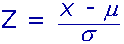
 Doing so would allow for some more control over where the supers fall in the distribution as influenced by the plus component rather than the d6 component. We can use the statistical information to decide where The Hulk falls within our super hero world.  First we have to decide in what percentile we want the Hulk to fall and then we can use a procedure called "Standardizing a Normal Distribution" to give us our number. We use the following formula in this case:

Z is a value that corresponds with a certain percentage of outcomes. For example, 90% of outcomes will be equal or less than z =1.645, 95% will be less than or equal to z =1.96, and 99% will be less than z =2.57. If The Hulk is stronger than 90% of really strong people in your game, you should set z to 1.645. If stronger than 95% of crazy strong people, at 1.96 etc. We would have an equation that looks something like:
1.96 = (x - 32.99)/8.59
Hmmm....the first thing that jumps out is that this tool isn't necessarily useful for our purposes. Another way to translate this is STR = d12 + z(Bonus - 5) + 4d6 attack.  What this means is that if we wanted The Hulk to be stronger than 95% of other Bricks we'd have to increase the "flat" number by 17.18 and that takes if off the chart. This tells me that the Abrams may not be the best baseline to use even if it's cool. This is largely due to the "swingy" nature of the open ended die rolls. Setting the baseline at such a high number means that we cannot use an actual distribution based on the likelihood of actual occurrence based on rolls and have it be very useful. In fact, even if we set the "average" Brick Strength at:

d12 + 2 with a 1d6 Attack, Melee

We get the following:

\bar{x} \!\,=13.27 σ = 5.83 min=4 max=56

Even at this level we see that The Hulk would have to be (1.96*5.83) points higher than average (11ish points) to be stronger than 95% of all other Bricks.

Does this mean that we cannot use a normal distribution to help us in our converting of characters? I don't think so. I do think it means that we cannot base our conversions on a distribution of damage, rather we have to create an arbitrary distribution and mean. Let's say we keep the mean around d12 + 6 (we can set the number of d6s of Attack based on how likely we want the character to be to damage, hurt, destroy an Abrams with each of those being an added die above 2d6). Given that a "normal" can have a strength of up to d12 without Edges (we can assume that the Edges allow for characters beyond human and in the low end of Brick like Captain America), this gives us a working range of +1 to +12. If we choose 2 (arbitrarily) as our standard deviation this gives us a distribution that looks like:

\bar{x} \!\,=6 σ = 2 min=1 max=12

If we use this in all of our calculations, we will get The Hulk as having a d12 + 6 + (1.96*2) Strength. In other words, a d12 + 10 Strength if we want him to have a Strength higher than 95% of other Supers. He'd have a d12 +9 at 90% and the percentage of people at d12 +8, +7, and +6 become larger until you hit 50% of your target population. Then the pattern repeats the other way with 95% of your Bricks having more than d12 +6 - (1.96*2) or d12 +2 Strength. That leaves only 5% of your Bricks with d12+2 or less. You can use this as a guideline to shape your campaign and should try to follow it as much as possible. This way if players as "How Strong is d12 +9?" You can answer that it is stronger than 90% of all other "Brick" caliber characters and be correct in saying so.

While some of this conversation may seem obscure, I think it is important to have some structured guidelines that help GMs and players when they are creating/simulating characters especially when it comes to abstract things like emulating the comics. The same player who might balk at The Hulk having "only" at d12 + 10 Strength when told it is 200 Tons might smile with joy when they find out that this is the level better than 95% of all super strong characters in the campaign universe...a campaign universe that includes Galactus and many others of the ultra-cosmic scale.

Additionally, we can see how Savage Worlds dice have a pretty big standard deviation due to the open ended nature of the rolling and the combination of several dice. The analysis was also useful for looking at what it really takes to create a character who can destroy an Abrams Tank in a single blow. It is easily possible through a number of combinations that are affordable at character creation.

For me, I wouldn't set that as the baseline for my "Bricks." I'd probably set it at around 21 which is the amount of damage it takes to do 1 wound to an Abrams, but YMMV.

Thursday, September 12, 2013

Make Mine Savage -- Some Observations on Savage Worlds Probabilities Before Conversions

One of the many concerns that gamers have when playing any game is "will my character be as awesome as I imagine?" In a d20/Pathfinder game where the player wants to become the world's best dual wielding sword fighter, this is a question of optimization within some pretty well known constraints. A lot of work has been put into d20/Pathfinder and 4th Edition D&D to ensure "balance" and regular play and min/maxing gets players familiar with certain guidelines. Every gamer, no matter how RP oriented, has a little power gamer in them. This can especially be the case when the player is adapting their favorite character from fiction into a role playing game character. Have you looked at some of the stats for Conan or Elric in Gods, Demigods, and Heroes and Deities and Demigods? Let's just say that there is some game breaking wish fulfillment going on there.


I have found that this call to power game gets amped up on steroids when players start adapting their favorite super heroes to their favorite super hero system. Sometimes all thought of game balance goes out the window in the attempt to create "accurate" representations of one's favorite hero/heroine. I remember when I first started playing Champions. The first superheroes I converted to the game were the X-men -- Byrne era. It was a great exercise in design. The X-men had a broad array of powers among them and statting them up really taught me the underlying basics of character design in Champions. I built the characters with Sunburst and Crusader as my benchmark characters and had a stack of 200 point X-men (it was 2nd edition Champions). Colossus had a 55 Strength, Nightcrawler had teleportation and martial arts, Wolverine had a 2d6 killing attack (3 1/2d6 with Str added), and so on. When I showed these characters to some new friends, they told me that I had the X-men all wrong. Colossus was severely underpowered, etc.

When I designed the characters, I looked at the baseline world rules in the Champions rule book and the Guide to the Marvel Universe to feed my assumptions. To me it was perfectly clear that the Hulk with his ability to lift 100 tons had a 60 Strength which has a lifting capacity of 100 tons. Colossus < Hulk, thus 55 Strength. My baseline was a far cry from the baseline of the group who were using Grond as proxy for The Hulk and who were playing experienced characters in a campaign that had already suffered a good deal of "power proliferation." How much? People were taking "double armor piercing" as a modifier to overcome villains with "single hardened" defenses. At the time, I adjusted my next character designs and fit within the group's baseline.

As I've played more role playing games, I've come to the conclusion that my first instincts were right. That doesn't mean that I think my X-men were "correct," I'd have to look them over to see if they actually emulated the characters at the time. But it is to say that I think that the players in my group were suffering from a case of "power exaggeration" which led to power proliferation and eventually led to very long and drawn out combats as everyone had defenses too high (both villains and heroes) for the damage being done. No one wanted to get hurt...and so no one did. The group used their power fantasy to set the assumed baseline instead of starting with the game's mechanical baseline. Instead of asking how high a strength do you need to have to punch through a brick wall, they asked how they compared to Grond or Eurostar.

I don't mean to point them out as "playing wrong" because I don't think they were. I do mean to say that had they viewed the baseline as lower, then there would have been more room for character growth horizontally and less power proliferation. I think that the power exaggeration tendency is one of the reasons why many gamers think that game X or game Y cannot properly emulate super heroes or that the game can only do street level heroes and I noticed a bit of this discussion in my recent post on how Savage Worlds has these wonderful switches that GMs can use in game to have the same characters interact at different scales without ever needing to change the stats of the character.

Let me put it another way. How high a Shooting skill do you think Hawkeye needs to have?

1) d12
2) d12 +2
3) d12 +4
4) d12 +8

The power gamer might say d12 + 8 because "Hawkeye Never Misses." This isn't quite true, but it is true most of the time and we all know that Hawkeye can do some ridiculous things with his bow and arrows.

I would ask to start with the system's baseline assumptions. In Savage Worlds, the base difficulty for any skill and for all ranged attacks is 4. In order to get a "raise" on the action (and only 1 raise matters for the purpose of damage), the player must get a total of 8 or higher. With that in mind, we can see that at d12+8 Hawkeye will never miss, but is that really what Hawkeye is? Let's look at his probabilities at the different levels.

d12


What we can see here is that Hawkeye has an 87.50% chance of rolling a 4 or better with a d12 and a 49.77% chance of rolling an 8 and thus getting a raise. This gives Hawkeye a pretty amazing chance to hit his opponent and that he will likely only miss opponents with Superspeed or Deflection or at long range (-2 modifier). If you want to make it so that he hits 98.61% of the time and gets a raise 65.28% of the time then give him d12+2. At +4 he hits all of the time and gets a raise 87.50% of the time. I think a case can be made for any of these power levels depending on whether you are starting Hawkeye at Novice or at Legendary. I don't know that I would ever worry about d12+8, but if everyone in your game has Superspeed at -6 (the max) Deflection you might need that.

Just in case you are wondering what the probabilities for die values other than d12 are, I am providing them below. I think understanding the probability of a skill/attribute achieving a certain target number is one of the keys to creating a balanced Savage Worlds campaign. The game is a little "looser" in the balancing math than other games and requires GMs to be able to "eye" it out more than other systems. Note that all of these graphs are for Wild Card characters and include the possibility of choosing either the main or the wild die. I want to thank Any Dice for making this easy (all rolls assume a choice between exploding d6 and exploding dX with an expode depth of 3).

d10


 d8


 d6


 d4


As you can see by the above Wild Card probabilities, even a d4 Wild Card has a 62.50% chance to succeed at a basic difficulty task. The "GMs Best Friend" in Savage Worlds is supposed to be a +/-2 modifier with +/-4 modifier representing a significant advantage or disadvantage like hiding in heavy cover (+4) or shooting at Long range (-4).

All of these a significantly better than the chances of a d4 or d5 "Normal" who has a 25% or 50% chance of rolling a 4 or higher.

When I provide my character conversions and conversion guidelines, I want you to know where I am coming from. I will be coming from a position that a Novice Hawkeye probably has either a d12 or d12 +2 Shooting skill. At d12 he would have an 11% chance of shooting someone at Long Range who was in Complete Darkness. I think that is pretty amazing. At d12+2 this increases to over 30%. Now neither of those comes with a raise, but c'mon...he's shooting someone at 120 yards in total darkness almost 1/3 of the time...without spending a Bennie.

If my conversion guidelines end up seeming a little on the low end to you, please feel free to bump them up.

Thursday, September 05, 2013

Make Marvel Savage!!!

The recently cancelled Marvel Heroic Roleplaying game is among the better superhero rpgs to see publication. It combined a deep knowledge of the source material with an easy to learn and robust game mechanic. Marvel Heroic took a "drama" driven approach to comic books and the Cortex+ system was a good match. The license for the game ended before Cam Banks and crew were able to complete their goal of providing three campaigns for the game -- Civil War, Annihilation, and Age of Apocalypse -- but the source material they published is a gold mine for anyone playing any superhero game.  If you can find copies of the system and supplements pick them up.


As much as I enjoy the Cortex+ system, not everyone in my regular gaming group liked it as much as I did. They all recognized that it was a good system, but some of them are more tactical and miniatures minded than the game robustly supports. These gamers prefer more action and combat focused games like 3.X, 4e, and Savage Worlds. All games that can be played dramatically --just as MHR can be played with a combat focus -- but which lend themselves well to the use of miniatures. Of these games, I am most fond of the Savage Worlds game system due to its focus on quick and easy game play. I'm a busy GM and the Savage Worlds system and support material greatly aid the "working GM."


Yesterday I started posting write-ups from my old "Savage Worlds Character a Day" website, and I plan to continue that trend and to provide new write-ups as well. While my backlog contains characters from many genre -- including the Firefly Crew who are now a part of a new Cortex+ game -- my new write ups will largely be adaptations of comic book characters. Make that Marvel comic book characters based on the write ups in the Marvel Heroic Roleplaying game. Why? Because I think I want to run my players through Civil War or Annihilation...maybe both...and this is a good place to start. The Savage Worlds Super Powers companion has a very flexible and workable super hero system that has some guidelines/switches that add to the system's ability to emulate a wide variety of heroes. For example, it has guidelines for both street level and cosmic level hero campaigns. The thing is that Marvel characters are often a combination of the two. Nova is a mid-range hero when he's battling the villains of New York City, but when he exits the atmosphere he is a truly cosmic hero. Below are how I propose toggling the switches when running a Marvel game.

Savage Marvel Settings

When playing a Savaged Marvel game, it isn't as easy as stating that the current game is "Street, Baseline, or Cosmic." The circumstances of the story set the overall power level of the basic "Environmental Options" that are used in a gaming session. Character Power Point options are still determined by a Street, Baseline, or Cosmic character type but the underlying switches change. For example, Luke Cage's Super Strength lifting capacity fits more with "Street Hero" environment when he's hanging out with the Heroes for Hire, but when he's running around with the Avengers his lifting capacity seems to fall more in line with the "Baseline" campaign.

Note that this is an adjustment to the "Enviromental Options" and not reflective of the "Power Point" options. Luke Cage would likely be a "Standard" hero in that mix while the kids from Power Pack would be Minor Leaguers and Skeets and Boom-Boom might be Second Stringers.

According to the Savage Worlds Super Powers Companion the most common super hero campaigns have he following setting rules:

  • Baseline Environment
  • Inherent Power
  • Knockback
  • Recurring Roles
  • Super Karma
  • Unarmed Defenders
I would argue that the Savaged Marvel Game doesn't quite match this common campaign description, but only with regard to the environment. I would argue that the environment in Savaged Marvel campaigns should match the evening's (or plot point's) circumstances rather than be static. Characters in a Savaged Marvel campaign should be designed with their "Origin Environment" in mind and gain/lose benefits based on where the adventure is taking place. With this in mind, I recommend the following adjustments to the Environmental Options.

COSMIC AND BASELINE HEROES IN STREET HERO ENVIRONMENT


  1. The carrying capacity, flight, and speed modifiers for the Street Environment are used  instead of the Origin Environment.
  2. Knockback is reduced. Ever notice how The Thing doesn't seem to knockback "normals" as far as he would villains in his "Street" stories? 
  3. The character must spend a Bennie to get the benefit of their Heavy Weapon or Heavy Armor abilities.
  4. Cosmic Heroes must spend a Bennie to gain the Focus effect on their powers.
STREET LEVEL AND COSMIC HEROES IN BASELINE ENVIRONMENT

  1. Carrying capacity, flight, and speed scale to Baseline. It's amazing how Nova slows down and Spider-Man scales up. (I would argue that Spider-Man is a Standard "Street Hero").
  2. Knockback is normal.
  3. Street Heroes can spend a Bennie to gain the Heavy Weapon trait on their powers for 1 round.
  4. If a Street Hero purchased Heavy Armor in Street Environment the hero can spend a Bennie to get a +6 to toughness against a non-Armor Piercing attack.
  5. Cosmic Heroes must spend a Bennie to gain the Focus effect on their powers.
STREET LEVEL AND BASELINE HEROES IN COSMIC ENVIRONMENT

  1. Carrying capacity, flight, and speed scale to Cosmic automatically. Colossus and Gladiator have similar, but not identical, capabilities.
  2. Knockback is at Cosmic.
  3. All heroes can spend a Bennie to gain the Cosmic Focus ability that all Cosmic Origin characters have in this environment. 
  4. Characters with Strengths of d12+1 or higher, or those with an appropriate theme, may gain Heavy Armor for an entire combat with the expenditure of a Bennie.
As you can see, the major change from the rule book to the "Savaged Marvel" is that it allows characters from one Environment to team up with heroes of other environments at the "same level" so long as they are willing to spend Bennies to get certain effects. I think that this house rule allows a rough approximation of how heroes behave in the comic books. For example, Wolverine's claws would likely have the Focus ability at creation but when he's in a Street Environment he might have to spend a Bennie to get that bonus (signaling extraordinary effort for the Environment).

This house rule is far from official, but I think it will be a great aid when contemplating how Gladiator and The Hulk should have similar Strength stats even though Gladiator is a Marvel Superman proxy.