Thursday, September 12, 2013

Make Mine Savage -- Some Observations on Savage Worlds Probabilities Before Conversions

One of the many concerns that gamers have when playing any game is "will my character be as awesome as I imagine?" In a d20/Pathfinder game where the player wants to become the world's best dual wielding sword fighter, this is a question of optimization within some pretty well known constraints. A lot of work has been put into d20/Pathfinder and 4th Edition D&D to ensure "balance" and regular play and min/maxing gets players familiar with certain guidelines. Every gamer, no matter how RP oriented, has a little power gamer in them. This can especially be the case when the player is adapting their favorite character from fiction into a role playing game character. Have you looked at some of the stats for Conan or Elric in Gods, Demigods, and Heroes and Deities and Demigods? Let's just say that there is some game breaking wish fulfillment going on there.


I have found that this call to power game gets amped up on steroids when players start adapting their favorite super heroes to their favorite super hero system. Sometimes all thought of game balance goes out the window in the attempt to create "accurate" representations of one's favorite hero/heroine. I remember when I first started playing Champions. The first superheroes I converted to the game were the X-men -- Byrne era. It was a great exercise in design. The X-men had a broad array of powers among them and statting them up really taught me the underlying basics of character design in Champions. I built the characters with Sunburst and Crusader as my benchmark characters and had a stack of 200 point X-men (it was 2nd edition Champions). Colossus had a 55 Strength, Nightcrawler had teleportation and martial arts, Wolverine had a 2d6 killing attack (3 1/2d6 with Str added), and so on. When I showed these characters to some new friends, they told me that I had the X-men all wrong. Colossus was severely underpowered, etc.

When I designed the characters, I looked at the baseline world rules in the Champions rule book and the Guide to the Marvel Universe to feed my assumptions. To me it was perfectly clear that the Hulk with his ability to lift 100 tons had a 60 Strength which has a lifting capacity of 100 tons. Colossus < Hulk, thus 55 Strength. My baseline was a far cry from the baseline of the group who were using Grond as proxy for The Hulk and who were playing experienced characters in a campaign that had already suffered a good deal of "power proliferation." How much? People were taking "double armor piercing" as a modifier to overcome villains with "single hardened" defenses. At the time, I adjusted my next character designs and fit within the group's baseline.

As I've played more role playing games, I've come to the conclusion that my first instincts were right. That doesn't mean that I think my X-men were "correct," I'd have to look them over to see if they actually emulated the characters at the time. But it is to say that I think that the players in my group were suffering from a case of "power exaggeration" which led to power proliferation and eventually led to very long and drawn out combats as everyone had defenses too high (both villains and heroes) for the damage being done. No one wanted to get hurt...and so no one did. The group used their power fantasy to set the assumed baseline instead of starting with the game's mechanical baseline. Instead of asking how high a strength do you need to have to punch through a brick wall, they asked how they compared to Grond or Eurostar.

I don't mean to point them out as "playing wrong" because I don't think they were. I do mean to say that had they viewed the baseline as lower, then there would have been more room for character growth horizontally and less power proliferation. I think that the power exaggeration tendency is one of the reasons why many gamers think that game X or game Y cannot properly emulate super heroes or that the game can only do street level heroes and I noticed a bit of this discussion in my recent post on how Savage Worlds has these wonderful switches that GMs can use in game to have the same characters interact at different scales without ever needing to change the stats of the character.

Let me put it another way. How high a Shooting skill do you think Hawkeye needs to have?

1) d12
2) d12 +2
3) d12 +4
4) d12 +8

The power gamer might say d12 + 8 because "Hawkeye Never Misses." This isn't quite true, but it is true most of the time and we all know that Hawkeye can do some ridiculous things with his bow and arrows.

I would ask to start with the system's baseline assumptions. In Savage Worlds, the base difficulty for any skill and for all ranged attacks is 4. In order to get a "raise" on the action (and only 1 raise matters for the purpose of damage), the player must get a total of 8 or higher. With that in mind, we can see that at d12+8 Hawkeye will never miss, but is that really what Hawkeye is? Let's look at his probabilities at the different levels.

d12


What we can see here is that Hawkeye has an 87.50% chance of rolling a 4 or better with a d12 and a 49.77% chance of rolling an 8 and thus getting a raise. This gives Hawkeye a pretty amazing chance to hit his opponent and that he will likely only miss opponents with Superspeed or Deflection or at long range (-2 modifier). If you want to make it so that he hits 98.61% of the time and gets a raise 65.28% of the time then give him d12+2. At +4 he hits all of the time and gets a raise 87.50% of the time. I think a case can be made for any of these power levels depending on whether you are starting Hawkeye at Novice or at Legendary. I don't know that I would ever worry about d12+8, but if everyone in your game has Superspeed at -6 (the max) Deflection you might need that.

Just in case you are wondering what the probabilities for die values other than d12 are, I am providing them below. I think understanding the probability of a skill/attribute achieving a certain target number is one of the keys to creating a balanced Savage Worlds campaign. The game is a little "looser" in the balancing math than other games and requires GMs to be able to "eye" it out more than other systems. Note that all of these graphs are for Wild Card characters and include the possibility of choosing either the main or the wild die. I want to thank Any Dice for making this easy (all rolls assume a choice between exploding d6 and exploding dX with an expode depth of 3).

d10


 d8


 d6


 d4


As you can see by the above Wild Card probabilities, even a d4 Wild Card has a 62.50% chance to succeed at a basic difficulty task. The "GMs Best Friend" in Savage Worlds is supposed to be a +/-2 modifier with +/-4 modifier representing a significant advantage or disadvantage like hiding in heavy cover (+4) or shooting at Long range (-4).

All of these a significantly better than the chances of a d4 or d5 "Normal" who has a 25% or 50% chance of rolling a 4 or higher.

When I provide my character conversions and conversion guidelines, I want you to know where I am coming from. I will be coming from a position that a Novice Hawkeye probably has either a d12 or d12 +2 Shooting skill. At d12 he would have an 11% chance of shooting someone at Long Range who was in Complete Darkness. I think that is pretty amazing. At d12+2 this increases to over 30%. Now neither of those comes with a raise, but c'mon...he's shooting someone at 120 yards in total darkness almost 1/3 of the time...without spending a Bennie.

If my conversion guidelines end up seeming a little on the low end to you, please feel free to bump them up.

Thursday, September 05, 2013

Make Marvel Savage!!!

The recently cancelled Marvel Heroic Roleplaying game is among the better superhero rpgs to see publication. It combined a deep knowledge of the source material with an easy to learn and robust game mechanic. Marvel Heroic took a "drama" driven approach to comic books and the Cortex+ system was a good match. The license for the game ended before Cam Banks and crew were able to complete their goal of providing three campaigns for the game -- Civil War, Annihilation, and Age of Apocalypse -- but the source material they published is a gold mine for anyone playing any superhero game.  If you can find copies of the system and supplements pick them up.


As much as I enjoy the Cortex+ system, not everyone in my regular gaming group liked it as much as I did. They all recognized that it was a good system, but some of them are more tactical and miniatures minded than the game robustly supports. These gamers prefer more action and combat focused games like 3.X, 4e, and Savage Worlds. All games that can be played dramatically --just as MHR can be played with a combat focus -- but which lend themselves well to the use of miniatures. Of these games, I am most fond of the Savage Worlds game system due to its focus on quick and easy game play. I'm a busy GM and the Savage Worlds system and support material greatly aid the "working GM."


Yesterday I started posting write-ups from my old "Savage Worlds Character a Day" website, and I plan to continue that trend and to provide new write-ups as well. While my backlog contains characters from many genre -- including the Firefly Crew who are now a part of a new Cortex+ game -- my new write ups will largely be adaptations of comic book characters. Make that Marvel comic book characters based on the write ups in the Marvel Heroic Roleplaying game. Why? Because I think I want to run my players through Civil War or Annihilation...maybe both...and this is a good place to start. The Savage Worlds Super Powers companion has a very flexible and workable super hero system that has some guidelines/switches that add to the system's ability to emulate a wide variety of heroes. For example, it has guidelines for both street level and cosmic level hero campaigns. The thing is that Marvel characters are often a combination of the two. Nova is a mid-range hero when he's battling the villains of New York City, but when he exits the atmosphere he is a truly cosmic hero. Below are how I propose toggling the switches when running a Marvel game.

Savage Marvel Settings

When playing a Savaged Marvel game, it isn't as easy as stating that the current game is "Street, Baseline, or Cosmic." The circumstances of the story set the overall power level of the basic "Environmental Options" that are used in a gaming session. Character Power Point options are still determined by a Street, Baseline, or Cosmic character type but the underlying switches change. For example, Luke Cage's Super Strength lifting capacity fits more with "Street Hero" environment when he's hanging out with the Heroes for Hire, but when he's running around with the Avengers his lifting capacity seems to fall more in line with the "Baseline" campaign.

Note that this is an adjustment to the "Enviromental Options" and not reflective of the "Power Point" options. Luke Cage would likely be a "Standard" hero in that mix while the kids from Power Pack would be Minor Leaguers and Skeets and Boom-Boom might be Second Stringers.

According to the Savage Worlds Super Powers Companion the most common super hero campaigns have he following setting rules:

  • Baseline Environment
  • Inherent Power
  • Knockback
  • Recurring Roles
  • Super Karma
  • Unarmed Defenders
I would argue that the Savaged Marvel Game doesn't quite match this common campaign description, but only with regard to the environment. I would argue that the environment in Savaged Marvel campaigns should match the evening's (or plot point's) circumstances rather than be static. Characters in a Savaged Marvel campaign should be designed with their "Origin Environment" in mind and gain/lose benefits based on where the adventure is taking place. With this in mind, I recommend the following adjustments to the Environmental Options.

COSMIC AND BASELINE HEROES IN STREET HERO ENVIRONMENT


  1. The carrying capacity, flight, and speed modifiers for the Street Environment are used  instead of the Origin Environment.
  2. Knockback is reduced. Ever notice how The Thing doesn't seem to knockback "normals" as far as he would villains in his "Street" stories? 
  3. The character must spend a Bennie to get the benefit of their Heavy Weapon or Heavy Armor abilities.
  4. Cosmic Heroes must spend a Bennie to gain the Focus effect on their powers.
STREET LEVEL AND COSMIC HEROES IN BASELINE ENVIRONMENT

  1. Carrying capacity, flight, and speed scale to Baseline. It's amazing how Nova slows down and Spider-Man scales up. (I would argue that Spider-Man is a Standard "Street Hero").
  2. Knockback is normal.
  3. Street Heroes can spend a Bennie to gain the Heavy Weapon trait on their powers for 1 round.
  4. If a Street Hero purchased Heavy Armor in Street Environment the hero can spend a Bennie to get a +6 to toughness against a non-Armor Piercing attack.
  5. Cosmic Heroes must spend a Bennie to gain the Focus effect on their powers.
STREET LEVEL AND BASELINE HEROES IN COSMIC ENVIRONMENT

  1. Carrying capacity, flight, and speed scale to Cosmic automatically. Colossus and Gladiator have similar, but not identical, capabilities.
  2. Knockback is at Cosmic.
  3. All heroes can spend a Bennie to gain the Cosmic Focus ability that all Cosmic Origin characters have in this environment. 
  4. Characters with Strengths of d12+1 or higher, or those with an appropriate theme, may gain Heavy Armor for an entire combat with the expenditure of a Bennie.
As you can see, the major change from the rule book to the "Savaged Marvel" is that it allows characters from one Environment to team up with heroes of other environments at the "same level" so long as they are willing to spend Bennies to get certain effects. I think that this house rule allows a rough approximation of how heroes behave in the comic books. For example, Wolverine's claws would likely have the Focus ability at creation but when he's in a Street Environment he might have to spend a Bennie to get that bonus (signaling extraordinary effort for the Environment).

This house rule is far from official, but I think it will be a great aid when contemplating how Gladiator and The Hulk should have similar Strength stats even though Gladiator is a Marvel Superman proxy.


Tuesday, September 03, 2013

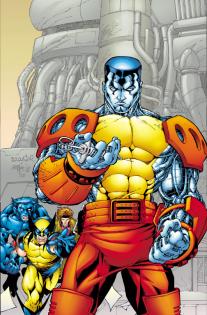
Colossus -- Savage Worlds Style (A Beginning)

Way back in 2004, I started a blog with the bold title "Savage Worlds Character a Day" with the audacious desire to convert one character from comics, history, or television into the Savage Worlds game system per day. Needless to say, I didn't accomplish the goal. What I did do was to stat up quite a few characters I enjoyed and spark some discussions with friends. I've decided to move those write ups over to this blog in the hopes of both centralizing my "writing" and spurring more discussion.

I do not present these write ups as the only way to represent characters in the SW system, rather I hope to see your ideas and enter into a conversation with you about how you would write up the same characters. These are starting points. Let's chat and come up with a "merged" write up so I can create a page of "finalized" characters. The statistics below were adapted using the original Savage Worlds supers rules as presented in the original Necessary Evil campaign guide. Let's update this using the full Super Powers Companion.


Colossus (A Savaged Version)

Security Level: Novice

Race: Human (Mutant)

Attributes: Agility d6, Smarts d6, Spirit, D6, Strength d8 (d12+5), Vigor d8 (d12)

Skills: Fighting d10, Guts d6, Intimidate d6, Throwing d8, Knowledge (Art) d4

Charisma: +0, Pace: 6, Parry: 7, Toughness: 6 (10/Heavy Armor)

Hindrances: Mutant (Major as Minor Wanted and Outsider), Heroic (Major), Loyal (Minor), Enemy (minor)

Edges: Arcane Background (Super Powers), Brawny, Power Points

Super Powers:

Living Steel Form: [Super Attribute (8pp) +7 steps Strength and +2 Steps Vigor requires activation; Toughness (4pp) +1 and Heavy Armor requires activation]

Attack Melee (3pp) +2d6 requires activation

Security Level: Seasoned

Race: Human (Mutant)

Attributes: Agility d6, Smarts d6, Spirit, D6, Strength d10 (d12+7), Vigor d10 (d12+2)

Skills: Fighting d10, Guts d6, Intimidate d6, Throwing d8, Knowledge (Art) d4

Charisma: +0, Pace: 6, Parry: 7, Toughness: 8 (11/Heavy Armor)

Hindrances: Mutant (Major as Minor Wanted and Outsider), Heroic (Major), Loyal (Minor), Enemy (minor)

Edges: Arcane Background (Super Powers), Brawny, Power Points x2 (20 total), Take the Hit

Super Powers:  

Living Steel Form: [Super Attribute (11pp) +8 steps Strength and +3 Steps Vigor requires activation; Toughness (4pp) +1 and Heavy Armor requires activation]

Attack Melee (5pp) +2d6, Knockback, requires activation

Security Level: Veteran

Race: Human (Mutant)

Attributes: Agility d6, Smarts d6, Spirit, D6, Strength d12 (d12+8), Vigor d12 (d12+2)

Skills: Fighting d10, Guts d6, Intimidate d6, Throwing d8, Knowledge (Art) d4

Charisma: +0, Pace: 6, Parry: 7, Toughness: 8 (11/Heavy Armor)

Hindrances: Mutant (Major as Minor Wanted and Outsider), Heroic (Major), Loyal (Minor), Enemy (minor)

Edges: Arcane Background (Super Powers), Brawny, Power Points x3 (25 total), Take the Hit, Hard to Kill (2pp), Arcane Resistance

Super Powers:

Living Steel Form: [Super Attribute (10pp) +8 steps Strength and +3 Steps Vigor requires activation; Toughness (4pp) +1 and Heavy Armor requires activation]

Attack Melee (9pp) +2d6, Knockback 4 AP, requires activation


Kaiju Crisis Looks Like Destructive Fun

Southern California has long had a vibrant hobby gaming culture. In the early days of RPGs there were APAs like Alarums & Excursions and D&D mods like Warlock. All over Los Angeles County there are designers and players who helped our hobby grow and who made sure that the hobby was shared with new people. Alan Emrich of Victory Point Games is one of those designers. Alan has long been active in the Southern California gaming scene. He has long been an active proponent of hobby gaming, and a few years ago he started teaching a new generation how to design games. He does so as both a college instructor and as a business owner. You see, Alan's company Victory Point Games is "a desktop publishing company for small, budget-priced games based around submissions from students, amateurs and professional game designers alike." It's a company that makes great games, but that is also designed to help gamers become game designers.

Recently, Victory Point Games has added mobile gaming to their list of genres in which they develop games. VPG has an extensive tabletop catalog and some of their tabletop games (like Zulus at the Ramparts) have been converted to mobile devices. The translations of tabletop games have been good so far, but I am looking forward to some of their direct to mobile games currently in development. In particular, I'm looking forward to Kaiju Crisis.

Kaiju Crisis

Our mobile-monster-mash, Kaiju Crisis, is coming soon to iOS and Android devices! The news from Monster Island is that we're in our first round of alpha testing, with game testers coming into the VPG offices and lending us their thoughts. Testers have had the opportunity to play the first few levels of the game, topple a few buildings, tangle with the National Guard, and gobble up some helpless pedestrians. When the dust settles, we've asked them to fill out a questionnaire with their thoughts on everything from the controls and interface to their player goals and fun factor
With all this going on, master artist Clark Miller has completed nearly all of our monster's (adorably) terrifying forms and accompanying special powers, including a flame jet, ice breath, and lightning burst. Additionally, many of the boss monsters you will combat, and the islands they call home, have made it into the game, and so his time on the project is nearly at an end
From there, and with all the feedback from our testers addressed, I will be designing, testing, and balancing the remaining game levels and boss fights, so that soon you, too, will be able to enjoy this special brand of stompy, smash-em-up fun. Enjoy this quick glimpse into the alpha build of the game, and a bit of the theme music from our talented composer, Cain German!

Tuesday, August 13, 2013

Dungeon Roller -- Tranforming Random Tables into Tabletop Fun


In March of 2012, Paul Hughes of blog of holding launched a Kickstarter campaign to fund his illustrated rendition of the old "random dungeon" charts from the original Advanced Dungeons & Dragons Dungeon Master's Guide. The Kickstarter was successful and raised close to $28,000. The additional funds allowed Hughes the time to create rules for a quick and easy Dungeon Crawl board game based on the poster and to begin work on a flash based version of the game called Dungeon Robber that would be hosted on the web and free to play for anyone who wanted to experience a narrative "rogue-like."

That game is now available and it is everything one could hope for from such a game. Players begin with very limited choices of career...they can only be Dungeon Robbers. New character classes, items, and the ability to recruit henchmen are unlocked with the successful retirement of past Dungeon Robbers. Do you want to be able to purchase food, and thus be able to heal at certain spots in the dungeon? Then you need to have a character retire as a Yeoman. Do you want to hire henchmen? Then some lucky sap needs to adventure long enough to become an innkeeper.

The game is tough and quite arbitrary due to its random nature, but it is fun in the classic Ken St. Andre way. Life is cheap and death is just around the corner. Going down a level in a dungeon is almost certain suicide unless you're of high enough level. Game play is similar to older text based games like Zork, but the results of the interface are more akin to playing a game of Dungeon Hack or another rogue-like. The game is good fun and I recommend playing the game on the website (just click the image above). If you like the game as much as I do just buy a copy of the poster and make sure that Paul gets a couple of ducats for his trouble.

Weird Wars Rome Continues Pinnacle's Long Run of Great High Concept Campaigns


A few years ago, at the height of the d20 Boom, a medium sized game publisher called Pinnacle Entertainment Group released a d20 version of their signature role playing game Deadlands. The d20 version was released in an attempt to take advantage of the recent increase in interest in the role playing game market sparked by the 3rd Edition of Dungeons & Dragons. The book sold well enough, but instead of increasing the Deadlands fan base it ended up alienating some fans who believed Pinnacle was abandoning their old Greg Gorden designed masterpiece. This wasn't the case, but the damage was done and sales declined.

By this time Pinnacle had already released their customizable and easy to learn and play Savage Worlds role playing game system. That game went on to be an award winning game and the Phoenix that helped Pinnacle rise from the ashes of their declined sales. Sales that had declined so much that three Friendly Local Gaming Stores in the Los Angeles area informed me that Pinnacle went out of business. Pinnacle wasn't out of business. Far from it. They were - and are - an innovative company and were at the cutting edge of the sale of digital products. Their sales for digital as well as physical Savage Worlds products saved the company and built them a loyal and passionate fan base. Staying at the fore of industry trends, Pinnacle has already had an extremely successful Deadlands Kickstarter campaign and they hope to repeat that success with their most recent project.


KS_Banner_G_480


Pinnacle Entertainment Group recently launched Weird Wars Rome a new Savage Worlds game setting on Kickstarter. The project quickly surpassed its initial goal and is quickly conquering the stretch goals that the company has put forth. So far the digital rewards that backers of this project will receive include an original soundtrack, short adventures, and interior outlays for poster maps. All backers of the project will also be receiving an 8 page supplement by Jack Emmert (of Cryptic Studios) that discusses the role of class and race, the gods, and myths and legends in ancient Roman society.

Weird Wars Rome is the latest in a series of tabletop roleplaying game books for Pinnacle's Weird Wars line of Savage Worlds settings. The Weird Wars product line reimagines historical military campaigns and twists them by adding supernatural and horrific elements to create entertaining alternate world game settings. Game settings to date have included Vietnam and World War II. In Weird Wars Rome, players are legionnaires living in the vast Roman Empire who encounter the terrors of war and of far darker things that lurk in the shadows of the fringes of the Empire...and in the heart of Rome itself.

Unlike many Kickstarter projects, the Weird Wars Rome Kickstarter automatically provides all new digital rewards to backers as each stretch goal is reached. There are no "pay for" add ons. Shortly after the Kickstarter campaign is completed, backers will be able to down load the completed pdf the book and any digital rewards that have been completed to date. The basic funding level is $20 for which the backer will receive a copy of the base Weird Wars Rome rulebook and some digital rewards. Other levels allow backers to get more physical products like dry-erase poster maps, custom dice, a GM Screen and some adventures.

Pinnacle Entertainment Group has long been one of the kings of "high concept" when it comes to games and campaign settings. Their DEADLANDS game set the tone for undead/Western mash-ups and many of their Savage Worlds settings have taken long standing narrative tropes and given them a "savage twist." The Savage Worlds game system is marketed as being Fast, Furious, and Fun and I have very much found this to be the case.

Thursday, August 01, 2013

Chainsaw Warrior -- Coming to a Digital Device Near You!

It's the year 2032. A warp has opened up in the old Municipal Buildings in the heart of old Manhattan and bizarre creatures are flooding through into our dimension. Goading them on is Darkness, a malevolent entity who intends dragging the city of New York back through the warp - destroying it utterly! 

Many brave men died assailing Darkness' stronghold before they remembered you. In the past you have done the Special Forces Unit many favors... but now you must come out of retirement to face the toughest challenge of your glorious career. Equipped with all the latest in high-tech armaments you must battle your way into the very heart of Darkness' domain and defeat him within the hour - or the city you love will be destroyed!! 

Chainsaw Warrior is a nail-biting game for one strong-nerved player. Yes, it is a solo game - just you against the clock! Can you save New York? Remember, you only have one hour!
 

In 1987 Games Workshop released a game that was an almost perfect high concept mash up of THE WARRIORS, ESCAPE FROM NEW YORK, and EVIL DEAD 2. That game was CHAINSAW WARRIOR and it was published in the days before Games Workshop decided they were a miniatures company and fiction publisher rather than a game workshop. In CHAINSAW WARRIOR the player took the role of an Arnold Schwartzenegger/Snake Pliskin/Ash mashup in his attempt to save Manhattan and rid the world of some terrible evil that included Mutants and Zombies...and you cannot kill enough mutants and zombies right?


In the designer notes, Steven Hand mentions that he was hard at work designing a sequel that would be published if CHAINSAW WARRIOR did well enough. As far as I know that sequel, which would have featured mutant Nazi zombies was never published. At least I never saw it and I don't own it, though I do own the original (see those sweet pics?). The game dwindled out of print and is now only available as an over priced ebay offering...UNTIL NOW!

Aurauch Digital will be releasing a Tablet and PC version of the game in the near future. Now a whole new generation will be able to struggle against THE DARKNESS.


I would be remiss if I didn't note that I had been introduced to this magnificent game by my dear friend Ron Peck. Ron had exquisite taste in music, games, and film. He was a dear friend who I miss dearly.