Monday, October 29, 2012

Halloween and Jack-Egg-Lanterns

Halloween has become a month-long celebration in our house (partly because it seems to take that long just to locate, unpack and put up all the varied decorations and do-dads).  We've always been fans of the holiday and holidays in general and are always on the lookout for new, fun (and best-of-all inexpensive!!!) ways to celebrate, decorate or both!  With our girls in preschool now (and desperately eager to help with every thing), it was important we find as many kid-friendly activities and crafts we could this year.

Enter the Halloween Jack-Egg-Lantern. 


We're surely not the first to think of this when we saw all those egg coloring kits go on sale last spring.  Our twins had such a great time decorating eggs this year -- and eating the hardboiled goodness! -- I nabbed a couple extra packs from the clearance bins to use at upcoming off-season events.  

With two girls and four fast hands to keep busy, one orange packet of dye was not going to be enough.  So to keep four hands busy and keep two imaginations working, we combined the red, yellow and pink colorings to make multiple shades of "pumpkin."  I think next time a drop or two of purple would also make a deeper color.  Green and purple are great Halloween colors anyway, and we could have done more to make Goblin or Frankenstein eggs or Purple Monster eggs...  Okay, all the better for next time.  This time, we focused on the pumpkin.  Some turned out more pinky-orange, a few more yellowy-orange, but overall we got a good blend and loved the results!
 

Some turned out more pinky-orange, a few more yellowy-orange, but overall we got a good blend.  For special egg-fects, we experimented with the usual techniques like mulit-color dipping and striping our "pumpkin" eggs with white, clear, and black crayons to add dimension and texture.  Looking back, red or dark orange crayon might do even better, especially pre-heated to give the lines more solid consistency.  


Our most vivid Jack-Egg-Lantern faces were achieved with a Sharpie, though the black crayon also turned out well.  Maybe next time we'll go with yellow wax for the faces and a deep orange for the dye to create that lit-from-within illusion.  

I think the most important part of this trial egg run is that it's a simple craft with a-typically healthy and edible results that offered great opportunities for a lot of peripheral fun, like practicing our scary faces (see below).  Have a spook-tacular Halloween!


Thursday, October 25, 2012

There Can Be No Halloween Season Without Vincent Price

I'll let my wife's Nicnup cartoon give us the break down of how important Vincent Price (May 27, 1911 – October 25, 1993) was and will always be to the Halloween season.


EVIL DEAD (1981) vs. EVIL DEAD (2013)

While it will be years until I will feel comfortable sharing my love of the EVIL DEAD series with History and Mystery, I am intrigued by the new Red Band trailer for the upcoming remake of the first EVIL DEAD film.

Raimi's first EVIL DEAD movie was more horror than horror/comedy, though the series itself is among the best horror/comedy, and it looks like the upcoming film is leaning more in that direction. The casting of young Jane Levy in the "Ash" role does hint that the film won't be completely absent of any humor.

Have a look at the 1981 trailer and the trailer for the new film and feel free to share your thoughts. My thoughts? The first trailer definitely shows its age, and the new trailer is of a film I'd like to see.


One thing is certain. I think I'm going to have to dig up my ARMY OF DARKNESS RPG.

Monday, October 22, 2012

David Lo Pan Style: Big Trouble in Little China meets PSY

As many of you know, I am of the opinion that John Carpenter's Big Trouble in Little China may well be the best film ever made.  Okay, that's an exaggeration, but you know the way that some Gen-Xers constantly reference Star Wars or Star Trek in conversation?  I'm that way with BTiLC.  I lost count of how many times I have watched the film a decade ago.

The film combines everything I love from Western genre film, Shaw Brothers over the top acting, and post-Tsui Hark Hong Kong cinematography and action.  In short, it is all things great about film that aren't in Singin' in the Rain.

BTiLC doesn't need a remake, but it does need more awesome fan creations like this.  If only Dennis Dun managed a cameo in the video.


If you don't like this video, you must be monumentally naive or already living in the Hell of Lacking a Sense of Style or Humor.  What can I say?  The Chinese have a lot of hells.

Tuesday, October 16, 2012

[Vintage RPGs] CHAMPIONS 1st Edition -- A Blast from the Past

The CHAMPIONS super hero role playing game is one of the best super hero role playing games ever designed, and the game to which all super hero rpgs are compared.  CHAMPIONS wasn't the first role playing game in the super hero genre, that honor goes to the game SUPERHERO 2044 which I discussed in an earlier blog post.  CHAMPIONS even builds upon some of the ideas in SUPERHERO 2044.  CHAMPIONS used the vague point based character generation system of SUPERHERO 2044 -- combined with house rules by Wayne Shaw -- as a jumping off point for a new detailed and easy to understand point based system.  CHAMPIONS was also likely influenced by the melee combat system in SUPERHERO 2044 in the use of the 3d6 bell curve to determine "to-hit" rolls in combat.


While CHAMPIONS wasn't the first super hero rpg, it was the first that presented a coherent system by which a player could design the superheroes they read about in comic books.  The first edition of VILLAINS & VIGILANTES, which predates CHAMPIONS, did a good job of emulating many aspects of comic book action but the ability to model a character in character design wasn't one of them.  CHAMPIONS was released at the Origins convention in the summer of 1981, and it immediately captured the interest of Aaron Allston of Steve Jackson Games.  Allston gave CHAMPIONS a positive review in issue #43 of the Space Gamer magazine, wrote many CHAMPIONS articles for that publication, and became one of the major contributors to the early days of CHAMPIONS lore.

Reading through the first edition of the game, as I have been doing the past week, can have that kind of effect upon a person.  The writing is clear -- if uneven in places -- and the rules mechanics inspire a desire to play around in the sandbox provided by the rules.  George MacDonald and Steve Peterson did more than create a great role playing game when they created CHAMPIONS, they created a great character generation game as well.  Hours can be taken up just playing around with character concepts and seeing how they look in the CHAMPIONS system. 

There are sites galore about CHAMPIONS and many reviews about how great the game is, and it truly is, so the remainder of the post won't be either of these.  Rather, I would like to point out some interesting tidbits about the first edition of the game.  Most of these will be critical in nature, but not all.  Before going further I will say that though CHAMPIONS is now in its 6th edition and is a very different game today in some ways, the 1st edition of the game is highly playable and well worth exploring.

  • One of the first things that struck me reading the book was how obviously playtested the character design system was.  This is best illustrated in the section under basic characteristics.  In CHAMPIONS there are primary and secondary characteristics.  The primary characteristics include things like Strength and Dexterity.  The secondary statistics are all based on fractions of the primary statistics and represent things like the ability to resist damage.  Where the playtesting shows here is in how players may buy down all of their primary statistics, but only one of their secondary statistics.  A quick analysis of the secondary statistics demonstrates that if this were not the case a buy strength then buy down all the secondary stats related to strength infinite loop would occur.  
  • It's striking how few skills there are in 1st edition CHAMPIONS.  There are 14 in total, and some of them are thinks like Luck and Lack of Weakness.  There are no "profession" skills in 1st edition.  To be honest, I kind of like the lack of profession skills.  Professions in superhero adventures seem more flavor than something one should have to pay points for, but this is something that will change in future editions.  
  • There are a lot of powers in CHAMPIONS, but the examples are filled with phrases like "a character" or "a villain" instead of an evocative hero/villain name.  It would have been more engaging for the folks at Hero Games to create some Iconic characters that are used throughout the book as examples of each power.  The game does include 3 examples of character generation (Crusader, Ogre, and Starburst), but these characters aren't mentioned in the Powers section.  An example using Starburst in the Energy Blast power would have been nice.
  • The art inside the book is less than ideal.  Mark "the hack" Williams has been the target of some criticism for his illustrations, but his work is the best of what is offered in the 1st edition book.  It is clear why they decided to use his work in the 2nd edition of the game.  Williams art is evocative and fun -- if not perfect -- while the work Vic Dal Chele and Diana Navarro is more amateurish.
  • The game provides three examples of character generation, but the designs given are less than point efficient and one outclasses the others.  The three sample characters are built on 200 points.  Crusader can barely hurt Ogre if he decides to punch him (his punch is only 6 dice), and his Dex is bought at one point below where he would receive a rounding benefit.  Ogre has a Physical Defense of 23.  This is the amount of damage he subtracts from each physical attack that hits and it is very high.  Assuming an average of 3.5 points of damage per die, Ogre can resist an average of 6.5 dice of damage per attack.  Yes, that's an average but the most damage 6 dice could do to him would be 13.  That would be fine, except Crusader has that 6d6 punch, and Starburst...oh, Starburst.  All of Starburst's major powers are in a multipower which means that as he uses one power he can use less of the other powers in the multipower.  The most damage he can do is 8d6, but only if he isn't flying and doesn't have his forcefield up.  Not efficient at all.  One might hope that character examples demonstrate the appropriate ranges of damage and defense, these don't quite achieve that goal.
  • The combat example is good, if implausible.  Crusader and Starburst defeating Ogre?  Sure.
  • The supervillain stats at the end of the book -- there are stats for 8 villains and 2 agents -- lack any accompanying art.  The only exception is Shrinker.  
  • Speaking of artwork and iconics.  Take that cover.
  • Who are these people?!  I want to know.  The only one who is mentioned in the book is Gargoyle.  It's pretty clear which character he is, but I only know his name because of a copyright notice.  Who are the other characters?  Is that "Flare"?  Someone once told me the villain's name was Holocaust, but that could just be a Bay Area rumor.  If you know, please let me know.  I'd love to see the stats for that guy punching "Holocaust" with his energy fist.
CHAMPIONS is a great game, and the first edition is a joy.  If you can, try to hunt down a copy and play some old school super hero rpg.


Thursday, October 04, 2012

[Superhero RPGs] Changling of the Teen Titans: The Same Hero in Different Systems

Those of you who read this blog on a regular basis know that  I consider Different Worlds magazine to be one of the great publications of what James Maliszewski calls the Golden Age of D&D.  The magazine ran from 1979 to 1987.  It was initially published by Chaosium, then by Sleuth Publications, and finally by Different Worlds Publications.  Two of those companies are still around today, and one is going very strong.

I was particularly impressed with Different Worlds' famously reprinted issue 23.  That issue was a "Special Superhero Issue" that contained articles by the designers of CHAMPIONS, VILLAINS & VIGILANTES, SUPERGAME, SUPERWORLD, and SUPERHERO 2044.  That's right, the designers of all the major superhero rpgs of the time had an article in that issue.  Add to this a cover illustrated by Bill Willingham and stats for the X-men in three different game systems (V&V, Champions, and Superworld) by the game designers, and you have a truly special magazine issue.  I would argue that it is the single best issue of a gaming magazine published to date.
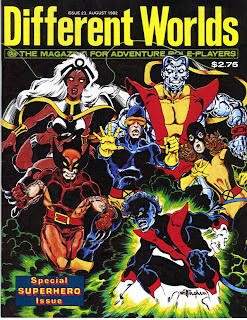
 

The success of this issue led Tadashi Ehara -- the magazine's editor -- do make the Special Superhero issue a somewhat regular feature, and a year later with issue 30 in September of 1983 the magazine had a special "New Teen Titans" issue.  This issue provides statistics for the New Teen Titans -- Nightwing and crew, though he's still Robin at the time -- for CHAMPIONS, VILLAINS & VIGILANTES, and SUPERWORLD.  Three systems that each handle super powers differently, but that are all workable systems.  The statistical representation of the characters, all done by the system designers, reveal interesting things about the rules themselves.  This is especially true for the character of Changeling.  As a shape shifter, his powers are a challenge to emulate.  How do you design a character who can become any animal?  It's a difficult design question, but one that comes up from time to time in the comics.  It is also a question that eventually led CHAMPIONS to adopt the "Multiform" power, a solution that I've never been fond of.

 http://index.rpg.net/pictures/show-water.phtml?picid=12071

Starting with CHAMPIONS, the character of Changeling is represented as a relatively normal heroic character in his base statistics, but has all of his shapechanging powers in a single 200 point multipower with all of his abilities represented as variable "multi" slots.

133 pts.   200 pt Multipower (+1/4 only reasonable creatures, +1/4 x6 END Battery) 
27m        Growth (200 pts)
  7m        Density Increase (50)
            7m        Flight (50)

It goes on like that to include a number of possible power combinations.  It's a solution, but one that isn't much better than the "multiform" solution later implemented.  I have always liked the use of a multipower in order to simulate this kind of ability, but I prefer one of two options not presented by Steve Peterson here.  First would be the each "animal" is a different "ultra" slot in a multipower.  Thus Gorilla would be one slot and Monkey another.  The other way would be to have several multipowers.  One for offensive abilities, a second for defensive, a third for movement, and a fourth for "variable senses and options."  Any of these can work, but as you can see any version also requires a lot of work by the player to get what they want.

Steve Perrin's SUPERWORLD adaptation was to just give Changeling all of the powers -- heightened strength, shrinking, growth, armor, movement, etc. each with a conditional use modifier of "only in certain shapes."  This is followed by a list of shapes that Changeling can assume: man, bear, cat, bird, canine, snake, elephant, octopus, and so on.  Any animal that he has listed, he can become.  And the GM and player can discuss which powers are appropriate to the form.  This is a pretty good solution, but it also requires bookkeeping with regard to building and then maximizing each form.

Jack Herman in his VILLAINS & VIGILANTES adaptation highlights the "rulings over rules" nature of the V&V system.  In this game, there is not shapechange power that quite captures Changeling's ability.  So Herman gives Changeling the following power:

TRANSFORMATION (Shapeshifter/Creatures): PR for each change equals the square root of the number of Basic Hits possessed by the new form assumed.  Any shape having over 20 Basic Hits cannot be maintained for more than 11 turns.  Smaller shapes have no time limit.  Only creature/animal shapes may be assumed, including intelligent non-human species, but he must be familiar with the creature to copy its shape.
 That's it.  Leaving the player and GM to design each and every animal the player can turn in to.  Other than having to design a lot of animal stats, this is a pretty nice adaptation.  It is also one that Herman had to invent as the power isn't in the rulebook.  That's the nature of V&V though.  House rules rule the day.

When the DC Heroes RPG eventually came out, they represented Changeling in the following way.
                                                                                                                           
He's got stats that are at the high end of normal human ability, except for his Body stat which is quite good.  His shape change power is represented by... well... the shape change power which is as follows:


I am a big fan of the DC Heroes solution.  It is similar to Herman's, but balanced by being a very expensive power to have at high levels, though inexpensive enough for a starting character to purchase it.  It limits abilities to existing animals, and many can be found in the appendix.  Like all of the options though, it does require a player to have a number of character sheets at the ready to represent Changeling in multiple forms.

I think it is interesting how the different games each approached the design challenge that a shape changing character brings.  I don't know that any has a perfect solution.  I like DC Heroes' solution, but only because their underlying AP rules structure means that each numerical value has a very specific meaning.

Friday, September 28, 2012

The Importance of House Rules to Ensure "Fun"

As often happens, is spent a part of last weekend playing games with my twin daughters History and Mystery.  We played a wide variety of games ranging from Candyland to Fantasy Flight Games' Rattlesnake with a little role playing as horses in between.  All of these activities were done not merely for the sake of occupying time, but also to create a sense of enjoyment among the participants.  In short, we were playing these games to have fun.

But how does one go about designing a "fun" game?  One of the reasons there are so many kinds of games (wargames, conflict games, area control games, cooperative games, track games) is because the goals of gamers with regard to what is fun aren't always the same.  Not only are they different among different people, but they are different for the same individual at different times.  For example, there are times when I want to play a little Battletech just to get out some aggression through robot vs robot conflict, but there are other times when I want to journey through Mirkwood with the help of my friend Jason in a cooperative fashion while playing Fantasy Flight's Lord of the Rings Living Card Game.  And those are just two of my moods.

I've also learned from playing with History and Mystery that sometimes the game's rules aren't the most fun way to use the game's components.  Let me just say that History and Mystery never cease to amaze me with regard to how they look at the world.  The other day, I had BURN NOTICE on in the background while they were coloring.  History looked up and saw the skyscraper condos overlooking the water and we had the following conversation:

HISTORY: That's pretty.  Where is that daddy?
ME: That, oh, that's Miami.
 HISTORY: Why is it YOUR ami?
ME: (Laughing) No...it's not My ami, it's not Your ami, it's Miami.
MYSTERY: It's not Your ami, or History's ami, but is it My ami?
I laughed for hours at the way their minds worked on that one.  It still makes me laugh.  I understood what they were getting at, and why they would mistake "Miami" for "My ami," but the way they are processing the information is hilarious.  I do think I was finally able to convey that it was just the name of the city...

At least I think so.

The point is that History and Mystery sometimes look at things differently than I do, and when this is combined with what they constitute as fun it leads to some enjoyable house rules.

Let's take our game of Rattlesnake as an example.  It's a simple game that comes with 12 very strong magnets that the players are trying to get rid of, and the first to do so wins the game.  The players roll a die and it tells them what color snake they have to set their egg upon.  If that egg disturbs another egg and they collide, then you have to pick up all the eggs that collided and have failed to get rid of any.  The magnets are very strong and the board is small, so this game can get pretty zany.


As written, I like the game and History and Mystery hate it.  You see "losing all your magnets" isn't fun for them.  What IS fun is making the magnets collide and picking them up.  For them, the loser is the first one to "lose" all of their eggs.  They find it fun to acquire the eggs.  What is interesting about this is that the trigger of the fun is the colliding of the magnets, which is one of the things I would argue is fun in the rules as written as well.  It is the fun that is inherent in the components.  The eggs have strong magnets that attract them to one another and they collide with a loud "clack!"  That's great fun.  That's great component fun, and it has nothing to do with the rules.  With regard to what my daughters find fun, the rules as written have an objective diametrically opposed to their fun goal. 

And this is where one sees the real importance of House Rules.  When I was younger, I made house rules to fix "what was wrong" with a game or to do a particular thing "better."  This led to the creation of a number of spell point systems, and no fewer than 5 versions of Superspeed for the DC Heroes role playing game.  At the time, I thought I was fixing the game objectively.  What I didn't understand, was that I was tweaking the rules to fit my fun-jective.  Having feeble Wizards -- regardless of how they matched up with other characters at high levels -- was annoying to me as a fun objective.  I wanted to play Gandalf or Merlin, I didn't want to be the apprentice in DRAGONSLAYER.  That just didn't seem fun to me, and the rules disagreed with that fun.  I liked the components of D&D -- the odd dice, the miniatures, and the rolling of 5 or 6 dice when casting fireball -- those were all fun activities.  Heck, one of the reasons I love Champions is the opportunity to roll handfuls of dice.  That's just a good time.  My fun goal and the fun goal of the game weren't lined up, even though the fun inherent in using the components was the same. 

Eventually, I learned to have a flexible definition of fun and to allow individual games to set the "magic circle" of what fun is being attempted.  In doing so, I've come to appreciate design efforts I might otherwise have overlooked.  Setting aside my personal fun-jectives from time to time leads to enjoyable experiences.  Heck, my journey as a game master in roleplaying games has gone from grudging acceptance to joy as I came to view the GM "fun" rule to be "Losing the game in a dramatic way is the job of the Game Master."  If you are losing properly, then the players are having fun.  The key here is "in a dramatic way."  There needs to be risk for the players, and character death must be an option.  But it's like a TV show, in that you know the protagonists will usually win out...not always, but usually... and they'll rarely die.  It depends on the game and the expectations, but players rarely enjoy investing time in creating a persona only to have it die as the GM laughs at how pathetic they are.  Though that can be fun from time to time too.

History and Mystery have reminded me of how important it is sometimes to forget what the fun being attempted by a game is, and to see what kind of fun the components of the game are advocating.  It was a nice refresher course for me, and it reminded me why I have all those Heroscape boxes lying around the house.