This post is about a rules hack for Marvel Heroic Roleplaying Game from Margaret Weis Productions. It's specific to the 4E dnd Hack by Dave Chalker from Critical Hits. I originally started writing it as a comment on Rob Donoghue's Some Space to Think Blog but it kept growing until it felt like a full blog post. If that interests you read on.
Rob has been talking about MHRPG on his blog for a few months now. Ever since he mentioned Affiliation dice and the DnD hack for MHRPG I've been thinking about how to hack the Affiliation dice in regard to the 4e DnD hack. Dave left them in but it feels like he never figured out how to implement it properly with 'splitting the party' GM tactics. My thought is to emphasize the fact that the PCs are a party and that they don't split up. So instead you can emphasize their strengths and weakness within the group.
A good replacement bucket for Affiliation might be 'Party Role', in the form of Leader, Striker, Controller, Defender. They are an important identifier for D&D PCs that fall outside of the other distinguishing features of your charater. So the party roles can be separated out from powers, classes and race. Leaders who are fighters, clerics who are striker/defenders, and controller rogues all have a place in my ideal DnD. This hack formalizes your strengths and weakness for filling these traditional party roles with a die to build your dice pool around. I haven't tried this out yet but here is an example of what I'm thinking.
You could be a tactically minded Wizard with the following Roles:
Leader d10
Controller d8
Striker d6
Defender d6 (or d4 depending on whether you want to add a weakness).
So when ever you take action to control the battlefield or target lots of enemies with your spells you would roll your Controller d8. When you take action to encourage, heal or put allies into positions to excel you roll Leader d10. If you take your turn to make yourself a target of the enemies to save your allies roll Defender d4. Looking to deal a lot of damage to the 'Big Bad Evil Guy' with your nova power, Striker d6.
Try it out; let me know what you think.

Tuesday, April 03, 2012


Friday, March 30, 2012
[DnDNext] Warding Off System Snobbery
I'm as guilty of it as the next gamer. If you mention that you play F.A.T.A.L. or one of a small list of games, I will roll my eyes derisively and mock you behind your back. I might even make a snide comment about your gaming preferences. Equally, I will be deeply offended if you roll your eyes at me when I mention that I love playing Dungeons and Dragons 4th Edition Essential Edition or The Rocky and Bullwinkle Role Playing Party Game. It's System Snobbery and one thing that the "edition wars" and the recent "dndnext" conversations have aptly demonstrated, it is alive and well.
The thing is that System Snobbery isn't new, and it isn't beneficial to the hobby as a whole. I was recently reminded of how insidious System Snobbery can be when I picked up and read Laryy DiTillio's commentary on the topic in issue 7 of Different Worlds Magazine. I've been spending a lot of time recently reading old gaming magazines, magazines from when I was just getting into the hobby. At the time, as a tween, I had neither the resources nor the knowledge that gaming magazines other than "The Dragon" existed at all. Heck, even though I lived in the same town as the talented and prolific Allen Varney -- we probably shopped at the same game store -- I hadn't even heard of The Space Gamer at the time.
Back to the point though. In his commentary on System Snobbery, Larry DiTillio has a couple of key observations that I think are worth sharing as we enter discussions regarding what we would like to see from a new edition of Dungeons and Dragons.
Larry's commentary follows a visit in 1979 to a reasonably sized convention in Oakland, CA called GrimCon. He mentions that the games organizers all are employees/founders of various small gaming companies like the Multiversal Trading Company and Grimoire Games. As such, the Con offered a lot of non-traditional role playing games as their "tournament fare."
Larry's firsts observation of gaming snobbery was that while the hosts of the convention were offering a wide variety of games for sampling, that the attendees pretty much ignored them to spend time in the open gaming area to play D&D. His thoughts, and I agree, were that conventions are the perfect time to try something new.
His second observation is of how he was treated at a DunDraCon event. At the event, Larry was scheduled to run a session of Tunnels and Trolls. He had been invited to DunDraCon IV by Steve Perrin to run the game. After sitting and waiting for players to show up, eventually a convention representative asked Larry why he had cancelled is T&T session. He notified them he hadn't, but discovered that someone had -- likely as a prank -- written "cancelled" on his sign up sheet. He eventually got gamers to a T&T table, but not before being passive aggressively bullied by some System-hater.
Larry makes a number of other observations, and is a talented storyteller in how he shares them, so I recommend picking up the issue. The crux of is article is the following:
"[A Good GM] will provide you with and enjoyable, rewarding RPG [experience]. NO MATTER WHAT SYSTEM THEY PREFER." So long as the GM is talented and committed to providing the players with a good time. He also acknowledges that we should be thankful to Steve Perrin (for "Runequest), to Dave Hargrave ("Arduin"), Ken St. Andre (T&T), Gary Gygax and Dave Arneson (D&D). I would add that in the years since, we have many more names to add to the list. These names range from Greg Gorden (007 and DC Heroes) to Mike Mearls (4e) and from Erik Mona (Pathfinder) to Chris Pramas (AGE/Green Ronin) to name only a few. We should also thank those, like Shelly Mazzanoble, who may not be among the "creators" of our games, but who stand at the front lines of those who promote our hobby and try to bring new people in. Not to mention the great stuff coming out of the Indie games marketplace.
Instead of being snobbish about the games we don't like, we should be thankful that we have so many great ones to choose from. Does that mean that we cannot criticize mechanics? No. We can and should, in a constructive manner that moves the hobby forward. We just shouldn't disparage people for preferring a system.
Gaming Snobbery...and public snobbery against gamers...are a couple of the reasons Wes, Joel, and I created the Dice Chuckers project. Join us in that project as either a sponsor, a participant, or in conversation. We'd love to hear from you.
The thing is that System Snobbery isn't new, and it isn't beneficial to the hobby as a whole. I was recently reminded of how insidious System Snobbery can be when I picked up and read Laryy DiTillio's commentary on the topic in issue 7 of Different Worlds Magazine. I've been spending a lot of time recently reading old gaming magazines, magazines from when I was just getting into the hobby. At the time, as a tween, I had neither the resources nor the knowledge that gaming magazines other than "The Dragon" existed at all. Heck, even though I lived in the same town as the talented and prolific Allen Varney -- we probably shopped at the same game store -- I hadn't even heard of The Space Gamer at the time.
Back to the point though. In his commentary on System Snobbery, Larry DiTillio has a couple of key observations that I think are worth sharing as we enter discussions regarding what we would like to see from a new edition of Dungeons and Dragons.
Larry's commentary follows a visit in 1979 to a reasonably sized convention in Oakland, CA called GrimCon. He mentions that the games organizers all are employees/founders of various small gaming companies like the Multiversal Trading Company and Grimoire Games. As such, the Con offered a lot of non-traditional role playing games as their "tournament fare."
Larry's firsts observation of gaming snobbery was that while the hosts of the convention were offering a wide variety of games for sampling, that the attendees pretty much ignored them to spend time in the open gaming area to play D&D. His thoughts, and I agree, were that conventions are the perfect time to try something new.
His second observation is of how he was treated at a DunDraCon event. At the event, Larry was scheduled to run a session of Tunnels and Trolls. He had been invited to DunDraCon IV by Steve Perrin to run the game. After sitting and waiting for players to show up, eventually a convention representative asked Larry why he had cancelled is T&T session. He notified them he hadn't, but discovered that someone had -- likely as a prank -- written "cancelled" on his sign up sheet. He eventually got gamers to a T&T table, but not before being passive aggressively bullied by some System-hater.
Larry makes a number of other observations, and is a talented storyteller in how he shares them, so I recommend picking up the issue. The crux of is article is the following:
"[A Good GM] will provide you with and enjoyable, rewarding RPG [experience]. NO MATTER WHAT SYSTEM THEY PREFER." So long as the GM is talented and committed to providing the players with a good time. He also acknowledges that we should be thankful to Steve Perrin (for "Runequest), to Dave Hargrave ("Arduin"), Ken St. Andre (T&T), Gary Gygax and Dave Arneson (D&D). I would add that in the years since, we have many more names to add to the list. These names range from Greg Gorden (007 and DC Heroes) to Mike Mearls (4e) and from Erik Mona (Pathfinder) to Chris Pramas (AGE/Green Ronin) to name only a few. We should also thank those, like Shelly Mazzanoble, who may not be among the "creators" of our games, but who stand at the front lines of those who promote our hobby and try to bring new people in. Not to mention the great stuff coming out of the Indie games marketplace.
Instead of being snobbish about the games we don't like, we should be thankful that we have so many great ones to choose from. Does that mean that we cannot criticize mechanics? No. We can and should, in a constructive manner that moves the hobby forward. We just shouldn't disparage people for preferring a system.
Gaming Snobbery...and public snobbery against gamers...are a couple of the reasons Wes, Joel, and I created the Dice Chuckers project. Join us in that project as either a sponsor, a participant, or in conversation. We'd love to hear from you.
Thursday, March 29, 2012
Twin Suns Entertainment -- Join Us on Our Adventure
Last year, my close friends Wes Kobernick and Joel Allan were chatting after one of our bi-weekly gaming sessions. We talked about how great it would be if someone made a documentary about roleplaying games and the people who played them -- a film that presented the "real" face of the gamer. Our gaming group, like many others, is a diverse group of friends who have professions ranging from Screenwriters and Lawyers to Non-Profit Program Directors and College Students.
We had all seen the "Trekkies" and "Darkon" documentaries. "Trekkies," while a great documentary, focused on the Star Trek fans that the director thought would make the most "interesting" story, but it left out the day to day fan of the series who didn't have any particular quirks -- other than being a fan of the show. It would have been nice to see the casual fan, as well as the dedicated fan. It only takes a few minutes wandering the internet, or looking at the TV ratings for "Big Bang Theory" before one realizes that "we are all Trekkies." It's only what we are passionate about that varies. "Darkon" was a very emotionally powerful documentary about live action roleplaying, the kind that the kid plays in the hilarious movie "Role Models," but Darkon is also a very sad movie.
While I highly recommend both of those documentaries, we wanted to do something different. Yes, like "Trekkies," we want to show some of the interesting stories of the role playing game hobby. There are plenty of interesting people who play role playing games, but we also wanted to give a look at the casual gamer and at the people who make role playing games as a profession. We wanted to make a film that was something of a snap shot of the hobby as it stands today...a hobby that has lost a few of its founders over the past couple of years and a hobby where some of its founders are still alive today.
What we realized in the course of the discussion was that we weren't looking for someone else to make the documentary, we were the perfect group to make it. Wes is an experienced film maker, Joel is a practicing attorney, and I have spent years developing contacts throughout the hobby who has an entrepreneurial spirit. We quickly decided to form our own company called Twin Suns Entertainment. TSE will produce not only a documentary film, but that produces ongoing entertainment products ranging from web series to physical role playing and board games, from childrens' books to mainstream fantasy novels. Our mission for TSE is for each of our products to promote the hobby and to highlight how hobby gaming in its role playing and table top game forms is a wonderful way to build community.
Today we launched the Kickstarter campaign for our documentary film. The film's working title is "Dice Chuckers," but we ask that you join us in creating title for the film when released and we beseech you to make a pledge and join us on the wonderful adventure that is founding an entertainment company.
We had all seen the "Trekkies" and "Darkon" documentaries. "Trekkies," while a great documentary, focused on the Star Trek fans that the director thought would make the most "interesting" story, but it left out the day to day fan of the series who didn't have any particular quirks -- other than being a fan of the show. It would have been nice to see the casual fan, as well as the dedicated fan. It only takes a few minutes wandering the internet, or looking at the TV ratings for "Big Bang Theory" before one realizes that "we are all Trekkies." It's only what we are passionate about that varies. "Darkon" was a very emotionally powerful documentary about live action roleplaying, the kind that the kid plays in the hilarious movie "Role Models," but Darkon is also a very sad movie.
While I highly recommend both of those documentaries, we wanted to do something different. Yes, like "Trekkies," we want to show some of the interesting stories of the role playing game hobby. There are plenty of interesting people who play role playing games, but we also wanted to give a look at the casual gamer and at the people who make role playing games as a profession. We wanted to make a film that was something of a snap shot of the hobby as it stands today...a hobby that has lost a few of its founders over the past couple of years and a hobby where some of its founders are still alive today.
What we realized in the course of the discussion was that we weren't looking for someone else to make the documentary, we were the perfect group to make it. Wes is an experienced film maker, Joel is a practicing attorney, and I have spent years developing contacts throughout the hobby who has an entrepreneurial spirit. We quickly decided to form our own company called Twin Suns Entertainment. TSE will produce not only a documentary film, but that produces ongoing entertainment products ranging from web series to physical role playing and board games, from childrens' books to mainstream fantasy novels. Our mission for TSE is for each of our products to promote the hobby and to highlight how hobby gaming in its role playing and table top game forms is a wonderful way to build community.
Today we launched the Kickstarter campaign for our documentary film. The film's working title is "Dice Chuckers," but we ask that you join us in creating title for the film when released and we beseech you to make a pledge and join us on the wonderful adventure that is founding an entertainment company.
Wednesday, March 21, 2012
[From The Archives] Surprised by Superhero 2044 -- The First Superhero RPG was More Influential than You Might Think
This post was originally published in June of 2010. Given the "rolling" format of blogs, I thought that I would repost it for newer readers. I was nicely surprised by Superhero: 2044, and will be blogging about Supergame soon as well as I own both the first and second editions of that superhero game. After reading this review, Donald Saxman was kind enough to include the test of the post in a reprint of the game.

According to Heroic Worlds by Lawrence Schick and Steve Perrin in Different Worlds #23, Superhero 2044 by Donald Saxman is the first commercially available superhero themed role playing game. Saxman's game was publishedin 1977 under the name Superhero '44. The game wasn't entitled Superhero 2044 until the game's second edition, when it was by Lou Zocchi's Gamescience Inc. later that same year. While I am a huge fan of super hero role playing games, and a student of the history of rpgs, this game sat on my bookshelf for years without a complete reading. Its lack of a list of itemized superpowers, and the mechanics of how they worked, was one of the key reasons that the game languished for so long on my shelf without a thorough examination. Apparently, Donald Saxman intentionally left a formal list of superpowers out of the book in order to respect the copyrights of various comic book publishers -- though that didn't stop artist Mike Cagle from providing a cover illustration filled with characters who bear an uncanny similarity to many popular comic book characters.

I just couldn't ever muster the desire to read or play a superhero role playing game that lacked a robust super power system. The recent release of Icons by Adamant Entertainment got my mind focused reading a new super hero rpg, and this opened the door for Superhero 2044 to work its way off the book shelf and into my reading pile. I quickly devoured the booklet and have come to the following conclusions.
First, Superhero 2044 is almost unplayable with its Rules as Written (RAW). The game is a jumble of multiple systems and contains no fewer than three major design directions, none of which are flowing in the same direction.
Second, without Superhero 2044 modern super hero role playing would not be what it is today. Those three major directions I mentioned above? Each of those had a significant influence on the super hero games that came after Superhero 2044. Without this game, there would be no Champions, Supergame, or Golden Heroes. Each of those super hero games lifts a concept out of Superhero 2044 and structures a game around that concept.
Superhero 2044 is more than the first super hero role playing game, it is the foundation upon which many games followed.
It was the first superhero game to include point based character construction. Though the point expenditure was limited to the building of a character's "attributes" and were not a part of "power design." This innovation, and at the time of Superhero 2044 this was a significant innovation, is one of the major design starting points for a number of super hero role playing games -- not the least of which is the Champions game.
Speaking of Champions, in addition to being inspired by the point based character design of Superhero 2044 it is evident that Champions melee combat system was influenced by Donald Saxman's game as well.
In Champions combat is resolved by taking a character's "Offensive Combat Value" and subtracting an opponent's "Defensive Combat Value." The result of that subtraction is then added to 11 to find the number required to hit an opponent on a roll of 3 six-sided dice. Champions combat system is one of the best on the market and the fact that it uses a comparison of combatant's effectiveness, and a bell curve resolution system, are among its chief strengths.
In Superhero 2044, you take a character's "Stamina" and subtract his opponents "Stamina." The difference between these two numbers is compared to the Universal Combat Matrix which gives you a number between 3 and 18 that the character must roll on 3 six-sided dice to determine if the character hit his opponent. It should be noted that this combat system is only used for "melee" combat in Superhero 2044, where it forms the foundation of Champions combat.
The Champions version is more elegant, as the result of the initial comparison is the modifier to the 3d6 roll, but it is the same system. It is as if the designers of Champions playtested and refined the Superhero 2044 melee combat system. Champions combat has some significant differences overall to Superhero 2044, but one can see that one echoes the other.
Like Champions, Supergame was influenced by Superhero 2044's point based character generation system. Given its own 1980 design date, and the fact that it was a part of "California Gaming Culture," might hint that Supergame itself also influenced Champions. One sees the underpinnings of Superhero 2044 is in the purchase of a character's starting attributes.
Both systems feature something that many modern gamers might consider odd. All of a character's attributes start at zero and can be increased -- this itself isn't odd to the modern gamer. What is odd is that both games have attribute levels where the character is suffering from a disability. In Superhero 2044, if a character has an Endurance of less than 20 that character is "fatigued" or worse. In Supergame, a character with an "Agony Score" of less than 15 "may either move or attack, but only one per turn." There are similar penalties for "Vigor" in Superhero 2044 and "Physical Score" in Supergame. The names of the attributes and the level of effect are different, but one can see the similarities. Most modern systems would start a character with a base number of points sufficient to not be fatigued or incapacitated, but both Superhero 2044 and Supergame allow for the possibility.
But it isn't the point based character design where Supergame bears the most similarity to its predecessor. Supergame includes rules for building specific powers -- though not as robust the later published Champions -- that are themselves an innovation over the state of gaming at that time and a step beyond what were offered in Superhero 2044.
The area where Supergame most reflects Superhero 2044 is in its ranged combat system. In Superhero 2044, ranged combat is decided by rolling a six sided die and adding/subtracting to the die total applicable modifiers. This sets the target number that must be rolled, or higher, on a second roll of a six sided die. For example a character with a 20 Dexterity (-1) shooting an opponent at point blank range (-3) with a shoulder weapon (-1) rolls a 6 on a six sided die. This gives a modified result of 1 (6-1-3-1=1) and means that the character hits if the player rolls a 1 or better on the second roll. This system, with some differences in modifier values, is the system used in Supergame.
While I was intrigued by the way that Superhero 2044 influenced the design of American super hero role playing games, I was amazed at how it had influenced a British one. In White Dwarf magazine issue 9, game designer Eamon Bloomfield reviewed Superhero 44 -- Superhero 2044's first edition -- and wrote the following:
The weekly planning sheet is one of the most intriguing aspects of the Superhero 2044 game and the most playable aspect. The game includes weekly planning sheets that provide a number of "activity blocks" to which players assign particular tasks, like fighting crime or resting. Golden Heroes, Games Workshop's super hero role playing game, featured a campaign system that bears no small similarities to that of Superhero 2044. Games Workshop was, and still is, the publisher of White Dwarf magazine and so it is easy to believe that this game review sparked some discussion of "planning sheet" style campaign play.
Golden Heroes features a campaign system that heavily relies on something very similar to Superhero 2044's weekly planning sheet. They have a system that uses something called a "Daily Utility Phase" or DUPs. The game describes them as follows:
The player's allocation of DUPs is compared to various campaign ratings, something vary similar to what Superhero 2044 calls "handicaps," in order to determine what events happen to the character and how much the character is able to improve over time. Both systems are dynamic and change as characters interact with the game world. The Golden Heroes system is more developed and is a part of a more complete system of mechanics, but it is unarguably a descendant of the Superhero 2044 system.
I wish I had read Superhero 2044 much sooner than I did. It is a definite diamond in the rough. While it would be difficult to play RAW, it has a large number of innovative mechanics and ideas. The fact that it contains enough ideas to influence no fewer than THREE super hero role playing games in their design is a significant achievement in and of itself. One cannot truly understand the development of the hobby without reading this game.
I think I will try to play the game itself soon, though I don't know if I will try to design a comprehensive powers system or use an existing one to supplement the game, as the campaign play system still stands out as something that has some depth and would be useful in a number of games. Given the abstract nature of the campaign planning system, one could easily adapt it to another game for use.
The game also features a detailed setting for super hero play. The setting lacks the microscopic detail of modern settings, but for the time the game was written it is quite intricate. Like the game itself, its setting is one that inspires addition and extension rather than provides a complete painting.
Donald Saxman has created something pretty special here and I'd love to see someone take this system and make a modern edition out of it. It would take some work, but it would be worth it.

According to Heroic Worlds by Lawrence Schick and Steve Perrin in Different Worlds #23, Superhero 2044 by Donald Saxman is the first commercially available superhero themed role playing game. Saxman's game was publishedin 1977 under the name Superhero '44. The game wasn't entitled Superhero 2044 until the game's second edition, when it was by Lou Zocchi's Gamescience Inc. later that same year. While I am a huge fan of super hero role playing games, and a student of the history of rpgs, this game sat on my bookshelf for years without a complete reading. Its lack of a list of itemized superpowers, and the mechanics of how they worked, was one of the key reasons that the game languished for so long on my shelf without a thorough examination. Apparently, Donald Saxman intentionally left a formal list of superpowers out of the book in order to respect the copyrights of various comic book publishers -- though that didn't stop artist Mike Cagle from providing a cover illustration filled with characters who bear an uncanny similarity to many popular comic book characters.

I just couldn't ever muster the desire to read or play a superhero role playing game that lacked a robust super power system. The recent release of Icons by Adamant Entertainment got my mind focused reading a new super hero rpg, and this opened the door for Superhero 2044 to work its way off the book shelf and into my reading pile. I quickly devoured the booklet and have come to the following conclusions.
First, Superhero 2044 is almost unplayable with its Rules as Written (RAW). The game is a jumble of multiple systems and contains no fewer than three major design directions, none of which are flowing in the same direction.
Second, without Superhero 2044 modern super hero role playing would not be what it is today. Those three major directions I mentioned above? Each of those had a significant influence on the super hero games that came after Superhero 2044. Without this game, there would be no Champions, Supergame, or Golden Heroes. Each of those super hero games lifts a concept out of Superhero 2044 and structures a game around that concept.
Superhero 2044 is more than the first super hero role playing game, it is the foundation upon which many games followed.
It was the first superhero game to include point based character construction. Though the point expenditure was limited to the building of a character's "attributes" and were not a part of "power design." This innovation, and at the time of Superhero 2044 this was a significant innovation, is one of the major design starting points for a number of super hero role playing games -- not the least of which is the Champions game.
Influence on Champions
Speaking of Champions, in addition to being inspired by the point based character design of Superhero 2044 it is evident that Champions melee combat system was influenced by Donald Saxman's game as well.
In Champions combat is resolved by taking a character's "Offensive Combat Value" and subtracting an opponent's "Defensive Combat Value." The result of that subtraction is then added to 11 to find the number required to hit an opponent on a roll of 3 six-sided dice. Champions combat system is one of the best on the market and the fact that it uses a comparison of combatant's effectiveness, and a bell curve resolution system, are among its chief strengths.
In Superhero 2044, you take a character's "Stamina" and subtract his opponents "Stamina." The difference between these two numbers is compared to the Universal Combat Matrix which gives you a number between 3 and 18 that the character must roll on 3 six-sided dice to determine if the character hit his opponent. It should be noted that this combat system is only used for "melee" combat in Superhero 2044, where it forms the foundation of Champions combat.
The Champions version is more elegant, as the result of the initial comparison is the modifier to the 3d6 roll, but it is the same system. It is as if the designers of Champions playtested and refined the Superhero 2044 melee combat system. Champions combat has some significant differences overall to Superhero 2044, but one can see that one echoes the other.
Influence on Supergame
Like Champions, Supergame was influenced by Superhero 2044's point based character generation system. Given its own 1980 design date, and the fact that it was a part of "California Gaming Culture," might hint that Supergame itself also influenced Champions. One sees the underpinnings of Superhero 2044 is in the purchase of a character's starting attributes.
Both systems feature something that many modern gamers might consider odd. All of a character's attributes start at zero and can be increased -- this itself isn't odd to the modern gamer. What is odd is that both games have attribute levels where the character is suffering from a disability. In Superhero 2044, if a character has an Endurance of less than 20 that character is "fatigued" or worse. In Supergame, a character with an "Agony Score" of less than 15 "may either move or attack, but only one per turn." There are similar penalties for "Vigor" in Superhero 2044 and "Physical Score" in Supergame. The names of the attributes and the level of effect are different, but one can see the similarities. Most modern systems would start a character with a base number of points sufficient to not be fatigued or incapacitated, but both Superhero 2044 and Supergame allow for the possibility.
But it isn't the point based character design where Supergame bears the most similarity to its predecessor. Supergame includes rules for building specific powers -- though not as robust the later published Champions -- that are themselves an innovation over the state of gaming at that time and a step beyond what were offered in Superhero 2044.
The area where Supergame most reflects Superhero 2044 is in its ranged combat system. In Superhero 2044, ranged combat is decided by rolling a six sided die and adding/subtracting to the die total applicable modifiers. This sets the target number that must be rolled, or higher, on a second roll of a six sided die. For example a character with a 20 Dexterity (-1) shooting an opponent at point blank range (-3) with a shoulder weapon (-1) rolls a 6 on a six sided die. This gives a modified result of 1 (6-1-3-1=1) and means that the character hits if the player rolls a 1 or better on the second roll. This system, with some differences in modifier values, is the system used in Supergame.
Influence on Golden Heroes
While I was intrigued by the way that Superhero 2044 influenced the design of American super hero role playing games, I was amazed at how it had influenced a British one. In White Dwarf magazine issue 9, game designer Eamon Bloomfield reviewed Superhero 44 -- Superhero 2044's first edition -- and wrote the following:
"Each character fills out a weekly planning sheet indicating whether he is patrolling, resting, training, or researching. This...show[s] how many crimes of what type he's stopped this week and at what damage to himself; without actually having to play the event...Overall good fun and realistic and a welcome addition to any role playing fan's collection. Certainly as a postal game it has a great future."
The weekly planning sheet is one of the most intriguing aspects of the Superhero 2044 game and the most playable aspect. The game includes weekly planning sheets that provide a number of "activity blocks" to which players assign particular tasks, like fighting crime or resting. Golden Heroes, Games Workshop's super hero role playing game, featured a campaign system that bears no small similarities to that of Superhero 2044. Games Workshop was, and still is, the publisher of White Dwarf magazine and so it is easy to believe that this game review sparked some discussion of "planning sheet" style campaign play.
Golden Heroes features a campaign system that heavily relies on something very similar to Superhero 2044's weekly planning sheet. They have a system that uses something called a "Daily Utility Phase" or DUPs. The game describes them as follows:
The scenarios played in each week occupy a certain number of DUPs for the characters involved. Any remaining DUPs can be devoted to other pursuits such as training, improving powers, developing scientific gadgets, etc.
Thus at the end of each scenario, you must inform the players how many spare DUPs their characters have. Preferably then, or at worst at the start of the next game session, the players must tell you how their characters have spent those DUPs.
The player's allocation of DUPs is compared to various campaign ratings, something vary similar to what Superhero 2044 calls "handicaps," in order to determine what events happen to the character and how much the character is able to improve over time. Both systems are dynamic and change as characters interact with the game world. The Golden Heroes system is more developed and is a part of a more complete system of mechanics, but it is unarguably a descendant of the Superhero 2044 system.
Closing Remarks
I wish I had read Superhero 2044 much sooner than I did. It is a definite diamond in the rough. While it would be difficult to play RAW, it has a large number of innovative mechanics and ideas. The fact that it contains enough ideas to influence no fewer than THREE super hero role playing games in their design is a significant achievement in and of itself. One cannot truly understand the development of the hobby without reading this game.
I think I will try to play the game itself soon, though I don't know if I will try to design a comprehensive powers system or use an existing one to supplement the game, as the campaign play system still stands out as something that has some depth and would be useful in a number of games. Given the abstract nature of the campaign planning system, one could easily adapt it to another game for use.
The game also features a detailed setting for super hero play. The setting lacks the microscopic detail of modern settings, but for the time the game was written it is quite intricate. Like the game itself, its setting is one that inspires addition and extension rather than provides a complete painting.
Donald Saxman has created something pretty special here and I'd love to see someone take this system and make a modern edition out of it. It would take some work, but it would be worth it.
Tuesday, March 20, 2012
DNDNext: The Kids Are Alright -- He-Man, Cartoons, and D&D
When I was around 11 or 12 years old, my best friend Sean McPhail and I used to play a fair amount of D&D. Our first foray into the hobby wasn't the best experience, we had a killer DM who had "memorized" his own personal dungeon. I have discussed that particular debacle in an earlier post. I am glad that my initial terrible introduction to D&D didn't sour me on the hobby as a whole, or the game in particular. I have a number of wonderful hobby related memories, and keep making new ones each week when I run games today.
Of those wonderful memories, there are a couple that stand out brilliantly in my mind. There is the use of the D&D Basic set as a substitute for the combat system in Broadsides & Boarding Parties. There is the 20 PC siege of The Keep on the Borderlands... Hey...the book provided stats for the residents of the Keep, that meant we were supposed to attack it right? Stats = dungeon right? No? Well, we thought so at the time and Darg and his crew had a good time sacking the Keep. There was also a great run through Castle Ravenloft. These were all experiences with Sean, and they were a great deal of fun.
But these weren't my most cherished D&D moment with Sean. No indeed. My most cherished D&D moment with him was when he ran his He-Man and the Masters of the Universe inspired dungeon. It was a dungeon that he had drawn out himself. The map was a complex maze of rooms that was a wonder to behold and a challenge to map out. In one of the rooms of that dungeon was a deadly Death Knight with it's delay blast fireball gems. In another room...and I'm getting overwhelmed with nostalgia just thinking about it was ... Beast Man. Beast Man was the challenge of challenges, and Sean presented him with awe inspiring description. He was the most intimidating foe my characters had faced to date. I don't know what Sean's full write up for the character was, but I do know that the blue gem in Beast Man's chest had a "sleep" spell within it that overwhelmed one of my characters. It was good stuff.
The toys, and cartoon, had inspired Sean and he in turn created an adventure that left me with one of my all time favorite D&D memories. What I didn't know at the time was that the writers of He-Man, Larry DiTillio for one, were players of D&D and that He-Man was in some ways a D&D cartoon. Fans of a certain age all know and love the old D&D cartoon with Hank the Ranger and Eric the Cavalier, but many of us also have a deep and abiding love for He-Man as well. For those of you who wonder just how much D&D influenced the He-Man show, let me share with you the words of Larry DiTillio (who also wrote Tunnels and Trolls adventures) who was a writer on the TV series.

In issue 34 of Different Worlds, Larry writes:
D&D was not just a part of popular culture, it was a part of the popular culture of the youth of the age. We grew up with the Moldvay/Cook Basic set with its Jeff Dee, Bill Willingham, and Erol Otus artwork. Artwork that was cartoony and that translated fantasy perfectly for the minds of 9 to 13 year olds of the era. It was the perfect "tween" introduction to the hobby. The Mentzer basic set that followed continued the tradition and provided a perfect jumping on place for younger players. Let the older players start with the AD&D books without the need of a basic set -- such as those in the Space Gamer crowd who asserted that the Basic set was a moot and unnecessary product.
It wasn't an unnecessary product, it was vital. It was a product that brought an entire generation into the hobby. Even with a horrible first experience with the game, Tom Moldvay's playful tone made sure that I retained my interest in the hobby. The Basic Set was marketed at younger gamers, but it wasn't "dumbed down" for younger gamers. It included all the rules of original D&D, but in a more coherent format. It lacked some of the complexities of AD&D, but it perfectly prepared players for those complexities.
D&D Next needs to make sure that it has a product -- from day one -- that is aimed at younger gamers and the beginning gamer. It needs a true basic set along the lines of those old ones. The more recent "Red Box" edition that Wizards released to promote the Essentials line doesn't cut it. I love that box and think that it was a good product, but the Essentials books themselves better fit the bill of what I am referring to. If the Red Box included Heroes of the Fallen Lands, that would be what I am talking about. Maybe with some artwork by the artists who are working diligently and with artistry on the current D&D comic books. Andrea Di Vito has done some great work on that book. My recommendation is that a new basic box have a cover that looks something like the following, and with rules aimed at the younger generation.


We were all new gamers once. Let's try and introduce new gamers with the same open arms and seriousness with which we were greeted. Let's create a new line of toys, a new animated series, and more boardgames like the recent "D&D Adventure Series."
Of those wonderful memories, there are a couple that stand out brilliantly in my mind. There is the use of the D&D Basic set as a substitute for the combat system in Broadsides & Boarding Parties. There is the 20 PC siege of The Keep on the Borderlands... Hey...the book provided stats for the residents of the Keep, that meant we were supposed to attack it right? Stats = dungeon right? No? Well, we thought so at the time and Darg and his crew had a good time sacking the Keep. There was also a great run through Castle Ravenloft. These were all experiences with Sean, and they were a great deal of fun.
But these weren't my most cherished D&D moment with Sean. No indeed. My most cherished D&D moment with him was when he ran his He-Man and the Masters of the Universe inspired dungeon. It was a dungeon that he had drawn out himself. The map was a complex maze of rooms that was a wonder to behold and a challenge to map out. In one of the rooms of that dungeon was a deadly Death Knight with it's delay blast fireball gems. In another room...and I'm getting overwhelmed with nostalgia just thinking about it was ... Beast Man. Beast Man was the challenge of challenges, and Sean presented him with awe inspiring description. He was the most intimidating foe my characters had faced to date. I don't know what Sean's full write up for the character was, but I do know that the blue gem in Beast Man's chest had a "sleep" spell within it that overwhelmed one of my characters. It was good stuff.
The toys, and cartoon, had inspired Sean and he in turn created an adventure that left me with one of my all time favorite D&D memories. What I didn't know at the time was that the writers of He-Man, Larry DiTillio for one, were players of D&D and that He-Man was in some ways a D&D cartoon. Fans of a certain age all know and love the old D&D cartoon with Hank the Ranger and Eric the Cavalier, but many of us also have a deep and abiding love for He-Man as well. For those of you who wonder just how much D&D influenced the He-Man show, let me share with you the words of Larry DiTillio (who also wrote Tunnels and Trolls adventures) who was a writer on the TV series.

In issue 34 of Different Worlds, Larry writes:
Incidentally, knowing Ye Ol' Sword is a game buff, it should come as no surprise that I often use game concepts in writing He-Man scripts. This includes spells, characters, traps, and plot twists. In fact, I even inserted a much-beloved dragon from one of my game supplements into a show and much to my delight the character proved popular enough to warrant a sequel. See how games and films fit together? He-Man fans should also keep an ear open for famous names from gaming, an inside joke I sometimes like to throw in my animated stories.
D&D was not just a part of popular culture, it was a part of the popular culture of the youth of the age. We grew up with the Moldvay/Cook Basic set with its Jeff Dee, Bill Willingham, and Erol Otus artwork. Artwork that was cartoony and that translated fantasy perfectly for the minds of 9 to 13 year olds of the era. It was the perfect "tween" introduction to the hobby. The Mentzer basic set that followed continued the tradition and provided a perfect jumping on place for younger players. Let the older players start with the AD&D books without the need of a basic set -- such as those in the Space Gamer crowd who asserted that the Basic set was a moot and unnecessary product.
It wasn't an unnecessary product, it was vital. It was a product that brought an entire generation into the hobby. Even with a horrible first experience with the game, Tom Moldvay's playful tone made sure that I retained my interest in the hobby. The Basic Set was marketed at younger gamers, but it wasn't "dumbed down" for younger gamers. It included all the rules of original D&D, but in a more coherent format. It lacked some of the complexities of AD&D, but it perfectly prepared players for those complexities.
D&D Next needs to make sure that it has a product -- from day one -- that is aimed at younger gamers and the beginning gamer. It needs a true basic set along the lines of those old ones. The more recent "Red Box" edition that Wizards released to promote the Essentials line doesn't cut it. I love that box and think that it was a good product, but the Essentials books themselves better fit the bill of what I am referring to. If the Red Box included Heroes of the Fallen Lands, that would be what I am talking about. Maybe with some artwork by the artists who are working diligently and with artistry on the current D&D comic books. Andrea Di Vito has done some great work on that book. My recommendation is that a new basic box have a cover that looks something like the following, and with rules aimed at the younger generation.


We were all new gamers once. Let's try and introduce new gamers with the same open arms and seriousness with which we were greeted. Let's create a new line of toys, a new animated series, and more boardgames like the recent "D&D Adventure Series."
Friday, March 16, 2012
DnDNext: What's Wrong with Having Armor "Reduce Damage" in RPGs?
Last year, I posted about the various rpg mechanics for representing the effects of armor in combat. I often hear from some corners of the gaming community that armor "reduces damage" and it shouldn't "reduce your ability to hit."
On the surface, this argument makes sense. Armor prevents the impact of a blow that did in fact come into contact with you from doing damage, and it doesn't make opponent's "whiff."
The problems with the argument only really come to the fore when one looks at armor from a strictly mechanical presentation. As my prior article mentioned, all armor effects are part of a linear equation -- at least in systems with a "to hit" mechanic. The to-hit roll represents one variable, the damage roll another, etc.
Pretty much all role playing games have some variation of this basic equation. Hero games, d20, Chaosium's systems...they all have some variation of the basic linear equation above. What this means in mechanical terms is that whether you use damage reduction or you use "increased chance to miss" armor always mechanically reduces damage. If it only reduces the probability of an attack "hitting," then it reduces the average damage of an attack by that percentage. In d20 based systems, this means that armor reduces damage by approximately 5% per point of armor class. One could arguably represent armor as a percentage damage reduction without ever altering any mechanics in D&D by doing exactly this.
There are many "reduce damage" systems on the market, Tunnels and Trolls and Hero come to mind quite readily. Some of these systems understand the linear equation and thus their mechanics reflect a certain threshold of effectiveness that armor/defenses should apply to attacks. T&T doesn't have "to-hit" rolls in the traditional sense at all, so having armor reduce damage is a direct effect of that system. Hero's mechanics are heavily playtested and balanced applications that are quite mechanically robust, and I won't bore you with the details of point cost to damage effectiveness. Just let me say that the system is remarkably predictable in this sense...in an amazing way.
While there are very sophisticated, or simple, damage reduction systems that work, I think that a large number of these systems don't work at all. Those that don't work tend not to work because they fail to understand that the mechanical equation is always a linear equation and they end up with armor reductions that are out of order with the basic percentages to-hit. By having a to-hit roll, which as I mentioned is a percentage of damage reduction system in its nature, with an added static damage reduction system armor there is the potential to create everlasting combats. This is because the armor reduction values often end up as making the effective Damage Per Round of attacks zero.
To illustrate this, I'd like to look at Christopher McDowall's new quick to play game Into the Odd. The game is open for playtesting under the Creative Commons, and I recommend taking a look. It has some very good ideas. I like that the system is based on an underlying ability "Save" system that has quick and easy determination of attribute bonuses that reflect a nice bell curve.
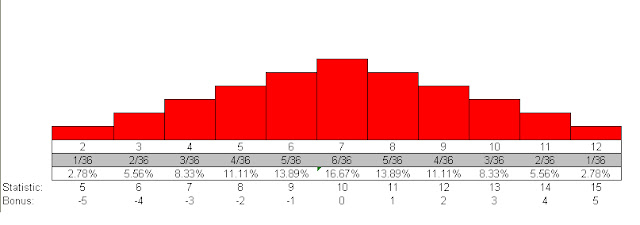
Attributes range from 5 to 15 and bonuses range from -5 to +5. The bonuses are applied to rolls against an opponent's attribute. Roll d20 and add your bonus, if it equals or exceeds the opponent's attribute (or the difficulty of a non character task) then you are successful. Quick and elegant. I really like it.
That said, Into the Odd includes a "dodge" system and an armor damage reduction system. Armor doesn't increase the chance to dodge, it reduces damage directly, but players have a chance to dodge and suffer no damage. The basic combat system is as follows:
Damage = [Damage Rolled + Damage Bonuses-Armor Defense] * Chance to Avoid Damage
The average damage per round for a light weapon (which does 1d6 damage) would be:
Avg. DPR = [3.5+0-Armor]*Chance to Avoid Damage
By having the reduction effect applied before the chance to avoid, McDowall allows for some interesting effects and makes the damage reduction effect less exaggerated than it would be if armor's bonus was applied after the chance to dodge was resolved. But armor still has an amazing effect on the game's combat system. Let's look at the average damage of a light weapon versus the armor types based on an opponent's attribute.

You can see by looking at the picture that even light armor provides a pretty significant defense against a light weapon. The average damage of a light weapon is 3.5, but depending on your opponent's STR you might take as little as 0.5 points of damage on average per round. The above chart includes the chance to dodge factored into the damage equation. If you have a 10 in a stat and you are trying to dodge someone with a 15, you have only a 30% chance of success (15+ on the roll).
But let's look at the Armor reduction from a different perspective. Let's remove the effect of the dodge roll completely. Into the Odd doesn't give Armor defensive reduction values that look in any way extreme. Light armor subtracts one point, heavy two, and a shield adds one additional point. That seems pretty moderate...until you look at how big a percentage of damage this is for an average light weapon.
 Light Armor's 1 point of reduction is 28.57% of the average damage (3.5) of a Light Weapon, and heavy armor and shield reduce the average damage amount by 85.71%. This is before any chance to dodge has been applied. You see similar, though not as drastic effects, against the "maximum" damage a light weapon can do. The protection of Light Armor, against a Light Weapon's average damage, is a greater percentage than would be gained by having a +5 bonus from a statistic. Wearing Light Armor is a better benefit than being among the 2.78% most physically capable people in the world.

On the surface, this argument makes sense. Armor prevents the impact of a blow that did in fact come into contact with you from doing damage, and it doesn't make opponent's "whiff."
The problems with the argument only really come to the fore when one looks at armor from a strictly mechanical presentation. As my prior article mentioned, all armor effects are part of a linear equation -- at least in systems with a "to hit" mechanic. The to-hit roll represents one variable, the damage roll another, etc.
Damage = (Probability of an attack hitting)*[average weapon damage + damage bonus] - Damage Reduction
Pretty much all role playing games have some variation of this basic equation. Hero games, d20, Chaosium's systems...they all have some variation of the basic linear equation above. What this means in mechanical terms is that whether you use damage reduction or you use "increased chance to miss" armor always mechanically reduces damage. If it only reduces the probability of an attack "hitting," then it reduces the average damage of an attack by that percentage. In d20 based systems, this means that armor reduces damage by approximately 5% per point of armor class. One could arguably represent armor as a percentage damage reduction without ever altering any mechanics in D&D by doing exactly this.
There are many "reduce damage" systems on the market, Tunnels and Trolls and Hero come to mind quite readily. Some of these systems understand the linear equation and thus their mechanics reflect a certain threshold of effectiveness that armor/defenses should apply to attacks. T&T doesn't have "to-hit" rolls in the traditional sense at all, so having armor reduce damage is a direct effect of that system. Hero's mechanics are heavily playtested and balanced applications that are quite mechanically robust, and I won't bore you with the details of point cost to damage effectiveness. Just let me say that the system is remarkably predictable in this sense...in an amazing way.
While there are very sophisticated, or simple, damage reduction systems that work, I think that a large number of these systems don't work at all. Those that don't work tend not to work because they fail to understand that the mechanical equation is always a linear equation and they end up with armor reductions that are out of order with the basic percentages to-hit. By having a to-hit roll, which as I mentioned is a percentage of damage reduction system in its nature, with an added static damage reduction system armor there is the potential to create everlasting combats. This is because the armor reduction values often end up as making the effective Damage Per Round of attacks zero.
To illustrate this, I'd like to look at Christopher McDowall's new quick to play game Into the Odd. The game is open for playtesting under the Creative Commons, and I recommend taking a look. It has some very good ideas. I like that the system is based on an underlying ability "Save" system that has quick and easy determination of attribute bonuses that reflect a nice bell curve.

Attributes range from 5 to 15 and bonuses range from -5 to +5. The bonuses are applied to rolls against an opponent's attribute. Roll d20 and add your bonus, if it equals or exceeds the opponent's attribute (or the difficulty of a non character task) then you are successful. Quick and elegant. I really like it.
That said, Into the Odd includes a "dodge" system and an armor damage reduction system. Armor doesn't increase the chance to dodge, it reduces damage directly, but players have a chance to dodge and suffer no damage. The basic combat system is as follows:
- Attacker rolls damage -- the assumption is that if an attack isn't actively dodged then it hits. I like that.
- Damage bonuses (from size of weapon, magic, or circumstances) are applied.
- Subtract Armor Reduction.
- Target rolls to avoid attack.
Damage = [Damage Rolled + Damage Bonuses-Armor Defense] * Chance to Avoid Damage
The average damage per round for a light weapon (which does 1d6 damage) would be:
Avg. DPR = [3.5+0-Armor]*Chance to Avoid Damage
By having the reduction effect applied before the chance to avoid, McDowall allows for some interesting effects and makes the damage reduction effect less exaggerated than it would be if armor's bonus was applied after the chance to dodge was resolved. But armor still has an amazing effect on the game's combat system. Let's look at the average damage of a light weapon versus the armor types based on an opponent's attribute.

You can see by looking at the picture that even light armor provides a pretty significant defense against a light weapon. The average damage of a light weapon is 3.5, but depending on your opponent's STR you might take as little as 0.5 points of damage on average per round. The above chart includes the chance to dodge factored into the damage equation. If you have a 10 in a stat and you are trying to dodge someone with a 15, you have only a 30% chance of success (15+ on the roll).
But let's look at the Armor reduction from a different perspective. Let's remove the effect of the dodge roll completely. Into the Odd doesn't give Armor defensive reduction values that look in any way extreme. Light armor subtracts one point, heavy two, and a shield adds one additional point. That seems pretty moderate...until you look at how big a percentage of damage this is for an average light weapon.

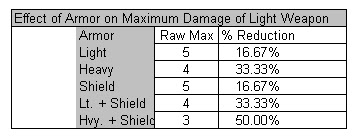
Here you can see that even when applied to the maximum amount of damage possible from a Light Weapon, Light Armor reduces the damage by 16.67%. This is the equivalent reduction of having a +3 bonus in a statistic. The amount of protection provided makes equipment more important than statistics in Into the Odd.
This seems odd to me. Should Light Armor be a better defense than being epically agile? I don't think so, but that is what is reflected in this system. If weapons did more damage, then this effect would be muted. If attribute bonuses were added to the damage dealt, this is not clear in the rules as written, the effect of attributes would be increased. My personal recommendation for this system is to step up the weapons a die, or to use something other than a d20 for the dodge roll. The d20 has linear probability of 5% for any value, and thus each +1 bonus equals a 5% shift. If a 2d6+bonus system vs attribute were used, this would radically change things and make attributes matter more.
As you can see, even when an armor "reduction" value is low, it might end up being the most significant combat effect. Is this the effect you want in your game? If it is, then this is what you want. If you want the game to be attribute -- or even skill driven -- then you might want to consider some alternatives. I like the "armor penetration" roll system where each armor has a penetration value that must be equaled or exceeded to hit the target underneath and where different weapons roll different armor penetration dice. This is the system used by the classic game Dragon Warriors. You can also create an "armor save" where armor protects from damage on a specific roll. Say a 6 or better. Light Armor could roll a d6, Medium a d8, Heavy a d10 and a shield could provide a die bump to the next better die.
Remember that damage when converted to a mechanic always creates an equation. Look at how big a factor armor ends up being in that equation and ask if that is what you want. In D&D attributes and Armor are equal in what a +1 difference means. A +1 to hit increases damage by 5% and an increase in Armor Class reduces damage by 5%. The fact that attributes also add to damage -- post to-hit determination -- means that attributes have a greater impact than armor.
There's a lot you can do in game systems, but don't let "common sense" be the only tool you use to analyze games. Break them down to the mechanics. In D&D Armor does "mechanically" reduce damage even though it seems like it reduces chances to hit. It's all a matter of perspective. I hope D&D Next sticks to the classic AC system. It's more balanced and robust than you might initially think.
Wednesday, March 14, 2012
Gaming History: The Space Gamer and Black Gate Magazine, TSR Buys SPI
On February 28th, the publisher of Black Gate Magazine, wrote a blog post celebrating an old SPI game called Swords and Sorcery. He praised the game in his semi-regular "new treasures" column. The game itself was published in 1978, but O'Neill had just acquired an edition from eBay. If the edition he purchased is the edition photographed in the blog post, he and I own the same edition of the game. The game may have been old, but it was new to him.
The post is quite positive, and I largely agree with O'Neill's review. As is common in discussion of old SPI games, a discussion of TSR's acquisition of SPI -- and their subsequent "killing" of SPI game lines -- was brought up in the comments section. Among the grognards of the gaming hobby, of which I am certainly one, there is often a good deal of ire aimed at TSR for their behavior. This ire is often directed at Lorraine Williams, but not always. One of those cases where it isn't directed at Lorraine Williams is in the TSR purchase of SPI in 1982. At that time, the company was very much in the control of Gygax and the Blumes -- though they were having plenty of internal strife at the time.
In this particular post, Black Gate's managing editor (and talented author Howard Andrew Jones) was the individual who brought up TSR's "killing" of SPI product lines. In my typical "provocateur" fashion, I mentioned that I thought that the TSR acquisition and killing of SPI was more complicated than most grognards think and even included some slight praise for Lorraine Williams -- as a fan I am actually amazed at the products that came out during her tenure, even if she hated gamers. Here is what I wrote:
I have since hunted down the issue of Fire & Movement I mentioned, and it is issue 27 (May/June 1982). In that issue Nick Schuessler writes a remarkably detailed article about TSR's acquisition of SPI and provides some context for the purchase. Some highlights of the article are:

But the May/June issue of Fire and Movement only gives us a part of the story. It doesn't truly show how desperate TSR was to diversify their brand, and how much internal strife existed at the company. Those elements can be seen in old issues of The Space Gamer. In issue 60 of TSG, John Rankin writes an article about a visit by TSR employees to Dallas where TSR Vice-President Duke Seifried were to meet with Heritage-USA and where there were possibly discussions for TSR to purchase Heritage or to enter into a joint venture with them. John Rankin's article states:

They purchased SPI, a company that had a rich catalog of war games but that also had a Fantasy Roleplaying Game called Dragon Quest. Supporting the SPI rpg would have possibly meant cannibalizing their own product lines. They had no plans to retain the talents acquired in the SPI purchase, and in fact eventually fired everyone they hired from SPI and refused to support life time subscriptions to SPI's magazine Strategy & Tactics. TSR did everything they could to alienate the customer base of the company they had just acquired, and they were "reorganizing" to end an outpouring of money. They were in constant need of revenue to stay afloat. They were selling a ton of product, but they also weren't developing products with any logical consistency. These are trends that wouldn't end any time soon. You can read Ryan Dancey's financial audit of TSR when Wizards of the Coast purchased them to see just how much this remained a problem in 1997.
I think that Rankin's comment regarding not wanting to lead, rather to control is a perfect description of the company. They boycotted GAMA and demanded D&D not be played at Origins. They had no plans for talent retention. They didn't publish the products they acquired. They don't seem to have been logical in the determination of the size of print runs. They cannibalized product lines -- even in the Blume/Gygax era though this became disastrous in the Williams era. As much as I love TSR's many settings having the Forgotten Realms, Greyhawk, Mystara, Hollow World, Birthright, and Dark Sun all as simultaneous fantasy setting product lines is a case study definition of cannibalizing product lines. Having "Basic," "Expert," "Companion," and "Master" D&D as well as Advanced D&D -- let alone a 2nd edition -- is also a case study definition.
The company produced great games, but they were not managed well at all. Bad management is endemic throughout the rpg industry. It is an industry primarily run by hobbyists and not business people. This is a creative boon, but a business curse.

On an interesting note, as I was looking through old The Space Gamer issues I found a letter by a John O'Neill of Ottawa, Canada in issue 66. I'm going to take a huge leap here and say that the John O'Neill in that 1983 letter is the publisher of Black Gate Magazine. Why would I make such an assumption? Just look at the first two paragraphs of that letter:
The post is quite positive, and I largely agree with O'Neill's review. As is common in discussion of old SPI games, a discussion of TSR's acquisition of SPI -- and their subsequent "killing" of SPI game lines -- was brought up in the comments section. Among the grognards of the gaming hobby, of which I am certainly one, there is often a good deal of ire aimed at TSR for their behavior. This ire is often directed at Lorraine Williams, but not always. One of those cases where it isn't directed at Lorraine Williams is in the TSR purchase of SPI in 1982. At that time, the company was very much in the control of Gygax and the Blumes -- though they were having plenty of internal strife at the time.
In this particular post, Black Gate's managing editor (and talented author Howard Andrew Jones) was the individual who brought up TSR's "killing" of SPI product lines. In my typical "provocateur" fashion, I mentioned that I thought that the TSR acquisition and killing of SPI was more complicated than most grognards think and even included some slight praise for Lorraine Williams -- as a fan I am actually amazed at the products that came out during her tenure, even if she hated gamers. Here is what I wrote:
While it is easy to blame TSR for what they did to SPI — and they deserve a lot of blame — one should keep two things in mind
First, when they purchased SPI it was in dire financial straights and would likely not have survived.
Second, they had hoped to keep SPI’s staff, but those staff members refused to work for TSR — for varied reasons — and left to form the Victory Games studio over at Avalon Hill.
Third, and this is where I get near heretical, it was the Blumes who devalued SPI’s contributions. A massive resurgence of publishing of SPI games happened under Lorraine Williams. We would never have seen the SPI monster TSR World War II game, or Wellington’s Victory, SNIPER (including BugHunters), let alone the 3rd edition of DragonQuest.
I believe she did the publishing of SPI stuff out of desperation, not any love for the product or the fans, as TSR was starting to have financial troubles which could only be met by an ever expanding publication schedule and continual revenue flow.
It was the Blumes who refused to acknowledge lifetime subscriptions to SPI magazines.
There is an excellent issue of Fire and Movement, printed by Steve Jackson Games, that goes over the purchase of SPI.
I have since hunted down the issue of Fire & Movement I mentioned, and it is issue 27 (May/June 1982). In that issue Nick Schuessler writes a remarkably detailed article about TSR's acquisition of SPI and provides some context for the purchase. Some highlights of the article are:
- On March 31, 1981 TSR announced they were initiating a chain of events to purchase SPI.
- On April 7th, eight key SPI staffers tendered their resignations and announced they were forming a new company called Victory Games that would work under the auspices of Avalon Hill.
- TSR acquirexd the trademarks and copyrights of the entire SPI inventory.
- Mark Herman, the leader of the eight defectors, had been negotiating with Avalon Hill to purchase SPI.
- The TSR conglomerate owned a science fiction magazine (Amazing), and a needlepoint company, in addition to D&D and in 1981 they had $17 million in sales revenue.
- SPI was a $2 million a year company.
But the May/June issue of Fire and Movement only gives us a part of the story. It doesn't truly show how desperate TSR was to diversify their brand, and how much internal strife existed at the company. Those elements can be seen in old issues of The Space Gamer. In issue 60 of TSG, John Rankin writes an article about a visit by TSR employees to Dallas where TSR Vice-President Duke Seifried were to meet with Heritage-USA and where there were possibly discussions for TSR to purchase Heritage or to enter into a joint venture with them. John Rankin's article states:
- Heritage USA still owed Duke Seifried money from his time with the company, and that Duke was a stockholder in the company.
- TSR was very much in need of a miniatures company if they wanted to diversify.
- No meeting between TSR and Heritage actually occurred, though Duke did likely get information from them as a stockholder.
- TSR "left no broken hearts in Dallas. But they didn't make any new friends either."
- There is a sense of some instability at TSR, and they are seen as not wanting to lead the industry rather just to "control it."
- TSR released 40 of its employees in June of 1983. Among these employees was Duke Seifried.
- TSR was reorganized into 4 companies.
- TSR Public Relations director Dietur Sturm described TSR finances as, "More or less, what you're looking at is money coming into the company from sales and not focused properly...Sales are there as far as the distributors and retailers and stores (are concerned); they have nothing to worry about."
They purchased SPI, a company that had a rich catalog of war games but that also had a Fantasy Roleplaying Game called Dragon Quest. Supporting the SPI rpg would have possibly meant cannibalizing their own product lines. They had no plans to retain the talents acquired in the SPI purchase, and in fact eventually fired everyone they hired from SPI and refused to support life time subscriptions to SPI's magazine Strategy & Tactics. TSR did everything they could to alienate the customer base of the company they had just acquired, and they were "reorganizing" to end an outpouring of money. They were in constant need of revenue to stay afloat. They were selling a ton of product, but they also weren't developing products with any logical consistency. These are trends that wouldn't end any time soon. You can read Ryan Dancey's financial audit of TSR when Wizards of the Coast purchased them to see just how much this remained a problem in 1997.
I think that Rankin's comment regarding not wanting to lead, rather to control is a perfect description of the company. They boycotted GAMA and demanded D&D not be played at Origins. They had no plans for talent retention. They didn't publish the products they acquired. They don't seem to have been logical in the determination of the size of print runs. They cannibalized product lines -- even in the Blume/Gygax era though this became disastrous in the Williams era. As much as I love TSR's many settings having the Forgotten Realms, Greyhawk, Mystara, Hollow World, Birthright, and Dark Sun all as simultaneous fantasy setting product lines is a case study definition of cannibalizing product lines. Having "Basic," "Expert," "Companion," and "Master" D&D as well as Advanced D&D -- let alone a 2nd edition -- is also a case study definition.
The company produced great games, but they were not managed well at all. Bad management is endemic throughout the rpg industry. It is an industry primarily run by hobbyists and not business people. This is a creative boon, but a business curse.
On an interesting note, as I was looking through old The Space Gamer issues I found a letter by a John O'Neill of Ottawa, Canada in issue 66. I'm going to take a huge leap here and say that the John O'Neill in that 1983 letter is the publisher of Black Gate Magazine. Why would I make such an assumption? Just look at the first two paragraphs of that letter:
In an age of man now only distantly remembered, there existed a magazine which the good people in the land of Fandom did enjoy. But lo, there came a day unlike any other day, when the Powers That Be sent a lightning bolt to rend asunder that magazine.Who, but the future editor of a Sword and Sorcery magazine, could write such a letter?
From the fragments of the one there emerged two magazines, and the Powers That Be told the people of Fandom to partake of them.
 |
| Image Copyright 2012 Jody Lindke |
Subscribe to:
Posts (Atom)