Wednesday, March 14, 2012

Gaming History: The Space Gamer and Black Gate Magazine, TSR Buys SPI

On February 28th, the publisher of Black Gate Magazine, wrote a blog post celebrating an old SPI game called Swords and Sorcery.  He praised the game in his semi-regular "new treasures" column.  The game itself was published in 1978, but O'Neill had just acquired an edition from eBay.  If the edition he purchased is the edition photographed in the blog post, he and I own the same edition of the game.  The game may have been old, but it was new to him. 

The post is quite positive, and I largely agree with O'Neill's review.  As is common in discussion of old SPI games, a discussion of TSR's acquisition of SPI -- and their subsequent "killing" of SPI game lines -- was brought up in the comments section.  Among the grognards of the gaming hobby, of which I am certainly one, there is often a good deal of ire aimed at TSR for their behavior.  This ire is often directed at Lorraine Williams, but not always.  One of those cases where it isn't directed at Lorraine Williams is in the TSR purchase of SPI in 1982.  At that time, the company was very much in the control of Gygax and the Blumes -- though they were having plenty of internal strife at the time.

In this particular post, Black Gate's managing editor (and talented author Howard Andrew Jones) was the individual who brought up TSR's "killing" of SPI product lines.  In my typical "provocateur" fashion, I mentioned that I thought that the TSR acquisition and killing of SPI was more complicated than most grognards think and even included some slight praise for Lorraine Williams -- as a fan I am actually amazed at the products that came out during her tenure, even if she hated gamers.  Here is what I wrote:

While it is easy to blame TSR for what they did to SPI — and they deserve a lot of blame — one should keep two things in mind
First, when they purchased SPI it was in dire financial straights and would likely not have survived.
Second, they had hoped to keep SPI’s staff, but those staff members refused to work for TSR — for varied reasons — and left to form the Victory Games studio over at Avalon Hill.

Third, and this is where I get near heretical, it was the Blumes who devalued SPI’s contributions. A massive resurgence of publishing of SPI games happened under Lorraine Williams. We would never have seen the SPI monster TSR World War II game, or Wellington’s Victory, SNIPER (including BugHunters), let alone the 3rd edition of DragonQuest.

I believe she did the publishing of SPI stuff out of desperation, not any love for the product or the fans, as TSR was starting to have financial troubles which could only be met by an ever expanding publication schedule and continual revenue flow.

It was the Blumes who refused to acknowledge lifetime subscriptions to SPI magazines.
There is an excellent issue of Fire and Movement, printed by Steve Jackson Games, that goes over the purchase of SPI.

I have since hunted down the issue of Fire & Movement I mentioned, and it is issue 27 (May/June 1982).  In that issue Nick Schuessler writes a remarkably detailed article about TSR's acquisition of SPI and provides some context for the purchase.  Some highlights of the article are:

  • On March 31, 1981 TSR announced they were initiating a chain of events to purchase SPI.
  • On April 7th, eight key SPI staffers tendered their resignations and announced they were forming a new company called Victory Games that would work under the auspices of Avalon Hill.
  • TSR acquirexd the trademarks and copyrights of the entire SPI inventory.
  • Mark Herman, the leader of the eight defectors, had been negotiating with Avalon Hill to purchase SPI.
  • The TSR conglomerate owned a science fiction magazine (Amazing), and a needlepoint company, in addition to D&D and in 1981 they had $17 million in sales revenue.
  • SPI was a $2 million a year company.
Schuessler's article is heavy on facts, and only has one bit of speculation.  That bit of speculation is whether the brain drain, the loss of Mark Herman and crew, will have a long term negative effect on the acquisition.  I would argue, from a historical perspective, that this was the single most devastating part of the acquisition.  SPI's strength was in its designers.  Mark Herman, Jerry Klug, John and Trish Butterfield, and Greg Gorden were some of the most talented designers of their era.


But the May/June issue of Fire and Movement only gives us a part of the story.  It doesn't truly show how desperate TSR was to diversify their brand, and how much internal strife existed at the company.  Those elements can be seen in old issues of The Space Gamer.   In issue 60 of TSG, John Rankin writes an article about a visit by TSR employees to Dallas where TSR Vice-President Duke Seifried were to meet with Heritage-USA and where there were possibly discussions for TSR to purchase Heritage or to enter into a joint venture with them.  John Rankin's article states:

  • Heritage USA still owed Duke Seifried money from his time with the company, and that Duke was a stockholder in the company.
  • TSR was very much in need of a miniatures company if they wanted to diversify. 
  •  No meeting between TSR and Heritage actually occurred, though Duke did likely get information from them as a stockholder.
  • TSR "left no broken hearts in Dallas.  But they didn't make any new friends either."
  • There is a sense of some instability at TSR, and they are seen as not wanting to lead the industry rather just to "control it."  

This all seems like a relatively mundane deal gone bad...until one looks at other issues discussing TSR.  By issue 65 of The Space Gamer, the internal strife at TSR comes to the fore.  In that issue, the following facts are reported.

  • TSR released 40 of its employees in June of 1983.  Among these employees was Duke Seifried.
  • TSR was reorganized into 4 companies.
  • TSR Public Relations director Dietur Sturm described TSR finances as, "More or less, what you're looking at is money coming into the company from sales and not focused properly...Sales are there as far as the distributors and retailers and stores (are concerned); they have nothing to worry about."
This news demonstrates a number of problems within TSR.  There is obviously internal strife.  The firing of Seifried and the "banishing" of Gygax to Los Angeles hint at that.  The company also clearly had no idea how to maintain and expand their product lines.  They purchased a needlepoint company for goodness' sake!  Why?  What synergy could that provide?

They purchased SPI, a company that had a rich catalog of war games but that also had a Fantasy Roleplaying Game called Dragon Quest.  Supporting the SPI rpg would have possibly meant cannibalizing their own product lines.  They had no plans to retain the talents acquired in the SPI purchase, and in fact eventually fired everyone they hired from SPI and refused to support life time subscriptions to SPI's magazine Strategy & Tactics.  TSR did everything they could to alienate the customer base of the company they had just acquired, and they were "reorganizing" to end an outpouring of money.  They were in constant need of revenue to stay afloat. They were selling a ton of product, but they also weren't developing products with any logical consistency.  These are trends that wouldn't end any time soon.  You can read Ryan Dancey's financial audit of TSR when Wizards of the Coast purchased them to see just how much this remained a problem in 1997.

I think that Rankin's comment regarding not wanting to lead, rather to control is a perfect description of the company.  They boycotted GAMA and demanded D&D not be played at Origins.  They had no plans for talent retention.  They didn't publish the products they acquired.  They don't seem to have been logical in the determination of the size of print runs.  They cannibalized product lines -- even in the Blume/Gygax era though this became disastrous in the Williams era.  As much as I love TSR's many settings having the Forgotten Realms, Greyhawk, Mystara, Hollow World, Birthright, and Dark Sun all as simultaneous fantasy setting product lines is a case study definition of cannibalizing product lines.  Having "Basic," "Expert," "Companion," and "Master" D&D as well as Advanced D&D -- let alone a 2nd edition -- is also a case study definition.

The company produced great games, but they were not managed well at all.  Bad management is endemic throughout the rpg industry.  It is an industry primarily run by hobbyists and not business people.  This is a creative boon, but a business curse.


On an interesting note, as I was looking through old The Space Gamer issues I found a letter by a John O'Neill of Ottawa, Canada in issue 66.  I'm going to take a huge leap here and say that the John O'Neill in that 1983 letter is the publisher of Black Gate Magazine.  Why would I make such an assumption?  Just look at the first two paragraphs of that letter:

In an age of man now only distantly remembered, there existed a magazine which the good people in the land of Fandom did enjoy.  But lo, there came a day unlike any other day, when the Powers That Be sent a lightning bolt to rend asunder that magazine.

From the fragments of the one there emerged two magazines, and the Powers That Be told the people of Fandom to partake of them.
Who, but the future editor of a Sword and Sorcery magazine, could write such a letter? 

Image Copyright 2012 Jody Lindke


Tuesday, March 13, 2012

Compact Heroes: Another Attempt at a Card Based Role Playing Game

In 1996, a company called Black Dragon Press released a game that combined the features of a collectible card game with those of a traditional table top role playing game.  This game was called Dragon Storm.  As an exercise in game innovation, it was an interesting concept.  As a game, it left something to be desired.  While the game mechanics underlying Dragon Storm were functional -- some might even argue that they were good -- the "collectible" aspect of the game made getting a complete set of cards for the game more difficult than was reasonable.  Of the 270 cards in the base set 90 were common, 90 were uncommon, and 90 were rare.  It was expensive to get a complete set back in the 90s, now it is nigh impossible.  The use of cards in character creation and game play was a novel idea, but the random/collectible aspects doomed the game from the start.


Last month Sacrosanct Games released a role playing game that uses the best features of Dragon Storm, while leaving out the collectible component. The game was funded by a successful Kickstarter campaign that I wish I had gotten in on. Their new "role playing card game" Compact Heroes is a card based game that is customizable -- in that you can buy expansions -- but which is not collectible in nature.  In this way, Compact Heroes has done Dragon Storm one better.  But is Compact Heroes a good game?  Is it worth spending $30 for the Master Set starter set?  Is it a complete game from the get go?


The answer to these questions is, as you might imagine, yes and no.  The game is playable, and you get a decent amount "toy factor" for your $30.  The problem is that the game is overly simple and seems somehow incomplete from just the Master Set.  It needs more "umph."  Let me explain.

Character Creation

Character creation in Compact Heroes is a simple affair.  You pick a card for your race.  Your choice of race will provide you with a bonus to one of your five basic attributes (Strength, Agility, Endurance, Intellect, and Luck).  These can all be seen on the character sheets

Strength adds to damage.  Agility adds to your "evasion" value.  Intellect gives you a Power Rating for spell casting and a bonus to hit with spells.  Luck gives you a value you can check against to make "luck checks" to avoid certain effects.  A roll equal to or lower than your luck means you succeed and avoid some ill effect.

Players then have two additional points they may distribute among the 5 attributes as they like, giving the starting character a total of 3 points in 5 attributes.  Once the attributes are selected, players may choose one skill (humans get two) that their character begins with.  This can be something like "Novice Dodge" which requires an Agility of 2 and provides an additional bonus to evade, or Novice Combat which provides a bonus to hit or damage. 

Once that attributes and skill(s) are selected, the player rolls 5d6 to determine wealth.  This yields an average of 17.5 gold, which isn't a lot of money for starting equipment...but there isn't that much equipment to choose from.

Needless to say, starting characters are very much beginners.  They aren't helpless, but they aren't highly skilled either.  A nice feature is that what skills a character can take are limited only by statistics and prior skill choices -- many skills have prerequisites.  There are no "classes," but logical choices are beneficial.

Combat

Combat in Compact Heroes couldn't be simpler.  After initiative is determined, a character may make one attack on his or her turn.  The attack is resolved by rolling a d20 and adding any bonuses to hit from skills or magic.  If this number is higher than an opponent's evade, the attack hits and damage is rolled.  From this damage, a character's "damage absorption" value is subtracted.  This damage absorption value is usually provided by a type of armor ranging from Clothing to Gothic Plate.

The system combines the d20 to hit system with an armor damage reduction system.  As I have blogged before, there is really no difference between having armor make some one harder to hit or having it reduce damage as both are part of a linear equation that can be balanced so that armor has the same effect regardless of which method is used.  

In Compact Heroes, the linear equation for damage is a standard one for damage reduction systems:

Damage = (Probability of an attack hitting)*[average weapon damage + damage bonus] - Damage Reduction

Or in this case:

Damage = (((20 + to Hit Bonus - Evade) x .05) x Average Weapon Damage + Bonus) - Damage Absorption. 

Note that the base number here is 20 rather than 21 as in D&D.  This is because a roll equal to evade is a miss.

Each point of evade lessens damage by 5% and each point of Damage Absorption reduces damage by one full point.  Depending on the weapon the percentage effect of Damage Absorption varies. 

Allow me to illustrate an example. 

Sojan is a starting character who has a Strength of 1 and an Agility of 2.  He has the Novice Combat (+2 to hit and +1 to damage) skill and the Novice Dodge (+2 to evade) skill.  He is wearing Clothing (Damage Absorption 1) and wielding a Long Sword (1d6+2 damage).

Sojan is fighting an Olekmar Goblin.  It is a level one creature, so should be okay for a starting character if the game is designed well.  The Goblin has +0 to hit, an Evade of 10, Damage Absorption of 1, and does 1d6 damage.

Sojan's total to hit bonus is +2 and total damage bonus is also +2.  His total evade is 14.

With these attributes, Sojan does an average of 3.5 damage per round against the Goblin.  In return, the Goblin does a damage per round of .05 points to Sojan.  This is because Sojan hits the Goblin 60% of the time, thus his damage per round is 60% of his average damage.  The Goblin only has a 30% chance to hit Sojan and his average damage is less.  Needless to say, Sojan can fight more than one Goblin at a time.

Given the Damage Absorption values of some armors (as high as 8), I don't know why they chose to use a Damage Absorption system.  Once I started looking at combats as linear equations, the need for Armor to "reduce" damage became an unnecessary abstraction for me.  If a game wants to use such a system, I prefer Dragon Warrior's armor penetration roll...a roll that follows the to hit roll...or a system like the Warhammer Fantasy Battles "Armor Save" instead of a flat number.  Your mileage may vary.

Needless to say, Compact Heroes' system isn't new but it is tried and true and many do like it.  The only caution I would add is to not go overboard when setting Damage Absorption values.

Skill Checks

The game also features attribute checks, which can be modified depending on the selection of skills a character has, where a player rolls 1d6 and adds a bonus for appropriate skill or stat.  The game master sets a difficulty and you must roll equal to or higher than the difficulty number.  There is little to no guidance regarding what appropriate difficulties are.  I like the simple skill system, but I'd like more specificity.

Experience and Advancement

Characters don't have levels, even though monsters do.  Instead, they earn experience points at intervals determined by the game master.  Each experience point may be spent to either increase an attribute or purchase a skill.  I like this system, it is simple and reminds me of Hero/Champions.  My only criticism is that no real guidance is given regarding how often xp should be given or what an appropriate level of advancement is for the game.  Yes, this can be group driven...and should be...but some guidance would be nice.


Final Thoughts

All in all, I think that Compact Heroes can be a workable and fun game if...

  1. It adds a rich setting with thematic intellectual property.  The game isn't enough, you need fluff.  The lack of fluff on the cards is a weakness.
  2. The game needs a rulebook that is longer than 3 pages and that contains recommendations and examples.
  3. The game needs some adventures...and fast.
  4. The game also needs to reduce the almost random quality of the artwork.  There are some stellar cards, but there are some very mediocre ones as well with regard to artwork.
  5. More skills, more spells.  There are not enough spells for long term play in the starter set.
  6. They need to sell "adventure decks."  A small deck of cards that features monsters, npcs, and skills that are all thematically related.  These need to have flavor text.
I'm going to give the game a try with my group, but I do want some more substance.  I'll likely start with the adventure in the Master Set and then run the adventure on their website.  Where it goes from there, I don't know.

Monday, March 12, 2012

The SF Library: Mandatory Anthology #1 "Adventures in Time and Space"

If you want to get a good sense of the "Golden Age" of Science Fiction, there is no better volume to have on your Science Fiction bookshelf than the Raymond J. Healy and J. Francis McComas edited Adventures in Time and Space.


 Adventures in Time and Space is an anthology making an argument for the literary merit of Science Fiction as a genre.  It was originally published in 1946 -- one year after the dawn of the Atomic Age and the end of the Second World War.  I own the 1957 Modern Library Edition, and it is a book I return to often when I think about what Science Fiction is as a genre and where it can go "literarily."  The genre has had some fine wordsmiths -- Heinlein, Asimov, Iain Banks, C.L. Moore -- come immediately to mind, but it is a genre that still suffers under the shadow of the poorest written "Space Westerns" of the genre.  It is this shadow that Healy and McComas were trying to destroy.  These editors believe that by 1946 Science Fiction as a genre had found its place as a literary genre, a genre of truly imaginative literature.  And they believed that the elevation of Science Fiction as a literary form was largely due to the work of one editor, John W. Campbell Jr.  As they put it in the introduction to the Modern Library edition:

"Critics have called this the 'definitive' anthology of science fiction stories.  We agree -- not just because it flatters us, but because it is an accurate judgment of the magazine editor who first published most of the stories in this collection.

That man was John W. Campbell, Jr. And perhaps no one man ever had a greater influence over a literary form, for Campbell single-handedly revolutionized the writing of -- and possibly more importantly -- the thinking in modern science fiction.

He created what all of us -- readers, writers and editors -- refer to as the Golden Age of twentieth-century imaginative literature. You are about to read the golden bests of that golden time.

Prior to Campbell's advent as editor of Astounding Stories in 1937, science fiction had badly deteriorated from the standard set by its great founders, Wells and Verne. While some editors strove for genuinely interesting scientific speculation, they allowed such challenging postulations to be presented in a framework of atrocious prose. Generally, however, magazines nominally presenting science fiction offered science that was claptrap and fiction that was graceless and dull.

Campbell changed all that...

As I read those words today, I don't think that Healy and McComas are overstating Campbell's influence.  Campbell is an editor whose shadow looms large over the genre, just as Lin Carter's looms over fantasy, or August Derleth's looms over the Weird Tale.  There have been great editors since Campbell, but he was among the first great editors of the genre.  This is especially telling in the themes of the stories he edited.

Read Asimov's Foundation stories and A.E. Van Vogt's Space Beagle and Slan stories in one straight run, and you will notice themes emerging.  Asimov's "psychohistory" and Van Vogt's "nexialism" sound very similar to each other thematically, and they are applied in similar ways.  Both of these disciplines are collections of the skills of other disciplines, they are a kind of "master science."  This optimistic theme of a rigorous social science that could better our lives is a common undercurrent in Campbellian fiction.  It is one of the hallmarks of his tenure...as is optimism itself.  It is sometimes striking how optimistic Campellian fiction is.  Even when it is skeptical -- like Herbert's Dune -- it contains optimism.  For what are Mentats and the Bene Gesserit, but practitioners of Nexialism and Psychohistory?

Adventures in Time and Space doesn't include Dune World or Slan, but it contains stories with many of the same themes.  Among my favorite tales are:

  • Robert Heinlein's "Requiem" and "The Roads Must Roll"
  • Henry Kuttner and C.L. Moore's "Time Locker" and "The Twonky" -- written as Lewis Padgett.  Moore and Kuttner seem to be to be vastly under-read by the modern SF reader.  C.L. Moore is arguably my favorite SF author, her combination of the weird and the wondrous are magnificent.
  • John W. Campbell, Jr's "Who Goes There?" which is the story that the classic SF films THE THING FROM ANOTHER WORLD and THE THING are based upon.  Campbell published this story under his Don A. Stuart pseudonym.
  • Isaac Asimov's "Nightfall"
  • A.E. VanVogt's "Black Destroyer" -- possibly my favorite SF story.  Readers will notice its influence in Ridley Scott's ALIEN and in the STAR TREK franchise.  The Space Beagle and its mission are surprisingly similar to that of the Enterprise and nexialism and Mr. Spock have a lot in common.
  • Harry Bates' "Farewell to the Master" was the inspiration for THE DAY THE EARTH STOOD STILL and stands as a classic tale far better than the "cold war bigger bully scares us straight" narrative of the film.
There are 35 tales in all in the anthology and they are tales that I return to again and again.  Much like Carter's "Adult Fantasy" series with its many fantasy anthologies, Adventures in Time and Space belongs on your bookshelf.

If only Erik Mona and Paizo had managed to get the rights to do a Planet Stories edition of the book before that line went on hiatus.  I would have loved to see this anthology with some artwork from their stable.  If only because the Coerl of "Black Destroyer" is also the influence behind the D&D monster the Displacer Beast.

Thursday, February 23, 2012

Why "The Brave" Trailer is Superior to "Wrath of the Titans" Trailer

Before I post the two trailers in question and critique the "Titans" trailer, I just want to state for the record that I am jazzed to see both of these movies. They both look like fun and appeal to my inner child.

Now take a minute to watch the trailer for "The Brave." It's only a couple of minutes long.


The trailer is essentially 2 minutes, or so, taken straight out of the film. Two minutes that encapsulate a story on their own, that hint at the stakes surrounding the situation, and that entertain. I now want to see the movie now more than ever, and have the sense that the film will make me weep as its twists are revealed.

Now take a minute to watch the trailer for "Wrath of the Titans."


From the opening BWAAAAAM -- straight out of "Inception" -- there is cut scene after cut scene of ever escalating action that reveals that our hero will have to battle many mythical beasts over the course of the film. Never mind that a releasing of the Titans, and their war against humanity, would make for an exciting series of films let alone a single picture. A fact that makes it appear as if this film will be trying to do too much in too little time, and at the expense of creating an actual narrative. The action scenes are compelling, and heighten my desire to see the spectacle of the film, but they do little to invest me emotionally in the film.

Both trailers make me want to watch the films, but one demonstrates that the film I will be watching will make me feel something emotionally while the other bludgeons me with spectacle.

I can't help but feel that the reliance on a spectacle oriented trailer, rather than an emotional one, for the upcoming "John Carter" film is a bad move. There is action in the John Carter series of tales, to be sure, but there is also a great romance. It is a mythic romance and the trailers have done little to convey that fact. I would even go so far as to say that the Super Bowl trailer made me want to watch the film less.

Compare the "John Carter: Virginia" clip to the Super Bowl ad. The Virginia clip makes me want to watch the movie, the Super Bowl ad makes me believe that Disney doesn't really believe in the story or that the characters are worth highlighting. Thankfully, the Virginia clip exists and lets me know that there will be character development -- even if it is apocryphal -- and not just spectacle.


I'll take Virginia over spectacle any day, and I'll take a short continual glimpse into the world over clips featuring the soundtrack of "Inception."

Friday, February 17, 2012

D&D Next: How About We Stop the Increasingly Granular Skill Rules?

I've been thinking a lot about what I want from the next edition of D&D lately.  Not just because of the recent announcement that there will be a new edition of the game, but that has contributed without a doubt.  Largely, I've been thinking about it because of the D&D Encounters group I play with every week.  I've been running encounters for over 2 years now, and I noticed a significant change in how the game played when Encounters adopted the "Essentials and Newest Book" only stance.

The game is smoother.  There's less analysis paralysis. The players role play more.  The players think of their characters in terms of personality more than as a list of powers.  The addition of themes has helped this, but so has the return to more archetypical character design and the clear articulation of the powers associated with a given thematic build.  Character builds in the post Essentials world have been more "thematically" oriented than the calculated and Hero System-esque min/max affairs I had been seeing before.  It's been a nice change, and it got me thinking how the addition of Feats and a scaling skill system have made D&D less creative.  In early D&D, if a character wanted to be a blacksmith, all the player had to say was that their character was a blacksmith.  If a player wanted a character to be a blacksmith, poet, wizard, tumbling acrobat, scientist, engineer, the DM might have told the player that was ridiculous...OR the DM might have said "sure, why not" it doesn't affect the mechanics of the game and might make for interesting stories.  In the post Hero/Gurps D&D era where skills are all articulated, if the player doesn't have a skill then that character is up Illithid Creek without a helmet.

Image by Jody Lindke


I'd like to see D&D Next return to an era where there is no scaling skill system and where characters can be good at a lot of things that are associated with their character's "core strengths" without needing to allocate skill points each level or without the ridiculous results of the 4e skill system where a 10th level character might have a higher DC to kick down the same door as a 1st level character.  If anything can be learned about how to implement a robust skill system -- inspired by the 3.x and 4e skill systems -- the Dragon*Age role playing game should be our guide.  The DCs for difficulty are fixed early.  They are a fixed point in space.  Difficult is difficult.  Challenging is Challenging.  An average task in that game can be achieved on an 11 or better on 3d6 -- an exactly average roll.  To that roll an ability bonus (+1 for average ability or +4 for amazing) and a "focus" bonus (if the character possesses a relevant focus) of +2 are added.  An average person, with a focus in a relevant area, would add +3 to the roll making the chance of success 8+ on 3d6 on an average difficulty task.  Rolling an 8+ on 3d6 is fairly easy -- with an 83% chance of success.

There's no need to create DCs that are impossible for 1st level characters, at least not if you want free-wheeling games where low level characters take huge risks, you can just make them supremely difficult.  All you need to do is make it so that the main difference is "trained" and "not trained."  Throw level out of the skill system -- except maybe to add some "focuses" that match a character concept as the character increases in level.

Let's just have a look at how the skill system in D&D has evolved to get a look at where we might want to go to mix the D&D legacy rules with what I think is a wonderfully innovative Dragon*Age skill system -- I might even recommend using Robin Laws'  Gumshoe system for mysteries, but that is an entirely different discussion.

In the White Box of D&D there are no skills.  Period.  There are abilities and they affect very little about game play except the rate which a character advances in level.  Eventually, with the addition of the Blackmoor and Greyhawk supplements, the ability scores have more mechanical effects, but there is still no skill system per se.

In Moldvay/Cook -- pre-Gazetteer/Compendium era -- edition of the rules added the "There's Always a Chance" rule on page B60 where you roll a d20 and compare it to a statistic (adding a -4 to +4 modifier to the roll based on difficulty) to account for all of the things a character could do outside of those abilities specifically granted by the character's class.  This rule might also be in the Holmes Basic, but I couldn't find it.  This is the root for what became the eventual early skill system of D&D.  The D&D Gazetteers, starting with Aaron Allston's Grand Duchy of Karameikos, gives characters a number of skills based on their level.  Success is determined by rolling equal to or less than an attribute on d20 -- modified for difficulty.  Players can spend an entire skill choice to gain +1 to an attribute for the purpose of a skill check.

The AD&D "non-weapon proficiency" system introduced in Oriental Adventures and implemented in both the Wilderness Survival Guide and the Dungeoneer's Survival Guide is very similar to the Allston system -- and pre-dates it.  This system comes after the broad AD&D "background skill" system in the Dungeon Masters Guide which gave characters background skills, but had no mechanical adjudication for those skills.

Until the 3rd edition, the Allston/Non-Weapon Proficiency system was the core skill system in D&D.  It always seemed a little wonky to me.  A character could use one choice to get a 55% chance to succeed at a skill (assuming an 11 stat), but had to spend an entire extra choice to get an additional 5%.  That never seemed quite right.  Additionally the difficulty of a task was entirely controlled by a character's full stat, rather than by the bonus, so an 18 in a stat meant a 90% chance of success for most tasks -- minus any modifiers.  It just seemed to make good characters too good.

The 3rd edition of the game learned from the 90% is too good example and tied skill checks to the stat bonuses -- which reflect the natural standard deviations of the attributes on a 3d6 curve -- and set them against difficulties.  A character with an 18 stat added +3 to a roll of a d20 and compared it to a difficulty -- a skill system similar to that of earlier DC based RPGs and wargames.  It works, but 3rd edition had scaling difficulties and opposed rolls and gave skill points every level which made it so characters had to make sure that they continued to spend precious skill points in ways that continued to be useful.  Finding a difficult clue at 10th level had a higher DC than finding a difficult clue at 1st level.  This needed to be so because the characters would have skill bonuses, but the higher DC also required the higher skill bonuses -- a kind of skill system moebius strip a never ending cycle of increase.

4th edition partly solved for the ever spending of skill points by having a system of "trained" and "not trained," but then muddied the mix with scaling DCs as the characters went up in level that was tied to ever increasing stats and magical bonuses.  Ironically, the 4e system is actually flat.  The increases are an illusion.  Yes a 10th level character can beat up a 1st level character, but a 10th level character has as hard a time solving a 10th level problem as a 1st level character has of solving a 1st level problem.  Amusingly, sometimes these problems might be the exact same thing.

I've always thought that scaling difficulties, skill points to demonstrate improvement toward scaling difficulties, and a system of granularly listed skills to detract rather than add from play.  In the early days of Mutants and Masterminds, Steve Kenson spent many a day on the forums trying to convince people that Batman would just have Super-Dex and Super-Intelligence along with "training" in those skills that are "trained only."  This would mean that he was good at all the skills, and that he didn't need to spend individual skill points.  Players who favored granular itemization of skills won out, and the M&M point buy system has never really recovered its balance since.  Thankfully it has guidelines based on power level for power effects so the fact that skill points and powers don't really matchup mechanically point for point doesn't matter too much, but it still affects that game and makes that game feel less "superheroic" and more GURPS-ish.

I've always preferred games where characters can have skills that were independent of the level of the character.  In Call of Cthulhu there are no character levels, just skill improvements through the use of skills.  In D&D, there are character levels but I'd love to see them separated from skill use.  There are tons of people who would be level 0 who would have tremendous skill at some science or artistic skill.  There is no need to create nerfed NPC classes -- as 3rd edition did -- or to create bizarre DC scaling tied to level -- as 4th edition does -- all that matters is "trained" and "untrained" with a possible "how well trained" and "do you practice" added for good measure.

I'd love to see D&D Next adopt a skill system with fixed DCs, like Dragon*Age, that allowed characters to take whatever knowledge/artist/artisan/profession skills they wanted without limit, and in which training in a class gave some small bonus.  For example, a thief might just be a better climber than a non-thief and have a slowly scaling bonus (say +1 to +4 at level 20) against that fixed DC.  There is no need to have a large section of the rule book filled with skills and their descriptions and submechanics.  Look at Dragon*Age, there is no set of three subskills for any of the focuses -- unlike 4e's Acrobatics or 3e's Tumble.  There is no need.

Keep it simple.  Stop becoming more granular and complex.  Sure, some players want D&D to have Advanced Squad Leader and GURPS levels of detail and granularity, but most want to sit around a table and have a good time.  Let's find some compromise between the non-weapon proficiency system and the 3.x system.

Wednesday, February 08, 2012

D&D Next: Non-D&D Games that "Are D&D to Me" #1 -- DRAGON AGE

Anyone who has gamed with me for any length of time, or who has read this blog for the past few years, knows that I am a big fan of the Dungeons & Dragons roleplaying game. In particular, I have a soft spot for the old 1981 Tom Moldvay edited Basic Set.  The rules set may be unforgiving to beginning characters and need a few tweaks, but the rules set is inspirational and clear.  It is so clearly written that making rules tweaks to change the things one may or may not like about the game seems sheer simplicity -- even to the novice gamer.


When I read the recent D&D Next discussions regarding how the game should feel thematically and mechanically, my thoughts always wander to Moldvay's introduction in the Basic Set:

I was busy rescuing the captured maiden when the dragon showed up.  Fifty feet of scaled terror glared down at us with smoldering red eyes.  Tendrils of smoke drifted out from between fangs larger than daggers.  The dragon blocked the only exit from the cave...
This is followed by a description of Moldvay's intentions in revising the D&D rules and simplifying them for inexperienced players before it returns to the action and once more inspires the reader to imagine just how exciting game play will be.  Setting aside the staid and cliche scenario Moldvay describes, the words are evocative and set a tone for potential players.  It is that tone which describes "What is D&D" to me.  Games and scenarios that inspire that kind of imagination while maintaining the simplicity and ease of play that Moldvay describes as his goals in the introduction.  An ideal "D&D" game is a game that is quick to learn, easy to play, and includes collaborative storytelling.  When things get too complex, they become "Rolemaster" or "GURPS" to me.  GURPS is a great game, but the complexity of its presentation can be overwhelming.  And let's not even begin to discuss games that use the famous Avalon Hill/SPI "case system" to present their game rules.  Let's just say that as much as Squad Leader innovated wargaming by adding a role playing elements, you don't want your roleplaying game to graphically look like an Advanced Squad Leader rule book if you want it to appeal to new gamers.

Interestingly enough, this means that not every game that is "D&D" to me is D&D, and not every version of D&D is "D&D" to me.  Some non-D&D games are fantastic, but they just don't capture the freeform, house ruleable, quick and dirty feeling I like in a "D&D" game.  For example, Moldvay is D&D to me, but Pathfinder isn't.  AD&D is D&D to me...unless you actually used Weapon Speed Factors, Weapon Versus Armor Adjustments, multiple attacks for people who have shorter weapons and are within melee range (check the DMG and get out those Daggers).  Using solely the 3.0 rulebooks, 3rd edition is D&D but the moment you add one splatbook it begins to wander away.  4e?  The AEDU core rulebooks are not at all D&D to me, but the Essentials line is.  I named all of these games because I think they all are wonderful, and all of them use some version of rules that have been copywritten under the name Dungeons & Dragons.

From the non-D&D realm, there are a number of games that just feel like the game that Moldvay inspires in his description.  The first in my mental list, and the subject of this post, is Green Ronin's brilliant table top roleplaying game Dragon Age.  The core AGE system designed by Chris Pramas -- with help from T.S. Luikart, Jesse Scoble, Owen K.C. Stephens, Steve Kenson, and Jeff Tidball -- is a marvel of simple complexity.  You can download a free version of the Quickstart rules for the game by right clicking  here.

Like the Moldvay Basic set, one can play Dragon Age battles as tactical miniatures struggles or throw out maps entirely and use common sense to determine outcomes.  The game includes random chance in the creation of characters, characters that mechanically fall into strict archetypes, and has clear and concise rules presentation.  That last part is central.  Most rpgs today take pages upon pages to describe the game mechanics, and technical writing is dull to the neophyte.  This is true even when the technical writing is well articulated.  Unless the technical writing is concise, it runs the risk of wandering into dull-land.  Additionally, I believe that the more "core" rules a game has, the less easy it is to tweak to your desires.  If I'm presented with a strong core mechanic and given free reign to create, I will.  If I'm given case study after case study within the rules as more and more specific possibilities are quantified, I'm less likely to be inspired to create my own rules.  Either because a rule already exists, or because it is more difficult to figure out how a new rule will patch in with all the existing ones.

If you made this poster please let me know so I can credit and link you.


What Dragon Age does magnificently, and that I hope the folks at Wizards of the Coast will remember, is give a simple core of rules and expand outward from them.  The underlying system is easy to explain...roll three dice add them to a modifier to see if that exceeds a target number.  That's it.  This simple system gets expanded.  One of those dice -- the Dragon die -- is used to determine how well you succeed if you succeed.  If you roll doubles on any two of the dice (about a 50% chance), then that Dragon die also signifies a number of points you can spend on "stunts" on an action you succeeded on.

In Dragon Age, you don't describe an awesome attack attempt -- like trying to hit someone in the head to knock them prone -- only to roll poorly and fail at the event you just described.  Instead, you roll for success knowing how many points you have to make the success more awesome.  The game reverses some of how gamers have been playing the game for 30 years, where they imagine the action before outcome then get outcome and reassess success.  Instead, you roll to find out how many resource points of awesome you have to spend.  It's like a Reiner Knizia Eurogame adaptation of RPG mechanics.  First roll to see how many resources you have, and if you can use them -- then go to town spending those resources.

It's elegant and fun and I have essentially described the entire game.  Yes, there are subtle mechanics and flavor mechanics and effects throughout the game, but the core is simple and strong.  It is also evocative.  It somehow manages to overcome the roll to see if you can see the troll "roll playing" that can happen in many games with skill lists.  It manages to make combat cinematic.  And it does this by using a less complex mechanic rather than adding more and more complex mechanics like "marking" and "surges" or "berserker points."     

If D&D Next follows in the footsteps of Dragon Age and presents a clear system that is elegant  and abstract, and which can support additional "plug-ins," then they will have created a game that I consider to be D&D.  I imagine it will be a game that a lot of people consider D&D.  Dragon Age feels like D&D and it doesn't ever use a d20.

Friday, February 03, 2012

D&D Next: "Zones of Control" from Chainmail to 4e

In my gaming career, I have played in a number of D&D campaigns.  In fact, I can honestly say that I have played in games using every D&D rules set. I've also played in Champions, Justice Inc., DC Heroes, and Savage Worlds campaigns -- to name just a few -- but this post isn't about those games.  This post is about D&D and how the D&D rules have implemented "Zones of Control" (ZoC) in various ways throughout the evolution of the game.  Every edition has featured some kind of implementation of ZoC, but the amount those were used by players in some edition varied on how house ruled a particular campaign happened to be.  More on that later.

One of the most frequent comments by critics I read on discussion boards, or in Twitter/Facebook discussions, about the 4th edition of Dungeons & Dragons is how it "requires the use of miniatures" or "feels more like a board/tactical video game" than it does a role playing game.  These comments always strike me as odd.  Not because the way people have played D&D has required miniatures and battlemaps.  There have always been campaigns that have elected to neglect the granular miniatures rules of D&D and highlight the abstract nature of what the White Box called the "alternative combat system."  What strikes me as odd is that these comments seem to have as an underlying assumption that the Rules as Written of D&D didn't assume the use of miniatures in every edition -- including the 4th.  There are some peculiarities of the 4th edition that make it more difficult to abstract away from -- many of which also exist in 3.x/Pathfinder -- but the game has always been rooted in miniatures as its default method of play.

I imagine I could try to defend my D&D's "miniatures as default" position by taking quotes from various editions which discuss how the game is a game of miniatures combat, like the fact that the original rules call themselves "Rules for Fantastic Medieval Wargames Campaigns Playable with Paper and Pencil and Miniature Figures."  But I think a line of argument like that one would become boring and could easily turn into a "just because it says miniatures doesn't mean they actually used miniatures" argument.  And because of the varied ways that people have actually played the game throughout the years, no one would be right and it would just be a bizarre pedantic discussion.  I'm not talking about a "right way" or a "proper way" to play D&D, I'm just talking about what the default setting of each edition was and how it was reflected in the rules -- in this case one particular rule.  For the sake of full disclosure, I will readily admit that half the campaigns I played in ignored many of the miniatures as default rules.  All of the games I have played in have ignored that bizarre "weapons vs. armor" chart in the AD&D Player's Handbook.

One of the key mechanics that demonstrates the miniatures as default setting is the fact that every edition of D&D has had some form of ZoC mechanic.  That's right, every edition.  To understand this statement, it would be helpful if I shared what exactly a ZoC mechanic is.  I have always found Jon Freeman's definition in The Complete Book of Wargames (1980) to be very useful in this regard, as ZoC rules are somewhat arcane and difficult to understand for all but the most hard core hex and chit wargamer.   Jon defines a Zone of Control in the following way:

Zone of Control (ZOC) -- A unit's "sphere of influence," usually the hex it is in and the six adjacent hexes that affect opposing units.  Effects vary greatly but usually involve combat, movement, and/or supply.

To rephrase, a Zone of Control is an area around a unit (character or combatant) in which that unit can affect the combat ability, movement, and/or supply of other units.

In OD&D, the ZoC rules varied depending on whether you were using the Chaimail rules system or the "alternative combat system" provided in the Men & Magic booklet.

If you were using Chaimail, the ZoC rules were two-fold.  First, if units were engaged in melee they remained in direct contact with one another until one unit was destroyed, broke, retreated, or was forced back in "good order" based on a resolution of unit morale.  At no point could any unit withdraw from melee combat excluding a morale result.  Once combatants were in contact, they were stuck in the other unit's Zone of Control.  The second ZoC rule in Chainmail deals with "Pass through Fire" during the movement phase.  In effect, missile troops have a ZoC that affects the movement of all units passing through their line of sight who are within their firing range.  Chainmail has two ZoC rules which require the use of miniatures to properly implement.  There are some additional nuances to these rules, but this post isn't a detailed discussion of Chainmail.  I'm just pointing out its ZoC mechanics with broad strokes.

The "alternative combat system" presented in the Men & Magic booklet is the system that eventually evolved into the modern D&D combat system.  It is the core d20 mechanic of the game.  Chainmail evolved into Warhammer -- I wouldn't even be able to understand Chainmail if I weren't a Warhammer gamer.  In the Men & Magic book, the alternative combat system is presented solely in the form of two charts which provide the number needed in order to hit an opponent based on the armor they are wearing.  These charts are on pages 19 and 20 of the booklet.  There is no discussion in that booklet of how to apply the system or how movement works.  Movement rates are provided in inches corresponding to the movement system used in Chainmail, that of inches on a table surface.  The Underworld & Wilderness Adventures booklet does have some clarifications and extensions to the alternative combat system, clarifications which imply that the Chainmail "locked in combat until killed/routed" still apply.  On page 25 of Underworld & Wilderness Adventures, it states "the basic system is that of Chainmail... Melee can be conducted with the combat table given in Volume I or by the CHAINMAIL system, with scores equalling a drive back or kill equal
only to a hit."  This is expanded upon on page 28 where the size of an individual figure's ZoC for melee purposes is revealed, "When opponents are within the range indicated for melee (3") then combat takes
place. Of course if one opponent is in a position where the other cannot strike, then only one will be able to attack, just as in combat on land."  In other words, figures enter into melee with figures within 3" of them -- at least for Air to Ground attacks.  Ground to Ground attacks might still require figures to be adjacent.

Regardless, there is no articulation of a means to disengage from melee in the White Box rules.  The Greyhawk Supplement adds an "attacking from flank/rear" chart that is clearly intended for miniatures use.  Eldritch Wizardry breaks the inches of movement down to how much a character may move within a specific "segment" of a round, once more implying miniature use.  The Swords & Spells, which was written as a replacement for Chainmail, finally provides some firm rules for disengaging from melee, rules which also strengthen the link to miniature use and which reinforce earlier assumptions, "special figures may be withdrawn from melee at any time desired, but opponent figures are allowed an additional round of attack wherein the withdrawing figure does not strike back."   In this we see the origins of the 3.x system "attack of opportunity" and a strengthening of the ZoC of meleeing units.  Melees may -- post Swords & Spells -- not be disengaged from except by special units who must be willing to endure a free strike.

It is this free strike rule which prevails in the first "Basic Rules" for D&D.  The rules for willingly disengaging from melee provide by Dr. Holmes are particularly dangerous for the person leaving combat.  "A character may withdraw from combat if there is space beside or behind him to withdraw into.  His opponent gets a free swing at him as he does so with an attacker bonus of +2 on the die roll, and shields do not count as protection when withdrawing."  The Holmes Basic Set has the same ZoC as Original D&D (as modified by Swords & Spells) with a bonus added to the attacker, which makes the ZoC even more deadly.  Once locked into melee, the player really has to weigh his/her options.

The Moldvay Basic Set gives those wanting to withdraw a couple of options with its "defensive movement" options.  One of those options is identical to the Holmes/S&S option.  The other option allows for a "fighting withdrawal" where the combatant can only move 1/2 their movement rate, but don't provoke an attack in doing so.  Given Moldvay's stressing of the utility of miniatures, "If miniatures are not being used, the DM should draw on a piece of paper or use something (dice work nicely) to represent the characters in place of miniature figures," it isn't surprising that he adds another tactical layer to how ZoCs work in D&D.  By his edition, they restrict movement somewhat but leaving them doesn't always provoke an attack.


It should be noted that the rules of combat up to the Moldvay Basic set are so arcane in their presentation, that most people had to make up how to play the game.  It is also true that it is pretty easy to ignore the ZoC, or to just assume melee contact for melee combatants and ignore "position" bonuses/penalties, and rely  strictly on the d20 rolls as the entire system.  In fact, this is how my first group played.  We were too young to be able to afford minis, so we just used common sense regarding who was in melee -- rarely the magic user -- and alternated d20 rules.  There was very little tactical maneuvering in our games, but a great deal of fun.  It is memories like ours that I think lead people to remember D&D as an abstract game rather than a minis game.  The memories are correct, but the rules had a default minis use setting that had "opportunity attacks" akin to 3.x.

This "free attack" ZoC continues through the AD&D Player's Handbook which includes rules for parrying, falling back, and fleeing on page 104.  Falling back is preferable, but doesn't truly prevent an opponent from attacking you unless you have a higher movement.  The opponent may still attack you, but if you are parrying they suffer a penalty.  Fleeing combat is similar to earlier withdrawals.  It should be noted that page 70 of the AD&D Dungeon Master's Guide does have the older method of opportunity attacks.  It also states the following, "if characters or similar intelligent creatures are able to single out an opponent or opponents, then the concerned figures will remain locked in melee until one side is dead or opts to attempt to break out of combat."  There are numerous references to figures, movement rates in inches, illustrations to determine flank/rear attacks.  The assumption here is on the use of figures -- even though the rules are easily abstracted.

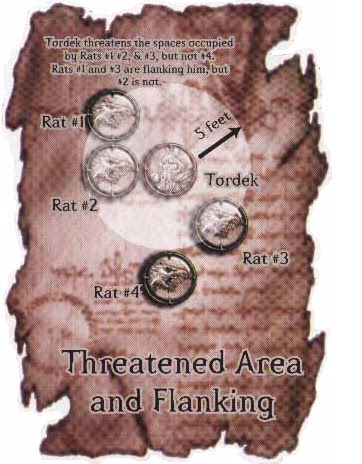
It isn't really until edition 3.5 that the rules begin to minimize the ability to be easily abstracted in the way earlier editions were.  While all the editions assumed miniatures use as a default setting, they were also easy to abstract.  Third edition attempted to keep this trend even though thinks like "threatening" and "flanking" -- both of which had real combat effects -- threw a little monkey wrench in the gears.  They tried to present these themes "abstractly" in the 3.0 PHB.


They quickly gave up on attempts to have "threatened area" and "flanking" be abstract when they created the 3.5 rulebook.  Once they produced that rule book, not only was the default assumption use of minis but the mechanics basically required them.  To not use minis was to abandon the benefits of a number of feats and tactical choices, or to limit those choices by subjecting them to "common sense, consensus, or fiat."  A system I attempted to use early in my 3.x experiences, but which quickly proved inadequate to my Champions and Battletech spoiled comrades.  They wanted clear display of their tactical choices, and who could blame them.  The 3.5 rule books certainly didn't.  


Fourth edition merely continued the trend of all earlier editions, with the use of the "threatening" ZoC.  What it added were layers of how to create additional opportunities for the ZoC to have effects.  It also added ZoCs to certain spells with the full articulation of ZoC spells for "controllers."  These are all things that were in the rules from the beginning of the game.

Early in the game, the rules were presented in Wargame terminology.  By 3rd Edition AD&D, they had become somewhat abstracted in presentation but were still deeply rooted in "threatened" effects.  So much so that the company felt the need to create a 3.5 edition of the game which specifically used miniatures to demonstrate how the combat rules work.  The difference was the use of language.  D&D by 3.5 had ceased using purely wargame language to describe combat effects, it had some of  its own concepts.  With the release of 4th edition, they returned to a use of wargame terminology and wargame style effects became implemented in more areas of the system.  By 4th edition, a game that had worked hard to feel less "game-ish" and more narrative had become, for some players, too game terminology oriented.  Players who used Wizards -- Controllers -- could feel the "game-ishness" of the system and it felt less narrative to them.

A part of this is because we don't have years upon years of stripping away the gamish stuff and substituting an array of cultural D&D rules mores to substitute for them.  Original D&D was as game-ish as 4e, every edition is actually as game-ish, but we had created short cuts and systems to eliminate those elements and go to the abstract.  In doing so, I think we actually neglected some of the real richness of the game.  We should celebrate the gamist pieces.  Use them.  Get used to them.  Once they become second nature, they become less "game-ish" and you can focus on the story.  The more you focus on ZoCs being annoying, when they've always been there but maybe you ignored them, the less you are enjoying a great game.

Every edition of D&D is great.  Let's hope they don't forget that with DNDNext.