WizKids/NECA announced yesterday that they will be producing games based on Star Trek intellectual properties. Their license includes television shows and movies and the WizKids products will be available in "digital" as well as physical formats.
WizKids will be adding the Star Trek characters to their existing line of Heroclix collectible miniatures games, which makes this both good news and bad news.
The good news is that there will be some cool minis, hopefully including the space ships, for Star Trek characters. The bad news is that they will have those clunky 1.5" miniatures bases that are slightly too big for the standard 1" format of most role playing games.
Hey WizKids! I want to buy your figures, but I want to use them in my Savage Worlds and Traveller games. I don't care for your collectible miniature game rules sets, but I do like the figures. How about hooking a gamer up?

Wednesday, June 09, 2010


Dr. Who to Star in Fright Night
It appears that David Tennant will be staring as the clueless "horror-jockey" Peter Vincent in the upcoming remake of the gen-X cult favorite 1980s "Dracula Next Door" film Fright Night. There is little doubt that Tennant will be able to capture a bumbling, tired, worn down, and sympathetic late-night weekend horror movie host -- a role that was captured perfectly by Roddy McDowell in the original.
What remains to be seen is if modern audiences, whose Saturday evenings are tragically free of Bob Wilkinsesque entertainment, will fully appreciate the character. Where the late night weekend television of gen-X and earlier featured wonderful horror host fare like "Creature Features," Count Gore, Joe Bob Briggs, the modern television schedule tends to lack colorful characters like these. I say tends to, because there are still some local channels that feature horror hosts, but characters like these were once ubiquitous.
Roddy McDowell's Peter Vincent was the strongest component of the original Fright Night, McDowell's brilliant combination of Peter Cushing and Peter Sellers in the portrayal of the part is remembered long after the particulars of the movie's narrative. The scene where Peter Vincent learns that faith matters and that things that go bump in the night aren't best combated by jaded performers, is one of the classic scenes in horror.
I am looking forward to this remake, but I do wonder how the film will resonate with younger audiences.
What remains to be seen is if modern audiences, whose Saturday evenings are tragically free of Bob Wilkinsesque entertainment, will fully appreciate the character. Where the late night weekend television of gen-X and earlier featured wonderful horror host fare like "Creature Features," Count Gore, Joe Bob Briggs, the modern television schedule tends to lack colorful characters like these. I say tends to, because there are still some local channels that feature horror hosts, but characters like these were once ubiquitous.
Roddy McDowell's Peter Vincent was the strongest component of the original Fright Night, McDowell's brilliant combination of Peter Cushing and Peter Sellers in the portrayal of the part is remembered long after the particulars of the movie's narrative. The scene where Peter Vincent learns that faith matters and that things that go bump in the night aren't best combated by jaded performers, is one of the classic scenes in horror.
I am looking forward to this remake, but I do wonder how the film will resonate with younger audiences.
Tuesday, June 01, 2010
Icons by Adamant Entertainment Available Today
When it comes to super hero game rules design, there are five names that are indicative of the highest quality -- and a deep work ethic. They are Greg Gorden, Ray Winninger, Jeff Grubb, Mike Selinker, and Steve Kenson. These are the designers who have created, or edited, the super hero games I play most often. George MacDonald, Steve Peterson, Bruce Harlick, Ray Greer, and Steven Long deserve mention for their work on Champions (the flag ship super hero RPG), but as important as that game is to the creation of the super hero RPG hobby I find myself playing other games more often.
Greg Gorden's rules set for DC Heroes -- especially after it was revised by Ray Winninger -- is what I consider to be the best super hero role playing game ever designed. It combines the effects based design philosophy of Champions with a focus on cinematic and quick play. Champions is a masterful game when it comes to character design, but it bogs down into a Star Fleet Battles variant when the players enter combat. DC Heroes allows for robust character design while allowing for abstract and narrative combat scenes that don't take up an entire evening. A descendant of his work on the Deadlands and Brave New World games systems can be seen in the Savage Worlds Necessary Evil setting.
Jeff Grubb's Marvel Super Heroes role playing game has a few flaws, like the fact that Captain America isn't a very effective character in those epic Avengers conflicts in the form the game has quantified him, but it is a quick playing game that is a wonderful introduction to the gaming hobby and that has enough source material to keep a gaming group playing for many years. The system is intuitive and its "Karma" system of experience ensures that players are encouraged to role play super heroes in a way that emulates the comics. In fact, Grubb's Karma system is one of the best uses of mechanics to influence play style ever invented.
Mike Selinker's Marvel Super Heroes Adventure Game (aka Marvel SAGA) uses card driven mechanics to resolve situations. While still a system of random task resolution, this card driven system empowers players to decide how much effort they want to put into a particular action. It's an ingenious system that solves the "Captain America/Batman" problem relatively easily.
Then there is Steve Kenson. Steve did something I thought was essentially impossible. He took the d20 mechanics of 3rd Edition Dungeons and Dragons and transformed them into a workable super hero role playing game-- by workable, I mean excellent. His ability to cut to the core of the d20 mechanics and eliminate almost everything that was extraneous resulted in a super hero game that allowed the character design specificity of Champions with some of the free form play of DC Heroes. His 1st edition design work on Mutants and Masterminds is nothing short of brilliant. The second edition of the game is still very good, but it features the return of some of the "flab" that Kenson cut from d20 to make it M&M and tilts a little more into the Champions side of the DC/Champions equation. Combat mechanics become a little to specific for me in the 2nd edition -- but I blame the fans.

Any time one of these creators works on a new system, especially a super hero system, it is news worthy. Kenson is currently at work on a new edition of M&M and an M&M DC RPG, but is also the author of a free wheeling indie super hero RPG that just went live on RPGNOW today. This game, ICONS, is a more free form role playing game than the more granular M&M. Icons has a rules set influenced by the very popular FATE game system. Icons also features a graphic style similar to the work of Bruce Timm, and the animated super hero cartoons of the 90s, as well as the work of Mike Parobeck.

I'll have a formal review of Icons soon, but graduate work prevents it today.
I will say this though. If Kenson's name is listed under "designers," then the game is likely a winner.
Greg Gorden's rules set for DC Heroes -- especially after it was revised by Ray Winninger -- is what I consider to be the best super hero role playing game ever designed. It combines the effects based design philosophy of Champions with a focus on cinematic and quick play. Champions is a masterful game when it comes to character design, but it bogs down into a Star Fleet Battles variant when the players enter combat. DC Heroes allows for robust character design while allowing for abstract and narrative combat scenes that don't take up an entire evening. A descendant of his work on the Deadlands and Brave New World games systems can be seen in the Savage Worlds Necessary Evil setting.
Jeff Grubb's Marvel Super Heroes role playing game has a few flaws, like the fact that Captain America isn't a very effective character in those epic Avengers conflicts in the form the game has quantified him, but it is a quick playing game that is a wonderful introduction to the gaming hobby and that has enough source material to keep a gaming group playing for many years. The system is intuitive and its "Karma" system of experience ensures that players are encouraged to role play super heroes in a way that emulates the comics. In fact, Grubb's Karma system is one of the best uses of mechanics to influence play style ever invented.
Mike Selinker's Marvel Super Heroes Adventure Game (aka Marvel SAGA) uses card driven mechanics to resolve situations. While still a system of random task resolution, this card driven system empowers players to decide how much effort they want to put into a particular action. It's an ingenious system that solves the "Captain America/Batman" problem relatively easily.
Then there is Steve Kenson. Steve did something I thought was essentially impossible. He took the d20 mechanics of 3rd Edition Dungeons and Dragons and transformed them into a workable super hero role playing game-- by workable, I mean excellent. His ability to cut to the core of the d20 mechanics and eliminate almost everything that was extraneous resulted in a super hero game that allowed the character design specificity of Champions with some of the free form play of DC Heroes. His 1st edition design work on Mutants and Masterminds is nothing short of brilliant. The second edition of the game is still very good, but it features the return of some of the "flab" that Kenson cut from d20 to make it M&M and tilts a little more into the Champions side of the DC/Champions equation. Combat mechanics become a little to specific for me in the 2nd edition -- but I blame the fans.

Any time one of these creators works on a new system, especially a super hero system, it is news worthy. Kenson is currently at work on a new edition of M&M and an M&M DC RPG, but is also the author of a free wheeling indie super hero RPG that just went live on RPGNOW today. This game, ICONS, is a more free form role playing game than the more granular M&M. Icons has a rules set influenced by the very popular FATE game system. Icons also features a graphic style similar to the work of Bruce Timm, and the animated super hero cartoons of the 90s, as well as the work of Mike Parobeck.

I'll have a formal review of Icons soon, but graduate work prevents it today.
I will say this though. If Kenson's name is listed under "designers," then the game is likely a winner.
Friday, May 28, 2010
Steve Jackson Games to Release OGRE 6th Edition Eventually

In 1977, Metagaming Concepts released the first game in their successful Microgames line of affordable war games -- it had a $2.95 cover price. The game had a reasonable print run of 8,000 copies and was a break out success that redefined the war gaming hobby by opening the door to new audiences of simulation game players. The game's second print run was 20,000. The game was among the first war games to have a science fiction theme, and it featured rules that were simple enough for someone who had never played a war game to pick up and play within minutes.
The game was titled OGRE and it was so successful a game that its sales fueled the development and growth of two hobby gaming corporations. The first company, Metagaming Concepts, fought hard to keep the intellectual property rights when the game's designer left the company to found his own company Steve Jackson Games. The lawsuit lasted for quite some time, but eventually the property followed its creator to its new home. By the time the game migrated over to Steve Jackson Games, it had sold approximately 70,000 copies (excluding the sales of its GEV expansion set).

The premise of OGRE is a simple one, but it is also one that captures the imagination. The OGRE referred to in the game is a cybernetic supertank that is attacking a human manned command center on a nuclear blasted battlefield. Inspired by Keith Laumer's Bolo series, Steve Jackson created a game where desperate -- and mortal -- defenders battle against the odds to preserve their fragile position against impossible odds. Though their forces significantly outnumber the OGRE, the supertank significantly outclasses them. The tone of the game can be readily seen in an article published in issue 9 of the venerable The Space Gamer magazine:
The command post was well guarded. It should have been. The hastily constructed, unlovely building was the nerve center for Paneuropean operations along a 700 kilometer section of front -- a front pressing steadily toward the largest Combine manufacturing center on the continent.
Therefore General DePaul had taken no chances. His command was located in the most defensible terrain available -- a battered chunk of gravel bounded on three sides by marsh and on the fourth by a river. The river was deep and wide; the swamp gluey and impassible. Nothing bigger than a rat could avoid detection by the icons scattered for 60 kilometers in every direction over land, swamp, and river surface. Even the air was finally secure; the enemy had expended at least 50 heavy missiles yesterday, leaving glowing holes over half the island, but none near the CP. The Combine's laser batteries had seen to that. Now that the jamscreen was up, nothing would get even that close. And scattered through the twilight were the bulky shapes of tanks and ground effect vehicles -- the elite 2033rd Armored, almost relaxed as they guarded a spot nothing could attack.
Inside the post, too, the mood was relaxed -- except at one monitor station, where a young lieutenant watched a computer map of the island. A light was blinking on the river. Orange: something was moving, out there where nothing should move. No heat. A stab at the keyboard called up a representation of the guardian unit...not that any should be out there, 30 kilometers away. None were. Whatever was out there was a stranger -- and it was actually in the river. A swimming animal? A man? Ridiculous.
The lieutenant spun a cursor, moving a dot of white light across the map and halting it on the orange spot with practiced ease. He hit another key, and an image appeared on the big screen...pitted ground, riverbank...and something else, something rising from the river like the conning tower of an old submarine, but he knew what it really was, he just couldn't place it...and then it moved. Not straight toward the camera icon, but almost. The lieutenant saw the "conning tower" cut a wake through the rushing water, bounce once, and begin to rise. A second before the whole shape was visible, he recognized it -- but for that second he was frozen. And so 30 men with their minds on other things were suddenly brought to heart-pounding alert, as the lieutenant's strangled gasp and the huge image on his screen gave the same warning...
OGRE!
Like the "Mayday!" on the Traveller role playing game box, this description has fired my imagination for years. The fear of the command post staff is palpable, but one can only truly understand their fear after playing the game. The OGRE is a killing machine that tears through defending infantry, ground effect vehicles, and heavy tanks alike. Sometimes one wonders if there is a way to stop the OGRE at all. Then one finds an "unbeatable" strategy that succeeds in defending a few command posts, only to find that the OGRE has adapted to the new strategies and once again exterminates those who stand in its way.
The original war game version of OGRE is a very strategically deep game, even more so when you add the Shockwave and GEV expansions, that has been printed in four "map and counter" editions and one Miniatures edition. The miniatures edition was printed in the 1990s and is a fun game, but I have always felt that it -- like the edition of Car Wars that came out at the beginning of this millennium -- was not the right direction for the game to go. I am certain the miniatures were profitable, and I believe that SJG should have made the miniatures game, but I think that SJG was wrong in thinking that the miniatures game had replaced the classic "map and counter" version of the game. It hadn't, not any more than Warhammer the role playing game replaced Warhammer the miniatures game. To be fair, SJG sold the games parallel in the 90s -- it wasn't until the early 00s that they marketed the miniatures game as a replacement. It just seems to me that OGRE's core strength is its accessibility, both in rules and in price point, and a miniatures game moves away from this strength.
OGRE has been on hiatus for a few years as SJG has focused the majority of their efforts on the wildly successful Munchkin card game. SJG has a history of focusing like a laser on their most successful titles while leaving less attention for other products.

But this year seems to be the year that SJG, after two years of excellent non-Munchkin offerings, is resurrecting the OGRE. The sixth edition of the game has components that fall somewhere between the map and counter game of old and the more recent miniatures game. This edition will feature "chipboard" playing pieces that the players construct for use in play. This is an approach that takes advantage of the cost savings of a "printed" rather than a "cast" product line, while having greater aesthetic appeal than looking at square counters bearing numbers.
I think it is the right direction for the game, and I hope that it is a successful venture for Steve Jackson Games.

I know that I am eagerly awaiting this edition and will proudly place it next to my OGRE/GEV boxed set, OGRE mini-game, OGRE Book (first and second editions), and OGRE Deluxe Edition (non-miniature) versions of the game.
If all goes well, I should be able to purchase and play the game at this year's GENCON -- though they don't include OGRE in their list of official releases yet.
Thursday, May 27, 2010
Wargaming School Renaissance -- Victory Point Games
Regular readers of this blog are well aware of the fact that I collect and play role playing and board games. My collection of each is quite large and ranges from the original D&D White Box by TSR to the recently released Old School Renaissance White Box by Brave Halfling Publishing on the role playing side, and a copy of Milton Bradley's Dogfight to Bucephelous Games Dogfight on the board game side.
What readers may not be aware of is the fact that I am also a fan of simulation war games as well. My collection currently includes the full line of Squad Leader boxed sets -- the precursor to Advanced Squad Leader (of which I don't own any sets) -- and a nice collection of issues of Strategy and Tactics and World at War among other things. My introduction to this particular market within the gaming hobby came in the early 80s when a friend named Christian Hunt introduced me to Steve Jackson's excellent mini-game Ogre which featured an artificially intelligent supertank crushing a small defensive force of human soldiers. The game was great fun, and it used all the classic components associated with the traditional war game -- i.e. hexagon maps, small 1/2" counters (hand or die cut depending on the game), and a Combat Results Table (or CRT). That game, with its small and easy to learn rules set, deeply ingrained an appreciation for how fun war games can be and made it possible for me to try out more complex rules sets -- though I must admit that I've yet to try Drang Nach Osten.
The vast majority of war games are time consuming affairs that take up a good deal of table space and require either familiarity with the underlying systems of a series of games, or the patience and time to read a complex rules set. This is one of the reasons there have been so many wargamers who play these games solitaire over the years. It can be hard to find someone else who had the time, energy, and interest to pour through pages of rules and who also spent the time futzing around with them enough that the two (or more) of you could just get straight to playing without one player having to teach the other the basics of the systems etc.
This "intimidation gap," particularly acute in monsters like Drang Nach Osten, is one of the reasons that I believe that Metagaming's line of mini-games (which started with Ogre) were so successful. They provided small, approachable, quick, and playable games that in turn gave players a substantive and robust gaming experience. A game like Ogre initially appears to have little strategic depth, but one quickly learns otherwise. In a way, the mini-game was the Eurogame before there was a Eurogame.
Recently, I had been lamenting the lack of a vibrant "mini-game" community of manufacturers. I believed, wrongly as it turns out, that there were few if any publishers selling games that offered depth of wargame experience with the compactness and playability of a mini-game or a Euro-game. I knew of Eurogames like Neuroshima Hex which were Euro-style games that approached the war game experience. I was even familiar with the Euro-influenced Card Driven Strategy war games available on the market -- ranging from Command and Colors to Paths of Glory. I was looking for a company more akin to Metagaming back in its heyday or Steve Jackson Games during its early years.
I didn't believe they existed.

Then I saw an advertisement for a new Independent French War Game Magazine called BATTLES -- published in English. That's right, a French magazine. The first issue of BATTLES contained a nice, playable, and quick wargame -- in contrast to the comparably monster games of Strategy and Tactics -- that had excellent quality components. The game was beautiful by war game standards...not to mention the magazine. BATTLES is a graphically amazing magazine that covers the war game hobby as a whole, rather than focusing on "in house" games as some other war game magazines do. But enough about BATTLES, or rather not enough but I'll save some comments for posts regarding the magazine, I want to talk about an American company that I found out about because of BATTLES.
You read that series of sentences correctly. I found out about an excellent American (Southern Californian in fact) game company by reading a French war game magazine (published in English). Talk about the world being flat!
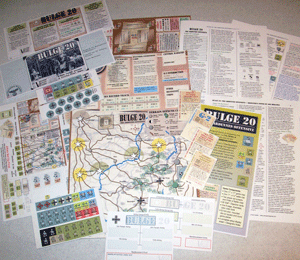
That game company is Victory Point Games and they operate out of Irvine, CA. The story of the game company's founding, and the Wild West nature of their product line/production schedule, are very reminiscent of all the qualities I admire about Metagaming and Steve Jackson. The company started as an extension of a college course, and has become something of a "community course" in game design. From their "About Us:"
A quick look through their website shows a deep catalog of games that appeal to the simulation gamer, with creations by well regarded creators like Jim Dunnigan, Joe Miranda, and Frank Chadwick, as well as light-hearted games that appeal to the casual gamer. Games like Forlorn Hope and Nemo's War address topics (space marines vs. aliens and Captain Nemo's world on the world's navies) that don't fit within the narrow confines of traditional wargaming.

What one will also find are blog entries discussing Victory Point Games' business model, and giving advice on how to design your own games the "victory point way."
These are games by gamers for gamers, but they aren't just games by gamers for "hardcore" gamers. These games are for both experienced and inexperienced gamers. You won't find any games that have "hundred" of die cut counters here. In fact, they have a whole line of games that feature no more than 20 counters used during play.

Everything about the company echoes Steve Jackson's early days -- before everything they made was Munchkin! Back in those days SJG produced games like One Page Bulge (which had one page of rules), Ogre, Car Wars, Undead, and Kung Fu 2100. The games were innovative and fun and made by people who obviously loved what they were doing. Add to this that SJG's house magazine The Space Gamer had a series of articles discussing the art of game design and you quickly see some parallels between the two entities.
Don't get me wrong. SJG is a great company. Their Frag Gold Edition is a wonderful, if overlooked by game stores, product. The same is true for their Revolution game -- and I am looking forward to owning copies of their new Zombie Dice and Cthulhu Dice games as well. In fact, I think that SJG has managed to recapture a bit of the creative spirit that was lost for a time as they focused on the best way to pay the bills. My point is that Victory Point Games behaves like SJG did when they were small and hungry.
Victory Point Games is indicative of a movement in wargaming similar to the "Old School Renaissance" movement in role playing. It's a movement of gamers who want to break from the current fads of gaming and introduce the world to a robust and vital hobby.
I'm all for it.
I am very excited about Victory Point Games offerings, and am looking forward to reviewing them as I'm playing them.
What readers may not be aware of is the fact that I am also a fan of simulation war games as well. My collection currently includes the full line of Squad Leader boxed sets -- the precursor to Advanced Squad Leader (of which I don't own any sets) -- and a nice collection of issues of Strategy and Tactics and World at War among other things. My introduction to this particular market within the gaming hobby came in the early 80s when a friend named Christian Hunt introduced me to Steve Jackson's excellent mini-game Ogre which featured an artificially intelligent supertank crushing a small defensive force of human soldiers. The game was great fun, and it used all the classic components associated with the traditional war game -- i.e. hexagon maps, small 1/2" counters (hand or die cut depending on the game), and a Combat Results Table (or CRT). That game, with its small and easy to learn rules set, deeply ingrained an appreciation for how fun war games can be and made it possible for me to try out more complex rules sets -- though I must admit that I've yet to try Drang Nach Osten.
The vast majority of war games are time consuming affairs that take up a good deal of table space and require either familiarity with the underlying systems of a series of games, or the patience and time to read a complex rules set. This is one of the reasons there have been so many wargamers who play these games solitaire over the years. It can be hard to find someone else who had the time, energy, and interest to pour through pages of rules and who also spent the time futzing around with them enough that the two (or more) of you could just get straight to playing without one player having to teach the other the basics of the systems etc.
This "intimidation gap," particularly acute in monsters like Drang Nach Osten, is one of the reasons that I believe that Metagaming's line of mini-games (which started with Ogre) were so successful. They provided small, approachable, quick, and playable games that in turn gave players a substantive and robust gaming experience. A game like Ogre initially appears to have little strategic depth, but one quickly learns otherwise. In a way, the mini-game was the Eurogame before there was a Eurogame.
Recently, I had been lamenting the lack of a vibrant "mini-game" community of manufacturers. I believed, wrongly as it turns out, that there were few if any publishers selling games that offered depth of wargame experience with the compactness and playability of a mini-game or a Euro-game. I knew of Eurogames like Neuroshima Hex which were Euro-style games that approached the war game experience. I was even familiar with the Euro-influenced Card Driven Strategy war games available on the market -- ranging from Command and Colors to Paths of Glory. I was looking for a company more akin to Metagaming back in its heyday or Steve Jackson Games during its early years.
I didn't believe they existed.

Then I saw an advertisement for a new Independent French War Game Magazine called BATTLES -- published in English. That's right, a French magazine. The first issue of BATTLES contained a nice, playable, and quick wargame -- in contrast to the comparably monster games of Strategy and Tactics -- that had excellent quality components. The game was beautiful by war game standards...not to mention the magazine. BATTLES is a graphically amazing magazine that covers the war game hobby as a whole, rather than focusing on "in house" games as some other war game magazines do. But enough about BATTLES, or rather not enough but I'll save some comments for posts regarding the magazine, I want to talk about an American company that I found out about because of BATTLES.
You read that series of sentences correctly. I found out about an excellent American (Southern Californian in fact) game company by reading a French war game magazine (published in English). Talk about the world being flat!

That game company is Victory Point Games and they operate out of Irvine, CA. The story of the game company's founding, and the Wild West nature of their product line/production schedule, are very reminiscent of all the qualities I admire about Metagaming and Steve Jackson. The company started as an extension of a college course, and has become something of a "community course" in game design. From their "About Us:"
Most great game ideas begin with an impassioned gamer thinking about a game and saying, “Wouldn’t it be cool if…?” That’s how the best game ideas occur – not from bottom-line watching bean counters, not from Sales or Marketing, not through scientific research – it is gamer passion that creates the best games.
Enter Alan Emrich, who was teaching various game-related subjects such as Game Design, Game Prototyping, and Game Project Management at The Art Institute of California: Orange County in 2007. An impassioned gamer himself, while teaching other impassioned gamers about the art, craft, and science of making games, he had one of those “Wouldn’t it be cool if…?” moments. Although he had been ‘designing game designers’ among his students for some time, the notion arrived as a culmination of thoughts coalesced.
Just as some genius at Reese’s figured out one day, “Hey, what if put the chocolate and peanut butter together?,” Alan blended the ideas of Desktop Publishing (DTP) with his students’ game projects. The seed of an idea for Victory Point Games was planted.
“Wouldn’t it be cool if,” Alan reasoned, “I could desktop publish a few copies of some of my students’ better course project games? That way, when they graduate and go find jobs in the game industry, they’ll have a published title to their credit and a copy of it in their portfolios. That would certainly be a plus on their resume and at job interviews. What a great graduation gift I could give them!” This became a notion that he had to pursue.
A quick look through their website shows a deep catalog of games that appeal to the simulation gamer, with creations by well regarded creators like Jim Dunnigan, Joe Miranda, and Frank Chadwick, as well as light-hearted games that appeal to the casual gamer. Games like Forlorn Hope and Nemo's War address topics (space marines vs. aliens and Captain Nemo's world on the world's navies) that don't fit within the narrow confines of traditional wargaming.

What one will also find are blog entries discussing Victory Point Games' business model, and giving advice on how to design your own games the "victory point way."
These are games by gamers for gamers, but they aren't just games by gamers for "hardcore" gamers. These games are for both experienced and inexperienced gamers. You won't find any games that have "hundred" of die cut counters here. In fact, they have a whole line of games that feature no more than 20 counters used during play.

Everything about the company echoes Steve Jackson's early days -- before everything they made was Munchkin! Back in those days SJG produced games like One Page Bulge (which had one page of rules), Ogre, Car Wars, Undead, and Kung Fu 2100. The games were innovative and fun and made by people who obviously loved what they were doing. Add to this that SJG's house magazine The Space Gamer had a series of articles discussing the art of game design and you quickly see some parallels between the two entities.
Don't get me wrong. SJG is a great company. Their Frag Gold Edition is a wonderful, if overlooked by game stores, product. The same is true for their Revolution game -- and I am looking forward to owning copies of their new Zombie Dice and Cthulhu Dice games as well. In fact, I think that SJG has managed to recapture a bit of the creative spirit that was lost for a time as they focused on the best way to pay the bills. My point is that Victory Point Games behaves like SJG did when they were small and hungry.
Victory Point Games is indicative of a movement in wargaming similar to the "Old School Renaissance" movement in role playing. It's a movement of gamers who want to break from the current fads of gaming and introduce the world to a robust and vital hobby.
I'm all for it.
I am very excited about Victory Point Games offerings, and am looking forward to reviewing them as I'm playing them.
Tuesday, May 25, 2010
Nuff Said: Shat My Dad Says
William Shatner...Nicole Sullivan...
I am almost bursting from the anticipation.
I am almost bursting from the anticipation.
Nuff Said: The Stars Are Right -- CthuLegos
Who knew that you could use Legos in your regular Call of Cthulhu rpg sessions?
Subscribe to:
Posts (Atom)