Raise your hand if you made stop motion action figure/lego figure movies, or dreamed of doing so, as a kid?

Thursday, May 20, 2010


Wednesday, May 19, 2010
Tuesday, May 18, 2010
The Invisible Gorrilla and Games -- Mystery Stories
In 1999, Daniel Simons did an experiment involving a person in a gorilla suit and people in different colored clothes passing a basketball to one another. The experiment was designed to see how we look at things and demonstrate how our perceptions can fail us. The basic finding of the experiment is that we fail to observe a lot of things that are going on around us, and that we have no idea that we are missing out on so much. Daniel Simons and Christopher Chabris have written a book called The Invisible Gorilla: And Other Ways Our Intuitions Deceive Us
 . Two of the things the book focuses on are how are intuitions often mislead us and how our perceptions aren't as keen as we believe them to be.
 "What does this have to do with games," you ask? Nothing and everything.
How many times have you been running a roleplaying game session in which you have laid clues for the players to discover which will help them to solve a mystery of some sort?
Sometimes the clues are embedded in your verbal descriptions of scenes and events, and sometimes they are placed on a battle mat for the players to find. The clues might even have been incorporated into dialogue role played out.
Of these times, how often have the players completely missed the clue due to focusing on other objects in your presentation?
Sometimes this can lead adventures into fun new directions. If the player's become convinced that the 12 year-old witness you were acting out in dialogue is so creepy that he must be a shapeshifted Goblin in disguise and the real reason the children of Vandomeer have been disappearing, it might be better to follow the player's lead and ignore the fact that you had placed several clues that it was the kind Cleric of Pelor who had been driven to despair after the death of his daughter and was looking for parts to construct a replacement. In a case like this, there is no reason to shoehorn the players into your planned story even though they missed your -- to you -- obvious clues. A good GM knows that the goal of play is to satisfy your player's desires and making their wild guesses into fact is a great way to achieve this goal.
Sadly, improper leaps to conclusions aren't the typical result of missed clues. The most common result is that the mystery grinds to a halt as the players "keep searching." In a game like D&D, or any other system where skill rolls determine the results of actions, this can amount to players "rolling again and again" or "taking 20" at each 5 foot square of a room with you having to notify them of what they did or didn't find. In a game that is looser and more "acted out," you have to decide whether to keep repeating the clues you have already shared or make up newer -- more obvious -- clues to give the players. Giving the players too obvious a clue after they failed to understand the initial clues can lead to some serious dissatisfaction by the players. They'll feel foolish for missing the initial clues, and railroaded by your new ultra-obvious clue.
Robin Laws' Gumshoe system tries to address these problems by having an underlying gaming assumption that the players will find the necessary clues automatically and lets them "spend points" in order to get more information from the clues. The system doesn't guarantee that the players will "solve" the mystery that you presented to them, it only means that they will actually find the clue, but it does increase the likelihood that their speculations might lead the adventure into another direction from what you originally planned.
In real life, it can be tragic when some real clue is missed or misinterpreted. In a roleplaying game missing a clue can bring a game to a boring halt, but misinterpreting a clue might lead to a better story. In real life, our intuitions deceive us and lead us into foolish actions, but in games our deceptive intuitions can lead us into entertaining experiences.
Sometimes you can exploit the deceptive intuitions of your players to assist you in constructing your adventures.
Do you have any stories where mysteries have bogged down or where deceptive intuitions have led to great adventures?
Thursday, May 13, 2010
Green Ronin, Mutants and Masterminds, and DC Adventures
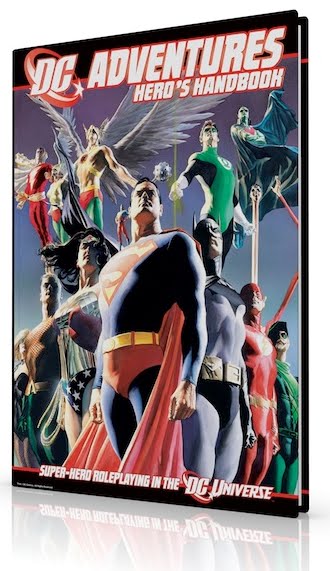
I quickly soured on those 2nd edition conversations as the system seemed to be migrating away from a DC Heroes influenced system into a Hero/Champions influenced system. Champions is a great game, but it can also intimidate new gamers and has certain exploits that hard core Hero gamers like to use. These kinds of exploits were being inserted into M&M and I wasn't as pleased as I had hoped. The game transformed from rules light to Champions light, and that was a step backwards in my opinion.
I still purchased all of the products. For all that I didn't like the mechanics of the game, the campaign advice and writing of Green Ronin products is among the best in the industry and I gladly support them. I merely had an "anti-granular" rules nag in the back of my mind every time I opened a text.
So when I read that Green Ronin was doing DC ala M&M, I have to admit that my fear was that it would be DC "Champions Light" and lack a fast and easy system that might appeal to new players -- one of the key reasons to acquire a license in the first place. This was particularly upsetting given Green Ronin's recently demonstrated commitment neophyte friendly games like their amazing Dragon Age and it's AGE System. In fact, I would love to see a DC AGE game.
My fears were somewhat allayed yesterday when I read a press release that Green Ronin was releasing a 3rd edition of Mutants and Masterminds. The key quote for me was "We worked to simplify some elements of the system and fix known issues, while retaining the flexibility and fast-paced play fans have enjoyed." If only they can accomplish what DC Heroes did so well, and M&M 2nd failed to do as well as M&M 1st, and present a system where Batman and Superman are able to adventure together in a manner where both are effective.
Whether I am ecstatic or not about the mechanics one thing is certain, I will be buying DC Adventures on day 1.
Wednesday, May 12, 2010
Fighting Fantasy and Fiend Folio Artist Russ Nicholson Starts Blog!

If you love Dark Creepers, Revenants, and the Githyanki, then Russ Nicholson is your man.
Axis of Awesome vs. Greyson97
Which is more remarkable?
Is the Axis of Awesome right in positing all pop songs use the same four chords?
Does knowledge of a "mere 4 chords" explain Greyson97?
Is the Axis of Awesome right in positing all pop songs use the same four chords?
Does knowledge of a "mere 4 chords" explain Greyson97?
Geekerati Gaming Archives Volume 1 -- Matt Forbeck Interview
In July of 2007, Geekerati Radio -- a podcast a few friends of mine and I ran for over two years -- had our first gaming related episode. It was our ninth episode overall and it featured an interview with Freelance Game Designer extraordinaire Matt Forbeck. Over the course of his career Matt has worked with most of the major game and toy companies -- from rpg games to toy design -- and has been nominated for 24 Origins awards and has won 13. His game designs have included miniatures rules for starship combat, dark future science fiction roleplaying games, bleak counterculture superhero rpgs, and the list goes on.
You can tell by the interview why Matt is called the nicest man in the gaming industry.
Last year in September the Geekerati show petered to a halt as we never got the listenership to justify the effort we were putting into the show. When you are interviewing Brandon Sanderson -- new author of the Wheel of Time series -- and you only get 4 "live" listeners (though the archive did quite well) it can be a bit disheartening. When you add a full time work schedule, MBA courses, attempts at a regular rpg gaming hobby, and twin toddlers to the mix it was becoming difficult to justify the time.
I loved the experience, and my co-hosts are great friends, and would like to do it again. But to do so will require some massive scheduling efforts and possibly some new co-hosts. Bill Cunningham, our mad pulp bastard, is hard at work promoting his own awesome pulp publishing company, Eric Lytle is keeping California safe from toxic chemicals, and Shawna Benson is striving toward fame and fortune.
Let me know if you think I should give it a go again, and in the meantime I'll be sharing the archives with you.
You can tell by the interview why Matt is called the nicest man in the gaming industry.

Last year in September the Geekerati show petered to a halt as we never got the listenership to justify the effort we were putting into the show. When you are interviewing Brandon Sanderson -- new author of the Wheel of Time series -- and you only get 4 "live" listeners (though the archive did quite well) it can be a bit disheartening. When you add a full time work schedule, MBA courses, attempts at a regular rpg gaming hobby, and twin toddlers to the mix it was becoming difficult to justify the time.
I loved the experience, and my co-hosts are great friends, and would like to do it again. But to do so will require some massive scheduling efforts and possibly some new co-hosts. Bill Cunningham, our mad pulp bastard, is hard at work promoting his own awesome pulp publishing company, Eric Lytle is keeping California safe from toxic chemicals, and Shawna Benson is striving toward fame and fortune.
Let me know if you think I should give it a go again, and in the meantime I'll be sharing the archives with you.
Subscribe to:
Posts (Atom)