Monday, February 01, 2010

The "Old School Revival" Makes Me Want to Go "Really Old School"


Over the past decade, in the shadow of WotC's Open Gaming License, there has been an explosion of DIY game design devoted to making new role playing game products inspired by and/or compatible with early editions of the Dungeons and Dragons game. Some of the games are merely trying to capture the "feel" of the old games and recapture some of the game playing nostalgia of the author's youth, others are attempts to fuse new design techniques with the simple ability to inspire the old games possessed.

This "movement" in itself is reminiscent of the nascent days of the role playing game industry when people were writing rpgs out of their basements, garages, and living rooms and didn't worry about getting enough revenue (either venture capital or revenue based on money received as compensation for selling a successful game company to a larger game company) to publish a "slick" product. Companies like Judge's Guild were in the marketplace selling creative, if not sufficiently edited, products that built on the excitement of a new hobby -- a hobby were game creation was "fun" and not so market driven.

It's fun reading the various Old School Revolution blogs like Greyhawk Grognard and Grognardia, or visiting the Dragonsfoot website. I've been so caught up by the OSR fever, that I purchased on of the Swords and Wizardry White Box boxed sets.

I manage to balance my RPG "news/study" time between keeping up with what's going on in the "Indie Narrative Gaming Verse," the OSR, and the modern industry fairly well. In fact, I'm proud of my ability to navigate through these three -- often very different -- waters. I am a proponent of the OSR, the narrative indie, and the ultra-corporate game. I will evangelize the wonders of My Life with Master at the same time as expounding the virtues of the 4th Edition of Dungeons and Dragons.

I was reading one of the OSR websites the other day and read the a statement similar to the following. "Why are we writing 'updates' or 'nostagia' versions rather than playing the actual old rules sets?" I don't remember where I read that, and the wording was different, but it got me thinking. I think there are a couple of answers.

First, those who think that "unsupported is dead" is nonsense, are delusional. Unsupported is certainly dead from a retailers point of view, they can't sell a product that isn't supported beyond a certain terminal limit. Unsupported is also dead from a consumer point of view. How many people are still running their first D&D campaign using only the Chainmail rules and the Little Brown Books? Not many. You can only read these books a certain number of times before you have memorized them. You can certainly expand on these books with house rules, and the games don't "require" more than these books to play, but gaming is a social endeavor. As such, gamers like to hear other gamers' ideas -- even if they don't/won't use them. Role playing games are about dialog. Dialog between the DM and Players, dialog between DM and manufacturer, and between DMs and other DMs. Some of this dialog breaks down when a game is no longer supported in its existing form. Thankfully, the internet -- and the Open Gaming License -- allows almost anyone to become the "manufacturer" (within the limits of the OGL). This is where the OSR shines, it restores the interaction between manufacturer and DM/Gamer. Dialog feeds creativity, silence starves it. When a publisher supports a game with printed material, they are participating in the dialog. When they stop the dialog has traditionally narrowed, but the OGL allows for a continuation of the game dialog that didn't exist before.

But and expansion of "manufacturers" means an expansion of published ideas of what the game is at its core. This requires new editions/rules sets. Which leads to my second point. The new creators are creative and want to leave their mark on the hobby, this is a good thing -- but it takes us away from the original rules.


Lastly, the Chainmail rule book and original Little Brown Books of D&D are not very clear when it comes to explaining the game and how to play it. I cut my role playing gamer teeth on the Moldvay Basic and Cook/Marsh Expert editions of the D&D role playing game. These sets had artwork by Jeff Dee, Erol Otis, and Bill Willingham that was the perfect combination of cartoony and fantastic to inspire my young imagination. They also had clearly written and easy to understand descriptions of how to play the game. If I didn't have the mental structure created by years of playing these, and later editions, of D&D -- and a good deal of Warhammer -- I would not be able to play D&D based on the "first four" books without doing some significant design work on my own. When one reads the original books, it becomes readily apparent why Ken St. Andre quickly drafted his own rpg Tunnels and Trolls as a response. Original D&D is difficult to understand, and newer rulebooks written more clearly -- like the Moldvay/Cook edition or the Holmes edition -- are still a much needed commodity. This is true even if your intention is to play Original D&D, especially true of you want to bring new gamers into the hobby.

This rant/ramble has inspired me to do something. It has been a while since I read Chainmail and the Little Brown Books. I think I want to see if I can read them, "understand" them, and present them in a clearer format. Over the next few months, I will be attempting to create a Beginner's version of the first role playing game. I don't think I'll publish it online or anything, though I'll likely share it if I am satisfied with it. I will try to create the game as it is "described" and not as I "now know" how it is played. I'll start with Chainmail and then work my way up.

I think I'll call the series, "How to play..."

Oh, and don't worry, I will get back to Northwest Smith later this week.

Thursday, January 28, 2010

Expanding James Maliszewski's "To Roll 20" D&D Combat System


Over at his absolutely must read "in praise of Old School RPG gaming" site Grognardia today, James Maliszewski takes on one of the typical myths regarding the complexity of the original AD&D and D&D games. Many people believe that you absolutely need the combat matrices on pages 74 and 75 of the Dungeon Master's Guide in order to run combat, and that continually looking at those charts can diminish the verisimilitude (to use a Gygaxian term) of the role playing experience.

In response to this criticism, James -- who has worked on the excellent "new school" games Colonial Gothic and Thousand Suns -- shares the chartless system he uses in his home campaign Dwimmermount. He describes the system as follows:

when a monster attacks, I roll a D20, and add the monster's Hit Dice and the target's (descending) armor class to the result of the dice roll. If the sum is 20 or more, the attack is successful. This system is simple and quick and I don't need to consult any charts.


What James has done here, and it is mildly ingenious, is to deconstruct the old THACO system that was introduced late in the 1st edition. Essentially, under the THACO system each player wrote down a number that represented how high that player needed to roll on a d20 (after modifiers were added) for their character to hit Armor Class (AC) zero -- THACO stood for To Hit AC 0. Using the old THACO system, the player essentially ran the following subroutine:

  1. Roll d20 + Attribute Bonuses + Item Bonuses
  2. Get total.
  3. Subtract total from THACO.
  4. Result is AC you hit


The subroutine created what can only be described as a seesawing of arithmetic. First you add and get a result, then you subtract, and finally you compare that to a target number -- your THACO. It was a clumsy system, but it was better than the charts and became the basis for the 2nd edition combat system.

James has taken that seesawing subroutine and made it a one sided equation. It's fairly elegant.

  1. Roll d20 + Attribute Bonuses + Item Bonuses + Opponents AC
  2. Compare result to Target Number of 20


The system has the same mathematical effect as the THACO system, but adds a layer of elegance by putting all the arithmetic at the beginning of the process -- a negative AC would be a negative modifier to the initial roll.

On his site, James has included the chart for Fighting Men that he uses in his campaign. I don't know what chart James used to base his chart on, but I have calculated the "To Roll 20" bonuses for the character classes based on the charts in the old DMG.


I would like to mention one small thing when using these charts. James' "To Roll 20" system does make it slightly more difficult to hit certain armor classes than the charts on page 74 would normally be. For example:

Kin Rathslayer is a 7th Level Fighter with a +1 Longsword and a 17 Strength. Due to his weapon and Strength, Kin gets a +2 total attribute and item bonus to hit. He decides to attack Theodore Dudek "villainous rogue" who has an Armor Class of -8 due to equipment, attributes, and armor.

Using the chart on page 74 of the DMG, Kin would need to roll a 20 -- excluding his +2 bonuses -- to hit Theodore. With his bonuses, Kin needs to roll an 18. Kin has a 15% chance to hit Theodore and take the crown of "King of RPGs."

Using the "To Roll 20" system, Kin would roll d20 +6 (level bonus) +1 (weapon bonus) + 1 (strength bonus) - 8 for Theodore's AC. Kin needs to roll a natural 20 in order to hit Theodore. He has only a 5% chance of success.


This slight drawback occurs in the regular THACO system as well, and is due to the fact that on the charts each character class can hit multiple ACs on a roll of 20. For example, a 7th level fighter hits AC -6 through -10 with a total of 20. All four of those ACs have an equal chance of being hit by the fighter. A 4th level fighter hits AC -2 through -7 on a total of 20 on the DMG chart on page 74. The THACO and "To Roll 20" systems remove this long tail effect and substitute a much needed ease of play to the system. The statistics work out differently than the charts -- more for the non-fighter classes than for the fighter -- but the dividends in ease of play more than make up for that drawback.

Were I to run a 1st edition game, I would certainly use James' "To Roll 20" system and mock those who think that AD&D requires charts to determine if you hit your opponent. At least I would if I could figure out how the initiative rules actually work when using speed factors and weapon sizes.

Wednesday, January 27, 2010

If You Could Play Casual Video Games on Demand Through Your TV, Would You?


According to Interactive TV Today, TAG Networks has been market testing a Video Game on Demand channel in cooperation with Oceanic Time Warner (the Hawaiian arm of Time Warner Cable). They launched the effort in 2008 and are now contemplating expanding the offering to other markets.

Owners of the current generation of console gaming systems can currently purchase games for download through their consoles, a system similar to traditional pay-per-view on demand sales, but it appears that TAG Networks system works more like Netflix on Demand, Stars on Demand, or USA on Demand. Your television remote control is your game system controller. ITVT reports, "TAG, which is ad-supported and available to all Oceanic Time Warner Cable's digital subscribers, allows viewers to use their remotes to play a range of casual games, including branded games such as "Bejeweled 2," "Tetris," "Diner Dash" and "Barney," and classic games such as Texas Hold'Em, Sudoku and Checkers. The channel, which also offers community features, including multiplayer gaming across households and high scores, is powered by a platform for which TAG Networks has filed nine patents to date."

Ad supported on demand gaming through your television sounds pretty interesting, and the offerings are good for the casual gamer )a large segment of the gaming population), but what about the console rpg player or real time strategy gamer?

There are a couple of games that look like they might appeal to the geek in me. In particular "Seven Seas" and "Mummy Maze." Both are casual games, but they share some aesthetic qualities with some games I have enjoyed in the past. "Seven Seas" looks a little like the classic "Sid Meier's Pirates" game and "Mummy Maze" shares some visual qualities with "Gauntlet" -- though it doesn't look like it shares many game play elements with that classic game. I hope that Game Table Online is looking at this channel and looking for ways to get their robust and deep game catalog into an interface like this. I would live to play Axis and Allies or Nuclear War while sitting at my couch.


Looking at the games a little more, and thinking about the possibility of further development in the social/community functionality offerings, a thought suddenly comes to me. While using a TV remote may not be the best way to play a real time strategy game, or an action rpg like Dragon Age, it might be a great way to play a turn based and game mastered role playing game.

When Wizards of the Coast launched the 4th Edition of Dungeons and Dragons, they heavily promoted something they called the "Virtual Game Table" which would allow people to run D&D games through via the internet. The DM would create a scenario using a scenario editing tool, and the players would interface with the dungeon through their individual computers. There are currently a few good remote gaming software packages available, so Wizards' offering would have had to have offered additional functionality and graphics capability that the current software lacks. This was one of the reasons the product failed, that and a fear that D&D 4e was trying to kill the actual table top experience (not a completely irrational fear in the gaming community).

I wonder if TAG Networks technology could be used to create an interactive household to household "television top" role playing game experience. I have friends that live across the country who I'd like to game with and gaming while sitting on the couch holding a TV remote would be more "comfortable" than sitting at my computer desk at the keyboard and mouse -- at least for me. Creating adventures might be a pain, but I think the play experience could be worth while. It also might be a way to introduce new gamers to the marketplace as the "social" interface might allow others to watch an ongoing game (say one that wasn't classified as private by the players).

It wouldn't replace the table top experience, anyone who has played face to face table top rpgs knows that they are a unique experience, but they might help expand the gaming hobby as a whole.

What do you think? Would you play casual games? Would you play rpgs? Other games?

Monday, January 25, 2010

The Street Master: Evangelizing Role Playing Games Without Dispelling Stereotypes


I have recently been frequenting the King of RPGs blog -- a blog used to promote gaming and the new King of RPGs Manga by Jason Thompson and Victor Hao. For the past few weeks, I've been deliberating whether or not to purchase the manga. After finally taking the time to view their Street Master video, I decided to take the plunge and order the book on Amazon today.

Before I get into the premise of the manga, I thought I would share the premise of the Street Master, share the first Street Master video, and tell you why this strange occurrence tipped the scales and goaded me into purchasing King of RPGs.

The Street Master is a mysterious individual who wanders Modern Post-Apocalyptic America in the pursuit of sharing the glory of role playing games with the world. Only role playing games can save us from the cultural (and entertainment) malaise currently overwhelming society. The Street Master sets up D&D games on street corners in random cities and evangelizes the entertainment merits of role playing games by recruiting passers by into spontaneous sessions of gaming fun.

I think that this is an ingenious way to share our hobby with the world at large and wish more people would set up random role playing game sessions with the sole desire of sharing a fun time with complete strangers and spreading the word about this wonderful entertainment medium. I don't necessarily recommend spreading the word by dressing up in Necromantic Sorcerer garb like the Street Master, that doesn't really help dismiss stereotypes, though it might be interesting if there were suddenly multiple Street Masters running games in multiple cities at the same time.

Regardless of the outfit, the gaming hobby desperately needs more advocates like the Street Master.


There are a couple of things that happen in this video that prompted me to buy the King of RPGs manga.

First, it's pretty obvious that the Street Master is Theo Dudek (the main character of King of RPGs) in disguise. Those nasty rumors that the Street Master is Jason Thompson obviously ignore the fact that Jason has horribly slandered Theo Dudek in print, and that his wearing of a d20 necklace would constitute mockery of the highest degree.

Second, if the comic book exhibits anywhere close to the sense of humor it would take to initiate an endeavor like the Street Master, it will be an entertaining diversion.

Third, the Street Master uses Gaming Paper in the promotion of our hobby. The folks at gaming paper are also wonderful advocates for the gaming hobby, and anyone who supports them deserves a second look.

Fourth, the Street Master says something that I am quickly going to turn into my gaming mantra -- even though it is humorously ironic.

"There are no limits in role playing games! ...Except the Rules!"


I want to add that there has been a minor kerfuffle regarding King of RPGs and viral marketing in the RPG Bloggers Network. I'll write a post with my opinions on that soon.

What do you think are the best ways to evangelize our hobby and expand the number of gamers playing role playing games?

Friday, January 22, 2010

Season of the Witch (2010) -- Nicolas Cage Gets Medieval on Us

Man, I love Nicolas Cage. I may not enjoy every movie he star in, but the man doesn't seem to be ashamed to star in movies aimed at geek culture. Bangkok Dangerous may have been less dynamic than I had hoped, and I can nitpick about Ghost Rider all day, but Cage keeps coming out in projects that seem specifically tailored to the kind of movie I want to see in theaters.

The upcoming Harry Dresden Sorcerer's Apprentice film by Disney looks like fun, and so does Season of the Witch.

Hero Press provides the synopsis from the press release.

"His faith broken by years of battle as a crusader, [medieval knight] Behmen (Nicolas Cage) returns to central Europe to find his homeland decimated by the Black Plague.

"While searching for food and supplies at the Palace at Marburg, Behmen and his trusted companion, Felson (Ron Perlman), are apprehended and ordered by the dying Cardinal to deliver a young peasant girl believed to be the witch responsible for the Plague to a remote abbey where her powers can be destroyed.

"Behmen agrees to the assignment but only if the peasant girl is granted a fair trial.

"As he and five others set off on this dangerous journey, they realize with mounting dread that the cunning girl is no ordinary human and that their mission will pit them against an evil that even in these dark times they never could have imagined."


Looks like they are taking a little from Seventh Seal and mixing it with a little Ivanhoe adding a dash of Brotherhood of the Wolf and a dollop of Christopher Lee.

What more could one ask for?

Right, that it is better than In the Name of the King or The Knights of Bloodsteel.

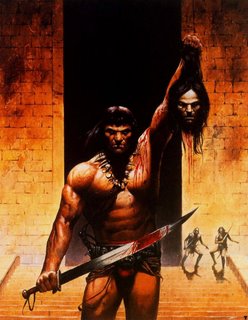
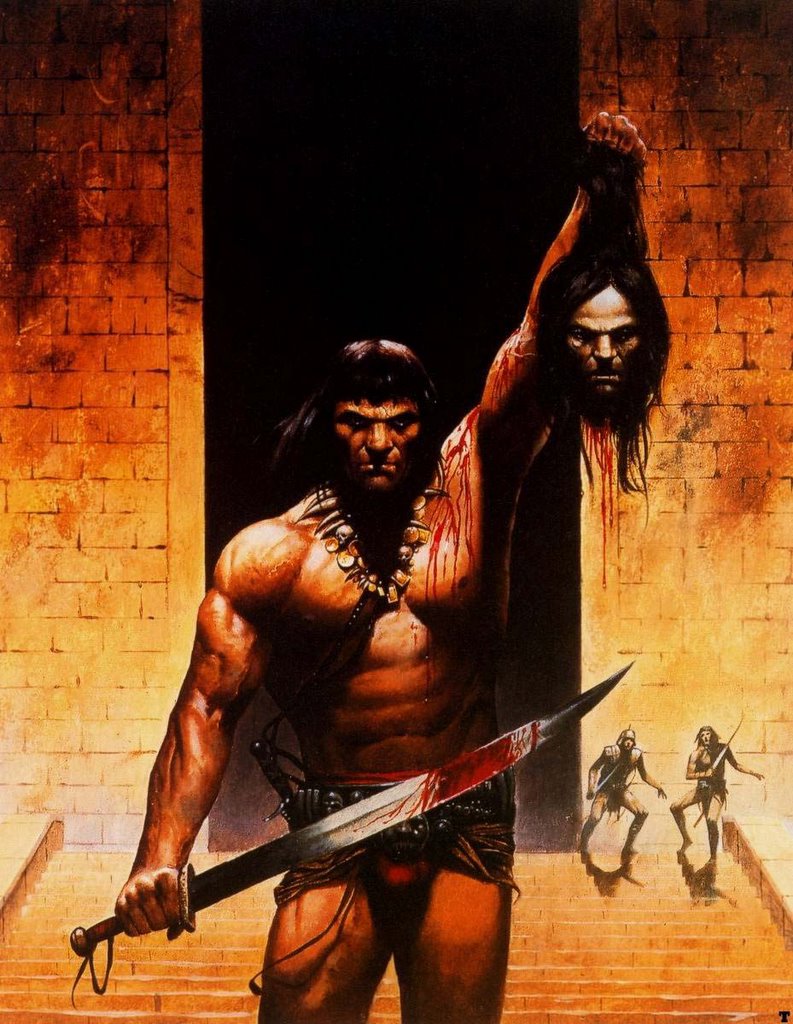
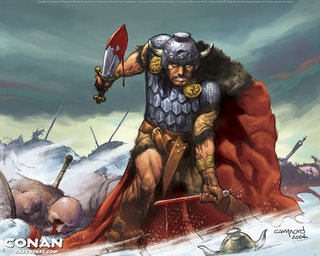
Remembering Robert E Howard on the 104th Anniversary of His Birth


In October of 2007, I wrote a post discussing the why Conan was still a resonant character for the modern reader. The character live in the psyche of the popular culture consciousness in a way that few other characters do. People who have never read a Sword and Sorcery tale, let alone a Howard tale, can provide some rough description of the character. That description may be reductive, but it will be a good rough sketch.

Since today is Howard's birthday, and because I think the post itself is a strong one that I don't think I can really improve upon, I have decided to reprint the article. I am only leaving out a preamble that discusses the Conan related products that were "recently" added to the marketplace. If you want to see a the prefatory paragraph and a list of the products, please feel free to read the original post as linked above.

I would like to make one brief comment before republishing the article proper.

In the original post, I wrote that both Herodotus and Plutarch wrote of the Cimmerian peoples, and that Howard's description of Conan's people fits nicely with those representations -- thus demonstrating Howard's seriousness in creating the world of Hyboria. The link to the classical history gives a kind of mythic historical weight to Howard's world that some other pre-historical Sword and Sorcery tales lack.

I wrote of the connection before I read Lin Carter's Golden Cities, Far. In the introduction to that book Lin Carter writes of the imaginary kingdoms that have appeared throughout fantastic fiction. Among these imaginary kingdoms, Carter includes the land of the Cimmerians. As Carter puts it:

The land of the Cimmerians was also popular. It was usually up on top of Scythia, or way over beside Hyperborea, or on the shores of the Frozen Sea. The Cimmerians -- who turned up in the 20th century in Robert E. Howard's popular stories of Conan the Barbarian -- were actually made up by old blind Homer. He seems to have invented them by getting the Welsh Cymry tribes confused with an obscure pack of nomads called the Gimri. As the Gimri were supposed to dwell north of the Black Sea, Homer and later writers assigned the imaginary nation of Cimmeria to that general region

Carter cites no authority for Homer's "invention" -- and even assuming that Homer is a single person is now viewed with skepticism -- rather in typical Carterian fashion, he provides opinion as knowledge. It is often entertaining, or sometimes enlightening, opinion, but opinion none the less. Even were it true that Homer created the classical understanding of Cimmeria, and thus provided the background for Plutarch's and Herodotus' later descriptions of the Cimmerians, it is of little consequence to my larger point. The fact that Howard's Cimmerians echo the Cimmerians of Plutarch and Herodotus is what gives them texture and realism, life if you will, that would be lacking without the context. Howard's research and intentionality shine through.

Patrice Louinet provides a nice discussion of the connections between Howard's description of Cimmeria and that of a number of historians/mythologists. In particular Louinet brings up Bullfinch's discussion of the link between Cambria, the Cymri, and the Cimmerians -- and quotes Howard (in a letter to Lovecraft) demonstrating that he willfully selected the semi-Celtic origin rather than a German or other European origin.


Now, on to the piece proper.


What's So Special About Conan?

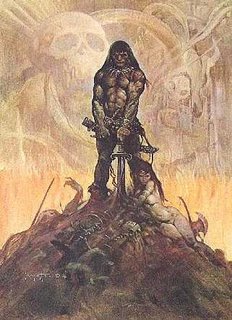
In today's USA Today, Mike Snider writes about Conan's reemergence as a relevant subject in popular culture (hat tip to SF Signal for the story). There are those of us who comment about poplar culture who think that Conan has never been an irrelevant figure in society. How can a character who codified an entire literary genre become truly irrelevant? Every story about a sword wielding barbarian, no matter how trite or bad, is at some level inspired by Robert E. Howard's creation.

Conan is always lurking in the pop culture subconscious and I think that we do a disservice to Conan fans, both existent and emerging when we use Arnold Schwarzenegger as the archetypal Conan representation, as Snider appears to do in the article. Some like Arnold as archetype, but I find Conan to be one of the most underestimated characters in American literature (with Natty Bumpo being a close second) and the Governator's portrayal -- while fun -- lacks the depth the character actually has as a literary figure.

When it comes to depictions of unreflective low art, one need look no further than the commonly perceived opinions of Robert Howard's Conan stories. If you ask the average man on the street to describe a Conan narrative, you will likely be given a tale of lust and violence. In the tale Conan will rescue some half-naked maiden from some rampaging beast and the story will end with the woman becoming all naked as she swoons at the hero's feet. In fact, a great deal of Conan pastiche has been based on this very simple formula. The largest problem with such a vision is that it is not all that accurate. Are there tales of this sort in the Conan oeuvre? Sure, but there are also tales of visionary wonder.


Like most authors, whether they write literature or Literature, Howard's writings reflect his own thoughts, experiences, and education. The writing reflects the aesthetic tastes of the author, or his/her understanding of a prospective audiences literary tastes. What makes something worth reading again and again is when an author satisfies those with "lower" tastes while providing them with some food for thought. Howard is no exception. In fact, I was surprised while I was rereading the first published Conan story, Howard's The Phoenix on the Sword to find that the author seemed to be hinting at a theory of the value of literature and its role in society.

Howard's Hyborean Age is a mythic world filled with magic and wonder, but it is also a world based on the history of the real world. Howard combined multiple eras of history so that societies whose "real world" existence is separated by centuries could co-exist narratively. Conan's own people, the Cimmerians, are based on a very real historical peoples. Both Herodotus, in his Histories, and Plutarch, in his Lives, mention the Cimmerian peoples (called Cimbri in Plutarch). In The Phoenix on the Sword, Howard appears to expect his audience to have at least a little understanding of the historical Cimmerians in his conversation of the role of literature in civilization. Conan, as protagonist, must hold ideas which the reader sympathizes with for the particular narrative of Phoenix to work.

So what kind of people were the Cimmerians? According to Plutarch they were a people who were pillagers and raiders, but not rulers.

For the Cimmerian attack upon Ionia, which was earlier than Croesus, was not a conquest of the cities, but only an inroad for plundering.
Herodotus, Histories, I, 6


What did they look like? According to Plutarch:

Their great height, their black eyes and their name, Cimbri, which the Germans use for brigands, led us merely to suppose that they were one of those races of Germania who lived on the shores of the Western Ocean. Others say that the huge expanse of Celtica stretches from the outer sea and the western regions to the Palus Maeotis and borders on Asian Scythia; that these two neighbouring nations joined forces and left their land... And although each people had a different name, their army was collectively called Celto-Scythian. According to others, some of the Cimmerians, who were the first-to be known to the ancient Greeks... took flight and were driven from their land by the Scythians. Plutarch, Life of Marius, XI


What was their temperament? According to Homer:

Thus she brought us to the deep-Rowing River of Ocean and the frontiers of the world, where the fog-bound Cimmerians live in the City of Perpetual Mist. When the bright Sun climbs the sky and puts the stars to flight, no ray from him can penetrate to them, nor can he see them as he drops from heaven and sinks once more to the earth. For dreadful night has spread her mantle over the heads of that unhappy folk. Homer, Odyssey, XI, 14


It is Homer's description of the Cimmerians that Howard uses in Phoenix to describe the mood of the people and to separate Conan from his kin. When Conan is asked why the Cimmerians are such a brooding people, Conan responds:

“Perhaps it’s the land they live in,” answered the king. “A gloomier land never was – all of hills, darkly wooded, under skies nearly always gray, with winds moaning drearily down the valleys.” – Phoenix on the Sword

The average Cimmerian is a dour and towering barbarian who destroys civilization then returns to his gloomy homeland only to begin the process again later. Howard's typical Cimmerian is similar to that of the classical scholars, and presents a figure most unlikely to advance the literary arts. But this is where Conan differs from his kin. In The Phoenix on the Sword, Conan is an older man who has conquered on of the greatest nations of the Hyborean Age expressly to free them from tyrannical rule. He conquered to rule, and to liberate an oppressed nation. A far cry from the typical barbarian. By separating Conan from his kin, Howard simultaneously increases the audience's sympathy for the barbarian king while enabling the character to advance a theory of the value of literature.

The Phoenix on the Sword is the tale of a plot to assassinate King Conan, a plot organized my a Machiavellian figure named Ascalante who desires to assume the throne. Ascalante is the product of civilization, but he is the antagonist of the story and so Howard uses his opinions of the Arts as a way to separate him from the audience's sympathy. When he describes a poet who has been brought into his conspiracy he describes the poet in pejorative terms. These terms evolve as the narrative moves from unpublished draft to final published form. Ascalante originally expresses his disdain for Rinaldo (the poet) in a long description:
“Rinaldo – a mad poet full of hare-brained visions and out-worn chivalry. A prime favorite with the people because of his songs which tear out their heart-strings. He is our best bid for popularity.” – Ascalante in Phoenix on the Sword (unpublished First submitted draft)


By the time the story is published the description is changed to the very brief, "“…Rinaldo, the hair-brained minstrel.” [Ascalante in Phoenix on the Sword(published)]. In the published form, Howard leaves out the value of Rinaldo's participation in the plot because it is redundant with information presented later in the story. When Ascalante is asked what value Rinaldo has as a conspirator, Ascalante's response is similar in both the published and unpublished text, but his hatred of Rinaldo is made more clear in the draft than in the published text:

“Alone of us all, Rinaldo has no personal ambition. He sees in Conan a red-handed, rough-footed barbarian who came out of the north to plunder a civilized land. He idealizes the king whom Conan killed to get the crown, remembering only that he occasionally patronized the arts, and forgetting the evils of his reign, and he is making the people forget. Already they openly sing The Lament for the King in which Rinaldo lauds the sainted villain and denounces Conan as ‘that black-hearted savage from the abyss.’ Conan laughs, but the people snarl.” – Ascalante in Phoenix on the Sword (published)

“Rinaldo – bah! I despise the man and admire him at the same time. He is your true idealist. Alone of us all he has no personal ambition. He sees in Conan a red-handed, rough-footed barbarian who came out of the north to plunder a peaceful land. He thinks he sees barbarism triumphing over culture. He already idealizes the king Conan killed, forgetting the rogue’s real nature, remembering only that he occasionally patronized the arts, and forgetting the evils under which the land groaned during his reign, and he is making the people forget. Already they open sing ‘The Lament for the King’ in which Rinaldo lauds the saintly villain, and denounces Conan as ‘that black-hearted savage from the abyss.’ Conan laughs, but at the same time wonders why the people are turning against him.” – Ascalante in Phoenix on the Sword (unpublished First submitted draft)


In both descriptions the poet is shown to be a blind idealist. Rinaldo, it appears, cannot look beyond the Cimmerian stereotypes as presented by Plutarch and Herodotus. Howard doesn't require the reader to have those preconceptions, but for the reader who has read Herodotus and Plutarch the stereotype becomes even clearer. Also by editing down the prose the author, either willingly or at editorial command, displays an amount of trust that his audience can reach the proper conclusion that barbarism typically destroys the valuable within civilization. What is interesting is that while Rinaldo is a conspirator, the poet is an antagonist, he is not a villain. He is a blind a foolish idealist, not acting in his own self interest. Ascalante even goes on to describe Rinaldo's motivations:

“Poets always hate those in power. To them perfection is always just behind the last corner, or beyond the next. They escape the present in dreams of the past and future. Rinaldo is a flaming torch of idealism, rising, as he thinks, to overthrow a tyrant and liberate the people.” – Ascalante in Phoenix on the Sword (published)

“Because he is a poet. Poets always hate those in power. To them perfection is always just behind the last corner or beyond the next. They escape the present in dreams of the past and the future. Rinaldo is a flaming torch of idealism and he sees himself as a hero, a stainless knight – which after all he is! – rising to overthrow the tyrant and liberate the people.” – Ascalante in Phoenix on the Sword (unpublished First submitted draft)


Ascalante specifies what kind of idealists poets are. They seek an imagined perfect society, and will always look for it no matter how good the society they are currently in happens to be. But this is Ascalante, the Machiavellian civilized man, and his opinion about what the value of the poet is. For him the poet is an easily manipulable puppet. What about the barbarian turned king, the protagonist, and oft argued proxy for the author? (It should be noted that many argue that Conan often reflects Howard's own views, this is not an original assertion on my part.)

Conan adores the poet, and understands the criticisms. He is aware that the poet's plays are leading many among the people to despise him, but he too is persuaded of the need for justice. When his chief adviser, Prospero, discusses disdain for Rinaldo, Conan comes to the poet's (and poetry in general) defense. The text is near identical in the published and unpublished format.

“Rinaldo is largely responsible,” answered Prospero, drawing up his sword-belt another notch. “He sings songs that make men mad. Hang him in his jester’s garb to the highest tower in the city. Let him make rhymes for the vultures.”
“No, Prospero, he’s beyond my reach. A great poet is greater than any king. His songs are mightier than my scepter, for he has hear ripped the heart from my breast when he chose to sing for me. I will die and be forgotten, but Rinaldo’s songs will live forever.” – Phoenix on the Sword (unpublished first submitted draft)

“Rinaldo is largely responsible,” answered Prospero, drawing up his sword-belt another notch. “He sings songs that make men mad. Hang him in his jester’s garb to the highest tower in the city. Let him make rimes for the vultures.”
“No, Prospero, he’s beyond my reach. A great poet is greater than any king. His songs are mightier than my scepter; for he has near ripped the heart from my breast when he chose to sing for me. I shall die and be forgotten, but Rinaldo’s songs will live for ever.” – Phoenix on the Sword (published)


For Conan, the atypical Cimmerian, poems and the arts have more power than weapons or royal authority. Not only that, but it is right and just that this is the case. Conan, the barbarian, is the defender of the value of literature, while Ascalante, the civilized man, sees literature as only a tool used to manipulate the foolish. Conan would seek to discuss the past and future, the ideal ones, with the poet, while Ascalante would merely use Rinaldo to destroy what he opposes. Conan's conflict between desiring a free press and swift justice, and the eventual melee that will result because of his favoring of the press, are made clear in the poetic prologue to the final chapter of the narrative.


What do I know of cultured ways, the gilt, the craft and the lie?
I, who was born in a naked land and bred in the open sky.
The subtle tongue, the sophist guile, they fail when the broadswords sing;
Rush in and die, dogs – I was a man before I was a king. – The Road of Kings Phoenix on the Sword (published)


Surprisingly, Conan's love of literature and the arts, and his defense of them, is so deeply rooted that he initially refuses to kill Rinaldo when Rinaldo attacks him. He still believes he can reason with the poet, it is only when he is left no other alternative that he kills the poet (the text is identical in both published and unpublished forms).


“He rushed in, hacking madly, but Conan, recognizing him, shattered his sword with a short terrific chop and with a powerful push of his open hand sent him reeling to the floor.” – Phoenix on the Sword (published)

“He straightened to meet the maddened rush of Rinaldo, who charged in wild and wide open, armed only with a dagger. Conan leaped back, lifting his ax.

‘Rinaldo!’ his voice was strident with desperate urgency. ‘Back! I would not slay you ..’

‘Die, tyrant!’ screamed the mad minstrel, hurling himself headlong on the king. Conan delayed the blow he was loth to deliver, until it was too late. Only when he felt the bite of the steel in his unprotected side did he strike, in a frenzy of blind desperation.

Rinaldo dropped with his skull shattered and Conan reeled back against the wall, blood spurting from between the fingers which gripped his wound.” – Phoenix on the Sword (published)


What is interesting in the narrative is that of all the conspirators, there are twenty in all, none are able to injure Conan with the success of the poet. The poet has both damaged Conan's regime and his body and yet Conan was ever reluctant to, though in the end capable of, slay his greatest enemy.

“’See first to the dagger-wound in my side,’ he bade the court physicians. ‘Rinaldo wrote me a deathly song there, and keen was the stylus.’

‘We should have hanged him long ago,’ gibbered Publius. ‘No good can come of poets..’” – Phoenix on the Sword (published)


What does this tell us of Howard's thoughts regarding the arts? We know that Conan loves them, but we also know how they were used to manipulate the populace and how his own love for them almost cost him his life. Is Howard trying to discuss how Plato's critique of the poets is a good one, while at the same time defending the possible nobility of the poet (as Aristotle does in his Rhetoric)? I think these are questions intentionally posed in the narrative (I know...never guess at intentionality), and make it clear why Conan's first story The Phoenix on the Sword was so compelling to readers when they first read it.

It should be noted that the story was originally submitted as a Kull tale, though I have yet to analyze that draft like I have these two subsequent writings. The Kull version was rejected by Weird Tales and the final (rather than the first) Conan version was the first appearance of what has become a culturally iconic figure.

Thursday, January 21, 2010

Paizo's Policies Not Always Awesome


Just a little rant today.

I am a big fan of Paizo Publications. I have been a fan of theirs since the days when they published Dragon and Dungeon magazines. I have been a fan of Erik Mona's even longer, dating back to the days of the Oerth Journal and the AOL Greyhawk sub-culture. Until recently, I cannot recall anything that they have done that I would be hyper critical of with regard to their corporate practices/behavior.

I would have liked for them to moderate the anti-WotC venom on their boards a little more, but I didn't/don't view this as a business failing.

Since they first announced the creation of the Pathfinder series of products, beginning with the monthly Pathfinder publication and other D&D products, I have been what is termed a "superscriber." In fact, I am a "charter superscriber." This means that I have been, and will continue, to be a consumer who subscribes to all of their Pathfinder products. With one small exception. I don't want to subscribe to the new Pathfinder RPG "rules subscription." At least not yet. My love of the Pathfinder product line has been its backward compatibility with Dungeons and Dragons 3.5. I'm still running my gaming group through the first Pathfinder series of adventures -- and the Falcon's Hollow series of modules.

While I think their public beta-testing of products is admirable. Heck, it's AWESOME! I'm playing their modules because I own thousands of dollars of 3.5 books and not to commit to playing their new update of the 3.5 rules -- which is an excellent product, I just want to buy it at my own pace and not commit to a subscription.

That said. I recently purchased the existing hardbound books for the Pathfinder rpg. I know that flies in the face of what I said earlier, but I'm just not ready to subscribe. I still believe in the products and want to read them.

When I ordered them I knew that I would have to wait a few days, possibly more than a week, before the products came to my house. In fact, it took exactly one week. With every other printed Paizo product I purchase, I immediately get PDF access. I expected the same with the online purchase of the Core Book, the Bestiary, and the DM Screen. This is especially true given that Paizo took advantage, as they should have, when WotC pulled the pdfs from the market. They bragged about how they were pdf advocates.

Sadly, there were no pdfs of the products for me to download. There was a wonderful 15% off that I received for being a superscriber, but no pdfs. Of the 140 Paizo products I have available for download, not one of them is these books. I was shocked. Since 2003, I have ordered $3424.29 worth of merchandise from Paizo -- combining magazine subscriptions, Pathfinder subscriptions, and pdf orders (of WotC stuff that I can no longer download if I lose my digital copy).

Think about it for a second. If Paizo has only 1,000 customers like me, they will have received $3,424,290.00 in gross revenue over the past 7 years -- minus the amount of our orders that are sales tax. They likely have more than that.

Here is the company who stresses the value of pdfs and customer relations, not giving me a download of my recently purchased physical copy.

My subscription to the other titles had led me to believe that pdf versions of print products was standard Paizo practice.

Sadly, this is not the case for the Pathfinder rulebooks. As customer service notified me today:

The Corebook, Bestiary and GM Screen are part of the Pathfinder RPG subscription. In order to qualify for the free PDF, the items need to be received as part of the subscription at the time we release the item. As a Pathfinder Adventure Path Subscriber, you did receive a discount of 15% on the items in this order.


Wow. Really? Given that the pdf is a very reasonably priced $9.99, and the book I purchased has an srp (that I got a 15% discount from) of $39.99 -- which is a bargain given the massiveness of the tome. I don't think it would be too much to give a superscriber the pdf free. I guess I could become a Pathfinder rulebook subscriber -- they get the pdf for free, but they also pay full cover price for the book.

Does my 15% count on my rule book subscription? If so, I might just subscribe. If not, this doesn't seem like a great deal.

I'm not sure that pdfs for subscribers only is the best business policy when it comes to reducing piracy, but that's just me.

Still...

Paizo isn't releasing a tidal wave of rulebooks. They are paced out nicely, and are excellent products. Maybe I'll subscribe anyway, but I cannot help but feel slighted.