Wednesday, December 16, 2009

Disney's SORCERER'S APPRENTICE Trailer: Fairy Tale Gets a "Dresden" Look

Image of Harry Dresden by Peter Hodges

One of the most entertaining sections of the film FANTASIA is the Mickey Mouse version of "The Sorcerer's Apprentice." In the animated sequence, Mickey and the audience learn the consequences of being overconfident and how the whimsical use of power can quickly lead to disaster.

Jerry Bruckheimer's production company, who has had some success in creating entertaining movies based on Disney concepts, is working on a film version of "The Sorcerer's Apprentice." Instead of medieval castles, capes, and conical hats, we have art deco, modern sports cars, and dragons. If the preview is any clue, the film -- directed by Jon Turtletaub (of the entertaining neo-pulp NATIONAL TREASURE franchise) -- looks a lot like what I imagined the world of Harry Dresden to be. In fact, Nicolas Cage's Balthazar Blake look almost exactly like my mental vision of Dresden.

Tuesday, December 15, 2009

Ambrose Bierce's "That Damned Thing," 12 Days of Lovecraft, and Why Seamus Cooper is Wrong


While I was reading the notes regarding the collaboration between C L Moore and Forrest Ackerman on her story "Nymph of Darkness," (I posted about the collaboration here) I was intrigued by Moore's reference to Ambrose Bierce's "That Damned Thing" as an inspiration for the way Nyusa's invisibility worked. I knew that Lovecraft's "The Colour Out of Space" featured a creature made of a color no one had ever seen before, and that Ambrose Bierce was one of Lovecraft's influences. I had just never taken the time to read Bierce's tale "That Damned Thing" ...until last night.

"That Damned Thing" is a short and enjoyable tale, that isn't at all what I expected based on my earlier assumptions. Having read Moore's correspondence with Ackerman, and Lovecraft's description in Supernatural Horror in Literature, I expected something Gothic and atmospheric. I expected a tale filled with madness and despair. Lovecraft's description of "That Damned Thing" points to it as an exception in Bierce's narrative style, a style which Lovecraft describes as "a jaunty and commonplacedly artificial style derived from journalistic models." Gothic and atmospheric are not words that I would use to describe "That Damned Thing." It certainly has its disturbing elements, and it is a wonderful commentary on willful disbelief, but it is a shockingly straight-forward tale.

"That Damned Thing" is a perfect example of the modern procedural tale. The story opens with men, Mountain Men to be specific, gathered around a table upon which lies the body of Hugh Morgan. The use of Mountain Men is likely very intentional with regard to what Bierce is aiming at with the story. Frederick Jackson Turner's presentation on "The Significance of the Frontier in American History" had been made earlier in the year that "That Damned Thing" was published, and the stages of Turner's hypothesis are witnessed in the tale.

First, we have the Mountain Men those rugged adventurers who explore the vast unknown wilderness. Then we have the "coroner," a figure who is one of the Mountain Men in dress and composure, but who has a job associated with greater civilization. In fact, the reason the men are gathered around the table is to perform a kind of coroner's inquest and decide upon the cause of Hugh Morgan's death. Finally, we have William Harker, the young journalist and fiction writer who had come to the Frontier to write a story about Hugh Morgan. William completely represents the final stage of development in Jackson's work. We have explorer's, law bringers, and the civilized, and they are all gathered around a table to guide us through the narrative.

The narrative is broken into four clear acts.

There is the establishing act where we find out that the men have gathered as a jury and that William Harker will testify regarding how Hugh Morgan died. We also learn that there is an additional piece of evidence, a book, that will play a role in the story even after it fails to play a role in the jury.

The next act consists of Harker's testimony about his hunting trip with Morgan and the beast that they encountered, a beast responsible for Hugh's death. A couple of things stand out here. We are finally given hints as to the location of the story. Bierce consistently uses the term chaparral when describing the environment, a flora commonly associated with the West. The use of chaparral lends further evidence to the Turner-esque nature of the story. When the beast is introduced, it is described as "the wind" moving vegetation. It is only after Morgan shoots at the beast, and it charges Morgan, that Harker realizes that they have encountered some creature...an invisible creature. The description of the invisibility is intriguing and somewhat puzzling.

"At a distance of less than thirty yards was my friend, down upon one knee, his head thrown back at a frightful angle, hatless, his long hair in disorder and his whole body in violent movement from side to side, backward and forward. His right arm was lifted and seemed to lack the hand -- at least, I could see none. The other arm was invisible."


We know from Harker's description that the creature is invisible, and transparent. We can see through it as it moves through the bushes in the earlier description. We also learn that things within its grasp are similarly obscured from our vision in the places where the creature holds its victim. There is obviously some cause, other than mere transparency, for the beast's invisibility.

In the third act, the Jury deliberates and determines that the death was caused by a mountain lion. The coroner assures the jurors that there is no other evidence available to help them in their determination of cause of death. The jury rejects a purely supernatural cause for the death, but acknowledges that Harker bears no fault. We also learn that the coroner was lying when he said that there was no other useful evidence. The book the coroner had been reading at the beginning of the tale happens to be Hugh Morgan's diary.

The final act is where all is made clear, in non-supernatural terms. Morgan's diary reveals to the audience that Morgan had indeed been encountering an invisible creature for some time, but Morgan had a scientific explanation. This was no mythic beast, rather the creature only reflects light that the human eye cannot see. Somehow light bends around the creature. This is where the description of the invisibility of the creature is at its strongest and weakest. The reason for the invisibility is ingenious, the execution is lacking. Bierce refers to Morgan noticing the creature because its form blocked his ability to see a couple of stars, yet he can "see through" the creature to the world behind it. In essence, the creature may not actually be invisible in the sense we tend to think of invisibility. Rather we may just be unable to see the thing, no black absence of light and no true transparency. A little awkward, but still cool.

What is even more interesting is what Bierce is doing here. One can readily understand why authors might write tales about the inability of those who follow a material metaphysic to acknowledge or engage with the supernatural. THE EXORCIST is a wonderful horror tale of this sort. The science being applied to the victim of possession is as horrifying as, if not more than, the effects of the actual possession. What happens in Bierce's tale is a material metaphysician, or rational realist if you will, in the form of the coroner unable to cope with a plausible scientific description of an unimaginable thing. Some scientists might want to explore the chaparral to find the beast, but the coroner essentially asserts that it is "better not to know." One wonders if Bierce was critiquing particular rigid dogmatists in the scientific community with this tale.

One can see why Lovecraft and Moore were inspired by the piece. Lovecraft liberally borrows names from "That Damned Thing" in his story "The Colour Out of Space." The only person who will share the tale of the invisible beast stalking the lands around Arkham is named Ammi Pierce -- clearly Ambrose Bierce -- and the name Nahum Gardner is close enough to Hugh Morgan for government work. The reluctance of the townsfolk to talk with our narrator in "Colour" fits with the jury's reluctance to deal with the unknown. Which brings me to today's 12 Days of Lovecraft Tor website post by Seamus Cooper.

Cooper asserts that "The Colour Out of Space" is quite bad. A strong opinion regarding a story that Lovecraft thought his best, and about a tale that is largely praised among Lovecraft fandom. Cooper believes that "Colour" is "ill-conceived and poorly executed." This belief seems to largely stem from the fact that Cooper believes that the stakes of the tale have already taken place and that there is nothing left to chill the spines of the reader.

He is wrong on both counts. Kenneth Hite discusses some of the merits of the tale in his Tour de Lovecraft, so I won't repeat them here. Instead, I'll make a couple of my own observations.

With regard to the tale being poorly executed, one finds this a particularly baffling claim. The story begins with what may be the best written first sentence and introductory paragraphs in all of Lovecraftian fiction, "West of Arkham the hills rise wild, and there are valleys with deep woods that no axe has ever cut." The words are poetry without purple prose. Lovecraft sets the tone of the wild and unexplored marvelously, and he sets the tone for the foulness of the place itself in exquisite fashion. This story is rife with beautifully constructed wordsmithing, something I wouldn't often credit Lovecraft's fiction.

It is also remarkable how Lovecraft has transformed a hunting encounter with an unknown beast into a horrifying encounter with an alien presence. An encounter, I might add, that extends the interaction between the alien and the scientific beyond the mere coroner. In the end the beast does vanish, leaving a small piece behind trapped in a well, putting a seeming end to the stakes. But given the fact that there is soon to be a reservoir on top of the location of the small (trapped) piece, and the nature altering and mind altering affect this piece has on the land and the people surrounding it, one wonders what will happen when the reservoir comes and possibly frees the beast.

The end of this tale is as creepy as the end of the first FRIDAY 13th, when we discover that it might be possible for Jason to rise from the bottom of the lake, or John Carpenter's THE THING. The creature is destroyed at the end of Carpenter's movie...or is it. The same is true here. Just how has the beast altered those around it? What effect will it have?

The stakes are subtle, rather than grotesque. They are social, rather than personal. But the stakes are horrifying none the less.

This beast represents something more than a colorless thing. No wonder the story inspired the source story for THE THING and the narrative of THE BLOB.

"Can't git away...draws ye...ye know summ'at's comin', but 'tain't no use..."

Ridley Scott's ROBIN HOOD Some Thoughts and the Trailer

Robin Hood is one of the great characters of British legend. He is the quintessential homegrown medieval renegade, who fights against authority to help those without power receive justice. He returns money unjustly taken by the crown from freemen, and likely foodstuffs and materials taken from serfs, to the rightful possessors of the money/materials.

His actions have been portrayed a number of ways by a number of people.

  1. Robin Hood steals from the rich and gives to the poor is a phrase with which most are familiar. On the surface, it seems to describe what Robin Hood is doing. Yet none of the traditional tales of Robin actually have him doing this action -- except in maybe the Warner Brothers Daffy Duck cartoon where he isn't very effective at this task. He isn't really "stealing" in the sense that we normally think of stealing, and the rich he is stealing from is the Crown (Prince John in particular). I have yet to see a Robin Hood film where Robin breaks into the house of a freeman to take money in order to buy food for starving peasants. I think I might enjoy such a tale, and we've seen similar non-Hood versions of that tale. As much as we often use the "steal from the rich to give to the poor" statement to describe what Robin does morally, we rarely see adaptations that actually have that as the narrative.
  2. Robin Hood as thorn in the side of an unjust regent is the version of the tale we most often see in film. The typical Robin Hood story has Prince John as the unjust tyrant reigning over England while his heroic brother is fighting valiantly in the Crusades. It is up to Robin to make sure that John doesn't so abuse the freemen and serfs that England is destroyed during Richard's absence. These tales often include coming up with the ransom for Richard, who is being held captive by the French. These stories often have a heavy Ivanhoe influence and are kind to the Crown in principle, though harsh to the tyrant John. Sometimes these versions of the tale have Robin's activities as one of the things that pressured John to sign the Magna Carta.
  3. Still other, more recent, versions of the Robin Hood story emphasize the importance of the Crusades and have those influence Robin's activities. In these tales, Robin is a homegrown rebel returning unjustly taken tax money that would be used to pay for an unnecessary foreign war. One can see how this line of narrative keeps Robin a topical figure, while finding new ways to explore the historic time period Robin to which is typically assigned. These stories allow Robin to be a people's hero against the tyranny of the State. Both Richard and John are to blame in these tales, or at least both contribute to the suffering of the people of England.
  4. My favorite version of the Robin Hood story, a version exemplified in the excellent series Robin of Sherwood starring Michael Praed, deals with Saxon/Norman tensions in medieval Britain and the tension between Christianity and Pagan faiths.


I have no idea which version of the tale, some existing trope or an entirely new one, that Ridley Scott will use in hims upcoming ROBIN HOOD movie. I do know that Scott is a talented director who makes films that typically manage to be both entertaining and of artistic merit -- an all to rare combination. Scott has played fast and loose with history, and with other source material for that matter, but he tends to have a clear vision with whatever project he is working on. His inclusion of Russell Crowe as Robin is icing on the cake.

Monday, December 14, 2009

[Blogging Northwest Smith] "Nymph of Darkness"


"Nymph of Darkness" is the first of the Northwest Smith stories to be written in collaboration with another author. C L Moore's collaborator on this piece was none other than an 18 year-old science fiction fan named Forrest Ackerman. Forry, as his friends called him, died on 12/4/2008 at the age of 92. I had hoped to have this entry posted on the anniversary of his death, and to spend some time praising Forry's contributions to Sci-Fi. Not the least of these contributions is the creation of the term "Sci-Fi," a term unabashedly used by those fans who care more about entertainment than present day literary acknowledgement. Make no mistake, I enjoy literary Science Fiction. I just happen to enjoy my Sci-Fi as well, and make no bones about it.

I apologize for the delay, but it comes with a fairly good reason. I had remembered reading a version of "Nymph of Darkness" in Forrest Ackerman's Ackermanthology Millennium Edition compilation. I also remembered that Forry had pointed out that there were two version of the story. A "spicier" version of the story was printed in the April 1935 issue of the fan magazine Fantasy Magazine, while a much "expurgated" version of the story was published in the December 1939 issue of Weird Tales. I needed to hunt down my copy of Ackermanthology! in order to look at some of the notes Forry provided regarding the collaboration. I had also hoped to compare the Weird Tales version to the Fantasy Magazine version, but Paizo has thankfully provided us with the "real thing" and not the "expurgated" story. An examination of the Weird Tales version will have to wait.
"Nymph of Darkness" begins very similarly to "Black Thirst." In both tales, Northwest Smith is wandering the waterfront of the Venusian city of Ednes. The danger of the waterfront is emphasized in both stories, as is the darkness of the Venusian sky -- a fact that is even more important in this story than in "Black Thirst." In "Nymph of Darkness," Smith once again finds himself in the path of a woman who may be in need of his aide, but something is different this time. In the end, a couple of things end up being different, but the initial difference is a difference in Smith himself. In earlier Smith stories, Northwest has almost leapt to the aide of damsels in distress. In this story, he is far more cautious. Given Smith's caution, this is definitely a Smith story that takes place after the events of "Shambleau." Moore describes Smith as follows, "He wanted no sound to indicate his own presence to the terror from which the woman fled. Ten years before he might have dashed out to her -- but ten years along the spaceways teaches a man prudence. Gallantry can be foolhardy sometimes, particularly along the waterfront, where any score of things might be in close pursuit."

Before we continue, I'd like to state that of the Moore stories in the Smith series, this tale starts the most awkwardly. I don't credit this to the collaboration, so much as it seems that the opening paragraphs lack the strong hand of an editor. Where prior Smith tales set the tone effectively without repetitive paragraphs, this tale wanders a little before it gets going. In the first paragraph we are told twice that the Patrol is too afraid of the waterfront to police it effectively, an unnecessary redundancy. The second paragraph of the story begins with this clumsy sentence, "Through the breathless blackness, along a street beneath which the breathing waters whispered, Northwest Smith strolled slowly."

The use of alliteration here might be appreciated, "breathless blackness," "waters whispered," and "strolled slowly" if not for the repetition of the use of "breath." One likes "breathless blackness," but is pulled out of the narrative by "breathing waters" so close after the other construction. I like what Moore is attempting here, but I would have liked another editorial pass through these paragraphs. That said, the rest of the story moves a quite a clip and the awkwardness of the first two paragraphs hints more at Moore's mind groping for some construction that will get the story moving. Eventually she does, and later examples of alliteration pull the reader in effectively.

Ackerman supplied the original outline for the story, and invented the name of the nymph of the tale -- Nyusa. In Ackermanthology!, Forry assures us that Nyusa was the result of experimenting with sounds rather than being made up from the initials of the major metropolis N.Y., U.S.A. One thinks Forry might be protesting too much here and, given Moore's later honesty in her creation of names, one wishes he would admit the play on words if it is really there. Moore admits in the collaborative that Ednes comes from the middle of the word Wednesday.

Despite Smith's caution, he still ends up running into the girl and aiding her against her pursuer. This pursuer is a shambling humanoid creature named Dolf, who pursues Nyusa wielding some sort of greenish light. The purpose of this light is revealed shortly. Smith has run into the nymph, but neither he nor the girl have seen each other. They have been relying on sound and touch due to the deep darkness of the Venusian night. Nyusa eventually guides Smith into a building and she asks him to lift her to turn on a light. When he does, he notices that while he is holding the weight of a woman in his arms -- he cannot see the body. Nyusa is completely invisible, except when certain wavelengths of light interact with her own natural skin color. At these times she becomes a semi-translucent and mist-like figure. Moore's inspiration for the cause of invisibility, as she makes clear in her letters to Forry, is Ambrose Bierce's tale "That Damned Thing." Bierce's tale was the inspiration for a couple of H P Lovecraft stories as well ("The Colour Out of Space" and "Dunwich Horror"). The shambling Dolf's greenish light is constructed to reveal Nyusa's presence.

The source of Nyusa's invisibility is also the source of both sides of the narrative tension in the story. Nyusa is the daughter of some god of Darkness, echoes of "Dunwich Horror" here, and that god's worshipers use Nyusa by having her dance under the eerie green illumination as a part of their prayer rituals -- rituals devoted to her father. She is portrayed as an unwilling participant in the rituals of these creatures, known as the Nov, the reader (and Smith) likely assume that her resistance to participating in the rituals stems from some rejection of Darkness. We are, after all, used to our damsels in distress tales.

But Moore will have none of this. The Nov, who are white amorphous slug like creatures, may have a mystical hold on Nyusa forcing her to perform rituals praising her father, but her desire to leave has nothing to do with revulsion of things man is better for not knowing. No, her desire to be free stems from a desire to fully explore the Darkness within herself. She wants to be free and to have the power of her Darkness grow, not to have it restrained by the ceremonies of the wretched Nov -- who use her, but do not praise her properly.

Smith doesn't know this as he watches the dance ritual. He only sees the revolting visages of the Nov, and hears the approach of Dolf. Smith slays Dolf, and one of the high priests of the Nov. This frees Nyusa from the hold the Nov had upon her and Smith witnesses her partial apotheosis into a being of Darkness. For his "gallantry," Smith is rewarded with a kiss. The kiss is both cold and filled with love, a combination of human warmth and unimaginable Darkness.

Once more, Moore has played with the damsel in distress story and added her typical spin. Nyusa's sensuality is a thing of danger, where non-sexual love would have been something safe. Smith begins the tale wary of attempting to rescue a girl because he is afraid of what her pursuers might be capable of. He finishes the tale wary of that which he has helped to liberate. To be fair, Nyusa would likely have been free soon enough without Smith's aid, but Smith was there to witness her apotheosis and helped to hasten it.

One thinks that maybe Smith should have trusted his cautious instincts a little bit more than he did.

Who knows what long term ramifications this will have upon the fate of the universe?


Previous Blogging Northwest Smith Entries:

6)[Blogging Northwest Smith] "Nymph of Darkness"
5)[Blogging Northwest Smith] "Julhi"
4)[Blogging Northwest Smith] "Dust of the Gods"
3)Blogging Northwest Smith: "Scarlet Dream"
2) Blogging Northwest Smith: "Black Thirst"
1) Blogging Northwest Smith: "Shambleau"

Friday, December 11, 2009

Lovecraft for Christmas, Kenneth Hite, Seamus Cooper, and "From Beyond" on Hulu Recommendation Friday

All this month, Tor is hosting a "December Belongs to Cthulhu" event on their website. I mentioned earlier the historic connection horror and the winter season have with each other, as perfectly described by Manly Wade Wellman.

The Tor site has even begun a series of posts entitled "The Twelve Days of Lovecraft" as a part of the celebration. The "Twelve Days" posts feature a discussion of twelve of Seamus Cooper's favorite Lovecraft tales, with a discussion of why they are so effective and what their greatest problems are. Cooper wrote the entertaining Mall of Cthulhu, which I reviewed earlier this year, and is a natural selection for a series of articles about Lovecraft's fiction.

I think it would be interesting to compare the entries to the indispensable "Tour de Lovecraft" web entries provided by polymath extraordinaire, and author of the Trail of Cthulhu roleplaying game (the BEST Lovecraftian RPG ever written, though the author would quibble with that praise), Kenneth Hite. Hite's "Tour de Lovecraft" is the yardstick by which I measure all story discussion blog posts.


Let's just say that in presenting this story, Hite's entry is useful to the neophyte and the veteran where Cooper's entry is useful primarily to the neophyte -- though Cooper does sprinkle in some good humor. As I noted in my review of Cooper's Mall of Cthulhu, Cooper makes a point of discussing Lovecraft's racism and the obscurity of Lovecraft's prose. Two things that are interesting to point out to the neophyte, but which without new insights into root causes (as William Jones has done in his discussions of Lovecraft and Eugenics) it's really beating a dead horse. Hite references the racism as well, because it really is blatant and must be mentioned, but focuses his post on comparing Lovecraft's storytelling with Edmund Burke's aesthetics. Now that is a connection that I might not have made, and I've read Burke's Enquiry.


Both authors note that "Dunwich Horror" is a Gospel-esque tale, but only Hite notices that there are two Gospels being presented. There is the supernatural Gospel of the creature and the secular Gospel of Armitage. Hite also discusses the work as pastiche. Something fans of Lovecraft often overlook is the influence prior authors had on Lovecraft's own writing, and Hite is right to remind us here that Lovecraft's story is not purely Lovecraft. It should be noted that while Hite's article is the "deeper" of the two, in this case, it is also the more confusing one to the uninitiated. If you haven't read the story before diving into Hite's conversation, you could quickly become lost. This is not the case with Cooper.


The sharpest distinction between the Cooper and Hite posts is their reactions to Lovecraft's description of the town. Cooper is bored by the length and clumsiness of the description of the town and Hite draws maps of Innsmouth based on the description. One can imagine that for most readers a description long and accurate enough to base a map upon might be a trite dull. Cooper and Hite also disagree with regard to Lovecraft's use of the "native" in the story. For Cooper, it is further evidence of Lovecraft's obsession with racial purity -- and it is. For Hite, it is something more. He sees Lovecraft's use of primitive mythology as a subversive one, where he inverts which mythology (Western or "other") is more important. In this tale, the mythical worldview of the other is more accurate. Though the eugenics narrative is still overpowering.


But this isn't "analyze Cooper and Hite Friday," this is Hulu Recommendation Friday. Given the Lovecraftian bent of the post so far, I feel that I must give a Lovecraftian offering. Without further ado, I give you the awful (as in not very good) , From Beyond.

Thursday, December 10, 2009

Cinerati Christmas Season Movie Marathon

It is no wonder that the commercial aspects of Christmas seem to come earlier every year. No sooner than one has celebrated Thanksgiving with loving family and friends, than one realizes how swiftly one has "gotten behind" in one's annual Christmas Season Movie Marathon. At least that's how things were in the Cinerati household. The other night, we had just finished watching the new Phineas and Ferb: Christmas Special -- which was surprisingly heartfelt -- when we realized that we were significantly behind in our Annual Christmas Season viewing regimen.


Every year, the Cinerati household views a minimum of one Christmas themed film or TV special during each day of December. We consider it our filmic advent calendar. We typically follow this up with a Christmas Season Movie Marathon where we try to increase our viewing level to 2 movies a day from the 18th through the 1st of January. This lets us watch more holiday fare, and lets us include things like the Rudolph New Years special without breaking from the rules of what constitutes a Christmas movie -- at least for those films or shows that take place after Christmas. Our definition of what constitutes a Christmas film is pretty broad, but that's what makes it such a fun tradition. Here is a partial list of the films and shows we typically select from:
  • Die Hard
  • Die Hard 2
  • The Last Boy Scout
  • The Thin Man
  • The Sound of Music
  • -- The one film that breaks our about or take place rule because the movie "feels" so Christmassy and Jody has many fond memories.
  • Lethal Weapon
  • Holiday Inn
  • White Christmas
  • Elf
  • Rudolf the Red-Nosed Reindeer
  • 3 Godfathers
  • The Bishop's Wife
  • Scrooged
  • The Ref
  • The Nightmare Before Christmas
  • Miracle on 34th Street
  • It's a Wonderful Life
  • Holiday Affair
  • The Shop Around the Corner
  • In the Good Old Summertime
  • Dr. Seuss's How the Grinch Stole Christmas
  • Harry Potter and the Philosopher's Stone
  • -- Harry's Christmas present is important for the whole series and the opening song sounds über-Christmassy to us.
  • We're No Angels
  • Joyeux Noel
  • Gremlins
  • Love Actually
  • About a Boy
  • A Christmas Story
  • A Christmas Carol
  • Young Sherlock Holmes -- This movie includes Christmas, but it is also a "Victorian/Edwardian" film and any film that takes place in that era just feels Christmassy. I blame Dickens.

Monday, December 07, 2009

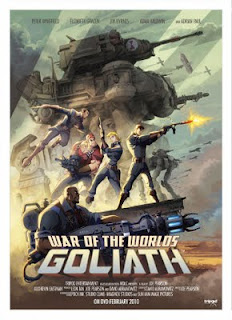
War of the Worlds: Goliath -- Coming in 2010


Next year will see the release of Tripod Entertainment's animated Steampunk film WAR OF THE WORLDS: GOLIATH. The film's premise is that 15 years after the Martian's failed attack on the earth in 1900 the aliens return to continue their attempted conquest of Earth. Much has changed in the intervening 15 years, as the industrious have reverse engineered a substantial amount of Martian technology. This sets the stage for a more evenly balanced conflict between the two worlds. The film's trailer hints at what the film will offer. The film will star geek favorites Adam Baldwin, Peter Wingfield, and Adrian Paul.


GOLIATH isn't the first WAR OF THE WORLDS sequel to make its way through the Hollywood entertainment assembly line. In 1988, there was a 2 season syndicated television series based on the premise that the Martians who invaded during the George Pal film merely went into hibernation and didn't die when they collapsed. The series aired in the US on Fox, and it too starred Adrian Paul (during the 2nd season).


The narrative premise of GOLIATH is a promising one and the show looks to have combined the best of the Steampunk genre with some elements of the classic animated television series STAR BLAZERS. Instead of a giant space faring WWII battleship, we have a giant sky spanning battle-zeppelin. I think the battle-zeppelin wins hands down.

Steampunk is a genre that has been gaining some momentum over the past few years. It combines "Vernian" futuristic technology with a Victorian/Edwardian time frame. I would posit that the first iteration of Steampunk was the Castle Falkenstein roleplaying game by Mike Pondsmith of R. Talsorian Games (publishers of the Cyberpunk rpg) and that the genre gained real traction with the novels The Difference Engine by Gibson and Sterling and The Prestige by Priest.

It has been noted in the comments that I am in error with regards to the origin of the term and genre of Steampunk. I will concede the term's origin, but I would take issue with some of those items retroactively classified into the genre. One could classify Spenser's The Faerie Queene as Epic Fantasy, but one would be misapplying a term for fantasy fiction in the post-Morris era. The same holds for Wild, Wild, West which shares as much with James Bond as it does with Steampunk (specifically). One might as well classify Ian Fleming's brilliant Chitty Chitty Bang Bang as Steampunk. Wikipedia and "internet citations" from Locus be damned!