It has been interesting watching the first few episodes this season. The title sequence is making it clear that the show is still in the "recruiting an audience" mode. Every episode begins with a brief description of the premise, something only new fans need. Certainly not something that the fan who has already purchased Heat Wave
Monday, October 26, 2009
Castle Feeds the Joss Whedon Fan
The writers of ABC's lighthearted procedural CASTLE (full episodes available at the link) have no illusions regarding who watches their show, and they are giving the early adopter fans some easter eggs tonight. In the brief episode preview below, I counted two Whedon easter eggs and one Underworld/White Wolf World of Darkness easter egg -- and I wasn't paying that close attention to the preview. It's nice to see the staff on CASTLE acknowledge that a lot of their fan base is there solely due to Nathan Fillion. We might be staying because the show is very enjoyable, and I certainly think it is, but we followed Nathan here.
It has been interesting watching the first few episodes this season. The title sequence is making it clear that the show is still in the "recruiting an audience" mode. Every episode begins with a brief description of the premise, something only new fans need. Certainly not something that the fan who has already purchased Heat Wave
need to see. My guess is that they are trying to recruit some of the older demographic that is currently watching DANCING WITH THE STARS and wanders over to CSI: MIAMI when that show is over. Given the comedic and romantic tones of CASTLE, versus the almost 4-color melodrama of CSI:MIAMI (which I really like for all its over-the-top-itude), it's probably a good strategy.
It has been interesting watching the first few episodes this season. The title sequence is making it clear that the show is still in the "recruiting an audience" mode. Every episode begins with a brief description of the premise, something only new fans need. Certainly not something that the fan who has already purchased Heat Wave
Friday, October 23, 2009
Hulu Recommendation Friday: The Pit and the Pendulum (1961)

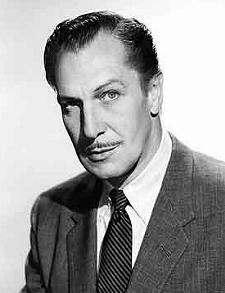
This Sunday will mark the sixteenth anniversary of the death of a horror film legend. October 25th, 1993, Vincent Price left this mortal coil. The horror films that Vincent Price starred in were not the violent shockfests people so often imagine when they thing of the words "horror film." His films were not about gore, or quick cathartic release of tension, rather they were about fear. H.P. Lovecraft, a pioneer in American "Wierd Fiction", wrote in his essay Supernatural Horror in Literature :
5-27-1911 to 10-25-1993
The oldest and strongest emotion of mankind is fear, and the oldest and strongest kind of fear is the fear of the unknown...their admitted truth must establish for all time the geniuneness and dignity of the wierdly horrible tale as a literary form. Against it are discharged all the shafts of a materialistic sophistication which clings to frequently felt emotions and external events, and of a naively insipid idealism which deprecates the aesthetic motive and calls for a didactic literature to "uplift" the reader toward a suitable degree of smirking optimism...men with minds sensitive to hereditary impulse will always tremble at the thought of the hidden and fathomless worlds of strange life which may pulsate in the gulfs beyond the stars...
This horror of the unknown is the kind of horror that permeated the films of Vincent Price. To be sure some like the Tingler had moments of visual shock, but most of the horror in Price's films was internal to the viewed characters. The audience felt the horror not as an immediate thing which passes when the musical sting chimes, but as a lingering afterthought which remained with the viewer long after the film had been viewed.
An image from The Tingler more akin to modern horror.
Vincent Price and Roger Corman's screen adaptations of Edgar Allen Poe tales are some of the best examples of this lingering kind of fear. With modern special effects making the imagery in The Pit and the Pendulum tame, possibly completely enervated of shock value, in comparison to the slaughter a Jason Voorhees is capable of committing. It is not the violence in Pit which horrifies, it is the thought of what man is capable of doing. This is the best kind of fear, the fear that reminds us as we look into the abyss that the abyss is looking back into us. True fear is horror at the possible meaninglessness of existence and the potential cruelty of man. How horrible is the realization in Fall of the House of Usher that Roderick Usher had accidently put his living sister prematurely into the tomb? The audience who watches this film can imagine both having to dig oneself free of an early grave and the terror of realization Roderick comes to when he realizes what he has done. There but for the grace of God go I.
Edgar Allan Poe is the founding voice for a great deal of American literature, including the modern horror tale. There have been some more recent Poe translations than the Corman/Price collaborations, but none seem to capture the tone as well. Price is magnificent in roles where we get to watch an otherwise noble man descend into madness. The Corman/Price films also manage to capture hints of the "unreliable narrator" literary device that Poe was famous for using/inventing. The lens through which the audience views the scene isn't the unreliable narrator, but the characters themselves often conceal their real motivations from each other. Have fun this Halloween with horror whose legacy can be seen in the SAW series, and the first HOSTEL, though the Poe versions spend a little more time on psychology of terror and less on the visceral sensations.
Thursday, October 22, 2009
Button Men for the iPhone: Thrust Interactive and Cheap Ass Games Release a Winner

I have long been a fan of the deceptively simple Cheap Ass game Button Men. In the game, each player possesses a button, the kind with a pin that fits nicely on those lanyards one tends to acquire at gaming conventions, which bears a nice looking illustration and a series of five numbers listed from lowest value to highest. Those numbers represent dice the player uses in an abstracted, and dice based, version of War. The goal is to "capture" your opponent's dice, which are each worth a point value equal to the number of sides that die possesses, by one of two methods (in the basic game at least). You can capture your opponent's dice through "power" attacks or "skill" attacks. The Button Men website does a wonderful job of describing the rules in detail.

It's great fun that seems mindless at first, until you finally encounter the player who plays the game "rationally." Then you come to understand that there is more to this little diversion than mere random chance. Strategy matters. Button Men is iconic of the inexpensive, but challenging/fun/and deep, games that James Ernest has made a career designing. The table top version of the game is a true classic that I cannot recommend highly enough.
So when the Button Men iPhone app became available yesterday, I found out thanks to John Kovalic, I leapt at the chance to purchase it. I didn't really know what the game would offer, but my hopes were high. I have come to trust Cheap Ass games over the years, their "Totally Renamed Spy Game" is one of the best card games ever made, but I have no experience with Thrust Interactive (
I had some minimum expectations. I hoped that the game would be graphically appealing, contain a decent variety of "buttons," and offer a decent randomization mechanism for two-player play. Essentially, I hoped -- at minimum -- that it was a game I could play with a friend by passing my iPhone between us.
What was offered was that and more. The game features buttons from two of the button men sets -- Soldiers and Vampires -- with new artwork that is appealing and with a color palette suited to the iPhone's digital display. Not all the artwork is better than the old images, the new picture of Shore is one of the weaker images, but the Starchylde and Dunkirk images are excellent re-inventions of already excellent images.

The game allows for 1 or 2 player games. In the 1 player game, I have been impressed with the AI so far -- though it has made a couple of baffling choices from time to time -- and have found it to be quite a time consuming distraction as I test different strategies. The 2 player version can be played in one of two ways. You can share your phone with your opponent, the 2 player play I expected, or interact with your opponent through bluetooth. I haven't had a chance to play a bluetooth opponent, but you can bet I'll be hunting down someone at the next gaming convention I attend.
The inclusion of two full sets of button men -- a $40 value if you buy the physical buttons -- for a $2.99 price makes this a bargain. The game play of the iPhone is quite addictive. Thrust's Button Men captures the simplicity and complexity of the tabletop version and adds some nice animations and sound effect to make a must buy application for any gamer's iPhone.
Now when are the Brom, Dork Tower, and Diceland expansions coming out?
Speaking of Diceland...when do I get that app?
Wednesday, October 21, 2009
Yet Another Glimpse of the Internet's Purpose
The internet was put upon this Earth to provide us all with entertaining, and mildly disturbing, DIY created content. Famous for this kind of fair are the folks at Rathergood.com, who provided us with that internet classic "We Like the Moon."
Below is their more recent video Agamemnon -- catchy and disturbing. One would also like to note that while having an overweight man dance while dressed like the 300, Agamemnon was never king of Sparta his brother Menelaus was. Both lived in Sparta for a time, but Agamemnon returned to his homeland and conquered those who had force him and his brother into exile.
Tuesday, October 20, 2009
Blogging Northwest Smith: "Scarlet Dream"

Published in the May 1934 issue of Weird Tales, "Scarlet Dream" is the third of C. L. Moore's tales of the interplanetary rogue trader Northwest Smith. It is also the third story in Paizo's Northwest of Earth collection. With this tale one can really see C. L. Moore developing her voice as an author of the weird supernatural horror story. Of the three Smith tales I have read for this series of blog posts, this is the best of the bunch so far.
Like in her previous Smith stories, there is little within the narrative itself that signifies that this is a science fiction story. Other than the fact that Smith eventually uses his magic wa... err ... "gun" against a foe, this story fits firmly within the narrative tropes of the "faerie" tale. Like Christina Rossetti's wonderfully frightening Goblin Market the tale demonstrates the consequences of tasting the "fruit" of Faerie. Like Dunsany's King of Elfland's Daughter, this tale has time in the land of magic move at a different pace than that of the real world. Unlike either of those tales, morality offers no salvation for our hero.
"Scarlet Dream" begins with Northwest Smith wandering the streets of a vibrant bazaar where he purchases a shawl made of an unbelievably light textile and bearing a mysterious glyph. The shawl, "clung to his hands like a live thing, softer and lighter than Martian 'lamb's-wool.' He felt sure it was woven from the hair of some beast rather than from vegetable fiber, for the electric clinging of it sparked with life. And the crazy pattern dazzled him with its utter strangeness."
In describing the physical properties of the shawl, Moore provides foreshadowing to the events that are about to unfold as the tale progresses. It is masterful foreshadowing as it occurs in a description where one does not assume the author is providing a map to the structure of the tale. Who would guess that the shawl clinging "to his hands like a live thing" hinted at darker things to come? Not darker things from the shawl itself, that would be obvious, but darker things that come as a result of the unnatural properties of another world. The use of strange patterns and objects of alien make would be used again by Moore in her section of Challenge from Beyond -- a shared universe tale she wrote in 1935 with H.P. Lovecraft, A. Merritt, Robert E. Howard, and Frank Belknap Long. Each of those authors adding their own characteristic touches to the story. In Moore's case, that touch is an artifact -- a shawl in "Scarlet Dream" and a crystal in "Challenge."
The market where Smith buys the shawl is in the city of Lakkmanda on Mars, but the description of the market is similar to one that might be given to the bazaar of Baghdad. It is not until Smith returns to his hotel room, a small cubicle of polished steel, that one gets any visual sense of the science fictional (sfnal). It doesn't detract from the story that it isn't a "hard science" tale, it adds to the mystery and sense of wonder as the tale unfolds.
Smith falls asleep covered in the shawl and is overtaken by a disturbing dream. He awakens, only to fall back asleep into another dream. It is in the second dream that Smith's consciousness is transported into a fantastic land. When he arrives he meets a young woman who is fleeing a horrible beast. She is covered in blood and frantic. Smith calms her and soon discovers that he is in an eerie bucolic paradise. The weather is pleasant and the lakeside landscape is beautiful. The temple building where he arrived in the world is the only large man made structure. There are no books, no worldly distractions, and as he soon learns...no food.
He is initially puzzled by the lack of food, but the beauty of the land -- and of the woman (whose name is never revealed) -- intrigue Smith and he follows the young woman to her house. The next day Smith finds himself overcome with hunger and asks the young woman to take him to the temple to acquire sustenance. When he arrives, he sees people kneeling before spigots docilely consuming the liquid being dispensed. He himself begins to partake when he realizes that the people, and now he himself, are feeding on blood! No mention is made of where the blood comes from, and Smith recoils in horror at the thought of feeding on blood. Yet...he has found it satisfying. As the days pass, he eventually partakes in a routine of idyllic days and nights with the young woman interrupted only by regular feedings at the temple. Smith has completely overcome any moral objections to the feeding, satisfied that it sustains him.
Throughout the story, there are references to a beast of some sort that was responsible for the murder of the young woman's sister -- beast that eventually comes for everyone when their time has come. Smith is unworried, and the girl is fatalistically accepting of her mortality. Life in this world is idyllic, yet the routine of it eventually over comes Smith. He needs adventure and discovery, not a dull routine in a beautiful setting. Unable to return home, he decides that he must journey within this realm to find adventure, but this is to be denied him. The planet has no food to sustain him, save for the temple's blood spigots, and Smith learns another terrifying fact. It seems that the entire planet, plants and all, are alive and feed on the blood of living things. If you stand too long in one place, the grass will drain you of your blood. You cannot sleep if you aren't on stone as the plants will eat you. This is a world where all the denizens are sustained by blood.
Smith is not shocked or terrified by the prospect, he is resigned to satisfy his sense of adventure. His spirit cannot be sentenced to a life of dull routine. It is his Fredrick Jackson Turnerian frontiersman spirit that saves him from a fate worse than death.
How? That's for you to find out when you read the story.
What is particularly interesting in this story is the way that Moore uses the traditional elements of the faerie story, that of entering a beautiful but dangerous world, while demonstrating how a non-moral actor would react to the environment. What use has the adventurer for bucolic paradise? Apparently, not much. It would be unfair to leave out that the girl, like the sister in Goblin Market, sacrifices herself in order to save a beloved, but in Goblin Market the spirit of curiosity is the culprit and not the savior. Also interesting was Smith's reaction to the feeding process in the world. He is initially revolted, as I imagine any one would be, but he quickly overcomes his moral rejection and feeds like everyone else. This is the moment where the audience, though not the character, get to feel a sense of cosmic horror. We look into the abyss with Smith, horrified, but he allows the abyss to look back into him and is largely unaffected. This is a disturbing thing to read. How does one react to a protagonist who so quickly, Smith does not resist eating for days nobly suffering before succumbing, to temptation?
Smith may never have discovered the name of the young woman, but the audience never discovers the origin of the blood the people feast upon. Is it the blood of those killed by the beast? Is it the blood of those killed by the planet? Is it the blood of the planet? If it is the blood of those killed by the beast, is some of it the young woman's sister's blood? Creepy...and wonderful.
Previous Blogging Northwest Smith Entries:
2) Blogging Northwest Smith: "Black Thirst"
1) Blogging Northwest Smith: "Shambleau"
Friday, October 16, 2009
Hulu Recommendation Friday: The Phantom

One of the oldest costumed superheroes, and arguably the first to wear the ever present skin tight costume, is Lee Falk's 1936 creation The Phantom. The Phantom, as a character and narrative construct, helped to establish the basis for the modern superhero tale. His origin, though it included some elements likely inspired by Burrough's Tarzan, can easily be seen as the model which has dominated the genre.
The 1996 film, starring Billy Zane as The Ghost Who Walks and directed by Simon Wincer, was produced during a time where Hollywood wasn't quite sure which direction to go with comic book characters. The films of the era -- Batman, The Shadow, and The Phantom (to name a few) -- were simultaneously serious and campy. Hollywood hadn't yet reached the point where it could trust that superhero narratives on the big screen could be presented "straight." One would think they would have learned the lesson from the Superman franchise, which had two excellent entries -- neither of which were particularly campy -- and two awful entries -- both of which were campy.
Of the three films mentioned above, Batman (directed by Tim Burton) was the least campy, but it did have its moments of campy awkwardness that seemed to clash with Burton's moody expressionist representation of Gotham. Burton's Batman is a great Bruce Wayne film, but it isn't a great Batman film.
The Shadow, though campier than Batman, is almost a perfect representation of the title character -- it's so close that fans can see what the film would have been if it had been serious. It would have been a great serious movie, but it is also an entertaining campy movie. The reflexive ironic jingoism of Alec Baldwin's character is wonderful, as is Margot Lane, leaving only the over the top Tim Curry (who I usually love) lessening the enjoyment of the film. Well...Tim Curry and the weird prosthetic makeup that Baldwin wore as the Shadow are what are wrong with the picture. Still it is an entertaining piece.
All three of the "transition" films were entertaining, and that includes The Phantom. One doesn't have to look past the one sheet to realize that the film falls more on the campy side of things than to the straight, which is a shame. Treat Williams and Cary-Hiroyuki Tagawa would have been excellent in a straight version of the film. They are entertaining here as well, but by deciding not to update the look of The Phantom's costume, the film doomed itself to campville. As camp, the movie is a fun ride with some genuinely entertaining action sequences. It's also fun to run around shouting "Slam Evil," as my friends and I did while displaying our collection of Phantom rings (the promotional item used to promote the film).
Enjoy the film, but enjoy imagining what might have been as well.
RHI Entertainment, who brought us the excellent Tin Man and the horrible Flash Gordon, are working on a new television version of The Phantom -- the preview is below -- which looks promising. The RHI series looks like a combination of The Phantom, TNT's Leverage, and Remo Williams, but that could be fun...and at least they updated the costume.

Wednesday, October 14, 2009
Conan Remembers the Alamo? -- Sanford Allen Discusses San Antonio's Influence on Robert E. Howard's Writing

For all that it is well-known that Robert E. Howard was a native of Texas, whose wild imaginings of far off lands took place without his leaving the Lone Star State, it is too rare that the influence its landscape and people had on Howard's tales. It is an important question to ponder as most writers instill into their stories a sense of place.
Sanford Allen, and his compadres (I was born in El Paso, so I'm allowed to use the word compadre) over at Mission Unknown, are writing a series of blog entries discussing San Antonio's place in the history of SF Universe. One may not necessarily think of San Antonio as particularly sfnal, so Mission Unknown is mapping out S.A.'s place on the SF map.
The most recent entry is a discussion of San Antonio's influence on Robert E. Howard's writing. A nice companion to this line of thought is Monkeybrain Books' Blood and Thunder: the Life and Art of Robert E. Howard.
Of particular interest in the Mission Unknown post is the influence that a valley an hour north of San Antonio -- a stone's throw in Texas -- had on Howard's poem Cimmeria.
Subscribe to:
Posts (Atom)