Below is their more recent video Agamemnon -- catchy and disturbing. One would also like to note that while having an overweight man dance while dressed like the 300, Agamemnon was never king of Sparta his brother Menelaus was. Both lived in Sparta for a time, but Agamemnon returned to his homeland and conquered those who had force him and his brother into exile.

Wednesday, October 21, 2009
Yet Another Glimpse of the Internet's Purpose
The internet was put upon this Earth to provide us all with entertaining, and mildly disturbing, DIY created content. Famous for this kind of fair are the folks at Rathergood.com, who provided us with that internet classic "We Like the Moon."
Below is their more recent video Agamemnon -- catchy and disturbing. One would also like to note that while having an overweight man dance while dressed like the 300, Agamemnon was never king of Sparta his brother Menelaus was. Both lived in Sparta for a time, but Agamemnon returned to his homeland and conquered those who had force him and his brother into exile.
Below is their more recent video Agamemnon -- catchy and disturbing. One would also like to note that while having an overweight man dance while dressed like the 300, Agamemnon was never king of Sparta his brother Menelaus was. Both lived in Sparta for a time, but Agamemnon returned to his homeland and conquered those who had force him and his brother into exile.


Tuesday, October 20, 2009
Blogging Northwest Smith: "Scarlet Dream"

Published in the May 1934 issue of Weird Tales, "Scarlet Dream" is the third of C. L. Moore's tales of the interplanetary rogue trader Northwest Smith. It is also the third story in Paizo's Northwest of Earth collection. With this tale one can really see C. L. Moore developing her voice as an author of the weird supernatural horror story. Of the three Smith tales I have read for this series of blog posts, this is the best of the bunch so far.
Like in her previous Smith stories, there is little within the narrative itself that signifies that this is a science fiction story. Other than the fact that Smith eventually uses his magic wa... err ... "gun" against a foe, this story fits firmly within the narrative tropes of the "faerie" tale. Like Christina Rossetti's wonderfully frightening Goblin Market the tale demonstrates the consequences of tasting the "fruit" of Faerie. Like Dunsany's King of Elfland's Daughter, this tale has time in the land of magic move at a different pace than that of the real world. Unlike either of those tales, morality offers no salvation for our hero.
"Scarlet Dream" begins with Northwest Smith wandering the streets of a vibrant bazaar where he purchases a shawl made of an unbelievably light textile and bearing a mysterious glyph. The shawl, "clung to his hands like a live thing, softer and lighter than Martian 'lamb's-wool.' He felt sure it was woven from the hair of some beast rather than from vegetable fiber, for the electric clinging of it sparked with life. And the crazy pattern dazzled him with its utter strangeness."
In describing the physical properties of the shawl, Moore provides foreshadowing to the events that are about to unfold as the tale progresses. It is masterful foreshadowing as it occurs in a description where one does not assume the author is providing a map to the structure of the tale. Who would guess that the shawl clinging "to his hands like a live thing" hinted at darker things to come? Not darker things from the shawl itself, that would be obvious, but darker things that come as a result of the unnatural properties of another world. The use of strange patterns and objects of alien make would be used again by Moore in her section of Challenge from Beyond -- a shared universe tale she wrote in 1935 with H.P. Lovecraft, A. Merritt, Robert E. Howard, and Frank Belknap Long. Each of those authors adding their own characteristic touches to the story. In Moore's case, that touch is an artifact -- a shawl in "Scarlet Dream" and a crystal in "Challenge."
The market where Smith buys the shawl is in the city of Lakkmanda on Mars, but the description of the market is similar to one that might be given to the bazaar of Baghdad. It is not until Smith returns to his hotel room, a small cubicle of polished steel, that one gets any visual sense of the science fictional (sfnal). It doesn't detract from the story that it isn't a "hard science" tale, it adds to the mystery and sense of wonder as the tale unfolds.
Smith falls asleep covered in the shawl and is overtaken by a disturbing dream. He awakens, only to fall back asleep into another dream. It is in the second dream that Smith's consciousness is transported into a fantastic land. When he arrives he meets a young woman who is fleeing a horrible beast. She is covered in blood and frantic. Smith calms her and soon discovers that he is in an eerie bucolic paradise. The weather is pleasant and the lakeside landscape is beautiful. The temple building where he arrived in the world is the only large man made structure. There are no books, no worldly distractions, and as he soon learns...no food.
He is initially puzzled by the lack of food, but the beauty of the land -- and of the woman (whose name is never revealed) -- intrigue Smith and he follows the young woman to her house. The next day Smith finds himself overcome with hunger and asks the young woman to take him to the temple to acquire sustenance. When he arrives, he sees people kneeling before spigots docilely consuming the liquid being dispensed. He himself begins to partake when he realizes that the people, and now he himself, are feeding on blood! No mention is made of where the blood comes from, and Smith recoils in horror at the thought of feeding on blood. Yet...he has found it satisfying. As the days pass, he eventually partakes in a routine of idyllic days and nights with the young woman interrupted only by regular feedings at the temple. Smith has completely overcome any moral objections to the feeding, satisfied that it sustains him.
Throughout the story, there are references to a beast of some sort that was responsible for the murder of the young woman's sister -- beast that eventually comes for everyone when their time has come. Smith is unworried, and the girl is fatalistically accepting of her mortality. Life in this world is idyllic, yet the routine of it eventually over comes Smith. He needs adventure and discovery, not a dull routine in a beautiful setting. Unable to return home, he decides that he must journey within this realm to find adventure, but this is to be denied him. The planet has no food to sustain him, save for the temple's blood spigots, and Smith learns another terrifying fact. It seems that the entire planet, plants and all, are alive and feed on the blood of living things. If you stand too long in one place, the grass will drain you of your blood. You cannot sleep if you aren't on stone as the plants will eat you. This is a world where all the denizens are sustained by blood.
Smith is not shocked or terrified by the prospect, he is resigned to satisfy his sense of adventure. His spirit cannot be sentenced to a life of dull routine. It is his Fredrick Jackson Turnerian frontiersman spirit that saves him from a fate worse than death.
How? That's for you to find out when you read the story.
What is particularly interesting in this story is the way that Moore uses the traditional elements of the faerie story, that of entering a beautiful but dangerous world, while demonstrating how a non-moral actor would react to the environment. What use has the adventurer for bucolic paradise? Apparently, not much. It would be unfair to leave out that the girl, like the sister in Goblin Market, sacrifices herself in order to save a beloved, but in Goblin Market the spirit of curiosity is the culprit and not the savior. Also interesting was Smith's reaction to the feeding process in the world. He is initially revolted, as I imagine any one would be, but he quickly overcomes his moral rejection and feeds like everyone else. This is the moment where the audience, though not the character, get to feel a sense of cosmic horror. We look into the abyss with Smith, horrified, but he allows the abyss to look back into him and is largely unaffected. This is a disturbing thing to read. How does one react to a protagonist who so quickly, Smith does not resist eating for days nobly suffering before succumbing, to temptation?
Smith may never have discovered the name of the young woman, but the audience never discovers the origin of the blood the people feast upon. Is it the blood of those killed by the beast? Is it the blood of those killed by the planet? Is it the blood of the planet? If it is the blood of those killed by the beast, is some of it the young woman's sister's blood? Creepy...and wonderful.
Previous Blogging Northwest Smith Entries:
2) Blogging Northwest Smith: "Black Thirst"
1) Blogging Northwest Smith: "Shambleau"
Friday, October 16, 2009
Hulu Recommendation Friday: The Phantom

One of the oldest costumed superheroes, and arguably the first to wear the ever present skin tight costume, is Lee Falk's 1936 creation The Phantom. The Phantom, as a character and narrative construct, helped to establish the basis for the modern superhero tale. His origin, though it included some elements likely inspired by Burrough's Tarzan, can easily be seen as the model which has dominated the genre.
The 1996 film, starring Billy Zane as The Ghost Who Walks and directed by Simon Wincer, was produced during a time where Hollywood wasn't quite sure which direction to go with comic book characters. The films of the era -- Batman, The Shadow, and The Phantom (to name a few) -- were simultaneously serious and campy. Hollywood hadn't yet reached the point where it could trust that superhero narratives on the big screen could be presented "straight." One would think they would have learned the lesson from the Superman franchise, which had two excellent entries -- neither of which were particularly campy -- and two awful entries -- both of which were campy.
Of the three films mentioned above, Batman (directed by Tim Burton) was the least campy, but it did have its moments of campy awkwardness that seemed to clash with Burton's moody expressionist representation of Gotham. Burton's Batman is a great Bruce Wayne film, but it isn't a great Batman film.
The Shadow, though campier than Batman, is almost a perfect representation of the title character -- it's so close that fans can see what the film would have been if it had been serious. It would have been a great serious movie, but it is also an entertaining campy movie. The reflexive ironic jingoism of Alec Baldwin's character is wonderful, as is Margot Lane, leaving only the over the top Tim Curry (who I usually love) lessening the enjoyment of the film. Well...Tim Curry and the weird prosthetic makeup that Baldwin wore as the Shadow are what are wrong with the picture. Still it is an entertaining piece.
All three of the "transition" films were entertaining, and that includes The Phantom. One doesn't have to look past the one sheet to realize that the film falls more on the campy side of things than to the straight, which is a shame. Treat Williams and Cary-Hiroyuki Tagawa would have been excellent in a straight version of the film. They are entertaining here as well, but by deciding not to update the look of The Phantom's costume, the film doomed itself to campville. As camp, the movie is a fun ride with some genuinely entertaining action sequences. It's also fun to run around shouting "Slam Evil," as my friends and I did while displaying our collection of Phantom rings (the promotional item used to promote the film).
Enjoy the film, but enjoy imagining what might have been as well.
RHI Entertainment, who brought us the excellent Tin Man and the horrible Flash Gordon, are working on a new television version of The Phantom -- the preview is below -- which looks promising. The RHI series looks like a combination of The Phantom, TNT's Leverage, and Remo Williams, but that could be fun...and at least they updated the costume.

Wednesday, October 14, 2009
Conan Remembers the Alamo? -- Sanford Allen Discusses San Antonio's Influence on Robert E. Howard's Writing

For all that it is well-known that Robert E. Howard was a native of Texas, whose wild imaginings of far off lands took place without his leaving the Lone Star State, it is too rare that the influence its landscape and people had on Howard's tales. It is an important question to ponder as most writers instill into their stories a sense of place.
Sanford Allen, and his compadres (I was born in El Paso, so I'm allowed to use the word compadre) over at Mission Unknown, are writing a series of blog entries discussing San Antonio's place in the history of SF Universe. One may not necessarily think of San Antonio as particularly sfnal, so Mission Unknown is mapping out S.A.'s place on the SF map.
The most recent entry is a discussion of San Antonio's influence on Robert E. Howard's writing. A nice companion to this line of thought is Monkeybrain Books' Blood and Thunder: the Life and Art of Robert E. Howard.
Of particular interest in the Mission Unknown post is the influence that a valley an hour north of San Antonio -- a stone's throw in Texas -- had on Howard's poem Cimmeria.
Tuesday, October 13, 2009
Maurice Sendak to Worried Parents...

"...go to hell."
From all the previews I have seen, I have been of the mindset that Eggers and Jonze missed the point of the children's book. All the talk of "heartwarming" and all the imagery of innocence were essentially shouting at me that the movie missed the dark aspects of the book.
Let's face it, the book is about a kid who "is wearing his wolf suit" and gets sent to bed without supper because of his bad behavior. The kid then spends 90% of the book reveling in his anger, so much so that he becomes the "Wildest Thing of All." Whether the suit is something he is actually wearing or a visual metaphor for the child's incorrigibility isn't clear, and doesn't matter. The point is that the kid is so angry that monsters think of him as their king.
Additionally, these monsters -- who represent the child's anger -- affectionately call out that they will eat him up if he returns to them and doesn't go to where he is loved. He will literally/figuratively be "consumed" by anger if he doesn't seek out the love of his family. WOW! That kid is one hate filled child.
Very different from the one portrayed in the previews.
Seeing stuffed monsters that look like fat versions of the Velveteen Rabbit didn't instill in me any sense that the film captured that kind of anger, and it still doesn't.
I'll watch the movie in full to see if Eggers and Jonze really did miss the point, but it is clear that Maurice Sendak came to the interview with his Wolf Suit on and has no plans of going home.
Has Science Fiction Leaving the Ghetto Meant the Beginning of a Post Sci-Fi Age? Stupid Question #3182
I have always been a Sci-Fi fan, a scifi fan, and a skiffy fan. While there is much to admire in the philosophically or politically sophisticated science fiction story, or the well-written literary SF tale, I have always liked literature that knew what its purpose was and fulfilled that purpose. The purpose of a Sci-Fi story is to entertain an audience with visions of the possible, and impossible, in an exciting and enthusiastic manner.
The Sci-Fi story doesn't spend pages upon pages describing sophisticated political systems, though there is nothing wrong in doing so in other sub-genre of Science Fiction. Instead, the Sci-Fi story uses readily recognizable archetypes as shortcuts for the audience to follow. Sci-Fi is Flash Gordon, Buck Rogers, Luke Skywalker, Northwest Smith, and Vic Corsaire.
One could probably get into long arguments regarding what is or isn't Sci Fi versus what is or isn't SF (literary Science Fiction), and those are fun discussions to have, but that is not the intention of this post today. Today, I am here to once again lament those who insult and deprecate Sci Fi in favor of a literary sub-genre they believe to be a far more noble pursuit. For these individuals, the ideal Science Fiction tale ought to be literary and "important." The SF story should touch on topical issues and present intelligent arguments about these issues. Such works include, but are by no means limited to, works like Asimov's Foundation, the works of H.G. Wells, Heinlein's Stranger in a Strange Land, Huxley's Brave New World, and Iain Bank's "Culture" novels. All of which are works to be admired, and are great literature and great Science Fiction, but none of which are the be all and end all of Science Fiction. In fact, many might not stumble into these wonderful stories if they weren't first enticed by the "fluff" contained in "skiffy."
As you can tell, I am an unabashed fan of the "skiffy." My fandom was carved deeper into my soul after I attended a Forrest J. Ackerman panel at the 2005 San Diego Comic Con. There's something about sitting in a room where the audience is fewer than 20 people in the audience of like-minded fans that solidifies one's fandom. It doesn't hurt when one of them is John Landis (sitting right next to you) and he keeps elbowing you just before Forrest Ackerman's punchlines and is mouthing the words to each of Forry's stories. It was obvious that Landis had talked with Forry numerous times and that each time was magical. That kind of excitement is contagious.
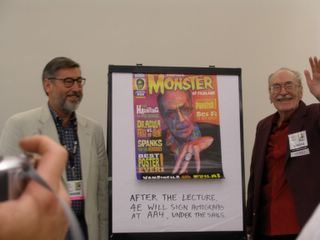
All of which brings me to an article by Damien Walter at the Guardian book blog. I first got word of the book blog entry thanks to the excellent folks over at SF Signal, where they asked if the "Sci Fi" label still applied. Their answer is identical to mine, "Yes, the Sci Fi label is still important." But after reading their post, and the piece in the Guardian, I realized that a short rebuttal of Mr. Walter's blog post was insufficient as a response to Mr. Walter's post.
In the Guardian piece, Damien Walter begs the question of whether we as a popular culture are now "post sci-fi." His central thesis seems to be that "with sci-fi filling up every corner of cinema and TV and mainstream literature borrowing its ideas freely" there is no further place for the literary tradition to advance now that it has become a cultural phenomenon. His post is an articulation which might as well be renamed "The End of Sci-Fi and the Last Man."
One of Walter's key arguments is that "the walls of speculative fiction [that dread phrase -- C.L.] as a genre are quickly tumbling down. They are being demolished from within by writers such as China Miéville and Jon Courtney Grimwood, and scaled from the outside by the likes of Michael Chabon and Lev Grossman. And they are being ignored altogether by a growing number of writers with the ambition to create great fiction, and the vision to draw equally on genre and literary tradition to achieve that goal."
This is all well and good. It is even true as far as it goes, but it demonstrates (as Walter does elsewhere in the piece) a complete lack of understanding regarding the literary history of Fantastic Literature and Fantasy. What were the Iliad and the Odyssey, if not works of Fantasy or "Speculative Fiction?" What was A Midsummer-Night's Dream and The Tempest, if not Fantasy? The Faerie Queene? The Rime of the Ancient Mariner? Beowulf? The Oresteia? The Eddas? What is Mary Shelley's Frankenstein or Edward Bellamy's Looking Backward if not Science Fiction?
All of the above a great literary works, written to be great fiction, and yet all of them fit neatly within any imagined definition of Fantasy or Fantastic Fiction. True, few of them are Science Fiction qua Science Fiction, but SF is the sub-genre not the genre -- a simple fact that Walter gets horribly wrong in his piece. To quote, "yet the literary tradition that has its roots in HG Wells and Jules Verne, Edgar Allan Poe and George MacDonald, that grew through the writing of Tolkien, Lieber, Howard, Heinlein, Clarke, and Asimov, and branched into the modern genres of fantasy, horror and science fiction, may have reached its fruition."
HG Wells and Jules Verne are the "roots" of the tradition? One might think of them as the branches closest to the trunk of the tree, but the roots? Is Walter serious? All the writers Walter mentioned are influenced by those works of Fantasy that predate them. One might argue that the 20th century was one where the literary world felt compelled to carve unnecessary categories into the literary landscape, categories designed to serve market interests, but one oughtn't think of 19th century writers as the root of a tradition. Don't even get me going on how one would attempt to draw a direct literary line from Wells to Howard.
It is not baffling that Walter piled Modern Fantasy and Science Fiction together, as they are both sub-genres of the Fantastic Tradition. That is true, but so is the work of Michael Chabon. Anyone who thinks Gentlemen of the Road is an attempt to scale the walls of Fantasy genre fiction from the "outside" is woefully mistaken. Gentlemen of the Road is a wonderful story in the direct tradition of Fritz Lieber, with no pretenses to being something else. It should be noted that much of the fiction of Avram Davidson is as worthy of literary consideration as that of Michael Chabon, and was as genre breaking for its day.
Just because Michael Chabon can draw from literary traditions other than the Fantastic Tradition when writing a story isn't a sign that we are in a "post sci-fi" era. It is merely a sign that Fantastic Fiction is ending a period of incestuousness where it fed off of itself for as long as it could. The fact that people are talking about the science fiction, or fantastic, elements of "literary fiction" is a sign that speculative fiction [that dread term again] is overcoming a certain stigma given it by literary critics and by "fans" who deride the fiction within their sub-genre which seeks to appeal to a wider audience.
*3182 is the number of lines in the epic poem Beowulf and his used here because of the muddled way Damien Walter articulates the lineage of Science Fiction and Fantasy.
The Sci-Fi story doesn't spend pages upon pages describing sophisticated political systems, though there is nothing wrong in doing so in other sub-genre of Science Fiction. Instead, the Sci-Fi story uses readily recognizable archetypes as shortcuts for the audience to follow. Sci-Fi is Flash Gordon, Buck Rogers, Luke Skywalker, Northwest Smith, and Vic Corsaire.
One could probably get into long arguments regarding what is or isn't Sci Fi versus what is or isn't SF (literary Science Fiction), and those are fun discussions to have, but that is not the intention of this post today. Today, I am here to once again lament those who insult and deprecate Sci Fi in favor of a literary sub-genre they believe to be a far more noble pursuit. For these individuals, the ideal Science Fiction tale ought to be literary and "important." The SF story should touch on topical issues and present intelligent arguments about these issues. Such works include, but are by no means limited to, works like Asimov's Foundation, the works of H.G. Wells, Heinlein's Stranger in a Strange Land, Huxley's Brave New World, and Iain Bank's "Culture" novels. All of which are works to be admired, and are great literature and great Science Fiction, but none of which are the be all and end all of Science Fiction. In fact, many might not stumble into these wonderful stories if they weren't first enticed by the "fluff" contained in "skiffy."
As you can tell, I am an unabashed fan of the "skiffy." My fandom was carved deeper into my soul after I attended a Forrest J. Ackerman panel at the 2005 San Diego Comic Con. There's something about sitting in a room where the audience is fewer than 20 people in the audience of like-minded fans that solidifies one's fandom. It doesn't hurt when one of them is John Landis (sitting right next to you) and he keeps elbowing you just before Forrest Ackerman's punchlines and is mouthing the words to each of Forry's stories. It was obvious that Landis had talked with Forry numerous times and that each time was magical. That kind of excitement is contagious.
All of which brings me to an article by Damien Walter at the Guardian book blog. I first got word of the book blog entry thanks to the excellent folks over at SF Signal, where they asked if the "Sci Fi" label still applied. Their answer is identical to mine, "Yes, the Sci Fi label is still important." But after reading their post, and the piece in the Guardian, I realized that a short rebuttal of Mr. Walter's blog post was insufficient as a response to Mr. Walter's post.
In the Guardian piece, Damien Walter begs the question of whether we as a popular culture are now "post sci-fi." His central thesis seems to be that "with sci-fi filling up every corner of cinema and TV and mainstream literature borrowing its ideas freely" there is no further place for the literary tradition to advance now that it has become a cultural phenomenon. His post is an articulation which might as well be renamed "The End of Sci-Fi and the Last Man."
One of Walter's key arguments is that "the walls of speculative fiction [that dread phrase -- C.L.] as a genre are quickly tumbling down. They are being demolished from within by writers such as China Miéville and Jon Courtney Grimwood, and scaled from the outside by the likes of Michael Chabon and Lev Grossman. And they are being ignored altogether by a growing number of writers with the ambition to create great fiction, and the vision to draw equally on genre and literary tradition to achieve that goal."
This is all well and good. It is even true as far as it goes, but it demonstrates (as Walter does elsewhere in the piece) a complete lack of understanding regarding the literary history of Fantastic Literature and Fantasy. What were the Iliad and the Odyssey, if not works of Fantasy or "Speculative Fiction?" What was A Midsummer-Night's Dream and The Tempest, if not Fantasy? The Faerie Queene? The Rime of the Ancient Mariner? Beowulf? The Oresteia? The Eddas? What is Mary Shelley's Frankenstein or Edward Bellamy's Looking Backward if not Science Fiction?
All of the above a great literary works, written to be great fiction, and yet all of them fit neatly within any imagined definition of Fantasy or Fantastic Fiction. True, few of them are Science Fiction qua Science Fiction, but SF is the sub-genre not the genre -- a simple fact that Walter gets horribly wrong in his piece. To quote, "yet the literary tradition that has its roots in HG Wells and Jules Verne, Edgar Allan Poe and George MacDonald, that grew through the writing of Tolkien, Lieber, Howard, Heinlein, Clarke, and Asimov, and branched into the modern genres of fantasy, horror and science fiction, may have reached its fruition."
HG Wells and Jules Verne are the "roots" of the tradition? One might think of them as the branches closest to the trunk of the tree, but the roots? Is Walter serious? All the writers Walter mentioned are influenced by those works of Fantasy that predate them. One might argue that the 20th century was one where the literary world felt compelled to carve unnecessary categories into the literary landscape, categories designed to serve market interests, but one oughtn't think of 19th century writers as the root of a tradition. Don't even get me going on how one would attempt to draw a direct literary line from Wells to Howard.
It is not baffling that Walter piled Modern Fantasy and Science Fiction together, as they are both sub-genres of the Fantastic Tradition. That is true, but so is the work of Michael Chabon. Anyone who thinks Gentlemen of the Road is an attempt to scale the walls of Fantasy genre fiction from the "outside" is woefully mistaken. Gentlemen of the Road is a wonderful story in the direct tradition of Fritz Lieber, with no pretenses to being something else. It should be noted that much of the fiction of Avram Davidson is as worthy of literary consideration as that of Michael Chabon, and was as genre breaking for its day.
Just because Michael Chabon can draw from literary traditions other than the Fantastic Tradition when writing a story isn't a sign that we are in a "post sci-fi" era. It is merely a sign that Fantastic Fiction is ending a period of incestuousness where it fed off of itself for as long as it could. The fact that people are talking about the science fiction, or fantastic, elements of "literary fiction" is a sign that speculative fiction [that dread term again] is overcoming a certain stigma given it by literary critics and by "fans" who deride the fiction within their sub-genre which seeks to appeal to a wider audience.
*3182 is the number of lines in the epic poem Beowulf and his used here because of the muddled way Damien Walter articulates the lineage of Science Fiction and Fantasy.
Monday, October 12, 2009
Blogging Northwest Smith: "Black Thirst"

In the last installment of "Blogging Northwest Smith," I discussed how C L Moore's tales of Northwest Smith included elements of Space Opera and Weird Horror and pushed the envelope of what constituted a Science Fiction tale. By Space Opera I am referring to the earlier "Space Opera equals Space Westerns" description often used during the early days of the genre.
I am far from the first to notice that Moore incorporated elements of Weird Horror into the tales of her space faring anti-hero, Lin Carter noticed her inclusion of these elements and thought it likely they were added to garner publication in Weird Tales. Whatever Moore's reasons for including Weird Horror elements, as she did with her adaptation of the Medusa into "pleasure vampire" in "Shambleau," she was deeply enough tied to the Lovecraftian circle that she was one of the co-authors (in fact she was the jump start author) of a Lovecraftian "shared world" tale entitled The Challenge from Beyond (more on this in a later post).
For the modern fan of Science Fiction, the incorporation of horror elements into a Science Fiction narrative seems perfectly natural. Everything from the Atomic Horror films of the 50s and 60s to Ridley Scott's masterpiece Alien (based on A.E. van Vogt's 1939 Astounding story "Black Destroyer" which was included as chapters 1-6 of The Voyage of the Space Beagle) to Joss Whedon's Firefly demonstrate how deeply saturated film and television are with the SF horror story. But for fans of "Space Westerns," Foundation, or modern Space Opera, the shift in suspension of disbelief from hard SF to Weird Horror SF isn't guaranteed.
When I read "Shambleau," I was struck by how much the narrative followed the format of a classic Western and by how the monster/alien of the tale was Lovecraftian in nature -- tentacles and all. "Black Thirst" takes the combination of Science Fiction and horror a different direction than "Shambleau." Where in "Shambleau" the tale was one of Weird Horror overlaying a Western, "Black Thirst" is a tale of Gothic Horror that contains no small elements of the Western and Weird Horror genre.
Our tale begins with our protagonist, Northwest Smith, leaning against a warehouse wall in some unfriendly waterfront street on Venus. He soon encounters a woman, immediately recognizable as a Minga maid, who begs Northwest to visit her in the Minga stronghold in order to provide her some sort of aid.
Moore spends some time describing the Minga palace as a building that pre-existed the majority of civilization on Venus, describing how the stronghold was already built by the time some great Venusian explorer had sailed the seas in search of new land. The Minga maids themselves are as mysterious as the palace from which they are sold, they are "those beauties that from the beginning of history have been bred in the Minga stronghold for loveliness and grace, as race-horses are bred on Earth, and reared from earliest infancy in the art of charming men. Scarcely a court on the three planets lacks at least one of these exquisite creatures..."
Establishing the mysterious origins of the stronghold and the maids, Moore quickly establishes the dangers associated with attempting to "lay a finger" on a Minga maid. It is a danger with no appeal as "The chastity of Minga girls was proverbial, a trade boast." The purpose of these beauty slaves seems not to be a sexual one, and this is reinforced later when the real purpose of the breeding of the maids is reveals, but a purely aesthetic one. The women are bred for their beauty, in form and manner, and the price paid is for these things alone.
The concept of a stronghold of courtesans, trained in the art of charming men, combined with the similarities between Malcolm Reynolds and Northwest Smith leave one wondering if Joss Whedon had read this tale before creating Firefly. Not to imply with any certainty that Whedon was directly influenced by Moore, but it is hard for me to visualize anyone other than Nathan Fillion playing Northwest Smith in a movie -- and if he did Whedon fans would cry foul that Northwest is a direct Mal ripoff.
As the Minga maid, named Vaudir, leaves Smith she does so with a warning. She warns Northwest about the evil that is the Alendar and hints at his origins when she discusses there are "elemental" things that don't sink back into the darkness from which they came if a civilization develops too swiftly. "Life rises out of dark and mystery and things too strange and terrible to be looked upon." Here she hints at the history of the Minga and the Alendar and Moore incorporates imagery from Weird Horror. The concept of elemental evil is one of Weird Horror and it is the type of horror that is used to describe the Alendar.
Smith agrees to help the maid and approaches the stronghold as she told him he should. What follows is a series of scenes reminiscent of Bram Stoker's Dracula in which our hero plays, a much braver version, of Jonathan Harker. Smith wanders the hallways of the palace sensing, but not seeing, the great evil that awaits him. He arrives at Vaudir's room, but it is not long before he encounters the Alendar him/itself. The Alendar is a manlike creature possessed of great psychic powers, powers which overwhelm our protagonist and could kill him in an instant. But a quick death is not to be for Smith as he possesses something of value that the Alendar desires.
The Alendar, it seems, is -- like the Shambleau -- a kind of vampire. Unlike the Shambleau the Alendar does not feed on sexual/physical pleasure, instead he/it feeds on beauty. For the Alendar beauty is a tangible thing, an objective thing that provides real nourishment. The only way in which beauty is subjective regarding the Alendar's hunger is in its "form." What is beauty for a human female isn't beauty in a human male, which is why the Alendar has spared Smith. Smith possesses the quality of male beauty which must be fully developed before the Alendar can feed on him. As the Alendar describes his method of nourishment, Smith is given glimpses of unimaginable beauty -- beauty that can cause madness.
How the tale unfolds from here I will leave for you to discover on you own, but I would like to spend some time discussing some of the interesting concepts Moore threw into this story.
She is quite obviously writing a tale about slavery and presents human trafficking as a horrible affair, but she is also presenting a discussion of beauty and what constitutes true beauty. The Alendar describes beauty as follows:
For beauty, as I have said, eats up all other qualities but beauty."
The beauty that Moore has the Alendar describe is in itself horrifying, yet it is also an interesting spark for discussion. Vaudir -- who has asked Smith for assistance and led to his current state of danger -- is beautiful, but she possesses something more. She possesses and intelligence and free will that make her more desirable to the Alendar than her beauty alone would demand. Smith too possesses this combination of independence and beauty, a combination that the Alendar seeks to use in order to overcome the boredom which results from the consumption of his current fare of pure beauty. Moore is simultaneously critiquing the "cult of beauty" and proffering an alternative -- a beauty that combines intelligence, independence, and appearance. There is a strong feminist spirit underlying the story and it is this spirit that separates this tale from a run of the mill narrative.
As before, Moore combines elements from a variety of literature in this piece in a manner that is fluid. The discussion of elemental evil has ties to Weird Horror. The Alendar, his stronghold, and the equation of beauty itself with the horrific echo Gothic Horror. The manner in which Smith is encountered and the stories resolution are straight from a Western, one could easily see "Black Thirst" as an episode of Wild, Wild, West. With all that Moore combines genre elements one might expect to become lost in some residual narrative clutter, yet that never occurs. Moore has a story she wants to tell, of a vampire who consumes beauty yet seeks something more, and it makes for quite an entertaining ride.
Previous Blogging Northwest Smith Entries:
1) Blogging Northwest Smith: "Shambleau"
Subscribe to:
Posts (Atom)