Tuesday, October 13, 2009

Maurice Sendak to Worried Parents...


"...go to hell."

From all the previews I have seen, I have been of the mindset that Eggers and Jonze missed the point of the children's book. All the talk of "heartwarming" and all the imagery of innocence were essentially shouting at me that the movie missed the dark aspects of the book.

Let's face it, the book is about a kid who "is wearing his wolf suit" and gets sent to bed without supper because of his bad behavior. The kid then spends 90% of the book reveling in his anger, so much so that he becomes the "Wildest Thing of All." Whether the suit is something he is actually wearing or a visual metaphor for the child's incorrigibility isn't clear, and doesn't matter. The point is that the kid is so angry that monsters think of him as their king.

Additionally, these monsters -- who represent the child's anger -- affectionately call out that they will eat him up if he returns to them and doesn't go to where he is loved. He will literally/figuratively be "consumed" by anger if he doesn't seek out the love of his family. WOW! That kid is one hate filled child.

Very different from the one portrayed in the previews.


Seeing stuffed monsters that look like fat versions of the Velveteen Rabbit didn't instill in me any sense that the film captured that kind of anger, and it still doesn't.

I'll watch the movie in full to see if Eggers and Jonze really did miss the point, but it is clear that Maurice Sendak came to the interview with his Wolf Suit on and has no plans of going home.

Has Science Fiction Leaving the Ghetto Meant the Beginning of a Post Sci-Fi Age? Stupid Question #3182

I have always been a Sci-Fi fan, a scifi fan, and a skiffy fan. While there is much to admire in the philosophically or politically sophisticated science fiction story, or the well-written literary SF tale, I have always liked literature that knew what its purpose was and fulfilled that purpose. The purpose of a Sci-Fi story is to entertain an audience with visions of the possible, and impossible, in an exciting and enthusiastic manner.

The Sci-Fi story doesn't spend pages upon pages describing sophisticated political systems, though there is nothing wrong in doing so in other sub-genre of Science Fiction. Instead, the Sci-Fi story uses readily recognizable archetypes as shortcuts for the audience to follow. Sci-Fi is Flash Gordon, Buck Rogers, Luke Skywalker, Northwest Smith, and Vic Corsaire.

One could probably get into long arguments regarding what is or isn't Sci Fi versus what is or isn't SF (literary Science Fiction), and those are fun discussions to have, but that is not the intention of this post today. Today, I am here to once again lament those who insult and deprecate Sci Fi in favor of a literary sub-genre they believe to be a far more noble pursuit. For these individuals, the ideal Science Fiction tale ought to be literary and "important." The SF story should touch on topical issues and present intelligent arguments about these issues. Such works include, but are by no means limited to, works like Asimov's Foundation, the works of H.G. Wells, Heinlein's Stranger in a Strange Land, Huxley's Brave New World, and Iain Bank's "Culture" novels. All of which are works to be admired, and are great literature and great Science Fiction, but none of which are the be all and end all of Science Fiction. In fact, many might not stumble into these wonderful stories if they weren't first enticed by the "fluff" contained in "skiffy."

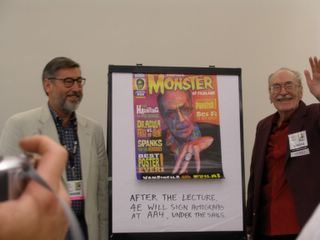
As you can tell, I am an unabashed fan of the "skiffy." My fandom was carved deeper into my soul after I attended a Forrest J. Ackerman panel at the 2005 San Diego Comic Con. There's something about sitting in a room where the audience is fewer than 20 people in the audience of like-minded fans that solidifies one's fandom. It doesn't hurt when one of them is John Landis (sitting right next to you) and he keeps elbowing you just before Forrest Ackerman's punchlines and is mouthing the words to each of Forry's stories. It was obvious that Landis had talked with Forry numerous times and that each time was magical. That kind of excitement is contagious.


All of which brings me to an article by Damien Walter at the Guardian book blog. I first got word of the book blog entry thanks to the excellent folks over at SF Signal, where they asked if the "Sci Fi" label still applied. Their answer is identical to mine, "Yes, the Sci Fi label is still important." But after reading their post, and the piece in the Guardian, I realized that a short rebuttal of Mr. Walter's blog post was insufficient as a response to Mr. Walter's post.

In the Guardian piece, Damien Walter begs the question of whether we as a popular culture are now "post sci-fi." His central thesis seems to be that "with sci-fi filling up every corner of cinema and TV and mainstream literature borrowing its ideas freely" there is no further place for the literary tradition to advance now that it has become a cultural phenomenon. His post is an articulation which might as well be renamed "The End of Sci-Fi and the Last Man."

One of Walter's key arguments is that "the walls of speculative fiction [that dread phrase -- C.L.] as a genre are quickly tumbling down. They are being demolished from within by writers such as China MiƩville and Jon Courtney Grimwood, and scaled from the outside by the likes of Michael Chabon and Lev Grossman. And they are being ignored altogether by a growing number of writers with the ambition to create great fiction, and the vision to draw equally on genre and literary tradition to achieve that goal."

This is all well and good. It is even true as far as it goes, but it demonstrates (as Walter does elsewhere in the piece) a complete lack of understanding regarding the literary history of Fantastic Literature and Fantasy. What were the Iliad and the Odyssey, if not works of Fantasy or "Speculative Fiction?" What was A Midsummer-Night's Dream and The Tempest, if not Fantasy? The Faerie Queene? The Rime of the Ancient Mariner? Beowulf? The Oresteia? The Eddas? What is Mary Shelley's Frankenstein or Edward Bellamy's Looking Backward if not Science Fiction?

All of the above a great literary works, written to be great fiction, and yet all of them fit neatly within any imagined definition of Fantasy or Fantastic Fiction. True, few of them are Science Fiction qua Science Fiction, but SF is the sub-genre not the genre -- a simple fact that Walter gets horribly wrong in his piece. To quote, "yet the literary tradition that has its roots in HG Wells and Jules Verne, Edgar Allan Poe and George MacDonald, that grew through the writing of Tolkien, Lieber, Howard, Heinlein, Clarke, and Asimov, and branched into the modern genres of fantasy, horror and science fiction, may have reached its fruition."

HG Wells and Jules Verne are the "roots" of the tradition? One might think of them as the branches closest to the trunk of the tree, but the roots? Is Walter serious? All the writers Walter mentioned are influenced by those works of Fantasy that predate them. One might argue that the 20th century was one where the literary world felt compelled to carve unnecessary categories into the literary landscape, categories designed to serve market interests, but one oughtn't think of 19th century writers as the root of a tradition. Don't even get me going on how one would attempt to draw a direct literary line from Wells to Howard.

It is not baffling that Walter piled Modern Fantasy and Science Fiction together, as they are both sub-genres of the Fantastic Tradition. That is true, but so is the work of Michael Chabon. Anyone who thinks Gentlemen of the Road is an attempt to scale the walls of Fantasy genre fiction from the "outside" is woefully mistaken. Gentlemen of the Road is a wonderful story in the direct tradition of Fritz Lieber, with no pretenses to being something else. It should be noted that much of the fiction of Avram Davidson is as worthy of literary consideration as that of Michael Chabon, and was as genre breaking for its day.

Just because Michael Chabon can draw from literary traditions other than the Fantastic Tradition when writing a story isn't a sign that we are in a "post sci-fi" era. It is merely a sign that Fantastic Fiction is ending a period of incestuousness where it fed off of itself for as long as it could. The fact that people are talking about the science fiction, or fantastic, elements of "literary fiction" is a sign that speculative fiction [that dread term again] is overcoming a certain stigma given it by literary critics and by "fans" who deride the fiction within their sub-genre which seeks to appeal to a wider audience.


*3182 is the number of lines in the epic poem Beowulf and his used here because of the muddled way Damien Walter articulates the lineage of Science Fiction and Fantasy.

Monday, October 12, 2009

Blogging Northwest Smith: "Black Thirst"


In the last installment of "Blogging Northwest Smith," I discussed how C L Moore's tales of Northwest Smith included elements of Space Opera and Weird Horror and pushed the envelope of what constituted a Science Fiction tale. By Space Opera I am referring to the earlier "Space Opera equals Space Westerns" description often used during the early days of the genre.

I am far from the first to notice that Moore incorporated elements of Weird Horror into the tales of her space faring anti-hero, Lin Carter noticed her inclusion of these elements and thought it likely they were added to garner publication in Weird Tales. Whatever Moore's reasons for including Weird Horror elements, as she did with her adaptation of the Medusa into "pleasure vampire" in "Shambleau," she was deeply enough tied to the Lovecraftian circle that she was one of the co-authors (in fact she was the jump start author) of a Lovecraftian "shared world" tale entitled The Challenge from Beyond (more on this in a later post).

For the modern fan of Science Fiction, the incorporation of horror elements into a Science Fiction narrative seems perfectly natural. Everything from the Atomic Horror films of the 50s and 60s to Ridley Scott's masterpiece Alien (based on A.E. van Vogt's 1939 Astounding story "Black Destroyer" which was included as chapters 1-6 of The Voyage of the Space Beagle) to Joss Whedon's Firefly demonstrate how deeply saturated film and television are with the SF horror story. But for fans of "Space Westerns," Foundation, or modern Space Opera, the shift in suspension of disbelief from hard SF to Weird Horror SF isn't guaranteed.

When I read "Shambleau," I was struck by how much the narrative followed the format of a classic Western and by how the monster/alien of the tale was Lovecraftian in nature -- tentacles and all. "Black Thirst" takes the combination of Science Fiction and horror a different direction than "Shambleau." Where in "Shambleau" the tale was one of Weird Horror overlaying a Western, "Black Thirst" is a tale of Gothic Horror that contains no small elements of the Western and Weird Horror genre.

Our tale begins with our protagonist, Northwest Smith, leaning against a warehouse wall in some unfriendly waterfront street on Venus. He soon encounters a woman, immediately recognizable as a Minga maid, who begs Northwest to visit her in the Minga stronghold in order to provide her some sort of aid.

Moore spends some time describing the Minga palace as a building that pre-existed the majority of civilization on Venus, describing how the stronghold was already built by the time some great Venusian explorer had sailed the seas in search of new land. The Minga maids themselves are as mysterious as the palace from which they are sold, they are "those beauties that from the beginning of history have been bred in the Minga stronghold for loveliness and grace, as race-horses are bred on Earth, and reared from earliest infancy in the art of charming men. Scarcely a court on the three planets lacks at least one of these exquisite creatures..."

Establishing the mysterious origins of the stronghold and the maids, Moore quickly establishes the dangers associated with attempting to "lay a finger" on a Minga maid. It is a danger with no appeal as "The chastity of Minga girls was proverbial, a trade boast." The purpose of these beauty slaves seems not to be a sexual one, and this is reinforced later when the real purpose of the breeding of the maids is reveals, but a purely aesthetic one. The women are bred for their beauty, in form and manner, and the price paid is for these things alone.

The concept of a stronghold of courtesans, trained in the art of charming men, combined with the similarities between Malcolm Reynolds and Northwest Smith leave one wondering if Joss Whedon had read this tale before creating Firefly. Not to imply with any certainty that Whedon was directly influenced by Moore, but it is hard for me to visualize anyone other than Nathan Fillion playing Northwest Smith in a movie -- and if he did Whedon fans would cry foul that Northwest is a direct Mal ripoff.

As the Minga maid, named Vaudir, leaves Smith she does so with a warning. She warns Northwest about the evil that is the Alendar and hints at his origins when she discusses there are "elemental" things that don't sink back into the darkness from which they came if a civilization develops too swiftly. "Life rises out of dark and mystery and things too strange and terrible to be looked upon." Here she hints at the history of the Minga and the Alendar and Moore incorporates imagery from Weird Horror. The concept of elemental evil is one of Weird Horror and it is the type of horror that is used to describe the Alendar.

Smith agrees to help the maid and approaches the stronghold as she told him he should. What follows is a series of scenes reminiscent of Bram Stoker's Dracula in which our hero plays, a much braver version, of Jonathan Harker. Smith wanders the hallways of the palace sensing, but not seeing, the great evil that awaits him. He arrives at Vaudir's room, but it is not long before he encounters the Alendar him/itself. The Alendar is a manlike creature possessed of great psychic powers, powers which overwhelm our protagonist and could kill him in an instant. But a quick death is not to be for Smith as he possesses something of value that the Alendar desires.

The Alendar, it seems, is -- like the Shambleau -- a kind of vampire. Unlike the Shambleau the Alendar does not feed on sexual/physical pleasure, instead he/it feeds on beauty. For the Alendar beauty is a tangible thing, an objective thing that provides real nourishment. The only way in which beauty is subjective regarding the Alendar's hunger is in its "form." What is beauty for a human female isn't beauty in a human male, which is why the Alendar has spared Smith. Smith possesses the quality of male beauty which must be fully developed before the Alendar can feed on him. As the Alendar describes his method of nourishment, Smith is given glimpses of unimaginable beauty -- beauty that can cause madness.

How the tale unfolds from here I will leave for you to discover on you own, but I would like to spend some time discussing some of the interesting concepts Moore threw into this story.

She is quite obviously writing a tale about slavery and presents human trafficking as a horrible affair, but she is also presenting a discussion of beauty and what constitutes true beauty. The Alendar describes beauty as follows:

"Beauty is as tangible as blood, in a way. It is a separate distinct force that inhabits the bodies of men and women. You must have noticed the vacuity that accompanies perfect beauty in so many women... the force so strong that it drives out all other forces and lives vampirishly at the expense of intelligence and goodness and conscience and all else...

For beauty, as I have said, eats up all other qualities but beauty."

The beauty that Moore has the Alendar describe is in itself horrifying, yet it is also an interesting spark for discussion. Vaudir -- who has asked Smith for assistance and led to his current state of danger -- is beautiful, but she possesses something more. She possesses and intelligence and free will that make her more desirable to the Alendar than her beauty alone would demand. Smith too possesses this combination of independence and beauty, a combination that the Alendar seeks to use in order to overcome the boredom which results from the consumption of his current fare of pure beauty. Moore is simultaneously critiquing the "cult of beauty" and proffering an alternative -- a beauty that combines intelligence, independence, and appearance. There is a strong feminist spirit underlying the story and it is this spirit that separates this tale from a run of the mill narrative.

As before, Moore combines elements from a variety of literature in this piece in a manner that is fluid. The discussion of elemental evil has ties to Weird Horror. The Alendar, his stronghold, and the equation of beauty itself with the horrific echo Gothic Horror. The manner in which Smith is encountered and the stories resolution are straight from a Western, one could easily see "Black Thirst" as an episode of Wild, Wild, West. With all that Moore combines genre elements one might expect to become lost in some residual narrative clutter, yet that never occurs. Moore has a story she wants to tell, of a vampire who consumes beauty yet seeks something more, and it makes for quite an entertaining ride.

Previous Blogging Northwest Smith Entries:

1) Blogging Northwest Smith: "Shambleau"

Thursday, October 08, 2009

Where "Dollhouse" Went Wrong

In his Entertainment Weekly column on Monday, Marc Bernardin asks the question "Where did 'Dollhouse' go wrong?" His article, in short, is an expression of his concern that the show will soon be canceled because its ratings (that's the number of people who watch the show) are on the decline. He mentions a number of contributing factors to the show's decline: Whedon's tendency to have strong finales and week starts, the "Friday Night Death Slot," poor advertising, and bad lead in programming.

I have another explanation, one that Bernardin overlooked. I think it is odd that Bernardin overlooked it, as we generally have very similar tastes when it comes to the pop culture/mass media menu, but he overlooked it none the less.

In a nutshell, it's because "Dollhouse" never gave me a reason to CARE about what was going on. Certainly, there were entertaining episodes that were filled with Whedonesque action and humor. And it would be unfair to say that I didn't care about any of the characters on the show. I worried about Echo's (Eliza Dushku) safety. I also enjoyed the portrayal of the FBI agent Paul Ballard (Tahmoh Penikett) and Echo's handler Boyd Langton (Harry Lennix). In fact, Lennix's portrayal of his character's conflicts are one of the strongest elements on the show. As a fan of 'Angel,' I was pleased to see Amy Acker working again in the roles of Dr. Saunders/Whiskey.

In fact -- I'll just put it out there -- I liked all the characters and actors on the show. Their performances were strong, especially the aforementioned Lennix and the unmentioned Alan Tudyk (who is always awesome), and I always felt like I was watching "real" people in a "real" universe.

Yet I still didn't care.

Why?

Because Whedon and crew never made it clear to me whether I should support or hate the human trafficking organization at the root of the show. Is the "Dollhouse" supporting some amazing philanthropic work that is threatened by the outside world, or are they just an organization that wipes people's minds in a kind of "forgotten" indentured servitude? Are they just an immoral human trafficking company that happens to have employees that I find pleasant?

If that's the case, and it seems to be, then there is little stake for me as a viewer in the narratives that Whedon and crew offered as a story arc. If Echo is trying to bring down the techno-brothel (where the doll's have no say in what they can/will do and won't remember anyway), I have a stake. Given the presentation of the Dollhouse so far, the only character I could really root for is Alpha (Alan Tudyk), but he's dead now having failed in his mission to defeat the Dollhouse and attain apotheosis. Sure he was crazy for the desire to become a living deity, but he was perfectly right in seeking to bring down the Dollhouse -- as it has been presented to us.

I could write at length about Whedon's seeming obsession with brothels/prostitutes as manifest in this show and Firefly. But at least the "courtesans" of Firefly seemed genre appropriate, possibly even inspired by C.L. Moore's Minga maids from her Northwest Smith story Black Thirst. Given that Malcolm Reynolds is the closest approximation of Northwest Smith to appear on any screen, I wouldn't find it surprising if NW were the entire inspiration behind Firefly, but you can read more about Firefly and Northwest Smith in a future "Blogging Northwest Smith" post (you can read the first one here). The dolls of Whedon's "Dollhouse" universe don't seem to be deeply rooted in the needs of the universe Whedon has presented in the series. In Firefly the courtesans also doubled as spies and were an integral part of the social dynamics of the 'verse. Last I checked, there was no equal need in the modern world unless your last name is Mitterrand.

Why should I desire the continued existence of the Dollhouse in the "Dollhouse" universe? There are a couple of hints, like with the Mellie character, but never any concrete reasons given. Unless I'm just supposed to think that human trafficking to fulfill sexual (and other) fantasies is unquestionably a moral virtue. Which I don't.

The reason the show is failing is because while Whedon has given us an emotional stake in the dolls, he has failed to give us a positive emotional stake in the Dollhouse.

Wednesday, October 07, 2009

In Memoriam Eleven Years Later: Eugenie Lela-Ilsa Johnson 05/04/1952 - 10/07/1998


Those of you who have been long time readers will have to forgive me once more for my annual "repeat" post. Today is a day that I often don't feel like posting about popular culture. Today is the eleventh anniversary of my mother's death, and I always feel a need to share on this day. I thought about writing something entirely original, but then I reread what I wrote in 2004 and it captures most of what I want to say. So instead of trying to reinvent the wheel, I will post the contents of a prior entry. Before you move on to the piece, I'd like to make two comments. I have added some sentences (I also updated my age and the length of time since my mom died), they are in italics, and my statement below that my mother will never get to meet her grandchildren has come true. My mom will never get to meet her lovely granddaughters Nora Thekla Lindke and Clio Millie Lindke. I don't often include photos of family on this blog, but I'll make a rare exception today.


Here are Nora and Clio. Do you see how much they look like their grandmother?
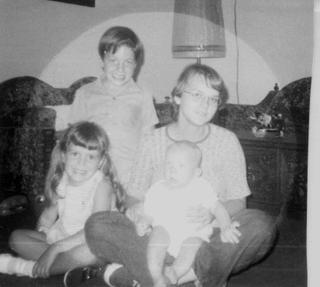


This is a picture of my mom in 1971, that blob on her lap is me.

Here is another picture of Nora and Clio.


A Day to Listen to the Velvet Underground

I am only 38 years old, but today marks the end of my first eleven years without a mom. That is an awkward sentence, but it best captures my sentiments. I am not an orphan, I still have a father. In fact, I recently had a wonderful, but too short, visit with him and my sister last week. Yet a part of me is still very much missing, a large part. October 7th, 1998...10,7,98...those numbers loom large and ominous in my heart and this is the first year I am not completely overwhelmed by them.

My wife and I have intimate conversations often, it is one of the joys of marriage, and she and I were discussing death the other day. Her grandmother had just died at the age of 92. My wife explained it this way, "When someone dies, the world feels a little less complete. Bird songs aren't as joyful, and sunrises are slightly less beautiful." Displaying, as she often does, the magnificence of unedited, awkward, and spontaneous verbal poetry. She was also correct. C.S. Lewis opens his book A Grief Observed with another observation about death:


No one ever told me that grief felt so like fear. I am not afraid, but the sensation is like being afraid. The same fluttering in the stomach, the same restlessness, the yawning. I keep on swallowing.


I still feel this way, not everyday...today.

There are two things that are still difficult for me to do seven years after my mom died when I was 27 (she was 46).

I have a hard time remembering truly happy moments with her...on command. Happy moments enter my consciousness at random moments and seldom on the anniversary of her death. Glimpses of her nymph-like smile...brief auditory illusions of her laughter enter my mind. But the majority of my memories are neither happy nor sad, they are the memories of everyday activities, evening dinners and the question which ever looms over the head of a teenager, "Have you finished your homework?" I remember watching videotapes with her on many occasions, though none as awkward as the time we watched The Hunger, just the two of us and an erotic vampire film. I remember feeling both uncomfortable being aroused by the film, in my mom's presence, while at the same time finding the situation hilarious. This moment just came to mind. There are many more like it, I just can't remember them on demand. In all honesty, I remember my mom as a happy person, a person who added joy to the world. Which is why I have my other difficulty.

I can't understand my mom's addiction, and eventual death due to how it ravaged her body, to heroin. I try, by reading/watching/listening to and about other addicts. I know the narrative of my mom's addictive cycle, I can see each step of her hopeless journey. That's not what I can't understand. I know the things that led to her addiction. What I can't understand is the overwhelming power of it, how addiction stole my mom from me...day by day. Oddly, some really shallow things help. They are a poor substitute for true knowledge, and seem trite when I think hard on them, but they help. These things include the music of the Velvet Underground (in particular, you guessed it, Heroin) and Iggy Pop, the films Permanent Midnight (which I saw just after her death) and Trainspotting, the book and film versions of Razor's Edge, and the writings of C.S. Lewis among other things.

I am the only member of my immediate family I know of who attends church. I was raised secularly. Strange as it sounds my mom found comfort in, though she was baffled by, my belief. She once asked -- before I was a regular church attendee -- if I believed in God, expecting me (the first college student in my family) to laugh at the absurdity of the question. I told her I did and her response lingers with me to this day, "Really?" Her eyes looked at me...proud, confused, unbelieving, yet hopeful. I never was able to tell her that hope was what faith was all about ("Faith is the realization of what is hoped for and evidence of things not seen" Hebrews 11:1). It isn't about "knowledge," little of life is about actual knowledge. This is why the Oracle at Delphi asked us to know ourselves, that is a difficult enough task. Let alone the ability to acquire actual knowledge of something else.

I was notified of my mom's death by answering machine. I was in classes all day and didn't have a cell phone. A series of messages of an ever-worsening condition. Seizures...followed by emergency medical action. The voices of my father and sister becoming more and more desperate as they couldn't reach me in person. My wife and I later read the medical records to piece together a time line, to see if there was an heroic effort to save my mom. There was. It is not the best way to be notified of death, answering machine, I think it is the worst. I also wish that my mom had been buried not cremated, I would have liked to have had the chance to speak, to say my own words. A dear friend of mine died of cancer two-and-a-half years ago and her funeral approximated what I would have liked for my mom. There is a tangible closure in the physical act of burial. It is still a sad event, to be sure, but there is emotional power in the ritual.

Instead, I will share the two poems I think best capture the way I feel. One is gender confused (for my situation not its own) and the other is written from an older generation to a younger one, but they will have to do. In addition I would like to add a part of Philip K. Dick's author's note from A Scanner Darkly.

The first poem is by W.H. Auden (and yes it's the poem from Four Weddings and a Funeral but the scene it is in is one of my favorites in all of cinema).


Stop all the clocks, cut off the telephone,
Prevent the dog from barking with a juicy bone,
Silence the pianos and with muffled drum
Bring out the coffin, let the mourners come.

Let aeroplanes circle moaning overhead
Scribbling on the sky the message He Is Dead,
Put crepe bows round the white necks of the public doves,
Let the traffic policemen wear black cotton gloves.

He was my North, my South, my East and West,
My working week and my Sunday rest,
My noon, my midnight, my talk, my song;
I thought that love would last for ever: I was wrong.

The stars are not wanted now: put out every one;
Pack up the moon and dismantle the sun;
Pour away the ocean and sweep up the wood.
For nothing now can ever come to any good.


The second poem is by Wordsworth:


SURPRISED by joy--impatient as the Wind
I turned to share the transport--Oh! with whom
But Thee, deep buried in the silent tomb,
That spot which no vicissitude can find?
Love, faithful love, recalled thee to my mind--
But how could I forget thee? Through what power,
Even for the least division of an hour,
Have I been so beguiled as to be blind
To my most grievous loss?--That thought's return
Was the worst pang that sorrow ever bore,
Save one, one only, when I stood forlorn,
Knowing my heart's best treasure was no more;
That neither present time, nor years unborn
Could to my sight that heavenly face restore.


Wordsworth wrote Suprised by Joy (C.S. Lewis titled one of his autobiographies after this poem), for his daughter Catherine who had died at the age of four. This poem masterfully captures the grief I feel over the loss of my mom. Every time I have wonderful event in my life, I want to call her and share the news. That can never happen and it brings the event of her death immediately to mind and my sorrow and feeling of loss are renewed. Every time...without fail. My mom missed my graduation, my wife's master's, my acceptance to graduate school, my wife completing her MFA in film at USC. She will not be there to see her first grandchild, or any of the joy that her grandchildren will bring into the world.

As I stated before, I have continually looked to fiction and biographical narrative to understand my mom's addiction and that is why I am including the following by Philip K. Dick.

This has been a novel about some people who were punished entirely too much for what they did. They wanted to have a good time, but they were like children playing in the street; they could see one another of them being killed --run over, maimed, destroyed -- but they continued to play anyhow...

Drug misuse is not a disease, it is a decision, like the decision to step out in front of a moving care. You would call that not a disease but an error in judgment. When a bunch of people begin to do it, it is a social error, a life-style. In this particular life-style the motto is "Be happy now because tomorrow you are dying," but the dying begins almost at once, and the happiness is a memory..."Take the cash and let the credit go," as Villon said in 1460. But that is a mistake if the cash is a penny and the credit is a whole lifetime...

If there was any "sin" it was that these people wanted to keep on having a good time forever, and were punished for that, but, as I say, I feel that, if so, the punishment was far to great...


I don't entirely agree with P.K. Dick's statement above. Certainly I agree that "the punishment was far too great," but I disagree with his statement that "drug misuse is not a disease." I absolutely believe that an individual has some -- though not always complete -- control over the initial decision whether to use or not use a drug initially. Some people are self-diagnosing their psychological state and self-medicating to heal themselves, others are being "happy now because tomorrow they are dying."

It does not matter why a person first used drugs, whether for "happiness" or to feel normal, there is a point in the addict's life where the drug takes over. The addict's brain chemistry is altered and they begin to experience the disease that is addiction. I firmly believe that addiction is a disease. Drug use? Not necessarily, but addiction is. When you've seen addiction in one person, you begin to recognize it when you witness it elsewhere. It is an eerie phenomenon to see the addicted personality because no matter who the addict is, no matter what their personal pain or prior life, no matter that every person is unique, the addicted personality is strikingly familiar.
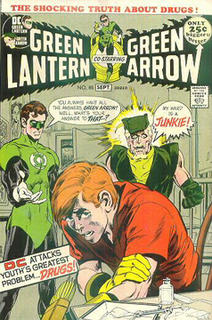


When my mom first told me of her addiction to heroin she expected me to be angry. A lot of my family was, I think the thought of my mother using heroin was too alien to them to even imagine. I think they viewed her use as somehow a failure on their part. I didn't, I only wanted to know if she was okay. By which I meant was she okay at the time she told me. My mom thought that heroin could make life more pleasant, for her it wasn't a selfish desire for more fun than anyone else was having, because she felt empty and sad on a regular basis. Heroin made her feel happy, like she could live life. But in making her think she could live life, heroin took life from her.

I don't "forgive" my mom for dying, I have never thought there was anything to forgive. I miss my mom and wish she were here. I love her and knowing that makes the missing part not so bad, because (as C.S. Lewis would say) the pain we feel now is a part of the love we have.

Friday, October 02, 2009

Hulu Recommendation Friday (on the following Tuesday): Steel Dawn


The 70s, 80s, and 90s were the heyday of the Post-Apocalyptic narrative. From movies to video games to role playing games there was an explosion of Post-Apocalyptic entertainment available.

One the movie front, we had quite a variety in quality to choose from. My favorite Post Apocalyptic film lies somewhere between Logan's Run, Escape from New York, and The Planet of the Apes. Mad Max, The Road Warrior, and The Quiet Earth were some of the shining stars of the film releases. Zardoz and Tank Girl were two of the weirder and less coherent entries. Jean Claude Van Damme's Cyborg fell somewhere in the middle of entertaining and mind-numbingly horrible.

On the gaming front, the post-apocalyptic role playing games varied from the systemically complex Aftermath to the wildly imaginative Gamma World. Aftermath always seemed to me to be a simulation of "what would happen if," which meant that most characters die in horrible fashion -- at least they did after some complex mathematical equations were applied to a couple of die rolls. Twilight 2000 was a representation of "what was going to happen." T2000, like Aftermath, featured complex rules systems with realistic representations of radiation poisoning. Nothing more fun that calculating "rads" and their very real affects on your character. Gamma World was a pure "what if" that included everything from serious speculation to mutant plant/rabbit fusions. Gamma World was the most intriguing of the games, but it also had the disadvantage of multiple editions with incompatible rules sets. I would be remiss if I left out the ultra-enjoyable Car Wars game by Steve Jackson Games...cars with machine guns and rocket launchers...mmm...fun.

As for video games...Wasteland is one of the classic computer role playing games and the ancestor of the excellent Fallout series of games.

In the middle of this Cold War inspired Post-Apocalyptomania, in 1987, came a film starring one of Hollywood's biggest stars. Fresh out of successful films like Red Dawn (itself a Post Apocalyptic movie in its own way), Youngblood, and Dirty Dancing, Patrick Swayze entered the medium with an entry that fused narrative elements from the Post Apocalyptic, Western, Sword and Sorcery, and Planetary Romance genres. Steel Dawn was directed by Lance Hool (Missing in Action 2) with a screenplay by Doug Lefler (director of The Last Legion). In addition to Swayze, the film stars Lisa Niemi (Swayze's real world wife) in the "romantic" role of Kasha and b-movie stalwart Brion James as Tark "the romantic rival."

The outline of the story is essentially Shane. A wanderer comes to town and helps a family who is being pressured by a land baron to give up their water to the land baron. Like most adaptations of Shane, the film understates the dangerous nature of the wanderer and overstates the relationship between Shane and the mother of the family under "siege." Alan Ladd's Shane is too friendly, the book's character is more akin to the Jack Palance character. Jean Claude Van Damme's Shane clone encounters a single mother and can thus become the romantic interest. Clint Eastwood's Shane translation is the hand of god working vengeance against an unjust man. Swayze's Shane is a former soldier who wanders into town with the goal of, temporarily at least, taking the place of a "Peacekeeper" who is murdered at the beginning of the film.

Swayze's arrival throws a wrench into the plans of the land baron, and into a burgeoning romance between Tark and Kasha. His skills with a sword spark the imagination of Kasha's son Jux and are what eventually allow Swayze to challenge the local land baron and avenge the death of the prior "Peacekeeper."

The swordplay, use of meditation, and moral clarity of the hero echo the narrative tropes of Planetary Romance -- the reason this film was recommended this week. The inclusion, at the beginning of the film, of weird horror in the form of sand-dwelling mutants, the aforementioned swordplay, and the lone walker nature of Swayze's character fall nicely in the Sword and Sorcery genre. The setting is definitely Post-Apocalyptic with a nuclear blasted landscape with enough history that their have even been Post-Holocaust wars that resulted in the creation of Post Apocalyptic super swordsman like Swayze and Sho -- the warrior hired by the land baron to defeat Swayze. And the story is a pure translation of Shane, but lacking in Shane's adulation of the father figure.

I have always found it interesting that the father, who is so strong in Schaefer's book Shane, is emasculated in favor of the Shane figure in film representations of the tale. Shane is a dangerous man, a gambler and murderer akin to Doc Holliday. Shane is a villain who becomes a hero when he encounters the civilizing influence of a family. Had Shane stopped in town, instead of the farm, he would have quickly become the villain of the story. A key scene, in most representations, demonstrating the difference in focus from father worship to rogue worship is the scene where the father gets into a fight in the local tavern. The book makes it clear how powerful the father is and how he is holding back to save his son, the movies make no such concessions and Steel Dawn is no different. Tark is not the young boy's father, but he is a capable farmhand who has been in the father role for some time. He is quickly displaced by Swayze, even when he is a fairly competent defender in his own right -- he's just not a sword jedi who meditates while standing on his head like Swayze.

The film is enjoyable, though very campy, and it is largely due to Swayze's extraordinary charisma.