It appears that the Strike is on and that it will start in earnest on Monday!
Anne Thompson, over at Thompson on Hollywood, has a good quick analysis of what this means for us as consumers of entertainment. In short, won't affect movies much...but television will be severely affected due to a lack of material.
How long after the strike has ended will the lack of material last? After all, no one says that the writers can't "think" about new ideas while they are on strike, but they do say that they shouldn't WRITE anything.
As the WGA phrases it, "Pencils down means pencils down". Read that list of names, it's impressive and filled with the shows you and I watch. Everything from this season's borderline Chuck to critically acclaimed shows like The Wire are represented. Not to mention The Jay Leno Show.
Does this mean that Jay Leno's jokes will get worse during the strike?
God save us and pray the strike ends quickly.

Friday, November 02, 2007


Tuesday, October 30, 2007
The Monsterpocalypse is Coming!

Are you one of those gamers who started playing Battletech in an attempt to mimic the battles between giant robots and giant lizard monsters? Have you been waiting for years for appropriately sized monster figures, pre-painted of course, for your Giant Monster Rampage or Escape from Monster Island games?
If you are a Kaiju gamer, or an gamer interested in becoming one, Privateer Press, Inc., publisher of the hit tabletop miniatures games WARMACHINE® and HORDES™, might just be making the game for you.

Privateer Press, Inc., recently announced its plans to produce a pre-painted collectible miniatures game (CMG) named Monsterpocalypse. Monsterpocalypse brings the kaiju (loosely translated from Japanese as ‘giant monster’) genre – a pop culture favorite – to the tabletop in the form of a fast-paced, action-packed CMG. Designed by Matt Wilson, the award winning creator of WARMACHINE and HORDES, Monsterpocalypse leverages the critically acclaimed abilities of Privateer Press as a leading miniatures manufacturer to enter a new category of product with a property that will appeal to a world-wide fan base of all ages.
Given the production quality, and quality of play, of their past products, as well as their recent foray into the Non-Collectible Card Game field Infernal Contraption, gamers of all stripes should give Monsterpocalypse at least a glance. With Infernal Contraption the company began their expansion into new aspects of the gaming hobby, and with Monsterpocalypse the company has an opportunity to not merely tap into the existing Collectible Miniatures Game market, but to expand it as well.
“We’ve had great success in the hobby miniatures category, and we will continue to support and expand our offerings there. We are excited to grow the company in this new direction. Creating a property about giant monsters is a natural fit for us and something I’ve always wanted to do.” said Wilson.
The Monsterpocalypse CMG will launch with over 80 figures in the initial set and will include large-scale monsters, destroyable city structures, and vehicles.
The giant lizard looks like he comes straight from Monster Island. I can't wait to see it painted.

One of their giant robot prototypes gives me hopes that I will be able to enact all of my Gundam and Vultron fantasies.

As for their demo UFO, a necessary addition to any Kaiju offering, let me say that I thought it was a giant mushroom at first glance. Let's hope the paint job changes that perception.

It is planned for release at retail in 2008. Figures will be sold in randomized booster packs and non-randomized starter games, and special figures will be available at events throughout 2008. Visit www.privateerpress.com for photos of prototype models and updates about the game.
I can't wait to show these to my Geekerati co-host Bill Cunningham.
Monday, October 29, 2007
The Best Horror Themed TV Shows: Tonight on Geekerati Radio
Last week, my co-hosts and I discussed the "merits" of the horror movie trend that David Edelstein called Torture Porn. Shawna and Bill were on different sides of the issue, though the conversation was extremely civil. If you are interested in the topic, you can read David Edelstein's New York Magazine article and then listen to our show.
This week, we'll be talking about our favorite horror themed television shows. Give a listen and call in at (646)478-5041 to let us know your favorites tonight at 7pm Pacific. The only way you can ensure that we talk about your favorite show, is for you to call in and join the chat. Do you remember the old Fox series Werewolf? We do.

This week, we'll be talking about our favorite horror themed television shows. Give a listen and call in at (646)478-5041 to let us know your favorites tonight at 7pm Pacific. The only way you can ensure that we talk about your favorite show, is for you to call in and join the chat. Do you remember the old Fox series Werewolf? We do.

Wednesday, October 24, 2007
You know the internet caters to niche audiences when...#1
...there is a site devoted entirely to groin punches/blows from comic books. Today's features Wolverine claiming that his will "grow back."
I knew there were some "groin shots" in comics, but I had no idea just how many there were. Maybe we are as banal as Idiocracy implied.
Thanks to Boing Boing for the link.
I knew there were some "groin shots" in comics, but I had no idea just how many there were. Maybe we are as banal as Idiocracy implied.
Thanks to Boing Boing for the link.
Tuesday, October 23, 2007
D&D Animation: Then and Now.
Back in the 1980s, I used to watch the Dungeons and Dragons cartoon. I thought it was great, and so did a lot of my peers. The animation was standard for cartoons of the time, in fact it might have been slightly better than some shows. I recently compared episodes of the GI JOE cartoon from the time period to episodes of the D&D cartoon and the D&D cartoon looks a little better in my opinion.
Here's a little clip for you to look at.
Since the 1980s, television animation has come a long way, or at least some of it has. Viewers can watch the beautifully rendered Avatar series on Nickelodeon, if they want to see what television animators are "capable" of producing. Not everything out today is of the caliber of Avatar, as not every thing in the 60s was Johnny Quest, but Avatar is a reasonable example of how beautiful modern televised animation can look. If I wanted to be mean, I could have used Samurai Champloo as my point of comparison, but I'm not that mean. I just wanted to point out that in the past 20 years, it has become possible to distribute some pretty beautiful animation on the medium of television. Which is why the new "provisional" trailer for the upcoming direct to DVD adaptation of the Dungeons and Dragons (Roleplaying Game) related Dragonlance book series, has me worried about how the film will affect the public's perception of D&D. I think it will give people the perception that D&D fans are satisfied by derivative stories with poor animation. Have a look for yourself:
In the interest of being completely honest, I should note that I am not biggest fan of the Dragonlance series. I find it entertaining, but in that kind of "it's related to my hobby so I like it" kind of way. The first trilogy of books, which the DVD is an adaptation of the first novel thereof, is pretty poorly crafted and very derivative. But I found some of the characters compelling and very much enjoyed the second trilogy, and some of the subsequent series as well -- including the recent "fill in the gaps" trilogy that has been being released this year. The new "fill in the gaps" trilogy eliminates some of the holes in narrative of the first trilogy. The need for such a series speaks volumes about the original series.
That said, Dragonlance has legions of fans, these are NYT Bestsellers we are talking about, and they deserve better than what this preview is showing me. If the CGI integration doesn't improve in the final product, I'll probably recommend that my friends watch Record of Lodoss War instead of the upcoming Dragonlance movie. At least, I'll be buying it first, so my friends will have warning.
Here's a little clip for you to look at.
Since the 1980s, television animation has come a long way, or at least some of it has. Viewers can watch the beautifully rendered Avatar series on Nickelodeon, if they want to see what television animators are "capable" of producing. Not everything out today is of the caliber of Avatar, as not every thing in the 60s was Johnny Quest, but Avatar is a reasonable example of how beautiful modern televised animation can look. If I wanted to be mean, I could have used Samurai Champloo as my point of comparison, but I'm not that mean. I just wanted to point out that in the past 20 years, it has become possible to distribute some pretty beautiful animation on the medium of television. Which is why the new "provisional" trailer for the upcoming direct to DVD adaptation of the Dungeons and Dragons (Roleplaying Game) related Dragonlance book series, has me worried about how the film will affect the public's perception of D&D. I think it will give people the perception that D&D fans are satisfied by derivative stories with poor animation. Have a look for yourself:
In the interest of being completely honest, I should note that I am not biggest fan of the Dragonlance series. I find it entertaining, but in that kind of "it's related to my hobby so I like it" kind of way. The first trilogy of books, which the DVD is an adaptation of the first novel thereof, is pretty poorly crafted and very derivative. But I found some of the characters compelling and very much enjoyed the second trilogy, and some of the subsequent series as well -- including the recent "fill in the gaps" trilogy that has been being released this year. The new "fill in the gaps" trilogy eliminates some of the holes in narrative of the first trilogy. The need for such a series speaks volumes about the original series.
That said, Dragonlance has legions of fans, these are NYT Bestsellers we are talking about, and they deserve better than what this preview is showing me. If the CGI integration doesn't improve in the final product, I'll probably recommend that my friends watch Record of Lodoss War instead of the upcoming Dragonlance movie. At least, I'll be buying it first, so my friends will have warning.
Wednesday, October 17, 2007
Kong vs. Kong: Universal, Nintendo, and Copyright
I love video games. I can still remember the times I used to walk into my local video game arcade, this is back when arcades were a hangout. The arcade was called "The Outer Limits" and it featured all the latest quarter vacuums. Within only a couple of years the place would become a dive bar. But for one brief flicker of time's candle, this was the place to hang out after school and in the summer.
One particular day, I noticed there was a new machine with a very long line waiting to play. Quarters were lined up like crazy, as players marked their turn on the machine. Like I wrote, this was back in the day. What was this new and exciting game? Was it the original Street Fighter? Was Tapper? Or even Dragon's Lair? No, this was something completely different. It was a game that combined my childhood love of Kaiju, with the natural attraction of cartoon characters jumping over rolling barrels. That's right, the game was Donkey Kong.
I was ten years old. Even though I noticed the huge appeal of the game, and even though I played it many times myself, I could never imagine the revolution in the video game industry that this one game would have. According to an article by Spanner over at The Escapist -- an excellent online video game magazine -- without the Donkey Kong video game, the today's gaming industry would be very different. Nintendo would likely not exist and based on Spanner's narrative I can imagine that the home video game console might have died in the video game market crash of 1984. If Nintendo hadn't resurrected the home video game console with their NES system, we might not be playing them today. Without Donkey Kong, Nintendo might never have released that amazing little box. Not too shabby for a game that's title, according to Spanner, is a mistranslation of "Stubborn Gorilla."
Spanner's article about Donkey Kong is important to us hear at Cinerati for a couple of reasons.
It is a story of hope about a company that became successful during turbulent times in a particular facet of the entertainment industry. Nintendo not only survived the collapse of the video game console market, they helped resurrect it. In a world where the makers of films and television shows are worried about how the technologies of the future will affect them, Nintendo's story provides more than a glimmer of inspiration.
It is also the story of a battle regarding intellectual property rights, especially salient given my post the other day regarding Cory Doctorow and the Doctorow Doctrine. Nintendo was sued by Universal because of the similarity Donkey Kong's title character had to the famous RKO (now Universal) monster King Kong. Universal wanted their share of Nintendo's, and all their licensees', profits from the game. Many of the licensees, like Coleco and Tiger, caved quickly to the demands. Nintendo, on the other hand, came out of their corner fighting and won. To quote, "John Kirby...stunned the room with a fatal blow to Universal's already weakening case. In 1975, Universal Studios had successfully taken RKO Pictures to court in order to prove the image and story of King Kong were over 40 years old and therefore in the public domain, clearing the path for Dino De Laurentiis to remake the movie in 1976 without paying any expensive royalties."
Copyright law has changed since then (lifetime plus how many years?), but one thing remains the same. Corporations still claim copyright for individual creator's works. You see, this is what I find most important about copyright. I don't care if a corporation is able to profit for lifetime-plus-seventy years on a product, but I do care that the individual responsible is able to profit. Cory Doctorow can advance his Walter Benjamin inspired defetishization of the artifact agenda all he wants, but I believe the act of creation instills certain rights, rights that shouldn't be hijacked by p2p servers or large corporations. Corporations, while necessarily being treated as individuals before the law in some ways (you do have to sue somebody after all), are not de facto people. Corporations should protect individual copyrights, and yes profit from them, but they shouldn't be giant leeches profiting off of the rights of dead men and women.
And this is where we can learn another lesson from the Universal City Studios, Inc. vs Nintendo Co., Ltd. case. When the case was over, the judge in the case (Judge Robert Sweet) determined that Nintendo could claim damages from Tiger Electronics. Tiger had been forced by Universal to change their Donkey Kong hand held game into a King Kong hand held game -- with some minor content alterations -- and pay royalties to Universal. Judge Sweet "determined the alterations were not sufficient to differentiate it from Nintendo's game," giving Nintendo the authority to take money from Tiger. Nintendo "instead decided to let Tiger off the hook and reclaim the profits Universal had made from the original King Kong license." So not only did Nintendo not pursue damages, they helped Tiger recoup royalties that never should have been paid in the first place. If only more copyright fights resolved themselves like this.
Most importantly, without Donkey Kong I probably wouldn't be going home to futz with my Wii tonight.
One particular day, I noticed there was a new machine with a very long line waiting to play. Quarters were lined up like crazy, as players marked their turn on the machine. Like I wrote, this was back in the day. What was this new and exciting game? Was it the original Street Fighter? Was Tapper? Or even Dragon's Lair? No, this was something completely different. It was a game that combined my childhood love of Kaiju, with the natural attraction of cartoon characters jumping over rolling barrels. That's right, the game was Donkey Kong.
I was ten years old. Even though I noticed the huge appeal of the game, and even though I played it many times myself, I could never imagine the revolution in the video game industry that this one game would have. According to an article by Spanner over at The Escapist -- an excellent online video game magazine -- without the Donkey Kong video game, the today's gaming industry would be very different. Nintendo would likely not exist and based on Spanner's narrative I can imagine that the home video game console might have died in the video game market crash of 1984. If Nintendo hadn't resurrected the home video game console with their NES system, we might not be playing them today. Without Donkey Kong, Nintendo might never have released that amazing little box. Not too shabby for a game that's title, according to Spanner, is a mistranslation of "Stubborn Gorilla."
Spanner's article about Donkey Kong is important to us hear at Cinerati for a couple of reasons.
It is a story of hope about a company that became successful during turbulent times in a particular facet of the entertainment industry. Nintendo not only survived the collapse of the video game console market, they helped resurrect it. In a world where the makers of films and television shows are worried about how the technologies of the future will affect them, Nintendo's story provides more than a glimmer of inspiration.
It is also the story of a battle regarding intellectual property rights, especially salient given my post the other day regarding Cory Doctorow and the Doctorow Doctrine. Nintendo was sued by Universal because of the similarity Donkey Kong's title character had to the famous RKO (now Universal) monster King Kong. Universal wanted their share of Nintendo's, and all their licensees', profits from the game. Many of the licensees, like Coleco and Tiger, caved quickly to the demands. Nintendo, on the other hand, came out of their corner fighting and won. To quote, "John Kirby...stunned the room with a fatal blow to Universal's already weakening case. In 1975, Universal Studios had successfully taken RKO Pictures to court in order to prove the image and story of King Kong were over 40 years old and therefore in the public domain, clearing the path for Dino De Laurentiis to remake the movie in 1976 without paying any expensive royalties."
Copyright law has changed since then (lifetime plus how many years?), but one thing remains the same. Corporations still claim copyright for individual creator's works. You see, this is what I find most important about copyright. I don't care if a corporation is able to profit for lifetime-plus-seventy years on a product, but I do care that the individual responsible is able to profit. Cory Doctorow can advance his Walter Benjamin inspired defetishization of the artifact agenda all he wants, but I believe the act of creation instills certain rights, rights that shouldn't be hijacked by p2p servers or large corporations. Corporations, while necessarily being treated as individuals before the law in some ways (you do have to sue somebody after all), are not de facto people. Corporations should protect individual copyrights, and yes profit from them, but they shouldn't be giant leeches profiting off of the rights of dead men and women.
And this is where we can learn another lesson from the Universal City Studios, Inc. vs Nintendo Co., Ltd. case. When the case was over, the judge in the case (Judge Robert Sweet) determined that Nintendo could claim damages from Tiger Electronics. Tiger had been forced by Universal to change their Donkey Kong hand held game into a King Kong hand held game -- with some minor content alterations -- and pay royalties to Universal. Judge Sweet "determined the alterations were not sufficient to differentiate it from Nintendo's game," giving Nintendo the authority to take money from Tiger. Nintendo "instead decided to let Tiger off the hook and reclaim the profits Universal had made from the original King Kong license." So not only did Nintendo not pursue damages, they helped Tiger recoup royalties that never should have been paid in the first place. If only more copyright fights resolved themselves like this.
Most importantly, without Donkey Kong I probably wouldn't be going home to futz with my Wii tonight.
Tuesday, October 16, 2007
What's So Special About Conan?
In today's USA Today, Mike Snider writes about Conan's reemergence as a relevant subject in popular culture (hat tip to SF Signal for the story). There are those of us who comment about poplar culture who think that Conan has never been an irrelevant figure in society. How can a character who codified an entire literary genre become truly irrelevant? Every story about a sword wielding barbarian, no matter how trite or bad, is at some level inspired by Robert E. Howard's creation. But it can't be denied that there is exciting news for Conan fans. Snider points to five recent developments that signal Conan's relevance:
Those these are important, and wonderful, developments for the Conan fan, they are not new. One should not think that there has been some kind of sudden explosion in 2007 of Conan material.
Snider neglected to mention:
The Conan explosion isn't a new thing either, I could have pulled numerous examples from the 90s or the 80s of Conan releases. Conan is always lurking in the pop culture subconscious and I think that we do a disservice to Conan fans, both existent and emerging when we use Arnold Schwarzenegger as the archetypal Conan representation, as Snider appears to do in the article. Some like Arnold as archetype, but I find Conan to be one of the most underestimated characters in American literature (with Natty Bumpo being a close second) and the Governator's portrayal -- while fun -- lacks the depth the character actually has as a literary figure.
When it comes to depictions of unreflective low art, one need look no further than the commonly perceived opinions of Robert Howard's Conan stories. If you ask the average man on the street to describe a Conan narrative, you will likely be given a tale of lust and violence. In the tale Conan will rescue some half-naked maiden from some rampaging beast and the story will end with the woman becoming all naked as she swoons at the hero's feet. In fact, a great deal of Conan pastiche has been based on this very simple formula. The largest problem with such a vision is that it is not all that accurate. Are there tales of this sort in the Conan oeuvre?
Sure, but there are also tales of visionary wonder.
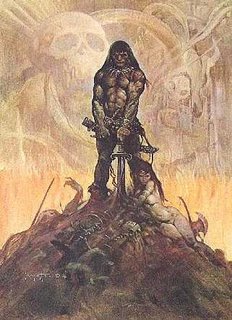
Like most authors, whether they write literature or Literature, Howard's writings reflect his own thoughts, experiences, and education. The writing reflects the aesthetic tastes of the author, or his/her understanding of a prospective audiences literary tastes. What makes something worth reading again and again is when an author satisfies those with "lower" tastes while providing them with some food for thought. Howard is no exception. In fact, I was surprised while I was rereading the first published Conan story, Howard's The Phoenix on the Sword to find that the author seemed to be hinting at a theory of the value of literature and its role in society.
Howard's Hyborean Age is a mythic world filled with magic and wonder, but it is also a world based on the history of the real world. Howard combined multiple eras of history so that societies whose "real world" existence is separated by centuries could co-exist narratively. Conan's own people, the Cimmerians, are based on a very real historical peoples. Both Herodotus, in his Histories, and Plutarch, in his Lives, mention the Cimmerian peoples (called Cimbri in Plutarch). In The Phoenix on the Sword, Howard appears to expect his audience to have at least a little understanding of the historical Cimmerians in his conversation of the role of literature in civilization. Conan, as protagonist, must hold ideas which the reader sympathizes with for the particular narrative of Phoenix to work.
So what kind of people were the Cimmerians? According to Plutarch they were a people who were pillagers and raiders, but not rulers.
What did they look like? According to Plutarch:
What was their temperament? According to Homer:
It is Homer's description of the Cimmerians that Howard uses in Phoenix to describe the mood of the people and to separate Conan from his kin. When Conan is asked why the Cimmerians are such a brooding people, Conan responds:
“Perhaps it’s the land they live in,” answered the king. “A gloomier land never was – all of hills, darkly wooded, under skies nearly always gray, with winds moaning drearily down the valleys.” – Phoenix on the Sword
The average Cimmerian is a dour and towering barbarian who destroys civilization then returns to his gloomy homeland only to begin the process again later. Howard's typical Cimmerian is similar to that of the classical scholars, and presents a figure most unlikely to advance the literary arts. But this is where Conan differs from his kin. InThe Phoenix on the Sword, Conan is an older man who has conquered on of the greatest nations of the Hyborean Age expressly to free them from tyrannical rule. He conquered to rule, and to liberate an oppressed nation. A far cry from the typical barbarian. By separating Conan from his kin, Howard simultaneously increases the audience's sympathy for the barbarian king while enabling the character to advance a theory of the value of literature.
The Phoenix on the Sword is the tale of a plot to assassinate King Conan, a plot organized my a Machiavellian figure named Ascalante who desires to assume the throne. Ascalante is the product of civilization, but he is the antagonist of the story and so Howard uses his opinions of the Arts as a way to separate him from the audience's sympathy. When he describes a poet who has been brought into his conspiracy he describes the poet in pejorative terms. These terms evolve as the narrative moves from unpublished draft to final published form. Ascalante originally expresses his disdain for Rinaldo (the poet) in a long description:
By the time the story is published the description is changed to the very brief, "“…Rinaldo, the hair-brained minstrel.” [Ascalante in Phoenix on the Sword(published)]. In the published form, Howard leaves out the value of Rinaldo's participation in the plot because it is redundant with information presented later in the story. When Ascalante is asked what value Rinaldo has as a conspirator, Ascalante's response is similar in both the published and unpublished text, but his hatred of Rinaldo is made more clear in the draft than in the published text:
In both descriptions the poet is shown to be a blind idealist. Rinaldo, it appears, cannot look beyond the Cimmerian stereotypes as presented by Plutarch and Herodotus. Howard doesn't require the reader to have those preconceptions, but for the reader who has read Herodotus and Plutarch the stereotype becomes even clearer. Also by editing down the prose the author, either willingly or at editorial command, displays an amount of trust that his audience can reach the proper conclusion that barbarism typically destroys the valuable within civilization. What is interesting is that while Rinaldo is a conspirator, the poet is an antagonist, he is not a villain. He is a blind a foolish idealist, not acting in his own self interest. Ascalante even goes on to describe Rinaldo's motivations:
Ascalante specifies what kind of idealists poets are. They seek an imagined perfect society, and will always look for it no matter how good the society they are currently in happens to be. But this is Ascalante, the Machiavellian civilized man, and his opinion about what the value of the poet is. For him the poet is an easily manipulable puppet. What about the barbarian turned king, the protagonist, and oft argued proxy for the author? (It should be noted that many argue that Conan often reflects Howard's own views, this is not an original assertion on my part.)
Conan adores the poet, and understands the criticisms. He is aware that the poet's plays are leading many among the people to despise him, but he too is persuaded of the need for justice. When his chief adviser, Prospero, discusses disdain for Rinaldo, Conan comes to the poet's (and poetry in general) defense. The text is near identical in the published and unpublished format.

For Conan, the atypical Cimmerian, poems and the arts have more power than weapons or royal authority. Not only that, but it is right and just that this is the case. Conan, the barbarian, is the defender of the value of literature, while Ascalante, the civilized man, sees literature as only a tool used to manipulate the foolish. Conan would seek to discuss the past and future, the ideal ones, with the poet, while Ascalante would merely use Rinaldo to destroy what he opposes. Conan's conflict between desiring a free press and swift justice, and the eventual melee that will result because of his favoring of the press, are made clear in the poetic prologue to the final chapter of the narrative.
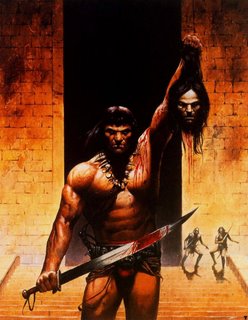
Surprisingly, Conan's love of literature and the arts, and his defense of them, is so deeply rooted that he initially refuses to kill Rinaldo when Rinaldo attacks him. He still believes he can reason with the poet, it is only when he is left no other alternative that he kills the poet (the text is identical in both published and unpublished forms).
What is interesting in the narrative is that of all the conspirators, there are twenty in all, none are able to injure Conan with the success of the poet. The poet has both damaged Conan's regime and his body and yet Conan was ever reluctant to, though in the end capable of, slay his greatest enemy.
What does this tell us of Howard's thoughts regarding the arts? We know that Conan loves them, but we also know how they were used to manipulate the populace and how his own love for them almost cost him his life. Is Howard trying to discuss how Plato's critique of the poets is a good one, while at the same time defending the possible nobility of the poet (as Aristotle does in his Rhetoric)? I think these are questions intentionally posed in the narrative (I know...never guess at intentionality), and make it clear why Conan's first story The Phoenix on the Sword was so compelling to readers when they first read it.
It should be noted that the story was originally submitted as a Kull tale, though I have yet to analyze that draft like I have these two subsequent writings. The Kull version was rejected by Weird Tales and the final (rather than the first) Conan version was the first appearance of what has become a culturally iconic figure.
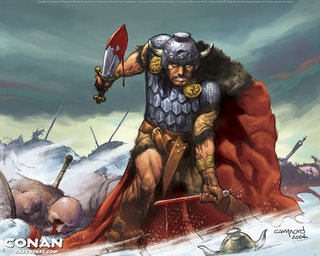
- The New PS3/XBOX 360 Video Game coming out next week
- The new "Conan The Phenomenon" hardcover by Paul Sammon
- The Savage Sword of Conan Trade Paperback Collection by Dark Horse
and- An upcoming movie by Millennium Films.
Those these are important, and wonderful, developments for the Conan fan, they are not new. One should not think that there has been some kind of sudden explosion in 2007 of Conan material.
Snider neglected to mention:
- Conan: The Ultimate Guide by Roy Thomas which released in September 2006
- The new Conan comic book series (first released in 2004) written by Kurt Busiek and illustrated by Cary Nord by Dark Horse
- The Mongoose Publishing Conan Roleplaying Game
not to mention- The Age of Conan series of media tie-in novels published in 2005 and 2006
or- Del Rey's publishing of Howard's Original Conan Stories released in 2003
The Conan explosion isn't a new thing either, I could have pulled numerous examples from the 90s or the 80s of Conan releases. Conan is always lurking in the pop culture subconscious and I think that we do a disservice to Conan fans, both existent and emerging when we use Arnold Schwarzenegger as the archetypal Conan representation, as Snider appears to do in the article. Some like Arnold as archetype, but I find Conan to be one of the most underestimated characters in American literature (with Natty Bumpo being a close second) and the Governator's portrayal -- while fun -- lacks the depth the character actually has as a literary figure.
When it comes to depictions of unreflective low art, one need look no further than the commonly perceived opinions of Robert Howard's Conan stories. If you ask the average man on the street to describe a Conan narrative, you will likely be given a tale of lust and violence. In the tale Conan will rescue some half-naked maiden from some rampaging beast and the story will end with the woman becoming all naked as she swoons at the hero's feet. In fact, a great deal of Conan pastiche has been based on this very simple formula. The largest problem with such a vision is that it is not all that accurate. Are there tales of this sort in the Conan oeuvre?
Sure, but there are also tales of visionary wonder.

Like most authors, whether they write literature or Literature, Howard's writings reflect his own thoughts, experiences, and education. The writing reflects the aesthetic tastes of the author, or his/her understanding of a prospective audiences literary tastes. What makes something worth reading again and again is when an author satisfies those with "lower" tastes while providing them with some food for thought. Howard is no exception. In fact, I was surprised while I was rereading the first published Conan story, Howard's The Phoenix on the Sword to find that the author seemed to be hinting at a theory of the value of literature and its role in society.
Howard's Hyborean Age is a mythic world filled with magic and wonder, but it is also a world based on the history of the real world. Howard combined multiple eras of history so that societies whose "real world" existence is separated by centuries could co-exist narratively. Conan's own people, the Cimmerians, are based on a very real historical peoples. Both Herodotus, in his Histories, and Plutarch, in his Lives, mention the Cimmerian peoples (called Cimbri in Plutarch). In The Phoenix on the Sword, Howard appears to expect his audience to have at least a little understanding of the historical Cimmerians in his conversation of the role of literature in civilization. Conan, as protagonist, must hold ideas which the reader sympathizes with for the particular narrative of Phoenix to work.
So what kind of people were the Cimmerians? According to Plutarch they were a people who were pillagers and raiders, but not rulers.
For the Cimmerian attack upon Ionia, which was earlier than Croesus, was not a conquest of the cities, but only an inroad for plundering.
Herodotus, Histories, I, 6
What did they look like? According to Plutarch:
Their great height, their black eyes and their name, Cimbri, which the Germans use for brigands, led us merely to suppose that they were one of those races of Germania who lived on the shores of the Western Ocean. Others say that the huge expanse of Celtica stretches from the outer sea and the western regions to the Palus Maeotis and borders on Asian Scythia; that these two neighbouring nations joined forces and left their land... And although each people had a different name, their army was collectively called Celto-Scythian. According to others, some of the Cimmerians, who were the first-to be known to the ancient Greeks... took flight and were driven from their land by the Scythians. Plutarch, Life of Marius, XI
What was their temperament? According to Homer:
Thus she brought us to the deep-Rowing River of Ocean and the frontiers of the world, where the fog-bound Cimmerians live in the City of Perpetual Mist. When the bright Sun climbs the sky and puts the stars to flight, no ray from him can penetrate to them, nor can he see them as he drops from heaven and sinks once more to the earth. For dreadful night has spread her mantle over the heads of that unhappy folk. Homer, Odyssey, XI, 14
It is Homer's description of the Cimmerians that Howard uses in Phoenix to describe the mood of the people and to separate Conan from his kin. When Conan is asked why the Cimmerians are such a brooding people, Conan responds:
“Perhaps it’s the land they live in,” answered the king. “A gloomier land never was – all of hills, darkly wooded, under skies nearly always gray, with winds moaning drearily down the valleys.” – Phoenix on the Sword
The average Cimmerian is a dour and towering barbarian who destroys civilization then returns to his gloomy homeland only to begin the process again later. Howard's typical Cimmerian is similar to that of the classical scholars, and presents a figure most unlikely to advance the literary arts. But this is where Conan differs from his kin. In
The Phoenix on the Sword is the tale of a plot to assassinate King Conan, a plot organized my a Machiavellian figure named Ascalante who desires to assume the throne. Ascalante is the product of civilization, but he is the antagonist of the story and so Howard uses his opinions of the Arts as a way to separate him from the audience's sympathy. When he describes a poet who has been brought into his conspiracy he describes the poet in pejorative terms. These terms evolve as the narrative moves from unpublished draft to final published form. Ascalante originally expresses his disdain for Rinaldo (the poet) in a long description:
“Rinaldo – a mad poet full of hare-brained visions and out-worn chivalry. A prime favorite with the people because of his songs which tear out their heart-strings. He is our best bid for popularity.” – Ascalante in Phoenix on the Sword (unpublished First submitted draft)
By the time the story is published the description is changed to the very brief, "“…Rinaldo, the hair-brained minstrel.” [Ascalante in Phoenix on the Sword(published)]. In the published form, Howard leaves out the value of Rinaldo's participation in the plot because it is redundant with information presented later in the story. When Ascalante is asked what value Rinaldo has as a conspirator, Ascalante's response is similar in both the published and unpublished text, but his hatred of Rinaldo is made more clear in the draft than in the published text:
“Alone of us all, Rinaldo has no personal ambition. He sees in Conan a red-handed, rough-footed barbarian who came out of the north to plunder a civilized land. He idealizes the king whom Conan killed to get the crown, remembering only that he occasionally patronized the arts, and forgetting the evils of his reign, and he is making the people forget. Already they openly sing The Lament for the King in which Rinaldo lauds the sainted villain and denounces Conan as ‘that black-hearted savage from the abyss.’ Conan laughs, but the people snarl.” – Ascalante in Phoenix on the Sword (published)
“Rinaldo – bah! I despise the man and admire him at the same time. He is your true idealist. Alone of us all he has no personal ambition. He sees in Conan a red-handed, rough-footed barbarian who came out of the north to plunder a peaceful land. He thinks he sees barbarism triumphing over culture. He already idealizes the king Conan killed, forgetting the rogue’s real nature, remembering only that he occasionally patronized the arts, and forgetting the evils under which the land groaned during his reign, and he is making the people forget. Already they open sing ‘The Lament for the King’ in which Rinaldo lauds the saintly villain, and denounces Conan as ‘that black-hearted savage from the abyss.’ Conan laughs, but at the same time wonders why the people are turning against him.” – Ascalante in Phoenix on the Sword (unpublished First submitted draft)
In both descriptions the poet is shown to be a blind idealist. Rinaldo, it appears, cannot look beyond the Cimmerian stereotypes as presented by Plutarch and Herodotus. Howard doesn't require the reader to have those preconceptions, but for the reader who has read Herodotus and Plutarch the stereotype becomes even clearer. Also by editing down the prose the author, either willingly or at editorial command, displays an amount of trust that his audience can reach the proper conclusion that barbarism typically destroys the valuable within civilization. What is interesting is that while Rinaldo is a conspirator, the poet is an antagonist, he is not a villain. He is a blind a foolish idealist, not acting in his own self interest. Ascalante even goes on to describe Rinaldo's motivations:
“Poets always hate those in power. To them perfection is always just behind the last corner, or beyond the next. They escape the present in dreams of the past and future. Rinaldo is a flaming torch of idealism, rising, as he thinks, to overthrow a tyrant and liberate the people.” – Ascalante in Phoenix on the Sword (published)
“Because he is a poet. Poets always hate those in power. To them perfection is always just behind the last corner or beyond the next. They escape the present in dreams of the past and the future. Rinaldo is a flaming torch of idealism and he sees himself as a hero, a stainless knight – which after all he is! – rising to overthrow the tyrant and liberate the people.” – Ascalante in Phoenix on the Sword (unpublished First submitted draft)
Ascalante specifies what kind of idealists poets are. They seek an imagined perfect society, and will always look for it no matter how good the society they are currently in happens to be. But this is Ascalante, the Machiavellian civilized man, and his opinion about what the value of the poet is. For him the poet is an easily manipulable puppet. What about the barbarian turned king, the protagonist, and oft argued proxy for the author? (It should be noted that many argue that Conan often reflects Howard's own views, this is not an original assertion on my part.)
Conan adores the poet, and understands the criticisms. He is aware that the poet's plays are leading many among the people to despise him, but he too is persuaded of the need for justice. When his chief adviser, Prospero, discusses disdain for Rinaldo, Conan comes to the poet's (and poetry in general) defense. The text is near identical in the published and unpublished format.
“Rinaldo is largely responsible,” answered Prospero, drawing up his sword-belt another notch. “He sings songs that make men mad. Hang him in his jester’s garb to the highest tower in the city. Let him make rhymes for the vultures.”
“No, Prospero, he’s beyond my reach. A great poet is greater than any king. His songs are mightier than my scepter, for he has hear ripped the heart from my breast when he chose to sing for me. I will die and be forgotten, but Rinaldo’s songs will live forever.” – Phoenix on the Sword (unpublished first submitted draft)
“Rinaldo is largely responsible,” answered Prospero, drawing up his sword-belt another notch. “He sings songs that make men mad. Hang him in his jester’s garb to the highest tower in the city. Let him make rimes for the vultures.”
“No, Prospero, he’s beyond my reach. A great poet is greater than any king. His songs are mightier than my scepter; for he has near ripped the heart from my breast when he chose to sing for me. I shall die and be forgotten, but Rinaldo’s songs will live for ever.” – Phoenix on the Sword (published)

For Conan, the atypical Cimmerian, poems and the arts have more power than weapons or royal authority. Not only that, but it is right and just that this is the case. Conan, the barbarian, is the defender of the value of literature, while Ascalante, the civilized man, sees literature as only a tool used to manipulate the foolish. Conan would seek to discuss the past and future, the ideal ones, with the poet, while Ascalante would merely use Rinaldo to destroy what he opposes. Conan's conflict between desiring a free press and swift justice, and the eventual melee that will result because of his favoring of the press, are made clear in the poetic prologue to the final chapter of the narrative.
What do I know of cultured ways, the gilt, the craft and the lie?
I, who was born in a naked land and bred in the open sky.
The subtle tongue, the sophist guile, they fail when the broadswords sing;
Rush in and die, dogs – I was a man before I was a king. – The Road of Kings – Phoenix on the Sword (published)
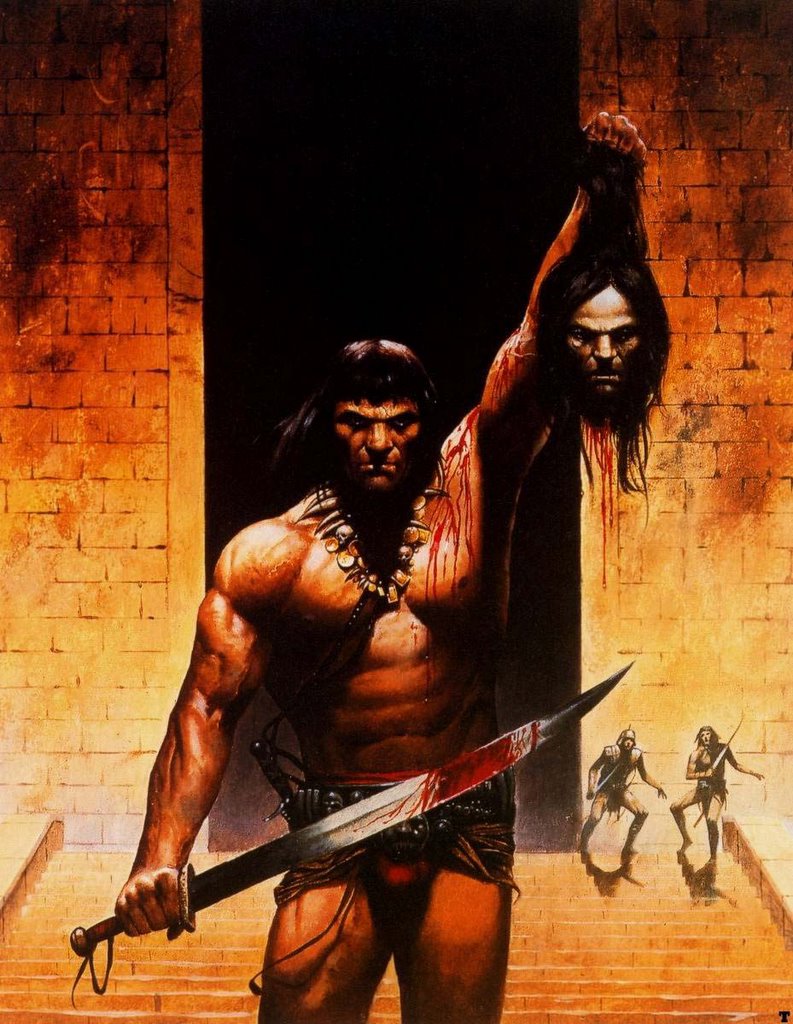
Surprisingly, Conan's love of literature and the arts, and his defense of them, is so deeply rooted that he initially refuses to kill Rinaldo when Rinaldo attacks him. He still believes he can reason with the poet, it is only when he is left no other alternative that he kills the poet (the text is identical in both published and unpublished forms).
“He rushed in, hacking madly, but Conan, recognizing him, shattered his sword with a short terrific chop and with a powerful push of his open hand sent him reeling to the floor.” – Phoenix on the Sword (published)
“He straightened to meet the maddened rush of Rinaldo, who charged in wild and wide open, armed only with a dagger. Conan leaped back, lifting his ax.
‘Rinaldo!’ his voice was strident with desperate urgency. ‘Back! I would not slay you ..’
‘Die, tyrant!’ screamed the mad minstrel, hurling himself headlong on the king. Conan delayed the blow he was loth to deliver, until it was too late. Only when he felt the bite of the steel in his unprotected side did he strike, in a frenzy of blind desperation.
Rinaldo dropped with his skull shattered and Conan reeled back against the wall, blood spurting from between the fingers which gripped his wound.” – Phoenix on the Sword (published)
What is interesting in the narrative is that of all the conspirators, there are twenty in all, none are able to injure Conan with the success of the poet. The poet has both damaged Conan's regime and his body and yet Conan was ever reluctant to, though in the end capable of, slay his greatest enemy.
“’See first to the dagger-wound in my side,’ he bade the court physicians. ‘Rinaldo wrote me a deathly song there, and keen was the stylus.’
‘We should have hanged him long ago,’ gibbered Publius. ‘No good can come of poets..’” – Phoenix on the Sword (published)
What does this tell us of Howard's thoughts regarding the arts? We know that Conan loves them, but we also know how they were used to manipulate the populace and how his own love for them almost cost him his life. Is Howard trying to discuss how Plato's critique of the poets is a good one, while at the same time defending the possible nobility of the poet (as Aristotle does in his Rhetoric)? I think these are questions intentionally posed in the narrative (I know...never guess at intentionality), and make it clear why Conan's first story The Phoenix on the Sword was so compelling to readers when they first read it.
It should be noted that the story was originally submitted as a Kull tale, though I have yet to analyze that draft like I have these two subsequent writings. The Kull version was rejected by Weird Tales and the final (rather than the first) Conan version was the first appearance of what has become a culturally iconic figure.

Subscribe to:
Posts (Atom)