Tuesday, April 25, 2006

Just for Fritz..."Our Star...Blazers!!!!"


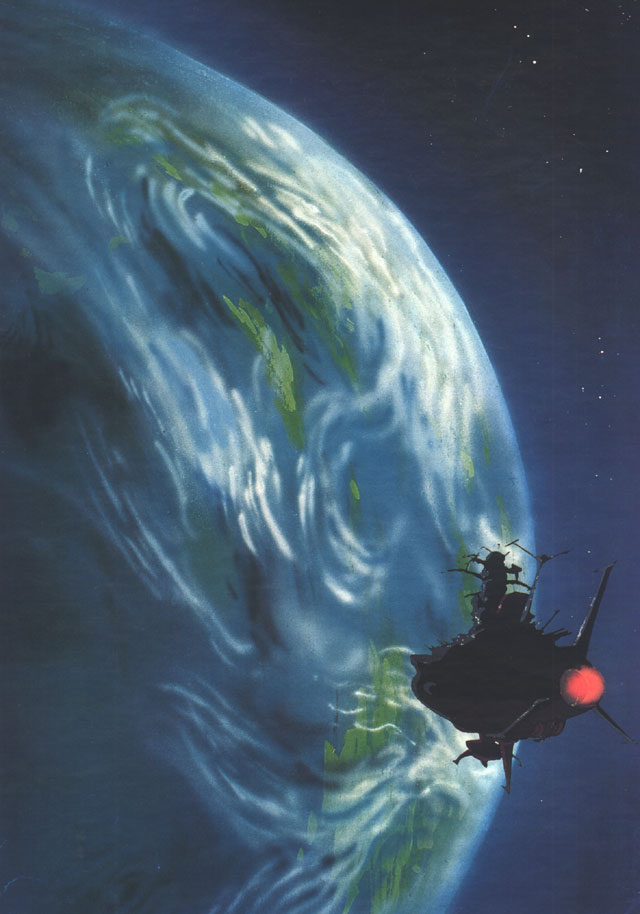
According to ICV2, who are reporting a Hollywood Reporter story, Josh Kline has been tapped to produce a live action version of Star Blazers. The Scotsman verifies the information, but also gives me enough information to cause me to worry. A quick search of IMDBPro (the more robust version of IMDB) revealed no results for Josh C Kline, who is, according to the Scotsman, "the the longtime rights holder of 'Star Blazers.'

Kind of reminds me of a certain film by Courtney Solomon that came out six or so years ago.

SciFi Original Movies and Haters

Last Saturday, the Kung Fu Monkey John Rogers of The Core and Blue Beetle fame wrote a brief review of the SciFi original movie MAMMOTH. His thoughts were that, basically, MAMMOTH was the type of film that SciFi original films ought to be, namely fun homages to the films of William Castle etc. His commenters, and there have only been a few, have been from essentially two camps. There were those who think that SciFi Network should never make the low budget SciFi Original movies, but should stick to series like Battlestar Galactica and Stargate. Then there were those, like Bill Cunningham of DISContent who pointed out that the SciFi originals get higher ratings than the regular series. Bill has a funny, but smart alecky, sense of humor and likes to refer to shows that have multiple "branches" by ironic titles. My favorites are CSI: Silverlake and Stargate: Cleveland. Bill, by the way, writes direct to DVD movies.

Which brings me to my thoughts on the SciFi original films versus their television series.

As an aside, prior to reading the Uberhaters website, I had mistakenly assumed that these features were primarily for television consumption. I have since discovered that most of these films are released simultaneously (or within close proximity) on DVD and that the DVD versions usually have decent added features and aren't edited for content.

When I started watching the SciFi channel, in the early 90s, it was because they were running reruns of The Six Million Dollar Man and Buck Rogers. A part of me still wishes they would run these series, but in the years since I have come to enjoy many of their television shows as well (Stargate chief among those enjoyments). There shows have been hit or miss for me though and it would be dishonest for me to say that I think all their series programming has been good. I have pretty much hated all of their "reality" based programs, Ghost Hunters schmost hunters, Scare Tactics schmare tactics. Yawn.

My wife and I are also among the small minority of SciFi fans who don't like the new Battlestar Galactica. My reasons are different from my wife's, I still can't narratively understand why the humans ever went back to an integrated defense system when their chief, and narratively only, enemy can easily take such things over. There is more to my complaint, but it stems from the fact that I think the show is all surface and no depth. It is too post-modern. I know people enjoy it, and I am always happy that there is a growth in the number of SciFi fans (yes that's a big Wanker sign to Harlan Ellison) in the marketplace. But like with Star Trek it's "only the original for me."

Back to the movies though. The SciFi original movies have created a wonderful thing, a marketplace for creative genre fiction on a modest budget. Sometimes that means films that are along the lines of drive-in films of the 50s and 60s, like the film MAMMOTH that John Rogers enjoyed (or Alien Apocalypse with Bruce Campbell or as I like to call it "Battlefield Earth, but fun"). Sometimes it means a Terminator redux with a post-apocalyptic future, or a low budget version of the Forever War. Sometimes it means fantasy, like the recent SciFi original Dungeons and Dragons 2: Wrath of the Dragon God Movie, which I thought was a significant improvement over the theatrical released, or the recent made for SciFi adaptation of the Nibelungenlied, Dark Kingdom. Like Roger Corman, SciFi is becoming a work-mill where genre fiction has a place to meet its audience. No one will argue that Death Race 2000 is an artistic masterpiece, but I love it and I think it is well written. Which brings me to a point. When the budget is low, as it is in all the SciFi originals (at least compared to "Hollywood" movies), it is solely the writing that makes or breaks the film. (Hmm..kind of like original Star Trek.)

I like that SciFi does its original films. I was delighted to read that they are profitable. I find some of them unbearably bad, but I find many of them entertaining and fun. Why pay $20.00 (I have a wife) to see Final Destination 4: Because Death Always Forgets to Kill Someone in the Prior Film when I can buy (or watch then buy) Dark Kingdom for the same price and see how Diane Duane and others have adapted one of the great legends of Europe?

I guess you can tell that I like the SciFi original movies, but that comes from me being a pretentiously non-pretentious genre fan. I would write more, but I have to go watch "The Lost Skeleton of Cadavra." I know it isn't a SciFi original, but it is genius.

"I'm a scientist...I don't believe in anything! Ha, ha, ha!"

"I sleep now."

Monday, April 24, 2006

Today is Armenian Genocide Remembrance Day

This last weekend I noticed a lot of cars in my neighborhood displaying the Armenian flag. Living in Glendale, I didn't have to think long to determine why so many of my fellow citizens were proudly displaying their patriotic loyalty to Armenia. Today is the 90th Anniversary of the Armenian Genocide.

There is a lot I could write, but I will instead quote Teddy Roosevelt:

The Armenian horror is an accomplished fact. Its occurrence was largely due to the policy of pacifism this nation has followed for the last four years. The presence of our missionaries, and our failure to go to war, did not prevent the Turks from massacring between half a million and a million Armenians, Syrians, Greeks and Jews — the overwhelmingly majority being Armenians. Our declaration of war now will certainly not do one one-hundredth part of the damage already done by our failure to go to war in the past; and it will enable us to render service of permanent value for the future, and incidentally to take another step in regaining our self-respect.


This is not meant to be some hidden message about my opinions regarding current events, rather it is an affirmation of my strong opposition to genocide and my belief that military intervention in such cases is justified.

Friday, April 21, 2006

Ptolus and Young Urban Player Characters

So, I think I finally found the answer to one of my great pet peeves with D&D 3.0 and beyond. If you look through the books there is a general emphasis on urban (yes, urban) game play and, even in 3.5 (which was better about this) a disappointing lack of rules for GMing a game in THE OUTDOORS (gasp!).

Apparently this may have something to do with the fact that the setting (if you can call it that) that they used to play test in was a giant freakin’ CITY!

Yup, a great big piece of urban sprawl. Because you know Middle Ages Europe was just crawling with big ass cities. And all those great epic works of fantasy that take place in cities. Let’s see – There’s Thieve’s World and, uh, I can’t think of anymore.

But it isn’t like you wanted to play a FANTASY game that involved, say, roaming the forest or hunting down dragons in faraway lands, or wandering around on your super cool horse looking for fair princesses (or princes) to rescue? You didn’t actually want to leave the giant urban sprawl of a capital city did you? Of course not. That’s silly. Who ever heard of a FANTASY game that involved THE OUTDOORS.

Now be a good gamer and cough up $119.99 for
Uncle Monte.

Comic Books --- The Wall Street Journal Gets It

Cinerati has often discussed, and lamented, the state of the comic book industry. Comics just don't sell at the rate they used to in prior "ages." Combine this with the fact that the target audience has shifted from the developing fan to the committed fan, a combination partly responsible for the decline in sales (not entirely, don't get me started on Jim Shooter and speculators in the early 90s).

Though Marvel and DC have done little to expand their audience to the emerging fan in recent years, if you think they have done a lot we ought to meet for coffee some time, one thing is certain, both Marvel and Time Warner (DC Comics) understand the need to increase revenue from the comic book marketplace. Even as a loss leader the production costs are becoming extremely high. When you combine huge printing costs, due to higher quality paper/printing techniques and smaller print runs, with increased pay to artists/writers you have to find ways to increase revenue flow without increasing prices. After all, the marketplace is too small for much of an uptick in cover price. In the link above, I discussed Marvel's plan to release digital back issues both online and in DVD-Rom is one way to address this. If you don't own 40 years of the X-men, 44 Years of the Fantastic Four, or the upcoming 40 Years of the Avengers, you are missing a great opportunity to read quality comics at a cheap price.

Now Marvel and DC are looking to a new avenue for revenue, actually an old avenue in a new medium. Comics have long had advertisements which often interupt the flow of the narrative/panel design. Now, according to the Wall Street Journal both companies are looking to product placement within the panels to increase revenue. (I would link the article, but you have to be a subscriber.) According to Brian Steinberg, "Las week, DaimlerChrysler AG's Dodge finalized an ad pact that will include product placements in Marvel comics." Combine this Daimler buy with Time Warner's recent contract with General Motors Corp, and the creation of "Rush City," and you have high priced ads which might become fluid parts of the narrative. The idea is similar to what Gaijin Studios did with "The Ride" two years back, with the addition that the cars are modern, rather than classic.

The ad buys are an direct example that comic books are finally admitting who their audience is, "one of Madison Avenue's most elusive audiences: guys in their 20s." As the Steinberg article points out, and we have said many times, "Lately, readers of comic books have gotten older. On Madison Avenue, 'there is a large misunderstanding of who is reading these titles and what they are paying attention to...' fans who kept buying the books have grown older, now reaching into their 20s and 30s." I actually think that even this estimate projects the comic audience too young. I would state that the audience is more in the late 20s to the early 40s, but that still constitutes real buying power. DC Advertising VP David McKillips "hopes to bring in other advertisers seeking an older male. 'You're going to see this year a lot more health and beauty care, shaving cream, razors, alongside the automotive."

Comics are finally realizing who their audience is, too bad that doesn't mean they want to expand the audience from its current niche place in the market. On the plus side, this does mean I will see fewer house ads in the issues I buy. If you saw, "In Good Company" with Dennis Quaid and its conversations about global corporation "synergy," and the film's argument that this is not a desireable revenue source, then you can appreciate my joy at reading that there would be more shaving cream ads and thus possibly fewer ads for movies/video games based on the IP of the company whose comics I am buying.

I hope that the companies will do more to expand the audience. Until that time comes, it is good to see that they are finally trying to bring in revenue from the advertisers who have products that might appeal to the comic reading audience. In television, the equation works from a revenue standpoing. TV studios ask, "Hey, what show will sell X to demographic Y." Comics have been denying who their demographic is for sometime. Comics grew up, but the revenue sources didn't. I wish that comics had been able to grow up while keeping some titles filled with the youthful joy that made me buy comics in the first place.

If you want to read the whole article, and are a WSJ subscriber, you can read the article here.

Thursday, April 20, 2006

Palladium Books Facing BK

Palladium Books is one of the biggest independent RPG companies around, and one of the oldest. I've always respected them because they're basically a one-man show: Kevin Seimbeda has lovingly nurtured his world of RIFTS for over fifteen years, and his company for over 20!

As much as I love the phenomenal support offered by WOTC for DND 3.5 and Modern, the fact is that there's something special about Palladium: they're the little publisher that could.

Anyway, check this out here, and read Sembeida's personal appeal. I think a $50 minimum may be a bit ambitious for some, so maybe we should try to collaborate?

Hopefully we can help keep a good company from going under!

Flash Gordon -- Planet of Peril


On January 7, 1934 Alex Raymond forever changed the "comic world" when he created a new comic strip character to compete with the extremely popular Buck Rogers comic strip. Flash Gordon offered all the excitement of the typical Buck Rogers adventure, but with two significant improvements. Raymond's art was far superior to that of the Rogers title and was better able to transate the excitement of "cliffhanging adventure." Second, the Flash Gordon universe was more fantastic that scientific.

Buck Rogers as a title has always demanded a modicum of scientific plausibility. The adventures of Buck Rogers (the comic strip) told of a future America where World War had changed governmental structures and a future China had come to rule the world.
Flash Gordon has never had limitations restricting it to the plausible. Flash was truly the adventures of the mind. Buck Rogers is a character who one could imagine Isaac Asimov writing a story about in adventures filled with political struggles as well as physical. If one were to imagine any classic science fiction author drafting tales of Flash Gordon, the first name to leap to the tongue would have to be Edgar Rice Burroughs. The adventures are too fantastic, too scientifically implausible, to wild, and too swashbuckling for any other author. Flash Gordon shares as much with modern tales of Fantasy as he does with science fiction.

Flash, Dale, and Zarkov inhabit a universe where there are self propelling planets, swordfights, and magic powers and, not surprisingly, Raymond's influence has extended into modern movies as well. A Gordon comic fan cannot help but see honest homage to Raymond's creation when he watches the Star Wars films. Both contain the aforementioned "moving planets" (Mongo vs. the Death Star), evil emperors (Ming vs. Palpatine), and magic powers (the Force and Ming's Magic). Both also contain princesses (Aura vs. Leia), anthropomorphic animistic friends (Thun the Lion Man vs. Chewbacca the Wookie), and roguish allies (Prince Barin vs. Han Solo). The list of comparisons above is far from exhaustive and is not meant to detract from Star Wars in any way. Star Wars easily deserves its place beside Raymond's creation, but the influence of Flash Gordon on a young Lucas is almost undeniable. One of the reasons for the enduring legacy of Raymond's creation was his attitude toward the medium itself:

I decided honestly that comic art is an art form in itself. It reflects the life and times more accurately and actually is more artistic than magazine illustration -- since it is entirely creative. An illustrator works with camera and models; a comic artist begins with a white sheet of paper and dreams up his own business -- he is playwright, director, editor, and artist at once.


It is wonderful that Checker Book Publishing is releasing the strips in a series of collected editions . So far there are five volumes in the series.

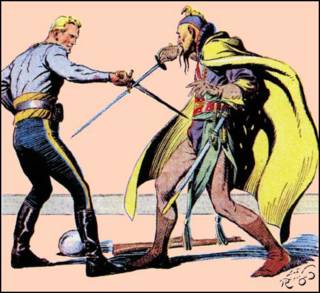
As you can see be the illustrations below the artistic quality is higher than one would expect from a 1930s newspaper strip. I think the art speaks for itself today and deserves a place in art history as well as in the history of popular culture.


Flash Gordon quickly leapt from the newspaper page and onto the big screen. In 1936, Alex Raymond's eponymous Polo player/Savior of the Planet Flash Gordon, played by the charismatic Buster Crabbe, first entered the sparkler powered rocket to the planet Mongo. Once there Flash would face numerous dangers and begin his battles against the evil emperor Ming, battles which would last for many years.


Thanks to You Tube, you can watch the first episode "Planet of Peril." Two warnings. First, the file is big so if you want to watch it, you had better have a high speed connection. Second, if you like it, rather than hunting down all the episodes as streaming video, do yourself (and the IP owners) a favor and buy the Space Soldiers DVD box set. I know, why buy when you can download? Well...you might just prompt someone to make a quality film that is a true adaptation of the material. We Flash Gordon fans are in dire need of a good adaptation, I can only watch Sam Jones so many times. Though I can sing the Queen song all day...Flash! Ahhhhhhhh!