Friday, February 03, 2006

Nostalgia and a Love of Westernized Chop Socky

With all the recent mentions of jiang-hu, Crouching Tiger, Hidden Dragon, House of Flying Daggers and Outlaws of the Water Margin (oh...I haven't mentioned that) in addition to my recent "I'm above all that" Chuck Norris post, some of you out in the "net" may think that I am not a fan of cheezy Westernized Chop Socky. Rereading the Chuck post, I noticed that my genuine enjoyment of his films may have been lost under the sarcastic tone referring to his new novel. I assure you I cut my teeth on Shaw Brothers movies and the Americanized martial arts movie.

My middle school afternoons were filled with hours watching USA, HBO, and Showtime presentations of Enter the Ninja ("Neenja!? I want my neenja now!), Good Guys Wear Black (which had more action in it when originally screened, I swear!), and Five Deadly Venoms to mention but a few. As I grew, so did my love of the martial arts action film. But there are two Americanized Chop Socky films that stand head and shoulders above the rest in my mind. One from the '80s (the height of the genre) and the other from the early '90s, Berry Gordy's: The Last Dragon starring Taimak and Jeff Speakman's straight forward tale of revenge The Perfect Weapon (only one of which stars the ever present Al Leong).

The Last Dragon is the story of Bruce Leroy, a young man in search of enlightenment and full knowledge of the martial arts. His goal is to be as great as his idol...Bruce Lee. He knows that a true master is in harmony both in body and mind and the movie is the tale of his journey of discovery. You see Bruce doesn't believe he is a master because he has not been able to attain a harmonious "glow" when practicing his martial arts. Even skilled warriors are able to attain a glow on their hands, the true master can emit one from his entire body.

Thrown into the mix is the Shogun of Harlem, Sho'Nuff, played appropriately over the top by Julius Carry (you may remember him from Brisco County Junior). The Shogun is the obligatory "evil overlord." In a Samurai film, he would be the evil Ronin or the Oyabun's chief assassin. The Shogun seeks fame, power, and the destruction of all who claim to be masters of the martial arts. His very reason for existance, in this film, is the utter destruction of Bruce Leroy.

Leroy, to give him credit, avoids fighting the Shogun for as long as possible. He delays and seeks non-violent resolution, but in the end he must make a heroic stand. Only to discover that the Shogun, laughable as Leroy imagined the Shogun to be, is capable of achieving enough focus to bring a glow to his hands.


How can this villain be a greater martial artist than our hero?

The answer is that he can't. Eventually, Leroy comes to understand that he had blinded himself to his own talents and is finally able to achieve a sublime glow covering his entire body.
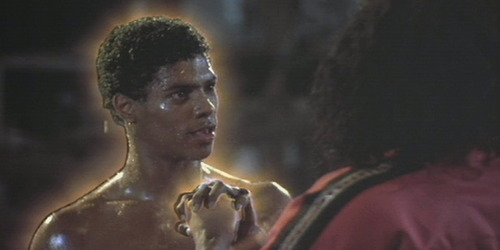


The film is enjoyable both as a comedy and as an action film. It predates I'm Gonna Git You, Sucka by about three years, but like Sucka it plays around with blaxploitation conventions. In fact, I prefer Dragon to the Wayans classic.

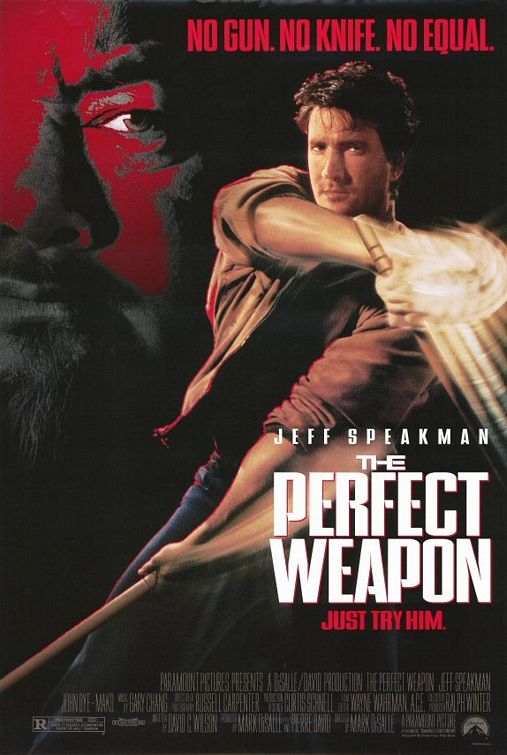
The Perfect Weapon is an attempt to combine the "bad kid made good through martial arts" narrative with the traditional kung fu trope of revenge. Jeff Speakman, the star of the film, does an excellent job of translating real world martial arts into big screen action. Most, if not all, of the choreography is based on real Kenpo techniques and action is delivered straight without wires or much need for suspended disbelief. The suspension is needed for the narrative, not the action.


I really can't add anything new to the discussion of the film. All I can do is agree with Luke Y. Thompson who said:
"Better than expected actioner that was supposed to launch Speakman into a big-time movie career; then Street Knight shot that notion down."


And Joe Bob Briggs who captures the essence of the film perfectly in his review when he writes:

Speakman's movie, "The Perfect Weapon," is the first flick that's so true to martial-arts teaching that the body count is only ONE. That's uno! Because, after all, the original idea was self-DEFENSE, right?

Jeff plays a hothead who takes on the Korean Mafia, trying to get even for the murder of an old friend by ruthless drug goons. Everybody thinks Speakman's an idiot, including his cop father, his cop brother, his kenpo karate master, his fighting Korean girlfriend, and several dozen oriental head-bashers. The surprising thing about the movie is that, as it turns out, he IS an idiot. He puts a high school kid in the hospital, almost gets his brother killed, almost kills the WRONG gangster, and endangers the lives of several other people, including a 12-year-old kid--until he figures out to "become the dragon, not the tiger." (I'm not going into it right now. It's some of that "Karate Kid" chopsocky poetry they use right before the big final fight.)


So anyhow, what's REALLY strange is that kenpo karate looks more like belly-dancing than it looks like kung-fu. You've got all this hand motion, and these arm swings, like Steve Martin doing "King Tut," and you don't really think it's a very MACHO martial-arts technique--until you see Speakman knock out FOUR guys in FIVE seconds. Excellent.


Add these two low-budget action classics to your netflix queue as soon as possible.

Thursday, February 02, 2006

Questions for Readers...Yeah, Readers...Like We Have Those.

I started this blog some time ago and it seems that only recently have we begun to have any regularity of visitation by others. At least I think that's true, one can never tell with the various "tracking" methods available on the internet. I am going to operate under the assumption that we do in fact have more than two readers, more than just Fritz, Rob, and me that is. But I want more readers than the current very select, read small, group of visitors we currently enjoy.

That's were you, my loyal visitors, come in. Since this is a pop-culture blog, I want to know what aspects of popular culture you are interested in reading about so that Cinerati can provide content that is engaging to you and which you will be able to recommend to others. I would appreciate it if you would take the following survey. You can answer the questions in the comments section, use a trackback from your own website, or both.

1) What areas of popular culture would you like to see enjoy more discussion on Cinerati?

2) What are five of your favorite "popcorn" movies? (I don't like to ask absolute favorites, or lists, because such things are fluid.)

2a) Would you like to see more film reviews/discussion on the site?

3) What are five of your favorite boardgames?

3a) Would you like to see more boardgame reviews/discussion on this site?

4) What are a few of the television shows that really interest you of late?

4a) Would you like to see more discussion of Television shows? An example of this kind of reporting would be Shouting into the Wind's excellent "The Watch List" and my Rollergirls article.

5) What videogames do you enjoy?

5a) Would you like to see more VG discussion on this site.

6) Do you play an MMORPG? Which one? What Server? Can I be in your guild?

7) Would you be interested in posting even as a "Double Post" with links to your own site here at Cinerati?

8) Does anyone know how to get The Bear at TTLB to respond? I would really like to get my pop-culture "community" rolling.

9) Do you have any other recommendations? How can we here at Cinerati better serve you? What are some areas we have overlooked?


Thanks for your time and even if you don't answer...thanks for visiting.

Wednesday, February 01, 2006

A Real Chuck Norris Fact

Like Uberbrian, I think that the whole "Chuck Norris Facts" thing has gone a little too far. You know an internet joke/pop-culture game has gone too far when it gets an article in the oh so topical Los Angeles Times. But unlike Uberbrian, I refuse to hide my legitimate love of things Chuck Norris. I just watched The Octagon dammit and I will be vindicated!

So in the spirit of genuine, rather than hipster poseur, Chuck Norris fandom, I announce the first real Chuck Norris fact. It appears that the ultra-action star has found a way to prolong his status as action hero into the infinite. It began with his "writing" of the official version of how he himself became so legendary. Chuck Norris fans proudly own this book in their bookselves, right between Shatner's Star Trek Memories and Heidegger's Being and Time.


No true Chuck fan can be without their first edition copy of Against All Odds. By the way, I am not kidding.

Following his memoir, Chuck seems to have acquired the writing bug. After all, as a literary character Chuck (or his literary counterpart) can live heroically into perpetuity. So Chuck fans need to rush out and buy The Justice Riders written by Ken Abraham, Aaron Norris, Tim Grayem, and Chuck Norris. With four authors and 295 pages, you know this is the great American novel.

Ezra Justice's orders from General Sherman are simple. Form a small, elite team of soldiers and make things difficult for the Confederacy. If caught, no one will claim knowledge of Justice, his men, or their orders. The Justice Riders are off and disrupting the Confederate's supply lines as best they can. But the team attracts the attention of Mordecai Slate and his "Death Raiders," and the battle becomes a far more personal one.


Dr. Nokes' State of the Blog the Cinerati Response

While we here at Cinerati agree with the vast majority of what Professor Nokes discussed in his State of the Blog Address, Number One remains confused at the good professor's love of the new Battlestar Galactica series. Number One believes that time spent watching that show could be better spent watching meaningful discussions of the human condition, shows like Rollergirls.

Number One also laments that the professor has, in all his tenure as a Medieval blogger, failed to once do an analysis of Camelot 3000, let alone mention the pop culture work.

Aside from these glaring problems, Number One looks forward to another year of spreading irony and ignorance while helping others waste precious moments that could be spent inventing wonders.

Tuesday, January 31, 2006

Young Lovers, Jiang Hu, and Rebel Samurai

One of the great joys in my life is that I am married to a woman who not only loves movies as much as I do, but who has similar tastes in film. Week after week we rush to the movie theatre to watch the latest releases or to watch classics on the big screen. Twice a week I check our mailbox for the little red bundles of joy that Netflix sends our direction. Daily my wife and I flip the channels -- TCM, HBO, Starz, etc. -- hoping some old favorite, or unseen gem turns up (the other day it was The Shop Around the Corner.

My wife and I love movies, and when it comes to movies we love tales of romance. Sure like any "manly man," I like my action movies. At least once a month some, obviously evil, force overcomes my will power and I am forced to watch Point Break and Roadhouse, luckily my wife is often possessed of the same schlock loving demon. But nothing satisfies me more than a good romantic comedy, or tale of tragic romance. Recently this affectation led my wife to watch two movies, Tristan and Isolde and Samurai Rebellion.

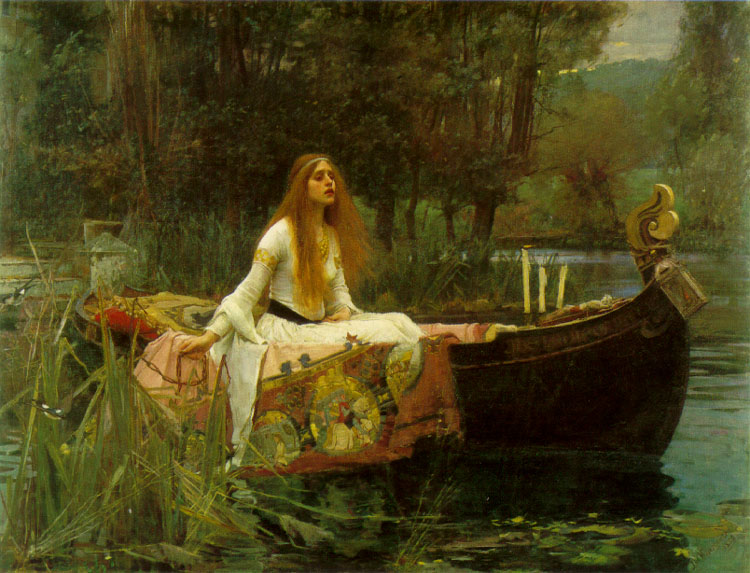
The Pre-raphaelite inspired imagery, costume design, and apparent combination of romance and action were what inspired us to watch the latest telling of Tristan and Isolde. We weren't disappointed. In fact we enjoyed the film very much, especially the visuals. The marriage scene between King Mark and Isolde looked as if it were directly lifted from John William Waterhouse's The Lady of Shalott.


Unlike many of the critics of the film, I was not disappointed that the film strayed from Wagner's version of the tale. There is no magic potion in the new version of the film, there is no magic at all. I think the critics whose were disappointed because of the differences do this version a disservice on two levels. First, to compare this work to one of the highest artistic achievements in a particular medium is unfair and uninformative to the common viewer. It fails to view the particular telling in context, both in medium and intent. Which leads to the second disservice. Tristan and Isolde is a part of a large body of works. Wagner's telling is one of possibly thousands of versions of the tale, so failing to properly adapt Wagner isn't even a legitimate criticism. A better question would be, "where does this new version stand in the larger collection?" Somewhere in the top quartile would be my sentiment. I have always been compelled by Chretien de Troyes careful analysis of the conflict of public duty and private desire, the same conflict that lovers encounter in the lands of jiang hu.

This version of Tristan and Isolde fits very well within the Chretienesque narrative. King Mark is likeable and lovable. Tristan is loyal and loves Mark. But Tristan loved Isolde before he knew who she was because she concealed her true identity from him during their initial romance. This is a significant twist from the typical, where it is Tristan who conceals his identity, but one which makes the movie work without anyone in the love triangle needing to be villified. I could discuss more about why I liked the film, but I think that Roger Ebert did an excellent job in his review.

David Chute was the reason we watched the second tragic romance Samurai Rebellion. Rebellion, like Tristan and Isolde and the tales of jiang hu, is a story where the central conflict is between duty and passion, but in Rebellion the lovers are not alone. This time the lovers have a champion, but the champion is also struggling with the tensions between duty and passion. We know from past movie experiences (Crouching Tiger, Hidden Dragon and House of Flying Daggers) that there is no right choice when faced with this conflict. If you choose duty, as the lovers do in Crouching Tiger, you are doomed to sadness, isolation, and death. If you choose passion, as the lovers do in Flying Daggers, you are doomed to sadness, isolation, and death. The choice is typically a winless scenario. This is both true of the Chinese tale of jiang hu and the arthurian tales of courtly love, but is it also true in feudal Japan?

Samurai Rebellion, it's Japanese title is literally "receive the wife," is the story of Isaburo (Toshiro Mifune). Isaburo is a man living a an age of peace whose chief talent is his skill at killing. He is a man out of place, but who adheres rigidly to the code of Bushido. His talents as a warrior have allowed him to achieve a position of some comfort and prestige under his local Daimyo. At the beginning of the story the Daimyo has two male children by two different wives. The first child, the Daimyo's heir, and the child's mother live in Edo with the Shogun with the heirs of the other Daimyo. Recently, one of the Daimyo's mistresses (a woman named Ichi) has given birth to a boy, giving the Daimyo a second son. After giving birth to the child, Ichi is sent away for a recovery period. When she returns she finds that the Daimyo has moved on to another mistress and thinks of his mistresses as nothing but pawns. She would be willing to accept this fate, but for the fact the newest pawn gloats at her position over Ichi. Thus Ichi attacks the new mistress and eventually strikes the Daimyo.

As one can imagine, this is not a good thing. The Daimyo, who is angry and dishonored, contacts Isaburo and demands that Isaburo's son Yogoro marry the insolent Ichi. Isaburo, who has lived a life in an unhappy marriage and had always hoped his children could avoid his fate, attempts to refuse the Daimyo as politely as possible, but in the end the marriage is made. To everyone's surprise Ichi and Yogoro are a near perfect match, they truly love one another and soon Ichi gives birth to a baby girl. Isaburo has been granted his wish, his son is in a happy marriage and has the beginnings of a family. Isaburo could not be happier.

It is then the Daimyo's first child succumbs to illness at Edo castle, making Ichi's child with the Daimyo the new heir. The Daimyo asserts that Ichi must move to Edo with the male child and abandon her marriage to Yogoro. Ichi and Yogoro refuse and, to the suprise of many, are supported in their decision by Isaburo. The conflict between duty and passion has been set in its path, and must meet its inevitable end. But it is in the resolution that a remarkable lesson is learned. Not by the characters, but by the audience. By watching the mounting tensions, and the drama that unfolds, the audience learns what it is like to see genuine love.

The Chinese tales of jiang hu, and the Arthurian tales, always seem tragic, but this is where the Japanese version differs from the other narratives. In most narratives the lovers seek to live with one another. For Yogoro and Ichi, merely being together is enough. It leads one to believe that the residents of jiang hu would do well to learn from the following passage from the Hagakure:

Meditation on inevitable death should be performed daily. Every day when one's body and mind are at peace, one should meditate upon being ripped apart by arrows, rifes, spears and swords, being carried away by surging waves, be thrown into the midst of a great fire, being struck by lightning, being shaken to death by a great earthquake, falling from thousand foot cliffs, dying of disease or committing seppuku at the death of one's master. And every day without fail should consider himself as dead.
There is a saying among the elders' that goes, "Step from under the eaves and you're a dead man. Leave the gate and the enemy is waiting." This is not a matter of being careful. It is to consider oneself as dead beforehand.


Isaburo knows he is a dead man once the conflict begins. His only desire is that the injustice of his Daimyo be known in Edo and that his son's marriage, and the love of his son's family, be acknowledged. It is beautiful and powerful to watch a man who has no expectation of life, merely justice...a higher justice.

Wednesday, January 25, 2006

A Good Tribute to Robert E Howard

I am a pretty big Robert E. Howard fan and have often been of two minds when reading published versions of his work. The first sympathizes with the "purist" movement who desire to read Howard's stories as Howard wrote them and not the "edited" versions most modern readers are familiar with. The second appreciates the work of Carter and DeCamp did to keep Howard's writing alive as a part of popular culture.

I try to balance these two conflicting mindsets, but as time passes it becomes both easier and more difficult as publishers have begun in recent years to publish anthologies collecting the works as they were initially published. They have finally made it affordable for me to share the experience the purists laud so greatly. But Ace books has recently begun publishing the Age of Conan series, which has really excited my second mindset. Ghost of the Wall the first of the third Age of Conan trilogies was released recently and I am looking forward to reading it. If it is anything like the other two trilogies, it should be a fun ride and that is where the conflict becomes more difficult.

The purists are upset with what was an almost hidden betrayal. For readers like me, who only know better because of the purists, we never would have known that Howard's work had been rearranged, re-edited, and had pastiches fill chronological gaps. Sure, we would have noticed that some of the stories lacked the darkness or sophistication of Howard's best work, but we notice that even in his actual work. It is upon reading Howard's unaltered words that his vision of Conan becomes clear, and it shares little with the pseudo-erotica some pastiches aspire to be or with the filmic representations.

But the new writers aren't as presumptuous as Carter and De Camp. I recently wrote Matt Forbeck, the editor of the Ace Books line, asking him a few questions about the philosophy behind the current publications. It was the first email I had written him that he had not responded to, well at least not directly. Since the email, Forbeck has written a couple of updates regarding the new series on his blog. One of these provided a link to Jeff Mariotte's blog where Mariotte (the author of the most recent trilogy) has written a very nice entry about his appreciation of Howard which answers nearly all the questions I had.

Howard and his friends, H.P. Lovecraft and Clark Ashton Smith, frequently borrowed from one another and in a way had shared worlds. The new Ace series seems to me to be writing in this vein. The authors of the Age of Conan books are writing in the time of Conan, but they are writing about other characters living in the rich environment Howard created. Unlike earlier publications, the new authors seek not to be substitutes for Howard, rather these authors are inspired by the Hyborian age and want to explore its possibilities. For me this is the perfect balance of my two mindsets. Having read Mariotte's essay on Howard, I look even more forward to reading his contribution.

A Book for Struggling Screenwriters

Recently, a great deal of my coverage has focused on games and the gaming industry. This may have left those of you who first read this site because of my "Want to Write a Supernatural Spec?" post wondering what you are doing reading this blog regularly. Others who came following our first movie review "In the Shadow of Kurosawa" might be wondering if Cinerati ever lives up to its name. Our focus here at Cinerati is to discuss Popular Culture, broadly defined, as our individual professional schedules allow us to write as amateur journalists. Sometimes this leads us to focus too keenly on one, or two, aspects of Popular Culture. Recently this focus has been overly dedicated to the discussion of Comic Books and Games.

Today I would like to recommend a book to all aspiring screenwriter's out there. In fact if you are interested in Hollywood and its workings at all, you must own Conversations with My Agent by Rob Long.


One might be wondering what I, a "character" in The Prisoner and Director of a non-profit devoted to civic engagement of youth, might have to offer as far as recommending books for aspiring professionals. There are after all blogs written by screenwriters who have written blockbusters or written by hard working direct to DVD writers, all of whom could better relate to screenwriters what it takes to be a working writer in Hollywood. That's not my goal. My goal is to provide hope to those who find themselves questioning their choices, staring at writer's bloc, or frustrated at the challenge of getting anyone to even look at your ideas. Is this you? Good, then let me continue.

I first heard of Rob Long's book at an LA Press Club event entitled Mass Market, Smart Content ( I reported on my experience here). The book was mentioned by panelist Scott Kaufer, who mentioned how accurate and entertaining the book was. In the spirit of full disclosure, Scott Kaufer is currently my wife's boss. He wasn't at the time of the event, neither my wife or I had met him before the event, but he is at present. Having said that, this recommendation, like most of Mr. Kaufer's recommendations, was a good one.

Conversations with My Agent (published in 1997), as its name implies, is filled with discussions that Rob Long had with his agent following the end of Cheers on which Long was an Executive Producer and Writer. The discussions are well written, ring true, and are often laugh out loud funny. During the process of reading Long's conversations one becomes familiar with many of the frustrations that writers in Hollywood face on a day to day basis. Everything from "development hell" to the desire to write a novel is discussed. Since purchasing the book, I have returned to the book again and again to reread a particular anecdote or example. The humorous examples always bring a smile to my face. Don't take my word for it, here is an exerpt:


ME
We're thinking about writing a feature film spec.

MY AGENT
Wonderful. That's a terrific idea. Do you know why?

ME
Why?

MY AGENT
You'll get it out of your system. You'll write one, it won't sell, and it'll be out of your system. And that will be good. Because you'l never never ever get another chance to write one.

ME
What?

MY AGENT
Please. You'll be busy. You'll be producing your television show or pitching another show or working on someone else's television show.

ME
But --

MY AGENT
We are not having a conversation. I am talking.

ME
But --

MY AGENT
It's a bad career move. It's a waste of time.

ME
But --

MY AGENT
Plus I don't handle feature scripts. It would be handled by someone else at the agency and do you know what? There's nobody here as nice as me.


The theme of "not having a conversation" is one that is constant through the book. The relationship of writer to agent is shown as very one sided and the running theme is that all decisions an agent makes are based on the agent, not the writer, getting paid. That may seem a cynical position, but I don't think it is. I believe that the lesson of the book, if there is one, is to remind writers that Hollywood is an industry filled with people who are making money. But these people are also risking resources on an often unproven commodity. You may be an extraordinarily talented and funny writer, but until you have turned a profit you will be viewed skeptically, and as Long demonstrates that skepticism is there even if you have turned a profit.

As a fan of television it is always nice to read a television writer write about why shows don't always work. "The main reason that television sitcoms are so bad is that too many educated people are involved in creating them."

I personally think Long's story about when he talked with his agent about writing a book was one of the most amusing conversations, but if you want to read that you have to buy the book. The book didn't sell as well as it ought, but when I had the opportunity to ask Long why this was the case he shared that it was because the book was too short. At 180 pages, the book is just the right length for the person who picked it up on the shelf at Barnes and Noble to finish the book by the time they go from the rear of the purchase line to the cash register. Whatever the reason...rush to your keyboard and order a copy.

While you are at it, you might want to check out his more recent book.