Since I know Caryn and since all of the photographs on her sight make me feel like I am starving to death (even though I just ate), I present without further ado...
Delicious! Delicious!

Friday, August 19, 2005


Neil Gaiman and Beowulf
Famed was this Beowulf far flew the boast of him,
son of Scyld, in the Scandian lands.
So goes part of the description of Beowulf in the Prologue to the famous poem, one of the great fantasy epics of all time. But an epic which has had many adaptations.
From the much lauded Grendel which views the myth through the eyes of a Nihilistic "monster" (it also represents Beowulf as a crazed figure, see the comments adapted from Scruton regarding Superheroes below), to the much anticipated (at least by me) boardgame there have been worthy adaptations. But there have also been less successful ones. While I enjoyed The Thirteenth Warrior (and the book version Eaters of the Dead), most critics and audiences found it disappointing, but it was nowhere near as disappointing as the Christopher Lambert version. Come to think of it...not much that Christopher Lambert has been in is worth watching (excepting of course Highlander the first one, and Greystoke). Especially horrifying were Gunmen and Highlander II (even the "Renegade Edition"). Planet Zeist? Pfewy!
Robert Zemeckis, director of the Back to the Future films and Castaway, is working on a new adaptation of the film and according to ICV2 and Variety the screenplay by Neil Gaiman has been Greenlighted (greenlit?).
I have two central concerns with the project.
Unlocked Wordhoard and The Lemmings Were Pushed share one of my concerns. DKP at Lemmings is concerned with how the "motion capture" will look, and Wordhoard thought it was enough of a concern to link it. I too share in this concern. Motion capture can work well, like Gollum in LotR, but it can also really freak you out, like it did in Zemeckis' own Polar Express. But I have high hopes for this one in regards to special EFX.
My second concern is with the use of Neil Gaiman as a writer. I like Gaiman, I own a lot of Sandman comics to prove it, but he can be a little pretentious at times. Let me rephrase that. He can be way too pretentious some times. No...wait. He IS extraordinarily pretentious. Did you read American Gods? Give me Manly Wade Wellman anyday! (Though to be honest I did like American Gods, but only the really pretentious part of me.) So I worry that the film, if Gaiman had creative control, might not be accessible to large audiences, but that worry is largely diminished because Zemeckis (the director of Used Cars and Romancing the Stone) is the opposite of pretentious. But then again...there is that Polar Express thing. But then he did come up with the story for Bordello of Blood, so who am I to say who is pretentious?
Thursday, August 18, 2005
Economics...Games...Movies...and Comic Books
In an earlier post I commented on the potential death of a Roleplaying Game Company named Decipher. During the comments, Cinerati member David N. Scott forwarded some complaints regarding the high cost of edition 3.5 of the Dungeons and Dragons game ending his comments with an "I dunno there was a pretty quick turnaround time between 3rd edition and 3.5." He was correct, as far as his statement goes, which is to say compared to TSR's earlier update schedule, an average of 10 years between editions, he was right. But I think my point got lost somewhere in the shuffle.
My point was that even the 3 year turnaround was a pretty lengthy one in the game industry. Magic the Gathering, the penultimate Collectible Card Game, is on its 9th or 10th edition and Twilight Imperium, one of my favorite war games, is on its 3rd. Both have been around for approximately 15 years or so. Not to mention Fantasy Flight Games boardgame Runebound which came out last year, but already has a Second Edition (with significant changes for the better I might add).
I also wanted to point out that while RPGs are expensive, they are trust me, that they are not more expensive than they were in the past. Now thanks to Poliblogger I have some supporting evidence. He provided this link to Economic History Services, provided by Miami University and Wake Forest University, which gives the real value in 2003 dollars of money from any date in US history.
So that Dungeon Master's Guide, 1st edition, that cost $15.00 in 1982 was the equivalent of $28.60 today (according to Consumer Price Index Adjustments) or $50.62 as share of GDP. The $19.95 Second Edition Dungeon Master's Guide from 1990...$28.09 Consumer Price Index. How much is a 3.5 edition Dungeon Master's Guide? $29.95, unless you buy it at Amazon where it is dirt cheap.
All this is well and good, even fun, but doesn't completely address David's larger point. Which is that Wizards of the Coast, a Hasbro subsidiary who produces D&D, has produced a great sum of material in the past two years and that much of it was reprinting of 3rd edition books. This is a partly true statement, they have in fact produced volumes (an average of 2 rulebooks a month these past two years), but as I own the books I can actually say that very little in the new books is reprinted from the 3rd edition material. Yes the Complete Warrior does update information from Sword and Fist. But Sword and Fist was a paperback "perfect bound" book which cost $19.95 (close to $15.00 on Amazon) and was a black and white printing consisting of 96 pages. Whereas the Complete Warrior is $26.95 ($17.79 on Amazon) is hardcover, full color and 160 pages. There is a great deal of new material in Complete Warrior, in addition to the updated material, and I think it is a value. The same has been true of all of the new Wizards of the Coast 3.5 material.
Having said this though, I do come back to the 2 rulebooks a month statement. That's $50 to $60 dollars a month if you want to buy all the books. Naturally, given the modular nature of Dungeons and Dragons, you don't need to buy all the rulebooks that come out. In fact, if you remove setting specific books the average drops to one a month or even one every two months. All said, most Roleplayers I know are completists and this can burn a hole in your wallet. I say, most I know, because the sales figures don't match my experience. DM books sell worse than player books, settings books sell worse than DM books.
I guess this is a long way of saying I think that both David and I are right. Yes Wizards prints too much stuff to keep track of, but I think the prices per item are very reasonable.
My point was that even the 3 year turnaround was a pretty lengthy one in the game industry. Magic the Gathering, the penultimate Collectible Card Game, is on its 9th or 10th edition and Twilight Imperium, one of my favorite war games, is on its 3rd. Both have been around for approximately 15 years or so. Not to mention Fantasy Flight Games boardgame Runebound which came out last year, but already has a Second Edition (with significant changes for the better I might add).
I also wanted to point out that while RPGs are expensive, they are trust me, that they are not more expensive than they were in the past. Now thanks to Poliblogger I have some supporting evidence. He provided this link to Economic History Services, provided by Miami University and Wake Forest University, which gives the real value in 2003 dollars of money from any date in US history.
So that Dungeon Master's Guide, 1st edition, that cost $15.00 in 1982 was the equivalent of $28.60 today (according to Consumer Price Index Adjustments) or $50.62 as share of GDP. The $19.95 Second Edition Dungeon Master's Guide from 1990...$28.09 Consumer Price Index. How much is a 3.5 edition Dungeon Master's Guide? $29.95, unless you buy it at Amazon where it is dirt cheap.
All this is well and good, even fun, but doesn't completely address David's larger point. Which is that Wizards of the Coast, a Hasbro subsidiary who produces D&D, has produced a great sum of material in the past two years and that much of it was reprinting of 3rd edition books. This is a partly true statement, they have in fact produced volumes (an average of 2 rulebooks a month these past two years), but as I own the books I can actually say that very little in the new books is reprinted from the 3rd edition material. Yes the Complete Warrior does update information from Sword and Fist. But Sword and Fist was a paperback "perfect bound" book which cost $19.95 (close to $15.00 on Amazon) and was a black and white printing consisting of 96 pages. Whereas the Complete Warrior is $26.95 ($17.79 on Amazon) is hardcover, full color and 160 pages. There is a great deal of new material in Complete Warrior, in addition to the updated material, and I think it is a value. The same has been true of all of the new Wizards of the Coast 3.5 material.
Having said this though, I do come back to the 2 rulebooks a month statement. That's $50 to $60 dollars a month if you want to buy all the books. Naturally, given the modular nature of Dungeons and Dragons, you don't need to buy all the rulebooks that come out. In fact, if you remove setting specific books the average drops to one a month or even one every two months. All said, most Roleplayers I know are completists and this can burn a hole in your wallet. I say, most I know, because the sales figures don't match my experience. DM books sell worse than player books, settings books sell worse than DM books.
I guess this is a long way of saying I think that both David and I are right. Yes Wizards prints too much stuff to keep track of, but I think the prices per item are very reasonable.
Bret Easton Ellis on His New Book Lunar Park
I am a pretty big Bret Easton Ellis fan. He is the "cool jaded Gen-X Enfant Terrible" I always wished I could be, but I'm not and really can't be. He recently did an interview on Amazon.com regarding his new book Lunar Park where he discussed his horror influences:
Comic Book Marketplace had a great article on the old Warren books recently and I was glad to see a mention of their books in the Ellis interview. Naturally, given my love of Forrest Ackerman (which you can read about in this old post on the San Diego Comic Con), I was glad to see the Warren Vampirella reference. Ackerman invented the name Vampirella, though he was (as he fully admits) inspired by the name Barbarella.
I do think Lunar Park is for those, who like Ellis and me, read these books as adolescents, and not for us as those adolecents.
Speaking of the interview...Fritz and I have talked about the ending of American Psycho a number of times and we disagree as to whether the events, in the end, are real or imagined.
The word from Ellis:
It is in some ways an homage to Stephen King and the comics I loved as a kid. Especially the EC Comics, like Vault of Horror and Tales from the Crypt. And the Warren Comics of the '70s that I was a huge fan of. They had titles like Creepy and Eerie and Vampirella. These were all influences on Lunar Park. That was the impetus to write the book. To write a book that was similar to the books that gave me pleasure as a boy and as an adolescent. I was really into the horror genre and the supernatural genre when I was a teenager and certainly I came of age, along with a lot of men of my generation, with the first book that Stephen King published and onward. But as I got older the book became less an homage and more personal.
Comic Book Marketplace had a great article on the old Warren books recently and I was glad to see a mention of their books in the Ellis interview. Naturally, given my love of Forrest Ackerman (which you can read about in this old post on the San Diego Comic Con), I was glad to see the Warren Vampirella reference. Ackerman invented the name Vampirella, though he was (as he fully admits) inspired by the name Barbarella.
I do think Lunar Park is for those, who like Ellis and me, read these books as adolescents, and not for us as those adolecents.
Speaking of the interview...Fritz and I have talked about the ending of American Psycho a number of times and we disagree as to whether the events, in the end, are real or imagined.
The word from Ellis:
Right, right, the "was it all a dream thing." [laughs] Our old friends Mr. Loose and Mr. Reality. I don't know. When I was writing the book I kind of thought I knew but I really didn't. I liked leaving it open. Because it is left open purposely in the book. And depending on who you are as a writer and what you desire from the book, you're going to go either way. And the movie doesn't answer that question. It's fine. Why answer it? Is the book more meaningful? Does it make it more interesting? It's probably a much more interesting book when you're left hanging and you decide on your own.
Upcoming Home Entertainment Releases
According to ICV2 the following Home Entertainment items are on their way to stores in the near future.
Batman Begins Deluxe Edition DVD (October 18) -- Will include a 72 page comic book.
Carcassonne: The River II -- This is an updating of a previous release, more than a sequel, in that it is designed to work with other Carcassonne updates. Carcassonne is an innovative and enjoyable tile based game of "world construction and control" where players lay tiles attempting to create cities or roads to control. The name comes from the famous French city known for its vast fortifications. It's history stems from Rome to the Albigensian Crusades to the Hundred Year's War. The growth of the city and regions are the inspiration for the Carcassone board game, the fortress is the inspiration for the Carcassonne: The City version of the game.
Frank Miller's adaptation of Thermopylae 300 starts filming in October as well. Ironically, it will begin filming in Montreal a city not known for its "Gates of Fire." The film will be directed by Zack Snyder of Dawn of the Dead remake fame. While I very much enjoyed Miller's 300, I wish that Steven Pressfield's Gates of Fire was the work being adapted. That being said, I don't know if it is better that the writer of such epics as Freejack and Above the Law be left behind and the writer of Robocop 2 and Robocop 3 be rewarded. Oh, and if you mention Sin City, I just have one thing to say...over-rated. Sky Captain and the World of Tommorrow did the computer environment better, and as Noir...do I even have to begin going down that road. I'll take Double Indemnity, Sunset Boulevard, Gilda, Criss Cross, Ace in the Hole (aka The Big Carnival) and at least a dozen films over Sin City's watered down Noir anyday.
Wednesday, August 17, 2005
Wow
Pierce Brosnan is out as 007, after long speculation.
One interesting bit...
I remember the last Bond movie I saw, the one with Halle Berry, had a massive overload of puns. Glad Brosnan agrees.
A single, surprising phone call and it was over. That's how Pierce Brosnan says he learned that his services as James Bond would no longer be required.
"One phone call, that's all it took!" the 52-year-old actor tells Entertainment Weekly magazine in its Aug. 19 issue.
One interesting bit...
Brosnan says he's grateful to have had the role, but adds: "It never felt real to me. I never felt I had complete ownership over Bond. Because you'd have these stupid one-liners _ which I loathed _ and I always felt phony doing them."
I remember the last Bond movie I saw, the one with Halle Berry, had a massive overload of puns. Glad Brosnan agrees.
Monday, August 15, 2005
Comic Books and "Art"
A while back, I wrote a post both praising and lamenting the possibility of an upcoming Watchmen movie. One of our early group members posted this in reply. I still stand by most of what I wrote, and will go into more detail later this week. But I thought that I would offer the following thoughts on "Art" as a prelude to further discussion on the topic. The paragraphs below are adapted from Roger Scruton's book "Modern Culture." I am certain he would be horrified by the use, but if Scruton read Fantastic Four issue number 56 (Third Series) "Remembrance of Things Past", Scuton might be very forgiving.
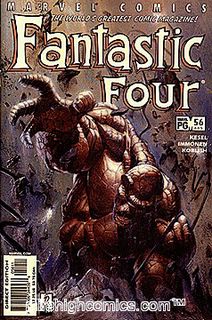
This is one of those cases where the interior art is superior to the cover, and where the cover has little if nothing to do with the narrative inside.
Without further ado...here is a modified version of what Scruton has to say about our affection for Superheroes (particularly Silver and Golden Age versions):
Ironically, much of the modern cynicism in comics is rooted in the book "Seduction of the Innocent" by Frederic Wertham. In the book, Wertham argues that the "crime books" glorify evil and are corrupting the minds of the young. His criticisms were largely baseless, founded on bad methodology and a Frankfurt school approach (with its inherent disdain of proletariat art), but they led to the strict regulation of comic books. This strict regulation, in turn, eventually caused an "anti-comics code" backlash. This backlash contained many books devoted to the very subjects restricted by the Comics Code. Many of the "great books" of the "graphic novel" era are a part of this backlash, but almost universally the books exhibit a cynicism and sophistication (in the classic sense) very much because they seek to "lower" the hero and bring him into the real world.
Gerard Jones, in his book Killing Monsters, argues that young people need comic books, or entertaiments like them, (and their portrayal of the ideal hero) in order to assist in the development of moral behaviors. I don't know if his thesis is correct, but it matches Scruton's description of "heroic art" and its intentions. Gerard Jones is a professional comic author so his advancing this kind of argument lends practical support to a philosophic position. In other words, he shows that the producers of the medium are thinking of the medium in the same way that a philosopher might.
But Gerard Jones has never written anything like The Watchment, The Authority, Hellblazer, or The Dark Knight Returns. His books all take place in the realm of imagination and do not attempt to bring the hero down into the real world.
This discussion begs the question..."What happens when we lower the echelon of the moral ideal?" In other words, "What does it say when Superman becomes less super? Or when The Question, a Randian objectivist moralist created by Steve Ditko, is turned into a madman?"
Those are some beginning thoughts which will be followed by a more specific discussion. My apologies once again to Roger Scruton.
This is one of those cases where the interior art is superior to the cover, and where the cover has little if nothing to do with the narrative inside.
Without further ado...here is a modified version of what Scruton has to say about our affection for Superheroes (particularly Silver and Golden Age versions):
Comic books tried to create a new narrative audience, one that would not merely see the point of the heroic ideal, but also adopt it...
In contemporary comic books we see exactly what the transition from moderism to the 'post-modern' world involves, namely, the final rejection of high culture as a redemtive force and the ruination of the sacred in its last imagined form.
Modern comic book authors like Alan Moore and Warren Ellis were anticipated by Nietzsche, for whom the heroic in comic books is a sham...Rather than accept comic book superheroic characters in the terms suggested by the drama we should, Nietzsche advises, translate them 'into reality, into the modern -- let us be even crueller -- into the bourgeois!'...Nietzsche's judgements are seldom fair, and this is no exception. Comic books, particularly Gold and Silver Age, are concerned with creating a new kind of heroism, and to offer a new kind of solace to those of us for whom the old heroic way of life is not available. Heroes of the old type are larger-than-life versions of humanity, who live, love and suffer more completely than the rest of us, and who illustrate the possibilities to which man, with divine assistance, may aspire. Comic book superheroes belong to a new type. They exist in a state of exalted solitude (note Superman's "Fortress of Solitude"), the result of some primeval mistake; but they long either to redeem or to be redeemed, through an act of loving sacrifice...
Our sympathy for the comic book superhero...is not the artificial thing that Nietzsche pilloried. It stems from the deepdown recognition that his predicament is ours. Precisely because we live in a morbidly unheroic world -- the world of the cynic and the salesman, in which gods and heroes have no place -- we are driven to regard our own existence as some kind of mistake.
Ironically, much of the modern cynicism in comics is rooted in the book "Seduction of the Innocent" by Frederic Wertham. In the book, Wertham argues that the "crime books" glorify evil and are corrupting the minds of the young. His criticisms were largely baseless, founded on bad methodology and a Frankfurt school approach (with its inherent disdain of proletariat art), but they led to the strict regulation of comic books. This strict regulation, in turn, eventually caused an "anti-comics code" backlash. This backlash contained many books devoted to the very subjects restricted by the Comics Code. Many of the "great books" of the "graphic novel" era are a part of this backlash, but almost universally the books exhibit a cynicism and sophistication (in the classic sense) very much because they seek to "lower" the hero and bring him into the real world.
Gerard Jones, in his book Killing Monsters, argues that young people need comic books, or entertaiments like them, (and their portrayal of the ideal hero) in order to assist in the development of moral behaviors. I don't know if his thesis is correct, but it matches Scruton's description of "heroic art" and its intentions. Gerard Jones is a professional comic author so his advancing this kind of argument lends practical support to a philosophic position. In other words, he shows that the producers of the medium are thinking of the medium in the same way that a philosopher might.
But Gerard Jones has never written anything like The Watchment, The Authority, Hellblazer, or The Dark Knight Returns. His books all take place in the realm of imagination and do not attempt to bring the hero down into the real world.
This discussion begs the question..."What happens when we lower the echelon of the moral ideal?" In other words, "What does it say when Superman becomes less super? Or when The Question, a Randian objectivist moralist created by Steve Ditko, is turned into a madman?"
Those are some beginning thoughts which will be followed by a more specific discussion. My apologies once again to Roger Scruton.
Subscribe to:
Posts (Atom)