As I reported in Apparently kid's don't watch enough TV the WB is planning on cancelling Kids WB on weekdays. This could have enormously bad consequences.
As we all know, due to an evil curse cast upon him by a cruel wizard, the Merch needs children to purchase Merch related products on a regular basis. He needs this even if it forces children's parents into unrecoverable debt. Otherwise he will become the hideous Fleshreaper (see above enormously bad consequences).
Thankfully, the men at Penny Arcade, unlike Kids WB, have got us covered.
Go and buy your Merch Merchandise now!

Wednesday, June 08, 2005


Psychics? We don't need no stinkin' Psychics?
Sidekicks on the other hand...those we need.
The hot news on IMDB today is the new FOX series "The Inside." Here's a brief description of the show:
Sound familiar? Hmm... sounds pretty familiar. Well except that Rebecca has "special insight," ala Will Graham of Manhunter, instead of psychic powers. I guess giving her psychic powers would make the show too much like Profiler. Remember Profiler?
But similarity to a cancelled show is alright, right? After all, maybe there is a place for this kind of thing, even if that place is Medium on NBC.
Now I am not usually the first person to gripe about "copycat films," in fact I defended Armageddon to friends who said it was like Deep Impact, but this is ridiculous.
Wait...this gives me an idea for a show.
The hot news on IMDB today is the new FOX series "The Inside." Here's a brief description of the show:
"The Inside" Premieres Tonight, 9/8C on FOX
Rachel Nichols stars as rookie FBI agent Rebecca Locke in the new FOX series, "The Inside". Locke is brought into Los Angeles's Violent Crimes Unit, which deals with the most taxing and dangerous cases, by Virgil "Web" Webster (Peter Coyote). Webster is obsessed with solving cases, so much so that Agent Paul Ryan (Jay Harrington), who becomes Rebecca's partner, believes Webster will sacrifice members of his own team to do so. Both Ryan and Webster know that Rebecca is something special, however, for her past allows her special insight into the minds and motives of those they hunt. Visit the official site for more information about "The Inside" including photos, message boards, cast profiles and more. "The Inside" premieres tonight at 9/8C on FOX.
Sound familiar? Hmm... sounds pretty familiar. Well except that Rebecca has "special insight," ala Will Graham of Manhunter, instead of psychic powers. I guess giving her psychic powers would make the show too much like Profiler. Remember Profiler?
Ally Walker stars as Dr. Sam Waters, a psychic detective with the Violent Crimes Task Force, a federal agency which often works with the FBI, ATF, and other crime-solving agencies. The VCTF investigates and solves such crimes, and continually chases the elusive man known anonymously as Jack, who has haunted Dr. Waters for years.
But similarity to a cancelled show is alright, right? After all, maybe there is a place for this kind of thing, even if that place is Medium on NBC.
Allison DuBois (Arquette) is a strong-willed young mother of three, a devoted wife and law student who begins to suspect that she can talk to dead people, see the future in her dreams and read people's thoughts. Fearing for her mental health, she turns for support to her husband Joe (Jake Weber, "U-571"), an aerospace engineer, who slowly comes to believe that what his wife is telling him just might be true. The real challenge is convincing her boss, D.A. Devalos (Miguel Sandoval) -- and the other doubters in the criminal justice system -- that her psychic abilities can give them the upper hand when it comes to solving violent and horrifying crimes whose mysteries often reside with those who live beyond the grave.
Now I am not usually the first person to gripe about "copycat films," in fact I defended Armageddon to friends who said it was like Deep Impact, but this is ridiculous.
Wait...this gives me an idea for a show.
Patrick Macnamara is a single father of two with a dual curse. Patrick can see the future, but only two parts of it. The first part, he has used to promote his writing career by writing advance speculative scripts. Jack can see television shows two years before they come out and he writes what he sees. The second part, and the part that frightens Patrick, is that he keeps seeing the murder of Hollywood executives, brutal murders and he sees them through the murderers eyes. In fact...these murders are exactly two years away. Can Patrick continue to advance his career and take care of his family. What is the connection between Patrick's gift and the murders? Who is responsible and why are there so many shows about psychics?
Tuesday, June 07, 2005
Busy Weekend Ahead
This weekend sees the release of a number of films I want to see. Top among them, but one I will probably have to wait for a wider release for, is Howl's Moving Castle
Naturally, this kind of hope-filled animated adventure can only be followed by a film guaranteed to "scare the living hell out of me." Or at least that is what I hope High Tension will do. Based on "industry" reception of this film, High Tension director Alexandre Aja has been given the director's chair for the remake of the Hills Have Eyes. The original Wes Craven version of Hills was a fun romp when I was younger, so I hope the remake will be as entertaining/disturbing.
I don't really know what High Tension is about, except that the preview features a beautiful woman beating someone to death with a barbed wire coated 2x4 while Sonic Youth plays in the background. What more can you ask for?
Well, I guess you could ask for that song to actually be in the film, but that (like asking for the trailer song for Underworld to actually be in the film) is requesting too much.
Apparently the moral of the story, based solely on previews is either:
Don't go to a remote bungalow to prepare for College Exams.
or
Don't mess with college students who are willing to go to a remote bungalow to prepare for College Exams.
I look forward to finding out which.
Speaking of looking forward. This week is also the release weekend for Doug Liman's newest big budget film Mr. and Mrs. Smith. A film with tropes which should be familiar to anyone who has seen both True Lies and Spy Kids, but directed by the cool as hell director of Swingers and The Bourne Identity. Think of it as a cool Spy Kids prequel. That's how I look at it.
Naturally, this kind of hope-filled animated adventure can only be followed by a film guaranteed to "scare the living hell out of me." Or at least that is what I hope High Tension will do. Based on "industry" reception of this film, High Tension director Alexandre Aja has been given the director's chair for the remake of the Hills Have Eyes. The original Wes Craven version of Hills was a fun romp when I was younger, so I hope the remake will be as entertaining/disturbing.
I don't really know what High Tension is about, except that the preview features a beautiful woman beating someone to death with a barbed wire coated 2x4 while Sonic Youth plays in the background. What more can you ask for?
Well, I guess you could ask for that song to actually be in the film, but that (like asking for the trailer song for Underworld to actually be in the film) is requesting too much.
Apparently the moral of the story, based solely on previews is either:
or
I look forward to finding out which.
Speaking of looking forward. This week is also the release weekend for Doug Liman's newest big budget film Mr. and Mrs. Smith. A film with tropes which should be familiar to anyone who has seen both True Lies and Spy Kids, but directed by the cool as hell director of Swingers and The Bourne Identity. Think of it as a cool Spy Kids prequel. That's how I look at it.
Friday, May 27, 2005
Zombies, Zombies Everywhere.
With the approaching release of George A. Romero's Land of the Dead on June 24th, I thought it would be a good idea to provide some reviews of Zombie themed games that I own. After all, when the creator of the Living Dead genre makes a movie, one could do worse than spend a few afternoons playing Zombie/Horror themed games in preparation. So over the next few weeks I will present reviews of Card Games, Board Games, and Role Playing Games containing an Living Dead or Horror component.
Today's game? Zombies!!! Naturally. Not to be confused with Mall of Horror by Asmodee Editions (also known as Zombies).
In 2001, US Playing Card Company (through a subsidiary named Journeyman Press) stepped into the board game/rpg market with a test game called Zombies!!!. The game was a surprising sleeper hit that quickly sold through its initial print run. I say surprising because US Playing Card Company cancelled planned expansions before the game even before it was released. In fact, the story of Zombies is kind of like the story of Firefly. The distributor of the product had less faith in it than the creators/designers of the product. Lucky for us, the game consumer, the game's creators retained the rights to the game and created Twilight Creations Inc. where they published Zombies and four expansion products (in addition to another game I will review later) of Zombified terror.
In Zombies, the players portray shotgun bearing citizens attempting to escape a city over run by zombies. Think of this game as the opening sequence to Romero's famous Dawn of the Dead and you get the general idea. The purpose of the game is to be the first person in the city to get to the Helipad and thus escape the city to drink Mai Tai's on a Carribean Island free of the infestation. Sounds like a simple idea and it is, but the game has some interesting elements.
Rather than a traditional "track game," like Candyland or Monopoly, Zombies is what is called a "Tile Based" game. What this essentially means is that at the begining of the game there is little or no "map" on the table and that the map comes into existance as the game is played. This innovation means that everytime you play the game, you are likely to be playing on a different "map" than during previous gaming session. Add to this tile laying element, the fact that the Helipad is the last tile to be laid on the board (meaning players have no idea during the early stages of the game where the Helipad will end up during the last tile laying phase), and you have a game with a two fold objective. First, survive long enough to find out where the Helipad will end up. Second, be the first to the Helipad.
Player's aren't helpless in their battle against the mindless hordes of the undead, and can fight them to collect "kills" and thus work toward the other path to victory. I guess I didn't mention that the other way to win is to kill 25 zombies. But combating the undead is a difficult thing. Each fight is essentially a fifty-fifty shot and you can only fail three times before you are "killed." When you are killed you have to re-start the game with no equipment and half the "zombie tokens" you had before your demise.
This is a fun, furious, and mindless game and has received a slightly better than average rating at boardgame geek (having been reviewed by over 1000 reviewers), which I think is fair. But I enjoy the game because it is easy to teach, easy to play, and more fun when you drool and go UnnnH, Brains! while grabbing at your friends. I rate the game as 3 out of five, but think this is a great "beer and pretzels" game.
Today's game? Zombies!!! Naturally. Not to be confused with Mall of Horror by Asmodee Editions (also known as Zombies).
In 2001, US Playing Card Company (through a subsidiary named Journeyman Press) stepped into the board game/rpg market with a test game called Zombies!!!. The game was a surprising sleeper hit that quickly sold through its initial print run. I say surprising because US Playing Card Company cancelled planned expansions before the game even before it was released. In fact, the story of Zombies is kind of like the story of Firefly. The distributor of the product had less faith in it than the creators/designers of the product. Lucky for us, the game consumer, the game's creators retained the rights to the game and created Twilight Creations Inc. where they published Zombies and four expansion products (in addition to another game I will review later) of Zombified terror.
In Zombies, the players portray shotgun bearing citizens attempting to escape a city over run by zombies. Think of this game as the opening sequence to Romero's famous Dawn of the Dead and you get the general idea. The purpose of the game is to be the first person in the city to get to the Helipad and thus escape the city to drink Mai Tai's on a Carribean Island free of the infestation. Sounds like a simple idea and it is, but the game has some interesting elements.
Rather than a traditional "track game," like Candyland or Monopoly, Zombies is what is called a "Tile Based" game. What this essentially means is that at the begining of the game there is little or no "map" on the table and that the map comes into existance as the game is played. This innovation means that everytime you play the game, you are likely to be playing on a different "map" than during previous gaming session. Add to this tile laying element, the fact that the Helipad is the last tile to be laid on the board (meaning players have no idea during the early stages of the game where the Helipad will end up during the last tile laying phase), and you have a game with a two fold objective. First, survive long enough to find out where the Helipad will end up. Second, be the first to the Helipad.
Player's aren't helpless in their battle against the mindless hordes of the undead, and can fight them to collect "kills" and thus work toward the other path to victory. I guess I didn't mention that the other way to win is to kill 25 zombies. But combating the undead is a difficult thing. Each fight is essentially a fifty-fifty shot and you can only fail three times before you are "killed." When you are killed you have to re-start the game with no equipment and half the "zombie tokens" you had before your demise.
This is a fun, furious, and mindless game and has received a slightly better than average rating at boardgame geek (having been reviewed by over 1000 reviewers), which I think is fair. But I enjoy the game because it is easy to teach, easy to play, and more fun when you drool and go UnnnH, Brains! while grabbing at your friends. I rate the game as 3 out of five, but think this is a great "beer and pretzels" game.
Thursday, May 26, 2005
Flash! Ah ah! Savior of the Universe!
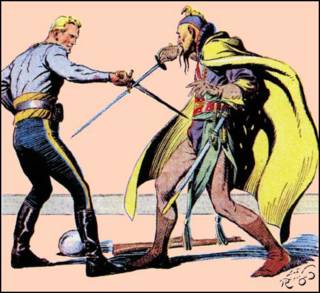
In 1934 Alex Raymond forever changed the "comic world" when he created a new comic strip character to compete with the extremely popular Buck Rogers comic strip. Flash Gordon offered all the excitement of the typical Buck Rogers adventure, but with two significant improvements. First, Raymond's art was far superior to that of the Rogers title and was better able to transate the excitement of "cliffhanging adventure." Second, the Flash Gordon universe was more fantastic that scientific. Buck Rogers as a title has always demanded a modicum of scientific plausibility, but Flash Gordon has never had such limitations. Flash was truly the adventures of the mind.
Not surprisingly Raymond's influence has extended into modern movies as well. A Gordon comic fan cannot help but see honest homage to Raymond's creation when he watches the Star Wars films. Both contain "moving planets" (Mongo vs. the Death Star), evil emperors (Ming vs. Palpatine), princesses (Aura vs. Leia), anthropomorphic animistic friends (Thun the Lion Man vs. Chewbacca the Wookie), roguish allies (Prince Barin vs. Han Solo. The list of comparisons above is far from exhaustive and is not meant to detract from Star Wars in any way. Star Wars easily deserves its place beside Raymond's creation, but the influence of Flash Gordon on a young Lucas is almost undeniable. One of the reasons for the enduring legacy of Raymond's creation was his attitude toward the medium itself:
I decided honestly that comic art is an art form in itself. It reflects the life and times more accurately and actually is more artistic than magazine illustration -- since it is entirely creative. An illustrator works with camera and models; a comic artist begins with a white sheet of paper and dreams up his own business -- he is playwright, director, editor, and artist at once.
It was with great excitement that I entered the comic shop yesterday, because the Third Volume in a series of collected editions by Checker Book Publishing was released this week. This particular volume features strips running from October 25, 1936 to June 5, 1938 and includes four exciting story arcs. Checker Books have planned two more volumes in the series and I eagerly await those as well.
Rather than bore you with specifics, I think I will let the art speak for itself today.


Monday, May 16, 2005
Monday, April 25, 2005
Jiang Hu Hustle 

I have been a fan of Kung Fu films since I was a child in the late 70s and early 80s. For Baby Boomers and early Gen-Xers this time period brings to mind Disco and bad baseball uniforms, but for me (a middle Gen-Xer) and others like me it means Kung Fu Action Theater on USA network and GI Joe. I remember basking in the glow of cathode ray tube illumination and watching fantastic and bizarre tales filled with martial artists who live tragic, yet wonderfully exciting, lives.
The one drawback to films like Five Deadly Venoms, Five Fingers of Death, Fists of the White Lotus, and The Master Killer was that the production quality of the films never lived up to how they inspired my imagination. I loved these movies as a child, but as I grew older I wanted more. I wanted Kung Fu movies that were not merely inspirational, but also visceral. In the late 80s and early 90s, almost as if in answer to a prayer, came the films of Jet Li and Jackie Chan. The martial arts in Li and Chan films was fast, furious, and exciting. Gone were the New Zealand accents and in were subtitles. There still was little, if any, production sound and some of their films were cheaply made or just plain bad (like Jet Li’s Last Hero in China, but many were magnificent. Jackie Chan’s high production value films like Drunken Master 2 set a new standard for these films, and Jet Li introduced me to a wonderful new genre that combined fantasy and martial arts. After watching Swordsman II it is hard to go back to regular martial arts films. Jet Li had taken me from the world of Kung Fu into the magical realm represented in the genre known as wuxia (woo-shah) meaning “martial chivalry.” These Chinese Fantasy films combined the complex narratives of good fantasy stories (think Lord of the Rings complexity) with amazing martial arts. In wuxia the first lesson or real Kung Fu is flying. Flying is what separates the common warrior from the virtous hero or vicious villain. For the true masters of the martial arts gravity is but an illusion, “sword energy” can extend hundreds of yards beyond the arc of a weapon with lethal precision, and no one can hide from their destiny.
Recent years have seen the release of some amazing wuxia films. Crouching Tiger, Hidden Dragon, Hero, and House of Flying Daggers have all transfixed American audiences with the power and beauty of their narratives. The lives of the people who often want nothing more than to leave the world of jiang hu (literally rivers and lakes), or the “world of martial arts,” only to have their lives end tragically because they fail to understand that you can never leave jiang hu. As Zhang Yimou stated in an LA Weekly interview with David Chute, “There is nothing I can do, I live in jiang hu.” The implication being that life in jiang hu is hopeless and eventually the life will catch up with you.
So what does all this discussion of jiang hu and wuxia have to do with Stephen Chow’s recent release Kung Fu Hustle? Isn’t Kung Fu Hustle a martial arts comedy like Jackie Chan’s films? Doesn’t the hero win and save the day? Good questions and the answers are: everything, yes/no, and yes. Kung Fu Hustle is indeed a martial arts comedy, but it incorporates many of the conventions of the wuxia genre and in particular urbanizes jiang hu. The film is a combination of Half a Loaf of Kung Fu, Johnny Dangerously, and Crouching Tiger, Hidden Dragon. At the beginning of the film the villainous Axe Gang is taking over the entire Shanghai underworld. The only place safe from their nefarious activities is a dilapidated and collapsing apartment house called “The Pig Sty.” But the Pig Sty is only safe until our wandering and reluctant hero Sing (Stephen Chow), who has long abandoned attempts at heroics, arrives pretending to be a member of the Axe Gang in order to take advantage of the local merchants. Needless to say, heroes avoiding their destiny make for poor imitation villains and Sings attempts at easy money lead to an escalated conflict between the forces of Good and Evil.
It soon becomes clear that Pig Sty is the home to a number of martial arts masters who have sought to leave jiang hu behind them. Pig Sty is home to no fewer than five martial arts masters who wanted nothing more than to live simple lives. When Sing’s impersonation draws the attention of the real Axe Gang, three of the masters must reveal themselves to save the local populace. These men choose duty over self-preservation and quickly dispatch the Axe Gang who flee the prowess of these great heroes. But this is just the beginning of the conflict. No member of the Axe Gang lives in the world of jiang hu and thus their leader must hire expert assassins who do. The story continues from there with “fated couples,” “musical instrument energy,” “lion roars,” “toad styles,” and “palms of Buddha” in abundance. There is almost no martial arts convention left behind in this masterfully sculpted combination. In most wuxia stories the heroes must choose between duty and passion. In Crouching Tiger, Hidden Dragon and Hero they choose duty and are destroyed because of it. In House of Flying Daggers the heroes choose passion and are destroyed. Stephen Chow’s new film is something I thought I would never see. Kung Fu Hustle is a happy tale about jiang hu, where some heroes perish and the greatest hero can succeed so long as he embraces his destiny. In this case a destiny where duty and passion are in balance.
The one drawback to films like Five Deadly Venoms, Five Fingers of Death, Fists of the White Lotus, and The Master Killer was that the production quality of the films never lived up to how they inspired my imagination. I loved these movies as a child, but as I grew older I wanted more. I wanted Kung Fu movies that were not merely inspirational, but also visceral. In the late 80s and early 90s, almost as if in answer to a prayer, came the films of Jet Li and Jackie Chan. The martial arts in Li and Chan films was fast, furious, and exciting. Gone were the New Zealand accents and in were subtitles. There still was little, if any, production sound and some of their films were cheaply made or just plain bad (like Jet Li’s Last Hero in China, but many were magnificent. Jackie Chan’s high production value films like Drunken Master 2 set a new standard for these films, and Jet Li introduced me to a wonderful new genre that combined fantasy and martial arts. After watching Swordsman II it is hard to go back to regular martial arts films. Jet Li had taken me from the world of Kung Fu into the magical realm represented in the genre known as wuxia (woo-shah) meaning “martial chivalry.” These Chinese Fantasy films combined the complex narratives of good fantasy stories (think Lord of the Rings complexity) with amazing martial arts. In wuxia the first lesson or real Kung Fu is flying. Flying is what separates the common warrior from the virtous hero or vicious villain. For the true masters of the martial arts gravity is but an illusion, “sword energy” can extend hundreds of yards beyond the arc of a weapon with lethal precision, and no one can hide from their destiny.
Recent years have seen the release of some amazing wuxia films. Crouching Tiger, Hidden Dragon, Hero, and House of Flying Daggers have all transfixed American audiences with the power and beauty of their narratives. The lives of the people who often want nothing more than to leave the world of jiang hu (literally rivers and lakes), or the “world of martial arts,” only to have their lives end tragically because they fail to understand that you can never leave jiang hu. As Zhang Yimou stated in an LA Weekly interview with David Chute, “There is nothing I can do, I live in jiang hu.” The implication being that life in jiang hu is hopeless and eventually the life will catch up with you.
So what does all this discussion of jiang hu and wuxia have to do with Stephen Chow’s recent release Kung Fu Hustle? Isn’t Kung Fu Hustle a martial arts comedy like Jackie Chan’s films? Doesn’t the hero win and save the day? Good questions and the answers are: everything, yes/no, and yes. Kung Fu Hustle is indeed a martial arts comedy, but it incorporates many of the conventions of the wuxia genre and in particular urbanizes jiang hu. The film is a combination of Half a Loaf of Kung Fu, Johnny Dangerously, and Crouching Tiger, Hidden Dragon. At the beginning of the film the villainous Axe Gang is taking over the entire Shanghai underworld. The only place safe from their nefarious activities is a dilapidated and collapsing apartment house called “The Pig Sty.” But the Pig Sty is only safe until our wandering and reluctant hero Sing (Stephen Chow), who has long abandoned attempts at heroics, arrives pretending to be a member of the Axe Gang in order to take advantage of the local merchants. Needless to say, heroes avoiding their destiny make for poor imitation villains and Sings attempts at easy money lead to an escalated conflict between the forces of Good and Evil.
It soon becomes clear that Pig Sty is the home to a number of martial arts masters who have sought to leave jiang hu behind them. Pig Sty is home to no fewer than five martial arts masters who wanted nothing more than to live simple lives. When Sing’s impersonation draws the attention of the real Axe Gang, three of the masters must reveal themselves to save the local populace. These men choose duty over self-preservation and quickly dispatch the Axe Gang who flee the prowess of these great heroes. But this is just the beginning of the conflict. No member of the Axe Gang lives in the world of jiang hu and thus their leader must hire expert assassins who do. The story continues from there with “fated couples,” “musical instrument energy,” “lion roars,” “toad styles,” and “palms of Buddha” in abundance. There is almost no martial arts convention left behind in this masterfully sculpted combination. In most wuxia stories the heroes must choose between duty and passion. In Crouching Tiger, Hidden Dragon and Hero they choose duty and are destroyed because of it. In House of Flying Daggers the heroes choose passion and are destroyed. Stephen Chow’s new film is something I thought I would never see. Kung Fu Hustle is a happy tale about jiang hu, where some heroes perish and the greatest hero can succeed so long as he embraces his destiny. In this case a destiny where duty and passion are in balance.
Subscribe to:
Posts (Atom)