Tuesday, October 07, 2008

In Memoriam Ten Years Later: Eugenie Lela-Ilsa Johnson 05/04/1952 - 10/07/1998


Those of you who have been long time readers will have to forgive me once more for a "repeat" post, on an annual basis today is a day that I don't feel like posting about popular culture. Today is the tenth anniversary of my mother's death, and I always feel a need to share on this day. I thought about writing something entirely original, but then I reread what I wrote in 2004 and it captures most of what I want to say. So instead of trying to reinvent the wheel, I will post the contents of a prior entry. Before you move on to the piece, I'd like to make two comments. I have added two paragraphs today (I also updated my age and the length of time since my mom died), they are in italics, and my statement below that my mother will never get to meet her grandchildren has come true. My mom will never get to meet her lovely granddaughters Nora Thekla Lindke and Clio Millie Lindke. I don't often include photos of family on this blog, but I'll make a rare exception today.


Here are Nora and Clio. Do you see how much they look like their grandmother?


This is a picture of my mom in 1971, that blob on her lap is me.

A Day to Listen to the Velvet Underground

I am only 37 years old, but today marks the end of my first ten years without a mom. That is an awkward sentence, but it best captures my sentiments. I am not an orphan, I still have a father. In fact, he should be receiving his Halloween card shortly. Yet a part of me is still very much missing, a large part. October 7th, 1998...10,7,98...those numbers loom large and ominous in my heart and this is the first year I am not completely overwhelmed by them.

My wife and I have intimate conversations often, it is one of the joys of marriage, and she and I were discussing death the other day. Her grandmother had just died at the age of 92. My wife explained it this way, "When someone dies, the world feels a little less complete. Bird songs aren't as joyful, and sunrises are slightly less beautiful." Displaying, as she often does, the magnificence of unedited, awkward, and spontaneous verbal poetry. She was also correct. C.S. Lewis opens his book A Grief Observed with another observation about death:


No one ever told me that grief felt so like fear. I am not afraid, but the sensation is like being afraid. The same fluttering in the stomach, the same restlessness, the yawning. I keep on swallowing.


I still feel this way, not everyday...today.

There are two things that are still difficult for me to do seven years after my mom died when I was 27 (she was 46).

I have a hard time remembering truly happy moments with her...on command. Happy moments enter my consciousness at random moments and seldom on the anniversary of her death. Glimpses of her nymph-like smile...brief auditory illusions of her laughter enter my mind. But the majority of my memories are neither happy nor sad, they are the memories of everyday activities, evening dinners and the question which ever looms over the head of a teenager, "Have you finished your homework?" I remember watching videotapes with her on many occasions, though none as awkward as the time we watched The Hunger, just the two of us and an erotic vampire film. I remember feeling both uncomfortable being aroused by the film, in my mom's presence, while at the same time finding the situation hilarious. This moment just came to mind. There are many more like it, I just can't remember them on demand. In all honesty, I remember my mom as a happy person, a person who added joy to the world. Which is why I have my other difficulty.

I can't understand my mom's addiction, and eventual death due to how it ravaged her body, to heroin. I try, by reading/watching/listening to and about other addicts. I know the narrative of my mom's addictive cycle, I can see each step of her hopeless journey. That's not what I can't understand. I know the things that led to her addiction. What I can't understand is the overwhelming power of it, how addiction stole my mom from me...day by day. Oddly, some really shallow things help. They are a poor substitute for true knowledge, and seem trite when I think hard on them, but they help. These things include the music of the Velvet Underground (in particular, you guessed it, Heroin) and Iggy Pop, the films Permanent Midnight (which I saw just after her death) and Trainspotting, the book and film versions of Razor's Edge, and the writings of C.S. Lewis among other things.

I am the only member of my immediate family I know of who attends church. I was raised secularly. Strange as it sounds my mom found comfort in, though she was baffled by, my belief. She once asked -- before I was a regular church attendee -- if I believed in God, expecting me (the first college student in my family) to laugh at the absurdity of the question. I told her I did and her response lingers with me to this day, "Really?" Her eyes looked at me...proud, confused, unbelieving, yet hopeful. I never was able to tell her that hope was what faith was all about ("Faith is the realization of what is hoped for and evidence of things not seen" Hebrews 11:1). It isn't about "knowledge," little of life is about actual knowledge. This is why Socrates asked us to know ourselves, that is a difficult enough task. Let alone the ability to acquire actual knowledge of something else.

I was notified of my mom's death by answering machine. I was in classes all day and didn't have a cell phone. A series of messages of an ever-worsening condition. Seizures...followed by emergency medical action. My wife and I later read the medical records to piece together a time line, to see if there was an heroic effort to save my mom. There was. It is not the best way to be notified of death, answering machine, I think it is the worst. I also wish that my mom had been buried not cremated, I would have liked to have had the chance to speak, to say my own words. Instead, I will share the two poems I think best capture the way I feel. One is gender confused (for my situation not its own) and the other is written from an older generation to a younger one, but they will have to do. In addition I would like to add a part of Philip K. Dick's author's note from A Scanner Darkly.

The first poem is by W.H. Auden (and yes it's the poem from Four Weddings and a Funeral but the scene it is in is one of my favorites in all of cinema).


Stop all the clocks, cut off the telephone,
Prevent the dog from barking with a juicy bone,
Silence the pianos and with muffled drum
Bring out the coffin, let the mourners come.

Let aeroplanes circle moaning overhead
Scribbling on the sky the message He Is Dead,
Put crepe bows round the white necks of the public doves,
Let the traffic policemen wear black cotton gloves.

He was my North, my South, my East and West,
My working week and my Sunday rest,
My noon, my midnight, my talk, my song;
I thought that love would last for ever: I was wrong.

The stars are not wanted now: put out every one;
Pack up the moon and dismantle the sun;
Pour away the ocean and sweep up the wood.
For nothing now can ever come to any good.


The second poem is by Wordsworth:


SURPRISED by joy--impatient as the Wind
I turned to share the transport--Oh! with whom
But Thee, deep buried in the silent tomb,
That spot which no vicissitude can find?
Love, faithful love, recalled thee to my mind--
But how could I forget thee? Through what power,
Even for the least division of an hour,
Have I been so beguiled as to be blind
To my most grievous loss?--That thought's return
Was the worst pang that sorrow ever bore,
Save one, one only, when I stood forlorn,
Knowing my heart's best treasure was no more;
That neither present time, nor years unborn
Could to my sight that heavenly face restore.


Wordsworth wrote Suprised by Joy (C.S. Lewis titled one of his autobiographies after this poem), for his daughter Catherine who had died at the age of four. This poem masterfully captures the grief I feel over the loss of my mom. Every time I have wonderful event in my life, I want to call her and share the news. That can never happen and it brings the event of her death immediately to mind and my sorrow and feeling of loss are renewed. Every time...without fail. My mom missed my graduation, my wife's master's, my acceptance to graduate school, my wife completing her MFA in film at USC. She will not be there to see her first grandchild, or any of the joy that her grandchildren will bring into the world.

As I stated before, I have continually looked to fiction and biographical narrative to understand my mom's addiction and that is why I am including the following by Philip K. Dick.

This has been a novel about some people who were punished entirely too much for what they did. They wanted to have a good time, but they were like children playing in the street; they could see one another of them being killed --run over, maimed, destroyed -- but they continued to play anyhow...

Drug misuse is not a disease, it is a decision, like the decision to step out in front of a moving care. You would call that not a disease but an error in judgment. When a bunch of people begin to do it, it is a social error, a life-style. In this particular life-style the motto is "Be happy now because tomorrow you are dying," but the dying begins almost at once, and the happiness is a memory..."Take the cash and let the credit go," as Villon said in 1460. But that is a mistake if the cash is a penny and the credit is a whole lifetime...

If there was any "sin" it was that these people wanted to keep on having a good time forever, and were punished for that, but, as I say, I feel that, if so, the punishment was far to great...


I don't entirely agree with P.K. Dick's statement above. Certainly I agree that "the punishment was far to great," but I disagree with his statement that "drug misuse is not a disease." I absolutely believe that an individual has some -- though not always complete -- control over the initial decision whether to use or not use a drug. Some people are self-diagnosing their psychological state and self-medicating to heal themselves, others are being "happy now because tomorrow they are dying."

It does not matter why a person first used drugs, whether for "happiness" or to feel normal, there is a point in the addict's life where the drug takes over. The addict's brain chemistry is altered and they begin to experience the disease that is addiction. I firmly believe that addiction is a disease. Drug use? Not necessarily, but addiction is. When you've seen addiction in one person, you begin to recognize it when you witness it elsewhere. It is an eerie phenomenon to see the addicted personality because no matter who the addict is, no matter what their personal pain or prior life, no matter that every person is unique, the addicted personality is strikingly familiar.
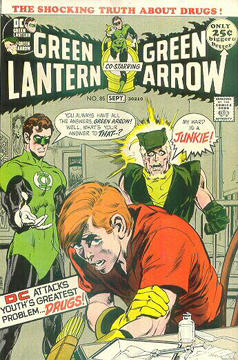


When my mom first told me of her addiction to heroin she expected me to be angry. A lot of my family was, I think the thought of my mother using heroin was too alien to them to even imagine. I think they viewed her use as somehow a failure on their part. I didn't, I only wanted to know if she was okay. By which I meant was she okay at the time she told me. My mom thought that heroin could make life more pleasant, for her it wasn't a selfish desire for more fun than anyone else was having, because she felt empty and sad on a regular basis. Heroin made her feel happy, like she could live life. But in making her think she could live life, heroin took life from her.

I don't "forgive" my mom for dying, I have never thought there was anything to forgive. I miss my mom and wish she were here. I love her and knowing that makes the missing part not so bad, because (as C.S. Lewis would say) the pain we feel now is a part of the love we have.

Thursday, October 02, 2008

Quick Cuts: Friends of Cinerati Speak Up. The Pirates vs. Ninja's Edition.

Two weeks ago was "International Talk Like a Pirate Day," or as I more inclusively call it "International Play Like a Pirate Day." Playing like a pirate, board games/video games etc., allows people to avoid irritating their co-workers and friends with random "arrs" and "avasts." In belated celebration of that day, I asked the "Friends of Cinerati" (insert Harlan Ellison-esque registered trademark here) the following question:

"When it comes to movies, do you prefer Ninja movies or Pirate movies? Given that preference, what is your favorite ninja/pirate film and why?"

William Jones

While I enjoy both Ninja and Pirate films, I think there is a soft spot - or maybe a hard spot - in my heart for pirate films. There is a long history of them, and there are even a number of good ones. Although, the not-so-good ones tend to be enjoyable for me as well.

As for my favorite pirate film, my first thought was Captain Blood (with Errol Flynn and Olivia de Havilland). This film doesn't have all of the pirate tropes that come later, but it does have enough: parrot speak, slaves (indentured servants) rebellion, a love triangle, flamboyant clothes, sword play, duels, and sea battles. What Captain Blood does lack are some of the martial art style combats that appear in modern pirate films (a bit of ninja with the pirates, I suppose).

But then I started thinking, and I was reminded of Monty Python's Crimson Permanent Assurance - the brief "pirate" film at the opening of Meaning of Life. Crimson Permanent Assurance is short, but in a few minutes, it heaps the pirate tropes into the film, replacing the high seas and tall ships with high finance districts and tall glass buildings. It is modern adventure into piracy and capitalism. In many ways it parallels Captain Blood - and includes the popular pirate "plank walk." Keeping with the tradition of pirate movies, the aged building with its indentured employees prowl Wall Street, preying upon bloated multi-national corporations. Like all good pirate films, rebellion is at the center of the story. Pigeons replace parrots, and file cabinets replace cannon, but it's all there - even sailing into the horizon.

William Jones is a writer and editor who has worked across genres, including mystery, horror, science fiction, dark fiction, historical and young adult. He has edited several fiction anthologies and magazines. His writing also reaches into the role-playing industry, where he has published articles and gaming supplements for a variety of publishers. Presently William is the editor of Dark Wisdom magazine. When not writing and editing, he teaches English at a university in Michigan.


Aaron Rosenberg

That's a tough call! I love ninja movies but I also love pirate flicks! I guess I'd have to go with pirates, though, since I actually own four great pirate movies—Against All Flags, Captain Blood, The Sea Hawk, and Pirates of the Caribbean. The four three are classic Errol Flynn movies, of course, with great swashbuckling, rousing scenes, and lovely damsels. And Pirates of the Caribbean is just plain fun, with its undead pirates and the lovely Elizabeth Swann and the odd but amusing Captain Jack Sparrow. I love pirate movies because of the action, the daring, and the fact that often you wind up rooting for the bad guy!

Aaron Rosenberg has written novels for Star Trek, StarCraft, WarCraft, Warhammer, and Exalted. He also writes roleplaying games, children’s books, and educational books. He lives and works in New York City.


Richard Scott Nokes

I prefer pirate movies, of course. By definition, good ninja movies cannot be seen, so silently do they slip off into the night. A really good ninja movie would have to be viewed frame-by-frame to even catch a glimpse of the ninjas.

My favorite pirate movie is Yellowbeard. While it is actually a rather bad film, it does have the last film appearance of Marty Feldman, perhaps the most handsome comic actor to grace the silver screen. In fact, the history of film should be divided into BM (Before Marty) and AM (Anno Marty).

Richard Scott Nokes is a professor of medieval literature at Troy University. Dr. Nokes enjoys reading, film, and all things medieval. He is interested in looking at representations of the medieval in modern culture, a phenomenon he calls Popular Medievalism.

Monday, September 22, 2008

What's in a Film Rating: 4 Stars? Five Stars? Letter Grade? or Jumping Happy Man?

Last week, Roger Ebert posted a journal entry discussing his own use of the four-star rating system and contrasted it with the San Francisco Chronicle's "Little Man." The post makes for interesting reading. Go read it and come back...

Did you notice the something interesting about Ebert's methodology? Here's the quote, "I consider 2.5 stars to be thumbs down; they consider 62.5 to be favorable." For Ebert 2.5 Stars is "thumbs down." I find this quite odd, and you should too for a few reasons. First, it is lunacy to use a system that provides a median value and have anything at or above that median value be "thumbs down." Second, it is counter-intuitive to American audiences, particularly those in the GPA obsessed era, to think of a 2.5 (mid-point between a C+ at 2.3 and a B- at 2.7) as a failing grade. Third, Ebert admits that he once "considered 2.5 stars to be a perfectly acceptable rating for a film I rather liked in certain aspects." This is an admission that demonstrates an inconsistency in his rating system. Some might argue growth, but I'd argue inconsistency since one reading his older reviews might misinterpret the meaning if they are familiar with his current use of 2.5 stars. The internets, and Lexis/Nexis, allow us to do such things without buying books collecting his reviews -- books which can be "retconned" easily.

For my part, I can't understand why any critic using the 4 point system wouldn't automatically convert any such ratings into a grade point scale. I know I do it -- almost subconsciously. A four star rating is an A, a 3 star is a B, 2 stars C, 1 star D, and no stars is an F. I'll avoid most D movies, but if there's no grade inflation a C should be "average."

And essentially this gets to the core of what I'm trying to say, which is to say that Ebert -- as he alludes in the title to his entry -- does indeed rate too highly. He's a grade-inflator. If he likes a movie, it's automatically a B or better. From a less skilled critic, I would blame it on a lack of subtlety of thought or to an exaggeration of the critic's Primal Screen. In this case, I'll write it off as another case of grade inflation...something we certainly need less of in our teachers, and apparently our reviewers.

If you haven't guessed, this is why I use a 5 point scale. That way a 2.5 might be a film that has some small elements I enjoy, but it is still a film that shouldn't be recommended. But then MetaCritic, Rotten Tomatoes, and I get into a disagreement. I think that a median rated film should be viewed as a median film, neither good nor bad. I don't like binary systems. Certainly, there are some films I would recommend to everyone and there are some films I would warn everyone to avoid. But there are also some films that I would recommend for some people and not others and that doesn't necessarily mean they are bad films, just that they aren't universal.

Friday, September 19, 2008

Quick Cuts: Friends of Cinerati Speak Up

In this entry in newly renamed "Quick Cuts," the friends of the Cinerati blog answer the following question:

"Was there a particular book (or television show, or film) that you read (or watched) as a child that inspired you into your current career?"

David Chute

I sometimes think the key issue is at which stage one's development gets arrested. I liked monsters (and Famous Monsters) as a kid but was never into the classic "guy movies," the war films and Westerns that were basically about groups of boys playing in the backyard, with no gurls allowed. For me the light bulb went on watching Ann-Margret in "Bye Bye Birdie." "Viva Las Vegas" and "Dr. No" were not far behind, and Claudia, Romy and Barbara (Bouchet) were strong favorites. But that opening back-projected image of A-M being massaged by a wind machine was the real thunderbolt. My interest in movies ever since has been as much about sex as anything else. Make of this what you will.


David Chute is a film critic who has written for LA Weekly, Premiere Magazine (both print and online), The Los Angeles Times, Film Comment, and Vanity Fair. In addition to his work as a critic, David has also written press kits for films like THE SHADOW, HARD TARGET, JACKIE BROWN, and IRON MONKEY.


Matt Forbeck

The blue book version of Dungeons & Dragons launched me into the world of games, fantasy, and adventure and swept me through my middle-school and teenage years, right through into adulthood. I don't know if you can call the many varied things I do a career in the traditional sense, but if it hadn't been for that thin, little booklet my friend's mom picked up for Christmas on a blue-light special, I'd have probably wound up in engineering or law instead!


Matt Forbeck has worked full-time on games and fiction since 1989. Projects Matt has worked on have been nominated for 23 Origins Awards and won 12. This includes the Best Roleplaying Game for Deadlands and The Lord of the Rings Roleplaying Game, Best Miniatures Rules for Warzone and The Great Rail Wars, Best Roleplaying Adventure for Independence Day, Best Fantasy Board Game for Genestealer, and Best Short Story for “Prometheus Unwound” from The Book of All Flesh.


Dale Launer

Woody Allen's Take the Money and Run. It really wasn't very funny, or coherent, no plot and it looked cheap. It was inspirational because I thought "Shit, I could do that!"


Dale Launer is writer and director of motion pictures. His movie-biz break came after the producing team of Lancaster/Wagner optioned his screenplay of RUTHLESS PEOPLE. It was produced and released in 1986. This was followed by BLIND DATE, for which Launer neither takes blame nor credit since it was heavily re-written. Launer followed this effort by optioning the rights to the film BEDTIME STORY, which was re-written and re-titled to DIRTY ROTTEN SCOUNDRELS (which he also produced). He also wrote and directed LOVE POTION #9, which was followed by MY COUSIN VINNY, which he wrote and produced.

He is currently finishing up TOM'S NU HEAVEN, a movie he made very, very independently.


Richard Scott Nokes

I think I was more influenced by people and events then by a single book, mostly because I was such a bookworm it would have taken a lot for one book to influence me over all the others.

Even though it's a cliche, The Lord of the Rings was probably the most influential book. As a child I really identified strongly with Sam, and liked to imagine when I grew older I would construct an underground hobbit hole and live in it. Even though I've grown up to have a career as more than of wizard than a hobbit, that book created my initial interest in the medieval.


Richard Scott Nokes is a professor of medieval literature at Troy University. Dr. Nokes enjoys reading, film, and all things medieval. He is interested in looking at representations of the medieval in modern culture, a phenomenon he calls Popular Medievalism.


Susan Palwick

Star Trek. (The original one; my third crush was on Spock. My first crush was on a parrot keeper in Florida, and my second crush was on Don Rickles. Yeah, I'm weird. That's why I write science fiction.)


Susan Palwick is a Science Fiction and Fantasy author who holds a doctoral degree from Yale. She currently teaches as an associate professor of English at the University of Nevada, Reno. She is the author of three novels (FLYING IN PLACE, THE NECESSARY BEGGAR, and SHELTER) and a collection of short stories entitled (THE FATE OF MICE). She is currently working on her fourth novel, DRIVING TO NOVEMBER, which is historical fantasy set in central Nevada. Her fiction often centers on concepts of identity, belonging, and sense of place.


How about you Cinerati readers out there? What do you have to say?

Play Like A Pirate Day: Cinerati's Replacement for Talk Like A Pirate Day

Nothing is more irritating than hearing your co-workers say, "Aaaargh, Avast, Ye Mateys." Potentially worse is the evergreen, "Dead Men Tell No Tales...Yar." For years, we have be scourged with International Talk Like A Pirate Day. It is time for that phenomenon to die.

That doesn't mean that we should no longer have a day celebrating piracy and the outlaw attitude, or as the founder of Talk Like A Pirate Day called it "Piratitude." Pirates are still awesome, it's just talking like a pirate that is lame. So we hear at Cinerati have decided to reclaim the holiday by creating "International Play Like A Pirate Day."

From now on September 19th will be a day when families and friends get together and enjoy some form of Piratical Recreation. Such recreation can include celebrating by talking like pirates, certainly role play (in the traditional sense) is play. Our celebration is inclusive, not exclusive. But families and friends will no longer be limited to listening to the "yars" and "aaarghs" of everyone around them. Some might choose more formal ludographic participation -- that's game play.

We here at Cinerati have some recommended Play Like A Pirate Day activities. These include:

1) Play a pirate themed roleplaying game. In particular, we recommend Pinnacle Entertainment Group's excellent PIRATES OF THE SPANISH MAIN. This is highly recommended for those who want to talk like a pirate. It encourages such behavior in an appropriate venue. Besides, by role playing (in the game sense) participants can act far more Piratical than is allowed under modern mores and laws.

If you want a more heroic bent with mystical aspects, you can always play Pinnacle's 50 Fathoms instead.


2)If you own a copy -- and not many do -- play an exciting session of the classic Broadsides and Boarding Parties


If you don't own a copy of Broadsides, try one of these two excellent pirate games from GMT Games.

3) Blackbeard: The Golden Age of Piracy. The game is a redesign of Avalon Hill's classic game of the same name. The new version is suitable for 1 to 5 players and has less "down time" for players who aren't in their current turn.


4) Winds of Plunder is a quick and fun game that is more in the style of the "Eurogame" than Blackbeard or Broadsides.


5) You can play the previously reviewed Sword and Skull.


6) Lastly, we recommend watching one of your favorite pirate films. We've included some of our favorites in the carousel below.


Or your can sing "For I am a Pirate King!"

Thursday, September 18, 2008

Shatner on Shatner at LA Times

Geoff Boucher has a post covering a recent conversation he had with William Shatner over at the LA Times' HERO COMPLEX blog. Naturally, the subject of Shatner's disappointment in being excluded from the JJ Abrams movie is discussed. Shatner wishes he had been Bobby Ewing'ed into the movie, as does -- secretly for some -- everyone else.

Everyone, dammit!

Including JJ!

Some random blog carried a story, based on what a best friend said he heard from his cousin, that she read on Ain't It Cool news that stated that JJ had a screenplay where Kirk comes back as his virile young self, seduces a couple of women, and then rapidly ages. Then he realized he couldn't use it because he'd already done that narrative in FOREVER YOUNG. -- If you believe this regarding the screenplay, some huckster wants to talk about a real estate venture with you.

One finds it difficult to imagine STAR TREK without Shatner. For some, like the editors at GEEK MONTHLY, Shatner is the franchise.

Here at Cinerati, we're Shatner fans first -- STAR TREK fans second. KINGDOM OF THE SPIDERS is more palatable than ST: GILLIGAN'S ISLAND (aka ST: VOYAGER). Denny Crane is pure genius.

But we know that Shatner is a controversial figure. It's fun reading through the comments section, fake former cast member posts and all. They are really amusing and indicative of how first impressions with actors in public places can shape one's opinions regarding the merit of an individual.

For the record, I have two Shatner autographs. One attained through his assistant and one signed in person while Shatner was suffering from a massive flu that failed to prevent him from signing autographs at GenCon SoCal. Shatner's dedication to his fans, and to exposure certainly, was admirable. Far more admirable than Walter Koenig's "reading" from his as yet unpublished (if it will ever be published) novel. Koenig's act of reading the book, which contained an annoying ad nauseum "itsy bitsy spider" refrain, before adoring fans seemed more selfish than any act that Shatner has been accused of perpetrating.

The most credible description, in my opinion, of Shatner behind the camera is the book CAPTAIN QUIRK which shows him as odd, at odds with the non-leads, friendly with the guest stars, and friends with the extras and stunt men. QUIRK presents a version of Shatner that isn't fawning, but allowed me to keep my own hero worship, it also matched my personal experience.

For a quote that best personifies what we here at Cinerat love about the Shatner, let me quote Cory from the HERO COMPLEX comments section:


William Shatner is made of pure awesome. Even awesome thinks Bill is awesome.

Cheers to you for years of entertainment, laughs and all-round awesomeness.


As Stan Lee would put it, "'Nuff Said."

Bangkok Dangerous (2008): Thai Action Not as "Hot" as Hong Kong

The early 1990s marked the heyday for the Hong Kong action film and its infiltration into the zeitgeist of the American film industry. Critics were enamored of the post-Peckinpah stylization of violence as depicted in the films of directors like John Woo, Tsui Hark, Jackie Chan, and Ronnie Yu. Hong Kong's action industry featured directors, and stars, who were conversant with the "history of film."

John Woo's films had scenes inspired by movie musicals and films from the French New Wave. Tsui Hark introduced Western style special effects to martial arts epics. Jackie Chan's martial arts films were direct descendants of the films of Harold Lloyd, Buster Keaton, and Laurel and Hardy. Ronnie Yu's use of color and isolation of training sequences as dance numbers hinted at the work of Stanley Donen. These were directors who were using inspirations from outside the action genre to feed new life into what had become a stale genre. In all ways, the Hong Kong directors seemed obsessed with pushing the boundary of what action films could offer. And critics and cinephiles were eating it up buffet style.

But like the American action film, the Hong Kong action film was doomed to eventually become a parody of itself. The HK action film industry, and its disciples, was doomed by its very inspiration. By creating an industry dedicated to pushing the limits of action, and what defines action, they set the stage for a tragic fall.

Before we come back to the HK film, lets look at where American actioners where in the early 90s. It is often forgotten that a film like DIE HARD had inserted new life into the American action film. Forgotten because the 90s were filled with derivative, routine, and stale films that provided the formula of action and little genuine action. American offerings in the 90s included HARD TO KILL, which had some freshness with regard to the presentation of martial arts, but soon spiraled into a series of Steven Seagal "Three Word Title" films of little or no merit.

1990 saw the release of weak, and routine, actioners like NAVY SEALS, ANOTHER 48 HOURS and YOUNG GUNS II, even while continuing the wave of fresh films following in the footsteps of DIE HARD. The year is filled with films like KINDERGARTEN COP, TOTAL RECALL, DIE HARD II and PREDATOR II. It should be noted that two of the good actioners of 1990 star Arnold Schwartzenegger, who will play a role in the decline of the action film, and that two are sequels. And we all know how much film franchises benefit from sequelitis.

1991 featured the release of LIONHEART, a film signaling the decline of an action star's cache, OUT FOR JUSTICE -- a "Three Word Title" Seagal film -- HARLEY DAVIDSON AND THE MARLBORO MAN, and POINT BREAK. There are places where one can find critics who are POINT BREAK apologists, the Cinerati website is one of those places, but one doesn't have to look hard at 1991 to see that the American action film industry was desperately in need of a blood transfusion. The Hong Kong action film was there to provide the service.

And what a service it was. Critics and fans loved the films. Eventually, partially due to the end of independent Hong Kong, the industry as it was known died out. Films like Tsui Hark's KNOCKOFF, an American film starring a faded American star, attempted to pack all of the virtues of an entire industry into one film, ending up with a farce of what the industry once was.

Since that decline, fans and critics have been looking for the "next Hong Kong." Which foreign market will inspire and influence the next wave of American film making. Will it be Korea, Bollywood, Turkey, or an "old world" infusion? No one knows for sure. It could be any one of the above, it could be all of the above. We have already seen considerable influence from all of the above.

There is one cinema that we can be relatively sure won't be the major influence, at least in the near future, for the next great wave of action films. That cinema is the cinema of Thailand. Certainly their films, like those of Tony Jaa, often feature unrelenting action. They are certainly, as was the case for the 1999 Pang Brothers film BANGKOK DANGEROUS, inspired by the Hong Kong industry. But they seemed to lack something that their HK predecessors had in spades -- seriousness. The Thai films sometimes seem to be pushing the limit merely to push the limit, or attempt to be an exaggeration of the operatic tragedy of an HK mobster film.

No place can one see the lack of connection these Thai films are having with American critics, and audiences, than with this month's American remake of BANGKOK DANGEROUS. The film was directed by the directors of the original and it stars a marquee level action actor. Given the proper climate, BANGKOK DANGEROUS would be a successful film if it had the proper combination of desired narrative elements, but it appears that American audiences aren't ready for Thai action.

The box office for the film was miserable, and the film rated only 8% fresh on Rotten Tomatoes. The reasons for the negative critical response are varied. Some critics have genuine criticisms that we should take into consideration, others seem to be merely riding the wave of negativity for the sake of being cool and writing an amusing scathing assault in the hopes of being quoted later -- possibly at the Razzies. I'd like to take a look at some of the "creme of the crop" responses to the new BANGKOK DANGEROUS, but first I'd like to offer my thoughts.

What is BANGKOK DANGEROUS? What is it not? And is it any good?

To answer the first question, BANGKOK DANGEROUS is an attempt at a "serious action drama." It is the Pang Brothers' remake of their fairly successful Thai action film from 1999. The 2008 version contains a prototypical, to the point of being cliche, Hong Kong assassin narrative. In these narratives an assassin seeks to leave the world of killing (echoes of the leaving Jiang Hu trope that is central in most Wuxia films) and seeks to live a normal life -- usually to fail in this pursuit. The failure is usually tied to a redemption of the assassin's moral character, the assassin moves from nihilist to hero over the course of the narrative. BANGKOK DANGEROUS follows this narrative to an almost farcical degree. Where the blinding of a character, and the newfound love between the blind girl and the assassin, is a central component of John Woo's THE KILLER, the use of a deaf girl as a redeemer in BANGKOK DANGEROUS is an almost cardboard imitation. It almost falls into parody. Almost. The performance of Cage and the young woman manage to salvage the dynamic, but never manage to make it visceral. The same is true for the majority of the other performances, they are serviceable but lack the depth necessary to bring the film out of the mediocre.

Most of BANGKOK DANGEROUS is well shot and presents a beautiful neon version of the city. The cinematography is almost brilliant in this regard, but an over-commitment to shadows and an overarching blue palette make the film seem murky at times. The overarching blue palette is a trademark of many HK films which often have a misty blue atmosphere. The use of the blue atmospherics once again demonstrate how BANGKOK DANGEROUS is an attempt at imitating the HK magic, but imitation is not art. Like the cinematography, the score seems influenced by prior art and lacks any real originality or power.

What BANGKOK DANGEROUS isn't is the wild romp of never ending action that the trailer hinted the film would be. It's not even close. Yes, there is action, but the action builds naturally and is sharply focused. This part of the narrative is the film at its best, when the trailer makes it look like this is the most farcical portion of the vehicle.

Finally, is the film any good? As you might have guessed from the above comments, BANGKOK DANGEROUS is a film that could have been excellent. It could have been the kind of action film American audiences were looking for, but it seems to lack some quality. It seems to lack spirit or heart. In the end, audiences are given a passable, and predictable, film that is better than an 8% Tomato Meter would lead one to believe. It reminds us that to be "rotten" a film need only be 2 1/2 stars out of five and that's actually not that bad.

Most of the creme of the crop critics seem to agree that the film falls within the 2 1/2 star range, with a few exceptions.

One thing is certain, the film isn't what one might expect from either the 8% Tomato Meter, nor from the film's advertising campaign.

If Danny and Oxide Pang lived within the fictional world of BANGKOK DANGEROUS, the recently released remake of the 1999, an underground business associate might recommend that they hire Kong two groups of people.

As his first assignment, Kong would be asked to make it seem as if Bryan Tyler had died of natural causes. Tyler's score accomplishes two undesirable ends. It manages to suck the life out of any action scene while simultaneously making the personal conflict scenes of the film seem unbearably slow paced. As was the case with his core for BUBBA HO-TEP, Tyler's BANGKOK DANGEROUS score exaggerates the weaknesses of the film it accompanies, rather than helping to overcome them by pulling the proper audio heartstrings. Tyler has done good work on previous films like THE GREATEST GAME EVER PLAYED and CONSTANTINE, so he doesn't deserve a brutal and public death for others to see "as an example."

The company who edited the film previews for BANGKOK DANGEROUS, on the other hand, deserve brutal and public executions that will serve as a lesson to those who make misleading trailers. The trailer made it appear as if BANGKOK DANGEROUS would be the most ridiculous action film since SHOOT 'EM UP, and that is not a connection any filmmaker would desire. SHOOT 'EM UP is 90 minutes of unrelenting violence and is arguably the worst action film ever made, while BANGKOK DANGEROUS is a moderately paced East Asian style neo-noir film that contains moments of action. The majority of the potential audience for what the film actually presented likely wrote the film off upon seeing the trailer.

RATING: 3 out of 5 Stars

Friday, September 12, 2008

Biographia Cinerati-philos: Opinions of the "Friends of Cinerati"

SF Signal has an excellent regular feature, entitled Mind Meld, where they ask Science Fiction and Fantasy authors to write their thoughts regarding some subject related to the SF/F industry. The answers give great insight into the minds of some of the leading authors, and upcoming authors, to their fans.

Beginning with this first Biographia Cinerati-philos (to borrow a page from Coleridge who I am certain is rolling over in his grave), or the Life and Opinions of the Friends of Cinerati, we have asked friends of the site to answer a question recently asked on the SF Signal website. Future entries will include additional authors covering a range of subject areas from film and literature to games. There will be no consistent theme which forms the pool of questions, save the interests of the site. The questions will have something to do with popular culture, as will the respondents themselves.

The responses to the question are listed below.

Q: How do you think media tie-in novels affect the genre of sf/f?


Aaron Rosenberg

Media tie-in novels are good for the SF/Fantasy genre for two reasons.

First, they bring in new readers. People who’ve never read SF/F will pick up a Transformers novel or a WarCraft novel because they loved the TV show and the movie or play the game. Then they’ll discover they enjoy reading the genre—they’ll look at similar tie-in novels and may also branch out into original SF/F fiction.

Second, media tie-in novels give the writers a chance to develop worlds, characters, and events more fully. For example, when I wrote the WarCraft book Tides of Darkness I was essentially novelizing the first WarCraft game. But I got to connect events, to offer character insights, and to generally flesh out the storyline from the game, transforming it into a full novel. This is not only great fun to do—and hopefully fun to read—but excellent practice. By doing work like this I get better at developing stories and characters, which translates to my original work as well as to any other tie-in writing I might do. That means that tie-in writers get stronger as writers in general, and help raise the bar for the genre overall. This encourages stronger, sharper, more insightful SF/F novels from everyone, so everyone—especially the reader—benefits.


Aaron Rosenberg has written novels for Star Trek, StarCraft, WarCraft, Warhammer, and Exalted. He also writes roleplaying games, children’s books, and educational books. He lives and works in New York City.


Susan Palwick

In general, anything that limits the number of new ideas in a field -- that decreases inventiveness rather than increasing it -- makes me sad. Of course, some media tie-ins are excellent work in their own right, and they can provide useful steady money for writers. But I'd be happier if creative artists of all sorts (and this is even truer in film, where everything these days seems to be prequels, sequels and remakes, rather than original work) were taking risks and giving us new ideas rather than rehashed old ones. SF/F arguably allows more inventiveness than any other genre, but too much of the material out there is formula of one kind or another.

Susan Palwick is an American science fiction and fantasy writer who began her career by publishing "The Woman Who Saved the World" for Isaac Asimov's Science Fiction Magazine in 1985.


Susan Palwick is a Science Fiction and Fantasy author who holds a doctoral degree from Yale. She currently teaches as an associate professor of English at the University of Nevada, Reno. She is the author of three novels (FLYING IN PLACE, THE NECESSARY BEGGAR, and SHELTER) and a collection of short stories entitled (THE FATE OF MICE). She is currently working on her fourth novel, DRIVING TO NOVEMBER, which is historical fantasy set in central Nevada. Her fiction often centers on concepts of identity, belonging, and sense of place.


Matt Forbeck

Tie-in novels lure people who might not otherwise read genre fiction into the science fiction and fantasy aisles of their friendly local bookstores or their favorite internet shop. They expand upon familiar settings (and sometimes plots and characters too) to give readers a new way to experience something—whatever the novel is tied to—that they already love. They encourage reading, and I never see anything wrong with that.

Matt Forbeck has worked full-time on games and fiction since 1989. Projects Matt has worked on have been nominated for 23 Origins Awards and won 12. This includes the Best Roleplaying Game for Deadlands and The Lord of the Rings Roleplaying Game, Best Miniatures Rules for Warzone and The Great Rail Wars, Best Roleplaying Adventure for Independence Day, Best Fantasy Board Game for Genestealer, and Best Short Story for “Prometheus Unwound” from The Book of All Flesh.

Thursday, September 11, 2008

Board Game Review: ESCAPE FROM NEW YORK

1982 may well be the "Best Geek Movie Year Ever," but 1981 was certainly the year I truly fell in love with movies. In fact, it may deserve consideration as the "Best Geek Movie Year Ever," and further consideration along those lines will have to be forthcoming. The central question of any such analysis is the following, "Is STAR TREK II: THE WRATH OF KHAN sufficiently great as a geek movie to displace the following: SCANNERS, THE HOWLING, NIGHTHAWKS, THE HAND, OUTLAND, DRAGONSLAYER, RAIDERS OF THE LOST ARK, CLASH OF THE TITANS, HEAVY METAL, AN AMERICAN WEREWOLF IN LONDON, ENTER THE NINJA, HALLOWEEN II, TIME BANDITS, GHOST STORY, the American release of INGLORIOUS BASTARDS, and not least of all ESCAPE FROM NEW YORK?" That's a pretty significant list to overcome, and it doesn't include the fact that THE EVIL DEAD was premiered in Detroit on October 15th of 1981 (it wasn't officially released until 1983). Nor does it include the fact that 1981 is also the year a number of my other favorite films were released, including: EXCALIBUR, FORT APACHE THE BRONX, THE DOGS OF WAR, THIEF, NIGHTHAWKS, STRIPES, SOUTHERN COMFORT, GALLIPOLI, THE FOX AND THE HOUND, and TAPS.

Most of these movies will pull the strings of anyone who is willing to give into their Primal Screen, and quite a few stand the test of time as "plain old" excellent movies or have like THE FOX AND THE HOUND been the fertile soil that many talented film makers grew from. 1981 was a great year to fall in love with movie theaters, and a cheap $1.00 theater in Sparks, NV that didn't care when a 10 year-old was buying a ticket to see EXCALIBUR was a great place for a life time love affair to begin. It was also a great year to become a John Carpenter fan, while 1996 was a good year to ask oneself "Why do I like John Carpenter again?." Those moments of doubt, which usually come after watching ESCAPE FROM L.A., are usually best cured by ESCAPE FROM NEW YORK. Both feature similar casts and similar stories, but ESCAPE FROM NEW YORK presents its subject matter as an actual possibility while ESCAPE FROM L.A. treats its subject as a joke.

ESCAPE FROM NEW YORK cost around $6 million to make, and raked in approximately $25.2 million in the box office. But in a year where the average movie ticket price was $2.78 (compared to today's $7.08), that's the equivalent of about $65 million today for a $14.5 million cost. Given the film's relative popularity, especially among "geek" audiences, it is no surprise that TSR (at that time a growing gaming company in the United States and the creators of Dungeons and Dragons) would take the plunge and acquire a license to produce a board game based on the film. TSR eventually manufactured a roleplaying game based on the INDIANA JONES franchise.

Gamers have had a long history of railing against licensed games, particularly games based upon a film property. From E.T. for the Atari 2600 to the poorly implemented DR. WHO roleplaying game by FASA, every gamer has his nightmare licensed game story. While it is true that gamers have been the victims of many a bad licensed product, they have also been blessed with some excellent games based on licenses. From West End Games' STAR WARS roleplaying game to the various CONAN based table top roleplaying games, gamers haven't always suffered when a license was involved.

So where does THE ESCAPE FROM NEW YORK board game fall in the spectrum of license based games?


The first thing that strikes a potential player of the game is the sub-par graphic on the box cover (above). One appreciates that TSR did more than simply reuse imagery from the press kit when designing the cover, but the cover doesn't really do much to invite game play. The palette of colors selected is uninspiring and the accuracy of the anatomy of the characters portrayed on the cover leaves something to be desired. If one where to merely judge a game by its cover, the verdict would no be a friendly one to the ESCAPE FROM NEW YORK board game. That said, production values of most games were often low at the time, especially when the game wasn't being produced by one of the major board game manufacturers like Milton Bradley or Parker Brothers.

Looking inside the rulebook one finds the graphics of the product increasing with Erol Otis presenting his version of the Crazies. Otis' work is always a little weird, but his stylings work well for these horrific sewer dwellers -- adding a layer of the almost supernatural.


Complementing the bizarre is a workmanlike illustration by Bill Willingham. Willingham, like Otis, is a fan favorite artist for those D&D players who cut their teeth on the legendary "red box" edition of the game, but Willingham's work here is merely serviceable. It provides a semblance of the tone the game should hope to convey in it's play, and its representation of perspective doesn't push the viewer out of the illustration, but one sees little of Willingham's sizable talent in this piece. One can witness the development of his talent in his 1984 series THE ELEMENTALS.


Graphic presentation is an important component of game presentation, but it is only one factor of game design and often has little to no influence over game play. One receives few if any hints as to actual game play from the art on a box cover or within the rule book. The same cannot be said of the game board itself. While the art on a game board may, or may not, influence the actual mechanics of game play, staring at an image for an hour or so can affect whether you are willing to reopen a game and revisit the content. Good rules, and play, can overcome a bad board, but game board design should be a central consideration for board game design. The board doesn't have to be anything flashy, but it should be presentable. When it comes to illustration, presentable is what ESCAPE FROM NEW YORK offers, but it is the game design elements that begin to hint that this game might be bringing more to the table than the merely passable graphics would have hinted. Notice that there are areas of different colors on the game map. The isle of Manhattan has been divided into areas of different colors. Sometimes such differences are only for show, but in the case of ESCAPE these elements signify how the areas affect gameplay.

Map of New York City


ESCAPE FROM NEW YORK falls into the category of "Adventure Board Game." More specifically, it falls into the category of "Early Adventure Board Game." These are games that fall somewhere between traditional track movement board games like CHUTES AND LADDERS and more complex table top gaming like Avalon Hill's BLITZKRIEG. Adventure board games combine traditional board gaming elements with wargame concepts and overlay an additional role playing component. The first of these games is, arguably, TSR's DUNGEON board game. Like a track movement game, adventure board games tend to use some form of randomization for movement on a map. Like traditional wargames, players can specifically target the opponents pieces and attack them. Unlike either of the above, adventure board games players also have encounters with non-player obstacles which must be individually overcome as distinct narrative elements. In other words, the game attacks the player's pieces, or provides narrative moments, which the players must overcome and interact with in order to complete the game. Additionally, players of an adventure board game take on the "role" of the character their piece represents. In the case of DUNGEON, the players take on the roles of fighters, wizards, and elves exploring a dungeon in the quest for gold. In the case of ESCAPE FROM NEW YORK, the players all take on the role of Snake Plisskin -- with only one player representing the "real Snake." That player being the one who finishes the game.

The goal of each player in the game is the same as Snake's mission in the movie. The players are all attempting to find the President and get him off of the criminal infested prison island of Manhattan. Failing that, they are to bring the tape the President was carrying. Failing that...you die, they die, everybody dies.

To find either the President or the Tape, the players must acquire clue cards which contain information as to the possible location of one or the other. They do this my moving around the isle of Manhattan to the various orange colored locations -- places like the Lincoln Center. Movement is determined by two factors. First, the role of two die determines how many "movement points" the player has this turn. Second, each space costs a different number of movement points to pass through. Red spaces, which likely signify dangerous areas where one must move slowly, cost 3 points of movement. Orange spaces, which signify places where one can find clues and/or the President/Tape, cost two spaces of movement. Green and White spaces, which are relatively safe areas, cost only one space of movement to pass through.

If the player ends their turn in an orange location, they find a clue. If they find enough clues, they can find the President or Tape at a location. Regardless of the color of location the character lands upon, and before any clues can be discovered, the player must draw an encounter card, like the Romero card below.


Encounter cards contain information about the areas where the encounter must be engaged. Romero must be engaged no matter which location you are on, but the Cabbie card is only encountered in Orange, White, and Green locations. If you are not on a space where the encounter can happen, you do not encounter that card and can move on about your business of finding the President or Tape. Sometimes it's good to miss encounters, and sometimes it's not so good.


Players don't tend to want to encounter Romero, but they do tend to desire a chat with Cabbie. This brings us to the next component of game play. Once a player has determined that he must engage with an encounter, that player has three options (listed on both the Romero and Cabbie cards). The player can try to avoid the encounter, befriend the encounter, or enter combat with the encounter. If the player succeeds at avoiding the encounter, nothing more happens. If they befriend the encounter, they get to keep the card and use any benefits conferred. If they fail at either of these tasks, they must fight the card but the fight will be more difficult than if they merely chose to fight in the first place. All of these tasks are resolved by rolling a single die and adding any modifiers for weapons and allies. If you lose a combat, you loose a card in your hand. If you have no cards in your hand...you're dead.

Gameplay is simple and fast paced. Figuring out how and where to move is the most complex task of gameplay and adds some interesting strategic decisions. Do you know where the President is, but want to mislead the other players before you grab him and make a run for it? Okay, but you might meet up with Romero or The Duke who are very difficult encounters. Do you risk red areas after you have the President in order to take a more direct route out of New York? Did you roll enough movement points to enter an orange space, and thus be able to attain a clue?

I was surprised at how deep the game play was on this simple adventure board game. More recent games in the genre are more complex and have better graphic representation, but this game is surprisingly fun. It maintains the tone and feel of the subject it is based on, while still being a playable game. It's rare enough that one finds that to be true in licensed games, that one should treasure the moments when one finds a game that accomplishes that small task.

RATING: B- Playable and fun, but not a spectacular addition to a game collection. If you like the movie, and can find the game for under $15.00, snap it up.

Thursday, September 04, 2008

Sporadic Geek Update (9/4/08)

Here's some geek news for today.

  • Stacey Chancellor, over at the excellent Flames Rising website, gives her review of the most recent Terry Brooks Shannara Novel -- The Gypsy Morph (The Genesis of Shannara, Book 3). The book is the third in a trilogy that connects Brooks' modern day Knights of the Word series with his original Shannara trilogy. Prior to this trilogy, I had been trying for years to convince some of my friends that the Shannara books were "post-apocalyptic" fiction that took place in our world. Most of my friends agreed and understood. For others though, it didn't matter how many times I pointed out that the characters fight a robotic dinosaur on the streets of what appears to be a crumbled Seattle, they thought I was crazy. It's been nice reading Brooks' latest trilogy and, based on Chancellor's review, I cannot wait to read The Gypsy Morph (The Genesis of Shannara, Book 3). Even if it seems that Chancellor is admittedly affected by her "Primal Screen" when reading Brooks fiction.


  • Kathryn Bigelow, the director of one of my favorite vampire movies Near Dark, has directed THE HURT LOCKER. The film is an actioner that portrays the lives of an elite Explosive Ordinance Disposal team stationed in Iraq. The film screened at the Venice film festival and seeks to capture the, largely untapped, audience of Americans willing to watch movies set in Iraq. I am a fan of Bigelow's -- I even love Point Break (Pure Adrenaline Edition), but K-19 not so much -- as well as a fan of the recent HBO series GENERATION KILL. Like KILL, the Bigelow movie is based on the experiences of an embedded journalist. All of which means that I will likely watch this film when/if it is released in theaters, regardless of Derek Elley of Variety's lukewarm review. The film may not be political enough for Elley, but it's apparent focus on "war as a drug" and the effect that violence has on its participants has me pretty interested.


  • According to Variety, Columbia has tagged "The Office" co-executive producers Lee Eisenberg and Gene Stupnitsky to write a script for a new GHOSTBUSTERS movie featuring the original characters.


    "The Office" is one of my favorite shows, and I'm sure that the co-executive producers will do a bang up job on the screenplay. But there is a little corner of my mind that wants Greg Costikyan to get a shot at a draft. Costikyan is the famous, at least in Grognard gaming circles, creator of the games THE CREATURE THAT ATE SHEBOYGAN, BUG EYED MONSTERS, and TOON. Or maybe Bill Slavicek who wrote some of the funniest adventures for the GHOSTBUSTERS roleplaying game in the '90s.

Wednesday, September 03, 2008

It's a Sad Day Charlie Brown -- Remembering Peanuts Animator Bill Melendez

Before I continue, I'd like everyone to take a moment of silence to reflect on how Bill Melendez affected your childhood. Melendez, who died on Tuesday at St. Johns Hospital in Santa Monica at the age of 91, was the "official" animator for the Peanuts movie specials in addition to working on the animated version of "The Lion, The Witch, and The Wardrobe." He worked on a number of other projects, to be sure, but those properties are the ones that had the greatest affect on me as I was growing up.

Here's one way that he affected me.

A BOY NAMED CHARLIE BROWN (1969), which Variety erroneously -- at least according to IMDB -- attributes to 1971, was one of my favorite movies growing up. It was also the story that made me most desire typical "Hollywood Endings," both in life and in film/tv. I hated that Charlie Brown lost the spelling bee. I was even more appalled that his loss was related to the thing he loved most in the world -- his pet beagle. You see, his misspells beagle at the climax of the story. I was heartbroken as a child, and I'm still heartbroken. I know that Charlie Brown, who is representative of the everyman, rarely gets to win in the Peanuts-verse, but I have always seen that as a kind of injustice. I want everyone to succeed in life.

Sure, I know that not everyone can become a successful actor, author, director, rock star, or statesman. That isn't what I am talking about. I am referring to the little successes that allow us to marvel at the world in which we live, the most important of which is a loving family that is free from tragedy. This is the stuff that dreams are made of. I want this for everyone. To further illustrate how the Charlie Brown film reinforced this desire, consider for a moment the role of Charlie's parents at the end of the film -- the lack thereof. Where is the loving embrace of a mother, or father, to console Charlie at the end of the story? Lost in "wah wah wah wah wah" land, no where to be seen by the audience. Charlie certainly has friends, Linus and Snoopy in particular, but what of family?

The Charlie Brown films made me long for a happy and loving family -- though like Charlie my experience was mixed. Certainly, my family loved me and let it be known. In fact, I had many a consolation hug after a tragic defeat. But my family life wasn't free of tragedy. In my late teens and throughout my twenties, I watched my mother as she struggled through addiction. More accurately, I watched as she slowly died from addiction. My younger sister, who lived at home with my mother, witnessed it more than I. It was a terrible struggle to which she eventually succumbed, more on that will be written on October 7th. But one moment comes to mind as I reflect on the absence of Charlie's parents after Charlie's loss, it is a memory of my mom in recovery -- in treatment at a center somewhere near Lake Tahoe.

My mom's parents, my grandparents, were still reeling from the hurt of having a daughter addicted to heroin and were looking for ways to cope. They latched on to the concept of "tough love," an important concept to keep in mind when one is an enabler which my grandparents weren't, seeking some magic trick to snap my mom out of the addictive cycle. They seemed to think that if they were "tough" that would help my mom, they focused on that more than the outward expression of love. I am certain they did what they did exactly because they loved their daughter, but their focus on one aspect of being a family in recovery prevented them from being ready for the likely inevitable "relapses" my mom would cycle through. That is, she would cycle through them if she was lucky enough to survive addiction. Sadly, my mom wasn't and I think that my grandparents regretted that they didn't spend more time giving comforting embraces to my mom and less time worrying about whether they were being tough enough.

I know I certainly felt that way. How many times have I asked myself whether I let my mom know how much, and how unconditionally, I loved her? Too many, and I have not always been satisfied with the answer.

What does this have to do with Peanuts? Well, in many ways my mom was Charlie Brown. She was "trying to kick the football" in life, only to have it frequently pulled away at the last second. This often happened as she attempted to advance her career. Unlike Charlie Brown, she had no Linus to offer "timeless truths." Her family was more present, and listened more than Charlie's, but her friends' consolation which she sought more often than the embrace of her children was rarely wise advice -- rather it was usually a detrimental escape.

Before this piece becomes too maudlin and makes it seem that Mr. Schulz creation was merely a catalyst that made me desire happy family life -- as well as appreciate the family I have, I should mention that Peanuts has also been a part of someone I dearly love's ongoing journey to success. My wife Jody is a winner of the 1996 prestigious Charles M. Schulz award for her college cartooning. It was winning this award that let Jody know that her dreams of entertaining people were possible. Not to sound too prideful -- I was able to be her Linus after she didn't win in 1992, a year so "bad" in the judges' mind that no one was awarded the prize. I told her that this only made the prize more legitimate and I let her know how convinced I was that she would eventually win the prize. She continued developing her craft and won the prize four years later when she thought her comic had improved enough. Jody is, if anything, her harshest critic.

Interesting Media Bits -- A Sporadic Geek Update

  • Brian Lowry shares some interesting observations regarding television today and television in 1993. It's amazing how much, and how little, has changed in the offerings available.


  • LA Observed shares what the Los Angeles Times consider to be the best "LA Movies" that were made between two extraordinarily arbitrary dates. LA STORY is at #20, which is too low. THE BIG LEBOWSKI is at #10, which seems about right. DAY OF THE LOCUST (1975) is nowhere to be seen, which is two words -- first begins with a c, second ends with a k -- "crazy talk," but is excluded due to the strange "Best 25 in the past 25 years" rule, which enables them to leave out an abundance of other great movies.


  • Stephen Sommers is slated to helm a new Tarzan movie. Had you asked me after the first MUMMY movie he made, I would have been unreservedly overjoyed. He maintained the proper balance of humor and pulp excitement necessary to pull off that film. After MUMMY II, I would have been more hesitant. In the years after VAN HELSING, that is to say NOW, I am actually a little worried. His live action JUNGLE BOOK was pretty good and his upcoming GI JOE movie might redeem all past misdeeds, or magnify them. It's a Tarzan movie, and I'm a big fan of Burroughs, so it is a must see. Though in my heart of hearts, I think it is unlikely to pass GREYSTOKE and the Disney animated TARZAN as a translation of the character and stories, but we'll see.

    Speaking of being a Burroughs fan. There is a meme going around the internets that Tarzan was named after Tarzana (which isn't true) as opposed to Tarzana Ranch -- which became Tarzana -- being named after Tarzan (which is true). Most of the misunderstanding is rooted in a spoof Snopes article from their "Lost Legends" section of the website, the urban legend site "All-Lies" falls for the gag. Most people read the article and say, "Aha, I knew that no one would name a town after Tarzan!" But they fail to follow links to this page "The Repository of Lost Legends" (TRoLL for short), where they let you know they were kidding. Or they could look at this well researched ERBzine page, where Burroughs obsessives live, and find the story of Tarzana. One could even go to the Tarzana Chamber of Commerce page where they discuss the topic. Sadly, too many people want to be "smarter than the obvious" and think that Tarzana being named after Tarzan is a myth.

    It isn't, the town was named after a fictional character. The internet can be wrong folks. Go read the Irwin Porges biography of Burroughs, then come back to me.


  • Jerry Bruckheimer, Randall Wallace, and Steven Pressfield to make "Killing Rommel," based on Pressfield's novel of the same name. I have been a fan of Pressfield's since I first read his novel "Gates of Fire" years ago. I look forward to seeing a Bruckheimerstravaganza WWII movie based on one of Pressfield's books.

Tuesday, September 02, 2008

Why Copyright Theft is Bad

Look, I know as well as anyone that "free is easier than paying." Given the power of the internet, "free is often better than buying." If I want to buy something, I usually have to either leave the house or wait for product delivery. The rare exception to this is ebooks, but if I buy them I still have to pay for them and as I wrote earlier "free is easier than paying."

But you also know what getting all your stuff for free means? It means that people will stop making the stuff that entertains you. If there is no money to be made, then people will stop working hard to produce things that entertain you. Case in point? Stephanie Meyer. Somebody leaked part of an early draft of her next book, and she's postponed indefinitely the writing of that installment.

It's hard work to write something worth reading and that work can be devoted to other profitable ventures. Those who have the talent, and discipline, to be creative in an entertainment field are also fully capable of making money other ways, and they will migrate away.

Don't tell me that "advertising" will eventually pay for all this great free stuff, and perpetuate the myth of the "economy of free." Sure, a lot of stuff we are currently paying for -- maybe even Meyer's books -- will be free due to ads, but at some point there has to be a purchased product to pay for the advertising that supports the "economy of free." It's economics 101. Heck, it's even more basic than that. Rousseau understood this when he wrote ON THE ORIGIN OF INEQUALITY. If you want people to create entertainment, then they need time and resources to be able to make that entertainment. If you want talented people, then the compensation has to be commensurate.

Go ahead and disagree, but don't come crying to me when all that is available to entertain you are mmorpgs, porn made in someone's basement, and Kirk/Picard slash fiction.

In A World...without "Voiceover Guy"

According to Variety, Don LaFontaine died on Monday. The official cause of death has not yet been released.

I cannot recall how many movies this man convinced me to see with his trademark "In a world..." tagline. Part of me knows that "In a world without Don LaFontaine, future voiceover guys will seem like pale imitations."

Help Save Superman!


On June 14th, 1938, seventy years before the virus quarantine goes into effect in the alternate future of Season 2 of Heroes, the LOS ANGELES TIMES front page was covering a trial that resulted in a guilty verdict for Police Capt. Earle Kynette with regard to the Harry Raymond bombing. It is also the date that some claim as the publication date for Action Comics #1.

Recent legal battles have revealed the "actual" publication date as April 18th, 1938, on which date the LOS ANGELES TIMES covered "the lawsuit brought by former child star Jackie Coogan against his mother and stepfather over the money he made as a youngster" -- a lawsuit with long term repercussions in the entertainment industry and a better starting point for the following commentary. You see, I'm one of those crazy people who believes that people should actually be paid for the things they create.

Like Jackie Coogan, the creators of Superman -- and their heirs -- had to wait a long time to receive copyrights to the contents of Action Comics #1 (unless you don't consider 70 years to be a long time). As everyone knows, Action Comics #1 is possibly the most important superhero comic book ever published. The book itself has an Overstreet value, in Very Fine condition, of $275,000 and which sold recently at auction in Very Fine minus condition for $69,000 (according to Heritage Auction Galleries). For decades Superman's creators, and their heirs, have been cheated by a claim that the comic was "work for hire" and thus the creators had sold their rights. In case you're wondering, while I am a "copyright stickler" I am not a fan of work for hire. I believe in creator ownership and limited rights for publishers.

Yet this injustice has been largely ignored by most, with the exception of hard core Superman fans. But then popular culture, and even hard core fans, tend to neglect those who entertain us as soon as those people move from the limelight -- even as their creations remain in the limelight. Who waits in Jerry Robinson's line at San Diego's famous Comic Con? Far fewer than the number of fans attending the conference who are fans of his collaborated creations -- Robin and the Joker. Americans -- even when they are die hard fans -- it seems, have no sense of history.

How else can one explain the fate of Joe Shuster's childhood home which was demolished in 1978, the same year that Richard Donner's SUPERMAN movie was released in movie theaters across the world. In a way that sentence describes the American attitude toward history. We had a "new" Superman, why do we need to remember or preserve historic locations associated with the old?

Thankfully, we Americans aren't always so fickle. Project Pride bought and restored the home of quintessential pulp author Robert E. Howard, and now author Brad Meltzer is working toward doing something similar with the childhood home of Jerry Siegel. It seems that exterior repairs of the site will cost around $50,000. Given my personal desire to make pilgrimages to the homes, childhood or otherwise, of the people who have entertained me, it shouldn't be surprising that I am so excited by Mr. Meltzer's efforts.

I only find it to be a shame that Meltzer has to have an auction at his website -- ordinarypeoplechangetheworld.com -- and that we couldn't just come together as a community without some material incentive.

To put it another way. I would rather someone invest $50,000 into a project that might be shared by thousands (hopefully more) of fans for years to come, than for someone to spend $275,000 for something that will remain encased in plastic locked away in someone's safe deposit box.

Tuesday, August 26, 2008

DEATH RACE (2008): How I Stopped Worrying and Learned to Love Watching a Commercial for a Video Game


When I entered the theater on Saturday to watch DEATH RACE (2008), starring Jason Statham, I had a huge chip on my shoulder. I fully expected the film to be as bad, if not worse, than Uwe Boll's IN THE NAME OF THE KING -- which also starred Jason Statham. What I forgot was that DEATH RACE is directed by "geek-media to film" über-director Paul W.S. Anderson (MORTAL COMBAT) -- who should in no way be confused with arthouse über-director Paul T. Anderson -- and in my mind having Anderson as a director is a positive thing.

One might ask why that is a positive thing. To answer, I will say that Anderson has in the past done what I thought was a complete impossibility. He directed an entertaining movie based upon a video game intellectual property, the aforementioned MORTAL COMBAT. He thankfully had nothing to do with the abomination that is MORTAL COMBAT 2. Anderson's ability to translate property from one geek medium to another isn't a one time fluke either. His 2002 screen adaptation of RESIDENT EVIL, starring his fiancé Milla Jovovich, was as entertaining an adaptation of a video game as has yet been made. I also believe that his Kurt Russell vehicle SOLDIER and his Gothic SF film EVENT HORIZON are highly underrated. Anderson's films are by no stretch of the imagination classics to be cherished, but they tend to be fun popcorn fare -- and to be honest that is what I hoped for in my heart of hearts when I went to see the new DEATH RACE.

I should have kept this in mind when I walked into the theater on Saturday afternoon, because I left the theater entertained.

Anderson's DEATH RACE begins with an opening scroll reminiscent of ROAD WARRIOR's description of how the world changes from the modern day -- a description seemingly based almost word for word on the future history described in Steve Jackson Games CAR WARS DELUXE EDITION. Essentially, the US economy collapses in 2012 (Corman's classic had the world's economy collapse), unemployment is ridiculously high, crime soars, corporations take over the prison system, the world watches its first "prison death match," eventually they become bored with fights to the death, and finally the DEATH RACE is born to satisfy their bloodlust.

Whew! That was quite a sentence. Needless to say, the script by Anderson attempts -- though ultimately fails -- to address one of my concerns regarding the remake. He also ties this film to the original by using David Carradine to do the voice over for Frankenstein in the film's opening race. I wanted some social commentary about our society's long history of bloodlust and Anderson hinted he would give that commentary to me. In the end though, he skipped over that part of the narrative to focus on the story of the racer, which brings me to the actual narrative of the film.

Anderson's script views like a bizarre combination of THE SHAWSHANK REDEMPTION, THE LONGEST YARD (the Burt Reynold's version), and the original DEATH RACE 2000. Jensen Ames (Jason Statham) is a down on his luck blue collar worker who loses his job at the local steel mill when that mill closes down -- as an aside, I knew I was watching fiction when the film depicted a working steel mill within the US. Ames returns home, his family is murdered, he gets framed for the murder and sentenced to life in prison. Shortly after his arrival at the prison, he is made an offer by the warden (Joan Allen). She needs him, you see. The fans love Frankenstein, but Frankenstein died at the end of the last race -- a race that he won according to the pay-per-view telecast. As incentive to participate in the race, Ames is offered his freedom. Frankenstein has already won four races, if he wins a fifth then he gets to go free and return to society. Ames, as the new Frankenstein, would only have to win one race to be reunited with his daughter.

The script is all pretty standard stuff and doesn't offer any of the criticism I had hoped for, but it does serve as a skeleton (even though a weak one) for what turns out to be an entertaining film.

What makes the film entertaining is the fact that it unabashedly acknowledges the fact that there will be a video game based on the film. The best example of this occurs during the first race, and all subsequent races, when the audience is shown how the various offensive and defensive devices on the vehicles are activated. In order to activate their weapons, the drivers must drive over lit up sword icons on the track. Shield icons activate the defensive items on the vehicles, and skulls activate death traps which destroy the vehicle that activated the skull. As the film portrays it, the DEATH RACE is a kind of bloody and fatal version of MARIO CART -- silly laughter and all. One might say the DEATH RACE is live action WARIO CART. I could almost hear Machine Gun Joe (Tyrese Gibson) shouting, "I'ma Machina Guna Joe-a...I'ma Gonna Weeen."

Though the premise might seem cartoony, the action is anything but. Anderson brings his signature style of quick cuts and hyperkinetic action to the screen. The action sequences run the gamut from fast cars with guns blazing to Ames opening up a can of whoop ass on those who annoy him.

One only wishes he had taken things a little bit further. It's one thing to acknowledge as a part of your film that a video game will be made about it. It is another thing to use that as an opportunity to criticize overly violent video games. I'm not one that is overly worried about the influence of violent games on society, but I enjoy a good SF criticism as much as anyone. Anderson drops the ball with regard to the video game criticism by both choosing MARIO CART style games as the basis for his action and by not taking the violence far enough...or at least not showing how much the fans love and obsess about the violence. It isn't enough to hear that the DEATH RACE has 70 million subscribers, I want to hear some obsessed fans talk about the race. Better yet, have those same hard working steel workers at the beginning of the film talk about their favorite racers. Both the original story and the first movie showed us the world outside the race, or at least gave glimpses. Anderson's DEATH RACE seems to take place outside the surrounding world and its fans are only those who order the streaming video on the internet.

It isn't only in the area of social criticism where Anderson drops the ball. Most disappointing to me was the fact that Robin Shou, who plays the character 14K, is never allowed to showcase his significant movie martial arts skills. Shou was one of the highlights of Anderson's MORTAL COMBAT, and it is nice to see him on the screen, but one laments that the film spends so much time focused on Statham that Shou never gets his time in the spotlight.

I could continue with a long list of places where Anderson failed to deliver on the promise of the film's potential, especially aggravating since Anderson has been wanting to do this project for more than a decade, but such a list would undermine my actual feelings regarding the film.

I have written, and said, many times that sometimes the only important thing about a film is whether or not it entertains you. Not all film is meant to be high art and DEATH RACE certainly falls into that category of film.

To play around a little with something I wrote above, "Anderson has done something I never would have never thought possible. He has made an entertaining movie that seems to have as its sole purpose the promotion of an affiliated video game." If the video game can live up to its big screen commercial, it should be a heck of a fun time.

RATING: 2.5/5 STARS