Reading the Los Angeles Times article on their favorite "SciFi Books of 2007" got me thinking about adding a new annual column to this website. I think it is time that I share with you my top five Science Fiction and Fantasy Pleasures and Pains of the past year. Like most years, it has been a good year to be a SF/F fan, but it that doesn't mean that it hasn't had its pratfalls.
I am optimistic by nature, but I thought I'd get the bad news out of the way first. Tomorrow, I'll write about my SF/F pleasures. That way, you readers out there who decide not to share in my pain can leave and come back tomorrow to find that all is right with the world. I'll do these in a countdown format, from fifth most painful to most painful.
5. The Golden Compass Controversy: If you aren't familiar with the controversy, there is a good list of links over at scificatholic. Is it just me, or are you getting sick of every Fantasy film/book that is released becoming the target of criticism by certain overzealous religious individuals? Let me pause for a moment to preempt any assumptions you might have at this point. First, I am a devout and practicing Catholic. Second, there is no doubt in my mind (nor should there be in yours) that The Golden Compass is a book/movie that is critical of Christianity in general, and Catholicism in particular. Third, I enjoyed the book series. Fourth, I think that anyone who describes Pullman's series as a "masterpiece" has low standards. Fifth, the cynical part of me believes the film was released at Christmas specifically to maximize the controversy. That said, some particularly zealous religious people need to take a breath and relax. If your faith is threatened by a film, you've got problems. If you can't respond to the "questions" your children ask you about faith after watching the film, you need to study tradition a little more. Besides, you've shouted about how everything else from Harry Potter to D&D is "heretical" and have lost credibility. You know, like the boy who cried wolf. So stop. Just stop with the cries of oppression. Watch the film and judge it by its spectacle, or lack thereof. Then come over to my house for a game of D&D.
4. Torchwood: The LA Times thought this show was a masterpiece. So, apparently, do a number of other people out there. It isn't. It is downright hard to watch. The "Cyberwoman" episode was laughable. Do you hear me? Laughable. This is the spin-off of the very good new Dr. Who series? Ugh.
3. Robin Hood: Have you seen the old 80s "Robin of Sherwood?" No? Go watch it, and avoid this new "sleaker" telling of the Robin Hood story. Let me tell you a couple of things about the Robin Hood mythos. First, he didn't "steal from the rich to give to the poor." He stole from the Prince John (and the Sheriff) to return unjustly acquired taxes. He was returning to the middle class what was rightfully theres. Second, if you want to do the post-Scott Ivanhoe-ish version of Robin Hood that's fine, but understand that Medieval England was a Catholic place. It is highly unlikely that Robin would think of the crusades as "the Pope's war." Sure, he might be critical of the crusades, possibly because he witnessed them first hand, but he should be a little more period than that. It's great to make topical commentary about today, but try to do it well. You see, the old "Robin of Sherwood" show did a great job of representing the class struggles of, then, modern England by having Robin the embodiment of Saxon justice against Norman tyranny. Now that works, particularly given the ending of the first half of the series. To be honest, you can actually stop watching at that point because it makes for a poignant and sad ending.
2. The announcement of the 4th edition of Dungeons and Dragons: There's nothing quite like an announcement that makes you look at your bookshelf and realize that it now holds $3-$5k worth of useless paper to bring you down. I'm excited about 4th edition, I even wrote a defense of the 4th edition. I am looking forward to it, but it was definitely painful news.
1. The New Flash Gordon television series: I don't even know what this show is. Can somebody tell me? Can somebody explain why I have been compelled, due to Flash Gordon obsession, to watch something that is patently not Flash Gordon. Dimensional portals? Huh. When did Flash Gordon become Sliders? Limited water supply? So this is Dune? Ming not an evil as $@!^ creep? Who is this guy and what is this show? Somebody please tell me? Where are the rockets? Where are the dinosaurs? Where is the fantastic? Make the pain stop, but also make them make some more Flash Gordon. Just make them make something that is actually Flash Gordon, and not just pain. This is Flash Gordon. This is also Flash Gordon. I don't know what this is.

Monday, December 10, 2007


Speed Racer Trailer
There are a couple of awkward moments in the trailer when Speed is seen talking while the voice over is from other characters, but this trailer displays Speed Racer (the film's) unique look. This is what Beatty intended with Dick Tracey. All I can say is, "Go Speed Go!"
Hat tip to SF Signal for the trailer.
Hat tip to SF Signal for the trailer.
Thursday, December 06, 2007
Watchmen vs. V for Vendetta
Yesterday, I mentioned that the sales of Watchmen trade paperbacks for the year of 2007 was expected to be around 95,000 copies. Friend, and fellow host on Geekerati, Bill Cunningham wanted me to do a comparison between Watchmen trade sales and those of V for Vendetta. Both were comic originals that have sales affected by the reality/possibility of a theatrical adaptation. The original V collection was published in 1988 and Watchmen was published (in trade form) in 1987, so -- all things being equal -- the sales should be similar if the appeal is similar.
According to ICV2, the retailer news service, V sold approximately 75,000 copies of the book from the August prior to the film's release to the August when the film was released on DVD. That would be from August 2005 to August 2006. It should be noted that V was intended to be released in November of 2005 (Remember, Remember the Fifth of November)and had a significant marketing campaign from the summer of 2005 to the eventual release in March of 2006. This can be compared to the current expected sales of 95,000 that Watchmen has for the year of 2007. Except for one major point, Watchmen has yet to have a "major marketing campaign." It certainly has internet buzz and, given the importance of the book in most critic's minds, the upcoming film is being discussed with relative regularity (not to mention that Time selected Watchmen as one of the most important books of the 20th Century).
To continue the analysis. In October of 2005, about 5 months before the release of V, the V hardcover sold 3,700 copies and the trade sold 1,400 for a total of 5,100 for the month. I don't know if the 75,000 in sales was for a combination of the hardcover and the trade, but I imagine that it is because 12 times the October sales figures comes to about 60k for the year of 2005, 15k shy of 75k but also a snapshot from the buildup rather than the August to August timeframe that ICV2 used. Warner claimed in 2006, in the month of March when V was released, that there were "currently...more than 500,000 copies of the book in print." That would be 500k from the initial publication of the collection in 1988 and not 500k in that year alone.
Looking at that information, and in an effort to give a fair comparison to the two books, I could list all the sales of both books from January 2001 to present and include the number of units sold of the #1 comic book of that month as well. That way we could see how, and whether, the movie release affected the sales of V and how the market itself fluctuated, which might also be a contributing variable to V and Watchmen sales. The figures only represent "comic book stores" and we know that Watchmen sold a "total of 22,000 in 2001." It should also be noted that until recently, neither Watchmen nor V were in the Top 25 (or even top 50) of Trade Sales in the direct market which would make a deep representation time consuming but not impossible for Watchmen (actually impossible for V). This also means that the mass market sales of an older, or "classic," trade paperback are likely larger than the direct market sales. After all, Watchmen sold 22k in 2001 while never making it into the top 25 in direct sales and the sales #s of the 25th books weren't staggering.
I won't actually do the full analysis, but I will look at some key dates.
January 2001: #1 X-Men #110 -- 101,000. Watchmen -- not in the top 25 of Trade Paperback Sales thus < 1,349. V for Vendetta -- not in the top 25 of Trade Paperback Sales thus < 1,349.
June 2001: #1 New X-Men #115 -- 142,300. Watchmen -- < 1,900. V for Vendetta -- < 1,900.
November 2001 (the first date where TPB info is readily available and can be regressed): #1 ORIGIN #4 -- 156,959. Watchmen -- < 2,152. V for Vendetta -- < 2,152.
November 2002: #1 MASTERS O/T UNIVERSE #1 -- 104,971. Watchmen -- < 1,198. V for Vendetta -- ?? < 1,198.
November 2003: #1 JLA/AVENGERS #3 (OF 4) -- 148,196. Watchmen -- <1,984. V for Vendetta -- ?? < 1,984.
November 2004: #1 SUPERMAN BATMAN #13 -- 157,949. Watchmen -- < 1,346. V for Vendetta -- ?? < 1,346.
March 2006 INFINITE CRISIS #5 (Of 7) -- 201,855. Watchmen -- 1,857. V for Vendetta -- 7,127.
December 2006: #1 JUSTICE LEAGUE O/AMERICA #4 -- 136,709. Watchmen -- 1,832. V for Vendetta -- 1,316
October 2007: #1 NEW AVENGERS #35 -- 111,481. Watchmen TP -- 2,332. V for Vendetta -- ?? < 1,482.
What the above chart show us is that neither book sold in the top 25, or even top 50, for most of the early 2000s in the "direct market" (at comic shops), but that Vendetta saw a significant increase in sales around the time of its release, but so did Watchmen and Watchmen (unlike V) has continued to stay in the top 100 books sold. In this year's market, direct sales (those at comic shops) amount to approximately 25% of the sales of Watchmen, but we can't use that to induct past performance as in prior years they may have been only 10 percent. What we do know is that DC claimed to have 500,000 copies of V in print in August 2006, including every copy published since 1988, and that Watchmen is selling about 95k this year alone. It seems to me that this demonstrates that the "comic market" is only a portion of trade paperback sales, that the "comic market" is a cottage industry (not saying that is a bad thing, it is profitable after all), that film releases affect the sales of books positively both in the mass market and in the "direct market" as well. Oh, and that more people like Watchmen than V which isn't too surprising given that Watchmen has a more coherent political philosophy.
According to ICV2, the retailer news service, V sold approximately 75,000 copies of the book from the August prior to the film's release to the August when the film was released on DVD. That would be from August 2005 to August 2006. It should be noted that V was intended to be released in November of 2005 (Remember, Remember the Fifth of November)and had a significant marketing campaign from the summer of 2005 to the eventual release in March of 2006. This can be compared to the current expected sales of 95,000 that Watchmen has for the year of 2007. Except for one major point, Watchmen has yet to have a "major marketing campaign." It certainly has internet buzz and, given the importance of the book in most critic's minds, the upcoming film is being discussed with relative regularity (not to mention that Time selected Watchmen as one of the most important books of the 20th Century).
To continue the analysis. In October of 2005, about 5 months before the release of V, the V hardcover sold 3,700 copies and the trade sold 1,400 for a total of 5,100 for the month. I don't know if the 75,000 in sales was for a combination of the hardcover and the trade, but I imagine that it is because 12 times the October sales figures comes to about 60k for the year of 2005, 15k shy of 75k but also a snapshot from the buildup rather than the August to August timeframe that ICV2 used. Warner claimed in 2006, in the month of March when V was released, that there were "currently...more than 500,000 copies of the book in print." That would be 500k from the initial publication of the collection in 1988 and not 500k in that year alone.
Looking at that information, and in an effort to give a fair comparison to the two books, I could list all the sales of both books from January 2001 to present and include the number of units sold of the #1 comic book of that month as well. That way we could see how, and whether, the movie release affected the sales of V and how the market itself fluctuated, which might also be a contributing variable to V and Watchmen sales. The figures only represent "comic book stores" and we know that Watchmen sold a "total of 22,000 in 2001." It should also be noted that until recently, neither Watchmen nor V were in the Top 25 (or even top 50) of Trade Sales in the direct market which would make a deep representation time consuming but not impossible for Watchmen (actually impossible for V). This also means that the mass market sales of an older, or "classic," trade paperback are likely larger than the direct market sales. After all, Watchmen sold 22k in 2001 while never making it into the top 25 in direct sales and the sales #s of the 25th books weren't staggering.
I won't actually do the full analysis, but I will look at some key dates.
January 2001: #1 X-Men #110 -- 101,000. Watchmen -- not in the top 25 of Trade Paperback Sales thus < 1,349. V for Vendetta -- not in the top 25 of Trade Paperback Sales thus < 1,349.
June 2001: #1 New X-Men #115 -- 142,300. Watchmen -- < 1,900. V for Vendetta -- < 1,900.
November 2001 (the first date where TPB info is readily available and can be regressed): #1 ORIGIN #4 -- 156,959. Watchmen -- < 2,152. V for Vendetta -- < 2,152.
November 2002: #1 MASTERS O/T UNIVERSE #1 -- 104,971. Watchmen -- < 1,198. V for Vendetta -- ?? < 1,198.
November 2003: #1 JLA/AVENGERS #3 (OF 4) -- 148,196. Watchmen -- <1,984. V for Vendetta -- ?? < 1,984.
November 2004: #1 SUPERMAN BATMAN #13 -- 157,949. Watchmen -- < 1,346. V for Vendetta -- ?? < 1,346.
March 2006 INFINITE CRISIS #5 (Of 7) -- 201,855. Watchmen -- 1,857. V for Vendetta -- 7,127.
December 2006: #1 JUSTICE LEAGUE O/AMERICA #4 -- 136,709. Watchmen -- 1,832. V for Vendetta -- 1,316
October 2007: #1 NEW AVENGERS #35 -- 111,481. Watchmen TP -- 2,332. V for Vendetta -- ?? < 1,482.
What the above chart show us is that neither book sold in the top 25, or even top 50, for most of the early 2000s in the "direct market" (at comic shops), but that Vendetta saw a significant increase in sales around the time of its release, but so did Watchmen and Watchmen (unlike V) has continued to stay in the top 100 books sold. In this year's market, direct sales (those at comic shops) amount to approximately 25% of the sales of Watchmen, but we can't use that to induct past performance as in prior years they may have been only 10 percent. What we do know is that DC claimed to have 500,000 copies of V in print in August 2006, including every copy published since 1988, and that Watchmen is selling about 95k this year alone. It seems to me that this demonstrates that the "comic market" is only a portion of trade paperback sales, that the "comic market" is a cottage industry (not saying that is a bad thing, it is profitable after all), that film releases affect the sales of books positively both in the mass market and in the "direct market" as well. Oh, and that more people like Watchmen than V which isn't too surprising given that Watchmen has a more coherent political philosophy.
Wednesday, December 05, 2007
If Watchmen Sales are a Hint, Comic Buyers are Few.

What do the sales of the Watchmen trade paperback tell us about the size of the comic book marketplace and the general audience appeal of comic book properties?
Two things.
First, that not a lot of people buy comic books and that "general interest" in graphic novels, while growing, isn't that vast.
Second, "general interest" increases significantly when a movie is in production.
I know, I know, you think I'm full of it and am exaggerating how desperate times are in the world of comic book sales. Before I share the statistics on the sales of the Watchmen trade paperback, let's have a look at the sales numbers of the top ten comic books in October 2007. I'd show you November's numbers, but those won't be available for a few weeks. According the ICV2, who are a retailer news service, here's how many copies the best selling books in October fared.
- NEW AVENGERS #35 sold 111,481 copies
- FRIENDLY NEIGHBORHOOD SPIDER-MAN #24 sold 110,405 copies (you thought maybe I was going #10 to #1? No such luck.)
- JUSTICE LEAGUE O/AMERICA #14 sold 101,763 copies
- MIGHTY AVENGERS #5 sold 99,544 copies (yes, there is a difference between New and Mighty Avengers.)
- JUSTICE SOCIETY O/AMERICA #10 sold 99,424 copies
- X-MEN MESSIAH COMPLEX ONE SHOT sold 98,958 copies (which sold out the print run)
- BUFFY THE VAMPIRE SLAYER #7 sold 94,144 copies
- MARVEL ZOMBIES 2 #1 (Of 5) sold 92,587 copies
- UNCANNY X-MEN #491 sold 85,638 copies
- WOLVERINE #58 sold 83,810 copies
"What, no BATMAN, you ask?" The best selling title featuring the Dark Knight, BATMAN #670, sold 76,890 and DETECTIVE COMICS #837 sold 51,363. Before you think I am continuing my ongoing "doom and gloom of the comic book industry" series and using these to show that comics won't be around for much longer, I am not. The numbers are actually surprisingly good, given the modern marketplace, much better than in prior years. I even find it a pleasant surprise that BUFFY is in the top 10 and selling so well. Why? Honestly, because I believe that a lot of those buying Joss Whedon's Buffy Season 8 series weren't existing comic customers. I believe he has brought new buyers into the medium. That makes me happy.
That doesn't mean that Zack Snyder's movie representation, in the upcoming Watchmen film, of a comic shop in the Watchmen movie isn't accurate.

Look at it, that's a pretty accurate image of your typical comic shop. Most of them don't look like the Secret Headquarters, but don't get me started on just how cottage and specialized your industry has to be to foster a store like Secret Headquarters. It looks like a Victorian Men's Club and caters to a similar clientèle.
That brings us back to the sales of the Watchmen trade paperback. Just how good were they in 2007? They were very good. According to ICV2 the book will have sold 95,000 copies, by year's end, during 2007. This is up from 22,000 copies in 2001, a significant increase indeed. Watchmen is one of the most acclaimed comic book miniseries (miniseries, not graphic novel dammit!) of all time. I may be one of the few who don't think it is the greatest series ever, don't get me wrong I think it is very good, but I agree that it is one of the most important series ever. TIME magazine praised the book, for goodness sake.
22k without a movie...95k with a movie in production. Do you see what I mean? To be fair 96k isn't exactly an awesome number, but that only makes my point regarding how niche comic sales are, but it is a significant one. Buying comics can see like a lonely hobby at times, and I'm not sure how long it will survive in the long run, but it is a hobby I have enjoyed for over twenty years.
Wednesday, November 28, 2007

Tuesday, November 20, 2007
Happy Thanksgiving!
I won't be posting for the weekend, as I will be visiting family in the far off land of "TehBayarea," so I leave you with warm Thanksgiving wishes. It is a time of year that demands the viewing of classic holiday entertainment like A Very Strong Bad Thanksgiving Watch and enjoy.
You might also want to watch this year's new Homestar Runner Thanksgiving special.
You might also want to watch this year's new Homestar Runner Thanksgiving special.
Monday, November 19, 2007
Huckabee on Chuck Norris on Huckabee
This blog rarely wanders into the wilderness of politics, but this Mike Huckabee ad requires sharing. I think this might be the single best campaign ad I've ever seen. Like the Mountain Dew ad (which is embedded below the Huckabee ad), it shows that Chuck isn't above poking a little fun at himself. Or as the saying goes, "Chuck Norris doesn't poke fun at himself, he scores a knockout."
Thursday, November 15, 2007
An Evening with Tim Minear
As a recent Variety article points out, "there is an image war raging during the WGA strike." So far, it appears that the writers are winning with about 63% of the fans supporting the writers and only around 7% supporting the studios. This means about 30% of the people don't care, but that is a talk for another time. I don't want to get into how the underlying philosophical concepts what the writers are asking are central to the existence of modern democracy, at least not here. Ask me over a Guinness, and I might be able to ramble for a good hour about the topic.
Needless to say, the studios seem to be reacting to the lack of public support. For example NBC is showing their charitable nature and giving fans the opportunity to buy television show props with the proceeds going to charity. See how that works, you buy Steve Carell's watch from NBC and the United Way benefits. NBC makes dismantling a show a charitable act.
Hmm...maybe they don't need the writers after all, that's pretty creative.
I'm kidding about the NBC dismantling the show part. Given that some of the items are signed, I am sure that the auctions were probably already scheduled. But I am not at all surprised that NBC would use this as an opportunity to shift the PR battle in their favor.
The only way that writers, current and future, are going to get an equitable outcome from the strike is if they win the PR battle. That's why Bill Cunningham, Shawna Benson and I did a Geekerati episode with Rob Long last Monday. That's why we will be interviewing Tim Minear about the strike tomorrow night. It's important to know why the writers are striking and why those 30% who don't currently care on way or another really ought to care. It matters. We're talking about the development of a new medium here, and that means that the norms established today will be lasting.
We will also be discussing the fans who support the strike, like the organizers of fans4writers.com. If you want to know more about the strike, or if you are a participant in fans4writers, listen in (starting at 7pm) and give us a call (starting at 7:15 or so) at (646) 478-5041 to join in the conversation.
Come listen to Bill, Shawna, and me on Friday night at 7pm, as we chat with Tim Minear. Maybe he'll even discuss how this is affecting his upcoming projects (MIRACLE MAN and DOLLHOUSE), but no promises. While you're waiting, make sure you visit Tim Minear.net. You can even read the shooting script for the Firefly episode "Out of Gas." For free. Legally.
How cool is that?
If you want even more information about the strike, you can play or download the Geekerati interview with writer/producer Rob Long below.


Needless to say, the studios seem to be reacting to the lack of public support. For example NBC is showing their charitable nature and giving fans the opportunity to buy television show props with the proceeds going to charity. See how that works, you buy Steve Carell's watch from NBC and the United Way benefits. NBC makes dismantling a show a charitable act.
Hmm...maybe they don't need the writers after all, that's pretty creative.
I'm kidding about the NBC dismantling the show part. Given that some of the items are signed, I am sure that the auctions were probably already scheduled. But I am not at all surprised that NBC would use this as an opportunity to shift the PR battle in their favor.
The only way that writers, current and future, are going to get an equitable outcome from the strike is if they win the PR battle. That's why Bill Cunningham, Shawna Benson and I did a Geekerati episode with Rob Long last Monday. That's why we will be interviewing Tim Minear about the strike tomorrow night. It's important to know why the writers are striking and why those 30% who don't currently care on way or another really ought to care. It matters. We're talking about the development of a new medium here, and that means that the norms established today will be lasting.
We will also be discussing the fans who support the strike, like the organizers of fans4writers.com. If you want to know more about the strike, or if you are a participant in fans4writers, listen in (starting at 7pm) and give us a call (starting at 7:15 or so) at (646) 478-5041 to join in the conversation.
Come listen to Bill, Shawna, and me on Friday night at 7pm, as we chat with Tim Minear. Maybe he'll even discuss how this is affecting his upcoming projects (MIRACLE MAN and DOLLHOUSE), but no promises. While you're waiting, make sure you visit Tim Minear.net. You can even read the shooting script for the Firefly episode "Out of Gas." For free. Legally.
How cool is that?
If you want even more information about the strike, you can play or download the Geekerati interview with writer/producer Rob Long below.

Monday, November 12, 2007


Television Fans Unite: You Have Nothing to Lose, but Bad Television Shows.
From the one commenter to my last post, it seems I may have conveyed the opinion that I don't want internetelevision to replace television. Or that I am trying, in some other way, to stand boldly against the impending advance of "progress" like John Henry. That's not me at all. Instead, I am merely stating that "I personally refuse to watch "promotional" ads online, especially when they contain paid advertisements, watch reruns of television shows, or buy new DVDs until the writers are given a better contract."
I plan to flex my meager market dollar to take away my "sales" from the studios, until they engage in more equitable practices. If I were alone, this would be a hopeless endeavor. Thankfully, I am not.
Joining me in supporting the striking writers are the good folks at fans4writers.com. They have a concise FAQ, describing the reasons for the strike. They also list a number of ways that we, as consumers -- you know, that thing that networks need -- can help the writers.
On a side note, I should add the following. As a VIEWER of televised or streaming media (as opposed to DVD sales), you should remember that YOU ARE THE PRODUCT. You are what the studios are selling to the advertisers. You are the carrot dangled before corporate executives. You are what brings the money to the industry. If the studios cannot offer you to the corporations who advertise on their stations and websites, that matters.
I plan to flex my meager market dollar to take away my "sales" from the studios, until they engage in more equitable practices. If I were alone, this would be a hopeless endeavor. Thankfully, I am not.
Joining me in supporting the striking writers are the good folks at fans4writers.com. They have a concise FAQ, describing the reasons for the strike. They also list a number of ways that we, as consumers -- you know, that thing that networks need -- can help the writers.
On a side note, I should add the following. As a VIEWER of televised or streaming media (as opposed to DVD sales), you should remember that YOU ARE THE PRODUCT. You are what the studios are selling to the advertisers. You are the carrot dangled before corporate executives. You are what brings the money to the industry. If the studios cannot offer you to the corporations who advertise on their stations and websites, that matters.
Wednesday, November 07, 2007
WGA Strike Day 3: Update and Thoughts
As of today, internetelevision is dead to me. I am a big fan of internetelevision, or as other people call it, "the ability to watch their favorite shows on the internet." Intelevision can come as purchased iTunes downloads, ad supported streaming video, or subscription based streams and downloads. It doesn't matter, it is all dead to me. I don't care if I can watch it when, where, and how I want.
At least not anymore. The fact that television producers think of webisodes and other streaming content as "promotional" and don't want to pay a fair share to the writers who produce the material is extremely bothersome to me. If you charge to place ads within the content, it isn't promotional -- it's a show. The internet is the future of visual home entertainment. With services like iTunes, Xbox Live, and Joost, not to mention the network websites and MySpace, there is an abundance of visual entertainment I can access whenever I want and without leaving my couch. These services, and others like them, are only going to continue to grow. That is unless we as consumers stop using them, and that's what I'm doing.
I will not visit a network website, or link to one, until the Writer's strike is over. I will not download any episodes from iTunes. I will not purchase a DVD. I will not watch any reruns, or reality TV, that the network runs during the strike.
I will support the writers, without whom I would not have the visual entertainment I enjoy.
Writers are some of the hardest working people in Hollywood, and they receive the least credit. Like Joss Whedon, I was appalled when I read the description, provided by Joss, of the striking writers in the NY Times. They described the writers as:
I've met a couple of writers, one of whom I interviewed on Monday, and I've yet to see one in "arty classes and fancy scarves." I think the writer was mistaking a memory of Tom Baker as Dr. Who for the writer's strike.
For a look at what the writers really look like, here's a video of the writers of The Office as they spell out their complaints. Watch the video and visit UnitedHollywood.com.
If you want even more information about the strike, you can play or download my interview with writer/producer Rob Long below.
At least not anymore. The fact that television producers think of webisodes and other streaming content as "promotional" and don't want to pay a fair share to the writers who produce the material is extremely bothersome to me. If you charge to place ads within the content, it isn't promotional -- it's a show. The internet is the future of visual home entertainment. With services like iTunes, Xbox Live, and Joost, not to mention the network websites and MySpace, there is an abundance of visual entertainment I can access whenever I want and without leaving my couch. These services, and others like them, are only going to continue to grow. That is unless we as consumers stop using them, and that's what I'm doing.
I will not visit a network website, or link to one, until the Writer's strike is over. I will not download any episodes from iTunes. I will not purchase a DVD. I will not watch any reruns, or reality TV, that the network runs during the strike.
I will support the writers, without whom I would not have the visual entertainment I enjoy.
Writers are some of the hardest working people in Hollywood, and they receive the least credit. Like Joss Whedon, I was appalled when I read the description, provided by Joss, of the striking writers in the NY Times. They described the writers as:
“All the trappings of a union protest were there… …But instead of hard hats and work boots, those at the barricades wore arty glasses and fancy scarves.”
I've met a couple of writers, one of whom I interviewed on Monday, and I've yet to see one in "arty classes and fancy scarves." I think the writer was mistaking a memory of Tom Baker as Dr. Who for the writer's strike.
For a look at what the writers really look like, here's a video of the writers of The Office as they spell out their complaints. Watch the video and visit UnitedHollywood.com.
If you want even more information about the strike, you can play or download my interview with writer/producer Rob Long below.
Tuesday, November 06, 2007
The WGA Strike and the Geek Perspective
Last night, television writer/producer Rob Long hung out with me and the rest of the geeks at Geekerati to discuss the current WGA strike. In addition to covering the expected questions like, "why the strike is happening" and "how will this affect the current television season," Rob discussed the ways new technology are going to change the ways we interact with visual entertainment. He discussed the need for writers to get their foot into the door when it comes to receiving their fair share of the "digital dollar" and what the digital future will look like.
You can listen to the episode by pressing pressing the play button below.
Or you can download the episode directly at the Geekerati website or on iTunes.
Rob Long is a writer and producer in Hollywood. He began his career writing on TV's long-running "Cheers," and served as co-executive producer in its final season. During his time on the series, “Cheers” received two Emmy Awards, and two Golden Globe awards. His most recent television series were "George and Leo," starring Bob Newhart and Judd Hirsh, “Love & Money,” on CBS, and “Men, Women & Dogs,” on the WB Network – all three of which he created with his writing partner, Dan Staley. Their production company, Staley/Long Productions, was based at Paramount Studios from 1993 to 2001, and is currently based at ABC Studios. In addition, he and his partner have served as creative consultants on numerous programs. Mr. Long has been twice nominated for an Emmy Award, and has received a Writers Guild of America award.
He has co-written several feature film scripts, including “Just a Shot Away,” currently in pre-production with a France-based production company.
His first book, Conversations with My Agent , chronicled his early career in television. It was published in the UK by Faber & Faber, in the US by Dutton, and in France by Actes Sud. His second book, Set up, Joke, Set Up, Joke
 , was published in November 2005 by Bloomsbury. He is also a co-founding partner in Madison Road Entertainment, an integrated advertising production company.
He is a contributing editor of National Review, Newsweek International, and the Los Angeles Times and writes occasionally for the Wall Street Journal and the BBC Radio Times (UK). His weekly radio commentary, “Martini Shot,” is broadcast on the Los Angeles public radio station KCRW, and is distributed nationally. It’s also podcast in iTunes, and can be found here: http://www.kcrw.com/show/ma
In addition to his work in television, film, and politics, Mr. Long is also a new media entrepreneur. His limited partnership venture, Yurth.com, is a fast-growing video site that combines videos, entertainment, news, and information all in a dynamic map-based interface. It can be found at Yurth.com.
He speaks often in front of trade, political, and community groups, including National Review Institute, CATO Institute, the Wednesday Morning Club, the Los Angeles Public Library Foundation, and the “Conversations/Design” Series on topics ranging from Hollywood and politics, screenwriting, contemporary media, and “how to break into the entertainment industry.”
Mr. Long graduated from Yale University, and spent two years at UCLA School of Film, Theater and Television, where he occasionally serves as an Adjunct Professor of Screenwriting. He serves as co-president on the Board of Directors of My Friend’s Place, an agency for homeless teens in Hollywood and is on the board of the American Cinema Foundation. He’s also an active and passionate member of the Southern Foodways Alliance.
You can listen to the episode by pressing pressing the play button below.
Or you can download the episode directly at the Geekerati website or on iTunes.
Rob Long is a writer and producer in Hollywood. He began his career writing on TV's long-running "Cheers," and served as co-executive producer in its final season. During his time on the series, “Cheers” received two Emmy Awards, and two Golden Globe awards. His most recent television series were "George and Leo," starring Bob Newhart and Judd Hirsh, “Love & Money,” on CBS, and “Men, Women & Dogs,” on the WB Network – all three of which he created with his writing partner, Dan Staley. Their production company, Staley/Long Productions, was based at Paramount Studios from 1993 to 2001, and is currently based at ABC Studios. In addition, he and his partner have served as creative consultants on numerous programs. Mr. Long has been twice nominated for an Emmy Award, and has received a Writers Guild of America award.
He has co-written several feature film scripts, including “Just a Shot Away,” currently in pre-production with a France-based production company.
His first book, Conversations with My Agent
, chronicled his early career in television. It was published in the UK by Faber & Faber, in the US by Dutton, and in France by Actes Sud. His second book, Set up, Joke, Set Up, Joke, was published in November 2005 by Bloomsbury. He is also a co-founding partner in Madison Road Entertainment, an integrated advertising production company. He is a contributing editor of National Review, Newsweek International, and the Los Angeles Times and writes occasionally for the Wall Street Journal and the BBC Radio Times (UK). His weekly radio commentary, “Martini Shot,” is broadcast on the Los Angeles public radio station KCRW, and is distributed nationally. It’s also podcast in iTunes, and can be found here: http://www.kcrw.com/show/ma
In addition to his work in television, film, and politics, Mr. Long is also a new media entrepreneur. His limited partnership venture, Yurth.com, is a fast-growing video site that combines videos, entertainment, news, and information all in a dynamic map-based interface. It can be found at Yurth.com.
He speaks often in front of trade, political, and community groups, including National Review Institute, CATO Institute, the Wednesday Morning Club, the Los Angeles Public Library Foundation, and the “Conversations/Design” Series on topics ranging from Hollywood and politics, screenwriting, contemporary media, and “how to break into the entertainment industry.”
Mr. Long graduated from Yale University, and spent two years at UCLA School of Film, Theater and Television, where he occasionally serves as an Adjunct Professor of Screenwriting. He serves as co-president on the Board of Directors of My Friend’s Place, an agency for homeless teens in Hollywood and is on the board of the American Cinema Foundation. He’s also an active and passionate member of the Southern Foodways Alliance.
Friday, November 02, 2007
WGA Strike update.
It appears that the Strike is on and that it will start in earnest on Monday!
Anne Thompson, over at Thompson on Hollywood, has a good quick analysis of what this means for us as consumers of entertainment. In short, won't affect movies much...but television will be severely affected due to a lack of material.
How long after the strike has ended will the lack of material last? After all, no one says that the writers can't "think" about new ideas while they are on strike, but they do say that they shouldn't WRITE anything.
As the WGA phrases it, "Pencils down means pencils down". Read that list of names, it's impressive and filled with the shows you and I watch. Everything from this season's borderline Chuck to critically acclaimed shows like The Wire are represented. Not to mention The Jay Leno Show.
Does this mean that Jay Leno's jokes will get worse during the strike?
God save us and pray the strike ends quickly.
Anne Thompson, over at Thompson on Hollywood, has a good quick analysis of what this means for us as consumers of entertainment. In short, won't affect movies much...but television will be severely affected due to a lack of material.
How long after the strike has ended will the lack of material last? After all, no one says that the writers can't "think" about new ideas while they are on strike, but they do say that they shouldn't WRITE anything.
As the WGA phrases it, "Pencils down means pencils down". Read that list of names, it's impressive and filled with the shows you and I watch. Everything from this season's borderline Chuck to critically acclaimed shows like The Wire are represented. Not to mention The Jay Leno Show.
Does this mean that Jay Leno's jokes will get worse during the strike?
God save us and pray the strike ends quickly.
Tuesday, October 30, 2007
The Monsterpocalypse is Coming!

Are you one of those gamers who started playing Battletech in an attempt to mimic the battles between giant robots and giant lizard monsters? Have you been waiting for years for appropriately sized monster figures, pre-painted of course, for your Giant Monster Rampage or Escape from Monster Island games?
If you are a Kaiju gamer, or an gamer interested in becoming one, Privateer Press, Inc., publisher of the hit tabletop miniatures games WARMACHINE® and HORDES™, might just be making the game for you.

Privateer Press, Inc., recently announced its plans to produce a pre-painted collectible miniatures game (CMG) named Monsterpocalypse. Monsterpocalypse brings the kaiju (loosely translated from Japanese as ‘giant monster’) genre – a pop culture favorite – to the tabletop in the form of a fast-paced, action-packed CMG. Designed by Matt Wilson, the award winning creator of WARMACHINE and HORDES, Monsterpocalypse leverages the critically acclaimed abilities of Privateer Press as a leading miniatures manufacturer to enter a new category of product with a property that will appeal to a world-wide fan base of all ages.
Given the production quality, and quality of play, of their past products, as well as their recent foray into the Non-Collectible Card Game field Infernal Contraption, gamers of all stripes should give Monsterpocalypse at least a glance. With Infernal Contraption the company began their expansion into new aspects of the gaming hobby, and with Monsterpocalypse the company has an opportunity to not merely tap into the existing Collectible Miniatures Game market, but to expand it as well.
“We’ve had great success in the hobby miniatures category, and we will continue to support and expand our offerings there. We are excited to grow the company in this new direction. Creating a property about giant monsters is a natural fit for us and something I’ve always wanted to do.” said Wilson.
The Monsterpocalypse CMG will launch with over 80 figures in the initial set and will include large-scale monsters, destroyable city structures, and vehicles.
The giant lizard looks like he comes straight from Monster Island. I can't wait to see it painted.

One of their giant robot prototypes gives me hopes that I will be able to enact all of my Gundam and Vultron fantasies.

As for their demo UFO, a necessary addition to any Kaiju offering, let me say that I thought it was a giant mushroom at first glance. Let's hope the paint job changes that perception.

It is planned for release at retail in 2008. Figures will be sold in randomized booster packs and non-randomized starter games, and special figures will be available at events throughout 2008. Visit www.privateerpress.com for photos of prototype models and updates about the game.
I can't wait to show these to my Geekerati co-host Bill Cunningham.
Monday, October 29, 2007
The Best Horror Themed TV Shows: Tonight on Geekerati Radio
Last week, my co-hosts and I discussed the "merits" of the horror movie trend that David Edelstein called Torture Porn. Shawna and Bill were on different sides of the issue, though the conversation was extremely civil. If you are interested in the topic, you can read David Edelstein's New York Magazine article and then listen to our show.
This week, we'll be talking about our favorite horror themed television shows. Give a listen and call in at (646)478-5041 to let us know your favorites tonight at 7pm Pacific. The only way you can ensure that we talk about your favorite show, is for you to call in and join the chat. Do you remember the old Fox series Werewolf? We do.

This week, we'll be talking about our favorite horror themed television shows. Give a listen and call in at (646)478-5041 to let us know your favorites tonight at 7pm Pacific. The only way you can ensure that we talk about your favorite show, is for you to call in and join the chat. Do you remember the old Fox series Werewolf? We do.

Wednesday, October 24, 2007
You know the internet caters to niche audiences when...#1
...there is a site devoted entirely to groin punches/blows from comic books. Today's features Wolverine claiming that his will "grow back."
I knew there were some "groin shots" in comics, but I had no idea just how many there were. Maybe we are as banal as Idiocracy implied.
Thanks to Boing Boing for the link.
I knew there were some "groin shots" in comics, but I had no idea just how many there were. Maybe we are as banal as Idiocracy implied.
Thanks to Boing Boing for the link.
Tuesday, October 23, 2007
D&D Animation: Then and Now.
Back in the 1980s, I used to watch the Dungeons and Dragons cartoon. I thought it was great, and so did a lot of my peers. The animation was standard for cartoons of the time, in fact it might have been slightly better than some shows. I recently compared episodes of the GI JOE cartoon from the time period to episodes of the D&D cartoon and the D&D cartoon looks a little better in my opinion.
Here's a little clip for you to look at.
Since the 1980s, television animation has come a long way, or at least some of it has. Viewers can watch the beautifully rendered Avatar series on Nickelodeon, if they want to see what television animators are "capable" of producing. Not everything out today is of the caliber of Avatar, as not every thing in the 60s was Johnny Quest, but Avatar is a reasonable example of how beautiful modern televised animation can look. If I wanted to be mean, I could have used Samurai Champloo as my point of comparison, but I'm not that mean. I just wanted to point out that in the past 20 years, it has become possible to distribute some pretty beautiful animation on the medium of television. Which is why the new "provisional" trailer for the upcoming direct to DVD adaptation of the Dungeons and Dragons (Roleplaying Game) related Dragonlance book series, has me worried about how the film will affect the public's perception of D&D. I think it will give people the perception that D&D fans are satisfied by derivative stories with poor animation. Have a look for yourself:
In the interest of being completely honest, I should note that I am not biggest fan of the Dragonlance series. I find it entertaining, but in that kind of "it's related to my hobby so I like it" kind of way. The first trilogy of books, which the DVD is an adaptation of the first novel thereof, is pretty poorly crafted and very derivative. But I found some of the characters compelling and very much enjoyed the second trilogy, and some of the subsequent series as well -- including the recent "fill in the gaps" trilogy that has been being released this year. The new "fill in the gaps" trilogy eliminates some of the holes in narrative of the first trilogy. The need for such a series speaks volumes about the original series.
That said, Dragonlance has legions of fans, these are NYT Bestsellers we are talking about, and they deserve better than what this preview is showing me. If the CGI integration doesn't improve in the final product, I'll probably recommend that my friends watch Record of Lodoss War instead of the upcoming Dragonlance movie. At least, I'll be buying it first, so my friends will have warning.
Here's a little clip for you to look at.
Since the 1980s, television animation has come a long way, or at least some of it has. Viewers can watch the beautifully rendered Avatar series on Nickelodeon, if they want to see what television animators are "capable" of producing. Not everything out today is of the caliber of Avatar, as not every thing in the 60s was Johnny Quest, but Avatar is a reasonable example of how beautiful modern televised animation can look. If I wanted to be mean, I could have used Samurai Champloo as my point of comparison, but I'm not that mean. I just wanted to point out that in the past 20 years, it has become possible to distribute some pretty beautiful animation on the medium of television. Which is why the new "provisional" trailer for the upcoming direct to DVD adaptation of the Dungeons and Dragons (Roleplaying Game) related Dragonlance book series, has me worried about how the film will affect the public's perception of D&D. I think it will give people the perception that D&D fans are satisfied by derivative stories with poor animation. Have a look for yourself:
In the interest of being completely honest, I should note that I am not biggest fan of the Dragonlance series. I find it entertaining, but in that kind of "it's related to my hobby so I like it" kind of way. The first trilogy of books, which the DVD is an adaptation of the first novel thereof, is pretty poorly crafted and very derivative. But I found some of the characters compelling and very much enjoyed the second trilogy, and some of the subsequent series as well -- including the recent "fill in the gaps" trilogy that has been being released this year. The new "fill in the gaps" trilogy eliminates some of the holes in narrative of the first trilogy. The need for such a series speaks volumes about the original series.
That said, Dragonlance has legions of fans, these are NYT Bestsellers we are talking about, and they deserve better than what this preview is showing me. If the CGI integration doesn't improve in the final product, I'll probably recommend that my friends watch Record of Lodoss War instead of the upcoming Dragonlance movie. At least, I'll be buying it first, so my friends will have warning.
Wednesday, October 17, 2007
Kong vs. Kong: Universal, Nintendo, and Copyright
I love video games. I can still remember the times I used to walk into my local video game arcade, this is back when arcades were a hangout. The arcade was called "The Outer Limits" and it featured all the latest quarter vacuums. Within only a couple of years the place would become a dive bar. But for one brief flicker of time's candle, this was the place to hang out after school and in the summer.
One particular day, I noticed there was a new machine with a very long line waiting to play. Quarters were lined up like crazy, as players marked their turn on the machine. Like I wrote, this was back in the day. What was this new and exciting game? Was it the original Street Fighter? Was Tapper? Or even Dragon's Lair? No, this was something completely different. It was a game that combined my childhood love of Kaiju, with the natural attraction of cartoon characters jumping over rolling barrels. That's right, the game was Donkey Kong.
I was ten years old. Even though I noticed the huge appeal of the game, and even though I played it many times myself, I could never imagine the revolution in the video game industry that this one game would have. According to an article by Spanner over at The Escapist -- an excellent online video game magazine -- without the Donkey Kong video game, the today's gaming industry would be very different. Nintendo would likely not exist and based on Spanner's narrative I can imagine that the home video game console might have died in the video game market crash of 1984. If Nintendo hadn't resurrected the home video game console with their NES system, we might not be playing them today. Without Donkey Kong, Nintendo might never have released that amazing little box. Not too shabby for a game that's title, according to Spanner, is a mistranslation of "Stubborn Gorilla."
Spanner's article about Donkey Kong is important to us hear at Cinerati for a couple of reasons.
It is a story of hope about a company that became successful during turbulent times in a particular facet of the entertainment industry. Nintendo not only survived the collapse of the video game console market, they helped resurrect it. In a world where the makers of films and television shows are worried about how the technologies of the future will affect them, Nintendo's story provides more than a glimmer of inspiration.
It is also the story of a battle regarding intellectual property rights, especially salient given my post the other day regarding Cory Doctorow and the Doctorow Doctrine. Nintendo was sued by Universal because of the similarity Donkey Kong's title character had to the famous RKO (now Universal) monster King Kong. Universal wanted their share of Nintendo's, and all their licensees', profits from the game. Many of the licensees, like Coleco and Tiger, caved quickly to the demands. Nintendo, on the other hand, came out of their corner fighting and won. To quote, "John Kirby...stunned the room with a fatal blow to Universal's already weakening case. In 1975, Universal Studios had successfully taken RKO Pictures to court in order to prove the image and story of King Kong were over 40 years old and therefore in the public domain, clearing the path for Dino De Laurentiis to remake the movie in 1976 without paying any expensive royalties."
Copyright law has changed since then (lifetime plus how many years?), but one thing remains the same. Corporations still claim copyright for individual creator's works. You see, this is what I find most important about copyright. I don't care if a corporation is able to profit for lifetime-plus-seventy years on a product, but I do care that the individual responsible is able to profit. Cory Doctorow can advance his Walter Benjamin inspired defetishization of the artifact agenda all he wants, but I believe the act of creation instills certain rights, rights that shouldn't be hijacked by p2p servers or large corporations. Corporations, while necessarily being treated as individuals before the law in some ways (you do have to sue somebody after all), are not de facto people. Corporations should protect individual copyrights, and yes profit from them, but they shouldn't be giant leeches profiting off of the rights of dead men and women.
And this is where we can learn another lesson from the Universal City Studios, Inc. vs Nintendo Co., Ltd. case. When the case was over, the judge in the case (Judge Robert Sweet) determined that Nintendo could claim damages from Tiger Electronics. Tiger had been forced by Universal to change their Donkey Kong hand held game into a King Kong hand held game -- with some minor content alterations -- and pay royalties to Universal. Judge Sweet "determined the alterations were not sufficient to differentiate it from Nintendo's game," giving Nintendo the authority to take money from Tiger. Nintendo "instead decided to let Tiger off the hook and reclaim the profits Universal had made from the original King Kong license." So not only did Nintendo not pursue damages, they helped Tiger recoup royalties that never should have been paid in the first place. If only more copyright fights resolved themselves like this.
Most importantly, without Donkey Kong I probably wouldn't be going home to futz with my Wii tonight.
One particular day, I noticed there was a new machine with a very long line waiting to play. Quarters were lined up like crazy, as players marked their turn on the machine. Like I wrote, this was back in the day. What was this new and exciting game? Was it the original Street Fighter? Was Tapper? Or even Dragon's Lair? No, this was something completely different. It was a game that combined my childhood love of Kaiju, with the natural attraction of cartoon characters jumping over rolling barrels. That's right, the game was Donkey Kong.
I was ten years old. Even though I noticed the huge appeal of the game, and even though I played it many times myself, I could never imagine the revolution in the video game industry that this one game would have. According to an article by Spanner over at The Escapist -- an excellent online video game magazine -- without the Donkey Kong video game, the today's gaming industry would be very different. Nintendo would likely not exist and based on Spanner's narrative I can imagine that the home video game console might have died in the video game market crash of 1984. If Nintendo hadn't resurrected the home video game console with their NES system, we might not be playing them today. Without Donkey Kong, Nintendo might never have released that amazing little box. Not too shabby for a game that's title, according to Spanner, is a mistranslation of "Stubborn Gorilla."
Spanner's article about Donkey Kong is important to us hear at Cinerati for a couple of reasons.
It is a story of hope about a company that became successful during turbulent times in a particular facet of the entertainment industry. Nintendo not only survived the collapse of the video game console market, they helped resurrect it. In a world where the makers of films and television shows are worried about how the technologies of the future will affect them, Nintendo's story provides more than a glimmer of inspiration.
It is also the story of a battle regarding intellectual property rights, especially salient given my post the other day regarding Cory Doctorow and the Doctorow Doctrine. Nintendo was sued by Universal because of the similarity Donkey Kong's title character had to the famous RKO (now Universal) monster King Kong. Universal wanted their share of Nintendo's, and all their licensees', profits from the game. Many of the licensees, like Coleco and Tiger, caved quickly to the demands. Nintendo, on the other hand, came out of their corner fighting and won. To quote, "John Kirby...stunned the room with a fatal blow to Universal's already weakening case. In 1975, Universal Studios had successfully taken RKO Pictures to court in order to prove the image and story of King Kong were over 40 years old and therefore in the public domain, clearing the path for Dino De Laurentiis to remake the movie in 1976 without paying any expensive royalties."
Copyright law has changed since then (lifetime plus how many years?), but one thing remains the same. Corporations still claim copyright for individual creator's works. You see, this is what I find most important about copyright. I don't care if a corporation is able to profit for lifetime-plus-seventy years on a product, but I do care that the individual responsible is able to profit. Cory Doctorow can advance his Walter Benjamin inspired defetishization of the artifact agenda all he wants, but I believe the act of creation instills certain rights, rights that shouldn't be hijacked by p2p servers or large corporations. Corporations, while necessarily being treated as individuals before the law in some ways (you do have to sue somebody after all), are not de facto people. Corporations should protect individual copyrights, and yes profit from them, but they shouldn't be giant leeches profiting off of the rights of dead men and women.
And this is where we can learn another lesson from the Universal City Studios, Inc. vs Nintendo Co., Ltd. case. When the case was over, the judge in the case (Judge Robert Sweet) determined that Nintendo could claim damages from Tiger Electronics. Tiger had been forced by Universal to change their Donkey Kong hand held game into a King Kong hand held game -- with some minor content alterations -- and pay royalties to Universal. Judge Sweet "determined the alterations were not sufficient to differentiate it from Nintendo's game," giving Nintendo the authority to take money from Tiger. Nintendo "instead decided to let Tiger off the hook and reclaim the profits Universal had made from the original King Kong license." So not only did Nintendo not pursue damages, they helped Tiger recoup royalties that never should have been paid in the first place. If only more copyright fights resolved themselves like this.
Most importantly, without Donkey Kong I probably wouldn't be going home to futz with my Wii tonight.
Tuesday, October 16, 2007
What's So Special About Conan?
In today's USA Today, Mike Snider writes about Conan's reemergence as a relevant subject in popular culture (hat tip to SF Signal for the story). There are those of us who comment about poplar culture who think that Conan has never been an irrelevant figure in society. How can a character who codified an entire literary genre become truly irrelevant? Every story about a sword wielding barbarian, no matter how trite or bad, is at some level inspired by Robert E. Howard's creation. But it can't be denied that there is exciting news for Conan fans. Snider points to five recent developments that signal Conan's relevance:
Those these are important, and wonderful, developments for the Conan fan, they are not new. One should not think that there has been some kind of sudden explosion in 2007 of Conan material.
Snider neglected to mention:
The Conan explosion isn't a new thing either, I could have pulled numerous examples from the 90s or the 80s of Conan releases. Conan is always lurking in the pop culture subconscious and I think that we do a disservice to Conan fans, both existent and emerging when we use Arnold Schwarzenegger as the archetypal Conan representation, as Snider appears to do in the article. Some like Arnold as archetype, but I find Conan to be one of the most underestimated characters in American literature (with Natty Bumpo being a close second) and the Governator's portrayal -- while fun -- lacks the depth the character actually has as a literary figure.
When it comes to depictions of unreflective low art, one need look no further than the commonly perceived opinions of Robert Howard's Conan stories. If you ask the average man on the street to describe a Conan narrative, you will likely be given a tale of lust and violence. In the tale Conan will rescue some half-naked maiden from some rampaging beast and the story will end with the woman becoming all naked as she swoons at the hero's feet. In fact, a great deal of Conan pastiche has been based on this very simple formula. The largest problem with such a vision is that it is not all that accurate. Are there tales of this sort in the Conan oeuvre?
Sure, but there are also tales of visionary wonder.
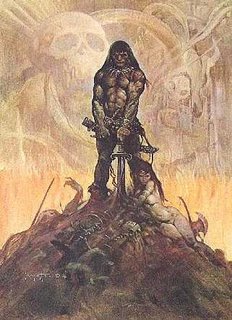
Like most authors, whether they write literature or Literature, Howard's writings reflect his own thoughts, experiences, and education. The writing reflects the aesthetic tastes of the author, or his/her understanding of a prospective audiences literary tastes. What makes something worth reading again and again is when an author satisfies those with "lower" tastes while providing them with some food for thought. Howard is no exception. In fact, I was surprised while I was rereading the first published Conan story, Howard's The Phoenix on the Sword to find that the author seemed to be hinting at a theory of the value of literature and its role in society.
Howard's Hyborean Age is a mythic world filled with magic and wonder, but it is also a world based on the history of the real world. Howard combined multiple eras of history so that societies whose "real world" existence is separated by centuries could co-exist narratively. Conan's own people, the Cimmerians, are based on a very real historical peoples. Both Herodotus, in his Histories, and Plutarch, in his Lives, mention the Cimmerian peoples (called Cimbri in Plutarch). In The Phoenix on the Sword, Howard appears to expect his audience to have at least a little understanding of the historical Cimmerians in his conversation of the role of literature in civilization. Conan, as protagonist, must hold ideas which the reader sympathizes with for the particular narrative of Phoenix to work.
So what kind of people were the Cimmerians? According to Plutarch they were a people who were pillagers and raiders, but not rulers.
What did they look like? According to Plutarch:
What was their temperament? According to Homer:
It is Homer's description of the Cimmerians that Howard uses in Phoenix to describe the mood of the people and to separate Conan from his kin. When Conan is asked why the Cimmerians are such a brooding people, Conan responds:
“Perhaps it’s the land they live in,” answered the king. “A gloomier land never was – all of hills, darkly wooded, under skies nearly always gray, with winds moaning drearily down the valleys.” – Phoenix on the Sword
The average Cimmerian is a dour and towering barbarian who destroys civilization then returns to his gloomy homeland only to begin the process again later. Howard's typical Cimmerian is similar to that of the classical scholars, and presents a figure most unlikely to advance the literary arts. But this is where Conan differs from his kin. InThe Phoenix on the Sword, Conan is an older man who has conquered on of the greatest nations of the Hyborean Age expressly to free them from tyrannical rule. He conquered to rule, and to liberate an oppressed nation. A far cry from the typical barbarian. By separating Conan from his kin, Howard simultaneously increases the audience's sympathy for the barbarian king while enabling the character to advance a theory of the value of literature.
The Phoenix on the Sword is the tale of a plot to assassinate King Conan, a plot organized my a Machiavellian figure named Ascalante who desires to assume the throne. Ascalante is the product of civilization, but he is the antagonist of the story and so Howard uses his opinions of the Arts as a way to separate him from the audience's sympathy. When he describes a poet who has been brought into his conspiracy he describes the poet in pejorative terms. These terms evolve as the narrative moves from unpublished draft to final published form. Ascalante originally expresses his disdain for Rinaldo (the poet) in a long description:
By the time the story is published the description is changed to the very brief, "“…Rinaldo, the hair-brained minstrel.” [Ascalante in Phoenix on the Sword(published)]. In the published form, Howard leaves out the value of Rinaldo's participation in the plot because it is redundant with information presented later in the story. When Ascalante is asked what value Rinaldo has as a conspirator, Ascalante's response is similar in both the published and unpublished text, but his hatred of Rinaldo is made more clear in the draft than in the published text:
In both descriptions the poet is shown to be a blind idealist. Rinaldo, it appears, cannot look beyond the Cimmerian stereotypes as presented by Plutarch and Herodotus. Howard doesn't require the reader to have those preconceptions, but for the reader who has read Herodotus and Plutarch the stereotype becomes even clearer. Also by editing down the prose the author, either willingly or at editorial command, displays an amount of trust that his audience can reach the proper conclusion that barbarism typically destroys the valuable within civilization. What is interesting is that while Rinaldo is a conspirator, the poet is an antagonist, he is not a villain. He is a blind a foolish idealist, not acting in his own self interest. Ascalante even goes on to describe Rinaldo's motivations:
Ascalante specifies what kind of idealists poets are. They seek an imagined perfect society, and will always look for it no matter how good the society they are currently in happens to be. But this is Ascalante, the Machiavellian civilized man, and his opinion about what the value of the poet is. For him the poet is an easily manipulable puppet. What about the barbarian turned king, the protagonist, and oft argued proxy for the author? (It should be noted that many argue that Conan often reflects Howard's own views, this is not an original assertion on my part.)
Conan adores the poet, and understands the criticisms. He is aware that the poet's plays are leading many among the people to despise him, but he too is persuaded of the need for justice. When his chief adviser, Prospero, discusses disdain for Rinaldo, Conan comes to the poet's (and poetry in general) defense. The text is near identical in the published and unpublished format.

For Conan, the atypical Cimmerian, poems and the arts have more power than weapons or royal authority. Not only that, but it is right and just that this is the case. Conan, the barbarian, is the defender of the value of literature, while Ascalante, the civilized man, sees literature as only a tool used to manipulate the foolish. Conan would seek to discuss the past and future, the ideal ones, with the poet, while Ascalante would merely use Rinaldo to destroy what he opposes. Conan's conflict between desiring a free press and swift justice, and the eventual melee that will result because of his favoring of the press, are made clear in the poetic prologue to the final chapter of the narrative.
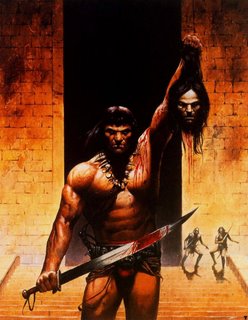
Surprisingly, Conan's love of literature and the arts, and his defense of them, is so deeply rooted that he initially refuses to kill Rinaldo when Rinaldo attacks him. He still believes he can reason with the poet, it is only when he is left no other alternative that he kills the poet (the text is identical in both published and unpublished forms).
What is interesting in the narrative is that of all the conspirators, there are twenty in all, none are able to injure Conan with the success of the poet. The poet has both damaged Conan's regime and his body and yet Conan was ever reluctant to, though in the end capable of, slay his greatest enemy.
What does this tell us of Howard's thoughts regarding the arts? We know that Conan loves them, but we also know how they were used to manipulate the populace and how his own love for them almost cost him his life. Is Howard trying to discuss how Plato's critique of the poets is a good one, while at the same time defending the possible nobility of the poet (as Aristotle does in his Rhetoric)? I think these are questions intentionally posed in the narrative (I know...never guess at intentionality), and make it clear why Conan's first story The Phoenix on the Sword was so compelling to readers when they first read it.
It should be noted that the story was originally submitted as a Kull tale, though I have yet to analyze that draft like I have these two subsequent writings. The Kull version was rejected by Weird Tales and the final (rather than the first) Conan version was the first appearance of what has become a culturally iconic figure.
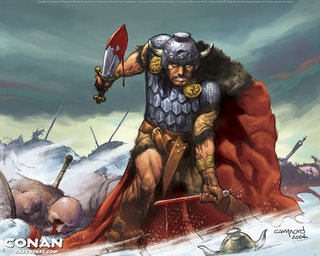
- The New PS3/XBOX 360 Video Game coming out next week
- The new "Conan The Phenomenon" hardcover by Paul Sammon
- The Savage Sword of Conan Trade Paperback Collection by Dark Horse
and- An upcoming movie by Millennium Films.
Those these are important, and wonderful, developments for the Conan fan, they are not new. One should not think that there has been some kind of sudden explosion in 2007 of Conan material.
Snider neglected to mention:
- Conan: The Ultimate Guide by Roy Thomas which released in September 2006
- The new Conan comic book series (first released in 2004) written by Kurt Busiek and illustrated by Cary Nord by Dark Horse
- The Mongoose Publishing Conan Roleplaying Game
not to mention- The Age of Conan series of media tie-in novels published in 2005 and 2006
or- Del Rey's publishing of Howard's Original Conan Stories released in 2003
The Conan explosion isn't a new thing either, I could have pulled numerous examples from the 90s or the 80s of Conan releases. Conan is always lurking in the pop culture subconscious and I think that we do a disservice to Conan fans, both existent and emerging when we use Arnold Schwarzenegger as the archetypal Conan representation, as Snider appears to do in the article. Some like Arnold as archetype, but I find Conan to be one of the most underestimated characters in American literature (with Natty Bumpo being a close second) and the Governator's portrayal -- while fun -- lacks the depth the character actually has as a literary figure.
When it comes to depictions of unreflective low art, one need look no further than the commonly perceived opinions of Robert Howard's Conan stories. If you ask the average man on the street to describe a Conan narrative, you will likely be given a tale of lust and violence. In the tale Conan will rescue some half-naked maiden from some rampaging beast and the story will end with the woman becoming all naked as she swoons at the hero's feet. In fact, a great deal of Conan pastiche has been based on this very simple formula. The largest problem with such a vision is that it is not all that accurate. Are there tales of this sort in the Conan oeuvre?
Sure, but there are also tales of visionary wonder.

Like most authors, whether they write literature or Literature, Howard's writings reflect his own thoughts, experiences, and education. The writing reflects the aesthetic tastes of the author, or his/her understanding of a prospective audiences literary tastes. What makes something worth reading again and again is when an author satisfies those with "lower" tastes while providing them with some food for thought. Howard is no exception. In fact, I was surprised while I was rereading the first published Conan story, Howard's The Phoenix on the Sword to find that the author seemed to be hinting at a theory of the value of literature and its role in society.
Howard's Hyborean Age is a mythic world filled with magic and wonder, but it is also a world based on the history of the real world. Howard combined multiple eras of history so that societies whose "real world" existence is separated by centuries could co-exist narratively. Conan's own people, the Cimmerians, are based on a very real historical peoples. Both Herodotus, in his Histories, and Plutarch, in his Lives, mention the Cimmerian peoples (called Cimbri in Plutarch). In The Phoenix on the Sword, Howard appears to expect his audience to have at least a little understanding of the historical Cimmerians in his conversation of the role of literature in civilization. Conan, as protagonist, must hold ideas which the reader sympathizes with for the particular narrative of Phoenix to work.
So what kind of people were the Cimmerians? According to Plutarch they were a people who were pillagers and raiders, but not rulers.
For the Cimmerian attack upon Ionia, which was earlier than Croesus, was not a conquest of the cities, but only an inroad for plundering.
Herodotus, Histories, I, 6
What did they look like? According to Plutarch:
Their great height, their black eyes and their name, Cimbri, which the Germans use for brigands, led us merely to suppose that they were one of those races of Germania who lived on the shores of the Western Ocean. Others say that the huge expanse of Celtica stretches from the outer sea and the western regions to the Palus Maeotis and borders on Asian Scythia; that these two neighbouring nations joined forces and left their land... And although each people had a different name, their army was collectively called Celto-Scythian. According to others, some of the Cimmerians, who were the first-to be known to the ancient Greeks... took flight and were driven from their land by the Scythians. Plutarch, Life of Marius, XI
What was their temperament? According to Homer:
Thus she brought us to the deep-Rowing River of Ocean and the frontiers of the world, where the fog-bound Cimmerians live in the City of Perpetual Mist. When the bright Sun climbs the sky and puts the stars to flight, no ray from him can penetrate to them, nor can he see them as he drops from heaven and sinks once more to the earth. For dreadful night has spread her mantle over the heads of that unhappy folk. Homer, Odyssey, XI, 14
It is Homer's description of the Cimmerians that Howard uses in Phoenix to describe the mood of the people and to separate Conan from his kin. When Conan is asked why the Cimmerians are such a brooding people, Conan responds:
“Perhaps it’s the land they live in,” answered the king. “A gloomier land never was – all of hills, darkly wooded, under skies nearly always gray, with winds moaning drearily down the valleys.” – Phoenix on the Sword
The average Cimmerian is a dour and towering barbarian who destroys civilization then returns to his gloomy homeland only to begin the process again later. Howard's typical Cimmerian is similar to that of the classical scholars, and presents a figure most unlikely to advance the literary arts. But this is where Conan differs from his kin. In
The Phoenix on the Sword is the tale of a plot to assassinate King Conan, a plot organized my a Machiavellian figure named Ascalante who desires to assume the throne. Ascalante is the product of civilization, but he is the antagonist of the story and so Howard uses his opinions of the Arts as a way to separate him from the audience's sympathy. When he describes a poet who has been brought into his conspiracy he describes the poet in pejorative terms. These terms evolve as the narrative moves from unpublished draft to final published form. Ascalante originally expresses his disdain for Rinaldo (the poet) in a long description:
“Rinaldo – a mad poet full of hare-brained visions and out-worn chivalry. A prime favorite with the people because of his songs which tear out their heart-strings. He is our best bid for popularity.” – Ascalante in Phoenix on the Sword (unpublished First submitted draft)
By the time the story is published the description is changed to the very brief, "“…Rinaldo, the hair-brained minstrel.” [Ascalante in Phoenix on the Sword(published)]. In the published form, Howard leaves out the value of Rinaldo's participation in the plot because it is redundant with information presented later in the story. When Ascalante is asked what value Rinaldo has as a conspirator, Ascalante's response is similar in both the published and unpublished text, but his hatred of Rinaldo is made more clear in the draft than in the published text:
“Alone of us all, Rinaldo has no personal ambition. He sees in Conan a red-handed, rough-footed barbarian who came out of the north to plunder a civilized land. He idealizes the king whom Conan killed to get the crown, remembering only that he occasionally patronized the arts, and forgetting the evils of his reign, and he is making the people forget. Already they openly sing The Lament for the King in which Rinaldo lauds the sainted villain and denounces Conan as ‘that black-hearted savage from the abyss.’ Conan laughs, but the people snarl.” – Ascalante in Phoenix on the Sword (published)
“Rinaldo – bah! I despise the man and admire him at the same time. He is your true idealist. Alone of us all he has no personal ambition. He sees in Conan a red-handed, rough-footed barbarian who came out of the north to plunder a peaceful land. He thinks he sees barbarism triumphing over culture. He already idealizes the king Conan killed, forgetting the rogue’s real nature, remembering only that he occasionally patronized the arts, and forgetting the evils under which the land groaned during his reign, and he is making the people forget. Already they open sing ‘The Lament for the King’ in which Rinaldo lauds the saintly villain, and denounces Conan as ‘that black-hearted savage from the abyss.’ Conan laughs, but at the same time wonders why the people are turning against him.” – Ascalante in Phoenix on the Sword (unpublished First submitted draft)
In both descriptions the poet is shown to be a blind idealist. Rinaldo, it appears, cannot look beyond the Cimmerian stereotypes as presented by Plutarch and Herodotus. Howard doesn't require the reader to have those preconceptions, but for the reader who has read Herodotus and Plutarch the stereotype becomes even clearer. Also by editing down the prose the author, either willingly or at editorial command, displays an amount of trust that his audience can reach the proper conclusion that barbarism typically destroys the valuable within civilization. What is interesting is that while Rinaldo is a conspirator, the poet is an antagonist, he is not a villain. He is a blind a foolish idealist, not acting in his own self interest. Ascalante even goes on to describe Rinaldo's motivations:
“Poets always hate those in power. To them perfection is always just behind the last corner, or beyond the next. They escape the present in dreams of the past and future. Rinaldo is a flaming torch of idealism, rising, as he thinks, to overthrow a tyrant and liberate the people.” – Ascalante in Phoenix on the Sword (published)
“Because he is a poet. Poets always hate those in power. To them perfection is always just behind the last corner or beyond the next. They escape the present in dreams of the past and the future. Rinaldo is a flaming torch of idealism and he sees himself as a hero, a stainless knight – which after all he is! – rising to overthrow the tyrant and liberate the people.” – Ascalante in Phoenix on the Sword (unpublished First submitted draft)
Ascalante specifies what kind of idealists poets are. They seek an imagined perfect society, and will always look for it no matter how good the society they are currently in happens to be. But this is Ascalante, the Machiavellian civilized man, and his opinion about what the value of the poet is. For him the poet is an easily manipulable puppet. What about the barbarian turned king, the protagonist, and oft argued proxy for the author? (It should be noted that many argue that Conan often reflects Howard's own views, this is not an original assertion on my part.)
Conan adores the poet, and understands the criticisms. He is aware that the poet's plays are leading many among the people to despise him, but he too is persuaded of the need for justice. When his chief adviser, Prospero, discusses disdain for Rinaldo, Conan comes to the poet's (and poetry in general) defense. The text is near identical in the published and unpublished format.
“Rinaldo is largely responsible,” answered Prospero, drawing up his sword-belt another notch. “He sings songs that make men mad. Hang him in his jester’s garb to the highest tower in the city. Let him make rhymes for the vultures.”
“No, Prospero, he’s beyond my reach. A great poet is greater than any king. His songs are mightier than my scepter, for he has hear ripped the heart from my breast when he chose to sing for me. I will die and be forgotten, but Rinaldo’s songs will live forever.” – Phoenix on the Sword (unpublished first submitted draft)
“Rinaldo is largely responsible,” answered Prospero, drawing up his sword-belt another notch. “He sings songs that make men mad. Hang him in his jester’s garb to the highest tower in the city. Let him make rimes for the vultures.”
“No, Prospero, he’s beyond my reach. A great poet is greater than any king. His songs are mightier than my scepter; for he has near ripped the heart from my breast when he chose to sing for me. I shall die and be forgotten, but Rinaldo’s songs will live for ever.” – Phoenix on the Sword (published)

For Conan, the atypical Cimmerian, poems and the arts have more power than weapons or royal authority. Not only that, but it is right and just that this is the case. Conan, the barbarian, is the defender of the value of literature, while Ascalante, the civilized man, sees literature as only a tool used to manipulate the foolish. Conan would seek to discuss the past and future, the ideal ones, with the poet, while Ascalante would merely use Rinaldo to destroy what he opposes. Conan's conflict between desiring a free press and swift justice, and the eventual melee that will result because of his favoring of the press, are made clear in the poetic prologue to the final chapter of the narrative.
What do I know of cultured ways, the gilt, the craft and the lie?
I, who was born in a naked land and bred in the open sky.
The subtle tongue, the sophist guile, they fail when the broadswords sing;
Rush in and die, dogs – I was a man before I was a king. – The Road of Kings – Phoenix on the Sword (published)
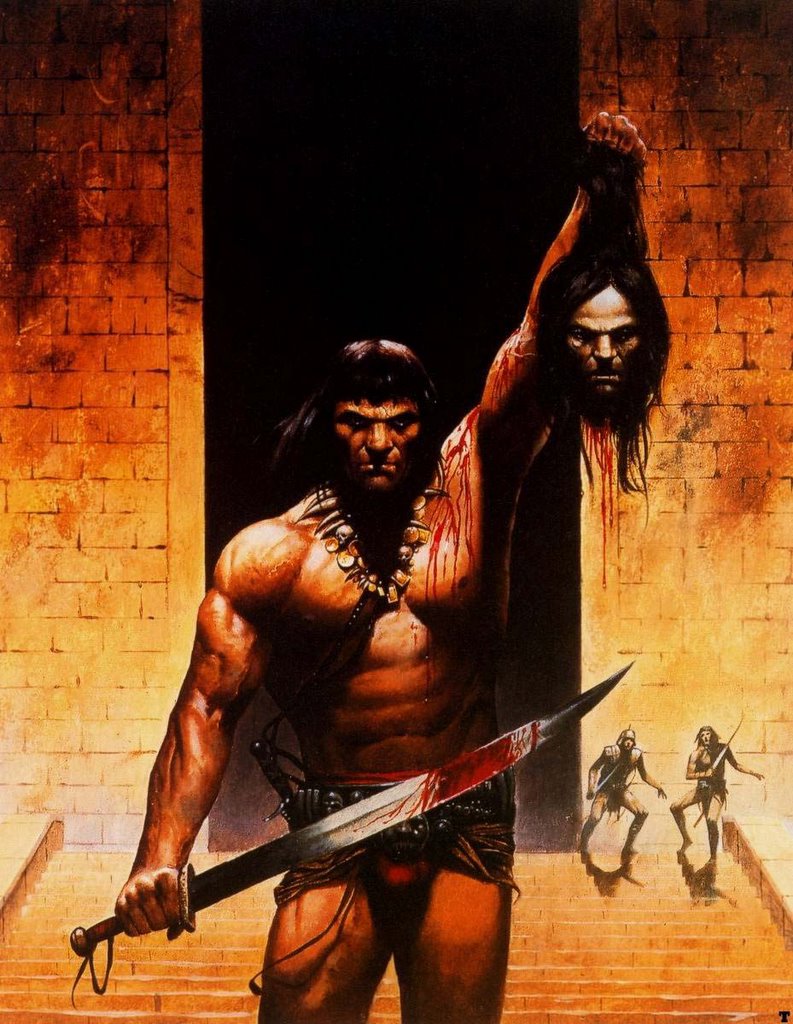
Surprisingly, Conan's love of literature and the arts, and his defense of them, is so deeply rooted that he initially refuses to kill Rinaldo when Rinaldo attacks him. He still believes he can reason with the poet, it is only when he is left no other alternative that he kills the poet (the text is identical in both published and unpublished forms).
“He rushed in, hacking madly, but Conan, recognizing him, shattered his sword with a short terrific chop and with a powerful push of his open hand sent him reeling to the floor.” – Phoenix on the Sword (published)
“He straightened to meet the maddened rush of Rinaldo, who charged in wild and wide open, armed only with a dagger. Conan leaped back, lifting his ax.
‘Rinaldo!’ his voice was strident with desperate urgency. ‘Back! I would not slay you ..’
‘Die, tyrant!’ screamed the mad minstrel, hurling himself headlong on the king. Conan delayed the blow he was loth to deliver, until it was too late. Only when he felt the bite of the steel in his unprotected side did he strike, in a frenzy of blind desperation.
Rinaldo dropped with his skull shattered and Conan reeled back against the wall, blood spurting from between the fingers which gripped his wound.” – Phoenix on the Sword (published)
What is interesting in the narrative is that of all the conspirators, there are twenty in all, none are able to injure Conan with the success of the poet. The poet has both damaged Conan's regime and his body and yet Conan was ever reluctant to, though in the end capable of, slay his greatest enemy.
“’See first to the dagger-wound in my side,’ he bade the court physicians. ‘Rinaldo wrote me a deathly song there, and keen was the stylus.’
‘We should have hanged him long ago,’ gibbered Publius. ‘No good can come of poets..’” – Phoenix on the Sword (published)
What does this tell us of Howard's thoughts regarding the arts? We know that Conan loves them, but we also know how they were used to manipulate the populace and how his own love for them almost cost him his life. Is Howard trying to discuss how Plato's critique of the poets is a good one, while at the same time defending the possible nobility of the poet (as Aristotle does in his Rhetoric)? I think these are questions intentionally posed in the narrative (I know...never guess at intentionality), and make it clear why Conan's first story The Phoenix on the Sword was so compelling to readers when they first read it.
It should be noted that the story was originally submitted as a Kull tale, though I have yet to analyze that draft like I have these two subsequent writings. The Kull version was rejected by Weird Tales and the final (rather than the first) Conan version was the first appearance of what has become a culturally iconic figure.

Monday, October 15, 2007
Ursula K LeGuin, Cory Doctorow, and Copyright
I have been wondering for some time now just how long the SF/Fantasy community will allow themselves to be swindled by Cory Doctorow's attempts to undermine copyright protections for writers. He's been incredibly crafty in his arguments. He has adeptly, and accurately, demonstrated how corporations often claim the copyright instead of the authors who created a product, but he uses this to shift the issue away from "creator ownership" issue into an "us vs. the corporate overlords" argument. Doing so he simultaneously points out a genuine injustice while misdirecting our ire toward the concept of copyright, which in fact protects creators (at least when corporate overlords don't hijack the rights). He has also pointed out that SF/Fantasy fans tend to both download and purchase hard copies of the things they like. In essence, the SF/Fantasy fan steals a peek, then buys the product, thus doing no "real" damage to the right holder.
I have never found Mr. Doctorow's arguments, and he has others, all that convincing. They seem to be overly concerned with "audience" rights and not with creator rights, which are necessary if people want to be able to make a living from this stuff. Certainly, there is some pretty wacky copyright legislation out there (lifetime plus how many years?), but that doesn't mean that the creator of a product doesn't have the right to profit from his or her creation. They should, and do, and current laws protect such rights.
In the past, the majority of the people I've read who seem to have any agreement with me have been corporate shills, and I don't want to just hang out with corporate shills -- or just them and Harlan Ellison (registered trademark) for that matter. So you can imagine my joy at finding that Ursula K. LeGuin also finds Mr. Doctorow's crusade a little too aggressive. It appears that Mr. Doctorow printed "in its entirety, a one-paragraph story that Ms Le Guin sent to the fanzine Ansible." LeGuin took issue and Mr. Doctorow eventually took action and apologized. You can read the original story at LeGuin's website.
LeGuin has accepted Mr. Doctorow's apology, but I'd like you to look at a couple of key phrases in Doctorow's apology which hint that he is also practicing more than a little self-righteous self-justification.
Unless Andrew Burt (you can read a copy of a letter he wrote Jerry Pournelle here) and Mr. Doctorow engaged in a serious brawl, it seems a bit petty for Mr. Doctorow to have put his emails in a "killfile." I don't believe that Judd Apatow put Mark Brazill in his killfile, even after being told to "Get cancer." But I don't know the nature of the "altercation," I just know that Mr. Doctorow has used a word which has some heavy implications. Though given his frequent use of rhetorical techniques which might make Gorgias blush, I think it might be little more than a heated email/comment section/message board flame war.
In fact, it seems that Burt's major sin (according to the Doctorow piece) is that Burt believes in copyright protection, "Burt is the Science Fiction Writers of America VP who had previously sent a fraudulent takedown notice that resulted in my novel being removed from an Internet document server." So Burt tries to protect Doctorow's copyright, making an error that forces a takedown notice, something LeGuin describes as "An overworked committee mistakenly identified a few works, among many, as infringing copyright; the mistakes were promptly admitted and redressed, with apologies." That appears to be our "altercation." Which makes me think that Mr. Doctorow is a bit like Mark Brazill in all of this, even his apology seems snide and canned. This is implied by his assertion that, "My understanding is that she is unsatisfied and remains upset with me." When LeGuin is on the record as writing, "It may be a bit clouded with arguments and self-justification, but apologising is hard, and apologies are rare and valuable. I accept his in all good faith." Who seems to be the one most in need of justification here?
As for me, I agree with LeGuin's hope that, "In my view, the best thing that could come out of my brush with the Doctorow Doctrine would be this: the honorable reinstatement of the SFWA e-piracy committee, with an expression of appreciation from SFWA officers and members of the honest and effective work they have done for us for so long."
I have never found Mr. Doctorow's arguments, and he has others, all that convincing. They seem to be overly concerned with "audience" rights and not with creator rights, which are necessary if people want to be able to make a living from this stuff. Certainly, there is some pretty wacky copyright legislation out there (lifetime plus how many years?), but that doesn't mean that the creator of a product doesn't have the right to profit from his or her creation. They should, and do, and current laws protect such rights.
In the past, the majority of the people I've read who seem to have any agreement with me have been corporate shills, and I don't want to just hang out with corporate shills -- or just them and Harlan Ellison (registered trademark) for that matter. So you can imagine my joy at finding that Ursula K. LeGuin also finds Mr. Doctorow's crusade a little too aggressive. It appears that Mr. Doctorow printed "in its entirety, a one-paragraph story that Ms Le Guin sent to the fanzine Ansible." LeGuin took issue and Mr. Doctorow eventually took action and apologized. You can read the original story at LeGuin's website.
LeGuin has accepted Mr. Doctorow's apology, but I'd like you to look at a couple of key phrases in Doctorow's apology which hint that he is also practicing more than a little self-righteous self-justification.
Andrew Burt, the person whom Ms Le Guin chose to communicate the matter to me, is someone with whom I had put in a killfile following an altercation. I delete all emails from him unread, and if he sent me a message, I did not see it.
Unless Andrew Burt (you can read a copy of a letter he wrote Jerry Pournelle here) and Mr. Doctorow engaged in a serious brawl, it seems a bit petty for Mr. Doctorow to have put his emails in a "killfile." I don't believe that Judd Apatow put Mark Brazill in his killfile, even after being told to "Get cancer." But I don't know the nature of the "altercation," I just know that Mr. Doctorow has used a word which has some heavy implications. Though given his frequent use of rhetorical techniques which might make Gorgias blush, I think it might be little more than a heated email/comment section/message board flame war.
In fact, it seems that Burt's major sin (according to the Doctorow piece) is that Burt believes in copyright protection, "Burt is the Science Fiction Writers of America VP who had previously sent a fraudulent takedown notice that resulted in my novel being removed from an Internet document server." So Burt tries to protect Doctorow's copyright, making an error that forces a takedown notice, something LeGuin describes as "An overworked committee mistakenly identified a few works, among many, as infringing copyright; the mistakes were promptly admitted and redressed, with apologies." That appears to be our "altercation." Which makes me think that Mr. Doctorow is a bit like Mark Brazill in all of this, even his apology seems snide and canned. This is implied by his assertion that, "My understanding is that she is unsatisfied and remains upset with me." When LeGuin is on the record as writing, "It may be a bit clouded with arguments and self-justification, but apologising is hard, and apologies are rare and valuable. I accept his in all good faith." Who seems to be the one most in need of justification here?
As for me, I agree with LeGuin's hope that, "In my view, the best thing that could come out of my brush with the Doctorow Doctrine would be this: the honorable reinstatement of the SFWA e-piracy committee, with an expression of appreciation from SFWA officers and members of the honest and effective work they have done for us for so long."
Friday, October 12, 2007
Does DEXTER IN THE DARK Spell Lights Out for the Franchise?
Dexter is back -- or most of him is back—in DEXTER IN THE DARK: A Novel (those of you who support independent bookstores can buy it at Mysterious Galaxy), Jeff Lindsay’s latest installment detailing the brutal exploits of his charmingly witty and only half-heartless serial killer, preying and slaying by his uniquely strict if lethal Harry Code of Conduct. This newest book finds Dexter in crisis – not of conscience, of course. He doesn’t have one. But in a crisis of identity, for Dexter’s mysterious inner fiend -- that giddy playmate that guides his death-dealing and leaves him elated after bouts of marvelous moonlit mayhem –- Dexter’s Dark Passenger is absent without leave.
As if prepping for a wedding and fatherhood aren’t enough to put Dexter off his game, a peculiar crime scene with macabre theological overtones sends Dexter’s Dark Passenger scurrying away, with troubling results for Dexter and his readers. Being out of communion dulls Dexter’s normally razor instincts, humor, and murderous talents when he, and we, need them most. Once again, he attracts the attention of a very dangerous intelligence, this time with a taste for children, but don’t expect the usual combination of chase, wit, twist, and surprise. Dexter is not only in the dark, he’s down right depressed. Jeff Lindsay takes a daring departure from the optimistic mayhem of America’s favorite avenging monster, but it’s a sad, fumbling new path.
Unlike DARKLY DREAMING DEXTER (at Mysterious Galaxy) and DEARLY DEVOTED DEXTER
 (at Mysterious Galaxy), DEXTER IN THE DARK leaves the complex realm of psychological vagary and broken psyches to dabble in something entirely outside Dexter’s universe: theology. Sans Dark Passenger, Dexter is befuddled, frustrated, and at risk of becoming normal, with all the emotions and vulnerabilities of any normal person, yet his world turns suddenly (and unjustifiably, despite ample narrative exposition) supernatural. Just when Dexter has no powers (not insight, not humor, and the boy can’t even seem to kill), Miami is overrun with them. The sum effect is a kind of amorphous melancholy, both for Dexter and his dear readers. Little help comes from the other characters made so vibrant in previous pages – the few times Dexter isn’t shuffling around in his own empty head, he’s avoiding conversations or being himself avoided. If you crave the slay-and-play criminology twice before scribed so ingeniously by Jeff Lindsay’s pen, brace yourself for page after unfunny, derivative, ill-conceived, if-it-had-to-be-supernatural-why-couldn’t-it-be-Lovecraftian-good page.
Spoiled until now navigating two books of vicious, psychotic violence on the shoulders of a fantastically entertaining monster, this clumsy foray into Anne Rice/DaVinci Code-esque old-god theology and conspiracy is by comparison plodding, simplistic, and dull. Lindsay abandons his established finesse of raising questions without answers, of suggestion and nuance, of abrasive yet oddly loveable and infinitely entertaining characters, and instead offers an obtuse, paint-by-numbers explanation for evil which abdicates Dexter from all moral responsibility for who and what he is, for his adherence to or abandonment of the Harry Code, and ultimately advocates an incoherent pseudo-loyalty to controlled evil. If Harry had read this book, he would have killed Dexter on sight. I found myself by the end rooting for the kids to get run over, shot, or drowned. Poor Rita.
For those who enjoy the Cthulhu mythos or tales with supernatural explanations, DEXTER IN THE DARK might be a fun romp, but this reader prays, to whatever Dark Gods will listen, that Lindsay returns to the world he tells so well –- Dexter’s Miami: wickedly funny, refreshingly mortal, splendidly violent, and mildly-sociopathic.
(those of you who support independent bookstores can buy it at Mysterious Galaxy), Jeff Lindsay’s latest installment detailing the brutal exploits of his charmingly witty and only half-heartless serial killer, preying and slaying by his uniquely strict if lethal Harry Code of Conduct. This newest book finds Dexter in crisis – not of conscience, of course. He doesn’t have one. But in a crisis of identity, for Dexter’s mysterious inner fiend -- that giddy playmate that guides his death-dealing and leaves him elated after bouts of marvelous moonlit mayhem –- Dexter’s Dark Passenger is absent without leave.As if prepping for a wedding and fatherhood aren’t enough to put Dexter off his game, a peculiar crime scene with macabre theological overtones sends Dexter’s Dark Passenger scurrying away, with troubling results for Dexter and his readers. Being out of communion dulls Dexter’s normally razor instincts, humor, and murderous talents when he, and we, need them most. Once again, he attracts the attention of a very dangerous intelligence, this time with a taste for children, but don’t expect the usual combination of chase, wit, twist, and surprise. Dexter is not only in the dark, he’s down right depressed. Jeff Lindsay takes a daring departure from the optimistic mayhem of America’s favorite avenging monster, but it’s a sad, fumbling new path.
Unlike DARKLY DREAMING DEXTER
(at Mysterious Galaxy) and DEARLY DEVOTED DEXTER (at Mysterious Galaxy), DEXTER IN THE DARK leaves the complex realm of psychological vagary and broken psyches to dabble in something entirely outside Dexter’s universe: theology. Sans Dark Passenger, Dexter is befuddled, frustrated, and at risk of becoming normal, with all the emotions and vulnerabilities of any normal person, yet his world turns suddenly (and unjustifiably, despite ample narrative exposition) supernatural. Just when Dexter has no powers (not insight, not humor, and the boy can’t even seem to kill), Miami is overrun with them. The sum effect is a kind of amorphous melancholy, both for Dexter and his dear readers. Little help comes from the other characters made so vibrant in previous pages – the few times Dexter isn’t shuffling around in his own empty head, he’s avoiding conversations or being himself avoided. If you crave the slay-and-play criminology twice before scribed so ingeniously by Jeff Lindsay’s pen, brace yourself for page after unfunny, derivative, ill-conceived, if-it-had-to-be-supernatural-why-couldn’t-it-be-Lovecraftian-good page. Spoiled until now navigating two books of vicious, psychotic violence on the shoulders of a fantastically entertaining monster, this clumsy foray into Anne Rice/DaVinci Code-esque old-god theology and conspiracy is by comparison plodding, simplistic, and dull. Lindsay abandons his established finesse of raising questions without answers, of suggestion and nuance, of abrasive yet oddly loveable and infinitely entertaining characters, and instead offers an obtuse, paint-by-numbers explanation for evil which abdicates Dexter from all moral responsibility for who and what he is, for his adherence to or abandonment of the Harry Code, and ultimately advocates an incoherent pseudo-loyalty to controlled evil. If Harry had read this book, he would have killed Dexter on sight. I found myself by the end rooting for the kids to get run over, shot, or drowned. Poor Rita.
For those who enjoy the Cthulhu mythos or tales with supernatural explanations, DEXTER IN THE DARK might be a fun romp, but this reader prays, to whatever Dark Gods will listen, that Lindsay returns to the world he tells so well –- Dexter’s Miami: wickedly funny, refreshingly mortal, splendidly violent, and mildly-sociopathic.
Wednesday, October 10, 2007
A History of Pulp Role Playing Games Part 1: The Dawn of Roleplaying Games
Those who wonder how old the connection between "The Pulps" and Roleplaying Games is need look no further than the introduction to the original (three book) Dungeons and Dragons boxed set. In this introduction, Gary Gygax describes who might be interested in playing his new creation:
The introduction is filled with names near and dear to the pulp aficionado. Edgar Rice Burrough's character John Carter first appeared in the February through July issues of The All-Story in 1912. TSR also designed an early miniatures wargame on the adventures of John Carter, it was called Warriors of Mars.

Robert E. Howard's famous barbarian Conan debuted at the height of his power in Weird Tales December 1932 issue in "The Phoenix on the Sword," a rewrite of a rejected Kull story titled "By This Axe I Rule." In the tale, Conan is already a mature man and king of Aquilonia and deals swift justice to a band of would be assassins. If you look carefully at the cover of the issue, you will notice that the advertised story, "Buccaneers of Venus," is a John Carter pastiche by Otis Adelbert Kline. Kline eventually became Howard's literary agent. As a gamer, I can't help but speculate that the amphibious antagonist on the cover is an inspiration behind the Kuo-Toa in the D&D game (H.P. Lovecraft's Deep Ones are another obvious influence.)

L. Sprague deCamp and Fletcher Pratt's everyman hero psychologist/enchanter Harold Shea wandered into his first fantastic landscape in the May 1940 issue of Unknown.

To be fair, most fantasy of the pre-Tolkien era was published in the pulps and as influential as these early fantasy tales were to the Dungeons and Dragons game (and are to the current D&D Eberron setting), they are not what most people mean when they are referring to "Pulp Roleplaying Games." Which is a shame since the pulps were filled with dynamic, original, and action packed tales that many modern Game Masters should look to for inspiration. Not every adventure need be a macguffin quest inspired by Tolkien's Lord of the Rings.
The lack of familiarity with, and I mean familiarity with and not awareness of, the underlying pulp inspirations that influenced the creation of role playing games is one of the largest failings of some of today's game designers. When I read Jesse Decker and David Noonan's discussion regarding why modern Dungeons and Dragons avoids explicit attempts at humor in its rulebooks, I near wept.
At no time was there a discussion about why the early rulebooks had humor in them, as opposed to the central reason they gave why there isn't humor any longer. They write, "In short, we worry that it isn't necessarily part of the shared D&D experience, and we don't want to mess up the flow of the game at the table." And in writing that one sentence, they ignore one of the major literary influences on the development of the Dungeons and Dragons game, the stories of Harold Shea by deCamp and Pratt. How can stories, and the tone they inspired, be not "necessarily part of the shared D&D experience?" Without these stories, you might not even have the game itself, particularly considering the deCamp/Pratt stories.
I am not saying this because I believe Gary Gygax to have been intimately familiar with Fletcher Pratt's Naval War Game, though he may have been. I am saying this because of two things. First, the underlying conceit of the Harold Shea stories themselves was probably inspirational to the creation of the "proto role playing game." Second, the humor that continually reared its head in early D&D books was the same kind of humor one found in the deCamp/Pratt stories.
To fully understand the above statement, you must understand the central conceit of the Harold Shea stories. Essentially, the central conceit is that Harold Shea (and his mentor) are able to travel to other dimensions -- many of which contain magic -- if they can alter their perceptions through the analysis of particular equations and logical proofs. When Harold Shea studies his first proof, which sends him to Ragnarök, a gamer can easily see the parallel between Shea looking at the pages upon pages of logic problems and their own experience looking at pages upon pages of rules. When roleplayers study the rules of a game, it is so they can fluidly experience the milieu the game is offering. This is exactly what Shea does in the stories. It should be noted that J. Eric Holmes, the editor of the first Dungeons and Dragons Basic Set, wrote in his book Fantasy Roleplaying Games (Hippocrene Books, 1981 pp. 209-210):
Holmes, who was an adapter and not a creator of the rules, saw the connection between one of de Camp's stories and the underlying concept of role playing games. It isn't hard to imagine Gary Gygax and Dave Arneson being inspired by a character who even more explicitly used a "rules set" to experience fantasy adventure.
Decker and Noonan are fine designers, and they have developed some of my favorite products, but they seem to have lost the connection between the pulps and the game they are working on. Dungeons and Dragons is the scion of pulp literature and we do the game a disservice when we don't acknowledge this fact. And we do the players of the game a disservice when we don't point them in the direction of the things that inspired their hobby. Early editions of the game included bibliographies of inspirational materials, many other roleplaying games still do, but the three core books of the Dungeons and Dragons game lack such references (the Eberron sourcebook does contain some). Decker and Noonan may be aware that roleplaying was influenced by pulps, but they aren't familiar with what those pulps had to offer and it shows in their reticence to include humor in the D&D experience.
These rules are strictly fantasy. Those wargamers who lack imagination, those who don't care for Burroughs' Martian adventures where John Carter is groping
through black pits, who feel no thrill upon reading Howard's Conan saga, who do
not enjoy the de Camp & Pratt fantasies or Fritz Leiber's Fafhrd and the Gray
Mouser pitting their swords against evil sorceries will not be likely to find
DUNGEONS and DRAGONS to their taste.
The introduction is filled with names near and dear to the pulp aficionado. Edgar Rice Burrough's character John Carter first appeared in the February through July issues of The All-Story in 1912. TSR also designed an early miniatures wargame on the adventures of John Carter, it was called Warriors of Mars.

Robert E. Howard's famous barbarian Conan debuted at the height of his power in Weird Tales December 1932 issue in "The Phoenix on the Sword," a rewrite of a rejected Kull story titled "By This Axe I Rule." In the tale, Conan is already a mature man and king of Aquilonia and deals swift justice to a band of would be assassins. If you look carefully at the cover of the issue, you will notice that the advertised story, "Buccaneers of Venus," is a John Carter pastiche by Otis Adelbert Kline. Kline eventually became Howard's literary agent. As a gamer, I can't help but speculate that the amphibious antagonist on the cover is an inspiration behind the Kuo-Toa in the D&D game (H.P. Lovecraft's Deep Ones are another obvious influence.)

L. Sprague deCamp and Fletcher Pratt's everyman hero psychologist/enchanter Harold Shea wandered into his first fantastic landscape in the May 1940 issue of Unknown.

To be fair, most fantasy of the pre-Tolkien era was published in the pulps and as influential as these early fantasy tales were to the Dungeons and Dragons game (and are to the current D&D Eberron setting), they are not what most people mean when they are referring to "Pulp Roleplaying Games." Which is a shame since the pulps were filled with dynamic, original, and action packed tales that many modern Game Masters should look to for inspiration. Not every adventure need be a macguffin quest inspired by Tolkien's Lord of the Rings.
The lack of familiarity with, and I mean familiarity with and not awareness of, the underlying pulp inspirations that influenced the creation of role playing games is one of the largest failings of some of today's game designers. When I read Jesse Decker and David Noonan's discussion regarding why modern Dungeons and Dragons avoids explicit attempts at humor in its rulebooks, I near wept.
At no time was there a discussion about why the early rulebooks had humor in them, as opposed to the central reason they gave why there isn't humor any longer. They write, "In short, we worry that it isn't necessarily part of the shared D&D experience, and we don't want to mess up the flow of the game at the table." And in writing that one sentence, they ignore one of the major literary influences on the development of the Dungeons and Dragons game, the stories of Harold Shea by deCamp and Pratt. How can stories, and the tone they inspired, be not "necessarily part of the shared D&D experience?" Without these stories, you might not even have the game itself, particularly considering the deCamp/Pratt stories.
I am not saying this because I believe Gary Gygax to have been intimately familiar with Fletcher Pratt's Naval War Game, though he may have been. I am saying this because of two things. First, the underlying conceit of the Harold Shea stories themselves was probably inspirational to the creation of the "proto role playing game." Second, the humor that continually reared its head in early D&D books was the same kind of humor one found in the deCamp/Pratt stories.
To fully understand the above statement, you must understand the central conceit of the Harold Shea stories. Essentially, the central conceit is that Harold Shea (and his mentor) are able to travel to other dimensions -- many of which contain magic -- if they can alter their perceptions through the analysis of particular equations and logical proofs. When Harold Shea studies his first proof, which sends him to Ragnarök, a gamer can easily see the parallel between Shea looking at the pages upon pages of logic problems and their own experience looking at pages upon pages of rules. When roleplayers study the rules of a game, it is so they can fluidly experience the milieu the game is offering. This is exactly what Shea does in the stories. It should be noted that J. Eric Holmes, the editor of the first Dungeons and Dragons Basic Set, wrote in his book Fantasy Roleplaying Games (Hippocrene Books, 1981 pp. 209-210):
"Years before Dungeons and Dragons was invented, L. Sprague de Camp wrote a story called "Solomon's Stone," published in 1942 in the magazine Unknown Worlds...The story was a fantasy in which the hero exchanges personalities with his alter-ego in the astral world. Here he discovers that the astral self of each living person on earth is the self he imagines or fantasies himself to be in his most private dreams...I am always reminded of "Solomon's Stone," though, when I see the bizarre and wonderful characters created by my friends for the game."
Holmes, who was an adapter and not a creator of the rules, saw the connection between one of de Camp's stories and the underlying concept of role playing games. It isn't hard to imagine Gary Gygax and Dave Arneson being inspired by a character who even more explicitly used a "rules set" to experience fantasy adventure.
Decker and Noonan are fine designers, and they have developed some of my favorite products, but they seem to have lost the connection between the pulps and the game they are working on. Dungeons and Dragons is the scion of pulp literature and we do the game a disservice when we don't acknowledge this fact. And we do the players of the game a disservice when we don't point them in the direction of the things that inspired their hobby. Early editions of the game included bibliographies of inspirational materials, many other roleplaying games still do, but the three core books of the Dungeons and Dragons game lack such references (the Eberron sourcebook does contain some). Decker and Noonan may be aware that roleplaying was influenced by pulps, but they aren't familiar with what those pulps had to offer and it shows in their reticence to include humor in the D&D experience.
Tuesday, October 09, 2007
Listen to the Geekerati Episode on Popular Medievalism
Last night we had a wonderful chat with Professor Richard Scott Nokes of Troy University about Popular Medievalism. We talked about what it is and where it is, and it's everywhere. We also talked about the connection between playing Dungeons and Dragons and studying Medieval History, and we got a little hint that the reason we call the Middle Ages the Dark Ages is due to bad press from certain people during the Renaissance.
We discussed a lot of different topics, but we spent a great deal of time discussing some of our favorite Popular Medieval movies. Some of the movies we mentioned were: Excalibur, The Lion in Winter, A Knight's Tale, Henry V, The Last Valley, The Lord of the Rings Trilogy, The Sword and the Sorcerer, Krull, and Ladyhawke.
What are some of your favorite Popular Medieval films? Books? Comics? Television Shows?
Listen to the episode and let us know.

We discussed a lot of different topics, but we spent a great deal of time discussing some of our favorite Popular Medieval movies. Some of the movies we mentioned were: Excalibur, The Lion in Winter, A Knight's Tale, Henry V, The Last Valley, The Lord of the Rings Trilogy, The Sword and the Sorcerer, Krull, and Ladyhawke.
What are some of your favorite Popular Medieval films? Books? Comics? Television Shows?
Listen to the episode and let us know.
Monday, October 08, 2007
Some Thoughts Before We Return to Posts About Popular Culture
When I put up my post regarding my mom's death, it is a very personal action in more ways than one. It is personal in that I am revealing a little bit of my life to the world, but it is also personal in that I am only writing about how I feel (or felt) about the event. In a way, this is very unfair to a number of people that I care deeply about who were also affected by my mom's death.
I am not writing about how they felt, or even about how we dealt with the situation together. I am writing just from my perspective. But I am do this because it is the only point of view I really have. I have no real way of knowing what these other people are experiencing, nor what they experienced, because I have had different experiences. My dad knew my mom years before I did, and I knew her for years before my sister did. Each of us, in a very real way, came to know a very different woman. That said, I would like to try to share what I think some of those differences are.
I am 9 years 8 month and 8 days older than my sister Krista. I was born on "Elvis' Birthday" and she was born on the anniversary of his death, January 8th and August 16th for those of you wondering. Which means that I have 9-plus years of memories about my mom that Krista will never have. It also means, because like many 20-somethings I was very independent of my family for a time, that Krista has some memories that I will never have. And a lot of the memories that my sister has are of my mom's struggle with, and loss to, addiction.
I have no personal experience of what it is like to live in the same apartment as a heroin addict, for which I am grateful. Moreover, I have no experience of what it is like to be a teenager living in the same apartment as a heroin addict. In the grand scheme of life, it is probably one of the last things I would ever want to experience. But my sister did just that, the combination of love and frustration must have been near unbearable. I don't know how I would have dealt with the situation, I hope I would do alright. My sister did much better than I imagine the average person in her circumstances would have.
It is one of the many things I admire about my sister, that she was able to survive that situation. I actually don't think my sister understands how much I admire her period, let alone for her strength in this situation. I think she sometimes thinks that I look down on her for not making some of the same choice that I have made, but that isn't true at all. Being almost 10 years older than my sister meant that I spent a lot of time babysitting her, taking her to the park, or even to concerts I wouldn't have otherwise attended. I changed her diapers on many occasions and must seem, in some way, to be a bit of a parental figure to her and, given my stodginess and geekdom, not even the "cool" parent. So I can see why my opinion is important to her, and how my own life experiences might make her think that I believe the choices I made are the only way to happiness. But I don't believe that at all.
In fact, if people knew a formula to happiness, there wouldn't be philosophy and a lot of life would be a lot easier.
I am not writing about how they felt, or even about how we dealt with the situation together. I am writing just from my perspective. But I am do this because it is the only point of view I really have. I have no real way of knowing what these other people are experiencing, nor what they experienced, because I have had different experiences. My dad knew my mom years before I did, and I knew her for years before my sister did. Each of us, in a very real way, came to know a very different woman. That said, I would like to try to share what I think some of those differences are.
I am 9 years 8 month and 8 days older than my sister Krista. I was born on "Elvis' Birthday" and she was born on the anniversary of his death, January 8th and August 16th for those of you wondering. Which means that I have 9-plus years of memories about my mom that Krista will never have. It also means, because like many 20-somethings I was very independent of my family for a time, that Krista has some memories that I will never have. And a lot of the memories that my sister has are of my mom's struggle with, and loss to, addiction.
I have no personal experience of what it is like to live in the same apartment as a heroin addict, for which I am grateful. Moreover, I have no experience of what it is like to be a teenager living in the same apartment as a heroin addict. In the grand scheme of life, it is probably one of the last things I would ever want to experience. But my sister did just that, the combination of love and frustration must have been near unbearable. I don't know how I would have dealt with the situation, I hope I would do alright. My sister did much better than I imagine the average person in her circumstances would have.
It is one of the many things I admire about my sister, that she was able to survive that situation. I actually don't think my sister understands how much I admire her period, let alone for her strength in this situation. I think she sometimes thinks that I look down on her for not making some of the same choice that I have made, but that isn't true at all. Being almost 10 years older than my sister meant that I spent a lot of time babysitting her, taking her to the park, or even to concerts I wouldn't have otherwise attended. I changed her diapers on many occasions and must seem, in some way, to be a bit of a parental figure to her and, given my stodginess and geekdom, not even the "cool" parent. So I can see why my opinion is important to her, and how my own life experiences might make her think that I believe the choices I made are the only way to happiness. But I don't believe that at all.
In fact, if people knew a formula to happiness, there wouldn't be philosophy and a lot of life would be a lot easier.
Subscribe to:
Posts (Atom)