Friday, April 14, 2006

Where are the UMDs?

That's right everyone- it's your favorite Uncle J.C. Loophole guesting again here at the phenom known as Cinerati. No - not the "dirty old man" Uncle, but the "fun" Uncle who loves to bring Tootsie Pops when he comes for a visit. As you know Wolf Flywheel and I usually sit at the helm of the USS Shelf 1, and recently we have been reviewing and talking about Easter themed films and animated specials. In going through my DVD for the review, I came across my UMD copy of Spider-Man 2. I took it out for a brief spin and remembered how unique and enjoyable it was to watch the movie on the go.

UMD- what is a UMD? I'm sure the regulars know- but for the benefit of anyone who is unawares- UMD stands for Universal Media Discs. If you own a PSP, you know all about those UMDs. In fact, you may have received Spider-Man 2 in your PSP package if you purchased it when it debuted in March of 2005. The UMDs are use for game content, as well as for movies and music. I have actually purchased several in the past when they were affordable. I actually like the portability and the PSP actually packs a good movie experience with the headphones on.
So what's all the fuss about the UMD? Well, it seems as if several studios, such as Warner Brothers and Paramount, are either scaling back their UMD releases or ending them altogether. PC Magazine reports:

"Disappointing sales have slowed the flow of movies on the proprietary Universal Media Disc to a mere trickle. At least two major studios have completely stopped releasing movies on UMD, while others are either toying with the idea or drastically cutting back.
And retailers also are cutting the amount of shelf space they've been devoting to UMD movies, amid talk that Wal-Mart is about to dump the category entirely."


Disappointing sales? Yeah, I'd say so. Just asking several local retailers gives the picture that not only do the things sit and rot on the shelf, but they can't push the PSP as the all-in-one media device that Sony intended it to be. Most people view it as a just a portable gaming device. Even among gamers and local gaming stores, where PSPs are purchased with more frequency, the disc that gets slapped on the counter with it is a game. I myself have several games- and the PSP is a great portable gaming console. I also think it is sold short as the all-in-one media device; the movies and music - and the fact that it also features memory stick that can store said media- and the fact that it can store digit pictures and browse the web make it an attractive gadget. So what has happened?

Further in the report, one of the studio's Home Entertain president states flatly that no one is watching movies on the PSP- "It's a game player, period." That's the attitude of most retailers and industry watchers -but I don't believe that is the real reason. The real reason perhaps lies within the device itself. Remember when I mentioned the memory stick? Well, a lot of people are using software to copy movies from their PC to the memory stick and then watching the movie on the go on their PSP. Think about it- UMDs are generally more expensive than a DVD. In fact it was cheaper to buy the fully loaded Hellboy special edition than it was to buy the UMD version. Couple that with the fact that it would be possible to copy the film to a Memory stick & that the UMD has smaller disc space (which means little or no extra features) -makes choosing the DVD over the UMD a no-brainer. The problem for the studios and retailers is that no one is purchasing the product, but that doesn't translate to "No one is watching movies on the PSP." The real problem revolves around 4 things- 1. Price 2. Accessibility and 3. Variety 4. Image

1.Price: I think I pretty well illustrated the problem of price in the Hellboy example. To further complicate things, it is a new format- and new formats are always more expensive before they hit market saturation and expansion.

2. Accessibility: The UMD movie can only be watched on a PSP. It is a narrow market product. DVD's spent a couple of years building up market base before DVD players became as cheap or cheaper than VCRs- but DVDs also are playable on home PCs and portable DVD players. Who knows? In time and given market base UMD slots might have appeared on DVD players or on your media card section of your PC. It seems rather unlikely, but it appears that Sony is exploring their options in an effort to revive the format. Next-gen application seems to be on the way to allow for UMD playback on televisions. Is it a little too late? If studios are scaling back or eliminating their new release UMDs- will they bring them back if the TV playback feature becomes reality? It will be depend on market saturation and the consumer's willingness to adapt to the format independently of the PSP. Time will tell. With the studios getting set for the HD-DVD and Blu-Ray format war coming soon- it will be an interesting turn of events.

3. Variety: If you looked at the movies available for UMD- the list looks like its geared toward the 18-35 yr old male demographic. It is intentional skewed that way, because that was key demographic that the PSP was advertised to and the main demographic that owns them . Therefore lots of action, horror, comedy and some anime. Few (OK as far as I can tell, none) classics, romantic movies, older animation, etc, etc, etc. The major studios jumped on the bandwagon like ants at a picnic- because this was the demographic that raked it in for them, or so they thought. But realistically, when you've plunked down around $200 for the PSP and another $40-50 for at least one game, what 18-35 year old male or female has the cash flow to shell out $20 to $30 for a bare bones movie disc, that some already have purchased on DVD. The lack of variety plus the fact that the studios did too much, too soon is a devastating blow to the format.

4. Here is another problem. Sony intended the device to be a media onestop- but when it released it in the US, it was pushed as a portable gaming console that could also play movies. It was a way for Sony to enter into the handheld gaming market, of which they seek to own a sizable chunk, with the flexibility to option into other areas later. It's a great handheld gaming device and the games that have been released have pushed the envelope for handheld gaming. Sony has failed to transition and expand the image of the PSP as a "portable media entertainment" device. Even in Japan, Sony's HQ and the most likely place for the transition to be more accepted by consumers, the PSP is falling behind the more popular Nintendo DS and DS Lite. Besides- here in the United States the iPod is the dominant force in portable music and video content, and it seems unlikely that the PSP will be able to overtake them anytime soon.

So, is this the end of the UMD? Who knows? We all can recall tech relics of the past, the 5" Floppy disc, the Beta tape, and even more recently the 3.5" Floppy; but the fact is that some formats that find a niche die hard, until support for it dies or something equitable comes along. Laser Disc anyone? I hate to see any innovation fail, but I suppose that if we can build upon failures it will not be in vain. Either way, I'm not quite ready to sound the death knell for the UMD, and it seems that Sony is trying everything it can to save the format in some way. I have enjoyed watch movies on the device and I suspect that PSP owners in general have found other ways to enjoy movies on their own. And you can bet that if the retailers start marking down the UMD movies, that I'll be there to snatch some up. And I have enjoyed the PSP as a music player and web browser. I like it and will continue to use it.

However I think that the future of media and entertain lies no longer in the confines of formats. While we may see the format war between Blu-Ray and HD-DVD play out soon, I believe I am with George Lucas is thinking that the true future in media entertainment lies in the server and media storage. We are really too tied into our physical objects. It's not necessarily a bad thing. Believe me, I'd much rather sit and read a book in it's physical form than try and read on online or on my Pocket PC. But at the same time, it makes it difficult for us to accept all-in-one devices or anything else that seems to do so many things. Heck, I still don't like a TV with a built in DVD player because my mind thinks, "If one or the other break, what will I do with the one that works?" Well, use it I guess or get it fixed- or buy another. My brain has been conditioned and hardwired in such a way that the idea of streamlining etc. is a quagmire rife with difficulty.

It shouldn't be that way. Signs already indicate that we are heading to a home that will have centralized servers that will download everything from movies to specials at the grocery store to the latest sports results, and all in one box. Can anyone guess what this is called? Why yes, Timmy- you are right. The internet. The future is here, folks. And things like TiVO, iPods, Blackberrys, etc demonstrate that the road lies more in how much we can push and get out of our devices and not necessarily how much we can get out of our chips, discs, cards, and cartridges. While there is still uncertainty - will the system crash, will I loose everything I've downloaded, I still want to backup stuff in case I buy a new device- future technology can provide answers and solutions if the marketplace is allowed the freedom to push the envelope. Besides, haven't we all wished we could be like the Jetsons when we were kids?

Thanks to Christian and crew here at Cinerati for allowing me to be a guest blogger. I have vacuumed the floor, put away my trash, and have not eaten all the chips and Easter candy. The Dr. Pepper is another story, but put it on my tab. As always come visit us over at The Shelf. Until next time, have a great weekend!

The views expressed by J.C. Loophole in this post are not necessarily those of the management. In fact, he probably didn't even run them by the management ahead of time, therefore resulting in a 90% probability that he will receive a tongue lashing later. After which he leave work early, stating he has a "cold", and will go by the store, pick up more Dr. Pepper and Peeps and drown his sorrows while watching a season set of "South Park" until he feels better. He will then work the sugar rush off during the weekend and end up getting into work late on Monday morning, thereby starting the whole process over again. We apologize in advance for any distress that this may cause, but let us be honest: we've all been there. So, go get your own Easter candy.

Thursday, April 13, 2006

Terrence Malick Has Become William Castle

I never would have predicted it, but apparently Terrence Malick has morphed into a modern day William Castle. Yes, Virginia, there still is showmanship in filmmaking. It appears that Terrence Malick's most recent film, The New World will be shown in Smellovision at a Japanese theater displaying the epic.

Had someone told me that the director of Badlands, Days of Heaven, and A Thin Red Line, who happens to be a former philosophy professor at MIT by the way, would have a film "enhanced" by a scent producing process, I would have told them that it sounds like a John Waters movie. Oh, and before you start yelling, "But Mike Todd invented Smell-o-vision," I can read, I just think that William Castle embodies the showman/filmmaker character. Check out the list of gimmicks he used in movies at his Wikipedia entry, or ask my friend Jay if you have any questions about Castle.

BTW, the effect in his version of Thirteen Ghosts is nothing short of genius. If you watch the film with the ghost revealing glasses, and then once without them, you are watching two very different films. In the first version, the ghosts are real and in the second they aren't, yet the film still works. Good Stuff.

Apparently, according to the blurb that is the article, the idea of using Smell-o-vision is that of the theater and not Malick...too bad, it was nice to dream that some director still valued showmanship surrounding their creations.

On a side note, before you think that the idea of people with advanced degrees in philosophy making cheesy genre films is unlikely, don't forget Wes Craven.

Tuesday, April 11, 2006

Movie Games for Cinefiles

People like to play games and have interesting conversations. Combine this with the number of people who love to watch movies, it is natural that people would make conversation games about the film industry. When it comes to "movie conversation games" the giant on the mountain is 7 Degrees of Kevin Bacon, but my wife (Bacon number 3) and I (Bacon number 3) aren't very good at the game. Actually it's surprising given how many movies we've seen, but we aren't very good at the Degrees of Kevin Bacon game.

In case you were wondering...my wife was an extra (and director's assistant) on Chumscrubber which has a large number of Bacon Number 2 stars, and she was also an extra in Sister Act with more Bacon Number 2's. I was an intern on Joy Ride with Steve Zahn (Bacon Number 2).


My wife and I prefer to play a game called "The Life of ____." In this game we treat an actor's career as if it were a single lifetime. For example, after learning how to travel through time and learning history Keanu Reeves becomes depressed after his "princess babe" dies he dates a terminally ill Cherlize Theron. Due to her rejection he studies the occult, attempts suicide, goes to hell, comes back and fights evil as John Constantine. The point of the game is to fill in the gaps of how the "avatar" went from one role to another, but as if they were the same person. This can become difficult when an actor, say John Wayne, plays characters who lived in different time periods.

So my wife and I borrowed a note from the Wold Newton Universe idea, a creaton of Philip Jose Farmer, and pretend that the later characters are decendants of the original. The Wold Newton Universe is a fictional universe where Farmer postulates that famous characters from fiction are related to one another as decendants. On of the best uses of this concept was in his book Tarzan Alive which included a fictional geneology for Tarzan, the book was a "fictional biography" that was written as if Tarzan had really lived.

So in our modified game the John Wayne of She Wore a Yellow Ribbon is the ancestor of him in Green Berets. It's even more interesting when you discover wonderful things like that Merlin is the ancestor of Sherlock Holmes and Little John, or that Henry VII is the decendant of Quint the ship captain and Custer.

I'm still trying to figure out if Neo is the decendant of Ted Theodore Logan or him later in life. The whole time travel question adds new dimensions to the game.

Monday, April 10, 2006

80stalgia

Often when I am sick, in bed, at home I flip the channels and pass an 80s classic film. The moment my fingers have found Pretty in Pink or The Breakfast Club, I become overwhelmed with 80stalgia. I become sad wondering where all the people I knew in High School are today.

It is surprising to me how few I kept in touch with as the years passed. And what is even more odd, is that my lack of contact has nothing to do with a lack of desire. I am just too lazy to correspond as much as I ought.

Oh, and before you think that I am like Robert E. Howard, or his creation, and filled with "gigantic melancholies and gigantic mirth" due to some crisis or state of adulthood, I have always been this way. I was nostagic for lost friends when I was in high school, and when I was in college. I moved a lot and communicated insufficiently. Most of the time, I am free of any kind of nostalgia, but those darn 80s movies get me every time.

Wednesday, April 05, 2006

Is Dungeons and Dragons Online Really Dungeons and Dragons?

Last month Dungeons and Dragons Online (DDO) went live for the game playing public. It seems odd that a Dungeons and Dragons based massive multiplayer online roleplaying game would take so long to come into existence. D&D was the first roleplaying game and I was one of many who hoped that it would also be one of the first game IPs (intellectual properties) to navigate the unexplored waters of the interwebonetosphere.

The Massively Multiplayer Online Roleplaying Game is one step closer to a fantasy every roleplayer has had from time to time, total immersion, and D&D's founders and players have speculated about such games for a long time. Total immersion speculation, and fiction, are as old as roleplaying itself. Shortly after the original D&D came out Andre Norton wrote the novel Quag Keep where D&D players find themselves inserted into the World of Greyhawk (a D&D game world). Joel Rosenberg wrote a series of fantasy novels where players are transported into a fantasy roleplaying environment with his Guardians of the Flame Series. Science fiction authors Larry Niven and Steven Barnes combined the joy of roleplaying games with Michael Crichton's Westworld in Dream Park, a kind of rpg Disneyland.
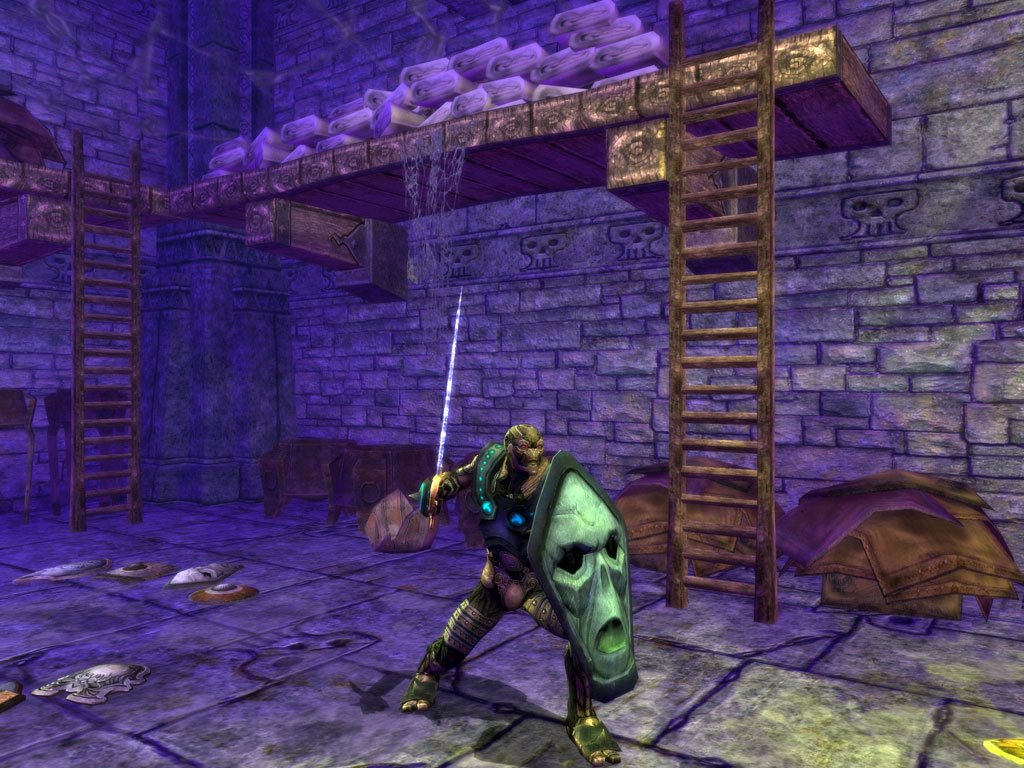
Combining roleplaying and player immersion has had a lively life in fiction, but it has also been becoming a reality with the creation of Massively Multiplayer Online Roleplaying Games. In these games, the players are able to actually see the world they are interacting with (rather than merely imagining as with table-top rpgs) and are able to design the appearance of their own avatar. Even the world's worst artist can have a great looking character thanks to skilled graphics programmers. MMORPGs make the mechanics of play largely transparent to the player which has the effect of minimizing, but not eliminating, metagaming. Metagaming is when players think of game effects in terms of mechanics rather than narrative. In a table-top session, metagaming can (but doesn't always) detract from the illusion many players attempt to create when playing rpgs. In other words, baring the invention of the holodeck (or interdimensional accidents like that in the D&D cartoon) MMORPGs are the closest thing to total immersion in existence today.

MMORPGs, in one form or another, have been in existance since around 1978, but those were text based affairs that didn't in anyway capture the modern gaming experience. Actually, saying they existed in 1978 is like comparing Hack to Baldur's Gate, but the early text based MUD's were multiplayer gaming experiments. The first modern total immersion style MMORPG was Meridian 59 in 1996. My own personal first experience was Ultima Online (1997), followed by Everquest (1999), Asheron's Call (1999), City of Heroes (2004), and World of Warcraft (late 2004, though I started in 2005). I just recently started playing Dungeons and Dragons Online.

Given that the first modern MMORPG was created in 1996, and that most MMORPGs are based on D&D style "generic" (as opposed to genera)fantasy worlds, what took the owners of the Dungeons and Dragons IP so long in entering the marketplace?

I can think of quite a few reasons actually.

First, in 1996 TSR --the company who created Dungeons and Dragons-- had ceased to make games of any sort and were on the verge of extinction. The company had tried to emulate the success of trading card games with its own collectible dice game. They over invested in that game while simultaneously branching into new areas in its tried and true RPG line. They overpublished Dragon Dice, and they overpublished new game worlds in 1995. The company was in the process of being purchased by another entity, Wizards of the Coast, and had little to no room to think about expanding into new markets.

Second, the "standard" computer RPGs for the D&D game were highly successful and set a very high standard of playability. If a D&D MMORPG were to come out, it would be instantly compared to the existing games based on the Baldur's Gate engine.

Third, as soon as Wizards purchased TSR they began planning for a new edition of the D&D game with new rules and character design innovations based on the past 20+ years of roleplaying "playtesting." If the D&D MMORPG wanted to emulate the experience, it would have to reflect these changes. Most players of a D&D MMORPG would want it to "feel" D&D and not like some random other MMORPG.

Fourth, the separation of player and Dungeon Master in the traditional rpg gaming format. Bioware's re-designed Neverwinter Nights was a genuine attempt to create computer based roleplaying where a dungeon master could design the adventures and the players could play them. It was, and is, an extraordinary game and for many makes the idea of an MMORPG unnecessary.

Fifth, game world. Which of D&D's many game worlds would be used in the creation of an MMORPG? Greyhawk? The Forgotten Realms? Mystara? Dark Sun? D&D has a lot of worlds and each has its own very devoted fans. Choose one world and you might lose potential clients who are fans of the others.

Sixth, the expectations for a game based on the original roleplaying game were huge. Whoever was to create the game would have to be willing to be under electron-microscope-like scrutiny. No matter what was made there would be detractors.


So...how did Turbine Entertainment do with their version of Dungeons and Dragons Online? For me, they did an almost perfect job. They captured the feel of D&D's newest game world, Eberron, combined it with a Player vs. Environment world which requires "adventuring parties" (groups of players) and doesn't require a large commitment of time to play.

Dungeons and Dragons Online, is just right for the casual MMORPG gamer like me. If you want to play your MMORPG and still have time to play pen and paper D&D on the weekends, it is certainly the game for you. The game, with minor exceptions, utilizes the mechanics of the Dungeons and Dragons game and integrates them into the MMORPG format with remarkable ease.

Which leads to my criticisms, or rather to the criticisms because none of these issues affect me as a player (well except one).

As the game currently stands a devoted player can finish all the dungeons and max out their character level in a relatively short time. Not me, I'm still Level 3 (rank 2), but the typical 1337 player who often plays MMORPGs won't be very satisfied and will quickly return to World of Warcraft. I see this as a good thing. I had "leet" power "doods" and prefer those who are there to have a good time.

The game is Player vs. Environment and lacks a Player vs. Player element. Many people enjoy PvP interaction in their massive multiplayer rpgs. They want to beat up on other people, defeating computer "bots" isn't sufficient for them. These gamers need MMORPGs to simulate the most dangerous game, killing real people. I tend not to like PvP players, finding that they are mean spirited and what they really want to do is be bullies to less experienced players. Traditionally, at least as Gygax and others present the game, the D&D game is players vs. environment with the DM as judge/narrator. Sometimes people viewed it as DM vs. Player, but that is short sighted and leads to unsatisfying gaming. Some players want "inter-party strife" and backstab for treasures etc. That tends to create short lived campaigns. Heroes battling evil, or villains conquering worlds, makes for good long term narrative and thus promotes campaign play. PvP elements tend to detract, in my opinion, from the overall enjoyment of an rpg. The day DDO goes PvP will be the day I unsubcribe.

The game doesn't perfectly reflect the rules of D&D. In DDO, there are spell points, 30 hit point first level characters, multiple ranks per level, and "free real-time" movement. If you want 5-foot steps and low hit points, this is not the game for you. The addition of multiple ranks per level comes with two key changes from the table top game. First, players essentially get one additional feat (ability) per rank (rather than once every 4 levels). Second, the current "10" level limit is in actuality closer to a 40 level limit in some respects. I understand that the emulation of D&D within the structure of a MMORPG requires some modification and these changes seem natural to me.

There is a great deal to praise about the Dungeons and Dragons Online MMORPG.

Graphically, it is beautiful. I love exploring new areas just to see what they look like. Turbine's game is more demanding in its hardware requirements than World of Warcraft, for good and for ill. By requiring more power, they were able to make the world look richer, but they also narrowed their audience to people with newer (meaning in the 21st century) computers.

The music and sound effects are great. My favorite adaptation/innovation is the incorporation of an omnicient DM voice when you enter some areas of dungeons. I was pleasantly surprised when I was informed that my ability to "Listen" revealed the sound of air passing beneath a wall. The DM voice narrates and describes dungeon environments and provides clues to players based on the skills they have selected. What this means is that the gaming experience is altered by your skill choices, cool innovation.

But when it comes to why I will continue playing DDO rather than other MMORPGs it's really very simple. When I sit down and play for a mere two-hours, I can accomplish an adventure and meet new people. In fact, I am required to interact with others. Recluses can have a heyday on World of Warcraft, but they would have a rough time on DDO. My only hope is that I start to find more people who want to play DDO in character.

If you are one of them Soulfinder Symbol is waiting to help you in your quest to fight the forces of the Dragon Below.

Tuesday, April 04, 2006

DVDs, The Future, and Kong

Bill Cunningham of DISContent works in the Direct to DVD industry and sees the future of the entertainment industry in the models being developed due to DVD sales. That is to say that he understands that there has been a sea change in the sources of filmmaking profits. The majority of profit, and revenue, comes from DVD sales. Bill, as he mentioned in his piece on Netflix, understands that DVD sales (like any other medium for entertainment delivery) are not the "future" of the film industry, they are the "now." The future will lie in an even more demand driven model. Whether that model will be On Demand, or another, remains to be seen. One thing is certain, the industry had better remain flexible. For the most part it has, but there are some dinosaurs who see projected celluloid (or digital images) as the only medium there is to watch movies.

Let's face it, I love going to the theater to catch movies on the big screen. I even believe that many movies are best seen in that environment. But I also believe that the best way to see La Boheme is in a theatre. That doesn't mean that it should, or rather will, be the primary means of distribution. Come on, are you really missing any of the subtleties of Herbie: Fully Loaded on your good sized television? And even if you have a film with subtle sound design like Kill Bill vol. 1 (vol. 2's sound isn't as "intentional" but that is another discussion), the film is still damn fine on the television. So long as you are watching movies in the proper aspect ratio, which varies from film to film, you aren't missing any of the director's vision and if you have a sophisticated sound system you are probably getting better sound at home than you would at the googleplex. Those Baby-Boomers don't want to shut up, if you know what I mean. For John Rogers over at Kung Fu Monkey it's the teens (BTW, it would cost almost $7.00/hr in CA not the $4.65 he proposes), but for me it has always been the Boomers.

"Honey? Why are their frogs raining from the sky? And what does that have to do with Exodus 8:2?"

For the record: "8:2 And if thou refuse to let [them] go, behold, I will smite all thy borders with frogs: "


Late last year, drudge and crew wanted to create a narrative wherein Kong was demonstrably a "flop." I responded fairly sternly. Well..it appears that not only was Kong not a flop in the theaters (its gross so far is $218 billion in the US and $544 billion total), it has apparently set a DVD sales record. Yet another sign that the now of visual entertainment is the DVD, and that market is largely about ownership not rental.

Monday, April 03, 2006

Opening Day

We have passed through the Void, largely unscathed, and reached the opening day of baseball.

We enter this year's season with hopes and worries. The World Baseball Classic gave us hope, hope that the game would expand to new markets, hope that a new era of international competition was beginning, and hope that American's could see how beautiful their national pastime is to watch.

The new book, Game of Shadows, with old allegations has us worried that people will let the sports writers create the narrative of the game. I'm not saying that steroids are not a serious issue for baseball, they are. But Game of Shadows is a re-presentation of the allegations, and evidence, which led Congress and the public to put pressure on baseball to have its current "3 strikes you're out" steroids policy. It seems small minded to me for the press to continue talking about the Bonds story as if it is new, rather than a continuation of an existing scandal.

Sports writers, contrary to the representation in Gehrig's speech in Pride of the Yankees, are the traditional "enemy" in baseball narratives. Think about The Natural (book and movie), Eight Men Out, The Southpaw, especially The Southpaw because there is no ambiguity regarding the protagonist's heroism. Remember that if sportswriters want to be more than presenters of statistics they have to find scandals or narratives of heroics. They need to tell stories in order to justify their existence. When few of the writers are talking about the amphetamine problems (""That's going to shake it up a little bit," Estrada said. "Amphetamines have been around since the days of Ty Cobb and Mickey Mantle. It was kept hush-hush and just accepted. Now that they're in the public eye, guys are getting criticized for taking them. I've heard guys say they'd retire if they can't take amphetamines. I don't know if they're joking or not.") of players, and focus on Steroids, they are overlooking the other problems of the game for the "crisis du'jour."

As anyone who studies baseball knows, cheating has always been a part of the game. It is baseball's dirty little secret. A-Rod "bumps" the first baseman, like Cobb used to "ram" the first basemen. Anyone who has read Old Time Baseball knows that a part of the great tradition of baseball is the correcting of past, less than moral, occurances.

Fritz once shared with me a funny bumper sticker regarding car racing, "There are two kinds of drivers...cheaters and losers." I think that the history of baseball is filled with this mentality. Even players who don't cheat won't hesitate to play as sneakily as the rules allow. The struggle of rules makers is to find the cheaters and punish them when they find them.

Let's enforce baseball's stricter new steroids policy. Let's not dwell in the past, recent or distant. Because, trust me, if you think there is some golden age when baseball was pure, I would be happy to talk with you about Mickey Mantle's bacterial infection and its causes or Joe D and his "wonderful treatment" of Marilyn Monroe.

Saturday, April 01, 2006

Introduction

Christian has done something many would consider insane -- he's graciously allowed me to post here at Cinerati. I'm very excited for the opportunity to share in the conversation about pop culture on this blog. For those of you who don't know me, I have my own blog called Shouting Into the Wind where I typically blog about TV, film and specifically screenwriting. I hope to post on these topics here at Cinerati as well as whatever else I dream up.

So thanks, Christian for the invitation. I hope I don't let you down.

A Million Little Panels

Baby- if you ever wondered
Wondered whatever became of J.C.-
I’m posting on the web on Cinerati
Cinerati- on your PC


James Frey...eat your heart out.
I’m glad to be a guest poster on Cinerati. I am a regular reader and fan so it’s an honor to be invited by Christian and Company to share some thoughts with you. And now my childhood plan to memorize the WKRP theme song has finally paid off- in spades. As you may or may not know, you can usually find me over at The Shelf along with fellow cynic at large and all around jovial guy, Wolf Flywheel. However, I thought that my message that I had today was important to share wherever I can. You see, I used to have a problem. A serious problem, in fact. A problem that took so much of my time and money. I am proud to say that I am well on the road to recovery. That is why I’m sharing this with you, in hopes that I can reach someone else out there who knows of what I speak. Yes, my friends I am a recovering comic book collector.

Confessions...
Don’t laugh. Don’t judge. You may look at me and mock - but you do not understand. Have you ever been standing by a section of comics, knowing full well that the money you’ve saved could go to so many other worthwhile, important things? Charity, helping the homeless, animal shelters, bills, food, gas... well you get the idea. You stand there, guilty as hell, but you’ve just got to have issue #294- because it all leads up to the Ultimate Crisis Crossover Infinite Megawar limited series that you’ve already preordered. Besides- this issue has the brand new costume. You buy it, avoiding the gaze of the cashier at the bookstore or megastore. Hopefully she doesn’t recognize you from school. Darn your stupidity- your irrational judgement! Yes you should have gone to the comics store- but they sold out a week before release. And you just had to have it. You just had to!

Oh it started simply enough. My dad would buy me the occasional Disney Comic. Harmless right? Junior Woodchucks and the like. Little did he know that Uncle Scrooge was a gateway comic. Soon I was experimenting with the Whitman 3-pack. Three comics in one plastic bag- who could resist? Before you know it, I’m standing next to the comics rack at the convenience store trying to figure out how I can score both a pack of Sweetarts and the new issues of the X-men and Spider-man. It wasn’t long before I was into the hard stuff. Limited Series, Annual issues, Crossover series, and even the occasional preorder. I wasn’t hanging out at the grocery store either. I was at the comic shop watching some greasy, overweight, bearded asthmatic putting my weekly fix in a bag and telling me how if I haven’t read the black and white indie comics I haven’t READ comics. I remember telling myself- I can stop. I’m not going to be that guy. I’m normal... I’ve got a girlfriend, I go to school- I don’t have a problem. Then it happened. I went home and read through my whole new score in a measly afternoon and was already wondering where I was going to get my next fix. Heck, that guy mentioned the black and white indies. I could try those - or maybe even a graphic novel. Yeah, that's it. I'll just try to find some loose change. Oh maybe I could sell something. Then I realized... oh god, I am that guy. Excuse me while I look on you disdainfully and laugh haughtily behind your back.

Realization and Recovery...

I had to stop and think - maybe I do have a problem. What had happened to me. Where did the fun go and become replaced with obsession? That was it. It wasn't fun anymore. It was a necessity. I couldn't fall behind. If I missed just one issue, I... I... I shuddered to consider the implications. And what’s worse- the comics themselves just weren’t the same anymore. I didn’t even really read them to enjoy them. I had to have them, because I had to keep up- I had to know what was going on. Little had I noticed that they were more expensive, and while I had to keep up with the storyline, the comics companies themselves had given up on the storyline a long time ago. In fact, I couldn’t count the different origin stories anymore. Or the new costumes, or who was allied with who, who ticked off who, or even who was now a hero and who was a villain. The comics had abandoned me... that little kid who years ago couldn’t wait to go to the grocery store to pick up a great story about their favorite hero. The comics companies made it too hard to even enjoy them anymore- but I was hooked. I knew what I had to do... I had to go cold turkey.

I declared my independence from comics collecting. I left the country for a while, helping other people. That is perhaps the indication that you are on the road to recovery. I fought hard. I occasionaly stepped it down a notch by reading a three panel comic... like a patch. Oh sure, I felt the occasional pang for a full color giant size issue, but I fought it by remembering that ultimately that road lead to disappointment. Those comics weren’t the comics I wanted. Those were gone- replaced by expensive, audience targeted, marketing ready product. Not the joyful art I missed. Ironically, I was the very target audience that the comics sought, the 18-30 year old male. But they lost me because they abandoned the key demographic that kept them alive for so long: the kid. Because they left the kid behind, they lost their innocence and it was a way out.

After I came back into the country, I got a job and went to college. I got married and had kids. I graduated with honors and became a useful member of society. I beat the problem. And you can to. Just have the courage to look at your problem and realize what it has become. Don’t let it beat you. Take it one day at a time. Everyday I tell myself, I am a recovering comic collector. I’m good enough, I’m smart enough, and dog-gone it people like me. I realized that my life is full and there are so many things out there to enjoy... and I know you can do it also.

Thanks for listening, and please take my story to heart and learn from it. I must go now, my son has just gotten into my mylar bags in the garage. I need to make sure he doesn’t mess with that issue where Spider-man gets the black suit. I need that one for the movie.

J.C. Loophole

J.C. Loophole is one of the creators of The Shelf. He takes full responsibility for all comments made here, although any complaints must be directed elsewhere... possibly to an email account that will lead nowhere and to a dummy corporation that will not respond to any inquires and will ultimately shield J.C. Loophole from all lawsuits. Any requests to appear on Larry King Live, Letterman, or any other talk show, or any request for book contracts may be directed to The Shelf. Please understand that due to the current nature of publishing memiors that the author's tongue may have been firmly planted in cheek. PS- Oprah, call me.

Thursday, March 30, 2006

Why Entry Level Gaming Industry Jobs Aren't Wise in Southern California

I love playing games. All kinds of games. Boardgames, roleplaying games, computer games, you name it. If I had infinite time and no responsibilities, I would become a professional game player. Not a professional game "winner," more likely a professional game loser, but I would have a great time.

I also like to tinker with game rules and game master a Savage Worlds or D&D 3.5 game every now and again. So naturally, I have grandiose dreams of becoming a hugely successful, and lavishly wealthy, game designer like Matt Forbeck or Chris Pramas.

This is why I like to look to see when new entry level jobs are available in the gaming industry, especially from companies I like. One such company, Fantasy Flight Games, is apparently growing at a good pace given that they seem to be continually on the lookout for new employees. This is amazing, especially given the current soft-ness of the gaming marketplace. It is not so amazing when you look at the quality of Fantasy Flight's games, which are very high indeed. No fewer than three of the boardgames I play most frequently were produced by FFG.

But given the fact that according to USC's Lusk Center, "Rent increases of six to seven percent can be expected in Los Angeles where the average monthly rent at the end of last year was $1,416," I don't think I will be able to work for the $10/hr that FFG pays its entry level employees. To be fair, the job is in Minnesota where rent is much cheaper. It is also true a friend of mine is looking for an assistant in a similar (i.e. Marketing) position and is paying a similar wage (in Los Angeles). As an entry level job, the wages aren't bad, but they aren't going to support my family.

To be honest, the more I look at how much the people who work making the games I enjoy earn, the more it makes me want to win the lottery to start a high paying game company. The people who work in the industry are brave indeed, and the freelance ones are definitely living "without a net." Especially when you have a very successful product and never see a dime because your fulfillment house goes bankrupt. I can't even imagine how much elbow grease and work ethic it takes to be able to pay the bills, by selling new products, that it takes in that situation.

To put $1,416 a month in perspective, for those who don't live in SoCal. It's essentially a mortgage payment on a $250,000 home. Like those exist in SoCal!

What $250,000 gets you in Inglewood. One bedroom condos and Inglewood isn't known as the safest place in the world.

What $200,000 gets you in Minneapolis
. I don't know if the area is safe, but the picture sure looks nice.


Needless to say, if you want to be a game designer in SoCal, you better have a day job.

Cooking Up a Winner?

I expected to hate Bravo's new series Top Chef. I have avoided watching episodes of the show for weeks. I was a pretty big fan of Hell's Kitchen, which I discovered thanks to Fritz, and I just didn't think a new show could measure up to Chef Ramsay.

My objection to watching the show were overthrown the other day by two clips from a promo for the show. The first was listening to the chef's complain about having to make dishes from food purchased at a mini-market. This was immediately followed by Top Chef's top chef, Tom Colicchio, saying that he wished the rules allowed him to fire "two...no all three of you." I immediately knew I had to give this show a try. Besides, it was a Bravo show. They were responsible for Blow Out, another show I enjoy when I am feeling ornery.

Top Chef follows a tried and true formula for reality television. First you have an "immunity" competition, followed by an elimination competition, ending with the board room interview. This is the Apprentice/Endurance model and creates a natural narrative structure with minimal need for "editorial creativity" to increase tension. The challenges, like the mini-mart grocery hunt, are sometimes silly, but they highlight the creativity and talent of the chefs. In fact, that is where this show truly shines. I actually believe that the contestants on this show are all competent cooks. That wasn't true on Hell's Kitchen which seemed more about turning people into good chefs by putting them through cooking boot camp.

Every week, on Top Chef, the winning recipe from the elimination challenge is featured on the website allowing for additional audience participation. This is something that was lacking on Ramsay's show. In fact, I can't really recall much about many of the contestents on Kitchen other than the fact that they all smoked like chimneys.

Hell's Kitchen was about how well the contestants could handle the stress of running a high-end kitchen. Top Chef combines the stress of providing and presenting food. The chef's are expected to be more than cooks, but personalities as well. After all, if you want to be a "famous chef" your personality is almost as important as your other talents.

The prize competed for is another major difference between HK and Chef. Chef Ramsay was supposed to provide the winning chef on HK with their own restaurant, but when Chef Michael won he was offered a job at one of Ramsay's existing restaurants. This is a significant offer, but is more along the lines of Trump's Apprentice than the initially advertised prize. Top Chef, on the other hand, offers a three prong prize. First, the contestant will be featured in Food and Wine Magazine and be a featured chef at Aspen's Food & Wine classic. Second, they will receive a full line of Kenwood appliances for a restaurant kitchen. Finally, they will receive $100,000 to assist in their culinary career, a nice down payment on a loan to start a business if you ask me.

Structurally, I think Chef is what I wished Kitchen would be. The lack of a strong personality like Ramsay is a drawback, but overall I think Chef is a better show. I have already begun developing favorites and foes.

Wednesday, March 29, 2006

Invitation to Bloggers

When I first envisioned Cinerati, I desired a blog with several members who discussed popular culture. Currently, we have three regular posters from our list of "columnists."

I want more.

So if you are interested in blogging about the topics we like, even if we don't blog about them enough, and you want to be a "cinerati-ite," let me know and I'll ship you an invite via email.

Live the Dream or Merely Dream

For the past two days this blog has idled in its subject matter, all the posts have been about Bones, that will not be the case today. Instead, I think that I would like to begin a discussion on a theme which will continue for the remainder of the week. Certainly, it will be the focus of my post today. That subject is the disconnect between "Living the Dream" and "Merely Dreaming."

What do I mean by "Living the Dream?" As you might have guessed, it deals with having a job in some creative/entertainment field. A professional baseball player, minor league on up, is living the sporting dream. The struggling rock band playing at a local dive bar is living the rock and roll dream. The author who slavishly writes stories and books with the hopes that they will sell, is living the literary dream. You get the picture. Naturally, in all of these cases the more successful the person is in their professional field the more of the dream they are living. But what I mean by living the dream is the actual taking of the risks and making of effort to actually attempt to succeed at a desired entertainment profession.

This is opposed to "Merely Dreaming." A mere dreamer is the person who goes to batting cages, buys baseball cards, and carefully monitors his Orosco Number, but who never even tries out for independant baseball. It is the girl who sings in the shower knowing that a famous record producer is going to call and she doesn't have to put in any effort. It is the "idea man" who has hundreds of great story ideas that he never shares with anyone or bothers to jot down on paper. The "mere dreamer" is the person who expects to be discovered and handed the dream, but who doesn't put in any effort.

This may all sound very hard on the dreamer. After all, it is important for all of us to be able to fantasize about being a professional athlete, rockstar, or writer. Fantasies help us deal with the stress of our day to day lives. That is not the kind of mere dreamer to whom I am referring, that would describe everyone. I am pointing out the person who knows they "deserve" to be a superstar.

There are also those who want to succeed, and don't know how. There are those who find the prospect of trying daunting or even frightening. Where do they fit in? They aren't "living the dream," but they aren't "merely dreamers." They are in a kind of goal limbo. An acquaintance and I were having a discussion about life and I asked her what her brother was currently doing.

Since I work for a non-profit devoted to youth civic engagement, I often find myself talking with young adults just deciding their potential careers. I also am presumptuous and typically decide to give my own, obviously invaluable and correct, advice on "how to succeeed."

My acquaintance told me that her brother wanted to do computer graphics work on video games or become a professional, but that he was currently not studying it in school or anything. I responded with my typical two-fold answer. First, college isn't necessary for every occupation particularly artistically oriented ones. Sure it can be helpful in programming etc., but a real "computer genius" could be self-taught. Second, that too many young people think they have to hurry into life and often rush into bad decisions.

Lord knows, I did. I spent 3+ years as a 21/Craps dealer, not going to school, because I thought it would be a good paying career choice. It can be, but it was misery for me. In fact, I was a "mere dreamer" when it came to being a college student for a time. I claimed to be a student when I hadn't been for a couple of years. I was dreaming, but not making effort to return to school.

The young woman followed up my responses with a very simple statement. "Well, actually, he just spends a lot of time playing World of Warcraft, and he doesn't even draw anymore." Boom! Instant "mere dreamer," right?

Not so fast. Given her brother's youth, he is twenty, there is hope for the young man yet. Sometimes there is a tendency to make even slight obstacles seem epic. When I dropped out of college for four years, returning to school seemed an absolute impossibility. So I didn't even try for a few years. It wasn't until I met the woman who is now my wife that I was able to see how easy it was to get back into school. We weren't dating at the time, we were just friends, but she was a subtle inspiration and constant reminder of possibility.

So I gave my third piece of advice, this for my acquaintance. Don't worry. Be supportive and discuss realistic ways to a career path. When one only looks at the end goal, in this case being the person who designs the next World of Warcraft equivalent success, it seems impossible and is hugely demoralizing to the beginner. Instead, I offered, talk to him about his drawings. See if he is interested in cartooning. If he still is have him draw some single panel jokes based on op-eds written in small local papers. When he gets about thirty, have him send them in to those same local papers asking if they need a cartoonist or illustrator. It won't pay a lot, but it will build a resume and give good experience. Of course, then he will also be..."living the dream!"

I should offer that the advice I gave is basically a description of how John Kovalic and Patrick McDonell, among others, got their start.

But that's not where my advice comes from, no it comes from watching my wife. You see, one of the things that was so inspiring about her was that she was able to live off of money she was being paid as an illustrator for two local papers and the university newspaper. She wasn't making much money at all, but she was making just enough to live with 3 roommates as long as her scholarships kept paying for school. She wrote a romance novel as her Master's thesis, and directed a neat 8 minute romantic comedy as her MFA thesis for film school. My wife is "living the dream." It is a true inspiration to watch and it started with very small steps.

Tuesday, March 28, 2006

Chewing on Old Bones

I know I just posted some reasons why I like Bones, Fox Network's semi-procedural, but I have to be completely honest and admit that I went into viewing the first episode with a very positive "pro-Bones bias. Was it because I was an Angel and Buffy fan? Sure, but it was more than that.


David Boreanaz answers a fan's question at the 2005 San Diego Comic Con


At last year's San Diego Comic Con, Fox did a presentation on the show where they screened the entire Pilot and provided David Boreanaz and Emily Deschanel as panelists to discuss the show. In retrospect, I wish that they had included Micheala Conlin and some of the other cast members as well, but Emily and David were the only cast members most people would recognize. I say that realizing that my own remembered experience of Emily had been in the movie Boogeyman, and that in all honesty not many people other than those who saw Boogeyman three or more times would recognize her. Point of fact, during the panel discussion all the questions were directed at David Boreanaz.

It was an excellent panel and David was the perfect "fanboy/girl" interviewee. Emily and David were on time. David answered every question, no matter how silly with seriousness, candor, and humor. He was also gentleman enough to make sure that Emily, who was being ignored by the audience (for the most part), was included in the discussion. He spent time using his own "clout" to promote the relative newcomer to the "Whedonfanverse."


Emily Deschanel is baffled by just how specific "Whedonfans" knowledge of David Boreanaz is.


BTW, if you want a preview of the television shows coming out in the next season are, at least those that might be of interest to comic fans, the San Diego Comic Con has some of the best pre-season panels/presentations around. If The Inside hadn't been cancelled, I also would have attended a panel with Tim Minear.

Monday, March 27, 2006

Bones to Pick

Friday, Shouting at the Wind linked an article at the Hollywood Reporter confirming that Bones had been picked up for a second season. In her post, Shawna Benson (the author of Shouting), added the descriptive "against all reasonable thought" to the news of the shows renewal. I was surprised, not disappointed, at the comment because my wife and I are regular Bones watchers.

[BTW, being disappointed because someone disagrees with your taste in film/tv is ridiculous. Entertainment is one of those cases where friendly disagreement easily accomodated.]

For those of you who don't watch a lot of TV or who might not know what I am writing about, Bones is a one-hour semi-procedural on Fox. The show is loosely based on the very procedural Temperance Brennan novels by Kathy Reichs. The novels are often gruesome and let you see more into the mind of Tempe Brennan than any television or film can accomplish (as an aside The Weather Man with Nicholas Cage did a pretty good job of getting into the head of the character, just the right amount of voice over).

I flippantly asked Shawna if she was not a big David Boreanaz fan and she responded in a very friendly fashion that she wanted to like the show, had watched the first three episodes, and had returned for the Adam Baldwin episode. Here answer told me two things. First, yes she is a David Boreanaz fan and second that she is a Joss Whedon fan. (Elementary my dear Watson!) So her disappointment lies elsewhere. In fact, according to her statement "[she] just found the whole thing predictable and though some of the dialogue is better than it used to be, they seriously need to staff some better writers."

This got me thinking. I took her comment about predictability very seriously and I agree the show is very predictable, but I find most shows to be. Take your average 1 hour drama, say last week's Smallville.

First we have the set-up or introduction, setting the stakes if you will.

Clark reveals his secret to Lana and asks her to marry him. Clark's father is finding out the results of his election bid. And the season stake is that we know someone close to Clark must die.


Second at minute 20 (usually spot on, maybe one or two minutes off depending on commercial selection), we have the moment the stakes are raised.

Clark's father wins the election. Lana goes to see Lex, gets upset, leaves and dies in car accident. After a commercial break, Clark decides to "change the result" and is notified that while he can change the past that fate will make up for the difference.


At the 40 minute mark (give or take a few seconds) the hero will suffer a major crisis. In a movie, this will be the point the hero struggles back from to save the day, in a serial TV show it may just be a character developing loss.

Clark has saved Lana, but their relationship is over forever and right at minute 40...Clark's father dies of a heart attack.


From here the story gets resolved.

Clark tells his mother everything (off camera) and his mother doesn't blame him, but it has obviously affected their closeness. Lana "supports" Clark, but abandons him. Chloe loves Clark, but can't be too close because Clark loves Lana. Lex looks on from afar. Clark is more alone than ever and more than ever needs human connection. Sets the stakes for the whole season. BTW, serial TV also has a "season" structure similar to the episode structure, and a series structure, etc. So...you might guess that before the show ends that Chloe is likely not long for the world. Why? Well, she knows Clark's secret, she is Lois' cousin, and she doesn't exist in Superman's "adult" life. Hmm...


This is a long way of saying that all narrative has a certain level of predictability. In fact, I often find myself looking at the clock during episodes of television programs. That said, it doesn't mean that Shawna is wrong. This is because Bones is a semi-procedural and thus doesn't always reveal the killer until the 40 minute mark. In fact, if it is well written it should have one or two very plausible red herrings to throw the audience off course. The question, should be (as I am interpreting Shawna's meaning), "Who did it and how?" If the answer is too obvious in the procedural then why watch the show?

It's a good question and one that I have an answer for, but it may not satisfy Shawna. I think the answer lies in the nature of the show. Bones, as I have written, is a "semi-procedural." By which I meant that it appears to be a procedural, but in reality is a romantic drama like Smallville, but instead of having superpowers Tempe Brennan has near infinite analytical skills, a superartist, super-biology geek, combat guru, and...okay they might as well be superpowers. For me, Bones is more Doc Savage than CSI, thus it is the character interactions that are most important. I like the banter and the little insights I get into the characters.

For example, during the episode where Tempe and crew solve a murder in the tunnel system under D.C., we encounter a mentally shattered veteran who asks Booth (Boreanaz) sarcastically, "Are you trying to tell me you know what I've been through?" Booth's answer immediately lets the character know that he really does have an understanding and had similar experiences. In fact, one thing the audience has learned over the course of the show is that Booth has done some horrible things. We just don't know what they are. In many ways, Booth is similar to Angel (another Boreanaz character). Except, where Angel was forced by a curse to do horrible things, it is the very sense of duty/nobility in Booth, the thing the audience most likes about him, that allowed him to do those things.

I have to admit that the surprise factor is a difficult challange for "mysteries" to maintain or achieve. That is probably why my favorite show in the genre gave up the ghost at the beginning of each story. Columbo always began with the audience watching the murder, we know all the facts. It was in watching Columbo unravel those facts that the audience was entertained. I look at Bones the same way, even though the murder and results are supposed to be "discovered."

Maybe Bones would be better if the format followed the Columbo format, but as for the dialogue I think it is some of the best on television.

Booth:"So it was the Spelunker, in the Steam Tunnel, with a Climbing Pick?"

Brennan:"I don't get it."


Oh, and I like that the show ends with the ultra-traditional (think Wild Wild West and Star Trek etc.) "group laugh" at the end of the show.

Friday, March 24, 2006

When in Need of Discipline and Learning...

Don't forget the wisdom of Tae Kwan Leap!

Time has no meaning...to a true student a year may be as a day1

Palm Springs' M Modern Gallery to Put Future on Display

For many in my generation, no name is associated with visions of the future than Syd Mead. His visionary design work can be seen on Blade Runner, Tron, Aliens, Star Trek: The Motion Picture (the slo-motion picture), 2010, and Strange Days. From the fantastically futuristic to the plausible, Syd Mead's artistic interpretations of the future are what I see when I imagine the world of tommorrow.

Palm Springs M Modern Gallery will have sketches spanning the past 50 years of Mead's imagination. Some of the work will be utopian and others dystopic, but I think one thing can be said for certain...it will be a sight to see.

When I think of fantasy, the first name that comes to mind is Harryhausen, but when I think the future I think Mead.

Random Thoughts From Random Blogs

This makes me think face masks might not be such a bad idea in Amateur Soccer.

Some Soccer players might be playing too much Tekken. Boot to the head!

Realizing that one of this woman's favorite movies is Conan the Barbarian makes me want to say "Ia, Ia, Cthulhu ftaghn!" Contemplate this on the Tree of Woe.

An excerpt from the Book of Eibon. Actually this is the first blog that reads like one of those random word spam emails.

Thursday, March 23, 2006

Stick Figure Theatre: Jet Li Distributes Justice

Sometimes I just love the interwebonetosphere beyond belief. A couple of years ago the PS2 came out with a video game (Rise to Honor) which used motion capture technology on Jet Li and allowed gamers everywhere to put the beat down on baddies like they were Wong Fei Hung. In fact, you can replay the game in Fong Sai Yuk/Wong Fei Hung garb. While I was "slicing" the interwebonetosphere today, I came upon something that would make any fan of Jet Li, The Order of the Stick, and Rolling Thunder (available on Namco Museum) jump for joy.

Without further ado...here is Flash Stick Fight! But it's totally Jet Li, you can tell by the open hand strikes and the "no shadow kick!"


The full series can ne seen at Stick Figure Death Theatre, just click on the image below.

Shatner Sings is Passe? What About Nimoy?!

For those of you who think that William Shatner was the only Star Trek star to sing tunes, here is a clip of Leonard Nimoy singing about Bilbo Baggins in Vulcan wig and all.

The amount of geekdom in this video is immeasurable. This is like crack for gamers.

Wednesday, March 22, 2006

Birthday Shatnerica

Whew! I came in under the wire! As all true William Shatner fans know, today is the birthday of the third most popular imaginary friend in the world. Happy Birthday Bill!

For your viewing pleasure here are some amusing Shatner vids.


And one of the greatest weapons in the TV Cop's arsenal.

Christian and Marriage

In the comments to my post regarding the Coulbert Report Dungeons and Dragons Online segment, I stated something along the lines of, "Tenser is actually a member of the Circle of Eight and not the Circle of Light so Stephen ought read that teleprompter a little more closely when pretending to have been a D&D geek." This, plus what I wrote in the actual post, prompted LYT to ask:

No offense, CJ, but...how the hell did you ever get married?

seriously. i could use that knowledge.


The answer is pretty simple, I adore my wife much like J.C. Loophole does his. But I guess that only answers how I stay married, I am after all approaching my 9th Anniversary (May 18th) for those who wonder.

The answer to how I got enough women to date me to find my perfect match, well that's a little more complicated but still easily enough done.

First, I have had a secret identity. Prior to the internetowebosphere, I had no "public" forum where women could find out my dirty little geeky secrets.

Second, I am a nice guy who has a sense of humor. I tend to make women laugh. I am no Lewis Fein when it comes to comedy, but then who is?

Third, I listen. Maybe this is the most important trait. This may have developed as a subset of my secret identity. After all, if you want to hide your comic collecting, action figure owning, roleplaying game addiction, this is much easier when you spend most of the time listening. That doesn't mean I always listen to other people, I am after all quite chatty. But I certainly spent a lot of time listening to the women I dated. It helps you find common interests and things that might make people laugh. Be attentive of other's interests.

Fourth, I actually asked women to go out. As Charlie, on Two and a Half Men keeps trying to show his brother, volume matters. Sure you will be refused dates by hundreds of women, but you will have some great dates as well.

Fifth, gradually reveal your geekdom. It lets women think they are being shown the "real you" and adds an illusion of depth. Trust me, that requires a big illusion in my case. I am open about my geekdom and hobbies now, but I have been married for almost 9 years so it's easy.

Sixth, have women friends who have similar interests. My wife isn't a gamer, but she is a talented cartoonist who liked the comic timing of Keith Giffen's Justice League when I revealed my comic fandom to her. In fact, I read these to her in bed. If John Rogers, the Kung Fu Monkey, reads this I hope he passes it along that Mr. Giffen helped provide the foundation for a healthy marriage. If he asks, we modeled ourselves after Booster and Beetle not Ice and Guy.

Seventh, my secret identity was the real me, just minus the D&D and comics. So when women were given the real me it wasn't a betrayal.

Really my advice comes down to the following. Be kind, honest, caring, and brave. If you want you can be:

* Trustworthy,
* Loyal,
* Helpful,
* Friendly,
* Courteous,
* Kind,
* Obedient,
* Cheerful,
* Thrifty,
* Brave,
* Clean,
* and Reverent.

As an aside... When I was younger, and still today, my hobbies were just that...hobbies. In High School, I only played computer games and roleplaying games in the Summer. During the year, I had Baseball, Soccer, Wrestling, and Speech/Debate to do. I was never one of the "popular" kids, but I wasn't Duckie either. I was more like Ethan Embry in Can't Hardly Wait.

Own a Piece of Christian's Library #2

It looks like David Scott will be getting The Annotated Lovecraft. Sorry Jay, but he was first. Don't worry though, I will be sending you a copy too as (appropriately for you) an Easter gift.

Today I will be making available two offerings, though I ask that David and Julie give some other people a chance on this one. I will make it a rule that contestants can only win with lightning speed bids once per week. David's post was almost instantly after I posted the article. I figure that's unfair to our reader in Kuala Lumpur or to the myriad readers who come merely to look at the South Park Version of Me (minimum 5 hits a day).

So today's offerings are:

1.A Grief Observed by C.S. Lewis. This book is a published version of the journal Lewis wrote in response to the death of Joy Davidman. Someone recently gave me a copy to read, not knowing that I already have a well loved one at home, so the edition offered is "uncracked." This is the Bantam Paperback version. It's a quick read, the Lewis section is only 89 pages, and is well worth the time.

2. Triplanetary and First Lensman by E.E. "Doc" Smith. These are the first two volumes in the famous, maybe even quintessential, Lensman "Space Opera" series. Anyone who is a big Star Wars fan should read these. That goes double for anyone who is a fan of Hal Jordan as Green Lantern. The Silver Age GL tales are very much inspired by the "Men of the Lens." The first 80 pages or so of Triplanetary are a little dull because they set the background/history for the series, but once you get past this point the series gets more action packed. If you are a Savage Worlds fan, this is a setting dying to be "savaged" and Triplanetary has almost all the information you need. Triplanetary is a 75 cent Pyramid Books edition, read but well taken care of, printed in 1970. First Lensman is $2.50 Berkeley edition printed in 1982. Both have mild yellowing, but no chipping. I have recently acquired Old Earth Books editions of the series and these need to move.

Tuesday, March 21, 2006

Own a Piece of Christian Johnson's Library -- Free Lovecraft Book

In a Cinerati first, I am going to offer free of charge to our blog fans a piece of Christian Johnson's library. From time to time I will be offering, free of charge, to Cinerati readers -- on a first come first serve basis -- overstock from my book collection. As many of you know, I read a lot of books. Some good...some bad. But reading a lot of books also means that I accumulate a lot of books. Sure I am donating some to my local library, but I would also like to share a limited few with people who I have tangential connections to.

So without further ado, the first book to be offered on Cinerati is The Annotated Lovecraft. I have two copies of this book and one of them needs to go.

The Annotated Lovecraft is a collection of some of H.P. Lovecraft's most famous tales edited by Lovecraft scholar S.T. Joshi. The book contains useful and enlightening annotations and benefits from Joshi's love of the material. Joshi's hard work in promoting scholarly research and weird writing is something that I deepley appreciate, but his disdain for the "Cthulhu Mythos" phenomenon is one that I take issue with. To quote:

Nor need we rehash the sorry story of the "Cthulhu Mythos," which (thanks largely to Derleth's rabid enthusiasm) took on a life of its own...


Joshi's own atheism, he has written books on the subject, seems to have made him overlook certain influences into Lovecraft's mythology. This is not to say that atheism isn't the best lens to look at Lovecraft, it is, rather that Joshi's particular atheism has made him overlook certain aspects in the fiction. Chief is the influence that Lucretius and the Epicurians had upon Lovecraft's mythos. As Bertrand Russell points out in his "Has Religion Made Useful Contributions to Civilization?," Lucretian Epicurianism is no friend to religion, but Epicurianism does have a kind of representation of the gods.

Epicurian "gods" are described as living inter mundia (in the spaces between universes) and Lovecraft and his friends often describe the "Mythos" characters as living "in the spaces between the stars." Not to mention the underlying elemental nature of Epicurian "theology" as witnessed in Lucretius' "De Rerum Natura." Derleth got his concept of the elemental nature of the "gods" from somewhere, but Derleth (like Joshi ignores the elemental connection) ignored the lesson from "Mountains of Madness" that the gods aren't really gods.

All of this is neither hear nor there for the collection, which is wonderful, or for Joshi's contribution, which is significant.

This volume includes the following stories:

Rats in the Walls -- Lovecraft's most Poe-esque piece (other than "The Stranger")
The Colour out of Space
The Dunwich Horror
At the Mountains of Madness
and his essay on Weird Fiction.

If you want it, just leave a comment and email me where to ship it. If you want to reimburse me shipping that's fine, but not necessary. I might, just might, request that you post about the book.

The Coulbert Report on D&D Online

Thanks to Matt Forbeck for pointing this one out.


Now for a brief cheat sheet to some, but nowhere near all, the jokes.

GenCon is the largest gaming convention in the country.

Len Lakofka wrote two of the early Dungeons and Dragons modules Secret of Bone Hill and Assassin's Knot. These adventures were known as the Lendore Isle series because of their location on the Lendore Isles on the World of Greyhawk. Assassin's Knot was one of the modules that first introduced me to true city based gaming and was innovative for its abandonment of the traditional "dungeon crawl" motif. These modules marked the first time that modules began to simulate narratives rather than tactical wargames.

All Paladins have to be Lawful Good.

There is no "Save vs. Psionic Attack." The appropriate save would be "Save vs. Spells" or "Rods, Staves, or Spells" depending on whether he was playing Basic or Advanced Dungeons and Dragons.
[Edit: After looking through my 1st edition DMG, I must correct myself. There is indeed a save vs. "Psionic Blast" for non-psionics. The implication then is that Coulbert's Paladin was a non-psionic character. Naturally this is a testimony to his honesty, and fairness, as a player. After all if your 21st level Paladin is non-psionic you can't be a munchkin.]

The idea that a "Cure Light Wounds" spell would be used on a 21st level Paladin is itself funny.

Tenser is a powerful mage in the World of Greyhawk.

The Sheldomar Valley is on the World of Greyhawk.

Displacer Beasts, Mind Flayers, and Beholders are creatures unique to the Dungeons and Dragons game.

By Stephen's difficulty pronouncing the names and places, it is likely his writers didn't go to "Exorcism Summer Camp" or find girlfriends.

Lagunies: The Real Newpsies

Following in the footsteps of MTV the Bravo (an NBC Universal Company) network will be premiering its new series The Real Housewives of Orange County tonight at 10pm. The Washington Post article by Tom Shayles makes it clear that the title is meant to appeal to fans of the ABC show Desperate Housewives, but his description of show content makes it sound more like Laguna Beach. To quote a description of an episode:
To give you an idea of the style of living: A teenage boy is given a new Mercedes-Benz as a present from his parents, but when his friends claim that the model is a "girls' Mercedes," the boy complains and is promptly given a new one, a different model. The original car goes to his 16-year-old sister.


That sounds more like one of the storylines on Laguna Beach than on Desperate Housewives, though to be honest most Laguna stories aren't much like The OC either. The OC focuses on people who feel "out of place" in Orange County and Laguna Beach focuses on "real" versions of the people who make Ryan, Seth, Marissa, and Summer feel out of place. In The OC the "Newpsies" (definition: McMansion Divas) are characters on the edges of the storylines who are antagonistic toward the central characters. In other words, the "newpsies" are stereotypes used to show that the central characters play against type. It looks like Real Housewives has decided to further ingrain that stereotype in our minds.

So I just have one question. Would you rather hang out with Kimberly Bryant or Julie Cooper?

By Dave Bjerke -- Bravo


For my money, I'll take Julie Cooper. Primarily because she even looks hot as an undead punk rock zombie.


Fans of "The O.C." know fully well the show's meta-cognative qualities. Summer, played by the beautiful Rachel Bilson, watches both The Valley (an evening soap like The OC and Sherman Oaks: The Real Valley. So it is only a matter of time before we hear mention of Lagunies: The Real Newpsies on the show. I am sure this will immediately be followed by Seth screaming, "Hey you guys!" when the show is on. (That's a Goonies reference, if you didn't get it.)

BTW, Rachel Bilson has been slowly but surely working her way up the charts toward actress I have the biggest crush on. Currently, Renee Zellweger is in first place, but that Summer as Wonder Woman image from Season 1 keeps coming back.

Monday, March 20, 2006

Origin Award Nominees Announced

Every year the Academy of Adventure Gaming Arts and Design of the Game Manufacturers Association announce the nominations for the "Origin Awards" or the American Gaming Oscars. Thanks to Matt Forbeck's site, I am able to list the nominees. But to be fair to Matt I will only post the categories I have something to say about, and I will post comments as well. If you want a complete list go to Matt's site.


Nominees for Board Game or Board Game Expansion of the Year: (Board Game College)
Amazonas by Mayfair Games, Inc.
Parthenon: Rise of the Aegean by Z-Man Games, Inc.
Rheinlander by Face 2 Face Games, Inc.
Shadows over Camelot by Days of Wonder
Vegas Showdown by Avalon Hill


Of these games, I own Vegas Showdown and Shadows over Camelot and I have to be honest that I do wish I owned the others. But finances and time are limited and so must my choices be. Of the two I own, I am particularly fond of the Camelot game. I like collaborative games and this is a good collaborative game. The added effect of the possibility that one of the knights working to save Camelot may indeed be a traitor adds some nice depth.

Vegas Showdown was a pleasantly surprising game. Players pretend they are Steve Wynn and try to become casino moguls, not at all what I expected by the title. The components, like much of Avalon Hill these days, don't keep pace with other company's offerings, but the design and playability make up for it.

Disappointments: Where is World of Warcraft?

My Vote: Shadows over Camelot.

Nominees for Traditional Card Game or Expansion of the Year: (Traditional Card Game College)
Gloom by Atlas Games
Oriente by Mayfair Games, Inc.
Paranoia by Mongoose Publishing
Plunder by Laughing Pan Productions
Reiner Knizia’s Poison by Playroom Entertainment


This is an extremely strong category. I own all the games except Plunder, they are all fun, but Gloom holds a special place in my heart. Poison is published by Playroom Entertainment and I have to be honest that their Killer Bunnies card game is one of the best games ever made.

Nominees for Role-Playing Game of the Year: (Role-Playing College)
Army of Darkness by Eden Studios
Artesia by Archia Studios Press
Deryni Adventure Game by Grey Ghost Press Inc.
Serenity by Margaret Weis Productions, Ltd.
World of Warcraft by Sword and Sorcery Studios


It is a sad year when none of the roleplaying games nominated feature original game mechanics and when they are universally from licensed products. This is not to say that individually these are bad games, but it does say something about the state of the industry when licenses and reused mechanics are the nominees.

Artesia uses the sometimes maligned, but quite good, Fuzion system as its basis for mechanics. Fuzion was originally designed as a reboot for the Champions rpg. While the system was quick, easy, and innovative, the grognards of Champions largely rejected it.

Serenity uses the system used in the first release of the Sovereign Stone RPG (Sovereign Stone eventually went to d20 in order to increase sales). The mechanics are solid and work similar to those of Savage Worlds, there was talk on the Savage boards about how Serenity seemed "too similar," but those players didn't realize that the similarities came not from the rules being inspired by Savage Worlds, but from The Great Rail Wars which also served as the inspiration for Savage. Yes GRW was inspired by Deadlands which was inspired by...(we don't have to take the regression too far do we?) Serenity is a good game based on a cult show/film.

Army of Darkness is has high production qualities and uses Eden Studio's Uni -System. With a little work Ash can fight Buffy and Angel and All The World's Zombies. The mechanics are good, why reinvent the wheel, and the semicompatability with other rules sets expands the playability of the game.

Deryni, which came out late from Grey Ghost, uses the Fudge rules set. Fudge is to RPGs what Linux is to programmers (d20 is Windows, and Champions/Gurps are Apple OS). That is to say, it is something that appears simple, but then requires a lot of work and that most of the support comes from other individuals who have very little consensus regarding mechanics. Grey Ghost is a great company who released a game based on Dying Earth a couple of years back. Deryni is a good product, but I don't think it quite measures up to Dying Earth.

World of Warcraft is this year's obligatory d20 nomination. I can say without a doubt that I love the d20 system, I honestly believe that Dungeons and Dragons is the greatest rpg ever made. I often defend the ability of d20 to simulate any genre, but I don't think it can reflect accurately every IP. WoW is case and point. After seeing how well Fantasy Flight mirrored the MMORPG experience with its boardgame mechanics, it is hard for me to play a d20 Warcraft game. I think Savage Worlds or an extrapolated version of Fantasy Flight's boardgame system would be more suitable to the feel of Warcraft. If you want to use d20 well, you have to be flexible like the Game Mechanics or Green Ronin.


Nominees for Role-Playing Game Supplement of the Year: (Role-Playing College)
Exalted Autochthonians by Whitewolf
GURPS Infinite Worlds by Steve Jackson Games
Mage by RPG Whitewolf
Midnight 2nd ed. RPG by Fantasy Flight
Shackled City by Paizo Publishing, LLC.


All I have to say is that you need to go out and buy Shackled City now. After that, you might want to buy Midnight just to read, but Shackled City demands to be played. Shackled City collects a series of adventures published in Dungeon magazine which form a campaign spanning from first through about twentieth level (D&D). The adventures are well written, balanced, and fun. Even if you don't play them, the book is a perfect text for how to design a compelling campaign.