As you all know, my wife and I moved from Crenshaw to Glendale at the first of this month. What you may not know is that we had somewhere in the realm of 100 boxes of books accompany us. Needless to say this made our move slightly backbreaking, and given my aging knees we had to have a large amount of assistance bringing our stuff up to our second story apartment. In all honesty, my wife an I had to stop and hire some movers to finish the job. We did 70%, but that last 30% was too much. Being a bibliophile-boardgame lover who owns 400+ DVDs and who was a catcher/soccer player when they were young is not a combination that is nice to the knees, especially when both your apartments are upstairs.
So we are in our new, 2-bedroom, apartment and have begun unpacking our boxes of stuff, and boy is it a lot of stuff. I can't believe that we still have this much, especially considering how much we gave away to libraries/used bookstores/local kids/(insert recipient here). My wife has kindly purchased three more bookcases for the second bedroom, now termed "the office." Though I have to admit "den of distractions" would be a better name. The room is filled with board games, comic books, fantasy/SciFi novels, role-playing games, and RPG related magazines. As an aside, I now hate myself for keeping 6 years worth of Dragon and Dungeon magazines. That high quality stock paper they use makes for quite a load, but I do like to go back and review the articles from time to time.
At least now I can segregate our books so that the living room contains all the books we want people to know we read. So all our Political Science, Philosophy, English Literature, and Film related books are in the living room and all the guilty pleasure stuff is in "the office."
It's nice to live a place that can fit all our stuff and still feel roomy, and that describes our new place accurately. It's very comfortable. In fact, my experience in Glendale has been somewhat "dreamy" to be honest. Most of my childhood was spent in poorer neighborhoods, and as a college student I lived in places that struggling students can afford. From houses shared with 5 roommates to Crenshaw with my wife (had to be close to USC and still have affordable housing) my adult residences have left something to be desired.
So far Glendale has been a land of chocolate rivers and marshmallow trees. I am certain I have seen little orange men running around singing. I know, I know, Glendale is just another suburb/town, but so far I love it. My wife and I even saw a squirrel eating nuts outside our front door this morning, a far cry from the crows who welcomed me home in other places.
I am still waiting for my new place to feel like home. I still feel like I am visiting someone else's apartment.
Who knows...maybe when we are finished unpacking I will invite you all over for a game of Killer Bunnies, Britannia (review to be posted on Monday), Kingmaker, or Scene It?

Saturday, March 11, 2006


Wednesday, March 08, 2006
Fantasy Films For the Compleat Gamer Part 1
Hawk the Slayer-- Game Grene has a review of this quintessential cheeseball fantasy film. No one who played roleplaying games in the 1980s hasn't seen this movie. Flying swords, machine gun crossbows, rapid fire arrows, "giants", elves named Crow, and Jack Palance. Need I say more? Two, very generous, stars. A must see for roleplayers.
Krull-- A world lightyears beyond your imagination. Like Hawk the Slayer this film is another of the roleplayer must see fantasy films. Also like Hawk this film comes from the vast fantasy wasteland that is the 1980s. I don't know what it was about the 80s and cheeseball, low-budget, fantasy films, but it seems a mainstay of the decade. Earlier decades got classics like The 7th Voyage of Sinbad and the 80s gets Krull. Liam Neeson, kidnapped princesses, teleporting fortresses, magic vs. technology, and the Glaive! After watching this film, I wanted all my D&D characters to have Glaives, but then I read what a real glaive was and changed my mind.
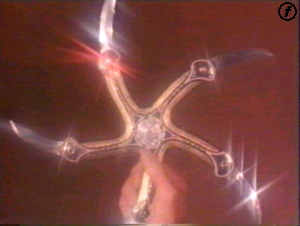
Memorable Quote" "I am Ergo the Magnificent! Short in stature, tall in power, narrow of purpose, and wide of vision and I do not travel with peasants and beggars, good bye!"--Ergo the Magnificent.

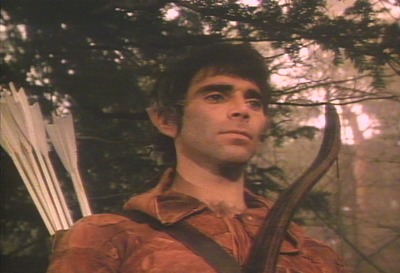
Best Quote: "I am no messenger, but I will give you a message. The message of death!" --Crow
Krull-- A world lightyears beyond your imagination. Like Hawk the Slayer this film is another of the roleplayer must see fantasy films. Also like Hawk this film comes from the vast fantasy wasteland that is the 1980s. I don't know what it was about the 80s and cheeseball, low-budget, fantasy films, but it seems a mainstay of the decade. Earlier decades got classics like The 7th Voyage of Sinbad and the 80s gets Krull. Liam Neeson, kidnapped princesses, teleporting fortresses, magic vs. technology, and the Glaive! After watching this film, I wanted all my D&D characters to have Glaives, but then I read what a real glaive was and changed my mind.
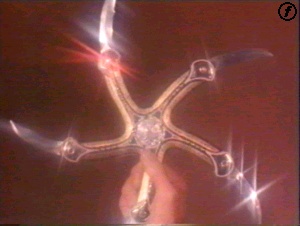
Memorable Quote" "I am Ergo the Magnificent! Short in stature, tall in power, narrow of purpose, and wide of vision and I do not travel with peasants and beggars, good bye!"--Ergo the Magnificent.
Tuesday, March 07, 2006
When Was the Golden Age of Baseball Again?
Young baseball fans growing up in today's America know one thing for certain, in the past there was a golden age of baseball. During this golden age the players were all gentlemen, there was no cheating, and the game was pure and beautiful. After all, the newsstands are filled with books and newspaper articles about how Barry Bonds is a veritable pharmaceutical factory. We are in an era without heroes and love a sport better forgotten until it becomes more like it once was.
It is with this backdrop that baseball historian Harvey Frommer wrote his newest book Old Time Baseball. His introduction hints at the sports need of a return to a "better" time:
Frommer's introduction is filled with the lament of the scholarly lover of baseball. It seems as if Frommer began his book looking for a lost, better, more innocent era than the one today. But if that was his goal, he failed. He succeeded instead to show how baseball has always been a sport with its scandals, lies, and artificial pageantry.
Old-Time Baseball is a brief, but detailed, look at baseball's growth from an amateur game to a professional sport during 19th century America. The book is the story of a game that went from idle recreation to national pastime. The story is one of false mythology, collusion with gamblers, and ruthless businessmen. It is a great story and one that puts the modern controversies of the game into context. This doesn't mean that the current controversies aren't legitimate, they are, but it does mean that controversy, conspiracy, and eventual correction are mainstays of the wonderful game that is baseball.
Frommer's book is useful both as entertainment and as a future reference which collects an abundance of baseball information into its mere 188 pages. You can read the book in a few hours, but to truly soak in the information takes repeated visits.
The first chapter is a simple timeline of baseball's history. It provides a list of important dates in the development of America's pastime and is thus a chapter readers will find themselves returning to again and again. Do you want to find out when the first recorded triple was hit? According to Frommer, that would be April 24, 1876 by Levi Meyerle. Though more interesting is the fact that on July 18, 1882, Tony Mullane pitched both right- and left-handed during a game. The second through fourth chapters are a narrative description of the development of the game throughout the century and the fifth chapter is a collection of biographical sketches of many of the great players of the gilded age. All of the information in the book is useful, even if it is dryly written.
While the book begins with what appears to be despair at the modern game, it ends on a high note. It is as if the author has regained faith in the modern game by looking honestly at the game's past. I can remember how reading The Southpaw and The Natural put into perspective some of my own worries that the game was less than it once was. An honest look at the past is tonic to this wonderful game, a game which has rules friendlier than most who play it.
Frommer closes:
Frommer's book was a pleasant addition to my readings during the Void between the World Series and the World Baseball Classic.
It is with this backdrop that baseball historian Harvey Frommer wrote his newest book Old Time Baseball. His introduction hints at the sports need of a return to a "better" time:
In 1975, my appreciation of the game of baseball deepened and
expanded...that year made me acutely aware of the hold of the game on America, of its roots, its idiosyncrasies, its magic...
Baseball in 2005...[T]he blaring rock music, the private boxes filled with people who too often have scant knowledge of and even less feeling for the game...crass commercialism fueled by print and electronic media...
Frommer's introduction is filled with the lament of the scholarly lover of baseball. It seems as if Frommer began his book looking for a lost, better, more innocent era than the one today. But if that was his goal, he failed. He succeeded instead to show how baseball has always been a sport with its scandals, lies, and artificial pageantry.
Old-Time Baseball is a brief, but detailed, look at baseball's growth from an amateur game to a professional sport during 19th century America. The book is the story of a game that went from idle recreation to national pastime. The story is one of false mythology, collusion with gamblers, and ruthless businessmen. It is a great story and one that puts the modern controversies of the game into context. This doesn't mean that the current controversies aren't legitimate, they are, but it does mean that controversy, conspiracy, and eventual correction are mainstays of the wonderful game that is baseball.
Frommer's book is useful both as entertainment and as a future reference which collects an abundance of baseball information into its mere 188 pages. You can read the book in a few hours, but to truly soak in the information takes repeated visits.
The first chapter is a simple timeline of baseball's history. It provides a list of important dates in the development of America's pastime and is thus a chapter readers will find themselves returning to again and again. Do you want to find out when the first recorded triple was hit? According to Frommer, that would be April 24, 1876 by Levi Meyerle. Though more interesting is the fact that on July 18, 1882, Tony Mullane pitched both right- and left-handed during a game. The second through fourth chapters are a narrative description of the development of the game throughout the century and the fifth chapter is a collection of biographical sketches of many of the great players of the gilded age. All of the information in the book is useful, even if it is dryly written.
While the book begins with what appears to be despair at the modern game, it ends on a high note. It is as if the author has regained faith in the modern game by looking honestly at the game's past. I can remember how reading The Southpaw
and The Natural put into perspective some of my own worries that the game was less than it once was. An honest look at the past is tonic to this wonderful game, a game which has rules friendlier than most who play it.Frommer closes:
Despite the naysayers that have surfaced through the decades, baseball is still our national pastime...Baseball is still comforting regularity, a sport played and viewed from childhood on.
Frommer's book was a pleasant addition to my readings during the Void between the World Series and the World Baseball Classic.
Monday, March 06, 2006
Genera vs. Generic and the Paladin
WARNING GEEKDOM POST BELOW...DO NOT READ UNLESS YOU WANT TO BE OVERWHELMED WITH GEEKITUDE
Matt Forbeck posted a link to an excellent article by Greg Stafford discussing game design decisions in roleplaying game design. In the article, Stafford discusses two underlying philosophies regarding what to include or leave out in a specific game's mechanics. To quote:
A genera game player wishes to imaginatively experience a limited and specific setting, within its own context and rules. Basic Pendragon is this kind of setting. It is about knights in a pseudo-medieval setting that includes the fantasy and legend that is (more or less) appropriate to that setting.
A generic game may use a specific genera as a basis, but the players want to expand it with the modern experience of open, freewheeling experimentation. Not just knights, but druids and wizards and thieves and ninjas in a King Arthur-like setting. Not just traditional knights, but women knights, Beowulf-era warriors, and Sigurd and Theoderic and El Cid too. Not just native British folklore, but kobolds and nagas and deep ones too.
His article is the beginning to a wonderful discussion, and one at the core of game design. When Matt Forbeck designed the Brave New World game system (based on Greg Gorden and Shane Lacy Hensley's system for Deadlands ) he had to decide whether to make his game a generic superhero game with the ability to capture all superhero types or whether he wanted to limit the types of heroes and the scope of powers to fit the genera his fictional narrative provided. He chose the latter. Because Forbeck's fictional history of the United States was one in which Alphas, or almost limitlessly powered superheroes, no longer existed. The only "supers" who remained in Brave New World were the lesser powered Deltas who primarily fit into easily defined archtypes.
Given the high level of competition in superhero RPGs, Forbeck's decision was a brave one and a necessary one. In the end, Forbeck produced an internally consistant game that was largely free of the "power creep" often associated with more generic settings.
But what does this have to do with Fantasy games, and the Paladin in particular? One of the big reasons people play Fantasy roleplaying games (big F because I am referring to the genre and not the game type) is to, for a brief moment, imagine and act as if they are one of their favorite characters from fantasy literature.
Games like Dungeons and Dragons allow players from a broad array of fantasy traditions to play the same game with only slight limitations. If you want to be Aragorn you can. If you want to be Belgarath you can. If you want to be Fafhrd and the Grey Mauser you can. The Dungeons and Dragons system is fairly generic and has become more so under the design influences of Monte Cook and Sean K. Reynolds. Certainly more so than Pendragon. But Dungeons and Dragons isn't a completely generic fantasy RPG.
In fact, Dungeons and Dragons has some very specific limitations resulting from the interpretation of fantasy that its initial game designers had. Gary Gygax's vision of fantasy was one inspired by H.P. Lovecraft, Clark Ashton Smith, Jack Vance, Tolkien, Michael Moorcock, Fritz Lieber, and Robert E. Howard (among a few others). As a result, the game does a wonderful job in simulating the source material. The magic system is rooted in a "Vancian" system heavily influenced by the Dying Earth stories of Jack Vance. The thieve's abilities, including the ability to read/use magic scrolls, is heavily influenced by Lieber's Fafhrd and Grey Mauser. Rangers come from Tolkien. The strict alignment system comes from Moorcock (among others). And the dreaded Temple of the Frog comes from Lovecraft, Smith, and Howard (Tsathoqqua arguably makes an appearance in Howard's Scarlet Citadel). The combination of influences lead to an interesting kaleidoscope rules set where Vancian magicians battled Hyperborian warriors.
This made for an inspirational and cutting edge game, one that spawned an entirely new game type. But fans soon found that they might need other rules sets if they wanted to play their vision of fantasy. Monte Cook and Sean K. Reynolds are among those for whom the kaleidoscope of earlier versions of Dungeons and Dragons were insufficient and some of their opinions can be seen in the current rules of the game. I say some because there are a couple of choices that Cook and Reynolds were pressured into by playtesters that Cook and Reynolds are less than satisfied with. One of these choices is the limiting of the Paladin class to Lawful Good alignment. The Paladin, you see, is a chosen defender/crusader for a god and couldn't an evil or not lawful and good god have defender/crusader's?
The answer is a simple one...yes and no. In a completely generic fantasy simulation, ti would certainly be reasonable, but in one where each character class comes from a different inspiration it isn't. The Paladin, like the Thief, in Dungeons and Dragons have very particular archtypes it is modelling. Why do all Thieve's have to worry about "thieve's guilds" in D&D? Because they did in Lieber. Why are all Paladins lawful good? Because Lancelot and Galahad are. The Paladin may exist in a roleplaying game with polytheistic pantheons in abundance, but it was inspired by mythology from a monotheistic society. Genre convention is the reason for the choice. It may not be a reason that satisfies Cook and Reynolds, because in many ways it is an arbitrary choice, but it is a creation of the understanding behind the creation of the class.
J. Eric Holmes, author of Dungeons and Dragons first basic set, gives another reason that Gygax may have which is behind the requirement. To quote his book on Fantasy Role Playing Games:
I don't mean to imply that the designers of games set out to teach us little moral lessons about everyday life -- except Gygax. In the D&D world fighters can do no magic, but magicians are so weak that they need to be protected by fighters. Clerics can heal wounds and do a lot of fighting but are no good at long distance offensives because they can not shoot arrows or throw offensive spells. The constraints of the rules practically dictate cooperation and mutual respect for the talents and weaknesses of each class, and I find it hard to believe that Gygax was not fully conscious of the principle when he wrote them.
Gygax calls this "play balance" and insists that it is not good for one character to grow too powerful with respect to the others. It is just this principle that some designers of other games have objected to and tried to write out of their own rules.
From a "moral education" standpoint, it makes sense to give additional powers and abilities to players willing to make sacrifices. If you create a game where some mechanics and goals feed "greedy" behavior, a class that accepts limits but gets benefits in return is an educational tool.
This is not to say that more generic games are less moral, that depends on the players involved. But what is certain is that in my experience those who want to play the Paladin with all the abilities and none of the restrictions have yet to give me a compelling argument not based on self-interest. At least within the context of D&D, in the campaigns I run. It is easier to defend the Paladin if you limit the Pantheon(s) available to the players. Easier still if your "universe" is monotheistic. Mine isn't, I play in Eberron, but I limit Paladins to the Silver Flame.
Sorry for the Long Delay Between Posts
I would have posted much more in the past two weeks save for a couple of big events that have occurred.
First, I have moved from South Los Angeles, the Crenshaw area...to be specific right across the street from Dorsey High School (alma mater of Chili Davis). Information about the school can be read here.

I now live in the suburban conclave of Glendale, where the cops ride in their cars without partners beside them. I no longer hear the thrumming of helicopter blades as I go to sleep. Gone are the sounds that I wonder whether they are gunshots or fireworks. They were usually fireworks. Now I live a block from Porto's.
Life is good, but my computers (laptop and desktop) are packed away.
Second, I was attending the California Council for the Social Studies Annual Conference in San Diego. I apologize to Professor Shugart for not harrassing him for a lunch meeting, but I was dog tired and sans communication devices. I was there for my day job promoting youth civic engagment (read VOTING) talking to teachers about using a 4 lesson curriculum the Non-Profit I work for designed. The curriculum is an attempt to get young people interested in voting.
So I have been busy unpacking and working and that is why I have been absent. I will attempt to address the problem with a book review or two in the next day or so.
First, I have moved from South Los Angeles, the Crenshaw area...to be specific right across the street from Dorsey High School (alma mater of Chili Davis). Information about the school can be read here.

I now live in the suburban conclave of Glendale, where the cops ride in their cars without partners beside them. I no longer hear the thrumming of helicopter blades as I go to sleep. Gone are the sounds that I wonder whether they are gunshots or fireworks. They were usually fireworks. Now I live a block from Porto's.
Life is good, but my computers (laptop and desktop) are packed away.
Second, I was attending the California Council for the Social Studies Annual Conference in San Diego. I apologize to Professor Shugart for not harrassing him for a lunch meeting, but I was dog tired and sans communication devices. I was there for my day job promoting youth civic engagment (read VOTING) talking to teachers about using a 4 lesson curriculum the Non-Profit I work for designed. The curriculum is an attempt to get young people interested in voting.
So I have been busy unpacking and working and that is why I have been absent. I will attempt to address the problem with a book review or two in the next day or so.
Wednesday, March 01, 2006
Friends, the Internet, and MMORPGs
Before I moved to Los Angeles, six years ago this August, I lived in Reno, Nevada, a college town that thinks it is a casino resort destination. Not that Reno doesn't have some very nice casinos, it does, it's just that as nice as they are...Reno is no Vegas. Then again, when it comes to quality of education...Vegas is no Reno.
While I was a college student in Reno, I made some very good friends. Two of whom are members of this blog community, Rob (Robert Barker) and Logan 5 (Patrick Ditton), and one who stops by for a visit every now and then (John Ford). These are the friends who I have managed best to keep in touch with, and I largely have the internet to thank for that.
But Fritz's last post regarding the Dungeons and Dragons Online game, I am indeed preparing an article about it but want to get some post-move play time in first, reminded me of one of the ways I had planned on using the internet to keep in contact with friends.
As you may have guessed, I am a gamer, but unlike the l33t masters of a single game I am a gaming renaissance man. If it is a game, chances are I have played it at least once or at least am familiar with it because a friend of mine has played it. I enjoy playing games for the new experiences they offer, but I also like them as cultural artifacts. The mechanics/tone/setting/subject of a particular game can tell us a lot about the game designer's (and our own) thoughts about the subject of a particular game.
Take Chess as an example. Chess is one of the most popular abstract simulation of war played in the world. The construction of its rules tell us that the "inventors" of the game felt that their are two central variables to winning a military conflict. First, you must control territory. Chess is, after all, a territory control game. Second, the elimination of the "highest ranking" piece of your opponent's army grants victory. The capture/trapping of your opponent's king is the only necessary condition for victory. That is a very simple beginning to a conversation of what Chess tells us about warfare, there is much more that can be discussed, but you can see the point. Any time a game deals with real world subject matter, it is by nature of its being a simulation of that subject matter a commentary or description of that subject.
Even when the games deal with entirely fictional subjects and situations games can tell us a great deal about the society that created them. That is why I love games, all kinds of games.
When I moved out of Reno, I had hoped to use a game to keep in contact with some of my friends. It seemed like a natural communication medium. My friends Josh and Rob both were signed up, as was I, to a MMORPG titled Asheron's Call. Like many MMORPGs, Asheron's Call is an open ended game with the ability to type text, alsolike many there were supplemental programs that allowed users to talk via microphones with other players. It was my hope that my friends and I could meet up online and catch up on what was going on in each others lives.
I had failed to take into account two things, among others I am sure. I failed to understand how much my friends', and my own, schedules would change after I moved. With Rob in Philadelphia going to Law School, me attending Graduate School in Claremont and working at a non-profit during the day, and Josh returning to school (as well as preferring odd times to play online), it was all but impossible to keep in touch using Asheron's Call. I guess we could have scheduled a regular weekly meetup, but the game design of AC didn't reward that kind of behavior. The second thing I failed to predict was how much better some of the newer MMORPGs would be. I haven't even looked at the Asheron's Call box in five years, let alone played a game. The monthly subscription cost that each MMORPG has limits the number of MMORPGs that a reasonable player will subscribe to at a given time.
I currently limit my self to two MMORPG subscriptions. Largely because my online game time is about 5 hours a week (max.) and I don't want to spend money on something I am not using. At 10 hours a month per game at $15.00, I am getting more than my movie equivelent value (MEV) of entertainment. MEV's are based on one movie costing approximatly $10 and providing 2 hours of entertainment. All of my entertainment purchases are done in MEVs. (I will do a more complete post on MEVs later). Needless to say $30.00 had better provide a minimum of 6 hours of entertainment value to meet the MEV formula, and the nature of MMORPGs mean that approximately 40% of game time is spent either "crafting," training, or getting to where you want to go.
The internet is a great communication tool, but like any other it requires effort to make it useful. I am still in contact with some friends thanks to the internet, but there are others whom I have lost contact with and that saddens me. I still think of those I have lost contact with as friends, just ones I have to hunt down and reconnect with.
So Sean, Robert June, Josh, and everyone else I am currently out of contact with, if you happen to be browsing through blogger and find this leave a comment in the comments section.
Christian Johnson would love to hear from you.
While I was a college student in Reno, I made some very good friends. Two of whom are members of this blog community, Rob (Robert Barker) and Logan 5 (Patrick Ditton), and one who stops by for a visit every now and then (John Ford). These are the friends who I have managed best to keep in touch with, and I largely have the internet to thank for that.
But Fritz's last post regarding the Dungeons and Dragons Online game, I am indeed preparing an article about it but want to get some post-move play time in first, reminded me of one of the ways I had planned on using the internet to keep in contact with friends.
As you may have guessed, I am a gamer, but unlike the l33t masters of a single game I am a gaming renaissance man. If it is a game, chances are I have played it at least once or at least am familiar with it because a friend of mine has played it. I enjoy playing games for the new experiences they offer, but I also like them as cultural artifacts. The mechanics/tone/setting/subject of a particular game can tell us a lot about the game designer's (and our own) thoughts about the subject of a particular game.
Take Chess as an example. Chess is one of the most popular abstract simulation of war played in the world. The construction of its rules tell us that the "inventors" of the game felt that their are two central variables to winning a military conflict. First, you must control territory. Chess is, after all, a territory control game. Second, the elimination of the "highest ranking" piece of your opponent's army grants victory. The capture/trapping of your opponent's king is the only necessary condition for victory. That is a very simple beginning to a conversation of what Chess tells us about warfare, there is much more that can be discussed, but you can see the point. Any time a game deals with real world subject matter, it is by nature of its being a simulation of that subject matter a commentary or description of that subject.
Even when the games deal with entirely fictional subjects and situations games can tell us a great deal about the society that created them. That is why I love games, all kinds of games.
When I moved out of Reno, I had hoped to use a game to keep in contact with some of my friends. It seemed like a natural communication medium. My friends Josh and Rob both were signed up, as was I, to a MMORPG titled Asheron's Call. Like many MMORPGs, Asheron's Call is an open ended game with the ability to type text, alsolike many there were supplemental programs that allowed users to talk via microphones with other players. It was my hope that my friends and I could meet up online and catch up on what was going on in each others lives.
I had failed to take into account two things, among others I am sure. I failed to understand how much my friends', and my own, schedules would change after I moved. With Rob in Philadelphia going to Law School, me attending Graduate School in Claremont and working at a non-profit during the day, and Josh returning to school (as well as preferring odd times to play online), it was all but impossible to keep in touch using Asheron's Call. I guess we could have scheduled a regular weekly meetup, but the game design of AC didn't reward that kind of behavior. The second thing I failed to predict was how much better some of the newer MMORPGs would be. I haven't even looked at the Asheron's Call box in five years, let alone played a game. The monthly subscription cost that each MMORPG has limits the number of MMORPGs that a reasonable player will subscribe to at a given time.
I currently limit my self to two MMORPG subscriptions. Largely because my online game time is about 5 hours a week (max.) and I don't want to spend money on something I am not using. At 10 hours a month per game at $15.00, I am getting more than my movie equivelent value (MEV) of entertainment. MEV's are based on one movie costing approximatly $10 and providing 2 hours of entertainment. All of my entertainment purchases are done in MEVs. (I will do a more complete post on MEVs later). Needless to say $30.00 had better provide a minimum of 6 hours of entertainment value to meet the MEV formula, and the nature of MMORPGs mean that approximately 40% of game time is spent either "crafting," training, or getting to where you want to go.
The internet is a great communication tool, but like any other it requires effort to make it useful. I am still in contact with some friends thanks to the internet, but there are others whom I have lost contact with and that saddens me. I still think of those I have lost contact with as friends, just ones I have to hunt down and reconnect with.
So Sean, Robert June, Josh, and everyone else I am currently out of contact with, if you happen to be browsing through blogger and find this leave a comment in the comments section.
Christian Johnson would love to hear from you.
Friday, February 24, 2006
Thursday, February 23, 2006
Is the World Ready for Major League Gaming?
According to the Wall Street Journal, Major League Gaming Inc. (MLG) has received $10 million in funding to use in its efforts to elevate videogame playing into a professional sport.
Let us leave aside the question of whether playing a video game is a sport at all, let alone a potentially professional one. Rather let us ask whether the world is ready for the professionalization of what is primarily a hobby.
There is an inherent competitiveness in the mindset of most gamers. If a gamer is skilled at a particular game, then he or she wants to show off their skills. One need only spend a few minutes on Xbox Live listening to the taunts of players to see how seriously some gamers take their entertainment. Those of us who grew up with the Atari 2600 remember the Fred Savage film The Wizard and fantasized about becoming famous for our leet Nintendo skills.
For certain, there is an interest on the part of the "sportsman" with regards to professional gaming. Who wouldn't like to write off the expense of their Xbox 360 when filing taxes, let alone get paid to play?
The types of games MLG will focus its competitions on, games like Halo 2 and CounterStrike, are certainly exciting games that require quick reflexes, good manual dexterity, and well-honed skills. These are features that guarantee that the "sport" will be able to develop and promote specific atheletes. If they are lucky, these gamers will have eccentric and interesting personalities.
The question then becomes one of audience. Will anyone pay to watch other people play video games? If G4's Arena is any indication, the evidence is mixed. The show doesn't offer large prizes, it doesn't command a large audience, and it perfectly displays the difficulty of creating play-by-play analysis of gameplay. Can MLG become a televised circuit competition like NASCAR? Only time will tell, but I doubt it.
More likely, the professionalization of video games will follow a path similar to that of professional Collectible Card Game events. The cash prizes will largely be paid by the video game manufacturers and be tied to new releases. I see the development as more a grassroots occurance than a national one. Even if MLG becomes successful, they would do well to remember that even the most successful professional sports began at the grassroots professional level.
I don't know if the audience is there for a league, but I am willing to watch and find out. I do know that gaming still has a lot of PR work to do in order to overcome the negative reporting done by much of the news media. A truly successful league will have to fight against negative PR to promote the sport and will face opposition from those who see gaming as a waste of time or as a contributor to youth violence.
One think is for sure, given my skill at most video games, I won't be among the first generation of video game "atheletes." I would be pwnt by all but the least skilled newb. To paraphrase Breaking Away, "to many people 'professional gamer' is just another joke, but to me it's another thing I can never be."
Let us leave aside the question of whether playing a video game is a sport at all, let alone a potentially professional one. Rather let us ask whether the world is ready for the professionalization of what is primarily a hobby.
There is an inherent competitiveness in the mindset of most gamers. If a gamer is skilled at a particular game, then he or she wants to show off their skills. One need only spend a few minutes on Xbox Live listening to the taunts of players to see how seriously some gamers take their entertainment. Those of us who grew up with the Atari 2600 remember the Fred Savage film The Wizard and fantasized about becoming famous for our leet Nintendo skills.
For certain, there is an interest on the part of the "sportsman" with regards to professional gaming. Who wouldn't like to write off the expense of their Xbox 360 when filing taxes, let alone get paid to play?
The types of games MLG will focus its competitions on, games like Halo 2 and CounterStrike, are certainly exciting games that require quick reflexes, good manual dexterity, and well-honed skills. These are features that guarantee that the "sport" will be able to develop and promote specific atheletes. If they are lucky, these gamers will have eccentric and interesting personalities.
The question then becomes one of audience. Will anyone pay to watch other people play video games? If G4's Arena is any indication, the evidence is mixed. The show doesn't offer large prizes, it doesn't command a large audience, and it perfectly displays the difficulty of creating play-by-play analysis of gameplay. Can MLG become a televised circuit competition like NASCAR? Only time will tell, but I doubt it.
More likely, the professionalization of video games will follow a path similar to that of professional Collectible Card Game events. The cash prizes will largely be paid by the video game manufacturers and be tied to new releases. I see the development as more a grassroots occurance than a national one. Even if MLG becomes successful, they would do well to remember that even the most successful professional sports began at the grassroots professional level.
I don't know if the audience is there for a league, but I am willing to watch and find out. I do know that gaming still has a lot of PR work to do in order to overcome the negative reporting done by much of the news media. A truly successful league will have to fight against negative PR to promote the sport and will face opposition from those who see gaming as a waste of time or as a contributor to youth violence.
One think is for sure, given my skill at most video games, I won't be among the first generation of video game "atheletes." I would be pwnt by all but the least skilled newb. To paraphrase Breaking Away, "to many people 'professional gamer' is just another joke, but to me it's another thing I can never be."
Tuesday, February 21, 2006
DVD Review: Doom: Unrated

Doom wasn't the first first-person shooter (FPS) video game, but it was the game that defined the genre. In the action packed shooter, scientists experimenting with Star Trek style matter transportation accidently open a portal into Hell. Video game players around the world battled demons who had been released as a result of this accident. Doom was a veritable clinic in how to combine action with horror. At the time Doom was released there was very little, in any medium, that could compare to the nervous, frightened, excitement players felt while playing the ground-breaking FPS.
In 2005, over a decade after the original video game release, the film industry released a theatrical version of Doom. The film was a large financial disappointment. With an estimated budget of $70 million, the film only managed to bring in a domestic gross of $28 million. It appeared that fans and critics were disappointed with the Hollywood version of the classic shooter. But it is common knowledge that DVD sales have replaced box office as the primary revenue source for films. The Doom DVD was released on February 7, 2006, uncut and with added documentary features.
At first glance, Doom looks like a perfect popcorn film, guaranteed to entertain. No one expects a movie based on a video game to have important social commentary. The Rock, a very entertaining and charismatic actor who has proven to be a box office draw, stars in the film and his inclusion brings the promise of humor and athleticism. Karl Urban, the hunky Eomir from the Lord of the Rings movies, stars as Reaper. The very pretty Rosamund Pike, recently of Pride and Prejudice, adds a character who contributes to the drama of the film. Beauty, brawn, a box office draw, and affiliation with a successful license, it seems like a match made in marketing heaven.
But apparently Andrzej Bartkowiak has opened his own little portal to Hell and has decided to make Doom fans everywhere suffer. This film misses the mark in so many ways that it would take to long to list them, but the potential viewer at least deserves a couple of highlights.
The first mistake Doom the movie makes, is to leave its source material behind. "Scientists accidently opening a portal to Hell?" the producers ask. "No, no, that is unrealistic. Hell should be metaphoric. Let's have the 'hellspawn' be the product of genetic manipulation." After all, what fans of Doom want to see is an adaptation of Resident Evil that takes place on Mars and not an adaptation of their favorite FPS.
Doom begins with a team of marines being sent, via an archeologically discovered transporation device, to Mars to investigate an outbreak at a scientific laboratory on Mars. From there, the action begins. Or at least that is what is supposed to happen, you know...action. In the spirit of Aliens, the marine squad is whittled down one by one, but unlike Aliens it's through a rather boring set of scenes that in which this whittling occurs. There is little to no tension and no horror in this horror/action film.
The film features a gimmick that fans giggled about the most prior to the film's release. There is a five-minute long first-person shooter perspective sequence where the audience becomes Reaper. Ironically, this segment is more entertaining that the rest of the film. One could argue that this is because the director of this sequence, Jon Farhat, has a better understanding of pacing and tension. In fact, I watched this segment of the film three times.
Doom commits the one sin that is unforgivable in an action/horror film. The movie is just plain dull. It's hard to explain why the film is so dull. There is no one flaw that makes it so, like being overly "talky" which Doom most certainly isn't. It's a combination of things. The film fails to frighten, it fails to excite, and it fails to make the audience laugh. Okay, I laughed once, but if I tell you when it will be a huge spoiler for those brave enough to journey through the Hell that is Doom.
The DVD contains a few, very interesting, documentaries about the making of the movie, including one about the FPS sequence. These are well worth watching if you are a Netflix subscriber. The unrated version adds a little more gore, some unneccessary (and not even worth it) nudity, and a spoonful more boredom to the original.
Friday, February 17, 2006
Book Review: Marked for Death by Matt Forbeck
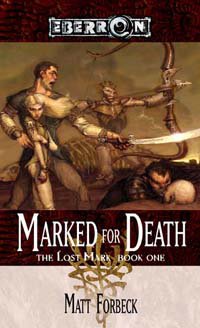
January 2006, as a part of its growing line of Eberron themed novels, Wizards of the Coast released the second part of Matt Forbeck's The Lost Mark trilogy. The Road to Death is the sequel to 2005's Marked for Death and picks up where the action of the first novel left off. Fantasy is filled with book series and when the latest book in a series arrives there are usually multiple reviews of the newest offering. The same is true in this case. You can read a very thorough book of the month club discussion over at Essential Eberron. What is usually lacking are "reminder reviews" of the first book in a series. After all, readers who don't discover a series until the second book is released will have to decide if they desire to catch up.
Marked for Death is a shared universe media tie-in story by Matt Forbeck, a long-time veteran of the role-playing game industry. Marked for Death is a part of Wizards of the Coast's marketing efforts to promote their newest campaign setting for the Dungeons and Dragons game. Forbeck's novel takes place in the Eberron world, like the other novels in the line, but does not share any protagonists with the other books in the series.
The Eberron world is a fantasy environment in which combines elements of pulp and detective/noir fiction with traditional fantasy tropes. A nice, if reductive, analogy would be to say that Eberron is like a fantasy version of Earth just after the First World War, or the Last War as it is called on Eberron. The magic of the world is pretty much what one would expect in a Dungeons and Dragons based fantasy novel with two exceptions. First, in addition to its traditional role in fantasy, the magic of Eberron has also developed in a manner similar to that of technology in our world. Powerful magic is still limited to trained users, but architecture and technology incorporating minor magic effects are common. Second, some aristocratic bloodlines in the world have magical powers associated with their ancestry, the so called Dragonmarks. Most individuals who bear a Dragonmark are members of an aristocratic family associated with one of twelve well established Marks. There are currently twelve such Marks, the aristocratic status of which was determined long ago during war between Dragonmarked houses. It was during the War of the Mark that one of what were then thirteen Dragonmarks was destroyed, the aptly named Mark of Death.
It is with this background that Marked for Death begins. The story focuses on the friends and family of a man named Kandler, a veteran of the Last War. Kandler lives with his close friend, the semi-lycanthopic "Shifter"Burch, and his step daughter, an elf-child named Esprë. This small band lives in a community that borders what was once one of the great nations of the world, but which is now a land of dust and death having been destroyed in an almost nuclear cataclysm at the end of the Last War. Recently citizens of the town have been disappearing mysteriously, and Kandler's step-daughter has manifested a Dragonmark now that she has entered puberty. Things are very tense in the small border community, but things are about to get worse.
Two groups of strangers have, by different means, discovered that the Mark of Death has reappeared and have come to the border community in hopes of capturing the person bearing the Mark. One group desires to keep the Mark out of "evil hands" and the other desires to conquer Eberron.
From this point on, the novel becomes a pursuit/rescue narrative very similar to the Carson of Venus tales by Edgar Rice Burroughs, both for better and for worse. Esprë is captured, rescued, and recaptured no less than three times in Marked for Death which can lead the reader into some frustration. Forbeck is attempting to build the cast for the series while simultaneously maintaining a cliffhanger narrative. This is not an easy task and Forbeck does a yeoman's job of it. Forbeck's narrative style is crisp and easy to read and moves at a breakneck pace. The reader isn't left with much time to breathe. Surprisingly, Forbeck manages to insert a good amount of character development into the narrative and the reader leaves the book caring about the protagonists more at the end of the novel than at the beginning, but the character development is tied tightly to the romantic B storyline. By tying much of the character development to the romantic storyline, Forbeck underdevelops one of the more entertaining characters in the book, Burch. Readers might find Burch fun and exciting, but he is a friend we see but don't yet know.
Forbeck, like many writers in the Eberron series, has his repeated descriptive line. In Keith Baker's City of Towers, the overly repeated event was the protagonist being disarmed. In The Crimson Talisman, Adrian Cole seemed to call every weapon, long or short, a dirk. Forbeck's characters sure seem to spend a great deal of time with their head in their hands, often shaking the head at the same time. But this is really a small complaint.
A good deal of Marked for Death is devoted to establishing, and raising, the stakes for the future volumes in the trilogy. Forbeck does this every well and made this reader hopeful for the series, but slightly dissatisfied with the original. Like the Carson of Venus stories, Forbeck seems too focused on the A narrative and forgets that readers like to have some small resolution at the end of a story. I wanted at least a minor story arc resolved.
Aristotle says that every story has a beginning, a middle, and an end. Marked for Death is merely a beginning, but it is a good beginning. If you read Marked for Death when it was released, the months spent waiting for the next volume were impatient months. The impatience I feel is sign that Forbeck effectively set the stakes for the reader. But if you're anything like me and find waiting even one week for the continuation of a narrative too long, you might want to wait until the series is finished to start reading them.
Wednesday, February 15, 2006
What is the Purpose of a Blogroll?
Professor Shugart over at Fruits and Votes made and interesting observation the other day during a discussion of recent changes to his website. During a discussion where he mentioned his criteria for updating his blogroll he stated, "I suspect I use the blogroll far more than any readers do, so if I don’t like a blog, why blogroll it?" Which hit on what I consider to be and underlying argument for purpose.
Professor Shugart, who I agree with on this proposition, is arguing that the primary reason for a blogroll is a kind of shared bookshelf for a particular blog. A blogroll in this paradigm would be a list of blogs that the author enjoys reading, or at least visits regularly, that he or she thinks people of similar interests might visit. But whether others visit the sites or not is of little consequence because the utility to the host blogger is sufficient reason in this model.
As I stated, I agree with this model, which is why our primary blogroll is so diverse. I have few, but a couple, of partisan/political blogs. On the left there is Daily Kos and Liberal Avenger. While on the right, we have Moxie and Odysseus. There are a couple of blogs by people who are conservative/liberal, but that the blog is of a pop-culture/personal opinion orientation, Cathy's World and Luke Y. Thompson's blog come to mind. A couple are extinct and will soon be eliminated. Right Wing Dodger Fan is a co-worker with the man who directed Ace Ventura, so I hoped he would post, but he hasn't in forever so I will remove him by the end of the week. Most of our blogroll links hit sites covering my, and others, interests on this blog and account for my daily routine. I visit Fruits and Votes for some quantitative and qualitative electoral model discussion, along with conversations about fruits and baseball. There are screenwriting blogs by the aspiring, the direct to DVD employed, and the blockbuster author. Things that interest me.
But I also have a separate blogroll which fits into another paradigm. For me it is what I would term both and "advertisement blogroll" and a "potluck blogroll." I signed up for the "homespun bloggers" link with two hopes in mind. First to increase readership of our bizarre corner of the web. Second, to find new things to read.
So it seems to me that blogrolls can serve three purposes, or combinations thereof: the living bookshelf, self-promotion, or grab bag. The question is, "is there some kind of moral/ethical standard which should be applied to blogroll use?"
Is there a kind of sleazy factor to the person who joins large cycling blogrolls, if they never intend to visit other sites on the blogroll?
Professor Shugart, who I agree with on this proposition, is arguing that the primary reason for a blogroll is a kind of shared bookshelf for a particular blog. A blogroll in this paradigm would be a list of blogs that the author enjoys reading, or at least visits regularly, that he or she thinks people of similar interests might visit. But whether others visit the sites or not is of little consequence because the utility to the host blogger is sufficient reason in this model.
As I stated, I agree with this model, which is why our primary blogroll is so diverse. I have few, but a couple, of partisan/political blogs. On the left there is Daily Kos and Liberal Avenger. While on the right, we have Moxie and Odysseus. There are a couple of blogs by people who are conservative/liberal, but that the blog is of a pop-culture/personal opinion orientation, Cathy's World and Luke Y. Thompson's blog come to mind. A couple are extinct and will soon be eliminated. Right Wing Dodger Fan is a co-worker with the man who directed Ace Ventura, so I hoped he would post, but he hasn't in forever so I will remove him by the end of the week. Most of our blogroll links hit sites covering my, and others, interests on this blog and account for my daily routine. I visit Fruits and Votes for some quantitative and qualitative electoral model discussion, along with conversations about fruits and baseball. There are screenwriting blogs by the aspiring, the direct to DVD employed, and the blockbuster author. Things that interest me.
But I also have a separate blogroll which fits into another paradigm. For me it is what I would term both and "advertisement blogroll" and a "potluck blogroll." I signed up for the "homespun bloggers" link with two hopes in mind. First to increase readership of our bizarre corner of the web. Second, to find new things to read.
So it seems to me that blogrolls can serve three purposes, or combinations thereof: the living bookshelf, self-promotion, or grab bag. The question is, "is there some kind of moral/ethical standard which should be applied to blogroll use?"
Is there a kind of sleazy factor to the person who joins large cycling blogrolls, if they never intend to visit other sites on the blogroll?
Friday, February 10, 2006
Robert Howard, King Conan, and the Arts
When it comes to depictions of unreflective low art, one need look no further than the commonly perceived opinions of Robert Howard's Conan stories. If you ask the average man on the street to describe a Conan narrative, you will likely be given a tale of lust and violence. In the tale Conan will rescue some half-naked maiden from some rampaging beast and the story will end with the woman becoming all naked as she swoons at the hero's feet. In fact, a great deal of Conan pastiche has been based on this very simple formula. The largest problem with such a vision is that it is not all that accurate. Are there tales of this sort in the Conan oevre?
Sure, but there are also tales of visionary wonder.
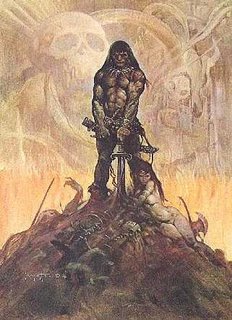
Like most authors, whether they write literature or Literature, Howard's writings reflect his own thoughts, experiences, and education. The writing reflects the aesthetic tastes of the author, or his/her understanding of a prospective audiences literary tastes. What makes something worth reading again and again is when an author satisfies those with "lower" tastes while providing them with some food for thought. Howard is no exception. In fact, I was surprised while I was rereading the first published Conan story, Howard's The Phoenix on the Sword to find that the author seemed to be hinting at a theory of the value of literature and its role in society.
Howard's Hyborean Age is a mythic world filled with magic and wonder, but it is also a world based on the history of the real world. Howard combined multiple eras of history so that societies whose "real world" existence is separated by centuries could co-exist narratively. Conan's own people, the Cimmerians, are based on a very real historical peoples. Both Herodotus, in his Histories, and Plutarch, in his Lives, mention the Cimmerian peoples (called Cimbri in Plutarch). In The Phoenix on the Sword, Howard appears to expect his audience to have at least a little understanding of the historical Cimmerians in his conversation of the role of literature in civilization. Conan, as protagonist, must hold ideas which the reader sympatizes with for the particular narrative of Phoenix to work.
So what kind of people were the Cimmerians? According to Plutarch they were a people who were pillagers and raiders, but not rulers.
What did they look like? According to Plutarch:
What was their temperment? According to Homer:
It is Homer's description of the Cimmerians that Howard uses in Phoenix to describe the mood of the people and to separate Conan from his kin. When Conan is asked why the Cimmerians are such a brooding people, Conan responds:
“Perhaps it’s the land they live in,” answered the king. “A gloomier land never was – all of hills, darkly wooded, under skies nearly always gray, with winds moaning dreaily down the valleys.” – Phoenix on the Sword
The average Cimmerian is a dour and towering barbarian who destroys civilization then returns to his gloomy homeland only to begin the process again later. Howard's typical Cimmerian is similar to that of the classical scholars, and presents a figure most unlikely to advance the literary arts. But this is where Conan differs from his kin. InThe Phoenix on the Sword, Conan is an older man who has conquered on of the greatest nations of the Hyborean Age expressly to free them from tyrannical rule. He conquered to rule, and to liberate an oppressed nation. A far cry from the typical barbarian. By separating Conan from his kin, Howard simultaneously increases the audience's sympathy for the barbarian king while enabling the character to advance a theory of the value of literature.
The Phoenix on the Sword is the tale of a plot to assassinate King Conan, a plot organized my a Machiavellian figure named Ascalante who desires to assume the throne. Ascalante is the product of civilization, but he is the antagonist of the story and so Howard uses his opinions of the Arts as a way to separate him from the audience's sympathy. When he describes a poet who has been brought into his conspiracy he describes the poet in perjorative terms. These terms evolve as the narrative moves from unpublished draft to final published form. Ascalante originally expresses his disdain for Rinaldo (the poet) in a long description:
By the time the story is published the description is changed to the very brief, "“…Rinaldo, the hair-brained minstrel.” [Ascalante in Phoenix on the Sword(published)]. In the published form, Howard leaves out the value of Rinaldo's participation in the plot because it is redundant with information presented later in the story. When Ascalante is asked what value Rinaldo has as a conspirator, Ascalante's response is similar in both the published and unpublished text, but his hatred of Rinaldo is made more clear in the draft than in the published text:
In both descriptions the poet is shown to be a blind idealist. Rinaldo, it appears, cannot look beyond the Cimmerian stereotypes as presented by Plutarch and Herodotus. Howard doesn't require the reader to have those preconceptions, but for the reader who has read Herodotus and Plutarch the stereotype becomes even clearer. Also by editing down the prose the author, either willingly or at editorial command, displays an amount of trust that his audience can reach the proper conclusion that barbarism typically destroys the valuable within civilization. What is interesting is that while Rinaldo is a conspirator, the poet is an antagonist, he is not a villain. He is a blind a foolish idealist, not acting in his own self interest. Ascalante even goes on to describe Rinaldo's motivations:
Ascalante specifies what kind of idealists poets are. They seek an imagined perfect society, and will always look for it no matter how good the society they are currently in happens to be. But this is Ascalante, the Machiavellian civilized man, and his opinion about what the value of the poet is. For him the poet is an easily manipulable puppet. What about the barbarian turned king, the protagonist, and oft argued proxy for the author? (It should be noted that many argue that Conan often reflects Howard's own views, this is not an original assertion on my part.)
Conan adores the poet, and understands the criticisms. He is aware that the poet's plays are leading many among the people to despise him, but he too is persuaded of the need for justice. When his chief advisor, Prospero, discusses disdain for Rinaldo, Conan comes to the poet's (and poetry in general) defense. The text is near identical in the published and unpublished format.

For Conan, the atypical Cimmerian, poems and the arts have more power than weapons or royal authority. Not only that, but it is right and just that this is the case. Conan, the barbarian, is the defender of the value of literature, while Ascalante, the civilized man, sees literature as only a tool used to manipulate the foolish. Conan would seek to discuss the past and future, the ideal ones, with the poet, while Ascalante would merely use Rinaldo to destroy what he opposes. Conan's conflict between desiring a free press and swift justice, and the eventual melee that will result because of his favoring of the press, are made clear in the poetic prologue to the final chapter of the narrative.
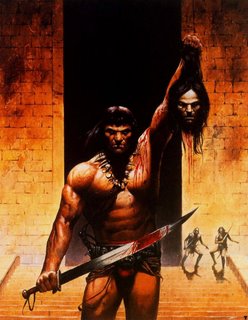
Surprisingly, Conan's love of literature and the arts, and his defense of them, is so deeply rooted that he initially refuses to kill Rinaldo when Rinaldo attacks him. He still believes he can reason with the poet, it is only when he is left no other alternative that he kills the poet (the text is identical in both published and unpublished forms).
What is interesting in the narrative is that of all the conspirators, there are twenty in all, none are able to injure Conan with the success of the poet. The poet has both damaged Conan's regime and his body and yet Conan was ever reluctant to, though in the end capable of, slay his greatest enemy.
What does this tell us of Howard's thoughts regarding the arts? We know that Conan loves them, but we also know how they were used to manipulate the populace and how his own love for them almost cost him his life. Is Howard trying to discuss how Plato's critique of the poets is a good one, while at the same time defending the possible nobility of the poet (as Aristotle does in his Rhetoric)? I think these are questions intentionally posed in the narrative (I know...never guess at intentionality), and make it clear why Conan's first story The Phoenix on the Sword was so compelling to readers when they first read it.
It should be noted that the story was originally submitted as a Kull tale, though I have yet to analyze that draft like I have these two subsequent writings. The Kull version was rejected by Weird Tales and the final (rather than the first) Conan version was the first appearance of what has become a culturally iconic figure.
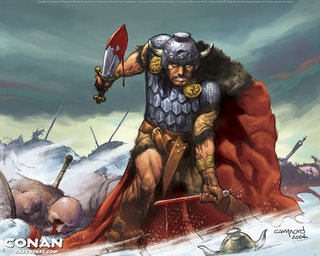
Sure, but there are also tales of visionary wonder.

Like most authors, whether they write literature or Literature, Howard's writings reflect his own thoughts, experiences, and education. The writing reflects the aesthetic tastes of the author, or his/her understanding of a prospective audiences literary tastes. What makes something worth reading again and again is when an author satisfies those with "lower" tastes while providing them with some food for thought. Howard is no exception. In fact, I was surprised while I was rereading the first published Conan story, Howard's The Phoenix on the Sword to find that the author seemed to be hinting at a theory of the value of literature and its role in society.
Howard's Hyborean Age is a mythic world filled with magic and wonder, but it is also a world based on the history of the real world. Howard combined multiple eras of history so that societies whose "real world" existence is separated by centuries could co-exist narratively. Conan's own people, the Cimmerians, are based on a very real historical peoples. Both Herodotus, in his Histories, and Plutarch, in his Lives, mention the Cimmerian peoples (called Cimbri in Plutarch). In The Phoenix on the Sword, Howard appears to expect his audience to have at least a little understanding of the historical Cimmerians in his conversation of the role of literature in civilization. Conan, as protagonist, must hold ideas which the reader sympatizes with for the particular narrative of Phoenix to work.
So what kind of people were the Cimmerians? According to Plutarch they were a people who were pillagers and raiders, but not rulers.
For the Cimmerian attack upon Ionia, which was earlier than Croesus, was not a conquest of the cities, but only an inroad for plundering.
Herodotus, Histories, I, 6
What did they look like? According to Plutarch:
Their great height, their black eyes and their name, Cimbri, which the Germans use for brigands, led us merely to suppose that they were one of those races of Germania who lived on the shores of the Western Ocean. Others say that the huge expanse of Celtica stretches from the outer sea and the western regions to the Palus Maeotis and borders on Asian Scythia; that these two neighbouring nations joined forces and left their land... And although each people had a different name, their army was collectively called Celto-Scythian. According to others, some of the Cimmerians, who were the first-to be known to the ancient Greeks... took flight and were driven from their land by the Scythians. Plutarch, Life of Marius, XI
What was their temperment? According to Homer:
Thus she brought us to the deep-Rowing River of Ocean and the frontiers of the world, where the fog-bound Cimmerians live in the City of Perpetual Mist. When the bright Sun climbs the sky and puts the stars to flight, no ray from him can penetrate to them, nor can he see them as he drops from heaven and sinks once more to the earth. For dreadful night has spread her mantle over the heads of that unhappy folk. Homer, Odyssey, XI, 14
It is Homer's description of the Cimmerians that Howard uses in Phoenix to describe the mood of the people and to separate Conan from his kin. When Conan is asked why the Cimmerians are such a brooding people, Conan responds:
“Perhaps it’s the land they live in,” answered the king. “A gloomier land never was – all of hills, darkly wooded, under skies nearly always gray, with winds moaning dreaily down the valleys.” – Phoenix on the Sword
The average Cimmerian is a dour and towering barbarian who destroys civilization then returns to his gloomy homeland only to begin the process again later. Howard's typical Cimmerian is similar to that of the classical scholars, and presents a figure most unlikely to advance the literary arts. But this is where Conan differs from his kin. In
The Phoenix on the Sword is the tale of a plot to assassinate King Conan, a plot organized my a Machiavellian figure named Ascalante who desires to assume the throne. Ascalante is the product of civilization, but he is the antagonist of the story and so Howard uses his opinions of the Arts as a way to separate him from the audience's sympathy. When he describes a poet who has been brought into his conspiracy he describes the poet in perjorative terms. These terms evolve as the narrative moves from unpublished draft to final published form. Ascalante originally expresses his disdain for Rinaldo (the poet) in a long description:
“Rinaldo – a mad poet full of hare-brained visions and out-worn chivalry. A prime favorite with the people because of his songs which tear out their heart-strings. He is our best bid for popularity.” – Ascalante in Phoenix on the Sword (unpublished First submitted draft)
By the time the story is published the description is changed to the very brief, "“…Rinaldo, the hair-brained minstrel.” [Ascalante in Phoenix on the Sword(published)]. In the published form, Howard leaves out the value of Rinaldo's participation in the plot because it is redundant with information presented later in the story. When Ascalante is asked what value Rinaldo has as a conspirator, Ascalante's response is similar in both the published and unpublished text, but his hatred of Rinaldo is made more clear in the draft than in the published text:
“Alone of us all, Rinaldo has no personal ambition. He sees in Conan a red-handed, rough-footed barbarian who came out of the north to plunder a civilized land. He idealizes the king whom Conan killed to get the crown, remembering only that he occasionally patronized the arts, and forgetting the evils of his reign, and he is making the people forget. Already they openly sing The Lament for the King in which Rinaldo lauds the sainted villain and denounces Conan as ‘that black-hearted savage from the abyss.’ Conan laughs, but the people snarl.” – Ascalante in Phoenix on the Sword (published)
“Rinaldo – bah! I despise the man and admire him at the same time. He is your true idealist. Alone of us all he has no personal ambition. He sees in Conan a red-handed, rough-footed barbarian who came out of the north to plunder a peaceful land. He thinks he sees barbarism triumphing over culture. He already idealizes the king Conan killed, forgetting the rogue’s real nature, remembering only that he occasionally patronized the arts, and forgetting the evils under which the land groaned during his reign, and he is making the people forget. Already they open sing ‘The Lament for the King’ in which Rinaldo lauds the saintly villain, and denounces Conan as ‘that black-hearted savage from the abyss.’ Conan laughs, but at the same time wonders why the people are turning against him.” – Ascalante in Phoenix on the Sword (unpublished First submitted draft)
In both descriptions the poet is shown to be a blind idealist. Rinaldo, it appears, cannot look beyond the Cimmerian stereotypes as presented by Plutarch and Herodotus. Howard doesn't require the reader to have those preconceptions, but for the reader who has read Herodotus and Plutarch the stereotype becomes even clearer. Also by editing down the prose the author, either willingly or at editorial command, displays an amount of trust that his audience can reach the proper conclusion that barbarism typically destroys the valuable within civilization. What is interesting is that while Rinaldo is a conspirator, the poet is an antagonist, he is not a villain. He is a blind a foolish idealist, not acting in his own self interest. Ascalante even goes on to describe Rinaldo's motivations:
“Poets always hate those in power. To them perfection is always just behind the last corner, or beyond the next. They escape the present in dreams of the past and future. Rinaldo is a flaming torch of idealism, rising, as he thinks, to overthrow a tyrant and liberate the people.” – Ascalante in Phoenix on the Sword (published)
“Because he is a poet. Poets always hate those in power. To them perfection is always just behind the last corner or beyond the next. They escape the present in dreams of the past and the future. Rinaldo is a flaming torch of idealism and he sees himself as a hero, a stainless knight – which after all he is! – rising to overthrow the tyrant and liberate the people.” – Ascalante in Phoenix on the Sword (unpublished First submitted draft)
Ascalante specifies what kind of idealists poets are. They seek an imagined perfect society, and will always look for it no matter how good the society they are currently in happens to be. But this is Ascalante, the Machiavellian civilized man, and his opinion about what the value of the poet is. For him the poet is an easily manipulable puppet. What about the barbarian turned king, the protagonist, and oft argued proxy for the author? (It should be noted that many argue that Conan often reflects Howard's own views, this is not an original assertion on my part.)
Conan adores the poet, and understands the criticisms. He is aware that the poet's plays are leading many among the people to despise him, but he too is persuaded of the need for justice. When his chief advisor, Prospero, discusses disdain for Rinaldo, Conan comes to the poet's (and poetry in general) defense. The text is near identical in the published and unpublished format.
“Rinaldo is largely responsible,” answered Prospero, drawing up his sword-belt another notch. “He sings songs that make men mad. Hang him in his jester’s garb to the highest tower in the city. Let him make rhymes for the vultures.”
“No, Prospero, he’s beyond my reach. A great poet is greater than any king. His songs are mightier than my scepter, for he has hear ripped the heart from my breast when he chose to sing for me. I will die and be forgotten, but Rinaldo’s songs will live forever.” – Phoenix on the Sword (unpublished first submitted draft)
“Rinaldo is largely responsible,” answered Prospero, drawing up his sword-belt another notch. “He sings songs that make men mad. Hang him in his jester’s garb to the highest tower in the city. Let him make rimes for the vultures.”
“No, Prospero, he’s beyond my reach. A great poet is greater than any king. His songs are mightier than my scepter; for he has near ripped the heart from my breast when he chose to sing for me. I shall die and be forgotten, but Rinaldo’s songs will live for ever.” – Phoenix on the Sword (published)

For Conan, the atypical Cimmerian, poems and the arts have more power than weapons or royal authority. Not only that, but it is right and just that this is the case. Conan, the barbarian, is the defender of the value of literature, while Ascalante, the civilized man, sees literature as only a tool used to manipulate the foolish. Conan would seek to discuss the past and future, the ideal ones, with the poet, while Ascalante would merely use Rinaldo to destroy what he opposes. Conan's conflict between desiring a free press and swift justice, and the eventual melee that will result because of his favoring of the press, are made clear in the poetic prologue to the final chapter of the narrative.
What do I know of cultured ways, the gilt, the craft and the lie?
I, who was born in a naked land and bred in the open sky.
The subtle tongue, the sophist guile, they fail when the broadswords sing;
Rush in and die, dogs – I was a man before I was a king. – The Road of Kings – Phoenix on the Sword (published)
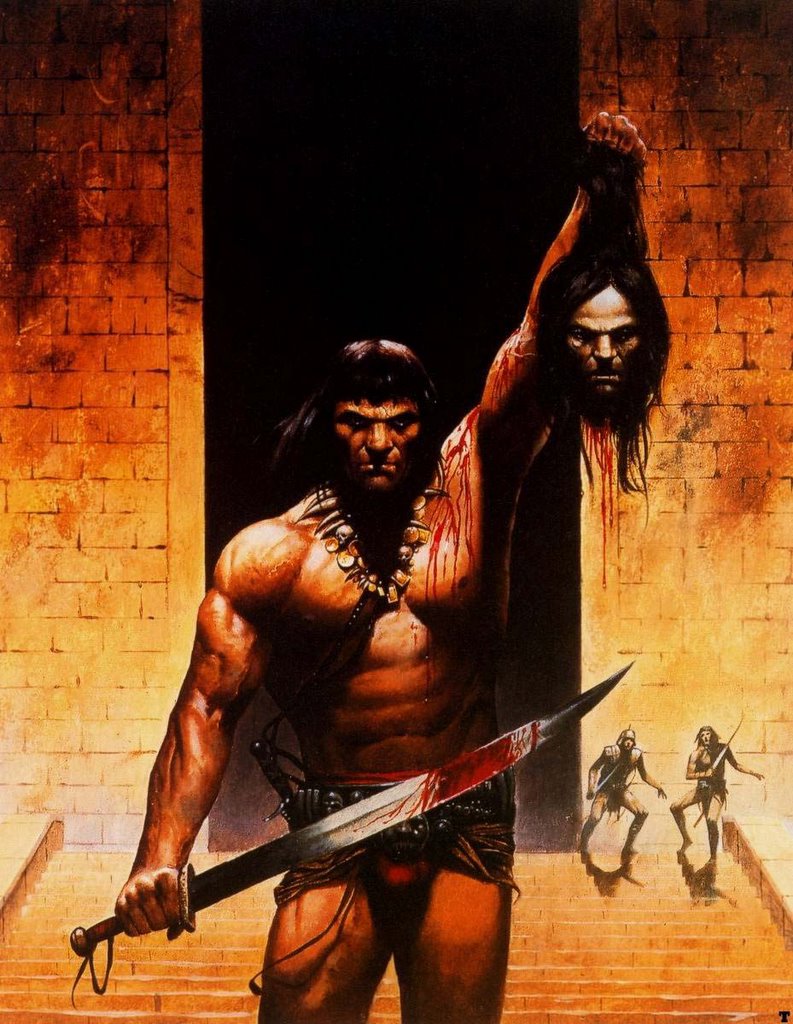
Surprisingly, Conan's love of literature and the arts, and his defense of them, is so deeply rooted that he initially refuses to kill Rinaldo when Rinaldo attacks him. He still believes he can reason with the poet, it is only when he is left no other alternative that he kills the poet (the text is identical in both published and unpublished forms).
“He rushed in, hacking madly, but Conan, recognizing him, shattered his sword with a short terrific chop and with a powerful push of his open hand sent him reeling to the floor.” – Phoenix on the Sword (published)
“He straightened to meet the maddened rush of Rinaldo, who charged in wild and wide open, armed only with a dagger. Conan leaped back, lifting his ax.
‘Rinaldo!’ his voice was strident with desperate urgency. ‘Back! I would not slay you ..’
‘Die, tyrant!’ screamed the mad minstrel, hurling himself headlong on the king. Conan delayed the blow he was loth to deliver, until it was too late. Only when he felt the bite of the steel in his unprotected side did he strike, in a frenzy of blind desperation.
Rinaldo dropped with his skull shattered and Conan reeled back against the wall, blood spurting from between the fingers which gripped his wound.” – Phoenix on the Sword (published)
What is interesting in the narrative is that of all the conspirators, there are twenty in all, none are able to injure Conan with the success of the poet. The poet has both damaged Conan's regime and his body and yet Conan was ever reluctant to, though in the end capable of, slay his greatest enemy.
“’See first to the dagger-wound in my side,’ he bade the court physicians. ‘Rinaldo wrote me a deathly song there, and keen was the stylus.’
‘We should have hanged him long ago,’ gibbered Publius. ‘No good can come of poets..’” – Phoenix on the Sword (published)
What does this tell us of Howard's thoughts regarding the arts? We know that Conan loves them, but we also know how they were used to manipulate the populace and how his own love for them almost cost him his life. Is Howard trying to discuss how Plato's critique of the poets is a good one, while at the same time defending the possible nobility of the poet (as Aristotle does in his Rhetoric)? I think these are questions intentionally posed in the narrative (I know...never guess at intentionality), and make it clear why Conan's first story The Phoenix on the Sword was so compelling to readers when they first read it.
It should be noted that the story was originally submitted as a Kull tale, though I have yet to analyze that draft like I have these two subsequent writings. The Kull version was rejected by Weird Tales and the final (rather than the first) Conan version was the first appearance of what has become a culturally iconic figure.

Thursday, February 09, 2006
Free Enterprise Special Edition Available March 7

The late '90s saw the release of two quintessential Gen-X films, Swingers (1996)and Free Enterprise (1998). Both films center their narratives on small, tight knit, groups of friends dealing with the romantic struggles typical of Gen-X 20-somethings. In a way, they are both a kind of Generation X version of Diner, but unlike Diner, the films star members of the generation the narrative is about, a kind of Diner in real time.
Swingers is the more frequently discussed film, having a kind of Sundance indie cred, but as well as Swingers captures the feel of Gen X as society understands it Free Enterprise captures Generation X as I experienced it. While the "youth culture" market and teen culture first emerged in the post-war Rock-n-Roll era, that market came into its developmental zenith with Generation X.
People who were born in the late-60s to late-70s experienced the first wave of what has been a continuing explosion of popular culture. Kids in the 40s could actually purchase every comic book published, and every fantasy/scifi novel, etc. But Generation X has been a generation both obsessed with, and struggling to keep up with the expansion of, popular culture. Generation X was exposed, thanks to syndication and cable television, to both new and old entertainment media. It is not uncommon to hear a Generation X member have a discussion of how much they love Alfred Hitchcock, Harold Lloyd, The Cure, Superman, G.I. Joe (the original "action figure", the smaller real action figures, and the cartoon), Beethoven, Rollerball, the O.C., and their Xbox 360. In fact, that list barely scratches the surface.
Sure, members of older -- and younger -- generations may discuss the same things, but the explosion and resulting obsession happened during the youth of Generation X and is as defining a characteristic as Drive-ins and drag-racing were for the "American Graffiti" generation, or protests and the "Summer of '69" were for boomers. A large part of what defines a generation is shared cultural experience, and for X-ers that generally means popular culture.
A few of key pop cultural experiences that most Gen-Xers share are Star Trek, Logan's Run, and Star Wars. In fact, when I was an undergrad fraternity member, the question I used to ask "young women" when they were at fraternity parties to see if they were old enough to hit on was, "So...how old were you when you saw Star Wars on the big screen?" It was a quick and easy way to see if they were 18, and one that didn't seem unnatural for most of the people I met.
Free Enterprise is the story of Generation X turning 30. I would say growing up, but that isn't what actually happens; at least not in the way that term is typically used. Generation X has a long way to go before they "put aside childish things" as Paul did in 1 Corinthians 13:11. Generation X is almost entirely defined by those childish things. To tell its story Free Enterprise centers its narrative on the lives of two men approaching "Last Day," a Logan's Run (movie) reference to their 30th birthdays.
Robert (Rafer Weigel) and Mark (Eric McCormack of Will & Grace) are two friends struggling through life in Southern California attempting to make a living with activities associated with their obsessions. Mark is the editor of Geek magazine, who has hopes of becoming a screenwriter/director and has been pitching his latest idea "Bradykiller" in the hopes of achieving that goal. Bradykiller is a kind of The Brady Bunch meets Silence of the Lambs film. Robert is a struggling editor at a direct to video production company. But Mark and Robert have a deeper connection than their interests in popular culture; they both have had William Shatner as an imaginary friend. Shatner (the imaginary friend) has "helped" both of these young men at one time or another in their pasts, and Captain Kirk is the major hero of these men's lives.
Little do these Star Trek, the original series only please, fans know how their lives are about to change when they meet the real William Shatner (played by William Shatner) while they are stopping by a Southern California used book store, the very real Iliad Bookshop. They are looking for pulp paperbacks when they stumble upon their idol. From their first meeting with William Shatner, Mark and Robert begin to discover how much they have in common with their hero and how human their hero is. As they learn that William Shatner is not Captain Kirk, and have to deal with the shock of such a revelation, they find that Shatner is a very human and very likable, if very eccentric, man.
Shatner does wonderful self-parody in this film. My favorite moments with him are when he tries to explain to Mark how it would be great if Mark would help him create his next great project. Shatner wants to do a rap version of Shakespeare's Julius Caesar, with Shatner in all the roles.
The film is a witty, cool, and savvy film about geeks coping with growing up that manages to produce laughter without ever being cruel. The film has so many easter eggs, you have to watch it at least twice.
I highly recommend this film.
For further reading, a great deal of cool trivia regarding the movie can be seen here. Mindfire Entertainment should be releasing a sequel some time this year.
Wednesday, February 08, 2006
What is the Internet for?
Other than Fantasy Baseball, that is.
This link features a streaming video of singing World of Warcraft characters answering that very question. Don't worry if you don't like massive multiplayer online video games, that isn't a pre-requisite to enjoying this film. What is required is a tolerance for blue language, so if you are a child or easily offended avoid the link.
Quick answer...The internet is for porn.
This link features a streaming video of singing World of Warcraft characters answering that very question. Don't worry if you don't like massive multiplayer online video games, that isn't a pre-requisite to enjoying this film. What is required is a tolerance for blue language, so if you are a child or easily offended avoid the link.
Quick answer...The internet is for porn.
Fantasy Baseball Time!!!
Anyone who is interested in joining Cinerati's fantasy baseball team...leave a message in the comments section.
Crazy Kill Bill Parody!
This is why I love the Interwebosphere!
Monday's article discussed the upcoming CBS/Aardman Animations production Creature Comforts. I am running through my, four times and hour, check to see if Cinerati has had any visitors/comments and lo and behold I have a comment!
Only I have no idea what it says. I don't speak Spanish or Portuguese, and I can't really tell the difference between the two when written, so you'll have to translate yourself.
I have never received spam in the haloscan hosted comments before, the comments appeared to have the words "animation and 3D", and the commentator had left a kind emoticon, so I clicked onto Azusa's homepage.
What I found there was one of the bright spots in my day. It appears that Azusa is working on an animated parody of Kill Bill entitled Bill Kill. Anyway, it features a superdeformed rendition of Uma that has to be seen to be believed.
Azusa, and your assistant P Chan (an entertaining character from Ranma 1/2, thanks for stopping by Cinerati.
Monday's article discussed the upcoming CBS/Aardman Animations production Creature Comforts. I am running through my, four times and hour, check to see if Cinerati has had any visitors/comments and lo and behold I have a comment!
Only I have no idea what it says. I don't speak Spanish or Portuguese, and I can't really tell the difference between the two when written, so you'll have to translate yourself.
Uiss, qué chuloo, qué buena pinta tiene, mola la animación aunque sea con plastilina en lugar de 3d
^_^
I have never received spam in the haloscan hosted comments before, the comments appeared to have the words "animation and 3D", and the commentator had left a kind emoticon, so I clicked onto Azusa's homepage.
What I found there was one of the bright spots in my day. It appears that Azusa is working on an animated parody of Kill Bill entitled Bill Kill. Anyway, it features a superdeformed rendition of Uma that has to be seen to be believed.

Azusa, and your assistant P Chan (an entertaining character from Ranma 1/2, thanks for stopping by Cinerati.
Tuesday, February 07, 2006
Blogging the Black Dahlia
As I mentioned in my post discussing my recent car break-in, I attended an LA Press Club event discussing the Black Dahlia murders. Donald Wolfe, the author of The Black Dahlia Files discussed his thesis while attempting to maintain enough mystery to convince the audience to purchase the book. Cathy Seipp, among others, was not convinced of Wolfe's conclusions, but still wanted to read the book. I purchased the book for future reference, but I lack the expertise to critique the book even after I finish reading it.
Larry Harnisch, on the other hand, seems to have the expertise and the time to give a detailed critique of the book and its arguments. Since February 3rd, he has been "blogging the book," and it has made for and interesting experience. Only one problem, if you don't read it regularly the "recent post" functionality of blogger lists the articles in reverse order. So...I thought I would give you the links of the first few in the order they were written.
Quick warning, Larry has only reached page 7 in his critique so get ready for some serious nitpicking.
Larry Harnisch, on the other hand, seems to have the expertise and the time to give a detailed critique of the book and its arguments. Since February 3rd, he has been "blogging the book," and it has made for and interesting experience. Only one problem, if you don't read it regularly the "recent post" functionality of blogger lists the articles in reverse order. So...I thought I would give you the links of the first few in the order they were written.
- Blogging the Wolfe Book
- Blogging the Wolfe Book, "The Monster"
- Blogging the Wolfe Book, Extra! Extra!
- Blogging the Wolfe Book, Sniff Test
- Blogging the Wolfe Book, the Boy on the Bicycle
- Blogging the Wolfe Book, Weather Report
Quick warning, Larry has only reached page 7 in his critique so get ready for some serious nitpicking.
Solving the Transportation Needs of the 21st Century With Mid-20th Century Technology.
Ray Bradbury, speculative author of numerous Sci-Fi classics, has an opinion piece in today's Los Angeles Times. Bradbury laments the growing transportation crisis the Southland will be facing in the next decade and offers a solution reminicent of Robert Heinlein's classic "The Roads Must Roll." It is Bradbury's opinion that the Southland abandon its current plans of Subway expansion, subways are for cold climates, and should begin immediately building a fast, efficient, and clean monorail system.
According to Bradbury, "Anyone who has ridden the Disneyland or Seattle monorails knows how quietly they move."
I'm sorry..."anyone who has ridden the Disneyland..." What the?! Are you kidding me? Should we be looking to yesterdays imagined accomplishments to solve today's problems?
To be fair the same could and should be said about that 19th century innovation, the Subway.
I don't think that solutions that would have worked had they been built at a time when they would have been visionary is the solution to today's problems. And I do honestly believe that Bradbury's early advocacy of the Monorail was visionary, but now it would take too long and cost too much. What we need more of is finding ways to remove the necessity of commuting at all. It is time for a number of businesses in Los Angeles to move, or move at least a segment, of the business to where the employees are.
For many jobs in our modern information/communication age, it doesn't matter where the employees are located. It only matters that the employees have the ability to communicate with one another swiftly and efficiently. I say, "tear down the financial skyscraper!" Let the stock advisors advise their middle class clients close to where they live. Why do we need "centralized" management and oversight? Can we not track efficiency that is remote?
Let us think beyond transportation! Let us use communication! If we can sign business deals with Chinese corporations from our living room, can't we sign local contracts from there as well?
Though...thinking about it...a monorail would be cool. I'd use it, at least until I acquired my flying car.
According to Bradbury, "Anyone who has ridden the Disneyland or Seattle monorails knows how quietly they move."
I'm sorry..."anyone who has ridden the Disneyland..." What the?! Are you kidding me? Should we be looking to yesterdays imagined accomplishments to solve today's problems?
To be fair the same could and should be said about that 19th century innovation, the Subway.
I don't think that solutions that would have worked had they been built at a time when they would have been visionary is the solution to today's problems. And I do honestly believe that Bradbury's early advocacy of the Monorail was visionary, but now it would take too long and cost too much. What we need more of is finding ways to remove the necessity of commuting at all. It is time for a number of businesses in Los Angeles to move, or move at least a segment, of the business to where the employees are.
For many jobs in our modern information/communication age, it doesn't matter where the employees are located. It only matters that the employees have the ability to communicate with one another swiftly and efficiently. I say, "tear down the financial skyscraper!" Let the stock advisors advise their middle class clients close to where they live. Why do we need "centralized" management and oversight? Can we not track efficiency that is remote?
Let us think beyond transportation! Let us use communication! If we can sign business deals with Chinese corporations from our living room, can't we sign local contracts from there as well?
Though...thinking about it...a monorail would be cool. I'd use it, at least until I acquired my flying car.
A Real Life Indiana Jones?
The advertisement links for King Kong and Living Dangerously: The Adventures of Merian C. Cooper over at The Shelf reminded me of a wonderful documentary that has been running on Turner Classic Movies.
I'm King Kong! The Exploits of Merian C. Cooper is a 60 minute documentary covering the life of the director of the original 1933 King Kong directed by Merian C. Cooper. The documentary was released just in time to serve as an interesting biographical background piece for those going to see the 2005 remake directed by Peter Jackson.
I'm King Kong! spends little time on the creation of the 1933 classic, rather it covers the exciting life of the man behind the camera. Merian C. Cooper was a cinematic innovator who, prior to King Kong, had revolutionized the documentary in his travels to dangerous corners of the globe. One innovation in particular was the way he used the camera to capture animals in action. Merian didn't photograph tigers and lions from a distance. Instead he captured the hunting tiger in action and filmed elephant stampedes from within the stampede itself. Cooper's documentary's pushed the envelope both technologically and narratively. Instead of presenting apparent scientific, or anthropological, observations, Cooper attempted to present the stories of the peoples he was documenting.
But the adventures of Merian C. Cooper don't begin with his explorations and documentaries, no they begin much earlier in his life. Cooper served as a bomber pilot during the First World War and stayed after the war in Poland where he served as a part of an independant air squadron battling the invading during the Russo-Polish war. It was this brief segment of Cooper's life that I found the most intriguing.
Ever since I was young I have read the Blackhawk comic books, but I (like Wikipedia) never made a connection to any real world pilot squadron. To me the Blackhawks were an idea only applicable to the Second World War, though they also served as inspiration for the pilots in Sky Captain and the World of Tommorrow. While the creators of Blackhawk were probably unaware of Cooper's piloting in Poland during the Russo-Poland war, this part of the documentary made it clear that Cooper was as much a real life Blackhawk as he was a real life Indiana Jones.
Cooper's life, as presented in I'm King Kong, is a life of adventure and struggle against all odds. It comes then as no surprise that Cooper's representation of the Denham character is an exercise of self-portrait. The exercise is taken even further with Jack Black's version of the character in the latest Kong film. Denham, like Cooper, was a man of action who lived close to the edge. If you get a chance, watch I'm King Kong the next time it shows on TCM.
I'm King Kong! The Exploits of Merian C. Cooper is a 60 minute documentary covering the life of the director of the original 1933 King Kong directed by Merian C. Cooper. The documentary was released just in time to serve as an interesting biographical background piece for those going to see the 2005 remake directed by Peter Jackson.
I'm King Kong! spends little time on the creation of the 1933 classic, rather it covers the exciting life of the man behind the camera. Merian C. Cooper was a cinematic innovator who, prior to King Kong, had revolutionized the documentary in his travels to dangerous corners of the globe. One innovation in particular was the way he used the camera to capture animals in action. Merian didn't photograph tigers and lions from a distance. Instead he captured the hunting tiger in action and filmed elephant stampedes from within the stampede itself. Cooper's documentary's pushed the envelope both technologically and narratively. Instead of presenting apparent scientific, or anthropological, observations, Cooper attempted to present the stories of the peoples he was documenting.
But the adventures of Merian C. Cooper don't begin with his explorations and documentaries, no they begin much earlier in his life. Cooper served as a bomber pilot during the First World War and stayed after the war in Poland where he served as a part of an independant air squadron battling the invading during the Russo-Polish war. It was this brief segment of Cooper's life that I found the most intriguing.
Ever since I was young I have read the Blackhawk comic books, but I (like Wikipedia) never made a connection to any real world pilot squadron. To me the Blackhawks were an idea only applicable to the Second World War, though they also served as inspiration for the pilots in Sky Captain and the World of Tommorrow. While the creators of Blackhawk were probably unaware of Cooper's piloting in Poland during the Russo-Poland war, this part of the documentary made it clear that Cooper was as much a real life Blackhawk as he was a real life Indiana Jones.
Cooper's life, as presented in I'm King Kong, is a life of adventure and struggle against all odds. It comes then as no surprise that Cooper's representation of the Denham character is an exercise of self-portrait. The exercise is taken even further with Jack Black's version of the character in the latest Kong film. Denham, like Cooper, was a man of action who lived close to the edge. If you get a chance, watch I'm King Kong the next time it shows on TCM.
Monday, February 06, 2006
Aardman Productions and CBS Sign Deal for Clay Animated Series

2006 is looking to be a good year for Aardman Animations, and it is much needed -- especially after a 2005 fire destroyed artifacts from earlier animation projects. Coming quick on the heels of their Oscar nomination for last year's Wallace and Gromit film, Aardman has signed a deal to produce an American Version of its Creature Comforts Claymation series. (You can view a clip of the BBC version here.)
According to ICV2, "The CBS Creature Comforts series will be produced in England and Los Angeles, with King of the Hill scribe Kit Boss serving as executive producer." The Futon Critic has additional details:
The project, which is being targeted for a January 2007 bow at the earliest, is a U.S. version of the ITV series of the same name. Here's how BBC America, which also aired the series last year, describes the project: "Creature Comforts, a hilarious collection of film shorts from the makers of Wallace & Gromit, puts interview responses from the British public into the mouths of over one hundred animal characters. In Creature Comforts, a shar-pei will do his best impression of Julia Roberts, hens will explain how feng shui should be incorporated into the work place, and sea lions will speak out against liposuction."
The show has been given an initial order of seven episodes and is slated to be run during CBS's primetime lineup. As both Futon and ICV2 point out though, with the development time required to begin an animated project, we wond be seeing any episodes until January 2007 making Creature Comforts one of the first announced mid-season pick ups for next year.
Aardman Animation has a long running history of well crafted programming and Number One greatly looks forward to this show's first broadcast.
Friday, February 03, 2006
Mad Cowgirl to Premiere at San Francisco Indie Fest

Luke Y. Thompson, otherwise known as LYT in our comments section, stars in (and was assistant director) Gregory Hatanaka's feature length action/horror film Mad Cowgirl which premieres this weekend at San Francisco's annual Indie Fest.
According to the Mad Cowgirl Website, the film tells the story of:
Therese, an ass-kicking health inspector with a failed marriage, an on-going affair with a creepy televangelist, nymphomania, and an obsession with old kung-fu movies. Further complicating her life is a very questionable relationship with her brother Thierry, a meat importer who may (or may not) have infected her with mad cow disease.

The film will be screening at the Roxie Cinema on Saturday 2/04 at 9:30pm and has already been given positive reviews by the San Francisco Examiner and the San Francisco Bay Guardian.
The film appears to have been shot on, the great boon to the indie film, a Mini-DV camera. Shooting in Mini-DV, while not as "pretty" as film, provides filmmakers with an inexpensive and useful alternative to scrounging for unused stock in order to film their projects. By the looks of the preview and the stills I have seen, the film is lit in a way that minimizes the disadvantages of the DV camera and allows the director to allocate funds to what is truly important in a low budget horror/action film...blood.
Sadly, I won't be able to watch LYT's latest film until it plays at the Silverlake Film Festival in March, but it looks like it is right up my alley (and maybe Uberbrian's as well).
Nostalgia and a Love of Westernized Chop Socky
With all the recent mentions of jiang-hu, Crouching Tiger, Hidden Dragon, House of Flying Daggers and Outlaws of the Water Margin (oh...I haven't mentioned that) in addition to my recent "I'm above all that" Chuck Norris post, some of you out in the "net" may think that I am not a fan of cheezy Westernized Chop Socky. Rereading the Chuck post, I noticed that my genuine enjoyment of his films may have been lost under the sarcastic tone referring to his new novel. I assure you I cut my teeth on Shaw Brothers movies and the Americanized martial arts movie.
My middle school afternoons were filled with hours watching USA, HBO, and Showtime presentations of Enter the Ninja ("Neenja!? I want my neenja now!), Good Guys Wear Black (which had more action in it when originally screened, I swear!), and Five Deadly Venoms to mention but a few. As I grew, so did my love of the martial arts action film. But there are two Americanized Chop Socky films that stand head and shoulders above the rest in my mind. One from the '80s (the height of the genre) and the other from the early '90s, Berry Gordy's: The Last Dragon starring Taimak and Jeff Speakman's straight forward tale of revenge The Perfect Weapon (only one of which stars the ever present Al Leong).
The Last Dragon is the story of Bruce Leroy, a young man in search of enlightenment and full knowledge of the martial arts. His goal is to be as great as his idol...Bruce Lee. He knows that a true master is in harmony both in body and mind and the movie is the tale of his journey of discovery. You see Bruce doesn't believe he is a master because he has not been able to attain a harmonious "glow" when practicing his martial arts. Even skilled warriors are able to attain a glow on their hands, the true master can emit one from his entire body.
Thrown into the mix is the Shogun of Harlem, Sho'Nuff, played appropriately over the top by Julius Carry (you may remember him from Brisco County Junior). The Shogun is the obligatory "evil overlord." In a Samurai film, he would be the evil Ronin or the Oyabun's chief assassin. The Shogun seeks fame, power, and the destruction of all who claim to be masters of the martial arts. His very reason for existance, in this film, is the utter destruction of Bruce Leroy.
Leroy, to give him credit, avoids fighting the Shogun for as long as possible. He delays and seeks non-violent resolution, but in the end he must make a heroic stand. Only to discover that the Shogun, laughable as Leroy imagined the Shogun to be, is capable of achieving enough focus to bring a glow to his hands.

How can this villain be a greater martial artist than our hero?
The answer is that he can't. Eventually, Leroy comes to understand that he had blinded himself to his own talents and is finally able to achieve a sublime glow covering his entire body.
The film is enjoyable both as a comedy and as an action film. It predates I'm Gonna Git You, Sucka by about three years, but like Sucka it plays around with blaxploitation conventions. In fact, I prefer Dragon to the Wayans classic.
The Perfect Weapon is an attempt to combine the "bad kid made good through martial arts" narrative with the traditional kung fu trope of revenge. Jeff Speakman, the star of the film, does an excellent job of translating real world martial arts into big screen action. Most, if not all, of the choreography is based on real Kenpo techniques and action is delivered straight without wires or much need for suspended disbelief. The suspension is needed for the narrative, not the action.
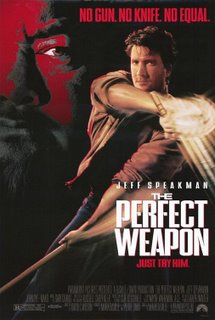
I really can't add anything new to the discussion of the film. All I can do is agree with Luke Y. Thompson who said:
And Joe Bob Briggs who captures the essence of the film perfectly in his review when he writes:
Add these two low-budget action classics to your netflix queue as soon as possible.
My middle school afternoons were filled with hours watching USA, HBO, and Showtime presentations of Enter the Ninja ("Neenja!? I want my neenja now!), Good Guys Wear Black (which had more action in it when originally screened, I swear!), and Five Deadly Venoms to mention but a few. As I grew, so did my love of the martial arts action film. But there are two Americanized Chop Socky films that stand head and shoulders above the rest in my mind. One from the '80s (the height of the genre) and the other from the early '90s, Berry Gordy's: The Last Dragon starring Taimak and Jeff Speakman's straight forward tale of revenge The Perfect Weapon (only one of which stars the ever present Al Leong).
The Last Dragon is the story of Bruce Leroy, a young man in search of enlightenment and full knowledge of the martial arts. His goal is to be as great as his idol...Bruce Lee. He knows that a true master is in harmony both in body and mind and the movie is the tale of his journey of discovery. You see Bruce doesn't believe he is a master because he has not been able to attain a harmonious "glow" when practicing his martial arts. Even skilled warriors are able to attain a glow on their hands, the true master can emit one from his entire body.
Thrown into the mix is the Shogun of Harlem, Sho'Nuff, played appropriately over the top by Julius Carry (you may remember him from Brisco County Junior). The Shogun is the obligatory "evil overlord." In a Samurai film, he would be the evil Ronin or the Oyabun's chief assassin. The Shogun seeks fame, power, and the destruction of all who claim to be masters of the martial arts. His very reason for existance, in this film, is the utter destruction of Bruce Leroy.
Leroy, to give him credit, avoids fighting the Shogun for as long as possible. He delays and seeks non-violent resolution, but in the end he must make a heroic stand. Only to discover that the Shogun, laughable as Leroy imagined the Shogun to be, is capable of achieving enough focus to bring a glow to his hands.

How can this villain be a greater martial artist than our hero?
The answer is that he can't. Eventually, Leroy comes to understand that he had blinded himself to his own talents and is finally able to achieve a sublime glow covering his entire body.
The film is enjoyable both as a comedy and as an action film. It predates I'm Gonna Git You, Sucka by about three years, but like Sucka it plays around with blaxploitation conventions. In fact, I prefer Dragon to the Wayans classic.
The Perfect Weapon is an attempt to combine the "bad kid made good through martial arts" narrative with the traditional kung fu trope of revenge. Jeff Speakman, the star of the film, does an excellent job of translating real world martial arts into big screen action. Most, if not all, of the choreography is based on real Kenpo techniques and action is delivered straight without wires or much need for suspended disbelief. The suspension is needed for the narrative, not the action.
I really can't add anything new to the discussion of the film. All I can do is agree with Luke Y. Thompson who said:
"Better than expected actioner that was supposed to launch Speakman into a big-time movie career; then Street Knight shot that notion down."
And Joe Bob Briggs who captures the essence of the film perfectly in his review when he writes:
Speakman's movie, "The Perfect Weapon," is the first flick that's so true to martial-arts teaching that the body count is only ONE. That's uno! Because, after all, the original idea was self-DEFENSE, right?
Jeff plays a hothead who takes on the Korean Mafia, trying to get even for the murder of an old friend by ruthless drug goons. Everybody thinks Speakman's an idiot, including his cop father, his cop brother, his kenpo karate master, his fighting Korean girlfriend, and several dozen oriental head-bashers. The surprising thing about the movie is that, as it turns out, he IS an idiot. He puts a high school kid in the hospital, almost gets his brother killed, almost kills the WRONG gangster, and endangers the lives of several other people, including a 12-year-old kid--until he figures out to "become the dragon, not the tiger." (I'm not going into it right now. It's some of that "Karate Kid" chopsocky poetry they use right before the big final fight.)
So anyhow, what's REALLY strange is that kenpo karate looks more like belly-dancing than it looks like kung-fu. You've got all this hand motion, and these arm swings, like Steve Martin doing "King Tut," and you don't really think it's a very MACHO martial-arts technique--until you see Speakman knock out FOUR guys in FIVE seconds. Excellent.

Add these two low-budget action classics to your netflix queue as soon as possible.
Thursday, February 02, 2006
Questions for Readers...Yeah, Readers...Like We Have Those.
I started this blog some time ago and it seems that only recently have we begun to have any regularity of visitation by others. At least I think that's true, one can never tell with the various "tracking" methods available on the internet. I am going to operate under the assumption that we do in fact have more than two readers, more than just Fritz, Rob, and me that is. But I want more readers than the current very select, read small, group of visitors we currently enjoy.
That's were you, my loyal visitors, come in. Since this is a pop-culture blog, I want to know what aspects of popular culture you are interested in reading about so that Cinerati can provide content that is engaging to you and which you will be able to recommend to others. I would appreciate it if you would take the following survey. You can answer the questions in the comments section, use a trackback from your own website, or both.
Thanks for your time and even if you don't answer...thanks for visiting.
That's were you, my loyal visitors, come in. Since this is a pop-culture blog, I want to know what aspects of popular culture you are interested in reading about so that Cinerati can provide content that is engaging to you and which you will be able to recommend to others. I would appreciate it if you would take the following survey. You can answer the questions in the comments section, use a trackback from your own website, or both.
1) What areas of popular culture would you like to see enjoy more discussion on Cinerati?
2) What are five of your favorite "popcorn" movies? (I don't like to ask absolute favorites, or lists, because such things are fluid.)
2a) Would you like to see more film reviews/discussion on the site?
3) What are five of your favorite boardgames?
3a) Would you like to see more boardgame reviews/discussion on this site?
4) What are a few of the television shows that really interest you of late?
4a) Would you like to see more discussion of Television shows? An example of this kind of reporting would be Shouting into the Wind's excellent "The Watch List" and my Rollergirls article.
5) What videogames do you enjoy?
5a) Would you like to see more VG discussion on this site.
6) Do you play an MMORPG? Which one? What Server? Can I be in your guild?
7) Would you be interested in posting even as a "Double Post" with links to your own site here at Cinerati?
8) Does anyone know how to get The Bear at TTLB to respond? I would really like to get my pop-culture "community" rolling.
9) Do you have any other recommendations? How can we here at Cinerati better serve you? What are some areas we have overlooked?
Thanks for your time and even if you don't answer...thanks for visiting.
Wednesday, February 01, 2006
A Real Chuck Norris Fact
Like Uberbrian, I think that the whole "Chuck Norris Facts" thing has gone a little too far. You know an internet joke/pop-culture game has gone too far when it gets an article in the oh so topical Los Angeles Times. But unlike Uberbrian, I refuse to hide my legitimate love of things Chuck Norris. I just watched The Octagon dammit and I will be vindicated!
So in the spirit of genuine, rather than hipster poseur, Chuck Norris fandom, I announce the first real Chuck Norris fact. It appears that the ultra-action star has found a way to prolong his status as action hero into the infinite. It began with his "writing" of the official version of how he himself became so legendary. Chuck Norris fans proudly own this book in their bookselves, right between Shatner's Star Trek Memories and Heidegger's Being and Time.
No true Chuck fan can be without their first edition copy of Against All Odds. By the way, I am not kidding.
Following his memoir, Chuck seems to have acquired the writing bug. After all, as a literary character Chuck (or his literary counterpart) can live heroically into perpetuity. So Chuck fans need to rush out and buy The Justice Riders written by Ken Abraham, Aaron Norris, Tim Grayem, and Chuck Norris. With four authors and 295 pages, you know this is the great American novel.
So in the spirit of genuine, rather than hipster poseur, Chuck Norris fandom, I announce the first real Chuck Norris fact. It appears that the ultra-action star has found a way to prolong his status as action hero into the infinite. It began with his "writing" of the official version of how he himself became so legendary. Chuck Norris fans proudly own this book in their bookselves, right between Shatner's Star Trek Memories and Heidegger's Being and Time.
No true Chuck fan can be without their first edition copy of Against All Odds. By the way, I am not kidding.
Following his memoir, Chuck seems to have acquired the writing bug. After all, as a literary character Chuck (or his literary counterpart) can live heroically into perpetuity. So Chuck fans need to rush out and buy The Justice Riders written by Ken Abraham, Aaron Norris, Tim Grayem, and Chuck Norris. With four authors and 295 pages, you know this is the great American novel.
Ezra Justice's orders from General Sherman are simple. Form a small, elite team of soldiers and make things difficult for the Confederacy. If caught, no one will claim knowledge of Justice, his men, or their orders. The Justice Riders are off and disrupting the Confederate's supply lines as best they can. But the team attracts the attention of Mordecai Slate and his "Death Raiders," and the battle becomes a far more personal one.
Dr. Nokes' State of the Blog the Cinerati Response
While we here at Cinerati agree with the vast majority of what Professor Nokes discussed in his State of the Blog Address, Number One remains confused at the good professor's love of the new Battlestar Galactica series. Number One believes that time spent watching that show could be better spent watching meaningful discussions of the human condition, shows like Rollergirls.
Number One also laments that the professor has, in all his tenure as a Medieval blogger, failed to once do an analysis of Camelot 3000, let alone mention the pop culture work.
Aside from these glaring problems, Number One looks forward to another year of spreading irony and ignorance while helping others waste precious moments that could be spent inventing wonders.
Number One also laments that the professor has, in all his tenure as a Medieval blogger, failed to once do an analysis of Camelot 3000, let alone mention the pop culture work.
Aside from these glaring problems, Number One looks forward to another year of spreading irony and ignorance while helping others waste precious moments that could be spent inventing wonders.
Subscribe to:
Posts (Atom)