The advertisement links for King Kong and Living Dangerously: The Adventures of Merian C. Cooper over at The Shelf reminded me of a wonderful documentary that has been running on Turner Classic Movies.
I'm King Kong! The Exploits of Merian C. Cooper is a 60 minute documentary covering the life of the director of the original 1933 King Kong directed by Merian C. Cooper. The documentary was released just in time to serve as an interesting biographical background piece for those going to see the 2005 remake directed by Peter Jackson.
I'm King Kong! spends little time on the creation of the 1933 classic, rather it covers the exciting life of the man behind the camera. Merian C. Cooper was a cinematic innovator who, prior to King Kong, had revolutionized the documentary in his travels to dangerous corners of the globe. One innovation in particular was the way he used the camera to capture animals in action. Merian didn't photograph tigers and lions from a distance. Instead he captured the hunting tiger in action and filmed elephant stampedes from within the stampede itself. Cooper's documentary's pushed the envelope both technologically and narratively. Instead of presenting apparent scientific, or anthropological, observations, Cooper attempted to present the stories of the peoples he was documenting.
But the adventures of Merian C. Cooper don't begin with his explorations and documentaries, no they begin much earlier in his life. Cooper served as a bomber pilot during the First World War and stayed after the war in Poland where he served as a part of an independant air squadron battling the invading during the Russo-Polish war. It was this brief segment of Cooper's life that I found the most intriguing.
Ever since I was young I have read the Blackhawk comic books, but I (like Wikipedia) never made a connection to any real world pilot squadron. To me the Blackhawks were an idea only applicable to the Second World War, though they also served as inspiration for the pilots in Sky Captain and the World of Tommorrow. While the creators of Blackhawk were probably unaware of Cooper's piloting in Poland during the Russo-Poland war, this part of the documentary made it clear that Cooper was as much a real life Blackhawk as he was a real life Indiana Jones.
Cooper's life, as presented in I'm King Kong, is a life of adventure and struggle against all odds. It comes then as no surprise that Cooper's representation of the Denham character is an exercise of self-portrait. The exercise is taken even further with Jack Black's version of the character in the latest Kong film. Denham, like Cooper, was a man of action who lived close to the edge. If you get a chance, watch I'm King Kong the next time it shows on TCM.

Tuesday, February 07, 2006


Monday, February 06, 2006
Aardman Productions and CBS Sign Deal for Clay Animated Series
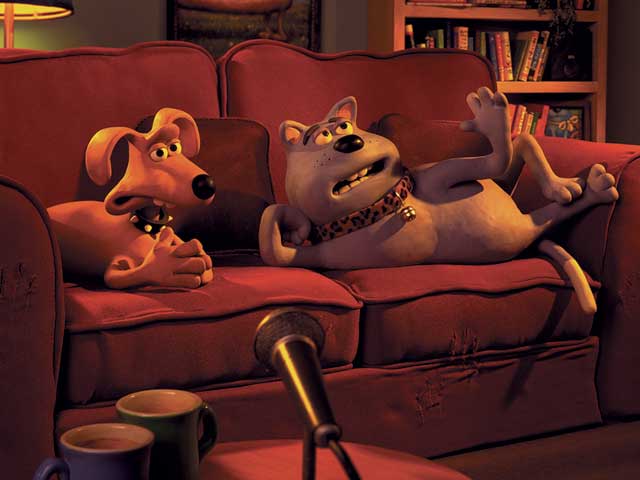
2006 is looking to be a good year for Aardman Animations, and it is much needed -- especially after a 2005 fire destroyed artifacts from earlier animation projects. Coming quick on the heels of their Oscar nomination for last year's Wallace and Gromit film, Aardman has signed a deal to produce an American Version of its Creature Comforts Claymation series. (You can view a clip of the BBC version here.)
According to ICV2, "The CBS Creature Comforts series will be produced in England and Los Angeles, with King of the Hill scribe Kit Boss serving as executive producer." The Futon Critic has additional details:
The project, which is being targeted for a January 2007 bow at the earliest, is a U.S. version of the ITV series of the same name. Here's how BBC America, which also aired the series last year, describes the project: "Creature Comforts, a hilarious collection of film shorts from the makers of Wallace & Gromit, puts interview responses from the British public into the mouths of over one hundred animal characters. In Creature Comforts, a shar-pei will do his best impression of Julia Roberts, hens will explain how feng shui should be incorporated into the work place, and sea lions will speak out against liposuction."
The show has been given an initial order of seven episodes and is slated to be run during CBS's primetime lineup. As both Futon and ICV2 point out though, with the development time required to begin an animated project, we wond be seeing any episodes until January 2007 making Creature Comforts one of the first announced mid-season pick ups for next year.
Aardman Animation has a long running history of well crafted programming and Number One greatly looks forward to this show's first broadcast.
Friday, February 03, 2006
Mad Cowgirl to Premiere at San Francisco Indie Fest

Luke Y. Thompson, otherwise known as LYT in our comments section, stars in (and was assistant director) Gregory Hatanaka's feature length action/horror film Mad Cowgirl which premieres this weekend at San Francisco's annual Indie Fest.
According to the Mad Cowgirl Website, the film tells the story of:
Therese, an ass-kicking health inspector with a failed marriage, an on-going affair with a creepy televangelist, nymphomania, and an obsession with old kung-fu movies. Further complicating her life is a very questionable relationship with her brother Thierry, a meat importer who may (or may not) have infected her with mad cow disease.

The film will be screening at the Roxie Cinema on Saturday 2/04 at 9:30pm and has already been given positive reviews by the San Francisco Examiner and the San Francisco Bay Guardian.
The film appears to have been shot on, the great boon to the indie film, a Mini-DV camera. Shooting in Mini-DV, while not as "pretty" as film, provides filmmakers with an inexpensive and useful alternative to scrounging for unused stock in order to film their projects. By the looks of the preview and the stills I have seen, the film is lit in a way that minimizes the disadvantages of the DV camera and allows the director to allocate funds to what is truly important in a low budget horror/action film...blood.
Sadly, I won't be able to watch LYT's latest film until it plays at the Silverlake Film Festival in March, but it looks like it is right up my alley (and maybe Uberbrian's as well).
Nostalgia and a Love of Westernized Chop Socky
With all the recent mentions of jiang-hu, Crouching Tiger, Hidden Dragon, House of Flying Daggers and Outlaws of the Water Margin (oh...I haven't mentioned that) in addition to my recent "I'm above all that" Chuck Norris post, some of you out in the "net" may think that I am not a fan of cheezy Westernized Chop Socky. Rereading the Chuck post, I noticed that my genuine enjoyment of his films may have been lost under the sarcastic tone referring to his new novel. I assure you I cut my teeth on Shaw Brothers movies and the Americanized martial arts movie.
My middle school afternoons were filled with hours watching USA, HBO, and Showtime presentations of Enter the Ninja ("Neenja!? I want my neenja now!), Good Guys Wear Black (which had more action in it when originally screened, I swear!), and Five Deadly Venoms to mention but a few. As I grew, so did my love of the martial arts action film. But there are two Americanized Chop Socky films that stand head and shoulders above the rest in my mind. One from the '80s (the height of the genre) and the other from the early '90s, Berry Gordy's: The Last Dragon starring Taimak and Jeff Speakman's straight forward tale of revenge The Perfect Weapon (only one of which stars the ever present Al Leong).
The Last Dragon is the story of Bruce Leroy, a young man in search of enlightenment and full knowledge of the martial arts. His goal is to be as great as his idol...Bruce Lee. He knows that a true master is in harmony both in body and mind and the movie is the tale of his journey of discovery. You see Bruce doesn't believe he is a master because he has not been able to attain a harmonious "glow" when practicing his martial arts. Even skilled warriors are able to attain a glow on their hands, the true master can emit one from his entire body.
Thrown into the mix is the Shogun of Harlem, Sho'Nuff, played appropriately over the top by Julius Carry (you may remember him from Brisco County Junior). The Shogun is the obligatory "evil overlord." In a Samurai film, he would be the evil Ronin or the Oyabun's chief assassin. The Shogun seeks fame, power, and the destruction of all who claim to be masters of the martial arts. His very reason for existance, in this film, is the utter destruction of Bruce Leroy.
Leroy, to give him credit, avoids fighting the Shogun for as long as possible. He delays and seeks non-violent resolution, but in the end he must make a heroic stand. Only to discover that the Shogun, laughable as Leroy imagined the Shogun to be, is capable of achieving enough focus to bring a glow to his hands.

How can this villain be a greater martial artist than our hero?
The answer is that he can't. Eventually, Leroy comes to understand that he had blinded himself to his own talents and is finally able to achieve a sublime glow covering his entire body.
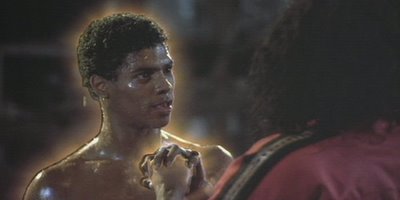
The film is enjoyable both as a comedy and as an action film. It predates I'm Gonna Git You, Sucka by about three years, but like Sucka it plays around with blaxploitation conventions. In fact, I prefer Dragon to the Wayans classic.
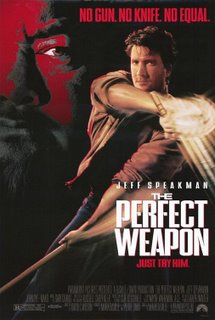
The Perfect Weapon is an attempt to combine the "bad kid made good through martial arts" narrative with the traditional kung fu trope of revenge. Jeff Speakman, the star of the film, does an excellent job of translating real world martial arts into big screen action. Most, if not all, of the choreography is based on real Kenpo techniques and action is delivered straight without wires or much need for suspended disbelief. The suspension is needed for the narrative, not the action.
I really can't add anything new to the discussion of the film. All I can do is agree with Luke Y. Thompson who said:
And Joe Bob Briggs who captures the essence of the film perfectly in his review when he writes:
Add these two low-budget action classics to your netflix queue as soon as possible.
My middle school afternoons were filled with hours watching USA, HBO, and Showtime presentations of Enter the Ninja ("Neenja!? I want my neenja now!), Good Guys Wear Black (which had more action in it when originally screened, I swear!), and Five Deadly Venoms to mention but a few. As I grew, so did my love of the martial arts action film. But there are two Americanized Chop Socky films that stand head and shoulders above the rest in my mind. One from the '80s (the height of the genre) and the other from the early '90s, Berry Gordy's: The Last Dragon starring Taimak and Jeff Speakman's straight forward tale of revenge The Perfect Weapon (only one of which stars the ever present Al Leong).
The Last Dragon is the story of Bruce Leroy, a young man in search of enlightenment and full knowledge of the martial arts. His goal is to be as great as his idol...Bruce Lee. He knows that a true master is in harmony both in body and mind and the movie is the tale of his journey of discovery. You see Bruce doesn't believe he is a master because he has not been able to attain a harmonious "glow" when practicing his martial arts. Even skilled warriors are able to attain a glow on their hands, the true master can emit one from his entire body.
Thrown into the mix is the Shogun of Harlem, Sho'Nuff, played appropriately over the top by Julius Carry (you may remember him from Brisco County Junior). The Shogun is the obligatory "evil overlord." In a Samurai film, he would be the evil Ronin or the Oyabun's chief assassin. The Shogun seeks fame, power, and the destruction of all who claim to be masters of the martial arts. His very reason for existance, in this film, is the utter destruction of Bruce Leroy.
Leroy, to give him credit, avoids fighting the Shogun for as long as possible. He delays and seeks non-violent resolution, but in the end he must make a heroic stand. Only to discover that the Shogun, laughable as Leroy imagined the Shogun to be, is capable of achieving enough focus to bring a glow to his hands.

How can this villain be a greater martial artist than our hero?
The answer is that he can't. Eventually, Leroy comes to understand that he had blinded himself to his own talents and is finally able to achieve a sublime glow covering his entire body.
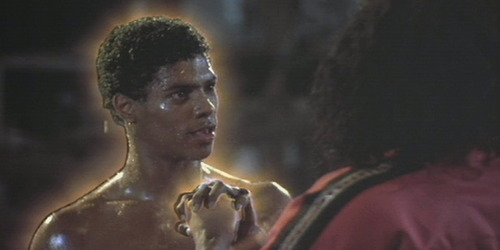
The film is enjoyable both as a comedy and as an action film. It predates I'm Gonna Git You, Sucka by about three years, but like Sucka it plays around with blaxploitation conventions. In fact, I prefer Dragon to the Wayans classic.
The Perfect Weapon is an attempt to combine the "bad kid made good through martial arts" narrative with the traditional kung fu trope of revenge. Jeff Speakman, the star of the film, does an excellent job of translating real world martial arts into big screen action. Most, if not all, of the choreography is based on real Kenpo techniques and action is delivered straight without wires or much need for suspended disbelief. The suspension is needed for the narrative, not the action.
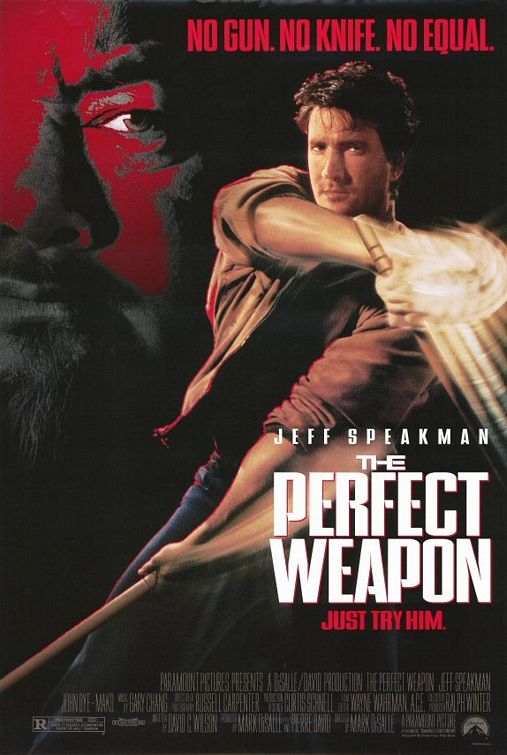
I really can't add anything new to the discussion of the film. All I can do is agree with Luke Y. Thompson who said:
"Better than expected actioner that was supposed to launch Speakman into a big-time movie career; then Street Knight shot that notion down."
And Joe Bob Briggs who captures the essence of the film perfectly in his review when he writes:
Speakman's movie, "The Perfect Weapon," is the first flick that's so true to martial-arts teaching that the body count is only ONE. That's uno! Because, after all, the original idea was self-DEFENSE, right?
Jeff plays a hothead who takes on the Korean Mafia, trying to get even for the murder of an old friend by ruthless drug goons. Everybody thinks Speakman's an idiot, including his cop father, his cop brother, his kenpo karate master, his fighting Korean girlfriend, and several dozen oriental head-bashers. The surprising thing about the movie is that, as it turns out, he IS an idiot. He puts a high school kid in the hospital, almost gets his brother killed, almost kills the WRONG gangster, and endangers the lives of several other people, including a 12-year-old kid--until he figures out to "become the dragon, not the tiger." (I'm not going into it right now. It's some of that "Karate Kid" chopsocky poetry they use right before the big final fight.)
So anyhow, what's REALLY strange is that kenpo karate looks more like belly-dancing than it looks like kung-fu. You've got all this hand motion, and these arm swings, like Steve Martin doing "King Tut," and you don't really think it's a very MACHO martial-arts technique--until you see Speakman knock out FOUR guys in FIVE seconds. Excellent.

Add these two low-budget action classics to your netflix queue as soon as possible.
Thursday, February 02, 2006
Questions for Readers...Yeah, Readers...Like We Have Those.
I started this blog some time ago and it seems that only recently have we begun to have any regularity of visitation by others. At least I think that's true, one can never tell with the various "tracking" methods available on the internet. I am going to operate under the assumption that we do in fact have more than two readers, more than just Fritz, Rob, and me that is. But I want more readers than the current very select, read small, group of visitors we currently enjoy.
That's were you, my loyal visitors, come in. Since this is a pop-culture blog, I want to know what aspects of popular culture you are interested in reading about so that Cinerati can provide content that is engaging to you and which you will be able to recommend to others. I would appreciate it if you would take the following survey. You can answer the questions in the comments section, use a trackback from your own website, or both.
Thanks for your time and even if you don't answer...thanks for visiting.
That's were you, my loyal visitors, come in. Since this is a pop-culture blog, I want to know what aspects of popular culture you are interested in reading about so that Cinerati can provide content that is engaging to you and which you will be able to recommend to others. I would appreciate it if you would take the following survey. You can answer the questions in the comments section, use a trackback from your own website, or both.
1) What areas of popular culture would you like to see enjoy more discussion on Cinerati?
2) What are five of your favorite "popcorn" movies? (I don't like to ask absolute favorites, or lists, because such things are fluid.)
2a) Would you like to see more film reviews/discussion on the site?
3) What are five of your favorite boardgames?
3a) Would you like to see more boardgame reviews/discussion on this site?
4) What are a few of the television shows that really interest you of late?
4a) Would you like to see more discussion of Television shows? An example of this kind of reporting would be Shouting into the Wind's excellent "The Watch List" and my Rollergirls article.
5) What videogames do you enjoy?
5a) Would you like to see more VG discussion on this site.
6) Do you play an MMORPG? Which one? What Server? Can I be in your guild?
7) Would you be interested in posting even as a "Double Post" with links to your own site here at Cinerati?
8) Does anyone know how to get The Bear at TTLB to respond? I would really like to get my pop-culture "community" rolling.
9) Do you have any other recommendations? How can we here at Cinerati better serve you? What are some areas we have overlooked?
Thanks for your time and even if you don't answer...thanks for visiting.
Wednesday, February 01, 2006
A Real Chuck Norris Fact
Like Uberbrian, I think that the whole "Chuck Norris Facts" thing has gone a little too far. You know an internet joke/pop-culture game has gone too far when it gets an article in the oh so topical Los Angeles Times. But unlike Uberbrian, I refuse to hide my legitimate love of things Chuck Norris. I just watched The Octagon dammit and I will be vindicated!
So in the spirit of genuine, rather than hipster poseur, Chuck Norris fandom, I announce the first real Chuck Norris fact. It appears that the ultra-action star has found a way to prolong his status as action hero into the infinite. It began with his "writing" of the official version of how he himself became so legendary. Chuck Norris fans proudly own this book in their bookselves, right between Shatner's Star Trek Memories and Heidegger's Being and Time.
No true Chuck fan can be without their first edition copy of Against All Odds. By the way, I am not kidding.
Following his memoir, Chuck seems to have acquired the writing bug. After all, as a literary character Chuck (or his literary counterpart) can live heroically into perpetuity. So Chuck fans need to rush out and buy The Justice Riders written by Ken Abraham, Aaron Norris, Tim Grayem, and Chuck Norris. With four authors and 295 pages, you know this is the great American novel.
So in the spirit of genuine, rather than hipster poseur, Chuck Norris fandom, I announce the first real Chuck Norris fact. It appears that the ultra-action star has found a way to prolong his status as action hero into the infinite. It began with his "writing" of the official version of how he himself became so legendary. Chuck Norris fans proudly own this book in their bookselves, right between Shatner's Star Trek Memories and Heidegger's Being and Time.
No true Chuck fan can be without their first edition copy of Against All Odds. By the way, I am not kidding.
Following his memoir, Chuck seems to have acquired the writing bug. After all, as a literary character Chuck (or his literary counterpart) can live heroically into perpetuity. So Chuck fans need to rush out and buy The Justice Riders written by Ken Abraham, Aaron Norris, Tim Grayem, and Chuck Norris. With four authors and 295 pages, you know this is the great American novel.
Ezra Justice's orders from General Sherman are simple. Form a small, elite team of soldiers and make things difficult for the Confederacy. If caught, no one will claim knowledge of Justice, his men, or their orders. The Justice Riders are off and disrupting the Confederate's supply lines as best they can. But the team attracts the attention of Mordecai Slate and his "Death Raiders," and the battle becomes a far more personal one.
Dr. Nokes' State of the Blog the Cinerati Response
While we here at Cinerati agree with the vast majority of what Professor Nokes discussed in his State of the Blog Address, Number One remains confused at the good professor's love of the new Battlestar Galactica series. Number One believes that time spent watching that show could be better spent watching meaningful discussions of the human condition, shows like Rollergirls.
Number One also laments that the professor has, in all his tenure as a Medieval blogger, failed to once do an analysis of Camelot 3000, let alone mention the pop culture work.
Aside from these glaring problems, Number One looks forward to another year of spreading irony and ignorance while helping others waste precious moments that could be spent inventing wonders.
Number One also laments that the professor has, in all his tenure as a Medieval blogger, failed to once do an analysis of Camelot 3000, let alone mention the pop culture work.
Aside from these glaring problems, Number One looks forward to another year of spreading irony and ignorance while helping others waste precious moments that could be spent inventing wonders.
Tuesday, January 31, 2006
Young Lovers, Jiang Hu, and Rebel Samurai
One of the great joys in my life is that I am married to a woman who not only loves movies as much as I do, but who has similar tastes in film. Week after week we rush to the movie theatre to watch the latest releases or to watch classics on the big screen. Twice a week I check our mailbox for the little red bundles of joy that Netflix sends our direction. Daily my wife and I flip the channels -- TCM, HBO, Starz, etc. -- hoping some old favorite, or unseen gem turns up (the other day it was The Shop Around the Corner.
My wife and I love movies, and when it comes to movies we love tales of romance. Sure like any "manly man," I like my action movies. At least once a month some, obviously evil, force overcomes my will power and I am forced to watch Point Break and Roadhouse, luckily my wife is often possessed of the same schlock loving demon. But nothing satisfies me more than a good romantic comedy, or tale of tragic romance. Recently this affectation led my wife to watch two movies, Tristan and Isolde and Samurai Rebellion.
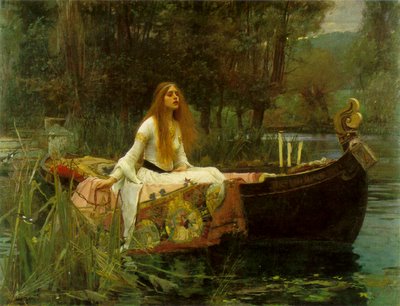
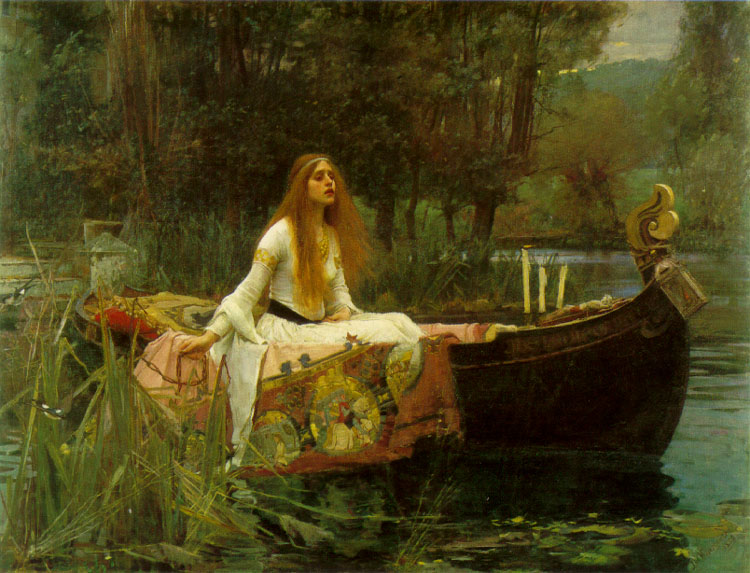
The Pre-raphaelite inspired imagery, costume design, and apparent combination of romance and action were what inspired us to watch the latest telling of Tristan and Isolde. We weren't disappointed. In fact we enjoyed the film very much, especially the visuals. The marriage scene between King Mark and Isolde looked as if it were directly lifted from John William Waterhouse's The Lady of Shalott.
Unlike many of the critics of the film, I was not disappointed that the film strayed from Wagner's version of the tale. There is no magic potion in the new version of the film, there is no magic at all. I think the critics whose were disappointed because of the differences do this version a disservice on two levels. First, to compare this work to one of the highest artistic achievements in a particular medium is unfair and uninformative to the common viewer. It fails to view the particular telling in context, both in medium and intent. Which leads to the second disservice. Tristan and Isolde is a part of a large body of works. Wagner's telling is one of possibly thousands of versions of the tale, so failing to properly adapt Wagner isn't even a legitimate criticism. A better question would be, "where does this new version stand in the larger collection?" Somewhere in the top quartile would be my sentiment. I have always been compelled by Chretien de Troyes careful analysis of the conflict of public duty and private desire, the same conflict that lovers encounter in the lands of jiang hu.
This version of Tristan and Isolde fits very well within the Chretienesque narrative. King Mark is likeable and lovable. Tristan is loyal and loves Mark. But Tristan loved Isolde before he knew who she was because she concealed her true identity from him during their initial romance. This is a significant twist from the typical, where it is Tristan who conceals his identity, but one which makes the movie work without anyone in the love triangle needing to be villified. I could discuss more about why I liked the film, but I think that Roger Ebert did an excellent job in his review.
David Chute was the reason we watched the second tragic romance Samurai Rebellion. Rebellion, like Tristan and Isolde and the tales of jiang hu, is a story where the central conflict is between duty and passion, but in Rebellion the lovers are not alone. This time the lovers have a champion, but the champion is also struggling with the tensions between duty and passion. We know from past movie experiences (Crouching Tiger, Hidden Dragon and House of Flying Daggers) that there is no right choice when faced with this conflict. If you choose duty, as the lovers do in Crouching Tiger, you are doomed to sadness, isolation, and death. If you choose passion, as the lovers do in Flying Daggers, you are doomed to sadness, isolation, and death. The choice is typically a winless scenario. This is both true of the Chinese tale of jiang hu and the arthurian tales of courtly love, but is it also true in feudal Japan?
Samurai Rebellion, it's Japanese title is literally "receive the wife," is the story of Isaburo (Toshiro Mifune). Isaburo is a man living a an age of peace whose chief talent is his skill at killing. He is a man out of place, but who adheres rigidly to the code of Bushido. His talents as a warrior have allowed him to achieve a position of some comfort and prestige under his local Daimyo. At the beginning of the story the Daimyo has two male children by two different wives. The first child, the Daimyo's heir, and the child's mother live in Edo with the Shogun with the heirs of the other Daimyo. Recently, one of the Daimyo's mistresses (a woman named Ichi) has given birth to a boy, giving the Daimyo a second son. After giving birth to the child, Ichi is sent away for a recovery period. When she returns she finds that the Daimyo has moved on to another mistress and thinks of his mistresses as nothing but pawns. She would be willing to accept this fate, but for the fact the newest pawn gloats at her position over Ichi. Thus Ichi attacks the new mistress and eventually strikes the Daimyo.
As one can imagine, this is not a good thing. The Daimyo, who is angry and dishonored, contacts Isaburo and demands that Isaburo's son Yogoro marry the insolent Ichi. Isaburo, who has lived a life in an unhappy marriage and had always hoped his children could avoid his fate, attempts to refuse the Daimyo as politely as possible, but in the end the marriage is made. To everyone's surprise Ichi and Yogoro are a near perfect match, they truly love one another and soon Ichi gives birth to a baby girl. Isaburo has been granted his wish, his son is in a happy marriage and has the beginnings of a family. Isaburo could not be happier.
It is then the Daimyo's first child succumbs to illness at Edo castle, making Ichi's child with the Daimyo the new heir. The Daimyo asserts that Ichi must move to Edo with the male child and abandon her marriage to Yogoro. Ichi and Yogoro refuse and, to the suprise of many, are supported in their decision by Isaburo. The conflict between duty and passion has been set in its path, and must meet its inevitable end. But it is in the resolution that a remarkable lesson is learned. Not by the characters, but by the audience. By watching the mounting tensions, and the drama that unfolds, the audience learns what it is like to see genuine love.
The Chinese tales of jiang hu, and the Arthurian tales, always seem tragic, but this is where the Japanese version differs from the other narratives. In most narratives the lovers seek to live with one another. For Yogoro and Ichi, merely being together is enough. It leads one to believe that the residents of jiang hu would do well to learn from the following passage from the Hagakure:
Isaburo knows he is a dead man once the conflict begins. His only desire is that the injustice of his Daimyo be known in Edo and that his son's marriage, and the love of his son's family, be acknowledged. It is beautiful and powerful to watch a man who has no expectation of life, merely justice...a higher justice.
My wife and I love movies, and when it comes to movies we love tales of romance. Sure like any "manly man," I like my action movies. At least once a month some, obviously evil, force overcomes my will power and I am forced to watch Point Break and Roadhouse, luckily my wife is often possessed of the same schlock loving demon. But nothing satisfies me more than a good romantic comedy, or tale of tragic romance. Recently this affectation led my wife to watch two movies, Tristan and Isolde and Samurai Rebellion.
The Pre-raphaelite inspired imagery, costume design, and apparent combination of romance and action were what inspired us to watch the latest telling of Tristan and Isolde. We weren't disappointed. In fact we enjoyed the film very much, especially the visuals. The marriage scene between King Mark and Isolde looked as if it were directly lifted from John William Waterhouse's The Lady of Shalott.
Unlike many of the critics of the film, I was not disappointed that the film strayed from Wagner's version of the tale. There is no magic potion in the new version of the film, there is no magic at all. I think the critics whose were disappointed because of the differences do this version a disservice on two levels. First, to compare this work to one of the highest artistic achievements in a particular medium is unfair and uninformative to the common viewer. It fails to view the particular telling in context, both in medium and intent. Which leads to the second disservice. Tristan and Isolde is a part of a large body of works. Wagner's telling is one of possibly thousands of versions of the tale, so failing to properly adapt Wagner isn't even a legitimate criticism. A better question would be, "where does this new version stand in the larger collection?" Somewhere in the top quartile would be my sentiment. I have always been compelled by Chretien de Troyes careful analysis of the conflict of public duty and private desire, the same conflict that lovers encounter in the lands of jiang hu.
This version of Tristan and Isolde fits very well within the Chretienesque narrative. King Mark is likeable and lovable. Tristan is loyal and loves Mark. But Tristan loved Isolde before he knew who she was because she concealed her true identity from him during their initial romance. This is a significant twist from the typical, where it is Tristan who conceals his identity, but one which makes the movie work without anyone in the love triangle needing to be villified. I could discuss more about why I liked the film, but I think that Roger Ebert did an excellent job in his review.
David Chute was the reason we watched the second tragic romance Samurai Rebellion. Rebellion, like Tristan and Isolde and the tales of jiang hu, is a story where the central conflict is between duty and passion, but in Rebellion the lovers are not alone. This time the lovers have a champion, but the champion is also struggling with the tensions between duty and passion. We know from past movie experiences (Crouching Tiger, Hidden Dragon and House of Flying Daggers) that there is no right choice when faced with this conflict. If you choose duty, as the lovers do in Crouching Tiger, you are doomed to sadness, isolation, and death. If you choose passion, as the lovers do in Flying Daggers, you are doomed to sadness, isolation, and death. The choice is typically a winless scenario. This is both true of the Chinese tale of jiang hu and the arthurian tales of courtly love, but is it also true in feudal Japan?
Samurai Rebellion, it's Japanese title is literally "receive the wife," is the story of Isaburo (Toshiro Mifune). Isaburo is a man living a an age of peace whose chief talent is his skill at killing. He is a man out of place, but who adheres rigidly to the code of Bushido. His talents as a warrior have allowed him to achieve a position of some comfort and prestige under his local Daimyo. At the beginning of the story the Daimyo has two male children by two different wives. The first child, the Daimyo's heir, and the child's mother live in Edo with the Shogun with the heirs of the other Daimyo. Recently, one of the Daimyo's mistresses (a woman named Ichi) has given birth to a boy, giving the Daimyo a second son. After giving birth to the child, Ichi is sent away for a recovery period. When she returns she finds that the Daimyo has moved on to another mistress and thinks of his mistresses as nothing but pawns. She would be willing to accept this fate, but for the fact the newest pawn gloats at her position over Ichi. Thus Ichi attacks the new mistress and eventually strikes the Daimyo.
As one can imagine, this is not a good thing. The Daimyo, who is angry and dishonored, contacts Isaburo and demands that Isaburo's son Yogoro marry the insolent Ichi. Isaburo, who has lived a life in an unhappy marriage and had always hoped his children could avoid his fate, attempts to refuse the Daimyo as politely as possible, but in the end the marriage is made. To everyone's surprise Ichi and Yogoro are a near perfect match, they truly love one another and soon Ichi gives birth to a baby girl. Isaburo has been granted his wish, his son is in a happy marriage and has the beginnings of a family. Isaburo could not be happier.
It is then the Daimyo's first child succumbs to illness at Edo castle, making Ichi's child with the Daimyo the new heir. The Daimyo asserts that Ichi must move to Edo with the male child and abandon her marriage to Yogoro. Ichi and Yogoro refuse and, to the suprise of many, are supported in their decision by Isaburo. The conflict between duty and passion has been set in its path, and must meet its inevitable end. But it is in the resolution that a remarkable lesson is learned. Not by the characters, but by the audience. By watching the mounting tensions, and the drama that unfolds, the audience learns what it is like to see genuine love.
The Chinese tales of jiang hu, and the Arthurian tales, always seem tragic, but this is where the Japanese version differs from the other narratives. In most narratives the lovers seek to live with one another. For Yogoro and Ichi, merely being together is enough. It leads one to believe that the residents of jiang hu would do well to learn from the following passage from the Hagakure:
Meditation on inevitable death should be performed daily. Every day when one's body and mind are at peace, one should meditate upon being ripped apart by arrows, rifes, spears and swords, being carried away by surging waves, be thrown into the midst of a great fire, being struck by lightning, being shaken to death by a great earthquake, falling from thousand foot cliffs, dying of disease or committing seppuku at the death of one's master. And every day without fail should consider himself as dead.
There is a saying among the elders' that goes, "Step from under the eaves and you're a dead man. Leave the gate and the enemy is waiting." This is not a matter of being careful. It is to consider oneself as dead beforehand.
Isaburo knows he is a dead man once the conflict begins. His only desire is that the injustice of his Daimyo be known in Edo and that his son's marriage, and the love of his son's family, be acknowledged. It is beautiful and powerful to watch a man who has no expectation of life, merely justice...a higher justice.
Wednesday, January 25, 2006
A Good Tribute to Robert E Howard
I am a pretty big Robert E. Howard fan and have often been of two minds when reading published versions of his work. The first sympathizes with the "purist" movement who desire to read Howard's stories as Howard wrote them and not the "edited" versions most modern readers are familiar with. The second appreciates the work of Carter and DeCamp did to keep Howard's writing alive as a part of popular culture.
I try to balance these two conflicting mindsets, but as time passes it becomes both easier and more difficult as publishers have begun in recent years to publish anthologies collecting the works as they were initially published. They have finally made it affordable for me to share the experience the purists laud so greatly. But Ace books has recently begun publishing the Age of Conan series, which has really excited my second mindset. Ghost of the Wall the first of the third Age of Conan trilogies was released recently and I am looking forward to reading it. If it is anything like the other two trilogies, it should be a fun ride and that is where the conflict becomes more difficult.
The purists are upset with what was an almost hidden betrayal. For readers like me, who only know better because of the purists, we never would have known that Howard's work had been rearranged, re-edited, and had pastiches fill chronological gaps. Sure, we would have noticed that some of the stories lacked the darkness or sophistication of Howard's best work, but we notice that even in his actual work. It is upon reading Howard's unaltered words that his vision of Conan becomes clear, and it shares little with the pseudo-erotica some pastiches aspire to be or with the filmic representations.
But the new writers aren't as presumptuous as Carter and De Camp. I recently wrote Matt Forbeck, the editor of the Ace Books line, asking him a few questions about the philosophy behind the current publications. It was the first email I had written him that he had not responded to, well at least not directly. Since the email, Forbeck has written a couple of updates regarding the new series on his blog. One of these provided a link to Jeff Mariotte's blog where Mariotte (the author of the most recent trilogy) has written a very nice entry about his appreciation of Howard which answers nearly all the questions I had.
Howard and his friends, H.P. Lovecraft and Clark Ashton Smith, frequently borrowed from one another and in a way had shared worlds. The new Ace series seems to me to be writing in this vein. The authors of the Age of Conan books are writing in the time of Conan, but they are writing about other characters living in the rich environment Howard created. Unlike earlier publications, the new authors seek not to be substitutes for Howard, rather these authors are inspired by the Hyborian age and want to explore its possibilities. For me this is the perfect balance of my two mindsets. Having read Mariotte's essay on Howard, I look even more forward to reading his contribution.
I try to balance these two conflicting mindsets, but as time passes it becomes both easier and more difficult as publishers have begun in recent years to publish anthologies collecting the works as they were initially published. They have finally made it affordable for me to share the experience the purists laud so greatly. But Ace books has recently begun publishing the Age of Conan series, which has really excited my second mindset. Ghost of the Wall the first of the third Age of Conan trilogies was released recently and I am looking forward to reading it. If it is anything like the other two trilogies, it should be a fun ride and that is where the conflict becomes more difficult.
The purists are upset with what was an almost hidden betrayal. For readers like me, who only know better because of the purists, we never would have known that Howard's work had been rearranged, re-edited, and had pastiches fill chronological gaps. Sure, we would have noticed that some of the stories lacked the darkness or sophistication of Howard's best work, but we notice that even in his actual work. It is upon reading Howard's unaltered words that his vision of Conan becomes clear, and it shares little with the pseudo-erotica some pastiches aspire to be or with the filmic representations.
But the new writers aren't as presumptuous as Carter and De Camp. I recently wrote Matt Forbeck, the editor of the Ace Books line, asking him a few questions about the philosophy behind the current publications. It was the first email I had written him that he had not responded to, well at least not directly. Since the email, Forbeck has written a couple of updates regarding the new series on his blog. One of these provided a link to Jeff Mariotte's blog where Mariotte (the author of the most recent trilogy) has written a very nice entry about his appreciation of Howard which answers nearly all the questions I had.
Howard and his friends, H.P. Lovecraft and Clark Ashton Smith, frequently borrowed from one another and in a way had shared worlds. The new Ace series seems to me to be writing in this vein. The authors of the Age of Conan books are writing in the time of Conan, but they are writing about other characters living in the rich environment Howard created. Unlike earlier publications, the new authors seek not to be substitutes for Howard, rather these authors are inspired by the Hyborian age and want to explore its possibilities. For me this is the perfect balance of my two mindsets. Having read Mariotte's essay on Howard, I look even more forward to reading his contribution.
A Book for Struggling Screenwriters
Recently, a great deal of my coverage has focused on games and the gaming industry. This may have left those of you who first read this site because of my "Want to Write a Supernatural Spec?" post wondering what you are doing reading this blog regularly. Others who came following our first movie review "In the Shadow of Kurosawa" might be wondering if Cinerati ever lives up to its name. Our focus here at Cinerati is to discuss Popular Culture, broadly defined, as our individual professional schedules allow us to write as amateur journalists. Sometimes this leads us to focus too keenly on one, or two, aspects of Popular Culture. Recently this focus has been overly dedicated to the discussion of Comic Books and Games.
Today I would like to recommend a book to all aspiring screenwriter's out there. In fact if you are interested in Hollywood and its workings at all, you must own Conversations with My Agent by Rob Long.
One might be wondering what I, a "character" in The Prisoner and Director of a non-profit devoted to civic engagement of youth, might have to offer as far as recommending books for aspiring professionals. There are after all blogs written by screenwriters who have written blockbusters or written by hard working direct to DVD writers, all of whom could better relate to screenwriters what it takes to be a working writer in Hollywood. That's not my goal. My goal is to provide hope to those who find themselves questioning their choices, staring at writer's bloc, or frustrated at the challenge of getting anyone to even look at your ideas. Is this you? Good, then let me continue.
I first heard of Rob Long's book at an LA Press Club event entitled Mass Market, Smart Content ( I reported on my experience here). The book was mentioned by panelist Scott Kaufer, who mentioned how accurate and entertaining the book was. In the spirit of full disclosure, Scott Kaufer is currently my wife's boss. He wasn't at the time of the event, neither my wife or I had met him before the event, but he is at present. Having said that, this recommendation, like most of Mr. Kaufer's recommendations, was a good one.
Conversations with My Agent (published in 1997), as its name implies, is filled with discussions that Rob Long had with his agent following the end of Cheers on which Long was an Executive Producer and Writer. The discussions are well written, ring true, and are often laugh out loud funny. During the process of reading Long's conversations one becomes familiar with many of the frustrations that writers in Hollywood face on a day to day basis. Everything from "development hell" to the desire to write a novel is discussed. Since purchasing the book, I have returned to the book again and again to reread a particular anecdote or example. The humorous examples always bring a smile to my face. Don't take my word for it, here is an exerpt:
The theme of "not having a conversation" is one that is constant through the book. The relationship of writer to agent is shown as very one sided and the running theme is that all decisions an agent makes are based on the agent, not the writer, getting paid. That may seem a cynical position, but I don't think it is. I believe that the lesson of the book, if there is one, is to remind writers that Hollywood is an industry filled with people who are making money. But these people are also risking resources on an often unproven commodity. You may be an extraordinarily talented and funny writer, but until you have turned a profit you will be viewed skeptically, and as Long demonstrates that skepticism is there even if you have turned a profit.
As a fan of television it is always nice to read a television writer write about why shows don't always work. "The main reason that television sitcoms are so bad is that too many educated people are involved in creating them."
I personally think Long's story about when he talked with his agent about writing a book was one of the most amusing conversations, but if you want to read that you have to buy the book. The book didn't sell as well as it ought, but when I had the opportunity to ask Long why this was the case he shared that it was because the book was too short. At 180 pages, the book is just the right length for the person who picked it up on the shelf at Barnes and Noble to finish the book by the time they go from the rear of the purchase line to the cash register. Whatever the reason...rush to your keyboard and order a copy.
While you are at it, you might want to check out his more recent book.
Today I would like to recommend a book to all aspiring screenwriter's out there. In fact if you are interested in Hollywood and its workings at all, you must own Conversations with My Agent by Rob Long.
One might be wondering what I, a "character" in The Prisoner and Director of a non-profit devoted to civic engagement of youth, might have to offer as far as recommending books for aspiring professionals. There are after all blogs written by screenwriters who have written blockbusters or written by hard working direct to DVD writers, all of whom could better relate to screenwriters what it takes to be a working writer in Hollywood. That's not my goal. My goal is to provide hope to those who find themselves questioning their choices, staring at writer's bloc, or frustrated at the challenge of getting anyone to even look at your ideas. Is this you? Good, then let me continue.
I first heard of Rob Long's book at an LA Press Club event entitled Mass Market, Smart Content ( I reported on my experience here). The book was mentioned by panelist Scott Kaufer, who mentioned how accurate and entertaining the book was. In the spirit of full disclosure, Scott Kaufer is currently my wife's boss. He wasn't at the time of the event, neither my wife or I had met him before the event, but he is at present. Having said that, this recommendation, like most of Mr. Kaufer's recommendations, was a good one.
Conversations with My Agent (published in 1997), as its name implies, is filled with discussions that Rob Long had with his agent following the end of Cheers on which Long was an Executive Producer and Writer. The discussions are well written, ring true, and are often laugh out loud funny. During the process of reading Long's conversations one becomes familiar with many of the frustrations that writers in Hollywood face on a day to day basis. Everything from "development hell" to the desire to write a novel is discussed. Since purchasing the book, I have returned to the book again and again to reread a particular anecdote or example. The humorous examples always bring a smile to my face. Don't take my word for it, here is an exerpt:
ME
We're thinking about writing a feature film spec.
MY AGENT
Wonderful. That's a terrific idea. Do you know why?
ME
Why?
MY AGENT
You'll get it out of your system. You'll write one, it won't sell, and it'll be out of your system. And that will be good. Because you'l never never ever get another chance to write one.
ME
What?
MY AGENT
Please. You'll be busy. You'll be producing your television show or pitching another show or working on someone else's television show.
ME
But --
MY AGENT
We are not having a conversation. I am talking.
ME
But --
MY AGENT
It's a bad career move. It's a waste of time.
ME
But --
MY AGENT
Plus I don't handle feature scripts. It would be handled by someone else at the agency and do you know what? There's nobody here as nice as me.
The theme of "not having a conversation" is one that is constant through the book. The relationship of writer to agent is shown as very one sided and the running theme is that all decisions an agent makes are based on the agent, not the writer, getting paid. That may seem a cynical position, but I don't think it is. I believe that the lesson of the book, if there is one, is to remind writers that Hollywood is an industry filled with people who are making money. But these people are also risking resources on an often unproven commodity. You may be an extraordinarily talented and funny writer, but until you have turned a profit you will be viewed skeptically, and as Long demonstrates that skepticism is there even if you have turned a profit.
As a fan of television it is always nice to read a television writer write about why shows don't always work. "The main reason that television sitcoms are so bad is that too many educated people are involved in creating them."
I personally think Long's story about when he talked with his agent about writing a book was one of the most amusing conversations, but if you want to read that you have to buy the book. The book didn't sell as well as it ought, but when I had the opportunity to ask Long why this was the case he shared that it was because the book was too short. At 180 pages, the book is just the right length for the person who picked it up on the shelf at Barnes and Noble to finish the book by the time they go from the rear of the purchase line to the cash register. Whatever the reason...rush to your keyboard and order a copy.
While you are at it, you might want to check out his more recent book.
Tuesday, January 24, 2006
Looking for an Addition to the Gamers Library? Keep Looking.
As the interests of the gamer and the hobbyist overlap, so too do the interests of the gamer and the collector. People who become serious about experiencing the wide variety of board game entertainment currently, and historically, often find themselves searching for particularly useful resources in their pursuits. In my adventures searching for useful books about roleplaying games I have found Heroic Worlds particularly useful. The Complete Guide to Role Playing Games was the first book of this nature I purchased. While by modern standards The Complete Guide is nowhere near complete (even for the time it was written), I still find it to be an invaluable resource. In fact, it is the cornerstone of the books about roleplaying games section of my home library.

Other books in my library include The Fantasy Roleplaying Gamer's Bible, I own both editions, and Dicing With Dragons. I have many more, but these few are among some of the better resources if you want to understand and collect roleplaying games.
Recently, my attention has expanded to include a desire for books about boardgames and card games. Ever since I read that first, very dry but very informative, page of The Oxford History of Board Games I have been in pursuit of helpful references regarding board games. In particular, I am looking not just for a checklist with beautiful images of hard to find treasures, but a book like the Oxford that contains descriptions of play. I understand that intellectual property rules may prevent the release of detailed rules, but I would like some description to base my interest on. True, there are some games worthy of purchase merely as examples of extraordinary illustration, but I am first and foremost someone who enjoys playing games.
This is the kind of resource I was hoping to find when I purchased The Games We Played. Sadly, this book was not what I had hoped it would be.

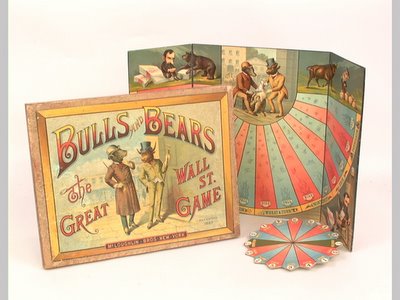
The Games We Played is the companion volume to a museum exhibit at the Henry Luce III Center for the Study of American Culture. As a companion to the exhibit the book is an amazing publication. It contains beautiful photography of interestingly designed board games accompanied by brief comments about what games have to say about the society in which they were created. To be fair though, the analysis is nowhere near the level of The Oxford History. The book provides just enough information about any particular game to give it a social contexts of the design and illustration, but rarely are any descriptions of the game play given. For example Bull and Bears: The Great Wall St. Game (1883) (Parker Brothers would make a similarly titled game in 1936) is described in the following way:
The above quote is useful in a discussion of board game as social artifact, but it does little to discuss the playability of the game. Ideally, a book like The Games We Played would do both. Instead, the reader must settle merely for an interesting discussion of historical relevence. Like most museum exhibits the discussions of the particular artifacts are brief, but not "written down" for a younger audience. Vicissitudes anyone? Why not just say realities or accurate representation? The information provided in the book inspires one to find out more about the people who played the beautifully illustrated games featured between its covers. Sadly, the book doesn't inspire the reader to become one of the people who has played the game. There are great advantages to recognizing the craftsmanship behind consumer products, the removal of utility from them is not one of those advantages. The gamer asks, "if no one is going to play the game, how is this different from a painting?" Then the gamer walks on unfulfilled.
If you are looking for an introduction into board games as a part of American social history, this book is for you. If you are looking for a checklist of some of the games that existed in the nineteenth-century and don't need to know what a game will play like before you buy it, this book is for you. If you want to see the complexity of the art of illustration, this book is for you. But if you are looking for an examination of gameplay as social phenomenon, this book is not for you. The authors have forgotten, it seems, that a part of the social significance of these boardgames is not merely what they represent, but how they represent them. The mechanics used to determine success or failure in Bulls and Bears are just as much a social commentary as are the (probable) Nast illustrations. How random is it? How predictable? I don't know, but I'd like to.
particularly useful. The Complete Guide to Role Playing Games was the first book of this nature I purchased. While by modern standards The Complete Guide is nowhere near complete (even for the time it was written), I still find it to be an invaluable resource. In fact, it is the cornerstone of the books about roleplaying games section of my home library.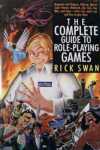
Other books in my library include The Fantasy Roleplaying Gamer's Bible
, I own both editions, and Dicing With Dragons. I have many more, but these few are among some of the better resources if you want to understand and collect roleplaying games.Recently, my attention has expanded to include a desire for books about boardgames and card games. Ever since I read that first, very dry but very informative, page of The Oxford History of Board Games
I have been in pursuit of helpful references regarding board games. In particular, I am looking not just for a checklist with beautiful images of hard to find treasures, but a book like the Oxford that contains descriptions of play. I understand that intellectual property rules may prevent the release of detailed rules, but I would like some description to base my interest on. True, there are some games worthy of purchase merely as examples of extraordinary illustration, but I am first and foremost someone who enjoys playing games.This is the kind of resource I was hoping to find when I purchased The Games We Played
. Sadly, this book was not what I had hoped it would be.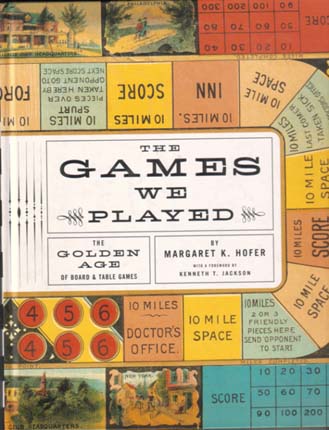
The Games We Played is the companion volume to a museum exhibit at the Henry Luce III Center for the Study of American Culture. As a companion to the exhibit the book is an amazing publication. It contains beautiful photography of interestingly designed board games accompanied by brief comments about what games have to say about the society in which they were created. To be fair though, the analysis is nowhere near the level of The Oxford History. The book provides just enough information about any particular game to give it a social contexts of the design and illustration, but rarely are any descriptions of the game play given. For example Bull and Bears: The Great Wall St. Game (1883) (Parker Brothers would make a similarly titled game in 1936) is described in the following way:
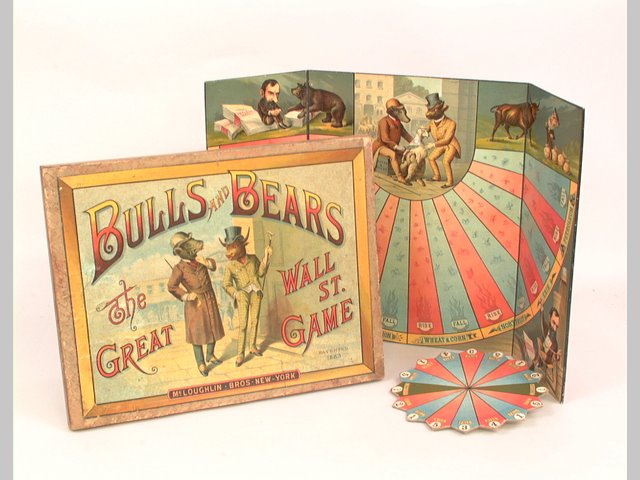
By the 1880s, wealth had emerged as the defining characteristic of success in American games, as in life. Bulls and Bears was based on the vicissitudes of the stock market -- an ideal theme for games -- and was designed to make players feel like speculators, bankers, and brokers, if only for a time. Possibly illustrated by famed political cartoonist Thomas Nast, who provided illustrations for some of McLoughlin Brothers' books, the gameboard depicts a nattily dressed bull and bear shearing sheep (under the removable spinner), a sublte commentary on the making of financial empires at the public's expense.
Bulls and Bears is unusual among nineteenth-century board games in incorporating caricatures of contemporary figures. In the lower corners of the board, rairoad magnates William Henry Vanderbilt and Jay Gould, whose speculation contributed to the fanancial panic that inspired this game, smugly read tickert tape showing the value of their stock. Gould is also shown at the top left looking glum as he contemplates the bear market. Cyrus Field, a railroad investor in collaboration with Gould, appears opposite him armed to defend his money bags.
The above quote is useful in a discussion of board game as social artifact, but it does little to discuss the playability of the game. Ideally, a book like The Games We Played would do both. Instead, the reader must settle merely for an interesting discussion of historical relevence. Like most museum exhibits the discussions of the particular artifacts are brief, but not "written down" for a younger audience. Vicissitudes anyone? Why not just say realities or accurate representation? The information provided in the book inspires one to find out more about the people who played the beautifully illustrated games featured between its covers. Sadly, the book doesn't inspire the reader to become one of the people who has played the game. There are great advantages to recognizing the craftsmanship behind consumer products, the removal of utility from them is not one of those advantages. The gamer asks, "if no one is going to play the game, how is this different from a painting?" Then the gamer walks on unfulfilled.
If you are looking for an introduction into board games as a part of American social history, this book is for you. If you are looking for a checklist of some of the games that existed in the nineteenth-century and don't need to know what a game will play like before you buy it, this book is for you. If you want to see the complexity of the art of illustration, this book is for you. But if you are looking for an examination of gameplay as social phenomenon, this book is not for you. The authors have forgotten, it seems, that a part of the social significance of these boardgames is not merely what they represent, but how they represent them. The mechanics used to determine success or failure in Bulls and Bears are just as much a social commentary as are the (probable) Nast illustrations. How random is it? How predictable? I don't know, but I'd like to.
Monday, January 23, 2006
Epaminondas, Hard to Pronounce but Innovative
In gaming circles there is a phenomenon called "Hobbying" that gets a great deal of use, but which the name does little to clue the outsider as to what exactly is being described. To be brief, in the gaming word a "hobbyist" is someone who likes to build, paint, and construct things. Games Workshop has made themselves into a large company indeed by combining strategy wargame behaviors with hobbyist tendencies. They do this by providing a fun rules sets for which you can buy unpainted miniatures and build terrain to host epic battles for your little armies (or as my wife would call them...little men). The game playing aspect of Warhammer is easy to define, it is the playing of the game against other players. They "hobbying" aspect comes in the assembly and painting of figures and the building of terrain. You can tell a true hobbyist when you see someone walk into an arts and crafts store with his significant other who says, "Oh my god...these foam eggs would make awesome Minarets! I can't wait to go home and get to work on these! Oh, oh, are those fake weeds?!"
Inside many a gamer is the person who likes to build things. The game player often desires to be the toy maker, and yet we as individuals often lack the talent to manufacture beautiful miniatures and terrain ourselves. But every now and then comes the opportunity for even the most artistically inept to build an exact wargame, and sometimes it is made necessary because purchasable sets to play are hard, if not impossible, to come by. Imagine if you will that the rules for Chess were readily available, but no one manufactured Chess sets. What would the committed gamer do? If he or she were a hobbyist the answer would be simple, build a set. The sculpture on the pieces may not be pretty, but it would be functional.
I mention this because I recently came upon discussion of a game entitled Epaminondas in the Oxford History of Board Games. The game has a confusing title one can imagine that the fanbase who find this a convenient name is limited to Victor Davis Hanson.

The game is named after Epaminondas of Thebes, who the game rules claim invented phalanx combat. According to Donald Kagan, Professor of Classics at Yale, that honor belongs to Pagondas who used the formation at the battle of Delium (424 BC):

Victor Davis Hanson discusses Epaminondas’ innovations to the phalanx in The Soul of Battle (1999):
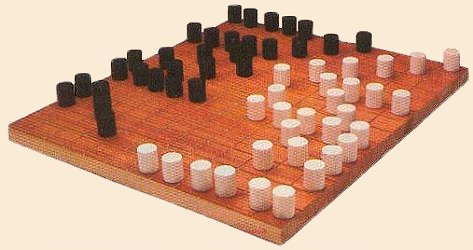
While Epaminondas is a difficult name to remember, at least with regard to spelling, the title aptly hints at the goals of the game. Epaminondas is what The Oxford History of Board Games describes as a Space/Attainment game. What this means is that the game is one in which the players "enter or move pieces upon a two-dimensional board with the aim of getting them into a specified pattern, configuration, or spacial position." In particular, the specific goal is to get one of one's pieces across the board into a corresponding position on the opponents end of the board. Essentially, the goal of the game is to move your pieces in such a way as one or more of your pieces ends up on your opponents end. If your opponent can neither eliminate this piece, or move an equal number of pieces onto your end of the board. The manner in which pieces are eliminated is where the name and theme of the game connect. You eliminate opposing pieces by moving larger phalanx's into your opponents existing phalanx. Like Epaminondas defeated the Spartans with his deeper phalanx, so to do you defeat your opponent's pieces.

As I mentioned, sets of this game are nigh impossible to come by, but if you are willing to do a little construction (and I mean very little), you can download the rules here and you can download a copy of a 14x12 grid here (right click and save to retrieve the file). The 14x12 grid is an unusual size, but one that can either be printed and glued to cardstock or constructed using some kind of router to carve a board for use. In addition, all that is necessary are two sets of different colored stones. Though I think I would someday like to see a copy of this game with beautifully carved hoplites facing off on a grid with topographic illustrations.
I haven't played many sessions of the game yet, but the premise is intriguing and may just be too complex for me to actually understand. Like with my first attempts to play Go, I might need someone to describe and demonstrate how to play the game as the written rules leave me needing to play it five or six times more before I actually think I understand the game.
Inside many a gamer is the person who likes to build things. The game player often desires to be the toy maker, and yet we as individuals often lack the talent to manufacture beautiful miniatures and terrain ourselves. But every now and then comes the opportunity for even the most artistically inept to build an exact wargame, and sometimes it is made necessary because purchasable sets to play are hard, if not impossible, to come by. Imagine if you will that the rules for Chess were readily available, but no one manufactured Chess sets. What would the committed gamer do? If he or she were a hobbyist the answer would be simple, build a set. The sculpture on the pieces may not be pretty, but it would be functional.
I mention this because I recently came upon discussion of a game entitled Epaminondas in the Oxford History of Board Games. The game has a confusing title one can imagine that the fanbase who find this a convenient name is limited to Victor Davis Hanson.

The game is named after Epaminondas of Thebes, who the game rules claim invented phalanx combat. According to Donald Kagan, Professor of Classics at Yale, that honor belongs to Pagondas who used the formation at the battle of Delium (424 BC):
On the right of the hoplite phalanx he massed the Theban contingent to the extraordinary depth of twenty-five, compared to the usual eight, while the hoplites from the other cities lined up as they liked, probably in the standard fashion. This is the first recorded use of the very deep wing in a hoplite phalanx, a tactic that would be used with devastating effect by Epaminondas of Thebes and Philip and Alexander of Macedon in the following century” (The Peloponnesian War 2003, 168).
Victor Davis Hanson discusses Epaminondas’ innovations to the phalanx in The Soul of Battle (1999):
From the battle of Delium (424) onward, the Thebans had always massed more deeply than the hoplite standard of eight shields…Epaminondas added a couple of vital ancillary tactical touches. The Theban mass and fighting elite would be placed on the left, not the right, of the Boeotian battle line, in order to smash the opposite elite royal right of the Spartan phalanx…In addition, specialized contingents…and the use of integrated cavalry tactics ensure that the Boeotians themselves could protect their new ponderous and unwieldy columns from enemy light-armed skirmishers and peltasts.
While Epaminondas is a difficult name to remember, at least with regard to spelling, the title aptly hints at the goals of the game. Epaminondas is what The Oxford History of Board Games describes as a Space/Attainment game. What this means is that the game is one in which the players "enter or move pieces upon a two-dimensional board with the aim of getting them into a specified pattern, configuration, or spacial position." In particular, the specific goal is to get one of one's pieces across the board into a corresponding position on the opponents end of the board. Essentially, the goal of the game is to move your pieces in such a way as one or more of your pieces ends up on your opponents end. If your opponent can neither eliminate this piece, or move an equal number of pieces onto your end of the board. The manner in which pieces are eliminated is where the name and theme of the game connect. You eliminate opposing pieces by moving larger phalanx's into your opponents existing phalanx. Like Epaminondas defeated the Spartans with his deeper phalanx, so to do you defeat your opponent's pieces.

As I mentioned, sets of this game are nigh impossible to come by, but if you are willing to do a little construction (and I mean very little), you can download the rules here and you can download a copy of a 14x12 grid here (right click and save to retrieve the file). The 14x12 grid is an unusual size, but one that can either be printed and glued to cardstock or constructed using some kind of router to carve a board for use. In addition, all that is necessary are two sets of different colored stones. Though I think I would someday like to see a copy of this game with beautifully carved hoplites facing off on a grid with topographic illustrations.
I haven't played many sessions of the game yet, but the premise is intriguing and may just be too complex for me to actually understand. Like with my first attempts to play Go, I might need someone to describe and demonstrate how to play the game as the written rules leave me needing to play it five or six times more before I actually think I understand the game.
Friday, January 20, 2006
Stephen King, Joe Bob Briggs, Peter Pan, and Matt Forbeck
Yesterday, I shared a link to Matt Forbeck's, who is a freelance game designer and fantasy author, blog which briefly discussed the copyright issues surrounding Peter Pan. Today Matt has a post that goes into much greater detail on the subject and provides an interesting connection to Stephen King.
One of the most interesting development in the situation, other than the Big Stevo connection, is that even though Disney isn't paying the Ormond Hospital royalties on the Barry prequel, they are contractually bound to give them royalties if they make a movie based on said prequel. That gives a hint at how messed up the copyright situation is with regards to the Pan. Matt has written a wonderful article combining personal narrative with factual presentation, if you are interested in Pan at all please read it. My only criticism is it's reliance on Wikipedia for information. Wiki is an interesting and possibly awsome resource, but as Penny-Arcade has pointed out not one without vulnerabilities. Overt vandalism is rare, but like Comic Book history Wiki is controlled by those with interest in the topic. What type of interest, pro or con, on a controversial topic does affect Wiki entries, though given enough time a kind of "Wisdom of Crowds" or "Cool and deliberative sense" tends to rule the day. Besides, with geek topics, especially non-controversial ones, Wiki has much joss, almost as much as a Kistler profile on Monitor Duty.
But what does this have to do with Stephen King and Joe Bob Briggs? Well the Rock Bottom Remainders are a band that Dave Barry and Stephen King are both members. And Joe Bob Briggs was recently in a fan film based on a Stephen King short story. In fact, thank to the Joe Bob link I discovered Stephen King's Short movies online. The site has a large catalogue of fan adaptations of Stephen King's stories. It even appears, if you are as concerned about IP rights as I am, that Big Steve knows about the site and supports fan productions, but it isn't made expressly clear. To be honest though, I don't think Joe Bob would do anything to hurt Big Steve.
One of the most interesting development in the situation, other than the Big Stevo connection, is that even though Disney isn't paying the Ormond Hospital royalties on the Barry prequel, they are contractually bound to give them royalties if they make a movie based on said prequel. That gives a hint at how messed up the copyright situation is with regards to the Pan. Matt has written a wonderful article combining personal narrative with factual presentation, if you are interested in Pan at all please read it. My only criticism is it's reliance on Wikipedia for information. Wiki is an interesting and possibly awsome resource, but as Penny-Arcade has pointed out not one without vulnerabilities. Overt vandalism is rare, but like Comic Book history Wiki is controlled by those with interest in the topic. What type of interest, pro or con, on a controversial topic does affect Wiki entries, though given enough time a kind of "Wisdom of Crowds" or "Cool and deliberative sense" tends to rule the day. Besides, with geek topics, especially non-controversial ones, Wiki has much joss, almost as much as a Kistler profile on Monitor Duty.
But what does this have to do with Stephen King and Joe Bob Briggs? Well the Rock Bottom Remainders are a band that Dave Barry and Stephen King are both members. And Joe Bob Briggs was recently in a fan film based on a Stephen King short story. In fact, thank to the Joe Bob link I discovered Stephen King's Short movies online. The site has a large catalogue of fan adaptations of Stephen King's stories. It even appears, if you are as concerned about IP rights as I am, that Big Steve knows about the site and supports fan productions, but it isn't made expressly clear. To be honest though, I don't think Joe Bob would do anything to hurt Big Steve.
Thursday, January 19, 2006
First DC Attempts to Get Me to Stop Buying Comics..Now Marvel Joins In

For me there are two truly iconic superhero costumes. These costumes have come to represent more than just the hero wearing them, they have come to represent the company publishing them. From DC comics, that costume is Superman's costume. No matter how many times they play with it, they always have to return to the iconic one. Why? Because the image has become so ingrained in the collective consciousness that the bold S has meaning outside the medium in which it was created. The same is true for Spider-Man. Peter Parker's character revolutionized comic book storytelling and the costume was an innovative imagining. Sure Marvel Comics have tampered with the costume temporarily in the past, and in doing so have created one of Spidey's most popular villains. But the newest costume change, and its association with Marvel's most fickle costume changer Iron Man are just too much. Iron Man changes costumes all the time. Will the same be true of Iron Spidey?
I hope not. Let us hope that Iron Spidey is a precursor to the "Red Arachnid" foe of Spider-Man.
Matt Forbeck Has News on New Peter Pan Prequel
Matt Forbeck discusses a controversy surrounding the 2004 Dave Barry prequel to Peter Pan and the reaction of the Great Ormond Street Hospital.
After reading the article go immediately and watch Finding Neverland and 2003's Peter Pan. Who doesn't love Jason Isaacs as Hook? Hmm...who?! YOU! Why I oughta!
After reading the article go immediately and watch Finding Neverland and 2003's Peter Pan. Who doesn't love Jason Isaacs as Hook? Hmm...who?! YOU! Why I oughta!
Wallace and Gromit Boardgame to Be Announced in February
Cards Inc. will be announcing the development of a game based on the Wallace and Gromit animated characters. According to ICV2 the announcement will be made at this year's Toy Fair, by which they likely mean the American International Toy Fair which will be held this February 12 through 15.
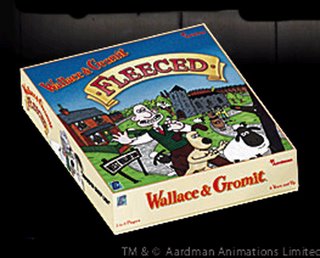
According to the article the game will be entitled Fleece and was "envisioned" by W&G creator Nick Park. The theme of the game appears to be inspired by the A Close Shave animated short featuring the lovable claymation characters.
By making the announcement at the American International Toy Fair, rather than at the GAMA Trade Show in March, Cards Inc. is likely exhibiting an intent to focus marketing efforts on large retail outlets like Walmart and Target rather than on local game stores like my own favorite Lionheart Games. Consumers often hear the complaints of large Toy Market specialty stores like Toys-R-Us and FAO Schwartz who bemoan the difficulty of competing with Target and Walmart price gouging, but what often get overlooked is the comparitively almost exponential difficulty of local gaming stores to compete with the large Toy Stores. Those who remember the last Christmas shopping season can likely remember Toys-R-Us advertising exclusive items like the Lava set for Heroscape. Local gaming stores are even more dependant on being able to offer unique quality games and merchandise.
I don't blame Cards Inc. for targetting the larger stores, it will mean more sales for them and thus more money, but I will still be ordering it from my local shop. Hopefully I will pay suggested retail, but if I have to pay a couple of bucks extra so be it. It is well worth it if it means I can continue to purchase games like the beautiful Settlers of Catan special edition.
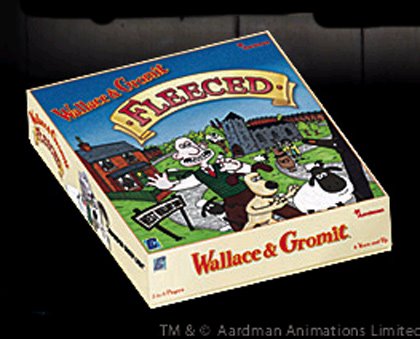
According to the article the game will be entitled Fleece and was "envisioned" by W&G creator Nick Park. The theme of the game appears to be inspired by the A Close Shave animated short featuring the lovable claymation characters.
By making the announcement at the American International Toy Fair, rather than at the GAMA Trade Show in March, Cards Inc. is likely exhibiting an intent to focus marketing efforts on large retail outlets like Walmart and Target rather than on local game stores like my own favorite Lionheart Games. Consumers often hear the complaints of large Toy Market specialty stores like Toys-R-Us and FAO Schwartz who bemoan the difficulty of competing with Target and Walmart price gouging, but what often get overlooked is the comparitively almost exponential difficulty of local gaming stores to compete with the large Toy Stores. Those who remember the last Christmas shopping season can likely remember Toys-R-Us advertising exclusive items like the Lava set for Heroscape. Local gaming stores are even more dependant on being able to offer unique quality games and merchandise.
I don't blame Cards Inc. for targetting the larger stores, it will mean more sales for them and thus more money, but I will still be ordering it from my local shop. Hopefully I will pay suggested retail, but if I have to pay a couple of bucks extra so be it. It is well worth it if it means I can continue to purchase games like the beautiful Settlers of Catan special edition.
Wednesday, January 18, 2006
Do You Remember When A&E Meant Arts and Entertainment?
It seems that lately the Arts and Entertainment network has decided to leave the Arts behind and focus on the entertainment half of their name. What do I mean by this? Why the explosion of "reality" tv shows that air on this network. Though as a friend of mine who worked on Forty Deuce explained about reality tv, "We take the truth into a dark room, strap it into a dentist chair, and get hard to work on it."
I remember fondly the days when A&E was the channel on which I could watch Pride and Prejudice. My evenings were filled with romantic forays into the English countryside, my wife cuddled close to me, watching very nice people encounter romantic complications. It was wonderful, the warmth of good dialogue and the person you love. What more could one ask for? But now...oh now...how the world has changed. A&E's line-up looks more like a police line-up than a romantic one. How can one cuddle and coo soft words into a loved one's ear when watching Dog the Bounty Hunter? One does not think of Sonnet 116 when watching Inked or Intervention.
What am I supposed to watch with my wife? What show touches upon the deeper truths of human existance? Does A&E have such an offering? Luckily, yes they do. They have provided me with the beauty that is Rollergirls. I am not kidding, this is great tv. Not because of the "sport" or the monolithic theatrical struggles that take place in the "wooden oval." No there is no Bach fugue playing here, that would be Rollerball not Rollergirls.
What makes Rollergirls entertaining, and even a profound commentary on the "common life", is the conversations and attempts at philosophizing that the competators give. Most of the "girls" are working class, and struggling, individuals who desire in some way to be great. To paraphrase Lunatic, "it gives my life a kind of purpose, no matter how pointless that purpose is." The young women of Rollergirls seek to escape the banality of normal existence and for one brief moment to feel adored. I would say "heroic," but I think that might provoke laughter. The funny thing, no matter how vulgar and prescripted the contests the Rollergirls participate in, no matter how unatheletic these atheletes are, they truly do seek to be successful and to feel they are accomplishing something.
For a member of the Holy Rollers, it is better to get punched in the eye for pennies than to make minimum wage selling DVDs all day. In fact, that is just what most of the girls do during the day, they work at dull service jobs. For the Lonestar Rollergirls in Austin, TX, this is their Fight Club where they struggle against the mundane and seek something more. Sure that something more is to beat the snot out of one another while others watch, but a lot of other people get paid a heck of a lot more money to do similar activities.
Just one question though...
Who would win in a fight between Johnathan E and Miss Conduct?


I remember fondly the days when A&E was the channel on which I could watch Pride and Prejudice. My evenings were filled with romantic forays into the English countryside, my wife cuddled close to me, watching very nice people encounter romantic complications. It was wonderful, the warmth of good dialogue and the person you love. What more could one ask for? But now...oh now...how the world has changed. A&E's line-up looks more like a police line-up than a romantic one. How can one cuddle and coo soft words into a loved one's ear when watching Dog the Bounty Hunter? One does not think of Sonnet 116 when watching Inked or Intervention.
What am I supposed to watch with my wife? What show touches upon the deeper truths of human existance? Does A&E have such an offering? Luckily, yes they do. They have provided me with the beauty that is Rollergirls. I am not kidding, this is great tv. Not because of the "sport" or the monolithic theatrical struggles that take place in the "wooden oval." No there is no Bach fugue playing here, that would be Rollerball not Rollergirls.
What makes Rollergirls entertaining, and even a profound commentary on the "common life", is the conversations and attempts at philosophizing that the competators give. Most of the "girls" are working class, and struggling, individuals who desire in some way to be great. To paraphrase Lunatic, "it gives my life a kind of purpose, no matter how pointless that purpose is." The young women of Rollergirls seek to escape the banality of normal existence and for one brief moment to feel adored. I would say "heroic," but I think that might provoke laughter. The funny thing, no matter how vulgar and prescripted the contests the Rollergirls participate in, no matter how unatheletic these atheletes are, they truly do seek to be successful and to feel they are accomplishing something.
For a member of the Holy Rollers, it is better to get punched in the eye for pennies than to make minimum wage selling DVDs all day. In fact, that is just what most of the girls do during the day, they work at dull service jobs. For the Lonestar Rollergirls in Austin, TX, this is their Fight Club where they struggle against the mundane and seek something more. Sure that something more is to beat the snot out of one another while others watch, but a lot of other people get paid a heck of a lot more money to do similar activities.
Just one question though...
Who would win in a fight between Johnathan E and Miss Conduct?

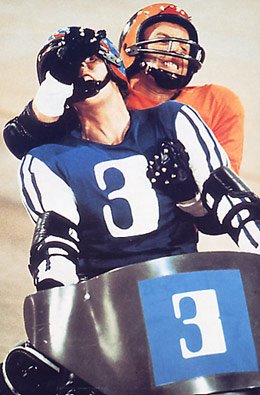
Tuesday, January 17, 2006
An Unpleasant First Experience
Last week, while attending a Los Angeles Press Club Event discussing a book about the Black Dahlia murder, I was describing the neighborhood where I live (notice the property crime index of 7 compared to a national average of 3.2). I live in South Los Angeles, across the street from Dorsey High School. I was talking about how in the 5 and a half years I have lived in the Crenshaw district of Los Angeles, my wife and I have never been the victim of a crime. I was even excited that gangs had agreed to a post-MLK march truce. But now that "have never" needs to be changed to "had never" been a victim of a crime.
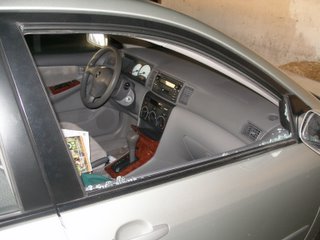
I walked out to my car this morning, ready to go to work, when I noticed there were several CDs spread over the "driveway" near my car. I began to wonder what happened, but when I got to my car all was answered. The passenger side window of my car had been shattered and the contents of my car spread about. Even my trunk had been opened and "searched." I did a quick inventory and noticed that nothing appeared to have been stolen, not even the $5.00 in the ashtray. The vandals had taken a long time throwing my stuff around and searching for something they might find to be valuable. But other than throwing my CDs around, they didn't take anything. I guess Science Fiction, Philosophy, and RPG books weren't up their alley, and I guess we had different tastes in music.
So I called the police, who took my report over the phone, and drove the car to a local dealership to have my window replaced. With the new car window setting me back around $400.00, I think I can afford a rent increase of a similar amount. Needless to say my wife and I began an apartment search today.

I walked out to my car this morning, ready to go to work, when I noticed there were several CDs spread over the "driveway" near my car. I began to wonder what happened, but when I got to my car all was answered. The passenger side window of my car had been shattered and the contents of my car spread about. Even my trunk had been opened and "searched." I did a quick inventory and noticed that nothing appeared to have been stolen, not even the $5.00 in the ashtray. The vandals had taken a long time throwing my stuff around and searching for something they might find to be valuable. But other than throwing my CDs around, they didn't take anything. I guess Science Fiction, Philosophy, and RPG books weren't up their alley, and I guess we had different tastes in music.

So I called the police, who took my report over the phone, and drove the car to a local dealership to have my window replaced. With the new car window setting me back around $400.00, I think I can afford a rent increase of a similar amount. Needless to say my wife and I began an apartment search today.
Thursday, January 12, 2006
G4 Expands Television Lineup
In past years the question has been asked, "Where is the music on Music Television?" It appears that a similiar question may come quickly to the tongues of G4: Videogame TV viewers. They may soon be asking, "Where are the Videogames on Videogame Television?"
Who am I kidding?
People are already asking, "When is G4 going to get some real programming?" and, "What is G4?"
Recently G4 has entered into a contract with Hasbro entitling G4 to run Hasbro based television programming as a part of its Action Blast hour. So far the lineup is filled with two Transformers shows, and no not the one from the 80's; at least not yet. The agreement with Hasbro is a sign that G4 is expanding its programming beyond the limited NPR/Public Access style shows where gamers talk about video games and into providing programming targetted at people who play video games.
This trend began when G4 started running Anime Unleashed, which is currently showing the (at least for me) very bizarre Cromartie High School. I watched an episode provided with my Newtype subscription. The trend continued with the addition of Formula D, a drift racing television show (drift racing is Nascar for Otaku), and the recent running of Star Trek the Next Generation episodes.
With G4's audience growing, pop culture fans may soon have an alternative to the very successful Sci Fi Channel. Though like SciFi, G4's will be a true success when it is running entertaining original programming.
Though I do miss the reruns of the Six Million Dollar Man. I miss Lee Majors, he saved Christmas after all, and have had to settle for reruns of Big Valley on Starz Western to get my Lee Majors fix.
Who am I kidding?
People are already asking, "When is G4 going to get some real programming?" and, "What is G4?"
Recently G4 has entered into a contract with Hasbro entitling G4 to run Hasbro based television programming as a part of its Action Blast hour. So far the lineup is filled with two Transformers shows, and no not the one from the 80's; at least not yet. The agreement with Hasbro is a sign that G4 is expanding its programming beyond the limited NPR/Public Access style shows where gamers talk about video games and into providing programming targetted at people who play video games.
This trend began when G4 started running Anime Unleashed, which is currently showing the (at least for me) very bizarre Cromartie High School. I watched an episode provided with my Newtype subscription. The trend continued with the addition of Formula D, a drift racing television show (drift racing is Nascar for Otaku), and the recent running of Star Trek the Next Generation episodes.
With G4's audience growing, pop culture fans may soon have an alternative to the very successful Sci Fi Channel. Though like SciFi, G4's will be a true success when it is running entertaining original programming.
Though I do miss the reruns of the Six Million Dollar Man. I miss Lee Majors, he saved Christmas after all, and have had to settle for reruns of Big Valley on Starz Western to get my Lee Majors fix.
Wednesday, January 11, 2006
Expanded List of Genre Movies Releasing This Year
- Tristan and Isolde Opens January 13.
- Underworld: Evolution Opens January 20.
- Nanny McPhee Opens January 27.
- V for Vendetta Opens March 17.
- Stay Alive Opens March 26. (Massive Multiplayer Online RPGs can Kill!)
- Silent Hill Opens April 21.
- The Gene Generation Opens May 24.
- X-Men 3 Opens May 26.
- The Omen 666 Opens June 6.
- Superman Returns Opens June 30.
- Pirates of the Caribbean: Dead Man's Chest Opens July 7.
- Lady in the Water Opens July 21.
- The Visiting Opens August 11.
- DOA: Dead or Alive Opens August 25. (First Dead or Alive Beach Volleyball...now the movie)
- Tenacious D: The Pick of Destiny Opens October 27.
- In the Name of the King: a Dungeon Siege Tale Opens December 1. (Uwe Boll...worst director ever)
- Creature from the Black Lagoon Opens December 13
- Eragon Opens December 15.
I am certain the list is nowhere near complete, and it does include some non-fantasy, but it is pretty extensive.
Tuesday, January 10, 2006
Columbo Wife Question Answered
If you look over in the left hand column, you will see that I am currently watching the Third Season of Columbo. I am a huge fan of the show and enjoy its formula immensely. The show doesn't try to outsmart you or fool the viewer, rather it shows the viewer the murder and the audience gets to watch as the famous detective unravels the mystery. It is an ingenious procedural format which plays wonderful games with the standard three act formula of screenwriting. It still follows the formula, you can set your clock to the "acts," but by shifting the murderer into the "hero" role the formula is altered enough to make it truly original.
Now to the main point. I remember playing a game of Trivial Pursuit, or hearing from a friend of a friend, that there is a question about Columbo's wife and what her first name is. I always thought this was an urban myth. In fact, I imagined that since one of the ways trivia game producers protect their IP is to put erroneous questions into the mix that the Mrs. Columbo question was one of these cases. In fact, upon checking I find that it is Columbo's suposed first name of Philip that is the urban myth (scroll down to Columbo).
The Season 3 Columbo DVD includes with it an episode of a show entitled Mrs. Columbo which has the wife of the famous detective solve a murder. The show should not be confused with the episode of Columbo entitled Rest in Peace Mrs. Columbo, rather it was an attempt to expand upon the Columbo universe though eventually Mrs. Columbo somehow became Mrs. Callahan and the show's title changed to Kate Loves a Mystery. So what is Columbo's wife's name? As the title change above indicates...Kate, played by Kathryn Janeway (I mean Kate Mulgrew).
I have viewed the Mrs. Columbo episode included on Season 3, and let me tell you...it nowhere near compares to the magic of a good Columbo episode. It doesn't even rank among the bad Columbo episodes for quality, not that there were many of those. Without the threat presented by Columbo's position as a Detective the investigation/interrogation techniques used by Kate (which bear remarkable similarity to those of Mr. Columbo) don't produce the narrative tension necessary. I found myself as irritated with Mrs. Columbo's questions as the murderer did, not to mention the mother/daughter solving the mystery together scene. It just didn't work for me. I guess I'll have to resolve myself to watching Murder She Wrote and Scarecrow and Remington Steele.
Now to the main point. I remember playing a game of Trivial Pursuit, or hearing from a friend of a friend, that there is a question about Columbo's wife and what her first name is. I always thought this was an urban myth. In fact, I imagined that since one of the ways trivia game producers protect their IP is to put erroneous questions into the mix that the Mrs. Columbo question was one of these cases. In fact, upon checking I find that it is Columbo's suposed first name of Philip that is the urban myth (scroll down to Columbo).
The Season 3 Columbo DVD includes with it an episode of a show entitled Mrs. Columbo which has the wife of the famous detective solve a murder. The show should not be confused with the episode of Columbo entitled Rest in Peace Mrs. Columbo, rather it was an attempt to expand upon the Columbo universe though eventually Mrs. Columbo somehow became Mrs. Callahan and the show's title changed to Kate Loves a Mystery. So what is Columbo's wife's name? As the title change above indicates...Kate, played by Kathryn Janeway (I mean Kate Mulgrew).
I have viewed the Mrs. Columbo episode included on Season 3, and let me tell you...it nowhere near compares to the magic of a good Columbo episode. It doesn't even rank among the bad Columbo episodes for quality, not that there were many of those. Without the threat presented by Columbo's position as a Detective the investigation/interrogation techniques used by Kate (which bear remarkable similarity to those of Mr. Columbo) don't produce the narrative tension necessary. I found myself as irritated with Mrs. Columbo's questions as the murderer did, not to mention the mother/daughter solving the mystery together scene. It just didn't work for me. I guess I'll have to resolve myself to watching Murder She Wrote and Scarecrow and Remington Steele.
Hall of Fame Says No to Blyleven Again
One of the things I wish for is a sea change in the voting for Baseball's Hall of Fame. Writers like George Will and Bill James have sophisticated formula they wish to be used in determining who should be hall eligible, but my system is a little simpler. I wish that candidates for the Hall of Fame were only compared to individuals of their own position during their own era, rather than against some mythic standard of supreme excellence. The fact that Ryne Sandberg wasn't a shoe in is evidence that voters weren't analyzing him as a second baseman, rather as a "non-pitching player."
I do believe that currently voters have two categories they consider pitching vs. non-pitching. But I believe that the thought process should be broader than that. Ryne was the best second baseman in baseball for a decade, and he compares nicely to other Hall inductees at the position, yet he took time to get into the Hall. The glut of existing, and forthcoming, First Basemen with 400+ HR has skewed the thinking of the voters. Would Rod Carew be voted in today, probably (he had more than 3000 hits) but I think there would be questions.
I say all of this because voters seems to be beginning to take my idea into consideration, but only with regards to letting in relief pitchers. It appears the criteria are now pitchers, non-pitchers, and relief pitchers. This an odd parsing and seems to be to be the only reason Bruce Sutter is this year's sole inductee into the Hall. Pitchers like Bert Blyleven, who was great for his era, are ignored because they are being compared to Walter Johnson and Cy Young. Nobody compares to those guys, that's like saying you have to compare favorable to Babe Ruth, it's just crazy. By thinking of relief pitchers as a separate entity from pitcher it allows the voters to be more reasonable in their expectations of relief pitchers, hence why Sutter is in, but the voters haven't adjusted their standards for starters to match. I restate, players should be measured by their own era, who was the best when they played. In fact, I think maybe four or five players should be inducted every year there are certainly that many we can argue for.
Let me just show you how Blyleven and Sutter compare.
Blyleven:
Strikeouts per inning: .74 WHiP: 1.20
Sutter:
Strikeouts per inning: .83 WHiP: 1.14
As you can see Sutter's K per inning and Walks/Hits per inning are superior, but he also averaged less than 2 innings per game while Blyleven averaged 7.18 innings per game. Blyleven had a great career, steady and strong, but it wasn't a meteoric career, nor was it an obvious "the very best of all-time" career. But that shouldn't be the standard, at least not in the sense that you have to be better than everything that came before. If you honestly look at the HoF, you will find pitchers whose careers don't quite match Blyleven's.
My request to the voters? Stop wanting every Hall pitcher to be Walter Johnson. There is only one of those...ever. If that is your standard, have a Hall of 1.
I do believe that currently voters have two categories they consider pitching vs. non-pitching. But I believe that the thought process should be broader than that. Ryne was the best second baseman in baseball for a decade, and he compares nicely to other Hall inductees at the position, yet he took time to get into the Hall. The glut of existing, and forthcoming, First Basemen with 400+ HR has skewed the thinking of the voters. Would Rod Carew be voted in today, probably (he had more than 3000 hits) but I think there would be questions.
I say all of this because voters seems to be beginning to take my idea into consideration, but only with regards to letting in relief pitchers. It appears the criteria are now pitchers, non-pitchers, and relief pitchers. This an odd parsing and seems to be to be the only reason Bruce Sutter is this year's sole inductee into the Hall. Pitchers like Bert Blyleven, who was great for his era, are ignored because they are being compared to Walter Johnson and Cy Young. Nobody compares to those guys, that's like saying you have to compare favorable to Babe Ruth, it's just crazy. By thinking of relief pitchers as a separate entity from pitcher it allows the voters to be more reasonable in their expectations of relief pitchers, hence why Sutter is in, but the voters haven't adjusted their standards for starters to match. I restate, players should be measured by their own era, who was the best when they played. In fact, I think maybe four or five players should be inducted every year there are certainly that many we can argue for.
Let me just show you how Blyleven and Sutter compare.
Blyleven:
Wins: 287 Losses: 250 ERA: 3.31 G: 692 GS: 685 CG: 242 SHO: 60 SV: 0 SVO: n/a IP: 4970.0 Hits: 4632 Runs: 2029 Earned Runs: 1830 HR: 430 HBP: 155 BB: 1322 Strikeouts: 3701
Strikeouts per inning: .74 WHiP: 1.20
Sutter:
Wins: 68 Losses: 71 ERA: 2.83 G: 661 GS: 0 CG: 0 SHO: 0 SV: 300 SVO:--- IP: 1042.0 Hits: 879 Runs: 370 Earned Runs: 328 HR: 77 HBP: 13 BB: 309 Strikeouts: 861
Strikeouts per inning: .83 WHiP: 1.14
As you can see Sutter's K per inning and Walks/Hits per inning are superior, but he also averaged less than 2 innings per game while Blyleven averaged 7.18 innings per game. Blyleven had a great career, steady and strong, but it wasn't a meteoric career, nor was it an obvious "the very best of all-time" career. But that shouldn't be the standard, at least not in the sense that you have to be better than everything that came before. If you honestly look at the HoF, you will find pitchers whose careers don't quite match Blyleven's.
My request to the voters? Stop wanting every Hall pitcher to be Walter Johnson. There is only one of those...ever. If that is your standard, have a Hall of 1.
What Hasbro's New Deal With Marvel Might Mean for RPGs
Hasbro and Marvel have entered into a 5-year licensing agreement, "under which Marvel has granted Hasbro toy and game rights to its renowned Super Hero universe that includes franchises such as Spider-Man, Fantastic Four, X-Men and Captain America. Through the agreement, Hasbro has obtained the rights to develop products based on Marvel’s globally-known universe of over 5,000 characters in a wide range of toy and game categories -- including action figures, role play and preschool toys, board games and puzzles. The agreement covers both the “classic” comic book look of the characters as well as product lines inspired by Marvel-themed movies."
Ordinarily such a licensing agreement would, while financially a big deal, not be seen as particularly out of the ordinary, but there are some interesting factors to consider with regard to this event.
First of all, the license guarantees Marvel $205 million in royalty and service fee payments, of which $70 million would be payable on the theatrical release of Spider-Man 3 and $35 million upon the theatrical release of Spider-Man 4. This is of particular importance given tha Marvel has recently decided to fund it's own film studio by creating an independent funding entity worth $525 million last year.
The second important consideration is Marvel's historic connection to Toy Biz Inc. Especially since according to the Toy Biz website Toy Biz is a division of Marvel Enterprises, Inc. ™ & © 2005 Marvel Enterprises, Inc. All Rights Reserved. According to Marvel the new agreement with Hasbro will result in lower royalty payments from Hasbro than came from Toy Biz, which makes sense since Marvel and Toy Biz are the same company. What the shift to Hasbro signifies is a desire by Marvel to continue seeing revenue from its intellectual properties while reducing the overhead costs of production. In the past, Toy Biz was responsible for manufacturing costs and royalty costs to the parent company thus expenditures, and thus risks, as well as profits were internal. Now the risk is external and the payments are internal. This is a significant change in the Marvel model. When Marvel was going bankrupt it was Toy Biz who merged with the financially unstable company and secured Marvel's place in the market. Now that most of Marvel's debt is paid, it appears that the companies are preparing to separate.
Third, what does this mean for Role Players? According to Marvel Chairmand Morton Handel, "Commencing in 2007, a wide range of toy and game categories – including action figures, role play and preschool toys, board games and puzzles – will be produced by our new licensee, Hasbro." Role playing products are a part of the licensing deal. What the new Marvel rpg, if any, produced from this deal will look like can only be guessed at, but it does look like a bright possibility.
In good news for Hasbro, the license can be extended past the five year term, dependent on the number of other entertainment properties released during that timeframe.
Ordinarily such a licensing agreement would, while financially a big deal, not be seen as particularly out of the ordinary, but there are some interesting factors to consider with regard to this event.
First of all, the license guarantees Marvel $205 million in royalty and service fee payments, of which $70 million would be payable on the theatrical release of Spider-Man 3 and $35 million upon the theatrical release of Spider-Man 4. This is of particular importance given tha Marvel has recently decided to fund it's own film studio by creating an independent funding entity worth $525 million last year.
The second important consideration is Marvel's historic connection to Toy Biz Inc. Especially since according to the Toy Biz website Toy Biz is a division of Marvel Enterprises, Inc. ™ & © 2005 Marvel Enterprises, Inc. All Rights Reserved. According to Marvel the new agreement with Hasbro will result in lower royalty payments from Hasbro than came from Toy Biz, which makes sense since Marvel and Toy Biz are the same company. What the shift to Hasbro signifies is a desire by Marvel to continue seeing revenue from its intellectual properties while reducing the overhead costs of production. In the past, Toy Biz was responsible for manufacturing costs and royalty costs to the parent company thus expenditures, and thus risks, as well as profits were internal. Now the risk is external and the payments are internal. This is a significant change in the Marvel model. When Marvel was going bankrupt it was Toy Biz who merged with the financially unstable company and secured Marvel's place in the market. Now that most of Marvel's debt is paid, it appears that the companies are preparing to separate.
Third, what does this mean for Role Players? According to Marvel Chairmand Morton Handel, "Commencing in 2007, a wide range of toy and game categories – including action figures, role play and preschool toys, board games and puzzles – will be produced by our new licensee, Hasbro." Role playing products are a part of the licensing deal. What the new Marvel rpg, if any, produced from this deal will look like can only be guessed at, but it does look like a bright possibility.
In good news for Hasbro, the license can be extended past the five year term, dependent on the number of other entertainment properties released during that timeframe.
Friday, January 06, 2006
Comedy Central Expands Motherload Lineup.
Last November Comedy Central, a division of MTV Networks and part of "New" Viacom, launched its broadband-optimized channel Motherload. The web-based channel featured original programming for online viewing (currently Motherload is incompatible with Firefox 1.5) by technically savvy consumers. In addition to a launch of five "broadband exclusive" shows, Motherload offers a number of services like previews/highlights/extras from existing Comedy Central programming. Motherload was created to both take advantage of a new medium while supporting existing Comedy Central Programming.
January 6, 2006, Comedy Central announced their 2006 development slate for the broadband entertainment site. Lou Wallach, senior vice-president, original programming and development, discussed upcoming developments:
A Comedy Central press release discussed what shows may be featured on Motherload in upcoming months.
Recently Comedy Central has received criticism for pulling the second run of a South Park episode which featured a bleeding Virgin Mary Statue. The follow up showing was pulled after Catholic groups loudly protested the episode's content. I think it is possible that with sufficient pressure from individuals who want to watch the episode, the network would likely re-air the episode or at minimum make it available to view on Motherload. We at Cinerati don't know why some people don't understand that South Park pokes fun at everybody. Number One believes that comedy fans who only want to experience Schadenfruede-esque humor and never be the brunt of a joke ought think about what that means.
January 6, 2006, Comedy Central announced their 2006 development slate for the broadband entertainment site. Lou Wallach, senior vice-president, original programming and development, discussed upcoming developments:
Our 2006 broadband development slate further represents COMEDY CENTRAL's commitment to developing and producing quality programming exclusively for this digital platform," said Wallach. "There is such a wealth of talent and content in the broadband arena. With the launch of 'MotherLoad' we have become the comedic hub for broadband content. Top comedians, actors and writers are looking to COMEDY CENTRAL as the launching pad for their broadband shows.
A Comedy Central press release discussed what shows may be featured on Motherload in upcoming months.
Projects in consideration to premiere on "MotherLoad" include (all titles listed are working titles): "All Access: Middle Ages" This hilarious VH1 clip-show parody is from Littleman, the gang behind MotherLoad's hit series "I Love the Thirties." The new show includes such episodes as "Most Awesomely Bad Plagues," "Worst Breakups: Henry VIII & Anne Boleyn" and "Best Crusade Ever." "How To Live" From writer Steve Kerper, "How To Live" is a show about a modern dysfunctional family, but produced in the style of 50's-era educational reels. "Fanboy" "Fanboy" is a live-action scripted series about an obnoxious comic-book geek. The series was developed by Hungryman, the commercial production company that works with Spike Jonze and Michel Gondry. "Good God" "Good God" is a live action comedy, a la "The Office," about God's workplace environment. This show is another Hungryman production. "Golden Age" This animated show comes from Augenblick Studios, whose animation has appeared in COMEDY CENTRAL's "Shorties Watching Shorties" and MTV2's "Wonder Showzen." Each episode of "Golden Age" features a profile of what happened to long-since-retired cartoon characters. For example, "Jerome" the gumdrop from the "Let's Go Out to the Lobby" film strips that played before movies in the 70s, was afflicted with numerous abuse problems. "Daisy Garden Story Time" A dark & twisted "Reading Rainbow" parody from Nick Gurewitch, the artist behind cult comic strip "The Perry Bible Fellowship". "My Wife, The Ghost" This series is a dark parody of the 50's-era supernatural sitcoms such as "My Mother the Car" and "Bewitched." "MotherLoad Presents" Taped in front of a live audience at New York's own Ars Nova Theater, this series features some of the funniest, strangest and most unique bits from NYC's alternative comedy scene.
Recently Comedy Central has received criticism for pulling the second run of a South Park episode which featured a bleeding Virgin Mary Statue. The follow up showing was pulled after Catholic groups loudly protested the episode's content. I think it is possible that with sufficient pressure from individuals who want to watch the episode, the network would likely re-air the episode or at minimum make it available to view on Motherload. We at Cinerati don't know why some people don't understand that South Park pokes fun at everybody. Number One believes that comedy fans who only want to experience Schadenfruede-esque humor and never be the brunt of a joke ought think about what that means.
Thursday, January 05, 2006
Everything You Need to Know About Roleplaying Games
8 bit D&D attempts to show what a "typical" roleplaying session is like, while simultaneously addressing rpg critics.
Now that I have made the cartoon sound sophisticated...the group it focuses on is more like your typical High School aged gaming group, though some of their behaviors are universal. In fact, anyone who has played an rpg has had a session similar to the one portrayed.
The opening prologue is a parody of the "rpgs = satan" crowd, best represented by Jack Chick, who have attacked the fantasy elements of rpgs.
Now that I have made the cartoon sound sophisticated...the group it focuses on is more like your typical High School aged gaming group, though some of their behaviors are universal. In fact, anyone who has played an rpg has had a session similar to the one portrayed.
The opening prologue is a parody of the "rpgs = satan" crowd, best represented by Jack Chick, who have attacked the fantasy elements of rpgs.
Wednesday, January 04, 2006
CBS and Viacom Once More Separate Publically Traded Entities
In 1999, the merger of CBS and Viacom was the largest media merger in history. At the time, it combined CBS (aka the old folks network) with Viacom's long list of youth oriented cable networks. The deal was described by CNN as move to get the "network of Dan Rather in touch with the MTV generation."
In December 2005, Paramount Pictures (a unit of Viacom Inc.) purchased Dreamworks SKG, increasing the catalogue of the media giant. Also in December of 2005 MTV announced , in what can only be called a flexing of synergistic media giant muscles, that it would be venturing into the digital download musical arena. But it appears that the recent activity partially helps to shore up Viacom after it decided to separate its businesses into two publically traded entities.
January 1, 2006 marked the first day that CBS and Viacom will become CBS Corporation and New Viacom Inc. While CBS will hold many of the former television properties of Viacom, it appears that MTV Networks will move on to the "New" Viacom.
I guess Dan Rather and the MTV generation didn't get along too well after all. Or maybe they did. After all, CBS brought in the New Year with a Dan Rather interview of Bill Clinton the sax playing star seen on MTV in 1992. Maybe CNN forgot that the MTV generation was voting in 1992 when they wrote their story in 1999.
In December 2005, Paramount Pictures (a unit of Viacom Inc.) purchased Dreamworks SKG, increasing the catalogue of the media giant. Also in December of 2005 MTV announced , in what can only be called a flexing of synergistic media giant muscles, that it would be venturing into the digital download musical arena. But it appears that the recent activity partially helps to shore up Viacom after it decided to separate its businesses into two publically traded entities.
January 1, 2006 marked the first day that CBS and Viacom will become CBS Corporation and New Viacom Inc. While CBS will hold many of the former television properties of Viacom, it appears that MTV Networks will move on to the "New" Viacom.
I guess Dan Rather and the MTV generation didn't get along too well after all. Or maybe they did. After all, CBS brought in the New Year with a Dan Rather interview of Bill Clinton the sax playing star seen on MTV in 1992. Maybe CNN forgot that the MTV generation was voting in 1992 when they wrote their story in 1999.
Tuesday, January 03, 2006
My Choice for the Rose Bowl!
It appears that some Marvel Golden Age Superheroes share my love of the USC Trojans.


Image copyright Hasbro, Characters Trademark Marvel Comics Group.
Monday, January 02, 2006
A Brief Comment
I have been researching for some time comments regarding the "fragmentation of the media" that the blogosphere will cause. Supposedly there will be a universe where we only read self-affirming political information, or putter around our own limited interests (RPGs, Comics, PC, Movies) without encountering any kind of larger shared community. I disagree with the thesis, primarily because the radio, television, cable, internet, explosion of newspapers, (insert other medium here), was supposed to do this in the past. None of them ever did.
Anyway, before I hint at what my longer post will discuss, let me just say that while they are "outside my interests" I visit Summer in Paris (a blog about fashion and handbags) relatively frequently now. Though I have to admit, it is not something I would expect I would read, I visited it because it linked to me and once I visited it I kept going back. My only criticism is that I wish the posts were longer. I also am a frequent reader of Tabloid Whore, who singlehandedly has made me a fan. Why? Because, though in colorful language, the blog makes me laugh.
I also use some "big name" portals, you know like Yahoo! and AOL. The "fearmongers" are too caught up to realize that people can become interested in new subjects, or that the market has already created "cultural centers."
Anyway, before I hint at what my longer post will discuss, let me just say that while they are "outside my interests" I visit Summer in Paris (a blog about fashion and handbags) relatively frequently now. Though I have to admit, it is not something I would expect I would read, I visited it because it linked to me and once I visited it I kept going back. My only criticism is that I wish the posts were longer. I also am a frequent reader of Tabloid Whore, who singlehandedly has made me a fan. Why? Because, though in colorful language, the blog makes me laugh.
I also use some "big name" portals, you know like Yahoo! and AOL. The "fearmongers" are too caught up to realize that people can become interested in new subjects, or that the market has already created "cultural centers."
Vote for Number One's Best of 2005
Happy New Year!
This year I am beginning a new tradition at Cinerati. I will post links to some, actually too many, of my favorite posts from this past year and you can tell me which ones you liked the best. This year there will be four categories: General, Comic Books, Movies, Games.
Without further ado, the nominees are:
There they are, the nominees for 2005. There are too many, even though I think I left out some interesting posts (like my Supernatural Spec post), but that's what happens when one nominates ones own work. I hope that other members of the Cinerati community will do similar posts.
Let me know what you think.
This year I am beginning a new tradition at Cinerati. I will post links to some, actually too many, of my favorite posts from this past year and you can tell me which ones you liked the best. This year there will be four categories: General, Comic Books, Movies, Games.
Without further ado, the nominees are:
General:
Comic Books:
Movies:
Games:
There they are, the nominees for 2005. There are too many, even though I think I left out some interesting posts (like my Supernatural Spec post), but that's what happens when one nominates ones own work. I hope that other members of the Cinerati community will do similar posts.
Let me know what you think.
Subscribe to:
Posts (Atom)