Tuesday, November 12, 2019

Remember when D&D Combat was "Simpler" and "Easier" to Understand than 5e? Me Either. Part 1: Some Initial Thoughts


GamerGrls by Jody Lindke ©2011
Back in September of 2019, Cam Banks wrote a brief response to people who argued that they missed the "good ol' days of gaming" when combat was easier to learn and play than the 5th Edition of Dungeons & Dragons. Cam's response was direct and to the point.


My response was a little snarkier than Cam's and included a reference to the Weapons & Armor chart in the 1st Edition AD&D Players Handbook (sic).

The point that each of us was making was that it is a myth that older versions of D&D were "rule light" that were easier to learn for newer gamers, or were somehow superior to more recent versions of the game because of their ease of play. Dungeons & Dragons has always been a complex game with arcane rules for combat that could be intimidating to new gamers and veteran gamers alike.

I've been a fan of every edition of Dungeons & Dragons that I've had the pleasure of playing. Yes, I even LOVE 4th Edition D&D. I think it has a nice balance of tension at the heart D&D system, whether to focus on role playing or on tactical combat. Each edition of the game has tried to fall somewhere in the middle, allowing for players who favor each kind of play to have a good experience, but I think that 4th Edition hit an almost perfect balance between the two. I would also argue, and this might shock some people, that it was less a tactical combat game than most of the editions that preceded it. This is especially true of 3rd Edition, which is the most granular simulation of tactical skirmish combat ever designed. 

There are so many sub-systems in 3rd Edition that you can essentially solo-play "SIMTavern" by using the skill rolls and random encounters without the need of a DM. I'm not writing that as a critical statement. It's a remarkable achievement that appeals to a sizable group of gamers that includes me as a card carrying member. I've spent many an hour using GURPS and Hero System to do exactly this type of gaming, and prior to 3rd Edition I never thought D&D was a good "SIMCity" rpg.

But this post isn't about the underlying skill system and how well it can be used to simulate day to day activities in a Bayesian's Daydream of game play. This post is the first in a series of posts about D&D combat and how complex it has always been. This series will cover Original Dungeons & Dragons, using both the Chainmail and Alternative Combat System variants, Basic D&D (Holmes, Molday/Cook, and Mentzer), AD&D 1st Edition, and AD&D 2nd Edition.

Today's post is just an overview regarding the motivation for the series of posts, which is a desire to argue that there never has been a truly simple era of D&D combat. As Cam stated above, each edition has its problems and gamers have adapted to those problems. Smart people have been confused by D&D from the beginning. If you read the first few issues of the famous Alarums and Excursions fanzine (you can order them from the source here), you'll see that some early gamers misinterpreted the spell system and Lee Gold initially thought that saving throws were based on rolling 2d10 and adding them together.

Lee Gold Discussing Saving Throw Probabilities Based on Assumption of 2d10 Added Together

While modern gamers may wonder how a game designer like Lee Gold could have this assumption, one need only look at the older twenty sided dice to see that they were numbered 0-9 twice. Thus it seems natural to infer that the alternative combat system and saving throw system were based on a roll of two of these dice added together. Later editions discussed this more expressly and included recommendations for how to convert these dice to "true" twenty-sided dice.

Modern gamers have the advantage of beginning play upon a foundation of norms established over decades. Early gamers didn't. This made early D&D even more confusing than today's game. Though I will argue in the next post that using the Chainmail system for D&D combat is even more confusing than today's game, even for a gamer with strong foundations in both role playing and modern miniatures games. Had I not played Warhammer I would have been in the dark on how to play Chainmail, even having read the rules several times. Though after examining those rules, rules it seems no one actually used for D&D, I think they would work quite well and eagerly want to try my hand at them.

Tomorrow, I'll delve into D&D Chainmail. For now, I'd like to know if any of you have tried it.

Friday, November 08, 2019

USAoploy is Releasing a New Edition of CLUE: DUNGEONS & DRAGONS


Shortly after Hasbro launched the 3rd Edition of Dungeons and Dragons, USAopoly produced a version of Clue(do) with a Dungeons & Dragons theme. This 2001 release replaced traditional characters like Mrs.White and Colonel Mustard with the iconic characters Hasbro featured in the Dungeons & Dragons rulebooks. Instead of playing Colonel Mustard, players could now be Regdar or Mialee. The murder weapons were similarly reskinned.


The production was more than a simple reskinning of the classic game of deduction. Yes, it had all the elements of the original, but it also featured elements that added a dash of Dungeons & Dragons feel to the game.


First and foremost of these elements was the addition of pewter miniatures of the characters. While the figures are too small to be used as D&D figures, they are very nice looking and give the game a nice ambience.

Mialee stands outside "The Maze" as she seeks out the murderer.

Regdar readies his weapon as he prepares to encounter a "Random Encounter"

The figures weren't the only change though. USAopoly's designers added an optional "random encounter" rule which allowed the adventurers to fight iconic monsters from the Dungeons & Dragons game, as well as to acquire treasures they could use to aid them in finding out the identity of the murderer.  Players can trigger a random encounter by stepping on one of the "scratched" squares and drawing a card.


The combat in these random encounters is extremely simplified, even more so than in the board game Dungeon. The character's ability to defeat a given monster is static. It doesn't matter whether you are a fighter or a wizard, just roll a d6 above a target number and you win. If you fail, you are banished to "the maze." It's not a "deep" mechanic, but it adds a nice flavor and the treasures can impact game play. USAopoly made sure to include some proprietary Wizards of the Coast creatures like The Beholder and Displacer Beast to the mix to make it a D&D and not generic fantasy experience.

Clue is a very solid game, but it is one that can become less exciting to play over time. That's why it's important that any variant include some small shift in mechanics, and Clue provides a wonderful basis for such changes. Books like New Rules for Classic Games by R. Wayne Schmittberger and The Boardgame Remix Kit by Kevan Davis, James Wallis and others are great places to look for suggestions for how to tweak games that have gone stale. So too is purchasing a game by USAopoly. While some games just reskin the existing game, others add subtle new twists that make the game fresh. Such was the case with the original Clue: Dungeons and Dragons. Will that be the case with the new version?

If the marketing copy and glimpses that USAopoly have given of the interior, it looks like they will.


This year's Dungeons & Dragons themed Clue ties into the new Baldur's Gate: Descent into Avernus campaign, with the players adopting the personas of key characters of the Forgotten Realms who are seeking the location of an Infernal Puzzle Box. There is a traitor who has murdered one of the party, replaced them, and has hidden the item.


A quick look at the board reveals that like the older D&D themed edition, there are board spaces with special markings. In this case it looks like these are either "Intrigue" or "Rumor" spaces that will allow players to draw cards or interact with the game in a way that differs from the basic mechanics.

The game retails for $39.95 and looks like a good purchase for D&D players and those who collect Clue variants alike.


Thursday, November 07, 2019

The New INVISIBLE MAN Trailer starring Elizabeth Moss Hits All the Right Notes


Universal Pictures has been trying to revive their Movie Monsters for a new audience for the past few decades to very mixed results. Their catalogue of creatures runs is a library of Classic Horror that includes: The Mummy, Dracula, Frankenstein's Monster, The Wolfman, The Invisible Man, and The Creature from the Black Lagoon. That's a menagerie that should form the foundation for a media empire, and it did.

In the early 20th Century, Universal dominated the horror movie market with these characters, but they also contributed to their downfall. As the popularity of the characters dwindled as audiences had come to think of them as cliche, Universal began to parody the characters in order to keep them fresh. When Abbot and Costello met Frankenstein, it wasn't in a production from a rival company. No, it was Universal who produced the picture and to financial success. That success diluted the brand as a Universal brand, even as they held copyright and trademark over many of the characters.

The Hammer Studios revived many of these characters, and in the Gothic setting, and eventually did so with distribution agreements with Universal. In the documentary Flesh and Blood, Christopher Lee states that Hammer's Horror of Dracula saved Universal Pictures from bankruptcy. This information is repeated in The Encyclopedia of Hammer Films. Hammer's productions initially treated the characters seriously, but updated the gore and sexuality to match the times. They too eventually fell into the parody/irony trap with productions like Dracula A.D. 1972.

While viewers in the early 1980s saw the release of An American Werewolf in London, an excellent Wolfman story distributed by Universal, they also saw other compelling adaptations of the monster like Joe Dante's classic The Howling. As the characters moved into the public domain, the Monsters were set free and Columbia/Sony took advantage of that freedom with films like Wolf, Mary Shelley's Frankenstein, and Bram Stoker's Dracula.

By the late 1990s and early 2000s, it was clear that if Universal wanted to demonstrate that these characters were "truly theirs," they would have to do something special. Their first foray, 1999s The Mummy, stands out as an excellent film that combines Pulp action and Horror storytelling, but as that franchise wandered into cheesy sword and sorcery films (as much as I love them) like The Scorpion King or bizarre and confused films like Van Helsing (Frankenstein's monster as Duracell for Dracula's Incubator is a strange premise) the relaunch momentum faded as it became stylistically confused. Universal's other serious attempt, the underrated The Wolfman, got lost in the shuffle.

Enter the 2010s and a renewed effort to revitalize the brand with a focus on creating a "shared universe" for the characters. In this new model, inspired by superhero films, Universal produced the "superhero Dracula" film Dracula Untold where Dracula takes on the curse for noble reasons and it is suggested that Dracula will be one of a cast of monsters who will fight a greater evil "Creature Commandos style" in a future Team-Up film. The shared universe was expanded with a new The Mummy featuring Tom Cruise as the target of the Mummy's obsession, with a gender reversal on Mummy and beloved. The film also features Russell Crowe as Dr. Jekyll/Mr. Hyde. My own "headcanon" has Tom Cruise's character as Frankenstein's Monster "Adam," but that's a conversation for another time. The Tom Cruise film earned sufficient money that it didn't kill off the idea of continuing Classic Monster productions. As Scott Mendelson points out in his Forbes article discussing the new The Invisible Man trailer, it wasn't really a success either. In large part because the "Dark Universe" shared universe model seems to be off putting to many fans. I'm not among those fans. I'd love to see the shared universe Monsters vs. Satan film, but that's just the role playing gamer in me.


This leaves us with the new The Invisible Man trailer. Where does it lie? Well, it certainly doesn't seem to be a part of the "Dark Universe." What it does seem to be is a great updating of the original Horror tale. Universal Pictures seems to be on the verge of repeating their success with Hammer Films by teaming up with Blumhouse Productions for this latest Classic Monster movie. Blumhouse is the perfect production company to develop The Invisible Man. The story should be a commentary of the evil men would do if they possessed the Ring of Gyges that is accessible to a modern audience. By incorporating elements of Gaslight, a 1944 MGM film that is particularly salient today, with the traditional Invisible Man story, the potential is through the roof.

If the trailer for The Invisible Man is any sign. It will be a new classic and be further evidence of Blumhouse's ability to channel modern fears into classic tales.


Wednesday, November 06, 2019

Can H.P. Lovecraft, Nicolas Cage, and Modern Horror Tropes Mix? COLOR OUT OF SPACE Will Answer This Question


Film adaptations of H.P. Lovecraft's fiction have a record as mixed as Lovecraft's legacy. Some of them are very good (I'm looking at you Call of Cthulhu), some are fun (like Re-Animator), and some are best left to the dustbin of history (no, I'm not linking The Unnamable).

There's no doubt that there is rich potential in Lovecraft's fiction that can be exploited and adapted to a modern environment. Cosmic horror, the terror of knowing that in the end everything is meaningless, is a truly terrifying concept. We can fight that fear with nihilism or irony, but it still lingers in the backs of our minds. What if nothing matters? That is the question at the heart of much of Lovecraft's fiction and it is a question that digs deep into our subconscious.

Film makers like Guillermo Del Toro have discussed making a big budget adaptation of At the Mountains of Madness, but derivative films like Prometheus present challenges to film makers who want to go straight to the source in the same way that Star Wars and Avatar present challenges to those who want to make Edgar Rice Burroughs' Barsoom tales on the big screen. There is the risk that audiences will think that a film inspired by the original material is the derivative film.

Stepping into this challenging market is Color Out of Space. The film is written and directed by Richard Stanley, who directed 1990's Hardware. You remember Hardware right? No? I liked it, but you might not. It's in the "not everyone's bag" category of film. This leaves me thinking the film could be good, or it could be very bad. The cast includes Nicolas Cage, Tommy Chong, and Joely Richardson, a cast that leaves me feeling the same way as the choice of director. If Nicolas Cage goes full Nicolas Cage, or dials his Cage level to Zero, the film could be great. If Cage sets the Cage level to 5, it could be trouble. I cannot tell by the trailer which Cage we are getting, so I'm still on the fence.


This isn't the first time that The Colour Out of Space has been adapted to film. Die, Monster, Die! (1964) adapted the story, with some liberties, and Wil Wheaton starred in an adaptation called The Curse in 1987. Die, Monster, Die! is on my annual horror viewing list, but I've not seen The Curse or heard anything good about it.

The story itself is a classic Lovecraftian tale, that draws more than a little imagery from American Gothic fiction and in particular Washington Irving's "Legend of Sleepy Hollow."

Compare the introduction to "Colour":

"West of Arkham the hills rise wild, and there are valleys with deep woods that no axe has ever cut. There are dark narrow glens where the trees slope fantastically, and where thin brooklets trickle without ever having caught the glint of sunlight. On the gentler slopes there are farms, ancient and rocky, with squat, moss-coated cottages brooding eternally over old New England secrets in the lee of great ledges; but these are all vacant now, the wide chimneys crumbling and the shingled sides bulging perilously beneath low gambrel roofs" -- H.P. Lovecraft, "The Colour out of Space" 1927.
 To the introduction to "Sleepy Hollow":

"In the bosom of one of those spacious coves which indent the eastern shore of the Hudson, at that broad expansion of the river denominated by the ancient Dutch navigators the Tappan Zee, and where they always prudently shortened sail and implored the protection of St. Nicholas when they crossed, there lies a small market town or rural port, which by some is called Greensburgh, but which is more generally and properly known by the name of Tarry Town. This name was given, we are told, in former days, by the good housewives of the adjacent country, from the inveterate propensity of their husbands to linger about the village tavern on market days. Be that as it may, I do not vouch for the fact, but merely advert to it, for the sake of being precise and authentic. Not far from this village, perhaps about two miles, there is a little valley or rather lap of land among high hills, which is one of the quietest places in the whole world. A small brook glides through it, with just murmur enough to lull one to repose; and the occasional whistle of a quail or tapping of a woodpecker is almost the only sound that ever breaks in upon the uniform tranquillity" -- Washington Irving, "The Legend of Sleepy Hollow" 1820.
The paragraphs are by no means identical, but both set the stage for bucolic New England farmlands that hide horrors in the shadows. Lovecraft's almost reads like a sequel to Irving.

Check out the trailer and let me know what you think. 

Tuesday, November 05, 2019

Robert Hewitt Wolfe's THE GOBLIN CROWN Continues a Long Standing Fantasy Tradition


It is a sign of the times that it took me three years to discover The Goblin Crown by Robert Hewitt Wolfe. I'd like to put most of the blame on the fact that we live in an era where there is more genre content being produced in a year than can be easily consumed in a lifetime and a good deal of that content is self-published, Kickstarted, or patron supported. I'd like that to be where I place the blame, but it was more likely due to the fact that I am in the process of earning my Ph.D. and don't have as much time to delve into the Science Fiction and Fantasy mid-list and new author stacks as I used to have.

While Robert Hewitt Wolfe's is an accomplished television writer whose credits range from Star Trek: The Next Generation to Elementary and include The Dresden Files (which gives him significant geek cred) and the underappreciated superhero show Alphas. The vast majority of Wolfe's television writing has been genre work, so it is not surprising that his first novel The Goblin Crown would be a Fantasy novel that is heavily steeped in genre tropes.

The Goblin Crown is the first volume of a series of (at least) three books in which Wolfe tells the tales of three high school students as they are transported into a fantasy realm. These teenagers are  the socially awkward Billy Smith, the angsty Lexi Aquino, and the prototypical quarterback Kurt Novac. These students must find a way to work together and combine their unique talents to help save the day for a desperate and outnumbered people, who are on the verge of extinction as war ravages the realms. These people are currently being rallied by a charismatic leader in a last desperate push for survival.

The twist? It is the Goblins who need saving from a massive human army. Goblin prophecy states that when Goblins most need them, a king from another world will arrive to save them and one of these young adventurers is destined to be that king.

What Works? 


Wolfe's talents as a writer are quickly apparent as he doesn't hesitate to make the main antagonist of this volume as psychologically complex and compelling as any of the protagonists. Wolfe's use of point of view characters is spot on for maximum emotional effect. We allowed to see into the mind of a hopeful Goblin named Hop who has quested into the depths of Mother Mountain to see if a new Goblin King has been sent. We become acutely aware of the worries and stresses of young Billy and Lexi as they adapt to this new world. Most importantly we get to experience the torment of General Sawtooth who wants to preserve his people, even as he knows he may have been misled by The Dark Lady and that his people may be doomed. The characters are compelling and have clear motivations that set up the conflict to come.

As mentioned earlier, Wolfe's basic conceit is that our young protagonists have been transported into another world. This is a common trope in fantasy and science fiction that is some variation of the "Trapped in Another World" trope and the "Down the Rabbit Hole" trope. While this is a common trope, it is one that has been used to great success by to many authors to list here, but that list includes like Edgar Rice Burroughs, L. Sprague de Camp, Michael Moorcock, and Andre Norton. For the trope to be successful, the conceit must be delivered quick and painlessly. The author must not make the reader wait too long before being transported into the magic realm and God forbid the author spend too much time describing the how and why the transportation works. Best to pull the veil away in a rapid and compelling fashion.

Let's examine a couple of archetypical examples of the genre.

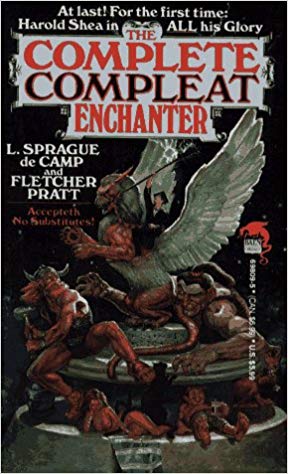
In "Solomon's Stone," author Sprague de Camp transports his protagonist from our world into the Astral Plane. The protagonist, Prosper Nash, is transported by the will of a demon he and his friends summoned at an evening's dinner party.
Prosper Nash felt a tremendous shock, as if a destroyer had dropped a depth bomb on him. While his mind strove to keep a grip on his body, he could feel that body being pulled out of his mental clutches--going--going--gone!

He was moving with great speed--or falling; it was like an express-elevator plunge, only more so...

Keep your head, J. Prosper. Let's take a look at this astral body of ours first.
-- L. Sprague de Camp "Solomon's Stone" Unknown Worlds vol. 6 no. 1 (1942).

 
It's quick and too the point. Sprague de Camp gives us a little more of the "whys and wherefores" of travel beyond the veil of the mundane in his more famous Harold Shea "Enchanter" stories, but he still gets us there quickly.

There, on sheets of paper spread before him, were the logical equations, with their little horseshoes, upside-down T's, and identity signs. 
His scalp prickled a trifle as he gazed at them. But what the hell! Stand by for adventure and romance! He bent over, giving his whole attention to the formulas, trying not to focus on one spot, but to apprehend the whole:

'If P equals not-Q, Q implies not-P, which is equivalent to saying either P or Q or neither, but not both. But if not-P is not implied by not-Q,  the counter-implicative form of the proposition--'

There was nothing bu six sheets of paper. Just that, lying in two neat rows of three sheets, with perhaps half an inch between them. There should be strips of table showing between them. But there was nothing--nothing...>


It is through this focus on a logical equation that Harold Shea is transported to Midgard's border and where is adventure begins. L. Sprague de Camp's tales were inspirational to Gary Gygax as he worked on the Dungeons & Dragons role playing game, and that work in turn inspired Andre Norton's Quag Keep, which uses magical lead miniatures as the conceit (and does so much quicker than de Camp). One of the most iconic versions of the Trapped in Another World trope is Edgar Rice Burroughs' A Princess of Mars, which sees Civil War Captain John Carter transported to the fantastic world of Barsoom through sheer force of will.

As I stood thus meditating, I turned my gaze from the landscape to the heavens where the myriad stars formed a gorgeous and fitting canopy for the wonders of the earthly scene. My situation was quickly riveted by a large red star close to the distant horizon. As I gazed upon it I felt a spell of overpowering fascination--it was Mars, the god of war, and for me, the fighting man, it had always held the power of irresistible enchantment. As I gazed at it an on that far gone night it seemed to call across the unthinkable void, to lure me to it, to draw me as a lodestone attracts a particle of iron.

My longing was beyond the power of opposition; I closed my eyes, stretched out my arms toward the god of my vocation and felt myself drawn with the suddenness of thought through the trackless immensity of space. There was an instant of extreme cold and darkness...
And...BOOM! He's on Mars. It's powerful imagery that makes no logical sense. We are given no plausible reason for the transportation to work, but it does and it is magical. This is the kind of conceit Wolfe uses in his book as Billy wills himself into another world:

What do I do? Please, please, Billy prayed silently, I have to get her out of here.

At that moment, Billy saw real light, a shining cell phone, illuminating the culvert.
Unfortunately, it was carried by the last person Billy wanted to see.

"What are you idiots doing?" It was Kurt. And he sounded furious.

Billy tried to catch his breath, push past the pain, and lift Lexi, anything to get her away from Kurt. To get Lexi to safety.

I need to get out. I need to be anyplace but here.


Then, suddenly, as if in answer to Billy's unspoken wish, the world around him shifted, warped, and bent. His stomach lurched. His ears popped. And just like that--

Billy was somewhere else.

Wolfe's description of transportation here is a combination of Burroughs and de Camp and it works nicely. You have the desperation of the scene, the compulsion to get away, and that's enough. Wolfe doesn't spend pages describing how and why the kids are transported, just that Billy wants to go and so they do. This is a fantasy novel and that comes with suspension of disbelief. When the trope used is a common one, such suspension is easy and granted eagerly. Don't spend time describing how and why, that only opens up the critical eye and limits the visceral experience. Wolfe understands this and takes us away quickly.

The reader is exposed to the world of the Hanorian Empire and Mother Mountain, which isn't given a world name in The Goblin Crown, at a nice pace. It's clear by his inclusion of Burroughs-esque use of language (and language acquisition) that Wolfe has a mapped out a compelling fantasy world. It may lack the Mythopoetic realism of Tolkien's Middle Earth, but it is logically consistent and has a history that mirrors the migrations, expansions, and invasions of real Earth history. If you don't find echoes of actual historical engagements between cultures in the backdrop of this story, you aren't paying attention. Wolfe has set up a clash of civilizations that views both societies as "human," with all the virtues and flaws that entails, which allows him to explore moral complexities.

While the majority of The Goblin Crown takes place within Goblin society, readers are given enough of human history to see a broader world. This first volume spends its time building Goblin society, and it's a rich one. We are given glimpses of the Goblin worship of  the Night Goddess and the justness of the religion's matriarch. These are not Warhammer's mindless Goblins. While they are still the untrustworthy, sneaky, and vicious Goblins we are used to, they are also a gentle, family minded, and caring people. Wolfe humanizes the Goblins without demonizing the humans and it makes the impending conflict more powerful.

One of the most developed aspects of the world, is the underlying magic system of the races. Humans, who worship the sun, have fire based magic and Goblins, who worship the Night Goddess, have cold based magic. Each system has strengths and weaknesses and both systems of magic come with the risk of madness and death if they are overused. We as readers are able to learn the intricacies of the magic system through the interactions between Lexi and a Goblin Wizard named Frost. After being transported to the new world, Lexi discovers that she is a Fire Mage and that her fiery temper may well lead her down the road to destruction.

Critique


As entertaining as The Goblin Crown is, I read it in an afternoon and ordered the sequel immediately thereafter, it isn't a perfect novel. 

Even as one of the novel's major is how well developed the majority of Wolfe's characters are, there are holes. While General Sawtooth, the major antagonist of the novel, is offered as a point of view character, Kurt Novac isn't. Given that Kurt is one of the core four characters (maybe five if you count Frost), having to rely on his conversations with other characters to reveal his inner thoughts is a bit of a letdown. We get Lexi, Billy, Hop, and Sawtooth as point of view characters. Leaving Kurt out of this list maked it seem like the author was attempting to prolong a mystery that wasn't really a mystery. Was the only reason Kurt wasn't used for point of view to leave us wondering who the Goblin King really was? Given the title of the novel, and the copy on the back cover of the book, one hopes not. Kurt needed to be explored a little more, especially since the character does evolve and shift from antagonist to one of the heroes as the book progresses.

The second area for critique is very much related to the first. The initial narrative misdirection regarding who and what the Goblin King is and how it is chosen was unecessary. While this misdirection leads to some very important narrative outcomes, and allows the point of view character to learn more about the world and their new abilities, it felt like a bit of a cheat. This is exacerbated by the fact that it's pretty obvious. It's a mystery without a mystery. It's like guessing who the murderer in a typical episode of Matlock is. We all know it's the Guest Star. What makes Matlock interesting isn't the who, but the why. Had the misdirection explored the why of the Goblin King, it would have worked. Instead, it was primarily a vehicle to move the characters from one location to another.

Final Thoughts


Setting aside these two relatively minor critiques, The Goblin Crown was a fun ride. It has a narrative and cast of characters that appeals to our inner child with a complex moral backdrop that engages our more cynical adult minds. If you love fantasy for all ages, or have a tween who is looking for a series to start, you couldn't do better than The Goblin Crown. Wolfe draws inspiration for Edgar Rice Burroughs, de Camp, Tolkien, and classic children's tales and creates a world worth exploring.

And explore this world is something I'll be doing over the next couple of weeks. I'll be writing up statistics for some of the main characters for a role playing game. I haven't decided on which game to use yet, but I'm leaning toward Genesys, Shadow of the Demon Lord (hey, he's planning a Kid Friendly Version), The Index Card RPG, or Symbaroum.

Tuesday, October 22, 2019

Role Playing Adventures in the "Alien Bones" Universe Part 1 (Tiny Frontiers Edition)

 
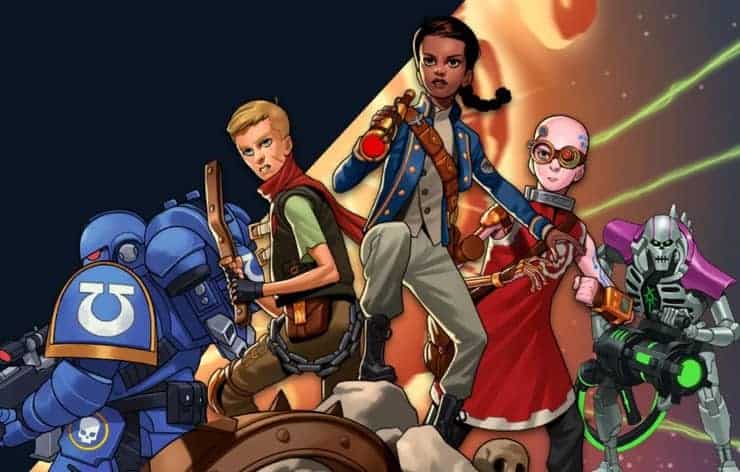
The Alien Bones graphic novel by Doc Wyatt and Chris Grine, released on October 2, 2019 and published by 1First Publishing, is a fun tale of "dim dark" adventure that introduces readers to a universe filled with alien dinosaurs, space pirates, intergalactic navies, and an existential threat called "The End." The universe is a wonderful mashup of Warhammer 40k, Doctor Who, Indiana Jones, Arthur Conan Doyle's The Lost World, Lost in Space, Scooby Doo, Philip Jose Farmer's Riverworld series, and a host of other inspirations. All of this makes it a perfect inspiration for role playing game sessions.

The first volume, and let's hope it's the first of many, focuses on the character of Liam Mycroft. Young Liam is the 10 year old son of a Xeno-paleontologist who has accompanied his father on a variety of digs where his father studies the bones of "alien dinosaurs." During one of these digs, Liam's father disappears without a trace, leaving young Liam alone. It is here that Liam's adventure begins. Joined by his friends Dianna Varlou and Rosa Ortega, as well as his trusty robot bodyguard Standard-5 ("Stan"), Liam embarks on a quest to find his father and in doing so discovers the secret of an existential threat that could destroy all life in the universe.

I interviewed Doc Wyatt on my Geekerati Media podcast and he has given me permission to generate role playing game statistics for several of the characters.


While I am tempted to describe the universe in detail, I am instead recommending that you purchase the book on Amazon (or at your friendly local comic book store) and providing gaming statistics for the main cast, as well as the statistics for one of the threats the young protagonists face.  (I'm also tempted to do stats for Warhammer Adventures: Attack of the Necron, a similarly dim dark story with delightful young protagonists).

Today, I'll be providing statistics for the excellent and simple Tiny Frontiers role playing game. Tiny Frontiers is a perfect system for novice and experienced gamers, making it a perfect fit for the first set of statistics for your gaming pleasure. In later posts, I'll provide statistics for the Savage Worlds, Star Frontiers, and Aliens & Asteroids role playing systems. I might even provide stats for The Expanse and Warhammer 40k role playing games, as both have elements that work well in the Alien Bones universe, but those systems are slightly more complex and Alien Bones was written for ages 4 to 444 and I wanted to have systems that younger gamers could jump right into.

Without further ado, here are the main characters of Alien Bones with statistics for Tiny Frontiers.

Liam Mycroft

Liam Mycroft is a 10 year old who is already on his way to becoming a Xenopaleontologist. His has great expertise regarding dinosaurs on all planets as well as knowledge of the ecosystems that produce these wonderful creatures.


Dianna Varlou

Dianna Varlou is Liam's best friend and steadfast companion. She is visiting Liam when his father disappears. She is the daughter of a respected Thermodynamicist, but her areas of expertise seem to lean more toward robotics and weapon design. She's kind of the team's MacGyver. When the team is faced with a new threat, she is the one who is able to weaponize Portal Crystals.


Rosa Ortega

Rosa Ortega is the class clown in Liam and Dianna's Holoclassroom on the Scholastic Network. While she doesn't seem to take things very seriously, she is a skilled computer hacker. She has an extraordinary amount of courage, which she clearly inherited from her parents who are both Generals in a Space Fleet stationed at Charon Base on the edge of explored space. Rosa has two sets of statistics. The first represents her as she is portrayed in the first half of Alien Bones, when she participates in the adventure only because she hacked a holoprojector. The second represents her as she is on a regular basis.


Standard-5 ("Stan")

Standard-5 is Liam's robot bodyguard or "Minder-bot/Nanny." Stan has many advanced skills that help him to protect Liam from a variety of dangers. Stan often seems over-protective of Liam, but can be convinced to allow Liam to take necessary risks. This can happen due to the use of an "Adventure Button" that Liam and Dianna installed*, or due to necessity.


The End

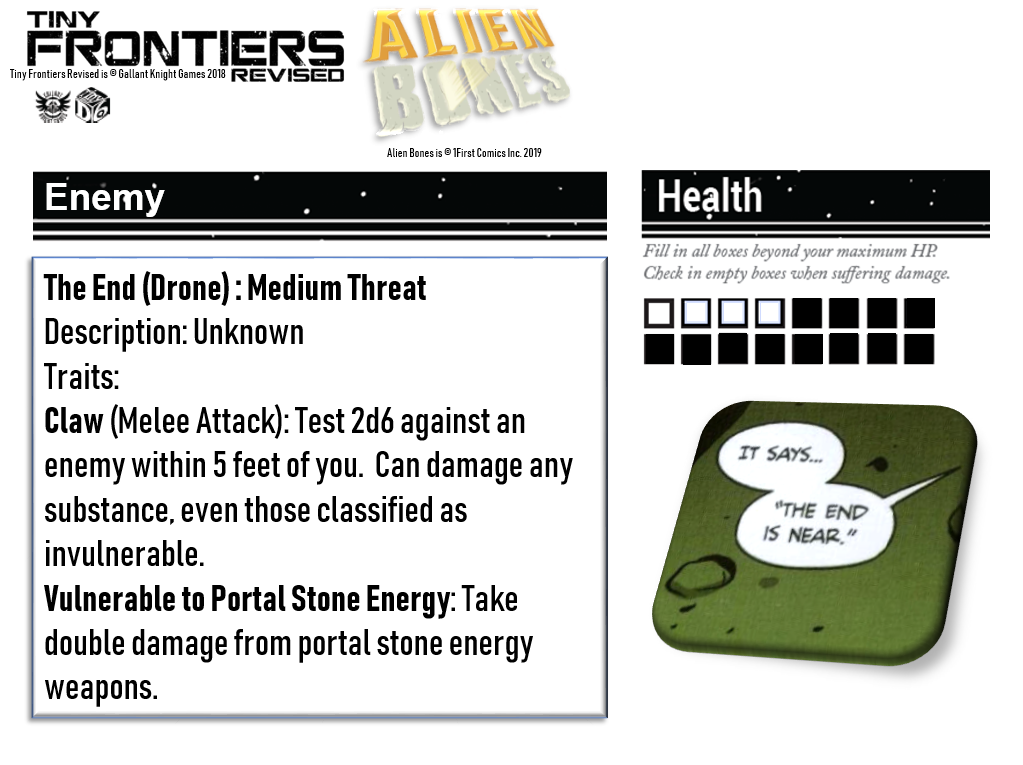
There are two main antagonists in Alien Bones. The first is the space pirate Captain Scarbones, but the long term threat is something known as "The End." It would be a bit of a spoiler to reveal exactly what The End is/are, but they are a foe on the scale of Tyrannids/Necrons in Warhammer 40k or the Sathar in Star Frontiers. They seek the destruction of all life and an end to the universe. Below are statistics for one of their drones. If you want to see what they look like, you need to buy Alien Bones. Chris Grines did a masterful job of illustrating an existential threat in a way that conveys the horror of the threat to adults while still being extremely kid-friendly.

I really enjoyed reading Alien Bones, and will be reviewing it later this week or early next week, and think it is a rich setting that I hope the author and artist will continue to explore.

Friday, October 18, 2019

The H.G. Wells Inspired TRIPODS AND TRIPLANES by Ares Games Looks Like a Good Time


The Wings of Glory pre-painted miniatures wargame has been the go-to game for those who want a simple and visually appealing introduction to simulations of WW I dogfights. I first encountered the game when Fantasy Flight Games held the license to produce the game in the United States. The first edition of the game lacked the beautiful pre-painted biplane and triplane miniatures that followed, but the mechanics and components were sound and appealing. Now that my daughters are older, I'm planning on breaking out my relatively large (and far too neglected) collection of miniatures and movement cards to play the original game. My hope is that I will be able to use it as a gateway game for Richthofen's War.

One of the reasons my interest in the game was rekindled was Ares production of an H.G. Wells inspired version called Tripods & Triplanes which simulates the fictional combat between brave pilots and the sinister machines of an invading Martian army. This particular combination sparked my interest for two reasons. The first, and most obvious one, is that I've long been a fan of H.G. Wells and the War of the Worlds storyline is rich for simulation in games. Not to mention the fact that H.G. Wells is one of the founders of the miniatures gaming hobby. As significant as that reason was, it was the fact that this setting will partially save my daughters from having me interrupt game play in order to force them to watch my favorite WW I movies or from being required to listen to me guide them through several Google searches to learn about the historic aces who participated in the Great War. Don't get me wrong they'll still have to suffer through those "learning experiences," it's just that these experiences are less likely to interrupt game play now.

The staff over at Wargames Illustrated have put together a wonderful unboxing video of Tripods & Triplanes that shows how nice the components are. The reviewer commented that he wished it had included a playmat in addition to the terrain pieces. I agree that would have been nice, but I've still got my beautiful playmats for the base game.

I can't wait to play this game and I love the design of the Tripods.


Thursday, October 17, 2019

Episode 165: Chatting with Doc Wyatt about Alien Bones and Super Dinosaur

Geekerati Episode 165


Episode 165: Chatting with Doc Wyatt about Alien Bones and Super Dinosaur

We were lucky enough to connect with Television and Film Producer Doc Wyatt a couple of weeks ago to discuss a couple of his newly released projects. While Doc's producing credits include films like Napoleon Dynamite, our discussion focused entirely on his work in comic books and animation. 

His most recent comic book Alien Bones is an adventure tale in the emerging "Dim Dark" genre. Tomorrow's post will include a review of the book as well as role playing game stats for some of the characters, which should give a suggestion of what I thought of the book. HINT: I liked it and so did my daughters.

Doc's a busy content creator, who's work includes a wide variety of animated series. If you like super heroes and/or Star Wars, it's likely that Doc and his writing partner Kevin Burke have worked on your favorite show. He's currently working on a number of series, but Episode 165 highlights his work on the recent Super Dinosaur series, which is an adaptation of a comic book by Robert Kirkman of The Walking Dead fame. Super Dinosaur is a mash up of Science Fiction, Super Hero, and Hollow Earth tropes that is currently airing on Amazon Prime.

I don't want to reveal too much of the interview here, but here are a couple of things we touch on during the interview. 

Image result for warhammer adventures

The Dim Dark genre and books like the new Warhammer Adventures series. Let's just say that if you like Alien Bones, you'll like Warhammer Adventures and vice versa.

The Spelljammer setting for the Dungeons & Dragons role playing game, a setting of wild fantasy adventures in outer space.

Related image
Season 20 of Doctor Who featuring Peter Davison as the Fifth Doctor, and the Enlightenment storyline in particular.

The classic Vincent Price horror film Witchfinder General and the comic book of the same name by Doc Wyatt.


The short lived Jeph Hephner series Agent X that ran on TNT in the early 2010s.


The amazingly entertaining Disney Junior series Octonauts that my family loved so much I had to order toys from England as Christmas presents.


The old show Voyage to the Bottom of the Sea, which is the live action adult equivalent of Octonauts, cool ships and all.


The Marvel comic book Death's Head featuring a character originally published by Marvel's British Comic book division in the 1980s.

Image result for deathshead comic 

It's a great conversation and we'd love for you to listen.


Friday, October 04, 2019

JUDGE DREDD: HELTER SKELTER Looks Fantastic!!!


The folks over at Wargames Illustrated have produced an unboxing video for the upcoming Osprey Wargame Judge Dredd: Helter Skelter. We are very excited about this miniatures skirmish game. It's based on Martin Wallace's excellent Wildlands game engine which will likely make it a great introduction to the table top wargaming hobby.


Wildlands features beautifully sculpted miniatures that have a coat of wash on them to bring out the sculpting details enough that non-hobbyists can play the game straight out of the box. Using wash instead of pre-painting provides enough detail to make the game look beautiful while allowing experienced hobbyists to paint the figures to their own tastes.

If you'd like to get a glimpse of how the Wildlands system works, the fine people at Watch It Played have done an excellent tutorial on the rules.


We'll definitely be reviewing it when it's released.

Wednesday, October 02, 2019

Why I Love "Step-Die" Systems Like Savage Worlds and Cortex+

In the last episode of Geekerati (Episode 164) Award Winning game designer Greg Gorden discussed a number of the game systems he's worked on in the past and some of the mechanical innovations he's come up with. Two of his major contributions discussed in the episode were "Exploding Die Rolls" and Die-Step game mechanics.


These mechanics have had wide reaching impact in game design across table top role playing game design and are worth discussing in some detail. As interesting and wide reaching as the influence of exploding dice has been, an innovation that's been around since the first edition of Ken St. Andre's masterpiece Tunnels & Trolls, this blog post will focus on the second innovation, die-step game mechanics, and why they are one of the best mechanical foundations for a role playing game.

There are several common base mechanics for arbitrating the success or failures of character actions in modern role playing games. Some of the most common include Difficulty Number/Target Number (or what Classic Traveller called a "Basic Throw"), Percent Chance (as exemplified in Runequest), Success Threshold (which can use narrative dice like Genesys, die pools like Vampire) or a "you, me, or we" Shared Decision Mechanic like Apocalypse World, Inspectres, and many other indie role playing games.

Many of these systems use a "Fixed Die" mechanic as a part of their resolution. For example, all rolls in D&D's Difficulty Number system are resolved using a twenty-sided die, Traveller and Apocalypse World use a roll of two six-sided dice, Vampire uses a pool of ten-sided dice, and Runequest uses percentile dice. The die type doesn't change to reflect the skill of the character or the challenges faced by the character in a fixed die system, only the modifier applied to the roll or the number of dice rolled changes.

Die-Step games take a different approach. Instead of using a single die type for the determination of success or failure of an action, they use various die types that move up or down to reflect the skill/natural talent of the character. For example, a character's Strength might be reflected as a die value ranging from d4 to d12 with a character of d4 Strength being weak and a character with a d12 Strength being very strong.


According to Rick Priestley, in his book Tabletop Wargames, one of the first wargames to use a Die-Step system was StarGrunt by Jon M. Tuffley. StarGrunt was first published in 1990 by Ground Zero Games and it's second edition is available in pdf for free at the link above. StarGrunt is a science fiction miniatures skirmish game that is inspired by fiction like Gordon Dickson's Dorsai, David Drake's Hammer's Slammers, the Alien films, and role playing games like 2300 AD. The rules are relatively easy to learn and one of the reasons this is the case is the fact that Tuffley decided to represent the effectiveness of individual troopers with something he called a "Basic Die." In StarGrunt, each given trooper is rated as either Green, Regular, or Veteran. The rating of each individual trooper is determined at the beginning of play with Green troopers using a d6, Regulars using a d8, and Veterans using a d10 to determine how successful they are at a given task. StarGrunt uses a Target Number system, but does use a Step-Die modifier mechanic called "Basic Die Plus and Basic Die Minus"  where the dice used by the troop levels is moved up or down one die type (from d6 to d4 or from d10 to d12) under some circumstances and modified by a additive/subtractive number in other cases (+1 or -1 to the roll).


Image Source Non-Playable Characters Blog
The first role playing game I can think of that used a Die-Step system is FASA's Earthdawn First Edition published in 1993, with game mechanics designed by Greg Gorden and others. As stated in the Geekerati Media interview, Gorden was inspired to use a Die-Step system when his boss asked him to design a Fantasy role playing game that had its own system, but that still used all of the polyhedral dice Dungeons and Dragons players were used to using. You can see how Earthdawn knew it was introducing a new concept in the Die-Step system to players of games like D&D and Runequest due to the way they first present the mechanic. In Earthdawn, players attributes are rated by a standard value and then given their die based effectiveness rating (yes, Earthdawn used the Papyrus font). Given that one of the character generation methods in Earthdawn, the random roll method, has players roll 4d6 and drop the lowest value, it is clear that the intended audience was D&D players and the authors were giving these players a point of reference for how good a "d8" in an attribute was. Looking at the chart below, we can see that a character with average Intelligence in D&D would have a d8 rating in Earthdawn.


As mentioned above, Earthdawn is a Target Number system and the rulebook provides guidelines for Game Masters to use when setting difficulty numbers. Looking at an "ordinary" person, we can see that a task of "Average" difficulty requires a roll of between 3-5 to achieve any degree of success. Let's assume a Difficulty Number of 4+ for a task and we can see that a person with a d6 will have about a 50% chance to get an "ordinary" success and a person with a d8 has about a 62.5% chance of getting a degree of success. For those wondering, the use of the term ordinary success is intentional as Earthdawn has Degrees of Success as well and the use of "about" is because the dice are open ended which doesn't affect this particular Difficulty Number but would higher values.


While Earthdawn is truly innovative, it is also illustrative of a weakness in Die-Step systems that will be touched upon later. You can see a hint at this weakness at Step Numbers 8 and 9 on the Step/Action Dice chart above.


Another revolutionary role playing game that utilizes a Die-Step mechanic is Shane Lacy Hensley's masterpiece Deadlands Classic. The first edition was published in 1996, three years after Earthdawn, but the underlying mechanics were designed by Shane Hensley with some additions like Fate Chips from Greg Gorden. Episode 164 of Geekerati erroneously credits Gorden with the use of a Step-Die mechanic in this game. That was all Hensley's idea and demonstrates how great designers can come up with parallel mechanics, though Hensley had done previous work on Earthdawn so that might have fueled the creative fire a little. Deadlands uses a combination of Die Pool and Die-Step mechanics as character attributes and skills are rated by both the quality and number of dice. Thus a person might have a Smarts of 4d4 or of 2d10. The person with the 4d4 rating will roll more dice, but the one rolling 2d10 is more intelligent. Like Earthdawn, die rolls in Deadlands are exploding or "open-ended," but unlike Earthdawn players select only the highest value from their pool rather than adding them together. This innovation leverages the strengths and intuitive nature of Die-Step systems without adding the limitation hinted at above.

One of the primary strengths of Die-Step systems is that they are easy to understand and are intuitive in representing each character's potential. If a game has a baseline difficulty of 4 for most tasks, it is easy to figure out how likely a character is to be able to accomplish a task merely by looking at the kind of die rolled. As mentioned above, a character with a d6 would have a 50% chance of success and a character with a d8 would have a 62.5% chance.

Another advantage, at least from a simulation perspective, is how modifiers affect Die-Step systems differently than standard fixed die systems. In D&D, for example, a +1/-1 modifier adjusts the level of success by a character by +/- 5%. Some might argue, okay I am arguing, that this isn't a good simulation of effects. A person who is a highly skilled sniper would be affected by crosswind and distance, but would not necessarily be AS affected by them as someone less skilled. In a fixed die system, the modifiers are static too. In a Die-Step system, the modifiers are fluid. Some might argue that this makes it more difficult to balance, but I would argue that you should balance for the ordinary and allow the dial to move with greater success.

Let's take the d6 vs. d8 above as an example and assume that these are the characters' ratings in their "Shoot" skill and that the base target number for successfully hitting something is 4+. Okay, this wasn't an exactly random choice. Let's assume that firing at long range adds  -1 modifier to the roll. In the case of the lesser trained d6 shooter, this is a penalty of 16.67%. In the case of the d8 person, it's "only" a penalty of 12.5%. Thus the skill of the characters is coded into the level the modifier affects the character with characters of higher skill suffering lower effects from modifiers. What I like about this is that it means that the probability of success by higher level characters is less random, even when accounting for obstacles and modifiers. And this is done in an elegant way that is embedded in the system.

If you don't agree with the benefits of a sliding system in die step systems, let me introduce you to rigid modifiers in a multiple die Target Number system like Champions. Because these systems use additive die pools, in the case of Champions rolling 3d6 and adding them together, results are along a bell-curve. This means that each point of modification has a different effect on the probability of the outcome based on the distribution curve of the die combination. Which brings me to the flaw in the Earthdawn system. Because Gorden wanted Earthdawn to be able to represent an tremendous range of Attributes, the actual Step/Action Dice table has attribute values going to 100, you quickly end up rolling pools of dice in order to achieve the ability to roll higher outcomes. For example, looking on the chart above you can see that there comes a point where a player rolls a 2d6 and adds them to get a value. This is considered "better" than rolling a d12. In the sense that it is impossible to roll a value of 1, this is better. However a quick glance at the table below illustrates the problem quite clearly.


A character rolling 2d6 has a significantly lower chance of a bad roll, but also has a significantly lower chance of a good roll. The results become even more extreme if the individual dice are exploding as they are in Earthdawn.


This is why I prefer the solution offered by Savage Worlds or Dungeon Crawl Classics which attempt to correct the distribution problem by either adding static modifiers after a person has achieved d12 or manufacturing dice that fill the void between d12 and d20. While the use of Die-Step systems may constrain the power curve more than some other systems, these games are well balanced and use the mechanic to very good effect. Savage Worlds, for example, has done an excellent job of adapting a Die-Step system to super heroes as have the Sentinel Comics role playing game and all the super hero games that used the Cortex+ system.

There are many games and game systems in the table top role playing game hobby. Dungeons & Dragons is a great place to start, but you should check them all out and see what you like.