When I was and undergraduate at the University of Nevada, Reno I ran a DC Heroes campaign that lasted for a couple of years. It is the most successful superhero campaign I've ever run. I had the luck to have a great group of gamers who were willing to cut loose and have a great time with the genre and who felt free to push the limits of the DC Heroes game system. This campaign is one of the reasons that I think DC Heroes is the best set of rules to play a superhero game, though Marvel Saga System comes in a close second.
The premise of the campaign was pretty simple. I wanted to run a game where the characters were on the same power level as the Justice League, minus Superman and Wonder Woman, and I wanted the game play to have a touch of the feel generated by the Giffen/Maguire/DeMatteis run in the Justice League books. I wanted a mix of action and comedy. To be honest, based on my experience in running RPGs, I knew the comedy would come whether I wanted it or not. It's is the DM's Lament to want to run a game that captures the epic tales of the Eddas and Beowulf only to end up with Monte Python's Holy Grail. Instead of fighting that tendency, I decided to roll with it. The title of the campaign was Justice League: Auxiliary. The premise being that the characters were members of the Justice League, as then managed by Maxwell Lord, but where the second string of the team.
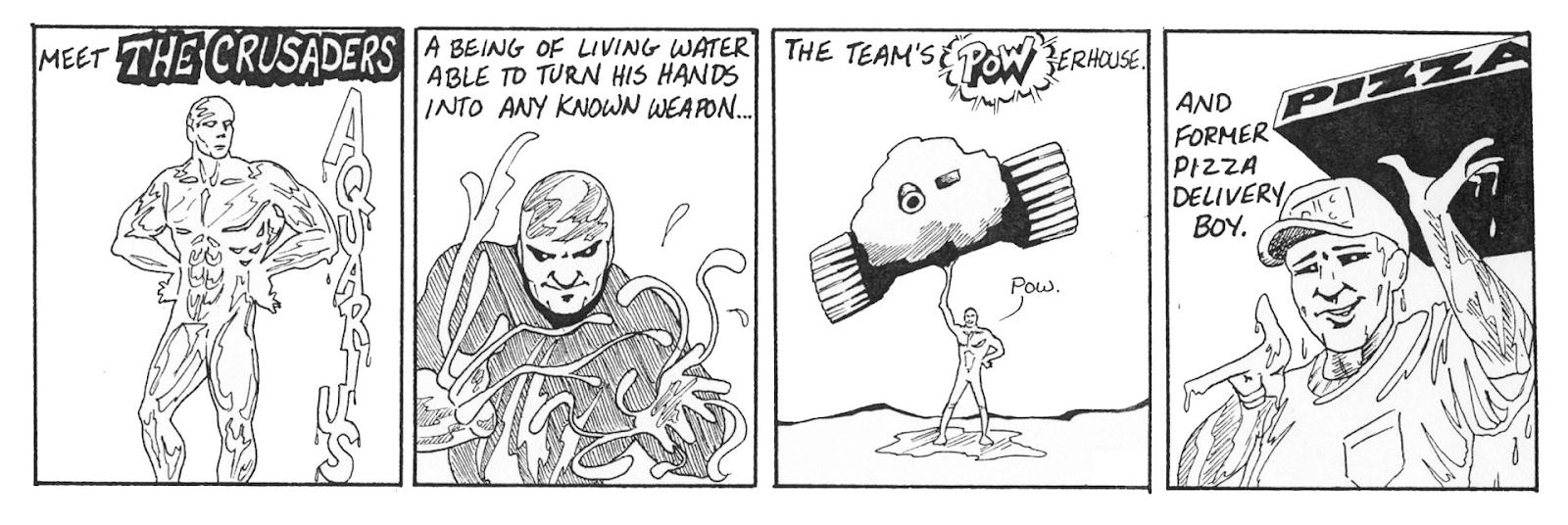
What a team it was too. The membership included an interesting mix of characters about whom my wife (girlfriend at the time) drew a couple of cartoon strips that ran in the school paper The Sagebrush. That brief strip was called "Meet the Crusaders" for obvious copyright reasons. Over the next few days, I'll be presenting the Crusaders to you and will be including statistics for them for a number of role playing games. The primary games I'll be using to emulate the characters are Wizards of the Coast's excellent 4e based Gamma World game and Pinnacle Entertainment Group's Savage Worlds.
First, let me introduced the team to you.
GABRIEL: ARCH-ANGEL
Gabriel was character who believed himself to be the Archangel Gabriel and who exacted swift justice on any he viewed to be in violation of his very strict code of morality. During a battle with the god Ares, he attempted to use his Aura of Fear power and ended up not only succeeding at cowing Ares but in causing the entire continent of Europe to quiver in fear as his pushing of the power extended the aura over the entire geographic area. The character was played by my good friend, and best man at my wedding, Matt.
AQUARIUS
One of the great things about the DC Heroes system was it's ability to make almost any superhero and my friend Robert's character Aquarius was one that really demonstrated the strength of the rules. Robert wanted to play a super strong character who was a living water elemental and who could transform his hands into any weapon he imagined. In this particular case, the powers were called Omni-Arm, Density Increase, Dispersal, and Water Control powers. Robert was a relatively new gamer at the time, and had never played a superhero game before, so in the early sessions he tended to limit his use of Omni-Arm to turning his hands into sledge hammers. That changed soon enough.
This is just a glimpse at two of the members of the team. I want to save the other strips for when I present each member's statistics, so you will be seeing these strips again as well as those for Jynx, Vanguard, Spirit, and perhaps the most bizarre superhero ever made...Jody's beloved "Less" who was a character inspired by John Carpenter's THE THING and Larry Cohen's THE STUFF. Who is Less? Why is Less called Less? You'll have to wait for his entry.
To bide you over until the next entry, and I promise it will be soon, here is a glimpse at what the Gamma World statistics sheet (page 1) will look like.
Those of you who have been reading/following Advanced Dungeons and Parenting ever since the Cinerati days know that I used to host a podcast called Geekerati with Shawna Benson, Bill Cunningham, Eric Lytle, and Wes Kobernick. We had a great run for a couple of years and were able to book guests like Margaret Weis and Tracy Hickman (DRAGONLANCE), Tim Minear (FIREFLY, ANGEL, AMERICAN HORROR STORY), Rob Long (CHEERS, KEVIN CAN WAIT), David Goetsch (BIG BANG THEORY), Brandon Sanderson (MISTBORN, ALCATRAZ Vs., STORMLIGHT ARCHIVE), Susan Palwick (FLYING IN PLACE), Matt Forbeck (BRAVE NEW WORLD, ENDLESS QUEST, BLOOD BOWL), Shane Hensley (SAVAGE WORLDS), and many more. It was hard work, and we were never able to catch the fire we hoped, but it was an experience I wouldn't trade for the world.
Recently, I've gotten the podcasting bug again. After chatting with friends with similar interests, we decided that instead of trying to relaunch Geekerati that it would be fun to create a real play podcast of a 5th edition D&D campaign. Our group won't be the first to do this, there are several excellent podcasts and streamers out there, but it's something that we think will be a great experience for a number of reasons. First, it might just catch on and we might be able to connect with people who have similar groups to our own. Second, we think that it will make our own role playing skills better. After all, knowing that someone might be listening might get you to focus on how much role playing your are doing. Finally, we are noticing that it is forcing us to thing about world building since we all agree that it might be more fun to create our own setting and share that with the world.
I've got a great group lined up, but we are still in the planning and logistics phase. We don't even have a name for our podcast yet. We do, however, already have a number of ideas for our setting and I will be sharing those over the summer as it gets flushed out more. I'll also be introducing you to some of our players and their characters. First here, then on a website for the podcast.
Speaking of websites...it's about time I started moving the Geekerati episodes over to my personal website at www.christianlindke.com instead of having them only on the Blog Talk Radio site.
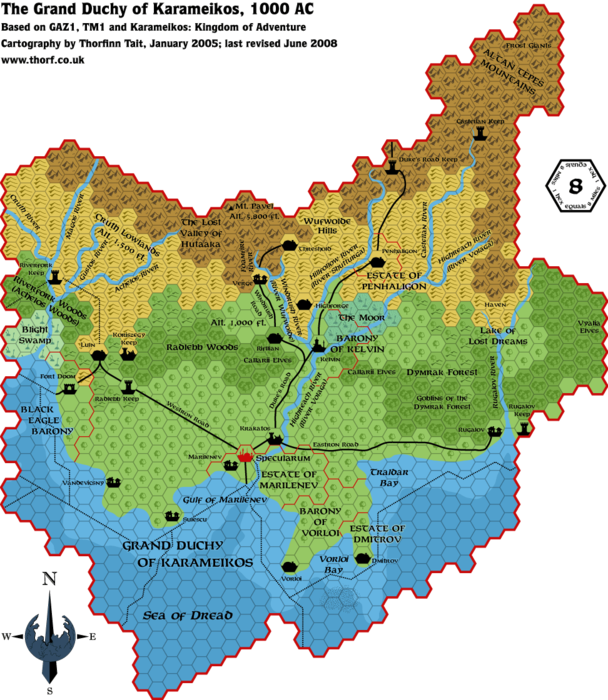
For those of you interested, here is a quick glimpse of a VERY rough draft of the country where our campaign will take place.
With the recent announcement that Ron Edwards was teaming up with Hero Games to produce CHAMPIONS NOW, a game that hearkens back to the first three editions of the game, I thought it would be a good time to take a look at those older editions.
The CHAMPIONS super hero role playing game is one of the best super hero role playing games ever designed, and the game to which all super hero rpgs are compared. CHAMPIONS wasn't the first role playing game in the super hero genre, that honor goes to the game SUPERHERO 2044 which I discussed in an earlier blog post. CHAMPIONS even builds upon some of the ideas in SUPERHERO 2044. CHAMPIONS used the vague point based character generation system of SUPERHERO 2044 -- combined with house rules by Wayne Shaw that were published in issue 8 of the Lords of Chaos Fanzine-- as a jumping off point for a new detailed and easy to understand point based system. CHAMPIONS was also likely influenced by the melee combat system in SUPERHERO 2044 in the use of the 3d6 bell curve to determine "to-hit" rolls in combat.
While CHAMPIONS wasn't the first super hero rpg, it was the first that presented a coherent system that allowed a player to design the superheroes they read about in comic books. The first edition of VILLAINS & VIGILANTES, which predates CHAMPIONS, did a good job of emulating many aspects of comic book action but the ability to model a character in character design wasn't one of them. CHAMPIONS was released at the Origins convention in the summer of 1981, and it immediately captured the interest of Aaron Allston of Steve Jackson Games. Allston gave CHAMPIONS a positive review in issue #43 of the Space Gamer magazine, wrote many CHAMPIONS articles for that publication, and became one of the major contributors to the early days of CHAMPIONS lore.
Reading through the first edition of the game, can have that kind of effect upon a person. The writing is clear -- if uneven in places -- and the rules mechanics inspire a desire to play around in the sandbox provided by the rules. George MacDonald and Steve Peterson did more than create a great role playing game when they created CHAMPIONS, they created a great character generation game as well. Hours can be taken up just playing around with character concepts and seeing how they look in the CHAMPIONS system.
There are sites galore about CHAMPIONS and many reviews about how great the game is, and it truly is, so the remainder of the post won't be either of these. Rather, I would like to point out some interesting tidbits about the first edition of the game. Most of these will be critical in nature, but not all. Before going further I will say that though CHAMPIONS is now in its 6th edition and is a very different game today in some ways, the 1st edition of the game is highly playable and well worth exploring and I'm glad that Ron Edwards has picked up that torch with CHAMPIONS NOW.
One of the first things that struck me reading the book was how obviously playtested the character design system was. This is best illustrated in the section under basic characteristics. In CHAMPIONS there are primary and secondary characteristics. The primary characteristics include things like Strength and Dexterity. The secondary statistics are all based on fractions of the primary statistics and represent things like the ability to resist damage. Where the playtesting shows here is in how players may buy down all of their primary statistics, but only one of their secondary statistics. A quick analysis of the secondary statistics demonstrates that if this were not the case a "buy strength then buy down all the secondary stats related to strength" infinite loop would occur.
It's striking how few skills there are in 1st edition CHAMPIONS. There are 14 in total, and some of them are things like Luck and Lack of Weakness. There are no "profession" skills in 1st edition. To be honest, I kind of like the lack of profession skills. Professions in superhero adventures seem more flavor than something one should have to pay points for, but this is something that will change in future editions.
There are a lot of powers in CHAMPIONS, but the examples are filled with phrases like "a character" or "a villain" instead of an evocative hero/villain name. It would have been more engaging for the folks at Hero Games to create some Iconic characters that are used throughout the book as examples of each power. The game does include 3 examples of character generation (Crusader, Ogre, and Starburst), but these characters aren't mentioned in the Powers section. An example using Starburst in the Energy Blast power would have been nice.
The art inside the book is less than ideal. Mark "the hack" Williams has been the target of some criticism for his illustrations, but his work is the best of what is offered in the 1st edition book. It is clear why they decided to use his work in the 2nd edition of the game. Williams art is evocative and fun -- if not perfect -- while the work Vic Dal Chele and Diana Navarro is more amateurish.
The game provides three examples of character generation, but the designs given are less than point efficient and one outclasses the others. The three sample characters are built on 200 points. Crusader can barely hurt Ogre if he decides to punch him (his punch is only 6 dice), and his Dex is bought at one point below where he would receive a rounding benefit. Ogre has a Physical Defense of 23. This is the amount of damage he subtracts from each physical attack that hits and it is very high. Assuming an average of 3.5 points of damage per die, Ogre can resist an average of 6.5 dice of damage per attack. Yes, that's an average but the most damage 6 dice could do to him would be 13. That would be fine, except Crusader has that 6d6 punch, and Starburst...oh, Starburst. All of Starburst's major powers are in a multipower which means that as he uses one power he can use less of the other powers in the multipower. The most damage he can do is 8d6, but only if he isn't flying and doesn't have his forcefield up. Not efficient at all. One might hope that character examples demonstrate the appropriate ranges of damage and defense, these don't quite achieve that goal.
The combat example is good, if implausible. Crusader and Starburst defeating Ogre? Sure.
The supervillain stats at the end of the book -- there are stats for 8 villains and 2 agents -- lack any accompanying art. The only exception is Shrinker.
Speaking of artwork and iconics. Take that cover.
Who are these people?! I want to know. The only one who is mentioned in the book is Gargoyle. It's pretty clear which character he is, but I only know his name because of a copyright notice. Who are the other characters? Is that "Flare"? The villain is named Holocaust, but that cannot be discerned from reading this rule book. If you know, please let me know. I'd love to see the stats for that guy punching "Holocaust" with his energy fist.
CHAMPIONS is a great game, and the first edition is a joy. If you can, try to hunt down a copy and play some old school super hero rpg.
I recently purchased a book that some claim was an inspiration for the THUNDARR THE BARBARIAN cartoon. I wanted to judge for myself if this was true and to read the story.
I've only read the first 30 pages, but I'll say that I think claims of inspiration are much overstated. The book is clearly a Burroughs pastiche that falls somewhere between the Thongor novels and the Gor books. That's not high praise. I'm not saying the book is terrible, but the storyline, world, and characters wouldn't lead me to create the post-apocalyptic world of THUNDARR and the "Thundar" name here seems more a riff on Lin Carter's Thongor.
It's an interesting look at other world planetary romance. Though better entries in that genre include THE DARK WORLD by Henry Kuttner, GUARDIANS OF THE FLAME by Joel Rosenberg, THE ARCHITECT OF SLEEP by Steve Boyett, and QUAG KEEP by Andre Norton, not to mention the entire John Carter cycle by Edgar Rice Burroughs.
I'll slog through the rest of the book to see if I can pull any good gaming material from it. I think there might be one or two good ideas here and there. If there are, I will share them.
Coming up with effective names is a challenge for any narrative medium, and this is no less true when it comes to running entertaining role playing game campaigns. Names can make or break a game session. Unlike other media, the challenge in role playing games doesn't solely stem from a need for verisimilitude. Not every game requires realistic names, and some games are better with silly names. It all depends upon the group you are with.
The real challenge comes in coming up with names on the spot that are both serviceable and memorable. You can create as many write ups for NPCs as you want in your game master prep time, but I can guarantee you that your players will often ignore the NPCs you've given deep backstories in favor of interrogating "random street urchin 6" or "Kobold number 5" for hours of entertaining game time. Entertaining game time...if you get the name right. Otherwise, the session might spiral into metagaming or groans. You have to both know what kinds of names fit with your group's temperament, and be quick on your feet. No one wants to wait 5 minutes while you look through Gygax's Book of Names or as you hit generate on a random name generator until you get the right name.
I'm not saying that I'm a master at this particular skill, but I do have one piece of advice for game masters both novice and experienced. Feel free to include your players in the name creation process. Don't feel that you have to do this work alone. If your players want to interrogate "random street urchin 6," as them to come up with a couple of names. These names won't always be great, but they will usually fit with your group's desires and are frequently memorable.
I am currently running a campaign entitled "Tinker, Tailor, Dwarf, and Spy" that takes place within the D&D Known World setting's (aka Mystara's) Grand Duchy of Karameikos. The fact that I am calling it the Grand Duchy will give grognards some hint as to the timeline I've set the campaign in. The Known World setting is a wonderful mashup of various cultures that might not seem to fit on the surface, but which work as a sandbox for freeform gaming. Sure, there's a society with peak Roman Empire governance placed between a proxy for the Eastern Empire and a Feudal society inspired by medieval Poland, the Grand Duchy of Lithuania, and a dash of the Holy Roman Empire. To the north is a country based on Naples, to the far north are the Germanic and Viking states. To the south is fantasy Hawaiistralia Reality TV island. It's a chaotic place, but if you buy in it can be wonderful. My players' characters haven't discovered it yet, but the "reason" why the countries are so chaotic in makeup in "my Mystara" is because one of the Immortals is preserving the dying cultures of our Earth and placing them on Mystara's surface, must as he places Mystara's dying cultures in it's Hollow World.
Anyway, one of the freedoms that a world like this provides is that almost any name is fair game, and here is a list of the names we use in my game with their alignment, race, and class. Some are canon names from the sourcebooks, but others are just ours.
Duke Stephen Karameikos (LG, Human, Fighter (Cavalier)) -- Ruler of Karameikos and the founder of the "Duke's Tinkers" who are Karameiko's secret police, the organization the player characters work for.
Duchess Olivia Karameikos (NG, Human, Thief (Mastermind)) -- Stephen's wife and the actual Chief of the Duke's Tinkers, she is known only as "The Weaver" to all but the most trusted Tinkers.
Kraeyg Lyste (NG, ??, Thief(??)) -- The publicly known head of the Tinkers about whom very little is actually known. They appear to have the ability to change shape and are careful to cover their tracks. They keep detailed documentation of all members, and potential members, of the Tinkers and rival organizations.
Festival Master Quarch (N, Human, ??) -- He runs the King's Festival in the northern town of Stallanford. Stallanford has no mayor, so Quarch is the nearest thing.
Alaric (CG(E), Human, Cleric) -- A priest of the Church of Traladara who has forsaken his oaths to serve The Iron Ring and who has become a priest of Orcus. (Deceased?)
Dinae (LE, Bugbear, Ranger) -- Dinae was once a tracker and wrangler for the Iron Ring who captured slaves for the organization and answered to Alaric. He has recently been turned into an asset in the service of the player characters.
Sharaen Vlatovski (N, Human, ??) -- A human woman who was married to a Kobold named (xxx) who had been forced into service to the Iron Ring by Alaric. She infiltrated Alaric's hideout by allowing herself to be captured, she was about to assassinate one of Alaric's lieutenants and free her husband when the PCs arrived. The PCs know that she is married to the kobold, but are unaware of her skill set. When the PCs return to Specularum, she will find Kraeyg and enter into service in the Tinkers.
Bukie Bimblebritches (N, Halfling, ??) -- He and his brother Howie own the Inn, Stables, and Gambling Hall in Stallanford. They are quite wealthy.
Felix Fentsworthy (N, Human, Thief(???)) -- He is the local fence in Stallanford and the head of its "band" of thieves. After all, you can't call 6 people a guild.
As you can see from the list above, my players can be a little punny, but not too punny.
I posted this last year, a little late, and am reposting it this year for those of you who want to add a little of the Season into your gaming.
I am a big fan of running seasonal adventures for my regular gaming group. Though my group hasn't played as regularly this year as they have in the past, I was inspired by Robert J. Schwalb's dark fantasy roleplaying game Shadow of the Demon Lord to write an adventure for this season. For the past few years, I've written and reshared adventures featuring Cthulhu Claus (based on my wife Jody Lindke's illustrations for an old Kickstarter) or the V'sori (evil aliens in the Necessary Evil setting for Savage Worlds), but this year I decided to feature Krampus -- that most devilish of Santa's helpers. While Krampus might be a bit played out for some, having gained mainstream notoriety, I'm still a big fan of the character and I have the pleasure of knowing an artist who has been participating in Krampuslaufen long before it was trendy to do so and Bill Rude's Krampus costume is amazing as is the fact that he can get even small children to pose with his horrifying costume.
In this mini-adventure, the PCs are passing through the town of
Nesbitt-Hill during one of their other adventures. You can use the map
below to represent the portion of the foothills of the Iron Peaks
immediately south of the Zauberspitz with Nesbitt-Hill being the
northern-most community on the map and Tower number 3 representing the
once great Beacon Fortress.
Shadow of the Krampus is a Novice (though not a "just now Novice") adventure for Shadow of the Demon Lord with a post-Christmas theme.
The town of Nesbitt-Hill is a vital stop for wanderers and miners who brave the dangers of the Iron Peaks in search of adventure or riches. For years the town has been a peaceful refuge, seemingly immune from the spread of the Demon Lord's Shadow. For even as the Shadow has spread, the town of Nesbitt-Hill remains a spark of light an happiness in an otherwise dark and desperate world.
But that changed last night. Historically, the Winter Solstice has been a time of celebration when the townsfolk of Nesbitt-Hill memorialize the the Solstice King and his champion Krampus. For it is this duo who has protected the town since the Battle of Zauberspitz where the Solstice King and Krampus defeated a horde of the Demon Lord's servants, or at least that is what the stories say. The stories also say that Krampus steals children who misbehave and returns them at the Spring Equinox after the darkness has been purged from the children's souls. If it is true that Krampus takes children and eventually brings them back, why is it that Krampus has taken no children for twenty years? Why does Mistress Oetzel swear she saw Krampus take adults this Winter Solstice? And why were these adults among the most generous citizens of Nesbitt-Hill? Has Krampus returned, but as a servant of the Demon Lord? Or is something else afoot?
With the exception of the map depicting the area of the Iron Peaks I refer to as the Gronwald, an area that lies in the shadow of the Zauberspitz, all of the maps were drawn by Dyson Logos and were taken from his Commercial Maps webpage. According to the page, Dyson has released these images under the Creative Commons Attribution 4.0 International License. If I have used any images that are not covered by this license, I will be happy to remove them.
The cover image of "Shadow of the Krampus?" was illustrated by Bill Rude, who was kind enough to give me permission to use it. Please visit his website and consider purchasing some of his art.
The other image is the "survival map" from Robert J Schwalb's playing aids page for Shadow of the Demon Lord. I am using it with the intention of it being fair use, but if Mr. Schwalb deems my use inappropriate I will be happy to remove it. This adventure requires the use of the Shadow of the Demon Lord rule book since all monster statistics, with the exception of Krampus, are located within the pages of that "vile" tome. Krampus was designed using rules from the Of Monstrous Mien supplement. It is highly recommended that you also own Hunger in the Void and Terrible Beauty to add details around the edges of this adventure.
The cartoon illustrations in the module are the work of my talented wife Jody Lindke. I included "rpg humor" cartoons because they remind me of the cartoons in the old AD&D Dungeon Masters Guide.
It's that time of day again. Time for a Christmas movie recommendation. Today's selection is a delightful romantic comedy that features a narrative you'll be seeing again on the list. It's a tale of a sales clerk who is deeply in love with his pen pal and who discovers that in person relationships are both more challenging and more rewarding than anonymous ones.
The Shop Around the Corner (1940) is a truly classic film. It's seemingly simple narrative is filled with human complexities and the performances by Jimmy Stewart and Margaret Sullavan are to die for. They deliver their most scathing lines of dialogue with just the right tinge of remorse, especially Sullavan, and the supporting cast is quite strong. Of the films based on the play Parfumerie, this is the one that spends the most time in the Christmas Season, and for that reason I almost put the others on the calendar before it. That would have been a disservice though, because each telling of the story adds new twists that build upon the foundation of this Ernst Lubitsch classic. I watch this film at least twice a year, and it never fails to make my heart smile.
I love crowdfunding sources, but there is one thing that I don't love. I don't love my fellow crowdsourcers. When we aren't bullying the people we profess to be supporting, we are finding new things to complain about. The latest in a long list of ridiculous complaints is the recent outcry about Patreon's new fee structure. Patreon announced that the would be shifting the charging of fees away from the creators and putting the cost of the transactions onto the backers in order to maximize revenue to the creators. This was done in response to a number of complaints by creators that they were losing as much as 15% of the total pledged to them to fees and that the fees were fluctuating. To remedy this issue, Patreon decided to charge patrons a fee of $0.35 + 2.9% of their pledge instead of charging a variable fee that depended on type of transaction etc. to the creators.
In response to this, a bunch of backers have flipped out. This is ridiculous. Why? I've got a couple of reasons.
1) The fees are exactly the same fees that you would pay at an AM/PM Market. They charge you $0.35 to use your debit card and they add the percentage processing fee they are charged by the bank (usually between 2.5% and 4%) to the price tag of items in the store. I don't see people picketing AM/PM demanding the $0.35 back on their pack of gum, and I don't think it is fair to complain to Patreon or the creators either.
2) This is an extremely reasonable fee. If you look at the graph below, you can see how much this costs patrons.
At a level of $100, this fee doesn't even come to a total fee of $3.50 and yet it ensures that the creator will receive 95% of that $100 instead of losing an additional $3.25.
3) It only really affects microbackers. It makes it so that the person pledging $1.00 is in reality pledging $1.38 and that the person backing at $5 is really backing at $5.50. Let me get this straight. You are losing your shit over $0.38 more money out of your pocket that allows more money to go into the pocket of someone you are supposed to be patronizing? Some patron you are. Microbackers might matter to creators in large numbers, they can help pay the bills after all, but in my experience they are more trouble than they are worth. We've all seen the concern troll $1.00 backers on Kickstarter. Look, $0.38 isn't going to break your bank and it allows more money to go to the creator that you supposedly believe in. Didn't know you were such a free rider. I thought you wanted to support a creator's efforts.
I personally never backed below $5 in any of the projects I backed anyway. Why? Because I knew fees were coming out and that I'd rather give $4.50 to a creator than $.75. I back within my budget and support projects I admire. I wish I could support more. I cannot, but I CAN afford to pay an extra $10 total on all my pledges combined. Does this prevent me from backing 1 more project at the $10 level? Sure.
It also means that when I increase my pledge to Saving Throw Show to $100, they'll be getting $95 instead of $85 and it will cost me less than they would have lost otherwise.
The Christmas Season is a wonderful time for movie viewing. It's fun to cozy up on the couch with family, or put together movie marathons with friends. And there are so many fantastic films that feature the Holidays as a backdrop.
Today's selection is a personal favorite. It's a film that hits all of the right notes for a Christmas movie. It has snowfall, friendship, a Dickensian sensibility, romance, and fantasy. It's also a film I adored when I was growing up and it still holds an extremely warm place in my heart. I might even venture to say that it is one of my favorite, even with its canonical lapses, films featuring Sherlock Holmes.
Featuring a screenplay by Chris Columbus and direction by Barry Levinson, Young Sherlock Holmes creates a wonderfully lovable version of Holmes. As a demi-Holmsian, which is to say someone who is a fan and not a scholar of the Holmesverse, I am frequently taken aback by portrayals of Sherlock Holmes as a distant or harsh person. It's a depiction that is often used to capture his intelligence, and how quirky people find him, but it is one at odds with the fact that Holmes is skilled at disguise, friendly with children, and frequently laughs or is genial when meeting old friends. One of my favorite such moments is when he meets McMurdo, the boxer/bodyguard in "The Sign of the Four." He's a man of many friends and that doesn't match how he is frequently portrayed. The Sherlock of Young Sherlock Holmes doesn't suffer fools, but he is genuinely good-natured with his friends. He is well acted and shows emotions running from joy and excitement to despair. Nicholas Rowe is one of my favorite Sherlocks.
The film also touches upon the importance of spending time with friends around the Holidays. It's a perennial film in our house.
On December 1st, I send out a tweet with the hashtag #ChristmasMarathonAdvent that recommended watching Christmas in Connecticut starring the ever wonderful Barbara Stanwyck. While I love watching Christmas movies the year round, and count down the days until Hallmark channel starts running their marathon, I realize that most people wait until the Christmas season to watch films. I also realized the #ChristmasMarathonAdvent wasn't the pithiest hashtag. So, I decided to transform daily tweets into daily blog posts people can use to create their own Christmas Movie Advent Calendar to count down the days to Christmas Eve.
The wonderful thing about Christmas films is that they run the genre gamut from children's fare to noir mysteries and from romantic comedies to action films. While there are some who might argue that films like The Last Boy Scoutdon't belong as "Christmas" films because of their violence and profanity, I don't take that position. The Last Boy Scout is a problematic film on many levels, including how it resolves the family conflict underpinning the narrative, but it is in the end a film about overcoming cynicism and embracing family. That's the requirement that I hold Christmas films to because Christmas in America is about spending time with family. Since I used The Last Boy Scout as an example of A Christmas film, it will not be included in the Christmas Marathon Advent Calendar as the days move forward, but other "controversial" films might. The list will be filled with films I enjoy. Films from a catalog from which I pull the films I watch every holiday season as my family and I have our own Christmas Season Movie Marathon.
Today marks the 3rd day of December and today's selection is one of my favorite Christmas movies, and one of my favorite John Wayne movies.
3 Godfathers is an interesting adaptation of the 3 Kings story. In this film, three ruthless bandits give up freedom in order to save the life of a new born child. The film has been remade a number of times, and parts of it don't age well, but the underlying message of love and selflessness is wonderful.
As I posted last week, my current D&D campaign "Tinker, Tailor, Dwarf, and Spy" takes place in the "Known World" setting that was originally published in the Cook Expert Set of Dungeons & Dragons. The players are currently adventuring in northern Karameikos, but I have plans to have the players wander into Darokin and Glantri. For those who aren't familiar with the Known World, it is a hodge-podge setting that includes an anachronistic combination of cultures ranging from the Roman Empire to Renaissance tech societies. Karameikos, where the players' characters are based, is a high-medieval culture and thus is an ideal starting society for the "default fantasy" campaign.
As I mentioned above, even though the characters are based out of a default fantasy kingdom, they will be wandering into Darokin and Glantri which are countries inspired by renaissance level cultures. Darokin is based on renaissance Florence and Genoa with a strict plutocratic government. Glantri is based on renaissance Glantri with the country being a "mageocracy" rather than plutocracy. Because the players will likely be traveling into these two nations, I had to ask myself whether or not I wanted to include firearms in my D&D campaign. After some back and forth, I decided that I would indeed be introducing characters who use Muskets, Pistols, and Arquebuses, but limiting them to Darokinian society.
In preparation for this move, I purchased the Tal'Dorei Campaign Setting by Green Ronin in the hopes that it included the rules for the Gunslinger archetype for the Fighter Class. It turns out that it wasn't necessary to purchase the full campaign guide, as Matthew Mercer has been kind enough to provide the Gunslinger rules as a Pay What You Want file. After reading the archetype, I found that it didn't fit exactly what I wanted to have in my games. The Tal'Dorei Gunslinger is closely based on the Pathfinder Gunslinger character class from the Pathfinder Ultimate Combat Guide and as cool as that class it, it comes with all of the "fiddliness" of the Pathfinder system. Matthew Mercer's Gunslinger kept that fiddliness and I wanted a class that fit with the simplicity of 5th edition.
In the end, I read through the existing archetypes and feats in 5th edition and realized that I didn't need to come up with an entirely new archetype or create new feats. All I needed to do was reskin some existing rules to fit the theme.
The first reskin I will be using in my game is the creation of a Blackpowder Marksman feat. The feat will be identical to the Crossbow Expert feat on page 165 of the 5th Edition Player's Handbook. That feat is pretty powerful and makes crossbow using Fighters extremely powerful options in 5e. A key element is the first benefit which lets those who possess the feat to "ignore the loading quality of crossbows with which you are proficient." In other words, it allows crossbow using Fighters to attack more than once when using an Attack action. I thought that it was fair to have a feat that applies all of these benefits to a person who uses black powder weapons.
While I don't want to spend any real time getting into the weeds of the Arquebus > Crossbow > Longbow > Shortbow argument, I will share the reasons for why I am happy with this quick fix. First, as argued effectively by Richard Berg in his wargame Arquebus, while the longbow's effectiveness had been reduced by the innovation of plate armor, "crossbows took more time to wind and fire than an arquebus, which had similar penetrative abilities but a far lower rate of fire." Looking at the stats for the crossbow and comparing them to the longbow, we see that these attributes are taken into account in 5e. The heavy crossbow does 1d10 damage and requires reloading while the longbow does 1d8 and doesn't. The Crossbow Expert feat allows a Fighter to use a crossbow with the same rate of fire as a longbow, something ahistorical but perfect for fantasy. In D&D a combat round is only 6 seconds long and a high level Fighter can shoot his longbow 8 times in a combat round (and thus a crossbow 8 times). That's not at all realistic, but it allows the damage curve to keep up with mages and hand to hand combatants. This is high fantasy after all and limiting arquebus/musket use to 4 shots per minute might be accurate, but it wouldn't be fun. So long as you keep the damage for the black powder weapons within reason (which the DMG does), game balance is retained.
Once I made this slight concession to fun over fact, I began looking to the character class archetypes to see how they fit the model of Musketeer. What I found was that two of the archetypes in the Player's Handbook reskinned nicely to be gun toting characters. I was especially impressed with how the Battle Master archetype fit for Musketeers. Since only a few of the maneuvers for the Battle Master specified "melee weapon," it meant that these abilities could be used with missile weapons with only minimum change. I quickly wrote up a page using The Homebrewery that included the Musketeer archetype based on the Battle Master. I haven't stated up the Eldritch Knight version, but if one limits the spell list properly it's easy to see spell as "magic ammunition."
Lastly, I created a background that would allow even non-Fighters to be proficient in "simple" black powder weapons and classified the arquebus as a simple weapon with the pistol and musket counting as martial weapons in Darokinian Society.
Just ran the second session of a new 5th Edition D&D campaign. The campaign takes place in the Grand Duchy of Karameikos where the player characters are members of a secret police force that investigates threats against Duke Stefan Karameikos. The secret police force is called The Tinkers and they answer to a secretive mastermind named The Weaver. This combination of factors led the players to name the campaign "Tinkers, Tailor, Dwarf, and Spy."
The Grand Duchy is one of the main "starting" kingdoms of the Mystara game setting. I've long been a fan of the Mystara Setting for Dungeons & Dragons. One big reason for this is that it was the setting used in the Moldvay/Cook Basic/Expert and BECMI editions of D&D. The biggest reason though, is that I love the bizarre anachronistic mashup of cultures in the game. You have a culture based on the Roman Empire that is doing trade with a culture based on renaissance Venice. It's got a touch of everything.
Having a bit of everything does take away from the verisimilitude, but when you add the reasons for the Hollow World setting inside the world the setting actually makes sense. The world of Mystara is hollow because the god Ka the Preserver, the first dinosaur to attain sentience and eventually immortality, sought to create a refuge for the societies that collapsed on the surface of the world. One could induct from this that Ka's sponsor builds the surface world from the collapsed cultures of other worlds.
At least that's how it works in my mind-canon, not that it will affect the campaign that all of the kingdoms are actually rescued cultures from other worlds. Though that will allow me to bring in some of the material from Freeport more fluidly.
The campaign begins with The Weaver sending the characters to the town of Stallanford to investigate whether the annual King's Festival is being used as recruiting grounds for the Cult of Halav. After the PCs have been given time to do initial investigations and get a night's rest, Orcs attack the town and kidnap the town's cleric who is also the man the PCs are supposed to spy upon.
I'm using the King's Festival module as the launching point for the campaign, with the following open threads added.
1) Depending on what happens, the surviving Orcs may seek to have the PCs put to trial for murder/wrongful death. 2) Is the cleric a part of the Cult of Halav? Is that cult a threat to Duke Stefan? 3) Is the big bad a part of the Iron Circle? Are visitors to the Orc Caves also members of the Iron Circle? 4) Who is the Weaver? 5) Who is Bargle the Infamous?
In 1977, Metagaming Concepts released Microgame #1. Metagaming's Microgame series was an attempt to bring to market complex and playable wargames that had limited components and a low price point and the line was a runaway success. A large reason for that success is the high quality and amazing replayability of Microgame #1, or as it is better known OGRE. The game was so successful that it not only launched a fad, it formed the basis for the early financial success of two companies. Metagaming first, and then Steve Jackson Games.
The $2.95 price point of the game made it extremely affordable, and interestingly up until recently you could once again buy a copy of the basic game for $2.95, but what made it a classic was its easy to understand rules and how well they fit the game's fictional concept. It's a concept that is instantly intelligible the moment one looks at the game's cover illustration. It is the struggle of multiple small units against a nigh invulnerable towering giant. It is army vs. Kaiju, village vs. giant, weak vs. strong. Can the weaker force prevail, or will they fall before THE OGRE?
The giant tank rumbles toward its target . . . its guns are
destroyed, its movement crippled, but only a few defenders are left.
Will they stop the robot juggernaut, or will it crush the Command Post
beneath its gigantic treads?
The game's success led to more Microgames, some of which expanded the Ogreverse and others like Melee and Wizard formed the foundation for complex and fan adored role playing games. When Steve Jackson left Metagaming, he made sure to bring OGRE with him and it helped launch his new company's success as did a continuation of Microgame style games including Car Wars and Battlesuit. Eventually Steve Jackson Games moved on to other ventures like GURPS and Munchkin, but when an OGRE Kickstarter raised almost a million dollars in revenue it proved that there was still demand for battle in the Ogreverse. One might even credit OGRE with Steve Jackson Games' recent non-Munchkin revival. That Kickstarter has led to a revival of the OGRE line, the return of Car Wars, and now a newly released video game on Steam. The game has been developed by Auroch Digital, who's earlier adaption of Games Workshop's classic Chainsaw Warrior demonstrated their ability to do quality adaptations of classic table top games.
BIRDEMIC: SHOCK AND TERROR is an
attempted homage to Hitchcock's classic film THE BIRDS. Following in the
footsteps of many nature gone awry films, BIRDEMIC's story links the
crisis at hand with mankind's ill treatment of the environment. In NIGHT
OF THE LEPUS, it was genetic research. In KINGDOM OF THE SPIDERS, it
was farmer's use of pesticides. Here the birds are responding to global
climate change.
While this kind of political commentary puts
BIRDEMIC strongly within the "nature attacks" genre, it also moves it
away from Hitchcock homage and into drive in theater formula.
Hitchcock's film is about interesting personal relationships, but
BIRDEMIC's attempts at these kinds of storylines fall flat as the
screenplay spends more time discussing stock options than it spends time
letting us get to
know the main characters.
A skilled film team
could have turned BIRDEMIC into an entertaining film along the lines of
ARACHNOPHOBIA, but filmmaker's amateurism prevented that from happening.
Ironically, the film's charm is rooted in the filmmaker's amateurism.
The filmmaker and crew were clearly excited to make the project and this
shines through the awkward camera angles, bad editing, and terrible
digital special effects.
The film is a sincere film, even if it is a bad one.
Creating a new action franchise is a difficult process. It requires some combination of strong IP, star power, compelling narrative, and innovative action sequences. As was demonstrated ably by John Wick in 2014, it does not require a giant budget. CBS Films' recently released American Assassinfeaturing Vince Flynn's CIA "consultant" Mitch Rapp, has many of the requisite components, but are they enough?
In 1999, Vince Flynn's first Mitch Rapp novel Transfer of Power hit the bookshelves and rose to number 13 on the New York Times best-seller list. While Transfer of Power was subject to some mixedcritical reviews, it was strong enough to build an audience big enough to support fifteen more novels and a movie deal. Though Mitch Rapp has a dedicated following are many reasons that Transfer of Power was not the book selected by Hollywood to introduce the character to a wider audience. The first and foremost reason is that Transfer of Power is about terrorists hijacking the White House and that storyline has been played out with Olympus Has Fallen and White House Down. The second is that the critics were right to complain that Transfer of Power takes a long time to get to the action. Films are a visual medium and they need stories that are suited to visual storytelling. Long scenes of Mitch Rapp and a retired Secret Service Agent discussing how they are going to slowly scout out where the terrorists have hidden bombs and booby traps makes for a plausible narrative, but it's not the stuff of a great action film. In the end, producers selected the 2010 novel American Assassin, which details Mitch Rapp's origin, as their franchise entry.
One of the things that makes Mitch Rapp a good literary character is that he is what author/screenwriter Steven Barnes described as "a nerdy guy who suffers a tragedy and turns himself into Jason Bourne to get revenge against 'the terrorists.'" While Mitch Rapp is a very physically capable character, NCAA Lacrosse player in the books, he is first and foremost a thinker. In the books, he speaks French like a native and a number of other languages. In the film, he's taught himself Arabic. He's an autodidact of the highest order. It's a quality that makes him difficult to cast though because the actor must be both athletic and "geeky." Dylan O'Brien fits the bill perfectly. The charm that he displayed in Teen Wolf is still evident, but it's suppressed a little as the filmic Mitch Rapp is suffering from a severe case of PTSD.
Michael Keaton portrays Mitch Rapp's mentor/tormentor Stan Hurley in typical Keatonesque fashion. Which in this case means that Keaton turns a relatively unlikable character in the books into a character that is kinder and gentler than the literary version while somehow managing to retain the cold lethality that Stan Hurley embodies in the books. Sanaa Lathan does an effective job of portraying Irene Kennedy, Mitch Rapp's handler and the person who recruited Rapp into a secretive off the books CIA program. Taylor Kitsch chews just enough scenery as "Ghost" that audiences will believe that he's blinded by a need for revenge, but not so much that he spirals into farce as a villain. Much more could have been done with the back story between Hurley and Ghost, but there is enough presented in the film to make Ghost's motivations clear.
Where the film begins to falter is in it's selected narrative. The underlying premise of the film is that some Iranian hardliners are unhappy with the nuclear deal between the United States and Iran. These hardliners have come into contact with a former US operative (Ghost) who has agreed to deliver nuclear material to them that they can use to make a nuclear device. What the hardliners don't know is that Ghost plans on using the device himself and in doing so get revenge on the country that abandoned him behind enemy lines. There are some twists in the plot that aren't given as much time to sink in with audiences as they deserve. Chief among these is that the Iranian government itself has been monitoring these hardliners and has sent their own agent to infiltrate the CIA's investigation. This is played off in a "OMG we have a traitor...oh, wait...not a traitor, but valuable resource" sequence that lasts all of five minutes.
Typical of many modern films, American Assassin isn't satisfied with smaller stakes. It takes what could have been an effective kidnap revenge story, which is one of the narratives in the book (though not with Ghost), and dials it to 11 with the addition of a nuclear device. Instead of learning from John Wick, Casino Royale, and The Bourne Identity that personal stakes can drive an action movie, the film relies on the staid ticking clock to maintain dramatic tension. This particular ticking clock falls flat and the story has other events that could have been used. One is reminded of how effectively Guarding Tess utilized one during the final kidnap and rescue sequence. In better action narratives, the personal drives the drama. In American Assassin, there are personal reasons for all the drama, but they play second fiddle to McGuffins.
Similarly, many of the action sequences of American Assassin lack aesthetic and emotional punch. Fans of martial arts films know that martial arts battles are beautiful dance sequences and they require similar attention. The fight, like the dance, must tell a story and viewers must be able to see what's going on. John Wick incorporated grappling techniques into the film in order to minimize the number of cuts in an editing sequence, a choice that resulted in some very elegant fight sequences. Mitch Rapp, in both the books and in the film, is a practitioner of Brazilian Jiu-Jitsu which has been featured in John Wick and Red Belt in some wonderful action sequences but is underused in American Assassin. Michael Cuesta's direction of the fight scenes fails to convey the dance the stunt team is providing. These scenes are over edited and confused and this more than anything is the film's biggest failing. An action film can be cliched and derivative, but the action it portrays must be compelling.
American Assassin has many of the components for a solid mid-budget franchise, but future writers and directors would do well to remember that the best action stories are personal and that fight scenes should be treated like beautiful dance numbers around which the rest of the film is structured.
When I first saw the trailer for American Assassin a couple of months ago, I was blown away. Here was a spy film starring Michael Keaton, Dylan O'Brien, and Taylor Kitsch. Michael Keaton has long been one of my favorite actors because of his ability to provide convincing performances in films like Clean and Sober even as he worked on classic comedies like Mr. Mom . Taylor Kitsch's career has been more mixed than Keaton's, but his strong performances in Friday Night Lights and Lone Survivor and many other projects more than make up for his less successful work. Dylan O'Brien is a star on the rise who is well known enough to younger audiences that he might just be able to launch an action franchise.
The earliest teaser trailers focused on the origins of the "American Assassin" Mitch Rapp (Dylan O'Brien), giving audiences a glimpse of his ruthless capabilities and the tragedy that inspired him to become a killer. It was these early teasers that convinced me to begin reading the Mitch Rapp books by Vince Flynn. I'm a fan of spy films and novels, but given the breadth of my pop culture tastes I usually need some catalyst to get me to start up yet another long running series. I was grateful to those trailers, because the Mitch Rapp books I've read - Transfer of Power, American Assassin, and Kill Shot - are engaging and plausible stories. Mitch hasn't knocked John Wells out of first place for my favorite modern spy, but he's starting to get close.
What impressed me most about these three books was how they never presented Mitch as superhuman. In the first book written in the series, Transfer of Power, the White House is taken over by terrorists and it's up to our hero Mitch to "save the day." Except it isn't up to him at all. Transfer of Power was published in 1999, before Olympus Has Fallen and White House Down, so the premise was fresh at the time but that book could not be used as the franchise launching film. It was also very different from those other White House has been taken over films. Instead of being a "single man against the small army" tale inspired by Die Hard that Olympus Has Fallen portrayed, Mitch spent most of Transfer of Power sitting in a closet with a retired Secret Service agent trying to figure out how to turn off a communications jamming device and locate explosives the terrorists set throughout the building. Mitch is doing this so that Delta and Seal Team Six can come and save the day. The book focused more on surveillance and planning than on action and dealt with Beltway Politics more than witty one liners after kill shots. There were no "Ho, Ho, Ho, now I have a machine gun" or "You've had your six" moments. It was as plausible as this implausible story could be.
This veneer of plausibility continued through the next two books I read. In American Assassin (the book), the main story line after Mitch's training is about an op gone bad and how Mitch adapts to the situation. Mitch's team is supposed to attempt to free a CIA agent who has been captured by terrorists and things go awry. Much of the book details the effects of emptying bank accounts and the paranoia this causes within the espionage community. There is action in the book, but there are also "follow Mitch as he pretends to jog in order to do surveillance" sections. The highest the stakes get is that the "bad guys" capture Stan Hurley (Michael Keaton's character in the film) and the danger of what will happen if they are able to interrogate him and find out everything the US has done. Very plausible stakes.
These plausible stories, minus Transfer of Power because Hollywood has done explosive versions of that movie, are the kinds of stories that make the best spy films. The best Bond film is Casino Royale and it's one of the most down to Earth of the series. My second favorite On Her Majesty's Secret Service is similarly plausible in its stakes. No giant space battles or massive underwater cities in those two films. When the Bourne films work best, it is because the stakes are personal. Similarly, Body of Lies works because it is realistic to the layperson and Hunt for Red October is so good because even with very high stakes the story doesn't go for too much spectacle.
American Assassin is directed by Michael Cuesta and his work on Kill the Messenger (which is exactly this kind of story) and Homeland
seem a perfect fit for a plausible actioner similar to the books. Add
to that a modest budget of $33 million, and we should be getting a
"street level" spy story right?
Apparently not. It seems that CBS Films wants American Assassin to have SPECTACLE, so they incorporate a nuclear device. A nuclear device that by all appearances they blow up at sea in a manner that causes mayhem during a hand to hand battle. At least that's what the most recent trailers seem to be showing me. I haven't seen the film yet, and reviews by the Hollywood Reporter and Indiewire are good enough that I still will, but I really wish that the producers hadn't gone for the big bang. Hollywood has been overly trapped by the big bang in recent years. Almost every superhero movie is a big ticking clock protect the castle from the big bad movie lately, and let's not even start on how Transformers movies have become all spectacle and no narrative. Every Star Wars movie seems to be about blowing up yet another Death Star or mega huge spacecraft/shield generator. This year was the worst summer for box office in a long time. Maybe it's because producers don't trust audiences with smaller action stories. That's too bad, because what made the first John Wick movie work was how personal it was. Not every story needs to be a ticking clock to save the world. Sometimes it's enough to have the clock be to save one's self or even a friend.
That's what the books are about, and what I was hoping the movie will be about. We'll see if it delivers. I hope it does, but fear that Hollywood is going through one of its "Bigger is Always Better" phases.
I've been a fan of the team at the Saving Throw Show for quite some time. I didn't jump on the Saving Throw Show bandwagon as early as their Kickstarter, but I did become an ardent fan soon afterward. One of the key reasons I jumped on the Saving Throw Show bandwagon was that they brought on The Dungeon Bastard and Lady Vorpal, Tom Lommel and Amy Vorpahl, as two of their recurring castmembers. This appreciation has only increased over the past few months as I've been watching Tom Lommel run the #Ironkeep Chronicles on Wednesday nights. On that show, Tom has managed to do something that isn't replicated by any other online streaming role playing game show. He's managed to both replicate the home game play experience and fused that with a series of interactive tutorials on Game Mastering where the audience helps shape the campaign.
What Makes #Ironkeep Chonicles Work
While there are many great live play rpg streams on the internet, the primary thing that sets #Ironkeep Chronicles apart is that it replicates the average home play experience. Many of the professional rpg-streams feel more like you are watching a television show or listening to a radio audio drama than they feel like the game play around your tables at home. While Tom has fantastic players, which like many rpg-streams includes actors/Twitch streamers/YouTubers, the show never loses the home game feeling. One great example of this phenomenon is the character creation episode of #Ironkeep Chronicles when Tom incorporated elements of John Harper's proto-rpg The Wildlings into the character design session to facilitate character creation.
Unlike Wil Wheaton's excellent Fantasy Age run on Tabletop, which used a very scripted adventure and where the character creation was focused on elements native to Fantasy Age, Tom did what many Game Masters do and mashed up game mechanics from multiple games right from the start. This trend of bringing in elements from outside of D&D, and not as original game design content, demonstrates to players and Game Masters how they can incorporate their large gaming libraries even when they don't get the chance to play anything other than D&D. Tom runs #Ironkeep like a home campaign and not as an IP generator. He's not trying to create new rules from scratch that will be sold by Saving Throw Show at a later date, though he probably should be, instead he is showing what busy but good GMs do. Busy but good GMs incorporate and improvise.
Speaking of improvisation, that's another part of what Tom does that mirrors the home gaming experience. Like many online shows, #Ironkeep Chronicles uses pre-published materials as its gaming foundation. In this case, the players are playing through Tales of the Yawning Portal, but due to time constraints and player tastes the actual adventure content wanders away from the written page. Take a change he made to White Plume Mountain as an example. In some ways, the classic deathtraps of the adventure don't make narrative sense. So Tom makes a significant change to the environment and turns it into a sort of amusement park prison that has Blackrazor as its key.
This is a significant change to the narrative of this classic dungeon, but it is the kind of change that one frequently sees in a home game. I've used The Veiled Societyas the starting point for my D&D campaigns several times. I love the urban setting and the politics of Specularum society. It has yet to run the same way twice. Not just because the players make different decisions each time, but also because I change who the real villains are each time in response to the players' actions and preferred style of play. Are my players "democrats" who want to see the end of feudalism and see Duke Stefan as a threat to free peoples? If so, then one of the old families might be heroic. Is the Veiled Society the actual threat? These things and more change in my game and by the time I'm done, the many changes I've made are often so significant that even rerunning the adventure for the same group, the players don't notice. They only notice they are in the same setting. This is the kind of thing that happens in all of our games, and that is what Tom shows the world.
The Secret Engine Behind #Ironkeep Chronicles is Disorganized Play
As good as #Ironkeep Chronicles is, the real secret to its charm and benefit to Game Masters is Tom's supplementary show Disorganized Play. This show is filled with tips on how to prepare for role playing game sessions with minimal prep time. Tom goes over all aspect of preparation including: crafting of NPCs and combat encounters, designing battlemaps that provide interesting challenges for players, and how to use Kanban style Plot Radar charts to improve your ability to script a campaign . It's a simple method of note taking that will help keep your games on track, especially if you are like me and only play once a month. Additionally, Disorganized Play is also a place where you can interact with Tom in real time as he brainstorms the campaign and answers questions from viewers. You have to be watching the Live Stream on Twitch to get the full benefit, but I highly recommend it. It's a perfect place for experienced and novice GMs to go to learn. In fact, his episode with Vana preparing her to run her first session is a great example of how fantastic an advocate for our hobby Tom is.