Sunday, January 22, 2017

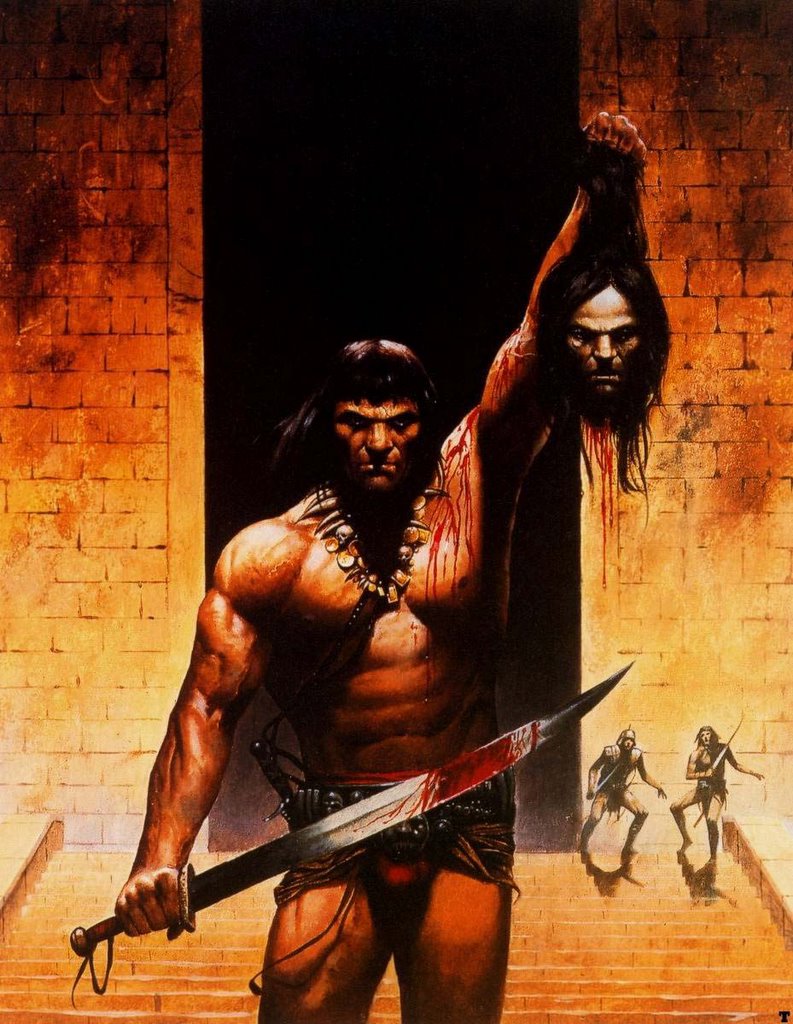
Why Conan Endures: an Updated Article from the Archives on Robert E Howard's Birthday.

A decade ago, USA Today printed an article by Mike Snider who wrote about Conan's reemergence as a relevant subject in popular culture (hat tip to SF Signal for the story). In response to this article, I wrote a blog post advancing the argument that there are those of us who comment about popular culture who think that Conan has never been an irrelevant figure in society. How can a character who serves as the inspiration for an entire literary genre become truly irrelevant? Every story about a sword wielding barbarian, no matter how trite or bad, is at some level inspired by Robert E. Howard's creation.

At the time Snider wrote his article there was some exciting news for Conan fans. Snider pointed to five recent developments that signal Conan's relevance:

  1. The PS3/XBOX 360 Video Game
  2. The "Conan The Phenomenon" hardcover by Paul Sammon
  3. The Savage Sword of Conan Trade Paperback Collection by Dark Horse
  4. and
  5. The Conan movie by Millennium Films.

Those were important offerings for the Conan fan. Some where better than others, and I wrote some thoughts about how the phenomenon knows as vast narrative hindered the film.  What is also true is that having a plethora of Conan merchandise in the pipeline wasn't a new occurrence. Snider seemd to be under the misunderstanding that 2007 marked some kind of sudden explosion in Conan related material.

Snider neglected to mention:

  1. Conan: The Ultimate Guide by Roy Thomas which released in September 2006
  2. The new Conan comic book series (first released in 2004) written by Kurt Busiek and illustrated by Cary Nord by Dark Horse
  3. The Mongoose Publishing Conan Roleplaying Game
  4. not to mention
  5. The Age of Conan series of media tie-in novels published in 2005 and 2006
  6. or
  7. Del Rey's publishing of Howard's Original Conan Stories released in 2003
In the years since Snider's article, we've seen:
    1.  A second role playing game which earned over $500,000 on Kickstarter. 
    2.  The Conan board game which earned over $3 million on Kickstarter.
    3.  Pulposaurus's upcoming pre-painted miniatures war game CROM: Conan Rise of Monsters.
    4.  An upcoming feature length film starring Arnold Schwarzenegger.
    5.  Son of Zorn, a sit-com inspired by Conan, He-man, and Thundarr the Barbarian.
The Conan explosion is perpetual and it isn't a new thing either, I could have pulled numerous examples from the 90s or the 80s of Conan releases. Conan is always lurking in the pop culture subconscious. We do a disservice to Conan fans, both existent and emerging when we use Arnold Schwarzenegger as the archetypal Conan representation, as Snider appears to do in the article. Some like Arnold as archetype, but I find Conan to be one of the most underestimated characters in American literature (with Natty Bumpo being a close second) and the Governator's portrayal -- while fun -- lacks the depth the character actually has as a literary figure.

When it comes to depictions of unreflective low art, one need look no further than the commonly perceived opinions of Robert Howard's Conan stories. If you ask the average man on the street to describe a Conan narrative, you will likely be given a tale of lust and violence. In the tale Conan will rescue some half-naked maiden from some rampaging beast and the story will end with the woman becoming all naked as she swoons at the hero's feet. In fact, a great deal of Conan pastiche has been based on this very simple formula and even a couple of the original tales fit this mold. The largest problem with such a vision is that it is not all that accurate when looking at Howard's tales of Conan as a whole. There are tales of this sort in the Conan oeuvre, but there are also tales of visionary wonder.


Like most authors, whether they write literature or Literature, Howard's writings reflect his own thoughts, experiences, and education. The writing reflects the aesthetic tastes of the author, or his/her understanding of a prospective audiences literary tastes. What makes something worth reading again and again is when an author satisfies those with "lower" tastes while providing them with some food for thought. Howard is no exception. In fact, I was surprised while I was rereading the first published Conan story, Howard's The Phoenix on the Sword to find that the author seemed to be hinting at a theory of the value of literature and its role in society.

Howard's Hyborean Age is a mythic world filled with magic and wonder, but it is also a world based on the history of the real world. Howard combined multiple eras of history so that societies whose "real world" existence is separated by centuries could co-exist narratively. Conan's own people, the Cimmerians, are based on a very real historical peoples. Both Herodotus, in his Histories, and Plutarch, in his Lives, mention the Cimmerian peoples (called Cimbri in Plutarch). In The Phoenix on the Sword, Howard appears to expect his audience to have at least a little understanding of the historical Cimmerians in his conversation of the role of literature in civilization. Conan, as protagonist, must hold ideas which the reader sympathizes with for the particular narrative of Phoenix to work.

So what kind of people were the Cimmerians? According to Herodotus they were a people who were pillagers and raiders, but not rulers.
For the Cimmerian attack upon Ionia, which was earlier than Croesus, was not a conquest of the cities, but only an inroad for plundering.
Herodotus, Histories, I, 6

What did they look like? According to Plutarch:

Their great height, their black eyes and their name, Cimbri, which the Germans use for brigands, led us merely to suppose that they were one of those races of Germania who lived on the shores of the Western Ocean. Others say that the huge expanse of Celtica stretches from the outer sea and the western regions to the Palus Maeotis and borders on Asian Scythia; that these two neighbouring nations joined forces and left their land... And although each people had a different name, their army was collectively called Celto-Scythian. According to others, some of the Cimmerians, who were the first-to be known to the ancient Greeks... took flight and were driven from their land by the Scythians. Plutarch, Life of Marius, XI

What was their temperament? According to Homer:

Thus she brought us to the deep-Rowing River of Ocean and the frontiers of the world, where the fog-bound Cimmerians live in the City of Perpetual Mist. When the bright Sun climbs the sky and puts the stars to flight, no ray from him can penetrate to them, nor can he see them as he drops from heaven and sinks once more to the earth. For dreadful night has spread her mantle over the heads of that unhappy folk. Homer, Odyssey, XI, 14

It is Homer's description of the Cimmerians that Howard uses in Phoenix to describe the mood of the people and to separate Conan from his kin. When Conan is asked why the Cimmerians are such a brooding people, Conan responds:

“Perhaps it’s the land they live in,” answered the king. “A gloomier land never was – all of hills, darkly wooded, under skies nearly always gray, with winds moaning drearily down the valleys.” – Phoenix on the Sword

The average Cimmerian is a dour and towering barbarian who destroys civilization then returns to his gloomy homeland only to begin the process again later. Howard's typical Cimmerian is similar to that of the classical scholars, and presents a figure most unlikely to advance the literary arts. But this is where Conan differs from his kin. In The Phoenix on the Sword, Conan is an older man who has conquered on of the greatest nations of the Hyborean Age expressly to free them from tyrannical rule. He conquered to rule, and to liberate an oppressed nation. A far cry from the typical barbarian. By separating Conan from his kin, Howard simultaneously increases the audience's sympathy for the barbarian king while enabling the character to advance a theory of the value of literature.

The Phoenix on the Sword is the tale of a plot to assassinate King Conan, a plot organized my a Machiavellian figure named Ascalante who desires to assume the throne. Ascalante is the product of civilization, but he is the antagonist of the story and so Howard uses his opinions of the Arts as a way to separate him from the audience's sympathy. When he describes a poet who has been brought into his conspiracy he describes the poet in pejorative terms. These terms evolve as the narrative moves from unpublished draft to final published form. Ascalante originally expresses his disdain for Rinaldo (the poet) in a long description:
“Rinaldo – a mad poet full of hare-brained visions and out-worn chivalry. A prime favorite with the people because of his songs which tear out their heart-strings. He is our best bid for popularity.” – Ascalante in Phoenix on the Sword (unpublished First submitted draft)

By the time the story is published the description is changed to the very brief, "“…Rinaldo, the hair-brained minstrel.” [Ascalante in Phoenix on the Sword(published)]. In the published form, Howard leaves out the value of Rinaldo's participation in the plot because it is redundant with information presented later in the story. When Ascalante is asked what value Rinaldo has as a conspirator, Ascalante's response is similar in both the published and unpublished text, but his hatred of Rinaldo is made more clear in the draft than in the published text:

“Alone of us all, Rinaldo has no personal ambition. He sees in Conan a red-handed, rough-footed barbarian who came out of the north to plunder a civilized land. He idealizes the king whom Conan killed to get the crown, remembering only that he occasionally patronized the arts, and forgetting the evils of his reign, and he is making the people forget. Already they openly sing The Lament for the King in which Rinaldo lauds the sainted villain and denounces Conan as ‘that black-hearted savage from the abyss.’ Conan laughs, but the people snarl.” – Ascalante in Phoenix on the Sword (published)

“Rinaldo – bah! I despise the man and admire him at the same time. He is your true idealist. Alone of us all he has no personal ambition. He sees in Conan a red-handed, rough-footed barbarian who came out of the north to plunder a peaceful land. He thinks he sees barbarism triumphing over culture. He already idealizes the king Conan killed, forgetting the rogue’s real nature, remembering only that he occasionally patronized the arts, and forgetting the evils under which the land groaned during his reign, and he is making the people forget. Already they open sing ‘The Lament for the King’ in which Rinaldo lauds the saintly villain, and denounces Conan as ‘that black-hearted savage from the abyss.’ Conan laughs, but at the same time wonders why the people are turning against him.” – Ascalante in Phoenix on the Sword (unpublished First submitted draft)

In both descriptions the poet is shown to be a blind idealist. Rinaldo, it appears, cannot look beyond the Cimmerian stereotypes as presented by Plutarch and Herodotus. Howard doesn't require the reader to have those preconceptions, but for the reader who has read Herodotus and Plutarch the stereotype becomes even clearer. Also by editing down the prose the author, either willingly or at editorial command, displays an amount of trust that his audience can reach the proper conclusion that barbarism typically destroys the valuable within civilization. What is interesting is that while Rinaldo is a conspirator, the poet is an antagonist, he is not a villain. He is a blind a foolish idealist, not acting in his own self interest. Ascalante even goes on to describe Rinaldo's motivations:

“Poets always hate those in power. To them perfection is always just behind the last corner, or beyond the next. They escape the present in dreams of the past and future. Rinaldo is a flaming torch of idealism, rising, as he thinks, to overthrow a tyrant and liberate the people.” – Ascalante in Phoenix on the Sword (published)

“Because he is a poet. Poets always hate those in power. To them perfection is always just behind the last corner or beyond the next. They escape the present in dreams of the past and the future. Rinaldo is a flaming torch of idealism and he sees himself as a hero, a stainless knight – which after all he is! – rising to overthrow the tyrant and liberate the people.” – Ascalante in Phoenix on the Sword (unpublished First submitted draft)

Ascalante specifies what kind of idealists poets are. They seek an imagined perfect society, and will always look for it no matter how good the society they are currently in happens to be. But this is Ascalante, the Machiavellian civilized man, and his opinion about what the value of the poet is. For him the poet is an easily manipulable puppet. What about the barbarian turned king, the protagonist, and oft argued proxy for the author? (It should be noted that many argue that Conan often reflects Howard's own views, this is not an original assertion on my part.)

Conan adores the poet, and understands the criticisms. He is aware that the poet's plays are leading many among the people to despise him, but he too is persuaded of the need for justice. When his chief adviser, Prospero, discusses disdain for Rinaldo, Conan comes to the poet's (and poetry in general) defense. The text is near identical in the published and unpublished format.

“Rinaldo is largely responsible,” answered Prospero, drawing up his sword-belt another notch. “He sings songs that make men mad. Hang him in his jester’s garb to the highest tower in the city. Let him make rhymes for the vultures.”
“No, Prospero, he’s beyond my reach. A great poet is greater than any king. His songs are mightier than my scepter, for he has hear ripped the heart from my breast when he chose to sing for me. I will die and be forgotten, but Rinaldo’s songs will live forever.” – Phoenix on the Sword (unpublished first submitted draft)

“Rinaldo is largely responsible,” answered Prospero, drawing up his sword-belt another notch. “He sings songs that make men mad. Hang him in his jester’s garb to the highest tower in the city. Let him make rimes for the vultures.”
“No, Prospero, he’s beyond my reach. A great poet is greater than any king. His songs are mightier than my scepter; for he has near ripped the heart from my breast when he chose to sing for me. I shall die and be forgotten, but Rinaldo’s songs will live for ever.” – Phoenix on the Sword (published)


For Conan, the atypical Cimmerian, poems and the arts have more power than weapons or royal authority. Not only that, but it is right and just that this is the case. Conan, the barbarian, is the defender of the value of literature, while Ascalante, the civilized man, sees literature as only a tool used to manipulate the foolish. Conan would seek to discuss the past and future, the ideal ones, with the poet, while Ascalante would merely use Rinaldo to destroy what he opposes. Conan's conflict between desiring a free press and swift justice, and the eventual melee that will result because of his favoring of the press, are made clear in the poetic prologue to the final chapter of the narrative.

What do I know of cultured ways, the gilt, the craft and the lie?
I, who was born in a naked land and bred in the open sky.
The subtle tongue, the sophist guile, they fail when the broadswords sing;
Rush in and die, dogs – I was a man before I was a king. – The Road of Kings Phoenix on the Sword (published)


Surprisingly, Conan's love of literature and the arts, and his defense of them, is so deeply rooted that he initially refuses to kill Rinaldo when Rinaldo attacks him. He still believes he can reason with the poet, it is only when he is left no other alternative that he kills the poet (the text is identical in both published and unpublished forms).

“He rushed in, hacking madly, but Conan, recognizing him, shattered his sword with a short terrific chop and with a powerful push of his open hand sent him reeling to the floor.” – Phoenix on the Sword (published)

“He straightened to meet the maddened rush of Rinaldo, who charged in wild and wide open, armed only with a dagger. Conan leaped back, lifting his ax.

‘Rinaldo!’ his voice was strident with desperate urgency. ‘Back! I would not slay you ..’

‘Die, tyrant!’ screamed the mad minstrel, hurling himself headlong on the king. Conan delayed the blow he was loth to deliver, until it was too late. Only when he felt the bite of the steel in his unprotected side did he strike, in a frenzy of blind desperation.

Rinaldo dropped with his skull shattered and Conan reeled back against the wall, blood spurting from between the fingers which gripped his wound.” – Phoenix on the Sword (published)

What is interesting in the narrative is that of all the conspirators, there are twenty in all, none are able to injure Conan with the success of the poet. The poet has both damaged Conan's regime and his body and yet Conan was ever reluctant to, though in the end capable of, slay his greatest enemy.

“’See first to the dagger-wound in my side,’ he bade the court physicians. ‘Rinaldo wrote me a deathly song there, and keen was the stylus.’

‘We should have hanged him long ago,’ gibbered Publius. ‘No good can come of poets..’” – Phoenix on the Sword (published)

What does this tell us of Howard's thoughts regarding the arts? We know that Conan loves them, but we also know how they were used to manipulate the populace and how his own love for them almost cost him his life. Is Howard trying to discuss how Plato's critique of the poets is a good one, while at the same time defending the possible nobility of the poet (as Aristotle does in his Rhetoric)? I think these are questions intentionally posed in the narrative (I know...never guess at intentionality), and make it clear why Conan's first story The Phoenix on the Sword was so compelling to readers when they first read it.

It should be noted that the story was originally submitted as a Kull tale, though I have yet to analyze that draft like I have these two subsequent writings. The Kull version was rejected by Weird Tales and the final (rather than the first) Conan version was the first appearance of what has become a culturally iconic figure.

Friday, January 13, 2017

Conan's Life as Nostalgic Neil Young Song

Neil Young's classic song Old Man is a song I associate with many of my favorite childhood memories. Harvest, the album featuring the song, played on our home's stereo with great frequency and is a part of the soundtrack that plays in the back of my mind from time to time. One might think that a parody of this classic rock ballad that mixes sorrowful nostalgia with John Milius' vision of Conan the Barbarian would come across as silly. It doesn't. Nat Kramer's parody music video "Conan Look at My Life" works because it adheres to the first rule of parody songs, above all things make sure that your song is good.


Friday, December 30, 2016

Shadow of the Krampus? -- A Winter Themed Adventure for Shadow of the Demon Lord

I am a big fan of running seasonal adventures for my regular gaming group. Though my group hasn't played as regularly this year as they have in the past, I was inspired by Robert J. Schwalb's dark fantasy roleplaying game Shadow of the Demon Lord to write an adventure for this season. For the past few years, I've written and reshared adventures featuring Cthulhu Claus (based on my wife Jody Lindke's illustrations for an old Kickstarter) or the V'sori (evil aliens in the Necessary Evil setting for Savage Worlds), but this year I decided to feature Krampus -- that most devilish of Santa's helpers. While Krampus might be a bit played out for some, having gained mainstream notoriety, I'm still a big fan of the character and I have the pleasure of knowing an artist who has been participating in Krampuslaufen long before it was trendy to do so and Bill Rude's Krampus costume is amazing as is the fact that he can get even small children to pose with his horrifying costume.


Bill Rude is a talented artist and you can look at a variety of his projects over at his 7 Hells: The Retro Art of Bill Rude website.

Illustration Copyright Jody Lindke 2016
In this mini-adventure, the PCs are passing through the town of Nesbitt-Hill during one of their other adventures. You can use the map below to represent the portion of the foothills of the Iron Peaks immediately south of the Zauberspitz with Nesbitt-Hill being the northern-most community on the map and Tower number 3 representing the once great Beacon Fortress.


Shadow of the Krampus is a Novice (though not a "just now Novice") adventure for Shadow of the Demon Lord with a post-Christmas theme. 

The town of Nesbitt-Hill is a vital stop for wanderers and miners who brave the dangers of the Iron Peaks in search of adventure or riches. For years the town has been a peaceful refuge, seemingly immune from the spread of the Demon Lord's Shadow. For even as the Shadow has spread, the town of Nesbitt-Hill remains a spark of light an happiness in an otherwise dark and desperate world.

But that changed last night. Historically, the Winter Solstice has been a time of celebration when the townsfolk of Nesbitt-Hill memorialize the the Solstice King and his champion Krampus. For it is this duo who has protected the town since the Battle of Zauberspitz where the Solstice King and Krampus defeated a horde of the Demon Lord's servants, or at least that is what the stories say. The stories also say that Krampus steals children who misbehave and returns them at the Spring Equinox after the darkness has been purged from the children's souls. If it is true that Krampus takes children and eventually brings them back, why is it that Krampus has taken no children for twenty years? Why does Mistress Oetzel swear she saw Krampus take adults this Winter Solstice? And why were these adults among the most generous citizens of Nesbitt-Hill? Has Krampus returned, but as a servant of the Demon Lord? Or is something else afoot?

https://www.dropbox.com/s/rxemivrin1vvt34/Shadow%20of%20the%20Krampus.pdf?dl=0


With the exception of the map depicting the area of the Iron Peaks I refer to as the Gronwald, an area that lies in the shadow of the Zauberspitz, all of the maps were drawn by Dyson Logos and were taken from his Commercial Maps webpage. According to the page, Dyson has released these images under the Creative Commons Attribution 4.0 International License. If I have used any images that are not covered by this license, I will be happy to remove them.

The cover image of "Shadow of the Krampus?" was illustrated by Bill Rude, who was kind enough to give me permission to use it. Please visit his website and consider purchasing some of his art.

The other image is the "survival map" from Robert J Schwalb's playing aids page for Shadow of the Demon Lord. I am using it with the intention of it being fair use, but if Mr. Schwalb deems my use inappropriate I will be happy to remove it. This adventure requires the use of the Shadow of the Demon Lord rule book since all monster statistics, with the exception of Krampus, are located within the pages of that "vile" tome. Krampus was designed using rules from the Of Monstrous Mien supplement. It is highly recommended that you also own Hunger in the Void and Terrible Beauty to add details around the edges of this adventure.

The cartoon illustrations in the module are the work of my talented wife Jody Lindke. I included "rpg humor" cartoons because they remind me of the cartoons in the old AD&D Dungeon Masters Guide.

I hope you enjoy the adventure.

Wednesday, December 21, 2016

A Christmas Adventure for Savage Worlds

Cthulhu Claus image by Jody Lindke


I originally posted this adventure on my Savage Worlds Character a Day blog...a blog with a far too ambitious name.

The adventure takes place in the Savage Worlds Necessary Evil setting and requires either that rulebook or the Super Powers Companion.

Operation Toybreaker -- A Christmas Themed Necessary Evil Savage Tale

Background:

The V'sori have successfully conquered the Earth. Very few are powerful enough to oppose their occupying forces to free humanity. Many of the world's villains have been gathered by Dr. Destruction to resist the occupation and inspire others to join the fight against the alien overlords.

Up until last year, most people had completely lost hope and have become "good citizens" of the V'sori empire. Few noticed that their neighbors were disappearing, while the numbers of drones grew. Few realized that the Earth wasn't merely being conquered, its residents were being "altered." No one was fighting back. It's hard to be inspired by news of Dr. Destruction's recent terrorist assault against the local television network.

That all changed last year on Christmas morning. Children across the world received Christmas presents for the first time since the V'sori invasion. The V'sori had come to expect a few underground Christmas celebrants, but they were not prepared when all the world's children received gifts...gifts that included cards reading "Merry Christmas to All! S. Claus."

As news spread of the magical gift giving -- gift giving that had evaded V'sori surveillance, many of the people of the world began to experience a new emotion. They began to Hope. Here was someone, or potentially someone, who could evade/outsmart the V'sori who hadn't historically been bent on global domination.

The V'sori had to stop this S. Claus at all costs. And so began Operation Toybreaker. If the V'sori could capture this Claus, and transform him into a Super Drone, they could ensure that the toys delivered from here on out contained appropriate "citizen conditioning messages." They could take this figure of hope and transform him into a figure of domination.

Two weeks ago, while battling Omegans at a site where the frozen bodies of WWII heroes had been located, V'sori radar picked up an odd signature -- it appeared to be a flying reindeer. They followed the signature to its final destination and the location of Santa's Village had become revealed. It took the V'sori seven days to overcome Santa's defenses and capture this bastion of hope. It took another five days to convert all of his remaining elves into drones and to reprogram Santa's Toy Soldier Defense Androids. It will take two days for the V'sori to convert Santa into a complicit drone.

The Adventure:

Dr. Destruction has intercepted a broadcast outlining the V'sori's capture of S. Claus and their plans to convert him into a Drone. Dr. Destruction desperately wants to use Omegans to rescue the figure of hope as Santa would make an amazing gun runner for the Omegan underground, but he knows that Omegans are unlikely to rescue this saccharine sweet icon without some deception.

His plan is simple. Convey to an Omegan cell that the V'sori have captured the worlds "Last Figure of Hope" a person capable of supplying the criminal underground with a steady supply of weapons. The person has technology that can evade V'sori communications satellites and can make large simultaneous deliveries.

(At this point, most players will get what's going on, but their villain PCs should remain clueless).

The villains are sent to rescue this individual who is being held in a specially built temporary prison facility on Baffin Island in Nunavut, Canada. Once at the location the PCs will face 2 encounters.

The first encounter is an outdoor battle against the converted remnants of Claus's cohorts. The PCs should face 1 Toy Soldier and 2 Elves per PC.

After the PCs finish this battle, they will wander through what remains of Santa's Village. Don't hold back on the description. There should be dead elves everywhere, as well as dead snowmen, and the carcasses of Santa's Reindeer. Play up the V'sori cruelty. Feel free to have another small skirmish here, or roleplay moments where the PCs find Santa's list only to find out that they were indeed supposed to receive that Atari 2600 for their 10th birthday...or some other humorous moment.

Upon completing the visit to Santa's village the PCs will approach a specially designed prison containing 1 K'tharen Warrior per 2 PCs and 2 Drones per PC, as well as the unconscious body of Claus. Claus's body is encased in a DuraSilicon Container (Toughness 15) where robotic devices are slowly converting him into a Super Drone.

Once the PCs arrive at the prison, they will have 15 rounds to defeat everyone and free Claus before he is converted. Use the Toughness statistics in the initial Jail Break for the Claus prison, but modify the map to contain only one cell.

If the PCs rescue Claus, they save Christmas and have recruited the world's most efficient weapons smuggler to the resistance.


Mind-Controlled Elf

Race: Elf

Agility: d8 Smarts: d6 Spirit: d6

Strength: d6 Vigor: d6 (d12+2 on drugs)

Pace: 8 (d10 to run) Parry: 5

Toughness: 6 (11 on drugs) (2)

Charisma: 0


Skills

Fighting d6 Repair d10 Notice d8 Stealth d8 Shooting d8

Throwing d6


Marksman

+2 to ranged attack if Elf does not move.


Pain-Killers

If the elves have eaten their cookies or egg-nog, they fight fearlessly (+2 vs. fear checks) and feel no pain (+2 to recover from shaken, and can take two wounds instead of one before going down). Because of the unsafe levels of drugs in the cookies, the elves must make vigor checks at -6 when the drugs wear off 1d4 minutes after consuming. They take 6 levels of fatigue (death) on a failed roll.


Gear

Gay Apparel Kevlar Vest (+4 armor vs. bullets, negates 4 AP, covers torso)
Candy Cane-shaped Vibro-Knife Damage: Str+d6 Heavy Weapon, AP 2

Pop-Gun (Disguised .50 Cal Rifle) Range: 30/60/120 Damage: 2d10
RoF: 1, Ammo: 7 (Hero-killer Rounds), AP 2

3 Presents (Disguised Grenades) Range: 5/10/20
Damage: 3d6 Medium Burst Template


Notes: The V’sori have given the elves Christmas Cookies and Egg-Nog laced with vigor-enhancing combat drugs, un-safe levels of pain killers and other mind-altering substances. Since they V’sori don’t care if the elves die, they have put near-lethal dosages into the cookies, and instructed the elves to eat the cookies if they are attacked.


Life-Sized Toy Soldier

Race: Robot

Agility: d4 Smarts: d4 Spirit: d4

Strength: d10 Vigor: d10

Pace: 4 Parry: 5 Toughness: 13 (6, Heavy Armor)

Charisma: 0


Skills

Fighting d6 Notice d4 Shooting d6

Size +2

Toy soldiers are very large, about 7 feet tall.


Construct

These toy soldiers are robots and therefore get +2 to recover from shaken, immune to disease and poison. Arrows, bullets and other piercing attacks do half damage, and they do not suffer from called shots. Constructs do not heal wounds normally, and cannot recover wounds from the Healing skill or power. Repair is used instead. Each Repair roll requires tools and spare parts (-2 modifier without tools, another -2 without spare parts) and 1d6 hours work.


Fearless

As robots, these soldiers are immune to fear effects.


Darkvision

These toy soldiers have infrared sensors that can see in the dark.


Gear

Plasma Rifle (A Toy Soldier’s Fusion Reactor regenerates 1 shot every 2 turns)

Range: 12/24/48 Damage: 3d10 RoF: 1, Ammo: 12, Heavy Weapon, AP 2

Vibro-Bayonet Damage: Str+d10 Heavy Weapon, AP 2


Notes: Made of heavy iron plating, these robot soldiers are super-tough, but very slow-moving. They are powered by large internal fusion reactors, which also power their plasma rifles.

Friday, December 16, 2016

Goobles and Goblins - A Gaming for Kids Review of an RPG Heartbreaker


Like many gamers and gaming fans, I have increasing become a consumer of streaming live play and game review channels. Among my favorite channels is the Saving Throw Show channel on Twitch. I started following the channel because I'm a fan of Tom Lommel's Dungeon Bastard series and both Lommel and Amy Vorpahl make appearances in Saving Throw Show content. Eventually, I became a Patreon backer of the channel and following this year's Extra Live 24 hour gaming marathon have become a more active participant in chats during the live streaming of events.

One of the things I like about Saving Throw Show is that it puts a spotlight on a couple of the overlooked aspects of Hollywood culture, its nerdiness and its rigorous work ethic. That's right, I've just described an industry that most people think of as filled with popular rich people who have too much spare time as an industry that is actually filled with extremely hard-working nerds. Because the real secret of Hollywood is that its engines are fueled by the work and imaginations of some very hard-working people who have a love of Dungeons & Dragons, Comic Books, and Pop Culture.  The Saving Throw Show is populated with a lot of these wonderful people and is a product of their hard work and this work includes streaming live play rpg sessions, interviews with game designers like John Wick, how to play videos, music videos, and comedy sketches. Watching content from the Saving Throw Show is a lot of fun and I imagine reflects what a lot of our gaming groups would be doing if we had the technical know how and courage to create content that others could review/criticize.

Recently, I was thinking about the theoretical section of my Ph.D. prospectus (read...procrastinating) and decided to watch their "Couple's Therapy" show on Twitch to pass the time. "Couple's Therapy" is a let's play show featuring Jordan and Meghan Caves-Callarman who are two Saving Throw Show regulars. During the episode, Jordan mentioned that he had created a Kid Friendly role playing game entitled Goobles and Goblins. So I logged onto Amazon and quickly ordered a copy of the game for analysis and am now ready to give you a quick review of the game.

TL:DR so far? You should watch Saving Throw Show and it introduced me to a new Kid Friendly RPG.


What is Goobles & Goblins?


Goobles & Goblins is an entry level role playing game designed to be played with younger players and to introduce those younger players to the larger hobby of role playing games. The game was created by Jordan Callarman (now Jordan Caves-Callarman) and its print version was funded through a small Kickstarter campaign back in 2015. The project had 84 backers and is in a similar Kickstarter success category as Jody and my Cthulhu Claus project was in 2012. The game was once supported by a webpage at www.gooblesandgoblins.com, but the site has since expired (hence no link).

Adventures in Goobles & Goblins take place in the magic filled Land of Glythe, but most of the details about the Land of Glythe have to be extracted from the text via complex hermeneutics. What information about Glythe there is within the pages of Goobles & Goblins is pretty wonderful, but it is as sparse as information about Fillory in the first episode of The Magicians. Jordan manages to drop little gems (the official currency of Glythe) to spark the imagination, but also leaves readers wanting a lot more.

How Does Goobles & Goblins Play?


Jordan discusses Goobles & Goblins at WonderCon. Image from WonderCon.

Goobles & Goblins features a very simple game engine, so simple that if I go into too much detail here it would serve as a replacement for buying the book. I want Jordan to sell copies, so I'll only touch upon the minimum necessary. Like most role playing games, Goobles & Goblins uses numerical characteristics to represent the effectiveness of characters with regard to specific tasks. In Goobles & Goblins these characteristics are Smarts, Speed, Strength, and Hits. These characteristics are rated on a scale of 1 to 3 (with Hits having possibly more points) based upon the adventuring degree the character attained from one of Lord Maxwell Armstrong's Academy of the Combative Arts, the Underground Rogue's Guild, or the Endless Tower. 

These characteristics are used as modifiers to opposed rolls where the player and GM roll a die and compare final results of die + modifier. It's a simple system that is very good for the age range it is aimed at. I will have some comments below about how I think this could improved in an introductory game, one of Jordan's stated goals is to have resolution of actions be fast and fun and opposed rolls can slow things down.

Key Innovation in Goobles & Goblins.


There is one really inspired innovation in Goobles and Goblins and that's its magic system. Many role playing games attempt to either imitate D&D's magic system, create an abstract system like Mage, or to emulate the magic of an existing fantasy world. That's not what Jordan did with Goobles & Goblins magic system. Jordan may not even realize this, but he has invented a magic system that hints at a wonderful and mysterious world of magic and adventure. The magic system of Goobles & Goblins is very simple. Wizards have the ability to summon a fighting companion using a magic artifact called an Animal Totem and they have access to a Magic Bag that contains three different randomly determined magic items each day. Wizards don't have spells. Instead, they are more capable of using the magic items that can be found throughout the world and have access to some additional items from their Magic Bag.

This suggests a couple of things. The first thing this suggests is that the Land of Glythe is in a world where magic was once common place, but where it is now largely relegated to those who possess items of power. For most people these items can be used only a limited number of times, but Wizards are more adept at using these items and might be able to use artifacts for many sessions. Since anyone can use Magic Items, anyone can use the items in the Wizard's Magic Bag, but only the Wizard might be able to use those more than once. There are a host of ideas to explore narratively regarding the Magic Items of Glythe and by having magic be item based Jordan has simultaneously created a system with some game balance elements and added some narrative mystery.


Areas for Improvement


I like Goobles & Goblins and I think it offers a lot of great ideas that can be incorporated into my own gaming with History and Mystery (my 8 year old twins). It does have several areas for improvement though.

First, I'm not fond of opposed rolls in games in general and especially in games with kids. The key to gaming with kids is to make sure that the focus is on the "play" and not on "rolling" and every time someone picks up a die it increases the time that it takes to resolve conflicts. My recommendation is to have the players make all die rolls. The kids should be rolling to hit, to dodge, and to use skills to overcome challenges against a fixed number. This fixed number should be the average roll (rounded down) plus challenge rating for the obstacle. For example, if a Monster has a Strength of 2 then the difficulty number should be the average roll of a die (rounded down) +2. You can round up the base difficulty for elite monsters. This halves the number of rolls being made on the table and gives a sense of agency to the kids playing.

Second, I think that the art needs an upgrade. While I think the art is whimsical and fun, I think that a more polished cartoony style might have increased the sales of the book. I'm not just saying this because I think that my wife Jody's artwork would work well for Glythe (though it would). I'm saying this because Kid Friendly games are becoming more common and that competition is pretty high. It includes games like Hero Kids and No Thank You, Evil! and I think that Goobles & Goblins has a skeleton that could be competitive with those games.

Third, the book needs work on the layout and content. Jordan Callarman gives us glimpses of Glythe, and they are wonderful glimpses, but I want more. I would like to see some more detail in the setting. This is something that could truly make the game competitive in the Kid Friendly market. I know the market isn't fully developed yet, but Goobles & Goblins has potential and "heart" that could secure a segment of the niche. Certainly a larger segment than the 84 people who backed it on Kickstarter. It most certainly deserves more support than that!


A Final Wonderful Touch


Look very carefully at that picture of Jordan at WonderCon promoting the game. It shows me a couple of things. The first is that Jordan is proud, rightly so, of his project. More importantly, look at those pictures behind him. Do you know what those are? Those are Goobles. Those are Goobles created by kids who stopped by Jordan's booth. That shows that Jordan "gets it." He knows what this game is about and he wrote a section of the book that displays this too. His "what is a Gooble" section is a delight and it needs to be expanded upon and moved forward. Goobles need to enter our lexicon. They are the monsters/creatures, friend or foe, who populate the imaginations of children. That's what a Gooble is and they are there for the discovering.

Why "Heartbreaker"?


My post title calls Goobles & Goblins an RPG Heartbreaker. One might wonder why I would use a pejorative to describe a game I think is very good. I'm not using the term Heartbreaker in the dismissive way that so many use the term today when talking about "Fantasy Heartbreakers." I'm using it in the original sense. When Ron Edwards coined the term "Fantasy Heartbreaker" he stated that they were "truly impressive in terms of the drive, commitment, and personal joy that's evident in both their existence and in their details." The Fantasy Heartbreakers were heartbreaking because we want them to be perfect, but they fall short in some way. For many of the games Edwards was writing about that failing was a lack of real innovation. That's not the case here. There is enough innovation in Goobles & Goblins to provoke a desire to play the game, but there is also "just enough" that it leaves me wanting so much more and I know I'm not going to get that so much more any time soon.

I hope I'm wrong. I hope that Jordan does a second edition which streamlines a couple of things, expands upon some others, and goes into great detail about the Land of Glythe with wonderful cartoony art and dynamic layout. The foundation is strong here, just as it was with the Little Brown Books of D&D.

Check out Goobles & Goblins and give it a play at your table.

Friday, October 14, 2016

Hacking the Black Hack using Zak's FASERIP System the Cypher Way -- Some Initial Thoughts

http://www.rpgnow.com/product/177913/Faserip?affiliate_id=86991

Readers know that I have long been a fan of Superhero role playing games. There was a time when I could claim to "own every Superhero RPG in print," but those days have long past. I still own a very large selection of Superhero RPGs that ranges from Superhero 2044 to DC Heroes to The Super Hack, but there are so many Superhero games out there that it is hard to keep up. I've read all of the games I own and have played most of them, but there are a few that stand out as able to withstand the test of time. Among those games that I return to again and again is the Classic Marvel Superheroes Roleplaying Game which uses the FASERIP system. The system isn't perfect, but it is very flexible, has quite a few "genius moments," and is great for getting people gaming quickly. It's a system that I want to use, but I want to use in a modified form and I've recently come across three resources that have inspired me in what I think will be a fruitful direction.

The first of those resources was +Zak Sabbath 's Character Generation Guide for his "Everything is Terrible" FASERIP campaign. In that post, Zak proposes a d20 based mechanic intended to replace the Universal Table that so many of us have used but which fewer of us have memorized. The Universal Table tells players what they need to roll to get a basic success (green), a substantial success (yellow), and a critical success (red). The division of success into different categories is one of the "genius" moments of the game, but needing to look at the chart to see if you've hit the next color (for those who haven't memorized the chart) can distract from game play.

Zak's proposal takes the categories on the chart and assigns them a Target Number. Players roll 3 Twenty-Sided Die against that target number. If only one die is a success, it's a Green result, two successes means Yellow, and three means a Red result. I recommend that you look at Zak's post for a detailed breakdown of the Target Numbers and his thoughts on the topic. They are worth your time. 

I took some time to do a quick breakdown of the basic probabilities of Zak's system in order to compare them to traditional FASERIP probabilities.


Looking at the basic Universal Table, you can see that a person with a "Shift 0" ability in something still has a 35% chance of achieving a Green result. When it comes to lifting weights, this works very well when one includes the "Intensities" rules from Advanced and Revised Marvel. In a fight, this means that a person with Fighting of Shift 0 still has a 35% chance of hitting his/her opponent. This somewhat high level of success seems to match with the heroic nature of Supers gaming. The same person has only a 6% chance of some level of improved success.


Looking at a table showing the probabilities resulting from his 3d20 system, we see some interesting results. The first is that Shift 0 really sucks. The second is that at the higher end, the probability of getting a Red result are close to those of the traditional FASERIP system. There are some notable differences at the low and mid-ranges, particularly with regard to Green results. In traditional FASERIP, a character with a Remarkable Fighting score has a 30% chance of a Green result and has a 44.36% chance in Zak's system. Scores lower than Good characters are less frequently successful under Zak's system and above Good they have are more frequently successful. I'm fine with that. It makes the "Street Level" heroes more impressive than they are under the regular system (when facing thugs) and the distinction between tiers continues.

To see how nicely Zak's quick Hack simulates the old FASERIP system, while requiring significantly less memorization, I compared the White results from FASERIP with those of ZakHak.

As you can see, the first four Shifts have a lower probability of success under ZakHak, you have a slightly higher probability of success from Excellent to Shift X, and the final two columns are essentially the same [Note: the percentage above is the percentage of 'failure' so higher numerical values equate to lower levels of success.]

I think Zak's system is intuitive and works and I'm likely to use a modified of it as I move toward adapting The Black Hack to the Superhero genre. There are a couple of previous attempts at Black Hat Supers (The Super Hack and The Powers Hack), but neither of those rules sets are as complete as I would like for a rules set intended for campaign use. What I want to do is take a the "roll under" system from The Black Hack as the base (this is as easy as taking the complement of Zak's value in a base 20 system) in order to have higher stats mean better results and have stats and results be the same number. I'm also contemplating adding the "roll x or y and add an interesting effect" rule from the Cypher System to the superhero game. The x or y will be yellow or red FEATS and they will allow the automatic use of some reality bending Power Stunt. I might event do a straight up mix of Cypher's 1 - 10 difficulty range and "pool expenditure" system, since I think that would mix with FASERIP's Karma system nicely.

Over the next few weeks, I'll be flushing out a full system but I will be using ZakHak as the base of whatever system I end up with.

Monday, September 19, 2016

[Annual Public Service Announcement] Play Like A Pirate, Don't Talk Like One -- Or if You're Going to Talk Like a Pirate, Go Big!

In 2008, I began advocating that people should celebrate "Play Like a Pirate Day" rather than participate in "Talk Like a Pirate Day." My contention was that one of the most irritating things you can hear your co-workers say is, "Aaaargh, Avast, Ye Mateys" a couple times an hour in some half-hearted participation in a day of international live action role playing. Even worse are the inconsistent uses of "Yar!"

What makes it most irritating is the fact that these small offering of participation are lackadaisical at best. It isn't talking like a pirate that's annoying, it's an ironic detachment or lack of commitment that's annoying.

I would rather my co-worker show up dressed in full "Age of Sail" apparel, blunderbuss and cutlass in hand, and charge into the office while staying in character as much as is possible for the day.  A wholehearted celebration of Talk Like a Pirate Day, I can get behind.  It would be fun, in the "employees showing up to work in costumes on Halloween" kind of way. You know... like when a person comes to work in their full blown Optimus Prime costume -- one where they can actually "transform" from robot to big rig.  Things like that create moments where you are truly impressed with your co-workers commitment. On the other hand, when your other co-worker shows up with only a pair of "cat ears" on and a mild scowl on their face, it's annoying. 

Most participation in International Talk Like a Pirate Day is of the cat ear type, and not the Optimus Prime type. That's why I still believe that it is time for the phenomenon to die. That doesn't mean that we should no longer have a day "celebrating" piracy and the outlaw attitude, or as the founder of Talk Like A Pirate Day called it "Piratitude." Pirates are still awesome (though not as awesome as Transforming Psionic Robot Pirate Ninja Dinosaur Mutant Demon Hunting Vampires), it's just that inserting random "arrrrs" like a pirate that is lame. I think gamers, and geeks of all kinds, should lay claim the holiday and re-cast it as "International Play Like A Pirate Day." That way the costume role players can  cosplay pirate and other people can play pirate themed games, read pirate themed novels, or watch pirate themed films.

As I wrote a couple of yeas ago, "from now on September 19th will be a day when families and friends get together and enjoy some form of Piratical Recreation. Such recreation can include celebrating by talking like pirates, certainly role play (in the traditional sense) is play. Our celebration is inclusive, not exclusive. But families and friends will no longer be limited to listening to the 'yars' and 'aaarghs' of everyone around them. Some might choose more formal ludographic participation -- that's game play."

Here is a list of recommended activities for this year's festivities:

1) Play a pirate themed roleplaying game. In particular, we recommend Pinnacle Entertainment Group's excellent PIRATES OF THE SPANISH MAIN. This is highly recommended for those who want to talk like a pirate. It encourages such behavior in an appropriate venue. Besides, by role playing (in the game sense) participants can act far more Piratical than is allowed under modern mores and laws.

If you want a more heroic bent with mystical aspects, you can always play Pinnacle's 50 Fathoms instead. If you aren't a fan of the Savage Worlds system, but still want to play an excellent pirate/swashbuckling role playing game you should check out 7th Sea.


2) If you own a copy -- and not many do -- play an exciting session of the classic Broadsides and Boarding Parties


If you don't own a copy of Broadsides, try one of these two excellent pirate games from GMT Games.

3) Blackbeard: The Golden Age of Piracy. The game is a redesign of Avalon Hill's classic game of the same name. The new version is suitable for 1 to 5 players and has less "down time" for players who aren't in their current turn.


4) Winds of Plunder is a quick and fun game that is more in the style of the "Eurogame" than Blackbeard or Broadsides.


5) You can play the previously reviewed Sword and Skull.


6) Lastly, we recommend watching one of your favorite pirate films.  Classics include Captain Blood and The Sea Hawk with Errol Flynn, Pirates of Penzance for those of a musical bent, and the more recent PIRATES OF THE CARIBBEAN films. There is a long list of wonderful films filled with pirattitude, give one of them a play today.

Or you can sing "For I am a Pirate King!"