Thursday, September 08, 2016

New 'Warlock of Firetop Mountain' Video Game Available on Steam


When the first 'Fighting Fantasy" gamebook The Warlock of Firetop Mountain was published in 1982, it helped to create an entirely new entertainment market. Fighting Fantasy gamebooks built upon the innovations of earlier interactive fiction like the Choose Your Own Adventure series and the solo role playing game adventures designed by Ken St. Andre and his compatriots for the Tunnels and Trolls roleplaying game.


Taking these two literary innovations as their inspiration, Games Workshop founders Ian Livingstone and Steve Jackson created a line of books which contained both the narrative adventure and the rules for a complete role playing game. The game rules were simple, but very flexible. Throughout the series, Fighting Fantasy authors have found ways to add on subsystems that have allowed the basic mechanics to cover various magic systems, super powers, chambara-esque samurai abilities, science fiction, werewolf transformations, and much more. A complete history of the line of books can be found in Jonathan Green's excellent book You are the Hero! Green is the author of several books in the series and a fan turned professional.

The plot of The Warlock of Firetop Mountain is simple. You are a hero, or at least an adventurer, who seeks to locate and acquire the Warlock of Firetop Mountain's fabulous treasure. The adventure itself was quite challenging and required players to carefully manage resources, develop mapping skills, and have more than a touch of luck. As difficult as the adventure was, it helped to spawn a total of 57 sequels and numerous books by competitors. Additionally, Warlock as been adapted as a board game, a D&D compatible adventure module, an interactive kindle book, and a couple of video games. Some of those games captured the excitement of the original, while others were less successful.

Tin Man Games recently released a new video game adaptation of the book and the results look promising. Rather than merely "converting" the book to graphic form, it appears that Tin Man has followed the lead of some of the best books in the Fighting Fantasy series and used the book and the rules as a skeleton on which to build a meatier product. This looks to be especially true with regard to the combat system. It appears that they've added maneuvers and other options to make the game more appealing to the modern PC gamer.


 You can see the framework of the original system, but options like "quick jab" and "piercing strike" add options unavailable in the original print book.

The game is currently available on Steam for the reasonable price of $19.99.

Have a look at the trailer and see if you want to risk the dangers that await you in Zagor's mountain stronghold.


Friday, August 12, 2016

Ghost House Pictures' 'Don't Breathe' Reunites Fede Alvarez and Jane Levy


In 2013, Ghost House Pictures rebooted the classic horror comedy series Evil Dead with a new director (Fede Alvarez) and a new star (Jane Levy). The film attempted to balance itself between the two horror/comedy extremes of the Evil Dead franchise. It was less creepy and haunting than the original film and focused less on humor than Evil Dead 2 or Army of Darkness. In attempting this balance, the film selected a talented comedic actress whose prior work included the short-lived and entertaining series Suburgatory.

The pairing was a success. Rotten Tomatoes ratings show that many critics and audience members found the Alvarez/Levy Evil Dead to be a worthy addition and the film is by a large margin the most successful theatrical release in the series. This success was in no small part due to the cult classic status the movies have attained as they have continued to build audience. The box office success of the 2013 Evil Dead film doesn't in itself answer whether audiences truly liked the new vision or whether the success was due primarily to the power of the brand. The film was polarizing among some of the fan base who thought the film was too gory and lacked sufficient humor. Ghost House Pictures has an opportunity to prove that Alvarez and Levy have appeal outside of a strong brand with this year's Don't Breathe. This film is an original story that features no supernatural elements and promises to focus on suspense rather than gore.

Don't Breathe opens with a premise similar to that of In Cold Blood, but turns the tables on the criminals in a fashion common in horror films like You're Next. The filmic twist in this case is that audiences are supposed to sympathize with one of the home invaders as she realizes that she and her friends have invaded the home of someone who, though blind, is freakishly good at killing people.

The film is slated for wide release on August 26th, right in time for the new school year and a good lead into Halloween.


Wednesday, August 03, 2016

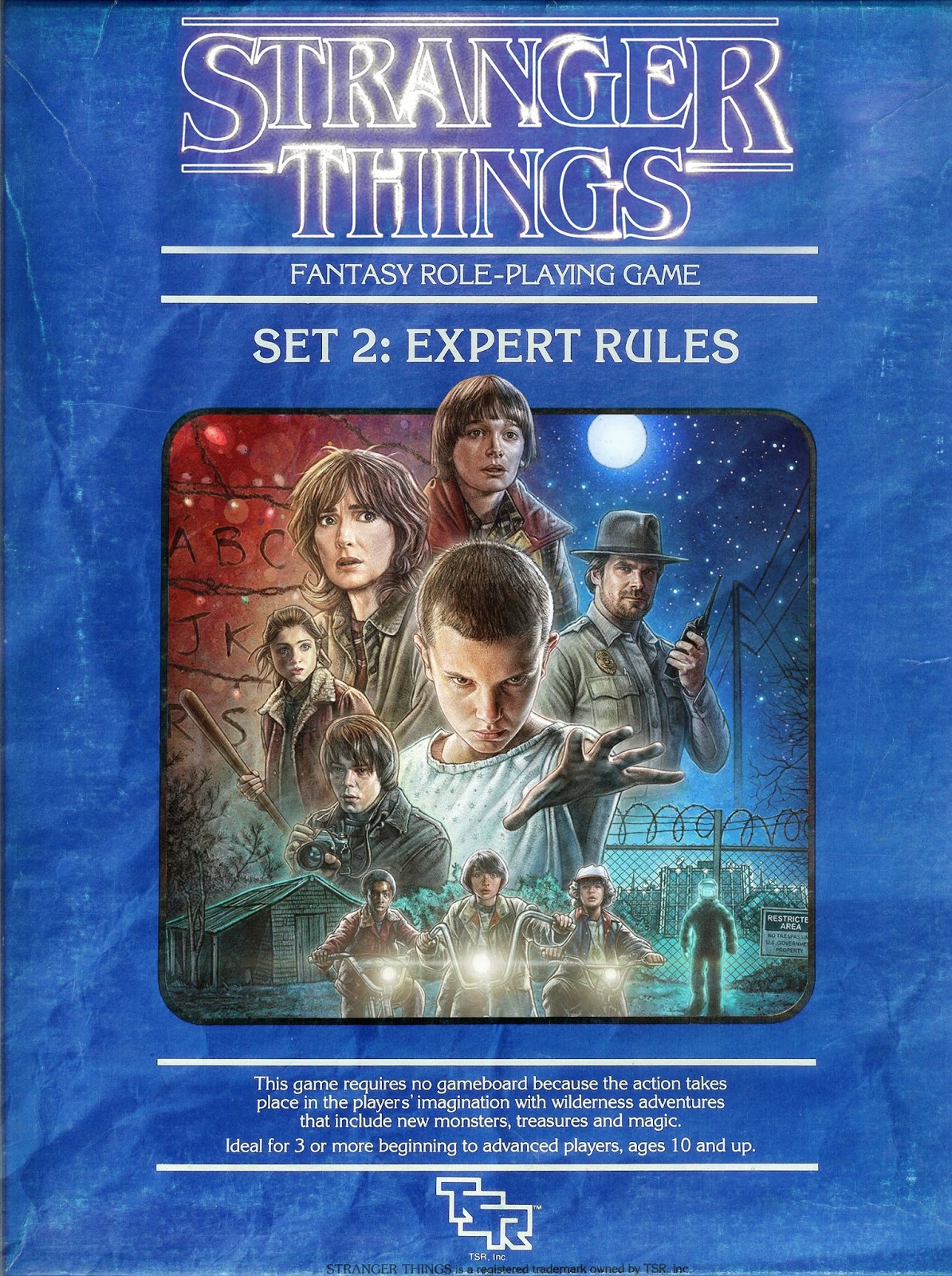
Savage Things (Part 3) -- A Super Heroic Second Take on Stranger Things' Eleven/Elle

Image Source -- Thorin Thompson

Introduction

Welcome to the third entry in a series of posts that translates the hit Netflix television Stranger Things into material useful for the Savage Worlds role playing game. Following the final entry in this series, there will be posts featuring statistics in Mentzer B/E Dungeons & Dragons, Fantasy Flight Games' Grimm role playing game, Hero Kids, Shadow of the Demon Lord, and other games as I am inspired to create the statistics.

Posts in Savage Things Series:
Part 1 -- The Setting and the Kids
Part 2 -- The Heroic Teens

Eleven/Elle Revisited (A Superheroic Look)

In the first entry in the Savage Things series, I presented statistics for Eleven/Elle that relied solely on the Savage Worlds Core Rulebook. This version of the character fits with a Firestarter or Scanners inspired campaign, but it doesn't capture the character for campaigns that want to take advantage of a more X-Men style of play. One of Stranger Things many influences, and one stated outright in the show, is issue #134 of The Uncanny X-Men. That issue marked the first appearance of "Dark Phoenix" and hinted to viewers who were familiar with the comics that psychic powers might be coming into play. My own take on the character is that she is also inspired by Rachel Summers, first seen in The Uncanny X-Men issue #141. The shaved head and manipulation of the character by scientists fits more with Rachel Summers, than with Jean Grey. With these thoughts in mind, I present to you an updated version of Eleven/Elle that uses the Savage Worlds Super Powers Companion which provides a more powerful version of the character. In order to balance this character, two versions of the Demogorgon/Monster will also be presented in the adversaries post.


  Eleven/Elle (Millie Bobby Brown) was kidnapped by Dr. Martin Brenner when she was born. Eleven's mother was one of Dr. Brenner's subjects in his experiments at the University of Indiana. While the show hints that she is the 11th child/subject Dr. Brenner has worked with, no other subjects are shown in the series. When Eleven runs away, she befriends a local diner owner named Benny and eventually encounters Mike Wheeler. Even though Eleven is quiet and largely clueless to the mundane world around her, she and Mike become very close friends. Eleven has abilities beyond her "experience" level and is an extremely powerful young woman. She hopes to find a way to rescue Will Byers and free herself from the influence of Dr. Brenner.


Attributes: Agility d4, Smarts d6, Spirit d10, Strength d4, Vigor d6
Skills: Faith d4, Notice d6, Psionics d12, Shooting d4, Survival d6, Tracking d4
Charisma: 0; Pace: 6; Parry: 2; Toughness: 5
Hindrances: All Thumbs, Clueless, Loyal, Exhausting Powers -- Powers Cause 1 Level of Fatigue When Used Can Knockout, but not Kill, Eleven.
Edges: Arcane Background (Superpowers), Brave, Danger Sense
Powers: Attack Ranged (Heavy Weapon, 4d6) 7 Points, Broadcast (One Channel at a Time, Contingent) 1 Point, Mind Reading (Slow to Activate, Increased Range to 1 mile, Complete Concentration) 5 Points, Increased Range on Mind Reading to Anywhere on Earth (Device: Requires Sensory Deprivation Chamber and Complete Concentration) 5 Points, Ensnare 3 Points, Mind Control (Slow to Activate, Very Limited Actions) 3 Points, Telekinesis (d12+1) 6 Points.  Power Points: 30 (Street Fighters)
Quirk: Loves Eggo Waffles.

It should be noted that this version of Eleven/Elle is significantly more powerful than the one from the first entry in the series, but that the character should still be used as a Player Character in order to not have the players feel railroaded by the Game Master.

Wednesday, July 27, 2016

Savage Things (Part 2): The Heroic Teens of Stranger Things


This is the second post in a series of posts presenting the people and places portrayed in the Netflix Original Series Stranger Things. You can find more information about the series, characters, and places in Part One. This entry focuses on what I call "Team Nancy." These are the teenage characters who are central to the story and who are centered around their relationship to Nancy Wheeler.

Posts in Savage Things Series:
Part 1 -- The Setting and the Kids
Part 2 -- The Heroic Teens
Part 3 -- A Super Heroic Second Take on Eleven/Elle

The Heroic Teens (Team Nancy)

Jonathan Byers (Charlie Heaton) is Joyce Byers' oldest son and the brother of Will Byers. He has a quiet and introverted personality that has led him to be considered an outsider by his classmates at Hawkins High School. Jonathan is developing talent as a photographer and hopes to someday attend NYU to study cinematography and become a film maker. His character is similar in personality to John Bender in The Breakfast Club or Michael Fitzsimmons in Peggy Sue Got Married. Jonathan loves his family, but is worried that Will's disappearance has caused his mother to have another psychiatric episode.


Attributes: Agility d6, Smarts d6, Spirit d8, Strength d6,
Vigor d6
Skills: Driving d4, Fighting d6, Investigation d6, Knowledge (Photography) d6, Notice d6, Shooting d4, Streetwise d4, Survival d4, Swimming d6, Tracking d4
Charisma: -2; Pace: 6; Parry: 5; Toughness: 5;
Academics
: 0
Hindrances: Curious, Doubting Thomas, Outsider
Edges: Alertness, Brave
Gear: Car, Camera, .38 Pistol, Bear Trap, 5 Gallons of Gasoline, Lighter

Nancy Wheeler (Natalia Dyer) is a young woman caught between two social worlds. She is Mike Wheeler's older sister and used to have a very close relationship to her "D&D geek" brother, but that changed when she started dating Steve Harrington who hangs with a more popular crowd. Nancy's conflict extends to more than her family though. In her desire to "fit in" with Steve and his friends, Nancy has recently begun to rebel against her family and her own instincts. Her friend Barbara sees this conflict and tries to point it out to Nancy, but Nancy doesn't quite see how much Steve genuinely cares for Nancy. Nancy Wheeler's character is a combination of Stacy Hamilton (Jennifer Jason Leigh) in Fast Times at Ridgemont High and Andie (Molly Ringwald) in Pretty in Pink.

Attributes: Agility d6, Smarts d8, Spirit d6, Strength d4, Vigor d6
Skills: Driving d4, Fighting d4, Investigation d6, Knowledge (Chemistry) d6, Notice d6, Persuasion d6, Shooting d6, Stealth d4, Streetwise d6
Charisma: 2; Pace: 6; Parry: 4; Toughness: 4; Academics: 1
Hindrances: Loyal, Overprotective Parents, Small
Edges: Attractive, Brave, Test Taker
Gear:


Steve Harrington (Joe Kerry) – Steve is Nancy’s boyfriend and is at a point in his life where he is going to have to choose what kind of man he will become. He comes from a relatively wealthy family and is one of the cooler kids in school. His character is a combination of Blane in Pretty in Pink and Stefen Djordjevic in All the Right Moves. His story arc through the first season of Stranger Things parallels that of Djordjevic in that he could be a good guy, and when push comes to shove comes back to being one, but he’s so caught up in being “cool” that his instincts lead him to initially make bad choices. In the end though, he will do whatever he can to keep Nancy safe.

Attributes: Agility d6, Smarts d4, Spirit d6, Strength d6, Vigor d8
Skills: Driving d6, Fighting d6, Intimidation d6, Investigation d4, Notice d4, Persuasion d4, Shooting d4, Streetwise d4, Swimming d6, Taunt d8
Charisma: 2; Pace: 6; Parry: 5; Toughness: 6;
Academics:
-1
Hindrances: Arrogant, Party Animal, Stubborn
Edges: Attractive, Fast Healer, Nerves of Steel
Gear: $500
 
Barbara Holland (Shannon Purser) -- Barbara has been Nancy Wheeler's best friend since Elementary School. She doesn't quite understand what Nancy sees in Steve Harrington, but knows deep down that she and Nancy will always be friends. Barbara is an excellent student, but she is viewed as a bit of an outsider because of her lack of "fashion sense" and her focus on school work. Barbara knows what's important in life and it's succeeding in school so you can get out of Hawkins and being loyal to those who deserve your loyalty and Nancy Wheeler deserves her loyalty.

Attributes: Agility d6, Smarts d8, Spirit d6, Strength d4, Vigor d6
Skills: Climbing d4, Driving d6, Investigation d4, Knowledge (Biology) d6, Knowledge (Chemistry) d6, Knowledge (History) d6, Notice d6, Stealth d4, Survival d4, Swimming d4
Charisma: -2; Pace: 6; Parry: 2; Toughness: 5; Academics: 2
Hindrances: Bad Eyes (Minor), Bad Luck, Outsider
Edges: Alertness, Be a Zebra, Test Taker
Gear: Car

New Buffy the Vampire Slayer Boardgame Coming from Jasco Games and Lynnvander Productions

Lynnvander Studios, a game design studio founded in 2005 by Thomas Grofton, has recently announced that they will be producing a number of licensed board games with significant cache in the geek community in partnership with Jasco Games. One of the first games to be released will be a new Whedonverse inspired game entitled Buffy the Vampire Slayer: the Board Game.


When designing adventure games inspired by heroic fiction or tropes, designers tend to choose between one of two models. The first model, and that chosen by games like Heroquest and the majority of role playing games, is to have one player take responsibility for being the Game Master/Storyteller who controls the actions of all of the villains, adversaries, and non-central characters in the narrative. The second model is to create a cooperative game where all of the players take the role of characters central to the narrative. In a cooperative game, the players work together to overcome the game itself. While there has been a recent increase in the number of cooperative games available, these kinds of games existed earlier in the hobby with one of my favorites being Games Workshop's classic Warhammer Quest board game. Either form of game play can be rewarding, but one of the advantages of cooperative game designs is that they allow for more natural implementation of solitaire game play.

The Buffy game being designed by Lynnvander studios is a fully cooperative game for 1 to 6 players that should be able to be played in about 40 to 60 minutes. The designers have decided to have the players take the roles of Buffy and her friends as they defend the town of Sunnydale from an onslaught of vampires and demons, even as the players must also work to prevent a big bad’s plot and open the Hellmouth.

By the description of the game, it seems that the Lynnvander productions design will be closer in mechanics to Fantasy Flight Games' challenging Lord of the Rings card game than to classic Warhammer Quest. Both of those games are excellent, but each presents a different gaming experience. This is all speculation on my part based on the descriptions presented, but either way I am excited to see what a new Buffy game brings.

The game should be available from Jasco this October, just in time for Halloween.

Thursday, July 21, 2016

Savage Things (Part 1): Savage Worlds Adventures in the World of Stranger Things


Stranger Things is a Netflix Original Series that was released on the streaming network on July 15, 2016. The show focuses on mysterious events which occur in the fictional city of Hawkins, Indiana in 1983 that are related to experiments at the Hawkins National Laboratory. The Laboratory receives its funding through the U.S. Department of Energy and is run by Dr. Martin Brenner who uses the Laboratory to engage in experiments similar to those of the CIA's Stargate Project.

Many have described the series as a love-song to the 80s due not only to the fact that the show takes place in 1983, but also due to the number of references to 80s pop culture the show contains and the number of homages to 80s pop culture which served to influence the show. These influences include the horror of Stephen King, Sam Raimi, and John Carpenter, alternative music from the early 80s, Dungeons & Dragons, and the films of George Lucas and Steven Spielberg. For example, the music during the opening credit sequence references score composed by John Carpenter and the opening shot of Episode 8 is a direct reference to the Imperial Base on Endor in Return of the Jedi.  A complete list of Easter Eggs and influences is beyond the scope of this blog post, but much has been written about the show at The Hollywood Reporter and elsewhere.

Given the supernatural elements of the show, and the fact that it falls into the Spielberg tradition of Tween/Teen Adventures, Stranger Things makes for the perfect setting for a role playing game campaign. To this end, I've put together some basic background material and statistics for important Player Characters/Non-Player Characters for you to use at your own gaming tables. The statistics in this initial blog post are for the Savage Worlds Roleplaying game using the core rulebook and the East Texas University setting book. The Savage Worlds system is particularly good at emulating the kinds of "kids using luck to survive dangerous situations" stories within the Tweenventure genre and the East Texas University setting of Pinebox, TX provides a nice analog for Hawkins, IN.  Future updates will include statistics for BubbleGumshoe, Hero Kids, and other popular role playing games.

Posts in Savage Things Series:
Part 1 -- The Setting and the Kids
Part 2 -- The Heroic Teens
Part 3 -- A Super Heroic Second Take on Eleven/Elle


Locations 
Hawkins, Indiana (Population 4,936) – Hawkins, Indiana is a fictional city created as a setting for tales in the Stranger Things-verse. The show uses the city of Jackson, Georgia as a proxy for Hawkins and thus all estimations of population and city services are done using real world data for Jackson. 

Hawkins PD – Hawkins law enforcement is overseen by the Chief of Police Jim Hopper manages the City Jail and a staff of 17. This staff includes 13 sworn police officers and 4 communications officers. The Hawkins City Jail has 16 beds for use in housing inmates and provides service 24-hours a day.


Hawkins Library – The Hawkins Library is the central library for the County and thus has a large selection of books and access to all major newspapers dating from 1910 are available on microfiche. In addition to its extensive collection of normal books, the Hawkins Library is also home to a private collection of books about mysterious incidents and the occult (this information is not included in the show, but was added due to The Monster using the Library as a nest in the Upside-Down). The library hours are as follows:

Monday – Thursday: 9:00 am – 8:00 pm
Friday: 9:00 am – 6:00 pm
Saturday: 10:00 am – 4:00 pm

Hawkins Middle School -- As one of the larger cities in the county, Hawkins Middle School (Home of the Tigers) serves as the home of the County School District's Middle and High Schools. These schools serve students from the neighboring cities. Hawkins Middle School has a population of 1,000 students in grades 7 and 8. It has an advanced science program for a school in the 1980s. This is as much due to the enthusiasm of Mr. Clarke as it is to grants and donations from Hawkins National Laboratory. The school district has an annual science competition and Will Byers' D&D group have won their grade level almost every year.

Hawkins High School -- Like the Middle School, Hawkins High School provides services for county residents who do not live in Hawkins proper. Unlike the Middle School, which only serves neighboring communities, the High School serves the entire County. This give Hawkins High School a population of 4,000 students. The High School receives support from the Hawkins National Laboratory and has a history of academic focus over athletics. The Football team typically has a .500 season and the same is true for the Baseball team. The school has a competitive Softball team and both men's a women's basketball have a history of success that exceed expectations from such a small county.


Hawkins National Laboratory -- The Hawkins National Laboratory was built in 1979 as part of a Department of Energy program seeking to research new forms of energy production. A good deal of the research at the Laboratory deals with the creation of more efficient solar energy cells. Given the variations in weather, Hawkins makes an ideal location for study of a solar panel that can operate productively in less sunny climates. Unknown to the public is that the majority of the Hawkins National Laboratory's funding comes from the CIA's Stargate Project. This project investigates whether humans are capable of manifesting psychic and psychokinetic powers. To advance their efforts they recruited Dr. Martin Brenner whose earlier research on the use of LSD and sensory deprivation at the University of Indiana led to early insights into psychic phenomenon. While the CIA initially selected the Stargate title for the project as a means of obfuscating the actual research going on, recent events at the Laboratory have led to the creation of a Portal between our dimension and a Shadow Dimension which parallels our own.


The Upside Down/Vale of Shadows – A dark reflection or echo of the material plane, a place of decay and death. It is a plane out of phase and filled with monsters. It is right next to you and you don’t even see it and it is governed by necrotic and shadow magic. The Upside-Down appears to be a dark and cold version of our world with necrotic growths and no living creatures other than The Monster and possibly its offspring.

There are only two ways to pass into the Upside-Down. The first is through the semi-permanent portal created by Elle/Eleven. This portal is on a lower level of Hawkins National Laboratory and has begun to warp the world around it. Inside the Laboratory these effects can be seen in necrotic outgrowths, a lower temperature, and constant light snowfall. In an area of around 2 miles in diameter around the Laboratory, the effects can be detected through instability in the electromagnetic field. When you are within the diameter, compasses no longer point North. They point to the Portal instead. The other means of passing into the Upside-Down is to use a temporary portal created by The Monster. These portals are created by The Monster as it enters and exits our world, but quickly close due to the amount of energy needed to produce them. They can last as long as 5 minutes. Of course, using them without The Monster noticing is no small feat.

The creators of the show have a 30 page bible dedicated to the Upside-Down, hinting at future adventures in upcoming seasons.

Negative Environmental Effects
Poisonous Atmosphere: anyone non-native caught in the Upside-Down must make a Stamina check once per day or suffer one level of Fatigue. This damage cannot cause the death of a Wildcard.
Cold: Unless wearing warm clothing, a person must make a Stamina check once per day or suffer one level of Fatigue. This damage cannot cause the death of a Wildcard.


Cast of Characters 

The Kids 

Will Byers (Noah Schnapp) – Will Byers' is close friends with Mike Wheeler, Dustin Henderson, and Lucas Sinclair. When the group is playing Dungeons & Dragons, Will tends to play the character Will the Wise and when given the choice between taking risks and playing it safe, he will often choose to cast Fireball instead of Protection spells. He is a good kid, but his current home life is very unstable. His mother Joyce is viewed as unstable by the town and Will is viewed as the easiest kid to bully at Hawkins Middle School.


Attributes: Agility d6, Smarts d6, Spirit d4, Strength d4, Vigor d6
Skills: Driving d6, Notice d6, Stealth d6, Survival d6, Shooting d4
Charisma: -2; Pace: 6; Parry: 2; Toughness: 5; Academics: 0
Hindrances: Loyal, Outsider, Young Edges: Alertness, Be a Zebra, Luck
Gear:


Mike Wheeler (Finn Wolfhard) – Mike Wheeler is 12 years old and is one of the "point of view" characters in Stranger Things. He is the Dungeon Master for the D&D gang and frequently runs 10 hour sessions on the weekends which end with a climactic battle against a powerful villain. In the first episode, his adventure includes a stressful encounter with Demogorgon. Little did he know that this adventure would shape the perceptions of his friends as they encountered The Monster from the Upside-Down. He is the son of Karen Wheeler and brother to Nancy Wheeler. He was once very close to his sister emotionally, but her recent relationship with Steve and his obsession with D&D have come in the way of their friendship. He is a good student with developing observational skills.

Attributes: Agility d4, Smarts d6, Spirit d6, Strength d4, Vigor d6
Skills: Driving d6, Investigation d6, Notice d6, Stealth d4, Streetwise d4, Tracking d4
Charisma: -2; Pace: 6; Parry: 2; Toughness: 5; Academics: 0
Hindrances: Outsider, Overprotective Parents, Young
Edges: Alertness, Brave, Multitasker
Gear: Binoculars, Walkie Talkie, Bicycle, Compass, RPG supplies
Dustin Henderson (Gaten Matarazzo) is one of Mike Wheeler's oldest friends and a part of the D&D group. He is not native to Hawkins and likely moved here from California (he wears a T-Shirt advertising the Castroville Artichoke Festival).  While all the kids in the D&D group are smart, scientific, and tech savvy, Dustin truly excels in these areas. His permanent teeth have not come in yet due to cleidocranial dysplasia.While Mike is the group's Dungeon Master, and the "hub" around which the group is centered, Dustin is the group's "leader." When push comes to shove, it is Dustin who gets the other kids to reconcile and who is able to rally the troops when the going gets tough. He is skeptical of certain kinds of authority and tends to view the challenges the gang faces through the lens of Star Wars and D&D.


Attributes: Agility d4, Smarts d6, Spirit d6, Strength d4, Vigor d6
Skills: Driving d6, Investigation d4, Persuasion d6, Repair d6, Streetwise d6
Charisma: -2; Pace: 6; Parry: 2; Toughness: 5; Academics: 0
Hindrances: Outsider, Quirk, Young
Edges: Command, Connections (Mr. Clarke), Multitasker
Gear: Bicycle, Compass, Walkie Talkie, Head Set

Lucas Sinclair (Caleb McLaughlin) Lucas is Mike's oldest friend and a key member of the D&D crew. He is smart and adventurous, but he often lacks patience and is not quick to trust anyone. He distrusts Eleven/Elle and wants to take action as quickly as possible to rescue Will. He is a man of action and not waiting.


Attributes: Agility d6, Smarts d6, Spirit d4, Strength d4, Vigor d6
Skills: Driving d8, Investigation d6, Notice d4, Shooting d6, Stealth d4
Charisma: -2; Pace: 8; Parry: 2; Toughness: 5; Academics: 0
Hindrances: Loyal, Outsider, Young
Edges: Alertness, Be a Zebra, Fleet-Footed
Gear: Binoculars (Typical 10×25 binoculars), Bicycle, Walkie Talkie, Compass, Wrist Rocket (d8 2/4/6). 
Eleven/Elle (Millie Bobby Brown) was kidnapped by Dr. Martin Brenner when she was born. Eleven's mother was one of Dr. Brenner's subjects in his experiments at the University of Indiana. While the show hints that she is the 11th child/subject Dr. Brenner has worked with, no other subjects are shown in the series. When Eleven runs away, she befriends a local diner owner named Benny and eventually encounters Mike Wheeler. Even though Eleven is quiet and largely clueless to the mundane world around her, she and Mike become very close friends. Eleven has abilities beyond her "experience" level and is an extremely powerful young woman. She hopes to find a way to rescue Will Byers and free herself from the influence of Dr. Brenner.

Attributes: Agility d4, Smarts d6, Spirit d10, Strength d4, Vigor d6
Skills: Faith d4, Notice d6, Psionics d12, Shooting d4, Survival d6, Tracking d4
Charisma: 0; Pace: 6; Parry: 2; Toughness: 5
Hindrances: All Thumbs, Clueless, Loyal
Edges: Arcane Background (Psionics), Brave, Danger Sense
Powers: Bolt, boost/lower trait, entangle, mind reading, telekinesis; Power Points: 10
Quirk: Loves Eggo Waffles.


To Be Continued...
Later in the week, there will be posts discussing the Teens, Parents, Supporting Cast, and Antagonists of Stranger Things.

Wednesday, July 20, 2016

Shadow of the Demon Lord is Frighteningly Good [The Review]

http://www.rpgnow.com/product/155572/Shadow-of-the-Demon-Lord?affiliate_id=86991


Over the past couple of months, and I apologize for the slow blog pace, I've written a couple of articles that have referred to Robert J Schwalb's new role playing game Shadow of the Demon Lord. In the first article, I discussed how it was ironic that Robert's parents were so afraid of D&D's satanic material that he was "forced" to play Warhammer Fantasy Role Play. This is essentially the same as being upset that your kid is listening to Def Leppard and pointing the kid to Venom as a replacement. As was discussed in the comments to that, the whole "satanic panic" phenomenon was overblown, but I still find it funny that Rob fled Glasya to the open arms of Slaanesh.

This journey into the darker artistic and game mechanic influences of Warhammer Fantasy Roleplay are readily apparent in Shadow of the Demon Lord. The baseline setting of Rob's game is one of a world that is desperately in need of heroes, any heroes. When the world is about to be destroyed by a malevolent cosmic force, even blackguards, madmen, and murderers can be the world's saviors. The game is as grim and dark as any Games Workshop setting, but there is something that sets Shadow apart from other games in the GrimDark tradition. Where other games in this genre are nihilistic, where even the heroes are often corrupt and doomed to fail, Shadow's setting holds within it the glimmer of hope. It is just possible that these heroes, flawed as they may be, might save the world from the cosmic destroyer that has descended upon the world.

As grim as Shadow of the Demon Lord appears to be, it is at its core a heroic role playing game.

Let that sink in for a moment. This is a game where the spark of hope might bring light to the world. It is entirely possible that the heroes will fail, but it is also possible that they will succeed in saving it. Even if they don't end up making the world a better place.

It is this basic heroic theme, and game mechanics that support heroic play, that are why I think that Shadow of the Demon Lord is one of the best role playing games to come out in years and that it is one of the best introductory roleplaying games for young gamers ever to be published. In future posts, I hope to write about several campaign setting ideas I have for this rules set. Before that happens though, I'd like to discuss how Shadow of the Demon Lord's mechanics encourage a heroic style of play and how these mechanics set it apart from other role playing games on the market.


Attribute Scores are Low, but Meaningful

At first glance, the attributes that Shadow of the Demon Lord uses to describe player character capabilities appear to be identical to those of a typical d20 game and one might be forgiven for assuming that they represent scores from 3 (poor) to 18 (excellent). Such an assumption would be wrong. In Shadow of the Demon Lord, any attribute above 10 provides a modifier to die rolls equal to the attribute score -10. So a character with a Strength of 13 in Shadow of the Demon Lord has a +3 modifier, the equivalent modifier of a 16 in 3rd Edition D&D.  Beyond that, a character with a 13 Strength in Shadow of the Demon Lord can lift 250lbs with little effort and 500lbs if the character makes a successful "challenge roll." Player characters will rarely see attributes higher than 15 in the game, but since this provides a +5 modifier to any affiliated roll that is a significant bonus indeed.

Challenge Rolls Never Explode to High Values

One of the key mechanics to Shadow of the Demon Lord is the "Challenge Roll." Any time a Game Master believes that there is a "significant" possibility that the average person would fail at a task, the Game Master asks the player to make a successful challenge roll. For example, if a character wants to climb a wall the Game Master might ask the player to make a Strength or Agility Challenge Roll to see if the character was successful. All Challenge Rolls are made against a Difficulty of 10. That's right, every task has a base chance of success of 55% for a character with an attribute of 10. This default "ease" of success reflects the default heroism of the campaign and the fact that the player characters are something special. The roll against this value can be modified with bonuses and penalties or by boons and banes. Bonuses and penalties are directly added or subtracted from the roll and are typically determined by a character's attributes. On the rare occasion that there is a penalty, it is usually no more than -2 to a roll. The only times you usually see a penalty worse than -2 is due to a character's attribute score or because the penalty is affecting the Health score (Hit Points in other games). Circumstances don't tend to apply penalties to rolls, rather they tend to apply "banes." A bane is a variable roll which results in a negative number from -1 to -6 being applied to a roll (more on this in a moment).  The point here is that the base chance of success is 55% and rarely gets worse than 25% for non-combat actions.

Boons and Banes

In the discussion of Challenge Rolls, I briefly mentioned that the largest modifiers to success or failure are due to mechanics called "boons" and "banes." Quite simply, these are the bread and butter of the benefit/penalty effects of the game. Straight bonuses and penalties are typically the result of a character's attributes, but boons and banes are the product of circumstances. Is a wall slippery? Add one or two banes to the roll. What is a bane? A bane is a 1d6 roll that provides a penalty to a Challenge Roll from -1 to -6. This makes it sound as if a 2 bane penalty could be pretty severe, which would detract from my assertion that this is a heroic game, but it isn't as severe as it might seem at first glance. A 2 bane Challenge Roll rolls a d20 + Attribute Bonus against a Difficulty of 10 as normal, but applies a penalty of -1 to -6 based on the highest result of 2 six sided die. So for example, if a character was climbing a slippery wall and had a Strength of 13 that character would roll d20 + 3 as normal. To determine the effect that the banes have, the player would then roll 2d6. Let's say the player rolled a 2 and a 3. This would mean that the total penalty to the roll would be -3 and not -5 as one might imagine. The most a character will be penalized by banes in Shadow of the Demon Lord is -6. The inverse is true of boons. The highest benefit any number of boons can provide you is +6. This provides a nice range of possibilities, and a real possibility of failure, without every leaving the realm of "heroic."


Professions Matter, not Skills

In a move that runs against the trend of many modern role playing game systems, with the exception of "story games," player characters in Shadow of the Demon Lord do not have clearly delineated skills with a set bonus. What Shadow of the Demon Lord characters do have are "professions." Professions are broadly defined as "occupations, pursuits, and areas of knowledge" that can be used by players to justify gaining benefits (boons) on actions or the ability to succeed at a task automatically if it makes sense. Player characters start with two professions, even before they choose a character class, and how useful they are is limited by the imagination of the players and the restrictiveness of the Game Master. While I cannot see inside the mind of the game designer, the mechanic seems to be a combination of the Professions from Barbarians of Lemuria, Secondary Careers from Advanced Dungeons and Dragons, and the Areas of Knowledge mechanic from the classic James Bond 007 role playing game by Victory Games.

The use of the profession mechanic gives Game Masters a dial they can use to determine how heroic they want their game to be. Let's say that a player has the "Soldier" profession. In a free-wheeling and highly heroic campaign, a Game Master could allow this profession to add a boon to the following actions: attacks when fighting in coordination with others, detecting ambushes, concealment in an outdoor setting, and a host of others. In a less heroic campaign, the Game Master could allow for only some of those uses or even none. The key to a good game is to be consistent and to encourage your players to use professions in an active manner. A key question which might help determine the utility of the profession might include "what kind of soldier was your character?"


Classes are Like Careers

Robert J. Schwalb acknowledged the influence that Warhammer Fantasy Roleplay had on him and on the design of Shadow of the Demon Lord. While that influence abounds in the artistic style of the game, there is no place where the influence shows up more than in the game's use of character classes or "paths" as they are called in the game. There are four tiers of character in Shadow of the Demon Lord (Starting, Novice, Expert, and Master). Starting characters have experience in a prior profession, but have yet to choose any heroic paths. Once the characters complete their first adventure they are free to choose their first Novice path from the obligatory Magician, Priest, Rogue, and Warrior archetypes.

At each level, the character will either gain a path benefit or make a new path selection. Additional novice benefits are gained at 2nd, 5th, and 8th level. At 3rd level a character chooses an Expert path. These paths are more narrowly defined than Novice paths and include things like Artificer, Assassin, Berserker, and Paladin. The only prerequisite to choosing an Expert path is that it makes sense for your character. You can be a Warrior Artificer or Warrior Paladin. One of these paths may be more beneficial from a "min/max" perspective, but neither is forbidden. Unlike in Warhammer where you can only leave a career after completing all the advances and are limited to exit careers (unless you pay an experience point penalty), in Shadow of the Demon Lord you are free to choose any combination you like. This also applies at 7th Level when a character chooses a Master path. These paths are more powerful than those prior, and even more narrow. The Master level is also where you find the Bard option in this game.

The Highest Difficulty in Combat is 25

Given how flexible and "recommendation" toned so much of the game is, I found it interesting that the rule for Defense (the game's version of AC) was rigid. The book states, "A creature's Defense cannot exceed 25, even if weapons, armor, and other effects would increase it beyond that number." What this does is set a "cap" on difficulties and highlights the fact that the characters are already amazingly capable. Between the 25 cap and the 10 baseline, you have variation of difficulty but one that fits within a reasonable range. A character with a +1 bonus from Strength and a boon might just be able to hit that Dragon in combat. Given that characters will rarely have an attribute above 15, this highlights the system's intended focus on maximizing boons in play.


Heroes Always Go First

Shadow of the Demon Lord has an interesting initiative system for combat. Players can choose to use "fast" actions or "slow" actions. If the player chooses to use a "fast" action, then his or her characters can either move or use an action/attack. If the player chooses the "slow" option, the character can move and act. The round is divided into the Fast component and the Slow component with player characters acting first in their respective phases. This allows players tactical options while minimizing the number of die rolls needed in the game. Opponents could technically go first in a round, but if they do their actions may be less efficient. The same goes for players. It's an elegant system that highlights the heroic underpinnings of the game.


System Can Be Used for Multiple Genres, But is Generic Not Universal


Shane Hensley is fond of describing his Savage Worlds role playing game with the phrase, "generic, not universal." What Shane means by this is that Savage Worlds can handle any genre you want, but that characters made for a Superhero game won't necessarily be convertible to a Fantasy setting. This is because the "range of probabilities" for both games are the same, but the effects that that range emulates are different. For example, in the core Savage Worlds rulebook a d12+3 Strength can lift a certain amount of weight, but in a Superhero setting that same score can lift more than in another setting. Similarly, the foundational mechanics of Shadow of the Demon Lord are elegant enough to emulate a wide variety of genres. You could use the mechanics, almost unchanged, to run a Superhero game, a Modern Espionage game, or a Martial Arts Chambara/Wuxia action fest. In each setting the characters would have similar statistics, but they would not be transferable because a 14 Strength in an Espionage game isn't the same as a 14 Strength in a Superhero game. Given the underlying base ranges of Difficulty (10 to 25), a Game Master should keep in mind what level of challenge these describe in the milieu being emulated. In a Superhero game, the Hulk holding up the mountain is a level 25 challenge which a Game Master might even limit to certain paths. In an Espionage game, that same level might be what it takes to lift a car off of a person trapped underneath it.

Final Thoughts

Shadow of the Demon Lord is a very well designed game. Whether you want to use it with its core setting, or hack it to fit your own preferences it can provide years of entertainment.

In the coming weeks I plan on posting several short conversions of the game to other genres...yes, more family friendly ones at that.

The list includes:
1) Shadow of the Avatar
2) Shadows over the Galactic Empire
3) Shadow of Professor Destruction
4) Big Shadow over Little China


Thursday, June 23, 2016

When Pulp Meets Urban Fantasy

I love a good urban fantasy yarn. I'm a regular reader of the tales of Harry Dresden, Atticus O'Sullivan, and Detective Inspector Wei Chen. There is just something about the combination of noir tropes with magic that excites my literary appetites. I'm also a big fan of Pulp heroes like Nick Charles, The Spider, Doc Savage, and Billy Byrne. In my opinion, these two genre are too rarely combined. Manly Wade Wellman's tales of John Thunstone are among some of the most imaginative fiction I've read. The Thunstone tales combine the cool atmospherics of a Thin Man film and add a wonderful layer of sinister mysticism. Thunstone faces fantastic foes who lurk on the edges of human society, seeking our destruction.

The Complete Thunstone from Haffner Press. Image by Raymond Swanland.
Given my love of these kinds of stories, and my love of Angry Robot Books, it is surprising that I missed the release of Alyc Helms' The Dragon of Heaven which is the first entry in her Missy Masters/Mr. Mystic series of books. This July will see the release of The Conclave of Shadow, a title that echoes Wellman's School of Darkness, and it looks to be an intriguing entry.


The books tell the tale of a street magician named Missy Masters who had inherited magical powers, and a job as the vigilante hero Mr. Mystic, from her estranged grandfather. Missy soon discovers that it takes more than a snazzy clothes and a talent for witty banter to combat the forces of evil effectively, it also takes experience.

From this basic premise, it appears at first glance that Helms brings in narrative elements that might be inspired by Barry Hughart's Bridge of Birds series and dials up the magical power dial up to 11. It's hard to tell where on the scale of Savvy Scholar outwits the Forces of Evil to Sorcerer Supreme obliterates Cosmic Threats this book series lies, but the premises are intriguing enough for me to find out. I'll be checking out this series in the next couple of weeks, so I'll let you know. I might even throw in a Savage Worlds and Shadow of the Demon Lord write up or two for characters in the series.

Monday, June 20, 2016

Shadows of Voltan -- A Shadow of the Demon Lord Character Sheet for Crow

A while back, I did a post discussing Hawk the Slayer and provided statistics for the character Crow in both Savage Worlds and Shadow of the Demon Lord format. While I was happy with the statistical representation, I wasn't happy with the formatting. So I spent some time in Publisher and worked this sheet out. I've got the original publisher file, and a version of this character sheet in pdf, so I'll likely be adapting some more characters soon.


It's my plan to do a series of articles, including some fanbrew campaigns, for Shadow of the Demon Lord because I am increasingly convinced that it is one of the better introductory rpgs on the market. While the game has a granularity that most long time gamers will appreciate, it's very accessible. 

Tuesday, May 10, 2016

Explore a Futuristic Kowloon Walled City as a Cat?!


After reading Jim Butcher's latest book, The Aeronaut's Windlass, I found myself confused by some of the public book reviews. I saw many references to "giant talking cats" popping up from time to time. It's true there are cats in the book. It is also true, to a certain extent, that they talk. The thing is, they aren't "giant" cats and they don't "talk" in any way that is particularly fantastic. In Butcher's book, the "fantastic" thing isn't that cats can talk, rather the fantasy element is that some humans can speak cat. In our own "non-fantastic" world, grown cats only seem to meow in order to communicate with humans. They will, in fact, modify their meows to create a subtle cat to human interactions that simulate language, but we humans seem to be pretty dim when it comes to understanding what cats are trying to say. Some of us are, that is.


What really impressed me was Butcher's ability to write about cats without overly anthropomorphizing them, though there are Warrior Born who go a little in that direction. He was so successful in his writing that he created an interest I didn't know I had, an interest in playing a cat based adventure game on the computer or console. It looks like game designers Koola and Viv are working on a project that will perfectly scratch this its. They are working on a third-person adventure game where you play as a cat exploring a terrain based on Kowloon Walled City. I don't think I could ask for more.


Thursday, May 05, 2016

Throwback Thursday Gaming: Moldvay Basic Dungeons & Dragons

"I was busy rescuing the captured maiden when the dragon showed up. Fifty feet of scaled terror glared down at us with smoldering red eyes. Tendrils of smoke drifted out from between fangs larger than daggers. The dragon blocked the only exit from the cave.

Sometimes I forget that D&D® Fantasy Adventure Game is a game and not a novel I'm reading or a movie I'm watching."


Thus opens the Tom Moldvay edited Dungeons & Dragons Basic Rulebook, and with those words my own fascination with the role playing game hobby began. It's a simple - even simplistic - introduction to a fantasy tale. It begins with that most cliche of story lines, the rescuing of a maiden, which was stale even at the time the rules were being published. It was such a stale trope that the film Dragonslayer, a rare truly magical fantasy film from the 80s, used a reversal of that cliche as a central component to its narrative. But the imagery of "smoldering red eyes" and "fangs larger than daggers" was more than enough to capture my childhood imagination.


It is often said that "the Golden Age of Science Fiction is 12," meaning that what each reader considers the Golden Age of Science Fiction is the literature they read when they were 12 years old. While there is some small amount of truth to that, I do have a fond spot for the fiction I read when I was 12 and I was briefly under the nostalgia induced delusion that the 80s Fright Night was better than the more recent remake, but it isn't always the case. In fact, my favorite Science Fiction and Fantasy - and those I think are canonical "Golden Age" classics - are stories I read in my 20s and 30s. What's ironic is that the stories I read in my 20s and 30s are the "traditional" classics, while the stories I read when I was 12 where the avant garde rebels. My 12 year-old Golden Age is Moorcock's Elric & Corum, Donaldson's "Land," and Cook's Black Company. It wasn't until I was older that I gained a true appreciation of Tolkien, C.L. Moore, Kuttner, Heinlein, Asimov, Burroughs, Howard, and so many others.

Given my referential baseline of Fantasy literature - Moorcock, Donaldson, and Cook - it might seem odd that Moldvay's Basic set would be the one that set my imagination alight. The book's line art, most of it by Bill Willingham, Erol Otis, Dave LaForce, and Jeff Dee, is a far cry from gritty and looks closer to the art that would be featured on the D&D cartoon than it does to the covers of a Black Company or Elric novel. Even odder is that by the time I came to be introduced to D&D, the Mentzer edition was already in publication, and the Jeff Easley art it featured was much closer to the fantasy images my readings brought to mind. Yet, to this day, when I think about what is best about D&D, I think about the Moldvay rules.

Tom Moldvay's editing of the Basic Set presented the D&D rules in a clear and easy to understand manner that left little ambiguity in my young mind regarding how the game was played. Having read the Original Little Brown Books that were the first public presentation of the D&D rules, I now understand what a remarkable task this was. Yes, Moldvay was following in the footsteps of Dr. Holmes' first Basic Set and was able to stand on the good Doctor's shoulders. Dr. Holmes first Basic set presented D&D's rules in an intelligible way, but the rules were written for the older teen to adult gamer. Tom Moldvay's rules, as should be evident by the fact that his "Appendix Moldvay" of recommended readings is filled with Young Adult and Kid's Literature, were designed as an introduction for the young gamer. That's what makes the edition so strong. It presents rules that could be described as arcane and mysterious, in a manner that most 10 year olds could begin running a game within a couple of hours...and they'd be enjoyable hours of reading. Not just because of the clearly written prose, but also because of that lovely line art.

Do yourself a favor. If' you've never read this edition, go back and read the Moldvay Basic Set. It's a bargain and well worth giving a try.


Friday, April 29, 2016

Hedgehobbit Discusses VanGrasstek's DUNGEON -- An Early Indie RPG

In addition to work, TA-ing, grading, and working on my prospectus, I've been toiling around with creating rules that approximate how I would have played D&D if I had been an adult when the original Little Brown Books were published. I've been reading and re-reading the Chainmail rules and reading sections of the original D&D rulebooks to get a sense of how I would have understood those rules if I had never played the game, no one was there to teach me the game, and all I had was these physical documents from which to develop a game. It's an interesting challenge, but it's the challenge that many early gamers faced.


I've been a fan of the fanzine Alarums & Excursions since it was first introduced to me by Gary at Aero Hobbies. Gary, who is sadly no longer with us, was a central figure in the Southern California role playing game scene. His gaming group is responsible for the creation of the Thief Class for D&D, think about that the next time you backstab someone in game play. When I walked into Gary's store, I was new to the Los Angeles area, but he quickly made me feel at home in this metropolis and introduced me to a number of wonderful people. He was a one man social network, and the issue of Alarums & Excursions he first handed me was like a social network in print form. Prior to reading this issue, I had heard of the zine but I had no idea what to expect. What I found was that it was like reading the best parts of a very creative discussion forum, a forum where people didn't hastily respond and thus where the worst of forums rarely reared its head.

What most amazes me about Alarums & Excursions is the creativity, this is especially true in the early issues. Reading the first few issues of the zine - and I'll be discussing my adventures reading the zine in detail in a series of posts - I was struck by how varied the interpretations of how to play D&D were. I'm not saying that I was struck by the differences in "house rules," though those are remarkable as well, rather I was struck by how differently people interpreted the rules of the original books. The early 70s was truly a time when everyone was playing a different version of D&D, and that makes the era all that more exciting to me.

So I want to try to capture some of that magic. I want to play D&D as I "would have" played it if I'd been around then to do so. What would my D&D have looked like? In order to help me on this quest, I've read a couple of other attempts to create rules for "Playing D&D with Chainmail" and I'll share my thoughts on those when I share my version of how to do just that. I've also been reading Craig VanGrasstek's rules for Dungeon  written in 1974. VanGrasstek's rules, discussed in the video by Hedgehobbit embedded below, are one player's attempt to reverse engineer D&D from a playing session.

Let me repeat that. VanGrasstek's rules are a reverse engineered version of D&D based upon his experience in a gaming session. That's how explosively creative and desiring of new kinds of play the 70s were, it's also what we see a lot of today in the DIY game community. Reading VanGrasstek's rules have given me a sense of the kinds of things that get "lost" in interpretation, and I'll be keeping those in mind as I design "How I Would Have Played LBB D&D." I think it will be a fruitful exercise, and I hope that I'll be able to convince my gaming group into giving my LBB D&D a try. Maybe we can even see a bunch of different versions of D&D in our group and try them all.


Thursday, April 28, 2016

Space Hulk Deathwing Looks to Be a Stunning FPS


I remember the first time I saw the Space Hulk board game being played at a gaming convention in the Bay Area. I was amazed. Watching as blip counters were turned over and revealed to be either "false positives" or hordes of Alien-esque xenos who's claws could rip through the thick armor of Space Marine Terminators changed what I viewed was possible in board game design. I'll admit I was young, but that was the effect none the less. It should come as no surprise that one of my favorite game designers, Matt Forbeck, listed it as worthy of recognition as one of the Top 100 Hobby Games of All Time.


Video game adaptations of the franchise have been hit or miss. The computer adaptation in the 90s, also ported over to 3D0 systems, was as difficult to win (as the Marines) as the board game, but due to the lack of the social component that exists in board games it never really captured my imagination in the same way as the table top version. More recent turn based versions have been much more successful. These games tend to use a top down POV and provide players with a robust gaming experience. The new Space Hulk video game goes beyond translation of the table top game to video game format and shifts the franchise fully over into the First Person Shooter genre. It's nice to see one of the franchises that inspired the action of early FPS games finally get, at least by what is shown in the new game play video, an exciting FPS of its own.


Friday, April 22, 2016

ID4 Resurgence: I See Your H.G. Wells Clone and Raise You FOOTFALL and ROBOTECH


Independence Day is probably my favorite adaptation of H.G. Wells' classic tale War of the Worlds. It captures the desperation of defending a world against an overwhelming force and does a nice job of updating "microbes" into a computer virus in a way that requires no small amount of suspension of disbelief, but somehow still seems appropriate. One of the best things about the film was that it knew what it was and didn't care to be anything more. It was just a good time bundled into a nice 2 hours and 25 minutes.

It looks like the sequel, Independence Day: Resurgence, is happy to follow the formula of its predecessor. Just as ID4 borrowed from one of the all-time classic SF stories, arguable THE STORY that established the Invasion narrative plotline that every invasion movie has followed, the new movie looks like it is inspired by a host of classics as well. From the Macross inspired reverse engineering of alien technology in preparation of invasion, to the larger than life "war ending" impact crater of Footfall, this trailer has a little bit of everything.

I cannot wait for this to come out!


New Editions of WARMACHINE and HORDES Coming in June


I've been a fan of the Iron Kingdoms since Privateer Press released The Longest Night, part one of their Witchfire Trilogy of adventures for D&D 3rd Edition, in 2001. The combination of steam driven battle mechs with high fantasy sorcery scratched an itch I didn't even know I had. I ran the adventures for my gaming group, though our adventures quickly drifted away from the scripted story, and purchased various editions of the Warmachine and Hordes rulebooks. I've even purchased the main box set for the customizable card game and the Iron Kingdoms inspired adventure board game The Undercity. I also own all of the Iron Kingdoms RPG books.

Sadly, as is too often the case, I haven't had as much time to play games in the Iron Kingdoms as much as I'd like to and this is one of the reasons why I'm excited that Privateer Press is releasing new editions of Warmachine and Hordes. With the new marketing push, maybe I can convince my gaming group to give the Iron Kingdoms RPG a try.