Friday, August 07, 2015

Sorry Gaming Paper, But The Game I'm Most Pleased I Backed on Kickstarter Is...#RPGaDAY2015 [Day 2]


The first "patron" project I ever backed was Wolfgang Baur's first  Kobold Publishing product. There was a time that I backed every one of Baur's projects, but as he continued to publish primarily for D&D 3.x and Pathfinder at the same time that my bookshelves overflowed with material for those games I moved on to supporting other projects. I missed out on some excellent products, but I'm only going to play those games -x- times and I have more material then I will ever need.

I backed my first Kickstarter project in 2010 and in doing so began a fandom journey of directly supporting projects that I believe in before they are published. I became a non-profitsharing venture capitalist. I decided to be more than a consumer and to support the companies and creators I admire by backing their projects. Note the word I used there, backing. I didn't say "pre-order" their games because that isn't what Kickstarter really is. Yes, that is often what it ends up being for some companies, but that isn't the only thing a backer is. I'd have backed some of the projects I did solely for a T-Shirt or button that proclaimed I was a backer. That first Kickstarter project that I backed was Erik Bauer's Gaming Paper Adventures project. With it Eric left the realm of selling gaming accessories and entered the realm of game designer. Erik is one of the nicest guys in the industry and a natural salesman. I've called him a gaming huckster in the past, and I meant it in the nicest and most William Castle way. In addition to being a great salesman, Erik is a great guy. I'm proud to have supported his project. It's probably the "product" I'm most pleased to have backed, but since it's a supplement it isn't technically a game . So it isn't the game I'm most pleased I backed.


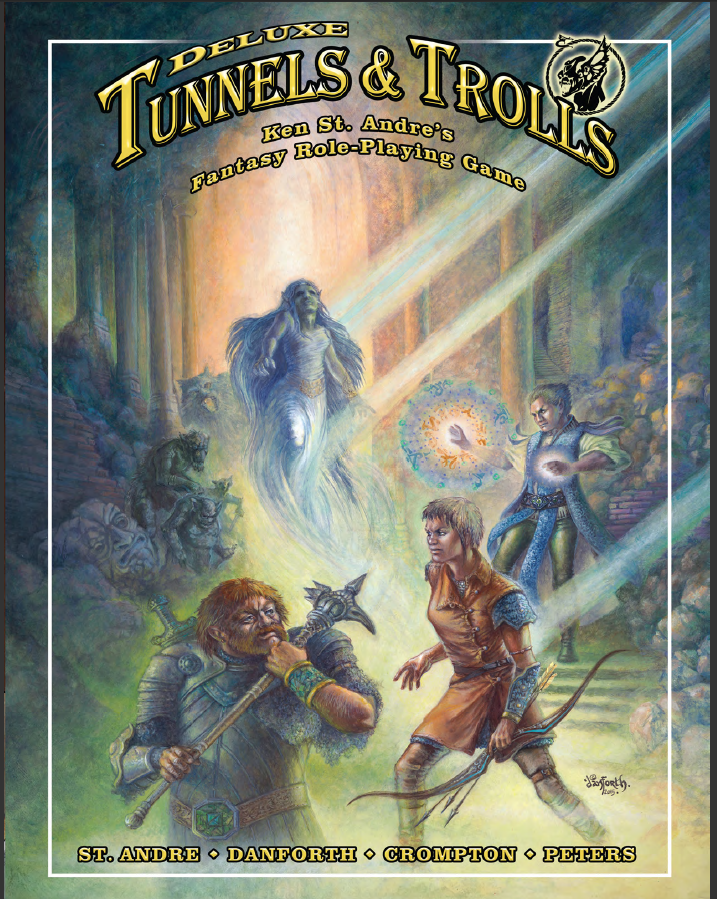
The game that I'm most pleased to have backed is Deluxe Tunnels and Trolls. There are so many reasons that I'm pleased to have backed this game. First and foremost is that Tunnels and Trolls, along with various Fighting Fantasy and Lone Wolf game books, was the vast majority of role playing game play that I participated in as a kid. Without those and Bard's Tale, I likely would have stopped playing games after my first session. My first experience had been with a "killer DM" and it hadn't been much fun, then I encountered a Ken St. Andre solo module and it was salve to my wound.

Don't get me wrong, Ken St. Andre is a "killer DM," his adventures don't suffer fools and they don't suffer the wise either. They are brutal, but they are never cruel and never seem unfair. When Ken kills one of your characters in a horrific fashion, you end up laughing with him at the absurdity of the situation. The worlds of Ken St. Andre, and his fellow Trolls, are imaginative to the point of psychedelia. They are a patchwork of everything wonderful in fantasy. They are Michael Moorcock meets Disney meets Harryhausen. They are creations of pure joy and excitement.

Add to Ken's literary patchwork the wonderful artwork of Liz Danforth and you have a perfect example of why role playing games caught on in the first place.

For a long time, the 5th edition had been my "go to" version of the game. There had been a 7th edition published by Fiery Dragon that updated some rules, and had a nice packaging, but it lacked a little of what made the original so magical. That little bit was the touch of Ken St. Andre's imagination and Danforth's editing and artwork. Liz Danforth edited the classic 5th edition and was brought back for the new Deluxe version of the game. It's taken a few years for this version of the game to be fully developed, but what I have experienced so far captures that early magic.

Tunnels and Trolls was the second role playing game to be published and it laid the foundation for today's OSR movement. Whenever I buy a new OSR product, I'm reminded of Tunnels & Trolls and that's a good thing. 


Thursday, August 06, 2015

#RPGaDay2015: [Day 1] Exciting Forthcoming Game


Last year, Dave Chapman aka +Autocratik created a blog prompt called #RPGaDAY wherein Dave did all of us amateur bloggers a favor by giving us 31 ideas for blog posts. The intention is that bloggers would write 31 posts over the course of a month and it was very successful last year. I was one of the participants, but I did not manage to post all 31 days. In fact, I think I only managed half a dozen or so. Even with that disappointment, I'm trying again this year even though I'm starting 5 days after the fact.

Let's move past the prologue and get to today's#RPGaDAY2015 answer:


Since I'm already a couple of days behind, and I'll be trying to catch up over the next few days, I'll keep this short.

The forthcoming game I am most looking forward to is...

http://www.modiphius.com/john-carter.html 

I've been a big fan of Modiphius, the publisher of the upcoming Edgar Rice Burroughs' John Carter role playing game, since I backed their Achtung! Cthulhu role playing game on Kickstarter a couple of years ago. That role playing game setting was compatible with both the Savage Worlds and Call of Cthulhu role playing games at publication and it seemed like a nice counterpart to Weird War II. The new John Carter game, which should be out by Christmas of this year, uses Modiphius Entertainment's own game system entitled the 2d20 LITE system. It's a streamlined version of the system they had designed for their new Mutant Chronicles role playing game. The design lead on the 2d20 system was Jay Little, who is one of my favorite game designers, and the mechanics are sound.

To quote Modiphius' Press Release:
John Carter —The Roleplaying Game: Due for release: Christmas 2015
Explore the wonders of Barsoom from the vast deserts to the ancient cities. Discover the forgotten secrets of a world that was old when life first spawned in the oceans of Earth. Play as pilots, warriors, scientists, or one of the terrifying green Tharks.  Create you own Barsoom adventures or take on the great journeys as John Carter himself along side Dejah Thoris, Kantos Kan, Xodar, Tars Tarkas, Thuvia of Ptarth, Carthoris of Helium or any of the other major heroes and heroines of Barsoom.

The John Carter roleplaying game uses 2d20 LITE—a streamlined version of the 2d20 system featured in the Mutant Chronicles, INFINITY and Conan roleplaying games. Designed for fast flowing action accentuating the exuberant adventures of the original books, 2d20 LITE let’s you dive into the game immediately with a sleek, pulse-pounding system. Major industry artists will help bring Barsoom to life. 
 Edgar Rice Burroughs and Michael Moorcock were the two figures who most shaped my early fiction tastes and I am more than excited to see a Planetary Romance game based on Burroughs' influential series make it to print.

I interviewed Chris Birch of Modiphius last year on Geekrati about Achtung! Cthulhu and Mutant Chronicles last year and it looks like the company continues to grow.


Monday, August 03, 2015

Street Fighter Board Game Coming Your Way

Jasco Games, who recently debuted their Mega Man Board Game at Gen Con, is extending their partnership with Capcom to include a new Street Fighter Board Game. As a tried and true member of the Street Fighter Generation who has watched the franchise evolve over the years, I am very excited about this project. One of the things that stands out is that the board game will include painted miniatures for the various fighters for use in the game.


Details about the mechanics of the board game are sparse, but as the project develops we'll see if we can get a look at the playtest rules. In the meantime, I know that at minimum I'll have a decent number of miniatures to run a White Wolf Street Fighter RPG campaign or a Savage Worlds version.

Sunday, August 02, 2015

Pinnacle Announces Their Projects for 2015 and Beyond

I'm a huge fan of Pinnacle Entertainment Group's Savage Worlds role playing game. It combines the simplicity of play of early games in the hobby with the customization and player choice of the modern game. It is easy to learn, but has a depth I've yet to tap out. I've run a number of campaigns and am looking forward to getting an East Texas University game running in the next couple of weeks.


This week, at the rpg hobby's largest convention GENCON, Pinnacle gave a presentation discussing their upcoming projects for the year. They are revisiting some of their best settings and are expanding their offerings. One key new offering comes in around the 7 minute 30 second mark that I think presents a good marketing strategy for the company. Pinnacle has released some excellent "genre" sourcebooks over the years, but when it comes to adventure support that has tended to either be "setting" specific or digital only. It now appears that they'll be doing an adventure compilation for each genre with less setting specificity. Their first one deals with...well...maybe you should just watch the video to see all the exciting things they've got planned. Make sure to watch the last minute of the video as well. It's a doozy.


Saturday, August 01, 2015

Hugo Ballot: My #1s

I wasn't going to post my Hugo Award Ballot, or any portion of it, but then I saw John O'Neill's ballot over at Black Gate and I felt compelled to share mine. Like John, I'm only going to share my top vote in each category. Unlike John, I won't be writing a long post on why I voted the way I did. I'm happy to discuss the issue in person, but I find that the internet is no more conducive than the letters page of a Fanzine to productive dialog.

I will say that these are my honest opinions of the ballot as it exists. It is not my opinion of what the "best of SF/F last year was," and I've tried to remove politics from the equation. I will be the first to admit that my gaming hobby affected my voting once or twice. That said, there are a number of votes for No Award that are higher than I would expect when voting for a year's best award.

Best Novel

        Rank            ----------------------------
        1               Skin Game by Jim Butcher (Roc Books)

Best Novella
        Rank            -----------------------
        1               No Award

Best Novelette
        Rank            ----------------------------
        1               The Triple Sun: A Golden Age Tale by Rajnar Vajra (Analog, Jul/Aug 2014)
 
Best Short Story
        Rank            ----------------------------
        1               A Single Samurai by Steven Diamond (The Baen Big Book of Monsters, Baen)

Best Related Work

        Rank            ----------------------------
        1               The Hot Equations: Thermodynamics and Military SF Ken Burnside (Riding the Red
                         Horse, Castalia House)

Best Graphic Story

        Rank            ----------------------------
        1               Rat Queens Volume 1: Sass and Sorcery

Best Dramatic Presentation (Long Form)

        Rank            ----------------------------
        1               Edge of Tomorrow 

Best Dramatic Presentation (Short Form)

        Rank            ----------------------------
        1               The Flash: Pilot teleplay by Andrew Kreisberg & Geoff Johns, story by Greg Berlanti, Andrew Kreisberg & Geoff Johns, directed by David Nutter (Berlanti Productions, DC Entertainment, Warner Bros. Television; The CW)

Best Professional Editor (Short Form)

        Rank            ----------------------------
        1               Jennifer Brozek
   
Best Professional Editor (Long Form)

        Rank            ----------------------------
        1               Toni Weisskopf
     
Best Professional Artist

        Rank            ----------------------------
        1               Julie Dillon
     
Best Semiprozine

        Rank            ----------------------------
        1               Lightspeed Magazine

Best Fanzine

        Rank            ----------------------------
        1               Black Gate
   
Best Fancast

        Rank            ----------------------------
        1               No Award

Best Fan Writer

        Rank              
        1               No Award

Best Fan Artist

        Rank            ----------------------------
        No Vote      

The John W. Campbell Award (not a Hugo)

        Rank            ----------------------------
        1               Wesley Chu
 

Wednesday, July 29, 2015

Witcher Table Top RPG Coming from CD PROJEKT RED and R.TALSORIAN GAMES


It was recently announced on the CD Projekt Red forums that they had come to an agreement with R Talsorian Games regarding the production of a table top role playing game for The Witcher. According to the announcement:

Together with R.Talsorian Games, makers of the hit pen and paper role-playing system Cyberpunk 2020, we are pleased to announce an agreement to develop The Witcher Role-Playing Game -- the go-to tabletop Witcher experience for pen and paper RPG enthusiasts.

The Witcher Role-Playing Game will allow tabletop RPG fans to re-create an array of characters known from the Witcher universe and live out entirely new adventures set within the world of Geralt of Rivia. Powered by Fuzion, the same ruleset that made Cyberpunk 2020 gain worldwide player acclaim, The Witcher Role-Playing Game will feature a myriad of spells, rituals, and curses; favorite gear and items from the entire Witcher series including a bestiary of devilish monsters players can face during their adventures. The system will provide all the necessary tools to create and play out your own adventures and become everything from a battle-hardened monster slayer to a merchant kingpin controlling a vast network of contacts.

The Witcher Role-Playing Game is currently slated for a mid 2016 release. More information about the system, price and availability will be provided at a later point in time.
I am simultaneously excited and ambivalent about this project, due largely to the involvement of R Talsorian Games. Before I get into my reasons for ambivalence, I'd like to highlight why I'm excited about R Talsorian's involvement in this project. 

I think that R Talsorian has historically been one of the most creative and forward looking companies in the entire role playing game industry. The company was founded in 1985 and was one of the first companies to bring Anime style gameplay into the hobby with their Mekton (1985) role playing game. The game had a relatively intuitive system that allowed for ease of play and customization of individual mechs. It also introduced players to a setting inspired by the classic Mobile Suit Gundam anime. This was quickly followed by the release of  Teenagers from Outer Space (TFOS -- 1987), a role playing game that mirrored high school romance anime and featured a simple system that was good for introductory games.

The same year that TFOS was released, R Talsorian published its Cyberpunk game. While this game had some mechanics that were inspired by earlier games (the lifepath system is similar to Traveller), it had two major effects on the industry. First, it provided the market with its first "attitude" role playing game. Cyberpunk was a game written with style that evoked an attitude. This design feature would go on to influence the World of Darkness series of games, as would the rules for Cyberpsychosis which emulated the loss of humanity one feels as one acquires more cyberware and learns that "metal is better than meat." You can see echoes of this system in the Humanity trait in Vampire. R Talsorian's Cyberpunk game was a cornerstone moment in the industry and game designer Mike Pondsmith is to be praised for the inspiration.

R Talsorian's innovation didn't stop there. Their Castle Falkenstein game was one of the first Steampunk game, and still the best one. That's making quite a statement given that there are several good Steampunk games around, but it is Pondsmith's ability to infuse mood into a setting and to incorporate mechanics that fit that mood that set Castle Falkenstein apart. The company also released new editions of Mekton that were compatible with Cyberpunk, games based on Dragonball Z, Bubblegum Crisis, and Armored Trooper Votoms. There was even a short stint where R Talsorian partnered with Hero games to release a "Fuzion" powered version of Champions. The partnership seemed natural, two successful Bay Area companies working together, but ended up doing some short-term damage to the Champions brand. This is too bad, as the Fuzion version of the game is quite fun to play and easier for new gamers to pick up and play.

Man, I love this company and their products.

But...back in 2013 I backed the latest version of the Mekton role playing game. It has not yet been published and updates have become scarce from the company. I'm not worried about the project, but I do wish communication was better. And I've got no fear that anyone is running away with a Kickstarter fortune. The Mekton game raised a respectable amount of money, but no one is getting rich off of it. I also understand that a part of the reason for the lack of communication is that R Talsorian has been working with CD Projekt Red on a new Cyberpunk computer game.

But it's hard to get excited about a game when I'm still waiting for another game to come out...one I've already paid for.

That said, I'm pretty jazzed and eagerly await the release of The Witcher table top game. Even though I still think it's a pretty silly name for a franchise.

Tuesday, July 28, 2015

The Evolution of Savage Worlds Damage and Effects: Toward a Faster, Furiouser, and Funner Process.

When I had my first opportunity to see Savage Worlds in action at a Gen Con demonstration in 2002, I was blown away. There were two things that jumped out at me.


First was the bravery of Shane and crew at Pinnacle. The gaming industry was in the midst of the d20 boom, products like d20 Stargate and d20 Everquest were being released, and it looked like the entire hobby would be Hero or d20 based. Even Green Ronin's innovative Mutants and Masterminds game was d20 adjacent and based on the OGL. For a company, especially a mid-range company that would be more vulnerable to shifts in the market winds, to release a new system in that environment was a truly brave move. Doubly brave considering the push-back they eventually received on their Deadlands d20 line when fans failed to notice that future products were double stat-ed for d20 and Classic rules sets.

Second was how the game lived up to the "Fast! Furious! Fun!" tagline on the cover. If you take the time to watch any of the how to play videos from Saving Throw or Wil Wheaton's TitansGrave series on Geek & Sundry, you will notice that roleplaying games can bog down during combat pretty quickly. This is even the case with good Game Masters (like Wheaton) and experienced gamers (like the Saving Throw crew). Savage Worlds isn't immune to this problem, but it is suffers from it less than many other systems. Combat in the game is definitely Fast and Furious. Whether it is Fun can depend on the Game Master and Players, but I think the default is yes.

Savage Worlds was designed to be able to handle combats of a relatively large nature in very little time and to achieve this goal it incorporated a couple of key mechanics. The first was the use of different categories for different kinds of characters. Characters who are meant to be fodder, or at least easier to defeat than others, are classified as "Extras" and those who are meant to stick around a while - like the Player's characters - are called "Wild Cards." It's a system inspired by games like Feng Shui, but it's a very effective system. The second way that Savage Worlds speeds up combat is through its Keep It Simple/Is It Simple Enough philosophy. A perfect example of this is the "Up, Down, or Off the Table" principle of combat (pg 68 of Savage Worlds Deluxe HC) which was the underlying reason for the recent change to the game's "Shaken" rules. This rules change isn't the first relatively major change in Savage Worlds' combat system and I'd like to take you through many of those changes to show you how the game has changed in order to keep things moving Fast! and Furious! in order to maximize the Fun!

In the 2003 edition of the game (which you can play using the v3 of the Test Drive Rules), combat worked in the following way. A player rolled to hit. If the player hit the opponent, then they had to keep track of how much they hit that opponent by and for each 4 points over the number needed the player added +2 to the damage dealt to an opponent. This damage was resisted by Toughness and could be "soaked" if the victim spent a "Benny" to make the roll. If a player took more than 3 wounds, then that character would suffer the effects of a knockout blow. The effects of this knockout blow depended on the amount of damage the attack did while the character was at three wounds. For example, Hugh Manley has taken 3 damage from attacks earlier in combat. He suffers another attack and it would do 2 points of damage. This would leave Hugh incapacitated, but Hugh could spend a "Benny" to soak the damage to prevent the knockout effect.


This system was fast, but probably wasn't fast enough for the designers because by the time that the 2004 Revised Edition, the bonus damage had been changed from +2 "per raise" to "+1d6 per raise." Given that the average damage of a d6 is 3.5 and that these dice could "ace" (be rolled again and added on a 6) it made it possible to do more damage. The system for incapacitation remained the same for this edition.

Counting how many successes one has achieved, and rolling an additional number of d6s equal to that number, can be time consuming. This is likely why the team changed the rule again in the Explorer's Edition in 2008. You can play this edition using v6.0 of the Test Drive Rules. In this edition, the attacker rolled +1d6 if he or she rolled any raises, but only an additional +1d6. Using the older Incapacitation rules though, this might still end up bogging things down. With this new edition Players made an "incapacitation roll" when their character takes more than their three wound allotment. Now, instead of comparing the amount of damage from the final attack against a chart and deciding whether to soak the damage, the player would decide whether to soak or make an incapacitation roll where if the character rolled high enough then it would still be active. This system was quicker than before and worked pretty well.


Then Necessary Evil came out, and with it characters with enough Vigor to almost always get a raise on an "incapacitation" check and thus who were nigh impossible to knock out of a fight. So this brought about one more change. Like the Explorer's Edition, damage in the Savage Worlds Deluxe edition was an additional +1d6 if the attack had any raises (and only +1d6), but incapacitation changed. This time, any time a character suffers more than three wounds that character is incapacitated...period. A Vigor roll is made to see if there is permanent damage or death, but the character is out of the fight period...unless the character makes a soak roll, but that requires a Benny.  This change made combat much faster, and scaled well with the new Super Hero rules and characters with higher stats.

But combats could still bog down a little and so Pinnacle made one more change, this time to the Shaken rules.  It's a small change, but it has some significant effects on combat. One of the most significant of these changes is that it speeds things up. Players can still spend Bennies to keep their characters moving, but the importance of Bennies has been increased. Given how the rules have been written since day one, this seems intentional. The designers want there to be a good and moving Benny economy.

Since the game was released in 2003, it has seen a number of changes and editions, but it seems that uniformly the question underlying the changes is "How can we make this simpler?" The thing that most impresses me with Savage Worlds is how it strives to capture all the granularity of a complex game like Hero or 3.x while keeping the game as simple as possible. I think that they manage this feat remarkably well.

If you are interested in playing Savage Worlds, and you should be, you can download and play the modern day adventure The Wild Hunt for free. It even includes a recent version of the Test Drive rules. There is a more recent version of the rules in the Lankhmar set, but that is for another post.

Friday, July 17, 2015

Learning from the Casual Gamer: What I Learned Reading Lauren Orsini's Review of Magic: Arena of the Planeswalkers

I've been excited about the upcoming release of Hasbro's Magic the Gathering: Arena of the Planeswalkers board game since I first got news of it last year. The game has already received limited release through brick and mortar specialty stores and on Amazon.com, but has an official wide release date of August 1, 2015. I've got my game on pre-order with a smaller FLGS who isn't on Wizards of the Coast's list of premiere stores and I'm eager to play it. My eagerness is two fold. First, the game has received praise on Boardgame geek and Tom Vasel has given it a big thumbs up. Second, the game looks to be heavily influenced by one of my favorite introductory miniatures games Heroscape.


My eagerness to play the game has only increased after reading an interesting, and mildly irritating, review of Magic: Arena of the Planeswalkers from Forbes, entitled "I played 'Magic the Gathering: Arena of the Planeswalkers' and All I Got Was Drunk."

The article was irritating because of its focus on drinking, used for humor I suppose, and the fact that it was a perfect demonstration of the ubiquity of tl;dr culture. If something is too long people will ignore it. It's one of those path dependent results of video games masking the the mechanics underlying game play. Video games implement the mechanics and players don't need to know how a game works in order to begin play and can learn how the mechanics work through play. There is still a learning curve, but it is an active learning curve.

I'm not entirely opposed to this, but it is a mentality that doesn't work too well with board games. You cannot play a board game without having some sense of the mechanics. This is one of the reasons that some games have "basic" and "advanced" rules that can be used. As I wrote, I'm not opposed to working toward making games more "open and play," but I am frustrated by how the transition to digital reading has lowered people's tolerance for long form journalism and games with rules longer than six pages.

The article is interesting because it demonstrates what an encounter with a "light" wargame is to a casual gamer. I have often wondered why Heroscape didn't do as well as I had hoped and Lauren Orsini filled in that gap for me nicely. To me, Heroscape and games like it, are popcorn and soda affairs that are quick to play and don't require a Master's Degree in Rules Acquisition like the classic Advanced Squad Leader does. Compared to the hundreds of pages of rules in ASL, a 20 page rulebook is nothing. But for someone used to pick up and play, or 4 page rulebooks, the story is quite different.

Image Source ICv2


For gamers like Lauren, Arena of the Planeswalkers 20 page rulebook is the referential counterpoint to those hundreds of pages of rule and being asked to flip through those pages to find a rule is similar to us searching for rule A25.45 which refers us to rule F.8, but is really referring to rule A25.53.

In Tom Vasel's reviews of the game, he talks about how quick the game plays and his group is playing it in less than half an hour. In Lauren's review, she describes how she and her group played for over three hours and still hadn't finished the game. She also expressed concern that her group might not have been playing the game correctly.


It would be easy enough to turn this discussion into a screed against Lauren and tl;dr gamers like her, but that's not what I want to do here. Yes, tl;dr culture irritates me. I don't like it when my students haven't read The Federalist Papers because they are difficult to understand and I don't like it when a gamer is intimidated by a "mere" 20 pages of rules.

 Having written that, 20 pages is actually quite a lot of rules. The basic rules of Chess, one of the greatest games ever made, can be written in two pages.


I think that as fans of games and gaming we need to take into account how intimidating a 20 page rulebook can be and not be surprised when someone is intimidated by it. Think about those game sessions when you wanted to play a new game, but hadn't read the rules yet, and read them aloud to the group before play. Remember how long that took? Remember how not fun that was? Playing a game with a longer rulebook requires home work to be done by at least one of the game group. Keep that in mind when designing games, but more importantly keep that in mind when playing with inexperienced gamers.

It is our job as game advocates and fans to familiarize ourselves with games so that we can teach them to others and make their experiences as much "open and play" as possible. I think that Lauren's article gives us some pretty good insight into how an inexperienced gamer approaches our hobby. She did her best to learn and play the game with her group and wrote a relatively positive review for someone as intimidated as she was.


Now...what Forbes was thinking when they assigned this article to her is another matter entirely.

Tuesday, July 14, 2015

Into The Badlands Looks Like a Post-Apocalyptic, Kung Fu, Western and That's a Beautiful Thing.


I've seen quite a few adaptations of Journey to the West, aka Monkey, in my day. Most of these adaptations fail to capture the wonder I experienced when I first encountered Sun Wukong in Ron Lim's excellent comic book Dragon Lines. It wasn't until Steven Chow's wild and imaginative Journey to the West: Conquering the Demons that I saw a filmic version of the tale that approached what I had always wanted to see. I've yet to see a Western adaptation that properly captures the heroism and whimsy of Sun Wukong. While I appreciated Jackie Chan's and Jet Li's performances as manifestations of Monkey in The Forbidden Kingdom, the film itself focused too much on the wandering Westerner and not enough on Monkey. I've been pretty skeptical of Hollywood's ability to bring this character to screen as the rightful protagonist of a tale.


It looks like AMC might just change my assessment. AMC released a preview trailer for their upcoming series Into the Badlands which is based on the classic tale of heroism and wonder, and I'm really impressed. Yes, it's a Western version of the tale, but it is also a "Western" version of the tale. I'll still go in skeptical, but this show looks like a lot of fun and Daniel Wu's performance as "Sunny" looks great. I was never able to see my much wished for version of the tale with Dennis Dun as Monkey, but Daniel Wu brings a wonderful charisma to the screen.

The cinematography of the trailer hints at the influence of Wong Kar Wai and Ronny Yu, and that is a very good thing.


I can't wait to adapt this to Feng Shui, Chris Pramas' Dragon Fist RPG, or Savage Worlds.


Thursday, July 09, 2015

Yay! The Return of Cel Shading! Transformers: Devastation is a Game that Looks Like a Cartoon

While the actual gameplay in the new Transformers: Devastation trailer looks less than inspiring, it looks like a mashup of Dynasty Warriors and Tekken, I'm extremely happy to see the return of Cel Shading in video games. There was a brief period in the 90s/early 00s when Cel Shading was all the rage, mostly in some poor games, but I always thought the concept was a good one. Who doesn't want to play a game that looks like the source material? It only adds to the verisimilitude and can create an immersive experience.

Kudos for returning to the format.


TitansGrave, Fantasy AGE, and Stunt Dice -- Probabilties of Rolling Doubles on 3d6


Green Ronin's AGE game system is one of the more innovative role playing systems on the market and the company has begun a major marketing push to promote the system. As a part of their promotional campaign, or as a bit of wonderful serendipity, the AGE system was selected by Wil Wheaton as the role playing system that would be featured in his entertaining TitansGrave: The Ashes of Valkana webseries. I've begun reviewing the show episode by episode, and will continue to do so, but one thing struck me as I was watching the second episode that prompted me to do a post that wanders down Probability Lane in the middle of Statisticsville.

One of the things that really sets the AGE system apart from other systems is its "Stunt" system. This system allows for an increase in player agency at key moments during a game session. It's a mechanic that evolved from early Greg Gorden designs like James Bond 007 which had pools of points players could spend that would allow their characters to do special actions that were out of the realm of possibility for normal "non-player" characters. Some early games that were inspired/influenced by this mechanic include Marvel Superheroes (Karma) and DC Heroes (Hero Points). This mechanic has been very influential in the story game genre where player agency takes priority over game master storytelling. Modern games in this school include, but are not limited to, D&D 5th Edition (Inspiration), Through the Breach: The Malifaux RPG (Twist Decks), and Savage Worlds (Bennies).

While the "Stunt" system falls within this design school of modeling character heroics through the increase of player agency, the AGE take is relatively unique. Where most systems have a set pool of points, or have GMs give points to players, AGE allows probability to decide when players get points to spend. Additionally, and most importantly, many systems have either set effects like rerolls (Bennies) or allow for players to radically alter the elements of a scene (Hero Points and many story driven games). AGE takes a middle ground philosophically between these two extremes. While stunt points allow for more than "mere" rerolls, the Dragon AGE role playing game provides lists of effects that can be achieved by spending stunt points and assigns each a cost. For example, attacking two foes simultaneously might require 4 stunt points while adding a die to damage might only require 2. These are only two, of a large number, of effects that can be achieved. What is important here is that while AGE allows for increased player agency, it does so within constraints that are balanced to ensure players feel challenged.

So how does one acquire these extremely valuable stunt points?

In any AGE game when a player attempts to accomplish a task, that player rolls 3d6 and adds whatever attribute is relevant to that task. For example, when picking a lock a character might add her Dexterity score to the roll. This number is then compared to a Difficulty Number. If the roll plus bonus equals or exceeds that number, the action is successful. If lower, then the action fails. One of these die is of a different color and in Dragon AGE is called the "dragon die", but we'll call it the "stunt die." How successful a character was with the action is sometimes (in the case of extended actions) determined by the value of the stunt die.

If any two of the die come up doubles (or if all three come up as a triple), and the action is successful, the player acquires stunt points which may be spent to make that action special. Maybe the attack hit vulnerable spots or a lock is permanently disabled.  These things are determined by the expenditure of stunt points and a player acquires a number of these equal to the stunt die value. Note that this only occurs when a player rolls doubles (or triples) and is successful.

It's elegant and allows characters to feel extremely heroic in their actions, but this leaves open the question. How common are doubles on 3d6 and how do we even begin to think about these things. There are a couple of books that might be helpful. Chapter 3 of Reiner Knizia's classic Dice Games: Properly Explained is a good place to start, but I have found O'Reilly's Statistics in a Nutshell to be a wonderful resource to return to once the basic idea is understood.

The first way we can see how frequently doubles, or triples, turn up is to write out all the possible combinations.


In this case, it isn't too much work, but if more die had been rolled then it would have been far more time consuming and really we don't want to have to do this all the time. What we really need to understand is that this kind of problem is an example of an intersection of independent events. This means that it is an example where we are looking for matching results from things that are independent from on another. This is the case in all die rolls since what a die rolled on one roll does not effect what gets rolled on the next die roll. If you roll a six on a d6 and pick it up, you still have a 1 in 6 chance of rolling a six the next time you roll the die. These are independent events.

When determining the probability of independent events, we need to know the total number of combinations possible. In this case, that's simple because we are rolling 3d6. This makes the total number of combinations as follows:


6 × 6 × 6 = 216 

 Now we need to know the probability of rolling doubles (or triples) on 3d6. This is equal to:

P(Rolling Doubles) = 1 - P(Not Rolling Doubles)

Since this is a case of an intersection of independent events, we will use the following equation and modify it as a chance of not rolling doubles and then subtract that probability from 1.

P(D1 ∩ D2 ∩ D3) = P(D1) × P(D2) × P(D3)

We know that the probability of rolling a number on 1d6 is 100%. The first number we roll doesn't matter, so that makes D1 = 1.

We know that there are 5 ways to not roll the number rolled on the first die and that leaves us with D2 = 5/6.

We know that the chance of not rolling a number on either of the first two die is 4/6 which makes D3 = 4/6.

This gives us the following equation:

P(D1 ∩ D2 ∩ D3) = P(1) × P(5/6) × P(4/6) = .66667

P(D1 ∩ D2 ∩ D3) = P(1) × P(5/6) × P(4/6)  = .55554

The odds of not rolling doubles is .66667. Thus the odds of rolling doubles is:

P(Doubles) = 1 - (.66667) = .44443

P(Doubles) = 1 - .55554 = .44446


This leaves us with a 44.44% chance of rolling doubles or triples. If you want to double check the equation, you can count the 16*6 combinations above and divide that by 216. Another way of looking at this intersection is using this Venn diagram. As you can see, there are 6 ways of rolling triples and 30 doubles combinations at each intersection of any two dice (making a total of 96).

As for calculating the odds of earning stunt points at any given Difficulty rating, that is beyond the scope of this conversation and I'd leave such analysis up for those much better versed in probability and statistics than I am.

Wednesday, June 24, 2015

A Short Q&A Discussing THE SIXTH GUN for Savage Worlds

Yesterday, I wrote a brief review/overview of the upcoming The Sixth Gun campaign setting for the Savage Worlds role playing game.

To make a long story short, you need to back this project or buy it as soon as it comes out. It's a great mashup of Westerns, Fantasy, and Horror that provides a wonderful sandbox for creative play.

In addition to getting an advanced look at the rules and initial adventure campaign, both of which are up to Pinnacle's high production standards, I had the opportunity to engage in a brief Q&A with the creators. 

I'd like to share my chat with Shane, Jodi, and Scott.
Shane Lacy Hensley, owner of Pinnacle Entertainment Group and creator of the award-winning Savage Worlds and Deadlands roleplaying games.

Jodi Black, COO and Managing Editor for Pinnacle Entertainment Group, and Game Club volunteer for her kids' Middle School for the past 3 years

Scott A. Woodard, author of The Sixth Gun RPG


 1) What prompted PEG to seek a license for The Sixth Gun? Are you worried about brand dilution or cannibalization from your Deadlands line?
Shane: Oni approached us, and at first I was reluctant, of course. But as I said elsewhere, I DEVOURED the graphic novels, fell in love with them, and said "Who else SHOULD do this game besides us?" No one, of course. And the fact that they'd be 100% compatible with Deadlands (and vice-versa) is a huge advantage from my point of view.


 2) The Sixth Gun looks like it might be more "kid friendly" than a straight Deadlands game, but given that there is a Gallows Tree and a horror tone what age group do you think will be most appropriate?

Jodi: I think teens and preteens will love the dark elements of The Sixth Gun--but, with a little GM editing, Deadlands fits that niche too. One age group The Sixth Gun can adapt better to is the 6-10 age range, depending of course on the child's tolerance for dark. My youngest daughter would have gleefully embraced talking to hanged men at age 6, while my oldest daughter would have needed to be 8 or so. Now that they're 13 and 15, of course, they're at the perfect age for exploring the Weird West!


3) Could you tell me a little bit about the factions (Sword of Abraham and Knights of Solomon) in the game?

Scott: Both organizations are integral to the central plot of The Sixth Gun comic series. Because of that, they simply had to be present in the game. For those unfamiliar with the series, the Knights of Solomon are an order that seeks to acquire ancient artifacts and relics in order to exploit their power for personal gain, while the Sword of Abraham stands opposed to their efforts in order to prevent Armageddon! In the roleplaying game, we present details about both factions, information on their lairs, archetypal NPC stat blocks for both, and the option to actually play representatives from either group. In the comic, Drake Sinclair was once in the employ of the Knights of Solomon, but over time, their paths diverged. Perhaps your PC shares a similar backstory...

 4) The majority of Savage Worlds settings seem to be "high concept" combinations of multiple genres, what is it about the Savage Worlds system that encourages that?
Shane: I'm not sure it's Savage Worlds so much as my personal preference for not just doing another Tolkien knockoff. From the very beginning we've only wanted to do games with a twist. Deadlands and Sixth Gun are Western horror--which didn't exist in the RPG space at the time. Lankhmar is thieves' guild fantasy. 50 Fathoms is fantasy pirates. Sometimes that keeps us from taking on a genre until we have that twist. We'd like to do a classic pulp setting, for example, but haven't found anything with a good twist yet. There are plenty of early Nazi / zeppelin / Indiana Jones style pulp games out there already. What could we do that's different and unique? We haven't figured that out yet.

5) If I wanted to run a Savage Worlds game for 7 to 10 year olds, what is one rule change you would recommend to speed up the learning curve?
Jodi: Rules for magic, regardless of system or setting, tend to be the hardest to grasp so that's always the easiest change to make: Either no magic for their characters, or help them make an easy magic-using character to run (choosing entangle instead of bolt, for example). For The Sixth Gun, I'd probably not use the Critical Failures Setting Rule either, as not all kids do well with complete failure as a plot device. I also suggest taking Hindrances they can relate to, like Impulsive and Short Temper...or maybe that's just MY experience with kids. :)

Tuesday, June 23, 2015

Savage Worlds, The Sixth Gun, and Infinite Possibilities

"It was human suffering that called The Six into existence. And The Six gave the humans the power to recreate the world."


I've been a fan of role playing games produced by Pinnacle Entertainment Group since the first time I saw a copy of the Deadlands role playing game sitting on the shelf of a friendly local game store. My fandom only increased when they released the Savage Worlds role playing game in the early 2000s. The system, based on a very simplified version of the Deadlands rules, lives up to its tagline and is Fast, Furious, and Fun! It is one of the easiest role playing games to teach people how to play, and it runs combats swifter than any other system I've played. The mechanics are also incredibly flexible and can be used to simulate everything from Sword & Sorcery to Superheroes without missing a beat.

Over the years, Pinnacle has produced a number of settings for the Savage Worlds system, often featuring high concept mash-ups of other genre. Some of my favorites are the Cyberpunk meets Gothic horror Rippers and the Independence Day/V meets The Avengers setting Necessary Evil. Prior to this past month, they have only published one Western inspired setting in their Deadlands Reloaded adaptation of the original role playing game.

Pinnacle is currently finishing up a Kickstarter campaign for a new Western themed Savage Setting called The Sixth Gun based on the Oni Press comic book series of the same name. I've had the benefit of giving the rules a look over, and I can say that this may quickly become my favorite Savage Setting.

While The Sixth Gun is at its base a Western tale, it is far more than that. The quote at the beginning of this post is from the story and it is literally true. Those who control The Six have the power to recreate the world in their own image. In a way, The Sixth Gun is a Feng Shui meets Deadlands mashup and that is a beautiful thing.


While The Six are "guns" in the current setting, they have been clubs and swords in the past. Who's to say they couldn't be "Rings of Power" in another? Not me. I'm already prepping a Savage Supers Setting based on "The Sixth Ring." It's a Savage high concept mashup of Green Lantern, Deadlands, Feng Shui, and The Sixth Gun.

As is typical of Savage Settings, The Sixth Gun is rules are well written and written using active voice. This makes for quick reading. There are a number of small differences in the mechanics from the core rules. It is often said that Savage Worlds is not a "universal" rules set, rather a rules set that can be adapted to any setting. In The Sixth Gun, the standard Arcane Backgrounds are not allowed. Instead, there are specific Backgrounds that are better suited to the core The Sixth Gun setting. This allows the game to have magic "feel" different for the setting than it would using the rules from the core rule book. The setting also uses a couple of key rules like "Born a Hero" and "Critical Failures" to give the setting the appropriate grimly heroic tone.

As a father who is teaching his seven year-old daughters to play role playing games, this setting is slightly more cartoony than the Deadlands setting and allows me to role play "action ghost stories" with the twins instead of the more serious grimdark horror of Deadlands. I'm still waiting for a Savage Worlds "Moldvay/Cook Basic" equivalent to be published, but I've been working on an equivalent for my home game.


In addition to The Winding Way, an adventure campaign for The Sixth Gun game, Pinnacle have two free adventures available on RPGNow entitled Circle the Wagons and The One-Hand Gang. The Winding Way is a great introduction to The Sixth Gun setting and highlights the transformative nature of The Six. I cannot wait for these books to be published, and you have a couple more days to back the project yourself.

Wednesday, June 17, 2015

Titansgrave: Ashes of Valkana | Episode 1 Review


I was pretty skeptical when I first heard the news that Geek & Sundry would be running a Tabletop Roleplaying Game Let's Play with Wil Wheaton as the Game Master. I wasn't skeptical that Geek & Sundry would actually produce the show, rather I was skeptical that it would work as a piece of entertainment.

I've been a fan of playing RPGs since I was ten years old, but I've learned one thing from standing around watching RPGA sessions at various conventions. With the exception of the fictional world of the Gold web series, where roleplaying games are a spectator sport, it isn't often fun to watch other people play them. There are so many ways that the spectator experience can be fouled. The Game Master might not be willing to engage in theatrics. The Game Master may be bad at theatrics...although that can have its own short term entertainment value. The medium isn't very visual on its own and requires participants to fill in the "spectacle" of the tale. The players may not be evocative in their explanations of what their characters are doing. The game play might get caught up in the spiral of discussing things that aren't at all game related, and thus turn the experience into merely watching a conversation about which version of Highlander 2 is worth watching.

The answer is neither.

It's one thing for a roleplaying game session to be fun for the participants, which it can be with all the above failures, it's quite another for it to be fun to watch.

David Nett and his friends did a great job of creating an entertaining to watch roleplaying game experience with their second season of Gold entitled Night of the Zombie King, but they did so in an entirely scripted format where the roleplaying game session was merely the setting for a host of dramatic tensions. Being scripted, the session is also heavily edited and time compressed. The question is whether the entertainment value of a well-written and well acted "scripted simulation" of a roleplaying session can be recreated in a real gaming session where things are much looser.

If the first episode of TitansGrave: Ashes of Valkana is any indication, the answer is yes. I won't say that it is a "resounding yes," for reasons I'll articulate as the review goes along, but I will say that Geek & Sundry did manage to create an entertaining viewing experience.

WHAT'S GOOD ABOUT TITANSGRAVE

Before I comment on what I believe the show has done wrong, let me begin by praising what it got correct. A lot of work went into producing this web series, and it shows. Wil Wheaton has recruited a number of actors, of the tradition and voice varieties, to play the game with him. Before you assume that the "recruiting of actors" means the "recruiting of non-gamers/non-geeks," let me cue you in on a little secret. D&D is the secret language of Hollywood. There is an entire community of rpg geeks in tinseltown, and while not everyone games a lot do.

The show has also selected a game system, the AGE system from Green Ronin, that has a lot of improvisational narrative potential. All roleplaying games have at their root the potential for improvisational narrative, it is after all what really defines a roleplaying game, but given the tactical wargame roots of the hobby the game can sometimes descend into a series of "I roll a 13, I do 5 damage, You roll a 15, I take 3 damage" comments that are mindnumbing to watch. Roleplaying is best watched when "roles" are being "played" and that means that actions are being described rather than mere die rolls. AGE's "stunt point" system aids in making combat sequences more narrative, rather than quantitative, by mechanically encouraging players to create descriptions of their actions in return for benefits. Players respond to incentives, and if you incentivize narrative descriptions you tend to get more of them.

The show hired adventure writers from the game industry who worked with Wil Wheaton to bring about his world. It's one thing to hire talented writers, but it is another thing to hire people who can take a story and translate it into a game experience. Experienced adventure writers have a knack for it. It takes more than breaking a story down beat by beat and then creating stats to gamify a story. It takes an intuition regarding how players will respond to circumstances. You also need to be able to create a small enough segment of a story that it can be played (after being edited) in less than an hour and still have narrative movement. This includes taking into account the delay that mechanics will cause as actions are resolved. What separates roleplaying games from mere improvisational theater is the fact that actions are arbitrated by mechanics. This is something that not only is at the core of what makes roleplaying games "games," but is a key to ensuring that all players get an equal chance to participate/succeed.

Hiring Wes Otis for the sound effects and musical loops was wise. Otis has done good work as a sound professional, but he has also made some great effects for home play.

The show is well edited, which cuts down on the digressions that players are prone to making, and has incorporated sound effects and some minor animations to increase the visual appeal. The editing is key for this show, and they seem to know it. They have edited out the distracting digressions, while leaving some of the more entertaining ones in, which gives the session a nice play flow.

The cast does a good job of staying interesting without trying too hard. One of my person peeves when watching some episodes of Tabletop is that the players often seem to be trying too hard to entertain. They seem to have the sense that watching a board game isn't exciting in and of itself, and thus feel the need to spice it up. Wil Wheaton, Hank Green, Laura Bailey, Yuri Lowenthal, and Alison Haislip may be doing that a little in TitansGrave, but it is indistinguishable from the normal one-upsmanship I've witnessed in my playing experience.

WEAKNESSES

This show is not made for a wide audience. It's hard to tell if the show is meant to only appeal to those who are already gaming, or whether it is also meant to bring more people in. I say that because the first episode already has a couple of inside jokes that might appeal to long time gamers, but which will be missed by new viewers.  Additionally, the first story is "age confined" in that they had to bleep out profanity and that it's about drinking. This isn't a bad thing per se, and I found it quite entertaining, but it does limit your viewing audience.

Lack of use of voice actor talent. C'mon people! Let's get crazy! We've got funny people here, but they seem to be holding back a little in combat. This could partially be because they are still learning the AGE system, and don't feel comfortable with it, but I want more verbal sound effects from the players. Laura Bailey and Yuri Lowenthal are trending in this direction, but I want more as a viewer. You really can't "commit" too much for me. Think about it like a comedic role. You have to be willing to fully commit to the joke/process. That doesn't mean go over the top, but it does mean you have to immerse yourself in the play and lose the wall of "I'm being judged."

The show hasn't quite captured a way to make the depiction of combat visually interesting. I both like and dislike the battle display they are doing. I like that they aren't showing miniatures on the table, which can be good are bad for spectators, allowing the actors to free form act rather than move game pieces. What isn't working for me is how static the display is. If you are going to present a graphic virtual tabletop, have the images move about on the hologrid you've presented. I also noticed that Wil Wheaton began to fall into the "I roll an x and do y damage" drone. It's hard not to, and Wheaton was great most of the time, but it's something he'll need to fight.

The show isn't perfect, but it did entertain me. We'll see how the season progresses. One thing is certain, I will keep watching. I will also be buying the tabletop campaign supplement as soon as Green Ronin releases it.


Tuesday, May 26, 2015

The Perils of Public Statements and Why Natasha Pulley is the Bravest SF/F Fan I've Ever Read


The Guardian is one of the few newspapers that truly takes Science Fiction and Fantasy literature seriously on a regular basis. They frequently have reviews of new releases, cover the latest kerfuffle in fandom, and run a number of opinion columns discussing the genres. As a fan, it's nice to find a place in the mainstream media where I can see one of my obsessions treated without a hint of irony.

This isn't to say that The Guardian doesn't wander into Clickbaitlandia from time to time. I took one of their regular writers, Damien Walter, to task for asking if we were "in a post-Sci Fi era." Damien was kind enough to take my discussion seriously, which made for one of my own personal blogging highlights. One does not often imagine that people who have deadlines to meet, and who are halfway across the globe, have time to respond to one's little island of ideas.

About a week or so ago, Damien wrote a piece lamenting the tyranny of mega-novel series in epic fantasy fiction. As a fan of the Fantasy genre, who is tired of being expected to read 10,000 pages over the span of 20 years in order to get a complete tale told within an author's mythopoeic construction, I was glad to see someone I respect shared my views. I miss the compact and deep shorter novels of days past. Long gone are the days of Elric of Melnibone, we now live in the era of The Wheel of Time. I think that today's readers are poorer for that experience, but there are those who disagree with Damien's view. Among them is an aspiring author named Natasha Pulley.

Natasha Pulley argues in her own piece at The Guardian that, "High fantasy...hinges on world-building. When there really is a whole world to build, and not just a historical period or a particular country, world-building does not take a few paragraphs in a short story; it takes chapters. Add to that the anvil on which creative writing schools hammer their students now, show don't tell, and these details take even longer to convey." Her argument is that the modern genre of Epic Fantasy requires the massive amounts of elaboration that so many modern Fantasy novels indulge in as a condition of additig literary value and verisimilitude. In Pulley's analysis, many of the best Fantasy stories are very simple tales at there core and it is the addition of world-building and subtle portrayals of character interaction that make these stories truly worthwhile.


There is more to her argument, to be sure and you should read her piece in its entirety, but it is one that I could not disagree with more. I think that the kind of "subtlety" of interpersonal interactions that makes up much of the verbiage of many a modern tale are flaws in writing and not virtues.

Before I elaborate on my reasons, I want to take a moment to repeat something I wrote in the headline of this post. Natasha Pulley may be the bravest SF/F fan I've ever read. I write this because she has written column that takes up a somewhat controversial opinion during a time when fandom won't hesitate to demonstrate to you exactly how wrong you are, and often not in the nicest of terms. The reason I am writing this post is less because I disagree with Pulley and think she is in need of "correction," rather it's because of the ire she raised among my Facebook friends. I have an odd collection of "friends" on Facebook who run the gamut from "not at all interested in SF/F" to editors in the field, and many of them were outraged by Pulley's piece. One of the nicer critiques was that it seemed that The Guardian had recently become a cesspool of nothing but click bait articles.

I, myself, even tweeted out a brief "you clearly haven't read x..." tweet in response to Pulley's article. I wasn't insulting in tone or language, but I think I was a bit dismissive. Pulley's response was perfect, "I'll add that to my reading list." Not only is she brave, but she clearly cast a Stoneskin spell upon herself after writing the piece. The rage on my feed, and Pulley's own polite response to my snark, are why I'm writing this post.

I'll begin my critique of Pulley's piece by using a trick she uses in her own article. In order to demonstrate how simple, almost simplistic, Epic Fantasy tales can be, she reduces a couple to their barest skeleton. Her choices are Game of Thrones, The Lord of the Rings, and Harry Potter. I'll go a step more modern, into a series that is "windier" (pun totally intended) than Rowling at her most "we are camping for 300 pages," and pick Patrick Rothfuss's The Name of the Wind.

Name of the Wind  : Homeless youth goes to college and acquires student loan debt.

Spoiler alert. That's pretty much all that happens in that book and it takes a long time to get there. Readers are led through sidebar after sidebar of other short stories along the way, but that's the crux of the book. Oh...and it's very enjoyable because it's well written. A part of how well it is written is in the little short stories that take place throughout the book. In fact, the sidebars contain far more world-building than the wordy narrative. Some of the best world-building in Rothfuss' book are the product of "off-hand" comments made by characters in the book. By off-hand, I mean off-hand to the characters, they are very intentional by the author.

This brings me to my main point. While Pulley is correct in stating that the on page development of deep friendships or interactions between characters can be page consuming, she is wrong about world-building. The problem, and blessing, of modern Fantasy is that it gives us entire conversations. This makes for very believable characters, but neither moves the story along nor gives the reader a sense of the world.

The best world-building is seen in shorter fiction, not in longer. It is, as Pulley rightfully acknowledges, extremely difficult to write short fiction let alone short Fantasy fiction. That's one of the reasons, much to Susan Palwick's disappointment I imagine, that I have not published any fiction to date. It's hard to be creative. But as difficult as short fiction is to write, it is where the best writing occurs.

Robert E Howard's first Conan tale, which I examined at this blog some time ago, is rich with world-building. Sometimes Howard achieves world-building through heuristic shortcuts where certain nations are "inspired" by our own history. He's not alone in this though as Robert Jordan borrowed from Dune, King Arthur, Tolkien, and a host of other sources for his Wheel of Time series. One would imagine that with all of the world-building shortcuts Jordan used, he wouldn't need so many books to tell his tale.

Fritz Lieber's classic tales of Nehwon are all short fiction, usually novellas, that give a strong sense of place in a very small number of words.

Michael Moorcock's Elric Saga is brilliant for its world-building and yet the world gets no "bigger" the more books you read. The world is real from moment one, even if you don't get the heuristic shortcuts Moorcock is using.

Garth Nix's tales of Hereward and Mr. Fitz take place in a fully imagined environment and never have they wandered into even the novel in length.

H.P. Lovecraft build complex mythologies within the short form.

C.L. Moore's Northwest Smith is one of the most realized characters in all of fiction, and his tales are a collection of shorter stories.

Barsoom is fully realized in "Under the Moons of Mars." Yes, that's a novel, but it isn't a massive mega-novel series. Even as a series, the full of Barsoom lore pales before a single volume of Rothfuss in mass.

Averoigne is as real a place as any other, but Clark Ashton Smith did not need 12 volumes to immerse us there.

The depth of a setting can be shared with arcane and subtle references that inspire the imagination. One need not have a fully articulated mythology akin to the Silmarillion fully referenced within a tale to give that tale depth. I'm not saying that having a fully written Silmarillion isn't helpful to an author who wants to be able to share subtle references with readers, it probably is. Instead, I'm saying that all readers need are subtle references to fill in the blanks. Gary Gygax's Appendix N is filled with tales of wonder far shorter, and more inspirational, than much of what is published today.

Leave gaps for the readers to fill. Let our imaginations live in the spaces between.

It is a tragedy that Fantasy has wandered too often away from praise of shorter fiction, short stories, novels, and novellas. They are still printed, but they lack the commercial success of their mega-tyrants. Given how much easier it is to translate a shorter tale to other media, other fandoms are ill-served by this tyranny.

I've shared only a few of my favorite shorter tales of Fantasy. What are some of yours?