Thursday, August 14, 2014

D&D -- Manuals of Monsters and How They Have Presented Them OD&D to Present

This year marks the 40th Anniversary of the Dungeons & Dragons roleplaying game and the release of the "5th Edition" of the Dungeons & Dragons rules. Long time fans of the game will understand that there are scare quotes around 5th Edition due to the fact that there is room for discussion that there have been seven or more editions of the game, depending on how you count a new edition. I've enjoyed each edition of the game and have never taken sides in any of the edition wars. If you were to ask me what my favorite edition of the game is, I would answer with the Weem's rallying cry:


While I haven't taken part in any edition wars, I have noticed some things that I think have contributed to negative sentiments some players have regarding various editions of the game. For example, I believe that one of the main factors contributing to criticism of 4th edition D&D is quite simply the graphic design choices and "fluff" choices that the game designers made in the construction of that rules set. I believe that Robert Schwalb's observation are essentially correct . You can see an example of how Robert would have reformatted some of the information here. It's a little rough around the edges, but you can quickly see how 4th edition could have been formatted to look more like previous editions.

I also believe that many of the complaints people had about changes in the rules of 4th edition are actually due to their own house ruling of earlier games. For example, complaints about required miniatures use ignore the fact that 3rd edition's flanking and attack of opportunity rules made miniatures a vital component of that game. In fact, 3rd edition was the first time I ever used miniatures in any non-Champions game I'd played. This isn't to say that there aren't legitimate criticisms of 4th edition's combat system - it can bog down and take an hour plus to run a combat - just to say that some of those criticisms also apply to other editions as well. In fact, I would argue that the presentation of the rules in 4th edition is WHY so many people think the game is radically different rules wise. There is no fluff or context for almost anything presented in the rules. The abilities of the classes are presented in a Magic the Gathering style box, with Magic style text, but there is no sense of place in any of the rules. That is a killer and the graphic design hurt tremendously.

No where is this more evident than in the presentation of monsters. For over 30 years the Dungeons & Dragons game had been increasing the amount of "fluff" in its monster entries. Early editions of the game had minimal information scattered over many pages - or even a couple of booklets. By 3rd edition there was a combination of beautiful and useful statistic blocks combined with ample ecological and sociological data about the monster that was being presented. 4th edition - prior to the publication of the excellent Essentials Monster Vault: Threats to the Nentir Vale - completely reversed this trend. It returned to the earliest days of presenting monsters as little more than a set of numbers. I believe that this was one of the primary reasons players thought that 4th edition was less able to facilitate "role play" instead of "roll play" than earlier editions. I have often argued the opposite as page 42 of the DMG and the Monster Manual on a business card are almost everything a DM needs to run 4th edition. The DM can wing the rest and up the role play all day. I have argued that many times, and believe it to be true, but I cannot argue that the presentation of the monsters as mere lines of numbers doesn't convey the sense that "role play" was far less important in the minds of the designers than "roll play." 

I think the best way to demonstrate the history of monster presentations in D&D is not a discussion, but a demonstration. The following are stat blocks from the various editions of D&D selected to highlight how each edition added depth of presentation to the monsters...until 4th edition...and how 5th edition has restarted the tradition of more detailed entries with greater verisimilitude. One caveat. The entry for OD&D was pieced together by me from information contained on multiple pages in two booklets. Those booklets are Book II: Monsters and Treasure from the OD&D box set and the Greyhawk Supplement. I own physical copies of all the books featured in this article.

Original D&D


The OD&D Gnoll features very little information about Gnoll's as a creature and the illustration makes it difficult to visualize what kind of creature this actually is. The reference to "Lord Sunsany" (Dunsany?) not making clear what Gnolls are like only ads confusion to the reader. There is room for the Dungeon master to expand on the information, but there is no context for the creature and it is primarily being presented as a set of numbers that players can fight. The "number of attacks" and "points of damage" information come from the Greyhawk supplement as all attacks did 1-6 in the primary OD&D rulebooks.

Advanced D&D Monster Manual

You can clearly see a radical shift in emphasis between OD&D and the Monster Manual. Gygax not only describes what the Gnoll looks like, but provides sociological and ecological information. We know where Gnolls live. We know a little bit about their social  structure. We also have a better illustration of the creature.


The Moldvay Basic Gnoll is very similar to the one presented in the OD&D boxed set. This is likely due to the introductory nature of the rule book. It should be noted here though that the presentation here is cleaner than in OD&D and that there is some description of appearance and mannerism. It isn't as complete as the Monster Manual, but it is still a step up from OD&D.

Second Edition Monstrous Compendium

By Advanced Dungeons and Dragons 2nd Edition, TSR was providing a great deal of information about their monsters. This Gnoll entry takes information from the earlier MM and organizes it into a more cohesive order and provides some roleplaying information about Gnoll behavior. This is a very useful stat block.

Third Edition Monster Manual


The 3rd edition Gnoll has excellent art, but after the 2nd edition Monstrous Compendium's single page per monster layout the need to flip between two pages to get the information is less than ideal. The description provides a number of interesting bit about society and appearance. There is also a good section on how to use the monster in combat. Notice here the inclusion of factors like "reach" which comes into play for the attacks of opportunity. This has the best art so far. The 3.5 rulebook is similar with added information regarding level adjustments and Gnolls as characters. The stat block section is considerably larger in 3.5 due to the inclusion of information regarding "touch" and "flat footed" armor classes. All of which is done to speed up play in a tactical game by removing from the DM the need to do math on the fly.

4th Edition Monster Manual


First, let me say that there is some cool stuff in here. There are multiple types of Gnoll, each with distinct attack types. The art is more cartoony than 3rd, but I really like it. If you want to run combat, there is good advice. If you read the "Gnoll Lore" section, there are some interesting tidbits. BUT...everything is presented related to some mechanic. The Gnoll Lore is given in increments based on skill checks. It isn't narrative fluff, it's "stuff you roll for." Encounters are set up including terms like "level 8 brute" which means almost nothing to the new gamer and makes it seem like you are putting together a Warhammer Fantasy Battle or Warmachine group. And that's the crux of the ire right there. The entry focuses on the mechanical and miniature wargame elements of D&D. Is there stuff that makes for good role play here? Sure. Take this quote, "slaves who show strength and savagery might be indoctrinated into the gnoll vanguard." That's pretty cool, but it requires a DC 25 to know. Huh? The DC to know set up was something that I largely ignored in 4th edition, just like I ignored "segments" and "weapon vs. armor type" in AD&D (though a recent issue of Gygax Magazine demonstrated that at least Lenard Lakofka uses them in his games). 

What About 5th Edition?

It looks like they've returned to - and taken a step further - the presentation style they used in 3rd edition and merging it with the ease of use of the 2nd edition presentation. This post at Critical Hits shows the Bullette and this one from Dread Gazebo shows the Umber Hulk.  Wizards of the Coast has been kind enough to provide us with the Sphinx.


If you want to know why I'm so excited about 5th edition. This is why. There is a full page of narrative description of sphinxes that also includes an inset of the riddle from a classic AD&D module. The art is very good and the layout is wonderful. The stat block tells you a lot about the new D&D edition. Check out that Armor Class. It's only 17 for a Challenge 17 monster. For a 4e player, who is used to AC increasing by one per level or for a 3rd edition player who is used to Fighters adding +1 to hit every level, this must seem quite low. In fact, it isn't for 5e. Yes, the monster is likely to be hit fairly frequently by appropriate level opponents - but the 199 hit points will help it stick around. Also examine that section on Legendary Actions. This is a modification of one of my favorite developments in later expansions for 4e, monsters taking actions during an opponent's turn. In this case at the end of an opponent's turn. The stat block also isn't as reliant on miniatures based mechanics as the 4e block. I've written a couple of posts on "Zones of Control" for this blog that demonstrate that D&D has always been a miniatures war game, but it has typically been one where one can ignore that element and move on with game play. 3.x and 4e made that more difficult than earlier editions, but we seem to be moving back toward a nice balance.


Wednesday, August 13, 2014

Tyranny of Dragons Trailer Looks Pretty Cool

My favorite effect in this video is how the Adamantine shield shatters one of the Cultist's weapons. This looks to be a much better use of Tiamat than I managed in my middle school all-night first DM-ing session. I guess it helps when one has a story to frame the encounter.


#RPGaDAY #4: Most Recent RPG Purchase -- What Do You Mean by Most Recent? Espionage vs 5th Edition Player's Handbook

I've been having fun thinking about Dave Chapman's (aka +Autocratik or @autocratik) #RPGaDAY prompts. While I haven't been keeping up with the calendar, and am about nine days behind, the list of 31 ideas for rpg related blog posts have been thought provoking in different ways. One of the most interesting things about the prompts is that there are many ways to approach each one. For example, when I wrote my response to prompt #2 I made some distinctions about what it was to actually be a gamemaster. The distinctions led me to two different answers. A similar thing happened when I thought about today's post on the "Most recent RPG purchase." I began asking myself whether Dave was asking what was the most recent RPG I've purchased  or whether he was asking which RPG I've purchased most recently. These are two different things.

The "most recent RPG I've purchased" isn't a recent RPG at all. For the past month I have been scouring through my gaming collection to find the copy of the Espionage adventure Merchants of Death that belongs in my Espionage boxed set. I've never played Espionage, nor it's follow up Danger International, but I have always been intrigued with how his game shaped the future of the Hero Game system and more importantly the Champions RPG. Though I own - and have played - Top Secret and James Bond and have run sessions of Night's Black Agents (which is awesome and currently available from Pelgrane Press), I haven't run or played an spy thriller using the Hero System. I am a fan of the system overall and have wanted to run a game ever since I read Aaron Allston's Strike Force where he discussed how he had adapted the martial arts rules from Danger International for use in his Champions campaign. He believed that the way martial arts were modeled in DI were superior to the old 3rd edition and earlier Champions system. Clearly the other designers agreed because the 4th edition of Champions uses a modified version of Aaron's adapted system.


So my interest has been high for a long time and Espionage and Danger International have long been a part of my game collection. Recently I've been wanting to play a superhero game with my gaming group and have been confronted by one significant problem. All of my favorite superhero role playing games that have tactical components have a fairly extensive character generation system. DC Heroes, Champions, and Savage Worlds each have qualities I very much like, but since they allow you to build characters based on a concept and my group has little experience with this kind of character generation. In fact, it often leads to analysis paralysis due to an overwhelming number of choices. Yes, 3.x D&D/Pathfinder have a daunting number of choices too, but some of them are spaced out across play and not all the decisions have to be made up front. My thoughts were that if I could run a game of Espionage which utilizes the Hero System, but where the choices are more confined, it would be a nice introduction. Trust me when I say that character generation sessions have broken down by merely asking the question "How strong is your superhero?" Given that some of my players don't own all the games I own...scratch that...none of my players own all of the games I own, we often have to have character creation sessions. Given the build a character nature of Champions/DC/Savage Worlds this can lead to some pretty dull "game time."

Long story short, I wanted to run Espionage for the players and I wanted to use the introductory adventure Merchants of Death. I couldn't find it anywhere, so I had to hunt eBay and various online used RPG stores until I found a copy of Espionage that had the adventure. I am clearly not the only person who has misplaced the adventure as it took quite some time to find a copy. But find one I did, and it arrived today making it my "most recently purchased RPG."


As for the most recent RPG that I have purchased, I will spare you the long context laden backstory. Last Friday I got my copy of the D&D 5th Edition's Player's Handbook at my Friendly Local Game Store. Let me just say that I am a big fan of D&D in all of its editions, but that I am very impressed with this particular edition and look forward to playing it. I am also intrigued how Hasbro has chosen to have D&D be the only brand mentioned on the cover of the Player's Handbook. Wizards of the Coast is mentioned inside the book, and Wizards and Kobold Press are listed on the module, but D&D is the only brand present on the cover of this book. It's a very interesting assertion of brand commitment.


Tuesday, August 12, 2014

#RPGaDAY #3: First RPG Purchased -- Tunnels & Trolls 5th Edition


It happened approximately one month before the Great Sweet Pickles Bus War of 7th grade. My friend Mark and I had been competing over who could purchase the most Michael Whelan covered Elric novels and who could purchase the most obscure role playing game. Given the number of game stores in Reno, NV at the time and the purchasing power of 7th graders, the phrase "obscure roleplaying game" is better defined as "a game not published by TSR."

Mark struck first with his purchase of the Tunnels & Trolls 5th edition rules from Flying Buffalo. I was really impressed when Mark showed me his copy and I knew that I had to find my own copy - and get some of those "solo dungeons" that used the Tunnels & Trolls system. It didn't take long for me to find the rules and copies of Arena of Khazan, City of Terrors, and Beyond the Silvered Pane. Before I knew it, I was enjoying hours upon hours of role playing fun. I had a file card case full of combatants for Arena of Khazan, and a handful of characters who survived long enough to become precious to me.

While there are some detractors of the Tunnels & Trolls game system, I have always thought that the game was not only enjoyable but also innovative.


  1. Liz Danforth's art and editing in the 5th edition of the game set it apart from many other publication of the era. The 5th edition is a truly professional edition and prior to the soon to be released "Deluxe Edition" it has been my go to edition of the game.
  2. Ken St. Andre's version of the Saving Throw as presented in T&T has had a deep influence on the gaming industry. Where D&D at the time had saves for "spells," "poison," and "rods, staves, wands" T&T had a system that used a character's attributes against a target number. It took D&D several generations before they adopted something similar with the 3rd edition rules set, and completed the transition with their own 5th edition. Prior to 3.0, stat checks in D&D were typically "roll stat value or less on d20" and 3.0 changed that to roll d20+stat modifier vs. target. T&T's system uses a simple formula [15 + (level of challenge x 5)] - Statistic = Target Number on open ended 2d6. Dan Eastwood does a nice statistical breakdown of the system here.
  3. The concept of exploding dice was new with T&T and though T&T explodes on doubles where some other games explode on largest value, it isn't hard to see the influence of T&T.
As I mentioned earlier, Moldvay Basic was the first rpg game system I owned, but T&T 5th edition was the first edition that I spent my own allowance on. It was my first purchase, and it is still one of my first loves. I might just crack open that file card case this evening.


Thursday, August 07, 2014

And Now is the Time on Sprockets When We Self-Promote -- Cthulhu Claus Holiday Cards Season 2

I'm very excited to announce that Twin Suns Entertainment - a company that I and a couple of friends started in 2011 - launched our second Kickstarter campaign today with Cthulhu Claus Holiday Cards Series 2.

When we launched the first series of cards in 2012, Twin Suns Entertainment had already attempted a failed Kickstarter program for a documentary about gamers that was going to be directed by our own Wes Kobernick. My wife Jody came up with the idea of doing a series of Holiday Cards based around a doodle she had done depicting Cthulhu as Santa Claus. My partners, Wes and Joel, thought it was a very good idea and so our project was researched, price quotes obtained, contracts with Jody Lindke and Kenneth Hite negotiated, and project launched. During the process, we teamed up with Game Salute as our distributor for those who wanted to purchase the cards after the Kickstarter campaign. You can still buy cards from them at this link.

Here is some sample art from the first campaign:

This image is a much cleaned up and colorized version of the illustration that inspired the first campaign.


The Cthulhu Claus sleigh ride illustration is probably my favorite illustration in the first set. I love not only the design on the "reindeer," but also the way Jody used color.


These are what the cards look like in the box of 25. There are five cards of each illustration that Jody did for the piece.


Even Cthulhu like's cookies. I really like how Jody used the image of frosting and red hots to represent a stomach wound and intestines.


And if Cthulhu can eat a cookies, why can't we. I hope that some day we'll be able to put together a Cthulhu Claus cookie cutter, but talk about an expensive proposition for the initial set up. And I thought trying to get die-cut stickers was a pain.

The new series of cards will have a slightly different look as the inspirations for the illustrations will come from multiple sources and stem from another project we are working on at present, but here is a glimpse.


I really think that Jody has knocked the ball out of the park with this illustration, but we'll see if you agree.  If you want to back our latest project, you can do so my clicking on the widget below. Please spread the word to your friends.


Support Green Ronin's Attempt to Publish "Love 2 Hate"

Before I post today's #RPGaDay post, I thought that I would take a moment to highlight a great game project that Green Ronin has running on Kickstarter through tomorrow. The game is called LOVE 2 HATE and looks to be a fantastic entry into the "saying inappropriate things" category of party games that have been very successful of late. An early entry into the genre was APPLES TO APPLES which I think accidentally created the category as AtoA judges selected funnier choices as the winners, a trend that led to the creation of CARDS AGAINST HUMANITY where the goal was to create misanthropic combinations...often offensive combinations.


LOVE 2 HATE uses a "sentence finishing" mechanic where players use one card that says "I Hate the way/I Love the way..." (Some Noun)... and other cards have finishing clauses that lead to some hilarious results.  Here are two examples of combinations from the game that have been shared by Green Ronin's Nicole Lindroos.


Looking at these examples it appears that Green Ronin are navigating the balance between inappropriate yet hilarious and the possibly offensive with a great deal of care. Some might argue too much care as there really should be very few boundaries to comedy, but I think that some of these finishing cards can lead to some pretty interesting results and I am very much looking forward to playing this game with my regular gaming group.

You can support the game by visiting their Kickstarter page and the buy in is very affordable. While you are there, you might just consider backing at the level that gets you a copy of WALK THE PLANK. I've owned that game for some time now and think it is a fantastic little card game.

It's nice to see Green Ronin throwing their hat back into the card game ring.

Wednesday, August 06, 2014

#RPGaDAY #2: First RPG Gamemastered -- Sieging the Keep of the Borderlands and Advanced Dungeons & Monty Haul vs. Actual Gamemastering


What was the first role playing game I Gamemastered for anyone? This may seem like a simple answer at first. After all, the first game you Gamemaster is the first one where you serve as the individual "running" the game right? I'm not sure that is true. Whether or not someone has actually "Gamemastered" a game depends upon what one means by Gamemastered.


  • Does it mean the person who hosted the game, refereed the rules, read box text, and took on the role of NPCs an monsters? 
  • Does it mean the person who facilitated an entertaining narrative experience that included the above listed hosting and refereeing?
  • Does it mean someone who has achieved what Gary Gygax called Gaming Mastery? 


If I use the first category of Gamemastery, then there are two games that vie for my first game. I co-Gamemastered Moldvay Basic with my friend Sean. I mentioned in the first post in this series that Sean and I had done a mash up of Broadsides and Boarding Parties and Moldvay Basic, but that's not the game we co-Gamemastered. The mash up of B&BP/D&D was a 2 player competitive game with campaign rules. The first game that we worked together to run for each other was the famous module Keep on the Borderlands. Neither one of us had read the module cover to cover before deciding to adventure in the Keep and its environs, so our first adventure is best named "The Great Siege of Castellan Keep and Sacking of the Caves of Chaos." Sean and I rolled up a number of characters, probably around 10 each. My characters had names that ranged from Darg to Jamis Kelton depending on how "balanced" the stats of the character were. The aforementioned Darg had an 18 Strength in Moldvay Basic no less, but had very little else to offer statistically and thus had a name worthy of his intellectual capacity. Sean and I took those rolled up characters and began the siege of the Keep. We weren't fools. We had our characters attack at night and had the Thieves climb the walls to eliminate the guards before they could raise the alarm, but if I am to be completely honest our efforts to have life at the Keep "dynamic" were minimal and the mayhem we caused from one building to the next were largely unnoticed by neighbors. Unbelievably so. After slaying all within our path in the Keep, and taking their sweet loots, we headed out into the wilderness and the caves.

I'm quite surprised it never occurred to us that the city might be there as a place of rest and basecamp, but it didn't occur to me until a month or so later.

Still using the first category of Gamemastery, but making it a case where I am the sole person running a game for others, my first foray as Dungeonmaster was running an all night session of AD&D for some friends at a sleepover. The module we played that night was...the Monster Manual. I'm sure there was some bizarre thread that I attempted to maintain to have the evening make any kind of sense. For example, I'm sure the adventure started in a Tavern. After that though, things get fuzzy. From what I remember, the players essentially got into a series of fights wherein monsters teleported in a random or the PCs instantly transported to the monster's location to engage in life and death struggle. The battles started small with a couple of kobolds or goblins - treasure was rolled from the tables in the back of the book - but by morning time the players were taking their high level warriors and wizards to the 1st level of Hell to combat Tiamat. They won. It seemed exciting at the time, but in memory seems both ridiculous and dull. I am actually embarrassed to share the story...except for the fact that the idea of a band of adventurers riding Apparatuses of Kwalish and toting Portable Fortresses of Dearn while wielding Holy Avengers, Staves of the Magi, and the Sword of Kas as they venture into the 1st layer of Hell to kill Tiamat still sounds a bit awesome to me in a perverse way.

It wasn't the kind of play that would have engendered long term stories and fostered friendship though. To get to that kind of Gamemastering, I have to shift over to the second category above. And when it comes to fulfilling the entertaining narrative experience definition of Gamemastering, then I'd have to say that DC Heroes was the first game I ever truly Gamemastered. By the time I ran that game, I had played in campaigns run by several excellent GMs. My friend Sean was the first of these as his running of Ravenloft stressed the importance of setting the stage, my friend Rob who ran excellent Villains and Vigilantes and Basic D&D adventures, Ron who's sense of adventure and pace were extraordinary, Matt for infusing character, Roger for downplaying the role of dice, and several Champions groups who "role" played more than roll played. With experience as a player, and with the knowledge of several systems, I ran a couple of DC Heroes campaigns. Prior to my current group, they were the best time I had ever had playing an rpg. My players immersed themselves in their characters. The rules were loose enough to allow almost anything to occur, and I think I was able to construct some entertaining banter between the players and the NPCs.

Of course in that description of my journey there was that bit about knowledge of several systems, and that is what Gygax talks about in his two books on Gaming Mastery. So maybe it takes a bit of Gaming Mastery...and a willingness to make a fool out of yourself while making funny voices...that really makes a good Gamemaster.


Tuesday, August 05, 2014

#RPGaDAY #1: First RPG Played -- Dungeons & ... Boarding Parties?

I'm a couple of days behind schedule with my first #RPGaDAY post, but work and vacation took priority. It's my hope that I'll be able to do one of these a day for the next month and answer all of the questions posted by @autocratik. I don't often participate in list-memes, but this one has more of a blog carnival feel to it.

I've been playing role playing games for a long time and most of the friends I have today are connected one way or another with game play. Mirroring that sentiment, I was first introduced to gaming by one of my dearest lifelong friends Sean McPhail -- or rather he and I were introduced to gaming by one of his older brothers. I have discussed my first gaming session on this blog before when writing about "Pants Issues." In that post, I use the image of the Moldvay edited Basic Set to represent the version of Dungeons & Dragons that Sean and I "played" on that occasion.


Thinking back about that first gaming session though, I don't think that is correct. My parents did purchase me a copy of the Moldvay set for Christmas after I came home and conveyed how exciting my introduction to D&D had been, but I didn't own the boxed set at the time. My friend Sean owned some of the AD&D books and had rolled up 1st level characters named Gandalf and Aragorn. When the friend of one of Sean's brothers said he knew how to run a D&D game, Sean loaned me Gandalf and the adventure was on. BTW, the fate of Gandalf is discussed in the Pants Issues post.

The "game" that Sean and I experienced had very little relation - as far as I can remember - to Sean's description of the AD&D rules, but it was definitely some form of D&D. It was D&D that was highly adversarial in its player to DM relationship and it was so free form and abstract in its description of combat that I think I can claim that my first gaming experience wasn't Moldvay Basic. Though Moldvay Basic with its rich introduction is the reason I continued playing. It most certainly wasn't AD&D. There was no talk of segments, modifiers against armor type, or any of the particularities of that rules set. I think that Sean and I were introduced to White Box OD&D...though as the Pants Issues post makes clear I wouldn't say that I actually got much of a chance to play it. 

And if I didn't get much of a chance to play it, then what was my actual first RPG played?

That would be something that my friend Sean and I put together ourselves. We had been playing a bunch of Broadsides & Boarding Parties and we loved everything about the game...except the hand-to-hand combat and campaign rules.


So we decided to use the rules from Moldvay Basic as our combat system. Thus began a couple of weeks worth of piratical adventures with Fighter, Thief, and Wizard ship captains, and thus began the first of many house rule adaptations in my role playing game career.


Monday, August 04, 2014

Mantic Games Launches New Dungeon Crawl Game on Kickstarter


Mantic Games was created in 2008 by Ronnie Renton who used his experience as former Global Marketing Director for Games Workshop to create a company dedicated to bringing gamers the best in fantasy and sci-fi miniatures and games at affordable prices. Where Games Workshop recently seems to have shifted its focus into intellectual property development and high end exclusive hobby products, Mantic is very much about getting gamers playable games on a reasonable budget.


I've been a fan of Mantic's Dwarf King's Hold games designed by Jake Thornton who has previously worked on a number of GW products like Circle of Blood and  the Dark Shadows campaign as well as several Warhammer army books back in the day. I find that the price to miniatures ratio in Mantic's products place them in the more affordable side of the hobby, but by no means are the games inexpensive. The rules to their games are simple, but I have always hoped they would beef them up a little and create a more comprehensive dungeon crawl game. My hope - one that they hint might be fulfilled in the Kickstarter video - is that Dungeon Saga, the sequel line to Dwarf King's Hold, will have those rules.


The new Dungeon Saga: The Dwarf King's Quest game that Mantic is launching on Kickstarter has only one pledge level and at $100.00 it comes in as one of the more expensive products Mantic has released to date. That's a similar price to Mantic's Mars Attacks game, but Mars Attacks comes with 39 miniatures, terrain, etc. where Dungeon Saga currently has 22 on offer. That number is likely to increase as stretch goals are reached and more people back the project. If the Mars Attacks Kickstarter that Mantic ran last year is any indication, then Mantic will end up providing a great deal of value to backers by the end of the project.

What is certain is that I will be backing this latest project by Mantic and I look forward to seeing what comes next.


Friday, July 25, 2014

Chatting with The Big Bang Theory Screenwriters on Geekerati

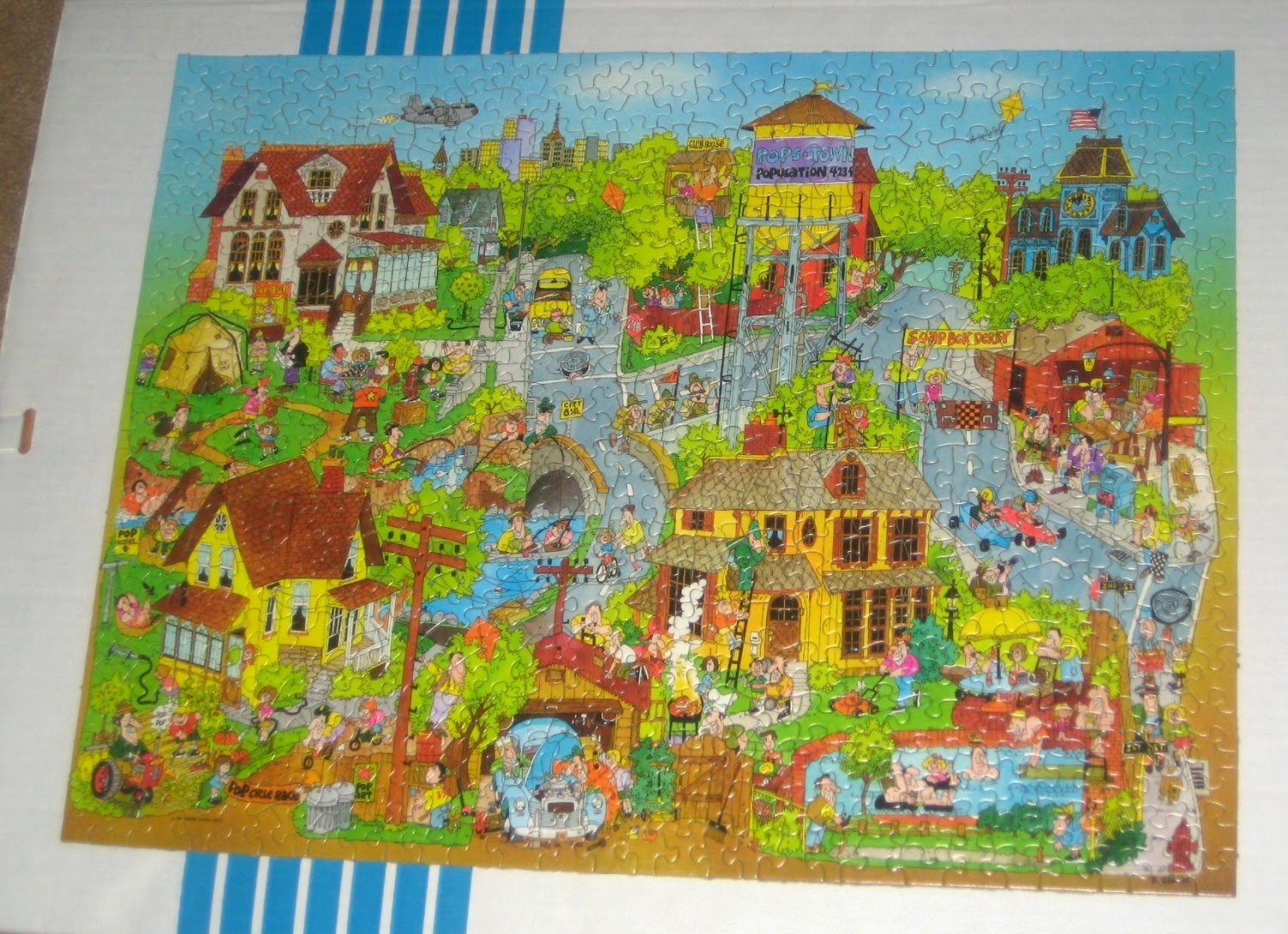
Sometimes I forget how blessed my life is, living as I do in beautiful southern California. There are times when I need to take a break from grumbling that not enough people listen to the Geekerati podcast I do with Shawna Benson, or wondering why no one has spontaneously noticed that I would be perfect as a voice on their latest animated series. Today is one of those times when I remind myself that no matter how challenging and intimidating my life might be I pretty much live in "Pops Town" as depicted in one of the Hallmark puzzles by Robert Blair Martin. A heavily populated version of Pops Town, to be sure, but one none the less. The Los Angeles area can be a scary place if you don't know anyone, but it also happens to be filled with wonderful people who can make this megalopolis feel like it's just the right size.


Let me walk you on a brief tangent about this aspect of L.A. before we get back to the main point of this post...getting you to listen to the Big Bang Theory interviews Shawna and I did on Geekerati.

My wife Jody and I moved down here so that she could attend film school at USC and I could begin pursuing graduate education. We moved to Los Angeles from Reno and we immediately experienced culture shock. Let me tell you, unless you are from a big city it is quite shocking to be surrounded by so many people. The Reno/Sparks Metropolitan Statistical Area has a population of roughly 425,000... or roughly 3 Comic-Cons. The Los Angeles Combined Statistical Area - or as someone who lives in Glendale and commutes to Riverside for my Ph.D. classes calls "L.A." - has roughly 18 million. That's roughly 120 Comic-Cons. That is a lot of people and when Jody and I first moved down here it was mind-boggling. We lived in Crenshaw at the time, and finding any place that wasn't crowded was a quest suitable for 16th level Rangers and not wide eyed newbs from the Sierras. Though we did discover that the "vacant lot" where Elizabeth Short' body was found is a 9 minute walk from the Crenshaw Krispy Kreme.

How crowded is Los Angeles you ask?

There is so much light pollution in the area that Jody and I describe the Los Angeles day as having two parts, "Day and Dim." There is no night, only dim. There are so few stars visible that we wondered why they bothered to maintain the Griffith Observatory, though at the time the Observatory was closed for renovation.

Our first Christmas in Los Angeles, we made the mistake of heading over to Universal City Walk to get a feel of L.A. at Christmas-time. For Jody, who grew up in Nevada City where they have Cornish Christmas/Victorian Christmas every year, venturing into a pseudo-mall that has a Santa hat wearing King Kong as its only acknowledgement of the season was horrifying. It was anti-Christmas for her. There was no snow. There were no Christmas carols. It was 70 degrees. We later learned that the Southland celebrates Christmas - and so many other wonderful celebrations - magnificently, it's only Universal City Walk that is terrible...except at Halloween when it is appropriately horrifying.

For our first year, we were very lonely in a very large place. Then something magical happened. We wandered from our cave and managed to meet some Angelinos. Some where natives, but most - like us - were transplants. Some of them were semi-famous, but most were normal people getting by. I'd like to take a moment to highlight a couple of lynch pin people who have made our day to day lives in L.A. wonderful: Bill Cunningham, Shawna Benson, Wes Kobernick, Joel Allan, Eric Lytle, Luke Y. Thompson, David N. Scott, Julie Scott, Kate Coe, Dale Launer, Scott Kaufer, Caryn Mamrack, Kevin Burke and Nicholas Santillan. These names only scratch the surface of people who have been more than generous with their time and energy to both Jody and me...and are people I can name without feeling like I am "name dropping." I would mention some of the people in my gaming group, but it is my hope that I have been able to do for them what the above people have done for me and Jody.

These people make Los Angeles feel like a very small town. Small in the cozy way and not in the gossipy loss of privacy way.

It is through these people, and some of un-named individuals, that I have had the ability to get some great guests on the Geekerati podcast that Shawna Benson, Bill Cunningham, Wes Kobernick, Eric Lytle, and I started in 2007. Of the many great guests, the "gets" that most surprised me in that I was able to get them at all were writers from the biggest comedy on television...The Big Bang Theory. There are really only three "gets" that I would geek out more over, William Shatner, Bruce Campbell, and Nathan Fillion. I'll add them to my bucket list.

We had Executive Producer David Goetsch on our show in early 2008. In that episode we discussed a number of topics, but I remember one thing fairly distinctly. It was Goetsch's kind tolerance of me telling him that TBBT had better not commit a BOSTON COMMON. For those who don't know, BOSTON COMMON was a sit com starring Anthony Clark who played a geeky hick who is madly in love with much cooler Traylor Howard. Needless to say, they get together in Romantic Comedy fashion at the end of the short - due to it being a mid-season pick up - season. The show was picked up for another season, which apparently made the writers panic because they broke the couple up in order to "recapture the magic." As an aside, Traylor Howard went on to star in TWO GUYS, A GIRL, AND A PIZZA JOINT which starred two geek favorites (Nathan Fillion and Julius Carry), someone geeks love to hate (Ryan Reynolds), and a highly under appreciated comic actor (Richard Ruccolo).

Since its launch, TBBT has been Jody and my favorite modern sit com, it falls somewhere behind FRAZIER and THE DICK VAN DYKE SHOW on the all-time list. Jody has even written a spec screenplay for it, which is a double edged sword for a struggling screenwriter. You've written for what you love, but you don't tend to have people read specs for their own show. This isn't for "IP" reasons. It's more due to the fact that if you don't get the characterization perfect - in the minds of the shows creators - they might be very resistant to your interpretation. This is true even if your screenplay is funny. That's one of the reasons writers submit screenplays for similar shows, or other popular shows. You want to demonstrate you can write in the genre, but you don't want to claim you understand the characters better than the show's creators.

Anyway, enough of the build up. You will find the two episodes we interview TBBT writers embedded below. If you need any proof of the show's geek cred, just think about the fact that they were willing to spend time with a fellow geek to chat for over an hour...twice...and hopefully again.

Interview with David Goetsch


Find Additional Blogcritics Podcasts with Geekerati Radio on BlogTalkRadio

Interview with Maria Ferrari


Online Entertainment Radio at Blog Talk Radio with Geekerati Radio on BlogTalkRadio

Thursday, July 10, 2014

Guardians of the Galaxy in D&D Gamma World: Rocket Raccoon


Like most geeks, I am extremely excited about Guardians of the Galaxy. The latest Marvel Studios film is a brave leap into the lesser known characters of the Marvel-verse. Until Dan Abnett, Keith Giffen, and Andy Lanning's run on Annihilation the Guardians -like Alpha Flight - had been an acquired taste of a small niche of comic book fans. Abnett and Lanning populated the new Guardians with a strange group of characters - otherwise comical characters - and put them in extreme circumstances. Following after Tolkien's model, the Guardians' narrative within Annihilation is that of the "common man." Sure Rocket and Groot are a competent pair, and Drax has been a Marvel heavy hitter in the past, but none of them match the cosmic might of Firelord, Silver Surfer, or Nova.

It made for compelling stuff and now that same band of misfits - and not those who bear the power cosmic - are going to be featured in the upcoming film.

I asked my friends in the Social Network-verse what game system they would use to run a Guardians of the Galaxy campaign and received some very good answers. Some would run it in Hero System, others in Savage Worlds, and still others in Bulldogs!. I am intimately familiar with two of those systems, and almost chose to create statistics in Savage Worlds, but in the end I chose Wizards of the Coasts' excellent D&D Gamma World as my game of choice. As I was thinking how to stat the characters in as simple a fashion as possible, the ideas just leaped out at me. Groot was a "Giant Plant" and that's all I needed to know to stat him. I'll likely attempt a Savage Worlds conversion in the future...and a Marvel Saga and Marvel Heroic as well as purchase a copy of Bulldogs!...but for now, I'm using D&D Gamma World. It should be noted that all characters will be 10th level as most Gamma Supers should be.

My first entry is none other than my twin daughters' - History and Mystery - favorite Guardian...

Monday, July 07, 2014

Dungeons and Dragons: 5th Edition and "Zones of Control"

Back in 2012, I wrote a blog post discussing how every edition of Dungeons & Dragons had miniature use as a part of its default mechanics assumptions.

Let me repeat that in clearer language. Every edition of Dungeons & Dragons is a miniatures based tactical role playing game.

As I wrote in the earlier post, this doesn't mean that those playing without miniatures were "playing the game wrong." I've played in at least one adventure in every edition of D&D and there are plenty of rules my gaming groups have either ignored or added to make our own experience more fun. Here are just a few ways my groups have modified game play:

1) None of the 1st Edition AD&D campaigns I've played in has ever used the Weapon Speed Factors or the Modifications for Armor Class.
2) I've played in 1st Edition games that used "Spell Points" for spell casters.
3) As a Game Master, I've disallowed non-Lawful Good Paladins in 3.x and 4e.
4) I had a DM who used Arduin's Damage System in his AD&D Campaign.
5) I've never used the initiative system from Eldritch Wizardry.
6) I give every race a second wind as a minor action (Dwarves get it as a free action) to speed up play.
7) One campaign I played in had us set our miniatures on the play mat in "Marching Order." No matter the shape of the room our characters were attacked based on that formation in Bard's Tale-esque fashion. We could have been in the center of a room 100' x 100' and all of the melee attacks would have been targeted at either the front row or the back row without anyone attacking our Magic Users in the middle.

Every one of the games I played with these groups was fun and thus none of these groups was playing "wrong." None of these groups played games to the rules as written either. No one - with the exception of organized play - should play to the rules as written. Role playing games are written to be adapted to play for your local gaming group. There are two key elements that allow for this without "breaking" the game. First, there are no winners and losers in D&D. The only way to win is to have fun and changing the rules for your local group is one way to create fun. Some changes are fun for a short time before they create more boredom than fun - in general - so there is room for advice regarding power scaling and Monte Haul campaigns, but the aim is to maximize fun. Second, most role playing games - excepting a couple of innovative Indie games - have a Game Master who moderates the game and who has absolute authority in rules interpretation in the local gaming group. So long as the Game Master is fair and focuses on keeping the game entertaining for the players in his or her group, then what rules are included or left out don't matter much.

Man...that's a lot of prefatory information. You can read the older post to see how each edition of D&D has implemented the use of what are called "Zones of Control" or "ZoCs" in great detail in the older post. The short version is this:

Original Edition (Chainmail): Once engaged in melee a unit was stuck until death or a failed morale check.

Original Edition (Alternate Combat): Not locked in combat, but adds "flanking" rules in Greyhawk Supplement. Swords & Spells supplement adds attacks of opportunity.

D&D Basic (Holmes): Attack of Opportunity against those leaving combat.

D&D Basic (Moldvay): Adds "Defensive Withdrawal" similar to "5 foot move" or "shift" in later editions.

1st Edition AD&D: Attack of Opportunity for withdrawal and Rear Attack Rules (Page 69 & 70 of DMG)


2nd Edition AD&D: Similar to 1st (Pages 81 to 84 of Revised DMG)

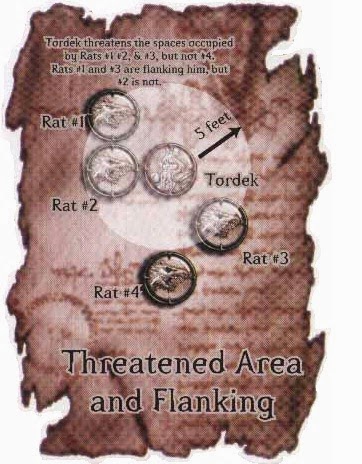
3rd Edition D&D: See image below.


3.5 Edition D&D: See image below.


Pathfinder: See image below.


4th Edition D&D: See image below.


Each of these editions demonstrates the influence of tactical wargames on the combat systems of each edition. It should also be noted that each edition of the game adds new layers of complexity regarding what affects whether you are in a Zone of Control and whether you are flanking an opponent. Pathfinder, 3rd Edition, 3.x, and 4th edition all have creatures with reach that expands their Zones of Control and each of those games has specific rules regarding how conditions influence your ability to flank other combatants. If you read the earlier article and examine the pages of the 1st Edition DMG you will see that there are rules similar to those implemented by later editions, but you will also wish that the earlier edition had created cool graphic representations like those of later editions.

5th edition (in the Basic Rules) takes a big step away from the trend and is even more abstract than the earliest editions of the game with regard to flanking. I would argue that 5th edition is the first edition with takes "no position" with regard to miniatures and carefully crafts descriptions so that combat can be run either way without house rules or dropping rules -- though it does still refer to "squares" from time to time. The new edition still includes Opportunity Attacks - a firm Zone of Control concept - as described on page 74. But instead of listing a specific amount of distance moved as in Moldvay, 1st AD&D, and later editions it merely lists the need to use the "Disengage" action. The Disengage action can be used with a tactical map, but doesn't require one as it is more narrative in its description than the older "Defensive Withdrawal."  The Rogue class on page 27 hints at the flanking rules for 5th edition which does not seem to entail a good deal of examining to see if combatants align properly on opposite sides of an opponent in a way that require illustration. Under Sneak Attack, the Basic rules state that you can deal extra damage if you have advantage OR "if another enemy of the target is within 5 feet of it, that enemy isn't incapacitated, and you don't have disadvantage on the die roll." That's a pretty big shift toward simplicity and away from map use. While it could be argued that the 5 foot rule implies the use of maps, one could easily assume that a creature engaged in melee has an enemy within  feet. If this replaces needing opposite sides for advantage, this is a boon for mapless gaming. It is easily adaptable regardless. So what does this make 5th edition's Zone of Control rules based on the Basic Set?

5th Edition D&D: Attacks of Opportunity (strong ZoC) and potentially with Flanking if another enemy of the target is within 5 feet of it. 

Wednesday, June 18, 2014

Marvel Villains & Vigilantes [Civil War]: Ant-Man

While I am in the process of researching my article on the first edition of Villains & Vigilantes, I thought that I might try to emulate something that the early writers of Different Worlds Magazine did and adapt some Marvel characters to the system. While the article I am researching is the second in my series of reviews of the games in the history of superhero rpgs -- the first can be found here -- discusses the first edition of Villains & Vigilantes, all of the adaptations I make will be for the more commonly available 2nd edition of the game. There are a couple of reasons for this. The first is that the 2nd edition is more widely available on ebay, from FGU, or a "revised revised" edition from Jeff Dee and Jack Herman at Monkey House Games. The second is that the revised edition is an easier game to play than the first edition.

My hope/plan is to emulate the Friends and Foes from the excellent Marvel Heroic Roleplaying Civil War Sourcebook to see how well the V&V system represents the characters in that product. This being the first of the adaptations, I've already notice some major differences in how V&V works versus the mechanics of Marvel Heroic. In this case, the way that Growth works. The Size change power is one of the wonkier powers in V&V because of the way that weight affects hit points and carrying capacity. As adapted, Eric O'Grady would be a pretty effective Solo character against many of the characters published by FGU and Monkey House Games.  If you are wondering, here are the guidelines I used to adapt.


1) As much as possible translated powers on a 1 to 1 basis. If a hero has Energy Blast, then they will get V&V Power Blast. The only exception might be if they have Energy Blast at the d12 level, then I might increase the damage capacity from the base V&V power.

2) For "Enhanced" statistics of up to d8, I give the Heightened "x" power at the "A" level -- +2d10 -- as opposed to the B level which is +3d10. For characters that have d10, they get B, and for those of d12 they get both A and B.

3) Base statistics tend to be in the 10 to 16 range. For example, O'Grady is a covert expert etc. so he has a 16 Agility. Most of his other stats were 10 to 12 before the bonus from powers/training.

4) Specialties are treated as Heightened Expertise and give +4 to the area on attack rolls or "saves" that are related to the expertise. Ant-Man has "Vehicles" expert and so any rolls he makes to drive - Agility Saves most likely - will receive a +4 bonus to his Agility for those purposes.

5) All Heightened Statistics results will be rolled and not selected in order to emulate the way that V&V works.

Those guidelines will be used in all cases. I will minimize my own editorial decisions to add powers or increase them, because Cam and crew did such a good job adapting the characters for Marvel Heroic and I thought it might be nice to be able to play through the campaign they developed with V&V stats.


You can access a PDF of these stats here.

As you can see, O'Grady is kind of a power house. We'll see how he compares to Araña in a future post.


Tuesday, June 17, 2014

Aesop's Fables and Regression Analysis

Who knew that Aesop was a source on the challenges of causal inference? I certainly didn't before reading the tale of THE WOMAN AND THE HEN to my daughters History and Mystery earlier this evening. There are many translations of the tale, but the Barnes & Noble edition that we own has an interesting moral for students of statistics and their utility in researching observational data. Before I reveal that moral, let me give you a quick paraphrase of the tale.

The Woman and the Hen
 
I once heard of a woman who owned a Hen that laid a single egg every day. These eggs were of the highest quality and the woman always received a high price for them when she sold them at the weekly farmer's market. One day, the woman wondered if she might be able to get the Hen to lay two eggs instead of one each day and so collected some observational data regarding the Hen's egg laying habits. She found that by feeding the single hen one ounce of feed a day the Hen would lay one egg. She hypothesized that feeding the chicken two ounces of feed a day would cause the Hen to lay two eggs a day. She tested this hypothesis by feeding the Hen the two ounces of feed for two weeks. In the process of the experiment, the Hen became overweight and stopped laying eggs altogether.
I modified the story the way I did because of the particular translated moral of the Barnes & Noble edition:

Figures are not always facts.

The moral is usually presented as some modification of "don't be greedy," but the formulation in my edition got me thinking about observational data and how collinearity can lead to bad inferences.

In the case of our woman, she sets forth to rigorously measure some observational data regarding her Hen's laying habits and finds collects the following information every day:

Hen = 1
Food = 1
Egg =1

From this information, she clearly imagines that the relationship is something like the following.

Egg = B1 + B(Food)

Instead of immediately seeing the collinearity problem in her data - because she didn't have STATA, R, or SPSS - she assumes that her B1 value is 0 and that the independent variable is food. If she was a little craftier, she might have decided that the relationship is something akin to:

Egg = B1 + B(Food) + B(Chicken)

Which is probably a better hypothesis as far as an overall model goes, but one which still suffers problems of collinearity. She should have noticed this trend almost immediately since there was zero variation in her data. Which brings us to the central problem here and that is the N of her observation pool. One cannot make generalizable statements from a single case. This is often what people mean when they say pithily that "data isn't the plural of anecdote." As smart as that sounds, it can actually be a very wrong statement because in opinion data with a sufficiently large sample that is randomly selected that is seeking to understand what people believe, the plural of anecdote is in fact data. 

For detailed discussions of Verbal Reports as Data, you can read Ericsson's paper. Suffice to say that anecdotes can be data if they are in a properly structured and controlled experiment or rigorously designed survey instrument. 

All of which is kind of beside the point of our tale, as the woman's problem is with pure observational data using a single subject in a very controlled fashion. The problems here are collinearity, lack of variation, and a small N. Even given the small N, if we had some variation in production and food given we could make a sound hypothesis for this one Hen.  Let's create a STATA do file that gives us this variation.

set obs 100
gen chicken=.
gen eggs=.
gen food=.
replace chicken=1
replace eggs=1
replace food=1
replace eggs = 2 if _n >10 & _n < 35
replace food = 2 if _n >=20
replace eggs = 0 if _n > 55
replace food = 0 if _n >74
regress eggs food chicken

This gives us the following result with Chicken removed due to collinearity. 

Here we can see that the amount of food does have an impact on egg production, but this would be based on observational data that the woman did not have for her Hen. It should be noted that the above information also tells us that if we don't feed the Hen at all, we will still produce .29 of an egg a day. All of which leads us to the same conclusion as Aesop that observational data can be misleading, even when statistically significant and where there visually appears to be a relationship.


This was probably the nerdiest post I've ever written, and it is filled with some holes as the model really could be refined to be much better as could the do file, but it all points to the same moral.

Be careful to have a good theory when designing statistical models. Excluded variables can matter, as can a lack of variation in the data. The woman would have been better served getting two Hens, or by varying the amount of food in a way that was rigorously experimental and not based on a single treatment. So my additional Aesop moral is:

Replication if Vital.