Friday, July 25, 2014

Chatting with The Big Bang Theory Screenwriters on Geekerati

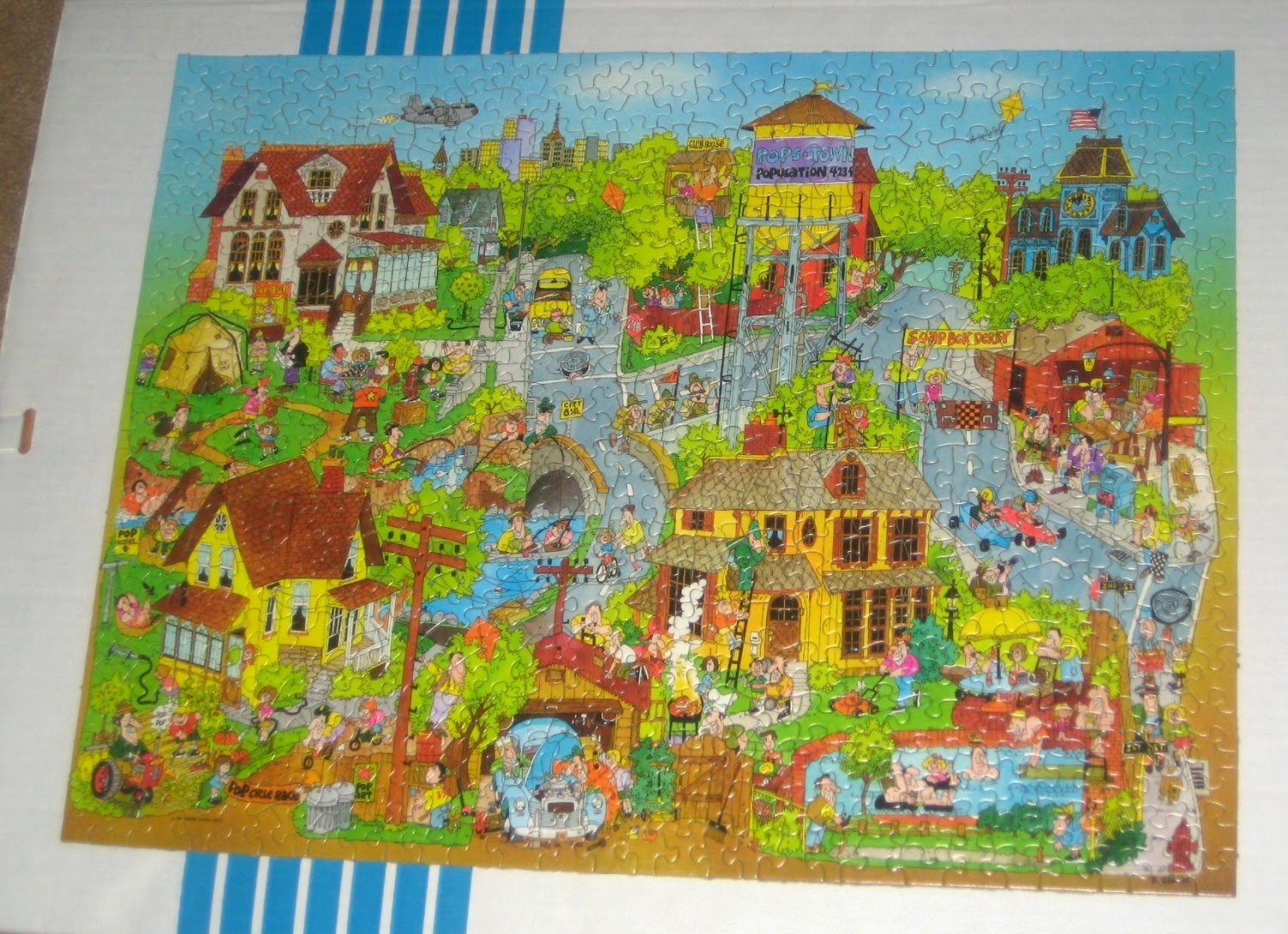
Sometimes I forget how blessed my life is, living as I do in beautiful southern California. There are times when I need to take a break from grumbling that not enough people listen to the Geekerati podcast I do with Shawna Benson, or wondering why no one has spontaneously noticed that I would be perfect as a voice on their latest animated series. Today is one of those times when I remind myself that no matter how challenging and intimidating my life might be I pretty much live in "Pops Town" as depicted in one of the Hallmark puzzles by Robert Blair Martin. A heavily populated version of Pops Town, to be sure, but one none the less. The Los Angeles area can be a scary place if you don't know anyone, but it also happens to be filled with wonderful people who can make this megalopolis feel like it's just the right size.


Let me walk you on a brief tangent about this aspect of L.A. before we get back to the main point of this post...getting you to listen to the Big Bang Theory interviews Shawna and I did on Geekerati.

My wife Jody and I moved down here so that she could attend film school at USC and I could begin pursuing graduate education. We moved to Los Angeles from Reno and we immediately experienced culture shock. Let me tell you, unless you are from a big city it is quite shocking to be surrounded by so many people. The Reno/Sparks Metropolitan Statistical Area has a population of roughly 425,000... or roughly 3 Comic-Cons. The Los Angeles Combined Statistical Area - or as someone who lives in Glendale and commutes to Riverside for my Ph.D. classes calls "L.A." - has roughly 18 million. That's roughly 120 Comic-Cons. That is a lot of people and when Jody and I first moved down here it was mind-boggling. We lived in Crenshaw at the time, and finding any place that wasn't crowded was a quest suitable for 16th level Rangers and not wide eyed newbs from the Sierras. Though we did discover that the "vacant lot" where Elizabeth Short' body was found is a 9 minute walk from the Crenshaw Krispy Kreme.

How crowded is Los Angeles you ask?

There is so much light pollution in the area that Jody and I describe the Los Angeles day as having two parts, "Day and Dim." There is no night, only dim. There are so few stars visible that we wondered why they bothered to maintain the Griffith Observatory, though at the time the Observatory was closed for renovation.

Our first Christmas in Los Angeles, we made the mistake of heading over to Universal City Walk to get a feel of L.A. at Christmas-time. For Jody, who grew up in Nevada City where they have Cornish Christmas/Victorian Christmas every year, venturing into a pseudo-mall that has a Santa hat wearing King Kong as its only acknowledgement of the season was horrifying. It was anti-Christmas for her. There was no snow. There were no Christmas carols. It was 70 degrees. We later learned that the Southland celebrates Christmas - and so many other wonderful celebrations - magnificently, it's only Universal City Walk that is terrible...except at Halloween when it is appropriately horrifying.

For our first year, we were very lonely in a very large place. Then something magical happened. We wandered from our cave and managed to meet some Angelinos. Some where natives, but most - like us - were transplants. Some of them were semi-famous, but most were normal people getting by. I'd like to take a moment to highlight a couple of lynch pin people who have made our day to day lives in L.A. wonderful: Bill Cunningham, Shawna Benson, Wes Kobernick, Joel Allan, Eric Lytle, Luke Y. Thompson, David N. Scott, Julie Scott, Kate Coe, Dale Launer, Scott Kaufer, Caryn Mamrack, Kevin Burke and Nicholas Santillan. These names only scratch the surface of people who have been more than generous with their time and energy to both Jody and me...and are people I can name without feeling like I am "name dropping." I would mention some of the people in my gaming group, but it is my hope that I have been able to do for them what the above people have done for me and Jody.

These people make Los Angeles feel like a very small town. Small in the cozy way and not in the gossipy loss of privacy way.

It is through these people, and some of un-named individuals, that I have had the ability to get some great guests on the Geekerati podcast that Shawna Benson, Bill Cunningham, Wes Kobernick, Eric Lytle, and I started in 2007. Of the many great guests, the "gets" that most surprised me in that I was able to get them at all were writers from the biggest comedy on television...The Big Bang Theory. There are really only three "gets" that I would geek out more over, William Shatner, Bruce Campbell, and Nathan Fillion. I'll add them to my bucket list.

We had Executive Producer David Goetsch on our show in early 2008. In that episode we discussed a number of topics, but I remember one thing fairly distinctly. It was Goetsch's kind tolerance of me telling him that TBBT had better not commit a BOSTON COMMON. For those who don't know, BOSTON COMMON was a sit com starring Anthony Clark who played a geeky hick who is madly in love with much cooler Traylor Howard. Needless to say, they get together in Romantic Comedy fashion at the end of the short - due to it being a mid-season pick up - season. The show was picked up for another season, which apparently made the writers panic because they broke the couple up in order to "recapture the magic." As an aside, Traylor Howard went on to star in TWO GUYS, A GIRL, AND A PIZZA JOINT which starred two geek favorites (Nathan Fillion and Julius Carry), someone geeks love to hate (Ryan Reynolds), and a highly under appreciated comic actor (Richard Ruccolo).

Since its launch, TBBT has been Jody and my favorite modern sit com, it falls somewhere behind FRAZIER and THE DICK VAN DYKE SHOW on the all-time list. Jody has even written a spec screenplay for it, which is a double edged sword for a struggling screenwriter. You've written for what you love, but you don't tend to have people read specs for their own show. This isn't for "IP" reasons. It's more due to the fact that if you don't get the characterization perfect - in the minds of the shows creators - they might be very resistant to your interpretation. This is true even if your screenplay is funny. That's one of the reasons writers submit screenplays for similar shows, or other popular shows. You want to demonstrate you can write in the genre, but you don't want to claim you understand the characters better than the show's creators.

Anyway, enough of the build up. You will find the two episodes we interview TBBT writers embedded below. If you need any proof of the show's geek cred, just think about the fact that they were willing to spend time with a fellow geek to chat for over an hour...twice...and hopefully again.

Interview with David Goetsch


Find Additional Blogcritics Podcasts with Geekerati Radio on BlogTalkRadio

Interview with Maria Ferrari


Online Entertainment Radio at Blog Talk Radio with Geekerati Radio on BlogTalkRadio

Thursday, July 10, 2014

Guardians of the Galaxy in D&D Gamma World: Rocket Raccoon


Like most geeks, I am extremely excited about Guardians of the Galaxy. The latest Marvel Studios film is a brave leap into the lesser known characters of the Marvel-verse. Until Dan Abnett, Keith Giffen, and Andy Lanning's run on Annihilation the Guardians -like Alpha Flight - had been an acquired taste of a small niche of comic book fans. Abnett and Lanning populated the new Guardians with a strange group of characters - otherwise comical characters - and put them in extreme circumstances. Following after Tolkien's model, the Guardians' narrative within Annihilation is that of the "common man." Sure Rocket and Groot are a competent pair, and Drax has been a Marvel heavy hitter in the past, but none of them match the cosmic might of Firelord, Silver Surfer, or Nova.

It made for compelling stuff and now that same band of misfits - and not those who bear the power cosmic - are going to be featured in the upcoming film.

I asked my friends in the Social Network-verse what game system they would use to run a Guardians of the Galaxy campaign and received some very good answers. Some would run it in Hero System, others in Savage Worlds, and still others in Bulldogs!. I am intimately familiar with two of those systems, and almost chose to create statistics in Savage Worlds, but in the end I chose Wizards of the Coasts' excellent D&D Gamma World as my game of choice. As I was thinking how to stat the characters in as simple a fashion as possible, the ideas just leaped out at me. Groot was a "Giant Plant" and that's all I needed to know to stat him. I'll likely attempt a Savage Worlds conversion in the future...and a Marvel Saga and Marvel Heroic as well as purchase a copy of Bulldogs!...but for now, I'm using D&D Gamma World. It should be noted that all characters will be 10th level as most Gamma Supers should be.

My first entry is none other than my twin daughters' - History and Mystery - favorite Guardian...

Monday, July 07, 2014

Dungeons and Dragons: 5th Edition and "Zones of Control"

Back in 2012, I wrote a blog post discussing how every edition of Dungeons & Dragons had miniature use as a part of its default mechanics assumptions.

Let me repeat that in clearer language. Every edition of Dungeons & Dragons is a miniatures based tactical role playing game.

As I wrote in the earlier post, this doesn't mean that those playing without miniatures were "playing the game wrong." I've played in at least one adventure in every edition of D&D and there are plenty of rules my gaming groups have either ignored or added to make our own experience more fun. Here are just a few ways my groups have modified game play:

1) None of the 1st Edition AD&D campaigns I've played in has ever used the Weapon Speed Factors or the Modifications for Armor Class.
2) I've played in 1st Edition games that used "Spell Points" for spell casters.
3) As a Game Master, I've disallowed non-Lawful Good Paladins in 3.x and 4e.
4) I had a DM who used Arduin's Damage System in his AD&D Campaign.
5) I've never used the initiative system from Eldritch Wizardry.
6) I give every race a second wind as a minor action (Dwarves get it as a free action) to speed up play.
7) One campaign I played in had us set our miniatures on the play mat in "Marching Order." No matter the shape of the room our characters were attacked based on that formation in Bard's Tale-esque fashion. We could have been in the center of a room 100' x 100' and all of the melee attacks would have been targeted at either the front row or the back row without anyone attacking our Magic Users in the middle.

Every one of the games I played with these groups was fun and thus none of these groups was playing "wrong." None of these groups played games to the rules as written either. No one - with the exception of organized play - should play to the rules as written. Role playing games are written to be adapted to play for your local gaming group. There are two key elements that allow for this without "breaking" the game. First, there are no winners and losers in D&D. The only way to win is to have fun and changing the rules for your local group is one way to create fun. Some changes are fun for a short time before they create more boredom than fun - in general - so there is room for advice regarding power scaling and Monte Haul campaigns, but the aim is to maximize fun. Second, most role playing games - excepting a couple of innovative Indie games - have a Game Master who moderates the game and who has absolute authority in rules interpretation in the local gaming group. So long as the Game Master is fair and focuses on keeping the game entertaining for the players in his or her group, then what rules are included or left out don't matter much.

Man...that's a lot of prefatory information. You can read the older post to see how each edition of D&D has implemented the use of what are called "Zones of Control" or "ZoCs" in great detail in the older post. The short version is this:

Original Edition (Chainmail): Once engaged in melee a unit was stuck until death or a failed morale check.

Original Edition (Alternate Combat): Not locked in combat, but adds "flanking" rules in Greyhawk Supplement. Swords & Spells supplement adds attacks of opportunity.

D&D Basic (Holmes): Attack of Opportunity against those leaving combat.

D&D Basic (Moldvay): Adds "Defensive Withdrawal" similar to "5 foot move" or "shift" in later editions.

1st Edition AD&D: Attack of Opportunity for withdrawal and Rear Attack Rules (Page 69 & 70 of DMG)


2nd Edition AD&D: Similar to 1st (Pages 81 to 84 of Revised DMG)

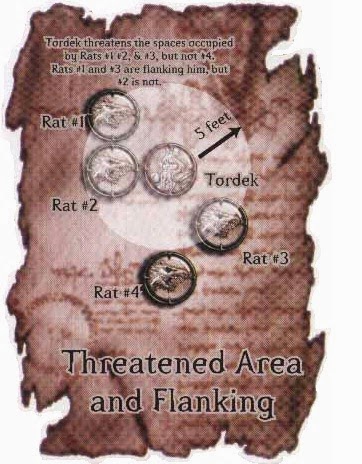
3rd Edition D&D: See image below.


3.5 Edition D&D: See image below.


Pathfinder: See image below.


4th Edition D&D: See image below.


Each of these editions demonstrates the influence of tactical wargames on the combat systems of each edition. It should also be noted that each edition of the game adds new layers of complexity regarding what affects whether you are in a Zone of Control and whether you are flanking an opponent. Pathfinder, 3rd Edition, 3.x, and 4th edition all have creatures with reach that expands their Zones of Control and each of those games has specific rules regarding how conditions influence your ability to flank other combatants. If you read the earlier article and examine the pages of the 1st Edition DMG you will see that there are rules similar to those implemented by later editions, but you will also wish that the earlier edition had created cool graphic representations like those of later editions.

5th edition (in the Basic Rules) takes a big step away from the trend and is even more abstract than the earliest editions of the game with regard to flanking. I would argue that 5th edition is the first edition with takes "no position" with regard to miniatures and carefully crafts descriptions so that combat can be run either way without house rules or dropping rules -- though it does still refer to "squares" from time to time. The new edition still includes Opportunity Attacks - a firm Zone of Control concept - as described on page 74. But instead of listing a specific amount of distance moved as in Moldvay, 1st AD&D, and later editions it merely lists the need to use the "Disengage" action. The Disengage action can be used with a tactical map, but doesn't require one as it is more narrative in its description than the older "Defensive Withdrawal."  The Rogue class on page 27 hints at the flanking rules for 5th edition which does not seem to entail a good deal of examining to see if combatants align properly on opposite sides of an opponent in a way that require illustration. Under Sneak Attack, the Basic rules state that you can deal extra damage if you have advantage OR "if another enemy of the target is within 5 feet of it, that enemy isn't incapacitated, and you don't have disadvantage on the die roll." That's a pretty big shift toward simplicity and away from map use. While it could be argued that the 5 foot rule implies the use of maps, one could easily assume that a creature engaged in melee has an enemy within  feet. If this replaces needing opposite sides for advantage, this is a boon for mapless gaming. It is easily adaptable regardless. So what does this make 5th edition's Zone of Control rules based on the Basic Set?

5th Edition D&D: Attacks of Opportunity (strong ZoC) and potentially with Flanking if another enemy of the target is within 5 feet of it. 

Wednesday, June 18, 2014

Marvel Villains & Vigilantes [Civil War]: Ant-Man

While I am in the process of researching my article on the first edition of Villains & Vigilantes, I thought that I might try to emulate something that the early writers of Different Worlds Magazine did and adapt some Marvel characters to the system. While the article I am researching is the second in my series of reviews of the games in the history of superhero rpgs -- the first can be found here -- discusses the first edition of Villains & Vigilantes, all of the adaptations I make will be for the more commonly available 2nd edition of the game. There are a couple of reasons for this. The first is that the 2nd edition is more widely available on ebay, from FGU, or a "revised revised" edition from Jeff Dee and Jack Herman at Monkey House Games. The second is that the revised edition is an easier game to play than the first edition.

My hope/plan is to emulate the Friends and Foes from the excellent Marvel Heroic Roleplaying Civil War Sourcebook to see how well the V&V system represents the characters in that product. This being the first of the adaptations, I've already notice some major differences in how V&V works versus the mechanics of Marvel Heroic. In this case, the way that Growth works. The Size change power is one of the wonkier powers in V&V because of the way that weight affects hit points and carrying capacity. As adapted, Eric O'Grady would be a pretty effective Solo character against many of the characters published by FGU and Monkey House Games.  If you are wondering, here are the guidelines I used to adapt.


1) As much as possible translated powers on a 1 to 1 basis. If a hero has Energy Blast, then they will get V&V Power Blast. The only exception might be if they have Energy Blast at the d12 level, then I might increase the damage capacity from the base V&V power.

2) For "Enhanced" statistics of up to d8, I give the Heightened "x" power at the "A" level -- +2d10 -- as opposed to the B level which is +3d10. For characters that have d10, they get B, and for those of d12 they get both A and B.

3) Base statistics tend to be in the 10 to 16 range. For example, O'Grady is a covert expert etc. so he has a 16 Agility. Most of his other stats were 10 to 12 before the bonus from powers/training.

4) Specialties are treated as Heightened Expertise and give +4 to the area on attack rolls or "saves" that are related to the expertise. Ant-Man has "Vehicles" expert and so any rolls he makes to drive - Agility Saves most likely - will receive a +4 bonus to his Agility for those purposes.

5) All Heightened Statistics results will be rolled and not selected in order to emulate the way that V&V works.

Those guidelines will be used in all cases. I will minimize my own editorial decisions to add powers or increase them, because Cam and crew did such a good job adapting the characters for Marvel Heroic and I thought it might be nice to be able to play through the campaign they developed with V&V stats.


You can access a PDF of these stats here.

As you can see, O'Grady is kind of a power house. We'll see how he compares to Araña in a future post.


Tuesday, June 17, 2014

Aesop's Fables and Regression Analysis

Who knew that Aesop was a source on the challenges of causal inference? I certainly didn't before reading the tale of THE WOMAN AND THE HEN to my daughters History and Mystery earlier this evening. There are many translations of the tale, but the Barnes & Noble edition that we own has an interesting moral for students of statistics and their utility in researching observational data. Before I reveal that moral, let me give you a quick paraphrase of the tale.

The Woman and the Hen
 
I once heard of a woman who owned a Hen that laid a single egg every day. These eggs were of the highest quality and the woman always received a high price for them when she sold them at the weekly farmer's market. One day, the woman wondered if she might be able to get the Hen to lay two eggs instead of one each day and so collected some observational data regarding the Hen's egg laying habits. She found that by feeding the single hen one ounce of feed a day the Hen would lay one egg. She hypothesized that feeding the chicken two ounces of feed a day would cause the Hen to lay two eggs a day. She tested this hypothesis by feeding the Hen the two ounces of feed for two weeks. In the process of the experiment, the Hen became overweight and stopped laying eggs altogether.
I modified the story the way I did because of the particular translated moral of the Barnes & Noble edition:

Figures are not always facts.

The moral is usually presented as some modification of "don't be greedy," but the formulation in my edition got me thinking about observational data and how collinearity can lead to bad inferences.

In the case of our woman, she sets forth to rigorously measure some observational data regarding her Hen's laying habits and finds collects the following information every day:

Hen = 1
Food = 1
Egg =1

From this information, she clearly imagines that the relationship is something like the following.

Egg = B1 + B(Food)

Instead of immediately seeing the collinearity problem in her data - because she didn't have STATA, R, or SPSS - she assumes that her B1 value is 0 and that the independent variable is food. If she was a little craftier, she might have decided that the relationship is something akin to:

Egg = B1 + B(Food) + B(Chicken)

Which is probably a better hypothesis as far as an overall model goes, but one which still suffers problems of collinearity. She should have noticed this trend almost immediately since there was zero variation in her data. Which brings us to the central problem here and that is the N of her observation pool. One cannot make generalizable statements from a single case. This is often what people mean when they say pithily that "data isn't the plural of anecdote." As smart as that sounds, it can actually be a very wrong statement because in opinion data with a sufficiently large sample that is randomly selected that is seeking to understand what people believe, the plural of anecdote is in fact data. 

For detailed discussions of Verbal Reports as Data, you can read Ericsson's paper. Suffice to say that anecdotes can be data if they are in a properly structured and controlled experiment or rigorously designed survey instrument. 

All of which is kind of beside the point of our tale, as the woman's problem is with pure observational data using a single subject in a very controlled fashion. The problems here are collinearity, lack of variation, and a small N. Even given the small N, if we had some variation in production and food given we could make a sound hypothesis for this one Hen.  Let's create a STATA do file that gives us this variation.

set obs 100
gen chicken=.
gen eggs=.
gen food=.
replace chicken=1
replace eggs=1
replace food=1
replace eggs = 2 if _n >10 & _n < 35
replace food = 2 if _n >=20
replace eggs = 0 if _n > 55
replace food = 0 if _n >74
regress eggs food chicken

This gives us the following result with Chicken removed due to collinearity. 

Here we can see that the amount of food does have an impact on egg production, but this would be based on observational data that the woman did not have for her Hen. It should be noted that the above information also tells us that if we don't feed the Hen at all, we will still produce .29 of an egg a day. All of which leads us to the same conclusion as Aesop that observational data can be misleading, even when statistically significant and where there visually appears to be a relationship.


This was probably the nerdiest post I've ever written, and it is filled with some holes as the model really could be refined to be much better as could the do file, but it all points to the same moral.

Be careful to have a good theory when designing statistical models. Excluded variables can matter, as can a lack of variation in the data. The woman would have been better served getting two Hens, or by varying the amount of food in a way that was rigorously experimental and not based on a single treatment. So my additional Aesop moral is:

Replication if Vital.

Tuesday, June 10, 2014

A History of Superhero RPGs Game by Game (Part 1): Superhero 2044

Some material in this post was originally published in June of 2010. Since that time, the excellent Age of Ravens blog has written a series on the History of Superhero RPGs that gives brief synopses of these games through the ages and James Maliszewski has published an essay by Superhero 2044 creator Donald Saxman. The Saxman essay, along with my June 2010 post, were included as additional materials in the 2010 reprint edition of Superhero 2044.

As you will read in the discussion below, I  was nicely surprised by Superhero: 2044.  It is a clear demonstration of the wild creativity of the early RPG community, but also an example of how hard it is to create games in a chaotic environment. This series will attempt to review and discuss most of the major superhero roleplaying games, and a couple of key supplements, that have been published. Given that I own the vast majority - though sadly not all - of the superhero games that have been published to date, this should be a fun exercise. I will be blogging about the games in the order they were published, so Villains and Vigilantes (1st Edition) and Supergame will be the next games in this series. 


According to Heroic Worlds by Lawrence Schick and Steve Perrin in Different Worlds #23, Superhero 2044 by Donald Saxman is the first commercially available superhero themed role playing game. Saxman's game was publishedin 1977 under the name Superhero '44. The game wasn't entitled Superhero 2044 until the game's second edition, when it was by Lou Zocchi's Gamescience Inc. later that same year. While I am a huge fan of super hero role playing games, and a student of the history of rpgs, this game sat on my bookshelf for years without a complete reading. Its lack of a list of itemized superpowers, and the mechanics of how they worked, was one of the key reasons that the game languished for so long on my shelf without a thorough examination. Apparently, Donald Saxman intentionally left a formal list of superpowers out of the book in order to respect the copyrights of various comic book publishers -- though that didn't stop artist Mike Cagle from providing a cover illustration filled with characters who bear an uncanny similarity to many popular comic book characters.


Donald Saxman was inspired to create Superhero 2044 when he was a player in a D&D campaign run by science fiction and fantasy author John M. Ford.  Ford's game featured an adventure in which, "the party of magicians and swordsmen met Batman and Doc Savage, and ultimately fought Doctor Doom and Darkseid with the help of Luke Cage and the Phantom Stranger." From that short bit of description of Ford's campaign from the Superhero 2044 rulebook, one can see how this kind of high concept mashup could inspire players to design all kinds of things. With the help of his friends, and nearly two years of design and playtesting, Donald Saxman created the Superhero 2044 role playing game. While Lawrence Schick states that the game was influenced by D&D in Different Worlds, a close reading of the game shows that few if any of those influences were mechanical. Saxman writes that one of his chief influences was GDW's early rpg En Garde and that he made a conscious effort to avoid being influenced by D&D.

The Game

Superhero 2044 begins with a description of the game universe. The majority of game play will take place on the island of Inguria, a city that is kind of a cross between Macross City and the future cities of the Legion of Superheroes. There are a number of creative influences on exhibition here and the combination results in one of the game's biggest assets, a rich world in which to play.

Like many games being released around the same time, Superhero 2044 features a point based character build system where players have 140 points to spend on a number of character attributes (Vigor, Stamina, Endurance, Mentality, Charisma, Ego, and Dexterity). While some of these attributes share similar names, they do have different functions and one- Stamina - would have benefited from a different name as it represents hand-to-hand fighting ability and overall physical capability. Players also ten pick one of three archetypes (Ubermensch, Toolmaster, and Unique), each of which modifies starting attributes accordingly.

While there are no "strict" minimum values to the stats, there are effective minimums in order to avoid penalties. One requires a minimum of 20 Endurance, 11 Vigor, and 6 Dexterity in order to function at a normal level. Given that the Toolmaster starts with -10 points to the starting value of Endurance, a player would have to spend 30 points on Endurance to avoid penalties. It might have been better to have the statistics start at base values and allow players to buy them down if they want to represent some disadvantage. One could, for example, have started characters with those minimum statistics and only 103 statistic points. One might also have created more uniform base values for the statistics. All three of these concepts quickly enter into superhero rpg design, for point based systems anyway. Once the points are spent, the players are allowed 50 bonus points to add to one of these in special circumstances in order to emulate some power. The example given is 50 extra Endurance vs. Bullets and some recommendations are made to base super powers on weapons and gadgets contained in the game.

Though there is a point based system for the purchase of attributes, there is no such system for super powers. Donald Saxman had intended to write three books for he Superhero 2044 system in which one of the later books would provide such a system, but those books were never published. This doesn't mean that no power design rules were ever published. Wayne Shaw - who I interviewed on the Geekerati podcast - wrote an extensive super power design rules set in Niall Shapero's excellent The Lords of Chaos fanzine and Shaw offers some ideas in the insert to the 2010 reprint of the game.


Because of the lack of a super power design system, the game sat on my shelf for some time. When I did read the book, I found it to be much better than I expected. While I would argue that without Wayne Shaw's additions in The Lords of Chaos issue 8 the game would be challenging to run,without Superhero 2044 modern super hero role playing would not be what it is today.  The game had a significant influence on the super hero games that came after Superhero 2044 and if it hadn't been written there would be no Champions, Supergame, or Golden Heroes. Each of those super hero games lifts a concept out of Superhero 2044 and structures a game around that concept.

Superhero 2044 is more than the first super hero role playing game, it is the foundation upon which many games followed.

As I mentioned earlier, it was the first superhero game to include point based character construction. Though the point expenditure was limited to the building of a character's "attributes" and were not a part of "power design." This innovation, and at the time of Superhero 2044 this was a significant innovation, is one of the major design starting points for a number of super hero role playing games -- not the least of which is the Champions game. The Champions first edition rule book mentions the influence that Wayne Shaw's character creation rules had on the game's early design, but the influence Superhero 2044 had on Champions reached beyond the character design system.

Influence on Champions' Combat System

In addition to being inspired by the point based character design of Superhero 2044 it is evident that Champions melee combat system was influenced by Donald Saxman's game as well.

In Champions combat is resolved by taking a character's "Offensive Combat Value" and subtracting an opponent's "Defensive Combat Value." The result of that subtraction is then added to 11 to find the number required to hit an opponent on a roll of 3 six-sided dice. Champions combat system is one of the best on the market and the fact that it uses a comparison of combatant's effectiveness, and a bell curve resolution system, are among its chief strengths.

In Superhero 2044, you take a character's "Stamina" and subtract his opponents "Stamina." The difference between these two numbers is compared to the Universal Combat Matrix which gives you a number between 3 and 18 that the character must roll on 3 six-sided dice to determine if the character hit his opponent. It should be noted that this combat system is only used for "melee" combat in Superhero 2044, where it forms the foundation of Champions combat.

The Champions version is more elegant, as the result of the initial comparison is the modifier to the 3d6 roll, but it is the same system. It is as if the designers of Champions playtested and refined the Superhero 2044 melee combat system. Champions combat has some significant differences overall to Superhero 2044, but one can see that one echoes the other.

Influence on Supergame

Like Champions, Supergame was influenced by Superhero 2044's point based character generation system. Given its own 1980 design date, and the fact that it was a part of "California Gaming Culture," might hint that Supergame itself also influenced Champions. One sees the underpinnings of Superhero 2044 is in the purchase of a character's starting attributes.

Both systems feature something that many modern gamers might consider odd. All of a character's attributes start at zero and can be increased -- this itself isn't odd to the modern gamer. What is odd is that both games have attribute levels where the character is suffering from a disability. In Superhero 2044, if a character has an Endurance of less than 20 that character is "fatigued" or worse. In Supergame, a character with an "Agony Score" of less than 15 "may either move or attack, but only one per turn." There are similar penalties for "Vigor" in Superhero 2044 and "Physical Score" in Supergame. The names of the attributes and the level of effect are different, but one can see the similarities. Most modern systems would start a character with a base number of points sufficient to not be fatigued or incapacitated, but both Superhero 2044 and Supergame allow for the possibility.

But it isn't the point based character design where Supergame bears the most similarity to its predecessor. Supergame includes rules for building specific powers -- though not as robust the later published Champions -- that are themselves an innovation over the state of gaming at that time and a step beyond what were offered in Superhero 2044.

The area where Supergame most reflects Superhero 2044 is in its ranged combat system. In Superhero 2044, ranged combat is decided by rolling a six sided die and adding/subtracting to the die total applicable modifiers. This sets the target number that must be rolled, or higher, on a second roll of a six sided die. For example a character with a 20 Dexterity (-1) shooting an opponent at point blank range (-3) with a shoulder weapon (-1) rolls a 6 on a six sided die. This gives a modified result of 1 (6-1-3-1=1) and means that the character hits if the player rolls a 1 or better on the second roll. This system, with some differences in modifier values, is the system used in Supergame.


Influence on Golden Heroes

While I was intrigued by the way that Superhero 2044 influenced the design of American super hero role playing games, I was amazed at how it had influenced a British one. In White Dwarf magazine issue 9, game designer Eamon Bloomfield reviewed Superhero 44 -- Superhero 2044's first edition -- and wrote the following:

"Each character fills out a weekly planning sheet indicating whether he is patrolling, resting, training, or researching. This...show[s] how many crimes of what type he's stopped this week and at what damage to himself; without actually having to play the event...Overall good fun and realistic and a welcome addition to any role playing fan's collection. Certainly as a postal game it has a great future."

The weekly planning sheet is one of the most intriguing aspects of the Superhero 2044 game and the most playable aspect "out of the box."  The game includes weekly planning sheets that provide a number of "activity blocks" to which players assign particular tasks, like fighting crime or resting. Golden Heroes, Games Workshop's super hero role playing game, featured a campaign system that bears no small similarities to that of Superhero 2044. Games Workshop was, and still is, the publisher of White Dwarf magazine and so it is easy to believe that this game review sparked some discussion of "planning sheet" style campaign play.

Golden Heroes features a campaign system that heavily relies on something very similar to Superhero 2044's weekly planning sheet. They have a system that uses something called a "Daily Utility Phase" or DUPs. The game describes them as follows:

The scenarios played in each week occupy a certain number of DUPs for the characters involved. Any remaining DUPs can be devoted to other pursuits such as training, improving powers, developing scientific gadgets, etc.

Thus at the end of each scenario, you must inform the players how many spare DUPs their characters have. Preferably then, or at worst at the start of the next game session, the players must tell you how their characters have spent those DUPs.

The player's allocation of DUPs is compared to various campaign ratings, something vary similar to what Superhero 2044 calls "handicaps," in order to determine what events happen to the character and how much the character is able to improve over time. Both systems are dynamic and change as characters interact with the game world. The Golden Heroes system is more developed and is a part of a more complete system of mechanics, but it is unarguably a descendant of the Superhero 2044 system.

Closing Remarks

I wish I had read Superhero 2044 much sooner than I did. It is a definite diamond in the rough. While it would be difficult to play RAW, it has a large number of innovative mechanics and ideas. The fact that it contains enough ideas to influence no fewer than THREE super hero role playing games in their design is a significant achievement in and of itself. One cannot truly understand the development of the hobby without reading this game.

I think I will try to play the game itself soon, though I don't know if I will try to design a comprehensive powers system or use an existing one to supplement the game, as the campaign play system still stands out as something that has some depth and would be useful in a number of games. Given the abstract nature of the campaign planning system, one could easily adapt it to another game for use.

The game also features a detailed setting for super hero play. The setting lacks the microscopic detail of modern settings, but for the time the game was written it is quite intricate. Like the game itself, its setting is one that inspires addition and extension rather than provides a complete painting.

Donald Saxman has created something pretty special here and I'd love to see someone take this system and make a modern edition out of it. It would take some work, but it would be worth it.

It would be a dream come true for me if both Wayne Shaw and Donald Saxman would agree to work with me to run a Kickstarter of Superhero 2044 Second Edition that incorporates some of Shaw's changes while keeping the basic system as is. Such an endeavor would be a truly OSR adventure and one that I think would be worth exploring. What would a more developed version of the game look like? I hope we get to find out.

Monday, April 14, 2014

The Tiger, The Princess, Monty Hall, and Probability

Every now and then I encounter a book that changes the way I think about the world. Sometimes a book has one insight and sometimes it has several. In the case of Daniel Kahneman's Thinking, Fast and Slow, I've lost count of the ways it has forced me to re-evaluate my perceptions. This is partly because the book covers a wide terrain of psychology and partly because it presents so many interesting observations. One of my many take aways from the book was how we don't think intuitively about statistics. Let me restate that in a paraphrase, while our mind is great at seeing patterns in nature (even sometimes when they are not there) our mind is not great at seeing the patterns that underlie probabilities and statistics.

This is an important observation for game design and game play. We've all seen the player who has rolled several low scores on to hit rolls in a D&D session who says "the odds are getting better of me rolling a 20" or the player who has rolled 6 "aces" in a row in Savage Worlds who picks up the dice and says "the odds of me acing again are 1/(some huge number)." In both cases, the individual is wrong. While it is true that given a sufficiently large draw that the die rolls of a player will tend toward the mean, prior die rolls have no influence on future die rolls. As an extension of that, the player who has already rolled 6 "aces" has exactly a 1/6 chance (assuming a d6 is being rolled) of acing on the 7th roll. The prior rolls have no influence over the initial roll. The answer would be different if the person had stated before rolling at all that there chances of acing 7 times was 1/(some huge number) but it isn't true after the person has successfully aced 6 rolls and is now rolling the seventh roll.

When I was a 21/Craps dealer as an undergrad in Nevada, I saw how this kind of flawed logic could have real financial consequences.

"Wow!" The player would say, "there have been a lot of 7's rolled in a row, so it's time to 'buy' the 4 at a 5% vig." Their underlying assumption is that prior rolls affect future outcomes in die rolls. They don't.

Interestingly, when players are in situations where prior decisions DO affect future outcomes they are just as prone to intuitively come to the wrong conclusion. A great example of this phenomenon is the Monty Hall problem where a player is given three choices, shown the results of one of the selections they did not make, and then asked to either switch or keep their original choice. The correct answer to this question - because prior choices DO affect outcomes in this case - is counter intuitive. I'll let the good folks at Khan Academy explain why.


Think about how this dilemma will affect game play in hidden information games that you design and play. And let this be a reminder that understanding how a probabilities work can make you a better player, designer, or game master.

Friday, April 11, 2014

EN World -- Striking Out on Its Own with O.L.D. and N.E.W.

In the before times, in the not now, EN World was a site for news about the upcoming 3rd edition of Dungeons & Dragons. Since that time, the website has evolved into a vibrant community site that not only had news about role playing games, but was also a publisher of exciting campaign materials for both the 4th Edition of D&D and the Pathfinder Rpg. This month the folks at EN World have taken another bold step and have launched a Kickstarter to fund the publication of their own role playing game system N.E.W./O.L.D. or as they have branded it "What's O.L.D. is N.E.W."

Rediscover the fun of pencil and paper, of building anything you can imagine, with rules that are clear but not so thin they'll blow away in a strong wind.
In What's O.L.D. Is N.E.W. you'll do all that and more! Build a starship. Brew a potion. Explore a dungeon. Create a universe. Put your wizard in the starship. Explore *your* world.


Both O.L.D. and N.E.W. are "generic" role playing games for their respective genres - Fantasy and SF - and as such constitute a brave move by Russ Morrissey. While the market for generic SF games isn't overly crowded, the market for generic Fantasy games is saturated. Morrissey is counting on his game's ability to be extremely customizable while at the same time being accessible. It isn't the first game rule set to make this claim, but if Morrissey delivers on that promise the games can gain a good foothold in the market. Savage Worlds, one of my personal favorite systems, shares some of this space and it is the combination of flexibility and playability that I believe makes SW as popular as it is. There's room in my heart for another game that hits that space and I'm backing this project. You can download the playtest documents yourself to see if they might interest you. As I read through the documents, and give them a brief run through with my group, I'll let you know my thoughts.

Thursday, April 03, 2014

THE EYE OF ARGON - or - When A Community Mocks Its Own


I've long been a fan of science fiction and fantasy, and I've long been a person who is pretentiously opposed to pretense. In a way, I'm like an angry Polyanna who aggressively argues against those who mock the "juvenile" or "popular" things in SF/F. I love "skiffy" and have experienced no greater sense of wonder than reading Edgar Rice Burroughs' writings of John Carter. That's right. I believe that ERB's tales of Barsoom are as imaginative - nay more so - than Iain Bank's Culture novels, and I love those too. I'm the fan who loves both the Dragonlance stories and Malazan Book of the Fallen. I love the genre at its most literary, at its most imaginative, and when it falls into the "written by an overenthusiastic fan" territory.

I'm so positive in my passion about genre fiction and geek culture that I wrote an approving review of I, FRANKENSTEIN and have been reminded by my editor at Topless Robot that I need to bare the fangs every now and then because I am usually so enthusiastic.

While it's not for my upcoming Topless Robot article, I did find something that really aggravates me. It's how cruel SFF professionals and fandom can be. There are plenty of examples I could pull out of a hat, often dealing with the treatment of female fans as being "fake geek girls." As the father of twin girls who love Pirates, Pokemon, Paladins, and Princesses, I find that whole "controversy" infuriating. That's why I'm not going to write about that topic. It would be very difficult for me to avoid expletives on what has been consistently a G-rated or PG-rated blog.

Instead, I want to focus on how professionals and fandom have treated on particular enthusiast of Sword and Sorcery fiction, Jim Theis the author of THE EYE OF ARGON.


I've been doing nightly out loud readings of THE EYE OF ARGON. I do one chapter, or half chapter as the book has half-chapters as well, per night. I thought it would be fun to do. I heard that the SF/F community had regular readings of this poorly written work of fiction that were the book equivalent of MST3K...and it had been mentioned by the MST3K crew...so I thought it would be fun to do my own midnight readings with my wife.

My takeaway from the experience is that the SF/F community are cruel, judgmental, and full of themselves. I also came to believe that I was part of the problem. By participating in my own personal midnight reading, I was being an SF/F bully.

My sister, Krista aka  Luna McDunerson, bought me a the Wildside Press version of the book, which has a long introduction by Lee Weinstein that discusses the search and discovery of the real Jim Theis. It mentions an interview on a local (Los Angeles) radio show/podcast called Hour 25 where Jim supposedly stated, "that he was hurt that his story was being mocked and said he would never write anything again."

I'll be honest with you. I fluctuate in what to think. Either the whole thing is a hoax, or SF/F authors and fandom are cruel. Scratch that. Even if the whole thing is an elaborate hoax with false scholarship creating a plausible back story of a 16 year old writing the story for OSFAN, SF/F authors and fandom are still cruel. It doesn't matter whether Jim Theis is a real person or a fictional person, what matters is that the community has spent over 30 years mocking him. I became one of those people and it makes me feel terrible. The anger I feel toward myself more than outweighs the joy from any of the small chuckles I experienced during my reading of the work.

The thing is, I think that Jim Theis was a real person and that he did write THE EYE OF ARGON. While the Eaton Collection doesn't have a copy of OSFAN 10, the issue that is said to contain the original story, they do have issue 11 thanks to a generous donation by former UCLA librarian Bruce Pelz. According to the Weinstein essay in the Wildside edition, Theis remained an active fan of SF/F for most of his life. Can you imagine what it would be like to attend conventions where there was a midnight event dedicated to mocking you? It would be one thing if Theis embraced that mockery and made it his own, finding some way to leverage it into a positive thing, but that Hour 25 interview seems to imply the opposite. The mockery killed Theis' desire to become a writer. That's right, the SF/F community's mockery shattered a fan's aspirations. To me, that is the biggest crime that any professional or fan can do. No matter how "bad" a writer is at writing, they are never wrong to aspire to become a published author.

Yes THE EYE OF ARGON is poorly written, but not much more so than Lin Carter's THONGOR stories. Unlike Theis, Carter doesn't have the excuse that he was 16 when he wrote the THONGOR tales. Unlike Carter, Theis wasn't a brilliant editor. If an editor as brilliant as Carter was can write drivel and still be a vital contributor to the field as a whole, who is to say Theis may not have evolved into something more? I can tell you from experience that there are some sentences in ARGON that hint at some talent, if only Theis could set aside his Thesaurus for a moment.


When my wife was in film school, one of her classmates stated that she wanted "to be one of those writers who writes terrible movies" and wanted to know how to do that because it seemed like an easy way to make money. It was a statement filled with pretense and disdain that also lacked an understanding of why and how things are created. I don't think anyone writes with the intention of creating something terrible - baring those things that are done as parody. Instead, most writers are attempting to entertain others and to share their own personal feelings and joys. Jim Theis, like Lin Carter, clearly enjoyed his Robert E. Howard stories. Heck, he might even have enjoyed Carter's THONGOR stories. It seems that a 16 year old Thies wanted to share his love of those tales with others by creating his own version. What was his reward for exposing himself thus?

He was publicly ridiculed for over 30 years.

For a community to spend 30+ years making a game that amounts to nothing more than "Taking turns mocking one's own" is something for which I have nothing but I have disdain. I'm not saying to end the readings of THE EYE OF ARGON. There is humor to be found in the mixed metaphors and odd misuses of words that Theis clearly didn't understand. But there is also an enthusiasm to the writing, a sincerity, that should be acknowledged. Readings of THE EYE OF ARGON can be humorous and educational experiences, but they should exclude mockery for mockery's sake. Acknowledge the enthusiasm of the author. Point out how his errors are the errors that many new authors make. And remember that the writing in THE EYE OF ARGON is so "bad" that many of the early myths of its origin required that it be written by someone of respected talent.

Friday, January 10, 2014

Question for My Internetowebosphere Friends and Readers

I am considering updating the Twin Suns Entertainment logo this year. We are currently working on a number of offerings and I think a new logo might fit with our product line and vision, but I am very supportive of the wisdom of crowds and want to get some feedback from those who think spending 2 to 15 minutes reading my blog from time to time think.

Here is the old logo -- which I do like:


Now here are some examples of what I am considering:


Thursday, January 09, 2014

Would You Like to Play a Game? -- Hasbro's Original D&D Collector Box is a Part of a Corporate Vision

The new Original Edition D&D Premium Reprint from Wizards of the Coast is truly a wonder to behold, and it gives the buyer a good glimpse at Hasbro's D&D corporate strategy moving forward.  I'll discuss this a bit more in a minute, but first let's just have a look at the box.


The original three D&D booklets were sold as a part of a collector's edition which featured either a woodgrain box (super rare) or a white box (the version I have at home), and this new edition comes in an engraved wooden box that I found to be pretty spectacular.

One of the nice little features that stood out as a real highlight for me was the reflective image on the inside of the box top. Wizards/Hasbro could have let the wood alone speak for the product, and that would have been great, but this Wizardly image really sets a nice tone.


Here you get a glimpse of what the box looks like when the booklets are stored within. Notice the red ribbon? That ribbon will allow you to remove the 7 paper saddle stitched books without damaging the edges, this is a nice bit of design that like LORDS OF WATERDEEP demonstrates a significant amount of thought has been put into both presentation and utility.


The box itself contains the original 3 booklets as well as all four of the eventual supplements that were published for the original D&D game. This new edition provides new cover art for all of the booklets. The Eldritch Wizardry cover that freaked my neighbor out so much when I was a kid is no longer present, instead there is a picture of a Wizard summoning tentacles. This would probably still upset said neighbor, but it is a less controversial image. And the old cover is one that would stir up some serious discussions on my Facebook feed where the battle lines of some Lamentations of the Flame Princess fans would do virtual battle with some of the Athena Anthology supporters would debate its appropriateness. I won't enter that fray as I am a fan of LotFP and of many of the Progressive game design that has been created over the past few years. Regardless of anyone's thoughts on the Eldritch Wizardry cover, the Greyhawk cover is a beauty.

Covers aside, there is plenty to discuss regarding the interiors of the booklets which are unchanged from the original -- or largely unchanged. Part of me thinks this is endearing as it lets gamers see the art that inspired a 40 year old hobby. The other part of me thinks that if they were going to redo any of the art, they might as well have replaced the interior art. There are talented artists who could have done chiaroscuro work that was an homage to the old art, but didn't look like doodles that ...well...I drew. Then again, that might just be the point. Anyone is a good enough artist to draw visual monsters for their home campaign. All you need is suspension of disbelief.

There is no inclusion of the Chainmail rules set here, so you will have to play D&D using the "optional" combat system presented in the first booklet. Thankfully, that system was the basis for the modern d20 engine and can be easily learned by the modern gamer. Or, rather it can be created rather easily by the modern gamer as this game is nigh unplayable by itself without some interpretation and house rules. This is why there were articles written and an explosion of alternate RPGs. The modern gamer has 40 years of interpretation, precedent, and house rules to work with so we can actually use these rules, but I do warn you that they are a bit different from what you might be used to.

Which brings me to the point I hinted at during the opening paragraph. This product points to Hasbro's new corporate strategy -- or rather a better tactical application of their long time strategy -- they want to have "a D&D experience for every gamer at your table." They make this abundantly clear with an advertising flier containing that very quote. In the past, the tactic used by Hasbro to advance the strategy of "a D&D for everyone" was an attempt to create a "perfect D&D" that was balanced, appealed to old gamers, and was hip for new gamers. This was what 4th edition was trying to be, a D&D for everyone. That tactic failed. It insulted some gamers and further fractured the customer base.

The new tactic is very different and is what Hasbro should have been doing all along. That tactic is to provide products with D&D Intellectual Property and Brand that match the needs of various gamers.

Want old school games?

Cool. Hasbro will release old rule books in collectors editions and pdfs. You can play D&D as it was originally played.

Want to play 2nd through 4th edition? 

Those are being supported too in different ways.

Interested in D&D Next our new rules set that is a combination of old and new school design and fairly easily converted between editions?

That will be coming out this year.

Are you a Eurogamer?

Have you seen LORDS OF WATERDEEP?

Wargamer?

Have you seen CONQUEST OF NERATH?

Casual RPG/Board Gamer?

Our Ravenloft, Ashardalon, and Drizzt game is just right for you.

New to gaming?

Try DUNGEON out.

The same is true for video games etc. and I think that this is a wonderful approach by Hasbro. The games they have been designing to support their IP have been excellent. RAVENLOFT and LORDS OF WATERDEEP have been played several times by my group over the past two years and the digital app version of WATERDEEP is looking pretty compelling to me.

So how about it? Would you like to play a game?

Saturday, January 04, 2014

Game Mastering Advice from AT&T...Yes, AT&T

I am a big fan of the "interviewing the kids" ad campaign being run by AT&T. Actor Beck Bennett does a great job of interacting with the kids in these largely unscripted videos. Bennett gives the young actors prompts and then responds in humorous fashion. Watching the Wildcard NFL games today, I have seen a great deal of the "Pool" episode and it hit me how perfect this is as an instructional tool for Game Masters everywhere. GMs are often afraid of the indie "just say yes" mantra, but this is the kind of magic you get when you follow it.


That's right, Dinosaurs who can transform into robots who Karate chop the water. If your games aren't featuring moments that awesome, then you might take a cue from Beck and just let your player's imaginations flow.

I also think that Beck would be an ideal GM for introducing gaming to younger kids.

Monday, December 16, 2013

Feng Shui -- The Day the Reindeer Died!

Every year I like to run a Christmas themed adventure for my gaming group. A couple of years ago, it was a Necessary Evil game where the "heroes" had to fight off murderous V'sori gingerbread men. Had Stan! published Gingerbread Kaiju that year, the minis for those V'sori would have been edible. To be honest, when I say "Christmas themed" I almost always mean "based on the opening sequence of Scrooged." What can I say? I love the movie and it makes perfect fodder for role playing action.


This year my gaming group was introduced to the joy that is Feng Shui during the alpha playtest. I played quite a bit of Feng Shui in the late 90s and early 00s, but most of my group are young whippersnappers who blink unknowingly when I mention films like KILLER, HARDBOILED, THE BRIDE WITH WHILE HAIR, or FIST OF LEGEND...this will be corrected. The group really enjoys the cinematic/narrative style of the Feng Shui system and really want me to put together a campaign for the game. I'm happy to oblige, but being a Ph.D. student and a Program Director at a non-profit doesn't leave too much prep time. So while I didn't have time to outline some branches for the overall campaign yet, I decided that I would take the time to adapt my old stand by THE NIGHT THE REINDEER DIED to Feng Shui. I ran the game this past weekend and it was pretty fun. We didn't get as far as I'd have liked -- I wanted to send the group into 2056 where they facilitate a JINGLE ALL THE WAY-esque riot that begins to undermine the Buro's control due to people actually caring about a hot Christmas item -- but we didn't get that far. Instead, they stopped at "shutting down the Star Gate."

For those of you interested in playing a session, here is the outline and a couple of special characters as well.  We've got Skipper from MADAGASCAR, Lee Majors, and Krampus available for groups who don't have existing characters. Now...onto the show...dim the lights...pull back the curtain...and...

In a world...

Introduction

The player characters are resting at their hideout/attuned Feng Shui site in between forays into the Netherworld, shadow runs against the Ascended, and secret battles against the Hand. All seems calm. Let the players role play some of their background subplots and ask them where they'd like the narrative direction of their character's lives to go. Take notes. Just as the conversation gets going really well and some strong roleplaying is going on, have there be a "knock on the door." It will be an insistent knock that will not go away. It even sounds excited...if it is possible for a knock to sound excited.

When the PCs open the door Buddy the Elf - Will Farrell from the movie ELF - will be standing at the door in a near panic. He will explain to the PCs that an army of mechanical monkeys (Jammers) from the future are at the North Pole attempting to blow up Santa's Workshop. It turns out that Santa's Workshop is a major Feng Shui site, which explains a great deal about how he accomplishes his deliveries. Santa is currently losing the battle and needs the player's help. If the Jammers succeed in blowing up the North Pole at the exact right moment (midnight Christmas Eve), it will have a ripple effect that might allow the Jammers to destroy all Feng Shui sites simultaneously. This will cause the world to turn into a combination of the future from the TERMINATOR and PLANET OF THE APES films.

Flight to the North Pole

Try to make the trip to the North Pole quick, but feel free to add moments where they come under aerial attack. As they approach the Pole, give them the full description of how there are Searchlights scanning the sky and flak exploding at almost random. Have the PCs land at the Pole, meet Santa, and be sent on a mission to get behind enemy lines, find the computer that has opened a gateway between now and 2056, and shut it down. This should include 3 basic battles in the blood covered snow scape of the Pole. 

Make sure to insert lots of references to your favorite Christmas movies. Is Bruce Willis there? Is he fighting Satan Claws? Abominable? Heatmiser? You get the picture.

The final fight will be the PCs against BattleChimp Yamato and a number of Macaque mooks equal to the PCs +4. There will be a clock counting down as the Jammers are bringing a nuclear warhead through the portal. The PCs must disconnect the portal from the heart of the kid from Polar Express (the only child with enough belief in Santa to make the connection to 2056) without harming the child, defeat BattleChimp Yamato and crew.  If you wish, you can have the PCs continue on into 2056 to take the fight to the Jammers and the Buro.

Resources

Map of the North Pole


Every Fighting Game Ever Mirrors My Own PVP Experiences

Freddie Wong's video Every Fighting Game Ever is an amusing 1 minute and 42 second short film that demonstrates why I'm not the biggest fan of PVP video games...well this and the fact that I'm genuinely terrible at them.


Tuesday, December 10, 2013

Things a Parent Thinks About Games #1

A couple of years ago, with Jeff Tidball's blessing, I wrote a few responses to his and Will Hindmarch's excellent book Things We Think About Games. More than responses, these were posts that reacted to statements in the book using a Tidball/Hindmarch aphorism as the starting point for discussion. Amateur blogging being what it is, these posts tapered off and I never continued the series. It's always kind of bothered me as the book itself is fantastic and because I keep picking it up to read as a catalyst for discussion with my friends or even to examine my own thoughts on games and game play. Since I rebranded this site "Advanced Dungeons and Parenting" a while back, I've seen an uptick in readership...even when there is a gap between posts due to graduate school. The posts that tend to do best are those about Savage Worlds and those about gaming generally, as opposed to those posts that are more of the "hey have you seen this new game" variety. Looking at the data, and combining it with my desire to write more about the Tidball/Hindmarch book, I've decided to add a semi-regular series of posts discussing Things from a parent's perspective. These will be reactions to the book as it applies to playing games with kids, in particular my own 6 year old twin daughters.

The player of any game has, at most, two hands.

Things begins with a very simple statement about a utilitarian design consideration, "are the components of your game conducive to actual play?" It's a vital question, especially when it comes to gaming with children. There has been a trend in Role Playing Games lately to design games that can be played with children. There are some very good games on the market Hero Kids, Little Wizards, and RpgKids to name but a few, but I keep thinking that they all have somehow missed out on the design lessons of existing children's' games and from the design lesson of Stan!'s Pokemon Jr. role playing game. Think about children's games for a second. 

What are the first two games that come to mind?

For me they are Candy Land (the link is to the Princess Version I might just order the twins for Christmas) and Hungry Hungry Hippos.

Image from Collider.com
What do all of these games - and Pokemon Jr. - have in common?

Toy factor and/or simplicity. You don't need to read rules to understand the intricacies of HHH or Candy Land. The game pretty much teaches you how to play. As a story telling game, Pokemon Jr. has the parents take the role of storyteller who prompts children into action. Little Wizards - and excellent game - does the same, but Pokemon has these really cool looking Poke-cards (Got 'em All) and the rules are only a couple of pages. Most of Stan!'s design in Jr. is the scripting of adventures to play with the kids. Candy Land uses colors and color matching as its signifier of movement. These games are easy to pick up and play and have "toy factor."

Our games need to do this as well. RpgKids has some pretty cool Crayon maps that add a nice Print-and-Play toy factor to the game, but the rule book has an odd cover. The drawings also eventually lose their appeal when compared to something like the Print-and-Use figures for Order of the Stick.

This or Pikachu?
Hero Kids has a more cartoony feel - and good graphic design with some "toy factor" - but its resolution mechanic is similar to that of Risk and the rule book is longer than that of Heroquest. In fact, in some ways the game is as complex as Heroquest...though Heroquest's dice are more intuitive when giving results. I think my twins might prefer to see swords and shields over seeing who has the highest number. They can calculate the highest number - and tell it to me in Japanese - but does it have the "toy factor" needed to keep play "playful?" I think it does to a certain degree, but I also think it would need more toy factor in a published product. It also needs more character types - though it has some good ones - and the standees need to be in color. They need to be in COLOR!

When designing RPGs for children, we need to think less about "how can we get them interested in playing rpgs when they are older?" and more about "what will they think is fun now?" We need RPGs that tell the same kinds of stories we are showing our children. Can I play "Avatar" type games? With Hero Kids yes, with the others?... Can I play Tinkerbell-esque adventures? Pokemon based? My Little Ponybased? And don't get me going on the Pathfinder Pony game. If you think I am introducing Pathfinder to 6 year olds, you are crazy.

The fact that I ranted a bit on making sure that the design is such that it appeals to kids and has graphic fun factor and toy factor may seem like I am criticizing the games I listed above. I am not. They are all good games and I am grateful to their designers. I am just saying they are the equivalent of Avalon Hill's Afrika Korps or Gettysburg. They are early designs in what I hope will become a growing genre.