Friday, February 01, 2013

[Simulation vs. Playability] Villains & Vigilantes 2e -- A Look at Telekinesis and Force Field

As I mentioned in a background post recently, I will be doing a series of posts looking at roleplaying games  to analyze how they balance simulation and playability in the execution of their rules set. In that post, I asserted that every non-abstract game is a simulation of some central conceit. This is particularly the case in role playing games where the conceit is one of the major reasons for the selection of a given game. While some people might play a role playing game because it uses system a or system b, I would argue that more players buy a game because it has a certain conceit. How many people are buying the new STAR WARS rpg by Fantasy Flight Games because it uses a "narrative dice" mechanic, compared to how many people are buying it because it is the current STAR WARS rpg?

I would argue that while every game faces significant challenges in balancing simulation vs. playability, superhero roleplaying games face the largest challenge. This is largely because a superhero rpg must be able to handle almost any possibility in order to simulate its source material. Almost anything can happen in a comic book and that can be difficult to simulate.

The first superhero roleplaying game was Superhero 2044, and it was inspirational on many levels. It was also unplayable as written. Donald Saxman did a yeoman's job of simulating certain aspects of comic books -- superhero "patrols" for example -- but the combat system and character creation systems need additional tweaking to work. Many of the concepts of 2044 made their way into the CHAMPIONS roleplaying game, via heavy house rulings by Wayne Shaw. You can see 2044's influence in both the "point based" character creation system and in the CHAMPIONS combat system (click the link above to see the similarities in the combat system).

The first playable superhero roleplaying game was Villains & Vigilantes. The first edition of the game is playable, but has some very cloogy bits -- like the "to hit" matrix which makes the 2nd edition matrix look like child's play. The second edition was an improvement in every way over the first edition and is still a game I very much enjoy reading and playing. I recently had my regular gaming group roll up some V&V characters and look forward to a full fledged adventure in the near future. It's a fun system that falls heavily into the "abstractionist" rather than "simulationist" camp, but some of its design choices simulate comic book action better than others. To highlight this conflict, I'd like to examine how two powers are mechanically represented in the game: Force Field and Telekinesis. These are two of the three powers in the game I would need if I wanted to make Sue Storm Richards -- The Invisible Woman as a character. I understand that she she doesn't "technically" have telekinesis as a power, but she uses her force fields to mimic the effects of a traditional TK character.

In fact, let's stat up Sue Richards in the process.

In V&V, like in many super hero game systems, a character's primary statistics can affect how individual powers work. V&V uses the classic D&D system of 3 to 18 as the range of "normal human" statistics, and has five main statistics: Strength, Endurance, Agility, Intelligence, and Charisma. Most of these are self-explanatory. Only Charisma doesn't follow the normal definition. It measures not only what we would normally call Charisma, but also includes what degree the character falls on the side of good or evil. So a "very heroic" good hero might have an 18, as would a "very evil" villain.

In Sue's case, I believe all of her basic attributes fall within the normal range. If they didn't, we'd have to decide what her stats were before exposure to Cosmic Rays and deconstruct what her "initial" statistics were and how they are different from her "super heroic" statistics so we could know what attribute related superpower -- like "Enhanced Agility" -- we would need to give her. To limit debate -- though not eliminate it -- I'll be using the "Classic Marvel Forever" stats for the old TSR Marvel Game as a baseline. Since "weight" also matters in V&V, I'll also use the Marvel.com bio which tells us that Sue is 5"6" and weighs 120 lbs.

Below, I'll include her Classic Marvel Forever stat and follow it with my V&V translation. For Charisma, we'll assume that she isn't currently under the influence of the Fear Monger and give her a high Charisma.


Attribute Classic Marvel V&V
Strength Typical 10
Endurance Remarkable 18
Agility Excellent 16
Intelligence Good 14
Charisma N/A 16
For the sake of argument, we'll make her a 7th level character. This will matter as things progress, and we'll also assume that her 6 level advancements have not been added to the stats above.

Now...let's have a look at those powers and see how they simulate various effects from the comic books.


Force Field


The Force Field power is pretty interesting and actually covers most of what Sue Storm Richards does with her Force Fields in the comics. It creates barriers that can comprise of x number of 1 inch "square planes" where x is the player's current number of power points (1 inch is the equivalent of approximately 5 feet). In the case of Sue Storm she has 58 power (starting power equals the sum of all stats except Charisma), so she is capable of making a pretty big force field -- Fifty-Two five foot "square planes" is a lot of surface area.

Force Field provides "Force Field defense," which in Villains & Vigilantes means that the player is very difficult to hit. Most powers need to roll a 0 or less on a d20 to hit someone in a Force Field. While that might seem impossible, players do get to add modifiers to that base number of 0 or less based on powers, stats, and level. The Force Field power also lets our Invisible Woman attach opponents doing damage equivalent to her "basic HTH damage." As you will see when you look at the character sheet below, this isn't very much. In fact, it's only 1d4.

There are a couple of interesting things to look at here.

First, it costs a number of Power Points to keep up a Force Screen equal to 1/2 the number of points of damage repulsed which originated from a list of powers. This is interesting because there is not a rule anywhere in the game for determining whether damage is repulsed or not. One might assume that "damage repulsed" is damage from an attack that would have hit the defender, but for the fact the defender was protected by Force Field. I think this is a reasonable interpretation.  Let's see how this ruling would work -- notice that we are already having to make a ruling to interpret the use of a power.

Ice Powers are on the list of powers that take energy to defend against using Force Field. Ice Power hits a character protected by Force Field on a 0 or less. A character with no defenses that work against Ice Power would be hit on a 14 or less (a 70% chance). Let's say that Blizzard is attacking Sue Storm. Normally, he would hit her on a 14 or less, but she has her Force Field up. He rolls to hit as normal and rolls a 13 and would normally hit Sue except for the Force Field, so he misses. With other defenses, this would be the end of the result. Because Force Field has a power cost related to "repulsed" damage, we now need Blizzard to determine how much damage he would have done and we subtract 1/2 that amount from Sue's current power score. If Sue were protecting someone else and the attack got past the Force Field, which in Blizzard's case would only be possible with modifiers from stats or level, she would lose power equal to the full amount of damage done. At least that's what I think would happen.

Let me just say, that if my interpretation is correct it seems like a pretty good simulation of how Force Fields work in the comics. We often see Force Field users straining to maintain the Field under pressure of attacks. How this power would work from devices, like Iron Man's suit for example, is another matter entirely as suits don't have "Power Ratings" and instead have a number of "Uses." This only adds to the number of rulings we must make to fill in cracks in the rules.

The second interesting thing here is that the Force Field's damage is based on the character's normal ability to damage someone when punching them. I don't know about you, but I think most Force Field attackers -- like say Hal Jordan or Sue Storm -- have this kind of attack because their hand to hand attack isn't very "superheroic." This aspect of the power doesn't seem very realistic as a simulation. I would recommend using a fix that I am going to be making for Telekinesis in a moment, and that is to use an alternate means of calculating base damage for this power. A normal HTH attack is based on a character's strength and weight. Force Field powers should have their "HTH Damage" based on an attribute that best simulates how the Force Field works. For Sue Storm, I would argue that the HTH damage should be based on her "Endurance" instead of Strength. This would still only give "Level 1" Sue Storm 1d6 damage, and isn't something that breaks the system. I would also argue that Hal Jordan's should be based on his Charisma score.
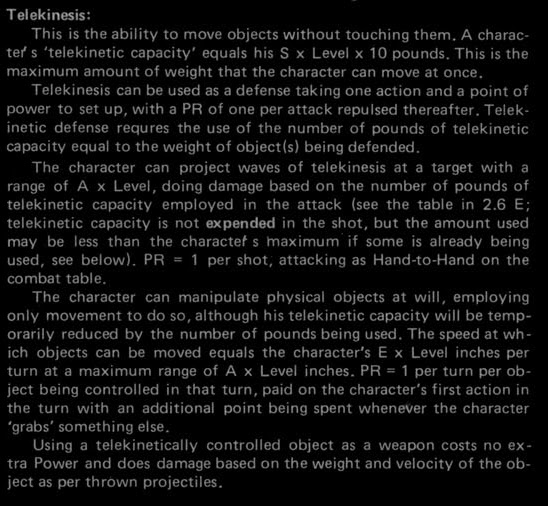


Reading through the Telekinesis power, we can see that it does essentially what Telekinesis should be able to do. It can move things, be used as an attack, and manipulate physical objects. Sound's right. What is interesting here though is the "telekinetic capacity" and how it is determined. The number of pounds a character can move is equal to Strength x Level x 10 pounds. In Sue's case, this would mean she could lift 10 (her Strength) x 1 (or 7 for our "experienced" version) x 10 pounds with her mind. So she could lift either 100lbs. or 700lbs. This would allow her to do either 1d4 or 1d8 damage with her TK. Not very impressive (okay, the 1d8 is almost in the right range for a primary attach, but not quite), and seemingly counter-intuitive. How many of the primarily TK oriented characters are known for their massive Strength? Most of the TK oriented heroes I can think of have average strength, and substitute TK for their Strength.

I think we should use an alternate means of Capacity Calculation. Normal carrying capacity is calculated as follows:

So for Sue we take one-tenth her Strength cubed (1 cubed) plus one-tenth her Endurance which is 1.8. This gives us a total of 2.8 which we multiply by 1/2 her weight or 60lbs. This gives us a total of 168 pounds. I think that looks right for her carrying capacity, but not her "Force Field" Capacity. If we substitute Endurance for Strength in this equation to determine "Force Field HTH", we get 458lbs and a 1d6 damage. While I still think this is low for a higher level Sue, it seems okay for 1st level Sue.  As for Telekinesis, I recommend making two changes. First, change the equation to (Key Stat x Level x 20 lbs = TK Capacity). Then I recommend selecting the appropriate key stat for the character's character concept. In Sue's case, I think it should be Endurance. At 1st Level, this would have given her a 360lbs. TK capacity. Not fantastic, and still only good for 1d6 damage which is about 1/2 of the average attack power, but I think it's well within reason for a starting character.

One thing that is possible in V&V is for a character to have a power "selected" multiple times. The recommendation V&V gives is to increase the effectiveness of the power if it has been "rolled" more than once. I would argue that Sue Storm rolled TK at least twice and would have that increase the multiple of x20lbs to x40lbs giving her a 1st level TK of 720lbs and 1d8 damage. That's all I need for her starting out.

One of the things that V&V allows characters to do is increase basic statistics with level increases. For the sake of argument, let's assume that modern Invisible Woman is 7th level and that she has put all of her advancements into Endurance.

Using our updated equations 7th level Invisible Woman would have a Force Field Capacity of 973lbs doing 1d10 damage. This is right in the sweet spot of between 1d10 and 1d12 plus stat bonuses damage (+1 in Sue's case). Her TK would be 6720lbs which does 2d8 damage. Given that this hits like a HTH attack, and HTH attacks are the least accurate in the game hitting on only a 5 or less, I think this is right in the sweet spot and puts her in line with most of V&V's "Bricks."

Notice that what constitutes a massively strong character in V&V is 3 tons, significantly less than the Hulk's 100 ton lift capacity. That would do somewhere in the range of 6d10 damage, a figure not likely to be "survivable" by most characters.

Just looking at these two powers it seems that V&V is a very good simulator of Comic Book style action, but that it still has a few cracks to fill in. Some are easy to fill in, like changing the TK equation or even I imagine coming up with a new Carrying Capacity to Basic HTH Damage chart (something I would recommend doing). Others are a little more difficult, like figuring out what is meant by "Damage Repulsed." The game was the first truly viable superhero role playing game. It is a fun game, but it does show some fraying around the edges of the rules. Some of these are legacies of being a kind of D&D derivative in combat, others are due to insufficient play testing.

None of them are game killers though, and all of them make for interesting combinations about how V&V tackles the problem of Simulation vs. Playability. With the exception of some of the equations required, and the clunkiness of the combat system, it's pretty clear that a lot of effort went into playability instead of simulation and where the designers focused too much on simulation -- the system's attack power vs. defense power attack chart comes to mind -- you end up with some of the more clunky aspects of the game.

I hope that Fantasy Flight Games Fantasy Games Unlimited and Monkey House Games are able to work out their legal issues in an amicable manner, and that we will be able to see a true 3rd edition of the game soon. It is one of the greats.

 Invisible Woman is Copyright Marvel Comics.

Thursday, January 31, 2013

Joys of Being a Geek Dad #3167(a).1 -- Warhammer Thank You Letters

I run D&D Encounters at my Friendly Local Game Store in Burbank, CA once a week in the evening. Because my wife Jody works during the time I am running the game, I bring my daughters History and Mystery to the game store with me (that's them in the banner above). They play with some of "dad's little guys," color, watch movies, and come over to the table to ask questions while we play. At the end of most of these evenings the girls get a comic book "for good behavior."

This past week I was playing with my regular group and my daughters decided to write thank you letters to the game store. Here is what they did -- oh...and keep in mind that they are 4 years old.


The drawing above is by my daughter History. She's written the word Warhammer -- missing two Ms -- and drawn the game playing table where players can play Warhammer. I was pretty impressed by her inclusion of terrain on the table.


Next up is my daughter Mystery who tried to write Thank You -- that's the Thathe Uouu which is her own attempt -- she then asked me how to spell it. I told her and she wrote Thank You To Gome Stre which is her way of writing game store. All I can say is Yay phonetics!  Both History and Mystery are getting very good at figuring out the consonants in words. The vowels are sometimes tricky, but they seem to be catching those too.  


Last, but certainly not least, is this beauty were Mystery has repeatedly written Warhammer on a sheet of paper. I'm tempted to have this made into a T-shirt.

Wednesday, January 23, 2013

Simulation vs. Playability: The Background Discussion for a Blog Series


Over the course of the next few weeks, I will be discussing how some games balance their desire to simulate a certain activity with the need for a game to be playable. Most of the posts will be dealing with role playing games, but I might wander into wargame territory from time to time.

Let us take as a given for the purposes of our discussion that, with the exception of purely abstract games, most games are a simulation of some central conceit.

For example, both Chess and Men of Iron are to one degree or another simulations of medieval warfare. Men of Iron has what Elias, Garfield, and Gutschera (2012) would describe as higher "intensity" of the medieval warfare conceit than Chess, but both do share that central conceit. On the Elias, Garfield, and Gutschera "Scale of Intensity for Conceits," Chess is rated a 3 (Very Light Conceit) while Men of Iron would likely be rated around an 8 (Simulation, but with many sacrifices to gameplay).  As a further illustration Tic-Tac-Toe rates a 1 (Purely Abstract) and Squad Leader ranks a 10 (Full-on Simulation).  This might make one wonder where Advanced Squad Leader would rank, but I digress.

I understand that there are those who may disagree with the initial premise that "all non-abstract games are a simulation" either as a mere tautology, and others who completely disagree with the premise as an a priori. I believe it will prove useful for the series of discussions I hope to have about role playing games as simulations of the various subjects they address.

The framing of games, and in particular role playing games, as simulations should not be confused with Ron Edwards' GNS (Gamist, Narrativist, and Simulationist) system of game play analysis. As I interpret GNS Theory as a theory of play that can inform design and not a theory of system deconstruction and design. As Ron states in the above linked essay, "These terms, or modes, describe three distinct types of people's decisions and goals during play." These are player goals toward which games may be designed, but in my opinion a "Simulation" is not the same as a "Simulationist" game. 

To illustrate, the excellent Narrativist game The Extraordinary Adventures of Baron Munchausen is a simulation of storytelling as the good Baron himself might engage in it. It is not a simulation of the Baron's adventures, though James Wallis considered making a game where players could enact those adventures, it is instead a simulation of storytelling in a particular style. Another example of a game that is a simulation of storytelling is Tales of the Arabian Nights. Both Baron and Arabian Nights simulate the activity of storytelling within their conceits differently, but in the end the game play of both are best described by the stories created within the rules of the game. There is a reason that Wallis calls these kinds of games "Story-Making" games. So it's possible to have simulations of storytelling that results in story-making which in the end results in storytelling when the results with game play are shared.

Okay, enough of the metaphysics of games being simulations. Let's move forward please -- ed.

Games are also about fun, and to be fun games must be playable. This is as true of role playing games as it is for any other kind of game. As Robin Laws says in his masterwork Robin's Laws of Good Game Mastering, "Roleplaying games are entertainment; your goal as GM is to make your games as entertaining as possible for all participants." 

The key part of that statement is "as possible for all participants." Because players come to a gaming table with different "ideas of fun" as highlighted in Edwards' GNS theory, roleplaying game design must make decisions between the level of depth of simulation and the playability of the system. Some players find granular verisimilitude and accuracy of representation entertaining. For these players reading Chapter H of the Advanced Squad Leader rulebook is as much fun as actual game play. Other players might enjoy quick systems or systems that foster the creation of narratives.

Historically, one of the conflicts that has resulted from the attempt to design "good" games is a tension between "realism" and "playability." In Issue 8 of MOVES magazine (1973), Victor Madeja argued that "Commercial wargames fail to accurately represent modern war. Although no game will ever recreate the confusion, horror and destruction of war, we should at least expect a wargame to partly simulate the decision-making process involved in actual battle. Instead we have chess-like caricatures of reality. What semblance of realism we were led to expect is sacrificed on the altar of playability" (Emphasis mine). For Victor, there was a clear distinction between realism and playability and he thought that games at the time leaned too much toward playability and not enough toward actual simulation .

You can purchase access to the first 60 issues of MOVES magazine for the very reasonable price of $19.95 at Strategy and Tactics Press.

By Issue 14 of MOVES (1974) John Hill, the eventual designer of SQUAD LEADER, addresses the conflict by stating, "One of the hardest problems facing any war game designer is the careful balancing between playability and realism. Actually, any reasonably competent wargamer could probably design a realistic 'simulation,' but to design a good game is something else. As an example, 1914 was an excellent simulation of corps level fighting of that era, but as a game it was worthless -- it couldn't be played." John Hill would eventually go on to become an advocate of what he called "abstraction." This was a controversial game design philosophy in which the designer cared less about "what actually happened" and more concerned with the "effects" of what happened and how to model those effects. So, for Hill the fact that gunfire affected morale was more important than modelling the specific physical effects of bullet trajectories. Examples of "abstraction" designs in role playing games include D&D's "hit points" and the "effects based design" of CHAMPIONS.

The tension between simulation and realism is one that has been discussed in role playing games since the origin of the hobby. In the Advanced Dungeons and Dragons DUNGEON MASTERS GUIDE, Gary Gygax writes, "Of the two approaches to hobby games today, one is best defined as the realism-simulation school and the other as the game school." -- You can see in this discussion the origins of Edwards' GNS theory. -- "AD&D is assuredly an adherent of the latter school. It does not stress any realism (in the author's opinion an absurd effort at best considering the topic!). It does little to attempt to simulate anything either. ADVANCED DUNGEONS & DRAGONS is first and foremost a game for the fun and enjoyment of those who seek to use imagination and creativity...As a realistic simulation of things from the realm of make-believe, or even as a reflection of medieval or ancient warfare or culture or society, it can be deemed only a dismal failure...Those who...generally believe games should be fun, not work, will hopefully find this system to their taste."

In his paragraph on design intent, excerpted above, Gygax clearly puts himself in the "abstraction" design camp. His discussion of Hit Points in the DMG also makes this clear, whereas those who criticize hit points or how armor "makes it harder to hit and doesn't stop damage" fall more into the simulationist camp. I would like to say that I disagree with Gygax that his game "does little to attempt to simulate anything." I would argue that it is simulating heroic fantasy, but it is doing so from an abstractionist position. It's a small distinction, but not an unnecessary one.

As an aside, most gamers or designers are a combination of abstractionist/simulationist. Ken St. Andre, the designer of one of the most abstractionist rpgs I have ever played, doesn't like armor class systems because they don't simulate what he wants. This is the case even though his TUNNELS & TROLLS combat system sacrifices specificity for playability and speed of play.

When it comes to the tension between "simulation" and "playability" there is not a procedural definition of what is right or wrong. What is right or wrong doesn't even depend on what is being simulated. What determines whether it is better to favor simulation or playability is how that decision works within the rules set and the goals of the game itself. Sometimes it is important that a game be a good simulation of what it is trying to represent. CHAMPIONS is very much an "effects based design" system in character creation, but its combat system simulates the panel to panel flow of comic books extremely well. VILLAINS & VIGILANTES has a random character creation system that favors simulation -- though it also includes GM "rulings over rules" -- over abstraction as it defines specifically what Flame Powers and Ice Powers do and how they work rather than define effects and have you decide what matches what. Both are good games.

In the coming weeks, I'll be looking at some games and how they address the Simulation/Realism vs. Playability/Abstraction conflict. I'll be starting with VILLAINS & VIGILANTES and how it emulates Force Fields and Telekinesis in its simulation of super heroic conflict. While I think that the V&V system overall is quite good, I believe that the designs of these two powers demonstrate good "simulation" on the one hand and "awkward" simulation on the other.

I'd like to leave this conversation with two quotes for Will Hindmarch and Jeff Tidball from their Things we Think About Games.


1) Theme and gameplay are two different things.
2) Balance is not the same thing as fun.

Elias, George Skaff. Garfield, Richard, and Gutschera, K. Robert (2012), Characteristics of Games. Massachusetts Institute of Technology Press.

Wednesday, January 02, 2013

The Big Bang Theory and D&D: One Geek's Perspective


Those of you who visit this blog with any regularity know that I am not merely a fan of Geek Culture, but I'm a bit of an evangelist as well.  I want the world to have the same love for Geek Culture that I do.  So portrayals, and reactions to portrayals, of Geeks and Hobbyists are something that I pay close attention to.  I am also a big fan of the television show "The Big Bang Theory."  To my memory TBBT has had the cast play D&D on two occasions, the most recent being the December 13th episode "The Santa Simulation."  This episode has met with quite a bit of criticism on my Twitter and Facebook feeds.  One of the most mild criticisms was Chris Pramas' post on 12/14,  though the brief conversation that followed gives a glimpse at some of the ire that the show can engender from the Geek community.

Before I continue, I'd like to point out that I'm on friendly terms with two of the writers on the show.  This isn't to say that I'm close friends or anything that intimate, but that I and my Geekerati co-host Shawna Benson have done podcast interviews with both Executive Producer David Goetsch (in 2008) and Supervising Producer Maria Ferrari  (late 2012) on separate occasions.  Maria was one of the writers of "The Santa Simulation" episode, so my curiosity wonders if some small spark for the episode came from her participation in my little podcast.  My Shatnerian hubris tells me "Of course it did," while the person who has an understanding of production schedules and how Hollywood actually works says "Puh-leeze, get over yourself."  These facts make me predisposed to be favorable to the show, and I thought everyone should know that before they read further.

The fact is that I find the Nerd Rage being tossed at the creators of THE BIG BANG THEORY to be ludicrous.  I can understand not liking "The Santa Simulation" as an episode, though I liked it and will discuss why below, but to rage at the creators accusing them of "laughing at geeks rather than laughing with them" is unmerited.  Having forced two of the writers to endure marathon live-streaming runs on my podcast, I have learned two things.

First, the people on the show are geeks.  They don't all geek out about the same things you do, but they do all geek out about aspects of geek culture.  They have writers who are comic book fanatics, Star Trek fanatics, video gamers, and hobby gamers.  Have you ever noticed the games that the cast plays at the beginning of episodes?  While the "Ticket to Ride" game going on in a recent episode was a fairly mainstream demonstration, the playing of "Talisman" during an earlier episode points to some serious Hobby Gaming on someone's part.

Second, these people are nice.  Extremely nice.  David Goetsch's only failing as a human being is that he is a Red Sox fan.  Given that the Cubs likely threw the 1918 World Series to give the Sox their much discussed "pre-curse" World Series victory, I have a particular disdain for Red Sox fans.  The fact that David Goetsch is so nice that he overcomes my anti-SoxFan bias is a testimony to how nice he truly is.  Listen to the conversations Shawna and I live-streamed with the writers.  They not only put up with my asides, meanderings, and bad jokes, they join in.  When hanging out with "real geeks," they spend not one moment laughing at us and are instead laughing with us.

Now for a discussion of "The Santa Simulation" proper, as it is an episode that has fostered so much distracting discussion on my various social network feeds.

"The Santa Simulation" is an episode that has as it's "A Storyline" that the core cast -- minus Penny -- haven't been able to play D&D as much as they like over the past few years and want to play.  They want to play so badly that they are willing to prioritize it over night's out with the women in their lives, in Sheldon's case he "forbids" his girlfriend from participating.

The first criticism that leaps out at gamers, and the one highlighted by Chris Pramas in the tweet I linked earlier, is that the show "propagates the myths that only dudes play D&D and that it's either D&D or sex."  I think that this is a fair criticism of the episode, but I'd like to examine it a little further.  It is true as far as it goes, but it should be pointed out that a) it is only Sheldon who "forbids" his girlfriend from playing, b) that Sheldon has very peculiar ideas about societal norms, and c) that Sheldon's girlfriend very much wanted to play in the game.

I'd also like to share a quick anecdote with you.  This past year, the company my friends and I started up launched our first Kickstarter.  We funded a Cthulhu Claus Holiday Card project that was illustrated by my wife Jody Lindke and that contained greetings written by Gaming God Kenneth Hite.  When the project was completed and all boxes had been shipped to backers, I approached my Friendly Local Game Store and asked if they would be interested in carrying the cards.  I also had a retailer tier available on the project.  The manager/owner of the local store said, and I paraphrase here, "the customers at this store would likely not be interested in the project as they aren't very sociable and won't have people to send them to.  They'll look at them, think they are cute, but won't buy them." 

I am not kidding.  Additionally, ZERO retailers backed the project.

That store owner was harder on the hobbyists who frequent the store than TBBT has ever been to the geek community.  The fact is that "gamer are not social" is tried and true stereotype.  The fact that hobby gaming is itself a social hobby that requires social networks -- physical ones not digital ones -- in order to fully appreciate is beside the point.  The most sociable people I know are all gamers.  Are all gamers sociable?  No, but many are and all seem to enjoy the company of their friends while playing games.  TBBT's "The Santa Simulation" at least got that part right.

Back to Chris's point though, he's right that the show didn't break stereotypes and it would have been nice if they had.  It would have been fun seeing how Penny reacted during Leonard's "Holiday Themed" D&D adventure.  I think there was some real room for comedy gold just in that thought experiment, not to mention how it would drive Sheldon crazy.  This is especially the case given that Sheldon has yet to defeat Penny at any game, and an entire episode was dedicated to Penny besting Sheldon -- though sad to say that episode (The Re-Entry Minimization) didn't include any hard core hobby games.  So I think Chris is on to something with his reaction.  TBBT had a moment when they could have gone for the harder, but funnier, storyline and they didn't.  TBBT stuck with the easy gamers are boys assumption when they could have been narratively braver.

That isn't only due to meeting stereotypes though, or from a lack of ability.  It also has to do with screenplay structure.  TBBT -- like most modern shows -- has an A and a B storyline.  Sometimes they even have a C storyline.  Given that the majority of the cast was playing D&D and they only had 3 regular characters not in the game, what would be left for the B storyline if everyone was playing the game?  That's a challenge the writers had to face, and they came up with the episode they came up with.  It was essentially "boys night vs. girls night out."  And you know what, the "boys night" looked like more fun.

That's right, the D&D game looked like more fun than going out "clubbing."  Leonard's "Let's rescue Santa Claus" D&D adventure was exactly the kind of thing gamers do for the holidays.  Savage Worlds has a free Christmas Evening adventure -- and I should point out that a couple of years ago I ran a Savages Save Santa Necessary Evil game.  RPGNow is filled with holiday themed adventures for heaven knows how many game systems.  This year I ran a Call of Cthulhu holiday themed adventure -- and no it didn't involve Cthulhu Claus.  Next year's will.  The guys were all having a great time, the play looked engaging and fun, until Sheldon ruined the boys night out due to his personal history with Santa Claus.

Let me say something that was embedded in that last paragraph again.  It made playing D&D look fun.  It started off silly, but in the end it looked like a great time.  I can see someone saying, "That's what people where afraid of in the 80s?  Really?  It looks fun and I'm going to give it a try."

Do I think the episode could have been better?  Yes.  Having Penny and Sheldon battle it out over the fate of Santa Claus would have been amazing.  Showing non-gamers being recruited to gaming was a missed opportunity for D&D evangelization.  But the episode was fun, and it made me happy that I'd already planned a holiday themed Cthulhu game.

Thursday, December 20, 2012

Roleplaying and Player vs. Player Conflict


Everyone who has played a role playing game has at some point experienced sessions, or even campaigns, that contain Player vs. Player conflict.  When it comes to MMORPGs, there are some who claim that Player vs. Player is their favorite mode of play.  There are even Pen and Paper RPGs that have Player vs. Player treachery as the primary motivating factor for the game -- PARANOIA I'm looking at you.  There is definitely a time and a place for PvP play, it can be highly rewarding.  Much of the game industry is based on the assumption that the players will be playing against one another and not cooperatively.

One of the major innovations of RPGs was that they stressed player cooperation rather than competition.  A fact that many DMs didn't take enough to heart in the early days.  Which brings to mind how important it is to understand what your players expect from a game, and how to set expectations to minimize disappointment if a group has decided to embark on a PvP campaign experience.  After all, who hasn't lost a friend or two over a game of DIPLOMACY due to a breaking of that game's "magic circle" when someone used real world commitments/obligations to shape outcomes in the game.


Which brings me to the point of this post.  Player vs. Player conflict can be great in a game, but "inner party" strife can ruin a game.  If the players of a game are expecting this: 


And they get this as a part of adventure design:


You can end up with some very disappointed players.

I recently had this occur during a recent season of D&D Encounters (The Council of Spiders adventure).  The module is set up so that the characters distrust one another and have conflicting objectives.  To add to the intraparty conflict, WotC released "Treachery" cards that can be used during play.  The treachery cards cause bad things to happen to your fellow players -- or take advantage of bad things already happening to them -- and give you a benefit.  The intention is to create a sense of paranoia and drama.  It's a decent goal, but it can end with disappointed players.

This is due to a couple of reasons:

  1. Player expectations -- Many people play RPGs because they want a collaborative experience where they work with others to achieve objectives.
  2. Mary Sue Syndrome -- The descriptor might sound derogatory.  Don't take it that way.  Many players are playing romanticized versions of themselves.  This is true even when they aren't playing a character who seems remotely like themselves.  Players care about their characters and they want control over them.  When PvP erupts in an RPG it often makes a player feel threatened...and by other players no less.  This can lead "at the table" conflict to leave the magic circle of play and bleed over into real life.  This isn't good, and unless you're playing PARANOIA this is a real risk.  Let me restate this again.  Players play characters again and again because they like them.  If they perceive that character is being directly threatened, they may take it as a slight against themselves.
  3. Most Players Don't Really Suspend Disbelief -- What separates good actors from bad actors?  One trait is the ability of good actors -- even ones who aren't "transformed" in each role -- is there ability to immerse themselves in a role and completely separate themselves from the actions of the character.  Most gamers aren't good actors.  The veil of suspended belief is thin.  They are usually not roleplaying.  They often take "roleplayed" moments more seriously than they should.  As a DM, I have roleplayed NPCs who were jerks to one or more players.  I have often had to go out of my way to let players -- who thought I was beating up on them -- know that it was only the character behaving this way, that I was acting.  This surprises some players as they expect you to do something like say "so and so says" rather than for you to affect a voice and act it out straight.
  4. Metagaming -- Players will use information they don't have against their peers.  Did the Evil High Priest secretly tell player A to plant evidence that player B was a member of an evil cult?  Guess what.  If there has been time between sessions, player B will begin looking for that evidence.  This is true even if player B would have no idea the planting of evidence is occurring.  They will act on player information and be hurt when they are called on it.  Why?  See #3 and #4. Ask me about a Vampire LARP experience regarding this kind of conflict where players teamed up against a storyteller's character -- an Antediluvian Settite -- because characters were acting on player knowledge.   They had a big gathering.  Every vampire in the session knew the guy was a Settite.  Everyone.  Even though his power was to make people do stuff without knowing who told them to or why.  They were supposed to think it was their own idea.  It took some very skilled ad libbing from a co-storyteller to transform the narrative into making this "trial" the key piece of action.  The action was supposed to be around the Prince.  But people didn't want to "hurt" their friends, so they acted on player knowledge and reworked a whole narrative.  It worked.  No one's feelings were hurt, but it was still a mess. 
In my opinion, Player vs. Player conflict can be a powerful narrative tool.  After all, the source of all DRAMA is conflict.  Thing is in player vs. player conflict -- that isn't entirely pre-scripted and then acted out line by line by actors but is actually played -- things can get messy.  They often do get messy.  I would argue that setting up cases of player conflict should be rare.  I might even recommend avoiding them altogether.  You'll have a happier table, even if it is one that misses out on some "dramatic opportunities."

Tuesday, December 11, 2012

MAN OF STEEL -- Does Zack Snyder Get It?

If the most recent trailer for the new Superman film MAN OF STEEL is any indication, the answer is a resounding YES!

I have long argued that Superman is my favorite character because he is the most complex of all superheroes.  He isn't merely the first, he is the most interesting.  He has layers and layers.

To often authors and illustrators focus on what Superman can "do" and not "why" he does it or "what" he needs.  Superman is the living embodiment of the question Aristotle poses his Politics.  In Book One of THE POLITICS, Aristotle writes about man and society: "But he who is unable to live in society, or who has no need because he is sufficient for himself, must be either a beast or a god: he is no part of a state. A social instinct is implanted in all men by nature, and yet he who first founded the state was the greatest of benefactors. For man, when perfected, is the best of animals, but, when separated from law and justice, he is the worst of all; since armed injustice is the more dangerous, and he is equipped at birth with arms, meant to be used by intelligence and virtue, which he may use for the worst ends."

Like all men, Kal-El has the instinct to live within society.  He desires to be a part of humanity.  It is why he has a secret identity at all.  Superman has no need for a secret identity except as a way to connect himself with "The City."  Unlike Spider-Man and Batman, Superman wears no mask in his heroic identity.  He lets the world see him as he is.  But he knows that his superheroic identity can not be a part of society.  Superman is godlike and disconnected.  He would be naturally rejected by the society.  Not out of spite or fear, though some would feel that way, but out of awe.  Yet Kal-El isn't sufficient in himself.  Yes, he can survive the vacuum of space without protection.  He can survive a nuclear explosion and lift mountains, yet he is alone.  He is the "Last Son of Krypton."  He needs society and the only way he can have that is through the creation of the adult Clark Kent.

Without Clark Kent and the merging with society that persona gives Kal-El, he might well become a beast.  The tragedy is that through the creation and maintaining of Clark Kent as a persona, Superman puts those he loves at greater risk.  Spider-Man's adoption of a secret identity is done to protect Aunt May, and with some exception it does exactly that.  Superman's secret identity puts Lois, Lana, Jimmy, and Ma and Pa Kent at greater risk than otherwise.  Since Superman is a public figure, he could spend all his time in the Fortress of Solitude with no private life.  Villains would attack the Fortress and only attack civilians in typically villainous ways.  By having roots in society Kal-El puts those people at risk of being targeted as individuals due to their connection with him.  Yet he needs them to become fulfilled...to be a part of law and justice...to work with intelligence and virtue.

He is a truly tragic figure, and I have always been moved when writers are able to capture that small part of him.  Sadly, too few capture that conflict.  They are too often trapped by looking only at Superman as mythic figure and not as someone with the social instinct.

The new preview shows a Clark that yearns for that connection, but whose powers not only separate him from society but cause him pain.  Imagine Clark -- the child -- who can hear all the sounds of the world at once pounding into his eardrums.  Every conversation, every tear, every rain drop.  How alone he must feel.  The voice over with Ma Kent reflecting this in the trailer is magnificent.


Monday, December 10, 2012

Jackie Chan's ZODIAC --- Okay, Now I'm Interested

Seeing Jackie Chan in the teaser trailer for ZODIAC, I was really worried.  The luge body suit stunts were impressive, but they were also stiffer and less fluid than a typical Jackie stunt.  I wondered how much of his natural grace had been worn down by the various exertions he has put his body through during his career.

After seeing the extended trailer I still may hope that Jackie is able to enjoy a long and well deserved retirement, but I am no longer worried about him going out with a fizzle.

Thursday, December 06, 2012

Enter Colonel Philip Green or... Gary Mitchell? -- STAR TREK: INTO DARKNESS

I'm beginning to wonder if Cumberbatch's character in the upcoming STAR TREK: INTO DARKNESS is either Colonel Philip Green or Gary Mitchell. There has been some talk about how the villain cannot be Gary Mitchell of late, even though the initial leak was that it was Mitchell.

Watching the teaser trailer, I'm torn between whether it is Green or Mitchell and leaning heavily toward Mitchell.  It looks like the crew explores a new planet with strange plants, there is a blond character very reminiscent of Sally Kellerman's character Dr. Elizabeth Dehner, and Cumberbatch does some pretty superhuman feats in the clips below. 


Oh, and you see him wearing a Star Fleet uniform.


If it is Mitchell, I'll be geeking out pretty hard as Where No Man Has Gone Before is possibly my favorite Star Trek episode.


Tuesday, December 04, 2012

Knights of Pen & Paper: Good Idea, but...

As a member of Generation X, I am a fan of "meta" media that is well done.  The initial trailer for the Behold Studios game "Knights of Pen & Paper" makes the game look like it could have been one of those beautiful meta moments.  It looks like a combination of Phoenix Wright with old school "Dragon Warrior," and that would be a beautiful thing indeed.


Reading through the reviews on iTunes, and looking at the in app purchase price schedule, it becomes quickly apparent that this is a game that hopes to have its profits driven by micro-transactions rather than by raw sales.  This is really too bad, as I think that this game might have some traction as a pure single transaction game with expansion purchases to buy updates similar to Ravenmark.


Alas, it seems that was not meant to be. I would have easily paid $7 to $10 for an excellent meta-rpg, but a micro transaction "buy gold" game?  Not so much.

Wednesday, November 28, 2012

Donnie Yen's Dragon (aka Wu Xia): Watch It

Donnie Yen's latest martial arts film was recently released in the US under the relatively uninformative title DRAGON, a title that brings to my mind thoughts of Bruce Lee and his many classic kung fu films.  It is also a title that does a disservice to the film.  As awe inspiring as Bruce Lee was as a performer, using any of Lee's major works as a reference point is completely off base as the vast majority of Lee's films were of a different film genre than DRAGON.

DRAGON follows in the wuxia tradition in which martial artists live in the world of jiang hu and are inexorably trapped within an epically tragic tale, often a romantic tale.  Think CROUCHING TIGER, HIDDEN DRAGON and you are on the right track.  But DRAGON, directed by Peter Ho-Sun Chan, brings in elements of American Film Noir to the traditional tragic fantasy elements of a typical wuxia film.    DRAGON begins as a murder mystery of a kind, a murder mystery that reveals that Liu Jin-xi (Donnie Yen) is more than the humble paper maker he appears to be.  It is a mystery that ends in proper wuxia tragedy.  It is a heartfelt film with fine emotional beats, even if the martial arts themselves don't quite live up to the remarkable high standards Yen has set of late.  This isn't to say the film isn't beautiful, it is, rather that this isn't a rapid paced actioner.  This is a film of investigations, fear of the loss of a mundane life, and tragedy.  It has some echoes of the Shaw Brothers classic ONE ARMED SWORDSMAN, but is entirely its own creation.

Given the narrative tensions of the film, I wouldn't have marketed the film under the title DRAGON.  I would have based the title on the original title Wu Xia, a term that literally means "martial hero."  Given the connotations of honor in the phrase, I would have called the film AN HONORABLE MAN.  The title would then echo the tensions in the movie and provided context for potential viewers.  Is Liu Jin-xi an honorable man?  Has he always been an honorable man?  Will he leave the tale an honorable man?  These are the questions the audience faces as they watch the film.  They are questions worth asking and the investigations of Takeshi Kaneshiro's character answer only one of these questions.  The answer to the others are revealed through the subtleties of Donnie Yen's performance.


Wednesday, October 31, 2012

Disney + Marvel + Lucasfilm = ???

Yesterday it was announced that Disney would be buying Lucasfilm and that they would begin production on Episode 7 of the STAR WARS franchise.  The interwebonetosphere was abuzz with Gen-Xers in awe of how quickly Disney, under Bob Iger has moved to collect a good percentage of their childhood loves under one corporate banner.  Disney now owns the Marvel catalog of Super Heroes, the Star Wars Franchise, Indiana Jones, in addition to their own creations.  It's quite an array of IP.

My Geekerati co-host Shawna Benson mentioned how anyone who has been to Disneyland and walked through the Star Tours store could plainly see this was a natural move for Disney corporation.  Think of how many toy aisles will be filled with Disney owned action figures... Star Wars, Marvel, Princesses, Princes, Beauties, Beasts, Jake, Tinkerbell.  Good grief!

All of this analysis misses one key point, the real reason that Disney purchased Lucasfilm.  Lost in the annals of film, there is a highly underrated cinematic masterpiece that was produced by Lucasfilm in the 80s.  It has largely been forgotten.  Lucas himself attempted to Jedi mindtrick the entire human race to forget of its existence. 

No, I'm not talking about the STAR WARS HOLIDAY SPECIAL.  I'm referring to a Marvel property.

With the acquisition of both Marvel and Lucasfilms, Bob Iger has enabled Disney to overcome the legal morass preventing an updating of the greatest film of all time...

HOWARD THE DUCK!


I can see it now.  Howard the Duck taking over Toon Town.  A Howard the Duck inserted into the Indiana Jones ride.  A Howard the Duck journey on Star Tours.  A retheming of Splash Mountain to Duck Mountain.  Howard the Duck being made a canonical member of the Duck Tales verse.

You heard it here first.


[The above is not serious, it is a joke.  No one believes that HtD was a good movie.]

Tuesday, October 30, 2012

A Halloween Toast!

Because it's so difficult to get young children to eat toast and cheese, it being such an unnatural and un-kid-friendly snack...

Okay, I just like Halloween, and holidays, and any time I can holiday up a staple like toast, I'm gonna do it.  This food "craft" if you will, is fast, super easy, and turns out pretty well with any level of creative skill.  You'll need bread, a toaster oven, and orange cheese that can melt (the orange cheese that turns to industrial plastic liner when heated -- and you know what I mean, because we've all had it, and some of us like it -- will not do).

Arrange your bread.  Before applying cheese, round it by trimming the corners with a small knife.  Then cut eyes and a nose with the same knife.  For the mouth, the easiest thing to do is cut the large shape of the mouth, then cut and add teeth after (remember, this is going to melt together, so it will look like one big pumpkin jack-o-lantern face as long as the edges overlap or meet).  Arrange your cheesy "face" on the bread and pop it in the toaster oven.


The result is yummy, cheesy fun.  It's a great way to add a little kid-fun and holiday cheer to your average soup or munchy snack.  Pictured here is a whole wheat bread and mild cheddar cheese.  A dark rye or pumpernickel will offer more contrast and really make that pumpkin grin stand out!  Our preschoolers are always smiles to find faces staring back at them from their plates.  I'm not sure if that's funny or frightening, but since either is welcome at Halloween, bon appetite! 


Monday, October 29, 2012

Halloween and Jack-Egg-Lanterns

Halloween has become a month-long celebration in our house (partly because it seems to take that long just to locate, unpack and put up all the varied decorations and do-dads).  We've always been fans of the holiday and holidays in general and are always on the lookout for new, fun (and best-of-all inexpensive!!!) ways to celebrate, decorate or both!  With our girls in preschool now (and desperately eager to help with every thing), it was important we find as many kid-friendly activities and crafts we could this year.

Enter the Halloween Jack-Egg-Lantern. 


We're surely not the first to think of this when we saw all those egg coloring kits go on sale last spring.  Our twins had such a great time decorating eggs this year -- and eating the hardboiled goodness! -- I nabbed a couple extra packs from the clearance bins to use at upcoming off-season events.  

With two girls and four fast hands to keep busy, one orange packet of dye was not going to be enough.  So to keep four hands busy and keep two imaginations working, we combined the red, yellow and pink colorings to make multiple shades of "pumpkin."  I think next time a drop or two of purple would also make a deeper color.  Green and purple are great Halloween colors anyway, and we could have done more to make Goblin or Frankenstein eggs or Purple Monster eggs...  Okay, all the better for next time.  This time, we focused on the pumpkin.  Some turned out more pinky-orange, a few more yellowy-orange, but overall we got a good blend and loved the results!
 

Some turned out more pinky-orange, a few more yellowy-orange, but overall we got a good blend.  For special egg-fects, we experimented with the usual techniques like mulit-color dipping and striping our "pumpkin" eggs with white, clear, and black crayons to add dimension and texture.  Looking back, red or dark orange crayon might do even better, especially pre-heated to give the lines more solid consistency.  


Our most vivid Jack-Egg-Lantern faces were achieved with a Sharpie, though the black crayon also turned out well.  Maybe next time we'll go with yellow wax for the faces and a deep orange for the dye to create that lit-from-within illusion.  

I think the most important part of this trial egg run is that it's a simple craft with a-typically healthy and edible results that offered great opportunities for a lot of peripheral fun, like practicing our scary faces (see below).  Have a spook-tacular Halloween!


Thursday, October 25, 2012

There Can Be No Halloween Season Without Vincent Price

I'll let my wife's Nicnup cartoon give us the break down of how important Vincent Price (May 27, 1911 – October 25, 1993) was and will always be to the Halloween season.


EVIL DEAD (1981) vs. EVIL DEAD (2013)

While it will be years until I will feel comfortable sharing my love of the EVIL DEAD series with History and Mystery, I am intrigued by the new Red Band trailer for the upcoming remake of the first EVIL DEAD film.

Raimi's first EVIL DEAD movie was more horror than horror/comedy, though the series itself is among the best horror/comedy, and it looks like the upcoming film is leaning more in that direction. The casting of young Jane Levy in the "Ash" role does hint that the film won't be completely absent of any humor.

Have a look at the 1981 trailer and the trailer for the new film and feel free to share your thoughts. My thoughts? The first trailer definitely shows its age, and the new trailer is of a film I'd like to see.


One thing is certain. I think I'm going to have to dig up my ARMY OF DARKNESS RPG.

Monday, October 22, 2012

David Lo Pan Style: Big Trouble in Little China meets PSY

As many of you know, I am of the opinion that John Carpenter's Big Trouble in Little China may well be the best film ever made.  Okay, that's an exaggeration, but you know the way that some Gen-Xers constantly reference Star Wars or Star Trek in conversation?  I'm that way with BTiLC.  I lost count of how many times I have watched the film a decade ago.

The film combines everything I love from Western genre film, Shaw Brothers over the top acting, and post-Tsui Hark Hong Kong cinematography and action.  In short, it is all things great about film that aren't in Singin' in the Rain.

BTiLC doesn't need a remake, but it does need more awesome fan creations like this.  If only Dennis Dun managed a cameo in the video.


If you don't like this video, you must be monumentally naive or already living in the Hell of Lacking a Sense of Style or Humor.  What can I say?  The Chinese have a lot of hells.

Tuesday, October 16, 2012

[Vintage RPGs] CHAMPIONS 1st Edition -- A Blast from the Past

The CHAMPIONS super hero role playing game is one of the best super hero role playing games ever designed, and the game to which all super hero rpgs are compared.  CHAMPIONS wasn't the first role playing game in the super hero genre, that honor goes to the game SUPERHERO 2044 which I discussed in an earlier blog post.  CHAMPIONS even builds upon some of the ideas in SUPERHERO 2044.  CHAMPIONS used the vague point based character generation system of SUPERHERO 2044 -- combined with house rules by Wayne Shaw -- as a jumping off point for a new detailed and easy to understand point based system.  CHAMPIONS was also likely influenced by the melee combat system in SUPERHERO 2044 in the use of the 3d6 bell curve to determine "to-hit" rolls in combat.


While CHAMPIONS wasn't the first super hero rpg, it was the first that presented a coherent system by which a player could design the superheroes they read about in comic books.  The first edition of VILLAINS & VIGILANTES, which predates CHAMPIONS, did a good job of emulating many aspects of comic book action but the ability to model a character in character design wasn't one of them.  CHAMPIONS was released at the Origins convention in the summer of 1981, and it immediately captured the interest of Aaron Allston of Steve Jackson Games.  Allston gave CHAMPIONS a positive review in issue #43 of the Space Gamer magazine, wrote many CHAMPIONS articles for that publication, and became one of the major contributors to the early days of CHAMPIONS lore.

Reading through the first edition of the game, as I have been doing the past week, can have that kind of effect upon a person.  The writing is clear -- if uneven in places -- and the rules mechanics inspire a desire to play around in the sandbox provided by the rules.  George MacDonald and Steve Peterson did more than create a great role playing game when they created CHAMPIONS, they created a great character generation game as well.  Hours can be taken up just playing around with character concepts and seeing how they look in the CHAMPIONS system. 

There are sites galore about CHAMPIONS and many reviews about how great the game is, and it truly is, so the remainder of the post won't be either of these.  Rather, I would like to point out some interesting tidbits about the first edition of the game.  Most of these will be critical in nature, but not all.  Before going further I will say that though CHAMPIONS is now in its 6th edition and is a very different game today in some ways, the 1st edition of the game is highly playable and well worth exploring.

  • One of the first things that struck me reading the book was how obviously playtested the character design system was.  This is best illustrated in the section under basic characteristics.  In CHAMPIONS there are primary and secondary characteristics.  The primary characteristics include things like Strength and Dexterity.  The secondary statistics are all based on fractions of the primary statistics and represent things like the ability to resist damage.  Where the playtesting shows here is in how players may buy down all of their primary statistics, but only one of their secondary statistics.  A quick analysis of the secondary statistics demonstrates that if this were not the case a buy strength then buy down all the secondary stats related to strength infinite loop would occur.  
  • It's striking how few skills there are in 1st edition CHAMPIONS.  There are 14 in total, and some of them are thinks like Luck and Lack of Weakness.  There are no "profession" skills in 1st edition.  To be honest, I kind of like the lack of profession skills.  Professions in superhero adventures seem more flavor than something one should have to pay points for, but this is something that will change in future editions.  
  • There are a lot of powers in CHAMPIONS, but the examples are filled with phrases like "a character" or "a villain" instead of an evocative hero/villain name.  It would have been more engaging for the folks at Hero Games to create some Iconic characters that are used throughout the book as examples of each power.  The game does include 3 examples of character generation (Crusader, Ogre, and Starburst), but these characters aren't mentioned in the Powers section.  An example using Starburst in the Energy Blast power would have been nice.
  • The art inside the book is less than ideal.  Mark "the hack" Williams has been the target of some criticism for his illustrations, but his work is the best of what is offered in the 1st edition book.  It is clear why they decided to use his work in the 2nd edition of the game.  Williams art is evocative and fun -- if not perfect -- while the work Vic Dal Chele and Diana Navarro is more amateurish.
  • The game provides three examples of character generation, but the designs given are less than point efficient and one outclasses the others.  The three sample characters are built on 200 points.  Crusader can barely hurt Ogre if he decides to punch him (his punch is only 6 dice), and his Dex is bought at one point below where he would receive a rounding benefit.  Ogre has a Physical Defense of 23.  This is the amount of damage he subtracts from each physical attack that hits and it is very high.  Assuming an average of 3.5 points of damage per die, Ogre can resist an average of 6.5 dice of damage per attack.  Yes, that's an average but the most damage 6 dice could do to him would be 13.  That would be fine, except Crusader has that 6d6 punch, and Starburst...oh, Starburst.  All of Starburst's major powers are in a multipower which means that as he uses one power he can use less of the other powers in the multipower.  The most damage he can do is 8d6, but only if he isn't flying and doesn't have his forcefield up.  Not efficient at all.  One might hope that character examples demonstrate the appropriate ranges of damage and defense, these don't quite achieve that goal.
  • The combat example is good, if implausible.  Crusader and Starburst defeating Ogre?  Sure.
  • The supervillain stats at the end of the book -- there are stats for 8 villains and 2 agents -- lack any accompanying art.  The only exception is Shrinker.  
  • Speaking of artwork and iconics.  Take that cover.
  • Who are these people?!  I want to know.  The only one who is mentioned in the book is Gargoyle.  It's pretty clear which character he is, but I only know his name because of a copyright notice.  Who are the other characters?  Is that "Flare"?  Someone once told me the villain's name was Holocaust, but that could just be a Bay Area rumor.  If you know, please let me know.  I'd love to see the stats for that guy punching "Holocaust" with his energy fist.
CHAMPIONS is a great game, and the first edition is a joy.  If you can, try to hunt down a copy and play some old school super hero rpg.


Thursday, October 04, 2012

[Superhero RPGs] Changling of the Teen Titans: The Same Hero in Different Systems

Those of you who read this blog on a regular basis know that  I consider Different Worlds magazine to be one of the great publications of what James Maliszewski calls the Golden Age of D&D.  The magazine ran from 1979 to 1987.  It was initially published by Chaosium, then by Sleuth Publications, and finally by Different Worlds Publications.  Two of those companies are still around today, and one is going very strong.

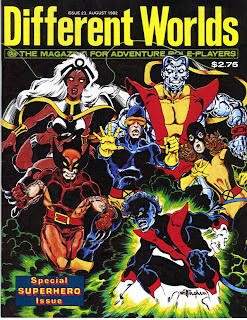
I was particularly impressed with Different Worlds' famously reprinted issue 23.  That issue was a "Special Superhero Issue" that contained articles by the designers of CHAMPIONS, VILLAINS & VIGILANTES, SUPERGAME, SUPERWORLD, and SUPERHERO 2044.  That's right, the designers of all the major superhero rpgs of the time had an article in that issue.  Add to this a cover illustrated by Bill Willingham and stats for the X-men in three different game systems (V&V, Champions, and Superworld) by the game designers, and you have a truly special magazine issue.  I would argue that it is the single best issue of a gaming magazine published to date.


The success of this issue led Tadashi Ehara -- the magazine's editor -- do make the Special Superhero issue a somewhat regular feature, and a year later with issue 30 in September of 1983 the magazine had a special "New Teen Titans" issue.  This issue provides statistics for the New Teen Titans -- Nightwing and crew, though he's still Robin at the time -- for CHAMPIONS, VILLAINS & VIGILANTES, and SUPERWORLD.  Three systems that each handle super powers differently, but that are all workable systems.  The statistical representation of the characters, all done by the system designers, reveal interesting things about the rules themselves.  This is especially true for the character of Changeling.  As a shape shifter, his powers are a challenge to emulate.  How do you design a character who can become any animal?  It's a difficult design question, but one that comes up from time to time in the comics.  It is also a question that eventually led CHAMPIONS to adopt the "Multiform" power, a solution that I've never been fond of.

 http://index.rpg.net/pictures/show-water.phtml?picid=12071

Starting with CHAMPIONS, the character of Changeling is represented as a relatively normal heroic character in his base statistics, but has all of his shapechanging powers in a single 200 point multipower with all of his abilities represented as variable "multi" slots.

133 pts.   200 pt Multipower (+1/4 only reasonable creatures, +1/4 x6 END Battery) 
27m        Growth (200 pts)
  7m        Density Increase (50)
            7m        Flight (50)

It goes on like that to include a number of possible power combinations.  It's a solution, but one that isn't much better than the "multiform" solution later implemented.  I have always liked the use of a multipower in order to simulate this kind of ability, but I prefer one of two options not presented by Steve Peterson here.  First would be the each "animal" is a different "ultra" slot in a multipower.  Thus Gorilla would be one slot and Monkey another.  The other way would be to have several multipowers.  One for offensive abilities, a second for defensive, a third for movement, and a fourth for "variable senses and options."  Any of these can work, but as you can see any version also requires a lot of work by the player to get what they want.

Steve Perrin's SUPERWORLD adaptation was to just give Changeling all of the powers -- heightened strength, shrinking, growth, armor, movement, etc. each with a conditional use modifier of "only in certain shapes."  This is followed by a list of shapes that Changeling can assume: man, bear, cat, bird, canine, snake, elephant, octopus, and so on.  Any animal that he has listed, he can become.  And the GM and player can discuss which powers are appropriate to the form.  This is a pretty good solution, but it also requires bookkeeping with regard to building and then maximizing each form.

Jack Herman in his VILLAINS & VIGILANTES adaptation highlights the "rulings over rules" nature of the V&V system.  In this game, there is not shapechange power that quite captures Changeling's ability.  So Herman gives Changeling the following power:

TRANSFORMATION (Shapeshifter/Creatures): PR for each change equals the square root of the number of Basic Hits possessed by the new form assumed.  Any shape having over 20 Basic Hits cannot be maintained for more than 11 turns.  Smaller shapes have no time limit.  Only creature/animal shapes may be assumed, including intelligent non-human species, but he must be familiar with the creature to copy its shape.
 That's it.  Leaving the player and GM to design each and every animal the player can turn in to.  Other than having to design a lot of animal stats, this is a pretty nice adaptation.  It is also one that Herman had to invent as the power isn't in the rulebook.  That's the nature of V&V though.  House rules rule the day.

When the DC Heroes RPG eventually came out, they represented Changeling in the following way.
                                                                                                                           
He's got stats that are at the high end of normal human ability, except for his Body stat which is quite good.  His shape change power is represented by... well... the shape change power which is as follows:


I am a big fan of the DC Heroes solution.  It is similar to Herman's, but balanced by being a very expensive power to have at high levels, though inexpensive enough for a starting character to purchase it.  It limits abilities to existing animals, and many can be found in the appendix.  Like all of the options though, it does require a player to have a number of character sheets at the ready to represent Changeling in multiple forms.

I think it is interesting how the different games each approached the design challenge that a shape changing character brings.  I don't know that any has a perfect solution.  I like DC Heroes' solution, but only because their underlying AP rules structure means that each numerical value has a very specific meaning.

Friday, September 28, 2012

The Importance of House Rules to Ensure "Fun"

As often happens, is spent a part of last weekend playing games with my twin daughters History and Mystery.  We played a wide variety of games ranging from Candyland to Fantasy Flight Games' Rattlesnake with a little role playing as horses in between.  All of these activities were done not merely for the sake of occupying time, but also to create a sense of enjoyment among the participants.  In short, we were playing these games to have fun.

But how does one go about designing a "fun" game?  One of the reasons there are so many kinds of games (wargames, conflict games, area control games, cooperative games, track games) is because the goals of gamers with regard to what is fun aren't always the same.  Not only are they different among different people, but they are different for the same individual at different times.  For example, there are times when I want to play a little Battletech just to get out some aggression through robot vs robot conflict, but there are other times when I want to journey through Mirkwood with the help of my friend Jason in a cooperative fashion while playing Fantasy Flight's Lord of the Rings Living Card Game.  And those are just two of my moods.

I've also learned from playing with History and Mystery that sometimes the game's rules aren't the most fun way to use the game's components.  Let me just say that History and Mystery never cease to amaze me with regard to how they look at the world.  The other day, I had BURN NOTICE on in the background while they were coloring.  History looked up and saw the skyscraper condos overlooking the water and we had the following conversation:

HISTORY: That's pretty.  Where is that daddy?
ME: That, oh, that's Miami.
 HISTORY: Why is it YOUR ami?
ME: (Laughing) No...it's not My ami, it's not Your ami, it's Miami.
MYSTERY: It's not Your ami, or History's ami, but is it My ami?
I laughed for hours at the way their minds worked on that one.  It still makes me laugh.  I understood what they were getting at, and why they would mistake "Miami" for "My ami," but the way they are processing the information is hilarious.  I do think I was finally able to convey that it was just the name of the city...

At least I think so.

The point is that History and Mystery sometimes look at things differently than I do, and when this is combined with what they constitute as fun it leads to some enjoyable house rules.

Let's take our game of Rattlesnake as an example.  It's a simple game that comes with 12 very strong magnets that the players are trying to get rid of, and the first to do so wins the game.  The players roll a die and it tells them what color snake they have to set their egg upon.  If that egg disturbs another egg and they collide, then you have to pick up all the eggs that collided and have failed to get rid of any.  The magnets are very strong and the board is small, so this game can get pretty zany.


As written, I like the game and History and Mystery hate it.  You see "losing all your magnets" isn't fun for them.  What IS fun is making the magnets collide and picking them up.  For them, the loser is the first one to "lose" all of their eggs.  They find it fun to acquire the eggs.  What is interesting about this is that the trigger of the fun is the colliding of the magnets, which is one of the things I would argue is fun in the rules as written as well.  It is the fun that is inherent in the components.  The eggs have strong magnets that attract them to one another and they collide with a loud "clack!"  That's great fun.  That's great component fun, and it has nothing to do with the rules.  With regard to what my daughters find fun, the rules as written have an objective diametrically opposed to their fun goal. 

And this is where one sees the real importance of House Rules.  When I was younger, I made house rules to fix "what was wrong" with a game or to do a particular thing "better."  This led to the creation of a number of spell point systems, and no fewer than 5 versions of Superspeed for the DC Heroes role playing game.  At the time, I thought I was fixing the game objectively.  What I didn't understand, was that I was tweaking the rules to fit my fun-jective.  Having feeble Wizards -- regardless of how they matched up with other characters at high levels -- was annoying to me as a fun objective.  I wanted to play Gandalf or Merlin, I didn't want to be the apprentice in DRAGONSLAYER.  That just didn't seem fun to me, and the rules disagreed with that fun.  I liked the components of D&D -- the odd dice, the miniatures, and the rolling of 5 or 6 dice when casting fireball -- those were all fun activities.  Heck, one of the reasons I love Champions is the opportunity to roll handfuls of dice.  That's just a good time.  My fun goal and the fun goal of the game weren't lined up, even though the fun inherent in using the components was the same. 

Eventually, I learned to have a flexible definition of fun and to allow individual games to set the "magic circle" of what fun is being attempted.  In doing so, I've come to appreciate design efforts I might otherwise have overlooked.  Setting aside my personal fun-jectives from time to time leads to enjoyable experiences.  Heck, my journey as a game master in roleplaying games has gone from grudging acceptance to joy as I came to view the GM "fun" rule to be "Losing the game in a dramatic way is the job of the Game Master."  If you are losing properly, then the players are having fun.  The key here is "in a dramatic way."  There needs to be risk for the players, and character death must be an option.  But it's like a TV show, in that you know the protagonists will usually win out...not always, but usually... and they'll rarely die.  It depends on the game and the expectations, but players rarely enjoy investing time in creating a persona only to have it die as the GM laughs at how pathetic they are.  Though that can be fun from time to time too.

History and Mystery have reminded me of how important it is sometimes to forget what the fun being attempted by a game is, and to see what kind of fun the components of the game are advocating.  It was a nice refresher course for me, and it reminded me why I have all those Heroscape boxes lying around the house.