Thursday, December 20, 2012

Roleplaying and Player vs. Player Conflict


Everyone who has played a role playing game has at some point experienced sessions, or even campaigns, that contain Player vs. Player conflict.  When it comes to MMORPGs, there are some who claim that Player vs. Player is their favorite mode of play.  There are even Pen and Paper RPGs that have Player vs. Player treachery as the primary motivating factor for the game -- PARANOIA I'm looking at you.  There is definitely a time and a place for PvP play, it can be highly rewarding.  Much of the game industry is based on the assumption that the players will be playing against one another and not cooperatively.

One of the major innovations of RPGs was that they stressed player cooperation rather than competition.  A fact that many DMs didn't take enough to heart in the early days.  Which brings to mind how important it is to understand what your players expect from a game, and how to set expectations to minimize disappointment if a group has decided to embark on a PvP campaign experience.  After all, who hasn't lost a friend or two over a game of DIPLOMACY due to a breaking of that game's "magic circle" when someone used real world commitments/obligations to shape outcomes in the game.


Which brings me to the point of this post.  Player vs. Player conflict can be great in a game, but "inner party" strife can ruin a game.  If the players of a game are expecting this: 


And they get this as a part of adventure design:


You can end up with some very disappointed players.

I recently had this occur during a recent season of D&D Encounters (The Council of Spiders adventure).  The module is set up so that the characters distrust one another and have conflicting objectives.  To add to the intraparty conflict, WotC released "Treachery" cards that can be used during play.  The treachery cards cause bad things to happen to your fellow players -- or take advantage of bad things already happening to them -- and give you a benefit.  The intention is to create a sense of paranoia and drama.  It's a decent goal, but it can end with disappointed players.

This is due to a couple of reasons:

  1. Player expectations -- Many people play RPGs because they want a collaborative experience where they work with others to achieve objectives.
  2. Mary Sue Syndrome -- The descriptor might sound derogatory.  Don't take it that way.  Many players are playing romanticized versions of themselves.  This is true even when they aren't playing a character who seems remotely like themselves.  Players care about their characters and they want control over them.  When PvP erupts in an RPG it often makes a player feel threatened...and by other players no less.  This can lead "at the table" conflict to leave the magic circle of play and bleed over into real life.  This isn't good, and unless you're playing PARANOIA this is a real risk.  Let me restate this again.  Players play characters again and again because they like them.  If they perceive that character is being directly threatened, they may take it as a slight against themselves.
  3. Most Players Don't Really Suspend Disbelief -- What separates good actors from bad actors?  One trait is the ability of good actors -- even ones who aren't "transformed" in each role -- is there ability to immerse themselves in a role and completely separate themselves from the actions of the character.  Most gamers aren't good actors.  The veil of suspended belief is thin.  They are usually not roleplaying.  They often take "roleplayed" moments more seriously than they should.  As a DM, I have roleplayed NPCs who were jerks to one or more players.  I have often had to go out of my way to let players -- who thought I was beating up on them -- know that it was only the character behaving this way, that I was acting.  This surprises some players as they expect you to do something like say "so and so says" rather than for you to affect a voice and act it out straight.
  4. Metagaming -- Players will use information they don't have against their peers.  Did the Evil High Priest secretly tell player A to plant evidence that player B was a member of an evil cult?  Guess what.  If there has been time between sessions, player B will begin looking for that evidence.  This is true even if player B would have no idea the planting of evidence is occurring.  They will act on player information and be hurt when they are called on it.  Why?  See #3 and #4. Ask me about a Vampire LARP experience regarding this kind of conflict where players teamed up against a storyteller's character -- an Antediluvian Settite -- because characters were acting on player knowledge.   They had a big gathering.  Every vampire in the session knew the guy was a Settite.  Everyone.  Even though his power was to make people do stuff without knowing who told them to or why.  They were supposed to think it was their own idea.  It took some very skilled ad libbing from a co-storyteller to transform the narrative into making this "trial" the key piece of action.  The action was supposed to be around the Prince.  But people didn't want to "hurt" their friends, so they acted on player knowledge and reworked a whole narrative.  It worked.  No one's feelings were hurt, but it was still a mess. 
In my opinion, Player vs. Player conflict can be a powerful narrative tool.  After all, the source of all DRAMA is conflict.  Thing is in player vs. player conflict -- that isn't entirely pre-scripted and then acted out line by line by actors but is actually played -- things can get messy.  They often do get messy.  I would argue that setting up cases of player conflict should be rare.  I might even recommend avoiding them altogether.  You'll have a happier table, even if it is one that misses out on some "dramatic opportunities."

Tuesday, December 11, 2012

MAN OF STEEL -- Does Zack Snyder Get It?

If the most recent trailer for the new Superman film MAN OF STEEL is any indication, the answer is a resounding YES!

I have long argued that Superman is my favorite character because he is the most complex of all superheroes.  He isn't merely the first, he is the most interesting.  He has layers and layers.

To often authors and illustrators focus on what Superman can "do" and not "why" he does it or "what" he needs.  Superman is the living embodiment of the question Aristotle poses his Politics.  In Book One of THE POLITICS, Aristotle writes about man and society: "But he who is unable to live in society, or who has no need because he is sufficient for himself, must be either a beast or a god: he is no part of a state. A social instinct is implanted in all men by nature, and yet he who first founded the state was the greatest of benefactors. For man, when perfected, is the best of animals, but, when separated from law and justice, he is the worst of all; since armed injustice is the more dangerous, and he is equipped at birth with arms, meant to be used by intelligence and virtue, which he may use for the worst ends."

Like all men, Kal-El has the instinct to live within society.  He desires to be a part of humanity.  It is why he has a secret identity at all.  Superman has no need for a secret identity except as a way to connect himself with "The City."  Unlike Spider-Man and Batman, Superman wears no mask in his heroic identity.  He lets the world see him as he is.  But he knows that his superheroic identity can not be a part of society.  Superman is godlike and disconnected.  He would be naturally rejected by the society.  Not out of spite or fear, though some would feel that way, but out of awe.  Yet Kal-El isn't sufficient in himself.  Yes, he can survive the vacuum of space without protection.  He can survive a nuclear explosion and lift mountains, yet he is alone.  He is the "Last Son of Krypton."  He needs society and the only way he can have that is through the creation of the adult Clark Kent.

Without Clark Kent and the merging with society that persona gives Kal-El, he might well become a beast.  The tragedy is that through the creation and maintaining of Clark Kent as a persona, Superman puts those he loves at greater risk.  Spider-Man's adoption of a secret identity is done to protect Aunt May, and with some exception it does exactly that.  Superman's secret identity puts Lois, Lana, Jimmy, and Ma and Pa Kent at greater risk than otherwise.  Since Superman is a public figure, he could spend all his time in the Fortress of Solitude with no private life.  Villains would attack the Fortress and only attack civilians in typically villainous ways.  By having roots in society Kal-El puts those people at risk of being targeted as individuals due to their connection with him.  Yet he needs them to become fulfilled...to be a part of law and justice...to work with intelligence and virtue.

He is a truly tragic figure, and I have always been moved when writers are able to capture that small part of him.  Sadly, too few capture that conflict.  They are too often trapped by looking only at Superman as mythic figure and not as someone with the social instinct.

The new preview shows a Clark that yearns for that connection, but whose powers not only separate him from society but cause him pain.  Imagine Clark -- the child -- who can hear all the sounds of the world at once pounding into his eardrums.  Every conversation, every tear, every rain drop.  How alone he must feel.  The voice over with Ma Kent reflecting this in the trailer is magnificent.


Monday, December 10, 2012

Jackie Chan's ZODIAC --- Okay, Now I'm Interested

Seeing Jackie Chan in the teaser trailer for ZODIAC, I was really worried.  The luge body suit stunts were impressive, but they were also stiffer and less fluid than a typical Jackie stunt.  I wondered how much of his natural grace had been worn down by the various exertions he has put his body through during his career.

After seeing the extended trailer I still may hope that Jackie is able to enjoy a long and well deserved retirement, but I am no longer worried about him going out with a fizzle.


Thursday, December 06, 2012

Enter Colonel Philip Green or... Gary Mitchell? -- STAR TREK: INTO DARKNESS

I'm beginning to wonder if Cumberbatch's character in the upcoming STAR TREK: INTO DARKNESS is either Colonel Philip Green or Gary Mitchell. There has been some talk about how the villain cannot be Gary Mitchell of late, even though the initial leak was that it was Mitchell.

Watching the teaser trailer, I'm torn between whether it is Green or Mitchell and leaning heavily toward Mitchell.  It looks like the crew explores a new planet with strange plants, there is a blond character very reminiscent of Sally Kellerman's character Dr. Elizabeth Dehner, and Cumberbatch does some pretty superhuman feats in the clips below. 


Oh, and you see him wearing a Star Fleet uniform.


If it is Mitchell, I'll be geeking out pretty hard as Where No Man Has Gone Before is possibly my favorite Star Trek episode.


Tuesday, December 04, 2012

Knights of Pen & Paper: Good Idea, but...

As a member of Generation X, I am a fan of "meta" media that is well done.  The initial trailer for the Behold Studios game "Knights of Pen & Paper" makes the game look like it could have been one of those beautiful meta moments.  It looks like a combination of Phoenix Wright with old school "Dragon Warrior," and that would be a beautiful thing indeed.


Reading through the reviews on iTunes, and looking at the in app purchase price schedule, it becomes quickly apparent that this is a game that hopes to have its profits driven by micro-transactions rather than by raw sales.  This is really too bad, as I think that this game might have some traction as a pure single transaction game with expansion purchases to buy updates similar to Ravenmark.


Alas, it seems that was not meant to be. I would have easily paid $7 to $10 for an excellent meta-rpg, but a micro transaction "buy gold" game?  Not so much.

Wednesday, November 28, 2012

Donnie Yen's Dragon (aka Wu Xia): Watch It

Donnie Yen's latest martial arts film was recently released in the US under the relatively uninformative title DRAGON, a title that brings to my mind thoughts of Bruce Lee and his many classic kung fu films.  It is also a title that does a disservice to the film.  As awe inspiring as Bruce Lee was as a performer, using any of Lee's major works as a reference point is completely off base as the vast majority of Lee's films were of a different film genre than DRAGON.

DRAGON follows in the wuxia tradition in which martial artists live in the world of jiang hu and are inexorably trapped within an epically tragic tale, often a romantic tale.  Think CROUCHING TIGER, HIDDEN DRAGON and you are on the right track.  But DRAGON, directed by Peter Ho-Sun Chan, brings in elements of American Film Noir to the traditional tragic fantasy elements of a typical wuxia film.    DRAGON begins as a murder mystery of a kind, a murder mystery that reveals that Liu Jin-xi (Donnie Yen) is more than the humble paper maker he appears to be.  It is a mystery that ends in proper wuxia tragedy.  It is a heartfelt film with fine emotional beats, even if the martial arts themselves don't quite live up to the remarkable high standards Yen has set of late.  This isn't to say the film isn't beautiful, it is, rather that this isn't a rapid paced actioner.  This is a film of investigations, fear of the loss of a mundane life, and tragedy.  It has some echoes of the Shaw Brothers classic ONE ARMED SWORDSMAN, but is entirely its own creation.

Given the narrative tensions of the film, I wouldn't have marketed the film under the title DRAGON.  I would have based the title on the original title Wu Xia, a term that literally means "martial hero."  Given the connotations of honor in the phrase, I would have called the film AN HONORABLE MAN.  The title would then echo the tensions in the movie and provided context for potential viewers.  Is Liu Jin-xi an honorable man?  Has he always been an honorable man?  Will he leave the tale an honorable man?  These are the questions the audience faces as they watch the film.  They are questions worth asking and the investigations of Takeshi Kaneshiro's character answer only one of these questions.  The answer to the others are revealed through the subtleties of Donnie Yen's performance.


Wednesday, October 31, 2012

Disney + Marvel + Lucasfilm = ???

Yesterday it was announced that Disney would be buying Lucasfilm and that they would begin production on Episode 7 of the STAR WARS franchise.  The interwebonetosphere was abuzz with Gen-Xers in awe of how quickly Disney, under Bob Iger has moved to collect a good percentage of their childhood loves under one corporate banner.  Disney now owns the Marvel catalog of Super Heroes, the Star Wars Franchise, Indiana Jones, in addition to their own creations.  It's quite an array of IP.

My Geekerati co-host Shawna Benson mentioned how anyone who has been to Disneyland and walked through the Star Tours store could plainly see this was a natural move for Disney corporation.  Think of how many toy aisles will be filled with Disney owned action figures... Star Wars, Marvel, Princesses, Princes, Beauties, Beasts, Jake, Tinkerbell.  Good grief!

All of this analysis misses one key point, the real reason that Disney purchased Lucasfilm.  Lost in the annals of film, there is a highly underrated cinematic masterpiece that was produced by Lucasfilm in the 80s.  It has largely been forgotten.  Lucas himself attempted to Jedi mindtrick the entire human race to forget of its existence. 

No, I'm not talking about the STAR WARS HOLIDAY SPECIAL.  I'm referring to a Marvel property.

With the acquisition of both Marvel and Lucasfilms, Bob Iger has enabled Disney to overcome the legal morass preventing an updating of the greatest film of all time...

HOWARD THE DUCK!


I can see it now.  Howard the Duck taking over Toon Town.  A Howard the Duck inserted into the Indiana Jones ride.  A Howard the Duck journey on Star Tours.  A retheming of Splash Mountain to Duck Mountain.  Howard the Duck being made a canonical member of the Duck Tales verse.

You heard it here first.


[The above is not serious, it is a joke.  No one believes that HtD was a good movie.]

Tuesday, October 30, 2012

A Halloween Toast!

Because it's so difficult to get young children to eat toast and cheese, it being such an unnatural and un-kid-friendly snack...

Okay, I just like Halloween, and holidays, and any time I can holiday up a staple like toast, I'm gonna do it.  This food "craft" if you will, is fast, super easy, and turns out pretty well with any level of creative skill.  You'll need bread, a toaster oven, and orange cheese that can melt (the orange cheese that turns to industrial plastic liner when heated -- and you know what I mean, because we've all had it, and some of us like it -- will not do).

Arrange your bread.  Before applying cheese, round it by trimming the corners with a small knife.  Then cut eyes and a nose with the same knife.  For the mouth, the easiest thing to do is cut the large shape of the mouth, then cut and add teeth after (remember, this is going to melt together, so it will look like one big pumpkin jack-o-lantern face as long as the edges overlap or meet).  Arrange your cheesy "face" on the bread and pop it in the toaster oven.


The result is yummy, cheesy fun.  It's a great way to add a little kid-fun and holiday cheer to your average soup or munchy snack.  Pictured here is a whole wheat bread and mild cheddar cheese.  A dark rye or pumpernickel will offer more contrast and really make that pumpkin grin stand out!  Our preschoolers are always smiles to find faces staring back at them from their plates.  I'm not sure if that's funny or frightening, but since either is welcome at Halloween, bon appetite! 


Monday, October 29, 2012

Halloween and Jack-Egg-Lanterns

Halloween has become a month-long celebration in our house (partly because it seems to take that long just to locate, unpack and put up all the varied decorations and do-dads).  We've always been fans of the holiday and holidays in general and are always on the lookout for new, fun (and best-of-all inexpensive!!!) ways to celebrate, decorate or both!  With our girls in preschool now (and desperately eager to help with every thing), it was important we find as many kid-friendly activities and crafts we could this year.

Enter the Halloween Jack-Egg-Lantern. 


We're surely not the first to think of this when we saw all those egg coloring kits go on sale last spring.  Our twins had such a great time decorating eggs this year -- and eating the hardboiled goodness! -- I nabbed a couple extra packs from the clearance bins to use at upcoming off-season events.  

With two girls and four fast hands to keep busy, one orange packet of dye was not going to be enough.  So to keep four hands busy and keep two imaginations working, we combined the red, yellow and pink colorings to make multiple shades of "pumpkin."  I think next time a drop or two of purple would also make a deeper color.  Green and purple are great Halloween colors anyway, and we could have done more to make Goblin or Frankenstein eggs or Purple Monster eggs...  Okay, all the better for next time.  This time, we focused on the pumpkin.  Some turned out more pinky-orange, a few more yellowy-orange, but overall we got a good blend and loved the results!
 

Some turned out more pinky-orange, a few more yellowy-orange, but overall we got a good blend.  For special egg-fects, we experimented with the usual techniques like mulit-color dipping and striping our "pumpkin" eggs with white, clear, and black crayons to add dimension and texture.  Looking back, red or dark orange crayon might do even better, especially pre-heated to give the lines more solid consistency.  


Our most vivid Jack-Egg-Lantern faces were achieved with a Sharpie, though the black crayon also turned out well.  Maybe next time we'll go with yellow wax for the faces and a deep orange for the dye to create that lit-from-within illusion.  

I think the most important part of this trial egg run is that it's a simple craft with a-typically healthy and edible results that offered great opportunities for a lot of peripheral fun, like practicing our scary faces (see below).  Have a spook-tacular Halloween!


Thursday, October 25, 2012

There Can Be No Halloween Season Without Vincent Price

I'll let my wife's Nicnup cartoon give us the break down of how important Vincent Price (May 27, 1911 – October 25, 1993) was and will always be to the Halloween season.


EVIL DEAD (1981) vs. EVIL DEAD (2013)

While it will be years until I will feel comfortable sharing my love of the EVIL DEAD series with History and Mystery, I am intrigued by the new Red Band trailer for the upcoming remake of the first EVIL DEAD film.

Raimi's first EVIL DEAD movie was more horror than horror/comedy, though the series itself is among the best horror/comedy, and it looks like the upcoming film is leaning more in that direction. The casting of young Jane Levy in the "Ash" role does hint that the film won't be completely absent of any humor.

Have a look at the 1981 trailer and the trailer for the new film and feel free to share your thoughts. My thoughts? The first trailer definitely shows its age, and the new trailer is of a film I'd like to see.


One thing is certain. I think I'm going to have to dig up my ARMY OF DARKNESS RPG.

Monday, October 22, 2012

David Lo Pan Style: Big Trouble in Little China meets PSY

As many of you know, I am of the opinion that John Carpenter's Big Trouble in Little China may well be the best film ever made.  Okay, that's an exaggeration, but you know the way that some Gen-Xers constantly reference Star Wars or Star Trek in conversation?  I'm that way with BTiLC.  I lost count of how many times I have watched the film a decade ago.

The film combines everything I love from Western genre film, Shaw Brothers over the top acting, and post-Tsui Hark Hong Kong cinematography and action.  In short, it is all things great about film that aren't in Singin' in the Rain.

BTiLC doesn't need a remake, but it does need more awesome fan creations like this.  If only Dennis Dun managed a cameo in the video.


If you don't like this video, you must be monumentally naive or already living in the Hell of Lacking a Sense of Style or Humor.  What can I say?  The Chinese have a lot of hells.

Tuesday, October 16, 2012

[Vintage RPGs] CHAMPIONS 1st Edition -- A Blast from the Past

The CHAMPIONS super hero role playing game is one of the best super hero role playing games ever designed, and the game to which all super hero rpgs are compared.  CHAMPIONS wasn't the first role playing game in the super hero genre, that honor goes to the game SUPERHERO 2044 which I discussed in an earlier blog post.  CHAMPIONS even builds upon some of the ideas in SUPERHERO 2044.  CHAMPIONS used the vague point based character generation system of SUPERHERO 2044 -- combined with house rules by Wayne Shaw -- as a jumping off point for a new detailed and easy to understand point based system.  CHAMPIONS was also likely influenced by the melee combat system in SUPERHERO 2044 in the use of the 3d6 bell curve to determine "to-hit" rolls in combat.


While CHAMPIONS wasn't the first super hero rpg, it was the first that presented a coherent system by which a player could design the superheroes they read about in comic books.  The first edition of VILLAINS & VIGILANTES, which predates CHAMPIONS, did a good job of emulating many aspects of comic book action but the ability to model a character in character design wasn't one of them.  CHAMPIONS was released at the Origins convention in the summer of 1981, and it immediately captured the interest of Aaron Allston of Steve Jackson Games.  Allston gave CHAMPIONS a positive review in issue #43 of the Space Gamer magazine, wrote many CHAMPIONS articles for that publication, and became one of the major contributors to the early days of CHAMPIONS lore.

Reading through the first edition of the game, as I have been doing the past week, can have that kind of effect upon a person.  The writing is clear -- if uneven in places -- and the rules mechanics inspire a desire to play around in the sandbox provided by the rules.  George MacDonald and Steve Peterson did more than create a great role playing game when they created CHAMPIONS, they created a great character generation game as well.  Hours can be taken up just playing around with character concepts and seeing how they look in the CHAMPIONS system. 

There are sites galore about CHAMPIONS and many reviews about how great the game is, and it truly is, so the remainder of the post won't be either of these.  Rather, I would like to point out some interesting tidbits about the first edition of the game.  Most of these will be critical in nature, but not all.  Before going further I will say that though CHAMPIONS is now in its 6th edition and is a very different game today in some ways, the 1st edition of the game is highly playable and well worth exploring.

  • One of the first things that struck me reading the book was how obviously playtested the character design system was.  This is best illustrated in the section under basic characteristics.  In CHAMPIONS there are primary and secondary characteristics.  The primary characteristics include things like Strength and Dexterity.  The secondary statistics are all based on fractions of the primary statistics and represent things like the ability to resist damage.  Where the playtesting shows here is in how players may buy down all of their primary statistics, but only one of their secondary statistics.  A quick analysis of the secondary statistics demonstrates that if this were not the case a buy strength then buy down all the secondary stats related to strength infinite loop would occur.  
  • It's striking how few skills there are in 1st edition CHAMPIONS.  There are 14 in total, and some of them are thinks like Luck and Lack of Weakness.  There are no "profession" skills in 1st edition.  To be honest, I kind of like the lack of profession skills.  Professions in superhero adventures seem more flavor than something one should have to pay points for, but this is something that will change in future editions.  
  • There are a lot of powers in CHAMPIONS, but the examples are filled with phrases like "a character" or "a villain" instead of an evocative hero/villain name.  It would have been more engaging for the folks at Hero Games to create some Iconic characters that are used throughout the book as examples of each power.  The game does include 3 examples of character generation (Crusader, Ogre, and Starburst), but these characters aren't mentioned in the Powers section.  An example using Starburst in the Energy Blast power would have been nice.
  • The art inside the book is less than ideal.  Mark "the hack" Williams has been the target of some criticism for his illustrations, but his work is the best of what is offered in the 1st edition book.  It is clear why they decided to use his work in the 2nd edition of the game.  Williams art is evocative and fun -- if not perfect -- while the work Vic Dal Chele and Diana Navarro is more amateurish.
  • The game provides three examples of character generation, but the designs given are less than point efficient and one outclasses the others.  The three sample characters are built on 200 points.  Crusader can barely hurt Ogre if he decides to punch him (his punch is only 6 dice), and his Dex is bought at one point below where he would receive a rounding benefit.  Ogre has a Physical Defense of 23.  This is the amount of damage he subtracts from each physical attack that hits and it is very high.  Assuming an average of 3.5 points of damage per die, Ogre can resist an average of 6.5 dice of damage per attack.  Yes, that's an average but the most damage 6 dice could do to him would be 13.  That would be fine, except Crusader has that 6d6 punch, and Starburst...oh, Starburst.  All of Starburst's major powers are in a multipower which means that as he uses one power he can use less of the other powers in the multipower.  The most damage he can do is 8d6, but only if he isn't flying and doesn't have his forcefield up.  Not efficient at all.  One might hope that character examples demonstrate the appropriate ranges of damage and defense, these don't quite achieve that goal.
  • The combat example is good, if implausible.  Crusader and Starburst defeating Ogre?  Sure.
  • The supervillain stats at the end of the book -- there are stats for 8 villains and 2 agents -- lack any accompanying art.  The only exception is Shrinker.  
  • Speaking of artwork and iconics.  Take that cover.
  • Who are these people?!  I want to know.  The only one who is mentioned in the book is Gargoyle.  It's pretty clear which character he is, but I only know his name because of a copyright notice.  Who are the other characters?  Is that "Flare"?  Someone once told me the villain's name was Holocaust, but that could just be a Bay Area rumor.  If you know, please let me know.  I'd love to see the stats for that guy punching "Holocaust" with his energy fist.
CHAMPIONS is a great game, and the first edition is a joy.  If you can, try to hunt down a copy and play some old school super hero rpg.


Thursday, October 04, 2012

[Superhero RPGs] Changling of the Teen Titans: The Same Hero in Different Systems

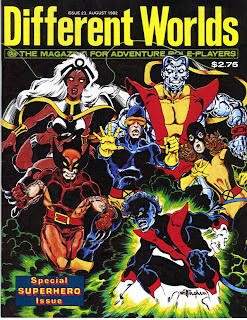
Those of you who read this blog on a regular basis know that  I consider Different Worlds magazine to be one of the great publications of what James Maliszewski calls the Golden Age of D&D.  The magazine ran from 1979 to 1987.  It was initially published by Chaosium, then by Sleuth Publications, and finally by Different Worlds Publications.  Two of those companies are still around today, and one is going very strong.

I was particularly impressed with Different Worlds' famously reprinted issue 23.  That issue was a "Special Superhero Issue" that contained articles by the designers of CHAMPIONS, VILLAINS & VIGILANTES, SUPERGAME, SUPERWORLD, and SUPERHERO 2044.  That's right, the designers of all the major superhero rpgs of the time had an article in that issue.  Add to this a cover illustrated by Bill Willingham and stats for the X-men in three different game systems (V&V, Champions, and Superworld) by the game designers, and you have a truly special magazine issue.  I would argue that it is the single best issue of a gaming magazine published to date.


The success of this issue led Tadashi Ehara -- the magazine's editor -- do make the Special Superhero issue a somewhat regular feature, and a year later with issue 30 in September of 1983 the magazine had a special "New Teen Titans" issue.  This issue provides statistics for the New Teen Titans -- Nightwing and crew, though he's still Robin at the time -- for CHAMPIONS, VILLAINS & VIGILANTES, and SUPERWORLD.  Three systems that each handle super powers differently, but that are all workable systems.  The statistical representation of the characters, all done by the system designers, reveal interesting things about the rules themselves.  This is especially true for the character of Changeling.  As a shape shifter, his powers are a challenge to emulate.  How do you design a character who can become any animal?  It's a difficult design question, but one that comes up from time to time in the comics.  It is also a question that eventually led CHAMPIONS to adopt the "Multiform" power, a solution that I've never been fond of.

 http://index.rpg.net/pictures/show-water.phtml?picid=12071

Starting with CHAMPIONS, the character of Changeling is represented as a relatively normal heroic character in his base statistics, but has all of his shapechanging powers in a single 200 point multipower with all of his abilities represented as variable "multi" slots.

133 pts.   200 pt Multipower (+1/4 only reasonable creatures, +1/4 x6 END Battery) 
27m        Growth (200 pts)
  7m        Density Increase (50)
            7m        Flight (50)

It goes on like that to include a number of possible power combinations.  It's a solution, but one that isn't much better than the "multiform" solution later implemented.  I have always liked the use of a multipower in order to simulate this kind of ability, but I prefer one of two options not presented by Steve Peterson here.  First would be the each "animal" is a different "ultra" slot in a multipower.  Thus Gorilla would be one slot and Monkey another.  The other way would be to have several multipowers.  One for offensive abilities, a second for defensive, a third for movement, and a fourth for "variable senses and options."  Any of these can work, but as you can see any version also requires a lot of work by the player to get what they want.

Steve Perrin's SUPERWORLD adaptation was to just give Changeling all of the powers -- heightened strength, shrinking, growth, armor, movement, etc. each with a conditional use modifier of "only in certain shapes."  This is followed by a list of shapes that Changeling can assume: man, bear, cat, bird, canine, snake, elephant, octopus, and so on.  Any animal that he has listed, he can become.  And the GM and player can discuss which powers are appropriate to the form.  This is a pretty good solution, but it also requires bookkeeping with regard to building and then maximizing each form.

Jack Herman in his VILLAINS & VIGILANTES adaptation highlights the "rulings over rules" nature of the V&V system.  In this game, there is not shapechange power that quite captures Changeling's ability.  So Herman gives Changeling the following power:

TRANSFORMATION (Shapeshifter/Creatures): PR for each change equals the square root of the number of Basic Hits possessed by the new form assumed.  Any shape having over 20 Basic Hits cannot be maintained for more than 11 turns.  Smaller shapes have no time limit.  Only creature/animal shapes may be assumed, including intelligent non-human species, but he must be familiar with the creature to copy its shape.
 That's it.  Leaving the player and GM to design each and every animal the player can turn in to.  Other than having to design a lot of animal stats, this is a pretty nice adaptation.  It is also one that Herman had to invent as the power isn't in the rulebook.  That's the nature of V&V though.  House rules rule the day.

When the DC Heroes RPG eventually came out, they represented Changeling in the following way.
                                                                                                                           
He's got stats that are at the high end of normal human ability, except for his Body stat which is quite good.  His shape change power is represented by... well... the shape change power which is as follows:


I am a big fan of the DC Heroes solution.  It is similar to Herman's, but balanced by being a very expensive power to have at high levels, though inexpensive enough for a starting character to purchase it.  It limits abilities to existing animals, and many can be found in the appendix.  Like all of the options though, it does require a player to have a number of character sheets at the ready to represent Changeling in multiple forms.

I think it is interesting how the different games each approached the design challenge that a shape changing character brings.  I don't know that any has a perfect solution.  I like DC Heroes' solution, but only because their underlying AP rules structure means that each numerical value has a very specific meaning.

Friday, September 28, 2012

The Importance of House Rules to Ensure "Fun"

As often happens, is spent a part of last weekend playing games with my twin daughters History and Mystery.  We played a wide variety of games ranging from Candyland to Fantasy Flight Games' Rattlesnake with a little role playing as horses in between.  All of these activities were done not merely for the sake of occupying time, but also to create a sense of enjoyment among the participants.  In short, we were playing these games to have fun.

But how does one go about designing a "fun" game?  One of the reasons there are so many kinds of games (wargames, conflict games, area control games, cooperative games, track games) is because the goals of gamers with regard to what is fun aren't always the same.  Not only are they different among different people, but they are different for the same individual at different times.  For example, there are times when I want to play a little Battletech just to get out some aggression through robot vs robot conflict, but there are other times when I want to journey through Mirkwood with the help of my friend Jason in a cooperative fashion while playing Fantasy Flight's Lord of the Rings Living Card Game.  And those are just two of my moods.

I've also learned from playing with History and Mystery that sometimes the game's rules aren't the most fun way to use the game's components.  Let me just say that History and Mystery never cease to amaze me with regard to how they look at the world.  The other day, I had BURN NOTICE on in the background while they were coloring.  History looked up and saw the skyscraper condos overlooking the water and we had the following conversation:

HISTORY: That's pretty.  Where is that daddy?
ME: That, oh, that's Miami.
 HISTORY: Why is it YOUR ami?
ME: (Laughing) No...it's not My ami, it's not Your ami, it's Miami.
MYSTERY: It's not Your ami, or History's ami, but is it My ami?
I laughed for hours at the way their minds worked on that one.  It still makes me laugh.  I understood what they were getting at, and why they would mistake "Miami" for "My ami," but the way they are processing the information is hilarious.  I do think I was finally able to convey that it was just the name of the city...

At least I think so.

The point is that History and Mystery sometimes look at things differently than I do, and when this is combined with what they constitute as fun it leads to some enjoyable house rules.

Let's take our game of Rattlesnake as an example.  It's a simple game that comes with 12 very strong magnets that the players are trying to get rid of, and the first to do so wins the game.  The players roll a die and it tells them what color snake they have to set their egg upon.  If that egg disturbs another egg and they collide, then you have to pick up all the eggs that collided and have failed to get rid of any.  The magnets are very strong and the board is small, so this game can get pretty zany.


As written, I like the game and History and Mystery hate it.  You see "losing all your magnets" isn't fun for them.  What IS fun is making the magnets collide and picking them up.  For them, the loser is the first one to "lose" all of their eggs.  They find it fun to acquire the eggs.  What is interesting about this is that the trigger of the fun is the colliding of the magnets, which is one of the things I would argue is fun in the rules as written as well.  It is the fun that is inherent in the components.  The eggs have strong magnets that attract them to one another and they collide with a loud "clack!"  That's great fun.  That's great component fun, and it has nothing to do with the rules.  With regard to what my daughters find fun, the rules as written have an objective diametrically opposed to their fun goal. 

And this is where one sees the real importance of House Rules.  When I was younger, I made house rules to fix "what was wrong" with a game or to do a particular thing "better."  This led to the creation of a number of spell point systems, and no fewer than 5 versions of Superspeed for the DC Heroes role playing game.  At the time, I thought I was fixing the game objectively.  What I didn't understand, was that I was tweaking the rules to fit my fun-jective.  Having feeble Wizards -- regardless of how they matched up with other characters at high levels -- was annoying to me as a fun objective.  I wanted to play Gandalf or Merlin, I didn't want to be the apprentice in DRAGONSLAYER.  That just didn't seem fun to me, and the rules disagreed with that fun.  I liked the components of D&D -- the odd dice, the miniatures, and the rolling of 5 or 6 dice when casting fireball -- those were all fun activities.  Heck, one of the reasons I love Champions is the opportunity to roll handfuls of dice.  That's just a good time.  My fun goal and the fun goal of the game weren't lined up, even though the fun inherent in using the components was the same. 

Eventually, I learned to have a flexible definition of fun and to allow individual games to set the "magic circle" of what fun is being attempted.  In doing so, I've come to appreciate design efforts I might otherwise have overlooked.  Setting aside my personal fun-jectives from time to time leads to enjoyable experiences.  Heck, my journey as a game master in roleplaying games has gone from grudging acceptance to joy as I came to view the GM "fun" rule to be "Losing the game in a dramatic way is the job of the Game Master."  If you are losing properly, then the players are having fun.  The key here is "in a dramatic way."  There needs to be risk for the players, and character death must be an option.  But it's like a TV show, in that you know the protagonists will usually win out...not always, but usually... and they'll rarely die.  It depends on the game and the expectations, but players rarely enjoy investing time in creating a persona only to have it die as the GM laughs at how pathetic they are.  Though that can be fun from time to time too.

History and Mystery have reminded me of how important it is sometimes to forget what the fun being attempted by a game is, and to see what kind of fun the components of the game are advocating.  It was a nice refresher course for me, and it reminded me why I have all those Heroscape boxes lying around the house.


Wednesday, September 19, 2012

Play Like A Pirate -- Or if You're Going to Talk Like a Pirate, Go Big!

In 2008, I began advocating that people should celebrate "Play Like a Pirate Day" rather than participate in "Talk Like a Pirate Day." My contention was that one of the most irritating things you can hear your co-workers say is, "Aaaargh, Avast, Ye Mateys" a couple times an hour in some half-hearted participation in a day of international live action role playing. Even worse are the inconsistent uses of "Yar!"

What makes it most irritating is the fact that these small offering of participation are lackadaisical at best.

I would rather my co-worker show up dressed in full "Age of Sail" apparel, blunderbuss and cutlass in hand, and charge into the office while staying in character as much as is possible for the day.  A wholehearted celebration of Talk Like a Pirate Day, I can get behind.  It would be fun, in the "employees showing up to work in costumes on Halloween" kind of way. You know... like when a person comes to work in their full blown Optimus Prime costume -- one where they can actually "transform" from robot to big rig.  Things like that create moments where you are truly impressed with your co-workers commitment. On the other hand, when your other co-worker shows up with only a pair of "cat ears" on and a mild scowl on their face, it's annoying. 

Most participation in International Talk Like a Pirate Day is of the cat ear type, and not the Optimus Prime type. That's why I still believe that it is time for the phenomenon to die. That doesn't mean that we should no longer have a day "celebrating" piracy and the outlaw attitude, or as the founder of Talk Like A Pirate Day called it "Piratitude." Pirates are still awesome (though not as awesome as Transforming Psionic Robot Pirate Ninja Dinosaur Mutant Demon Hunting Vampires), it's just that talking like a pirate that is lame. I think gamers, and geeks of all kinds, should lay claim the holiday and re-cast it as "International Play Like A Pirate Day." That way the costume role players can  cosplay pirate and other people can play pirate themed games, read pirate themed novels, or watch pirate themed films.

As I wrote a couple of yeas ago, "from now on September 19th will be a day when families and friends get together and enjoy some form of Piratical Recreation. Such recreation can include celebrating by talking like pirates, certainly role play (in the traditional sense) is play. Our celebration is inclusive, not exclusive. But families and friends will no longer be limited to listening to the 'yars' and 'aaarghs' of everyone around them. Some might choose more formal ludographic participation -- that's game play."

Here is a list of recommended activities for this year's festivities -- thankfully the Day doesn't fall on a Weekday this year:

1) Play a pirate themed roleplaying game. In particular, we recommend Pinnacle Entertainment Group's excellent PIRATES OF THE SPANISH MAIN. This is highly recommended for those who want to talk like a pirate. It encourages such behavior in an appropriate venue. Besides, by role playing (in the game sense) participants can act far more Piratical than is allowed under modern mores and laws.

If you want a more heroic bent with mystical aspects, you can always play Pinnacle's 50 Fathoms instead.


2) If you own a copy -- and not many do -- play an exciting session of the classic Broadsides and Boarding Parties


If you don't own a copy of Broadsides, try one of these two excellent pirate games from GMT Games.

3) Blackbeard: The Golden Age of Piracy. The game is a redesign of Avalon Hill's classic game of the same name. The new version is suitable for 1 to 5 players and has less "down time" for players who aren't in their current turn.


4) Winds of Plunder is a quick and fun game that is more in the style of the "Eurogame" than Blackbeard or Broadsides.


5) You can play the previously reviewed Sword and Skull.


6) Lastly, we recommend watching one of your favorite pirate films.  Personally, I'm going to watch CAPTAIN BLOOD with Errol Flynn today, and maybe a PIRATES OF THE CARIBBEAN film.


Or you can sing "For I am a Pirate King!"

Monday, September 17, 2012

Star Wars Anime? Sure. Why Not?

The Star Wars community has long been a creative force on the internet, and for the most part Lucas and Co have been very open to the use of the IP in fan created work.

I recently caught wind of a Star Wars anime project being tinkered around with on 4chan.  The project is far from finished, but this video gives a glimpse at the state of the animation -- the video I'm posting has sound that the /m/ animations lacked.


In all, I think that the animation looks good.  One thing struck me about this brief piece though, and that is how much it humanizes the Imperial Pilots.  The Star Wars films have always presented the Storm Troopers and Pilots as faceless and ominous archetypes -- and eventually as weak willed clones with subconscious "Orders" planted within their minds.  This artist, Otaking 77077, has given us a glimpse into the helmets of the pilots, and it changes the point of view in interesting ways.  I found myself rooting for the Imperials in this video.  It was an interesting sentiment to experience, as I'm used to the Empire as antagonists and not protagonists.

A part of me wonders if my point of view would have been different if the Imperials were represented with Zentradi skin tones or blue skin like the residents of Gamilon.

Friday, September 14, 2012

[Book Review] GIANT THIEF -- Where's the Likeable Rogue?

Easie Demasco is a character with whom I am conflicted. On the one hand, he is a witty character who has a well developed sense of humor. One the other hand, he's a jerk -- one who never really becomes more than a jerk. He's also the strongest and most compelling feature of David Tallerman's novel GIANT THIEF (published by Angry Robot Books).


GIANT THIEF is a fairly straight forward tale of:

1) Thief acquires MacGuffin not understanding it's value.
2) Thief meets people who understand value of MacGuffin and seek to use thief in battle against evil.
3) Well...you kind of know the rest.

Often these tales include a heroic journey or follow a bildungsroman format in which our Thief undergoes some major transformation or grows in some way -- usually evolving morally. Not so with GIANT THIEF.   Easie begins the story as a selfish and greedy rogue, and he ends the story as a selfish and greedy rogue with more grandiose plans than before.


Technically,  that does count as some kind of character development, but it lacks the moral evolution that often occurs in these tales.  Easie goes from a petty thief to an individual who seeks to become a master thief. He goes from pick pocket to one who wants to become a Thomas Crown-esque figure, but he lacks the sophisticated charm of a Thomas Crown and has instead a clownish sense of humor.  If one were to cast Easie for a film, one would look more to comedic talent than to cool sexuality.  He's more Daffy Duck than Han Solo.

There are quite a few clumsy moments in the book and the chapters establish and follow a  predictable rhythm. One is tempted to say that the book is one that isn't to be recommended based on these flaws, as they are often fatal to good storytelling. And yet...

I keep finding myself wanting to throttle Easie Damasco, or watch him get caned, or at least have a long talk with him to wake him up and set him on a more moral path. I keep finding myself imagining conversations with him.

All of which means that Tallerman has achieved something that is often rare within a novel, he's created a realistic character who lingers in ones mind weeks after a book has been read. That is a good thing indeed. If only Easie were more likeable. He's a rogue and a scoundrel...and that's it. He's not loveable. He's not nice. He doesn't harbor a hidden heroic heart. But he is interesting and I want to know more about him


[Gaming Notes -- Contains a minor Spoiler]

The book's MacGuffin and interpretation of Giants are perfectly suited for adaptation to the gaming table.  The MacGuffin is a non-magical stone sacred to the Giants that signifies who is the Giant's chief.  In Giant society the orders of the chief must be followed without question, even if they violate the morality of the tribe members.  The Giants in this case are gentle pacifist vegetarians, but they are asked to do some terrible things.  All of which could make for a compelling and morally complex D&D adventure.

You can play with PC preconceptions regarding Giants and slowly introduce them to the moral complexity of the situation.  How many Giants will the players defeat, or even kill, before they discover the secret of the stone?  How will they feel about their actions later.

These are good questions, that can make for a rewarding adventure as well.

Thursday, September 13, 2012

[Gaming Library] Aaron Allston's STRIKE FORCE: A Must Own GM Resource

At the Origins convention in 1981 Hero Games released what would become one of the best selling super hero role playing games of all time, a game that is still around and which has served as the IP behind a  computer MMORPG.  That game is CHAMPIONSand it is one of the great games that the hobby has produced. 

CHAMPIONS has a large and active fan base, though it does seem to have dwindled a little between the 5th and 6th edition of the rules.  That dwindling may soon find itself reversed with the recent release of CHAMPIONS: LIVE ACTION and upcoming release of CHAMPIONS COMPLETE.  I've been of the opinion the past couple of editions of CHAMPIONS and the HERO rules have become a little bloated, and it seems that the designers behind CHAMPIONS COMPLETE agree as their upcoming rulebook is only 240 pages in total.  While much can be, and has been, written about the CHAMPIONS game, there is one supplement for the game that transcends the game itself and is one of the best "how to run a campaign" supplements ever produced...for any game system.

When CHAMPIONS was released in 1981, Aaron Allston worked for The Space Gamer magazine which was then a publication of Steve Jackson Games.  Steve Jackson returned from the Origins convention with news of the game and asked Aaron to review the game for the magazine.  Aaron did so and his positive review appears in issue 43 of The Space Gamer.  This article was quickly followed by a "proto-Strike Force" article entitled "Look Up in the sky..." in issue 48


In the article in issue 48, Allston describes how he came to be a CHAMPIONS player and game master -- he would later become one of its premiere contributors.

The superhero campaign of CHAMPIONS which I run, which is successful enough that it's been thrown out of TSG playtest sessions (it was crowding out all the other games), began as an irritation. Steve Jackson came back from Origins with the news that some new company in California had nabbed the name CHAMPIONS; I'd hoped to use CHAMPIONS on a personal game project.  I could review the Hero Games offering if I wished.  Wonderful.
 Looking over the rulebook, though, I was impressed.  The game appeared clear and coherent after a single read-through and seemed to faithfully simulated the four-color stuff of comic books.  Extensive solo playtesting ensured almost immediately, with the heroic Lightbearers waging a running war with the criminal mastermind Overlord.
In the end, Overlord's munitions-running scheme was wrecked; the Lightbearers disbanded, with one member dead and two others unwillingly allied with the villain; and I had chosen to run CHAMPIONS on a regular basis.
 There is a good deal more to the article in which Allston shares with potential players and game masters some guidelines and some pratfalls that might happen as one plays a super hero campaign.  How does one exactly acquire a super hero secret headquarters anyway?  One can see the foundations for the book STRIKE FORCE in the article, and Allston provides a nice glimpse into what can contribute to the running of a successful game.  As good as the article is, it pales in comparison to the CHAMPIONS sourcebook that Allston wrote based upon that early -- initially merely a playtest -- campaign.


Aaron Allston's STRIKE FORCE is one of the better campaign sourcebooks ever written.  It has a very simple arrangement.  It begins with a section on campaign use.  This section is not a how to plot an adventure section, as by 3rd edition CHAMPIONS had a pretty good chapter on that, rather it was advice for dealing with very specific problems.  This chapter covers the following:

  • The "Character Story" -- discusses how to help players develop the character stories that they dreamed up when they initially created the character.
  • Simulating the Comics -- discussed how to keep the players behaving in a four-color fashion.
  • The New Player
  • Aging the Hunteds -- How to make "Hunted" behave like real world constant interactions rather than as a mere random roll done each week.
  • Listening to Your Players
  • Ground Rules
  • Translation Follies
  • Types of CHAMPIONS Players -- The Builder, The Buddy, The Combat Monster, The Genre Fiend, The Copier, The Mad Slasher, The Mad Thinker, The Plumber, The Pro from Dover, The Romantic, The Rules Rapist, The Showoff, and The Tragedian.
  • Character Conception Checklist
  • How to Ruin Your Campaign
If Allston had written no other sections than the "types of players" and "how to ruin your campaign" sections of the sourcebook, this would be an invaluable resource.  Allston's breakdown of player types builds upon some of the discussions which had been going on in Different Worlds magazine and other places in the game-verse, but his clear description of the varied motivations of players is spot on and extremely useful.  Between STRIKE FORCE and Robin Law's book on Game Mastering Rules, you have almost everything you need to run any game successfully...if you follow the advice that is.

In addition to the overview on Campaign advice -- generic campaign advice -- Allston then continues providing an invaluable tool by giving us a look into his own campaign in the subsequent chapters of the book.  We are given an "Abbreviated History" of the STRIKE FORCE campaign, which can be used as an example or as an outline for one's own campaign.  He provides the full roll call of the STRIKE FORCE and SHADOW WARRIORS teams as well as Independent heroes and a number of Villains from the campaign.  This is followed by a detailed history of the campaign -- both his real world work and the in game history.  In the history, Allston shares some of the storytelling challenges he faced and how he overcame them in play.

If you can find a copy of the book, I highly recommend it.

Tuesday, September 11, 2012

Being a Parent Can Be Heartbreaking

Last night I spent a wonderful evening with my lovely 4 year old daughters History and Mystery.  They had spent part of the day coloring with Jody and had shifted from one creative activity to another, namely dancing.  Both of the girls had turned on their electric keyboards to play pre-recorded songs, neither in sync with the other, and had begun dancing with the free and unselfconscious joy that only young children can truly manage.

It was a beautiful scene to watch, and was one of those glowing moments when as a parent you feel on top of the world.  That natural high was about to take a severe drop...as you might have guessed from the title of the post.

As happens every night, and too quickly every night, the clock ticked past seven and thus initiated parenting subroutine 8.(e).D.7.1.(m).3.  That's right, it was bedtime.  It was time to take a quick bath, brush teeth, read stories, and sing a bed time song.  None of this was out of the ordinary.  There was also what appeared to be the typical groaning about how either History or Mystery had yet to finish some entertaining task, which usually amounts to "but Dad...Ironman needs to go defend the castle" or some similar activity.  This evening though, History was upset that she hadn't been able to finish coloring the pictures she had been working on earlier in the day.  Jody and I assured her that there would be plenty of time to color them tomorrow, maybe even when mom was working on some drawings of her own.

That's when it happened.  Mystery looked right at Jody and then at me and asked, "Why am I not an artist like mom?  I want to be an artist like mom."  I immediately felt as if, Mola Ram had reached into my chest, pulled out my heart, and left it burning in his hands laughing maniacally.  I was stunned for a moment as I tried to find a way to tell a 4 year old that:

1) Yes you can be an artist like mom.  You can be anything you want to be.
2) That some things take time to learn, and show her how she was more comfortable drawing and coloring now than she was a year ago.
        a) I'm not one to tell History or Mystery that they are now "better" at a task like drawing and       
            coloring at an age when they should be experimenting and feeling free. 

The books on parenting provide wonderful advice, but they don't do anything for the sinking feeling one feels in ones chest when a child expresses disillusionment at a perceived limitation.

Ugh.