Tuesday, October 16, 2012

[Vintage RPGs] CHAMPIONS 1st Edition -- A Blast from the Past

The CHAMPIONS super hero role playing game is one of the best super hero role playing games ever designed, and the game to which all super hero rpgs are compared.  CHAMPIONS wasn't the first role playing game in the super hero genre, that honor goes to the game SUPERHERO 2044 which I discussed in an earlier blog post.  CHAMPIONS even builds upon some of the ideas in SUPERHERO 2044.  CHAMPIONS used the vague point based character generation system of SUPERHERO 2044 -- combined with house rules by Wayne Shaw -- as a jumping off point for a new detailed and easy to understand point based system.  CHAMPIONS was also likely influenced by the melee combat system in SUPERHERO 2044 in the use of the 3d6 bell curve to determine "to-hit" rolls in combat.


While CHAMPIONS wasn't the first super hero rpg, it was the first that presented a coherent system by which a player could design the superheroes they read about in comic books.  The first edition of VILLAINS & VIGILANTES, which predates CHAMPIONS, did a good job of emulating many aspects of comic book action but the ability to model a character in character design wasn't one of them.  CHAMPIONS was released at the Origins convention in the summer of 1981, and it immediately captured the interest of Aaron Allston of Steve Jackson Games.  Allston gave CHAMPIONS a positive review in issue #43 of the Space Gamer magazine, wrote many CHAMPIONS articles for that publication, and became one of the major contributors to the early days of CHAMPIONS lore.

Reading through the first edition of the game, as I have been doing the past week, can have that kind of effect upon a person.  The writing is clear -- if uneven in places -- and the rules mechanics inspire a desire to play around in the sandbox provided by the rules.  George MacDonald and Steve Peterson did more than create a great role playing game when they created CHAMPIONS, they created a great character generation game as well.  Hours can be taken up just playing around with character concepts and seeing how they look in the CHAMPIONS system. 

There are sites galore about CHAMPIONS and many reviews about how great the game is, and it truly is, so the remainder of the post won't be either of these.  Rather, I would like to point out some interesting tidbits about the first edition of the game.  Most of these will be critical in nature, but not all.  Before going further I will say that though CHAMPIONS is now in its 6th edition and is a very different game today in some ways, the 1st edition of the game is highly playable and well worth exploring.

  • One of the first things that struck me reading the book was how obviously playtested the character design system was.  This is best illustrated in the section under basic characteristics.  In CHAMPIONS there are primary and secondary characteristics.  The primary characteristics include things like Strength and Dexterity.  The secondary statistics are all based on fractions of the primary statistics and represent things like the ability to resist damage.  Where the playtesting shows here is in how players may buy down all of their primary statistics, but only one of their secondary statistics.  A quick analysis of the secondary statistics demonstrates that if this were not the case a buy strength then buy down all the secondary stats related to strength infinite loop would occur.  
  • It's striking how few skills there are in 1st edition CHAMPIONS.  There are 14 in total, and some of them are thinks like Luck and Lack of Weakness.  There are no "profession" skills in 1st edition.  To be honest, I kind of like the lack of profession skills.  Professions in superhero adventures seem more flavor than something one should have to pay points for, but this is something that will change in future editions.  
  • There are a lot of powers in CHAMPIONS, but the examples are filled with phrases like "a character" or "a villain" instead of an evocative hero/villain name.  It would have been more engaging for the folks at Hero Games to create some Iconic characters that are used throughout the book as examples of each power.  The game does include 3 examples of character generation (Crusader, Ogre, and Starburst), but these characters aren't mentioned in the Powers section.  An example using Starburst in the Energy Blast power would have been nice.
  • The art inside the book is less than ideal.  Mark "the hack" Williams has been the target of some criticism for his illustrations, but his work is the best of what is offered in the 1st edition book.  It is clear why they decided to use his work in the 2nd edition of the game.  Williams art is evocative and fun -- if not perfect -- while the work Vic Dal Chele and Diana Navarro is more amateurish.
  • The game provides three examples of character generation, but the designs given are less than point efficient and one outclasses the others.  The three sample characters are built on 200 points.  Crusader can barely hurt Ogre if he decides to punch him (his punch is only 6 dice), and his Dex is bought at one point below where he would receive a rounding benefit.  Ogre has a Physical Defense of 23.  This is the amount of damage he subtracts from each physical attack that hits and it is very high.  Assuming an average of 3.5 points of damage per die, Ogre can resist an average of 6.5 dice of damage per attack.  Yes, that's an average but the most damage 6 dice could do to him would be 13.  That would be fine, except Crusader has that 6d6 punch, and Starburst...oh, Starburst.  All of Starburst's major powers are in a multipower which means that as he uses one power he can use less of the other powers in the multipower.  The most damage he can do is 8d6, but only if he isn't flying and doesn't have his forcefield up.  Not efficient at all.  One might hope that character examples demonstrate the appropriate ranges of damage and defense, these don't quite achieve that goal.
  • The combat example is good, if implausible.  Crusader and Starburst defeating Ogre?  Sure.
  • The supervillain stats at the end of the book -- there are stats for 8 villains and 2 agents -- lack any accompanying art.  The only exception is Shrinker.  
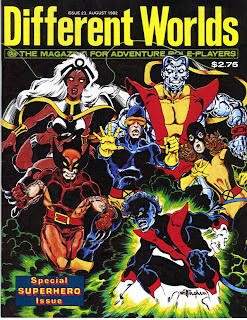
  • Speaking of artwork and iconics.  Take that cover.
  • Who are these people?!  I want to know.  The only one who is mentioned in the book is Gargoyle.  It's pretty clear which character he is, but I only know his name because of a copyright notice.  Who are the other characters?  Is that "Flare"?  Someone once told me the villain's name was Holocaust, but that could just be a Bay Area rumor.  If you know, please let me know.  I'd love to see the stats for that guy punching "Holocaust" with his energy fist.
CHAMPIONS is a great game, and the first edition is a joy.  If you can, try to hunt down a copy and play some old school super hero rpg.


Thursday, October 04, 2012

[Superhero RPGs] Changling of the Teen Titans: The Same Hero in Different Systems

Those of you who read this blog on a regular basis know that  I consider Different Worlds magazine to be one of the great publications of what James Maliszewski calls the Golden Age of D&D.  The magazine ran from 1979 to 1987.  It was initially published by Chaosium, then by Sleuth Publications, and finally by Different Worlds Publications.  Two of those companies are still around today, and one is going very strong.

I was particularly impressed with Different Worlds' famously reprinted issue 23.  That issue was a "Special Superhero Issue" that contained articles by the designers of CHAMPIONS, VILLAINS & VIGILANTES, SUPERGAME, SUPERWORLD, and SUPERHERO 2044.  That's right, the designers of all the major superhero rpgs of the time had an article in that issue.  Add to this a cover illustrated by Bill Willingham and stats for the X-men in three different game systems (V&V, Champions, and Superworld) by the game designers, and you have a truly special magazine issue.  I would argue that it is the single best issue of a gaming magazine published to date.


The success of this issue led Tadashi Ehara -- the magazine's editor -- do make the Special Superhero issue a somewhat regular feature, and a year later with issue 30 in September of 1983 the magazine had a special "New Teen Titans" issue.  This issue provides statistics for the New Teen Titans -- Nightwing and crew, though he's still Robin at the time -- for CHAMPIONS, VILLAINS & VIGILANTES, and SUPERWORLD.  Three systems that each handle super powers differently, but that are all workable systems.  The statistical representation of the characters, all done by the system designers, reveal interesting things about the rules themselves.  This is especially true for the character of Changeling.  As a shape shifter, his powers are a challenge to emulate.  How do you design a character who can become any animal?  It's a difficult design question, but one that comes up from time to time in the comics.  It is also a question that eventually led CHAMPIONS to adopt the "Multiform" power, a solution that I've never been fond of.

 http://index.rpg.net/pictures/show-water.phtml?picid=12071

Starting with CHAMPIONS, the character of Changeling is represented as a relatively normal heroic character in his base statistics, but has all of his shapechanging powers in a single 200 point multipower with all of his abilities represented as variable "multi" slots.

133 pts.   200 pt Multipower (+1/4 only reasonable creatures, +1/4 x6 END Battery) 
27m        Growth (200 pts)
  7m        Density Increase (50)
            7m        Flight (50)

It goes on like that to include a number of possible power combinations.  It's a solution, but one that isn't much better than the "multiform" solution later implemented.  I have always liked the use of a multipower in order to simulate this kind of ability, but I prefer one of two options not presented by Steve Peterson here.  First would be the each "animal" is a different "ultra" slot in a multipower.  Thus Gorilla would be one slot and Monkey another.  The other way would be to have several multipowers.  One for offensive abilities, a second for defensive, a third for movement, and a fourth for "variable senses and options."  Any of these can work, but as you can see any version also requires a lot of work by the player to get what they want.

Steve Perrin's SUPERWORLD adaptation was to just give Changeling all of the powers -- heightened strength, shrinking, growth, armor, movement, etc. each with a conditional use modifier of "only in certain shapes."  This is followed by a list of shapes that Changeling can assume: man, bear, cat, bird, canine, snake, elephant, octopus, and so on.  Any animal that he has listed, he can become.  And the GM and player can discuss which powers are appropriate to the form.  This is a pretty good solution, but it also requires bookkeeping with regard to building and then maximizing each form.

Jack Herman in his VILLAINS & VIGILANTES adaptation highlights the "rulings over rules" nature of the V&V system.  In this game, there is not shapechange power that quite captures Changeling's ability.  So Herman gives Changeling the following power:

TRANSFORMATION (Shapeshifter/Creatures): PR for each change equals the square root of the number of Basic Hits possessed by the new form assumed.  Any shape having over 20 Basic Hits cannot be maintained for more than 11 turns.  Smaller shapes have no time limit.  Only creature/animal shapes may be assumed, including intelligent non-human species, but he must be familiar with the creature to copy its shape.
 That's it.  Leaving the player and GM to design each and every animal the player can turn in to.  Other than having to design a lot of animal stats, this is a pretty nice adaptation.  It is also one that Herman had to invent as the power isn't in the rulebook.  That's the nature of V&V though.  House rules rule the day.

When the DC Heroes RPG eventually came out, they represented Changeling in the following way.
                                                                                                                           
He's got stats that are at the high end of normal human ability, except for his Body stat which is quite good.  His shape change power is represented by... well... the shape change power which is as follows:


I am a big fan of the DC Heroes solution.  It is similar to Herman's, but balanced by being a very expensive power to have at high levels, though inexpensive enough for a starting character to purchase it.  It limits abilities to existing animals, and many can be found in the appendix.  Like all of the options though, it does require a player to have a number of character sheets at the ready to represent Changeling in multiple forms.

I think it is interesting how the different games each approached the design challenge that a shape changing character brings.  I don't know that any has a perfect solution.  I like DC Heroes' solution, but only because their underlying AP rules structure means that each numerical value has a very specific meaning.

Friday, September 28, 2012

The Importance of House Rules to Ensure "Fun"

As often happens, is spent a part of last weekend playing games with my twin daughters History and Mystery.  We played a wide variety of games ranging from Candyland to Fantasy Flight Games' Rattlesnake with a little role playing as horses in between.  All of these activities were done not merely for the sake of occupying time, but also to create a sense of enjoyment among the participants.  In short, we were playing these games to have fun.

But how does one go about designing a "fun" game?  One of the reasons there are so many kinds of games (wargames, conflict games, area control games, cooperative games, track games) is because the goals of gamers with regard to what is fun aren't always the same.  Not only are they different among different people, but they are different for the same individual at different times.  For example, there are times when I want to play a little Battletech just to get out some aggression through robot vs robot conflict, but there are other times when I want to journey through Mirkwood with the help of my friend Jason in a cooperative fashion while playing Fantasy Flight's Lord of the Rings Living Card Game.  And those are just two of my moods.

I've also learned from playing with History and Mystery that sometimes the game's rules aren't the most fun way to use the game's components.  Let me just say that History and Mystery never cease to amaze me with regard to how they look at the world.  The other day, I had BURN NOTICE on in the background while they were coloring.  History looked up and saw the skyscraper condos overlooking the water and we had the following conversation:

HISTORY: That's pretty.  Where is that daddy?
ME: That, oh, that's Miami.
 HISTORY: Why is it YOUR ami?
ME: (Laughing) No...it's not My ami, it's not Your ami, it's Miami.
MYSTERY: It's not Your ami, or History's ami, but is it My ami?
I laughed for hours at the way their minds worked on that one.  It still makes me laugh.  I understood what they were getting at, and why they would mistake "Miami" for "My ami," but the way they are processing the information is hilarious.  I do think I was finally able to convey that it was just the name of the city...

At least I think so.

The point is that History and Mystery sometimes look at things differently than I do, and when this is combined with what they constitute as fun it leads to some enjoyable house rules.

Let's take our game of Rattlesnake as an example.  It's a simple game that comes with 12 very strong magnets that the players are trying to get rid of, and the first to do so wins the game.  The players roll a die and it tells them what color snake they have to set their egg upon.  If that egg disturbs another egg and they collide, then you have to pick up all the eggs that collided and have failed to get rid of any.  The magnets are very strong and the board is small, so this game can get pretty zany.


As written, I like the game and History and Mystery hate it.  You see "losing all your magnets" isn't fun for them.  What IS fun is making the magnets collide and picking them up.  For them, the loser is the first one to "lose" all of their eggs.  They find it fun to acquire the eggs.  What is interesting about this is that the trigger of the fun is the colliding of the magnets, which is one of the things I would argue is fun in the rules as written as well.  It is the fun that is inherent in the components.  The eggs have strong magnets that attract them to one another and they collide with a loud "clack!"  That's great fun.  That's great component fun, and it has nothing to do with the rules.  With regard to what my daughters find fun, the rules as written have an objective diametrically opposed to their fun goal. 

And this is where one sees the real importance of House Rules.  When I was younger, I made house rules to fix "what was wrong" with a game or to do a particular thing "better."  This led to the creation of a number of spell point systems, and no fewer than 5 versions of Superspeed for the DC Heroes role playing game.  At the time, I thought I was fixing the game objectively.  What I didn't understand, was that I was tweaking the rules to fit my fun-jective.  Having feeble Wizards -- regardless of how they matched up with other characters at high levels -- was annoying to me as a fun objective.  I wanted to play Gandalf or Merlin, I didn't want to be the apprentice in DRAGONSLAYER.  That just didn't seem fun to me, and the rules disagreed with that fun.  I liked the components of D&D -- the odd dice, the miniatures, and the rolling of 5 or 6 dice when casting fireball -- those were all fun activities.  Heck, one of the reasons I love Champions is the opportunity to roll handfuls of dice.  That's just a good time.  My fun goal and the fun goal of the game weren't lined up, even though the fun inherent in using the components was the same. 

Eventually, I learned to have a flexible definition of fun and to allow individual games to set the "magic circle" of what fun is being attempted.  In doing so, I've come to appreciate design efforts I might otherwise have overlooked.  Setting aside my personal fun-jectives from time to time leads to enjoyable experiences.  Heck, my journey as a game master in roleplaying games has gone from grudging acceptance to joy as I came to view the GM "fun" rule to be "Losing the game in a dramatic way is the job of the Game Master."  If you are losing properly, then the players are having fun.  The key here is "in a dramatic way."  There needs to be risk for the players, and character death must be an option.  But it's like a TV show, in that you know the protagonists will usually win out...not always, but usually... and they'll rarely die.  It depends on the game and the expectations, but players rarely enjoy investing time in creating a persona only to have it die as the GM laughs at how pathetic they are.  Though that can be fun from time to time too.

History and Mystery have reminded me of how important it is sometimes to forget what the fun being attempted by a game is, and to see what kind of fun the components of the game are advocating.  It was a nice refresher course for me, and it reminded me why I have all those Heroscape boxes lying around the house.


Wednesday, September 19, 2012

Play Like A Pirate -- Or if You're Going to Talk Like a Pirate, Go Big!

In 2008, I began advocating that people should celebrate "Play Like a Pirate Day" rather than participate in "Talk Like a Pirate Day." My contention was that one of the most irritating things you can hear your co-workers say is, "Aaaargh, Avast, Ye Mateys" a couple times an hour in some half-hearted participation in a day of international live action role playing. Even worse are the inconsistent uses of "Yar!"

What makes it most irritating is the fact that these small offering of participation are lackadaisical at best.

I would rather my co-worker show up dressed in full "Age of Sail" apparel, blunderbuss and cutlass in hand, and charge into the office while staying in character as much as is possible for the day.  A wholehearted celebration of Talk Like a Pirate Day, I can get behind.  It would be fun, in the "employees showing up to work in costumes on Halloween" kind of way. You know... like when a person comes to work in their full blown Optimus Prime costume -- one where they can actually "transform" from robot to big rig.  Things like that create moments where you are truly impressed with your co-workers commitment. On the other hand, when your other co-worker shows up with only a pair of "cat ears" on and a mild scowl on their face, it's annoying. 

Most participation in International Talk Like a Pirate Day is of the cat ear type, and not the Optimus Prime type. That's why I still believe that it is time for the phenomenon to die. That doesn't mean that we should no longer have a day "celebrating" piracy and the outlaw attitude, or as the founder of Talk Like A Pirate Day called it "Piratitude." Pirates are still awesome (though not as awesome as Transforming Psionic Robot Pirate Ninja Dinosaur Mutant Demon Hunting Vampires), it's just that talking like a pirate that is lame. I think gamers, and geeks of all kinds, should lay claim the holiday and re-cast it as "International Play Like A Pirate Day." That way the costume role players can  cosplay pirate and other people can play pirate themed games, read pirate themed novels, or watch pirate themed films.

As I wrote a couple of yeas ago, "from now on September 19th will be a day when families and friends get together and enjoy some form of Piratical Recreation. Such recreation can include celebrating by talking like pirates, certainly role play (in the traditional sense) is play. Our celebration is inclusive, not exclusive. But families and friends will no longer be limited to listening to the 'yars' and 'aaarghs' of everyone around them. Some might choose more formal ludographic participation -- that's game play."

Here is a list of recommended activities for this year's festivities -- thankfully the Day doesn't fall on a Weekday this year:

1) Play a pirate themed roleplaying game. In particular, we recommend Pinnacle Entertainment Group's excellent PIRATES OF THE SPANISH MAIN. This is highly recommended for those who want to talk like a pirate. It encourages such behavior in an appropriate venue. Besides, by role playing (in the game sense) participants can act far more Piratical than is allowed under modern mores and laws.

If you want a more heroic bent with mystical aspects, you can always play Pinnacle's 50 Fathoms instead.


2) If you own a copy -- and not many do -- play an exciting session of the classic Broadsides and Boarding Parties


If you don't own a copy of Broadsides, try one of these two excellent pirate games from GMT Games.

3) Blackbeard: The Golden Age of Piracy. The game is a redesign of Avalon Hill's classic game of the same name. The new version is suitable for 1 to 5 players and has less "down time" for players who aren't in their current turn.


4) Winds of Plunder is a quick and fun game that is more in the style of the "Eurogame" than Blackbeard or Broadsides.


5) You can play the previously reviewed Sword and Skull.


6) Lastly, we recommend watching one of your favorite pirate films.  Personally, I'm going to watch CAPTAIN BLOOD with Errol Flynn today, and maybe a PIRATES OF THE CARIBBEAN film.


Or you can sing "For I am a Pirate King!"

Monday, September 17, 2012

Star Wars Anime? Sure. Why Not?

The Star Wars community has long been a creative force on the internet, and for the most part Lucas and Co have been very open to the use of the IP in fan created work.

I recently caught wind of a Star Wars anime project being tinkered around with on 4chan.  The project is far from finished, but this video gives a glimpse at the state of the animation -- the video I'm posting has sound that the /m/ animations lacked.


In all, I think that the animation looks good.  One thing struck me about this brief piece though, and that is how much it humanizes the Imperial Pilots.  The Star Wars films have always presented the Storm Troopers and Pilots as faceless and ominous archetypes -- and eventually as weak willed clones with subconscious "Orders" planted within their minds.  This artist, Otaking 77077, has given us a glimpse into the helmets of the pilots, and it changes the point of view in interesting ways.  I found myself rooting for the Imperials in this video.  It was an interesting sentiment to experience, as I'm used to the Empire as antagonists and not protagonists.

A part of me wonders if my point of view would have been different if the Imperials were represented with Zentradi skin tones or blue skin like the residents of Gamilon.

Friday, September 14, 2012

[Book Review] GIANT THIEF -- Where's the Likeable Rogue?

Easie Demasco is a character with whom I am conflicted. On the one hand, he is a witty character who has a well developed sense of humor. One the other hand, he's a jerk -- one who never really becomes more than a jerk. He's also the strongest and most compelling feature of David Tallerman's novel GIANT THIEF (published by Angry Robot Books).


GIANT THIEF is a fairly straight forward tale of:

1) Thief acquires MacGuffin not understanding it's value.
2) Thief meets people who understand value of MacGuffin and seek to use thief in battle against evil.
3) Well...you kind of know the rest.

Often these tales include a heroic journey or follow a bildungsroman format in which our Thief undergoes some major transformation or grows in some way -- usually evolving morally. Not so with GIANT THIEF.   Easie begins the story as a selfish and greedy rogue, and he ends the story as a selfish and greedy rogue with more grandiose plans than before.


Technically,  that does count as some kind of character development, but it lacks the moral evolution that often occurs in these tales.  Easie goes from a petty thief to an individual who seeks to become a master thief. He goes from pick pocket to one who wants to become a Thomas Crown-esque figure, but he lacks the sophisticated charm of a Thomas Crown and has instead a clownish sense of humor.  If one were to cast Easie for a film, one would look more to comedic talent than to cool sexuality.  He's more Daffy Duck than Han Solo.

There are quite a few clumsy moments in the book and the chapters establish and follow a  predictable rhythm. One is tempted to say that the book is one that isn't to be recommended based on these flaws, as they are often fatal to good storytelling. And yet...

I keep finding myself wanting to throttle Easie Damasco, or watch him get caned, or at least have a long talk with him to wake him up and set him on a more moral path. I keep finding myself imagining conversations with him.

All of which means that Tallerman has achieved something that is often rare within a novel, he's created a realistic character who lingers in ones mind weeks after a book has been read. That is a good thing indeed. If only Easie were more likeable. He's a rogue and a scoundrel...and that's it. He's not loveable. He's not nice. He doesn't harbor a hidden heroic heart. But he is interesting and I want to know more about him


[Gaming Notes -- Contains a minor Spoiler]

The book's MacGuffin and interpretation of Giants are perfectly suited for adaptation to the gaming table.  The MacGuffin is a non-magical stone sacred to the Giants that signifies who is the Giant's chief.  In Giant society the orders of the chief must be followed without question, even if they violate the morality of the tribe members.  The Giants in this case are gentle pacifist vegetarians, but they are asked to do some terrible things.  All of which could make for a compelling and morally complex D&D adventure.

You can play with PC preconceptions regarding Giants and slowly introduce them to the moral complexity of the situation.  How many Giants will the players defeat, or even kill, before they discover the secret of the stone?  How will they feel about their actions later.

These are good questions, that can make for a rewarding adventure as well.

Thursday, September 13, 2012

[Gaming Library] Aaron Allston's STRIKE FORCE: A Must Own GM Resource

At the Origins convention in 1981 Hero Games released what would become one of the best selling super hero role playing games of all time, a game that is still around and which has served as the IP behind a  computer MMORPG.  That game is CHAMPIONSand it is one of the great games that the hobby has produced. 

CHAMPIONS has a large and active fan base, though it does seem to have dwindled a little between the 5th and 6th edition of the rules.  That dwindling may soon find itself reversed with the recent release of CHAMPIONS: LIVE ACTION and upcoming release of CHAMPIONS COMPLETE.  I've been of the opinion the past couple of editions of CHAMPIONS and the HERO rules have become a little bloated, and it seems that the designers behind CHAMPIONS COMPLETE agree as their upcoming rulebook is only 240 pages in total.  While much can be, and has been, written about the CHAMPIONS game, there is one supplement for the game that transcends the game itself and is one of the best "how to run a campaign" supplements ever produced...for any game system.

When CHAMPIONS was released in 1981, Aaron Allston worked for The Space Gamer magazine which was then a publication of Steve Jackson Games.  Steve Jackson returned from the Origins convention with news of the game and asked Aaron to review the game for the magazine.  Aaron did so and his positive review appears in issue 43 of The Space Gamer.  This article was quickly followed by a "proto-Strike Force" article entitled "Look Up in the sky..." in issue 48


In the article in issue 48, Allston describes how he came to be a CHAMPIONS player and game master -- he would later become one of its premiere contributors.

The superhero campaign of CHAMPIONS which I run, which is successful enough that it's been thrown out of TSG playtest sessions (it was crowding out all the other games), began as an irritation. Steve Jackson came back from Origins with the news that some new company in California had nabbed the name CHAMPIONS; I'd hoped to use CHAMPIONS on a personal game project.  I could review the Hero Games offering if I wished.  Wonderful.
 Looking over the rulebook, though, I was impressed.  The game appeared clear and coherent after a single read-through and seemed to faithfully simulated the four-color stuff of comic books.  Extensive solo playtesting ensured almost immediately, with the heroic Lightbearers waging a running war with the criminal mastermind Overlord.
In the end, Overlord's munitions-running scheme was wrecked; the Lightbearers disbanded, with one member dead and two others unwillingly allied with the villain; and I had chosen to run CHAMPIONS on a regular basis.
 There is a good deal more to the article in which Allston shares with potential players and game masters some guidelines and some pratfalls that might happen as one plays a super hero campaign.  How does one exactly acquire a super hero secret headquarters anyway?  One can see the foundations for the book STRIKE FORCE in the article, and Allston provides a nice glimpse into what can contribute to the running of a successful game.  As good as the article is, it pales in comparison to the CHAMPIONS sourcebook that Allston wrote based upon that early -- initially merely a playtest -- campaign.


Aaron Allston's STRIKE FORCE is one of the better campaign sourcebooks ever written.  It has a very simple arrangement.  It begins with a section on campaign use.  This section is not a how to plot an adventure section, as by 3rd edition CHAMPIONS had a pretty good chapter on that, rather it was advice for dealing with very specific problems.  This chapter covers the following:

  • The "Character Story" -- discusses how to help players develop the character stories that they dreamed up when they initially created the character.
  • Simulating the Comics -- discussed how to keep the players behaving in a four-color fashion.
  • The New Player
  • Aging the Hunteds -- How to make "Hunted" behave like real world constant interactions rather than as a mere random roll done each week.
  • Listening to Your Players
  • Ground Rules
  • Translation Follies
  • Types of CHAMPIONS Players -- The Builder, The Buddy, The Combat Monster, The Genre Fiend, The Copier, The Mad Slasher, The Mad Thinker, The Plumber, The Pro from Dover, The Romantic, The Rules Rapist, The Showoff, and The Tragedian.
  • Character Conception Checklist
  • How to Ruin Your Campaign
If Allston had written no other sections than the "types of players" and "how to ruin your campaign" sections of the sourcebook, this would be an invaluable resource.  Allston's breakdown of player types builds upon some of the discussions which had been going on in Different Worlds magazine and other places in the game-verse, but his clear description of the varied motivations of players is spot on and extremely useful.  Between STRIKE FORCE and Robin Law's book on Game Mastering Rules, you have almost everything you need to run any game successfully...if you follow the advice that is.

In addition to the overview on Campaign advice -- generic campaign advice -- Allston then continues providing an invaluable tool by giving us a look into his own campaign in the subsequent chapters of the book.  We are given an "Abbreviated History" of the STRIKE FORCE campaign, which can be used as an example or as an outline for one's own campaign.  He provides the full roll call of the STRIKE FORCE and SHADOW WARRIORS teams as well as Independent heroes and a number of Villains from the campaign.  This is followed by a detailed history of the campaign -- both his real world work and the in game history.  In the history, Allston shares some of the storytelling challenges he faced and how he overcame them in play.

If you can find a copy of the book, I highly recommend it.

Tuesday, September 11, 2012

Being a Parent Can Be Heartbreaking

Last night I spent a wonderful evening with my lovely 4 year old daughters History and Mystery.  They had spent part of the day coloring with Jody and had shifted from one creative activity to another, namely dancing.  Both of the girls had turned on their electric keyboards to play pre-recorded songs, neither in sync with the other, and had begun dancing with the free and unselfconscious joy that only young children can truly manage.

It was a beautiful scene to watch, and was one of those glowing moments when as a parent you feel on top of the world.  That natural high was about to take a severe drop...as you might have guessed from the title of the post.

As happens every night, and too quickly every night, the clock ticked past seven and thus initiated parenting subroutine 8.(e).D.7.1.(m).3.  That's right, it was bedtime.  It was time to take a quick bath, brush teeth, read stories, and sing a bed time song.  None of this was out of the ordinary.  There was also what appeared to be the typical groaning about how either History or Mystery had yet to finish some entertaining task, which usually amounts to "but Dad...Ironman needs to go defend the castle" or some similar activity.  This evening though, History was upset that she hadn't been able to finish coloring the pictures she had been working on earlier in the day.  Jody and I assured her that there would be plenty of time to color them tomorrow, maybe even when mom was working on some drawings of her own.

That's when it happened.  Mystery looked right at Jody and then at me and asked, "Why am I not an artist like mom?  I want to be an artist like mom."  I immediately felt as if, Mola Ram had reached into my chest, pulled out my heart, and left it burning in his hands laughing maniacally.  I was stunned for a moment as I tried to find a way to tell a 4 year old that:

1) Yes you can be an artist like mom.  You can be anything you want to be.
2) That some things take time to learn, and show her how she was more comfortable drawing and coloring now than she was a year ago.
        a) I'm not one to tell History or Mystery that they are now "better" at a task like drawing and       
            coloring at an age when they should be experimenting and feeling free. 

The books on parenting provide wonderful advice, but they don't do anything for the sinking feeling one feels in ones chest when a child expresses disillusionment at a perceived limitation.

Ugh.


Thursday, September 06, 2012

Cubicle 7's Yggdrasill -- Gaming in the Norse Epics

As a fantasy fan and a gaming fan, I am always on the lookout for fresh ideas in both areas.  It never ceases to amaze me how often the freshest ideas come from looking back and returning to "primary sources" instead of using only the most recent works for inspiration.  For example, I have found reading the "The Bonestealer's Mirror" by John C. Hocking in a recent issue of Black Gate Magazine to be far more entertaining Sword and Sorcery fare than the staid stacks of post-Conan "Thud and Blunder."  This kind of looking back is why I find the stories of C.L. Moore or Poul Anderson's Three Hearts and Three Lions (even with its total cop out of an ending) so refreshing while I find a good deal of modern fantasy to be played out.

This isn't to say that "older is always better," far from it.  It is only to say that when writing in a tradition, it is often useful to go back to a font closer to the origin as the water of ideas there is often cleaner and has more room for the writer to invent new ideas.  It is easier to adapt Beowulf into a Western than it is to do the same to The 13th Warrior for example -- due to the added commentary that 13th Warrior is making regarding the time in which the story takes place.

It is often said that the fantasy role playing of role playing games is Tolkienesque, that all fantasy rpg campaigns are to some degree adaptations of The Lord of the Rings.  There is some truth to the statement, though plenty of exceptions, as most fantasy rpgs have their elves, dwarves, and halflings.  They have their Rangers and their Thieves.  They have their dragons and magical rings.  At least enough of them do that the argument isn't entirely an insane one to make.  It also means that many games that could otherwise be great -- due to interesting mechanics -- fail to succeed and become Fantasy Heartbreakers.  Fantasy Heartbreaker is too often a term used with derision, and it oughtn't be.  Fantasy Heartbreakers are "heartbreaking" after all, they are the underdogs that we root for that ultimately failed in their goals.  Too often those goals were to incrementally improve on the existing state of gaming, too often they are just making a "better version of game x that came out last year."  They have too often forgotten the truism that I began this post with, "often the freshest ideas come from looking back and returning to "primary sources" instead of using only the most recent works for inspiration."

Cubicle 7's Yggdrasill does what these other works often fail to do, it reaches back into the annals, into the very things that inspired Tolkien himself, to create a rich milieu for fantasy role playing.  To say that Yggdrasill is a beautiful product is an understatement.  Like Cubicle 7's excellent Tolkien licensed rpg The One Ring, the graphic components of the game are top notch.  So too is the writing, the translation, and the structure of the book.  The game knows where to begin.  If you want to create a game about the world of the Sagas, then you had better set the tone quickly, and this game certainly does that.  It begins with an original piece of fiction, and follows with numerous quotations from the Völuspa.  The game captures the feel of its setting very well.  By looking to back to the Eddas, the game has created a rich milieu for storytelling and game play. 

As for the rules themselves, they are simple to explain and easy to understand.  They are also informed by a couple of different eras of gaming -- they seem to have a touch of Greg Gorden-esque (Deadlands, DC Heroes, James Bond 007, and others) elegance to them.  How much?  I cannot say yet, I want to see these rules in action.  One can review the physical and narrative quality of a game merely by reading it, but one can only truly review the rules after extensive play.  I will say this for Yggdrasill, it makes me want to play it and the information on the world is enough that even if the rules fail the book itself is still an asset.


Wednesday, September 05, 2012

History, Mystery, Orcus, and Cthulhu Greeting Cards

Today has been a crazy day, but from the moment it began I knew that it was the day that I would have to launch my new Kickstarter project even though I haven't finished editing the pitch video.  Don't worry, I will finish that soon and I'll be adding a couple of rewards.


I knew I had to launch the project when my daughter Mystery who was cheerfully playing with one of my Balor D&D pre-painted miniatures ran over to the shelf where my limited edition D&D mini Orcus was lying and brought him to the breakfast table to "play with his friend."  I don't know exactly what kind of games that Orcus and his pal "little Balor" play together, but I do know they include Aurora from Sleeping Beauty and Silvermist from the Tinkerbell series among their closest friends an playmates.

Who knew that Aurora and Silvermist went for the "bad boy" type. Watch out Prince Phillip.


It was the perfect combination of cute and terrifying and I took that as the sign that the time was right.

You see, I've been planning to release a Cthulhu Claus Holiday Card project for some time now as one of the offerings of the business my friends Wes and Joel formed with me last year.  Our goal is to create a number of gaming and gaming related products with an overarching aim of building community and expanding the scope of the hobby.  I think that the Cthulhu Claus Holiday Card project fits that mold perfectly.

I hope that its mix of Lovecraftian imagery adapted by the humorous hand of my wife Jody Lindke -- the first woman to win the prestigious Charles Schulz Cartooning Award -- with the spirit of the Holiday Season will make a great gift for gamers and for non-gamer pulp fans alike.  Ever since I first saw "All I want for Solstice is my Sanity" video and read through Tor's December belongs to Lovecraft blog entries, I've wanted to do a Lovecraft themed Christmas product.  The only thing I lacked was the funds to launch such a project, and now with Kickstarter I have that opportunity.

Of course, that also means that the success or failure of this project is up to you.  If you want this product, please back my project.  I promise that there will be more rewards coming -- original artwork anyone? -- and that we will have stretch goals.  Help me make this happen.

Monday, September 03, 2012

Jackie Chan + Street Luge Suit + 101st Film = Win?

It looks like Jackie Chan's 101st film CHINESE ZODIAC is a return to classic Chan-esque action.  The trailer from the film features Jackie Chan performing a series of stunts wearing what can only be called a Street Luge Suit.  While the concept is interesting, and hearkens back to JC classics like ARMOR OF GOD, Chan does seem to be showing his age in the sequence.  I'm excited to see the film, but I think I'll be spending more time than usual worrying if Jackie Chan is going to be seriously injured than I did when he was younger.  Given that he fractured his skull in ARMOR OF GOD, maybe I should have worried more then too.


Friday, August 31, 2012

Reason I Love LA #3,227 -- The San Gabriel Valley

Among the things I do in my day job as a non-profit director, I work with students at 8 high schools in the San Gabriel Valley who participate in civic engagement clubs on their respective high school campuses.  To coordinate activities between the various clubs, we have executive board meetings with leaders from each school every other week.  These often take place at one of the wonderful restaurants in the SGV.

I came across this video the other day and it captured a couple of things I love about working with these kids.

1) Their sense of humor.
2) The many interesting restaurants where we have held meetings at, like Cha Cafe. (Yes those are Chorizo Wontons on their menu).


Skip past the initial skit and enjoy the catchy tune and look out for a lot of restaurants worth visiting.  Oh...and some of the high schools that the student I work with attend are featured as well.

A New Fanlema -- STAR WARS DETOURS

Like the crew over at Tor books, I'm of two minds regarding the new Seth Green (and the Robot Chicken Crew) animated series STAR WARS DETOURS.  Basing my opinion solely on the trailer below, this show is either a humorous tangent from regular STAR WARS that I can share with History and Mystery or it will be yet another disappointing attempt at humor related to a franchise I have adored since childhood.

The people working on the project give one hope that the cartoons will be funny and entertaining.  Green, Matt Senreich, and Todd Grimes have a good track record, but I keep getting this nagging feeling that comedians who work well together when "edgy" might not quite click when doing more "kiddie" fare.  Just watching the preview, I have noticed quite a few pop culture references that are supposed to have comedic impact.  Most of them will have either History or Mystery turning to a chuckling father and asking questions like, "Dad...why are you laughing?  Is it funny that Han Solo put on a hat?  Are hats funny?"


We are currently in a golden age of entertainment for kids my daughters' age -- they are both 4 btw -- and this might be a great addition to a long list of great shows.  A long list that includes DOC MCSTUFFINS, GRAVITY FALLS, PHINEAS AND FERB, IRON MAN: ARMORED ADVENTURES, AVENGERS: EARTH'S MIGHTIEST HEROES, SUPER HERO SQUAD, and MY LITTLE PONY: FRIENDSHIP IS MAGIC to name but a few.  To pull two of the shows out for special consideration GRAVITY FALLS and MY LITTLE PONY manage to insert pop culture references for the adults while crafting interesting and entertaining narratives for kids, but STAR WARS: DETOURS seems -- once again just based on the preview -- that it will be closer in tone to SUPER HERO SQUAD.  This isn't a bad thing as the twins enjoy SHS, but what really gets them excited is EARTH'S MIGHTIEST HEROES.  They like the real drama and real emotion of that show.

When I examine why I feel any trepidation to this show at all, it seems to stem from something hinted at in that last sentence.  I'm torn between whether I think the next STAR WARS project should be comedic or serious, and I think I might be leaning toward serious.  Though I am always ready for well done humor, and adore shows I can watch with my twins...

You see the fanlema I'm facing?


Wednesday, August 29, 2012

THE AVENGERS (1952) -- Pre-Make Trailer

I've been a fan of the "Premake" series of You Tube videos for some time.  They display a nice combination of deep knowledge of older pop culture with a genuine desire to show that awesomeness to a younger generation of viewers.

Some of my fondest childhood memories are of watching old Flash Gordon and Buck Rogers serials at my Oma and Opa's house on the weekends.  My Opa loved these old serials and he instilled in me nostalgia for stories that had been filmed before my parents had been born.  I still love these tales, and they have shaped the types of genre fiction I still enjoy today.  I blame these old serials for my seeking out of Edgar Rice Burroughs and that led to a discovery of Leigh Brackett, and the rest is as they say "history."

I cannot wait to share the old serials with my lovely twin daughters History and Mystery.  They already love super heroes and Star Wars -- even if they think that Yoda is Darth Vader's personal Goblin.  It won't be long before they are watching Buck, Flash, and Emma Peel.  Speaking of Emma, I hope that I can give my daughters enough knowledge of the show THE AVENGERS that they will appreciate how awesome a Diana Rigg version of Black Widow would have been.

For your viewing pleasure...THE AVENGERS 1952.


Friday, August 17, 2012

D&D Keynote -- A Focus on Vision Rather than Hype

In prior years, the Gen Con presentations by Wizards of the Coast have focused on selling consumers on an upcoming product. The staff of wizards would present the upcoming year's product line up, or try to sell the audience that the latest edition or product line was the best invention since the dawn of role playing. This tendency hit its peak with the launch of 4th Edition in 2008. The prior year's presentation was filled with advertising buzzwords and alienated some gamers.
This year, Wizards of the Coast decided to try an entirely different tactic. They still provided presentations about product lines that gave gamers a look at what was coming out in the near future, but they also sponsored their first Keynote Address. During the address, Wizards of the Coast CEO Greg Leeds discussed the company's vision as it faced the challenge of providing consumers with "D&D Next." That vision was to ensure that Wizards worked with the most talented designers possible, and to make sure that the D&D brand was controlled by the most important individuals. Who are the most important individuals to D&D and the brand? The fans. The vision of D&D Next and the Future of D&D is to let the fans make D&D the game they want it to be.

Leeds' comments were brief and to the point.  He wasn't selling a line of products or attempting to build hype for D&D Next.  In fact, his portion of the presentation was very low key.  He was focusing on the vision of the "Future of D&D."

After his initial presentation, Kevin Kulp of EN World came onto the stage to talk with three people heavily involved with the production of what will be the next edition of D&D, an edition that according to Mike Mearls still faces 2 years of playtesting.  Mike Mearls -- the head of the design team -- was joined by Ed Greenwood and Jon Schindehette who are involved with the creative side of the development of the next edition of the game.  Ed is working on the literary elements and Jon on the visual elements, and both are working with the design team to ensure that the next edition will work for a broader number of fans than the last edition.


As can be discerned from the above commentary, the focus of Wizards' vision is on fan involvement.  This includes more than having the fans participate in a two and a half year open playtest, it also involves letting the fans influence the direction that future content evolves.

Mearls described D&D as "more than a game, it is a shared experience.  It is about drama, the table, the thrill of victory, and the agony of a natural one."  He also stressed that the point of D&D is the people, the DM and the Players.  D&D -- at least in earlier editions -- is the one game where the rulebook tells you to break the rules.  D&D Next will be about putting the rules behind us and letting the players tell the stories they want to tell.

As an example, the Forgotten Realms will be the first setting released for the new edition of Dungeons & Dragons and like in previous edition changes there will be a major event that shakes the world -- an event called "The Sundering."

The highlight of the event will be a series of six books by many of the big Realms authors:

R.A. Salvatore will write the first book in the series, THE COMPANIONS
Paul Kemp will write THE GODBORN
Erin M. Evans writes THE ADVERSARY
Richard Lee Byers writes THE REAVER
Troy Denning writes THE SENTINEL
Ed Greenwood writes THE HERALD

These books will give points of view of the events that make up "The Sundering," but unlike in  previous editions, the players and the results of the adventures they play in the Realms will now shape the future of the setting.

You read that correctly, no longer will the "Giants of the Realms" like Elminster, Drizzt, Khelben Blackstaff be the ones who shape the world.  Instead the campaigns that people play in -- at least those who use published adventures -- will shape the future of the official world.  Let's hope that Wizards is able to use the skills they gained from the old Living City experience, as well as by watching the development of Legend of the Five Rings, to make this work fluidly.


Additionally, and most excitingly, Wizards will be rolling out their full back catalog of D&D products in digital form.  Starting early next year, Wizards will release the first wave of digital products.  They are using the lessons they learned from producing the collector's editions of the AD&D books to inform the production of these digital offerings.  Good news indeed, as the old scans often seemed rushed.  Wizards won't release all the products in one lump sum, rather they will release them in waves.  This ensures quality and means that Wizards will officially be supporting all editions of D&D.  They will truly be supporting all fans, even those who won't play D&D Next.

I for one am excited about the "Future of D&D."

Gen Con:The Finest Four Days in Gaming Have Begun

Gen Con, one of the longest running hobby gaming conventions, celebrates its 45th anniversary this year and continues to provide its trademarked BEST FOUR DAYS IN GAMING.  The event opened to the public yesterday August 16 and will continue through Sunday, August 19.


If you've never been to Gen Con, it might surprise you to find out that it is as much a collection of creative workshops as it is a fan convention.  This stems from the fact that Gen Con has been deeply involved with the role playing game hobby since the very beginnings of role playing as a hobby, and as James Wallis wrote quoting the now famous game designer Greg Costikyan in Interactive Fantasy (IF) issue #2 back in 1994,  "gaming is a democratic form of entertainment, placing the audience and the creator on more or less equal footing."  This is true of most gaming, but it is especially true of role playing games where an expected part of play is the creation of new content -- either mechanical or narrative.  Since the early days of the hobby designers like Greg Stafford have been arguing that role playing games themselves are art, "Role-playing games are a new form of art, as legitimate as sculpture, drama, or prose fiction."  Gen Con is filled with events for those gamers who wish to become artists.

The Writer's Symposium contains over 70 events focused on the creation and marketing of genre fiction.

The Gen Con film festival -- and supporting "how to" panels -- keeps growing every year due to the democratization of film making tools. 

There are game design workshops a plenty, and a vibrant artist's gallery where new artists and established names share their work and their expertise.  The Miniature Hobby Events feature skilled miniature painting and provide over 60 workshops from those who want to learn more about painting, building terrain, and pursuing this artistic avenue.

In addition to the artistic and creative events, this year's event has a couple of highlights.

  • As mentioned above, Gen Con is celebrating its 45th anniversary.
  • The convention is also celebrating its 10th year in Indianapolis.
  • Last year's event saw four-day turnstile attendance of more than 120,000 and this year's event is even bigger than last year.
  • Thursday night featured a Keynote speech discussing the Future of Dungeons & Dragons.  It was the first time that Wizards of the Coast has provided a visionary Keynote address.
  • More than 45 brand new games will be on sale at the convention -- form family games to card games and rpgs Gen Con is hobby gaming's version of E3.
There is something for everyone to do at this year's convention.  If you are in town, you definitely want to stop by.  If you aren't here this year, you might want to visit www.gencon.com and consider attending next year's event.

Monday, August 13, 2012

In Preparation for Gen Con, I Have Joined the BDCA Network

That's right, I am a certified member of the the Dungeon Bastard's own Badass Dungeon Crushers Association.


Unlike the many who have been Judged Unworthy due to caring about things like "acting" and "plot" and "fair-play," I am one of the elite!

As an Official Member, I am now entitled to:
  • Smack talk any character at the table who is shorter than your character.
  • Invoke your Badass Aura of Awesome which gives you 10 temporary hit points and a +2 to attack and damage for the next 2d4 rounds.
  • Once per combat, declare any dice result you don’t care for to be a “cocked dice” and immediately re-roll.
  • Ignore any phrase the DM says that does not include the words “initiative,” “armor class,” “damage,” or “treasure.”
  • Respond to any inquiry about your health, well-being, or mental state with the simple, muttered rejoinder of: “I’m crushing it.”

Barbarian Rage!

Thursday, August 09, 2012

You Got Your TWILIGHT in My Fighting Fantasy Style Gamebook, and I'm Glad.

When I purchased An Assassin in Orlandes, the first of Tin Man Games Gamebook Adventures, I did so out of a nostalgia for the old Fighting Fantasy Gamebooks by Ian Livingstone and Steve Jackson and other excellent books in that genre.  I had recently acquired my first smart phone and was impressed that many of the old Fighting Fantasy books were available for purchase.  It was nice to revisit the books that along with Tunnels and Trolls solos had been my proxy game group during my middle and early high school years.  During that time, I was only able to play role playing games sporadically and the game books were a great substitute.  The smart phone versions brought back fond memories, even if it was harder to finish an adventure where one couldn't "accidentally" read future entries for clues.

The Fighting Fantasy Gamebooks, and their eventual competitors, became a huge phenomenon.  One thing they never managed to do was expand their audience beyond certain market sectors which were mostly male readers.  TSR made a brief attempt at expanding the demographic with their Heart Quest books, but they didn't catch on for various reasons.

With the smart phone and the transition to ebooks, the gamebook has seen a resurgence.  One of the leading publishers in this resurgence is Tin Man Games, and with good reason.  When I began playing An Assassin in Orlandes, just to see how this "small upstart's Fighting Fantasy competitor" would fare, I was impressed with the thoughtfulness that went into the production. The book had a compelling narrative, a fun little game system (that also allows for a little "tilting" of die rolls which is a nice touch), and even had "Achievements" that could be earned by successful and unsuccessful play.  In short, it was clear that Tin Man was going to be big.  Their success continued with the acquisition of the license to produce future Fighting Fantasy Gamebooks, taking them from competitor to partner, and the acquisition of the Judge Dredd license.  I've been playing around with their Judge Dredd gamebook app, and it is quite fun -- more on that later. 

Tin Man really seems to know what they are doing, and they are also doing what publishers should have been doing during the first boom.  They are expanding the pool of potential gamebook players.  While we geeks might be precious to protect our hobbies from "fakes," "hipsters," or "sparkly vampires," as John Scalzi points out -- we shouldn't be.  Whoever wants to be a geek should be allowed to be, and they should be welcomed into our hobbies with open arms.  One of the things that I've learned from living in Southern California is that everyone is a geek.  That's right...everyone.  Disneyland's profits are based on the premise, and have been working for years.  Walk around Disneyland one day as an observer of people.  What do you see?  People from all walks of life joyously expressing their love and affection for fantasy, science fiction, and cartoons.  It is a place where they let down their pretentious guard and allow themselves to have fun.  And that is what being a geek is about.  It is about never loosing the "Golden Age of Science Fiction is 14" attitude and making the Golden Age of Science Fiction right now.  The same is true for comic books, role playing games, or whatever else you geek out about.  When Vampire the Masquerade hit the gaming hobby, I remember those who wrong-mindedly poo pooed Goths coming into our hobby playing their "weepy Goth Anne Rice game."  While others were doing that, I was meeting some great friends who it eventually turned out happened to be willing to try playing Warhammer 40k and Globbo.  Trust me, if you can get someone to play Globbo you've won the pop-culture wars and I credit White Wolf with getting Vampire fans who would never think of playing Globbo in the first place to try it out.  VtM was the gateway game that lead to more gaming for a lot of people.

It appears that Tin Man Games is trying to give fans of the Twilight books and Vampire Diaries a gateway gamebook into my favorite hobby with Strange Loves: Vampire Boyfriends.  This is something we should be praising.  After all, how far is it from Vampire Boyfriends -- a book with game mechanics -- to Vampire the Masquerade?  And as I've mentioned already, Vampire the Masquerade can lead to Twilight Imperium play.

Check out Tin Man's book trailer for their new book Vampire Boyfriends, the first in the Strange Loves series.


You know what?  I think I might just pick up a copy of this book/game.

Wednesday, August 08, 2012

Nintendo and Why I Love Minor League Baseball

Bull Durham is one of the best baseball films ever made.  It's one of the classics like Major League, Bang the Drum Slowly, For the Love of the Game, Fear Strikes Out, and Pride of the Yankees (not a complete list by any means).  One of the things that separates it from those other films is that it is a story about Minor League baseball players who play for the Durham Bulls.  The Bulls are currently Tampa Bay's Triple A affiliate, but were an Atlanta Braves Single-A team at the time of the film.  The film's protagonist "Crash" Davis is a long time minor league veteran who had been playing AAA and is sent down to Single-A to season a pitching phenom.

"Crash" may be the protagonist, but the Minor Leagues are the spotlight character of the film.  If you follow the background dialogue, you get to hear about many of the unique events and promotions that happen in the minors.  Taco nights, Little League Nights, "Clowns of Baseball," hot dog eating contests, and a lot of other classic small town activities abound in their mentions.  Add to that baseball that is played at a level much better than most of us ever played the game, but clumsy in comparison to the play in "the show" and you have a perfect demonstration of why baseball continues to capture the American imagination.  Yes, home runs in the Majors and phenoms like Mike Trout are awe inspiring to watch, but games played by the Rancho Cucamonga Quakes which open with FUNTAINMENT are Americana at its best.  They are filled with hope, inspiration, and the delusion that if we'd only listened to our High School coaches a little more often, that we too might have a fun career.  As Willie Stargell said,  "It's supposed to be fun, the man says 'Play Ball' not 'Work Ball' you know.

And fun is what it looks like the players of the Dunedin Blue Jays are having.  They recently qualified for the playoffs, and have taken this as an opportunity to create a unique season highlight video.  They have created a fictional Nintendo Entertainment System baseball game that depicts their recent accomplishment.  The video is a good deal of fun, and shows once more why I love Minor League Baseball.


It brings back memories of the 8-Bit version of the infamous Bill Buckner World Series moment.

Monday, August 06, 2012

13 Game Books You Must Own

A couple of years ago, I blogged about how every gamer should own a copy of Rick Swan's Complete Guide to Role Playing Games.  I still agree with this sentiment, but I would like to share another 13 books that every gamer should add to their library.  I'll be blogging about these books over the next few weeks, but I thought it would be good to point them out as a group now.  That way, we can hopefully talk more specifics later as I hope some of you will add a couple of these titles to your library if you haven't already.  These will by no means be the last books I mention, they just happen to be the handful that I grabbed off the shelf today.

Every gamer has an aspiration to design, and to design one must know what has gone before and get some sense of place within the hobby.  The following books are a great place to start:


  1. Thirty Years of Adventure: A Celebration of Dungeons & Dragons: If you want a good glimpse of the game that launched our hobby, or at least the market for our hobby, this is a great place to start.  It is a "propaganda" piece, but it's still quite good.  I'll talk more about the strengths and weaknesses of this book when I get around to its post.
  2. 40 Years of Gen Con: Robin Laws and Michelle Nephew give us a good collection that discusses the biggest gaming con in America.
  3. The Complete Book of Wargames: Jon Freeman (aka John Jackson) gives an excellent overview of the War Game hobby at a time when that hobby was in an early transition.  By the late 80s, this hobby was nearly dead.  Today?  It likely has more players than ever, but its marketplace is very different.
  4. The Fantasy Role Playing Gamer's Bible: Sean Patrick Fannon's excellent entry into the "so this is role playing and you should love it" library.  Try to get the purple 1st edition, the stick figure cartoons make the book.
  5. Game Design -- Theory and Practice vol. 1:  There is no volume 2 to this book by Steve Jackson Games, but this is an essential addition to anyone's library.
  6. Wargame Design: If you want to know the history of the gaming hobby, from its early Wargaming roots, this is a must own book.  The staff of SPI give a great overview of the hobby's founding, and present some good design guidelines.
  7. A Player's Guide to Table Games: This is a great book to get your friends to bridge the gap from "mass market" games into "hobby games."  John Jackson (aka Jon Freeman) reviews and discusses everything from Monopoly to Sniper and the Sid Sackson revolution.  This book helps to demonstrate the Sackson/Euro link. 
  8. Family Games -- The 100 Best:  This is one of two books that end up with 200 recommendations that every gamer should have in their library.  Trust me, these books provide a great "core" collection.
  9. Hobby Games -- The 100 Best:  This is the second of the 100 Best books, and it contains titles that are less mainstream than in Family.  You should own every game in this book.
  10. Heroic Worlds:  This book is a very good overview of the role playing game hobby as of the early 90s.  It is a vital research resource, and a good checklist for completists.
  11. The Comprehensive Guide to Board Wargaming: Nicholas Palmer's essential introduction to the war game hobby.  It includes an overview of systems, and some puzzles to work out.
  12. The Best of Board Wargaming:  A second book by Palmer.  This one contains more detailed reviews of games, and a good discussion of Simulation vs. Playability.
  13. The Playboy Winner's Guide to Boardgames: Jon Freeman's reprint of John Jackson's book, and why I believe they are the same person.  You'll definitely read this one for the prose, as there are no pictures.  This book extends the discussion in Player's Guide to include RPGs and Squad Leader -- thus includes essay regarding Playability vs. Simulation.