

Wednesday, December 28, 2011
Happy 4th Day of Christmas -- A Belated Merry Christmas
I meant to put this cartoon up on Christmas Eve, but alas I was too busy getting the house ready for Santa Claus.


Thursday, December 22, 2011
Second Battleship Preview Leaves Me Wishing They Made "Battleship Galaxies" Into Film
Yesterday I tweeted that I might be the only person in America who is excited to see the upcoming "Battleship" film directed by Peter Berg. I think that Berg has a talent for both the artistic and for the popcorn, and think that his "Battleship" film looks like pure popcorn. Ridiculous popcorn.
Like, doesn't make any sense popcorn.
Not only that, but popcorn that follows the typical invasion story formula.
Regardless, after seeing the alien designs in this film, and having played the "Battleship: Galaxies" board game, I personally wonder why they didn't just base the film on that game. It would still have the transmedia marketing tie in, and it would make sense to include the aliens.
Like, doesn't make any sense popcorn.
Not only that, but popcorn that follows the typical invasion story formula.
- Earth encounters alien force
- Earth gets owned by alien force -- the "Footfall" moment
- Earth keeps fighting against hopeless odds
- Some change/shift occurs
- Earth wins/Aliens quit
Regardless, after seeing the alien designs in this film, and having played the "Battleship: Galaxies" board game, I personally wonder why they didn't just base the film on that game. It would still have the transmedia marketing tie in, and it would make sense to include the aliens.
Wednesday, December 21, 2011
In Defense of Candy Land
In a recent episode of the Dice Tower podcast, Eric Summerer gave some surprising praise for the classic Milton Bradley board game "Candy Land." To those who are casual gamers, rather than obsessive hobby gamers, it might seem odd to call praise of "Candy Land" surprising, but it is. While the "child's first game" is a staple in most households, it isn't a well thought of game in the hobby gaming community. For example, the hobby gamer's go to website for opinion research is the excellent Board Game Geek website, and its members have given the game a lowly 3.2/10 rating (with an N of 1568). This rating falls somewhere between "bad" and "not so good."

My opinion of the game has changed over the past year, and now falls pretty squarely in line with Eric Summerer's praise, and also with Rob Donohue's. He praised the game as a great introductory game that he was playing with his son. If memory serves, Mr. Summerer stated that "Candy Land" was the first game where his son actually started playing by the rules. I had a similar experience with my 3 and a half year-old twin daughter's Mystery and History. They adore this game, and have learned some valuable game playing lessons from the game. Like Mr. Summerer's son, they play the game by the rules...well with one small exception. Rather than the goal of the game being to "go home" as is written in the rules, Mystery and History are on a journey to have tea at Hello Kitty's house. To add to the immersion, they have placed Lego Duplo "cat legos" on the board at both the home and peanut brittle house squares. The home square represents Hello Kitty's house and the peanut brittle house is the domicile of Hello Kitty's apocryphal twin sister "Boxie."
I am pretty sure that my own heightened opinion of the game is stronger than that of Mr. Summerer's. Where I once found the game "simple" and not really worth playing, I now believe the game to be a vital addition to any gamer's collection. But one must own the game for the right reasons.
"Candy Land" was created in 1948 by Eleanor Abbott. Eleanor was a retired San Diego school teacher who suffered from Polio, and she created the game as a fantasy world into which children suffering from the disease could escape. The game was first played by children in a polio ward in a San Diego hospital and was published in 1949 to great success.
The game is quite simple. Players draw cards which have and illustration of either a colored square (or two) or a board location. The player then places their game piece on the next square of the color drawn, or the location in the illustration. The first player to follow the track all the way to the "home" square wins. The cards are only shuffled once, unless the entire deck has been gone through and then you shuffle again. There is no strategy to playing the game efficiently, and the players make no tactical decisions.
It is a game of pure chance.
I believe that this one of the primary causes for the low rating the game receives on Board Game Geek. To elaborate, I believe the following to be the reasons the game is so disdained:
I agree.
A good game of "Candy Land" is very much like watching a good movie, especially if you are playing with people of the recommended age group of 3 to 6 years old. Watching Mystery and History act out their journey is a great part of the fun of the game play.
But the benefits of "Candy Land" are more than just the entertainment of play, which does in all honesty have limits. The highest benefits of playing the game are as follows:
I think that the benefits of "Candy Land" far outweigh the first criticism of the game, that of "pure" randomness. Opposition to chance in games is more a personal taste issue than any transcendent rule of game design. That said, I do think that the second criticism -- that the game is decided before play actually begins -- has a good deal of merit. Therefore, I'd like to offer the two following variant rules for "Candy Land."
I have found that this game is perfect for its intended audience, and believe it a vital part of any gamer's collection. It can also be used as a point of departure for design and the creation of house rules.
The "Boxie" character should not be confused with Hello Kitty's real twin sister Mimi, and is a creation of my daughter Mystery.
Walsh, Tim (2004). Timeless Toys.

My opinion of the game has changed over the past year, and now falls pretty squarely in line with Eric Summerer's praise, and also with Rob Donohue's. He praised the game as a great introductory game that he was playing with his son. If memory serves, Mr. Summerer stated that "Candy Land" was the first game where his son actually started playing by the rules. I had a similar experience with my 3 and a half year-old twin daughter's Mystery and History. They adore this game, and have learned some valuable game playing lessons from the game. Like Mr. Summerer's son, they play the game by the rules...well with one small exception. Rather than the goal of the game being to "go home" as is written in the rules, Mystery and History are on a journey to have tea at Hello Kitty's house. To add to the immersion, they have placed Lego Duplo "cat legos" on the board at both the home and peanut brittle house squares. The home square represents Hello Kitty's house and the peanut brittle house is the domicile of Hello Kitty's apocryphal twin sister "Boxie."
I am pretty sure that my own heightened opinion of the game is stronger than that of Mr. Summerer's. Where I once found the game "simple" and not really worth playing, I now believe the game to be a vital addition to any gamer's collection. But one must own the game for the right reasons.
"Candy Land" was created in 1948 by Eleanor Abbott. Eleanor was a retired San Diego school teacher who suffered from Polio, and she created the game as a fantasy world into which children suffering from the disease could escape. The game was first played by children in a polio ward in a San Diego hospital and was published in 1949 to great success.
The game is quite simple. Players draw cards which have and illustration of either a colored square (or two) or a board location. The player then places their game piece on the next square of the color drawn, or the location in the illustration. The first player to follow the track all the way to the "home" square wins. The cards are only shuffled once, unless the entire deck has been gone through and then you shuffle again. There is no strategy to playing the game efficiently, and the players make no tactical decisions.
It is a game of pure chance.
I believe that this one of the primary causes for the low rating the game receives on Board Game Geek. To elaborate, I believe the following to be the reasons the game is so disdained:
- The game is purely random with player decisions having no influence on play.
- Due to the single shuffle, the game's outcome is effectively decided before the first piece is moved.
I agree.
A good game of "Candy Land" is very much like watching a good movie, especially if you are playing with people of the recommended age group of 3 to 6 years old. Watching Mystery and History act out their journey is a great part of the fun of the game play.
But the benefits of "Candy Land" are more than just the entertainment of play, which does in all honesty have limits. The highest benefits of playing the game are as follows:
- Teaches turn taking
- Teaches following the rules
- The lack of tactical contribution minimizes "bad losing/gloating by winners"
- Teaches color matching
- Engages the imagination in storytelling
- Introduces all the basics of future board game play in a conflict free environment
I think that the benefits of "Candy Land" far outweigh the first criticism of the game, that of "pure" randomness. Opposition to chance in games is more a personal taste issue than any transcendent rule of game design. That said, I do think that the second criticism -- that the game is decided before play actually begins -- has a good deal of merit. Therefore, I'd like to offer the two following variant rules for "Candy Land."
Bag Draw
In this version of "Candy Land," all of the cards are placed into a bag, or hat, and the players draw a random card from the bag on their turn. This makes the game more purely random, and eliminates the pre-determination factor of the game.
If players wanted to eliminate completely the influence of prior draws from future play, cards can be immediately put back into the bag after it has been used for movement determination.
1 to 4 and Left or Right
In this variant, players shuffle the cards as normal at the beginning of the game thus setting the order of cards for the remainder of the game. The first player draws as normal and is considered Player 1 for the remainder of the game. The other players in counter-clockwise rotation are players 2 through 4.
After the first player's draw, all future draws are decided through the roll of a six-sided die. On a result of 1 to 4, the player of that number draws the next card. On a result of 5, the player to the left of the current player draws a card. On a result of 6, the player to the right of the current player draws a card.Neither of these optional rules eliminates the role of chance in play, but both add a level of mystery and change the Markov dynamics. of play.
I have found that this game is perfect for its intended audience, and believe it a vital part of any gamer's collection. It can also be used as a point of departure for design and the creation of house rules.
The "Boxie" character should not be confused with Hello Kitty's real twin sister Mimi, and is a creation of my daughter Mystery.
Walsh, Tim (2004). Timeless Toys.
Friday, December 16, 2011
A Victory Point Games Christmas
Victory Point Games is an independent small press gaming company located in Southern California that is both a game company and a classroom. Not only do they want to produce fun to play games, but it is their mission to turn game players into game designers. They are a friendly and talented crew.
For the past few years, VPG has released playable game after playable game. What the games have sometimes lacked in quality of components, they have more than made up for in quality of play. Recently, VPG has made two corporate decisions that will bring the physical/visual quality of their products in line with the play quality. First, they have ordered a die-press in order to produce high quality die-press counters for their games. They have been hand pressing and cutting the individual games in the past. Second, VPG has slated a series of digital adaptations of their games.
VPG has just released their first digital game, an adaptation of Chris Taylor's "Loot and Scoot" fantasy game. The digital version of the game does a good job of capturing the simple charm of the printed version of the game. It also features significant graphic improvement over the tabletop game. You can compare the digital version's graphic presentation to that of the original by looking at the images below. The first two images come from the new digital edition, while the second two images come from the physical version of the game.


For the past few years, VPG has released playable game after playable game. What the games have sometimes lacked in quality of components, they have more than made up for in quality of play. Recently, VPG has made two corporate decisions that will bring the physical/visual quality of their products in line with the play quality. First, they have ordered a die-press in order to produce high quality die-press counters for their games. They have been hand pressing and cutting the individual games in the past. Second, VPG has slated a series of digital adaptations of their games.
VPG has just released their first digital game, an adaptation of Chris Taylor's "Loot and Scoot" fantasy game. The digital version of the game does a good job of capturing the simple charm of the printed version of the game. It also features significant graphic improvement over the tabletop game. You can compare the digital version's graphic presentation to that of the original by looking at the images below. The first two images come from the new digital edition, while the second two images come from the physical version of the game.


I am quite fond of the physical game, and there is no replacing a good face to face board game experience, but the digital game is both cheaper and slicker than its physical counterpart. The new digital game -- available for both iPhone and Android devices -- comes in at an inexpensive $2.99 where the physical copy has a $17.95 price point if purchased direct. The digital game is competitively priced, where the physical game reflects the costs associated with limited print runs, both are worth the price. Get yourself a copy of the digital game, and purchase a copy of the physical game for a friend.
In addition to "Loot and Scoot," VPG has a large catalog of fun games that make perfect Christmas presents. My top ten list (in no particular order) are the following:
Thursday, December 15, 2011

Cinerati Netflix Recommendation: "The Last Detective"
Picture, if you will, the typical American police procedural. If you have the same picture in your mind that I do, then you are picturing a team of detectives rushing to solve a crime. They are rushing to fight against the "First 48" hours after which the solution of a murder/crime becomes more difficult. They receive their forensic data at lightning speed, have a coroner on call, and the episodes often contain exciting chases and flashy gunfights.
Sometimes, just sometimes, we get to see the actual procedures of the investigator -- if we happen to be watching a classic episode of "Law & Order." Even then, the show is episodic and mystery driven. Certainly, in the best procedural dramas like "Justified," the main detective evolves as the season progresses and his life is an on going sub-plot that ties episodes together. But it is rare that the detective's story move beyond sub-plot to become the driving force in the show, and it is the mysteries themselves that dominate. The best procedural dramas have strong sub-plots that become long standing arcs where the characters evolve over time and become real to the viewers. In the worst procedural dramas, some of which are among my guilty pleasures, the detectives never become more than ciphers who rampage through mystery after mystery. Yes...rampage through mystery after mystery, their gunfire solving crimes as often as the justice system.
The ITV drama "The Last Detective" is the best sort of police procedural. It's mysteries take their time in resolving themselves, and the detective exploring them is a delight to watch. He is calm, understated, and intelligent. Detective Constable "Dangerous" Davies, played by Peter Davison, is anything but dangerous and is initially disliked by his fellow detectives for his low key personality. In the first episode, he increases their dislike of him when he relentlessly pursues a mystery investigation to its unfortunate end. "Dangerous" is given the title "the last detective" because of this investigation. It is his supervisor's way of telling him that when a crime comes to the department, Dangerous will be the last detective called to investigate it. That is unless the crime is so lame/irritating that no one else will do it.
The manner in which the pilot episode allows the investigation to reveal the life and personality of the murder victim is a marvel to watch. As the investigation unfolds the viewer comes to care for the victim, a rare phenomenon in procedural dramas. The third episode has that rarest of rarest occurrences, an unsolved crime, but that unsolved crime leads to an interesting narrative of obsession and the risks that detectives constantly take.
I have always had a soft spot for Peter Davison as an actor. He was the first "Doctor" I watched on television and the "Fifth Doctor" is still my favorite. Davison brings all of his charm and charisma to this show. If you've got the time, give it a try.
Sometimes, just sometimes, we get to see the actual procedures of the investigator -- if we happen to be watching a classic episode of "Law & Order." Even then, the show is episodic and mystery driven. Certainly, in the best procedural dramas like "Justified," the main detective evolves as the season progresses and his life is an on going sub-plot that ties episodes together. But it is rare that the detective's story move beyond sub-plot to become the driving force in the show, and it is the mysteries themselves that dominate. The best procedural dramas have strong sub-plots that become long standing arcs where the characters evolve over time and become real to the viewers. In the worst procedural dramas, some of which are among my guilty pleasures, the detectives never become more than ciphers who rampage through mystery after mystery. Yes...rampage through mystery after mystery, their gunfire solving crimes as often as the justice system.
The ITV drama "The Last Detective" is the best sort of police procedural. It's mysteries take their time in resolving themselves, and the detective exploring them is a delight to watch. He is calm, understated, and intelligent. Detective Constable "Dangerous" Davies, played by Peter Davison, is anything but dangerous and is initially disliked by his fellow detectives for his low key personality. In the first episode, he increases their dislike of him when he relentlessly pursues a mystery investigation to its unfortunate end. "Dangerous" is given the title "the last detective" because of this investigation. It is his supervisor's way of telling him that when a crime comes to the department, Dangerous will be the last detective called to investigate it. That is unless the crime is so lame/irritating that no one else will do it.
The manner in which the pilot episode allows the investigation to reveal the life and personality of the murder victim is a marvel to watch. As the investigation unfolds the viewer comes to care for the victim, a rare phenomenon in procedural dramas. The third episode has that rarest of rarest occurrences, an unsolved crime, but that unsolved crime leads to an interesting narrative of obsession and the risks that detectives constantly take.
I have always had a soft spot for Peter Davison as an actor. He was the first "Doctor" I watched on television and the "Fifth Doctor" is still my favorite. Davison brings all of his charm and charisma to this show. If you've got the time, give it a try.
Friday, December 09, 2011
Is a "True" Dungeon Master a "Fire in Which Players are Consumed?"
Wednesday's Penny Arcade comic completed their "Conflux" storyline in which Tycho convinces Gabe to run a Pathfinder game for a group of 4th Edition D&D players. A theme of the storyline has presented a "Pathfinder is hardcore like older editions of D&D" narrative, one that ends with Gabe now knowing the horrors of edition wars and why they happen. We as players have preferences. We like what we are used to, and changes are sometimes hard to adapt to.
I have always found it interesting that most players I know are willing -- if not even tremendously eager -- to try new game systems, but will react in horror when their favorite role playing game is released in a new edition. With the exception of Call of Cthulhu, it seems that if a game has a new edition it has a schism within its player base. It has happened several times for D&D. It happened with Traveller, Hero System, Vampire/World of Darkness...and on and on.
In the case of D&D, some of those who disparage the newest edition of the game often wax nostalgic for an era in which the players and the DM were almost akin to foes. For these players, the past was an era where players died cruelly at the whims of a harsh Dungeon Master. It was the challenge of succeeding in spite of such DMs, or failing spectacularly because of them, that was what made the Old School Games so great. You can find such nostalgic tales throughout the OSR sphere. You can also find tales of how great it was when the game assumed that the players would backstab each other and betray each other at any given moment. It is this point of view that is expressed by Tycho in the Conflux storyline. To quote Tycho in the storyline's finale, "A True Dungeon Master is a Fire in Which Players are Consumed!"
This was certainly the attitude the first person who I ever had as a DM had. He didn't hesitate to transform my Wizard into an Axe-beak -- a bizarre combination of Ostrich and mythic beast. I felt humiliated. The character wasn't my own, my friend Sean had rolled the character up. He had named the character Gandalf, I had high hopes for the young mage. In all honesty, after this first gaming experience -- which I have blogged about before -- it is really a miracle that I play these games to this day.
But that adversarial DM was just playing the game the way it was intended to be played, right? Old School D&D is cutthroat and the DM is your enemy, right?
What do the old rule books actually say is the role of the DM?
One almost finds a quote supporting this position on page 9 of the first edition AD&D Dungeon Master's Guide. On that page, when discussing how to use "wandering monsters," Gary Gygax uses the phrase "if a party deserves to have these beasties inflicted upon them..." which seems to imply a cruel whimsy underlying the job of DM. But taking that phrase out of context leaves out his advocacy of making the game fun. To quote, "if your work as a DM has been sufficient, the players will have all they can handle upon arrival, so let them get there, give them a chance. The game is the thing, and certain rules can be distorted or disregarded altogether in favor of play."
It seems here that Gary Gygax is arguing that the DM's job is to make the game fun for the players...including by bending the rules in their favor. To quote page 110:
Here Gygax argues to not let dice get in the way of a player's enjoyment. Though I find the use of player and character to be clumsy in the above paragraph. It is no wonder some people thought that D&D was about "real" magic, when you write that "a player will die through no fault of his own." Player?! Holy!
Okay, so the AD&D DMG has some comments on making sure the focus is on fun and not competition between the DM and players, but what about the other old school books?
I don't believe that the rules of D&D ever advocated an adversarial relationship between DM and players. I think they always viewed the DM as the arbiter of the rules and the facilitator of fun. In my opinion, it was individual egos, and the natural desire to win sometimes, that created the killer DMs who believe as Tycho shouts.
My own credo is that a great DM has to be a great loser. Yes, there are times when the monsters will win, but the DM is required to make it exciting for the players when the monsters are losing as well as when the monsters are winning.
I have always found it interesting that most players I know are willing -- if not even tremendously eager -- to try new game systems, but will react in horror when their favorite role playing game is released in a new edition. With the exception of Call of Cthulhu, it seems that if a game has a new edition it has a schism within its player base. It has happened several times for D&D. It happened with Traveller, Hero System, Vampire/World of Darkness...and on and on.
In the case of D&D, some of those who disparage the newest edition of the game often wax nostalgic for an era in which the players and the DM were almost akin to foes. For these players, the past was an era where players died cruelly at the whims of a harsh Dungeon Master. It was the challenge of succeeding in spite of such DMs, or failing spectacularly because of them, that was what made the Old School Games so great. You can find such nostalgic tales throughout the OSR sphere. You can also find tales of how great it was when the game assumed that the players would backstab each other and betray each other at any given moment. It is this point of view that is expressed by Tycho in the Conflux storyline. To quote Tycho in the storyline's finale, "A True Dungeon Master is a Fire in Which Players are Consumed!"
This was certainly the attitude the first person who I ever had as a DM had. He didn't hesitate to transform my Wizard into an Axe-beak -- a bizarre combination of Ostrich and mythic beast. I felt humiliated. The character wasn't my own, my friend Sean had rolled the character up. He had named the character Gandalf, I had high hopes for the young mage. In all honesty, after this first gaming experience -- which I have blogged about before -- it is really a miracle that I play these games to this day.
But that adversarial DM was just playing the game the way it was intended to be played, right? Old School D&D is cutthroat and the DM is your enemy, right?
What do the old rule books actually say is the role of the DM?
One almost finds a quote supporting this position on page 9 of the first edition AD&D Dungeon Master's Guide. On that page, when discussing how to use "wandering monsters," Gary Gygax uses the phrase "if a party deserves to have these beasties inflicted upon them..." which seems to imply a cruel whimsy underlying the job of DM. But taking that phrase out of context leaves out his advocacy of making the game fun. To quote, "if your work as a DM has been sufficient, the players will have all they can handle upon arrival, so let them get there, give them a chance. The game is the thing, and certain rules can be distorted or disregarded altogether in favor of play."
It seems here that Gary Gygax is arguing that the DM's job is to make the game fun for the players...including by bending the rules in their favor. To quote page 110:
Now and then a player will die through no fault of his own. He or she will have done everything correctly, taken every reasonable precaution, but still the freakish roll of the dice will kill the character. In the long run you should let such things pass as the players will kill more than one opponent with their own freakish rolls at some later time. Yet you do have the right to arbitrate the situation. You can rule that the player, instead of dying, is knocked unconscious, loses a limb, is blinded in one eye or invoke an reasonably severe penalty that still takes into account what the monster has done. It is very demoralizing to the players to lose a cared-for-player character when they have played well.
Here Gygax argues to not let dice get in the way of a player's enjoyment. Though I find the use of player and character to be clumsy in the above paragraph. It is no wonder some people thought that D&D was about "real" magic, when you write that "a player will die through no fault of his own." Player?! Holy!
Okay, so the AD&D DMG has some comments on making sure the focus is on fun and not competition between the DM and players, but what about the other old school books?
The Underworld and Wilderness Adventures (Original D&D)
Even in the advice scarce Original D&D rulebook, Gygax goes out of his way to point out how traps with guaranteed lethality are "undesirable" in most instances.(p.6) The fear of "death," its risk each time is one of the most stimulating parts of the game. It therefore behooves the campaign referee to include as many mystifying and dangerous areas as is consistant (sic) with a reasonable chance for survival ...For example, there is no question that a player's character could easily be killed by falling into a pit thirty feet deep or into a shallow pit filled with poisoned spikes, and this is quite undersirable in most instances.
Holmes Basic
It appears as if Dr. Holmes agrees with Gary that the adventures should be challenging, but not adversarial through his use of language.(p.22) In setting up his dungeon, the Dungeon Master should be guided by...so that the adventurers have a reasonable chance of survival. (p.40) Traps should not be of the "Zap! You're dead!" variety...
Moldvay Basic
Unlike earlier quotes, the bold and italicized emphasis in the Moldvay quote are straight from the book. It's as if he is reacting to what he saw as a trend in the DM-ing styles he was seeing in the day.(p.B60) It is important that the DM be fair, judging everything without favoring one side or another. The DM is there to see that the adventure is interesting and that everyone enjoys the game. D&D is not a contest between the DM and the players! The DM should do his or her best to act impartially when taking the part of monsters or handling disputes between characters.
I don't believe that the rules of D&D ever advocated an adversarial relationship between DM and players. I think they always viewed the DM as the arbiter of the rules and the facilitator of fun. In my opinion, it was individual egos, and the natural desire to win sometimes, that created the killer DMs who believe as Tycho shouts.
My own credo is that a great DM has to be a great loser. Yes, there are times when the monsters will win, but the DM is required to make it exciting for the players when the monsters are losing as well as when the monsters are winning.
ePawn: One Step Closer to an Affordable Digital Game Board
Even before I first saw the video of Carnegie Mellon students using the Microsoft Surface to play roleplaying games, I have been genuinely excited about the potential to have a fully interactive digital game board to use in my role playing an board gaming experiences. The amount of storage space taken up with "dungeon tiles" and terrain on my gaming shelves is more than I'd like. It includes cardboard tiles, printed cardstock tiles, and actual terrain pieces. It would be nice to have a playing surface that projected the images, and only have to have 3-D terrain pieces on my shelf.
The main problem so far seems to be affordability, but based on this article at Tech Crunch affordability seems to be approaching. The new ePawn pad plans to provide a decent playing area (26") for $400. It also looks like it would be a great surface to play some of those app transitioned board games like "Small World."
What are your thoughts? Are you looking forward to integrated digital/physical gaming?
The main problem so far seems to be affordability, but based on this article at Tech Crunch affordability seems to be approaching. The new ePawn pad plans to provide a decent playing area (26") for $400. It also looks like it would be a great surface to play some of those app transitioned board games like "Small World."
What are your thoughts? Are you looking forward to integrated digital/physical gaming?
Wednesday, December 07, 2011
Mythbusters Fires a Broadside at Dublin, CA
Thank goodness that no one was hurt in this accident, because we can now make Monte Python/Mythbusters references.
Tuesday, December 06, 2011
Which RISK Would You Buy?
This holiday season features two intriguing new additions to the library of RISK games. The first is the release, by Hasbro, of RISK: Legacy. In this edition of the classic game, the rules of play evolve over the course of play and game balance and rules will differ on play 7 from what they were when you opened the box. This new version of the game has sparked some conversations through the gaming community, and I have to admit that the concept of choices made during one play of a game affecting later "fresh" plays of the game is an intriguing feature. Fortress AT has a good discussion of the game and its features. Tom Vasel gives a nice overview in the embedded video below.
The other intriguing RISK entry for this season is a SOLID SNAKE themed version of the game by USAopoly.
I am looking forward to both versions of the game, but which would top your Holiday shopping wishlist.
The other intriguing RISK entry for this season is a SOLID SNAKE themed version of the game by USAopoly.
I am looking forward to both versions of the game, but which would top your Holiday shopping wishlist.
Monday, December 05, 2011
John Carter of Mars: Andrew Stanton Channels My Imagination
It is rare that film translations of fiction visually translate anything resembling the reader's imagination, but that is exactly what Andrew Stanton appears to have done with his adaptation of John Carter.
Tuesday, November 22, 2011
What if Kurt Russell had Landed the Han Solo Part?
Thanks to Geoff Boucher of the invaluable LA Times Hero Complex, I found this intriguing audition where Kurt Russell reads for the part of Han Solo opposite William Katt of Greatest American Hero fame. Believe it or not, it is a real possibility that Kurt could have landed the Han role. Thankfully he didn't. He's a little too Dexter Riley in this reading, and too little Snake Plissken. I would argue that Russell had so much of the residual fairy dust from his Disney live action films, that he may have made a great Luke. He has the charm, he just lacks the ruggedness.
I'm a big fan of Russell's, but if I had seen this footage before watching Escape from New York or Tombstone even I would have had a hard time believing that Russell could emote "grimness."
I have also realized another thing after watching these, and other, auditions for Star Wars. I realized that had I been directing the films, the actors may have become frustrated with hearing a single piece of direction uttered by me. That phrase would have been, "FASTER...MORE INTENSE!" It's true of the Harrison Ford audition as much as it is of these. The actors just seem so calm when they are delivering these lines.
I'm a big fan of Russell's, but if I had seen this footage before watching Escape from New York or Tombstone even I would have had a hard time believing that Russell could emote "grimness."
I have also realized another thing after watching these, and other, auditions for Star Wars. I realized that had I been directing the films, the actors may have become frustrated with hearing a single piece of direction uttered by me. That phrase would have been, "FASTER...MORE INTENSE!" It's true of the Harrison Ford audition as much as it is of these. The actors just seem so calm when they are delivering these lines.
Thursday, November 17, 2011
Ben Thompson Reminds Us How Badass History and Mythology Are
I love to read about history and mythology. Heck, I love to read just about anything. This is true despite the efforts of several teachers who assigned meaningless "coming of age" stories like A Separate Peace and history texts that were as dull as spoons. To be fair, the history texts were likely the fault of administrators but I also had teachers who did little to make the words in those dull history texts come alive.
There were wonderful exceptions to be sure. I had a Nevada History teacher who would lavishly illustrate the chalkboard with a glimpse into the past -- in colored chalk no less. I can only imagine the hours of effort it took for her to create images that were overlooked by most of the students in the class. She was a hard grader, but an engaging teacher. She made John Fremont and the Donner Party vividly real for me.
Excepting this teacher -- and a couple of others -- I was lucky to come out of my early education with a love of reading. Seriously...have you read A Separate Peace?
Lucky...except for one thing. Role playing games existed and they fueled my reading passion. Thanks to the many creators of the role playing games of my youth, my interest in the exciting playground that is world history was kindled. I can thank people like Gary Gygax, Dave Arneson, Graeme Morris, and Greg Stafford for reminding me that the stories are what make history so exciting.

Today's young readers don't have something I didn't have. They have the internet and Ben Thompson's excellent Badass of the Week website.
At the site -- and in his two books -- Thompson does the world a huge favor. He makes history more than fun. He makes it hard core. His books and website are the DragonForce of history/mythology books. They are "metal." In short, he rocks.
Over the past few years Thompson has become my favorite historian. Will his work be lauded ages from now as the quintessential history texts? Will they become the text books of University Core Curriculum programs? No.
They will inspire readers -- at that most cynical and needed age...the teen years -- to become interested in history.
Thompson recently gave a Google Talk where he did a reading from each of his two books. He's unnecessarily nervous and self-deprecating.
Do yourself a couple of favors. Buy his books on Amazon and visit his website weekly.
His biographical sketches -- like this one about Wolf the Quarrelsome whom Ben mentions in the Talk -- are engaging. They also make for wonderful inspirational fare for D&D campaigns.
Here's hoping that Ben is able to get a TV deal out of this.
There were wonderful exceptions to be sure. I had a Nevada History teacher who would lavishly illustrate the chalkboard with a glimpse into the past -- in colored chalk no less. I can only imagine the hours of effort it took for her to create images that were overlooked by most of the students in the class. She was a hard grader, but an engaging teacher. She made John Fremont and the Donner Party vividly real for me.
Excepting this teacher -- and a couple of others -- I was lucky to come out of my early education with a love of reading. Seriously...have you read A Separate Peace?
Lucky...except for one thing. Role playing games existed and they fueled my reading passion. Thanks to the many creators of the role playing games of my youth, my interest in the exciting playground that is world history was kindled. I can thank people like Gary Gygax, Dave Arneson, Graeme Morris, and Greg Stafford for reminding me that the stories are what make history so exciting.

Today's young readers don't have something I didn't have. They have the internet and Ben Thompson's excellent Badass of the Week website.
At the site -- and in his two books -- Thompson does the world a huge favor. He makes history more than fun. He makes it hard core. His books and website are the DragonForce of history/mythology books. They are "metal." In short, he rocks.
Over the past few years Thompson has become my favorite historian. Will his work be lauded ages from now as the quintessential history texts? Will they become the text books of University Core Curriculum programs? No.
They will inspire readers -- at that most cynical and needed age...the teen years -- to become interested in history.
Thompson recently gave a Google Talk where he did a reading from each of his two books. He's unnecessarily nervous and self-deprecating.
Do yourself a couple of favors. Buy his books on Amazon and visit his website weekly.
His biographical sketches -- like this one about Wolf the Quarrelsome whom Ben mentions in the Talk -- are engaging. They also make for wonderful inspirational fare for D&D campaigns.
Here's hoping that Ben is able to get a TV deal out of this.
Wednesday, November 16, 2011
[Cinerati Cartoons] -- Nicnup: Exciting Employment Opportunity
Jody uploaded this strip today. Though she did it years ago, it still seems topical.


Friday, November 11, 2011
[Cinerati Cartoons] -- Nicnup: Gesundheit
My wife Jody has a wonderful and visual sense of humor. In this Nicnup strip, she manages to capture how I have felt almost every time I've had a loud sneeze. They do sometimes feel earth shattering.


Friday, November 04, 2011
Romance: Cinerati Style
My wife and I have a very comfortable romance. We love date nights as much as any other couple, but we also enjoy a cozy night enjoying our favorite past times. A couple of years ago, before the twins were born, my wife drew this image of what one of our typical evenings might look like. The picture was a nice snapshot of our home at the time. Jody is there, I'm there, tons of books are there, our two cats (Goose and Pumpkin) are there, and so is our dog Oreo.

The image is of our home a few years ago, so if she were to draw it today Oreo and Pumpkin would be absent from the picture. Both were quite old when she drew the image and neither are still with us today. There would also be two tremendously energetic twin daughters in the image, and Jody and I would look a little more exhausted. We would still look just as comfortable. We have a comfortable romance. There is no one I would rather spend every day of my life with.
Since my wife is a cartoonist, I'll put it in cartoon terms. Linus has his blanket, and I have Jody. I feel just as lost without her as Linus did without his blanket. There is an emptiness in the small moments I am away from her, and her smile is all that can fill it.

The image is of our home a few years ago, so if she were to draw it today Oreo and Pumpkin would be absent from the picture. Both were quite old when she drew the image and neither are still with us today. There would also be two tremendously energetic twin daughters in the image, and Jody and I would look a little more exhausted. We would still look just as comfortable. We have a comfortable romance. There is no one I would rather spend every day of my life with.
Since my wife is a cartoonist, I'll put it in cartoon terms. Linus has his blanket, and I have Jody. I feel just as lost without her as Linus did without his blanket. There is an emptiness in the small moments I am away from her, and her smile is all that can fill it.
Thursday, October 27, 2011
Phoenix Wright, from Nintendo DS to the Big Screen
Those of you who have been reading this sight for a couple of years, know that I am a huge Phoenix Wright fan. The game series is a splendid addition to the procedural/detective game genre. A genre that includes many great video games, as well as some of the best table top games ever created.
 At first glance, the game might seem a little strange. It is entirely narrative, requires keen observation and logic skills, but almost no coordination. It requires a skill set that is typically used in board/card game play and when used in those it tends to be in an "abstract" fashion. Most video games that use this skill set -- exclusively -- also tend to be abstract. Think Chess, Solitaire, and Minesweeper for examples of the kinds of games that have historically been observational/logical in game play. Very rarely are these games narratively exciting.
Somehow, the Phoenix Wright game manages to be exactly that -- exciting. Sure, the random "OBJECTION!" from time to time wakes up the mind in a brute way, but it is the engaging stories and humor that really make these games worth playing -- and replaying. It should be noted that game designer extraordinaire did work on a "Harvey Birdman" game for the Wii that is more humorous, but similarly entertaining.
Engaging stories and humor...hmmm...that sounds like a good combination for a film, and low and behold there is a Phoenix Wright film in the works. The official trailer should be released November 5th and the film will be released in Japan on February 11th. The film will be directed by Takashi Miike of 13 Assassins, Ichi the Killer, and Audition fame.

One might think that Miike is an odd choice for a humorous attorney film based upon a video game, but players of the game are familiar with how gruesome some of the murders in the game actually are. One can only hope that Miike is able to balance the gore, humor, and engaging narrative in the same manner as the games.

Somehow, the Phoenix Wright game manages to be exactly that -- exciting. Sure, the random "OBJECTION!" from time to time wakes up the mind in a brute way, but it is the engaging stories and humor that really make these games worth playing -- and replaying. It should be noted that game designer extraordinaire did work on a "Harvey Birdman" game for the Wii that is more humorous, but similarly entertaining.
Engaging stories and humor...hmmm...that sounds like a good combination for a film, and low and behold there is a Phoenix Wright film in the works. The official trailer should be released November 5th and the film will be released in Japan on February 11th. The film will be directed by Takashi Miike of 13 Assassins, Ichi the Killer, and Audition fame.

One might think that Miike is an odd choice for a humorous attorney film based upon a video game, but players of the game are familiar with how gruesome some of the murders in the game actually are. One can only hope that Miike is able to balance the gore, humor, and engaging narrative in the same manner as the games.
Wednesday, October 26, 2011
A Blacksmith's Macaroni and Cheese? Pure Cheese!
I don't know if I have ever posted a commercial video on this website before, but the new Velveeta ad campaign is incredible. I don't know who came up with the "Liquid Gooooold!" slogan, and the idea of using a blacksmith to sell Mac&Chee, but this is hilarious.
Here is the first ad I saw.
But it is the next ad that really brings the cheese!
Should I laugh at the absurdity of comparing cooking to blacksmithery?
Should I be offended at the sociological implications of the ad?
Should I wonder if the person who came up with the campaign plays D&D? Wait, they probably do. "Smite them with the liquid gold until there can be no more smiting!" Only a D&D player could write that.
What's next? Will the blacksmith fight hordes of fast food goblins?
Here is the first ad I saw.
But it is the next ad that really brings the cheese!
Should I laugh at the absurdity of comparing cooking to blacksmithery?
Should I be offended at the sociological implications of the ad?
Should I wonder if the person who came up with the campaign plays D&D? Wait, they probably do. "Smite them with the liquid gold until there can be no more smiting!" Only a D&D player could write that.
What's next? Will the blacksmith fight hordes of fast food goblins?
Tuesday, October 25, 2011
Make Tonight a Vincent Price Night

On this day of Creepiness,
When rampant ghoulies run,
and kids go masked about,
Enjoying pagan fun...
When rampant ghoulies run,
and kids go masked about,
Enjoying pagan fun...
Witches feast on human flesh,
While we recall a host,
(A haunt himself in living)
Recently turned ghost...
While we recall a host,
(A haunt himself in living)
Recently turned ghost...
Scary movies [were] his thing,
(Theater gave '[i]m a try)
Whales of August I liked best.
My favorite was The Fly.
(Theater gave '[i]m a try)
Whales of August I liked best.
My favorite was The Fly.
We do request a brief repose,
(A moment should suffice)
of silence just to say,
"So long" to Mr. Vincent Price.
Fine, Silence, and then we get the candy?!
SH!
Yow!
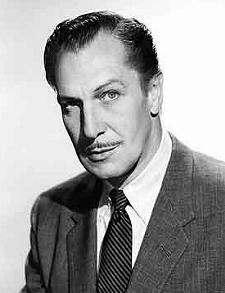
5-27-1911 to 10-25-1993
October 25th, 1993, Vincent Price, a horror film legend, left this mortal coil. The horror films that Vincent Price starred in were not the violent shockfests people so often imagine when they thing of the words "horror film." His films were not about gore, or quick cathartic release of tension, rather they were about fear. H.P. Lovecraft, a pioneer in American "Wierd Fiction", wrote in his essay Supernatural Horror in Literature :
The oldest and strongest emotion of mankind is fear, and the oldest and strongest kind of fear is the fear of the unknown...their admitted truth must establish for all time the geniuneness and dignity of the wierdly horrible tale as a literary form. Against it are discharged all the shafts of a materialistic sophistication which clings to frequently felt emotions and external events, and of a naively insipid idealism which deprecates the aesthetic motive and calls for a didactic literature to "uplift" the reader toward a suitable degree of smirking optimism...men with minds sensitive to hereditary impulse will always tremble at the thought of the hidden and fathomless worlds of strange life which may pulsate in the gulfs beyond the stars...
This horror of the unknown is the kind of horror that permeated the films of Vincent Price. To be sure some like the Tingler had moments of visual shock, but most of the horror in Price's films was internal to the viewed characters. The audience felt the horror not as an immediate thing which passes when the musical sting chimes, but as a lingering afterthought which remained with the viewer long after the film had been viewed.

An image from The Tingler more akin to modern horror.
Vincent Price and Roger Corman's screen adaptations of Edgar Allen Poe tales are some of the best examples of this lingering kind of fear. With modern special effects making the imagery in The Pit and the Pendulum tame, possibly completely enervated of shock value, in comparison to the slaughter a Jason Voorhees is capable of committing. It is not the violence in Pit which horrifies, it is the thought of what man is capable of doing. This is the best kind of fear, the fear that reminds us as we look into the abyss that the abyss is looking back into us. True fear is horror at the possible meaninglessness of existence and the potential cruelty of man. How horrible is the realization in Fall of the House of Usher that Roderick Usher had accidently put his living sister prematurely into the tomb? The audience who watches this film can imagine both having to dig oneself free of an early grave and the terror of realization Roderick comes to when he realizes what he has done. There but for the grace of G-d go I.
When Price first died, I worried that the "lingering fear" horror tale was dead. I "feared" that all I would be able to watch were gorefests made purely for shock value, but I should have known better. There were already hints that filmmakers knew what kind of fear was most valuable. In John Carpenter's version of the Fog, the horror wasn't that the dead had come back for revenge. It was why they came back, and that it didn't matter who they killed to get the requisite number of victims in compensation. Even a child would have sated their lust for vengeance. There were other films as well, but I would like to focus on what has come since Price died.
The Others, starring Nicole Kidman, is a wonderful example of personal realization bringing horror. Sure there are moments of suspense, but what keeps you talking about the film is the moment of realization. The same goes for Sixth Sense, but I think that the Village with its demonstration of what people will do to create a "just" society is more horrifying. Even if you guess the "twist" in the Village the lengths the Elders go through to maintain the serenity of the village is frightening. Eric Kripke's story about the Boogeyman isn't about gore, it is about how we give power to our fears. The same can be said for the numerous Japanese horror films which have come our way over the past few years. They often contain shocking images, but it is the lingering thoughts of the spitefulness of the dead which have value in the long term. The most Lovecraftian of recent horror tales was The Forgotten in which humankind were naught but play pieces for aliens in a G-dless materialistic universe. Julianne Moore, and all the other characters, were truly helpless against the antagonists and the resolution that she was "okay" isn't cathartic because the threat remains for everyone else.
Sporatic Geek Update -- Battleship, D&D, and Donkey Kong
In the process of maintaining a blog about popular culture and Geek activities, I often find articles that would make for good blog posts. I tend to leave these articles as open tabs on my web browser, intending to at some point come back to them and give them the full length discussion that they deserve. Eventually, months pass and these topics go untouched. Guilt ensures that the tabs stay open, but a busy life ensures that the full posts don't get written. That's why I created the "Sporatic Geek Update" a couple of years ago.
The update isn't meant to be regular, hence the "sporatic" part of the name, but it is filled with things that I think are wonderful and worth checking out. Here are some of the things that have happened over the past 3-5 months -- that's right months -- that I wanted to talk about, but haven't.
That's it for this "Sporadic Geek Update." There's quite a bit of exciting stuff in it. Let me know your thoughts.
The update isn't meant to be regular, hence the "sporatic" part of the name, but it is filled with things that I think are wonderful and worth checking out. Here are some of the things that have happened over the past 3-5 months -- that's right months -- that I wanted to talk about, but haven't.
- Jonathan Liu over at Geek Dad wrote a great article about the latest Battleship related boardgame Battleship: Galaxies. The game is an exciting, if not well known, war game of the kind that I hope Hasbro continues to manufacture. As the good folks at Heroscapers point out, the game was designed by Craig Van Ness who also designed the fantastic Heroscape board game. The game is available at Amazon -- and at your friendly local game store -- and is a perfect holiday gift.
- David Ewalt of Forbes Magazine has an interview with Shelly Mazzanoble about her latest book Everything I Need to Know, I Learned from Dungeons and Dragons. Shelly is an Associate Brand Manager at Wizards of the Coast who's first real encounters with D&D came as a Hasbro employee. She is a wonderful writer and a great advocate for the hobby.
- Robert Schwalb has written an excellent post about how "checking your ego at the door" can help you become a better game designer. I would argue that this article is also a must read for managers and "authors" in any creative field.
- Gamasutra covers the "Secret History of Donkey Kong." Donkey Kong was one of the games that sparked the arcade revolution, and its legacy still echoes through the video game industry.
- Matthew D. Wilson, the Chief Creative Officer of Privateer Press, made a steampunk version of "Little Red Riding Hood" entitled Wolfsbane.
That's it for this "Sporadic Geek Update." There's quite a bit of exciting stuff in it. Let me know your thoughts.
Subscribe to:
Posts (Atom)