I am glad that Wizards of the Coast is using their experiences running Magic: The Gathering events over the years to improve they way they run Dungeons and Dragons organized play. I even think that the D&D Encounters model, short adventures that can be run in two hours and tie into a larger campaign story, is an ideal structure to use in game store based play and to use in game store demos. It also gives me a sense that Hasbro is dedicated to promoting the hobby when they support endeavors like this -- that empower the hobby market and allow it to generate interest. I am certainly happy that they are making videos that show examples of what gaming really looks like:
What I am not excited about is that they seem to be limiting the D&D Encounters program to game stores alone and not offering the adventures (with their cool maps and supplies) to the gaming public at large -- after a delay to allow the game stores some exclusivity naturally.
You see...I am a bit of a completist. When I play a role playing game, I like to own all of the adventures and as many of the products for the game as I possibly can. This is especially true when the products come with well designed maps that I can use repeatedly.
By offering the Encounters adventures solely to the game store, Wizards is encouraging the eventual development of an underground market for these adventures and the merch that accompanies them. This is a bad thing, and ignores a potential revenue stream.
Not every gamer has 2 hours on a Wednesday that he/she can spend out of the house playing a game in a store. Some gamers are home bound and can only play in their own homes. They might be parents of small children. They might be married. They might have graduate school. They might have jobs that prevent them from going to stores during normal operating hours with any regularity.
What about these gamers Wizards?! What about those of us who would be willing to pay, and use, these products in our home games?
Sure, I'd be willing to wait 6 months -- or a year -- to wait for the whole Encounters storyline to be played out in the stores. This would give the stores a period of exclusivity that might encourage those who do have the time, but might not otherwise go to local stores (who are the lynchpin of the business) otherwise.
Thing is, I'd really like these to become available commercially at some point. Throw those of us who buy our stuff at FLGSs, but who are limited to gaming at home, a bone here!
We're the hobby too.

Tuesday, May 25, 2010


Monday, May 24, 2010
Fantasy Flight Games to Release "Space Hulk" Card Game

From the first publication of their flagship board game Twilight Imperium, Fantasy Flight Games have been succeeding at balancing the two most difficult tasks that game publishing companies face. There is often a tension between managing a company effectively -- actually treating the business as a business -- and the publication/creation of high quality games. If a company pays too much attention to making games that fit trends, and thus might sell well in the short term, they run the risk of alienating players due to the decreasing originality of their own products. If they ignore the financial aspects of the industry, they will slowly grind to a halt and fail to produce product that fans have eagerly awaited for years.
Fantasy Flight has done neither of these, much to their credit. They have a proper balance of pushing new creative envelopes in game design, and extending on great design ideas. A quick look at the history of the company shows that they have created some innovative games like Disk Wars and Twilight Imperium, but that they have been savvy enough to end a product line before it ended the company.
Ever since I first read that Fantasy Flight had been granted the license to create games based on Games Workshop intellectual properties, I have eagerly awaited each new entry produced by the company. Fantasy Flight have managed to release a nice balance of reprints/revisions of classic GW boxed games like Fury of Dracula and producing new games based on a previously used themes like their excellent Horus Heresy and Warhammer Fantasy Roleplay 3rd edition games.
Last year, Games Workshop did a limited release of a revised edition of their classic Space Hulk tactical board game of Space Marines fighting sinister aliens. The new release, an update of the 1st edition of the game that ignored changes made during the second edition, was available for a very short time and is currently sells for somewhere between $100 and $150 on eBay (still fairly close to list price). $150 can seem a pretty steep price to pay for a tactical board game -- even one as high on replay value as Space Hulk -- and one sometimes finds oneself in the mood to play a game when there is no one available for a quick table top game or with more friends hanging out than the two required for Space Hulk. The movement rules in Space Hulk do allow for solo play, but the game is better with two players. For my money, I'll current play Dennis Sustare's Intruder over Space Hulk as a solitaire game -- it's more portable and plays quicker. This will likely change in the coming months.
Fantasy Flight Games has announced that they will be releasing a new cooperative card game, designed by Corey Konieczka, entitled Death Angel.

Space Hulk: Death Angel - The Card Game is a cooperative card game set in the grim darkness of Warhammer 40,000. Players must work together as an alien menace threatens to devour their hopes of survival. If all Space Marines perish, the players collectively lose. Likewise, if at least one of the surviving Space Marines completes the objective, the players all win!
Playable in under an hour, Death Angel takes 1-6 players straight into the action. Each player takes control of a combat team (or two combat teams if playing with less than four players). If playing solo, the single player controls three combat teams. Combat teams are made up of two unique Space Marines, each with their own flavor and style.
A quick playing cooperative card game that emulates the grim darkness of the 40k universe?
Yes please.
Thursday, May 20, 2010
Is The Cup of Tears Already the Third Best Ninja Movie Ever Made?
Gary Shore's two-minute independently produced "trailer" The Cup of Tears has already led to him signing an agreement with Universal to direct a film based upon the trailer. The two-minute trailer combines Tibetan monks, Shaolin looking monks, Samurai, Ninjas, things that look like missiles shot in "bullet time," and space ships shooting at each other. Somehow it manages to do this with almost no similarity to Cowboy Bebop.
Looking at Shore's direction of the action sequences, I am almost tempted to say that this is the third best American made ninja movie ever produced.
The first two?
Ninja Assassin and Revenge of the Ninja
The lack of Sho Kosugi automatically removes Shore's film from the top two.
As for other films in the Top 10 American Produced ninja movies, they include in no particular order The Octogon, You Only Live Twice, American Ninja, The Challenge, and The Hunted.
I don't consider Kill Bill a ninja film. It is too much an amalgam of all that is awesome in Eastern action cinema.
Nuff Said -- Prince of Persia Trailer as Performed by Legos
Raise your hand if you made stop motion action figure/lego figure movies, or dreamed of doing so, as a kid?
Wednesday, May 19, 2010
Tuesday, May 18, 2010
The Invisible Gorrilla and Games -- Mystery Stories
In 1999, Daniel Simons did an experiment involving a person in a gorilla suit and people in different colored clothes passing a basketball to one another. The experiment was designed to see how we look at things and demonstrate how our perceptions can fail us. The basic finding of the experiment is that we fail to observe a lot of things that are going on around us, and that we have no idea that we are missing out on so much. Daniel Simons and Christopher Chabris have written a book called The Invisible Gorilla: And Other Ways Our Intuitions Deceive Us
 . Two of the things the book focuses on are how are intuitions often mislead us and how our perceptions aren't as keen as we believe them to be.
 "What does this have to do with games," you ask? Nothing and everything.
How many times have you been running a roleplaying game session in which you have laid clues for the players to discover which will help them to solve a mystery of some sort?
Sometimes the clues are embedded in your verbal descriptions of scenes and events, and sometimes they are placed on a battle mat for the players to find. The clues might even have been incorporated into dialogue role played out.
Of these times, how often have the players completely missed the clue due to focusing on other objects in your presentation?
Sometimes this can lead adventures into fun new directions. If the player's become convinced that the 12 year-old witness you were acting out in dialogue is so creepy that he must be a shapeshifted Goblin in disguise and the real reason the children of Vandomeer have been disappearing, it might be better to follow the player's lead and ignore the fact that you had placed several clues that it was the kind Cleric of Pelor who had been driven to despair after the death of his daughter and was looking for parts to construct a replacement. In a case like this, there is no reason to shoehorn the players into your planned story even though they missed your -- to you -- obvious clues. A good GM knows that the goal of play is to satisfy your player's desires and making their wild guesses into fact is a great way to achieve this goal.
Sadly, improper leaps to conclusions aren't the typical result of missed clues. The most common result is that the mystery grinds to a halt as the players "keep searching." In a game like D&D, or any other system where skill rolls determine the results of actions, this can amount to players "rolling again and again" or "taking 20" at each 5 foot square of a room with you having to notify them of what they did or didn't find. In a game that is looser and more "acted out," you have to decide whether to keep repeating the clues you have already shared or make up newer -- more obvious -- clues to give the players. Giving the players too obvious a clue after they failed to understand the initial clues can lead to some serious dissatisfaction by the players. They'll feel foolish for missing the initial clues, and railroaded by your new ultra-obvious clue.
Robin Laws' Gumshoe system tries to address these problems by having an underlying gaming assumption that the players will find the necessary clues automatically and lets them "spend points" in order to get more information from the clues. The system doesn't guarantee that the players will "solve" the mystery that you presented to them, it only means that they will actually find the clue, but it does increase the likelihood that their speculations might lead the adventure into another direction from what you originally planned.
In real life, it can be tragic when some real clue is missed or misinterpreted. In a roleplaying game missing a clue can bring a game to a boring halt, but misinterpreting a clue might lead to a better story. In real life, our intuitions deceive us and lead us into foolish actions, but in games our deceptive intuitions can lead us into entertaining experiences.
Sometimes you can exploit the deceptive intuitions of your players to assist you in constructing your adventures.
Do you have any stories where mysteries have bogged down or where deceptive intuitions have led to great adventures?
Thursday, May 13, 2010
Green Ronin, Mutants and Masterminds, and DC Adventures
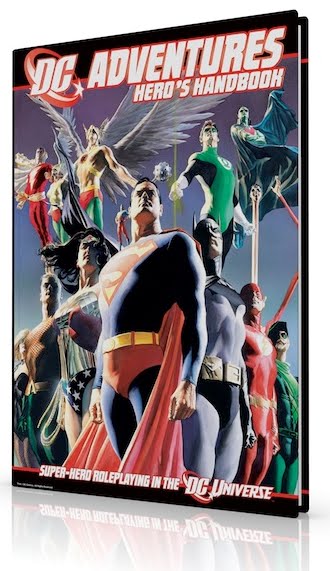
I quickly soured on those 2nd edition conversations as the system seemed to be migrating away from a DC Heroes influenced system into a Hero/Champions influenced system. Champions is a great game, but it can also intimidate new gamers and has certain exploits that hard core Hero gamers like to use. These kinds of exploits were being inserted into M&M and I wasn't as pleased as I had hoped. The game transformed from rules light to Champions light, and that was a step backwards in my opinion.
I still purchased all of the products. For all that I didn't like the mechanics of the game, the campaign advice and writing of Green Ronin products is among the best in the industry and I gladly support them. I merely had an "anti-granular" rules nag in the back of my mind every time I opened a text.
So when I read that Green Ronin was doing DC ala M&M, I have to admit that my fear was that it would be DC "Champions Light" and lack a fast and easy system that might appeal to new players -- one of the key reasons to acquire a license in the first place. This was particularly upsetting given Green Ronin's recently demonstrated commitment neophyte friendly games like their amazing Dragon Age and it's AGE System. In fact, I would love to see a DC AGE game.
My fears were somewhat allayed yesterday when I read a press release that Green Ronin was releasing a 3rd edition of Mutants and Masterminds. The key quote for me was "We worked to simplify some elements of the system and fix known issues, while retaining the flexibility and fast-paced play fans have enjoyed." If only they can accomplish what DC Heroes did so well, and M&M 2nd failed to do as well as M&M 1st, and present a system where Batman and Superman are able to adventure together in a manner where both are effective.
Whether I am ecstatic or not about the mechanics one thing is certain, I will be buying DC Adventures on day 1.
Wednesday, May 12, 2010
Fighting Fantasy and Fiend Folio Artist Russ Nicholson Starts Blog!

If you love Dark Creepers, Revenants, and the Githyanki, then Russ Nicholson is your man.
Axis of Awesome vs. Greyson97
Which is more remarkable?
Is the Axis of Awesome right in positing all pop songs use the same four chords?
Does knowledge of a "mere 4 chords" explain Greyson97?
Is the Axis of Awesome right in positing all pop songs use the same four chords?
Does knowledge of a "mere 4 chords" explain Greyson97?
Geekerati Gaming Archives Volume 1 -- Matt Forbeck Interview
In July of 2007, Geekerati Radio -- a podcast a few friends of mine and I ran for over two years -- had our first gaming related episode. It was our ninth episode overall and it featured an interview with Freelance Game Designer extraordinaire Matt Forbeck. Over the course of his career Matt has worked with most of the major game and toy companies -- from rpg games to toy design -- and has been nominated for 24 Origins awards and has won 13. His game designs have included miniatures rules for starship combat, dark future science fiction roleplaying games, bleak counterculture superhero rpgs, and the list goes on.
You can tell by the interview why Matt is called the nicest man in the gaming industry.
Last year in September the Geekerati show petered to a halt as we never got the listenership to justify the effort we were putting into the show. When you are interviewing Brandon Sanderson -- new author of the Wheel of Time series -- and you only get 4 "live" listeners (though the archive did quite well) it can be a bit disheartening. When you add a full time work schedule, MBA courses, attempts at a regular rpg gaming hobby, and twin toddlers to the mix it was becoming difficult to justify the time.
I loved the experience, and my co-hosts are great friends, and would like to do it again. But to do so will require some massive scheduling efforts and possibly some new co-hosts. Bill Cunningham, our mad pulp bastard, is hard at work promoting his own awesome pulp publishing company, Eric Lytle is keeping California safe from toxic chemicals, and Shawna Benson is striving toward fame and fortune.
Let me know if you think I should give it a go again, and in the meantime I'll be sharing the archives with you.
You can tell by the interview why Matt is called the nicest man in the gaming industry.

Last year in September the Geekerati show petered to a halt as we never got the listenership to justify the effort we were putting into the show. When you are interviewing Brandon Sanderson -- new author of the Wheel of Time series -- and you only get 4 "live" listeners (though the archive did quite well) it can be a bit disheartening. When you add a full time work schedule, MBA courses, attempts at a regular rpg gaming hobby, and twin toddlers to the mix it was becoming difficult to justify the time.
I loved the experience, and my co-hosts are great friends, and would like to do it again. But to do so will require some massive scheduling efforts and possibly some new co-hosts. Bill Cunningham, our mad pulp bastard, is hard at work promoting his own awesome pulp publishing company, Eric Lytle is keeping California safe from toxic chemicals, and Shawna Benson is striving toward fame and fortune.
Let me know if you think I should give it a go again, and in the meantime I'll be sharing the archives with you.
Watch the (fake) The Day After Ragnarök Movie Trailer, then Buy the Book

YouTube creator "BloodRunsClear" has created a movie trailer for an imagined film based on Kenneth Hite's remarkable Savage Worlds game setting The Day After Ragnarök (DAR) by Atomic Overmind Press.
Kenneth Hite has long been respected as one of the most talented writers in the gaming hobby, and has been a long time advocate of the independent game publisher movement. His "Suppressed Transmission" column for the online version of Pyramid Magazine was a must read while it existed was a rich source of inspiration for game masters everywhere. Hite has the capacity to connect seemingly unrelated events/objects in ways that were an almost "how to" education in designing alternative histories/presents. Reading his column, I always wondered what would happen if Kenneth Hite took the talents he demonstrated in "Suppressed Transmission" and applied them to an rpg setting. With The Day After Ragnarök Hite answered that question and it is a magnificent amalgam of Pulp goodness. Let's just say it's a setting that is a post-WW II Norse Apocalypse as seen through Robert E. Howard's eyes. It's a world where both Doc Savage and Conan would be welcome, and where characters of classic noir films stand in the shadows.
Tuesday, May 11, 2010
J. Eric Holmes on Miniatures

 (Hippocrene Books 1981):
When role-playing grew out of fantasy war gaming, many of the players were used to playing games with armies of toy soldiers. The first Gygax rules, Chainmail, were intended for just such games, and allowed for the fantasy element...
Dr. Holmes clearly articulates the rpgs have their origins in miniatures wargames, or at least their rules do.
The metal miniatures are not a necessary ingredient of the fantasy game, which runs perfectly well without them.
He also posits that they are not necessary for play of the modern -- in 1981 -- roleplaying game. This comment fits within the context of the book as an example of where Dr. Holmes is attempting to remove any intimidation a reader might have regarding RPGs if miniatures are required. Given that all the pictures of Dr. Holmes playing -- in the book -- include the extensive use of miniatures, I think this is the case.
The fantasy gamer is usually concerned with a few figures representing the player characters and their opponents, and for these encounters the 25mm scale is ideal. There are an almost unlimited supply of figure possibilities.
To use figures or not to use figures, that is the question for the fantasy role-player. Minifigs's Steve Carpenter says that if your eyes don't light up when you first see the tiny armies on the table top, you will never get the bug or understand someone who has.
These quotes exhibit that while Dr. Holmes has an appreciation for the use of miniatures in the game, he is ecumenical about who plays the game. Some people don't understand the appeal of miniatures in the game, that is perfectly understandable. But for those who are merely intimidated by the prospect, he has the following advice:
Another way to get started is to begin playing one of the role-playing games without figures. After the game has been going for a while and has gained a regular group of players (a few will always drop out or join up after the initial games), introduce the first use of figures. There should be figures of the regular characters in the game and one or two monsters. Other monsters can then be represented by small chesspieces, or unpainted figures, or even blobs of plasticene clay.
These sentences add to my earlier assertion that Dr. Holmes' comments that "miniatures are unnecessary" were partly to assuage any fear of financial bankruptcy that may be caused by joining the hobby. Here he adds an economical way to incorporate minis.
He finishes the chapter with this:
There are advantages to having figures on the table to represent the characters in a game...
The placing of figures facilitates [a] kind of dialogue with the referee and vastly increases the ease of visualization. Since many game melees are just that, a melee of characters and monsters running about and in and out, the poor referee finds it a lot easier to keep track of them all when they are represented by tiny metal sculptures. And, finally, the whole thing makes an exciting and pleasing spectacle!
Miniatures use isn't a new part of the hobby. Nor is there a greater financial focus on miniatures than in the past. TSR created their own miniatures company in the 80s under Gygax/Blumes, and lobbied to put others out of business to reduce their competition. They hired Duke Siefried to assist them in the financial endeavor. Miniatures and D&D as an industry have always gone hand in hand, even though D&D in home games hasn't been ubiquitous.
Monday, May 10, 2010
RIP: J. Eric Holmes (1930 - 2010)

J. Eric Holmes wrote the first "Basic" edition for the Dungeons and Dragons game, he describes how he -- a Professor in the Department of Neurology at USC at the time (Fight On!) -- came to write the product in his informative book Fantasy Role Playing Games (Hippocrene Books 1981) as follows:
In 1974 I persuaded Gygax that the original D&D rules needed revision and that I was the person to rewrite them. He readily conceded that there was a need for a beginners' book and "if you want to try it, go ahead..." I edited a slim (48 pages) handbook for beginners in roleplaying, published by TSR in 1977...
Without that Basic set, the role playing game hobby may have aged out with the older generation who were the majority of the audience playing the game prior to the publication of Holmes' work. Gary Gygax wrote of the importance of the Holmes Basic set to the hobby as a whole in Dragon #22:
If millions take to the fantasy world of J.R.R. Tolkien, and nearly as many follow the heroic feats of Conan, the market potential of a game system which provides participants with a pastime which creates play resembling these adventuresome worlds and their inhabitants is bounded only by its accessibility. Access has two prominent aspects; availability is the first; that is, are potential players informed of the fact that the game exists, and are they able to physically obtain it; and difficulty is the second, for if once obtained the game is so abstruse as to be able to be played only by persons with intelligence far above the norm, or if the game demands a volume of preliminary work which is prohibitive for the normal individual, this will be recognized and the offering shunned even if it is available. D&D failed on both counts, and still it grew. Today we are putting D&D onto the track where it is envisioned it will have both maximum availability and minimum difficulty. This is best illustrated in the "Basic Set."
Well over two years ago we recognized that there was a need for an introductory form of the game. In 1977, the colorfully boxed "Basic Set" was published. It contained simplified, more clearly written rules, dungeon geomorphs, selections of monsters and treasures to place in these dungeons, and a set of polyhedra dice -- in short all that a group of beginning players need to start play with relative ease.
Without the "Basic Set," D&D would have grown due to the size of the interested market, but it would not have had explosive growth. Gygax is right that the original rules failed on both the above counts, he is also right that the "Basic Set" succeeded on both. This is evident is that the "Basic Set" increased sales exponentially as it provided a pathway to the other products -- a well lit and easy to follow pathway. In the article quoted above, Gygax states that between January 1974 to December 1975 (two years of sales) 4,000 sets of the original rules were sold. Comparably, at the time the article was written (February 1979) the "Basic Set" was selling 4,000 copies per month, "and the sales graph is upward."
Holmes articulated the underlying difficulty of the original rules as follows:
When Tactical Studies Rules published the first DUNGEONS & DRAGONS rule sets, the three little books in brown covers, they were intended to guide people who were already playing the game. As a guide to learning the game, they were incomprehensible. There was no description of the use of the combat table. Magic spells were listed, but there was no mention of what we all now know is a vital aspect of the rules: that as the magic user says his spell, the words and gestures for it fade from his memory and he cannot say it again.
Holmes understood that gaming companies needed to write products that could introduce people to the hobby. They needed to promote their products to broader demographics if they wanted to survive as a viable industry. Roleplaying games tend to get more and more complex the longer the rules set remains in play, and thus become more difficult for the neophyte player. One response to the "rules bloat" has been to reboot with new editions, but this can alienate your existing player base who enjoy the complexity the game has to offer. The other solution is to offer an introductory version of the game. The hard core current players will not, as a block, purchase the product, but it is a great way to introduce new players into the hobby.
Hasbro is attempting to apply this lesson with product offerings that are coming out later this year -- among them a new Dungeons & Dragons Introductory Set.

John Eric Holmes was a great advocate for the role playing game hobby, a gaming enthusiast, and the game designer responsible for making D&D rule accessible. He was also an active member of Edgar Rice Burroughs fandom. He is definitely someone I would have loved to meet.
From one Trojan gamer to another, all I can say is Fight On!
Friday, May 07, 2010
Oligatory Sharing of George Lucas Exploiting Gen-Xer's Love of Star Wars Post
The video featuring Darth Vader in a sound booth recording directions for the Tom Tom navigation device is very amusing and deserves to be shared for its entertainment value alone. That doesn't mean that I don't feel a pang of irritation with how George Lucas continues to mock, ridicule, or ruin what was an amazing experience for me as a child. Lucas has always exploited the market potential of Star Wars -- especially on the merchandising end -- but this seems a bit forced. Yes, it seems even more forced than Star Wars Slurpee cups or Burger King mugs.
It's odd being in an aging demographic that still finds the imagery of its childhood to be effective for commercial appeal. For all my irritation, I'm considering saving up to buy one of these. Can you imagine a Baby Boomer saving up to buy a Jonny Quest -- or Yogi Bear -- voiced GPS system? Heck, even a James T. Kirk one would probably appeal to Gen X more than Boomers. We're an odd bunch.
It should be mentioned that the Darth Vader video pales in comparison to Orson Welles discussing peas.
It's odd being in an aging demographic that still finds the imagery of its childhood to be effective for commercial appeal. For all my irritation, I'm considering saving up to buy one of these. Can you imagine a Baby Boomer saving up to buy a Jonny Quest -- or Yogi Bear -- voiced GPS system? Heck, even a James T. Kirk one would probably appeal to Gen X more than Boomers. We're an odd bunch.
It should be mentioned that the Darth Vader video pales in comparison to Orson Welles discussing peas.
Thursday, May 06, 2010
My Favorite "Non-Wizards of the Coast/TSR" Fantasy Setting

You won't find slave trading nations engaging in espionage and sabotage in Mystara and you won't find the Elvish Liberation Front in Greyhawk. I find no contradiction in the fact that I love two settings so diametrically opposed in their respective tones. Mystara's Pratt/DeCamp style is wonderful fun to play around in, as is Greyhawk's Howardian/Moorcockian gloom. No fantasy setting has set my imagination alight in quite the same way as these two have. Eberron comes close, but it is in many ways a combination of those two worlds.
There are quite a few Fantasy settings written by companies other than Wizards of the Coast, and many of them are very good. Green Ronin's Freeport setting is very popular. The old school Tekumel holds cache with many. The City State of the Invincible Overlord appeals to still others. These are but a smattering of the offerings available, but none of these truly ignite my imagination. I will use ideas from them, to be sure, but none of them call to me at night demanding to be read and re-read.
That honor lies with Paul "Wiggy" Wade-Williams' Hellfrost campaign setting for the Savage Worlds roleplaying game. If Mystara is Pratt/DeCamp and Greyhawk is Howard/Moorcock, then Hellfrost is Poul Anderson/George R. R. Martin. Wiggy's setting takes all that is horrific about medieval stories and puts them into a setting where the players find themselves in a desperate -- and likely hopeless -- struggle against powers beyond their ken. Inspired by the Norse concept of Fimbulwinter, the Hellfrost campaign takes place in a world that is slowly freezing. Summers are getting shorter and shorter, and the winters are getting longer. The god of the sun has disappeared, and may be dead, and the gods of death and winter are growing in power. How does one survive in such a world? Desperately.
The setting is made all the more appealing by the sheer "prolificity" of its author. Wiggy is a writer of the Walter Gibson school. His writing is so prolific that I wonder when he has time to eat, or to play in the settings he has created. Yet, it is evident from his casual internet posts that he does in fact eat and play a great deal. Where most indie rpg companies are lucky to come out with three or four products a year, Wiggy has a new product available on his company's website every week. Since 2008, Triple Ace games has published over 90 products for their fans -- and they are of remarkable quality for the volume.
Do yourself a favor and check out Rassilon -- the world of Hellfrost. It can easily be converted to your favorite rpg system, though it works very well in Savage Worlds.
Wednesday, May 05, 2010
Gale Force 9 Official D&D Maps and Token Sets Look Nice
Gale Force 9 has some very nice looking products coming down the pipeline in support of the 4th Edition D&D game. Their Character Tokens, Dungeon Master Tokens, and Game Mats all look like great additions to a D&D player's collection.


Roleplaying Evangelism -- Hasbro Targets Young Audiences

Last, I commented about my belief that if the roleplaying hobby wants to remain vibrant and "alive," it will need to recruit younger gamers. The alternative is for our hobby to age with us and fade into the mists of antiquity. When I was growing up, TSR specifically targeted younger gamers with the Moldvay/Cook "Basic" line of D&D products, the Fantasy Forest and Dungeon! boardgames, action figures, and a Saturday morning cartoon.
During the 90s, TSR largely abandoned products designed to appeal to young audiences and shifted to a tone somewhere in the PG-13 range. While their misguided attempt to disassociate themselves from Culture Wars criticisms regarding the games occult content through the removal of the words "Devil" and "Demon" from their early AD&D 2nd edition products might lead one to believe that the company had become "kid centric" as a whole, this belief would be in error. The 90s saw TSR produce the Ravenloft line of horror fantasy products (PG-13 horror to be sure), the Birthright fantasy setting (a slightly darker and more political setting), and the Dark Sun apocalyptic planetary romance setting (Dark Sun as planetary romance deserves a whole post of its own). The only real effort to attract young gamers was Troy Denning's "Black Box" D&D Basic set, a set that happens to be my favorite introduction to the hobby ever written. Denning, who left TSR during the Gygax era to be one of the founders of Pacesetter, is an old hand at writing "new gamer" friendly products and his "Black Box" was a doozy (it too deserves its own post). Aside from this product though TSRs products were aimed squarely at mid-teens and higher. Mystara, Spelljammer, and Dragonlance were for the mid-teens, while Greyhawk, Forgotten Realms, Birthright, Planescape, and Dark Sun were for older audiences. Heck...Planescape has wonderful content that is borderline R rated fantasy. This list doesn't include their X-Files inspired Dark*Matter
 setting for the Alternity game, that was R for sure.
 To some gamers, the fact that TSR wrote so much PG-13 material might make the company seem too "kid oriented." I'm not one of them. When I say that gaming companies need to recruit younger players for the health of the hobby, I mean 8-10 year-olds. This audience was abandoned by TSR in the 90s, to the detriment of the hobby. Pre-90s TSR, for all that grognards think of it as a more "hard core" era of the company had corporate policies directed specifically at attracting younger audiences. To quote a Kevin Blume interview in THE SPACE GAMER #63, "The demographics are moving younger...Our major grouping seems to be from eight to 22...We, ourselves, have adopted a code of ethics and conduct similar to what is used in the comic book industry...People can holler censorship if they want, but that type of material will not be allowed at Gen Con, and the yptes of products that promote sex, nudity, and violence and so forth [sic] are simply not appropriate for this audience...our marketplace is composed of an awful lot of younger people."
Compare Blume's description of the hobby in 1983 with today's gaming audience. It matches the Games Workshop audience, who due to specific outreach (without overt censorship BTW) have managed to increase the number of young players, but it doesn't match other aspects of the roleplaying game hobby.
This is why I was so happy last week when I saw that Wizards of the Coast, in coordination with Moonstone Publishing, had released a free introductory adventure specifically targeted at younger players. This adventure, The Heroes of Hesiod, is based on the Young Reader novel Monster Slayers
 by Lucas Ritter -- the novel itself is an extension of Mirrorstone's excellent and successful "Practical Guide to" series of books which includes the best selling A Practical Guide to Monsters
 .
.
 .
. If our hobby is to continue to grow, or sustain itself as a mature marketplace, products like these and Faery's Tale Deluxe
 by Patrick Sweeney, Sandy Antunes, Christina Stiles, and Robin D. Laws need to be produced. As gamers, we need to encourage and support these efforts as much as we fight against them censoring down the product lines for adults. There is nothing wrong with hobby gaming becoming such a mature market that there are separate product lines for kids, teens, and adults. All that matters is that all of the product lines are of good quality and that companies and fans support them when they are. It was tragic that Wizards didn't support the Knights of the Silver Dragon
 series in the same way that they are supporting the "Practical Guides" line -- an article in Dragon Magazine is not as aggressive a marketing effort as coordination with libraries and well produced online content.
The funny thing is that the "Practical Guide to Monsters" that was successful enough to prompt this expansion, was itself an extension of the Knights of the Silver Dragon series of books.
Show your support and download The Heroes of Hesiod and play it with your kids/younger friends.
Wednesday, April 28, 2010
Roleplaying Evangelism -- The Kids Are Alright

 . The post, and the original comment by Will or Jeff at Gameplaywright, discusses what it really means for a game to be dead and what it takes to keep a game alive. The short answer is that a game is alive as long as people are playing the game.
The longer answer is that games are truly alive as long as anyone is actively promoting participation in the play of the game. A game that is only played by one group during one play session a year isn't dead for that group, but it is dead for all intents and purposes. A game that is played by very few people, and has no support products (like A Penny for My Thoughts), but has Fred Hicks pounding the pavement in support of the game online, at conventions, and at friendly local game stores, is very much alive. Goblinoid Games purchase and promotion of Starships and Spacemen are keeping that game alive, even if it never sees the promised revised edition.
The whole "Old School Renaissance" movement is about keeping games alive and promoting older games/older styles of play to keep them alive. Some of what the OSR movement does is that it re-introduces gaming to players of a particular generation and gets those people to start gaming again. Some of what they do is bring new gamers into the hobby who are looking for less expensive, and more DIY, entries into the hobby. A lot of the advocates of OSR have particular ideas of what gaming means. These ideas reflect their tastes in the style of content as much as the style of narrative.
For someone like Ron Edwards, the creator of the excellent Sorcerer independent role playing game, the playing of role playing games is a kind of counter culture activity. For him the counter culture that saturated popular culture is a quintessential part of the D&D experience. In his essay "Naked Went the Gamer" in Fight On! #6, Edwards states that the SF/F culture that appealed to him "ran more underground, more enthused about bloodshed and pulp driven plots, and the associated science fiction was rebellious and rude as in Dangerous Visions." In particular, he was attracted to two aspects of the gaming hobby and the subculture it represented to him. These were the monstrous and the naked. I won't go into any real details here, you should read the essay yourself, but a brief synopsis of his point is the following. In the 70s, popular culture itself was a kind of counter culture that celebrated the monstrous and the naked. That the overall culture of the 70s and early 80s was such that nudity in role playing games, or in society in general, wasn't shocking. For him the gaming company's "flinched" when responding to the heightened cultural conservatism of the mid to late 80s. To quote:
D&D went Disney while GURPS shed Metagaming's zesty illustrations. Rolemaster, Rifts, and the Hero System were born eunuchoid and stayed that way. T&T and Tekumel remained marginal, and the latter's Book of Ebon Bindings vanished. Even the Arduin Trilogy, of all things, cleaned up its art. RuneQuest content floundered and was eventually scrubbed to nothing by Avalon Hill. Role-playing publishing became monster-ly and naked-ly cleansed, in as stunning a victory for the coalition of censors as anyone could have imagined.
Before I go on to criticize Edwards view of this as the ideal state of gaming, I would like to say the following. He is right in asserting that the gaming hobby, as a whole, shouldn't run away from doing "adult" themed products. No individual company should feel compelled to Disney-fy their content. I am with him when he argues that we should defend the works, like the dreaded D&D Supplement III: Eldritch Wizardry from those who want to argue that its cover is exploitative and that the product encourages devil worship. Roleplaying products should not be written with the intent to "not offend." They should be written to appeal to an audience.
And here is where I differ from Ron in my gaming experience. I don't view the Jeff Dee and Bill Willingham illustrated D&D Basic Set as a watering down of other material. I see it as material directed at an entirely different audience. In this case, that audience was 11 year old me. The 70s weren't merely counter culture, porn chic, Disco, Punk, and Caligula. They were also a time of uncensored Richard Scarry, of Atari, and of Star Wars. The 80s weren't just an era of cultural conservatism and Moral Majority backlash. They were a time of the Atari 2600, Transformers, GI Joe, and -- yes -- the D&D Cartoon. They were a great time to be a child, not the least reason because TSR and other gaming companies began looking to children as a way to expand their business. I was one of those children and the games they presented to me, especially the Moldvay/Cook line of D&D products were like manna from heaven to my imagination. For the child who adores Roald Dahl's Charlie and the Chocolate Factory and Ian Fleming's Chitty Chitty Bang Bang, as well as Edith Hamilton's Mythology, the "Basic/Expert" D&D products were ideal introductions to a hobby -- regardless of Ron's belief that these were "flinches." Not all young people like Karl Edward Wagner or Heavy Metal, some prefer Manly Wade Williams and Edgar Rice Burroughs.
These people need products too.
Edwards makes the logical mistake of associating all appeals to children in rpg content with flinching from facing criticism from cultural conservatives. Certainly, changing Devils and Demons to Baatezu and Tanar'ri in the 2nd Edition of the AD&D game was such a flinch -- and it has been properly ridiculed -- but Pacesetter's Universal Pictures Monsters inspired Chill is not, nor is Hero Games superhero game Champions. He also makes the Pauline Kael error of believing that all gamers share his opinion of whether the role playing hobby, and the old school, are quintessentially counter culture. That is hogwash. The role playing hobby is both culture and counter culture, it has room for all.
This is why it is so important that we older gamers, who play the old school games, support efforts to attract new -- and younger -- gamers into the hobby. Without them, the games will age with us and eventually die. No one will play them or know what they are. TSR began appealing to younger players almost immediately with games like Fantasy Forest and Dungeon!, the cartoon was a natural extension of these efforts -- as were the action figures.
Who is doing more to keep the hobby alive...Ron Edwards with his inspirational, but niche, independent rpgs, or Jeff Kinney author of Diary of a Wimpy Kid who includes a chapter where the title character starts playing a roleplaying game? WJWalton has a post over at "The Escapist" blog that provides a part of the answer. Gaming needs more people like Ron Edwards, but we need also need more people like Jeff Kinney.
I like Ron's work. I often find his ideas inspirational, but the story of a young kid wanting to play D&D with his dad warms my heart and gives me hope for the future. I would also like to add that the good folks at The Escapist have had role playing game defense literature on their website for quite some time.

It's a bad thing when gaming product self-censor, but it is a good thing when gaming products are written for young audiences. The Pokemon Jr! Adventure Game
 is one of the best introductory rpgs ever written, and one would have to work hard to make it counter culture.
Oscar Mistakes #4325
Cliff Robertson getting Best Actor for his performance in Charly over Peter O'Toole's performance in The Lion in Winter.
Really?! Really?!
Really?! Really?!
Tuesday, April 27, 2010
Goblinoid Games Purchases Rights to Starships and Spacemen

These early science fiction games varied in quality and theme. The science fiction of Ken St. Andre's Starfaring is reminiscent of the John Carpenter film Dark Star and had rules that focused on playing the ship as a whole rather than on individual members of a crew seeking adventure as a team. The game had a humorous bent and like much humor of the 1970s might offend some readers due to the sexual nature of some of the jokes/illustrations. Space Patrol's system was inspired by Star Trek (though it did have rules for playing Laumer-esque Bolo tanks as well), so much so that Heritage Models was able to use the same system in their licensed Star Trek game. Heritage's Space Patrol based Star Trek was one of the earliest licensed role playing game properties.
Like Space Patrol, Fantasy Games Unlimited's Starships and Spacemen was inspired by the Star Trek television series. Fantasy Games Unlimited also produced a board game in the Starships and Spacemen universe entitled Star Explorer which expanded on the themes set forth in the Starships and Spacemen game.

This week Goblinoid Games announced that they had acquired the rights to publish an edition of Starships and Spacemen and they have made the original rules available in pdf format. In the long run, they plan to adapt the system to be compatible with their Mutant Future and Labyrinth Lord d20 Open Game License/Old Game Renaissance systems. This should be a fairly easy process. Like many early role playing games, Starships and Spacemen shares some mechanical qualities with the Dungeons & Dragons role playing game. For example, six of an S&S character's 8 primary attributes are determined by rolling three six-sided dice -- just as in D&D. S&S differs from D&D in its use of attributes in that it distinguishes between inborn attributes which remain the same for that character throughout play and acquired attributes which can improve over time. The game also contains "Branches" and "Subclasses" similar to the class system used in D&D. The acquired attributes mentioned earlier, expand the basic class/level system and incorporates an early skill/point system into the mix.
Sadly for Starships and Spacemen, and a number of other promising SF role playing games, Game Design Workshop had released the first Traveller rulebooks in 1977. The Traveller rules were more closely related to SF literature, having a heavy Foundatiom influence, and this combined with an ambitious support schedule led to Traveller dominating the SF rpg market for years to come. Fantasy Games Unlimited eventually dropped support for S&S and moved on to their Space Opera project which had a broader scope with regard to the kinds of SF it emulated -- everything from hard SF to Pulp.
It's nice to see games like Starships and Spacemen return from the dead due to the long tail effect and the low cost of distribution through the internet. I look forward to seeing what Goblinoid Games have to offer in the coming months. In the meantime, I will have to dig up my S&S rulebook from storage and write a review soon.
Subscribe to:
Posts (Atom)