Thursday, April 03, 2014

THE EYE OF ARGON - or - When A Community Mocks Its Own


I've long been a fan of science fiction and fantasy, and I've long been a person who is pretentiously opposed to pretense. In a way, I'm like an angry Polyanna who aggressively argues against those who mock the "juvenile" or "popular" things in SF/F. I love "skiffy" and have experienced no greater sense of wonder than reading Edgar Rice Burroughs' writings of John Carter. That's right. I believe that ERB's tales of Barsoom are as imaginative - nay more so - than Iain Bank's Culture novels, and I love those too. I'm the fan who loves both the Dragonlance stories and Malazan Book of the Fallen. I love the genre at its most literary, at its most imaginative, and when it falls into the "written by an overenthusiastic fan" territory.

I'm so positive in my passion about genre fiction and geek culture that I wrote an approving review of I, FRANKENSTEIN and have been reminded by my editor at Topless Robot that I need to bare the fangs every now and then because I am usually so enthusiastic.

While it's not for my upcoming Topless Robot article, I did find something that really aggravates me. It's how cruel SFF professionals and fandom can be. There are plenty of examples I could pull out of a hat, often dealing with the treatment of female fans as being "fake geek girls." As the father of twin girls who love Pirates, Pokemon, Paladins, and Princesses, I find that whole "controversy" infuriating. That's why I'm not going to write about that topic. It would be very difficult for me to avoid expletives on what has been consistently a G-rated or PG-rated blog.

Instead, I want to focus on how professionals and fandom have treated on particular enthusiast of Sword and Sorcery fiction, Jim Theis the author of THE EYE OF ARGON.


I've been doing nightly out loud readings of THE EYE OF ARGON. I do one chapter, or half chapter as the book has half-chapters as well, per night. I thought it would be fun to do. I heard that the SF/F community had regular readings of this poorly written work of fiction that were the book equivalent of MST3K...and it had been mentioned by the MST3K crew...so I thought it would be fun to do my own midnight readings with my wife.

My takeaway from the experience is that the SF/F community are cruel, judgmental, and full of themselves. I also came to believe that I was part of the problem. By participating in my own personal midnight reading, I was being an SF/F bully.

My sister, Krista aka  Luna McDunerson, bought me a the Wildside Press version of the book, which has a long introduction by Lee Weinstein that discusses the search and discovery of the real Jim Theis. It mentions an interview on a local (Los Angeles) radio show/podcast called Hour 25 where Jim supposedly stated, "that he was hurt that his story was being mocked and said he would never write anything again."

I'll be honest with you. I fluctuate in what to think. Either the whole thing is a hoax, or SF/F authors and fandom are cruel. Scratch that. Even if the whole thing is an elaborate hoax with false scholarship creating a plausible back story of a 16 year old writing the story for OSFAN, SF/F authors and fandom are still cruel. It doesn't matter whether Jim Theis is a real person or a fictional person, what matters is that the community has spent over 30 years mocking him. I became one of those people and it makes me feel terrible. The anger I feel toward myself more than outweighs the joy from any of the small chuckles I experienced during my reading of the work.

The thing is, I think that Jim Theis was a real person and that he did write THE EYE OF ARGON. While the Eaton Collection doesn't have a copy of OSFAN 10, the issue that is said to contain the original story, they do have issue 11 thanks to a generous donation by former UCLA librarian Bruce Pelz. According to the Weinstein essay in the Wildside edition, Theis remained an active fan of SF/F for most of his life. Can you imagine what it would be like to attend conventions where there was a midnight event dedicated to mocking you? It would be one thing if Theis embraced that mockery and made it his own, finding some way to leverage it into a positive thing, but that Hour 25 interview seems to imply the opposite. The mockery killed Theis' desire to become a writer. That's right, the SF/F community's mockery shattered a fan's aspirations. To me, that is the biggest crime that any professional or fan can do. No matter how "bad" a writer is at writing, they are never wrong to aspire to become a published author.

Yes THE EYE OF ARGON is poorly written, but not much more so than Lin Carter's THONGOR stories. Unlike Theis, Carter doesn't have the excuse that he was 16 when he wrote the THONGOR tales. Unlike Carter, Theis wasn't a brilliant editor. If an editor as brilliant as Carter was can write drivel and still be a vital contributor to the field as a whole, who is to say Theis may not have evolved into something more? I can tell you from experience that there are some sentences in ARGON that hint at some talent, if only Theis could set aside his Thesaurus for a moment.


When my wife was in film school, one of her classmates stated that she wanted "to be one of those writers who writes terrible movies" and wanted to know how to do that because it seemed like an easy way to make money. It was a statement filled with pretense and disdain that also lacked an understanding of why and how things are created. I don't think anyone writes with the intention of creating something terrible - baring those things that are done as parody. Instead, most writers are attempting to entertain others and to share their own personal feelings and joys. Jim Theis, like Lin Carter, clearly enjoyed his Robert E. Howard stories. Heck, he might even have enjoyed Carter's THONGOR stories. It seems that a 16 year old Thies wanted to share his love of those tales with others by creating his own version. What was his reward for exposing himself thus?

He was publicly ridiculed for over 30 years.

For a community to spend 30+ years making a game that amounts to nothing more than "Taking turns mocking one's own" is something for which I have nothing but I have disdain. I'm not saying to end the readings of THE EYE OF ARGON. There is humor to be found in the mixed metaphors and odd misuses of words that Theis clearly didn't understand. But there is also an enthusiasm to the writing, a sincerity, that should be acknowledged. Readings of THE EYE OF ARGON can be humorous and educational experiences, but they should exclude mockery for mockery's sake. Acknowledge the enthusiasm of the author. Point out how his errors are the errors that many new authors make. And remember that the writing in THE EYE OF ARGON is so "bad" that many of the early myths of its origin required that it be written by someone of respected talent.

Friday, January 10, 2014

Question for My Internetowebosphere Friends and Readers

I am considering updating the Twin Suns Entertainment logo this year. We are currently working on a number of offerings and I think a new logo might fit with our product line and vision, but I am very supportive of the wisdom of crowds and want to get some feedback from those who think spending 2 to 15 minutes reading my blog from time to time think.

Here is the old logo -- which I do like:


Now here are some examples of what I am considering:


Thursday, January 09, 2014

Would You Like to Play a Game? -- Hasbro's Original D&D Collector Box is a Part of a Corporate Vision

The new Original Edition D&D Premium Reprint from Wizards of the Coast is truly a wonder to behold, and it gives the buyer a good glimpse at Hasbro's D&D corporate strategy moving forward.  I'll discuss this a bit more in a minute, but first let's just have a look at the box.


The original three D&D booklets were sold as a part of a collector's edition which featured either a woodgrain box (super rare) or a white box (the version I have at home), and this new edition comes in an engraved wooden box that I found to be pretty spectacular.

One of the nice little features that stood out as a real highlight for me was the reflective image on the inside of the box top. Wizards/Hasbro could have let the wood alone speak for the product, and that would have been great, but this Wizardly image really sets a nice tone.


Here you get a glimpse of what the box looks like when the booklets are stored within. Notice the red ribbon? That ribbon will allow you to remove the 7 paper saddle stitched books without damaging the edges, this is a nice bit of design that like LORDS OF WATERDEEP demonstrates a significant amount of thought has been put into both presentation and utility.


The box itself contains the original 3 booklets as well as all four of the eventual supplements that were published for the original D&D game. This new edition provides new cover art for all of the booklets. The Eldritch Wizardry cover that freaked my neighbor out so much when I was a kid is no longer present, instead there is a picture of a Wizard summoning tentacles. This would probably still upset said neighbor, but it is a less controversial image. And the old cover is one that would stir up some serious discussions on my Facebook feed where the battle lines of some Lamentations of the Flame Princess fans would do virtual battle with some of the Athena Anthology supporters would debate its appropriateness. I won't enter that fray as I am a fan of LotFP and of many of the Progressive game design that has been created over the past few years. Regardless of anyone's thoughts on the Eldritch Wizardry cover, the Greyhawk cover is a beauty.

Covers aside, there is plenty to discuss regarding the interiors of the booklets which are unchanged from the original -- or largely unchanged. Part of me thinks this is endearing as it lets gamers see the art that inspired a 40 year old hobby. The other part of me thinks that if they were going to redo any of the art, they might as well have replaced the interior art. There are talented artists who could have done chiaroscuro work that was an homage to the old art, but didn't look like doodles that ...well...I drew. Then again, that might just be the point. Anyone is a good enough artist to draw visual monsters for their home campaign. All you need is suspension of disbelief.

There is no inclusion of the Chainmail rules set here, so you will have to play D&D using the "optional" combat system presented in the first booklet. Thankfully, that system was the basis for the modern d20 engine and can be easily learned by the modern gamer. Or, rather it can be created rather easily by the modern gamer as this game is nigh unplayable by itself without some interpretation and house rules. This is why there were articles written and an explosion of alternate RPGs. The modern gamer has 40 years of interpretation, precedent, and house rules to work with so we can actually use these rules, but I do warn you that they are a bit different from what you might be used to.

Which brings me to the point I hinted at during the opening paragraph. This product points to Hasbro's new corporate strategy -- or rather a better tactical application of their long time strategy -- they want to have "a D&D experience for every gamer at your table." They make this abundantly clear with an advertising flier containing that very quote. In the past, the tactic used by Hasbro to advance the strategy of "a D&D for everyone" was an attempt to create a "perfect D&D" that was balanced, appealed to old gamers, and was hip for new gamers. This was what 4th edition was trying to be, a D&D for everyone. That tactic failed. It insulted some gamers and further fractured the customer base.

The new tactic is very different and is what Hasbro should have been doing all along. That tactic is to provide products with D&D Intellectual Property and Brand that match the needs of various gamers.

Want old school games?

Cool. Hasbro will release old rule books in collectors editions and pdfs. You can play D&D as it was originally played.

Want to play 2nd through 4th edition? 

Those are being supported too in different ways.

Interested in D&D Next our new rules set that is a combination of old and new school design and fairly easily converted between editions?

That will be coming out this year.

Are you a Eurogamer?

Have you seen LORDS OF WATERDEEP?

Wargamer?

Have you seen CONQUEST OF NERATH?

Casual RPG/Board Gamer?

Our Ravenloft, Ashardalon, and Drizzt game is just right for you.

New to gaming?

Try DUNGEON out.

The same is true for video games etc. and I think that this is a wonderful approach by Hasbro. The games they have been designing to support their IP have been excellent. RAVENLOFT and LORDS OF WATERDEEP have been played several times by my group over the past two years and the digital app version of WATERDEEP is looking pretty compelling to me.

So how about it? Would you like to play a game?

Saturday, January 04, 2014

Game Mastering Advice from AT&T...Yes, AT&T

I am a big fan of the "interviewing the kids" ad campaign being run by AT&T. Actor Beck Bennett does a great job of interacting with the kids in these largely unscripted videos. Bennett gives the young actors prompts and then responds in humorous fashion. Watching the Wildcard NFL games today, I have seen a great deal of the "Pool" episode and it hit me how perfect this is as an instructional tool for Game Masters everywhere. GMs are often afraid of the indie "just say yes" mantra, but this is the kind of magic you get when you follow it.


That's right, Dinosaurs who can transform into robots who Karate chop the water. If your games aren't featuring moments that awesome, then you might take a cue from Beck and just let your player's imaginations flow.

I also think that Beck would be an ideal GM for introducing gaming to younger kids.

Monday, December 16, 2013

Feng Shui -- The Day the Reindeer Died!

Every year I like to run a Christmas themed adventure for my gaming group. A couple of years ago, it was a Necessary Evil game where the "heroes" had to fight off murderous V'sori gingerbread men. Had Stan! published Gingerbread Kaiju that year, the minis for those V'sori would have been edible. To be honest, when I say "Christmas themed" I almost always mean "based on the opening sequence of Scrooged." What can I say? I love the movie and it makes perfect fodder for role playing action.


This year my gaming group was introduced to the joy that is Feng Shui during the alpha playtest. I played quite a bit of Feng Shui in the late 90s and early 00s, but most of my group are young whippersnappers who blink unknowingly when I mention films like KILLER, HARDBOILED, THE BRIDE WITH WHILE HAIR, or FIST OF LEGEND...this will be corrected. The group really enjoys the cinematic/narrative style of the Feng Shui system and really want me to put together a campaign for the game. I'm happy to oblige, but being a Ph.D. student and a Program Director at a non-profit doesn't leave too much prep time. So while I didn't have time to outline some branches for the overall campaign yet, I decided that I would take the time to adapt my old stand by THE NIGHT THE REINDEER DIED to Feng Shui. I ran the game this past weekend and it was pretty fun. We didn't get as far as I'd have liked -- I wanted to send the group into 2056 where they facilitate a JINGLE ALL THE WAY-esque riot that begins to undermine the Buro's control due to people actually caring about a hot Christmas item -- but we didn't get that far. Instead, they stopped at "shutting down the Star Gate."

For those of you interested in playing a session, here is the outline and a couple of special characters as well.  We've got Skipper from MADAGASCAR, Lee Majors, and Krampus available for groups who don't have existing characters. Now...onto the show...dim the lights...pull back the curtain...and...

In a world...

Introduction

The player characters are resting at their hideout/attuned Feng Shui site in between forays into the Netherworld, shadow runs against the Ascended, and secret battles against the Hand. All seems calm. Let the players role play some of their background subplots and ask them where they'd like the narrative direction of their character's lives to go. Take notes. Just as the conversation gets going really well and some strong roleplaying is going on, have there be a "knock on the door." It will be an insistent knock that will not go away. It even sounds excited...if it is possible for a knock to sound excited.

When the PCs open the door Buddy the Elf - Will Farrell from the movie ELF - will be standing at the door in a near panic. He will explain to the PCs that an army of mechanical monkeys (Jammers) from the future are at the North Pole attempting to blow up Santa's Workshop. It turns out that Santa's Workshop is a major Feng Shui site, which explains a great deal about how he accomplishes his deliveries. Santa is currently losing the battle and needs the player's help. If the Jammers succeed in blowing up the North Pole at the exact right moment (midnight Christmas Eve), it will have a ripple effect that might allow the Jammers to destroy all Feng Shui sites simultaneously. This will cause the world to turn into a combination of the future from the TERMINATOR and PLANET OF THE APES films.

Flight to the North Pole

Try to make the trip to the North Pole quick, but feel free to add moments where they come under aerial attack. As they approach the Pole, give them the full description of how there are Searchlights scanning the sky and flak exploding at almost random. Have the PCs land at the Pole, meet Santa, and be sent on a mission to get behind enemy lines, find the computer that has opened a gateway between now and 2056, and shut it down. This should include 3 basic battles in the blood covered snow scape of the Pole. 

Make sure to insert lots of references to your favorite Christmas movies. Is Bruce Willis there? Is he fighting Satan Claws? Abominable? Heatmiser? You get the picture.

The final fight will be the PCs against BattleChimp Yamato and a number of Macaque mooks equal to the PCs +4. There will be a clock counting down as the Jammers are bringing a nuclear warhead through the portal. The PCs must disconnect the portal from the heart of the kid from Polar Express (the only child with enough belief in Santa to make the connection to 2056) without harming the child, defeat BattleChimp Yamato and crew.  If you wish, you can have the PCs continue on into 2056 to take the fight to the Jammers and the Buro.

Resources

Map of the North Pole


Every Fighting Game Ever Mirrors My Own PVP Experiences

Freddie Wong's video Every Fighting Game Ever is an amusing 1 minute and 42 second short film that demonstrates why I'm not the biggest fan of PVP video games...well this and the fact that I'm genuinely terrible at them.


Tuesday, December 10, 2013

Things a Parent Thinks About Games #1

A couple of years ago, with Jeff Tidball's blessing, I wrote a few responses to his and Will Hindmarch's excellent book Things We Think About Games. More than responses, these were posts that reacted to statements in the book using a Tidball/Hindmarch aphorism as the starting point for discussion. Amateur blogging being what it is, these posts tapered off and I never continued the series. It's always kind of bothered me as the book itself is fantastic and because I keep picking it up to read as a catalyst for discussion with my friends or even to examine my own thoughts on games and game play. Since I rebranded this site "Advanced Dungeons and Parenting" a while back, I've seen an uptick in readership...even when there is a gap between posts due to graduate school. The posts that tend to do best are those about Savage Worlds and those about gaming generally, as opposed to those posts that are more of the "hey have you seen this new game" variety. Looking at the data, and combining it with my desire to write more about the Tidball/Hindmarch book, I've decided to add a semi-regular series of posts discussing Things from a parent's perspective. These will be reactions to the book as it applies to playing games with kids, in particular my own 6 year old twin daughters.

The player of any game has, at most, two hands.

Things begins with a very simple statement about a utilitarian design consideration, "are the components of your game conducive to actual play?" It's a vital question, especially when it comes to gaming with children. There has been a trend in Role Playing Games lately to design games that can be played with children. There are some very good games on the market Hero Kids, Little Wizards, and RpgKids to name but a few, but I keep thinking that they all have somehow missed out on the design lessons of existing children's' games and from the design lesson of Stan!'s Pokemon Jr. role playing game. Think about children's games for a second. 

What are the first two games that come to mind?

For me they are Candy Land (the link is to the Princess Version I might just order the twins for Christmas) and Hungry Hungry Hippos.

Image from Collider.com
What do all of these games - and Pokemon Jr. - have in common?

Toy factor and/or simplicity. You don't need to read rules to understand the intricacies of HHH or Candy Land. The game pretty much teaches you how to play. As a story telling game, Pokemon Jr. has the parents take the role of storyteller who prompts children into action. Little Wizards - and excellent game - does the same, but Pokemon has these really cool looking Poke-cards (Got 'em All) and the rules are only a couple of pages. Most of Stan!'s design in Jr. is the scripting of adventures to play with the kids. Candy Land uses colors and color matching as its signifier of movement. These games are easy to pick up and play and have "toy factor."

Our games need to do this as well. RpgKids has some pretty cool Crayon maps that add a nice Print-and-Play toy factor to the game, but the rule book has an odd cover. The drawings also eventually lose their appeal when compared to something like the Print-and-Use figures for Order of the Stick.

This or Pikachu?
Hero Kids has a more cartoony feel - and good graphic design with some "toy factor" - but its resolution mechanic is similar to that of Risk and the rule book is longer than that of Heroquest. In fact, in some ways the game is as complex as Heroquest...though Heroquest's dice are more intuitive when giving results. I think my twins might prefer to see swords and shields over seeing who has the highest number. They can calculate the highest number - and tell it to me in Japanese - but does it have the "toy factor" needed to keep play "playful?" I think it does to a certain degree, but I also think it would need more toy factor in a published product. It also needs more character types - though it has some good ones - and the standees need to be in color. They need to be in COLOR!

When designing RPGs for children, we need to think less about "how can we get them interested in playing rpgs when they are older?" and more about "what will they think is fun now?" We need RPGs that tell the same kinds of stories we are showing our children. Can I play "Avatar" type games? With Hero Kids yes, with the others?... Can I play Tinkerbell-esque adventures? Pokemon based? My Little Ponybased? And don't get me going on the Pathfinder Pony game. If you think I am introducing Pathfinder to 6 year olds, you are crazy.

The fact that I ranted a bit on making sure that the design is such that it appeals to kids and has graphic fun factor and toy factor may seem like I am criticizing the games I listed above. I am not. They are all good games and I am grateful to their designers. I am just saying they are the equivalent of Avalon Hill's Afrika Korps or Gettysburg. They are early designs in what I hope will become a growing genre.
 

Monday, November 11, 2013

Make Mine Savage -- What Statistics Can Tell You About Baseline Super Strength and Converting the Hulk

Sorry that it has been so long since my last post -- pretty much exactly one month -- you can blame that on my busy work and school schedule. I'm a full time Ph.D. student in Political Science at UC Riverside and work full-time as well. Add to that the fact that I actually spend time with family and game twice a month, and it leaves little time for blogging.

I'm a huge fan of Savage Worlds and the more that I play it, the more I find that the system falls into the sweet spot of where I am in my gaming life right now. I need a game that is relatively intuitive, that is flexible, that has some good tactical rules, has some good "abstract" rules, and can be played in a hurry. Savage Worlds is one of those rules sets. Recently, my group has been playtesting FENG SHUI for Atlas Games and playing around with the Accursed setting for Savage Worlds. In the near future, I hope that my group will be interested in playing a Savage Worlds based supers game. Before I ask my players to make that leap, I do want them to be more comfortable with Savage Worlds as a system. Super hero campaigns push any rules set to the limit and demand a lot of players with regard to knowledge of the rules set, so I won't likely be asking the players until early next year.

When I do run the campaign, I will likely be running a Marvel game or a Marvel/DC mashup game and so I'll be converting a number of characters as well as using some conversions I find online. As I've mentioned a couple of times in the Make Mine Savage series, one of the challenges in character conversion is avoiding "power exaggeration." This occurs when a player/GM substitutes their own power fantasy about a given character to set the assumed baseline instead of starting with the game's mechanical baseline and moving from there. The prime example of a power fantasy setting a baseline in relative power discussions often occurs when chatting about whether The Hulk or the Juggernaut is stronger. For gamers/comic fans of a certain age, one only has to wait until the second or third round of discussion before the scene from Secret Wars where The Hulk holds up a mountain range comes into play.

Let's just say that if you are setting your baseline for what The Hulk needs to be capable of at "Fifty Billion Tons" as a mechanical necessity, this is beyond even the Cosmic Level of Savage Worlds which would set d12+12 at 10,000 tons. Were I adjudicating the mountain scene above, I'd use the Dramatic Tasks rules and apply appropriate penalties with each failure on The Hulk's behalf equating to a level of fatigue.

So where would we set The Hulk within a Savage Worlds framework? What is the appropriate level for The Hulk? The old Official Handbook of the Marvel Universe, as well as the old FASERIP system, place The Hulk at the 100 Tons range which is d12+9. This is useful as far as it goes, but doesn't really tell us a lot. This is especially true if the GM is using my alternate "dials" with regard to lifting or is using the following Edge:

Super-Brawny 
Requirements: Novice, Strength and Vigor d12+
     Your super-bruiser is significantly stronger than other characters in the setting. This is either because the character is large for his or her size category, or because she or he is very fit. The character is more resistant to damage than other characters (+2 to Toughness). Additionally, the character can lift or carry more that most characters with the same strength. This character can carry 10 times the amount listed on the Superhuman Strength chart. This edge may be taken multiple times where the multiplier stacks logarithmically (2xSuper-Brawny = x 1000 lift, but the character only receives the Toughness bonus once. If you wish, you can require the expenditure of a bennie and a STR roll at -6 to activate this ability. A failure on the roll equals 1 level of fatigue. Characters who become incapacitated from this fatigue must rest until they recover.

 I'm a fan of the above Edge because it allows for increased carry/lift capacity without altering the underlying damage mechanics of the game. One of the seeming truisms of comic books is that really strong characters, characters capable of lifting battleships, often punch street level heroes without turning them into paste. This emulates that aspect of the game.

A feat like the above, gives a tool that allows Savage Worlds to accommodate what The Hulk can lift, but it does little to tell us what The Hulk's combination of Strength and Damage should be. To establish this baseline, we need to ask how easy it is for the average "Brick" to destroy some very big and very impressive vehicle or piece of hardware. I think that the M1A1 Abrams serves this purpose nicely. The Abrams weighs approximately 68 tons and for all intents and purposes serves as a nice baseline for "Super Tank." According to the Savage Worlds Rulebook, the Abrams has a Toughness of 77/58/29 (60/41/12), or in "real" terms a toughness of 17. What I mean by "real" terms, is Toughness - Armor. This is because in the Savage Worlds baseline campaign it is possible for super heroes to add the "Focus" modifier to their "Attack, Melee" combat power. The Focus modifier allows attackers to ignore armor if they make a to hit roll at a penalty. One can imagine two kinds of Supers games. In the first, all "Bricks" worth their salt have the Focus modifier. In the second, none have the modifier. For the purposes of the statistical analysis here, I will assume that they do have the Focus Modifier.

This makes our question -- assuming that the "Mean" super hero can "destroy" an Abrams with one punch -- what is the right combination of Strength and Damage to achieve this task? Destroying a vehicle requires causing 4 wounds (+16 above the Toughness) and thus requires a roll of 33. We can set our bar lower to require only that the character be able to "Damage" an Abrams, but that is a setting dial. For our current dial, let's assume 33.

Using the calculator at Anydice - set to default settings -- this provides us with the following answer:


\bar{x} \!\,=31.81 σ = 7.99 min=13 max=116
If you prefer, you can make it d12+9 which makes x-bar 32.81 and increases the min and the max by 1 while having no effect on the standard deviation. In fact, at Attack, Melee 4d6 the amount of Strength above 12 provides a great dial for use with regard to punching holes in Abrams tanks and crippling them.  If you wanted to increase the spread of pluses, you could set the baseline as:

STR d12+5 with a 5d6 Attack, Melee Power with focus. 

\bar{x} \!\,=32.99 σ = 8.59 min=11 max=131

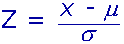
 Doing so would allow for some more control over where the supers fall in the distribution as influenced by the plus component rather than the d6 component. We can use the statistical information to decide where The Hulk falls within our super hero world.  First we have to decide in what percentile we want the Hulk to fall and then we can use a procedure called "Standardizing a Normal Distribution" to give us our number. We use the following formula in this case:

Z is a value that corresponds with a certain percentage of outcomes. For example, 90% of outcomes will be equal or less than z =1.645, 95% will be less than or equal to z =1.96, and 99% will be less than z =2.57. If The Hulk is stronger than 90% of really strong people in your game, you should set z to 1.645. If stronger than 95% of crazy strong people, at 1.96 etc. We would have an equation that looks something like:
1.96 = (x - 32.99)/8.59
Hmmm....the first thing that jumps out is that this tool isn't necessarily useful for our purposes. Another way to translate this is STR = d12 + z(Bonus - 5) + 4d6 attack.  What this means is that if we wanted The Hulk to be stronger than 95% of other Bricks we'd have to increase the "flat" number by 17.18 and that takes if off the chart. This tells me that the Abrams may not be the best baseline to use even if it's cool. This is largely due to the "swingy" nature of the open ended die rolls. Setting the baseline at such a high number means that we cannot use an actual distribution based on the likelihood of actual occurrence based on rolls and have it be very useful. In fact, even if we set the "average" Brick Strength at:

d12 + 2 with a 1d6 Attack, Melee

We get the following:

\bar{x} \!\,=13.27 σ = 5.83 min=4 max=56

Even at this level we see that The Hulk would have to be (1.96*5.83) points higher than average (11ish points) to be stronger than 95% of all other Bricks.

Does this mean that we cannot use a normal distribution to help us in our converting of characters? I don't think so. I do think it means that we cannot base our conversions on a distribution of damage, rather we have to create an arbitrary distribution and mean. Let's say we keep the mean around d12 + 6 (we can set the number of d6s of Attack based on how likely we want the character to be to damage, hurt, destroy an Abrams with each of those being an added die above 2d6). Given that a "normal" can have a strength of up to d12 without Edges (we can assume that the Edges allow for characters beyond human and in the low end of Brick like Captain America), this gives us a working range of +1 to +12. If we choose 2 (arbitrarily) as our standard deviation this gives us a distribution that looks like:

\bar{x} \!\,=6 σ = 2 min=1 max=12

If we use this in all of our calculations, we will get The Hulk as having a d12 + 6 + (1.96*2) Strength. In other words, a d12 + 10 Strength if we want him to have a Strength higher than 95% of other Supers. He'd have a d12 +9 at 90% and the percentage of people at d12 +8, +7, and +6 become larger until you hit 50% of your target population. Then the pattern repeats the other way with 95% of your Bricks having more than d12 +6 - (1.96*2) or d12 +2 Strength. That leaves only 5% of your Bricks with d12+2 or less. You can use this as a guideline to shape your campaign and should try to follow it as much as possible. This way if players as "How Strong is d12 +9?" You can answer that it is stronger than 90% of all other "Brick" caliber characters and be correct in saying so.

While some of this conversation may seem obscure, I think it is important to have some structured guidelines that help GMs and players when they are creating/simulating characters especially when it comes to abstract things like emulating the comics. The same player who might balk at The Hulk having "only" at d12 + 10 Strength when told it is 200 Tons might smile with joy when they find out that this is the level better than 95% of all super strong characters in the campaign universe...a campaign universe that includes Galactus and many others of the ultra-cosmic scale.

Additionally, we can see how Savage Worlds dice have a pretty big standard deviation due to the open ended nature of the rolling and the combination of several dice. The analysis was also useful for looking at what it really takes to create a character who can destroy an Abrams Tank in a single blow. It is easily possible through a number of combinations that are affordable at character creation.

For me, I wouldn't set that as the baseline for my "Bricks." I'd probably set it at around 21 which is the amount of damage it takes to do 1 wound to an Abrams, but YMMV.

Thursday, September 12, 2013

Make Mine Savage -- Some Observations on Savage Worlds Probabilities Before Conversions

One of the many concerns that gamers have when playing any game is "will my character be as awesome as I imagine?" In a d20/Pathfinder game where the player wants to become the world's best dual wielding sword fighter, this is a question of optimization within some pretty well known constraints. A lot of work has been put into d20/Pathfinder and 4th Edition D&D to ensure "balance" and regular play and min/maxing gets players familiar with certain guidelines. Every gamer, no matter how RP oriented, has a little power gamer in them. This can especially be the case when the player is adapting their favorite character from fiction into a role playing game character. Have you looked at some of the stats for Conan or Elric in Gods, Demigods, and Heroes and Deities and Demigods? Let's just say that there is some game breaking wish fulfillment going on there.


I have found that this call to power game gets amped up on steroids when players start adapting their favorite super heroes to their favorite super hero system. Sometimes all thought of game balance goes out the window in the attempt to create "accurate" representations of one's favorite hero/heroine. I remember when I first started playing Champions. The first superheroes I converted to the game were the X-men -- Byrne era. It was a great exercise in design. The X-men had a broad array of powers among them and statting them up really taught me the underlying basics of character design in Champions. I built the characters with Sunburst and Crusader as my benchmark characters and had a stack of 200 point X-men (it was 2nd edition Champions). Colossus had a 55 Strength, Nightcrawler had teleportation and martial arts, Wolverine had a 2d6 killing attack (3 1/2d6 with Str added), and so on. When I showed these characters to some new friends, they told me that I had the X-men all wrong. Colossus was severely underpowered, etc.

When I designed the characters, I looked at the baseline world rules in the Champions rule book and the Guide to the Marvel Universe to feed my assumptions. To me it was perfectly clear that the Hulk with his ability to lift 100 tons had a 60 Strength which has a lifting capacity of 100 tons. Colossus < Hulk, thus 55 Strength. My baseline was a far cry from the baseline of the group who were using Grond as proxy for The Hulk and who were playing experienced characters in a campaign that had already suffered a good deal of "power proliferation." How much? People were taking "double armor piercing" as a modifier to overcome villains with "single hardened" defenses. At the time, I adjusted my next character designs and fit within the group's baseline.

As I've played more role playing games, I've come to the conclusion that my first instincts were right. That doesn't mean that I think my X-men were "correct," I'd have to look them over to see if they actually emulated the characters at the time. But it is to say that I think that the players in my group were suffering from a case of "power exaggeration" which led to power proliferation and eventually led to very long and drawn out combats as everyone had defenses too high (both villains and heroes) for the damage being done. No one wanted to get hurt...and so no one did. The group used their power fantasy to set the assumed baseline instead of starting with the game's mechanical baseline. Instead of asking how high a strength do you need to have to punch through a brick wall, they asked how they compared to Grond or Eurostar.

I don't mean to point them out as "playing wrong" because I don't think they were. I do mean to say that had they viewed the baseline as lower, then there would have been more room for character growth horizontally and less power proliferation. I think that the power exaggeration tendency is one of the reasons why many gamers think that game X or game Y cannot properly emulate super heroes or that the game can only do street level heroes and I noticed a bit of this discussion in my recent post on how Savage Worlds has these wonderful switches that GMs can use in game to have the same characters interact at different scales without ever needing to change the stats of the character.

Let me put it another way. How high a Shooting skill do you think Hawkeye needs to have?

1) d12
2) d12 +2
3) d12 +4
4) d12 +8

The power gamer might say d12 + 8 because "Hawkeye Never Misses." This isn't quite true, but it is true most of the time and we all know that Hawkeye can do some ridiculous things with his bow and arrows.

I would ask to start with the system's baseline assumptions. In Savage Worlds, the base difficulty for any skill and for all ranged attacks is 4. In order to get a "raise" on the action (and only 1 raise matters for the purpose of damage), the player must get a total of 8 or higher. With that in mind, we can see that at d12+8 Hawkeye will never miss, but is that really what Hawkeye is? Let's look at his probabilities at the different levels.

d12


What we can see here is that Hawkeye has an 87.50% chance of rolling a 4 or better with a d12 and a 49.77% chance of rolling an 8 and thus getting a raise. This gives Hawkeye a pretty amazing chance to hit his opponent and that he will likely only miss opponents with Superspeed or Deflection or at long range (-2 modifier). If you want to make it so that he hits 98.61% of the time and gets a raise 65.28% of the time then give him d12+2. At +4 he hits all of the time and gets a raise 87.50% of the time. I think a case can be made for any of these power levels depending on whether you are starting Hawkeye at Novice or at Legendary. I don't know that I would ever worry about d12+8, but if everyone in your game has Superspeed at -6 (the max) Deflection you might need that.

Just in case you are wondering what the probabilities for die values other than d12 are, I am providing them below. I think understanding the probability of a skill/attribute achieving a certain target number is one of the keys to creating a balanced Savage Worlds campaign. The game is a little "looser" in the balancing math than other games and requires GMs to be able to "eye" it out more than other systems. Note that all of these graphs are for Wild Card characters and include the possibility of choosing either the main or the wild die. I want to thank Any Dice for making this easy (all rolls assume a choice between exploding d6 and exploding dX with an expode depth of 3).

d10


 d8


 d6


 d4


As you can see by the above Wild Card probabilities, even a d4 Wild Card has a 62.50% chance to succeed at a basic difficulty task. The "GMs Best Friend" in Savage Worlds is supposed to be a +/-2 modifier with +/-4 modifier representing a significant advantage or disadvantage like hiding in heavy cover (+4) or shooting at Long range (-4).

All of these a significantly better than the chances of a d4 or d5 "Normal" who has a 25% or 50% chance of rolling a 4 or higher.

When I provide my character conversions and conversion guidelines, I want you to know where I am coming from. I will be coming from a position that a Novice Hawkeye probably has either a d12 or d12 +2 Shooting skill. At d12 he would have an 11% chance of shooting someone at Long Range who was in Complete Darkness. I think that is pretty amazing. At d12+2 this increases to over 30%. Now neither of those comes with a raise, but c'mon...he's shooting someone at 120 yards in total darkness almost 1/3 of the time...without spending a Bennie.

If my conversion guidelines end up seeming a little on the low end to you, please feel free to bump them up.

Thursday, September 05, 2013

Make Marvel Savage!!!

The recently cancelled Marvel Heroic Roleplaying game is among the better superhero rpgs to see publication. It combined a deep knowledge of the source material with an easy to learn and robust game mechanic. Marvel Heroic took a "drama" driven approach to comic books and the Cortex+ system was a good match. The license for the game ended before Cam Banks and crew were able to complete their goal of providing three campaigns for the game -- Civil War, Annihilation, and Age of Apocalypse -- but the source material they published is a gold mine for anyone playing any superhero game.  If you can find copies of the system and supplements pick them up.


As much as I enjoy the Cortex+ system, not everyone in my regular gaming group liked it as much as I did. They all recognized that it was a good system, but some of them are more tactical and miniatures minded than the game robustly supports. These gamers prefer more action and combat focused games like 3.X, 4e, and Savage Worlds. All games that can be played dramatically --just as MHR can be played with a combat focus -- but which lend themselves well to the use of miniatures. Of these games, I am most fond of the Savage Worlds game system due to its focus on quick and easy game play. I'm a busy GM and the Savage Worlds system and support material greatly aid the "working GM."


Yesterday I started posting write-ups from my old "Savage Worlds Character a Day" website, and I plan to continue that trend and to provide new write-ups as well. While my backlog contains characters from many genre -- including the Firefly Crew who are now a part of a new Cortex+ game -- my new write ups will largely be adaptations of comic book characters. Make that Marvel comic book characters based on the write ups in the Marvel Heroic Roleplaying game. Why? Because I think I want to run my players through Civil War or Annihilation...maybe both...and this is a good place to start. The Savage Worlds Super Powers companion has a very flexible and workable super hero system that has some guidelines/switches that add to the system's ability to emulate a wide variety of heroes. For example, it has guidelines for both street level and cosmic level hero campaigns. The thing is that Marvel characters are often a combination of the two. Nova is a mid-range hero when he's battling the villains of New York City, but when he exits the atmosphere he is a truly cosmic hero. Below are how I propose toggling the switches when running a Marvel game.

Savage Marvel Settings

When playing a Savaged Marvel game, it isn't as easy as stating that the current game is "Street, Baseline, or Cosmic." The circumstances of the story set the overall power level of the basic "Environmental Options" that are used in a gaming session. Character Power Point options are still determined by a Street, Baseline, or Cosmic character type but the underlying switches change. For example, Luke Cage's Super Strength lifting capacity fits more with "Street Hero" environment when he's hanging out with the Heroes for Hire, but when he's running around with the Avengers his lifting capacity seems to fall more in line with the "Baseline" campaign.

Note that this is an adjustment to the "Enviromental Options" and not reflective of the "Power Point" options. Luke Cage would likely be a "Standard" hero in that mix while the kids from Power Pack would be Minor Leaguers and Skeets and Boom-Boom might be Second Stringers.

According to the Savage Worlds Super Powers Companion the most common super hero campaigns have he following setting rules:

  • Baseline Environment
  • Inherent Power
  • Knockback
  • Recurring Roles
  • Super Karma
  • Unarmed Defenders
I would argue that the Savaged Marvel Game doesn't quite match this common campaign description, but only with regard to the environment. I would argue that the environment in Savaged Marvel campaigns should match the evening's (or plot point's) circumstances rather than be static. Characters in a Savaged Marvel campaign should be designed with their "Origin Environment" in mind and gain/lose benefits based on where the adventure is taking place. With this in mind, I recommend the following adjustments to the Environmental Options.

COSMIC AND BASELINE HEROES IN STREET HERO ENVIRONMENT


  1. The carrying capacity, flight, and speed modifiers for the Street Environment are used  instead of the Origin Environment.
  2. Knockback is reduced. Ever notice how The Thing doesn't seem to knockback "normals" as far as he would villains in his "Street" stories? 
  3. The character must spend a Bennie to get the benefit of their Heavy Weapon or Heavy Armor abilities.
  4. Cosmic Heroes must spend a Bennie to gain the Focus effect on their powers.
STREET LEVEL AND COSMIC HEROES IN BASELINE ENVIRONMENT

  1. Carrying capacity, flight, and speed scale to Baseline. It's amazing how Nova slows down and Spider-Man scales up. (I would argue that Spider-Man is a Standard "Street Hero").
  2. Knockback is normal.
  3. Street Heroes can spend a Bennie to gain the Heavy Weapon trait on their powers for 1 round.
  4. If a Street Hero purchased Heavy Armor in Street Environment the hero can spend a Bennie to get a +6 to toughness against a non-Armor Piercing attack.
  5. Cosmic Heroes must spend a Bennie to gain the Focus effect on their powers.
STREET LEVEL AND BASELINE HEROES IN COSMIC ENVIRONMENT

  1. Carrying capacity, flight, and speed scale to Cosmic automatically. Colossus and Gladiator have similar, but not identical, capabilities.
  2. Knockback is at Cosmic.
  3. All heroes can spend a Bennie to gain the Cosmic Focus ability that all Cosmic Origin characters have in this environment. 
  4. Characters with Strengths of d12+1 or higher, or those with an appropriate theme, may gain Heavy Armor for an entire combat with the expenditure of a Bennie.
As you can see, the major change from the rule book to the "Savaged Marvel" is that it allows characters from one Environment to team up with heroes of other environments at the "same level" so long as they are willing to spend Bennies to get certain effects. I think that this house rule allows a rough approximation of how heroes behave in the comic books. For example, Wolverine's claws would likely have the Focus ability at creation but when he's in a Street Environment he might have to spend a Bennie to get that bonus (signaling extraordinary effort for the Environment).

This house rule is far from official, but I think it will be a great aid when contemplating how Gladiator and The Hulk should have similar Strength stats even though Gladiator is a Marvel Superman proxy.


Tuesday, September 03, 2013

Colossus -- Savage Worlds Style (A Beginning)

Way back in 2004, I started a blog with the bold title "Savage Worlds Character a Day" with the audacious desire to convert one character from comics, history, or television into the Savage Worlds game system per day. Needless to say, I didn't accomplish the goal. What I did do was to stat up quite a few characters I enjoyed and spark some discussions with friends. I've decided to move those write ups over to this blog in the hopes of both centralizing my "writing" and spurring more discussion.

I do not present these write ups as the only way to represent characters in the SW system, rather I hope to see your ideas and enter into a conversation with you about how you would write up the same characters. These are starting points. Let's chat and come up with a "merged" write up so I can create a page of "finalized" characters. The statistics below were adapted using the original Savage Worlds supers rules as presented in the original Necessary Evil campaign guide. Let's update this using the full Super Powers Companion.


Colossus (A Savaged Version)

Security Level: Novice

Race: Human (Mutant)

Attributes: Agility d6, Smarts d6, Spirit, D6, Strength d8 (d12+5), Vigor d8 (d12)

Skills: Fighting d10, Guts d6, Intimidate d6, Throwing d8, Knowledge (Art) d4

Charisma: +0, Pace: 6, Parry: 7, Toughness: 6 (10/Heavy Armor)

Hindrances: Mutant (Major as Minor Wanted and Outsider), Heroic (Major), Loyal (Minor), Enemy (minor)

Edges: Arcane Background (Super Powers), Brawny, Power Points

Super Powers:

Living Steel Form: [Super Attribute (8pp) +7 steps Strength and +2 Steps Vigor requires activation; Toughness (4pp) +1 and Heavy Armor requires activation]

Attack Melee (3pp) +2d6 requires activation

Security Level: Seasoned

Race: Human (Mutant)

Attributes: Agility d6, Smarts d6, Spirit, D6, Strength d10 (d12+7), Vigor d10 (d12+2)

Skills: Fighting d10, Guts d6, Intimidate d6, Throwing d8, Knowledge (Art) d4

Charisma: +0, Pace: 6, Parry: 7, Toughness: 8 (11/Heavy Armor)

Hindrances: Mutant (Major as Minor Wanted and Outsider), Heroic (Major), Loyal (Minor), Enemy (minor)

Edges: Arcane Background (Super Powers), Brawny, Power Points x2 (20 total), Take the Hit

Super Powers:  

Living Steel Form: [Super Attribute (11pp) +8 steps Strength and +3 Steps Vigor requires activation; Toughness (4pp) +1 and Heavy Armor requires activation]

Attack Melee (5pp) +2d6, Knockback, requires activation

Security Level: Veteran

Race: Human (Mutant)

Attributes: Agility d6, Smarts d6, Spirit, D6, Strength d12 (d12+8), Vigor d12 (d12+2)

Skills: Fighting d10, Guts d6, Intimidate d6, Throwing d8, Knowledge (Art) d4

Charisma: +0, Pace: 6, Parry: 7, Toughness: 8 (11/Heavy Armor)

Hindrances: Mutant (Major as Minor Wanted and Outsider), Heroic (Major), Loyal (Minor), Enemy (minor)

Edges: Arcane Background (Super Powers), Brawny, Power Points x3 (25 total), Take the Hit, Hard to Kill (2pp), Arcane Resistance

Super Powers:

Living Steel Form: [Super Attribute (10pp) +8 steps Strength and +3 Steps Vigor requires activation; Toughness (4pp) +1 and Heavy Armor requires activation]

Attack Melee (9pp) +2d6, Knockback 4 AP, requires activation


Kaiju Crisis Looks Like Destructive Fun

Southern California has long had a vibrant hobby gaming culture. In the early days of RPGs there were APAs like Alarums & Excursions and D&D mods like Warlock. All over Los Angeles County there are designers and players who helped our hobby grow and who made sure that the hobby was shared with new people. Alan Emrich of Victory Point Games is one of those designers. Alan has long been active in the Southern California gaming scene. He has long been an active proponent of hobby gaming, and a few years ago he started teaching a new generation how to design games. He does so as both a college instructor and as a business owner. You see, Alan's company Victory Point Games is "a desktop publishing company for small, budget-priced games based around submissions from students, amateurs and professional game designers alike." It's a company that makes great games, but that is also designed to help gamers become game designers.

Recently, Victory Point Games has added mobile gaming to their list of genres in which they develop games. VPG has an extensive tabletop catalog and some of their tabletop games (like Zulus at the Ramparts) have been converted to mobile devices. The translations of tabletop games have been good so far, but I am looking forward to some of their direct to mobile games currently in development. In particular, I'm looking forward to Kaiju Crisis.

Kaiju Crisis

Our mobile-monster-mash, Kaiju Crisis, is coming soon to iOS and Android devices! The news from Monster Island is that we're in our first round of alpha testing, with game testers coming into the VPG offices and lending us their thoughts. Testers have had the opportunity to play the first few levels of the game, topple a few buildings, tangle with the National Guard, and gobble up some helpless pedestrians. When the dust settles, we've asked them to fill out a questionnaire with their thoughts on everything from the controls and interface to their player goals and fun factor
With all this going on, master artist Clark Miller has completed nearly all of our monster's (adorably) terrifying forms and accompanying special powers, including a flame jet, ice breath, and lightning burst. Additionally, many of the boss monsters you will combat, and the islands they call home, have made it into the game, and so his time on the project is nearly at an end
From there, and with all the feedback from our testers addressed, I will be designing, testing, and balancing the remaining game levels and boss fights, so that soon you, too, will be able to enjoy this special brand of stompy, smash-em-up fun. Enjoy this quick glimpse into the alpha build of the game, and a bit of the theme music from our talented composer, Cain German!

Tuesday, August 13, 2013

Dungeon Roller -- Tranforming Random Tables into Tabletop Fun


In March of 2012, Paul Hughes of blog of holding launched a Kickstarter campaign to fund his illustrated rendition of the old "random dungeon" charts from the original Advanced Dungeons & Dragons Dungeon Master's Guide. The Kickstarter was successful and raised close to $28,000. The additional funds allowed Hughes the time to create rules for a quick and easy Dungeon Crawl board game based on the poster and to begin work on a flash based version of the game called Dungeon Robber that would be hosted on the web and free to play for anyone who wanted to experience a narrative "rogue-like."

That game is now available and it is everything one could hope for from such a game. Players begin with very limited choices of career...they can only be Dungeon Robbers. New character classes, items, and the ability to recruit henchmen are unlocked with the successful retirement of past Dungeon Robbers. Do you want to be able to purchase food, and thus be able to heal at certain spots in the dungeon? Then you need to have a character retire as a Yeoman. Do you want to hire henchmen? Then some lucky sap needs to adventure long enough to become an innkeeper.

The game is tough and quite arbitrary due to its random nature, but it is fun in the classic Ken St. Andre way. Life is cheap and death is just around the corner. Going down a level in a dungeon is almost certain suicide unless you're of high enough level. Game play is similar to older text based games like Zork, but the results of the interface are more akin to playing a game of Dungeon Hack or another rogue-like. The game is good fun and I recommend playing the game on the website (just click the image above). If you like the game as much as I do just buy a copy of the poster and make sure that Paul gets a couple of ducats for his trouble.

Weird Wars Rome Continues Pinnacle's Long Run of Great High Concept Campaigns


A few years ago, at the height of the d20 Boom, a medium sized game publisher called Pinnacle Entertainment Group released a d20 version of their signature role playing game Deadlands. The d20 version was released in an attempt to take advantage of the recent increase in interest in the role playing game market sparked by the 3rd Edition of Dungeons & Dragons. The book sold well enough, but instead of increasing the Deadlands fan base it ended up alienating some fans who believed Pinnacle was abandoning their old Greg Gorden designed masterpiece. This wasn't the case, but the damage was done and sales declined.

By this time Pinnacle had already released their customizable and easy to learn and play Savage Worlds role playing game system. That game went on to be an award winning game and the Phoenix that helped Pinnacle rise from the ashes of their declined sales. Sales that had declined so much that three Friendly Local Gaming Stores in the Los Angeles area informed me that Pinnacle went out of business. Pinnacle wasn't out of business. Far from it. They were - and are - an innovative company and were at the cutting edge of the sale of digital products. Their sales for digital as well as physical Savage Worlds products saved the company and built them a loyal and passionate fan base. Staying at the fore of industry trends, Pinnacle has already had an extremely successful Deadlands Kickstarter campaign and they hope to repeat that success with their most recent project.


KS_Banner_G_480


Pinnacle Entertainment Group recently launched Weird Wars Rome a new Savage Worlds game setting on Kickstarter. The project quickly surpassed its initial goal and is quickly conquering the stretch goals that the company has put forth. So far the digital rewards that backers of this project will receive include an original soundtrack, short adventures, and interior outlays for poster maps. All backers of the project will also be receiving an 8 page supplement by Jack Emmert (of Cryptic Studios) that discusses the role of class and race, the gods, and myths and legends in ancient Roman society.

Weird Wars Rome is the latest in a series of tabletop roleplaying game books for Pinnacle's Weird Wars line of Savage Worlds settings. The Weird Wars product line reimagines historical military campaigns and twists them by adding supernatural and horrific elements to create entertaining alternate world game settings. Game settings to date have included Vietnam and World War II. In Weird Wars Rome, players are legionnaires living in the vast Roman Empire who encounter the terrors of war and of far darker things that lurk in the shadows of the fringes of the Empire...and in the heart of Rome itself.

Unlike many Kickstarter projects, the Weird Wars Rome Kickstarter automatically provides all new digital rewards to backers as each stretch goal is reached. There are no "pay for" add ons. Shortly after the Kickstarter campaign is completed, backers will be able to down load the completed pdf the book and any digital rewards that have been completed to date. The basic funding level is $20 for which the backer will receive a copy of the base Weird Wars Rome rulebook and some digital rewards. Other levels allow backers to get more physical products like dry-erase poster maps, custom dice, a GM Screen and some adventures.

Pinnacle Entertainment Group has long been one of the kings of "high concept" when it comes to games and campaign settings. Their DEADLANDS game set the tone for undead/Western mash-ups and many of their Savage Worlds settings have taken long standing narrative tropes and given them a "savage twist." The Savage Worlds game system is marketed as being Fast, Furious, and Fun and I have very much found this to be the case.

Thursday, August 01, 2013

Chainsaw Warrior -- Coming to a Digital Device Near You!

It's the year 2032. A warp has opened up in the old Municipal Buildings in the heart of old Manhattan and bizarre creatures are flooding through into our dimension. Goading them on is Darkness, a malevolent entity who intends dragging the city of New York back through the warp - destroying it utterly! 

Many brave men died assailing Darkness' stronghold before they remembered you. In the past you have done the Special Forces Unit many favors... but now you must come out of retirement to face the toughest challenge of your glorious career. Equipped with all the latest in high-tech armaments you must battle your way into the very heart of Darkness' domain and defeat him within the hour - or the city you love will be destroyed!! 

Chainsaw Warrior is a nail-biting game for one strong-nerved player. Yes, it is a solo game - just you against the clock! Can you save New York? Remember, you only have one hour!
 

In 1987 Games Workshop released a game that was an almost perfect high concept mash up of THE WARRIORS, ESCAPE FROM NEW YORK, and EVIL DEAD 2. That game was CHAINSAW WARRIOR and it was published in the days before Games Workshop decided they were a miniatures company and fiction publisher rather than a game workshop. In CHAINSAW WARRIOR the player took the role of an Arnold Schwartzenegger/Snake Pliskin/Ash mashup in his attempt to save Manhattan and rid the world of some terrible evil that included Mutants and Zombies...and you cannot kill enough mutants and zombies right?


In the designer notes, Steven Hand mentions that he was hard at work designing a sequel that would be published if CHAINSAW WARRIOR did well enough. As far as I know that sequel, which would have featured mutant Nazi zombies was never published. At least I never saw it and I don't own it, though I do own the original (see those sweet pics?). The game dwindled out of print and is now only available as an over priced ebay offering...UNTIL NOW!

Aurauch Digital will be releasing a Tablet and PC version of the game in the near future. Now a whole new generation will be able to struggle against THE DARKNESS.


I would be remiss if I didn't note that I had been introduced to this magnificent game by my dear friend Ron Peck. Ron had exquisite taste in music, games, and film. He was a dear friend who I miss dearly. 

Thursday, July 25, 2013

Little Geek Girls: Don't Say Superheroes are "Just for Boys"

On Tuesday, Kirk Hamilton at Kotaku shared a music video by The Doubleclicks entitled "Nothing to Prove."  I'll be honest and say that the song itself doesn't do much for me and sounds a bit like a song that would be performed by Carrie Brownstein on an episode of Portlandia, though I guess comparing a song to a song by a member of Sleater-Kinney isn't exactly an excoriating review. The aesthetics of the song notwithstanding, it was the visual content of the music video that really resonated with me. In particular the woman holding the "Don't tell my daughters that Lego, Robots, and Superheroes are for boys."


That sentence struck me like lightning and with almost perfect timing. As regular readers of this blog know, I am the father of two young girls I call History and Mystery in my blog posts and who are the two "Twin Princess Superheroes" referred to in the right sidebar. To give you a picture, this is them on a "Fancy Day."


As you can see, they are wearing Fancy Nancy-esque clothing with sunglasses, domino masks, and History is holding forth a Captain America shield. This is them at their "Princess Superheroiest," well accepting when they where their Bell and Aurora dresses kitted with Merrida bow and arrow and Iron Man masks and "Boomers." All of which is to say that they have acquired many of their mom and dad's geek obsessions. I cannot express how much fun it is imagining playing D&D with the twins when they get older. I'm giddy right now thinking about it.

As you might guess, my daughters live a pretty happy life. They have parents who share their interests and who play are willing to play any game or support any interest. But that's not to say that these young innocents haven't already faced the dreaded "you aren't allowed to be interested in that" assertion by some of their peers. There was one student at their school - a student that History had a crush on no less - who saw that History and Mystery were wearing superhero tennis shoes (Cap and Iron Man) and who took it upon himself to point out to my daughters that "Superheroes" are for boys. What's more, the boy also pointed out the "Blue" is for boys too.

Blue.

BLUE!

Are you kidding me?! This kid tried to lay claim to a color? Ugh.

Back to the story. This young boy's attack upon their preferences was the first time that my daughters had been told that something was outside their purview. Sure, Jody and I have told the girls that we cannot afford certain things or that they have to wait until they are "bigger kids" to play Advanced Squad Leader with dad, but we've never told them that any given entertainment was reserved for a particular subset of society. Jody and I find that concept to be absurd on its face. No one is going to stop me from DVRing REAL HOUSEWIVES (OC and Jersey only), and certainly no one is going to tell Jody she cannot watch JUSTIFIED or THE AVENGERS because she's a woman.

So after this boy attacked my daughter's love for superheroes Mystery comes home weeping. She's upset that she's no longer allowed to like Captain America - who has fought off more Closet Monsters than I care to imagine - because he's for boys. Needless to say, it didn't take me long to inform my daughter that Captain America is for everyone and to give Mystery several real world examples of the women in my and Jody's life who are fans of "Steve." After which we watched a couple episodes of EARTH'S MIGHTIEST HEROES and called it good. My daughters seemed satisfied. Heck, History started wearing blue (Mystery's favorite color) in solidarity with her sister.

But the story doesn't end with having a supportive mom and dad who have supportive friends. Sadly, this little punk has already sown the seed of a mental weed that must be constantly pursued and extracted as quickly as possible. I've already had History ask me if there REALLY are any female race car drivers and heaven knows what the next moment will be. One thing I do know, I'll have to be vigilant. It's no longer enough to just share the things I'm passionate about with my daughters. I now have to be prepared to help my daughters defend their enjoyment.

I'm happy to do it, but it's something that shouldn't have to be done. Stop attacking "Fake Geek Girls." Some of the kindest, warmest, and giving people I know are Geek Girls (yes I'm talking about you Jody, Susan, Shawna, and America...and many others). There is nothing fake about them.

And for those of you who spend the time "vetting" to see if a "Fake Geek Girl" is actually a real geek. You know that vetting time would be far more enjoyable if it was just a normal conversation where you both geek out right? Sure, you might end up fighting about whether Alan Scott or Hal Jordan are the better GL or how big a jerk Dan Didio is, but I guarantee that you will be more likely to leave that conversation with a friend than you will if you begin your "conversation" with an oral exam in which you scrutinize even the slightest error.


Tuesday, July 23, 2013

Siri as D&D Dungeon Master

As might be guessed Siri is a "killer DM." I think she ran a Call of Cthulhu adventure for me at an old DundraCon (it's in Apple's backyard).  On a serious note, check out the copy of Gary Gygax's ROLE PLAYING MASTERY on the table. That is a significant easter egg, especially given the kind of DM Siri turns out to be.


And yes, I own a copy of ROLE PLAYING MASTERY. I also have a copy of MASTER OF THE GAME.