Friday, March 30, 2012

[DnDNext] Warding Off System Snobbery

I'm as guilty of it as the next gamer.  If you mention that you play F.A.T.A.L. or one of a small list of games, I will roll my eyes derisively and mock you behind your back.  I might even make a snide comment about your gaming preferences.  Equally, I will be deeply offended if you roll your eyes at me when I mention that I love playing Dungeons and Dragons 4th Edition Essential Edition or The Rocky and Bullwinkle Role Playing Party Game.  It's System Snobbery and one thing that the "edition wars" and the recent "dndnext" conversations have aptly demonstrated, it is alive and well.

The thing is that System Snobbery isn't new, and it isn't beneficial to the hobby as a whole.  I was recently reminded of how insidious System Snobbery can be when I picked up and read Laryy DiTillio's commentary on the topic in issue 7 of Different Worlds Magazine.  I've been spending a lot of time recently reading old gaming magazines, magazines from when I was just getting into the hobby.  At the time, as a tween, I had neither the resources nor the knowledge that gaming magazines other than "The Dragon" existed at all.  Heck, even though I lived in the same town as the talented and prolific Allen Varney -- we probably shopped at the same game store -- I hadn't even heard of The Space Gamer at the time.

Back to the point though.  In his commentary on System Snobbery, Larry DiTillio has a couple of key observations that I think are worth sharing as we enter discussions regarding what we would like to see from a new edition of Dungeons and Dragons.

Larry's commentary follows a visit in 1979 to a reasonably sized convention in Oakland, CA called GrimCon.  He mentions that the games organizers all are employees/founders of various small gaming companies like the Multiversal Trading Company and Grimoire Games.  As such, the Con offered a lot of non-traditional role playing games as their "tournament fare." 

Larry's firsts observation of gaming snobbery was that while the hosts of the convention were offering a wide variety of games for sampling, that the attendees pretty much ignored them to spend time in the open gaming area to play D&D.  His thoughts, and I agree, were that conventions are the perfect time to try something new.

His second observation is of how he was treated at a DunDraCon event.  At the event, Larry was scheduled to run a session of Tunnels and Trolls.  He had been invited to DunDraCon IV by Steve Perrin to run the game. After sitting and waiting for players to show up, eventually a convention representative asked Larry why he had cancelled is T&T session.  He notified them he hadn't, but discovered that someone had -- likely as a prank -- written "cancelled" on his sign up sheet.  He eventually got gamers to a T&T table, but not before being passive aggressively bullied by some System-hater. 

Larry makes a number of other observations, and is a talented storyteller in how he shares them, so I recommend picking up the issue.  The crux of is article is the following:

"[A Good GM] will provide you with and enjoyable, rewarding RPG [experience].  NO MATTER WHAT SYSTEM THEY PREFER." So long as the GM is talented and committed to providing the players with a good time.  He also acknowledges that we should be thankful to Steve Perrin (for "Runequest), to Dave Hargrave ("Arduin"), Ken St. Andre (T&T), Gary Gygax and Dave Arneson (D&D).  I would add that in the years since, we have many more names to add to the list.  These names range from Greg Gorden (007 and DC Heroes) to Mike Mearls (4e) and from Erik Mona (Pathfinder) to Chris Pramas (AGE/Green Ronin) to name only a few.  We should also thank those, like Shelly Mazzanoble, who may not be among the "creators" of our games, but who stand at the front lines of those who promote our hobby and try to bring new people in.  Not to mention the great stuff coming out of the Indie games marketplace.

Instead of being snobbish about the games we don't like, we should be thankful that we have so many great ones to choose from.  Does that mean that we cannot criticize mechanics?  No.  We can and should, in a constructive manner that moves the hobby forward.  We just shouldn't disparage people for preferring a system.

Gaming Snobbery...and public snobbery against gamers...are a couple of the reasons Wes, Joel, and I created the Dice Chuckers project.  Join us in that project as either a sponsor, a participant, or in conversation.  We'd love to hear from you.


Thursday, March 29, 2012

Twin Suns Entertainment -- Join Us on Our Adventure

Last year, my close friends Wes Kobernick and Joel Allan were chatting after one of our bi-weekly gaming sessions.  We talked about how great it would be if someone made a documentary about roleplaying games and the people who played them -- a film that presented the "real" face of the gamer.  Our gaming group, like many others, is a diverse group of friends who have professions ranging from Screenwriters and Lawyers to Non-Profit Program Directors and College Students.

We had all seen the "Trekkies" and "Darkon" documentaries.  "Trekkies," while a great documentary, focused on the Star Trek fans that the director thought would make the most "interesting" story, but it left out the day to day fan of the series who didn't have any particular quirks -- other than being a fan of the show.  It would have been nice to see the casual fan, as well as the dedicated fan.  It only takes a few minutes wandering the internet, or looking at the TV ratings for "Big Bang Theory" before one realizes that "we are all Trekkies."  It's only what we are passionate about that varies.  "Darkon" was a very emotionally powerful documentary about live action roleplaying, the kind that the kid plays in the hilarious movie "Role Models," but Darkon is also a very sad movie.

While I highly recommend both of those documentaries, we wanted to do something different.  Yes, like "Trekkies," we want to show some of the interesting stories of the role playing game hobby.  There are plenty of interesting people who play role playing games, but we also wanted to give a look at the casual gamer and at the people who make role playing games as a profession.  We wanted to make a film that was something of a snap shot of the hobby as it stands today...a hobby that has lost a few of its founders over the past couple of years and a hobby where some of its founders are still alive today.

What we realized in the course of the discussion was that we weren't looking for someone else to make the documentary, we were the perfect group to make it.  Wes is an experienced film maker, Joel is a practicing attorney, and I have spent years developing contacts throughout the hobby who has an entrepreneurial spirit.  We quickly decided to form our own company called Twin Suns Entertainment.  TSE will produce not only a documentary film, but that produces ongoing entertainment products ranging from web series to physical role playing and board games, from childrens' books to mainstream fantasy novels.  Our mission for TSE is for each of our products to promote the hobby and to highlight how hobby gaming in its role playing and table top game forms is a wonderful way to build community.

Today we launched the Kickstarter campaign for our documentary film.  The film's working title is "Dice Chuckers," but we ask that you join us in creating title for the film when released and we beseech you to make a pledge and join us on the wonderful adventure that is founding an entertainment company.

Wednesday, March 21, 2012

[From The Archives] Surprised by Superhero 2044 -- The First Superhero RPG was More Influential than You Might Think

This post was originally published in June of 2010. Given the "rolling" format of blogs, I thought that I would repost it for newer readers. I was nicely surprised by Superhero: 2044, and will be blogging about Supergame soon as well as I own both the first and second editions of that superhero game.  After reading this review, Donald Saxman was kind enough to include the test of the post in a reprint of the game. 


According to Heroic Worlds by Lawrence Schick and Steve Perrin in Different Worlds #23, Superhero 2044 by Donald Saxman is the first commercially available superhero themed role playing game. Saxman's game was publishedin 1977 under the name Superhero '44. The game wasn't entitled Superhero 2044 until the game's second edition, when it was by Lou Zocchi's Gamescience Inc. later that same year. While I am a huge fan of super hero role playing games, and a student of the history of rpgs, this game sat on my bookshelf for years without a complete reading. Its lack of a list of itemized superpowers, and the mechanics of how they worked, was one of the key reasons that the game languished for so long on my shelf without a thorough examination. Apparently, Donald Saxman intentionally left a formal list of superpowers out of the book in order to respect the copyrights of various comic book publishers -- though that didn't stop artist Mike Cagle from providing a cover illustration filled with characters who bear an uncanny similarity to many popular comic book characters.


I just couldn't ever muster the desire to read or play a superhero role playing game that lacked a robust super power system. The recent release of Icons by Adamant Entertainment got my mind focused reading a new super hero rpg, and this opened the door for Superhero 2044 to work its way off the book shelf and into my reading pile. I quickly devoured the booklet and have come to the following conclusions.

First, Superhero 2044 is almost unplayable with its Rules as Written (RAW). The game is a jumble of multiple systems and contains no fewer than three major design directions, none of which are flowing in the same direction.

Second, without Superhero 2044 modern super hero role playing would not be what it is today. Those three major directions I mentioned above? Each of those had a significant influence on the super hero games that came after Superhero 2044. Without this game, there would be no Champions, Supergame, or Golden Heroes. Each of those super hero games lifts a concept out of Superhero 2044 and structures a game around that concept.

Superhero 2044 is more than the first super hero role playing game, it is the foundation upon which many games followed.

It was the first superhero game to include point based character construction. Though the point expenditure was limited to the building of a character's "attributes" and were not a part of "power design." This innovation, and at the time of Superhero 2044 this was a significant innovation, is one of the major design starting points for a number of super hero role playing games -- not the least of which is the Champions game.

Influence on Champions

Speaking of Champions, in addition to being inspired by the point based character design of Superhero 2044 it is evident that Champions melee combat system was influenced by Donald Saxman's game as well.

In Champions combat is resolved by taking a character's "Offensive Combat Value" and subtracting an opponent's "Defensive Combat Value." The result of that subtraction is then added to 11 to find the number required to hit an opponent on a roll of 3 six-sided dice. Champions combat system is one of the best on the market and the fact that it uses a comparison of combatant's effectiveness, and a bell curve resolution system, are among its chief strengths.

In Superhero 2044, you take a character's "Stamina" and subtract his opponents "Stamina." The difference between these two numbers is compared to the Universal Combat Matrix which gives you a number between 3 and 18 that the character must roll on 3 six-sided dice to determine if the character hit his opponent. It should be noted that this combat system is only used for "melee" combat in Superhero 2044, where it forms the foundation of Champions combat.

The Champions version is more elegant, as the result of the initial comparison is the modifier to the 3d6 roll, but it is the same system. It is as if the designers of Champions playtested and refined the Superhero 2044 melee combat system. Champions combat has some significant differences overall to Superhero 2044, but one can see that one echoes the other.

Influence on Supergame

Like Champions, Supergame was influenced by Superhero 2044's point based character generation system. Given its own 1980 design date, and the fact that it was a part of "California Gaming Culture," might hint that Supergame itself also influenced Champions. One sees the underpinnings of Superhero 2044 is in the purchase of a character's starting attributes.

Both systems feature something that many modern gamers might consider odd. All of a character's attributes start at zero and can be increased -- this itself isn't odd to the modern gamer. What is odd is that both games have attribute levels where the character is suffering from a disability. In Superhero 2044, if a character has an Endurance of less than 20 that character is "fatigued" or worse. In Supergame, a character with an "Agony Score" of less than 15 "may either move or attack, but only one per turn." There are similar penalties for "Vigor" in Superhero 2044 and "Physical Score" in Supergame. The names of the attributes and the level of effect are different, but one can see the similarities. Most modern systems would start a character with a base number of points sufficient to not be fatigued or incapacitated, but both Superhero 2044 and Supergame allow for the possibility.

But it isn't the point based character design where Supergame bears the most similarity to its predecessor. Supergame includes rules for building specific powers -- though not as robust the later published Champions -- that are themselves an innovation over the state of gaming at that time and a step beyond what were offered in Superhero 2044.

The area where Supergame most reflects Superhero 2044 is in its ranged combat system. In Superhero 2044, ranged combat is decided by rolling a six sided die and adding/subtracting to the die total applicable modifiers. This sets the target number that must be rolled, or higher, on a second roll of a six sided die. For example a character with a 20 Dexterity (-1) shooting an opponent at point blank range (-3) with a shoulder weapon (-1) rolls a 6 on a six sided die. This gives a modified result of 1 (6-1-3-1=1) and means that the character hits if the player rolls a 1 or better on the second roll. This system, with some differences in modifier values, is the system used in Supergame.


Influence on Golden Heroes

While I was intrigued by the way that Superhero 2044 influenced the design of American super hero role playing games, I was amazed at how it had influenced a British one. In White Dwarf magazine issue 9, game designer Eamon Bloomfield reviewed Superhero 44 -- Superhero 2044's first edition -- and wrote the following:

"Each character fills out a weekly planning sheet indicating whether he is patrolling, resting, training, or researching. This...show[s] how many crimes of what type he's stopped this week and at what damage to himself; without actually having to play the event...Overall good fun and realistic and a welcome addition to any role playing fan's collection. Certainly as a postal game it has a great future."

The weekly planning sheet is one of the most intriguing aspects of the Superhero 2044 game and the most playable aspect. The game includes weekly planning sheets that provide a number of "activity blocks" to which players assign particular tasks, like fighting crime or resting. Golden Heroes, Games Workshop's super hero role playing game, featured a campaign system that bears no small similarities to that of Superhero 2044. Games Workshop was, and still is, the publisher of White Dwarf magazine and so it is easy to believe that this game review sparked some discussion of "planning sheet" style campaign play.

Golden Heroes features a campaign system that heavily relies on something very similar to Superhero 2044's weekly planning sheet. They have a system that uses something called a "Daily Utility Phase" or DUPs. The game describes them as follows:

The scenarios played in each week occupy a certain number of DUPs for the characters involved. Any remaining DUPs can be devoted to other pursuits such as training, improving powers, developing scientific gadgets, etc.

Thus at the end of each scenario, you must inform the players how many spare DUPs their characters have. Preferably then, or at worst at the start of the next game session, the players must tell you how their characters have spent those DUPs.

The player's allocation of DUPs is compared to various campaign ratings, something vary similar to what Superhero 2044 calls "handicaps," in order to determine what events happen to the character and how much the character is able to improve over time. Both systems are dynamic and change as characters interact with the game world. The Golden Heroes system is more developed and is a part of a more complete system of mechanics, but it is unarguably a descendant of the Superhero 2044 system.

Closing Remarks

I wish I had read Superhero 2044 much sooner than I did. It is a definite diamond in the rough. While it would be difficult to play RAW, it has a large number of innovative mechanics and ideas. The fact that it contains enough ideas to influence no fewer than THREE super hero role playing games in their design is a significant achievement in and of itself. One cannot truly understand the development of the hobby without reading this game.

I think I will try to play the game itself soon, though I don't know if I will try to design a comprehensive powers system or use an existing one to supplement the game, as the campaign play system still stands out as something that has some depth and would be useful in a number of games. Given the abstract nature of the campaign planning system, one could easily adapt it to another game for use.

The game also features a detailed setting for super hero play. The setting lacks the microscopic detail of modern settings, but for the time the game was written it is quite intricate. Like the game itself, its setting is one that inspires addition and extension rather than provides a complete painting.

Donald Saxman has created something pretty special here and I'd love to see someone take this system and make a modern edition out of it. It would take some work, but it would be worth it.

Tuesday, March 20, 2012

DNDNext: The Kids Are Alright -- He-Man, Cartoons, and D&D

When I was around 11 or 12 years old, my best friend Sean McPhail and I used to play a fair amount of D&D.  Our first foray into the hobby wasn't the best experience, we had a killer DM who had "memorized" his own personal dungeon.  I have discussed that particular debacle in an earlier post.  I am glad that my initial terrible introduction to D&D didn't sour me on the hobby as a whole, or the game in particular.  I have a number of wonderful hobby related memories, and keep making new ones each week when I run games today.

Of those wonderful memories, there are a couple that stand out brilliantly in my mind.  There is the use of the D&D Basic set as a substitute for the combat system in Broadsides & Boarding Parties.  There is the 20 PC siege of The Keep on the Borderlands...  Hey...the book provided stats for the residents of the Keep, that meant we were supposed to attack it right?  Stats = dungeon right?  No?  Well, we thought so at the time and Darg and his crew had a good time sacking the Keep.  There was also a great run through Castle Ravenloft.  These were all experiences with Sean, and they were a great deal of fun.

But these weren't my most cherished D&D moment with Sean.  No indeed.  My most cherished D&D moment with him was when he ran his He-Man and the Masters of the Universe inspired dungeon.  It was a dungeon that he had drawn out himself.  The map was a complex maze of rooms that was a wonder to behold and a challenge to map out.  In one of the rooms of that dungeon was a deadly Death Knight with it's delay blast fireball gems.  In another room...and I'm getting overwhelmed with nostalgia just thinking about it was ... Beast Man.  Beast Man was the challenge of challenges, and Sean presented him with awe inspiring description.  He was the most intimidating foe my characters had faced to date.  I don't know what Sean's full write up for the character was, but I do know that the blue gem in Beast Man's chest had a "sleep" spell within it that overwhelmed one of my characters.  It was good stuff.

The toys, and cartoon, had inspired Sean and he in turn created an adventure that left me with one of my all time favorite D&D memories.  What I didn't know at the time was that the writers of He-Man, Larry DiTillio for one, were players of D&D and that He-Man was in some ways a D&D cartoon.  Fans of a certain age all know and love the old D&D cartoon with Hank the Ranger and Eric the Cavalier, but many of us also have a deep and abiding love for He-Man as well.  For those of you who wonder just how much D&D influenced the He-Man show, let me share with you the words of Larry DiTillio (who also wrote Tunnels and Trolls adventures)  who was a writer on the TV series. 


 In issue 34 of Different Worlds, Larry writes:

Incidentally, knowing Ye Ol' Sword is a game buff, it should come as no surprise that I often use game concepts in writing He-Man scripts. This includes spells, characters, traps, and plot twists.  In fact, I even inserted a much-beloved dragon from one of my game supplements into a show and much to my delight the character proved popular enough to warrant a sequel.  See how games and films fit together?  He-Man fans should also keep an ear open for famous names from gaming, an inside joke I sometimes like to throw in my animated stories.

D&D was not just a part of popular culture, it was a part of the popular culture of the youth of the age.  We grew up with the Moldvay/Cook Basic set with its Jeff Dee, Bill Willingham, and Erol Otus artwork.  Artwork that was cartoony and that translated fantasy perfectly for the minds of 9 to 13 year olds of the era.  It was the perfect "tween" introduction to the hobby.  The Mentzer basic set that followed continued the tradition and provided a perfect jumping on place for younger players.  Let the older players start with the AD&D books without the need of a basic set -- such as those in the Space Gamer crowd who asserted that the Basic set was a moot and unnecessary product.

It wasn't an unnecessary product, it was vital.  It was a product that brought an entire generation into the hobby.  Even with a horrible first experience with the game, Tom Moldvay's playful tone made sure that I retained my interest in the hobby.  The Basic Set was marketed at younger gamers, but it wasn't "dumbed down" for younger gamers.  It included all the rules of original D&D, but in a more coherent format.  It lacked some of the complexities of AD&D, but it perfectly prepared players for those complexities.

D&D Next needs to make sure that it has a product -- from day one -- that is aimed at younger gamers and the beginning gamer.  It needs a true basic set along the lines of those old ones.  The more recent "Red Box" edition that Wizards released to promote the Essentials line doesn't cut it.  I love that box and think that it was a good product, but the Essentials books themselves better fit the bill of what I am referring to.  If the Red Box included Heroes of the Fallen Lands, that would be what I am talking about.  Maybe with some artwork by the artists who are working diligently and with artistry on the current D&D comic books.  Andrea Di Vito has done some great work on that book.  My recommendation is that a new basic box have a cover that looks something like the following, and with rules aimed at the younger generation. 


We were all new gamers once.  Let's try and introduce new gamers with the same open arms and seriousness with which we were greeted.  Let's create a new line of toys, a new animated series, and more boardgames like the recent "D&D Adventure Series."

Friday, March 16, 2012

DnDNext: What's Wrong with Having Armor "Reduce Damage" in RPGs?

Last year, I posted about the various rpg mechanics for representing the effects of armor in combat.  I often hear from some corners of the gaming community that armor "reduces damage" and it shouldn't "reduce your ability to hit." 

On the surface, this argument makes sense.  Armor prevents the impact of a blow that did in fact come into contact with you from doing damage, and it doesn't make opponent's "whiff."

The problems with the argument only really come to the fore when one looks at armor from a strictly mechanical presentation.  As my prior article mentioned, all armor effects are part of a linear equation -- at least in systems with a "to hit" mechanic.  The to-hit roll represents one variable, the damage roll another, etc.

Damage = (Probability of an attack hitting)*[average weapon damage + damage bonus] - Damage Reduction

Pretty much all role playing games have some variation of this basic equation.  Hero games, d20, Chaosium's systems...they all have some variation of the basic linear equation above.  What this means in mechanical terms is that whether you use damage reduction or you use "increased chance to miss" armor always mechanically reduces damage.  If it only reduces the probability of an attack "hitting," then it reduces the average damage of an attack by that percentage.  In d20 based systems, this means that armor reduces damage by approximately 5% per point of armor class.  One could arguably represent armor as a percentage damage reduction without ever altering any mechanics in D&D by doing exactly this.

There are many "reduce damage" systems on the market, Tunnels and Trolls and Hero come to mind quite readily.  Some of these systems understand the linear equation and thus their mechanics reflect a certain threshold of effectiveness that armor/defenses should apply to attacks.  T&T doesn't have "to-hit" rolls in the traditional sense at all, so having armor reduce damage is a direct effect of that system.  Hero's mechanics are heavily playtested and balanced applications that are quite mechanically robust, and I won't bore you with the details of point cost to damage effectiveness.  Just let me say that the system is remarkably predictable in this sense...in an amazing way.

While there are very sophisticated, or simple, damage reduction systems that work, I think that a large number of these systems don't work at all.  Those that don't work tend not to work because they fail to understand that the mechanical equation is always a linear equation and they end up with armor reductions that are out of order with the basic percentages to-hit.  By having a to-hit roll, which as I mentioned is a percentage of damage reduction system in its nature, with an added static damage reduction system armor there is the potential to create everlasting combats.  This is because the armor reduction values often end up as making the effective Damage Per Round of attacks zero.

To illustrate this, I'd like to look at Christopher McDowall's new quick to play game Into the Odd.  The game is open for playtesting under the Creative Commons, and I recommend taking a look.  It has some very good ideas.  I like that the system is based on an underlying ability "Save" system that has quick and easy determination of attribute bonuses that reflect a nice bell curve.


Attributes range from 5 to 15 and bonuses range from -5 to +5.  The bonuses are applied to rolls against an opponent's attribute.  Roll d20 and add your bonus, if it equals or exceeds the opponent's attribute (or the difficulty of a non character task) then you are successful.  Quick and elegant.  I really like it.

That said, Into the Odd includes a "dodge" system and an armor damage reduction system.  Armor doesn't increase the chance to dodge, it reduces damage directly, but players have a chance to dodge and suffer no damage.  The basic combat system is as follows:

  • Attacker rolls damage -- the assumption is that if an attack isn't actively dodged then it hits.  I like that.
  • Damage bonuses (from size of weapon, magic, or circumstances) are applied.
  • Subtract Armor Reduction.
  • Target rolls to avoid attack.
In the linear equation, this would look as follows:

Damage = [Damage Rolled + Damage Bonuses-Armor Defense] * Chance to Avoid Damage

The average damage per round for a light weapon (which does 1d6 damage) would be:

Avg. DPR = [3.5+0-Armor]*Chance to Avoid Damage

By having the reduction effect applied before the chance to avoid, McDowall allows for some interesting effects and makes the damage reduction effect less exaggerated than it would be if armor's bonus was applied after the chance to dodge was resolved.  But armor still has an amazing effect on the game's combat system.  Let's look at the average damage of a light weapon versus the armor types based on an opponent's attribute. 


You can see by looking at the picture that even light armor provides a pretty significant defense against a light weapon.  The average damage of a light weapon is 3.5, but depending on your opponent's STR you might take as little as 0.5 points of damage on average per round.  The above chart includes the chance to dodge factored into the damage equation.  If you have a 10 in a stat and you are trying to dodge someone with a 15, you have only a 30% chance of success (15+ on the roll). 

But let's look at the Armor reduction from a different perspective.  Let's remove the effect of the dodge roll completely.  Into the Odd doesn't give Armor defensive reduction values that look in any way extreme.  Light armor subtracts one point, heavy two, and a shield adds one additional point.  That seems pretty moderate...until you look at how big a percentage of damage this is for an average light weapon.

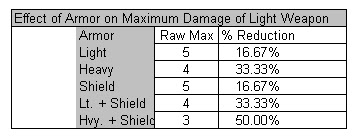
Light Armor's 1 point of reduction is 28.57% of the average damage (3.5) of a Light Weapon, and heavy armor and shield reduce the average damage amount by 85.71%.  This is before any chance to dodge has been applied.  You see similar, though not as drastic effects, against the "maximum" damage a light weapon can do.  The protection of Light Armor, against a Light Weapon's average damage, is a greater percentage than would be gained by having a +5 bonus from a statistic.  Wearing Light Armor is a better benefit than being among the 2.78% most physically capable people in the world.

Here you can see that even when applied to the maximum amount of damage possible from a Light Weapon, Light Armor reduces the damage by 16.67%.  This is the equivalent reduction of having a +3 bonus in a statistic.  The amount of protection provided makes equipment more important than statistics in Into the Odd.  

This seems odd to me.  Should Light Armor be a better defense than being epically agile?  I don't think so, but that is what is reflected in this system.  If weapons did more damage, then this effect would be muted.  If attribute bonuses were added to the damage dealt, this is not clear in the rules as written, the effect of attributes would be increased.  My personal recommendation for this system is to step up the weapons a die, or to use something other than a d20 for the dodge roll.  The d20 has linear probability of 5% for any value, and thus each +1 bonus equals a 5% shift.  If a 2d6+bonus system vs attribute were used, this would radically change things and make attributes matter more.  

As you can see, even when an armor "reduction" value is low, it might end up being the most significant combat effect.  Is this the effect you want in your game?  If it is, then this is what you want.  If you want the game to be attribute -- or even skill driven -- then you might want to consider some alternatives.  I like the "armor penetration" roll system where each armor has a penetration value that must be equaled or exceeded to hit the target underneath and where different weapons roll different armor penetration dice.  This is the system used by the classic game Dragon Warriors.  You can also create an "armor save" where armor protects from damage on a specific roll.  Say a 6 or better.  Light Armor could roll a d6, Medium a d8, Heavy a d10 and a shield could provide a die bump to the next better die.

Remember that damage when converted to a mechanic always creates an equation.  Look at how big a factor armor ends up being in that equation and ask if that is what you want.  In D&D attributes and Armor are equal in what a +1 difference means.  A +1 to hit increases damage by 5% and an increase in Armor Class reduces damage by 5%.  The fact that attributes also add to damage -- post to-hit determination -- means that attributes have a greater impact than armor.

There's a lot you can do in game systems, but don't let "common sense" be the only tool you use to analyze games.  Break them down to the mechanics.  In D&D Armor does "mechanically" reduce damage even though it seems like it reduces chances to hit.  It's all a matter of perspective.  I hope D&D Next sticks to the classic AC system.  It's more balanced and robust than you might initially think.

Wednesday, March 14, 2012

Gaming History: The Space Gamer and Black Gate Magazine, TSR Buys SPI

On February 28th, the publisher of Black Gate Magazine, wrote a blog post celebrating an old SPI game called Swords and Sorcery.  He praised the game in his semi-regular "new treasures" column.  The game itself was published in 1978, but O'Neill had just acquired an edition from eBay.  If the edition he purchased is the edition photographed in the blog post, he and I own the same edition of the game.  The game may have been old, but it was new to him. 

The post is quite positive, and I largely agree with O'Neill's review.  As is common in discussion of old SPI games, a discussion of TSR's acquisition of SPI -- and their subsequent "killing" of SPI game lines -- was brought up in the comments section.  Among the grognards of the gaming hobby, of which I am certainly one, there is often a good deal of ire aimed at TSR for their behavior.  This ire is often directed at Lorraine Williams, but not always.  One of those cases where it isn't directed at Lorraine Williams is in the TSR purchase of SPI in 1982.  At that time, the company was very much in the control of Gygax and the Blumes -- though they were having plenty of internal strife at the time.

In this particular post, Black Gate's managing editor (and talented author Howard Andrew Jones) was the individual who brought up TSR's "killing" of SPI product lines.  In my typical "provocateur" fashion, I mentioned that I thought that the TSR acquisition and killing of SPI was more complicated than most grognards think and even included some slight praise for Lorraine Williams -- as a fan I am actually amazed at the products that came out during her tenure, even if she hated gamers.  Here is what I wrote:

While it is easy to blame TSR for what they did to SPI — and they deserve a lot of blame — one should keep two things in mind
First, when they purchased SPI it was in dire financial straights and would likely not have survived.
Second, they had hoped to keep SPI’s staff, but those staff members refused to work for TSR — for varied reasons — and left to form the Victory Games studio over at Avalon Hill.

Third, and this is where I get near heretical, it was the Blumes who devalued SPI’s contributions. A massive resurgence of publishing of SPI games happened under Lorraine Williams. We would never have seen the SPI monster TSR World War II game, or Wellington’s Victory, SNIPER (including BugHunters), let alone the 3rd edition of DragonQuest.

I believe she did the publishing of SPI stuff out of desperation, not any love for the product or the fans, as TSR was starting to have financial troubles which could only be met by an ever expanding publication schedule and continual revenue flow.

It was the Blumes who refused to acknowledge lifetime subscriptions to SPI magazines.
There is an excellent issue of Fire and Movement, printed by Steve Jackson Games, that goes over the purchase of SPI.

I have since hunted down the issue of Fire & Movement I mentioned, and it is issue 27 (May/June 1982).  In that issue Nick Schuessler writes a remarkably detailed article about TSR's acquisition of SPI and provides some context for the purchase.  Some highlights of the article are:

  • On March 31, 1981 TSR announced they were initiating a chain of events to purchase SPI.
  • On April 7th, eight key SPI staffers tendered their resignations and announced they were forming a new company called Victory Games that would work under the auspices of Avalon Hill.
  • TSR acquirexd the trademarks and copyrights of the entire SPI inventory.
  • Mark Herman, the leader of the eight defectors, had been negotiating with Avalon Hill to purchase SPI.
  • The TSR conglomerate owned a science fiction magazine (Amazing), and a needlepoint company, in addition to D&D and in 1981 they had $17 million in sales revenue.
  • SPI was a $2 million a year company.
Schuessler's article is heavy on facts, and only has one bit of speculation.  That bit of speculation is whether the brain drain, the loss of Mark Herman and crew, will have a long term negative effect on the acquisition.  I would argue, from a historical perspective, that this was the single most devastating part of the acquisition.  SPI's strength was in its designers.  Mark Herman, Jerry Klug, John and Trish Butterfield, and Greg Gorden were some of the most talented designers of their era.


But the May/June issue of Fire and Movement only gives us a part of the story.  It doesn't truly show how desperate TSR was to diversify their brand, and how much internal strife existed at the company.  Those elements can be seen in old issues of The Space Gamer.   In issue 60 of TSG, John Rankin writes an article about a visit by TSR employees to Dallas where TSR Vice-President Duke Seifried were to meet with Heritage-USA and where there were possibly discussions for TSR to purchase Heritage or to enter into a joint venture with them.  John Rankin's article states:

  • Heritage USA still owed Duke Seifried money from his time with the company, and that Duke was a stockholder in the company.
  • TSR was very much in need of a miniatures company if they wanted to diversify. 
  •  No meeting between TSR and Heritage actually occurred, though Duke did likely get information from them as a stockholder.
  • TSR "left no broken hearts in Dallas.  But they didn't make any new friends either."
  • There is a sense of some instability at TSR, and they are seen as not wanting to lead the industry rather just to "control it."  

This all seems like a relatively mundane deal gone bad...until one looks at other issues discussing TSR.  By issue 65 of The Space Gamer, the internal strife at TSR comes to the fore.  In that issue, the following facts are reported.

  • TSR released 40 of its employees in June of 1983.  Among these employees was Duke Seifried.
  • TSR was reorganized into 4 companies.
  • TSR Public Relations director Dietur Sturm described TSR finances as, "More or less, what you're looking at is money coming into the company from sales and not focused properly...Sales are there as far as the distributors and retailers and stores (are concerned); they have nothing to worry about."
This news demonstrates a number of problems within TSR.  There is obviously internal strife.  The firing of Seifried and the "banishing" of Gygax to Los Angeles hint at that.  The company also clearly had no idea how to maintain and expand their product lines.  They purchased a needlepoint company for goodness' sake!  Why?  What synergy could that provide?

They purchased SPI, a company that had a rich catalog of war games but that also had a Fantasy Roleplaying Game called Dragon Quest.  Supporting the SPI rpg would have possibly meant cannibalizing their own product lines.  They had no plans to retain the talents acquired in the SPI purchase, and in fact eventually fired everyone they hired from SPI and refused to support life time subscriptions to SPI's magazine Strategy & Tactics.  TSR did everything they could to alienate the customer base of the company they had just acquired, and they were "reorganizing" to end an outpouring of money.  They were in constant need of revenue to stay afloat. They were selling a ton of product, but they also weren't developing products with any logical consistency.  These are trends that wouldn't end any time soon.  You can read Ryan Dancey's financial audit of TSR when Wizards of the Coast purchased them to see just how much this remained a problem in 1997.

I think that Rankin's comment regarding not wanting to lead, rather to control is a perfect description of the company.  They boycotted GAMA and demanded D&D not be played at Origins.  They had no plans for talent retention.  They didn't publish the products they acquired.  They don't seem to have been logical in the determination of the size of print runs.  They cannibalized product lines -- even in the Blume/Gygax era though this became disastrous in the Williams era.  As much as I love TSR's many settings having the Forgotten Realms, Greyhawk, Mystara, Hollow World, Birthright, and Dark Sun all as simultaneous fantasy setting product lines is a case study definition of cannibalizing product lines.  Having "Basic," "Expert," "Companion," and "Master" D&D as well as Advanced D&D -- let alone a 2nd edition -- is also a case study definition.

The company produced great games, but they were not managed well at all.  Bad management is endemic throughout the rpg industry.  It is an industry primarily run by hobbyists and not business people.  This is a creative boon, but a business curse.


On an interesting note, as I was looking through old The Space Gamer issues I found a letter by a John O'Neill of Ottawa, Canada in issue 66.  I'm going to take a huge leap here and say that the John O'Neill in that 1983 letter is the publisher of Black Gate Magazine.  Why would I make such an assumption?  Just look at the first two paragraphs of that letter:

In an age of man now only distantly remembered, there existed a magazine which the good people in the land of Fandom did enjoy.  But lo, there came a day unlike any other day, when the Powers That Be sent a lightning bolt to rend asunder that magazine.

From the fragments of the one there emerged two magazines, and the Powers That Be told the people of Fandom to partake of them.
Who, but the future editor of a Sword and Sorcery magazine, could write such a letter? 

Image Copyright 2012 Jody Lindke


Tuesday, March 13, 2012

Compact Heroes: Another Attempt at a Card Based Role Playing Game

In 1996, a company called Black Dragon Press released a game that combined the features of a collectible card game with those of a traditional table top role playing game.  This game was called Dragon Storm.  As an exercise in game innovation, it was an interesting concept.  As a game, it left something to be desired.  While the game mechanics underlying Dragon Storm were functional -- some might even argue that they were good -- the "collectible" aspect of the game made getting a complete set of cards for the game more difficult than was reasonable.  Of the 270 cards in the base set 90 were common, 90 were uncommon, and 90 were rare.  It was expensive to get a complete set back in the 90s, now it is nigh impossible.  The use of cards in character creation and game play was a novel idea, but the random/collectible aspects doomed the game from the start.


Last month Sacrosanct Games released a role playing game that uses the best features of Dragon Storm, while leaving out the collectible component. The game was funded by a successful Kickstarter campaign that I wish I had gotten in on. Their new "role playing card game" Compact Heroes is a card based game that is customizable -- in that you can buy expansions -- but which is not collectible in nature.  In this way, Compact Heroes has done Dragon Storm one better.  But is Compact Heroes a good game?  Is it worth spending $30 for the Master Set starter set?  Is it a complete game from the get go?


The answer to these questions is, as you might imagine, yes and no.  The game is playable, and you get a decent amount "toy factor" for your $30.  The problem is that the game is overly simple and seems somehow incomplete from just the Master Set.  It needs more "umph."  Let me explain.

Character Creation

Character creation in Compact Heroes is a simple affair.  You pick a card for your race.  Your choice of race will provide you with a bonus to one of your five basic attributes (Strength, Agility, Endurance, Intellect, and Luck).  These can all be seen on the character sheets

Strength adds to damage.  Agility adds to your "evasion" value.  Intellect gives you a Power Rating for spell casting and a bonus to hit with spells.  Luck gives you a value you can check against to make "luck checks" to avoid certain effects.  A roll equal to or lower than your luck means you succeed and avoid some ill effect.

Players then have two additional points they may distribute among the 5 attributes as they like, giving the starting character a total of 3 points in 5 attributes.  Once the attributes are selected, players may choose one skill (humans get two) that their character begins with.  This can be something like "Novice Dodge" which requires an Agility of 2 and provides an additional bonus to evade, or Novice Combat which provides a bonus to hit or damage. 

Once that attributes and skill(s) are selected, the player rolls 5d6 to determine wealth.  This yields an average of 17.5 gold, which isn't a lot of money for starting equipment...but there isn't that much equipment to choose from.

Needless to say, starting characters are very much beginners.  They aren't helpless, but they aren't highly skilled either.  A nice feature is that what skills a character can take are limited only by statistics and prior skill choices -- many skills have prerequisites.  There are no "classes," but logical choices are beneficial.

Combat

Combat in Compact Heroes couldn't be simpler.  After initiative is determined, a character may make one attack on his or her turn.  The attack is resolved by rolling a d20 and adding any bonuses to hit from skills or magic.  If this number is higher than an opponent's evade, the attack hits and damage is rolled.  From this damage, a character's "damage absorption" value is subtracted.  This damage absorption value is usually provided by a type of armor ranging from Clothing to Gothic Plate.

The system combines the d20 to hit system with an armor damage reduction system.  As I have blogged before, there is really no difference between having armor make some one harder to hit or having it reduce damage as both are part of a linear equation that can be balanced so that armor has the same effect regardless of which method is used.  

In Compact Heroes, the linear equation for damage is a standard one for damage reduction systems:

Damage = (Probability of an attack hitting)*[average weapon damage + damage bonus] - Damage Reduction

Or in this case:

Damage = (((20 + to Hit Bonus - Evade) x .05) x Average Weapon Damage + Bonus) - Damage Absorption. 

Note that the base number here is 20 rather than 21 as in D&D.  This is because a roll equal to evade is a miss.

Each point of evade lessens damage by 5% and each point of Damage Absorption reduces damage by one full point.  Depending on the weapon the percentage effect of Damage Absorption varies. 

Allow me to illustrate an example. 

Sojan is a starting character who has a Strength of 1 and an Agility of 2.  He has the Novice Combat (+2 to hit and +1 to damage) skill and the Novice Dodge (+2 to evade) skill.  He is wearing Clothing (Damage Absorption 1) and wielding a Long Sword (1d6+2 damage).

Sojan is fighting an Olekmar Goblin.  It is a level one creature, so should be okay for a starting character if the game is designed well.  The Goblin has +0 to hit, an Evade of 10, Damage Absorption of 1, and does 1d6 damage.

Sojan's total to hit bonus is +2 and total damage bonus is also +2.  His total evade is 14.

With these attributes, Sojan does an average of 3.5 damage per round against the Goblin.  In return, the Goblin does a damage per round of .05 points to Sojan.  This is because Sojan hits the Goblin 60% of the time, thus his damage per round is 60% of his average damage.  The Goblin only has a 30% chance to hit Sojan and his average damage is less.  Needless to say, Sojan can fight more than one Goblin at a time.

Given the Damage Absorption values of some armors (as high as 8), I don't know why they chose to use a Damage Absorption system.  Once I started looking at combats as linear equations, the need for Armor to "reduce" damage became an unnecessary abstraction for me.  If a game wants to use such a system, I prefer Dragon Warrior's armor penetration roll...a roll that follows the to hit roll...or a system like the Warhammer Fantasy Battles "Armor Save" instead of a flat number.  Your mileage may vary.

Needless to say, Compact Heroes' system isn't new but it is tried and true and many do like it.  The only caution I would add is to not go overboard when setting Damage Absorption values.

Skill Checks

The game also features attribute checks, which can be modified depending on the selection of skills a character has, where a player rolls 1d6 and adds a bonus for appropriate skill or stat.  The game master sets a difficulty and you must roll equal to or higher than the difficulty number.  There is little to no guidance regarding what appropriate difficulties are.  I like the simple skill system, but I'd like more specificity.

Experience and Advancement

Characters don't have levels, even though monsters do.  Instead, they earn experience points at intervals determined by the game master.  Each experience point may be spent to either increase an attribute or purchase a skill.  I like this system, it is simple and reminds me of Hero/Champions.  My only criticism is that no real guidance is given regarding how often xp should be given or what an appropriate level of advancement is for the game.  Yes, this can be group driven...and should be...but some guidance would be nice.


Final Thoughts

All in all, I think that Compact Heroes can be a workable and fun game if...

  1. It adds a rich setting with thematic intellectual property.  The game isn't enough, you need fluff.  The lack of fluff on the cards is a weakness.
  2. The game needs a rulebook that is longer than 3 pages and that contains recommendations and examples.
  3. The game needs some adventures...and fast.
  4. The game also needs to reduce the almost random quality of the artwork.  There are some stellar cards, but there are some very mediocre ones as well with regard to artwork.
  5. More skills, more spells.  There are not enough spells for long term play in the starter set.
  6. They need to sell "adventure decks."  A small deck of cards that features monsters, npcs, and skills that are all thematically related.  These need to have flavor text.
I'm going to give the game a try with my group, but I do want some more substance.  I'll likely start with the adventure in the Master Set and then run the adventure on their website.  Where it goes from there, I don't know.

Monday, March 12, 2012

The SF Library: Mandatory Anthology #1 "Adventures in Time and Space"

If you want to get a good sense of the "Golden Age" of Science Fiction, there is no better volume to have on your Science Fiction bookshelf than the Raymond J. Healy and J. Francis McComas edited Adventures in Time and Space.


 Adventures in Time and Space is an anthology making an argument for the literary merit of Science Fiction as a genre.  It was originally published in 1946 -- one year after the dawn of the Atomic Age and the end of the Second World War.  I own the 1957 Modern Library Edition, and it is a book I return to often when I think about what Science Fiction is as a genre and where it can go "literarily."  The genre has had some fine wordsmiths -- Heinlein, Asimov, Iain Banks, C.L. Moore -- come immediately to mind, but it is a genre that still suffers under the shadow of the poorest written "Space Westerns" of the genre.  It is this shadow that Healy and McComas were trying to destroy.  These editors believe that by 1946 Science Fiction as a genre had found its place as a literary genre, a genre of truly imaginative literature.  And they believed that the elevation of Science Fiction as a literary form was largely due to the work of one editor, John W. Campbell Jr.  As they put it in the introduction to the Modern Library edition:

"Critics have called this the 'definitive' anthology of science fiction stories.  We agree -- not just because it flatters us, but because it is an accurate judgment of the magazine editor who first published most of the stories in this collection.

That man was John W. Campbell, Jr. And perhaps no one man ever had a greater influence over a literary form, for Campbell single-handedly revolutionized the writing of -- and possibly more importantly -- the thinking in modern science fiction.

He created what all of us -- readers, writers and editors -- refer to as the Golden Age of twentieth-century imaginative literature. You are about to read the golden bests of that golden time.

Prior to Campbell's advent as editor of Astounding Stories in 1937, science fiction had badly deteriorated from the standard set by its great founders, Wells and Verne. While some editors strove for genuinely interesting scientific speculation, they allowed such challenging postulations to be presented in a framework of atrocious prose. Generally, however, magazines nominally presenting science fiction offered science that was claptrap and fiction that was graceless and dull.

Campbell changed all that...

As I read those words today, I don't think that Healy and McComas are overstating Campbell's influence.  Campbell is an editor whose shadow looms large over the genre, just as Lin Carter's looms over fantasy, or August Derleth's looms over the Weird Tale.  There have been great editors since Campbell, but he was among the first great editors of the genre.  This is especially telling in the themes of the stories he edited.

Read Asimov's Foundation stories and A.E. Van Vogt's Space Beagle and Slan stories in one straight run, and you will notice themes emerging.  Asimov's "psychohistory" and Van Vogt's "nexialism" sound very similar to each other thematically, and they are applied in similar ways.  Both of these disciplines are collections of the skills of other disciplines, they are a kind of "master science."  This optimistic theme of a rigorous social science that could better our lives is a common undercurrent in Campbellian fiction.  It is one of the hallmarks of his tenure...as is optimism itself.  It is sometimes striking how optimistic Campellian fiction is.  Even when it is skeptical -- like Herbert's Dune -- it contains optimism.  For what are Mentats and the Bene Gesserit, but practitioners of Nexialism and Psychohistory?

Adventures in Time and Space doesn't include Dune World or Slan, but it contains stories with many of the same themes.  Among my favorite tales are:

  • Robert Heinlein's "Requiem" and "The Roads Must Roll"
  • Henry Kuttner and C.L. Moore's "Time Locker" and "The Twonky" -- written as Lewis Padgett.  Moore and Kuttner seem to be to be vastly under-read by the modern SF reader.  C.L. Moore is arguably my favorite SF author, her combination of the weird and the wondrous are magnificent.
  • John W. Campbell, Jr's "Who Goes There?" which is the story that the classic SF films THE THING FROM ANOTHER WORLD and THE THING are based upon.  Campbell published this story under his Don A. Stuart pseudonym.
  • Isaac Asimov's "Nightfall"
  • A.E. VanVogt's "Black Destroyer" -- possibly my favorite SF story.  Readers will notice its influence in Ridley Scott's ALIEN and in the STAR TREK franchise.  The Space Beagle and its mission are surprisingly similar to that of the Enterprise and nexialism and Mr. Spock have a lot in common.
  • Harry Bates' "Farewell to the Master" was the inspiration for THE DAY THE EARTH STOOD STILL and stands as a classic tale far better than the "cold war bigger bully scares us straight" narrative of the film.
There are 35 tales in all in the anthology and they are tales that I return to again and again.  Much like Carter's "Adult Fantasy" series with its many fantasy anthologies, Adventures in Time and Space belongs on your bookshelf.

If only Erik Mona and Paizo had managed to get the rights to do a Planet Stories edition of the book before that line went on hiatus.  I would have loved to see this anthology with some artwork from their stable.  If only because the Coerl of "Black Destroyer" is also the influence behind the D&D monster the Displacer Beast.

Thursday, February 23, 2012

Why "The Brave" Trailer is Superior to "Wrath of the Titans" Trailer

Before I post the two trailers in question and critique the "Titans" trailer, I just want to state for the record that I am jazzed to see both of these movies. They both look like fun and appeal to my inner child.

Now take a minute to watch the trailer for "The Brave." It's only a couple of minutes long.


The trailer is essentially 2 minutes, or so, taken straight out of the film. Two minutes that encapsulate a story on their own, that hint at the stakes surrounding the situation, and that entertain. I now want to see the movie now more than ever, and have the sense that the film will make me weep as its twists are revealed.

Now take a minute to watch the trailer for "Wrath of the Titans."


From the opening BWAAAAAM -- straight out of "Inception" -- there is cut scene after cut scene of ever escalating action that reveals that our hero will have to battle many mythical beasts over the course of the film. Never mind that a releasing of the Titans, and their war against humanity, would make for an exciting series of films let alone a single picture. A fact that makes it appear as if this film will be trying to do too much in too little time, and at the expense of creating an actual narrative. The action scenes are compelling, and heighten my desire to see the spectacle of the film, but they do little to invest me emotionally in the film.

Both trailers make me want to watch the films, but one demonstrates that the film I will be watching will make me feel something emotionally while the other bludgeons me with spectacle.

I can't help but feel that the reliance on a spectacle oriented trailer, rather than an emotional one, for the upcoming "John Carter" film is a bad move. There is action in the John Carter series of tales, to be sure, but there is also a great romance. It is a mythic romance and the trailers have done little to convey that fact. I would even go so far as to say that the Super Bowl trailer made me want to watch the film less.

Compare the "John Carter: Virginia" clip to the Super Bowl ad. The Virginia clip makes me want to watch the movie, the Super Bowl ad makes me believe that Disney doesn't really believe in the story or that the characters are worth highlighting. Thankfully, the Virginia clip exists and lets me know that there will be character development -- even if it is apocryphal -- and not just spectacle.


I'll take Virginia over spectacle any day, and I'll take a short continual glimpse into the world over clips featuring the soundtrack of "Inception."

Friday, February 17, 2012

D&D Next: How About We Stop the Increasingly Granular Skill Rules?

I've been thinking a lot about what I want from the next edition of D&D lately.  Not just because of the recent announcement that there will be a new edition of the game, but that has contributed without a doubt.  Largely, I've been thinking about it because of the D&D Encounters group I play with every week.  I've been running encounters for over 2 years now, and I noticed a significant change in how the game played when Encounters adopted the "Essentials and Newest Book" only stance.

The game is smoother.  There's less analysis paralysis. The players role play more.  The players think of their characters in terms of personality more than as a list of powers.  The addition of themes has helped this, but so has the return to more archetypical character design and the clear articulation of the powers associated with a given thematic build.  Character builds in the post Essentials world have been more "thematically" oriented than the calculated and Hero System-esque min/max affairs I had been seeing before.  It's been a nice change, and it got me thinking how the addition of Feats and a scaling skill system have made D&D less creative.  In early D&D, if a character wanted to be a blacksmith, all the player had to say was that their character was a blacksmith.  If a player wanted a character to be a blacksmith, poet, wizard, tumbling acrobat, scientist, engineer, the DM might have told the player that was ridiculous...OR the DM might have said "sure, why not" it doesn't affect the mechanics of the game and might make for interesting stories.  In the post Hero/Gurps D&D era where skills are all articulated, if the player doesn't have a skill then that character is up Illithid Creek without a helmet.

Image by Jody Lindke


I'd like to see D&D Next return to an era where there is no scaling skill system and where characters can be good at a lot of things that are associated with their character's "core strengths" without needing to allocate skill points each level or without the ridiculous results of the 4e skill system where a 10th level character might have a higher DC to kick down the same door as a 1st level character.  If anything can be learned about how to implement a robust skill system -- inspired by the 3.x and 4e skill systems -- the Dragon*Age role playing game should be our guide.  The DCs for difficulty are fixed early.  They are a fixed point in space.  Difficult is difficult.  Challenging is Challenging.  An average task in that game can be achieved on an 11 or better on 3d6 -- an exactly average roll.  To that roll an ability bonus (+1 for average ability or +4 for amazing) and a "focus" bonus (if the character possesses a relevant focus) of +2 are added.  An average person, with a focus in a relevant area, would add +3 to the roll making the chance of success 8+ on 3d6 on an average difficulty task.  Rolling an 8+ on 3d6 is fairly easy -- with an 83% chance of success.

There's no need to create DCs that are impossible for 1st level characters, at least not if you want free-wheeling games where low level characters take huge risks, you can just make them supremely difficult.  All you need to do is make it so that the main difference is "trained" and "not trained."  Throw level out of the skill system -- except maybe to add some "focuses" that match a character concept as the character increases in level.

Let's just have a look at how the skill system in D&D has evolved to get a look at where we might want to go to mix the D&D legacy rules with what I think is a wonderfully innovative Dragon*Age skill system -- I might even recommend using Robin Laws'  Gumshoe system for mysteries, but that is an entirely different discussion.

In the White Box of D&D there are no skills.  Period.  There are abilities and they affect very little about game play except the rate which a character advances in level.  Eventually, with the addition of the Blackmoor and Greyhawk supplements, the ability scores have more mechanical effects, but there is still no skill system per se.

In Moldvay/Cook -- pre-Gazetteer/Compendium era -- edition of the rules added the "There's Always a Chance" rule on page B60 where you roll a d20 and compare it to a statistic (adding a -4 to +4 modifier to the roll based on difficulty) to account for all of the things a character could do outside of those abilities specifically granted by the character's class.  This rule might also be in the Holmes Basic, but I couldn't find it.  This is the root for what became the eventual early skill system of D&D.  The D&D Gazetteers, starting with Aaron Allston's Grand Duchy of Karameikos, gives characters a number of skills based on their level.  Success is determined by rolling equal to or less than an attribute on d20 -- modified for difficulty.  Players can spend an entire skill choice to gain +1 to an attribute for the purpose of a skill check.

The AD&D "non-weapon proficiency" system introduced in Oriental Adventures and implemented in both the Wilderness Survival Guide and the Dungeoneer's Survival Guide is very similar to the Allston system -- and pre-dates it.  This system comes after the broad AD&D "background skill" system in the Dungeon Masters Guide which gave characters background skills, but had no mechanical adjudication for those skills.

Until the 3rd edition, the Allston/Non-Weapon Proficiency system was the core skill system in D&D.  It always seemed a little wonky to me.  A character could use one choice to get a 55% chance to succeed at a skill (assuming an 11 stat), but had to spend an entire extra choice to get an additional 5%.  That never seemed quite right.  Additionally the difficulty of a task was entirely controlled by a character's full stat, rather than by the bonus, so an 18 in a stat meant a 90% chance of success for most tasks -- minus any modifiers.  It just seemed to make good characters too good.

The 3rd edition of the game learned from the 90% is too good example and tied skill checks to the stat bonuses -- which reflect the natural standard deviations of the attributes on a 3d6 curve -- and set them against difficulties.  A character with an 18 stat added +3 to a roll of a d20 and compared it to a difficulty -- a skill system similar to that of earlier DC based RPGs and wargames.  It works, but 3rd edition had scaling difficulties and opposed rolls and gave skill points every level which made it so characters had to make sure that they continued to spend precious skill points in ways that continued to be useful.  Finding a difficult clue at 10th level had a higher DC than finding a difficult clue at 1st level.  This needed to be so because the characters would have skill bonuses, but the higher DC also required the higher skill bonuses -- a kind of skill system moebius strip a never ending cycle of increase.

4th edition partly solved for the ever spending of skill points by having a system of "trained" and "not trained," but then muddied the mix with scaling DCs as the characters went up in level that was tied to ever increasing stats and magical bonuses.  Ironically, the 4e system is actually flat.  The increases are an illusion.  Yes a 10th level character can beat up a 1st level character, but a 10th level character has as hard a time solving a 10th level problem as a 1st level character has of solving a 1st level problem.  Amusingly, sometimes these problems might be the exact same thing.

I've always thought that scaling difficulties, skill points to demonstrate improvement toward scaling difficulties, and a system of granularly listed skills to detract rather than add from play.  In the early days of Mutants and Masterminds, Steve Kenson spent many a day on the forums trying to convince people that Batman would just have Super-Dex and Super-Intelligence along with "training" in those skills that are "trained only."  This would mean that he was good at all the skills, and that he didn't need to spend individual skill points.  Players who favored granular itemization of skills won out, and the M&M point buy system has never really recovered its balance since.  Thankfully it has guidelines based on power level for power effects so the fact that skill points and powers don't really matchup mechanically point for point doesn't matter too much, but it still affects that game and makes that game feel less "superheroic" and more GURPS-ish.

I've always preferred games where characters can have skills that were independent of the level of the character.  In Call of Cthulhu there are no character levels, just skill improvements through the use of skills.  In D&D, there are character levels but I'd love to see them separated from skill use.  There are tons of people who would be level 0 who would have tremendous skill at some science or artistic skill.  There is no need to create nerfed NPC classes -- as 3rd edition did -- or to create bizarre DC scaling tied to level -- as 4th edition does -- all that matters is "trained" and "untrained" with a possible "how well trained" and "do you practice" added for good measure.

I'd love to see D&D Next adopt a skill system with fixed DCs, like Dragon*Age, that allowed characters to take whatever knowledge/artist/artisan/profession skills they wanted without limit, and in which training in a class gave some small bonus.  For example, a thief might just be a better climber than a non-thief and have a slowly scaling bonus (say +1 to +4 at level 20) against that fixed DC.  There is no need to have a large section of the rule book filled with skills and their descriptions and submechanics.  Look at Dragon*Age, there is no set of three subskills for any of the focuses -- unlike 4e's Acrobatics or 3e's Tumble.  There is no need.

Keep it simple.  Stop becoming more granular and complex.  Sure, some players want D&D to have Advanced Squad Leader and GURPS levels of detail and granularity, but most want to sit around a table and have a good time.  Let's find some compromise between the non-weapon proficiency system and the 3.x system.

Wednesday, February 08, 2012

D&D Next: Non-D&D Games that "Are D&D to Me" #1 -- DRAGON AGE

Anyone who has gamed with me for any length of time, or who has read this blog for the past few years, knows that I am a big fan of the Dungeons & Dragons roleplaying game. In particular, I have a soft spot for the old 1981 Tom Moldvay edited Basic Set.  The rules set may be unforgiving to beginning characters and need a few tweaks, but the rules set is inspirational and clear.  It is so clearly written that making rules tweaks to change the things one may or may not like about the game seems sheer simplicity -- even to the novice gamer.


When I read the recent D&D Next discussions regarding how the game should feel thematically and mechanically, my thoughts always wander to Moldvay's introduction in the Basic Set:

I was busy rescuing the captured maiden when the dragon showed up.  Fifty feet of scaled terror glared down at us with smoldering red eyes.  Tendrils of smoke drifted out from between fangs larger than daggers.  The dragon blocked the only exit from the cave...
This is followed by a description of Moldvay's intentions in revising the D&D rules and simplifying them for inexperienced players before it returns to the action and once more inspires the reader to imagine just how exciting game play will be.  Setting aside the staid and cliche scenario Moldvay describes, the words are evocative and set a tone for potential players.  It is that tone which describes "What is D&D" to me.  Games and scenarios that inspire that kind of imagination while maintaining the simplicity and ease of play that Moldvay describes as his goals in the introduction.  An ideal "D&D" game is a game that is quick to learn, easy to play, and includes collaborative storytelling.  When things get too complex, they become "Rolemaster" or "GURPS" to me.  GURPS is a great game, but the complexity of its presentation can be overwhelming.  And let's not even begin to discuss games that use the famous Avalon Hill/SPI "case system" to present their game rules.  Let's just say that as much as Squad Leader innovated wargaming by adding a role playing elements, you don't want your roleplaying game to graphically look like an Advanced Squad Leader rule book if you want it to appeal to new gamers.

Interestingly enough, this means that not every game that is "D&D" to me is D&D, and not every version of D&D is "D&D" to me.  Some non-D&D games are fantastic, but they just don't capture the freeform, house ruleable, quick and dirty feeling I like in a "D&D" game.  For example, Moldvay is D&D to me, but Pathfinder isn't.  AD&D is D&D to me...unless you actually used Weapon Speed Factors, Weapon Versus Armor Adjustments, multiple attacks for people who have shorter weapons and are within melee range (check the DMG and get out those Daggers).  Using solely the 3.0 rulebooks, 3rd edition is D&D but the moment you add one splatbook it begins to wander away.  4e?  The AEDU core rulebooks are not at all D&D to me, but the Essentials line is.  I named all of these games because I think they all are wonderful, and all of them use some version of rules that have been copywritten under the name Dungeons & Dragons.

From the non-D&D realm, there are a number of games that just feel like the game that Moldvay inspires in his description.  The first in my mental list, and the subject of this post, is Green Ronin's brilliant table top roleplaying game Dragon Age.  The core AGE system designed by Chris Pramas -- with help from T.S. Luikart, Jesse Scoble, Owen K.C. Stephens, Steve Kenson, and Jeff Tidball -- is a marvel of simple complexity.  You can download a free version of the Quickstart rules for the game by right clicking  here.

Like the Moldvay Basic set, one can play Dragon Age battles as tactical miniatures struggles or throw out maps entirely and use common sense to determine outcomes.  The game includes random chance in the creation of characters, characters that mechanically fall into strict archetypes, and has clear and concise rules presentation.  That last part is central.  Most rpgs today take pages upon pages to describe the game mechanics, and technical writing is dull to the neophyte.  This is true even when the technical writing is well articulated.  Unless the technical writing is concise, it runs the risk of wandering into dull-land.  Additionally, I believe that the more "core" rules a game has, the less easy it is to tweak to your desires.  If I'm presented with a strong core mechanic and given free reign to create, I will.  If I'm given case study after case study within the rules as more and more specific possibilities are quantified, I'm less likely to be inspired to create my own rules.  Either because a rule already exists, or because it is more difficult to figure out how a new rule will patch in with all the existing ones.

If you made this poster please let me know so I can credit and link you.


What Dragon Age does magnificently, and that I hope the folks at Wizards of the Coast will remember, is give a simple core of rules and expand outward from them.  The underlying system is easy to explain...roll three dice add them to a modifier to see if that exceeds a target number.  That's it.  This simple system gets expanded.  One of those dice -- the Dragon die -- is used to determine how well you succeed if you succeed.  If you roll doubles on any two of the dice (about a 50% chance), then that Dragon die also signifies a number of points you can spend on "stunts" on an action you succeeded on.

In Dragon Age, you don't describe an awesome attack attempt -- like trying to hit someone in the head to knock them prone -- only to roll poorly and fail at the event you just described.  Instead, you roll for success knowing how many points you have to make the success more awesome.  The game reverses some of how gamers have been playing the game for 30 years, where they imagine the action before outcome then get outcome and reassess success.  Instead, you roll to find out how many resource points of awesome you have to spend.  It's like a Reiner Knizia Eurogame adaptation of RPG mechanics.  First roll to see how many resources you have, and if you can use them -- then go to town spending those resources.

It's elegant and fun and I have essentially described the entire game.  Yes, there are subtle mechanics and flavor mechanics and effects throughout the game, but the core is simple and strong.  It is also evocative.  It somehow manages to overcome the roll to see if you can see the troll "roll playing" that can happen in many games with skill lists.  It manages to make combat cinematic.  And it does this by using a less complex mechanic rather than adding more and more complex mechanics like "marking" and "surges" or "berserker points."     

If D&D Next follows in the footsteps of Dragon Age and presents a clear system that is elegant  and abstract, and which can support additional "plug-ins," then they will have created a game that I consider to be D&D.  I imagine it will be a game that a lot of people consider D&D.  Dragon Age feels like D&D and it doesn't ever use a d20.