Friday, February 03, 2012

D&D Next: "Zones of Control" from Chainmail to 4e

In my gaming career, I have played in a number of D&D campaigns.  In fact, I can honestly say that I have played in games using every D&D rules set. I've also played in Champions, Justice Inc., DC Heroes, and Savage Worlds campaigns -- to name just a few -- but this post isn't about those games.  This post is about D&D and how the D&D rules have implemented "Zones of Control" (ZoC) in various ways throughout the evolution of the game.  Every edition has featured some kind of implementation of ZoC, but the amount those were used by players in some edition varied on how house ruled a particular campaign happened to be.  More on that later.

One of the most frequent comments by critics I read on discussion boards, or in Twitter/Facebook discussions, about the 4th edition of Dungeons & Dragons is how it "requires the use of miniatures" or "feels more like a board/tactical video game" than it does a role playing game.  These comments always strike me as odd.  Not because the way people have played D&D has required miniatures and battlemaps.  There have always been campaigns that have elected to neglect the granular miniatures rules of D&D and highlight the abstract nature of what the White Box called the "alternative combat system."  What strikes me as odd is that these comments seem to have as an underlying assumption that the Rules as Written of D&D didn't assume the use of miniatures in every edition -- including the 4th.  There are some peculiarities of the 4th edition that make it more difficult to abstract away from -- many of which also exist in 3.x/Pathfinder -- but the game has always been rooted in miniatures as its default method of play.

I imagine I could try to defend my D&D's "miniatures as default" position by taking quotes from various editions which discuss how the game is a game of miniatures combat, like the fact that the original rules call themselves "Rules for Fantastic Medieval Wargames Campaigns Playable with Paper and Pencil and Miniature Figures."  But I think a line of argument like that one would become boring and could easily turn into a "just because it says miniatures doesn't mean they actually used miniatures" argument.  And because of the varied ways that people have actually played the game throughout the years, no one would be right and it would just be a bizarre pedantic discussion.  I'm not talking about a "right way" or a "proper way" to play D&D, I'm just talking about what the default setting of each edition was and how it was reflected in the rules -- in this case one particular rule.  For the sake of full disclosure, I will readily admit that half the campaigns I played in ignored many of the miniatures as default rules.  All of the games I have played in have ignored that bizarre "weapons vs. armor" chart in the AD&D Player's Handbook.

One of the key mechanics that demonstrates the miniatures as default setting is the fact that every edition of D&D has had some form of ZoC mechanic.  That's right, every edition.  To understand this statement, it would be helpful if I shared what exactly a ZoC mechanic is.  I have always found Jon Freeman's definition in The Complete Book of Wargames (1980) to be very useful in this regard, as ZoC rules are somewhat arcane and difficult to understand for all but the most hard core hex and chit wargamer.   Jon defines a Zone of Control in the following way:

Zone of Control (ZOC) -- A unit's "sphere of influence," usually the hex it is in and the six adjacent hexes that affect opposing units.  Effects vary greatly but usually involve combat, movement, and/or supply.

To rephrase, a Zone of Control is an area around a unit (character or combatant) in which that unit can affect the combat ability, movement, and/or supply of other units.

In OD&D, the ZoC rules varied depending on whether you were using the Chaimail rules system or the "alternative combat system" provided in the Men & Magic booklet.

If you were using Chaimail, the ZoC rules were two-fold.  First, if units were engaged in melee they remained in direct contact with one another until one unit was destroyed, broke, retreated, or was forced back in "good order" based on a resolution of unit morale.  At no point could any unit withdraw from melee combat excluding a morale result.  Once combatants were in contact, they were stuck in the other unit's Zone of Control.  The second ZoC rule in Chainmail deals with "Pass through Fire" during the movement phase.  In effect, missile troops have a ZoC that affects the movement of all units passing through their line of sight who are within their firing range.  Chainmail has two ZoC rules which require the use of miniatures to properly implement.  There are some additional nuances to these rules, but this post isn't a detailed discussion of Chainmail.  I'm just pointing out its ZoC mechanics with broad strokes.

The "alternative combat system" presented in the Men & Magic booklet is the system that eventually evolved into the modern D&D combat system.  It is the core d20 mechanic of the game.  Chainmail evolved into Warhammer -- I wouldn't even be able to understand Chainmail if I weren't a Warhammer gamer.  In the Men & Magic book, the alternative combat system is presented solely in the form of two charts which provide the number needed in order to hit an opponent based on the armor they are wearing.  These charts are on pages 19 and 20 of the booklet.  There is no discussion in that booklet of how to apply the system or how movement works.  Movement rates are provided in inches corresponding to the movement system used in Chainmail, that of inches on a table surface.  The Underworld & Wilderness Adventures booklet does have some clarifications and extensions to the alternative combat system, clarifications which imply that the Chainmail "locked in combat until killed/routed" still apply.  On page 25 of Underworld & Wilderness Adventures, it states "the basic system is that of Chainmail... Melee can be conducted with the combat table given in Volume I or by the CHAINMAIL system, with scores equalling a drive back or kill equal
only to a hit."  This is expanded upon on page 28 where the size of an individual figure's ZoC for melee purposes is revealed, "When opponents are within the range indicated for melee (3") then combat takes
place. Of course if one opponent is in a position where the other cannot strike, then only one will be able to attack, just as in combat on land."  In other words, figures enter into melee with figures within 3" of them -- at least for Air to Ground attacks.  Ground to Ground attacks might still require figures to be adjacent.

Regardless, there is no articulation of a means to disengage from melee in the White Box rules.  The Greyhawk Supplement adds an "attacking from flank/rear" chart that is clearly intended for miniatures use.  Eldritch Wizardry breaks the inches of movement down to how much a character may move within a specific "segment" of a round, once more implying miniature use.  The Swords & Spells, which was written as a replacement for Chainmail, finally provides some firm rules for disengaging from melee, rules which also strengthen the link to miniature use and which reinforce earlier assumptions, "special figures may be withdrawn from melee at any time desired, but opponent figures are allowed an additional round of attack wherein the withdrawing figure does not strike back."   In this we see the origins of the 3.x system "attack of opportunity" and a strengthening of the ZoC of meleeing units.  Melees may -- post Swords & Spells -- not be disengaged from except by special units who must be willing to endure a free strike.

It is this free strike rule which prevails in the first "Basic Rules" for D&D.  The rules for willingly disengaging from melee provide by Dr. Holmes are particularly dangerous for the person leaving combat.  "A character may withdraw from combat if there is space beside or behind him to withdraw into.  His opponent gets a free swing at him as he does so with an attacker bonus of +2 on the die roll, and shields do not count as protection when withdrawing."  The Holmes Basic Set has the same ZoC as Original D&D (as modified by Swords & Spells) with a bonus added to the attacker, which makes the ZoC even more deadly.  Once locked into melee, the player really has to weigh his/her options.

The Moldvay Basic Set gives those wanting to withdraw a couple of options with its "defensive movement" options.  One of those options is identical to the Holmes/S&S option.  The other option allows for a "fighting withdrawal" where the combatant can only move 1/2 their movement rate, but don't provoke an attack in doing so.  Given Moldvay's stressing of the utility of miniatures, "If miniatures are not being used, the DM should draw on a piece of paper or use something (dice work nicely) to represent the characters in place of miniature figures," it isn't surprising that he adds another tactical layer to how ZoCs work in D&D.  By his edition, they restrict movement somewhat but leaving them doesn't always provoke an attack.


It should be noted that the rules of combat up to the Moldvay Basic set are so arcane in their presentation, that most people had to make up how to play the game.  It is also true that it is pretty easy to ignore the ZoC, or to just assume melee contact for melee combatants and ignore "position" bonuses/penalties, and rely  strictly on the d20 rolls as the entire system.  In fact, this is how my first group played.  We were too young to be able to afford minis, so we just used common sense regarding who was in melee -- rarely the magic user -- and alternated d20 rules.  There was very little tactical maneuvering in our games, but a great deal of fun.  It is memories like ours that I think lead people to remember D&D as an abstract game rather than a minis game.  The memories are correct, but the rules had a default minis use setting that had "opportunity attacks" akin to 3.x.

This "free attack" ZoC continues through the AD&D Player's Handbook which includes rules for parrying, falling back, and fleeing on page 104.  Falling back is preferable, but doesn't truly prevent an opponent from attacking you unless you have a higher movement.  The opponent may still attack you, but if you are parrying they suffer a penalty.  Fleeing combat is similar to earlier withdrawals.  It should be noted that page 70 of the AD&D Dungeon Master's Guide does have the older method of opportunity attacks.  It also states the following, "if characters or similar intelligent creatures are able to single out an opponent or opponents, then the concerned figures will remain locked in melee until one side is dead or opts to attempt to break out of combat."  There are numerous references to figures, movement rates in inches, illustrations to determine flank/rear attacks.  The assumption here is on the use of figures -- even though the rules are easily abstracted.

It isn't really until edition 3.5 that the rules begin to minimize the ability to be easily abstracted in the way earlier editions were.  While all the editions assumed miniatures use as a default setting, they were also easy to abstract.  Third edition attempted to keep this trend even though thinks like "threatening" and "flanking" -- both of which had real combat effects -- threw a little monkey wrench in the gears.  They tried to present these themes "abstractly" in the 3.0 PHB.
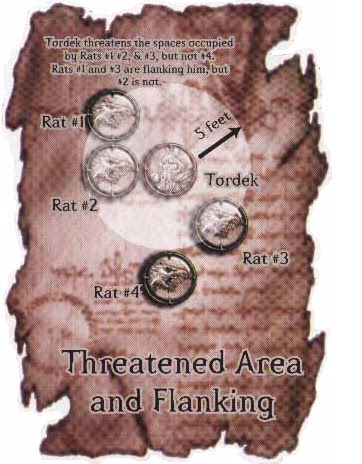

They quickly gave up on attempts to have "threatened area" and "flanking" be abstract when they created the 3.5 rulebook.  Once they produced that rule book, not only was the default assumption use of minis but the mechanics basically required them.  To not use minis was to abandon the benefits of a number of feats and tactical choices, or to limit those choices by subjecting them to "common sense, consensus, or fiat."  A system I attempted to use early in my 3.x experiences, but which quickly proved inadequate to my Champions and Battletech spoiled comrades.  They wanted clear display of their tactical choices, and who could blame them.  The 3.5 rule books certainly didn't.  


Fourth edition merely continued the trend of all earlier editions, with the use of the "threatening" ZoC.  What it added were layers of how to create additional opportunities for the ZoC to have effects.  It also added ZoCs to certain spells with the full articulation of ZoC spells for "controllers."  These are all things that were in the rules from the beginning of the game.

Early in the game, the rules were presented in Wargame terminology.  By 3rd Edition AD&D, they had become somewhat abstracted in presentation but were still deeply rooted in "threatened" effects.  So much so that the company felt the need to create a 3.5 edition of the game which specifically used miniatures to demonstrate how the combat rules work.  The difference was the use of language.  D&D by 3.5 had ceased using purely wargame language to describe combat effects, it had some of  its own concepts.  With the release of 4th edition, they returned to a use of wargame terminology and wargame style effects became implemented in more areas of the system.  By 4th edition, a game that had worked hard to feel less "game-ish" and more narrative had become, for some players, too game terminology oriented.  Players who used Wizards -- Controllers -- could feel the "game-ishness" of the system and it felt less narrative to them.

A part of this is because we don't have years upon years of stripping away the gamish stuff and substituting an array of cultural D&D rules mores to substitute for them.  Original D&D was as game-ish as 4e, every edition is actually as game-ish, but we had created short cuts and systems to eliminate those elements and go to the abstract.  In doing so, I think we actually neglected some of the real richness of the game.  We should celebrate the gamist pieces.  Use them.  Get used to them.  Once they become second nature, they become less "game-ish" and you can focus on the story.  The more you focus on ZoCs being annoying, when they've always been there but maybe you ignored them, the less you are enjoying a great game.

Every edition of D&D is great.  Let's hope they don't forget that with DNDNext.


Friday, January 27, 2012

D&D Next: What Replaying Warhammer Quest Taught Me Regarding Nostalgia, Fun, and Expectations

For the past twelve years, I have been playing roleplaying and board games with roughly the same group of people.  We have a couple of core members and have had a couple people wander in and out of our group, but by and large it is the same group of players.  The group has a high level of commitment from the players, so much so that one of the group regularly plays via Skype even though he has moved 6 hours away.

While the majority of our game play consists of two D&D campaigns -- one 3.5 and the other 4e -- I like to bring in some board game play, playtesting, or one-shot adventures from time to time.  Sometimes this corresponds with one of the unwritten rules of our group.  For example, when someone new joins the group at some point we will arrange for that player to experience some Moldvay/Cook Basic D&D goodness.  It is one of the two gaming rituals our group has. 

The first -- much to Steven Schend's dismay -- is that all new members of our group must watch the video that accompanied the TSR Dragon*Strike game.  Players who can endure that video and laugh will likely fit in well with our gaming group.  If you haven't experienced the 33 minutes that is the Dragon*Strike video, it's kind of like The Gamers only it wasn't trying to be a comedic look at the hobby.  As I mentioned earlier, the other is that that player will eventually play in a Moldvay/Cook era adventure.

The first time I ran a Basic D&D adventure for the group, I used the Keep on the Borderlands module.  The players prepared themselves for adventure and started off toward the Caves of Chaos.  On the way, they encountered a mysterious hermit.  Within 5 minutes -- real time -- the entire party had been killed by the hermit and his pet mountain lion. 

Last year, I ran another session.  This time I used one of the "Black Box" era modules, The Eye of Traldar.  I selected the adventure because the black box era modules were more narrative and story oriented than some of the early D&D adventures, and because I thought it would be less lethal than Keep.  The player's rolled up their characters, a fighter, a cleric, an elf, and a magic user, and we discussed their character backgrounds.  As this was a black box adventure and it took place in Karameikos, I pulled out my Karameikos Gazetteer and we added backgrounds for all the characters and created a back story describing why this band of merry adventurers were adventuring together.  This done, we began the first encounter of the adventure and rolled initiative.  Within seconds the magic user was dead, and the other characters started to worry.  The magic user's player experienced immediate and serious disappointment.  He had taken the time -- about half an hour -- to come up with a background, only to see that character killed off in a random fashion.

Needless to say, this was not a very satisfactory experience.  It's one of the reasons that, as much as I love the Mystara setting, I don't run a Moldvay/Cook campaign.  Character death can come seemingly at random, and that can be a serious downer for some players.

A similar thing happened three weeks ago when I pulled Warhammer Quest off the shelf and set it up for the group.  We were down two players, so the four of us made for a perfect WQ party.  We set up the game, made our characters, and started our cooperative dungeon crawl.  At first, we were having a good time.  We were all laughing at some of the absurd encounters and marveling at how hard the game was.  We were also experiencing some pretty bad rolls.  Then we hit one hallway and the world fell apart.  Our wizard rolled a one in the power phase, creating an additional foe, on repeated occasions.  We were swarmed by hostiles, and our Elf was brutally murdered.  It was a disappointing end to what had been two-hours of enjoyment until that point. 

Like The Eye of Traldar and Keep on the Borderlands, Warhammer Quest is an adventure game with a default setting of Hard.  In fact, it seems that this is the default setting for many of the games of the early rpg era.  No one would say that Call of Cthulhu is a storytelling game of heroic achievement and guaranteed success.  Paul, over at blog of holding, has a recent post describing the design philosophy and play philosophy of some designers during that era.  To quote him:

 In OD&D, there's no guarantee that things are fair. One of Gary's and Rob Kuntz's favorite stories, says Mornard, was Clark Ashton Smith's The Seven Geases, in which (spoilers ahead) the hero survives a horrible death at the hands of seven different monsters only to die meaninglessly slipping from a ledge. That was one of the seminal texts of D&D, said Mornard, and one of the stories it was designed to model. "The story that D&D tells," said Mike, "is the story of the world. Heroes aren't invincible."
The thing is, that I don't really like that kind of game.  I don't like whimsical and meaningless deaths for player characters.  This is especially true for games where character creation is a long process where significant narrative choices have been made.  The player quickly becomes attached to the character, and to have that character "meaninglessly slipping from a ledge" is unsatisfactory to most players.

Geoff Engelstein describes why this is true in a recent article on The Dice Tower podcast entitled Colonoscopies and Game Design.  In the podcast, Geoff discusses the psychology of pain and how people who experience pain -- say the pain of a colonoscopy -- will evaluate how much pain they felt by taking an average of the most pain they felt and how they feel at the end of an event.  If the moment of most intense pain comes at the end of a event, or play of a game, then the experience will be negative.  If the end of an experience is pleasant -- even though the moment of highest pain was the same or worse -- the over all experience will be viewed as a positive one.  It's funny how the psychology of the mind works isn't it.

What this means for those old games where death comes easy and the default setting is Hard, is that whimsical death's can still occur but that they should occur as part of a process and not as an ending.  It also means that if whimsical death is a possibility, one should not be encouraged to come up with detailed backgrounds for characters as those are a part of the playing process too.  If 30 minutes of game play are taken up with coming up with a background, and those 30 minutes are followed by 30 seconds in which your character is brutally cut down, then that isn't a very satisfactory experience.

Whatever direction D&D Next goes, I think that it needs to keep in mind this part of human psychology.  If death is to be whimsical, then find a way to make death a middle part of the process.  Encourage multiple characters like Paranoia or make character creation so quick that new characters can be inserted instantly.  You won't get very "narrative" games with rich character development, but you might get some fun ones where players vent out their own secret desires.

Personally, I hope that D&D Next falls somewhere between 3.x and 4e with regard to ease of death.  One might add more specific "knock out" rules, or rules for defeat without death, but I would be disappointed to see a return to a game set on Hard.  Those already exist, as do games on Easy.  I want to see a game set on Normal where death is a possibility, but where it isn't the only or primary signal of a failed endeavor.

Wednesday, January 25, 2012

AD&D's Appendix N? What About the Moldvay Appendix?

now become a widely used shorthand for the literary origins of RPGs."  James' site often includes discussions of the appendix, its influence on the early days of the hobby, and from time to time he even reviews books and authors featured in the Appendix. 

Given that he has taken the time to review the Carnelian Cube, a book that fellow Appendix N advocate Erik Mona has found "wanting," it is my hope that James will someday review the Kothar series by Gardner Fox.  Though if that doesn't happen I might just find the time to do so.  Having endured a couple of Lin Carter's Thongor books, I figure they cannot be much worse.  That said, Carter at least has the virtue of being one of the best editors in SF/F history even though his Thongor stories fall very short of the best of Sword and Sorcery fiction.

If I were to say that the influence of Appendix N extended beyond the gaming table and that many of the works therein are also seminal works of Science Fiction and Fantasy, I don't think there would be many who disagree.  The Appendix includes luminaries like Leigh Brackett, Edgar Rice Burroughs, J.R.R. Tolkien, Manly Wade Wellman, and Robert E. Howard -- and many others beside.  But the list is also incomplete.  There is no listing for Clark Ashton Smith, for example. 

But this is not the only list of recommended reading that the Dungeons & Dragons games have provided their readers.  No indeed.  The Erik Mona edited Pathfinder roleplaying game, or as I call it D&D Golarion, has it's own Appendix 3 which features a list of recommended reading.  It is a longer list than Gygax's, and a good one.


My own favorite "Appendix N" is a combination of the "inspirational source material" provided by Tom Moldvay on page B62 of the 1981 Dungeons & Dragons Basic and in the module X2 Castle Amber.  While others may have based their youthful Fantasy purchases on Appendix N, I based mine almost entirely on the Moldvay list.  It should be noted that Tom Moldvay was assisted in the creation of his list by Barbara Davis who was  Children's Librarian at the Lake Geneva Public Library.  Davis eventually became the Library Director from 1984 to 1996.  I don't know where she is now, but I'd like to thank her for the many hours of joy the list she worked on has provided many young people.

Maliszewski has already written a brief comment about how the Moldvay list differs from the Gygax one, and argues that it represents a shift from material that influenced the design of the game to a list that might provide inspiration or entertainment for those who play the game.  To quote James, "Whereas Gygax's list was a list of the specific books and authors who influenced him in creating the game -- and are thus a window into how he saw the game -- Moldvay's list is a generalized quasi-academic survey of fiction and non-fiction that might hold some interest to players of D&D."

His language is strong, and as much as he demurs from the quote being used as a "this list is better than the other list" statement, it seems clear to me that the use of the term "quasi-academic" is somewhat loaded.

Let's just say that James and I hold similar, but not exact positions on the lists.  I agree that the Gygax list is a specific list that influenced him in creating the game.  I think the list was also one which he thought would appeal to people who were currently playing D&D.  That is to say, adults.  When AD&D was first published, the game was just beginning to escape from college campuses and niche SF/F reading circles and into the mainstream.  The Moldvay list, on the other hand, is written for a generation of emerging players.  It is written for the young. 

Both lists include some overlap -- Fritz Leiber, Robert Howard, H.P. Lovecraft, and J.R.R. Tolkien.   But Moldvay's list is divided into many sections. 

There is Fiction: Young Adult, which includes Lloyd Alexander, L Frank Baum, and Ursula Le Guin. 

There is Non-Fiction: Young Adult, which includes Olivia Coolidge's Legends of the North.

There is Fiction: Adult Fantasy with Poul Anderson, Leigh Brackett, Avram Davidson, E.R. Eddison, Heinlein, Jack Vance, Karl Edward Wagner, and a host of others.

Adult Non-Fiction includes Jorge Luis Borges' The Book of Imaginary Beasts and Thomas Bullfinch.

In most ways, the Moldvay list is inclusive of Appendix N.  There are only four authors Moldvay's list leaves out that are in the Gygax list.  These are Frederic Brown, August DerlethMargaret St. Clair, and Stanley Weinbaum

If you want a wonderful overview of the Sword and Sorcery field, I would argue that you should start with the Moldvay list and add the four authors that Moldvay excluded.  If your primary mission is to see the books that influenced Gygax, stick to Appendix N.

Both are good lists, but I still prefer the Moldvay.  That attachment probably stems from an overall affection for the Moldvay Basic Set, but...

Monday, January 16, 2012

Gaming and the Screenwriting/Cartooning Widower #1 -- Meeting the Cartoonist


A few years ago, my wife Jody and I decided to attempt to jump the Snake River Canyon while riding a rocket aided motorcycle.  Okay, that's not exactly true.  We decided to attempt something even more impossible.  We decided that Jody was going to become a successful screenwriter and cartoonist.  Jody applied to USC's prestigious School of Cinema and Television, and we counted the days until the rejection letter would arrive and shatter all our dreams.

That day didn't come.  Instead, we received a very large envelope inviting Jody to attend the school.  We were elated, but also quite amazed by the situation.  I think Jody best described our emotional state when we first arrived on the USC campus in order to get her a student ID card.  She said, "But Christian...no one actually gets to go to school here.  This place is for remarkable people."

There was no irony in her tone when she made the statement.  She believed it.  You see, Jody has a serious case of underestimating her own talents and worth.  In Champions/HERO System terms, Jody has around a 30 point psychological disadvantage in this regard.  On the plus side, she spent all 30 of these points on her various skills and talents. 

Last week, Jody started up a blog called "Are You Famous Yet?" where she has been sharing her thoughts and experiences as she navigates the mysterious pathways that make up the Entertainment industry, or as it is typically called in Los Angeles...The Industry.  I thought that I would spend some of my blogging time sharing some of my own experiences as a "Screenwriting/Cartooning Widower."  Jody's struggles and long hours would make for lonely days and evenings were it not for the fact that I am an avid gamer and a working graduate student.

Speaking of gaming, the idea for the title of this post and subsequent posts on the subject, come from an article in issue 54 of Steve Jackson Games' old gaming magazine The Space Gamer. 

When I was an undergraduate student at the University of Nevada, Reno it was a golden age for that schools Cartoons page.  There were two well done cartoon strips (one about college life and one about a bear), and one cartoon strip that was something quite special.  That special cartoon strip had a truly bizarre name.  It was called Nicnup, and it told the story of a group of young people as they encountered life's oddities.  To say it "told a story" is a bit of a misstatement.  It contained jokes which featured young people encountering life's oddities. 

I had no idea who drew the strip, but I read it religiously in every issue of The Sagebrush.  It was the primary reason I read the school's paper.  It was a great strip that seemed to be getting better every issue as the artist better learned the craft.  I had no idea who the artist was, only that this person was named Jody Lindke.  (For those of you wondering, I took my wife's last name.)

One day I was sitting watching NFL in the television room of one of the dorms, I was waiting to see my friend Rich, when I see this friendly looking young woman carrying her bicycle up to her room.  I quickly ask if she would like to watch the game with me and she said yes.  After taking her bike back up to the room, we watched the game and chatted.  Mostly, we chatted.  I was quite smitten by this young woman named Jody and made arrangements to chat with her again in the near future.  Several more discussions later, I was inviting her to play in a Champions superhero campaign that I was running for some other friends.  She asked what day we played and I told her Monday.  She said she would be delighted to come but that she had to make sure she met her deadline first.

"Deadline?...hmm...?"  The words sounded important, but I made no connection at the time.  It wasn't until after a couple of weeks playing that I finally figured it out.  Jody was running late for the game, so I walked up to her dorm room to see if she could make it and that was when I found out she was the illustrator of Nicnup.  I was surprised.  Here I have been the friend of the best cartoonist in the school paper for over a month, and I had no idea that Jody and Jody Lindke were the same person...even after hearing references to this mysterious "deadline" thing.  I guess I'm pretty dense.

Anyway, for the next few months Jody would either show up on time or be late as the muse hit her or she struggled through coming up with a new idea/joke and therein lies the root of screenwriting/cartooning widower-dom.  The creative muse.  Coming up with ideas is difficult, more so when you are trying to come up with an idea that has the potential to entertain millions of people -- quite a few more than the thousands she entertained with her cartoon strips.

In the years since graduating, Jody no longer plays in my gaming groups.  She likes the people I game with, she likes the hobby, but the time she needs for her creative efforts has multiplied a hundred fold.  When we were in college, I could count the number of times she had to stay up all night to finish a cartoon on my fingers and toes. 

In the time since, I have lost count of the number of all-nighters Jody has experienced in the advancement of her career.  But there is one that comes to mind more vividly than any other.  It was the first "mix-week" she experienced at USC.  Twice each semester, student films have their sound mixes completed in a mad dash cram called "mix week."  During this time, the sound designers, sound department, and TAs work for a full week without ever coming home.  Near as I can tell, they work the entire week without any kind of sleep whatsoever. 

The frantic nature of these weeks, as well as film school in general, made for a pretty lonely marriage experience.  Pre-film school, we were a couple who essentially dated every night and had massive movie marathons every weekend.  During film school, I was lucky to see Jody for more than 5 minutes on some days.  I imagine that this kind of grueling schedule could put a strain on a relationship, but it didn't strain ours.  I made sure to visit Jody on her campus as much as possible, and I had my gaming hobby to fill in the lonely hours while she put her nose to the grindstone.  I was working full-time and in a Grad program, but I was the one with "oodles" of idle time in comparison to Jody.  I never felt resentment that Jody "didn't want to spend time with me."  It was pretty clear every time that I saw her that she would much rather spend time with me, but the demands on her time were severe. 

I was also lucky that Jody didn't resent my gaming time.  Yes, there was some minor resentment for the tabletop gaming I got to do.  That was spending time with other people after all, but there was absolutely no resentment for the hours I spent playing Final Fantasy.  Or as Jody calls it, "the walk around on the very big map and do nothing game."

The key thing I had to focus on was to make sure that my gaming time lined up with her busy time, and that I was free as often as possible during her free time.  Let me stress that this free time was not a lot of time, and that whatever time there was had to be spent doing more than watching a 30 minute sit-com.  There was often a week's (or two) worth of discussion about the world.  There was the need for hugs and quality time.  I made every moment count, and I think I managed to let her know how deeply loved she is in my efforts to cram a weeks worth of marriage into 45 minutes.

Film school was good practice for Jody's time in the "Industry Agency" trenches.  Those were days when she not only worked long, but in an environment that isn't exactly conducive to self-esteem.

I learned a lot about marriage during film school, about what is really important.  Communication and letting your spouse know your care are vital.  When your spouse is working ridiculously hard, it is important to recognize the fact and to sympathize.  Don't think they are doing it because they want to be away from you.  That way lies madness.

Instead, pick up a book, a hobby, or a "long map game" to pass the time, and use that time to think about how you are going to maximize the little together time that you are going to have together.  May I recommend quick jaunts to Culver City or Monrovia for dinner, or a nice hike at Griffith Park, or a brisk walk on the beach. 

When your spouse is trying to get a paying gig in a creative field, it's important to remember to be the net/parachute.  Don't resent any work you have to do to support them, financially or emotionally.  Because your loved one is taking the rocket jump across Snake River Canyon and they are scared enough without having to worry about how things are going at home.

Saturday, January 14, 2012

Reverb Gamers #14

REVERB GAMERS 2012, #14: What kinds of adventures do you enjoy most? Dungeon crawls,
mysteries, freeform roleplaying, or something else? What do you think that says about you?


My preferred game is something that crosses heavy roleplaying and a mystery. Our long running 3.5 D&D game is about urban investigators solving supernatural crimes for the city watch in Sharn. It's even inspired our 4e campaign about the same thing. In a roleplay/mystery I can develop my character and solve a puzzle simultaneousy. I like to tell stories about interesting characters and places but I love a good mystery. Mysteries in RPGs can be tricky though. If finding a clue is based on requiring specific steps be taken by the PCs the threads can go unpursued. Gumshoe does an interesting thing and guarantees that each scene reveals a clue but it's up to the players to role play how that find them. I think I may need to play more Gumshoe.

Friday, January 13, 2012

12-Sided Die: Should You Be Game for this New Webseries?


Earlier today, the team @12sideddie blasted the internet with a solicitation of their new gaming themed web series 12 Sided Die.

12 Sided Die is a web series directed by Daniel Murphy and written by Curtis Fortier that is aimed at the table top gaming community. According to the show's website, the show is:
A hilarious new web-series about romance, geeks, and graph paper.

Our hero: Curtis Foster, Permit Processor by day, Level Fourteen Wizard Warrior by night.

If theres one thing Curtis loves most on this Earth, it's playing a rousing game of "Swords and Swordsmen" with his friends Chris and Eric.

Sadly, the group is growing older... Eric is newly married, Chris is a father, and the time between games is growing larger with each passing day.

So, on their eve of their first game in over six months, when the stakes have never been higher, Curtis is convinced that nothing can get in his way.

Except, perhaps, a surprise distraction of his own: his neighbor Cynthia.
But is the show hilarious, and does it really capture geek romance?

The answer to this central question is maybe. The first episode of the series (embedded below) suffers from a significant dose of what I like to call "pilotitis." This is the slight awkwardness that many pilot episodes suffer from which fails to capture the full potential of the idea underlying the show, or the talent of the creators and performers of the show. A good historical example of pilotitis is Star Trek. The show's original pilot was pretty bad, but by the time they reworked the show for the second pilot the show's potential really shined through.

12 Sided Die has a good concept. It's a show about gamers and romance, but it is also a show about the difficulties of balancing a hobby with real life. Anyone who has played games, or had a passionate hobby, in their post-college/high school years understands how difficult in can be to find the proper balance in time to meet all your obligations and still find time for your hobbies. For example, I love playing board and role playing games. I also love running around the park with my wife and daughters, the allure of spending time with History and Mystery (our 3 1/2 year old twins) is a pretty significant obstacle to making time to play games. I am thankful that the girls really like the people who come over to game twice a month, and even more grateful that my friends like spending time with the girls. To be honest, if they weren't willing to let the girls "watch" us play it would be a deal breaker. History and Mystery would win out in the battle of hobby vs. family and which provides more joy. That said, my group does enjoy having the girls come around and the girls love to play with our "little men." It's that kind of tension, though other tensions as well, that underlie the dramatic/comedic conflicts of 12 Sided Die. Just add a dose of 30 something and single/looking for a relationship, and you've captured the show perfectly.

Back to the show's pilotitis. It leaps out at you from the first scene. The lighting during the play session in the opening is a distraction. The room looks unnaturally yellow, when it should be lit to look like a normally lit apartment. The problem is that they filmed a normally lit apartment, and normally lit apartments don't look like normally lit apartments on film. This scene is also a tad overacted. While Christopher Gehrman's over the top performance as the dungeon master can be forgiven, as he's playing an over the top dungeon master, Curtis Fortier's performance in this scene needs to be backed down a little. Not his "in character" performance, but his "I'm so excited about where the game campaign is going" performance, the same should be said of Eric Vesbit's performance in the scene as well. As the show progresses, the actors seem to fall into more natural rhythms and I don't see this being a problem in the long haul. It is just something that needs to be pointed out. As Hamlet would say:

Speak the speech, I pray you, as I pronounced it to
you, trippingly on the tongue:but if you mouth it,
as many of your players do, I had as lief the
town-crier spoke my lines. Nor do not saw the air
too much with your hand, thus, but use all gently;
for in the very torrent, tempest, and, as I may say,
the whirlwind of passion, you must acquire and beget
a temperance that may give it smoothness. O, it
offends me to the soul to hear a robustious
periwig-pated fellow tear a passion to tatters, to
very rags, to split the ears of the groundlings, who
for the most part are capable of nothing but
inexplicable dumbshows and noise: I would have such
a fellow whipped for o'erdoing Termagant; it
out-herods Herod: pray you, avoid it.

It should also be noted that the sound design is a bit off. There is an overuse of score, and the individual sound edits don't always match up with what I'm supposed to be hearing. This is particularly acute during a scene in which Curtis makes himself some "Strawberry Milk."

The show's strongest suit is in the story, it has a nicely done cliffhanger that is timed almost perfectly. This is a tale of a group who hasn't met to continue their game for almost 6-months given their current responsibilities, what happens when a new romance enters one of their lives? It's a nice touch, and well done. Kristina Lynn Bell is a nice choice for the romantic interest. I was a bit concerned with her introductory performance. Her acting to the audience "behind the fourth wall" started out a tad over the top, but by the end of the scene she won me over. The camera angles were bit off, but her performance really started to hit a sweet spot.

All of this can be written off as pilotitis, and I will certainly return for a second episode. The show as it stands did leave me wanting to see what happens next. It really left me wanting to see what happens next.   So...what happens next?!

But there was one thing that I couldn't quite write off as pilotitis, and it affected the verisimilitude of the entire show. That was the use of "made up game mechanics" that didn't quite sound like real game mechanics. I can understand, and appreciate, the desire to avoid violating other people's copyright. But in a d20 license world, there is no reason for a character to utter the line, "I'll cast my Pyro spell." Especially when one could just as easily say "I'll cast my Fireball." Heck, even in a pre-OGL world, you could have gotten away with that. This was magnified by the fact that the writers were willing to include real world references to Coke and Mountain Dew, but stumbled at the mention of concepts that would most appeal to their target audience. Don't be afraid to say D&D. Even better, if you want to have a little "geek cred" as Erik Mona and crew at Paizo if you can use the Pathfinder brand as your game of choice. If they say no, it doesn't matter. The rules are Open, just avoid Golarion specific references.

All of my criticisms are written with the understanding that these people are working really hard to provide something entertaining that they really believe in (see Jody Lindke's recent blog post on the subject).   But they are also written in the hopes that the show will address small problems and continue to improve.  There is something here.  Something that is already worth watching, for gamers, but it is something that could appeal to an even broader audience if it continues to improve on its strengths and address any weaknesses.  Entertaining people at all is hard.  The 12 Sided Die crew have already succeeded in entertaining me, now I want them to blow me away.

Reverb Gamers #13

It's Friday the thirteenth of January. What does that mean? It means it is time for Reverb Gamers Post 13.
Who's the best GM/storyteller/party leader you've ever had? What made him/her so great? (Courtesy of Atlas Games. Visit us at www.atlas-games.com)
This question is a bit tricky. I have a few solid long time gaming groups that I have been in. How do I answer this question without upsetting someone? I could pick a GM, a storyteller, and a party leader and still upset all my other gaming friends. I could go the vanity route and say I am, but that's just not true(I've played with a lot of skilled Role Players in the short while that I've been gaming). Gaming groups are sometimes fragile things just waiting for egos, and interpersonal drama to crack them like eggs. I will try to talk about what makes a great GM/storyteller/party leader in non-specifics(I really don't want to upset anyone).
Ask open ended questions that invite collaboration from other players at the table. Everything is open and friendly even in the most tense moments of narrative. above all encourage and facilitate fun for everyone. Don't try to mash up three things together as one thing(limit yourself to 2 things). Genre emulation is hard only try it with a group where everyone is buying in.

Thursday, January 12, 2012

Reverb Gamers 2012 #12

Do prefer collaborative or competitive games? What do you think that says about you? (Courtesy of Atlas Games. Visit us at www.atlas-games.com)

I definitely prefer colloboration over competition. When it comes to boardgames it's how I ended up being Design partners with Evan Denbaum. He and I formed a band of cooperative board gamers at EndGame's Boardgame Night.

I still like to win though so competition is still important to me(our first game design to be published will be competitive). I would just prefer to work with others toward victory.

Wednesday, January 11, 2012

Reverb Gamers 2012 #11

Have you ever played a character that was morally gray, or actually evil? Why or why not? If yes, did you enjoy it? (Courtesy of Atlas Games. Visit us at www.atlas-games.com)

People in general are morally gray, so of course I've role played evil and morally gray characters. This happens most often when GMing NPC villians. But I've played many characters who fall into this category. Sure it's fun to play the hero in the classic dungeon crawl but playing the backstabbing rogue can be just as fun(in fact for many players this is the default moral setting).

Fiasco, anyone? It's a game where Everyone is of questionable moral fiber. I've had lots of fun playing and facilitating this RPG.

Star Wars: Knights of the Old Repbblic and Mass Effect have in-game mechanics for monitoring evil and good acts. I once ruined a save file of KOTOR II by deciding my straight arrow jedi was tired of it all in the Sith Academy and decides to turn to the dark side. I must tell you that it was not rewarding, because the dialogue choices for a fallen paragon Jedi don't exist and the game just stalls out when it loads conversations with your fellow Sith apprentices.

Tuesday, January 10, 2012

Reverb Gamers 10 - Doctor Who?

Have you ever played a character originally from a book/TV/movie? How did the character change from the original as you played? If not, who would you most like to play? (Courtesy of Atlas Games. Visit us at www.atlas-games.com)
The most recent time that I played a character originally from a book/TV/movie was at last year's Dead of Winter Invitational(it's a local horror RPG gaming convention in the Bay Area put on by the Terror Rabbit). I was asked to play The Doctor. Who? Oh you know...
It was the morning game at the very beginning of the convention. Everyone but one other person was already around the table waiting. I took the empty seat closest to the door and waiting for me there was a fez(fez's are cool. I wear a fez now), a sonic screwdriver(a replica prop of the 11th Doctor's "magic wand"), and a picture of Matt Smith. So I sat don't and thought "Geronimo."(see I'm already getting into character). The GM felt it was important for his story that The Doctor be played by one of the players. We had the options of all the canon characters from Season 6 Doctor Who including (Spoilers!). No one had seen a lot of the show except for me, I was the person at the table with the most Whovian cred.
I think the major difference for me playing the doctor is that I had absolutely no idea what was going on in the story and was essentially winging it by making stuff up and trying to sound like I did(okay, it wasn't different at all). It was a lot of fun. We were playing the cubicle 7 role playing game which means that the Doctor is capable of anything and everything put has no plot points and really has to rely on the Companion players to move the story along, even when it means watching other players fail rolls that the Doctor could easily make. It is a strange balance that replicates the TV show well I feel. It is a little unusual for an RPG though, for one player to have all the skill power(I guess it's akin to high level 3.5 D&D in that way but in this case the skilled character isn't driving the story at the expense of other players).

An Alternative Vision of the Hobbit that Never Was -- Thank Heaven

Over at the Tor books website, there is a post discussing a short animated version of The Hobbit that was produced long before the Rankin/Bass film adaptation with which most people are familiar.  The film was worked on by Gene Deitch, who shares the genesis of the project on his website.

As I watched the approximately 12 minute adaptation, I was struck by two thoughts.  The first was how similar the animation style was to the illustrations on the covers of the paperback editions of The Lord of the Rings that my parents had sitting around the house when I was a child.


The second was how little the illustrations captured the feel of the fiction for me.  I never felt that the Ballantine covers truly captured the magic of Middle Earth.  They were dynamic covers, but they were too faux surreal and angular for my young tastes.  The Fellowship cover, above, captures neither Hobbiton nor Rivendell for me.  This isn't to say that those places might not look surreal, just that these images fail to capture my vision.

The same holds for the animated film.  It's adaptation of Thorin and the insertion of hearts into the costuming of various characters seems bizarre, though I do like the angular Gandalf who has a darkness that the other characters lack.

Watch the clip and judge for yourself.  One thing is certain though, the name change they gave Smaug is nigh unforgivable. 


Monday, January 09, 2012

Reverb Gamers 2012 #9

Atlas Games is hosting a new RPG blogging group called Reverb Gamers that is posting a writing prompt(1 each day in January) with a focus on RPGs LARPs and MMORPGs. I missed yesterday because I really couldn't think of an answer and I got sucked in by Star Wars The Old Republic. Sometimes you just have to play games instead of blogging about them. Anyway today's post:
Have you ever played a character of the opposite sex. Why or why not? If yes, how did the other players react? (Courtesy of Atlas Games. Visit us at www.atlas-games.com)
I have played characters of the opposite sex before. I usually only play female characters in single adventures or convention RPG games though. Our home campaign has a rule that you can only play characters of the same sex as you, which invariably someone tries to break(and usually they get away with it). The reaction was the same as if I had played a male character, from what I can tell.

It does, however, remind me of a odd thing about MMORPGs and the Internet. MMO avatars can provide a strange kind anonymity. I have seen people get upset when they think they are talking to a male or female person based on the sex of the avatar. Hey, I thought you were a woman/man.

Reverb Gamers 2012 #8

What's the one gaming accessory (lucky dice, soundtrack, etc.) you just can't do without? Why? (Courtesy of Atlas Games. Visit us at www.atlas-games.com)

Don't really have one. If you pushed me I would say good players. If the game doesn't have creative players at the table I'm checking out and going home.

Saturday, January 07, 2012

Reverb Gamers 2012 #7

How do you pick names for your characters?
I covered this briefly yesterday with the story of Hal Duran, here. For that I just chose two names that I thought sounded cool and made the characters first name and the second their surname. It only turned out to be a cool "in joke" name after the fact. Depending on the genre, the game length era its from I choose different names.
For four color supers its important to have rhyming or sound alike names or aliteration. My supervillain for Necessary Evil is called Darklight. Darklight because he is a lantern weilder in the style of Green Lantern and Sinestro. Where does the rhyming come in? With the civillian Identity of Dr. Marcus "Marc" Wright. For our Gamma World game I made a fiery leader with a temper named Paul Cano which sounds like volcano when you say it fast.
One way I like to name characters is to brainstorm random words, write them out on a sheet of paper and sound them out string them together put different emphasis on syllables and recreate sounds you like with new spellings.
For D&D one-shots I use the random name generator on DDI until I find something that matches my character concept.
Another way I like to name a character is through play. Come up with a title or a nickname and then through play find the characters history by connecting yourself to other NPCs. is there a family in distress who needs the party's help. Take their surname and say that your character is a distant relative arriving in time to save the day. Thus creating backstory on the fly and a name approriate to the setting.

Friday, January 06, 2012

Reverb Gamers 2012 #6

Describe your all-time favorite character to play. What was it about him/her/it that you enjoyed so much? (Courtesy of Atlas Games. Visit us at www.atlas-games.com)


My all-time favorite character to play, huh? Sounds like another bad episode of Let me tell you about my character.... My retailer friends will often complain that while running a game store they have to hear a lot of the "let me tell you about my character..." stories. Hear enough of them and you'll snap. I think because for the person telling the story it's a very personal thing. A connection you make in your own mind between yourself and the character you are creating and playing. For someone hearing the story without that context it's just details strung together. For those who wish to avoid such nonsense please read no further.


My first character in a "real" RPG with a real gaming group is probably my favorite character to play. A male Twilek Jedi Padawan named Hal Duran in my friend Wes' Star Wars SAGA edition game. It's set during the Clone Wars and Dark Times eras between The Phantom Menace and A New Hope. In an early session it was pointed out to me that "Hal Duran" sounds like Alderaan. I swear it wasn't on purpose. My Jedi's name is not a tribute to that doomed world. The inspiration for the name was from HAL 9000, the computer in 2001: a Space Odyssey and the band Duran Duran, they combined as an interesting name for a Jedi Padawan.

What do I enjoy most about playing this character? Hello? Jedi. For this game it's all about cinematic action. What highly improbable feet of acrobatics, and sword play will Hal pull off this week? Probably my favorite scene so far was chasing a personnel carrier with a speeder bike. It's hard to fight a moving target with a light saber. So I maneuvered the speeder in front of the carrier while using my light saber to protect myself from it's guns. Then I leaped off the bike while spinning like a top with light saber held angled in front of me, cutting a hole through the plasteel window simultaneously killing the driver and wounding the co-pilot. I landed on my feet in the back of the carrier. So I was fighting the guys inside while the carrier is crashing. Mandalore bounty hunters coming in the top and jumping off just in time for the carrier to explode from a thermal detonator. Boom! Awesome. That was just as a padawan, just gained knighthood in the last session.

Thursday, January 05, 2012

Reverb Gamers 2012 #5

Have you ever introduced a child to gaming, or played a game with a young person? How is gaming with kids different than gaming with adults? (Courtesy of Atlas Games. Visit us at www.atlas-games.com)


This question strikes me as funny. I was a young person once(a long time ago, I know). And when I was young we were introduced to gaming by our parents. And with a little brother around I obviously played with " a young person" as a a young person(as a child I played games with other children).


I must of course interpret the question as: Since you became an adult, "have you ever introduced a child to gaming or played a gane with a young person?


Sure of course, I have. It is very different than playing games with adults. For one you have to watch your lanquage. No swearing in front of the impressionable youth. usually parents of kids don't want to have to explain bad words to their kids at a young age. One of my college friends and his younger siblings would come over to my house and play D&D as a family. I really had to alter the content of my usual game to account for the wide range of ages at the table. I also had to take time to explain the rules with a new mindset. it took a lot of patience. We played several sessions but never actually finished the campaign.

Wednesday, January 04, 2012

Space Crusade (1990): In the Grim Darkness of Table Top Gaming, There is Only War

I promise to catch up with Eric on the Reverb Gamers posts, but first I have to share a bit of awesome.

Some of my fondest gaming moments are the years I spent playing the various editions of Warhammer (Fantasy and 40k) before moving down to the Los Angeles area.  My friends and I would meet every week to do battle with our half-painted (or at least all "primed") armies for hours on end.  We were devoted fans who not only played the "hard core" miniature battles games, but also most of the "Specialist" games released by Games Workshop in support of their war games.

Games Workshop was, and pretty much still is, on a rotating schedule of providing a new rules edition for their war games every 3 years or so.  During the year prior to a new rules release, they would roll out a Specialist game that covered a related theme.  If a new edition of 40k was coming out, we'd see "Gorkamorka."  If a new edition of Warhammer Fantasy was around the corner, we'd see "Mordheim."  It was great fun.

In the late 80s and early 90s, Games Workshop teamed up with Milton Bradley to create a couple mainstream adaptations of their signature games.  For Fantasy, those games were Heroquest and Battle Masters.  I own both of these games and they are prized possessions that have provided many an hour of entertainment. 


Sadly, as passionate as I was about these games, I somehow missed out on Space Crusade.  Space Crusade is a popular market adaptation of Games Workshop's signature Specialist game Space Hulk.  I say adaptation, but the more I look at it the more it looks like an "improvement."  I desperately would love to get my hands on a copy, but alas and alack they are rare and expensive.  When I see the components, I can see why.  Unlike Space Hulk which focuses solely on the conflict between Space Marines and Tyranids (Genestealers), the Space Crusade game includes Orks, Eldar, and crazed Androids who look suspiciously like Necrons to the mix.


Reverb Gamers 2012 #4

Are you a "closet gamer?" Have you ever hidden the fact that you're a gamer from your co-workers, friends, family, or significant other? Why or why not? How did they react if they found out? (Courtesy of Atlas Games. Visit us at www.atlas-games.com)

Addendum: Do you know anyone who is? Would you ever "out" another gamer? via Twitter

No. Definitely not. It's my primary social network. At my day job I let everyone know that I'm a gamer. I may not wear distracting gamer attire but I let my words and actions communicate that "I am a Gamer". I had a co-worker who totally wore gaming shirts all the time. It was okay with the people at our work so I guess sometimes it's okay to let your gamer geek flag fly at work, it just wasn't for me.

As a a game designer it's in my interest to let people know about the hobby and to try to spread the word. How else will anyone know about my work and the awesome work of my friends and colleagues.

I've known a few people who like to play it off as if they don't game when we got socially, but I wouldn't out them. It's a personal thing. They shouldn't be embarrassed by their hobby but I understand it. Just like you shouldn't be embarrassed about anything that you genuinely are.

Monday, January 02, 2012

Reverb Gamers 2012 Prompt #3

What kind of gamer are you? Rules Lawyer, Munchkin/Power Gamer,Lurker, Storyteller/Method Actor, or something else? (Search "types of gamer" for more ideas!) How does this affect the kinds of games you play? For example, maybe you prefer crunchy rules-heavy systems to more theatrical rules-light ones.


Role-Player not Roll-Player with a nice side of Storyteller. I am into story and theatrical combat. I try to bring what my friends call the 'awesome'. Christian's daughters rightly capture my play-style by shouting "Boom!" at the table.

I think Ryan Macklin does a good job of pointing out that this prompt "It's a trap!". I feel like all of these lavels for types of gamer apply to me depending on the game. sometimes more than 1 label at a time.

I enjoy mastering the rules for my PC when playing D&D so crunchy rules/Rules lawyer. But when I run D&D I care more about facilitating fun for everyone else and don't let things like rules get in the way of everyone's fun.

In Savage Worlds the rules are so simple that I find myself lurking in most games and occasionally trying to play the 'troublemaker'.

For Do it's a storytelling game so it's all about telling silly stories for me.

In the big picture I would say that the rules of a game and its themes will dictate my play style.

Reverb Gamers 2012 Prompt #2

REVERB GAMERS 2012, #2:
What is it about gaming that you enjoy the most? Why do you game? Is
it the adrenaline rush, the social aspect, or something
else?

It's definitely the social aspect. I have met many great friends through gaming. One bit of statistics based evidence for you. It was pointed out to me by the Face Book that more than 25% of my friends on Facebook are fans of a little FLGS(Friendly Local Game Shop) called EndGame. This also doesn't include more of my friends who game but aren't local to Oakland. So they only know about because I talk about it so much. Gaming is definitely a social thing for me(also I love telling stories; to people, with people, for people; the collaborative story telling that RPG play allows for is another major reason that I play games).

Sunday, January 01, 2012

Reverb Gamers 2012

Atlas Games is starting a new RPG blogger group called Reverb Gamers 2012. You can follow the results at their website and also on Twitter @ReverbGamers. For each day in January they are posting a prompt for RPG, MMORPG, and LARP players to discuss. I will endeavor to write a response, however brief, to each one.

Prompt for the 1st:

REVERB GAMERS 2012, #1: What was your first roleplaying experience?
Who introduced you to it?
How did that introduction shape the gamer you've become?


How should I answer this one? Do they mean formal roleplaying experience like with rules and stuff? Everyone's first roleplaying experience is when we are little kids and we imagine that we're the 'police' chasing down our 'robber' friends or some similar game. Do I count the Milton Bradley published Hero Quest, which is really a boardgame now that I look back on the experience? You know what? that's it.

Hero Quest 1989


It was designed by Stephen Baker, according to boardgamegeek.com. HeroQuest was developed by GamesWorkshop, you know The Hobby Games guys. It was released in 1990 in North America by MB so I must have first played this game when I was 8 or 9 years old. It was the go to boardgame for me, my brother, and our best friend Chris. We would all imagine we were our characters and take them on each quest in sequence in the game. We'd take turns playing as the evil Zargon. Eventually we upgraded the game and got the two expansions as they game out. Kellar's Keep and Return of the Witch Lord. And when we finished those we started 'hacking' the game. We made up new heroes using the stats for the other characters mixed up. I think one of the characters we made was really weak in dice rolling but had access to Zargon's spell cards. We also made a ranger. And we upgraded some of the characters so we could play the game with fewer heroes and really roleplay one character at a time(in the three player games we usually played two heroes per player for balance reasons).

It is the earliest in my life that I considered game design as a career path. I think I was 10 or 11 at the time. I always dabbled with the idea in middle school and high school. Turn the clock forward 20 years and I'm finally starting a career in game design. Just last week I was looking through some old notebooks and found card designs for MtG from the mid-nineties that I wrote while I was in high school. So I guess the lesson is pay attention to the career dreams of your 10 year old self.

My copy of the game is pretty beaten up. It is not at all like the video I posted above. My heroes and a few goblins are painted but are chipping badly. The box is not holding together and some of the cardboard furniture is missing. This game was a gift from my parents so thanks Mom and Dad for making sure I was a lifelong hobby game enthusiast. It is something of a treasure that I will never think about parting with though.

Wednesday, December 28, 2011

Happy 4th Day of Christmas -- A Belated Merry Christmas

I meant to put this cartoon up on Christmas Eve, but alas I was too busy getting the house ready for Santa Claus.

Thursday, December 22, 2011

Second Battleship Preview Leaves Me Wishing They Made "Battleship Galaxies" Into Film

Yesterday I tweeted that I might be the only person in America who is excited to see the upcoming "Battleship" film directed by Peter Berg. I think that Berg has a talent for both the artistic and for the popcorn, and think that his "Battleship" film looks like pure popcorn. Ridiculous popcorn.

Like, doesn't make any sense popcorn.

Not only that, but popcorn that follows the typical invasion story formula.

  1. Earth encounters alien force
  2. Earth gets owned by alien force -- the "Footfall" moment
  3. Earth keeps fighting against hopeless odds
  4. Some change/shift occurs
  5. Earth wins/Aliens quit
In Footfall the aliens stop when they realize that humans are crazy and won't ever give up.  In "Independence Day,"  we create a "virus" to even the odds.  In War of the Worlds, the aliens catch a cold.  It's a common formula, tried and true.  A little staid perhaps, but I don't mind if the film is pure popcorn.  Heck, even "Skyline" followed this formula even though it ended just as the shift toward "human" victory begins.


Regardless, after seeing the alien designs in this film, and having played the "Battleship: Galaxies" board game, I personally wonder why they didn't just base the film on that game.  It would still have the transmedia marketing tie in, and it would make sense to include the aliens.

Wednesday, December 21, 2011

In Defense of Candy Land

In a recent episode of the Dice Tower podcast, Eric Summerer gave some surprising praise for the classic Milton Bradley board game "Candy Land." To those who are casual gamers, rather than obsessive hobby gamers, it might seem odd to call praise of "Candy Land" surprising, but it is.  While the "child's first game" is a staple in most households, it isn't a well thought of game in the hobby gaming community.  For example, the hobby gamer's go to website for opinion research is the excellent Board Game Geek website, and its members have given the game a lowly 3.2/10 rating (with an N of 1568).  This rating falls somewhere between "bad" and "not so good."


My opinion of the game has changed over the past year, and now falls pretty squarely in line with Eric Summerer's praise, and also with Rob Donohue's.  He praised the game as a great introductory game that he was playing with his son.  If memory serves, Mr. Summerer stated that "Candy Land" was the first game where his son actually started playing by the rules.  I had a similar experience with my 3 and a half year-old twin daughter's Mystery and History.  They adore this game, and have learned some valuable game playing lessons from the game.  Like Mr. Summerer's son, they play the game by the rules...well with one small exception.  Rather than the goal of the game being to "go home" as is written in the rules, Mystery and History are on a journey to have tea at Hello Kitty's house.  To add to the immersion, they have placed Lego Duplo "cat legos" on the board at both the home and peanut brittle house squares.  The home square represents Hello Kitty's house and the peanut brittle house is the domicile of Hello Kitty's apocryphal twin sister "Boxie." 

I am pretty sure that my own heightened opinion of the game is stronger than that of Mr. Summerer's.  Where I once found the game "simple" and not really worth playing, I now believe the game to be a vital addition to any gamer's collection.  But one must own the game for the right reasons.

"Candy Land" was created in 1948 by Eleanor Abbott.  Eleanor was a retired San Diego school teacher who suffered from Polio, and she created the game as a fantasy world into which children suffering from the disease could escape.  The game was first played by children in a polio ward in a San Diego hospital and was published in 1949 to great success.

The game is quite simple.  Players draw cards which have and illustration of either a colored square (or two) or a board location. The player then places their game piece on the next square of the color drawn, or the location in the illustration.  The first player to follow the track all the way to the "home" square wins.  The cards are only shuffled once, unless the entire deck has been gone through and then you shuffle again.  There is no strategy to playing the game efficiently, and the players make no tactical decisions.

It is a game of pure chance.

I believe that this one of the primary causes for the low rating the game receives on Board Game Geek.  To elaborate, I believe the following to be the reasons the game is so disdained:

  1. The game is purely random with player decisions having no influence on play.
  2. Due to the single shuffle, the game's outcome is effectively decided before the first piece is moved.
There seems to be a preference on Board Game Geek on games where players have control and where the role of luck is minimized, but this is a view that I personally don't share.  I love games of skill, but most games of skill are also solvable games akin to Nim.  An eventual "best strategy" can become known and that means that the game is only fun/challenging insofar as the people playing the game have incomplete knowledge.  Tic Tac Toe is only fun when both of the players lack mastery.  This is never true of a game that incorporates chance.  Chance allows for variation in play, and allows weaker players to beat stronger players.  Reiner Knizia, in his book Dice Games Properly Explained, describes games of luck in the following way, "Even though you have no tactical influence, these games provide great entertainment.  It is like watching a good movie.  You cannot change the course of the action, but you join in the excitement."

I agree.

A good game of "Candy Land" is very much like watching a good movie, especially if you are playing with people of the recommended age group of 3 to 6 years old.  Watching Mystery and History act out their journey is a great part of the fun of the game play.

But the benefits of "Candy Land" are more than just the entertainment of play, which does in all honesty have limits.  The highest benefits of playing the game are as follows:

  1. Teaches turn taking
  2. Teaches following the rules
  3. The lack of tactical contribution minimizes "bad losing/gloating by winners"
  4. Teaches color matching
  5. Engages the imagination in storytelling
  6. Introduces all the basics of future board game play in a conflict free environment
That's a  lot of benefits.  One could add "can be used as the basis for a discussion of Markov chains and even a full discussion of statistics" if one were so inclined, but I don't think my 3 and a half year-old daughters would be up for such a discussion.

I think that the benefits of "Candy Land" far outweigh the first criticism of the game, that of "pure" randomness.  Opposition to chance in games is more a personal taste issue than any transcendent rule of game design.  That said, I do think that the second criticism -- that the game is decided before play actually begins -- has a good deal of merit.  Therefore, I'd like to offer the two following variant rules for "Candy Land."

Bag Draw
In this version of "Candy Land," all of the cards are placed into a bag, or hat, and the players draw a random card from the bag on their turn. This makes the game more purely random, and eliminates the pre-determination factor of the game.
If players wanted to eliminate completely the influence of prior draws from future play, cards can be immediately put back into the bag after it has been used for movement determination.
1 to 4 and Left or Right
In this variant, players shuffle the cards as normal at the beginning of the game thus setting the order of cards for the remainder of the game.  The first player draws as normal and is considered Player 1 for the remainder of the game.  The other players in counter-clockwise rotation are players 2 through 4. 
 After the first player's draw, all future draws are decided through the roll of a six-sided die.  On a result of 1 to 4, the player of that number draws the next card.  On a result of 5, the player to the left of the current player draws a card.  On a result of 6, the player to the right of the current player draws a card. 
Neither of these optional rules eliminates the role of chance in play, but both add a level of mystery and change the Markov dynamics. of play.

I have found that this game is perfect for its intended audience, and believe it a vital part of any gamer's collection.  It can also be used as a point of departure for design and the creation of house rules.

The "Boxie" character should not be confused with Hello Kitty's real twin sister Mimi, and is a creation of my daughter Mystery.

Walsh, Tim (2004). Timeless Toys.

Friday, December 16, 2011

A Victory Point Games Christmas

Victory Point Games is an independent small press gaming company located in Southern California that is both a game company and a classroom.  Not only do they want to produce fun to play games, but it is their mission to turn game players into game designers.  They are a friendly and talented crew.

For the past few years, VPG has released playable game after playable game.  What the games have sometimes lacked in quality of components, they have more than made up for in quality of play.  Recently, VPG has made two corporate decisions that will bring the physical/visual quality of their products in line with the play quality.  First, they have ordered a die-press in order to produce high quality die-press counters for their games.  They have been hand pressing and cutting the individual games in the past.  Second, VPG has slated a series of digital adaptations of their games.

VPG has just released their first digital game, an adaptation of Chris Taylor's "Loot and Scoot" fantasy game.  The digital version of the game does a good job of capturing the simple charm of the printed version of the game.  It also features significant graphic improvement over the tabletop game.  You can compare the digital version's graphic presentation to that of the original by looking at the images below.  The first two images come from the new digital edition, while the second two images come from the physical version of the game. 


I am quite fond of the physical game, and there is no replacing a good face to face board game experience, but the digital game is both cheaper and slicker than its physical counterpart.  The new digital game -- available for both iPhone and Android devices -- comes in at an inexpensive $2.99 where the physical copy has a $17.95 price point if purchased direct.  The digital game is competitively priced, where the physical game reflects the costs associated with limited print runs, both are worth the price.  Get yourself a copy of the digital game, and purchase a copy of the physical game for a friend.
In addition to "Loot and Scoot," VPG has a large catalog of fun games that make perfect Christmas presents.  My top ten list (in no particular order) are the following:

  1. Hero of Weehawken: The Aaron Burr Conspiracy
  2. Gettysburg: The Wheatfield
  3. Forlorn Hope
  4. Nemo's War
  5. Empires in America
  6. Zulu's on the Ramparts
  7. Waterloo 20
  8. Final Frontier
  9. Ancient Battles Deluxe
  10. The Barbarossa Campaign


Thursday, December 15, 2011

I've Got to Get Jody to Do Another Fantasy Toon Soon


Cinerati Netflix Recommendation: "The Last Detective"

Picture, if you will, the typical American police procedural.  If you have the same picture in your mind that I do, then you are picturing a team of detectives rushing to solve a crime.  They are rushing to fight against the "First 48" hours after which the solution of a murder/crime becomes more difficult.  They receive their forensic data at lightning speed, have a coroner on call, and the episodes often contain exciting chases and flashy gunfights. 

Sometimes, just sometimes, we get to see the actual procedures of the investigator -- if we happen to be watching a classic episode of "Law & Order."  Even then, the show is episodic and mystery driven.  Certainly, in the best procedural dramas like "Justified," the main detective evolves as the season progresses and his life is an on going sub-plot that ties episodes together.  But it is rare that the detective's story move beyond sub-plot to become the driving force in the show, and it is the mysteries themselves that dominate.  The best procedural dramas have strong sub-plots that become long standing arcs where the characters evolve over time and become real to the viewers.  In the worst procedural dramas, some of which are among my guilty pleasures, the detectives never become more than ciphers who rampage through mystery after mystery.  Yes...rampage through mystery after mystery, their gunfire solving crimes as often as the justice system.

The ITV drama "The Last Detective" is the best sort of police procedural.  It's mysteries take their time in resolving themselves, and the detective exploring them is a delight to watch.  He is calm, understated, and intelligent.  Detective Constable "Dangerous" Davies, played by Peter Davison, is anything but dangerous and is initially disliked by his fellow detectives for his low key personality.  In the first episode, he increases their dislike of him when he relentlessly pursues a mystery investigation to its unfortunate end.   "Dangerous" is given the title "the last detective" because of this investigation.  It is his supervisor's way of telling him that when a crime comes to the department, Dangerous will be the last detective called to investigate it.  That is unless the crime is so lame/irritating that no one else will do it.

The manner in which the pilot episode allows the investigation to reveal the life and personality of the murder victim is a marvel to watch.   As the investigation unfolds the viewer comes to care for the victim, a rare phenomenon in procedural dramas.  The third episode has that rarest of rarest occurrences, an unsolved crime, but that unsolved crime leads to an interesting narrative of obsession and the risks that detectives constantly take.

I have always had a soft spot for Peter Davison as an actor.  He was the first "Doctor" I watched on television and the "Fifth Doctor" is still my favorite.  Davison brings all of his charm and charisma to this show.  If you've got the time, give it a try.