Thursday, May 13, 2010

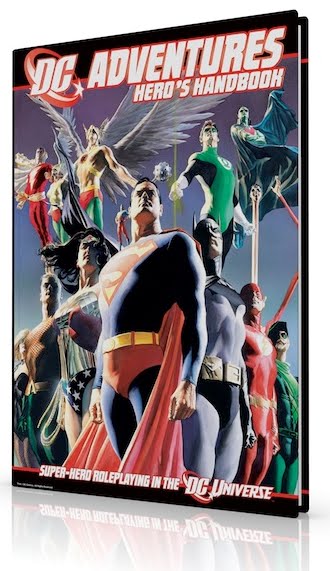
Green Ronin, Mutants and Masterminds, and DC Adventures

I have to admit that I was a little less than excited when I first heard that Green Ronin was releasing a DC Superheroes role playing game using their Mutants and Masterminds rules set. Mayfair's DC Heroes role playing game is my all-time favorite superhero system, and I loved the first edition of Mutants and Masterminds because it reflected so many design influences from that great game. The first edition of M&M was quick and streamlined and used "acting values, opposing values, and effects" to calculate power costs in a way very reminiscent of Greg Gorden's remarkable DC Heroes system. At the time, I was a fairly regular visitor to the Green Ronin boards and eagerly read discussions about a revised 2nd edition.

I quickly soured on those 2nd edition conversations as the system seemed to be migrating away from a DC Heroes influenced system into a Hero/Champions influenced system. Champions is a great game, but it can also intimidate new gamers and has certain exploits that hard core Hero gamers like to use. These kinds of exploits were being inserted into M&M and I wasn't as pleased as I had hoped. The game transformed from rules light to Champions light, and that was a step backwards in my opinion.

I still purchased all of the products. For all that I didn't like the mechanics of the game, the campaign advice and writing of Green Ronin products is among the best in the industry and I gladly support them. I merely had an "anti-granular" rules nag in the back of my mind every time I opened a text.

So when I read that Green Ronin was doing DC ala M&M, I have to admit that my fear was that it would be DC "Champions Light" and lack a fast and easy system that might appeal to new players -- one of the key reasons to acquire a license in the first place. This was particularly upsetting given Green Ronin's recently demonstrated commitment neophyte friendly games like their amazing Dragon Age and it's AGE System. In fact, I would love to see a DC AGE game.

My fears were somewhat allayed yesterday when I read a press release that Green Ronin was releasing a 3rd edition of Mutants and Masterminds. The key quote for me was "We worked to simplify some elements of the system and fix known issues, while retaining the flexibility and fast-paced play fans have enjoyed." If only they can accomplish what DC Heroes did so well, and M&M 2nd failed to do as well as M&M 1st, and present a system where Batman and Superman are able to adventure together in a manner where both are effective.

Whether I am ecstatic or not about the mechanics one thing is certain, I will be buying DC Adventures on day 1.

Wednesday, May 12, 2010

Fighting Fantasy and Fiend Folio Artist Russ Nicholson Starts Blog!

As readers know, I am a big fan of the Fighting Fantasy gamebooks and Russ Nicholson's art is one of the key reasons for that fandom. His dark and gritty line-work carefully balances grim imagery with humor and is indicative of the art typical of the British illustrators of White Wolf magazines in the 80s. Nicholson, and John Blanche, added a rough edged quality to the sleek and cartoony illustrations of the American "Basic" D&D artists Jeff Dee and Bill Willingham.

If you love Dark Creepers, Revenants, and the Githyanki, then Russ Nicholson is your man.

Axis of Awesome vs. Greyson97

Which is more remarkable?

Is the Axis of Awesome right in positing all pop songs use the same four chords? 


Does knowledge of a "mere 4 chords" explain Greyson97? 

Geekerati Gaming Archives Volume 1 -- Matt Forbeck Interview

In July of 2007, Geekerati Radio -- a podcast a few friends of mine and I ran for over two years -- had our first gaming related episode.  It was our ninth episode overall and it featured an interview with Freelance Game Designer extraordinaire Matt Forbeck.  Over the course of his career Matt has worked with most of the major game and toy companies -- from rpg games to toy design -- and has been nominated for 24 Origins awards and has won 13.  His game designs have included miniatures rules for starship combat, dark future science fiction roleplaying games, bleak counterculture superhero rpgs, and the list goes on.

You can tell by the interview why Matt is called the nicest man in the gaming industry.


Last year in September the Geekerati show petered to a halt as we never got the listenership to justify the effort we were putting into the show.  When you are interviewing Brandon Sanderson -- new author of the Wheel of Time series -- and you only get 4 "live" listeners (though the archive did quite well) it can be a bit disheartening.  When you add a full time work schedule, MBA courses, attempts at a regular rpg gaming hobby, and twin toddlers to the mix it was becoming difficult to justify the time.

I loved the experience, and my co-hosts are great friends, and would like to do it again.  But to do so will require some massive scheduling efforts and possibly some new co-hosts.  Bill Cunningham, our mad pulp bastard, is hard at work promoting his own awesome pulp publishing company, Eric Lytle is keeping California safe from toxic chemicals, and Shawna Benson is striving toward fame and fortune.

Let me know if you think I should give it a go again, and in the meantime I'll be sharing the archives with you.

Watch the (fake) The Day After Ragnarök Movie Trailer, then Buy the Book


YouTube creator "BloodRunsClear" has created a movie trailer for an imagined film based on Kenneth Hite's remarkable Savage Worlds game setting The Day After Ragnarök (DAR) by Atomic Overmind Press.

Kenneth Hite has long been respected as one of the most talented writers in the gaming hobby, and has been a long time advocate of the independent game publisher movement. His "Suppressed Transmission" column for the online version of Pyramid Magazine was a must read while it existed was a rich source of inspiration for game masters everywhere. Hite has the capacity to connect seemingly unrelated events/objects in ways that were an almost "how to" education in designing alternative histories/presents. Reading his column, I always wondered what would happen if Kenneth Hite took the talents he demonstrated in "Suppressed Transmission" and applied them to an rpg setting. With The Day After Ragnarök Hite answered that question and it is a magnificent amalgam of Pulp goodness. Let's just say it's a setting that is a post-WW II Norse Apocalypse as seen through Robert E. Howard's eyes. It's a world where both Doc Savage and Conan would be welcome, and where characters of classic noir films stand in the shadows.

Tuesday, May 11, 2010

J. Eric Holmes on Miniatures

James over at Grognardia has been discussing references to miniatures use in Old School RPGs in a couple of recent posts -- one on Basic Roleplaying and one on Traveller -- and I thought it would be nice to offer a couple of thoughts on the topic by the author of the first D&D Basic Set.  He wrote the following comments in his invaluable book Fantasy role playing games (Hippocrene Books 1981):

When role-playing grew out of fantasy war gaming, many of the players were used to playing games with armies of toy soldiers. The first Gygax rules, Chainmail, were intended for just such games, and allowed for the fantasy element...

Dr. Holmes clearly articulates the rpgs have their origins in miniatures wargames, or at least their rules do.

The metal miniatures are not a necessary ingredient of the fantasy game, which runs perfectly well without them.

He also posits that they are not necessary for play of the modern -- in 1981 -- roleplaying game. This comment fits within the context of the book as an example of where Dr. Holmes is attempting to remove any intimidation a reader might have regarding RPGs if miniatures are required. Given that all the pictures of Dr. Holmes playing -- in the book -- include the extensive use of miniatures, I think this is the case.

The fantasy gamer is usually concerned with a few figures representing the player characters and their opponents, and for these encounters the 25mm scale is ideal. There are an almost unlimited supply of figure possibilities.

To use figures or not to use figures, that is the question for the fantasy role-player. Minifigs's Steve Carpenter says that if your eyes don't light up when you first see the tiny armies on the table top, you will never get the bug or understand someone who has.

These quotes exhibit that while Dr. Holmes has an appreciation for the use of miniatures in the game, he is ecumenical about who plays the game. Some people don't understand the appeal of miniatures in the game, that is perfectly understandable. But for those who are merely intimidated by the prospect, he has the following advice:

Another way to get started is to begin playing one of the role-playing games without figures. After the game has been going for a while and has gained a regular group of players (a few will always drop out or join up after the initial games), introduce the first use of figures. There should be figures of the regular characters in the game and one or two monsters. Other monsters can then be represented by small chesspieces, or unpainted figures, or even blobs of plasticene clay.

These sentences add to my earlier assertion that Dr. Holmes' comments that "miniatures are unnecessary" were partly to assuage any fear of financial bankruptcy that may be caused by joining the hobby. Here he adds an economical way to incorporate minis.

He finishes the chapter with this:

There are advantages to having figures on the table to represent the characters in a game...

The placing of figures facilitates [a] kind of dialogue with the referee and vastly increases the ease of visualization. Since many game melees are just that, a melee of characters and monsters running about and in and out, the poor referee finds it a lot easier to keep track of them all when they are represented by tiny metal sculptures. And, finally, the whole thing makes an exciting and pleasing spectacle!

Miniatures use isn't a new part of the hobby. Nor is there a greater financial focus on miniatures than in the past. TSR created their own miniatures company in the 80s under Gygax/Blumes, and lobbied to put others out of business to reduce their competition. They hired Duke Siefried to assist them in the financial endeavor. Miniatures and D&D as an industry have always gone hand in hand, even though D&D in home games hasn't been ubiquitous.

Monday, May 10, 2010

RIP: J. Eric Holmes (1930 - 2010)

I read the news that J. Eric Holmes passed away on March 20, 2010 due to complications from a stroke on James Maliszewski's Grognardia blog yesterday. For players of role playing games of a certain generation, this is very sad news indeed. His passing is all the sadder because there are so many who don't know how much he contributed to the role playing game hobby. Dave Arneson and Gary Gygax created and promoted new hobby through their Dungeons and Dragons role playing game, but it was J. Eric Holmes who made that game intelligible to the world at large. His efforts, and those of Tom Moldvay and Dave Cook, are major contributions to the growth of the hobby as a whole.


J. Eric Holmes wrote the first "Basic" edition for the Dungeons and Dragons game, he describes how he -- a Professor in the Department of Neurology at USC at the time (Fight On!) -- came to write the product in his informative book Fantasy Role Playing Games (Hippocrene Books 1981) as follows:

In 1974 I persuaded Gygax that the original D&D rules needed revision and that I was the person to rewrite them. He readily conceded that there was a need for a beginners' book and "if you want to try it, go ahead..." I edited a slim (48 pages) handbook for beginners in roleplaying, published by TSR in 1977...

Without that Basic set, the role playing game hobby may have aged out with the older generation who were the majority of the audience playing the game prior to the publication of Holmes' work. Gary Gygax wrote of the importance of the Holmes Basic set to the hobby as a whole in Dragon #22:

If millions take to the fantasy world of J.R.R. Tolkien, and nearly as many follow the heroic feats of Conan, the market potential of a game system which provides participants with a pastime which creates play resembling these adventuresome worlds and their inhabitants is bounded only by its accessibility. Access has two prominent aspects; availability is the first; that is, are potential players informed of the fact that the game exists, and are they able to physically obtain it; and difficulty is the second, for if once obtained the game is so abstruse as to be able to be played only by persons with intelligence far above the norm, or if the game demands a volume of preliminary work which is prohibitive for the normal individual, this will be recognized and the offering shunned even if it is available. D&D failed on both counts, and still it grew. Today we are putting D&D onto the track where it is envisioned it will have both maximum availability and minimum difficulty. This is best illustrated in the "Basic Set."

Well over two years ago we recognized that there was a need for an introductory form of the game. In 1977, the colorfully boxed "Basic Set" was published. It contained simplified, more clearly written rules, dungeon geomorphs, selections of monsters and treasures to place in these dungeons, and a set of polyhedra dice -- in short all that a group of beginning players need to start play with relative ease.

Without the "Basic Set," D&D would have grown due to the size of the interested market, but it would not have had explosive growth. Gygax is right that the original rules failed on both the above counts, he is also right that the "Basic Set" succeeded on both. This is evident is that the "Basic Set" increased sales exponentially as it provided a pathway to the other products -- a well lit and easy to follow pathway. In the article quoted above, Gygax states that between January 1974 to December 1975 (two years of sales) 4,000 sets of the original rules were sold. Comparably, at the time the article was written (February 1979) the "Basic Set" was selling 4,000 copies per month, "and the sales graph is upward."

Holmes articulated the underlying difficulty of the original rules as follows:

When Tactical Studies Rules published the first DUNGEONS & DRAGONS rule sets, the three little books in brown covers, they were intended to guide people who were already playing the game. As a guide to learning the game, they were incomprehensible. There was no description of the use of the combat table. Magic spells were listed, but there was no mention of what we all now know is a vital aspect of the rules: that as the magic user says his spell, the words and gestures for it fade from his memory and he cannot say it again.

Holmes understood that gaming companies needed to write products that could introduce people to the hobby. They needed to promote their products to broader demographics if they wanted to survive as a viable industry. Roleplaying games tend to get more and more complex the longer the rules set remains in play, and thus become more difficult for the neophyte player. One response to the "rules bloat" has been to reboot with new editions, but this can alienate your existing player base who enjoy the complexity the game has to offer. The other solution is to offer an introductory version of the game. The hard core current players will not, as a block, purchase the product, but it is a great way to introduce new players into the hobby.

Hasbro is attempting to apply this lesson with product offerings that are coming out later this year -- among them a new Dungeons & Dragons Introductory Set.


John Eric Holmes was a great advocate for the role playing game hobby, a gaming enthusiast, and the game designer responsible for making D&D rule accessible. He was also an active member of Edgar Rice Burroughs fandom. He is definitely someone I would have loved to meet.

From one Trojan gamer to another, all I can say is Fight On!

Friday, May 07, 2010

Oligatory Sharing of George Lucas Exploiting Gen-Xer's Love of Star Wars Post

The video featuring Darth Vader in a sound booth recording directions for the Tom Tom navigation device is very amusing and deserves to be shared for its entertainment value alone. That doesn't mean that I don't feel a pang of irritation with how George Lucas continues to mock, ridicule, or ruin what was an amazing experience for me as a child. Lucas has always exploited the market potential of Star Wars -- especially on the merchandising end -- but this seems a bit forced. Yes, it seems even more forced than Star Wars Slurpee cups or Burger King mugs.

It's odd being in an aging demographic that still finds the imagery of its childhood to be effective for commercial appeal. For all my irritation, I'm considering saving up to buy one of these. Can you imagine a Baby Boomer saving up to buy a Jonny Quest -- or Yogi Bear -- voiced GPS system? Heck, even a James T. Kirk one would probably appeal to Gen X more than Boomers. We're an odd bunch.


It should be mentioned that the Darth Vader video pales in comparison to Orson Welles discussing peas.

Thursday, May 06, 2010

My Favorite "Non-Wizards of the Coast/TSR" Fantasy Setting

Those who have known me for any length of time know that I am deeply passionate about my love of two Fantasy roleplaying game settings that were released by TSR in the before times many moons before Wizards on Coasts made roleplaying games about Wizards in Covenants. I am referring, naturally, to TSR's Mystara (the Known World to us Moldvay/Cook players) and Greyhawk settings. The settings come from opposite sides of the Fantasy genre spectrum. Mystara has hope and humor and whimsy. Greyhawk has shades of gray, hopelessness due to the ever encroaching reach of Evil, and shady politics.

You won't find slave trading nations engaging in espionage and sabotage in Mystara and you won't find the Elvish Liberation Front in Greyhawk. I find no contradiction in the fact that I love two settings so diametrically opposed in their respective tones. Mystara's Pratt/DeCamp style is wonderful fun to play around in, as is Greyhawk's Howardian/Moorcockian gloom. No fantasy setting has set my imagination alight in quite the same way as these two have. Eberron comes close, but it is in many ways a combination of those two worlds.

There are quite a few Fantasy settings written by companies other than Wizards of the Coast, and many of them are very good. Green Ronin's Freeport setting is very popular. The old school Tekumel holds cache with many. The City State of the Invincible Overlord appeals to still others. These are but a smattering of the offerings available, but none of these truly ignite my imagination. I will use ideas from them, to be sure, but none of them call to me at night demanding to be read and re-read.

That honor lies with Paul "Wiggy" Wade-Williams' Hellfrost campaign setting for the Savage Worlds roleplaying game. If Mystara is Pratt/DeCamp and Greyhawk is Howard/Moorcock, then Hellfrost is Poul Anderson/George R. R. Martin. Wiggy's setting takes all that is horrific about medieval stories and puts them into a setting where the players find themselves in a desperate -- and likely hopeless -- struggle against powers beyond their ken. Inspired by the Norse concept of Fimbulwinter, the Hellfrost campaign takes place in a world that is slowly freezing. Summers are getting shorter and shorter, and the winters are getting longer. The god of the sun has disappeared, and may be dead, and the gods of death and winter are growing in power. How does one survive in such a world? Desperately.

The setting is made all the more appealing by the sheer "prolificity" of its author. Wiggy is a writer of the Walter Gibson school. His writing is so prolific that I wonder when he has time to eat, or to play in the settings he has created. Yet, it is evident from his casual internet posts that he does in fact eat and play a great deal. Where most indie rpg companies are lucky to come out with three or four products a year, Wiggy has a new product available on his company's website every week. Since 2008, Triple Ace games has published over 90 products for their fans -- and they are of remarkable quality for the volume.

Do yourself a favor and check out Rassilon -- the world of Hellfrost. It can easily be converted to your favorite rpg system, though it works very well in Savage Worlds.

Wednesday, May 05, 2010

Gale Force 9 Official D&D Maps and Token Sets Look Nice

Gale Force 9 has some very nice looking products coming down the pipeline in support of the 4th Edition D&D game. Their Character Tokens, Dungeon Master Tokens, and Game Mats all look like great additions to a D&D player's collection.


Roleplaying Evangelism -- Hasbro Targets Young Audiences


Last, I commented about my belief that if the roleplaying hobby wants to remain vibrant and "alive," it will need to recruit younger gamers. The alternative is for our hobby to age with us and fade into the mists of antiquity. When I was growing up, TSR specifically targeted younger gamers with the Moldvay/Cook "Basic" line of D&D products, the Fantasy Forest and Dungeon! boardgames, action figures, and a Saturday morning cartoon.

During the 90s, TSR largely abandoned products designed to appeal to young audiences and shifted to a tone somewhere in the PG-13 range. While their misguided attempt to disassociate themselves from Culture Wars criticisms regarding the games occult content through the removal of the words "Devil" and "Demon" from their early AD&D 2nd edition products might lead one to believe that the company had become "kid centric" as a whole, this belief would be in error. The 90s saw TSR produce the Ravenloft line of horror fantasy products (PG-13 horror to be sure), the Birthright fantasy setting (a slightly darker and more political setting), and the Dark Sun apocalyptic planetary romance setting (Dark Sun as planetary romance deserves a whole post of its own). The only real effort to attract young gamers was Troy Denning's "Black Box" D&D Basic set, a set that happens to be my favorite introduction to the hobby ever written. Denning, who left TSR during the Gygax era to be one of the founders of Pacesetter, is an old hand at writing "new gamer" friendly products and his "Black Box" was a doozy (it too deserves its own post). Aside from this product though TSRs products were aimed squarely at mid-teens and higher. Mystara, Spelljammer, and Dragonlance were for the mid-teens, while Greyhawk, Forgotten Realms, Birthright, Planescape, and Dark Sun were for older audiences. Heck...Planescape has wonderful content that is borderline R rated fantasy. This list doesn't include their X-Files inspired Dark*Matter setting for the Alternity game, that was R for sure.

To some gamers, the fact that TSR wrote so much PG-13 material might make the company seem too "kid oriented." I'm not one of them. When I say that gaming companies need to recruit younger players for the health of the hobby, I mean 8-10 year-olds. This audience was abandoned by TSR in the 90s, to the detriment of the hobby. Pre-90s TSR, for all that grognards think of it as a more "hard core" era of the company had corporate policies directed specifically at attracting younger audiences. To quote a Kevin Blume interview in THE SPACE GAMER #63, "The demographics are moving younger...Our major grouping seems to be from eight to 22...We, ourselves, have adopted a code of ethics and conduct similar to what is used in the comic book industry...People can holler censorship if they want, but that type of material will not be allowed at Gen Con, and the yptes of products that promote sex, nudity, and violence and so forth [sic] are simply not appropriate for this audience...our marketplace is composed of an awful lot of younger people."

Compare Blume's description of the hobby in 1983 with today's gaming audience. It matches the Games Workshop audience, who due to specific outreach (without overt censorship BTW) have managed to increase the number of young players, but it doesn't match other aspects of the roleplaying game hobby.

This is why I was so happy last week when I saw that Wizards of the Coast, in coordination with Moonstone Publishing, had released a free introductory adventure specifically targeted at younger players. This adventure, The Heroes of Hesiod, is based on the Young Reader novel Monster Slayers by Lucas Ritter -- the novel itself is an extension of Mirrorstone's excellent and successful "Practical Guide to" series of books which includes the best selling A Practical Guide to Monsters.

Wizards aggressive recruitment of younger gamers has also prompted them to publish a D&D version of arguably the best "mass market" miniatures game ever published -- Heroscape.Heroscape Master Set 3 Game

If our hobby is to continue to grow, or sustain itself as a mature marketplace, products like these and Faery's Tale Deluxe by Patrick Sweeney, Sandy Antunes, Christina Stiles, and Robin D. Laws need to be produced. As gamers, we need to encourage and support these efforts as much as we fight against them censoring down the product lines for adults. There is nothing wrong with hobby gaming becoming such a mature market that there are separate product lines for kids, teens, and adults. All that matters is that all of the product lines are of good quality and that companies and fans support them when they are. It was tragic that Wizards didn't support the Knights of the Silver Dragon series in the same way that they are supporting the "Practical Guides" line -- an article in Dragon Magazine is not as aggressive a marketing effort as coordination with libraries and well produced online content.

The funny thing is that the "Practical Guide to Monsters" that was successful enough to prompt this expansion, was itself an extension of the Knights of the Silver Dragon series of books.

Show your support and download The Heroes of Hesiod and play it with your kids/younger friends.

Wednesday, April 28, 2010

Roleplaying Evangelism -- The Kids Are Alright

I recently wrote a post responding to the "Dead Game" statement in Things We Think About Games. The post, and the original comment by Will or Jeff at Gameplaywright, discusses what it really means for a game to be dead and what it takes to keep a game alive. The short answer is that a game is alive as long as people are playing the game.

The longer answer is that games are truly alive as long as anyone is actively promoting participation in the play of the game. A game that is only played by one group during one play session a year isn't dead for that group, but it is dead for all intents and purposes. A game that is played by very few people, and has no support products (like A Penny for My Thoughts), but has Fred Hicks pounding the pavement in support of the game online, at conventions, and at friendly local game stores, is very much alive. Goblinoid Games purchase and promotion of Starships and Spacemen are keeping that game alive, even if it never sees the promised revised edition.

The whole "Old School Renaissance" movement is about keeping games alive and promoting older games/older styles of play to keep them alive. Some of what the OSR movement does is that it re-introduces gaming to players of a particular generation and gets those people to start gaming again. Some of what they do is bring new gamers into the hobby who are looking for less expensive, and more DIY, entries into the hobby. A lot of the advocates of OSR have particular ideas of what gaming means. These ideas reflect their tastes in the style of content as much as the style of narrative.

For someone like Ron Edwards, the creator of the excellent Sorcerer independent role playing game, the playing of role playing games is a kind of counter culture activity. For him the counter culture that saturated popular culture is a quintessential part of the D&D experience. In his essay "Naked Went the Gamer" in Fight On! #6, Edwards states that the SF/F culture that appealed to him "ran more underground, more enthused about bloodshed and pulp driven plots, and the associated science fiction was rebellious and rude as in Dangerous Visions." In particular, he was attracted to two aspects of the gaming hobby and the subculture it represented to him. These were the monstrous and the naked. I won't go into any real details here, you should read the essay yourself, but a brief synopsis of his point is the following. In the 70s, popular culture itself was a kind of counter culture that celebrated the monstrous and the naked. That the overall culture of the 70s and early 80s was such that nudity in role playing games, or in society in general, wasn't shocking. For him the gaming company's "flinched" when responding to the heightened cultural conservatism of the mid to late 80s. To quote:

D&D went Disney while GURPS shed Metagaming's zesty illustrations. Rolemaster, Rifts, and the Hero System were born eunuchoid and stayed that way. T&T and Tekumel remained marginal, and the latter's Book of Ebon Bindings vanished. Even the Arduin Trilogy, of all things, cleaned up its art. RuneQuest content floundered and was eventually scrubbed to nothing by Avalon Hill. Role-playing publishing became monster-ly and naked-ly cleansed, in as stunning a victory for the coalition of censors as anyone could have imagined.

Before I go on to criticize Edwards view of this as the ideal state of gaming, I would like to say the following. He is right in asserting that the gaming hobby, as a whole, shouldn't run away from doing "adult" themed products. No individual company should feel compelled to Disney-fy their content. I am with him when he argues that we should defend the works, like the dreaded D&D Supplement III: Eldritch Wizardry from those who want to argue that its cover is exploitative and that the product encourages devil worship. Roleplaying products should not be written with the intent to "not offend." They should be written to appeal to an audience.

And here is where I differ from Ron in my gaming experience. I don't view the Jeff Dee and Bill Willingham illustrated D&D Basic Set as a watering down of other material. I see it as material directed at an entirely different audience. In this case, that audience was 11 year old me. The 70s weren't merely counter culture, porn chic, Disco, Punk, and Caligula. They were also a time of uncensored Richard Scarry, of Atari, and of Star Wars. The 80s weren't just an era of cultural conservatism and Moral Majority backlash. They were a time of the Atari 2600, Transformers, GI Joe, and -- yes -- the D&D Cartoon. They were a great time to be a child, not the least reason because TSR and other gaming companies began looking to children as a way to expand their business. I was one of those children and the games they presented to me, especially the Moldvay/Cook line of D&D products were like manna from heaven to my imagination. For the child who adores Roald Dahl's Charlie and the Chocolate Factory and Ian Fleming's Chitty Chitty Bang Bang, as well as Edith Hamilton's Mythology, the "Basic/Expert" D&D products were ideal introductions to a hobby -- regardless of Ron's belief that these were "flinches." Not all young people like Karl Edward Wagner or Heavy Metal, some prefer Manly Wade Williams and Edgar Rice Burroughs.

These people need products too.

Edwards makes the logical mistake of associating all appeals to children in rpg content with flinching from facing criticism from cultural conservatives. Certainly, changing Devils and Demons to Baatezu and Tanar'ri in the 2nd Edition of the AD&D game was such a flinch -- and it has been properly ridiculed -- but Pacesetter's Universal Pictures Monsters inspired Chill is not, nor is Hero Games superhero game Champions. He also makes the Pauline Kael error of believing that all gamers share his opinion of whether the role playing hobby, and the old school, are quintessentially counter culture. That is hogwash. The role playing hobby is both culture and counter culture, it has room for all.

This is why it is so important that we older gamers, who play the old school games, support efforts to attract new -- and younger -- gamers into the hobby. Without them, the games will age with us and eventually die. No one will play them or know what they are. TSR began appealing to younger players almost immediately with games like Fantasy Forest and Dungeon!, the cartoon was a natural extension of these efforts -- as were the action figures.

Who is doing more to keep the hobby alive...Ron Edwards with his inspirational, but niche, independent rpgs, or Jeff Kinney author of Diary of a Wimpy Kid who includes a chapter where the title character starts playing a roleplaying game? WJWalton has a post over at "The Escapist" blog that provides a part of the answer. Gaming needs more people like Ron Edwards, but we need also need more people like Jeff Kinney.

I like Ron's work. I often find his ideas inspirational, but the story of a young kid wanting to play D&D with his dad warms my heart and gives me hope for the future. I would also like to add that the good folks at The Escapist have had role playing game defense literature on their website for quite some time.


It's a bad thing when gaming product self-censor, but it is a good thing when gaming products are written for young audiences. The Pokemon Jr! Adventure Game is one of the best introductory rpgs ever written, and one would have to work hard to make it counter culture.

Oscar Mistakes #4325

Cliff Robertson getting Best Actor for his performance in Charly over Peter O'Toole's performance in The Lion in Winter.

Really?! Really?!

Tuesday, April 27, 2010

Goblinoid Games Purchases Rights to Starships and Spacemen

In 1978 Fantasy Games Unlimited released Starships and Spacemen one of the first Science Fiction roleplaying games to hit the market -- the first three were Ken St. Andre's Starfaring (1976), Metamorphosis Alpha (1976) and Space Patrol (1977) which eventually became a licensed Star Trek game.

These early science fiction games varied in quality and theme. The science fiction of Ken St. Andre's Starfaring is reminiscent of the John Carpenter film Dark Star and had rules that focused on playing the ship as a whole rather than on individual members of a crew seeking adventure as a team. The game had a humorous bent and like much humor of the 1970s might offend some readers due to the sexual nature of some of the jokes/illustrations. Space Patrol's system was inspired by Star Trek (though it did have rules for playing Laumer-esque Bolo tanks as well), so much so that Heritage Models was able to use the same system in their licensed Star Trek game. Heritage's Space Patrol based Star Trek was one of the earliest licensed role playing game properties.

Like Space Patrol, Fantasy Games Unlimited's Starships and Spacemen was inspired by the Star Trek television series. Fantasy Games Unlimited also produced a board game in the Starships and Spacemen universe entitled Star Explorer which expanded on the themes set forth in the Starships and Spacemen game.


This week Goblinoid Games announced that they had acquired the rights to publish an edition of Starships and Spacemen and they have made the original rules available in pdf format. In the long run, they plan to adapt the system to be compatible with their Mutant Future and Labyrinth Lord d20 Open Game License/Old Game Renaissance systems. This should be a fairly easy process. Like many early role playing games, Starships and Spacemen shares some mechanical qualities with the Dungeons & Dragons role playing game. For example, six of an S&S character's 8 primary attributes are determined by rolling three six-sided dice -- just as in D&D. S&S differs from D&D in its use of attributes in that it distinguishes between inborn attributes which remain the same for that character throughout play and acquired attributes which can improve over time. The game also contains "Branches" and "Subclasses" similar to the class system used in D&D. The acquired attributes mentioned earlier, expand the basic class/level system and incorporates an early skill/point system into the mix.

Sadly for Starships and Spacemen, and a number of other promising SF role playing games, Game Design Workshop had released the first Traveller rulebooks in 1977. The Traveller rules were more closely related to SF literature, having a heavy Foundatiom influence, and this combined with an ambitious support schedule led to Traveller dominating the SF rpg market for years to come. Fantasy Games Unlimited eventually dropped support for S&S and moved on to their Space Opera project which had a broader scope with regard to the kinds of SF it emulated -- everything from hard SF to Pulp.

It's nice to see games like Starships and Spacemen return from the dead due to the long tail effect and the low cost of distribution through the internet. I look forward to seeing what Goblinoid Games have to offer in the coming months. In the meantime, I will have to dig up my S&S rulebook from storage and write a review soon.

Friday, April 23, 2010

Responding to Things We Think About Games: "Pants Issues"


I remember, fairly clearly, my earliest experiences with roleplaying games. I was introduced to the Dungeons and Dragons game by my dear friend Sean McPhail. His older brothers had been chatting about this new kind of fantasy game and Sean was pretty excited about it. It didn't take long for me to become as excited about the prospect of putting myself in the place of the great heroes of the fantasy genre. What if I was able to make decisions for Conan or Elric as they encountered dangers on some perilous quest?

My parents, noting my interest, made an 11 year-old me very happy at Christmas time when Santa brought me a Moldvay/Cook Basic Set, a Fiend Folio, a Deities and Demigods, and a Player's Handbook -- as well as several LJN D&D themed toys. The fact that this particular combination of books didn't contain all the rules necessary to run a campaign of my own didn't matter, they contained enough information to light my imagination afire. I made scores of characters and put them through the wringer that is Keep on the Borderlands. To be fair, I played Keep as if it were a strategy wargame and the characters I made were squad members, but I had a great time.

Then came the day when Sean and I were invited to play in a session of D&D at Sean's house with some of the older "kids." It was an absolutely eye-opening experience, both positively and negatively. My imagination ran wild with the possibilities and my youthful mind painted the scenes as clearly as if I were watching them on a movie screen. It wasn't that he Game Master provided ample descriptions of the locations, he hadn't, it was that my mind was able to fill in the blanks. Sean and my inclusion in the adventure came unexpectedly, so I didn't have any of my own characters and had to borrow one of Sean's. He gave me the choice of Aragorn or Gandalf, I chose Gandalf. How could I not? I was to play the great wizard Gandalf, who I had read about with such admiration. The fact that Gandalf was a first level Magic User with only one spell didn't affect me at all.


What did affect me was how poorly the Game Master ran the session. You see, he did the opposite of so many good Game Mastering techniques that the session Sean and I participated in was an almost ideal lesson of what not to do.

First, the game master informed us that he "didn't need the rulebooks" as he had them memorized and that as DM he was "God" and we would have to accept any decision he made regardless of how it represented our understanding of the rules.

Second, the game master didn't need to have any materials to help him run the adventure. He had memorized that as well, or rather he felt that he was perfectly capable of "winging it." He wasn't. Most people aren't unless it is in a collaborative rpg effort like Octane! or The Committee for the Exploration of Mysteries. These games work very well when the players wing it because the world construction is shared and the mechanics work to minimize arbitrary decision making. Or, as is the case with Octane!, the rules specifically discuss the disadvantages of arbitrary decision making. "Winged" adventures are more susceptible to capricious/vindictive GM behavior, or the feeling by players of the GM being vindictive.

Third, he viewed the game as a competition between the dungeon master and players. For him, the dungeon master "wins" D&D by killing off the players. Combined with the two techniques above, this creates the potential for what is possibly the worst gaming experience imaginable. In this case, much to my inexperienced dismay, it led to a violation of Things We Think About Games maxim #023:

In a tabletop roleplaying game, the characters are all wearing pants.

This is true even though none of the players informed the gamemaster that their characters were putting their pants on.
Issues such as these -- things that any person would do without comment -- are collectively "pants issues," and players in any sane game may always assert that they have done such things if it ever becomes important.

So what was Gandalf's "pants down" moment? I'm glad you asked.

After some time adventuring a dark and forbidding dungeon, and dispatching some horde of nasties or another, Gandalf, Aragorn, and their friends discovered a chest filled with treasure. Each character fixated on the item most interesting to him/her. For me, I mean Gandalf, that item was a magical scroll containing some arcane mystery. I shouted out immediately, "I read the scroll to see what it is." Thus was my fatal error.

Never mind that Gandalf had used his one spell, yes he only knew one spell as a first level magic user as this was the days before bonus spells for a character's high intelligence, Magic Missile during the earlier combat. In those days, casting Read Magic was a necessary part of deciphering a spell or spellbook. Gandalf hadn't memorized the spell and shouldn't have been able to read the spell. Gandalf, being more cautious of the dangers of untested magic than an 11 year-old, would also not have jumped out of his chair and yelled "I read the scroll!" You see, Gandalf had a high Wisdom score (14 or higher, though I don't know the exact number) -- much higher than 11 year-old me.

Gandalf would have known to take precautions. Never mind the fact that he would also know that he couldn't make anything of the scroll until he rested a day, memorized Read Magic, and only then would he be able to begin the process of unraveling the scroll's mysteries. He would have done those things, but 11 year-old me didn't and was merely excited by the mysteries of magic.

Then I heard the phrase most 1st and 2nd edition players are loath to hear, "make a saving throw versus petrification/polymorph!"

Uh oh!

Sitting at the far side of the living room, in a shadowy corner far from the prying eyes of the sinister and vindictive dungeon master, I could have pretended to roll dice and replied "I succeed!" Instead, I rolled the die and looked down with horrified eyes as the die roll was far beneath the value necessary to make the saving throw.

"I fail," I murmured meekly to the visiting DM.

"Your character has been turned into an Axe Beak," laughed my nemesis.


"An Axe Beak?!"

"An Axe Beak! Ha, ha! Someone get some rope to make a leash so you don't lose Gandalf."

And so I was punished and mocked for my excitement and wonder. I was too inexperienced a gamer, and too caught up in wanting to "play a story," to think that there were game masters who viewed the game play as a competition and who took pleasure from making players look foolish. I didn't know better than to read the scroll.

But Gandalf would have. He wouldn't, even at first level, have been caught with his "pants down." The DM used a pants issue to hose me and I have resented it ever since.

I wonder how many potential players we have lost through the decades because the person running the game used pants issues to hose the players for their own pleasure.

Tuesday, April 20, 2010

You Can Never Leave "The World of Martial Arts"

John Woo returns to his Last Hurrah for Chivalry roots with Reign of Assassins.


God I love wuxia films and the narrative tropes of jiang hu.

Responding to Things We Think About Games:When is a Game Actually Considered "Dead"?

In yesterday's blog post, I mentioned a couple of older games that had game mechanics that simulated or encouraged mundane activities in games devoted to heroic activities. These activities ranged from the item creation and crafting rules in Dungeons and Dragons Third Edition and DC Heroes post-character creation Gadgeteering rules to the Karma rules of Marvel Super Heroes and the kingdom governing rules of D&D's Birthright Setting. Looking back at that list, I realize that quite a few of those games are what can be considered "dead" properties. This got me to thinking about an entry in Will Hindmarch & Jeff Tidball's book Things We Think About Games:

STATEMENT 88
A game that is no longer supported is called "dead."


But that's business jargon. Don't let the state of a game line's release schedule determine whether or not you play it. Play it because it is fun.

Gamers who are active in the "Old School Renaissance" community are definitely followers of this maxim. Since the creation of the Open Gaming License, which put the mechanics of the 3rd edition of D&D into the Open community, the "Old School Renaissance" has been actively promoting the play of older role playing games. Some of the games that have benefited from this community's efforts include Dungeons and Dragons (Original, Advanced, and Basic editions -- I'm still waiting for the OSR 2nd Edition and the storm of controversy that will cause in the community), Gamma World, TSR's Conan RPG, and Marvel Super Heroes. Every one of these games has had an OSR reboot designed to introduce new players, or rekindle the imaginations of old school players, to the joys of those early systems.

These homage editions vary between efforts that retro-fit the rules set made open by the OGL and efforts that are designed under the assumption that the specific wording of rules can be copyrighted but not the underlying mechanics. Regardless of how technically correct those who design games under the second assumption may or may not be, they have all made a concerted effort to avoid use of undeniable product identity. Zefrs and 4C fall into this category and demonstrate how one can make an engaging rpg while stripping out the underlying trademarked source material.

I carefully couched my words in the above paragraph for a couple of reasons. The first is that I don't actually agree with the premise that the underlying mechanics aren't copyrighted with the other parts of the intellectual property. I would argue that those mechanics constitute the actual intellectual property and not the particular phrasing of those mechanics. Second, I think that these creators are doing us a great service. These products have been completely abandoned by their creators, with regard to the underlying mechanics, and a copyright system that doesn't take into consideration the concept of "abandonware" is in need of revision. Third, the Old School Renaissance community I was very active in during the late-nineties and early aughts took a very different approach to the issue -- and even that approach has some interesting complications.

I was a very active member of the DC Heroes online community, a community so active in the support of its game system that some of its members licensed the right to produce another game based on that system in order to keep it alive. That game, Blood of Heroes wasn't the most professional looking product with regard to illustrations, but it contained a meticulously playtested version of the underlying mechanics of the game. What is interesting is that even though Pulsar Games, a company made up of fans of the DC Heroes' MEGs system, licensed the use of the rules, they still may not have been perfectly within the law.


According to Ray Winninger
, the author of the 2nd edition of the game and of a derivative work called Undergroung:

As for DC HEROES itself:

1) Our contract with DC specified that DC Comics holds the copyright on every product we released. If you check the indices, you'll note they all say "Copyright (C) DC Comics Inc." The contracts didn't specify anything like "Mayfair owns the copyright to the actual game rules, while DC retains the rights to its IP" or anything similar, just "all DCH products are copyright DC Comics-period." This would suggest that DC actually owns DC HEROES. I know for certain that DC *believes* they own all rights to the game and everything produced for it and I suspect they're probably right.

2) Greg Gorden believes that his contract specified that he retained ownership of the DCH game system once DCH was out of print. When I was at Mayfair I looked for this agreement and couldn't find it-but that doesn't mean it doesn't exist. One potential problem is that it's unclear that Mayfair could have made such an arrangement with Greg in the first place. Remember, the DC licensing agreement specified that DC would retain full and perpetual copyright over everything we released.

3) Pulsar licensed DCH from Mayfair but it's not 100% clear that Mayfair ever had the necessary rights to grant such a license in the first place (#1 and #2 above). I believe that Pulsar later made a separate arrangement with Greg.

4) UNDERGROUND uses a variant of the DCH system-none of its specific text, tables or charts. The copyright to UNDERGROUND is not tied to the rights to DCH in any way. Mayfair no longer owns the rights to UNDERGROUND.

What is technically legal with regard to underlying rules hasn't been truly tested in a court of law, even though the Copyright Office has articulated that it is only the "form" of the rules that is currently protected -- tbone has some discussion why this should disturb the freelance game designer here. Personally, I favor greater protections for the game rules than the law currently holds, but I also am a huge advocate of greater creator rights and a diminishing of the dreaded "work for hire" that pervades the industry. There is no reason that Wolfgang Baur shouldn't have some ownership, in the form of residuals at minimum, if Hasbro decides to make derivative product from Dark*Matter except that the system of work for hire is broken.

On the positive side, the Wild West nature of the protections given to underlying mechanics do mean that we don't have to wait for a company to officially declare that something is abandonware before we start producing products using a reworking of the underlying mechanics for a neglected fan base -- and that's what we are really talking about here.

In a world where roleplaying game products can be stored on servers, at close to zero cost, for fans to purchase at any future time there is no excuse for a company letting a game "die." A company's bottom line with regard to a product doesn't determine the life span of play. It does determine the "product life span," but not the play life span. It is fans, and creators working after a product has "died," who determine whether a game is truly dead. And the internet has ensured that so many games aren't actually dead.

I still receive daily digests from the DC Heroes Yahoo Group. Every day someone is reworking the rules and converting characters. Savage Worlds would likely never have gained the audience it has today were it not for digital distribution and devoted fans writing for digital fanzines. The OSR is reviving games that I actually thought were genuinely dead. I was surprised to learn that people still play White Box D&D. I think it is awesome, but I was surprised.

In a post-internet world, when is a game truly dead? Does it require distributed support, even fan support to be counted as alive or does it merely need players?

What are your thoughts?

Monday, April 19, 2010

What If 16-bit Fantasy Games Were Designed by Bitter Divorcees?

The good folks over at SF Signal posted this amusing video featuring a more cynical view of what the solution to a side scrolling 16-bit fantasy adventure might be. In the video our intrepid hero rescues the princess, but then gets more than he bargained for as the material demands of the princess continually increase. One can imagine that this is a video game level that Oscar or Felix (of the play/movie/tv series The Odd Couple might design). Though the humor is cynical and staid, the video has its charms because one can actually imagine a game designer going to great lengths to create "meaningful" relationship tasks and goals within a video game experience. Such games may already exist.

I would be lying if I didn't say that the sequence where the video's protagonist goes to work for "the man" doing a task of physical labor, in order to pay for a wedding ring for his princess, didn't remind me of Peter Molyneaux's efforts at verisimilitude in Fable II. Molyneaux's game features complex systems for relationships (including financial support/gifts), real estate, and manual labor. In fact, I often joke that the amount of time I spent playing the "Blacksmithing" mini-game in order to earn money to purchase businesses/houses essentially transformed the game into a game of Blacksmith Hero. It was great fun to watch my labor equate to property ownership, which itself equated to revenue, though it wasn't fun of the combat/conflict variety. These tasks made my Fable II experience feel somehow more real. After all, even heroes have day jobs.


Even pen and paper roleplaying games sometimes offer their equivalents of the Blacksmith Hero experience. D&D 3.5's magic item construction system was a much needed rules set for the game, but the crafting rules could be utilized in a number of ways. One could merely have the players roll the skill checks and do the math, but one could also role play out the forging/crafting experience between the rolls. The 2nd Edition AD&D setting Birthright, one of my favorite settings, had sub-games devoted to govern the kingdoms and large scale battles. These sub-games were the setting's greatest strength and its greatest flaw. Superhero 2044 is essentially a pen and paper simulation of the "patrol" patterns of the superheroes being played by the characters. DC Heroes has gadget construction rules that can be roleplayed, and included recommendations for incorporating character's mundane -- but still meaningful -- sub-plots into the campaign. Marvel Superheroes rewarded characters for keeping up with their mundane lives while combating cosmic calamities.

What are your thoughts on the subject? Do mundane mini-games add realism to a fantasy video game? Do they detract from the experience?

Friday, April 16, 2010

Seth Rogen Green Hornet "Unexpectedly" Campy


Our good friend Bill Cunningham, he who (along with Harlan "freakin'" Ellison) has written a story for the upcoming Moonstone Green Hornet Chronicles and knows his Green Hornet inside and out, has the skinny on the upcoming Green Hornet movie.

It appears that the movie will be...

Prepare to look shocked.

You can do better than that.

CAMPY!

That's right. They promised the film would be serious and "dark" and "edgy." Apparently, what they meant by that is bright and silly.

We should have known when Steven Chow dropped out of the project and was replaced by someone with no Kung Fu that this was coming.

Oh Wait! We did.

Lone Wolf: Multiplayer Game Book: Does it Deliver?

In 1982, Steve Jackson and Ian Livingstone created a worldwide reading/roleplaying sensation with their Warlock of Firetop Mountain Fighting Fantasy Gamebook. Warlock combined the interactive qualities of the Choose-Your-Own adventure series of books with simple mechanics inspired by role playing games like Dungeons & Dragons. The books were wildly successful with over 50 entries in the series published to date. The series is currently being published by Wizard books in England, we Americans have to have our new books in the series shipped from Canada or overseas, and also has had two of the books released as iPhone applications.

The Fighting Fantasy books are classics in the genre, but they were surpassed in gaming complexity in 1984 when Joe Dever's Lone Wolf gamebook series first title Flight from the Dark was released. The Fighting Fantasy series is primarily made up of episodic entries where the puzzles/adventures are contained in full in a single volume. The exception to this is Steve Jackson's Sorcery series of four books. In contrast to the episodic Fighting Fantasy series, Dever created an Epic Fantasy narrative in his Lone Wolf series. In Dever's series, your character improved from book to book and items you acquired in one book would help you solve puzzles in subsequent volumes. Dever added layers of gameplay and narrative that were lacking in the Fighting Fantasy counterparts, and his series demonstrated the gamebook as a mature medium.


In support of their Fighting Fantasy gamebooks, Jackson and Livingstone released an introductory roleplaying game -- a non-solo and more traditional game -- in 1984 entitled simply Fighting Fantasy: The Introductory Role-playing Game. This game presented the rules system from the Fighting Fantasy books in a simplified form for use in pen and paper gameplay. The rules component of the books was relatively weak, as the rules were stripped down versions of the already simple rules of the gamebooks, but the two adventures included in the book were fun.


This initial offering was followed by the Riddling Reaver collection of adventures, which made for a fun campaign using a rudimentary system. By 1989, Livingston and Jackson realized that the introductory game was serviceable, but not a substantive offering in the gaming marketplace and they hired Marc Gascoigne and Pete Tamlyn to develop an advanced version of the product.


Gascoigne and Tamly's Advanced Fighting Fantasy presented a robust game system rooted in the system presented in the gamebooks and filled a niche that fans of the books needed filled. Gascoigne's system added layers of complexity to the gamebooks rules, while still presenting an introductory roleplaying game. The system is simple enough for beginners, but has a depth that allows for a great deal of game play.

Fans of the Lone Wolf series, who had purchased and read the Advanced Fighting Fantasy rules, eagerly waited to see what Dever would come up with in response to Fighting Fantasy's offering. That offering didn't come. In fact, while the Fighting Fantasy books seemed as unkillable as a zombie horde -- continually being resurrected from certain death just as a new generation of readers could be introduced to the books -- Lone Wolf began to fade into the background. Eventually, all the published books became available (with author permission) as free e-books on the internet. Then, from seemingly nowhere, wonderful news appeared. Mongoose Publishing released a tabletop RPG based on the characters of the Lone Wolf series and began republishing (in beautiful small format hardbacks) the original Lone Wolf books.


The republished volumes of the original gamebooks are a marvel. They include new stories as additional content in the back of each book; stories that expand the Lone Wolf world. The republished books are undeniably a godsend, but the first Mongoose Lone Wolf RPG was a gaming product that had rules based in Wizards of the Coast's d20 rules system. These rules are serviceable (they are actually quite good), but they lack the distinct feel of the Lone Wolf setting. After playing gamebooks that use a particular rules set, it feels a little unnatural to use an unrelated rules set when translating your experience into a multiplayer exercise. The d20 based Lone Wolf rpg sold decently, but with the release of the 4th edition of Dungeons & Dragons -- and the end of the d20 license -- it was time for Mongoose to create a multiplayer game that returned Lone Wolf gaming to its systemic roots.

It has taken a couple of years for the new rules set to come out, but as of the the first week of April 2010 long time fans of Lone Wolf finally have a multiplayer roleplaying game based on the system used in the gamebooks, but how does it measure up to the standard set by the Fighting Fantasy series?


Even though the products are separated by almost 20 years, it seems appropriate to compare the new Lone Wolf Multiplayer Game to the earlier Fighting Fantasy offerings. The Fighting Fantasy Introductory Roleplaying Game was originally published in 1984 and in its 240 paperback format pages presented a multiplayer version of the rules system contained within the Fighting Fantasy Gamebooks. Other than the two adventures included in the book, and a couple of sparse paragraphs describing the job of gamemastering and designing your own adventures, the booklet contained little that was not already in the published gamebooks. In fact, some of the solo gamebooks had already introduced some "advanced rules" that the introductory roleplaying game failed to include. The two adventures included in the book were formatted in a manner similar to that used in the gamebooks, but included some tips on how to run the encounters. By modern standards these adventures were simple "dungeon crawls," adventures where characters explore complexes and fight monsters. There was little or no context for the action in these adventures contained in the rulebook. This changed when the Riddling Reaver booklet expanded the adventures available for use by gamemasters, though it should be noted that it was 8 years before players of multiplayer Fighting Fantasy had rules for "skills" or "magic" published outside of the solo gamebooks for multiplayer use.

The Lone Wolf Multiplayer Game Book is similar in many respects to the earlier Fighting Fantasy offering. Coming it at 70 digest sized pages, it contains character creation rules for only one character type, the Kai Lord. It presents the basic system used in the gamebooks, including the "random number table," with very few options not offered in the solo versions. Unlike the Fighting Fantasy books, Lone Wolf contains a task resolution system for accomplishing things other than combat. It is a simple resolution system, to be sure, but it is one that is highly serviceable. Essentially, tasks are given a target number from 1 to 10 and that sets the number that the player must roll equal or higher than on d10 (or select from the random number table) in order to succeed. There are guidelines for bonuses and penalties, but it is essentially a quick and dirty task resolution system with a flat probability curve.

Lone Wolf contains a short Bestiary that includes some of the unique denizens of Magnamund like Giaks and Gourgazs, and some of the more generic character types a game master might need like Bears and Bandits. It also contains a brief discussion of the history of Magnamund, the world of the Lone Wolf tales. One really wishes that Mongoose had beefed up the chapters on the setting. At $19.99 for a 70 page book, one feels a little neglected when there is so little setting description. To be fair, the gamebooks are rich fields filled with descriptions of the world and its history, but this rulebook lacks that richness and the map in the middle of the book is made less useful or attractive by the fact that it is published in black and white.

Like the Fighting Fantasy RPG, Lone Wolf provides an introductory adventure for new game masters to use with their friends. The adventure is an entertaining narrative adventure entitled "The Merchant's Task." This adventure contains gaming opportunities for different kinds of players as it has roleplaying scenes, puzzle solving, and combat sequences. As such, it follows the modern trend of story based adventures as opposed to the classic dungeon crawl, but then again that is one of the things that separates the Lone Wolf solo book series from the Fighting Fantasy book series. The Lone Wolf books are more story driven and the Fighting Fantasy ones more puzzle/solution driven.

I have to admit that I was slightly disappointed with the first offering in the Lone Wolf Multiplayer line of books. It seemed in many ways more an overview of what gaming would be like that a complete game in itself, and with a $19.99 price tag the disappointment was exaggerated. I have to say though that there are a couple of things arguing in favor of the game. First is the fact that it isn't a bad introductory game, if only the price were $7.99 I would consider it an ideal introductory offer. The rules are clear and simple and the text provides numerous guidelines for the game master during the adventure, guidelines that can be used to create ones own adventures. Second is the fact that this is the first in a series of offerings.


This June we should see the publication of a book of linked adventures entitled Terror of the Darklords. This is slated to be a 160 page booklet containing an entire campaign's worth of game play in which the players will uncover conspiracies and battle against the evil Darklords.


Darklords will be followed in July by Heroes of Magnamund, a book containing a variety of character classes that players can use during campaign play. One can look at this as the second part of the player's guide in some ways. According to the Lone Wolf Multiplayer Game Book the Heroes book will also contain rules for higher level Kai Lords and additional rules for game masters. Mongoose is also planning to publish a gazetteer of Magnamund and a bestiary as well. All of these products will add to the cost of the game, but will add much needed depth as well.

As it stands, the current rule book places the Lone Wolf Multiplayer Game Book somewhere between the Fighting Fantasy Introductory Roleplaying Game and the Advanced Fighting Fantasy Roleplaying Game with regards to the complexity of the rules it offers. A good offering, but not quite what one would pray for after almost 20 years of waiting. If the later releases maintain the level of quality, the game looks like it might surpass Advanced Fighting Fantasy, but only time will tell.

I can say that I will be eagerly purchasing the books as they come out to see what Mongoose has to offer.