Tuesday, December 15, 2009

Ridley Scott's ROBIN HOOD Some Thoughts and the Trailer

Robin Hood is one of the great characters of British legend. He is the quintessential homegrown medieval renegade, who fights against authority to help those without power receive justice. He returns money unjustly taken by the crown from freemen, and likely foodstuffs and materials taken from serfs, to the rightful possessors of the money/materials.

His actions have been portrayed a number of ways by a number of people.

  1. Robin Hood steals from the rich and gives to the poor is a phrase with which most are familiar. On the surface, it seems to describe what Robin Hood is doing. Yet none of the traditional tales of Robin actually have him doing this action -- except in maybe the Warner Brothers Daffy Duck cartoon where he isn't very effective at this task. He isn't really "stealing" in the sense that we normally think of stealing, and the rich he is stealing from is the Crown (Prince John in particular). I have yet to see a Robin Hood film where Robin breaks into the house of a freeman to take money in order to buy food for starving peasants. I think I might enjoy such a tale, and we've seen similar non-Hood versions of that tale. As much as we often use the "steal from the rich to give to the poor" statement to describe what Robin does morally, we rarely see adaptations that actually have that as the narrative.
  2. Robin Hood as thorn in the side of an unjust regent is the version of the tale we most often see in film. The typical Robin Hood story has Prince John as the unjust tyrant reigning over England while his heroic brother is fighting valiantly in the Crusades. It is up to Robin to make sure that John doesn't so abuse the freemen and serfs that England is destroyed during Richard's absence. These tales often include coming up with the ransom for Richard, who is being held captive by the French. These stories often have a heavy Ivanhoe influence and are kind to the Crown in principle, though harsh to the tyrant John. Sometimes these versions of the tale have Robin's activities as one of the things that pressured John to sign the Magna Carta.
  3. Still other, more recent, versions of the Robin Hood story emphasize the importance of the Crusades and have those influence Robin's activities. In these tales, Robin is a homegrown rebel returning unjustly taken tax money that would be used to pay for an unnecessary foreign war. One can see how this line of narrative keeps Robin a topical figure, while finding new ways to explore the historic time period Robin to which is typically assigned. These stories allow Robin to be a people's hero against the tyranny of the State. Both Richard and John are to blame in these tales, or at least both contribute to the suffering of the people of England.
  4. My favorite version of the Robin Hood story, a version exemplified in the excellent series Robin of Sherwood starring Michael Praed, deals with Saxon/Norman tensions in medieval Britain and the tension between Christianity and Pagan faiths.


I have no idea which version of the tale, some existing trope or an entirely new one, that Ridley Scott will use in hims upcoming ROBIN HOOD movie. I do know that Scott is a talented director who makes films that typically manage to be both entertaining and of artistic merit -- an all to rare combination. Scott has played fast and loose with history, and with other source material for that matter, but he tends to have a clear vision with whatever project he is working on. His inclusion of Russell Crowe as Robin is icing on the cake.

Monday, December 14, 2009

[Blogging Northwest Smith] "Nymph of Darkness"


"Nymph of Darkness" is the first of the Northwest Smith stories to be written in collaboration with another author. C L Moore's collaborator on this piece was none other than an 18 year-old science fiction fan named Forrest Ackerman. Forry, as his friends called him, died on 12/4/2008 at the age of 92. I had hoped to have this entry posted on the anniversary of his death, and to spend some time praising Forry's contributions to Sci-Fi. Not the least of these contributions is the creation of the term "Sci-Fi," a term unabashedly used by those fans who care more about entertainment than present day literary acknowledgement. Make no mistake, I enjoy literary Science Fiction. I just happen to enjoy my Sci-Fi as well, and make no bones about it.

I apologize for the delay, but it comes with a fairly good reason. I had remembered reading a version of "Nymph of Darkness" in Forrest Ackerman's Ackermanthology Millennium Edition compilation. I also remembered that Forry had pointed out that there were two version of the story. A "spicier" version of the story was printed in the April 1935 issue of the fan magazine Fantasy Magazine, while a much "expurgated" version of the story was published in the December 1939 issue of Weird Tales. I needed to hunt down my copy of Ackermanthology! in order to look at some of the notes Forry provided regarding the collaboration. I had also hoped to compare the Weird Tales version to the Fantasy Magazine version, but Paizo has thankfully provided us with the "real thing" and not the "expurgated" story. An examination of the Weird Tales version will have to wait.

"Nymph of Darkness" begins very similarly to "Black Thirst." In both tales, Northwest Smith is wandering the waterfront of the Venusian city of Ednes. The danger of the waterfront is emphasized in both stories, as is the darkness of the Venusian sky -- a fact that is even more important in this story than in "Black Thirst." In "Nymph of Darkness," Smith once again finds himself in the path of a woman who may be in need of his aide, but something is different this time. In the end, a couple of things end up being different, but the initial difference is a difference in Smith himself. In earlier Smith stories, Northwest has almost leapt to the aide of damsels in distress. In this story, he is far more cautious. Given Smith's caution, this is definitely a Smith story that takes place after the events of "Shambleau." Moore describes Smith as follows, "He wanted no sound to indicate his own presence to the terror from which the woman fled. Ten years before he might have dashed out to her -- but ten years along the spaceways teaches a man prudence. Gallantry can be foolhardy sometimes, particularly along the waterfront, where any score of things might be in close pursuit."

Before we continue, I'd like to state that of the Moore stories in the Smith series, this tale starts the most awkwardly. I don't credit this to the collaboration, so much as it seems that the opening paragraphs lack the strong hand of an editor. Where prior Smith tales set the tone effectively without repetitive paragraphs, this tale wanders a little before it gets going. In the first paragraph we are told twice that the Patrol is too afraid of the waterfront to police it effectively, an unnecessary redundancy. The second paragraph of the story begins with this clumsy sentence, "Through the breathless blackness, along a street beneath which the breathing waters whispered, Northwest Smith strolled slowly."

The use of alliteration here might be appreciated, "breathless blackness," "waters whispered," and "strolled slowly" if not for the repetition of the use of "breath." One likes "breathless blackness," but is pulled out of the narrative by "breathing waters" so close after the other construction. I like what Moore is attempting here, but I would have liked another editorial pass through these paragraphs. That said, the rest of the story moves a quite a clip and the awkwardness of the first two paragraphs hints more at Moore's mind groping for some construction that will get the story moving. Eventually she does, and later examples of alliteration pull the reader in effectively.

Ackerman supplied the original outline for the story, and invented the name of the nymph of the tale -- Nyusa. In Ackermanthology!, Forry assures us that Nyusa was the result of experimenting with sounds rather than being made up from the initials of the major metropolis N.Y., U.S.A. One thinks Forry might be protesting too much here and, given Moore's later honesty in her creation of names, one wishes he would admit the play on words if it is really there. Moore admits in the collaborative that Ednes comes from the middle of the word Wednesday.

Despite Smith's caution, he still ends up running into the girl and aiding her against her pursuer. This pursuer is a shambling humanoid creature named Dolf, who pursues Nyusa wielding some sort of greenish light. The purpose of this light is revealed shortly. Smith has run into the nymph, but neither he nor the girl have seen each other. They have been relying on sound and touch due to the deep darkness of the Venusian night. Nyusa eventually guides Smith into a building and she asks him to lift her to turn on a light. When he does, he notices that while he is holding the weight of a woman in his arms -- he cannot see the body. Nyusa is completely invisible, except when certain wavelengths of light interact with her own natural skin color. At these times she becomes a semi-translucent and mist-like figure. Moore's inspiration for the cause of invisibility, as she makes clear in her letters to Forry, is Ambrose Bierce's tale "That Damned Thing." Bierce's tale was the inspiration for a couple of H P Lovecraft stories as well ("The Colour Out of Space" and "Dunwich Horror"). The shambling Dolf's greenish light is constructed to reveal Nyusa's presence.

The source of Nyusa's invisibility is also the source of both sides of the narrative tension in the story. Nyusa is the daughter of some god of Darkness, echoes of "Dunwich Horror" here, and that god's worshipers use Nyusa by having her dance under the eerie green illumination as a part of their prayer rituals -- rituals devoted to her father. She is portrayed as an unwilling participant in the rituals of these creatures, known as the Nov, the reader (and Smith) likely assume that her resistance to participating in the rituals stems from some rejection of Darkness. We are, after all, used to our damsels in distress tales.

But Moore will have none of this. The Nov, who are white amorphous slug like creatures, may have a mystical hold on Nyusa forcing her to perform rituals praising her father, but her desire to leave has nothing to do with revulsion of things man is better for not knowing. No, her desire to be free stems from a desire to fully explore the Darkness within herself. She wants to be free and to have the power of her Darkness grow, not to have it restrained by the ceremonies of the wretched Nov -- who use her, but do not praise her properly.

Smith doesn't know this as he watches the dance ritual. He only sees the revolting visages of the Nov, and hears the approach of Dolf. Smith slays Dolf, and one of the high priests of the Nov. This frees Nyusa from the hold the Nov had upon her and Smith witnesses her partial apotheosis into a being of Darkness. For his "gallantry," Smith is rewarded with a kiss. The kiss is both cold and filled with love, a combination of human warmth and unimaginable Darkness.

Once more, Moore has played with the damsel in distress story and added her typical spin. Nyusa's sensuality is a thing of danger, where non-sexual love would have been something safe. Smith begins the tale wary of attempting to rescue a girl because he is afraid of what her pursuers might be capable of. He finishes the tale wary of that which he has helped to liberate. To be fair, Nyusa would likely have been free soon enough without Smith's aid, but Smith was there to witness her apotheosis and helped to hasten it.

One thinks that maybe Smith should have trusted his cautious instincts a little bit more than he did.

Who knows what long term ramifications this will have upon the fate of the universe?


Previous Blogging Northwest Smith Entries:

6)[Blogging Northwest Smith] "Nymph of Darkness"
5)[Blogging Northwest Smith] "Julhi"
4)[Blogging Northwest Smith] "Dust of the Gods"
3)Blogging Northwest Smith: "Scarlet Dream"
2) Blogging Northwest Smith: "Black Thirst"
1) Blogging Northwest Smith: "Shambleau"

Friday, December 11, 2009

Lovecraft for Christmas, Kenneth Hite, Seamus Cooper, and "From Beyond" on Hulu Recommendation Friday

All this month, Tor is hosting a "December Belongs to Cthulhu" event on their website. I mentioned earlier the historic connection horror and the winter season have with each other, as perfectly described by Manly Wade Wellman.

The Tor site has even begun a series of posts entitled "The Twelve Days of Lovecraft" as a part of the celebration. The "Twelve Days" posts feature a discussion of twelve of Seamus Cooper's favorite Lovecraft tales, with a discussion of why they are so effective and what their greatest problems are. Cooper wrote the entertaining Mall of Cthulhu, which I reviewed earlier this year, and is a natural selection for a series of articles about Lovecraft's fiction.

I think it would be interesting to compare the entries to the indispensable "Tour de Lovecraft" web entries provided by polymath extraordinaire, and author of the Trail of Cthulhu roleplaying game (the BEST Lovecraftian RPG ever written, though the author would quibble with that praise), Kenneth Hite. Hite's "Tour de Lovecraft" is the yardstick by which I measure all story discussion blog posts.


Let's just say that in presenting this story, Hite's entry is useful to the neophyte and the veteran where Cooper's entry is useful primarily to the neophyte -- though Cooper does sprinkle in some good humor. As I noted in my review of Cooper's Mall of Cthulhu, Cooper makes a point of discussing Lovecraft's racism and the obscurity of Lovecraft's prose. Two things that are interesting to point out to the neophyte, but which without new insights into root causes (as William Jones has done in his discussions of Lovecraft and Eugenics) it's really beating a dead horse. Hite references the racism as well, because it really is blatant and must be mentioned, but focuses his post on comparing Lovecraft's storytelling with Edmund Burke's aesthetics. Now that is a connection that I might not have made, and I've read Burke's Enquiry.


Both authors note that "Dunwich Horror" is a Gospel-esque tale, but only Hite notices that there are two Gospels being presented. There is the supernatural Gospel of the creature and the secular Gospel of Armitage. Hite also discusses the work as pastiche. Something fans of Lovecraft often overlook is the influence prior authors had on Lovecraft's own writing, and Hite is right to remind us here that Lovecraft's story is not purely Lovecraft. It should be noted that while Hite's article is the "deeper" of the two, in this case, it is also the more confusing one to the uninitiated. If you haven't read the story before diving into Hite's conversation, you could quickly become lost. This is not the case with Cooper.


The sharpest distinction between the Cooper and Hite posts is their reactions to Lovecraft's description of the town. Cooper is bored by the length and clumsiness of the description of the town and Hite draws maps of Innsmouth based on the description. One can imagine that for most readers a description long and accurate enough to base a map upon might be a trite dull. Cooper and Hite also disagree with regard to Lovecraft's use of the "native" in the story. For Cooper, it is further evidence of Lovecraft's obsession with racial purity -- and it is. For Hite, it is something more. He sees Lovecraft's use of primitive mythology as a subversive one, where he inverts which mythology (Western or "other") is more important. In this tale, the mythical worldview of the other is more accurate. Though the eugenics narrative is still overpowering.


But this isn't "analyze Cooper and Hite Friday," this is Hulu Recommendation Friday. Given the Lovecraftian bent of the post so far, I feel that I must give a Lovecraftian offering. Without further ado, I give you the awful (as in not very good) , From Beyond.

Thursday, December 10, 2009

Cinerati Christmas Season Movie Marathon

It is no wonder that the commercial aspects of Christmas seem to come earlier every year. No sooner than one has celebrated Thanksgiving with loving family and friends, than one realizes how swiftly one has "gotten behind" in one's annual Christmas Season Movie Marathon. At least that's how things were in the Cinerati household. The other night, we had just finished watching the new Phineas and Ferb: Christmas Special -- which was surprisingly heartfelt -- when we realized that we were significantly behind in our Annual Christmas Season viewing regimen.


Every year, the Cinerati household views a minimum of one Christmas themed film or TV special during each day of December. We consider it our filmic advent calendar. We typically follow this up with a Christmas Season Movie Marathon where we try to increase our viewing level to 2 movies a day from the 18th through the 1st of January. This lets us watch more holiday fare, and lets us include things like the Rudolph New Years special without breaking from the rules of what constitutes a Christmas movie -- at least for those films or shows that take place after Christmas. Our definition of what constitutes a Christmas film is pretty broad, but that's what makes it such a fun tradition. Here is a partial list of the films and shows we typically select from:
  • Die Hard
  • Die Hard 2
  • The Last Boy Scout
  • The Thin Man
  • The Sound of Music
  • -- The one film that breaks our about or take place rule because the movie "feels" so Christmassy and Jody has many fond memories.
  • Lethal Weapon
  • Holiday Inn
  • White Christmas
  • Elf
  • Rudolf the Red-Nosed Reindeer
  • 3 Godfathers
  • The Bishop's Wife
  • Scrooged
  • The Ref
  • The Nightmare Before Christmas
  • Miracle on 34th Street
  • It's a Wonderful Life
  • Holiday Affair
  • The Shop Around the Corner
  • In the Good Old Summertime
  • Dr. Seuss's How the Grinch Stole Christmas
  • Harry Potter and the Philosopher's Stone
  • -- Harry's Christmas present is important for the whole series and the opening song sounds über-Christmassy to us.
  • We're No Angels
  • Joyeux Noel
  • Gremlins
  • Love Actually
  • About a Boy
  • A Christmas Story
  • A Christmas Carol
  • Young Sherlock Holmes -- This movie includes Christmas, but it is also a "Victorian/Edwardian" film and any film that takes place in that era just feels Christmassy. I blame Dickens.

Monday, December 07, 2009

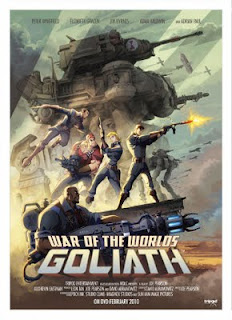
War of the Worlds: Goliath -- Coming in 2010


Next year will see the release of Tripod Entertainment's animated Steampunk film WAR OF THE WORLDS: GOLIATH. The film's premise is that 15 years after the Martian's failed attack on the earth in 1900 the aliens return to continue their attempted conquest of Earth. Much has changed in the intervening 15 years, as the industrious have reverse engineered a substantial amount of Martian technology. This sets the stage for a more evenly balanced conflict between the two worlds. The film's trailer hints at what the film will offer. The film will star geek favorites Adam Baldwin, Peter Wingfield, and Adrian Paul.


GOLIATH isn't the first WAR OF THE WORLDS sequel to make its way through the Hollywood entertainment assembly line. In 1988, there was a 2 season syndicated television series based on the premise that the Martians who invaded during the George Pal film merely went into hibernation and didn't die when they collapsed. The series aired in the US on Fox, and it too starred Adrian Paul (during the 2nd season).


The narrative premise of GOLIATH is a promising one and the show looks to have combined the best of the Steampunk genre with some elements of the classic animated television series STAR BLAZERS. Instead of a giant space faring WWII battleship, we have a giant sky spanning battle-zeppelin. I think the battle-zeppelin wins hands down.

Steampunk is a genre that has been gaining some momentum over the past few years. It combines "Vernian" futuristic technology with a Victorian/Edwardian time frame. I would posit that the first iteration of Steampunk was the Castle Falkenstein roleplaying game by Mike Pondsmith of R. Talsorian Games (publishers of the Cyberpunk rpg) and that the genre gained real traction with the novels The Difference Engine by Gibson and Sterling and The Prestige by Priest.

It has been noted in the comments that I am in error with regards to the origin of the term and genre of Steampunk. I will concede the term's origin, but I would take issue with some of those items retroactively classified into the genre. One could classify Spenser's The Faerie Queene as Epic Fantasy, but one would be misapplying a term for fantasy fiction in the post-Morris era. The same holds for Wild, Wild, West which shares as much with James Bond as it does with Steampunk (specifically). One might as well classify Ian Fleming's brilliant Chitty Chitty Bang Bang as Steampunk. Wikipedia and "internet citations" from Locus be damned!

Friday, December 04, 2009

Hulu Recommendation Friday: Gotcha!


In 1982, Steve Jackson Games released Killer: The Assassination Game, a game many consider to be the first "live action role playing" game (LARP). The game was the first serious attempt by a professional game company to provide a full scale set of rules for "Assassination Games" in order to facilitate more entertaining play. Games like "Assassination" or "Cops and Robbers" can become heated affairs without the establishment of firm and agreed upon norms for play and a consistent means for arbitration of disagreements. This is exactly the niche that Killer was able to fill. The game is still available as a pdf from Steve Jackson Games and even if you never intend to play a game, it is an entertaining read.

1982 also saw the release of the motion picture TAG: THE ASSASSINATION GAME. In this film, starring Linda Hamilton and Robert Carradine, an "Assassination" game goes bad. When reigning champion (Bruce Abbot) is killed under humiliating circumstances, he breaks and decides he needs to raise the stakes and play The Most Dangerous Game. The film is difficult to find on video, but it perfectly captured the 80s concerns regarding gaming and obsession. A large part of the 80s culture wars were the constant discussion about whether role playing games, or violent games like "Assassin," could corrupt the minds of the young and turn them into psychopathic killers. TAG: THE ASSASSINATION GAME is a film that plays on those fears.

In response to these kinds of concerns, more recent editions of the Steve Jackson Games version of Killer have included the following disclaimer.


While TAG: THE ASSASSINATION GAME is near impossible to find -- VHS copies average $90 on eBay -- for the time being, you can watch the film on Google Video.


GOTCHA! (1985) raised the stakes of "Assassination" games in a very different way than TAG. Where TAG represented the fears associated with the 80s Culture Wars, GOTCHA! is a comedy that plays off Cold War narrative tropes. The protagonist in GOTCHA! is as obsessed with "GOTCHA!" as the villain in TAG was with "TAG," but the skills he learned while playing the LARP end up serving him well when he gets caught up in the world of espionage. Anthony Edwards is wonderfully naive in the film, and Linda Fiorentino is enthralling as the seductress/spy. GOTCHA! lacks the sophistication of Stanley Donen's classic CHARADE, another film where an innocent gets caught up in the world of intrigue, but it is wonderful popcorn entertainment.


Thursday, December 03, 2009

Solomon Kane (2009) Has Yet to Secure US Distributor -- Come on Pulp Fans!


Earlier this year, I wrote about the upcoming SOLOMON KANE film. According to the film's production company (as of 11/24/2009) no company has purchased the rights to distribute the film in the United States.

It is time for us pulp fans to get the message out and build some buzz for this film. It may, or may not, live up to Howard fan expectations, but we must get the full big screen experience.

If you want a couple of talking points to respond to questions about the character, here were my thoughts:


If you were to take a random sample of Americans and ask them to name a hero created by Robert E Howard, arguably the creator of the Sword and Sorcery genre, their most likely answer would be Conan the Barbarian. For the past forty years, since Lin Carter and L. Sprague De Camp resurrected the hero for mass consumption, Howard's man of gigantic mirth and gigantic melancholies has appeared in a wide variety of media for public consumption. People have encountered Conan, or some approximation, in film, video games, comic books, television shows, and numerous pastiches written by more recent authors. Never mind the fact that the Conan of popular culture bears only passing resemblance to Howard's barbarian, the character has become a deeply ingrained part of the American Mythos.

From time to time some devoted soul, will attempt to resurrect another of Howard's heroes in the hopes that they too will become a part of the American psyche.

A little over a decade ago we saw the release of Kull the Conquerer starring Kevin Sorbo. Kull was a proto-Conan and the first published Conan stories is a re-writing of a Kull tale. The film meandered between the swashbuckling stylings of a Harryhausen Sinbad film and the camp of the Batman television series, and in doing so failed to capture the character or any real audience.

There have also been attempts to bring Howard's dour and deadly Puritan, Solomon Kane. In the 70s, Marvel Comics released a number of Solomon Kane comics, recently Dark Horse has done the same. In fact, Dark Horse is publishing the reprint trades of the Marvel books. In the 90s, Baen Books released a collection of Howard's Solomon Kane stories with and introduction by Ramsey Campbell. Campbell also used the Bael edition as an opportunity to "collaborate" with Howard in a manner similar to de Camp and the Conan tales. Del Rey released a beautiful edition of the Solomon Kane tales, with wonderful artwork by Gary Gianni, in 2004 -- an edition still in print -- that collects all of the original tales with a few exclusive story fragments. The Del Rey edition is Kane as Howard wrote him. Solomon Kane has even been the subject of the excellent The Savage Worlds of Solomon Kane role playing game by Pinnacle Entertainment.

Kane is among my favorite Sword and Sorcery heroes. His combination of a forthright pursuit of justice and his unforgiving personality makes for an interesting take on the "religiously motivated" hero. Howard describes him as, "a strange blending of Puritan and Cavalier, with a touch of the ancient philosopher, and more than a touch of the pagan...A hunger in his soul drove him on an on, an urge to right all wrongs, protect all weaker things...Wayward and restless as the wind, he was consistent in only one respect -- he was true to his ideals of justice and right. Such was Solomon Kane." Like so many of Howard's heroes, Kane was -- like Howard himself -- One Who Waled Alone.

Kane's star is certainly rising in the popular psyche, but how great a place the Puritan will hold will greatly depend on the upcoming film starring James Purefoy as the title character. If the preview is any indication, the character of the film will not be Howard's character "made flesh," but Purefoy's Kane might just be Howard's character in spirit.


Rocket Packs and Spaceships: Capcom's Dark Void Looks Like Pulpy Goodness


In January 2010, Capcom will be releasing a game that combines several pulpy elements dear to my heart.

First, the game opens with a pilot named Will who gets lost in the Bermuda Triangle during a storm only to find himself in an alien landscape.

Second, Will eventually acquires a rocket pack which he can use to combat the evil alien "Watchers."

Third, Capcom brought in some of the design crew from the excellent pulpy aerial combat game CRIMSON SKIES to work on this project. CRIMSON SKIES had a fluid and intuitive control interface, and the aerobatics of the game were truly exciting.

The game combines third person shooter/platformer action, with the aerial combat mechanics of CRIMSON SKIES and has an interesting visual style, all of which are highlighted in Capcom's latest preview video.


Looking at the game, it doesn't look like it will be a groundbreaking and genre redefining game like UNCHARTED 2 or MODERN WARFARE 2, but it does look like it will be a fun experience for those who love guys in rocket packs battling aliens. I know that I'll be picking this up next month.

It should also provide yet another weapon in my arsenal as I try to convince my game group to start up a Slipstream (pulpy SF setting for Savage Worlds) campaign.

Wednesday, December 02, 2009

Jesse Ventura's Conspiracy Theory: Substance or Tin Foil Hats?

The number of Gen X-ers who have fond memories of the classic myth and conspiracy television show In Search Of are legion. Each episode, Leonard Nemoy would narrate an "investigation" into some popular myth, ancient legend, or conspiracy. Viewers would learn a lot about the myth as myth, but leave most episodes with little knowledge of the "truth" regarding any of the topics being studied.

The show presented the topic, but didn't engage with it critically -- only observationally. Episodes about UFOs would feature interviews with those who claimed to have seen UFOs, or who claimed to be abducted, but wouldn't usually present the skeptical view.

Years later, Gen X-ers were among the first to enjoy the mythbusting exploits of James Randi, the "Mythbusters," and Penn and Teller. These individual provided wonderful tonic for many of our modern superstitions and did society a service by promoting skeptical thinking. More than that, they also provided great entertainment.

Myths and conspiracies are topics which captivate the imagination, and like most people I love learning about new ones. While the mythbusters listed above spend a great deal of time testing and exposing myths, they don't spend a lot of time introducing us to new ones. That is work for other people.

Enter Jesse Ventura.


The Former Governor, Navy SEAL, and Professional Wrestler has a new show entitled CONSPIRACY THEORY debuting on truTV Wednesday, December 2nd at 10 p.m. (ET/PT). The show builds on Ventura's reputation as a rebel and combines his passion for conspiracy theories with his blunt and forceful personality.

Each episode, Ventura and his circle of intrepid investigators (images of Doc Savage and his crew are currently running through my mind) go out into the field to examine these claims and present their results to the viewing audience. truTV describes the show as follows, "They're on a mission to examine possible conspiracies surrounding secret societies, global warming, alleged 9/11 cover-ups, a research center in Alaska that could be a secret government weapon, and apocalyptic prophecies, to name a few."

The first episode, which airs tonight, investigates claims made about a remote joint Air Force and Naval research center in Alaska called HAARP (The High Frequency Active Auroral Research Program). Throughout the episode various claims are made about HAARP. It is a secret weapon, it can control the weather and create earthquakes, it is a mind control device. Ventura and his team present each of these suppositions and interview individuals about the mystery of HAARP.

I think that this was an interesting, and odd, choice for a first episode. I had never heard of HAARP before the episode. This made me interested to learn more about it, but it also meant that it was curiosity with the new and not excitement that brought me to the episode.

Most of the investigation in this episode is less than engaging, that is until Ventura interviews Dr. Nick Begich. Dr. Begich is good television. He is the kind of guest that Penn and Teller's producers work hard to get on their show. The Begich section of the episode is so engaging, particularly after some of the earlier interviews, that I am having to hold myself back from writing more in order to avoid giving out spoilers.

CONSPIRACY THEORY's first episode introduced me to a conspiracy with which I was completely unfamiliar, and it did eventually manage to entertain, but it didn't do what I had most hoped for in a show of this type. Maybe it's because I live in a post-Randi world, but I expect shows like this to question the conspiracy. Ventura and crew didn't, they presented the conspiracy. Which is fun, but I want more.

In coming weeks, the show will feature episodes on the following topics:

  • 9/11
  • Global Warming
  • Big Brother
  • Secret Societies
  • Manchurian Candidates
  • Apocalypse 2012

Buck Rogers Web Series Debuting in 2010

The Dille Trust and Cawley Entertainment will be streaming a new Buck Rogers web series in 2010 and have posted a teaser trailer. When they wrote it was a teaser trailer, they meant it was a teaser trailer. One cannot discern much about what the series will be based in the short trailer available, but a couple of things are pretty clear.

First, there WILL be rocket ships. This is a good thing. One of the major flaws of the Syfy Flash Gordon series was its awkward attempt to write around rocket ships as transportation.

Second, Gil Gerard will be involved in some way. Given that the Gil Gerard series had a good cameo by Buster Crabbe, it's nice to see the Dille trust continuing the tradition of "handing off the baton."

Third, this is Buck Rogers. That in and of itself is enough to spark my interest.


Here is a description of what they intend to bring to the monitor next year:

Executive Producer James Cawley will be bringing Buck back to his beginnings telling the story from the perspective of a 22 year old Buck Rogers who leaves World War One and is propelled into the 25th Century. “We will be using the technology we have today, to present The Original version of The First Sci-Fi Hero ever! Previous filmed incarnations never really captured the original Buck from the comic strips, which is what we aim to do” Franchise owner, writer and game designer, Flint Dille will be an Executive Producer and Consultant, and will be instrumental in keeping true to the Buck Rogers mythos. Charles Root & Gary Evans who have been instrumental in the success of “New Voyages” will also be serving as Co-Executive Producers for Retro Film studios.


If it is true that they will be aiming to bring the "Original" version of the character to the monitor, some audience members may be turned off by the Yellow Peril nature of the narrative. The early comic strip stories were heavy with Yellow Peril imagery.

While I love rocketships and the classic time period for Buck, the best Buck adaptations -- the Gerard series, the Crabbe serial, the XXIV roleplaying game -- all contained some elements that updated the narrative for "contemporary" audiences. For example, the Gerard series played off of Cold War nuclear holocaust fears and the XXIV game (written by the talented Mike Pondsmith creator of the Cyberpunk rpg for R. Talsorian) incorporated cyberpunk and steampunk narrative elements. I hope this new version does something similar.

Speaking of Mike Pondsmith...one of these days I am going to have to do a post on just how influential this man has been in geek culture and how ahead of his time his concepts have been. Cyberpunk, Steampunk, Mecha, and Dragonball Z...he was there early and deep.

Tor Books Offering Cthulhu Christmas Cards and Baby Onesies

As a part of Tor Books Cthulhu themed December, the book publisher announced today that they will be selling Cthulhu themed Christmas cards and Baby Onesies in their online store. Looking at the quality of the artwork, and the fact that my twin daughters already have D&D themed onesies from Jinx (a gift from my dear friend Eric), this item will definitely be finding its way onto my list of Geek recommendations for Christmas this year.


Looking at the front of the onesie, we see a happy Santa with a happy H.P. Lovecraft sitting on his lap. If you look closely at the chair, you can make out some disturbing iconography. Instead of cheerful woodland animals sculpted into the frame, we see something more squamous and rugose.


Where we really see the sinister nature of these shirts is on the back side. Here we see that Santa isn't who we originally thought, instead of hailing from the North Pole he hails from Sleeping R'lyeh. Poor little H.P. is getting what he always dreamed about for Christmas, but we don't always want what we see in our dreams.

You can buy the shirt here.

Real Reason for "Mayan Apocalypse"

John Kovalic shows us how 2012 is just the Mayan version of the y2k technology error. When in doubt, blame IT guys.

One thing though. Did you notice how close, "CTL ALT KINICH AHAU" is to Cthulhu?

Which reminds me how close CTL-ALT-DEL is to Cthulhu.

Tuesday, December 01, 2009

The Real Cthulhu and the Meaning of Christmas


While the winter season is a season of celebration and family, it is also a season in which much of nature "dies" covered in a white shroud and under a bleak sky. In his story, "Sorcery from Thule," Manly Wade Wellman wrote of the connection -- in the human imagination -- of winter and terror. Wellman's story contains a brief section demonstrating why dark magics from Hyperborea, and the horror of Poe's Narrative of Arthur Gordon Pym and H.P. Lovecraft's At the Mountains of Madness all share a quality in their use of frigid climates to add to their sense of terror.

He paused a moment, even then, to ponder the connection between thoughts of evil and thoughts of the Arctic. Lovecraft, who wrote and thought as no other man about supernatural horror, was forever commenting upon the chill, physical and spirtual, of wickedness and baleful mystery. The ancients had believed in whole nations of warlocks to the far north -- Thule and Hyperborea. Iceland and Lapland had been synonyms for magic. Where did one find the baleful lycanthrope most plentiful? In frozen Siberia...Death's hand is icy. The Norseman's inferno is a place of utter dark and sleet.


There is something chilling, pardon the pun, about the chilling season.

In this haunted spirit of the season, Tor books have decided to follow up on their "Steampunk" month theme by having December be their "Month of Cthulhu."

Their first offering this month is a welcome piece of evangelism for H.P. Lovecraft as writer and as person, written by Weird Tales editor Steven H. Segal. His article focuses on Howard, as he calls him in the piece, as Geek -- as one of us. It is a nice portrait and runs smack against the typical portrayal of Lovecraft as recluse, though the piece does call Howard emotionally backward early on.

Segal presenting Lovecraft as "one of us" is important and helps dispel images of some attic dwelling weirdo, though Kenneth Hite's easy dismissal of Lovecraft as recluse in Cthulhu 101 does an even better job, which is an image that -- if cultivated -- will introduce Lovecraft to those who might otherwise overlook him. People read Neil Gaiman because, in addition to being a very good writer, he looks accessible and cool. Lovecraft might never look "cool," but he should certainly be viewed as accessible.

One thing that Segal leaves out in his litany of things Lovecraft would do if he lived as a modern geek is blogging. Lovecraft would blog. He would blog oceans of text. He would comment on innumerable other blogs. And his blog would be one of the most popular blogs on the internet. Lovecraft would be bigger than 4chan or Penny Arcade.

Monday, November 30, 2009

ICv2 Defends Indefensible WFRP 3rd Review

This is a strongly worded post. Before reading it, readers should know that I am a fan of Bill Bodden's work in general and that I do have a great deal of respect for him. I also think that ICv2 is an invaluable resource on the net. These are some of the reasons I was so deeply disappointed and prompted to write this post. I am not an employee of FFG, or any other gaming company.


On November 25th, 2009, the ICv2 website featured a professional review (written by Bill Bodden) of the Warhammer Fantasy Roleplaying Game 3rd Edition recently released by Fantasy Flight Games. I wrote about the controversy this new game would stir back in August.

The review rated the game 3 out of 5 stars, not an overly harsh rating, but the review itself was so deficient in substantive details that I was tempted to write a post entitled "How not to write a professional game review." Eventually, I decided not to write the post about the post, but the review itself still bothered me -- for reasons I will explain soon enough. I was prepared to leave the review behind me and write it off as one bad review on a site that has continually provided high quality content. Something happened last night to change my opinion.

First, Christian Peterson (CEO of Fantasy Flight Games) wrote ICv2 to complain about Bodden's review.

Second, ICv2 decided to defend the review.

I could understand ICv2 responding to some of the claims made in the Peterson email, but I could not -- and cannot -- understand any rational defense of Bodden's initial 396 word review. It was hack work, phoned in, and failed to serve the purposes that a review on ICv2's site ought to serve.

These are strong words regarding Bodden's work, work unworthy of a game designer I have great respect for in general, and as such require strong supporting evidence, which I hope to provide as this post continues.

Go back and read his initial review, linked above, before reading further here. Done? Good. Now we can begin.

I would like to start by providing what I will call a "Jefferson's Bible" version of Bodden's review. For those of you who are unfamiliar, Thomas Jefferson edited a version of the Bible which contained all of the important moral content, with none (actually only one) of the miracles. The "Jefferson's Bible" version of Bodden's review is as follows.

The roleplaying game industry is in decline. Fantasy Flight Games is trying to bring new people into the hobby with their WFRP3 game. The game has pretty board game like parts and is expensive. Because it is like a board game, existing gamers might not like it. Because it is expensive, new gamers will not buy it.


That's pretty much what Bodden wrote and it doesn't serve either of the purposes that a review on ICv2 ought to serve -- to be fair it partially covers one of the two purposes, but only just.

ICv2 is a news website for game and comic book retailers, and as such reviews from the site ought to fulfill the two following purposes.

First, and foremost, they must give retailers an idea regarding how well a particular game might perform financially. Retailers need all the help they can get in predicting demand, and it is up to retailer magazines like ICv2 to assist retailers with making informed decisions. A review ought to contain information in this regard, and Bodden's does have a little -- but only a little. He mentions that the game has a high entry cost which might affect sales of the item. This is important information, but it is also obvious information. The item has a suggested retail price of $99.95. This is hard to overlook, and the individual retailer has a better grasp of his own customer's willingness to hand over $100 than an industry magazine. The industry magazine needs to provide some information regarding the general demand, higher or lower than a typical game of this price point, the item might have. This would have been a perfect place for Bodden to discuss the controversy stirred by the release of a new edition of the game.

Rather than expressing his own concerns regarding the system, he could have presented a sense of the sentiment of the gaming community at large -- something that requires more than reviewing online sentiment. It requires market research, something the magazine (and not necessarily Mr. Bodden) should be doing. He does not do this. I don't expect Bodden to have detailed sales figures for FFG, who like most game companies grip their sales figures in a death grip which reduces information in the marketplace and undermines a retailer's ability to predict demand, but I do expect ICv2 to do some surveys regarding the general excitement level regarding WFRP3. They could provide this data to Bodden for entry into his review.

The second, and almost equally valuable, role that a review on a site dedicated to retailers must serve is to provide information about how a product works. When a customer approaches your average store owner looking for a product, he or she doesn't merely ask "is this any good?" On the contrary, the typical customer asks, "what is this game like and how does it play?" If a store owner is armed with information about the workings of a product, it saves him or her the time of playing and examining a game and the cost of purchasing a demo/test copy. Neither of these is an insignificant cost. An informed retailer is a trusted retailer, and it is ICv2's and Bodden's job to help create informed retailers so the hobby can grow. It ought to be a part of their mission statement.

Who do you trust when asking about a product? Do you trust the guy who says, "I've heard the game is expensive and plays like a boardgame?" Do you trust the guy who is able to break down game play, talk about the types of gamers who might be interested in the product, and who can compare the price point to similar products? I prefer the second guy, and wanted Bodden to provide the kind of information that can make retailers into those kinds of sales people without them having to spend $50.00 in inventory, and a variable amount of money in hours demo-ing, in order to achieve a level of understanding.


What makes all of this more egregious on the part of both ICv2 and Bodden, is that Bodden could have written a better review than he did with only information available on the FFG website. Their website provided the following advance stories detailing components, game play, and containing some actual text from the game itself. Some of these resources are listed below.


I know that this critique of a review may sound like I am attacking the reviewer, rather than the review, but there is so little actual content to the review that one must attack the review for that lack of content. Mr. Bodden received a review copy of the game, a copy he received far too close to the release date to get a good "advance review" and this is a big failure on FFGs part, but his review demonstrates no special knowledge that could not have been garnered from the FFG website or from a press release regarding the game.

Here is a list of the questions Bodden fails to answer:

How does the game play?
Is it like Heroquest, Runebound, Warhammer Quest, WFRP2?
How well written is the product?
Are the rules clear?
Can a new player understand how to play?
Are the components made of cheap materials?
Will they hold up under regular use?
How does the price compare to similar products?
Is there controversy regarding the game?
How can I as a retailer promote this game to expand the hobby?
With a price point of $99.95, the average retailer will be paying approximately $55.00 net, is it worth selling at a $25% discount? (something that would still give me $20 of revenue)


These are all questions that customers might ask a retailer, or that a retailer would want to know.

I should note that ICv2 is right, in one regard, in defending their critic. They are siding with their own staff over an advertiser who wants to control information. It is ICv2's job to ensure that retailers get more than the marketing efforts of companies to base their purchase decisions upon, and protecting reviewers at the possible expense of advertising dollars is a good way to demonstrate a commitment to accuracy. But accuracy isn't the problem with Bodden's review. His review is accurate in all non-normative aspects, what his review lacks is detailed and useful information for the retailer -- or even for the potential consumer.

As a point of comparison, I'd like to offer Aaron Allston's capsule review of ENEMIES for the first edition of the Champions role-playing game. The capsule review is written for consumers, and not retailers, but it is useful to retailers who might have considered carrying the book in 1982. The review is 190 words. (I will remove the review at the request of Mr. Allston, or the current owner of Space Gamer magazine.)

This is one of the first supplementary releases for the superhero RPG Champions. Presented are 36 villains of various experience and intent, each with detailed statistics and illustrations.

I wouldn’t buy this product if it were for an old, established RPG; six dollars for 36 NPCs is a little steep. However, it is worth it to pick up this booklet, simply because it contains so many complete characters. Character generation in Champions is by point-allocation, with some ambiguities in the rules. ENEMIES clears up some of the ambiguities, and corrects some problems that I didn’t know existed. However, editing is sloppy. Several examples of identical disadvantages showed dissimilar point values. This may be because the values of disadvantages vary from campaign to campaign, but this is not explained. There are a number of typos. The first villain in the book, evidently a genius at evasive maneuvering, has cleverly eluded the table of contents. The illustrations are fair to good, but the layout of pages throughout the book is often amateurish and confusing.

Buyers wishing to see interesting and useful applications of Champions character-building would do well to pick this up.


Allston provides specific examples of uses and errors in the book and details responses to concerns some consumers might have. If someone asks why they should spend $6 for 36 NPCs, I have an answer. I also have answers regarding quality of product and overall use within a line of products.

In all humility, I think my prior post on the announcement of the new WFRP game has as much insight as Mr. Bodden's review of a now available game, and that is why Mr. Bodden's review is indefensible. He should have taken the time to write a detailed review, rather than attempt to meet a deadline when the game company gave him the game with too little time to provide an in depth review by Black Friday.

Friday, November 27, 2009

Hulu Recommendation Friday -- The Best Chrismukkah Ever

In 2003, Jody and I were still pretty new to life in the Southland. We were also both very busy, especially Jody who was attending USC for Film School at the time. During mid-term week and finals week, she would pretty much spend the full week on campus. During these times, I would drive from our apartment in Crenshaw to the USC campus to spend breakfast with Jody and then I would head out to work and school out in Glendora and Claremont. Then at night, I would stop by the USC campus to eat dinner with Jody and return to our apartment to work on papers, read for class, or prep for my weekly D&D game while listening to the sounds of helicopters and police sirens.

2003 was also when The O.C. came on the air. I avoided the show like the plague for its first season. I had no interest in watching the 00's version of 90210 -- though I guess that job is now being done by 90210. It wasn't until the summer of 2004 that I began to watch the show. Jody had caught an episode from late in the season and it had piqued her interest by the sheer absurdity of the narrative. Eventually, we added the show to our Netflix queue and we've been hooked ever since.

Yes, the show was an evening teen soap, but its combination of geek references and self-referential style was just the thing to give Jody and me a few laugh. Doug Liman's direction of the first episode is magnificent, and we have been big fans of Josh Schwartz since we saw The Best Chrismukkah Ever episode. What red blooded male comic book collector hadn't wished that his girlfriend would dress up as Wonder Woman as a Christmas present? It was laugh out loud funny.

The first season, and the last season, of The O.C. are the best seasons of the show. They both maximize the elements that make the show worthwhile -- family, friends, and geek references. The show got lost in the middle somewhere as show runners took the show in less satisfying directions, but the show's finale is one of my favorite episodes of television.

Enjoy "The Best Chrismukkah Ever"

Tuesday, November 24, 2009

TCM Celebrates Christmas, but Not on Christmas Day

Turner Classic Movies is arguably the best channel on television, especially if you are a classic film fan. Every Thursday, in the weeks leading up to Christmas Day, the channel will be highlighting some classic holiday movie fare. Many of the films are not as well known as they should be, and others are annual staples in the Lindke household.

Cinerati-friend J.C. Loophole of The Shelf blog has been kind enough to share these Thursday schedules with us, as well as some comments regarding the upcoming TCM film festival in Los Angeles in April 2010 which will be showing a restoration of Fritz Lang's METROPOLIS.

One interesting twist to the schedule is that TCM is airing a Sherlock Holmes Marathon on Christmas Day that they have called, punny enough, "Holmes for the Holidays." While it makes a certain amount of sense from a market standpoint, the new Guy Ritchie Holmes film is coming out on Christmas Day, it doesn't strike me as particularly "Christmassy." The only Holmes story that makes me feel remotely in he holiday spirit is the wonderful YOUNG SHERLOCK HOLMES directed by Barry Levinson and written by Chris Columbus. YOUNG SHERLOCK HOLMES is one of those Lindke household holiday staples. Columbus' own HARRY POTTER AND THE SORCERER'S STONE is also on that list of Lindke holiday must sees.

Let's have a look at what TCM is offering this holiday season.


Thursday, Dec. 3
  • 8 p.m. – A Christmas Carol (1938), starring Reginald Owen and Gene Lockhart.
  • 9:15 p.m. – Little Women (1949), starring June Allyson, Elizabeth Taylor, Janet Leigh and Margaret O’Brien.
  • 11:30 p.m. – Tenth Avenue Angel (1948), starring Margaret O’Brien and Angela Lansbury.
  • 1 a.m. – 3 Godfathers (1948), starring John Wayne, Pedro Armindáriz, Harry Carey Jr. and Ward Bond.
  • 3 a.m. – Hell’s Heroes (1930), starring Charles Bickford and Raymond Hatton.
  • 4:30 a.m. – Bush Christmas (1947), starring John Fernside and Chips Rafferty.


  • The John Ford/John Wayne version of 3 GODFATHERS is a masterful demonstration of how a genre film can use tropes from other narrative milieu to create a powerful film that is both touching and beautiful. Like many great films, this one is a remake of a story that had been filmed at least twice before. More recently, the story was adapted -- with significant changes -- into anime with TOKYO GODFATHERS. 3 GODFATHERS is one of Wayne's strongest performances, those performances that are so often overlooked when people want to scoff at Wayne's talent, and is the kind of Christmas film we need more of today.


    Thursday, Dec. 10
  • 8 p.m. – It Happened on 5th Avenue (1947), starring Don DeFore, Ann Harding and Gale Storm.
  • 10 p.m. – Fitzwilly (1967), starring Dick Van Dyke, Barbara Feldon and Edith Evans.
  • Midnight – Love Finds Andy Hardy (1938), starring Mickey Rooney, Judy Garland and Lewis Stone.
  • 2 a.m. – Susan Slept Here (1954), staring Dick Powell, Debbie Reynolds and Anne Francis.
  • 4 a.m. – Little Women (1933), starring Katharine Hepburn, Joan Bennett, Paul Lukas and Frances Dee.


  • Thursday, Dec. 17
  • 8 p.m. – Christmas in Connecticut (1945), starring Barbara Stanwyck, Dennis Morgan and Sydney Greenstreet.
  • 10 p.m. – Holiday Affair (1950), starring Robert Mitchum and Janet Leigh.
  • 11:30 p.m. – Never Say Goodbye (1946), starring Errol Flynn and Eleanor Parker.
  • 1:30 a.m. – Period of Adjustment (1962), starring Tony Franciosa, Jane Fonda and Jim Hutton.
  • 3:30 a.m. – Beyond Tomorrow (1940), starring Harry Carey, C. Aubrey Smith and Maria Ouspenskaya.


  • Thursday, Dec. 24 – Robert Osborne’s Christmas Picks
  • 8 p.m. – Remember the Night (1940), starring Barbara Stanwyck and Fred MacMurray.
  • 9:45 p.m. – Christmas in July (1940), starring Dick Powell and Ellen Drew.
  • 11 p.m. – Chicken Every Sunday (1948), starring Dan Dailey and Celeste Holme.
  • 1 a.m. – Meet Me in St. Louis (1944), starring Judy Garland, Margaret O’Brien, Lucille Bremer and Mary Astor.
  • 3 a.m. – In the Good Old Summertime (1949), starring Judy Garland and Van Johnson.
  • 5 a.m. – The Shop Around the Corner (1940), starring Margaret Sullavan, James Stewart and Frank Morgan.


  • As much as I enjoy Nora Ephron's YOU'VE GOT MAIL, most of its strongest moments are directly out of IN THE GOOD OLD SUMMERTIME and THE SHOP AROUND THE CORNER. These are two of the best romantic comedies ever produced. While they are based on the same story, they are magical in their differences and each provides a different glimpse into what makes romance work. Critics often complain about how much of modern cinema is adaptation, as if this means some sort of dilution of creativity. IN THE GOOD OLD SUMMERTIME and THE SHOP AROUND THE CORNER are perfect demonstrations of how adaptation can result from inspiration.


    Friday, Dec. 25 – Holmes for the Holidays
  • 8 p.m. – The Hound of the Baskervilles (1939), starring Basil Rathbone, Nigel Bruce, Richard Greene and Wendy Barrie.
  • 9:30 p.m. – The Adventures of Sherlock Holmes (1939), starring Basil Rathbone, Nigel Bruce and Ida Lupino.
  • 11 p.m. – The Private Life of Sherlock Holmes (1970), starring Robert Stephens, Colin Blakely and Genevieve Page.
  • 1:15 a.m. – Sherlock Holmes’ Fatal Hour (1931), starring Arthur Wontner, Ian Fleming and Jane Welsh.
  • 2:30 a.m. – The Hound of the Baskervilles (1959), starring Peter Cushing, Christopher Lee, Andre Morell and Maria Landi.
  • 4 a.m. – A Study in Terror (1965), starring John Neville, Donald Houston, Georgia Brown and Anthony Quayle.
  • Monday, November 23, 2009

    Traci Lords is Dejah Thoris!


    From the folks at The Asylum, those masters of Mockbuster films, comes A Princess of Mars.

    Antonio Sabato Jr. is John Carter.

    Traci Lords is Dejah Thoris.

    I cannot make this up.

    Hey Disney! This is what happens when you take forever with a public domain property.

    The Asylum version of A Princess of Mars comes out on December 29, 2009. I don't care how mind-numbingly bad this is. I must own it. I must own it.


    Thanks to Bill Cunningham for the tip.

    Reality Blurs Following in Paizo Footsteps with Agents of Oblivion Beta


    While the news isn't new, it is well worth repeating. This past June, Reality Blurs announced they were releasing a pdf of the Beta version of their Agents of Oblivion Player's Guide for the Savage World's game system.

    The Agents of Oblivion setting fills a nice gap in the roleplaying game marketplace. The setting combines modern espionage with elements of horror to create an exciting gaming environment. The vast majority of horror roleplaying games ask the following question, "what happens when everyday people encounter the horrors from the beyond?" Agents of Oblivion, like Pelgrane Press' excellent Esoterrorists, asks, "what happens when extraordinarily skilled individuals encounter horrors from the beyond?"

    These games navigate the waters of the "action horror" genre, a genre that presents unique challenges to writers and game masters. It's hard to create the tension required to maintain an atmosphere of horror when those combating the horror are skilled at what they do, but that is a necessary component of horror games and stories. One need only watch a season of "Supernatural" to see some of the challenges the action horror genre doles out to writers. Week to week the episodes alternate between the deadly serious and the comedic, and when the episodes are serious the stakes are usually extremely high.

    Raising the stakes is one way to maintain that tension. The higher the stakes, the more likely we are willing to believe that the Winchester brothers must pay some cost in blood and sanity in order to save the day.

    Using comedic relief is another way -- believe it or not. When writing a comedic episode or adventure, the writer knows that he/she can "turn it up to 11." The risks to the characters may be lessened to some degree, but the limits of what can occur become limitless because you don't need to worry if your horror element accidentally becomes parody or farce. If it does, it only adds to the flames of fun. The light-hearted elements also make the tense moments, or the "gotcha" moments, a little more visceral due to the contrast. One doesn't want to over use humor, as it quickly can become silly, but it is a tool that should be incorporated in action horror.

    Another way to increase the underlying horrific tension, and the key way to do it in a black ops vs. eldritch horror game, is to raise the stakes by threatening third party characters. The characters -- children, spouses, teachers, important politicians -- must be three dimensional characters to give their deaths consequence, but if you can achieve that end then it becomes easy to maintain tension. Certainly the players, or the viewers of a show like Supernatural, know that the protagonist's lives aren't as at risk as they would be in a Lovecraft story (or a Call of Cthulhu game session), but they should know that their characters are capable of failure. And if they fail to save someone worth while, that can create a memory that lasts well beyond the campaign.

    Every now and then it is nice to step away from the traditional Epic Fantasy roleplaying game, or the hopeless despair of a game like Call of Cthulhu, and an action horror game like Agents of Oblivion can fill that slot nicely. Especially when it is free.

    Friday, November 20, 2009

    Hulu Recommendation Friday: Fright Night

    It wasn't quite the TWILIGHT or NEW MOON for Gen X movie goers, but it was a rollicking good time. FRIGHT NIGHT manages the careful balance between comedy horror and teen dramedy. Think of the film as Ferris Bueller meets the Hammer films catalog and you won't be far off. I also find it hard to imagine that a franchise like BUFFY THE VAMPIRE SLAYER could have come to fruition without FRIGHT NIGHT.


    Roddy McDowall is wonderful as the combination Van Helsing and local horror movie host -- like Zomboo. More to the point as local horror movie host Van Helsing poseur who is called to combat the forces of Darkness to help a teen whose neighbor happens to be a vampire.

    There's a phenomenon in horror films that I haven't written about before, and it's the underlying cause of the reason people tend to open doors when the audience knows better. Essentially, it's the fact that most characters who are in horror movies believe that they are in the real world. You know, where supernatural stuff doesn't really exist. One way that one can begin to categorize horror movies, and their characters, is how meta-aware they are that they are in a horror story.

    For example, the only real difference between your typical Lovecraftian professor and Manly Wade Wellman's John Thunstone is that Thunstone knows at the beginning that he is in a horror story and he acts accordingly. In Lovecraft's horror, the breakdown of the psyche of the protagonist is often triggered at the point they realize they are in a horror tale -- this is usually the case in horror movies as well. In Wellman's Thunstone tales, Thunstone's awareness allows him to combat evil in ways that others wouldn't. One can also compare the characters in "Supernatural" to characters in most other horror films/television shows. The Winchester's meta-awareness is what sets them apart and enables them to avoid opening doors best left closed.

    FRIGHT NIGHT plays with this concept a lot, and has fun with it. At first, only Charley knows he's living in a horror movie. Eventually, Roddy McDowall finds out, and though his character should know how to defeat evil the tension between real vs. supernatural makes him less effective at combating evil than he would otherwise be.

    Sadly, the film cannot be viewed as an embedded film on a non-Hulu site, but it can still be viewed at Hulu at the link provided. I don't think I like these "Crackle" hosted items on Hulu because they cannot be embedded.

    Click on the link or the picture and have a good time.

    Thursday, November 19, 2009

    Cthulhu 101 by Kenneth Hite -- Go Buy It Now!!!


    I have mentioned Kenneth Hite's works before on Cinerati. He's written everything from Children's books and roleplaying game products to Fortean magazine columns and "must read" companion books to the fiction of H.P. Lovecraft -- he's also written an illustrated guide to U.S. History.

    Hite's latest venture requires all of the skills highlighted in Hite's wide ranging bibliography. Cthulhu 101 by Kenneth Hite is one of the most informative and entertaining For Dummies-eque books I have ever read, and it is the first in what will be a line of "101 Books" by Hite's Atomic Overmind Press. The book some how manages to be a delightful and light-hearted introduction to the fiction of H.P. Lovecraft suitable for the completely uninitiated, while also containing enough in jokes to satisfy a wide array of Lovecraft fans.

    Do you have no knowledge of Cthulhu and H.P. Lovecraft? That's okay because Hite's informative and humorous tone will introduce you to the character and author in a way that piques interest without being a substitute for the experience. Hite deftly educates readers about Lovecraft, the Lovecraftian circle, and their place in modern horror fiction in bite sized content that reads like a fun conversation. Most sections begin with a question. For example, "Who is Cthulhu?" These questions are followed by a response, which may or may not be humorous. For the aforementioned question, the answer is a straightforward one:

    "Cthulhu is a monstrous being invented by the author H.P. Lovecraft in the short story 'The Call of Cthulhu.' Lovecraft wrote the story in 1926, and Weird Tales magazine published it in 1928."


    His answer to "I mean, what does Cthulhu look like?" is more humorous.

    Are you a gamer who has played the Call of Cthulhu roleplaying game, but want to know more about the character and author? This book is a great place to start and has a reading list in the back and directs readers to some of Hite's favorite stories. If you are an old D&D gamer who has a copy of the original Deities and Demigods, there is a nice in joke for you on page 49.

    Have you read all of Lovecraft's writing, but are wondering what the best film based on Lovecraft's fiction is? He's got you covered. If you want to know which Lovecraftian films to avoid, Hite's got a pretty good list. This list contains Cthulhu Mansion, and Hite's description of the film is one of the funniest film reviews I have ever read -- "There is, in fact, a mansion in this movie. The rest is lies and theft."

    Hite is a little hard on August Derleth, who is to Lovecraft as L. Sprague de Camp is to Robert E Howard, but is as fair to Derleth as any Lovecraft "purist" can be. This is to say, while Hite is critical of Derleth he makes sure to point out that one of the better Mythos tales -- "The Thing that Walked on the Wind" -- is a Derleth tale.

    As an aside, I'm one of those who -- like the Cimmerian -- is more forgiving of de Camp than many of my fellow Robert E Howard fans. Maybe it's because for all that de Camp butchered and infantalized Conan, deC amp's Harold Shea stories are must reads for any fan of Fantasy literature.

    Hite's prose is spot on throughout the book and the illustrations by Drew Pocza are a nice counterpoint to the information -- with one exception. While Pocza's black and white illustrations are well drawn and engaging, his cover does leave something to be desired. Pocza's digital colored Cthulhu on the cover lacks the charm of the interior illustrations.

    Don't let the cover, printed in the villain colors* of purple and green, fool you. This book is a must own -- go buy it now!

    * -- Green and Purple are the standard villain colors in four-color comic books. Think about all the iconic villains, particularly Marvel, and how many of them are green and purple themed.

    Is Mel Gibson Preventing New "Fahrenheit 451" Film?

    In an interview with Tor Books, Ray Bradbury enthusiastically discusses his desire to see Frank Darabont's adaptation of Bradbury's classic Fahrenheit 451 into a feature film completed -- but there seems to be a road block in the way. Mel Gibson owns the rights to make the Fahrenheit 451 film and isn't helping with the raising of funds for the film.


    Is Gibson sitting on the film rights until he can have full control of the project? Does anyone know more information?

    Wednesday, November 18, 2009

    Sporadic Geek Update 11-17: Jess Hartley, Matt Forbeck, and Assault Girls

    Here are a couple of items that caught my eye as I wandered the internet today:

    • Jess Hartley has a good "One Geek to Another" column up today discussing "Networking and Cross-Promotion." Her site, and columns, are on my regular must read list. She is an inciteful veteran of the gaming industry who regularly shares tips for the aspiring game designer and reviewer.


    • Tulkinghorn over at "The Hungry Ghost" pointed me toward what looks to be a combination of geek awesomeness -- ASSAULT GIRLS. A live action film with Big Guns, Kick Ass Women -- some with angel wings, Giant Sand Worms, all blended together through the Anime Transmogrifier.


    • Reactor 88 has released a conceptual trailer for a film based on Matt Forbeck's excellent BRAVE NEW WORLD roleplaying game.


    • Thanks to SF Signal, I discovered Manybooks.net who have public domain books which they have kindly translated into a number of formats...including Kindle.