With the approaching release of George A. Romero's Land of the Dead on June 24th, I thought it would be a good idea to provide some reviews of Zombie themed games that I own. After all, when the creator of the Living Dead genre makes a movie, one could do worse than spend a few afternoons playing Zombie/Horror themed games in preparation. So over the next few weeks I will present reviews of Card Games, Board Games, and Role Playing Games containing an Living Dead or Horror component.
Today's game? Zombies!!! Naturally. Not to be confused with Mall of Horror by Asmodee Editions (also known as Zombies).
In 2001, US Playing Card Company (through a subsidiary named Journeyman Press) stepped into the board game/rpg market with a test game called Zombies!!!. The game was a surprising sleeper hit that quickly sold through its initial print run. I say surprising because US Playing Card Company cancelled planned expansions before the game even before it was released. In fact, the story of Zombies is kind of like the story of Firefly. The distributor of the product had less faith in it than the creators/designers of the product. Lucky for us, the game consumer, the game's creators retained the rights to the game and created Twilight Creations Inc. where they published Zombies and four expansion products (in addition to another game I will review later) of Zombified terror.
In Zombies, the players portray shotgun bearing citizens attempting to escape a city over run by zombies. Think of this game as the opening sequence to Romero's famous Dawn of the Dead and you get the general idea. The purpose of the game is to be the first person in the city to get to the Helipad and thus escape the city to drink Mai Tai's on a Carribean Island free of the infestation. Sounds like a simple idea and it is, but the game has some interesting elements.
Rather than a traditional "track game," like Candyland or Monopoly, Zombies is what is called a "Tile Based" game. What this essentially means is that at the begining of the game there is little or no "map" on the table and that the map comes into existance as the game is played. This innovation means that everytime you play the game, you are likely to be playing on a different "map" than during previous gaming session. Add to this tile laying element, the fact that the Helipad is the last tile to be laid on the board (meaning players have no idea during the early stages of the game where the Helipad will end up during the last tile laying phase), and you have a game with a two fold objective. First, survive long enough to find out where the Helipad will end up. Second, be the first to the Helipad.
Player's aren't helpless in their battle against the mindless hordes of the undead, and can fight them to collect "kills" and thus work toward the other path to victory. I guess I didn't mention that the other way to win is to kill 25 zombies. But combating the undead is a difficult thing. Each fight is essentially a fifty-fifty shot and you can only fail three times before you are "killed." When you are killed you have to re-start the game with no equipment and half the "zombie tokens" you had before your demise.
This is a fun, furious, and mindless game and has received a slightly better than average rating at boardgame geek (having been reviewed by over 1000 reviewers), which I think is fair. But I enjoy the game because it is easy to teach, easy to play, and more fun when you drool and go UnnnH, Brains! while grabbing at your friends. I rate the game as 3 out of five, but think this is a great "beer and pretzels" game.

Friday, May 27, 2005


Thursday, May 26, 2005
Flash! Ah ah! Savior of the Universe!
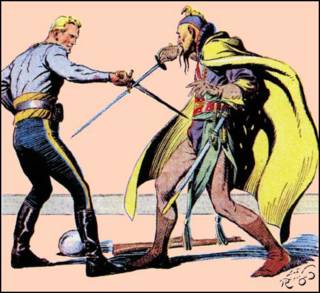
In 1934 Alex Raymond forever changed the "comic world" when he created a new comic strip character to compete with the extremely popular Buck Rogers comic strip. Flash Gordon offered all the excitement of the typical Buck Rogers adventure, but with two significant improvements. First, Raymond's art was far superior to that of the Rogers title and was better able to transate the excitement of "cliffhanging adventure." Second, the Flash Gordon universe was more fantastic that scientific. Buck Rogers as a title has always demanded a modicum of scientific plausibility, but Flash Gordon has never had such limitations. Flash was truly the adventures of the mind.
Not surprisingly Raymond's influence has extended into modern movies as well. A Gordon comic fan cannot help but see honest homage to Raymond's creation when he watches the Star Wars films. Both contain "moving planets" (Mongo vs. the Death Star), evil emperors (Ming vs. Palpatine), princesses (Aura vs. Leia), anthropomorphic animistic friends (Thun the Lion Man vs. Chewbacca the Wookie), roguish allies (Prince Barin vs. Han Solo. The list of comparisons above is far from exhaustive and is not meant to detract from Star Wars in any way. Star Wars easily deserves its place beside Raymond's creation, but the influence of Flash Gordon on a young Lucas is almost undeniable. One of the reasons for the enduring legacy of Raymond's creation was his attitude toward the medium itself:
I decided honestly that comic art is an art form in itself. It reflects the life and times more accurately and actually is more artistic than magazine illustration -- since it is entirely creative. An illustrator works with camera and models; a comic artist begins with a white sheet of paper and dreams up his own business -- he is playwright, director, editor, and artist at once.
It was with great excitement that I entered the comic shop yesterday, because the Third Volume in a series of collected editions by Checker Book Publishing was released this week. This particular volume features strips running from October 25, 1936 to June 5, 1938 and includes four exciting story arcs. Checker Books have planned two more volumes in the series and I eagerly await those as well.
Rather than bore you with specifics, I think I will let the art speak for itself today.


Monday, May 16, 2005
Subscribe to:
Posts (Atom)