Thursday, December 31, 2009

Fist of the Northstar: Mad Max Meets Superpowered Kung Fu (Hulu Recommendation Friday)


Happy New Year!

One of the great traditions of celebrating a new year, is looking back to the past and how it portrayed the future. The mid-80s were filled with post-apocalyptic narratives, but none quite as action packed as the anime series Fist of the North Star. The cartoon is best remembered for the exploding heads and bodies of its antagonists and its protagonist's favorite one-liner, "you're dead and you don't even know it yet." This is usually followed by the villain's body exploding in dramatic fashion.

Hulu has all 152 episodes of the series.


Koei Tecmo will be releasing a video game based on the manga/anime classic some time during 2010.


Wednesday, December 30, 2009

Toy Movies as You Likely Won't See Them


Playing off of the recent explosion of films based on 80s toy and animation properties, animator Dan Meth brings us a few imagined films based on other properties. The first film Care Bears vs. My Little Pony doesn't list an imagined director, one could easily pick a few names, but the other films do. My personal favorite is David Cronenberg's Cabbage Patch Kids. It captures the Cronenberg feel while demonstrating just how creepy the Cabbage Patch backstory really is. It's like a combination of Village of the Damned, The Children, Invasion of the Body Snatchers, and Night of the Living Dead.

Toy Movies

Just for kicks, here's the preview for The Children.

Some Thoughts on a Dragon Age RPG House Rule


The new Dragon Age pen and paper role playing game has only been available since December 9, 2009, but I am already thinking about how this system can be applied to situations not specifically listed in the rules set. Creating "house rules" is one of the great obsessions of Game Masters, and some players, and I am not someone who is immune to the obsession. I am, however, one who understands that when coming up with house rules one should not think that a couple of readings through a rules set gives one a better understanding of underlying game balance than the designers have. The designers have spent months, if not years, creating, playing, and testing the rules to see how different effects affect the game play.

One of my maxims as a game tweaker is, "never create a house rule that eliminates meaningful choices from the system." What I mean by this is that no "innovation" I create should be so desirable as to create an effect that must be selected for characters to be successful in the world. Don't create a "super choice." It also means that a rule shouldn't prevent players from creatively solving problems, or from making foolish choices.

Games are about stories, whether the game itself tells the story or the story comes when the player is talking about the great time he or she had playing it, and the more choices the players have the more creative the stories can be. Any given system will already have eliminated some choices as a part of design, for example there are no machine guns in Dragon Age, my goal is to find ways that the existing structure allows choices that might be overlooked if they aren't pointed out with a house rule -- or that might have to be house ruled on the fly when a player asks if he or she can perform a certain action.

As you might have guessed, this doesn't mean that there aren't any choices that house rules should not eliminate. There often are. As stated in Will Hindmarch's and Jeff Tidball's book Things We Think About Games in statement 018, "all variations on gameplay stem from two core types of alterations: expanding choices and restricting choices." A house rule may be needed to create a restriction against using an "exploit" a player discovers within a system. What is interesting in such cases is that by restricting the use of a particular choice, the house rule might actually increase the number of other meaningful choices within the system. After all, what is an exploit other than a "super choice" -- a choice that makes all other choices undesirable? The key as a game tweaker is to determine what the meaningful choices are within a given milieu and to work to maximize those events for players while eliminating choices which might supersede these choices to the detriment of the game.

A second maxim is, "never create a house rule that makes it more likely that the players will fail." Players participate in role playing games because they want to imagine succeeding at things they, in the real world, would find difficult or impossible. They want to leave the workspace cubicle and become "heroes." Players hate failing and they hate it when their characters die. This is even true in slaughter house games like Call of Cthulhu, which is why the rule book for that game goes to great lengths to describe how to make death "meaningful."

This doesn't mean that tasks should be made easy. In fact, Raph Koster has an entire "theory of fun" based on a definition of fun in which enjoyment is equated with continuous challenge based learning. A game must challenge the player enough to be interesting, but be easy enough that they do not become bored. For role playing games, like video games, this means that the rules, adventures, and stories must scale in difficulty and complexity in a way that corresponds with player and character experience. You don't want to make a rule that makes it more likely that players will fail in any given course of action, because the game designers -- if they have done their job with any iota of skill -- have developed a game that has a "fun balance." More than likely, they have weighted their "fun scale" on the side of challenging rather than ease.

Okay, with those caveats, what new house rule have I come up with for Green Ronin's Dragon Age pen and paper game?

In this case, it isn't a "new rule." Rather it is an expanded application of an existing rule. In the Dragon Age RPG, the rules use three kinds of tests to determine the success or failure of a given action.

There are basic tests where the player rolls 3 six-sided die (3d6) and adds the appropriate ability and focus in the hopes of exceeding some target number. For example, a person trying to sneak through an alley would make a test rolling 3d6 + their Dexterity ability + 2 if they have the Dexterity(Stealth) focus. If the game master thinks this would be a Challenging task, then the result must equal or exceed a total of 13.

There are opposed tests, which are made when a character is attempting an action that is actively opposed by another character. This test works like the basic test except that both characters make a test roll and compare target numbers with the higher target number winning. There is a tie-breaking mechanic, but it is unimportant at present.

Finally, there are advanced tests. These tests are typically used to emulated tasks that take a lot of time and/or planning to complete. This might include forging a suit of armor or researching the history of Ferelden. Players make a test as normal, against a static difficulty, but they record the number of pips displayed on a particular die within the 3d6 roll (the Dragon Die). This value is then compared to a "Success Threshold." If the value of the Dragon Die equals or succeeds this number, the task succeeds. If not, the player must make another test which if successful will add the value of its Dragon Die to the existing sum of prior Dragon Dice values. This continues until the threshold is passed. Failed tests merely increase the length of time it takes to succeed. These tests aren't typically used to determine the success or failure of a given task where failure has dire consequences, rather they help determine the speed of success for tasks that will eventually be successful if enough time can be committed.

This is where my alternate rule comes in. The rules as written (RAW) state that if a character is aided by other characters when attempting an advanced test, then the difficulty of the test should be modified instead of both characters making tests and summing the Dragon Dice of the multiple participants. I think that is fine for some actions, but if we could also use the advanced test mechanic to simulate a test to succeed at something that would be impossible for one person to accomplish and where prolonged exertion may or may not affect success or failure?

For example, let us say that a group of 4 characters stand before the Temple of Riognaton -- one of the Old Gods. The temple's massive stone doors haven't been opened in millenia, but the characters need to enter the Temple. The GM has determined that it would be impossible for one character to move the doors and that the action will require at least 2 of the characters. One could rule that this is a basic test where additional characters add a modifier to a primary character's roll, but I don't find that quite satisfying.

I would like to propose using advanced tests in these circumstances. The GM could determine that the task is a "formidable" task (needing a Success Threshold of 25) for the group and requires a target number of 15. All of the players could roll against the target number, with only those who succeed adding their Dragon Die value to the Success Threshold. Obviously, there are multiple ways one could use the Dragon Age system to emulate the opening of the doors, but this method allows the individual players to see how much their character contributed to the ultimate goal. It also avoids the more mechanical seeming, each helper adds +2 to the roll or each successful helper adds +2 to the roll mechanic. It takes an often static choice, aiding a comrade, and makes it more interactive.

One of the wonderful things about the Dragon Age rules set is that it inspires these kinds of uses of existing systems. My house rule for opening ancient temple doors didn't require the creation of a "new rule," but it did use an existing rule in a way not previously highlighted by the creators of the game.

Tuesday, December 29, 2009

Kung Fu Bunny 3 (Gongfu tu ): Amateur Animation Never Looked So Good


Allen Varney, a fellow University of Nevada graduate, recently tweeted about an amateur animation series called Kung Fu Bunny. In particular, he provided a link to the series creator's YouTube posting of the third episode of the series. This particular video has been online for about a month and the two older episodes were posted in 2007. Near as I can tell, these videos were posted by an animator who identifies himself merely as "Vincent." If I could read Chinese characters, I would be able to provide a translation of his printed name. Alas, this is not the case. You can visit his personal blog at http://blog.sina.com.cn/gongfutu.

The animation in the third episode of the series is seemlessly integrated into live action footage with remarkable effect. It's amazing how technological innovations have made it so that an amateur animator can integrated live action and animation in a way that makes Who Framed Roger Rabbit? look primitive in comparison. Certainly, some of Vincent's coloring technique, particularly the shading of the characters, was influenced by the Disney film, but the work here is excellent.

An added bonus to the video is that the narrative is wonderfully entertaining. American audiences will be familiar with the narrative tropes being used in the story as they are the time tested tropes of the Warner Bros. Bugs Bunny cartoons, Tom and Jerry, and Kid vs. Kat. In this case, our narrator wants to catch the mischievous Kung Fu Bunny and sets a trap. When this trap is evaded, and our animator mocked, he sends his trusty animated dog companion after the Bunny. The rest is comic gold.


Monday, December 28, 2009

TOY STORY: Now I'm Stressed About Buzz Lightyear's Fate

My wife and I are big fans of Disney's Pixar films, and we hope our 21 month old twin daughters will join us in our passion. I just watched the preview for next year's Toy Story 3. I had no idea what to expect, but the last thing I expected was cliffhanger stress, but that's what I feel now...cliffhanger stress.

What will happen to Buzz Lightyear?! I need to know!

The movie went from "must see due to fandom" to "must see or I'll go freakin' crazy!"

Fh'tagn!

Excited About KARATE KID (2010)

I have always found the storyline of the first Karate Kid movie to be a little less than satisfying. Most people see a story about a kid who is moved to a new neighborhood, is harassed by bullies, and learns martial arts to confront those bullies. I don't. I see a movie about a "new kid" who lies to people about having martial arts prowess in order to be better liked, who has his lie revealed with accompanying public embarrassment, and who eventually learns martial arts and confronts those who revealed his lie.

Daniel-San's lie in the first act of the movie creates a moral dilemma which could have made for an interesting story. Many of us have been the new kid in an unfamiliar community where we have no friends. The desire to make friends provide powerful pressures that can lead us to make mistakes that we must later overcome. One of my favorite romantic comedies The Importance of Being Earnest uses lies in this very manner. It also deals with the consequences that these lies can have upon the tellers. Had the original Karate Kid dealt more with Daniel confronting his deception, and less time painting "Johnny" as a two-dimensional bully (an effect that gets shattered in the third act of the film anyway as the villain role is completely shifted to the sensei of Cobra Kai dojo), the film would have been much more satisfying.

The new version of the film, starring Jaden Smith and Jackie Chan, seems to avoid my criticism of the original by making the story more purely about the new kid vs. bullies narrative. At least, the recently released trailer makes it seem that this is the case. I think that this is a good choice, one can always enjoy a kid faces off the bully story, but I don't think it is the best choice.

One of the things that I liked about the recent film Fighting, starring Brian White and Channing Tatum, was the lack of "villain" in the roles of the fighters in the film. Yes Fighting had villains, but they weren't the combatants. The combatants had real reasons for wanting to fight each other, reasons rooted in very human motivations. Brian White's character, Evan Hailey, has every reason to despise Channing Tatum's character. By providing a sympathetic, but not overly so, antagonist, Fighting was a little bit better than your average "fight movie." Given that the story is in many ways a remake of Jean Claude Van Damme's Lionheart, it is all the more remarkable.

The new Karate Kid changes the setting and the martial arts style of the protagonist and it looks to be interesting. That is, if I can wrap my mind around the change of "Sand the Floor" to "Take of Your Coat."


Wednesday, December 23, 2009

Tuesday, December 22, 2009

Green Ronin's Dragon Age RPG is Worth a Look


When Green Ronin announced they would be releasing a Dragon Age role playing game based on the BioWare computer and console game of the same name, I was initially skeptical about the endeavor. BioWare and Green Ronin are both held in high esteem by fans due to the consistent high quality of their products, but Dragon Age still seemed like less than a stellar idea by Green Ronin.

If there is one genre where the role playing game market is over saturated, it is in the Fantasy themed role playing game market. There isn't much room within the existing gaming marketplace for another Fantasy themed rpg, and the loyalty of consumers within the existing games' market share is pretty solid. Old school D&D players have games like Castles and Crusades and OSRIC. Mainstream Fantasy Gamers have the new Dungeons and Dragons and Pathfinder role playing games. Gamers who want things fast, furious, and fun have Savage Worlds and the excellent Hellfrost setting. Fantasy Flight Games introduced the Warhammer Fantasy Roleplay 3rd Edition game this year to seduce board and card gamers into the rpg hobby.

That brief list only scratches the surface of products available for the Fantasy fan. In fact, it leaves out a game that Green Ronin released this past March. Their Song of Fire and Ice game is a Fantasy RPG based on the popular series of novels by George R.R. Martin. I found it truly surprising that Green Ronin would attempt to release two Fantasy themed RPGs in the same year. It should be noted that these are full role playing games, each with their own mechanics, and not campaign settings for existing gaming properties. If these were setting books, I would be much less surprised than I am by the release of two complete role playing games within the same year. This struck me as potentially counter productive, and that dividing the game design resources at Green Ronin might affect the game quality.

This was all true before I purchased the pdf from RPGNOW and GM'd a session with my gaming group this past weekend. I read through the rule books last week and prepared myself to run my group through the adventure. As I did so, I was struck by how simple -- yet robust -- the Dragon Age RPG system is. The basic mechanics are easy to teach and learn. All actions, for which there is a possibility of failure, are decided by a simple mechanic. The player rolls three six sided die (one of a different color than the others) and adds them together. The player then adds this total to one of their statistics (for example: Communication) which have ratings of -2 to +4, if the statistic has an applicable focus the player adds 2 more to this total. This number is compared to a difficulty rating ranging from 7 (routine) to 21 (nigh impossible). If the total is equal to or greater than the number, the action succeeds. If the action is successful, then the player looks at the different colored die -- called the Dragon Die. The higher the total of that die, the more successful the action.

I was impressed by a couple of things in this system. I am very fond of the fact that the game uses a simple roll of three six sided dice. Most people, even non-gamers, have three of these lying around their house. Second, the mechanic is easy to remember, yet has enough depth that it is useful in structuring narrative results without being completely dependent on the sum of the total. A character needing a total of 11 on a check, who rolls 11 can still be extremely successful if their Dragon Die result is a 6. This means that quality successes come more frequently than they might otherwise come if a normal die distribution were used to determine "level of success."

Let's see an example of an action and include the probability of success.

Torvald the Hunter is tracking a wild boar through the forest. It hasn't rained in a few days, so the ground is neither more or less receptive of tracks than on a normal day. Torvald is about an hour behind the boar, so the Game Master decides that this is a Challenging activity -- so it has a target number of 13. Torvald is no more perceptive than the average person (his Perception is +1), but he is trained in the art of Tracking (and will add +2 to this roll). Taking the Target Number of 13 and subtracting Torvald's bonuses, we see that he will need a 10 or better to succeed on this action. Looking at the chart below, we can see that this gives him a 62.50% chance of success.


Torvald's player rolls his three dice and gets one 2, one 2, and a 6 on his Dragon Die. His roll totals 10. Adding his bonuses for statistic and focus his total is 13, which is enough for a success. Rolling a six on his Dragon Die means that this is a remarkable success and the GM rules that Torvald is able to predict the boar's movements and move ahead of it making the hunt easier. Had one of the two's been the Dragon Die and the six a regular die, Torvald would still be successful in following the beast but that success wouldn't be as great.

Quick, easy, and it feeds a narrative spirit. The entire game is based on this simple mechanic, and in knowing just this much you could jump into a game easily. You would even be able to navigate the slightly more complex combat system.

The combat system works like any other task, except you need to keep track of when you roll doubles. If any two of your dice have the same value, and you succeeded at the action, you are allowed to spend a number of "stunt points" equal to your Dragon Die on creating interesting combat effects. These effects range from making a second attack to tripping your foe. I am in love with this mechanic. One of the difficulties in any system is getting your players to explain their character's attacks in an exciting and narrative style. Some players are naturally resistant to doing anything other than rolling and stating damage, but this isn't the real cause of the difficulty. The difficulty typically stems from a player describing an exciting action (for example: "Torvald trips Estvan with his Boar Spear") only to have that action fail when the result of the action is rolled. Most systems require attempts at tripping etc. -- the narrative effects -- to be described before the attempt, like visualization exercises. If the action fails, this can create narrative disappointments and lead to players giving up on trying to describe combat excitingly. By shifting the declaration of narrative effects (with real bonuses rather than being mere descriptors), the stunt mechanic makes combats more exciting than many other game systems.

The elegant mechanic design is obviously aimed at bringing gamers over from one medium, Console/PC gaming, into the medium of table top role playing, and I think it is an excellent attempt. Dungeons and Dragons and Warhammer Fantasy Roleplay are attempting to appeal to the same market, but they are doing so by using design techniques from Console/PC/Card Game media. D&D and WFRP3 use "exception based" game design hoping that by emulating the style of other games, they will appeal to those gamers. I think that it will work, but I think what Green Ronin is doing will work as well -- and I think it will work for recruiting gamers who would otherwise be intimidated by the massive amount of rules most RPGs require players to learn.

Green Ronin's Dragon Age RPG is a "Red Box" for a new generation of gamers. The old D&D Red Box introduced an entire generation of gamers to a new hobby by simplifying and explaining a difficult game. Something that isn't attempted often enough in the current market. Chris Pramas remembers what it was about the Red Box that enticed the 80s generation of gamers, and he has brought those elements to a new generation of gamers with Dragon Age Set 1. It's a great Basic Set.


Monday, December 21, 2009

Fading of the Cries -- Will it be spooky or silly?

Ever since I first watched Brad Dourif in Dune, he's been one of my favorite "villain" actors. He plays the villain in the upcoming film Fading of the Cries, but I cannot tell by the trailer if the film will be a wonderfully creepy del Toro-esque film or if it will be campy.


Thought?

Midnight Chronicles -- The Best D&D Movie to Date


In September of 2009, Fantasy Flight Games released the Midnight Chronicles DVD. Midnight Chronicles is a first in the role playing game universe. It is a serious Fantasy movie created by gamers for gamers and other fantasy fans.

There have been Fantasy films created by gamers and for gamers in the past, but these were typically comedic affairs. Films like Dead Gentlemen's The Gamers substituted humor for production quality. It can be a winning formula, and certainly was for Dead Gentlemen, but it is also a formula that helps to maintain the stigma against films/television shows based on role playing game properties.

There have also been Fantasy films targeted at gamers, but made by non-gamers. Courtney Solomon's retched Dungeons and Dragons film left a bad taste in the mouth of the gaming community and "proved" to Hollywood that RPG franchises weren't worthy of translation into film/TV franchises.

Fantasy Flight Games' Midnight Chronicles is an attempt to reverse this bias, and an attempt to create an entertaining dark fantasy series. In order to achieve this goal, Fantasy Flight attempted the impossible. They attempted to make a Fantasy film with high production values on a shoe string independent film budget. The Midnight Chronicles film combines what are essentially the first two episodes of a spec pilot television series that would be based on the Midnight role playing game setting published by Fantasy Flight Games shortly after the release of the third edition of the Dungeons and Dragons roleplaying game.


The Midnight setting takes the traditional Tolkien Fantasy outline where a Dark Lord's armies march against the world of men in order to subjugate the masses and adds an interesting what if to the equation. In the typical Tolkien tradition tale, a band of heroes join together to foil the Dark Lord's plan and save civilization from his rule. Midnight asked the question, "What if the heroes of a particular age decided to side with the Dark Lord rather than resist?" The answer is that the Dark Lord wins and the world becomes a much worse place to live. This is the world of Midnight, a world where it has been 100 years since the Shadow fell. The world is now ruled by the Dark Lord. It is a world without heroes and largely without hope.

When Fantasy Flight first began developing Midnight Chronicles, they had hoped to create a high quality and entertaining Fantasy film that would be picked up as a television series, or be successful enough on its own to warrant further investment by the company itself. I don't know where they stand with regard to the last two goals, but I can say that they succeeded in their initial goal.

Midnight Chronicles far exceeded my initial expectations. I had expected a film that looked amateurish, had poor writing, a distracting and sub-par score, and had terrible acting. At best, I expected a movie that looked as good as a quality film school project. Midnight Chronicles is markedly better than either of these expectations. The movie falls somewhere between the Syfy Original film and a Sam Raimi production like Legend of the Seeker in overall production quality. Midnight Chronicles is what I would classify as a "good pilot." This does mean that the "movie" ends in a less than satisfactory manner. Since this is two episodes of a continuing narrative, there is no real sense of closure at the end of the DVD. I sincerely hope that Fantasy Flight has enough success with this project to continue the tale.


The story, while not "original," contains enough narrative arcs to maintain viewer interest and to leave one wanting more when the film ends. The strongest storylines are those surrounding the Legate Mag Kiln (faithful servant of the Dark Lord Izrador) and Morrec (the Robin Hood-esque "hunter" whose raids are delaying the completion of a temple to Izrador). The story regarding the legend of a possible savior of the land was far less interesting.

The acting is mixed, but some of the performances are quite good. Charles Hubbell is excellent as the Legate Mag Kiln. Matthew Amendt is less satisfactory as Gaelan, the foretold champion of justice. The film's acting largely avoids the awful overacting that can accompany Fantasy acting. It doesn't entirely avoid the pitfall, but it does largely avoid it. The camera work and effects are good enough to sustain suspension of disbelief, sometimes they are event striking. The fight choreography is mixed, as is the costuming/makeup. The movie definitely shows some "fraying" around the edges, but it is good enough to watch on repeated occasions.

In comparison to other films in the RPG film genre, Midnight Chronicles is in a class of its own. It is significantly better than either Dungeons and Dragons movie, both of which had larger budgets.Midnight Chronicles is an exhibition of what relatively inexperienced people are capable of producing when they take their subject seriously. When one considers the scope of what Fantasy Flight was able to achieve, and on what budget, it is quite impressive. I highly recommend this film to any gamer, but I also think that non-gamer Fantasy fans will have a good time with the film as well. At $14.99, it's a bargain.


Friday, December 18, 2009

The Dresden Files [Hulu Recommendation Friday]

Watching the preview for THE SORCERER'S APPRENTICE, put me in the mood for watching the Dresden Files television show.

Jim Butcher's Harry Dresden series is one of my literary addictions. I enjoy the way Butcher combines urban fantasy and noir detective fiction tropes in the books. Harry Dresden is a Wizard for Hire in a world that doesn't believe in magic, much to it's own peril.

In 2007, Syfy (then the SciFi Channel) aired twelve episodes of a series based on Butcher's books. The early shows, like the pilot below, were clumsy, but the show eventually found its voice and became quite entertaining.


Thursday, December 17, 2009

A Late Christmas List for the Pop Culture Geek (2009)


I try to get out a post highlighting some great gift ideas for pop culture fans each year. This year posting was delayed by a number of different life events, but we still have a week of shopping left and most of the gift ideas I will be offering are either readily available or older classics.

Gift Idea #1: Amazon's Kindle 2


This device is a wonderful addition to any book lover's inventory. The Kindle Wireless Reading Device is lightweight, has a decent amount of memory, and Amazon has a lot of books available in digital format for the device. Additionally, sites like ManyBooks.net have a large catalog of public domain books available in Kindle format. Is your favorite geek an Edgar Rice Burroughs fan who has been trying to hunt down a version of The MuckerThe Outlaw of Torn? Look no further than ManyBooks.net. The Kindle also has a pretty well kept secret. It's also a nice little 3G internet browser, with no monthly fees, where you can surf and even tweet. The internet fuctionality isn't on the par with an iPhone, but it's pretty good and keeps getting better.

Gift Item #2: Stephen Jones Edited Anthologies


I have in mind here three excellent anthologies edited by Stephen Jones that are a wonderful addition to any fan of weird fiction's bookshelf. The first two are H.P.Lovecraft's Book of Horror and H.P. Lovecraft's Book of the Supernatural: Classic Tales of the Macabre. The Book of Horror contains Lovecraft's seminal essay on Supernatural Literature and a selection of stories based on Lovecraft's recommendations. It is a great companion piece to any Lovecraft library and contains many of the stories that inspired Lovecraft himself. The Book of the Supernatural lacks the essay, but continues the exploration of tales that inspired Lovecraft. Between the two books, you have quite a wide sample of early weird fiction.

I would also recommend The Mammoth Book of Wolf Men, which was re-released this year in the hopes of riding on the wave of interest the upcoming WOLFMAN movie should generate. This anthology collects some excellent werewolf stories by authors like Neil Gaiman, Clive Barker, Hugh B. Cave, and Manly Wade Wellman.

Gift Idea #3: The Collected Captain Future


What's that poster you see on the wall of Sheldon and Leonard's apartment every week on "Big Bang Theory?" Who is this Captain Future: Wizard of Science guy, and what does he have to do with the joys of reading science fiction? Your favorite geek will be able to answer these questions and more after you buy him/her a copy of The Collected Captain Future Vol. 1 by Haffner Press. Captain Future was the creation of Edmund Hamilton who, along with Robert E. Howard and H.P. Lovecraft, was a key member of Farnsworth Wright's talented pool of writers during the heyday of Weird Tales magazine. The Captain Future stories were eventually converted into an anime series by Toei. The only question your favorite geek will be asking after reading this wonderful collection is, "does that poster belong to Sheldon or Leonard?"


Remember when Little People were bizarre looking utilitarian representations of what humans? Remember when Little People were just the right size to fit into your mouth and chew on? Remember when Little People cowered in fear of the "Dread God (Insert Your Name Here)? John Kovalic and the good folks at Dreamland Toyworks certainly do. The My Little Cthlhu "action figure" is a wonderful blend of Kovalic's elegant cartoon style, and the design of the older -- now changed -- Little People series of toys. Any geek who wants to being introducing his/her children to weird tales and the joys of "The Mythos" absolutely must own one of these wonderful figures.

Did I mention that Dreamland also makes "victims?"


This November, Fantasy Flight Games released their much awaited, and much debated, Warhammer Fantasy Roleplay 3rd Edition game. The game is an interesting combination of mechanics drawn from narrative games, traditional roleplaying games, card games, and video games -- combined in a way to make the game easier to learn while maintaining a depth of play experience. If purchased at your "Friendly Local Game Store," the method I most recommend as FLGSs are what truly sustain the gaming hobby, the game comes in at a hefty $99.95 (you can buy it from Amazon at the above link for 37% less). The price seems costly at first, but like most role playing games Warhammer 3 has the potential to give quite a lot of entertainment bang for the entertainment dollar -- given the number of hours of play and the number of players supported by one box. The graphic design of the product is excellent, the rules mechanics are easy to learn but robust, it supports both narrative styles and "hack n slash" style games, and FFG has a lot of interesting support products in the pipeline.

On a side note, while the rules set was created specifically for the Warhammer "universe," I believe that the mechanics could be used for a wide variety of game settings. Translating the rules from one genre to another would be a bit of work, likely too much work for a GM to do in his/her spare time, but the underlying system would work wonderfully with a Superhero themed setting.

Wednesday, December 16, 2009

Disney's SORCERER'S APPRENTICE Trailer: Fairy Tale Gets a "Dresden" Look

Image of Harry Dresden by Peter Hodges

One of the most entertaining sections of the film FANTASIA is the Mickey Mouse version of "The Sorcerer's Apprentice." In the animated sequence, Mickey and the audience learn the consequences of being overconfident and how the whimsical use of power can quickly lead to disaster.

Jerry Bruckheimer's production company, who has had some success in creating entertaining movies based on Disney concepts, is working on a film version of "The Sorcerer's Apprentice." Instead of medieval castles, capes, and conical hats, we have art deco, modern sports cars, and dragons. If the preview is any clue, the film -- directed by Jon Turtletaub (of the entertaining neo-pulp NATIONAL TREASURE franchise) -- looks a lot like what I imagined the world of Harry Dresden to be. In fact, Nicolas Cage's Balthazar Blake look almost exactly like my mental vision of Dresden.

Tuesday, December 15, 2009

Ambrose Bierce's "That Damned Thing," 12 Days of Lovecraft, and Why Seamus Cooper is Wrong


While I was reading the notes regarding the collaboration between C L Moore and Forrest Ackerman on her story "Nymph of Darkness," (I posted about the collaboration here) I was intrigued by Moore's reference to Ambrose Bierce's "That Damned Thing" as an inspiration for the way Nyusa's invisibility worked. I knew that Lovecraft's "The Colour Out of Space" featured a creature made of a color no one had ever seen before, and that Ambrose Bierce was one of Lovecraft's influences. I had just never taken the time to read Bierce's tale "That Damned Thing" ...until last night.

"That Damned Thing" is a short and enjoyable tale, that isn't at all what I expected based on my earlier assumptions. Having read Moore's correspondence with Ackerman, and Lovecraft's description in Supernatural Horror in Literature, I expected something Gothic and atmospheric. I expected a tale filled with madness and despair. Lovecraft's description of "That Damned Thing" points to it as an exception in Bierce's narrative style, a style which Lovecraft describes as "a jaunty and commonplacedly artificial style derived from journalistic models." Gothic and atmospheric are not words that I would use to describe "That Damned Thing." It certainly has its disturbing elements, and it is a wonderful commentary on willful disbelief, but it is a shockingly straight-forward tale.

"That Damned Thing" is a perfect example of the modern procedural tale. The story opens with men, Mountain Men to be specific, gathered around a table upon which lies the body of Hugh Morgan. The use of Mountain Men is likely very intentional with regard to what Bierce is aiming at with the story. Frederick Jackson Turner's presentation on "The Significance of the Frontier in American History" had been made earlier in the year that "That Damned Thing" was published, and the stages of Turner's hypothesis are witnessed in the tale.

First, we have the Mountain Men those rugged adventurers who explore the vast unknown wilderness. Then we have the "coroner," a figure who is one of the Mountain Men in dress and composure, but who has a job associated with greater civilization. In fact, the reason the men are gathered around the table is to perform a kind of coroner's inquest and decide upon the cause of Hugh Morgan's death. Finally, we have William Harker, the young journalist and fiction writer who had come to the Frontier to write a story about Hugh Morgan. William completely represents the final stage of development in Jackson's work. We have explorer's, law bringers, and the civilized, and they are all gathered around a table to guide us through the narrative.

The narrative is broken into four clear acts.

There is the establishing act where we find out that the men have gathered as a jury and that William Harker will testify regarding how Hugh Morgan died. We also learn that there is an additional piece of evidence, a book, that will play a role in the story even after it fails to play a role in the jury.

The next act consists of Harker's testimony about his hunting trip with Morgan and the beast that they encountered, a beast responsible for Hugh's death. A couple of things stand out here. We are finally given hints as to the location of the story. Bierce consistently uses the term chaparral when describing the environment, a flora commonly associated with the West. The use of chaparral lends further evidence to the Turner-esque nature of the story. When the beast is introduced, it is described as "the wind" moving vegetation. It is only after Morgan shoots at the beast, and it charges Morgan, that Harker realizes that they have encountered some creature...an invisible creature. The description of the invisibility is intriguing and somewhat puzzling.

"At a distance of less than thirty yards was my friend, down upon one knee, his head thrown back at a frightful angle, hatless, his long hair in disorder and his whole body in violent movement from side to side, backward and forward. His right arm was lifted and seemed to lack the hand -- at least, I could see none. The other arm was invisible."


We know from Harker's description that the creature is invisible, and transparent. We can see through it as it moves through the bushes in the earlier description. We also learn that things within its grasp are similarly obscured from our vision in the places where the creature holds its victim. There is obviously some cause, other than mere transparency, for the beast's invisibility.

In the third act, the Jury deliberates and determines that the death was caused by a mountain lion. The coroner assures the jurors that there is no other evidence available to help them in their determination of cause of death. The jury rejects a purely supernatural cause for the death, but acknowledges that Harker bears no fault. We also learn that the coroner was lying when he said that there was no other useful evidence. The book the coroner had been reading at the beginning of the tale happens to be Hugh Morgan's diary.

The final act is where all is made clear, in non-supernatural terms. Morgan's diary reveals to the audience that Morgan had indeed been encountering an invisible creature for some time, but Morgan had a scientific explanation. This was no mythic beast, rather the creature only reflects light that the human eye cannot see. Somehow light bends around the creature. This is where the description of the invisibility of the creature is at its strongest and weakest. The reason for the invisibility is ingenious, the execution is lacking. Bierce refers to Morgan noticing the creature because its form blocked his ability to see a couple of stars, yet he can "see through" the creature to the world behind it. In essence, the creature may not actually be invisible in the sense we tend to think of invisibility. Rather we may just be unable to see the thing, no black absence of light and no true transparency. A little awkward, but still cool.

What is even more interesting is what Bierce is doing here. One can readily understand why authors might write tales about the inability of those who follow a material metaphysic to acknowledge or engage with the supernatural. THE EXORCIST is a wonderful horror tale of this sort. The science being applied to the victim of possession is as horrifying as, if not more than, the effects of the actual possession. What happens in Bierce's tale is a material metaphysician, or rational realist if you will, in the form of the coroner unable to cope with a plausible scientific description of an unimaginable thing. Some scientists might want to explore the chaparral to find the beast, but the coroner essentially asserts that it is "better not to know." One wonders if Bierce was critiquing particular rigid dogmatists in the scientific community with this tale.

One can see why Lovecraft and Moore were inspired by the piece. Lovecraft liberally borrows names from "That Damned Thing" in his story "The Colour Out of Space." The only person who will share the tale of the invisible beast stalking the lands around Arkham is named Ammi Pierce -- clearly Ambrose Bierce -- and the name Nahum Gardner is close enough to Hugh Morgan for government work. The reluctance of the townsfolk to talk with our narrator in "Colour" fits with the jury's reluctance to deal with the unknown. Which brings me to today's 12 Days of Lovecraft Tor website post by Seamus Cooper.

Cooper asserts that "The Colour Out of Space" is quite bad. A strong opinion regarding a story that Lovecraft thought his best, and about a tale that is largely praised among Lovecraft fandom. Cooper believes that "Colour" is "ill-conceived and poorly executed." This belief seems to largely stem from the fact that Cooper believes that the stakes of the tale have already taken place and that there is nothing left to chill the spines of the reader.

He is wrong on both counts. Kenneth Hite discusses some of the merits of the tale in his Tour de Lovecraft, so I won't repeat them here. Instead, I'll make a couple of my own observations.

With regard to the tale being poorly executed, one finds this a particularly baffling claim. The story begins with what may be the best written first sentence and introductory paragraphs in all of Lovecraftian fiction, "West of Arkham the hills rise wild, and there are valleys with deep woods that no axe has ever cut." The words are poetry without purple prose. Lovecraft sets the tone of the wild and unexplored marvelously, and he sets the tone for the foulness of the place itself in exquisite fashion. This story is rife with beautifully constructed wordsmithing, something I wouldn't often credit Lovecraft's fiction.

It is also remarkable how Lovecraft has transformed a hunting encounter with an unknown beast into a horrifying encounter with an alien presence. An encounter, I might add, that extends the interaction between the alien and the scientific beyond the mere coroner. In the end the beast does vanish, leaving a small piece behind trapped in a well, putting a seeming end to the stakes. But given the fact that there is soon to be a reservoir on top of the location of the small (trapped) piece, and the nature altering and mind altering affect this piece has on the land and the people surrounding it, one wonders what will happen when the reservoir comes and possibly frees the beast.

The end of this tale is as creepy as the end of the first FRIDAY 13th, when we discover that it might be possible for Jason to rise from the bottom of the lake, or John Carpenter's THE THING. The creature is destroyed at the end of Carpenter's movie...or is it. The same is true here. Just how has the beast altered those around it? What effect will it have?

The stakes are subtle, rather than grotesque. They are social, rather than personal. But the stakes are horrifying none the less.

This beast represents something more than a colorless thing. No wonder the story inspired the source story for THE THING and the narrative of THE BLOB.

"Can't git away...draws ye...ye know summ'at's comin', but 'tain't no use..."

Ridley Scott's ROBIN HOOD Some Thoughts and the Trailer

Robin Hood is one of the great characters of British legend. He is the quintessential homegrown medieval renegade, who fights against authority to help those without power receive justice. He returns money unjustly taken by the crown from freemen, and likely foodstuffs and materials taken from serfs, to the rightful possessors of the money/materials.

His actions have been portrayed a number of ways by a number of people.

  1. Robin Hood steals from the rich and gives to the poor is a phrase with which most are familiar. On the surface, it seems to describe what Robin Hood is doing. Yet none of the traditional tales of Robin actually have him doing this action -- except in maybe the Warner Brothers Daffy Duck cartoon where he isn't very effective at this task. He isn't really "stealing" in the sense that we normally think of stealing, and the rich he is stealing from is the Crown (Prince John in particular). I have yet to see a Robin Hood film where Robin breaks into the house of a freeman to take money in order to buy food for starving peasants. I think I might enjoy such a tale, and we've seen similar non-Hood versions of that tale. As much as we often use the "steal from the rich to give to the poor" statement to describe what Robin does morally, we rarely see adaptations that actually have that as the narrative.
  2. Robin Hood as thorn in the side of an unjust regent is the version of the tale we most often see in film. The typical Robin Hood story has Prince John as the unjust tyrant reigning over England while his heroic brother is fighting valiantly in the Crusades. It is up to Robin to make sure that John doesn't so abuse the freemen and serfs that England is destroyed during Richard's absence. These tales often include coming up with the ransom for Richard, who is being held captive by the French. These stories often have a heavy Ivanhoe influence and are kind to the Crown in principle, though harsh to the tyrant John. Sometimes these versions of the tale have Robin's activities as one of the things that pressured John to sign the Magna Carta.
  3. Still other, more recent, versions of the Robin Hood story emphasize the importance of the Crusades and have those influence Robin's activities. In these tales, Robin is a homegrown rebel returning unjustly taken tax money that would be used to pay for an unnecessary foreign war. One can see how this line of narrative keeps Robin a topical figure, while finding new ways to explore the historic time period Robin to which is typically assigned. These stories allow Robin to be a people's hero against the tyranny of the State. Both Richard and John are to blame in these tales, or at least both contribute to the suffering of the people of England.
  4. My favorite version of the Robin Hood story, a version exemplified in the excellent series Robin of Sherwood starring Michael Praed, deals with Saxon/Norman tensions in medieval Britain and the tension between Christianity and Pagan faiths.


I have no idea which version of the tale, some existing trope or an entirely new one, that Ridley Scott will use in hims upcoming ROBIN HOOD movie. I do know that Scott is a talented director who makes films that typically manage to be both entertaining and of artistic merit -- an all to rare combination. Scott has played fast and loose with history, and with other source material for that matter, but he tends to have a clear vision with whatever project he is working on. His inclusion of Russell Crowe as Robin is icing on the cake.

Monday, December 14, 2009

[Blogging Northwest Smith] "Nymph of Darkness"


"Nymph of Darkness" is the first of the Northwest Smith stories to be written in collaboration with another author. C L Moore's collaborator on this piece was none other than an 18 year-old science fiction fan named Forrest Ackerman. Forry, as his friends called him, died on 12/4/2008 at the age of 92. I had hoped to have this entry posted on the anniversary of his death, and to spend some time praising Forry's contributions to Sci-Fi. Not the least of these contributions is the creation of the term "Sci-Fi," a term unabashedly used by those fans who care more about entertainment than present day literary acknowledgement. Make no mistake, I enjoy literary Science Fiction. I just happen to enjoy my Sci-Fi as well, and make no bones about it.

I apologize for the delay, but it comes with a fairly good reason. I had remembered reading a version of "Nymph of Darkness" in Forrest Ackerman's Ackermanthology Millennium Edition compilation. I also remembered that Forry had pointed out that there were two version of the story. A "spicier" version of the story was printed in the April 1935 issue of the fan magazine Fantasy Magazine, while a much "expurgated" version of the story was published in the December 1939 issue of Weird Tales. I needed to hunt down my copy of Ackermanthology! in order to look at some of the notes Forry provided regarding the collaboration. I had also hoped to compare the Weird Tales version to the Fantasy Magazine version, but Paizo has thankfully provided us with the "real thing" and not the "expurgated" story. An examination of the Weird Tales version will have to wait.
"Nymph of Darkness" begins very similarly to "Black Thirst." In both tales, Northwest Smith is wandering the waterfront of the Venusian city of Ednes. The danger of the waterfront is emphasized in both stories, as is the darkness of the Venusian sky -- a fact that is even more important in this story than in "Black Thirst." In "Nymph of Darkness," Smith once again finds himself in the path of a woman who may be in need of his aide, but something is different this time. In the end, a couple of things end up being different, but the initial difference is a difference in Smith himself. In earlier Smith stories, Northwest has almost leapt to the aide of damsels in distress. In this story, he is far more cautious. Given Smith's caution, this is definitely a Smith story that takes place after the events of "Shambleau." Moore describes Smith as follows, "He wanted no sound to indicate his own presence to the terror from which the woman fled. Ten years before he might have dashed out to her -- but ten years along the spaceways teaches a man prudence. Gallantry can be foolhardy sometimes, particularly along the waterfront, where any score of things might be in close pursuit."

Before we continue, I'd like to state that of the Moore stories in the Smith series, this tale starts the most awkwardly. I don't credit this to the collaboration, so much as it seems that the opening paragraphs lack the strong hand of an editor. Where prior Smith tales set the tone effectively without repetitive paragraphs, this tale wanders a little before it gets going. In the first paragraph we are told twice that the Patrol is too afraid of the waterfront to police it effectively, an unnecessary redundancy. The second paragraph of the story begins with this clumsy sentence, "Through the breathless blackness, along a street beneath which the breathing waters whispered, Northwest Smith strolled slowly."

The use of alliteration here might be appreciated, "breathless blackness," "waters whispered," and "strolled slowly" if not for the repetition of the use of "breath." One likes "breathless blackness," but is pulled out of the narrative by "breathing waters" so close after the other construction. I like what Moore is attempting here, but I would have liked another editorial pass through these paragraphs. That said, the rest of the story moves a quite a clip and the awkwardness of the first two paragraphs hints more at Moore's mind groping for some construction that will get the story moving. Eventually she does, and later examples of alliteration pull the reader in effectively.

Ackerman supplied the original outline for the story, and invented the name of the nymph of the tale -- Nyusa. In Ackermanthology!, Forry assures us that Nyusa was the result of experimenting with sounds rather than being made up from the initials of the major metropolis N.Y., U.S.A. One thinks Forry might be protesting too much here and, given Moore's later honesty in her creation of names, one wishes he would admit the play on words if it is really there. Moore admits in the collaborative that Ednes comes from the middle of the word Wednesday.

Despite Smith's caution, he still ends up running into the girl and aiding her against her pursuer. This pursuer is a shambling humanoid creature named Dolf, who pursues Nyusa wielding some sort of greenish light. The purpose of this light is revealed shortly. Smith has run into the nymph, but neither he nor the girl have seen each other. They have been relying on sound and touch due to the deep darkness of the Venusian night. Nyusa eventually guides Smith into a building and she asks him to lift her to turn on a light. When he does, he notices that while he is holding the weight of a woman in his arms -- he cannot see the body. Nyusa is completely invisible, except when certain wavelengths of light interact with her own natural skin color. At these times she becomes a semi-translucent and mist-like figure. Moore's inspiration for the cause of invisibility, as she makes clear in her letters to Forry, is Ambrose Bierce's tale "That Damned Thing." Bierce's tale was the inspiration for a couple of H P Lovecraft stories as well ("The Colour Out of Space" and "Dunwich Horror"). The shambling Dolf's greenish light is constructed to reveal Nyusa's presence.

The source of Nyusa's invisibility is also the source of both sides of the narrative tension in the story. Nyusa is the daughter of some god of Darkness, echoes of "Dunwich Horror" here, and that god's worshipers use Nyusa by having her dance under the eerie green illumination as a part of their prayer rituals -- rituals devoted to her father. She is portrayed as an unwilling participant in the rituals of these creatures, known as the Nov, the reader (and Smith) likely assume that her resistance to participating in the rituals stems from some rejection of Darkness. We are, after all, used to our damsels in distress tales.

But Moore will have none of this. The Nov, who are white amorphous slug like creatures, may have a mystical hold on Nyusa forcing her to perform rituals praising her father, but her desire to leave has nothing to do with revulsion of things man is better for not knowing. No, her desire to be free stems from a desire to fully explore the Darkness within herself. She wants to be free and to have the power of her Darkness grow, not to have it restrained by the ceremonies of the wretched Nov -- who use her, but do not praise her properly.

Smith doesn't know this as he watches the dance ritual. He only sees the revolting visages of the Nov, and hears the approach of Dolf. Smith slays Dolf, and one of the high priests of the Nov. This frees Nyusa from the hold the Nov had upon her and Smith witnesses her partial apotheosis into a being of Darkness. For his "gallantry," Smith is rewarded with a kiss. The kiss is both cold and filled with love, a combination of human warmth and unimaginable Darkness.

Once more, Moore has played with the damsel in distress story and added her typical spin. Nyusa's sensuality is a thing of danger, where non-sexual love would have been something safe. Smith begins the tale wary of attempting to rescue a girl because he is afraid of what her pursuers might be capable of. He finishes the tale wary of that which he has helped to liberate. To be fair, Nyusa would likely have been free soon enough without Smith's aid, but Smith was there to witness her apotheosis and helped to hasten it.

One thinks that maybe Smith should have trusted his cautious instincts a little bit more than he did.

Who knows what long term ramifications this will have upon the fate of the universe?


Previous Blogging Northwest Smith Entries:

6)[Blogging Northwest Smith] "Nymph of Darkness"
5)[Blogging Northwest Smith] "Julhi"
4)[Blogging Northwest Smith] "Dust of the Gods"
3)Blogging Northwest Smith: "Scarlet Dream"
2) Blogging Northwest Smith: "Black Thirst"
1) Blogging Northwest Smith: "Shambleau"

Friday, December 11, 2009

Lovecraft for Christmas, Kenneth Hite, Seamus Cooper, and "From Beyond" on Hulu Recommendation Friday

All this month, Tor is hosting a "December Belongs to Cthulhu" event on their website. I mentioned earlier the historic connection horror and the winter season have with each other, as perfectly described by Manly Wade Wellman.

The Tor site has even begun a series of posts entitled "The Twelve Days of Lovecraft" as a part of the celebration. The "Twelve Days" posts feature a discussion of twelve of Seamus Cooper's favorite Lovecraft tales, with a discussion of why they are so effective and what their greatest problems are. Cooper wrote the entertaining Mall of Cthulhu, which I reviewed earlier this year, and is a natural selection for a series of articles about Lovecraft's fiction.

I think it would be interesting to compare the entries to the indispensable "Tour de Lovecraft" web entries provided by polymath extraordinaire, and author of the Trail of Cthulhu roleplaying game (the BEST Lovecraftian RPG ever written, though the author would quibble with that praise), Kenneth Hite. Hite's "Tour de Lovecraft" is the yardstick by which I measure all story discussion blog posts.


Let's just say that in presenting this story, Hite's entry is useful to the neophyte and the veteran where Cooper's entry is useful primarily to the neophyte -- though Cooper does sprinkle in some good humor. As I noted in my review of Cooper's Mall of Cthulhu, Cooper makes a point of discussing Lovecraft's racism and the obscurity of Lovecraft's prose. Two things that are interesting to point out to the neophyte, but which without new insights into root causes (as William Jones has done in his discussions of Lovecraft and Eugenics) it's really beating a dead horse. Hite references the racism as well, because it really is blatant and must be mentioned, but focuses his post on comparing Lovecraft's storytelling with Edmund Burke's aesthetics. Now that is a connection that I might not have made, and I've read Burke's Enquiry.


Both authors note that "Dunwich Horror" is a Gospel-esque tale, but only Hite notices that there are two Gospels being presented. There is the supernatural Gospel of the creature and the secular Gospel of Armitage. Hite also discusses the work as pastiche. Something fans of Lovecraft often overlook is the influence prior authors had on Lovecraft's own writing, and Hite is right to remind us here that Lovecraft's story is not purely Lovecraft. It should be noted that while Hite's article is the "deeper" of the two, in this case, it is also the more confusing one to the uninitiated. If you haven't read the story before diving into Hite's conversation, you could quickly become lost. This is not the case with Cooper.


The sharpest distinction between the Cooper and Hite posts is their reactions to Lovecraft's description of the town. Cooper is bored by the length and clumsiness of the description of the town and Hite draws maps of Innsmouth based on the description. One can imagine that for most readers a description long and accurate enough to base a map upon might be a trite dull. Cooper and Hite also disagree with regard to Lovecraft's use of the "native" in the story. For Cooper, it is further evidence of Lovecraft's obsession with racial purity -- and it is. For Hite, it is something more. He sees Lovecraft's use of primitive mythology as a subversive one, where he inverts which mythology (Western or "other") is more important. In this tale, the mythical worldview of the other is more accurate. Though the eugenics narrative is still overpowering.


But this isn't "analyze Cooper and Hite Friday," this is Hulu Recommendation Friday. Given the Lovecraftian bent of the post so far, I feel that I must give a Lovecraftian offering. Without further ado, I give you the awful (as in not very good) , From Beyond.

Thursday, December 10, 2009

Cinerati Christmas Season Movie Marathon

It is no wonder that the commercial aspects of Christmas seem to come earlier every year. No sooner than one has celebrated Thanksgiving with loving family and friends, than one realizes how swiftly one has "gotten behind" in one's annual Christmas Season Movie Marathon. At least that's how things were in the Cinerati household. The other night, we had just finished watching the new Phineas and Ferb: Christmas Special -- which was surprisingly heartfelt -- when we realized that we were significantly behind in our Annual Christmas Season viewing regimen.


Every year, the Cinerati household views a minimum of one Christmas themed film or TV special during each day of December. We consider it our filmic advent calendar. We typically follow this up with a Christmas Season Movie Marathon where we try to increase our viewing level to 2 movies a day from the 18th through the 1st of January. This lets us watch more holiday fare, and lets us include things like the Rudolph New Years special without breaking from the rules of what constitutes a Christmas movie -- at least for those films or shows that take place after Christmas. Our definition of what constitutes a Christmas film is pretty broad, but that's what makes it such a fun tradition. Here is a partial list of the films and shows we typically select from:
  • Die Hard
  • Die Hard 2
  • The Last Boy Scout
  • The Thin Man
  • The Sound of Music
  • -- The one film that breaks our about or take place rule because the movie "feels" so Christmassy and Jody has many fond memories.
  • Lethal Weapon
  • Holiday Inn
  • White Christmas
  • Elf
  • Rudolf the Red-Nosed Reindeer
  • 3 Godfathers
  • The Bishop's Wife
  • Scrooged
  • The Ref
  • The Nightmare Before Christmas
  • Miracle on 34th Street
  • It's a Wonderful Life
  • Holiday Affair
  • The Shop Around the Corner
  • In the Good Old Summertime
  • Dr. Seuss's How the Grinch Stole Christmas
  • Harry Potter and the Philosopher's Stone
  • -- Harry's Christmas present is important for the whole series and the opening song sounds über-Christmassy to us.
  • We're No Angels
  • Joyeux Noel
  • Gremlins
  • Love Actually
  • About a Boy
  • A Christmas Story
  • A Christmas Carol
  • Young Sherlock Holmes -- This movie includes Christmas, but it is also a "Victorian/Edwardian" film and any film that takes place in that era just feels Christmassy. I blame Dickens.

Monday, December 07, 2009

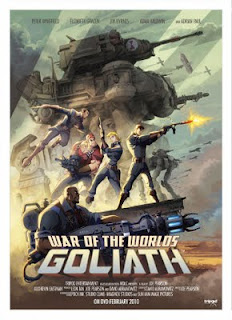
War of the Worlds: Goliath -- Coming in 2010


Next year will see the release of Tripod Entertainment's animated Steampunk film WAR OF THE WORLDS: GOLIATH. The film's premise is that 15 years after the Martian's failed attack on the earth in 1900 the aliens return to continue their attempted conquest of Earth. Much has changed in the intervening 15 years, as the industrious have reverse engineered a substantial amount of Martian technology. This sets the stage for a more evenly balanced conflict between the two worlds. The film's trailer hints at what the film will offer. The film will star geek favorites Adam Baldwin, Peter Wingfield, and Adrian Paul.


GOLIATH isn't the first WAR OF THE WORLDS sequel to make its way through the Hollywood entertainment assembly line. In 1988, there was a 2 season syndicated television series based on the premise that the Martians who invaded during the George Pal film merely went into hibernation and didn't die when they collapsed. The series aired in the US on Fox, and it too starred Adrian Paul (during the 2nd season).


The narrative premise of GOLIATH is a promising one and the show looks to have combined the best of the Steampunk genre with some elements of the classic animated television series STAR BLAZERS. Instead of a giant space faring WWII battleship, we have a giant sky spanning battle-zeppelin. I think the battle-zeppelin wins hands down.

Steampunk is a genre that has been gaining some momentum over the past few years. It combines "Vernian" futuristic technology with a Victorian/Edwardian time frame. I would posit that the first iteration of Steampunk was the Castle Falkenstein roleplaying game by Mike Pondsmith of R. Talsorian Games (publishers of the Cyberpunk rpg) and that the genre gained real traction with the novels The Difference Engine by Gibson and Sterling and The Prestige by Priest.

It has been noted in the comments that I am in error with regards to the origin of the term and genre of Steampunk. I will concede the term's origin, but I would take issue with some of those items retroactively classified into the genre. One could classify Spenser's The Faerie Queene as Epic Fantasy, but one would be misapplying a term for fantasy fiction in the post-Morris era. The same holds for Wild, Wild, West which shares as much with James Bond as it does with Steampunk (specifically). One might as well classify Ian Fleming's brilliant Chitty Chitty Bang Bang as Steampunk. Wikipedia and "internet citations" from Locus be damned!