Tuesday, August 30, 2005

Karate Kid Waxes On as Television Producer


UPDATE: Links corrected per David N. Scott's comment at 6:33pm.

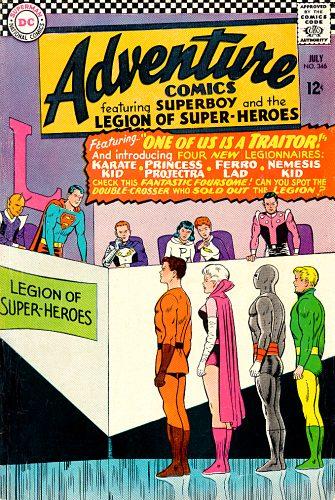
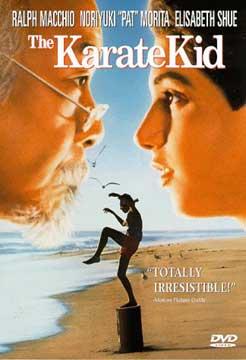
Ralph Macchio, not to be confused with Ralph Macchio, has signed a development deal with the teen targetted network "The N." According to Variety he will be developing shows for a network whose average viewer age is 15.

Does this strike anyone else as odd? I mean, come on! Ralph Macchio is the Karate Kid, not to be confused with the Karate Kid (whose name was used with permission by the film)! The target audience of The NTV weren't even born when his movie came out and the last show Macchio worked on was "The Ralph Show!"

Of course, maybe I am wrong and his new "Thelma and Louise" for teenage girls show will take off. Maybe he will be as good a television producer as Shaun Cassidy (I personally thought American Gothic was genius).

One thing is for certain...if he wants to be successful he needs to make sure that he keeps his focus: "Whole body...One Inch!" and if he does it right there is "no defense."

But given that The N shows Sabrina the Teenage Witch, a show I enjoy very much but that appealed to 15 year old girls almost a decade ago, I am skeptical.


Karate Kid?

Or...


Karate Kid?

Only the Legion of Superheroes can decide!

Sigh.

Now, as I've mentioned before, I often have Really Neat ideas for posting here. In this case, I had decided to post a detailed, piece by piece review of the modern dance show my sister was just in. I was going to talk about the dances, the themes, and how the choreographer's homosexuality was such a big part of the show, in odd little ways.

But, I never got around to it. I still have the program, so maybe sometime soon. Instead, I'll talk about D+D! Now, readers of Pererro and this blog already have some awareness of the epic story... Number One posts about the new edition, I respond bitterly, he tenderly but insistently convinces me to see her, er it, again...

And then, we found some extra money we'd forgotten about, and one of our favorite local game stores went under. So, we got a bunch of books.

And...

They're really great. It seems like the writers are really pouring themselves into the product, from four cool varieties of magic weapons, all with neat stories, to every new class having sample characters with little stories and hideouts... It's really great stuff.

The class books are oriented less mechanically now, around character themes (skills, combat, arcane or divine) instead of base classes. There are gallons of neat story lines and customization ideas, including two books (Dungeon Master's Guide 2 and Unearthed Arcana) devoted to them.

Oh, and Stormwrack is a lot of fun. There are really cool Corsair and Legendary captain classes, and gorillas that fly like flying squirrels.

OK, bye.

Thursday, August 25, 2005

Pre-Review Geeky Nit-Pickyness

Sometime next week, barring procrastination, I plan on doing a book review (similar to my Paul Feig review) of Steven Johnson's new book Everything Bad is Good for You.

But before I can do that, I have to point out how annoyed I am with his opening chapter. In this chapter, Johnson gives us a curriculum vitae of his geek credentials and begins the basis of his argument. You see, Johnson played APBA and D&D as a kid and wants to display how arcane these two pop-cultural entertainments are. In other words, he wants to show how thoughtful and complex these "simple games" are. I actually have no problem with the argument he is making, but I was irked at the "content."

from page 5 of Everything Bad is Good for You

Here's the Player's Handbook describing the process by which a sample character is made:
Monte wants to create a new character. He rolls four six-sided dice (4d6) and gets 5,4,4, and 1. Ignoring the lowest die, he records the result on scratch paper, 13. He does this five more times and gets these six scores: 13, 10, 15, 12, 8, and 14. Monte decides to play a strong, tough Dwarven fighter. Now he assigns his rolls to abilities. Strength gets the highest score, 15. His character has a +2 Strength bonus that will serve him well in combat. Constitution gets the next highest score, 14. The Dwarf's +2 Constitution racial ability adjustment [see Table 2-1: Racial Ability Adjustments, pg. 12] improves his Constitution score to 16, for a +3 bonus...Monte hs two bonus-range scores left (13 and 12) plus and average score (10). Dexterity gets the 13 (+1 bonus).


...Whis gets to the ultimate question of why a ten-year-old found any of this fun


Given that the above text comes from page 10 of the 3rd Edition Player's Handbook published in 2000, or page 10 of the Player's Handbook v. 3.5 published in 2003, it is unsurprising that this 10 year old who now lives in New York with his wife and two sons would write this piece. Because if it was the same ten-year old, he would be 15 now. Being an editor for Wired, married, with 2 kids by 15 is pretty remarkable.

Joking aside, here is what irritates me. Johnson is trying to share his ten-year old experience with us, but instead uses a modern reference. This is the equivelent of talking about how Star Wars influenced your life as a child (meaning the Original release) and then quoting from the re-released Special Edition and only those scenes which were added. It doesn't provide a true example of the phenomenon as encountered by Steven Johnson the ten-year old. More likely the Player's Handbook published in 1978. That's if it was a Player's Handbook at all and not a Basic Set or Original White Box.

That 1978 Player's Handbook describes character creation in the following way on page 8:
Creating the Player Character
Each participant in the campaign created by the referee must create one or more game personas. The game persona of each participant is called the player character in order to differentiate it from personas created by the referee, called non-player characters. The Dungeon Master is advices to limit player characters to one participent at commencement of the campaign, though as play progresses, additional player characters may be added in a judicious manner. Each player develops the abilities of his or her character through random number generation (by means of dice rolling) to determine the basic characteristics of the persona, the abilities. The payer then decides what race the character is, what the characters' class is, the alignment of the character, and what the character's name is to be...

Each and every character has six principal characteristics, the character's abilities. These abilities are strength, intelligence, wisdom, dexterity, constitution, and charisma. (See also APPENDIX I, Psionic Ability). The range of these abilities is between 3 and 18. The premise of the game is that each player character is above average -- at least in some respects -- and has superior potential. Furthermore, it is usually essential to the character's survival to be exceptional (with a rating of 15 or above) in no fewer than two ability characteristics. Each ability score is determined by random number generation. The referee has several methods of how this random number generation should be accomplished suggested to him or her in the Dungeon Master's Guide. The Dungeon Master will inform you as to which method you may use to determine your character's abilities.


As you can see the text young Johnson read was even more arcane than the newer text, requiring some sort of hermetic discipline to decipher. The new text is complicated, to be sure, but it is "glossier" and more excessible due to years of refinement and need for explanation. It has been "translated" for a broader audience, if you will. True, it is still fairly unaccessible, but not as unaccessible as the old Player's Handbook. Does this mean that Johnson's thesis that modern Popular Culture is more complex than it was in the past has no merit? No. First, let me state for the record that the Player's Handbook though enjoyed by Johnson as a ten-year old was the Advanced version of the game. The aforementioned Basic Set was very similar to the text in the new Handbook and both are designed for the beginning player.

Sorry, but something had to be said.

Even Creepier Version of Harry Potter Fans.

The Eyes...The Eyes...The Eyes...


Writers, Reality TV, and Residuals

I have mentioned in the past that the WGA doesn't always do all that it can to protect its members and ensure they are getting a proper cut of entertainment profits. My discussions have ranged from comparisons to SAG's video game negotiations to comments regarding DVD residuals. In each case I have been critical of the WGA, but one area I haven't talked about (at least not at enough length) is the WGA's reaction to reality tv.

WGA members are not exactly happy with reality tv. You might have noticed a correlation between writer strikes and an increase in reality programs on television. Surprising as it may sound though, reality tv shows do in fact have writers. Sure they aren't the same kind of writer that you might envision, they aren't scripting full dialogue, and sure much of what a traditional writer does for scripted television is done by the editors and directors of reality tv show. Reality tv shows have in the writer role, among other roles I am sure, what are called "story assistants" and these story assistants can become members of the WGA. This is a good thing for script tv writers as it means that the discount price of writers on reality tv is not a permanent state. My hypothesis is that once reality tv normalizes in the industry, bringing with it its ad revenue, the people who work on them will demand similar wages to those paid on scripted shows. Eventually this will cause a leveling of cost differences between the two styles of entertainment.

Before that happens one thing has to happen first. Chiefly that the crews on reality tv shows actually get paid for what they are working. Are you surprised to see this statement? Surely the crews on reality shows are at least paid for the work they do, we don't live in the 19th century after all? According to today's LA Times reality tv shows may be the sweatshops of television, continually flaunting labor laws.

Some key excerpts from the article are:

The Writers Guild of America, West, is backing the lawsuit, filed in Los Angeles County Superior Court, to put pressure on production companies and networks involved in the burgeoning reality TV business. The guild, which unveiled a push to organize reality TV writers in June, backed a similar suit last month against several networks and production companies.


To meet the deadline, Isenberg recalled, he found himself working six days a week, often until 10 p.m. Occasionally, the writers would stay past midnight to screen footage for Fox executives. Isenberg said one story assistant was so distraught after working 28 hours straight that she broke down in tears and had to be sent home.

Through it all, Isenberg continued to receive the same pay, about $900 a week. Under state labor laws, the suit alleges, he and his fellow writers should have received several thousand dollars in overtime pay.


Ah, the glamor of television. Work your arse off for $900 a week.

I'm Not Letting Undiscovered Go Undiscovered.

The movie Undiscovered, an apparent Romantic Comedy along the lines of Serendipity (but this looks better, comes out this weekend.

I have only seen one trailer for this film, but what I have seen has given me a great desire to see it. As far as I can tell the narrative begins with an unfulfilled "love at first sight" occurance on a crowded Subway. Our fated lovers see one another, but lose one another in the mass of people that is New York. That's okay because even if our protagonists were to have had the follow-up conversation it wouldn't have worked because Luke, our male fated lover, is heading to Los Angeles to become a successful rock musician. Fate has it in store for our young lovers though because Brier (the female fated lover) is heading to LA to become an actress.

Hijinx ensue.

I know, I know, it sounds lame, but trust me when I saw the preview my heart warmed at the thought of an entertaining romantic comedy. This year's crop has been a little clumsy, good sure but still clumsy, and I am looking for the first fluid one. You know it isn't a bumper crop when Wedding Crashers is the best romantic comedy of the season. I loved Crashers, but their should have been a more heartwarming romantic comedy. My hope is that Undiscovered is that comedy.

So here are the pros and cons:

  • Pro: From what I have seen the dialogue is witty. The story is a standard fated lovers tale and I like those. Stars Steven Strait who was hunky as hell in Sky High. Trust me...Steven was dreamy as the brooding firebrand Warren Peace. The film also stars Carrie Fisher and Peter Weller. I would go watch it just for them.
  • Con: It does star Ashlee Simpson, but she doesn't sing from what I can tell (not that she ever really sings, but you get the point) and she was cute on 7th Heaven


  • So my wife and I will be going to see this, in addition to Brothers Grimm and The Cave this weekend.

    Getting the Object of Your Affections to Appreciate Comic Books. ÜberCarnival Discussion.

    She laughs at my dreams, but I dream about her laughter.


    Okay, I admit it, I am a huge The O.C. fan. It happened rather suddenly. I had gone two years without watching a single episode, happily oblivious and perfectly willing to mock the ridiculous OC commercials. But then I went on two long trips out of town. No, I didn't watch the OC while I was on the road, but my wife did watch them as she longed for my return from distant lands. She expressed her enjoyment, so I added Season 1 to our Netflix queue and within three weeks have purchased both Seasons 1 and 2 from a local Wherehouse. Let's just say this is a GenX geek's dream. I eagerly await season 3.

    One of main characters, Seth Cohen (played by Adam Brody), is a huge comic book fan. Seth has had an enormous crush on a character named Summer (played by Rachel Bilson) and slightly after mid-season attempts to introduce her to comic books by handing her some of the "classics". The dialogue goes something like this:


    SETH

    Okay, so here is The Dark Knight Returns, The Watchmen, and Sandman.

    SANDY (Seth's Father)

    Don't you think those are a little dark son? Isn't life depressing enough. Comic books are supposed to be fun.

    ANNA (Seth's "Girlfriend")

    Snidely

    Yeah, maybe you should start with some Archie.

    SETH

    Oh, yeah, and Newport Beach is so dark.


    Putting aside my own observations about Watchmen and its Post-Modern heroic deconstruction of classic Charlton characters, many created by Steve Ditko, I think I agree with Sandy here. Sure, his response is a little simplistic, but I think he is on to something. Frank Miller once discussed the importance of understanding the "constructed" hero before you could fully understand the "deconstructed" hero.

    Oh, and before you think this is another "anti-sophisticated comic" screed. It isn't. I like Watchmen, The Dark Knight, and love Sandman. What I don't like is that these are the only books "acceptable" to "popular" society.


    Now back to the discussion...

    Given the Post-Modern nature of these three titles, I don't think they are the best way to INTRODUCE someone to comic books. If you love Fantasy/SciFi, you don't say to someone who isn't familiar with the genres, "Hey why don't you read Behold the Man and Lord Foul's Bane." The grim, cynical, deconstructed protagonists in these titles might make someone never want to read the genres again. Besides, Behold the Man is best if you have both read the Bible and are familiar with Golden Age SciFi morality fiction. So you start with Heinlein, Asimov, and Vance. Lord Foul's Bane with its anti-hero makes more sense if you have read, and appreciated, The Lord of the Rings and Alice's Adventures in Wonderland. So with Fantasy you start with Tolkien, Lewish, Dunsany, Harry Potter, and classic mythology. These are the things that "pull the new reader in," especially when that new reader is an outsider.

    I think the same goes for comic books. Introduce people to the "iconic" books instead of the "important" books.

    Below, I will provide a list of 5 comic book trade paperbacks or issues that I think everyone should have and use to introduce people to comic books. I would appreciate it if everyone out there, especially those at the Truth Laid Bear ÜberCarnival would do the same. I only have one rule...try to be fun and not important.

  • Comic Books for Your Significant Other

  • Justice League: A New Beginning This book shows that comic books can be well drawn and funny.

  • Ultimate Spiderman: Power and Responsibility is a wonderful take on the Spiderman story.

  • Starman: Sins of the Father shows that a comic book can be cutting edge without making the hero dark.

  • JLA/JSA: Virtue and Vice is partially written by the Director of Batman Begins which is a good selling point.

  • Whatever Happened to the Man of Tommorrow? is Alan Moore, of Watchmen fame, writing a moving tale where he in no way needed to deconstruct the ideal. In my opinion, this is the best of his work.


  • The above list is by no means comprehensive, or even a full beginning, so I look forward to your offerings.

    Wednesday, August 24, 2005

    Is Harry Potter "Corrupting the Minds of Our Youth?"

    And now for something completely different...

    Not to be like the Huffington Post, and report July's news in late August, but I just had to venture in on the "Harry Potter is Evil" discussion. Throughout most of my life I have heard a constant mantra, from certain segments of society: "Fantasy Fiction and Roleplaying games are the Devil's work! Anyone who reads them is practicing Devil Worship." One of the antagonists was Tipper Gore who stated that Dungeons and Dragons was a form of Satanism in her book "Raising PG Kids in an X-rated Society." But my least favorite, or at least the most aggravating, antagonist has historically been Pat Robertson who, while opposed to foreign terrorism, thinks we ought to "take out" the Venezuelan President.

    To those of you who think that Harry Potter, Dungeons and Dragons, and Fantasy literature are a form of "devil worship" let me give you the following advice.

    First, read this brief piece which gives an overview of what a "Satan Scare" is and how they are linked to historic blood libels with regard to their content. Another useful resource is Satanic Panic which works to dispel the validity of most claims of insidious Satanism in American culture.

    Second, read this very in depth analysis by Michael Stackpole who is responding to Pat Pulling (the founder of Bothered About Dungeons and Dragons). In the essay, Stackpole breaks down many of the myths around Role Playing and Fantasy.

    Third, I recommend that you yourself read the material in question. If you do, you will find that Harry Potter has a clear moral compass with Good combatting Evil, Tolkien's work contains Biblical references, CS Lewis' fiction is Biblical allegory, and that a great deal of fantasy is inspired by classical concepts of Virtue. It is this focus on virtue that is one of the key reasons people are drawn to Fantasy. They like to see people struggle to do Good, even when it is extremely difficult.

    Lewis, Tolkien, and Potter are easy to defend on this ground, as are many others. Some authors, like Philip Pullman with his "advocacy for a democratic revolt in Heaven because a Monarchic Heaven is unjust", are worth reading to discuss the arguments with your children. Do you disagree with Pullman's fantasy based moral argument? Good. Now tell children why you disagree. Write fantasy countering the argument, but don't fetishize the argument by banning Pullman books.

    Some books, like Zorachus, really oughtn't be read by children at all, but it isn't meant for children. The themes of the book regarding what happens to a good man who is given power in a corrupt and evil society ought to be examined and discussed.

    Oh and before you think I believe all criticisms of Fantasy are unjust. I agree whole heartedly with The Entertainment Complex
    and the sentiments expressed in the photograph (by EC) below.


    US Army Intelligence Intercepts Terrorist Communique

    Odysseus, a soldier currently serving in Iraq intercepted this communique between Al Qaeda operatives. You can tell Odysseus is in Iraq because the pop culture references are a little out of date. Like 6 months or so.

    Errors include that Hal Jordan has returned as Green Lantern and that Firefly now has a movie coming out.

    Tuesday, August 23, 2005

    After Fritz's Last Post...

    ALL YOUR BASE ARE BELONG TO US!!!!!

    The meme that will never die.

    Back to the Caber Toss for ESPN?

    When ESPN first came on the air I was a young and naive to the subtleties of "World Sport." Thankfully ESPN was there to give me my first taste of Australian Rules Football, Curling, Logging Competitions, and the awe-inspiring Caber Toss. That changed over time and now ESPN is "the sports channel of record" with a family of channels so massive that the movie Dodgeball parodied them by having a channel called ESPN 8 -- The Ocho! Funny thing was "8" wasn't that far from the truth.

    But recent changes might mean a return to obscurity for ESPN. Sure they have rights to Monday Night Football in the near future, but in the aftermath of a successful broadcast of the Tour d'France Comcast's OLN is stepping into the ring of major sports broadcasting. Their first acquisition was rights to NHL games, a relatively easy task with the success of NHL on TV being what it is. Now it looks like OLN has their sights on the cable rights to MLB as well.

    Personally, I see this as a winning situation for me in that I hope that OLN will hire better commentators than ESPN when covering baseball. Just because a player is in the Hall of Fame doesn't mean he can talk about baseball.

    Who knows...maybe I will learn the mysteries of County Cricket on ESPN. At minimum I expect and expansion of their ESPN manufactured X-Sports.

    Monday, August 22, 2005

    Life and Death Behind Bars

    The Bureau of Justice Statistics has posted a report on Suicide and Homicide in State Prisons and Local Jails. Some of the key facts regarding this topic can be seen here. The overall homicide rate can be seen here for comparison. The suicide rate information, for the United States in General, can be found at the WHO site. The WHO site only list 1999 and doesn't do comparisons, but you can compare the rate to 1999 in prisons and jails.

    Needless to say, suicide rates are higher in jails than in the general populace.

    Huffington Post Reporting April's News In August

    Back on April 28th, I posted Rethinking My Shatner Fetish in response to comments made by Canadian law enforcement officers and their observations that child molesters seem to be Star Trek fans.

    Not wanting to miss out on this wonderfully topical discussion, Ellen Ladowsky posted her observations at the Huffington Post on August 18th. To be fair Ladowsky goes into far more detail than my earlier, pithy, post. She has obviously gone back and watched all of the original series episodes, but given her "keen" observations one would have been willing to wait longer so she could incorporate references from Next Generation, Voyager, Deep Space Nine, or even Enterprise.

    It really is too bad that she rushed this article to the presses to meet deadlines.

    Thanks extended to Mickey Kaus for the heads up.

    Google Tools

    I am a big google fan and thought that I would share some of the new "offerings" from google.

  • First, there is what I call Google Who Needs Stinkin' Peer Review When Random Idiot on the Internet Can Evaluate Your Scholarship


  • Second, is what I like to call Google Copyright Violation


  • These are extraorninarily useful tools. The scholar tool collects academic papers, but without the aid of informed editorial selection. The "print" tool provides full text scans of books. You know ones that came out last week.

    Want to read On Tyranny by Leo Strauss? You could before a recent law suit. There are currently restricted pages, but google is fighting that. All from your computer screen. Sure printing is irritating, but possible.

    Oh, and if you want a gmail account...let me know in the comments section.

    Friday, August 19, 2005

    There's a whole new world out there...Food Blogging.

    Since I know Caryn and since all of the photographs on her sight make me feel like I am starving to death (even though I just ate), I present without further ado...

    Delicious! Delicious!

    Neil Gaiman and Beowulf

    Famed was this Beowulf far flew the boast of him,
    son of Scyld, in the Scandian lands.

    So goes part of the description of Beowulf in the Prologue to the famous poem, one of the great fantasy epics of all time. But an epic which has had many adaptations.

    From the much lauded Grendel which views the myth through the eyes of a Nihilistic "monster" (it also represents Beowulf as a crazed figure, see the comments adapted from Scruton regarding Superheroes below), to the much anticipated (at least by me) boardgame there have been worthy adaptations. But there have also been less successful ones. While I enjoyed The Thirteenth Warrior (and the book version Eaters of the Dead), most critics and audiences found it disappointing, but it was nowhere near as disappointing as the Christopher Lambert version. Come to think of it...not much that Christopher Lambert has been in is worth watching (excepting of course Highlander the first one, and Greystoke). Especially horrifying were Gunmen and Highlander II (even the "Renegade Edition"). Planet Zeist? Pfewy!

    Robert Zemeckis, director of the Back to the Future films and Castaway, is working on a new adaptation of the film and according to ICV2 and Variety the screenplay by Neil Gaiman has been Greenlighted (greenlit?).

    I have two central concerns with the project.

    Unlocked Wordhoard and The Lemmings Were Pushed share one of my concerns. DKP at Lemmings is concerned with how the "motion capture" will look, and Wordhoard thought it was enough of a concern to link it. I too share in this concern. Motion capture can work well, like Gollum in LotR, but it can also really freak you out, like it did in Zemeckis' own Polar Express. But I have high hopes for this one in regards to special EFX.

    My second concern is with the use of Neil Gaiman as a writer. I like Gaiman, I own a lot of Sandman comics to prove it, but he can be a little pretentious at times. Let me rephrase that. He can be way too pretentious some times. No...wait. He IS extraordinarily pretentious. Did you read American Gods? Give me Manly Wade Wellman anyday! (Though to be honest I did like American Gods, but only the really pretentious part of me.) So I worry that the film, if Gaiman had creative control, might not be accessible to large audiences, but that worry is largely diminished because Zemeckis (the director of Used Cars and Romancing the Stone) is the opposite of pretentious. But then again...there is that Polar Express thing. But then he did come up with the story for Bordello of Blood, so who am I to say who is pretentious?

    Thursday, August 18, 2005

    Economics...Games...Movies...and Comic Books

    In an earlier post I commented on the potential death of a Roleplaying Game Company named Decipher. During the comments, Cinerati member David N. Scott forwarded some complaints regarding the high cost of edition 3.5 of the Dungeons and Dragons game ending his comments with an "I dunno there was a pretty quick turnaround time between 3rd edition and 3.5." He was correct, as far as his statement goes, which is to say compared to TSR's earlier update schedule, an average of 10 years between editions, he was right. But I think my point got lost somewhere in the shuffle.

    My point was that even the 3 year turnaround was a pretty lengthy one in the game industry. Magic the Gathering, the penultimate Collectible Card Game, is on its 9th or 10th edition and Twilight Imperium, one of my favorite war games, is on its 3rd. Both have been around for approximately 15 years or so. Not to mention Fantasy Flight Games boardgame Runebound which came out last year, but already has a Second Edition (with significant changes for the better I might add).

    I also wanted to point out that while RPGs are expensive, they are trust me, that they are not more expensive than they were in the past. Now thanks to Poliblogger I have some supporting evidence. He provided this link to Economic History Services, provided by Miami University and Wake Forest University, which gives the real value in 2003 dollars of money from any date in US history.

    So that Dungeon Master's Guide, 1st edition, that cost $15.00 in 1982 was the equivalent of $28.60 today (according to Consumer Price Index Adjustments) or $50.62 as share of GDP. The $19.95 Second Edition Dungeon Master's Guide from 1990...$28.09 Consumer Price Index. How much is a 3.5 edition Dungeon Master's Guide? $29.95, unless you buy it at Amazon where it is dirt cheap.

    All this is well and good, even fun, but doesn't completely address David's larger point. Which is that Wizards of the Coast, a Hasbro subsidiary who produces D&D, has produced a great sum of material in the past two years and that much of it was reprinting of 3rd edition books. This is a partly true statement, they have in fact produced volumes (an average of 2 rulebooks a month these past two years), but as I own the books I can actually say that very little in the new books is reprinted from the 3rd edition material. Yes the Complete Warrior does update information from Sword and Fist. But Sword and Fist was a paperback "perfect bound" book which cost $19.95 (close to $15.00 on Amazon) and was a black and white printing consisting of 96 pages. Whereas the Complete Warrior is $26.95 ($17.79 on Amazon) is hardcover, full color and 160 pages. There is a great deal of new material in Complete Warrior, in addition to the updated material, and I think it is a value. The same has been true of all of the new Wizards of the Coast 3.5 material.

    Having said this though, I do come back to the 2 rulebooks a month statement. That's $50 to $60 dollars a month if you want to buy all the books. Naturally, given the modular nature of Dungeons and Dragons, you don't need to buy all the rulebooks that come out. In fact, if you remove setting specific books the average drops to one a month or even one every two months. All said, most Roleplayers I know are completists and this can burn a hole in your wallet. I say, most I know, because the sales figures don't match my experience. DM books sell worse than player books, settings books sell worse than DM books.

    I guess this is a long way of saying I think that both David and I are right. Yes Wizards prints too much stuff to keep track of, but I think the prices per item are very reasonable.

    Bret Easton Ellis on His New Book Lunar Park

    I am a pretty big Bret Easton Ellis fan. He is the "cool jaded Gen-X Enfant Terrible" I always wished I could be, but I'm not and really can't be. He recently did an interview on Amazon.com regarding his new book Lunar Park where he discussed his horror influences:

    It is in some ways an homage to Stephen King and the comics I loved as a kid. Especially the EC Comics, like Vault of Horror and Tales from the Crypt. And the Warren Comics of the '70s that I was a huge fan of. They had titles like Creepy and Eerie and Vampirella. These were all influences on Lunar Park. That was the impetus to write the book. To write a book that was similar to the books that gave me pleasure as a boy and as an adolescent. I was really into the horror genre and the supernatural genre when I was a teenager and certainly I came of age, along with a lot of men of my generation, with the first book that Stephen King published and onward. But as I got older the book became less an homage and more personal.


    Comic Book Marketplace had a great article on the old Warren books recently and I was glad to see a mention of their books in the Ellis interview. Naturally, given my love of Forrest Ackerman (which you can read about in this old post on the San Diego Comic Con), I was glad to see the Warren Vampirella reference. Ackerman invented the name Vampirella, though he was (as he fully admits) inspired by the name Barbarella.

    I do think Lunar Park is for those, who like Ellis and me, read these books as adolescents, and not for us as those adolecents.

    Speaking of the interview...Fritz and I have talked about the ending of American Psycho a number of times and we disagree as to whether the events, in the end, are real or imagined.

    The word from Ellis:

    Right, right, the "was it all a dream thing." [laughs] Our old friends Mr. Loose and Mr. Reality. I don't know. When I was writing the book I kind of thought I knew but I really didn't. I liked leaving it open. Because it is left open purposely in the book. And depending on who you are as a writer and what you desire from the book, you're going to go either way. And the movie doesn't answer that question. It's fine. Why answer it? Is the book more meaningful? Does it make it more interesting? It's probably a much more interesting book when you're left hanging and you decide on your own.

    Upcoming Home Entertainment Releases

    According to ICV2 the following Home Entertainment items are on their way to stores in the near future.

  • Batman Begins Deluxe Edition DVD (October 18) -- Will include a 72 page comic book.


  • Carcassonne: The River II -- This is an updating of a previous release, more than a sequel, in that it is designed to work with other Carcassonne updates. Carcassonne is an innovative and enjoyable tile based game of "world construction and control" where players lay tiles attempting to create cities or roads to control. The name comes from the famous French city known for its vast fortifications. It's history stems from Rome to the Albigensian Crusades to the Hundred Year's War. The growth of the city and regions are the inspiration for the Carcassone board game, the fortress is the inspiration for the Carcassonne: The City version of the game.


  • Frank Miller's adaptation of Thermopylae 300 starts filming in October as well. Ironically, it will begin filming in Montreal a city not known for its "Gates of Fire." The film will be directed by Zack Snyder of Dawn of the Dead remake fame. While I very much enjoyed Miller's 300, I wish that Steven Pressfield's Gates of Fire was the work being adapted. That being said, I don't know if it is better that the writer of such epics as Freejack and Above the Law be left behind and the writer of Robocop 2 and Robocop 3 be rewarded. Oh, and if you mention Sin City, I just have one thing to say...over-rated. Sky Captain and the World of Tommorrow did the computer environment better, and as Noir...do I even have to begin going down that road. I'll take Double Indemnity, Sunset Boulevard, Gilda, Criss Cross, Ace in the Hole (aka The Big Carnival) and at least a dozen films over Sin City's watered down Noir anyday.
  • Wednesday, August 17, 2005

    Wow

    Pierce Brosnan is out as 007, after long speculation.

    A single, surprising phone call and it was over. That's how Pierce Brosnan says he learned that his services as James Bond would no longer be required.

    "One phone call, that's all it took!" the 52-year-old actor tells Entertainment Weekly magazine in its Aug. 19 issue.


    One interesting bit...

    Brosnan says he's grateful to have had the role, but adds: "It never felt real to me. I never felt I had complete ownership over Bond. Because you'd have these stupid one-liners _ which I loathed _ and I always felt phony doing them."


    I remember the last Bond movie I saw, the one with Halle Berry, had a massive overload of puns. Glad Brosnan agrees.

    Monday, August 15, 2005

    Comic Books and "Art"

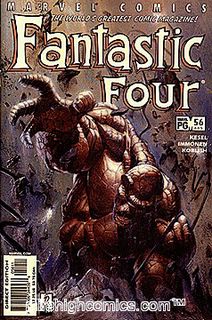
    A while back, I wrote a post both praising and lamenting the possibility of an upcoming Watchmen movie. One of our early group members posted this in reply. I still stand by most of what I wrote, and will go into more detail later this week. But I thought that I would offer the following thoughts on "Art" as a prelude to further discussion on the topic. The paragraphs below are adapted from Roger Scruton's book "Modern Culture." I am certain he would be horrified by the use, but if Scruton read Fantastic Four issue number 56 (Third Series) "Remembrance of Things Past", Scuton might be very forgiving.


    This is one of those cases where the interior art is superior to the cover, and where the cover has little if nothing to do with the narrative inside.

    Without further ado...here is a modified version of what Scruton has to say about our affection for Superheroes (particularly Silver and Golden Age versions):

    Comic books tried to create a new narrative audience, one that would not merely see the point of the heroic ideal, but also adopt it...

    In contemporary comic books we see exactly what the transition from moderism to the 'post-modern' world involves, namely, the final rejection of high culture as a redemtive force and the ruination of the sacred in its last imagined form.

    Modern comic book authors like Alan Moore and Warren Ellis were anticipated by Nietzsche, for whom the heroic in comic books is a sham...Rather than accept comic book superheroic characters in the terms suggested by the drama we should, Nietzsche advises, translate them 'into reality, into the modern -- let us be even crueller -- into the bourgeois!'...Nietzsche's judgements are seldom fair, and this is no exception. Comic books, particularly Gold and Silver Age, are concerned with creating a new kind of heroism, and to offer a new kind of solace to those of us for whom the old heroic way of life is not available. Heroes of the old type are larger-than-life versions of humanity, who live, love and suffer more completely than the rest of us, and who illustrate the possibilities to which man, with divine assistance, may aspire. Comic book superheroes belong to a new type. They exist in a state of exalted solitude (note Superman's "Fortress of Solitude"), the result of some primeval mistake; but they long either to redeem or to be redeemed, through an act of loving sacrifice...

    Our sympathy for the comic book superhero...is not the artificial thing that Nietzsche pilloried. It stems from the deepdown recognition that his predicament is ours. Precisely because we live in a morbidly unheroic world -- the world of the cynic and the salesman, in which gods and heroes have no place -- we are driven to regard our own existence as some kind of mistake.


    Ironically, much of the modern cynicism in comics is rooted in the book "Seduction of the Innocent" by Frederic Wertham. In the book, Wertham argues that the "crime books" glorify evil and are corrupting the minds of the young. His criticisms were largely baseless, founded on bad methodology and a Frankfurt school approach (with its inherent disdain of proletariat art), but they led to the strict regulation of comic books. This strict regulation, in turn, eventually caused an "anti-comics code" backlash. This backlash contained many books devoted to the very subjects restricted by the Comics Code. Many of the "great books" of the "graphic novel" era are a part of this backlash, but almost universally the books exhibit a cynicism and sophistication (in the classic sense) very much because they seek to "lower" the hero and bring him into the real world.

    Gerard Jones, in his book Killing Monsters, argues that young people need comic books, or entertaiments like them, (and their portrayal of the ideal hero) in order to assist in the development of moral behaviors. I don't know if his thesis is correct, but it matches Scruton's description of "heroic art" and its intentions. Gerard Jones is a professional comic author so his advancing this kind of argument lends practical support to a philosophic position. In other words, he shows that the producers of the medium are thinking of the medium in the same way that a philosopher might.

    But Gerard Jones has never written anything like The Watchment, The Authority, Hellblazer, or The Dark Knight Returns. His books all take place in the realm of imagination and do not attempt to bring the hero down into the real world.

    This discussion begs the question..."What happens when we lower the echelon of the moral ideal?" In other words, "What does it say when Superman becomes less super? Or when The Question, a Randian objectivist moralist created by Steve Ditko, is turned into a madman?"

    Those are some beginning thoughts which will be followed by a more specific discussion. My apologies once again to Roger Scruton.

    Sunday, August 14, 2005

    The Simpsons

    Given the literally hundreds of Simpsons episodes there must be in existence at this point, and the fact that we only watch the Simpsons about a handful of times during any given year, it absolutely amazes me that nearly every time I watch the Simpsons it’s an episode I’ve already seen. We nearly broke this record a couple of years back while hanging out at my sister’s because they had gotten TiVo and we sat around watching the Simpsons for a couple of hours. Nonetheless the only new episode I remember watching was the one where the family goes to England. So, it was no surprise to me that when we just happened to turn on the television while eating pizza, and it just happened to be showing the Simpsons, the episode was, of course, the one where they go to England. As if there is some cosmic que out there keeping track of what episodes we’ve watched and preventing us from seeing new ones. I don’t even care all that much, but the statistics of this happening astound me.

    Friday, August 12, 2005

    Sky High

    Well, I planned to do a really well-thought out review. Except that I never did. So... Sky High. I liked this movie a lot. Basically, if you have some fondness for goofy silver age type superheroes, you will too. If not, you'll complain about bad acting and effects, like some of the mainstream reviewers did.

    One of my favorites (not mentioned earlier) was people complaining about the super kids not getting drunk at a party scene. Because, you know, the kids of the super hero protectors of the world are all gonna be gettin' drunk and peelin' off their clothes all the time. Sigh.

    Anyway, if you like silver age heroes, and if you like Bruce Campbell or the Kids In The Hall (who have good parts-well, two Kids), go fo for it.

    Thursday, August 11, 2005

    Bad news for Comic Books!

    Carl Icahn, whose attempts at buying and then shattering Marvel almost destroyed one of the "big two", is attempting to buy Warner Brothers. According to ICV2:

    he reportedly wants to sell all or part of its cable TV and publishing operations.


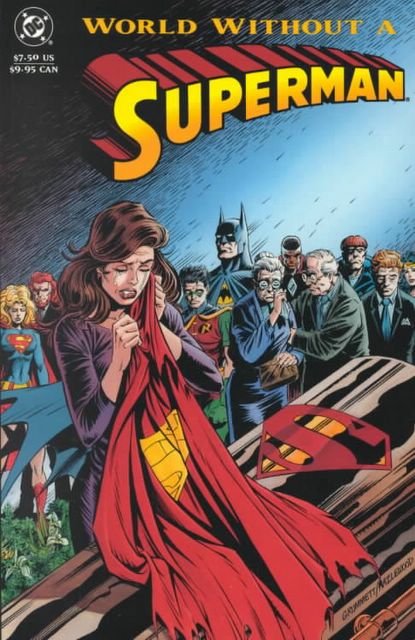
    DC Comics is a part of the Time Warner family, so if his bid is successful he may end up destroying the comics legend. Can you imagine a world without Superman?


    Icahn certainly can. Having read the book Comic Book Wars (an article about it is here, I hope that someone like ToyBiz is willing to buy DC if divestiture comes. But mostly I hope that Icahn...can't.

    Watching another "Big Boy" fall.

    A commonly occuring theme on this blog is the ever shrinking comic book market, but while that market is indeed shrinking it seems to have redefined its role as a loss-leader for movies. As a loss-leader, I imagine that comic books will be able to subsist at current levels for some time. The same cannot be said of the Roleplaying/Collectible Card Game market.

    Roleplaying Games (RPGs) and Collectible Card Games (CCGs) are both media which can tie themselves to any given intellectual property, but with rare exception RPGs/CCGs are not the "origin" of the intellectual property. For example, the Dungeons and Dragons RPG is the oldest and most successful Roleplaying Game ever made. Yet, when New Line Cinema, and Joel Silver, decided to make a D&D movie it was a huge disappointment. Why? Frankly because D&D is a product made to "simulate" a type of intellectual property that pre-existed the game, chiefly "heroic fantasy" and "epic fantasy." Pick a fantasy story, from Tolkein to Jordan, and I can use that as the basis for a great D&D campaign (or series of games). But to take a "genre simulator" and try to make a film based on it is a daunting task, in fact I would argue it is too general to be successful. A much better idea would have been to base a movie on a narrative created for the D&D game, like Dragonlance or the Assault on the Slavers modules (Slave Pits of the Undercity, Secrets of the Slavers Stockade, Assault on the Aerie of the Slave Lords, and In the Dungeons of the Slave Lords), or one could have based the movie on one of an abundance of novels.

    In a brief restatement, RPGs and CCGs are dependant on other media for inspiration/market appeal because they are simulations of that media. A great example of this phenomenon are the recent troubles at Decipher. Decipher makes RPGs and CCGs based on a number of intellectual properties. Chiefly their games are (and have been) based on The Lord of the Rings, Star Trek, and Star Wars. Three huge intellectual properties with large fan bases, fan bases with a great deal of crossover appeal into the RPG/CCG world. For some time this lead to great success, but as this article points out that success may be short lived.

    In the case of RPGs, as opposed to comic books, the alternate intellectual property is the market lead in. As interest in the Lord of the Rings movies tapers, so tapers interest in products related to it. This is essentially what has happened to Decipher, who went from good sized company to a company on the verge of collapse. The rapid growth/retraction of products based on specific IPs is a danger that Decipher didn't seem to properly take into account, and now they will probably cease to exist.

    Dungeons and Dragons, on the other hand, simulates a genre and its fans will keep buying the game and other products from the genre even if the D&D movie was among the worst films ever made. Surprisingly, a sequel to the D&D film awaits. Tragically, like with Deuce Bigelow, some unseen cosmic force will pull me into the theater. Even though I know only doom awaits.

    Saturday, August 06, 2005

    Anniversary of Hiroshima

    About a month or so ago, on the syndicated Chris Matthews Show, a discussion was brought up as to whether dropping the bomb on Hiroshima was correct. By now we have heard all the arguments as to why it was needed -- namely to prevent an invasion that would cost two-hundred thousand lives. Also now we have heard the revisionist platform that argues that those numbers are inflated, that Japan was ready to surrender, etc. This, by the way, is the prevailing paradigm that is taught at UCLA.

    Baby boomer Matthews reminded us though, that his dad who was stationed at the Pacific during the war, that there was a good chance he would never have been born if the Americans invaded. It was that statement that showed, I think, that Truman made the right decision in dropping the bomb. If Americans really think about it, Truman really did not have much of a choice: lose 250 thousand American lives or drop the bomb.

    I think it's best summed up by Truman's biographer* David McCullough: "How could a president, or the others charged with responsibility for the decision, answer to the American people if... after the bloodbath of an invasion of Japan, it became known that a weapon sufficient to end the war had been available by midsummer and was not used?"


    Now here's a question for this blog: assuming that bombing Hiroshima was neccessary, what about Nagasaki?

    *http://news.bbc.co.uk/2/hi/asia-pacific/4724793.stm

    Tuesday, August 02, 2005

    Confessions of a Twenty-something College Student

    The purpose of having a blog (or sharing one) is that there will be entries by the contributor(s). Without question, I have not fulfilled my blogging duties by only posting so sparingly. I've decided to change that and consider this the start of many more posts, hopefully.

    Next question is what will I be posting about. Now obviously we have a myriad of represented pop-culturists, from Number One's knowledge of comics to Fritz's database of random street pictures. However, I represent a totally different demographic, that of a college student. So I've decided my posts will be about my niche.

    Such confessions may include the going-ons of UCLA, heavily concentrated on the throes of student government activities. I am also deeply involved in local city politics, especially ever since my city council voted to build a Wal Mart Supercenter. So expect my posts to gear towards that direction too. Finally, being a son of immigrant parents, I love to discuss that rich and unique experience that many consider to be the foundation of the American dream.

    So expect this to be the first of many confessions of a twenty-something college student.

    Monday, August 01, 2005

    Quick Thought

    Hey, something Number One said on Pererro made me think. Something about Pokemon being pro-slavery.

    That really bugs me about some talking animals movies... wouldn't it actually be really horrible if animals were sentient and had feelings? How horrifying would poaching be, or just the Circle of Life(Insert Elton John Music)? Anyway, expect a review on Sky High soon... Need some time to work on it.